



As previously mentioned, ChatGPT is vastly becoming a skill in itself that recruiters ought to use to keep a leg-up on the competition.
Mastering it can automate a large chunk of the workload including job descriptions, new client outreach emails, candidate screening, FAQs, and more. The Large Language Model has enormous capabilities of being custom-fit to your job role as a recruiter, acting as an assistant or junior to you.
Here, we’ll delve into some more ChatGPT prompts that will help you create your own AI recruitment assistant.
Note, updated 2026: these prompts were written for the ChatGPT of late 2023 and they still work, because what makes a prompt work is structure rather than magic words: context first (the job description, the resume, your real numbers), then the task, then the output format you want back. What has changed is everything around them. Bard no longer exists, ChatGPT’s privacy controls are now specific settings you can point at, and regulators have started treating AI in hiring as its own category. The notes under the prompts below have been updated accordingly.
1. Boolean Search
2. Candidate assessment
3. Tailoring interview questions
4. Breaking down technical jargon
5. Performance analysis
6. Personal branding
7. Business Development templates
8. Legal
9. Eliminating Unconscious Bias
10. Crafting an Employer Value Proposition (EVP)
1. Boolean Search
Being able to pinpoint exactly what candidate you’re looking for in a recruitment database requires sufficient knowledge of using a Boolean search.
Here’s a prompt we used to search for a boolean string for a Data Engineer:
Please craft a Boolean search string for LinkedIn to identify a data engineer with expertise in large multi-national financial institutions, specifically in Fintech, and located in Amsterdam. Additionally, include alternative variations or terms that individuals may use to describe their experience as a data engineer on their LinkedIn profiles. Your search string should be comprehensive and effective in capturing relevant profiles, taking into account the various ways individuals might express their experience as a data engineer.
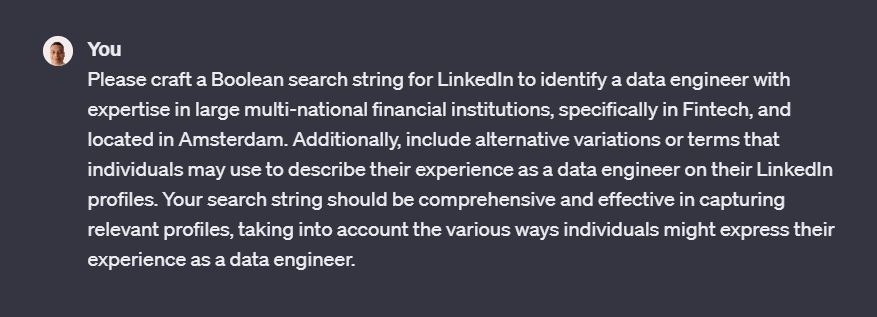
And the result we got:
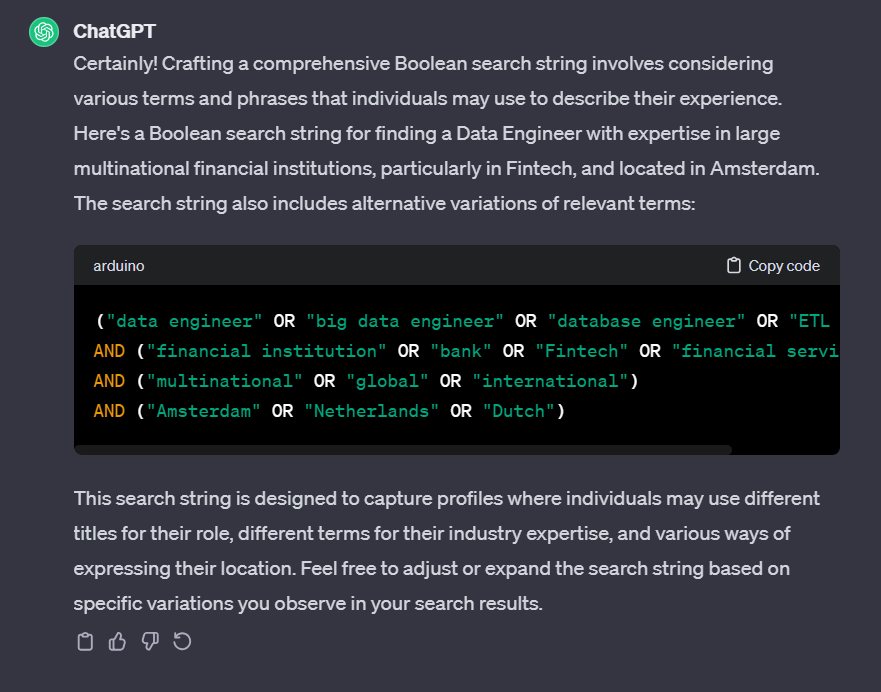
The string is formatted perfectly and ready to copy straight into the search function of a recruitment database.
When prompting, tell ChatGPT to take into account the various terms that people with a specific job use on LinkedIn, and it will include all of the options. For example: A Frontend, Front-end, or FE Engineer and other variations you may not have thought of.
The caveat that costs people an afternoon: ChatGPT does not know LinkedIn’s syntax rules, so it will happily hand you a string LinkedIn cannot run, and LinkedIn fails quietly rather than throwing an error. According to LinkedIn’s own help page, the supported set is small: AND, OR and NOT (which must be typed in uppercase, or they are read as ordinary keywords), quotation marks for exact phrases, and parentheses for grouping. Wildcards such as an asterisk are not supported, nor are braces, brackets or angle brackets, and the + and - operators are not officially supported either.
So put the constraint in the prompt itself: Use only uppercase AND, OR and NOT, quotation marks and parentheses. No wildcards, no braces, no brackets, no plus or minus operators. This is also why the “list every variation” instruction earns its place. With no wildcard to fall back on, every version of a title has to be spelled out and joined with OR, and that is exactly the tedious part worth handing to a model.
2. Candidate assessment
Although you’ll have to work this one out for yourself, ChatGPT can provide a basic candidate assessment based on how their resume matches up with the job description.
Parse in the job description and the resume and watch it go to work.
This will help you narrow down your search, pre-qualifying your candidate list for 1st stage interviews.
Keep the decision yours. A pros-and-cons list is a reading aid, not a verdict, and that distinction is now a legal one as well as an ethical one. The EU AI Act places AI systems used to filter job applications and evaluate candidates in its high-risk category (Annex III, point 4), with the obligations attached to those systems due to apply from 2 December 2027 after the Digital Omnibus pushed the date back from August 2026. GDPR Article 22 separately gives candidates rights over decisions taken solely by automated processing. Using an LLM to read 200 resumes faster is fine. Letting its output rank or reject people with no human reading the resume is the thing that turns a prompt into a regulated system.
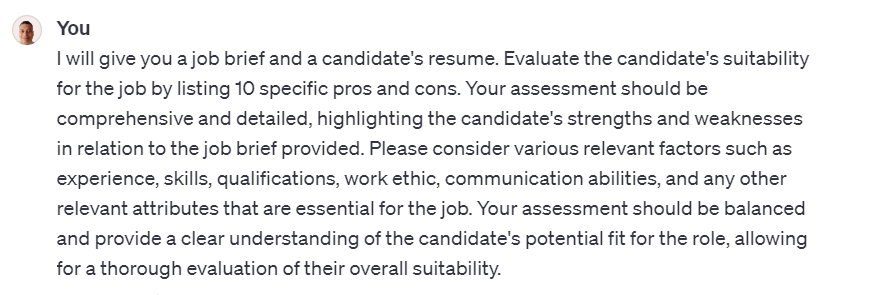
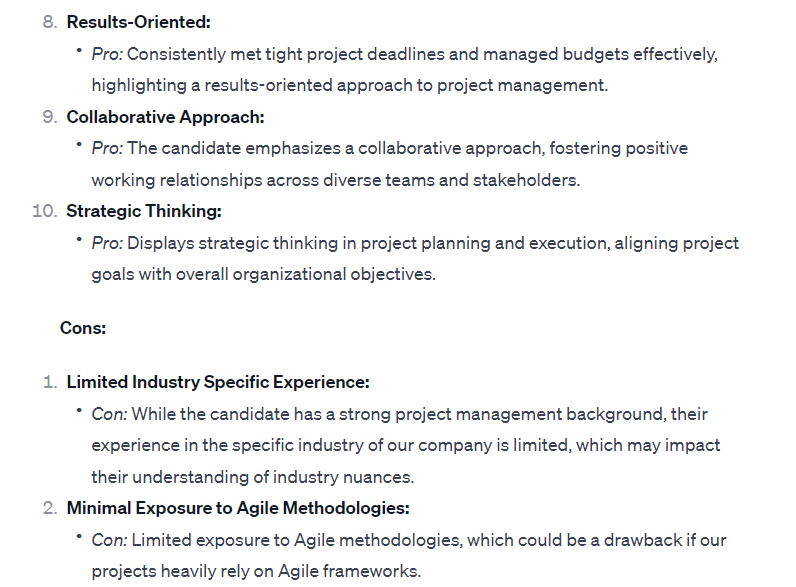
Prompt: I will give you a job brief and a candidate’s resume. Evaluate the candidate’s suitability for the job by listing 10 specific pros and cons. Your assessment should be comprehensive and detailed, highlighting the candidate’s strengths and weaknesses in relation to the job brief provided. Please consider various relevant factors such as experience, skills, qualifications, work ethic, communication abilities, and any other relevant attributes that are essential for the job. Your assessment should be balanced and provide a clear understanding of the candidate’s potential fit for the role, allowing for a thorough evaluation of their overall suitability.
Job Brief:
Role: Senior Project Manager
Requirements:
- Minimum of 7 years of project management experience
- PMP certification preferred
- Proven success in leading cross-functional teams
- Excellent communication and interpersonal skills
- Strong organizational and problem-solving abilities
- Proficiency in project management tools and methodologies
- Demonstrated ability to meet tight deadlines and manage budgets effectively
Result:
3. Tailoring interview questions
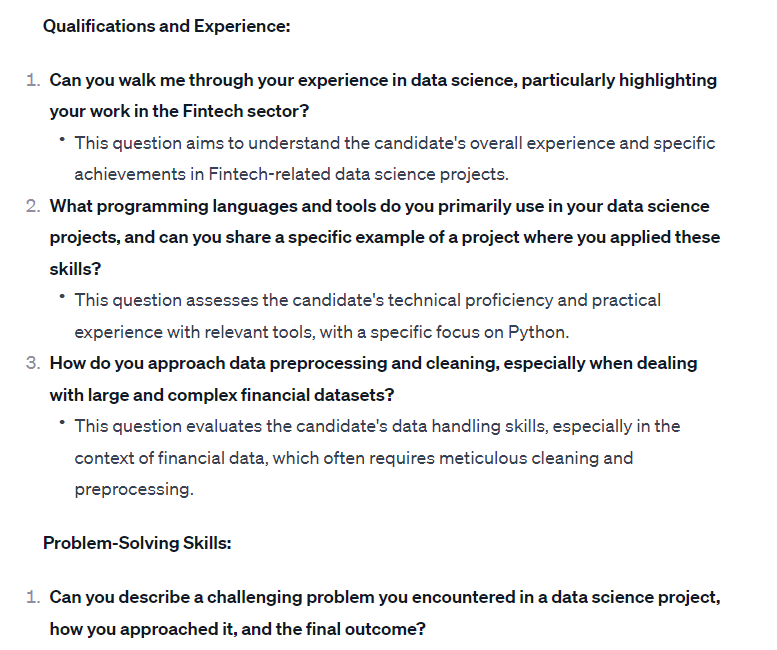
In addition to compiling a list of interview questions for a job role, you can parse a job description into your prompt and ask for specific questions relating to the job description.
So instead of just prompting “create a detailed list of interview questions for a data scientist job”, be sure to include the job description for maximum results.
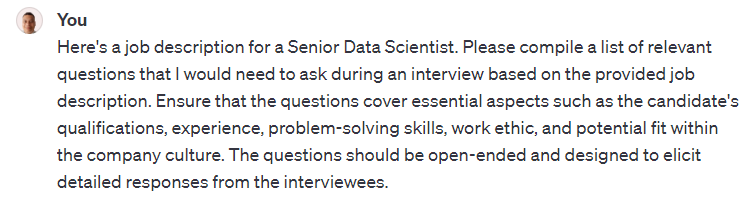
Prompt: Here's a job description for a Senior Data Scientist. Please compile a list of relevant questions that I would need to ask during an interview based on the provided job description. Ensure that the questions cover essential aspects such as the candidate's qualifications, experience, problem-solving skills, work ethic, and potential fit within the company culture. The questions should be open-ended and designed to elicit detailed responses from the interviewees.
Result:
4 . Breaking down technical jargon
Few recruiters possess impeccable knowledge of the ins and outs of a technical role. Most will have to learn on the job.
So if you want to get familiar with or brush up your skills of knowing what a specific technical job consists of, ChatGPT can speed up that process significantly.
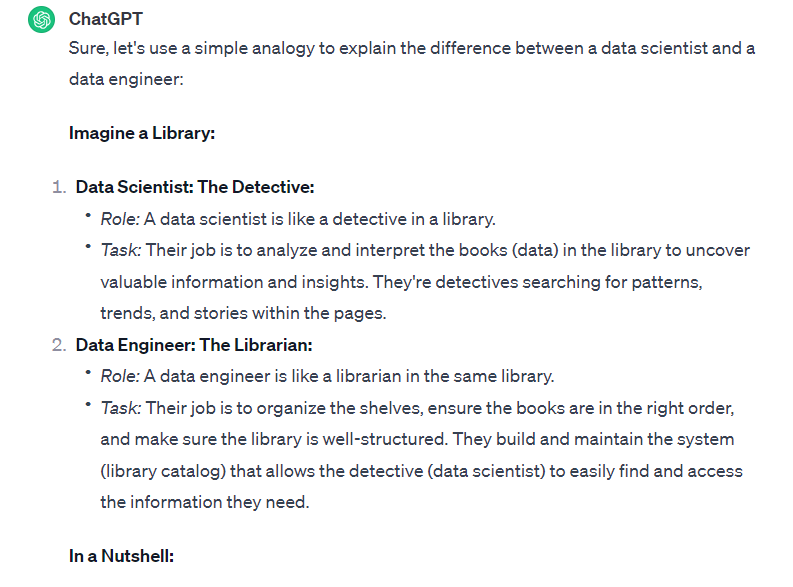
At the risk of coming across as patronizing, you can prompt: Describe the difference between a data scientist and a data engineer in a way that’s easy to understand for someone with no technical knowledge

Result:
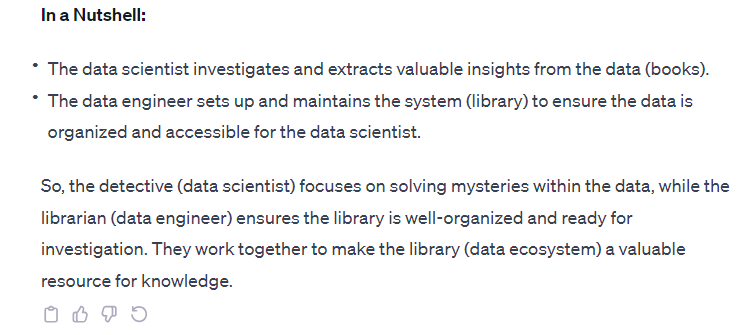
Or paste in a job description and ask it to explain it to you in a way that’s easy to understand for someone who isn’t tech-savvy.
5. Performance analysis
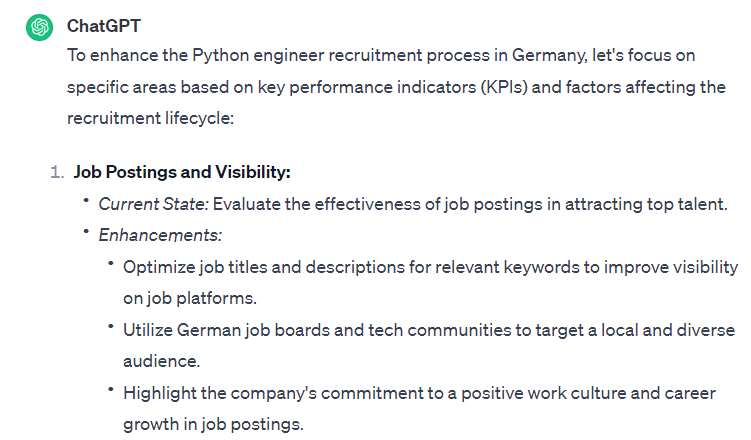
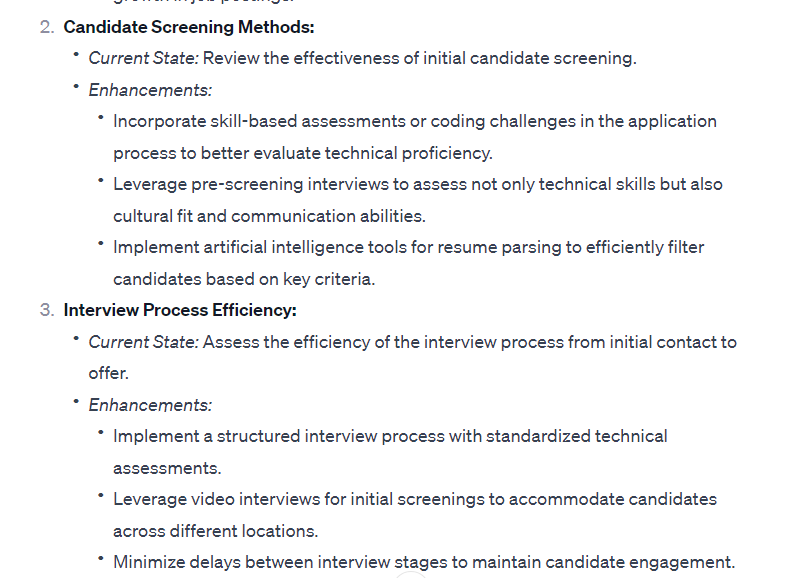
Although this is a bit more complex to crack, you can gain tips and suggestions on how to improve your recruitment efforts. It’s important to have a tangible performance analysis of how you’re performing.
With this, you can get some suggestions on what to improve on.
Note: It’s important to show the right data in your search for better results, such as:
- Your candidate outreach message
- How many responses it’s getting
- Your job descriptions
- Interview questions
6. Personal branding
Creating and building a personal brand is a crucial part of becoming a top-notch recruiter. It will help in becoming a thought leader in your recruitment niche, increasing your visibility on LinkedIn and providing a sense of trustworthiness to new clients.
Using the LLM, you can spearhead your recruitment marketing efforts and create a winning personal brand.
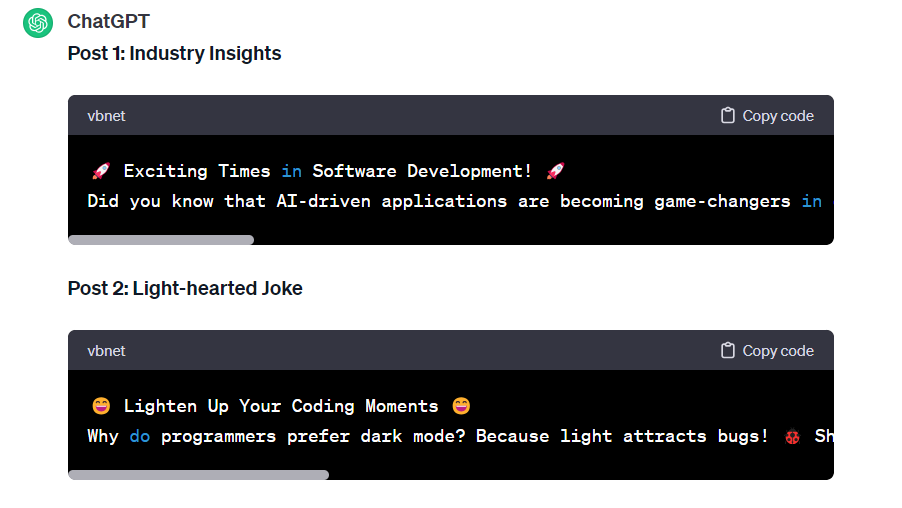
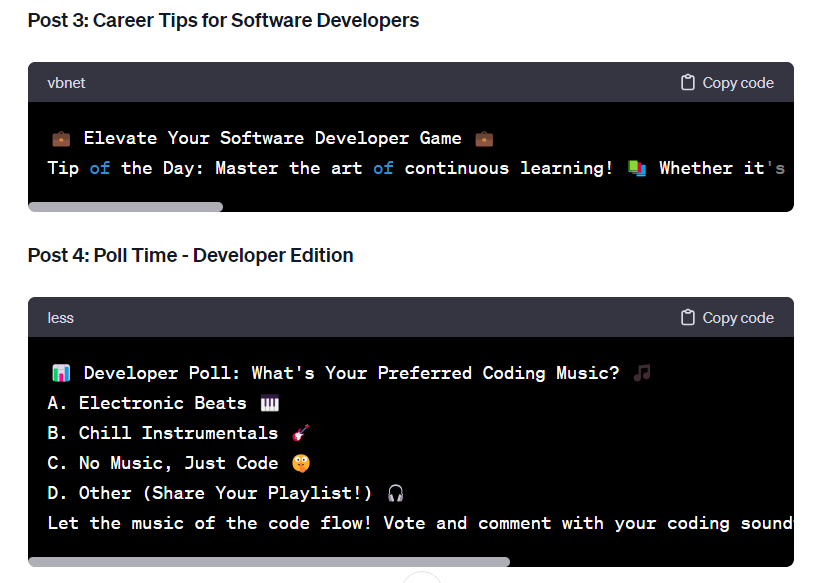
You can start with the following prompt: Please generate a series of LinkedIn posts suitable for a software developer recruiter. Your posts should aim to engage with potential candidates and clients by becoming a thought leader in the space. Include posts like funny jokes, software developer polls, tips to be a better software developer, and industry insights.

Result:
7. Business Development templates
If your main method of winning new business is cold emails, it's important to have a basic structure to your emails that allows you to automate en masse, winning the law-of-averages game.
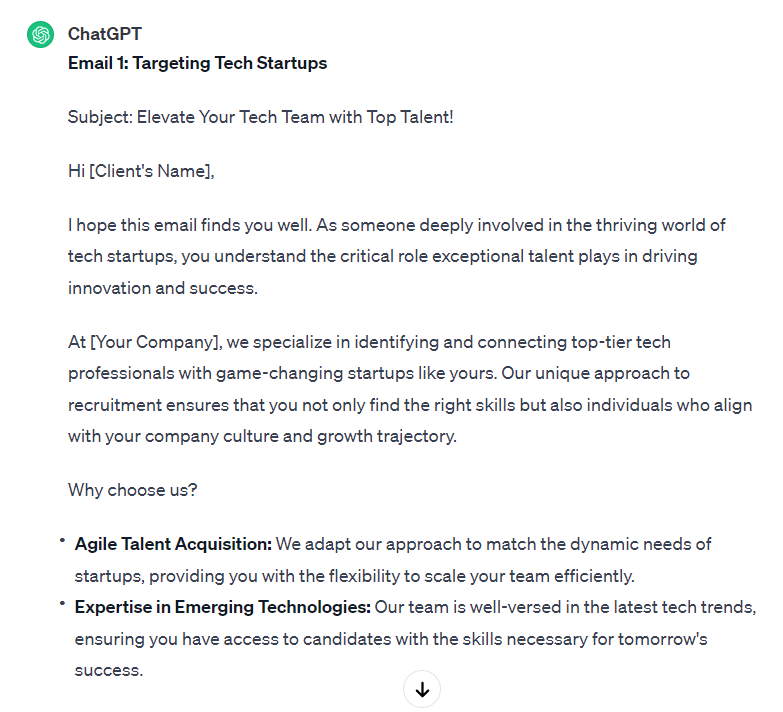
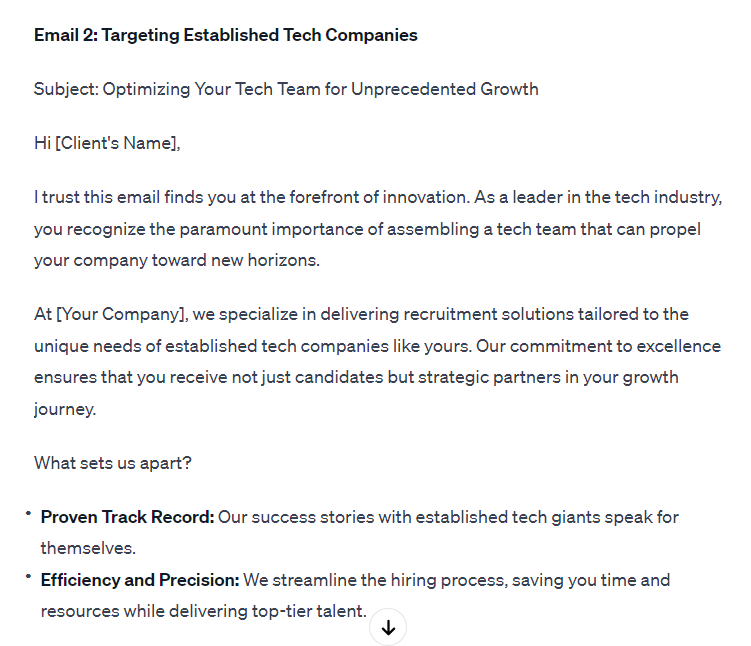
You can create multiple templates for business development emails that are segmented by location, industry, tech stack, etc., and vary in style and content.
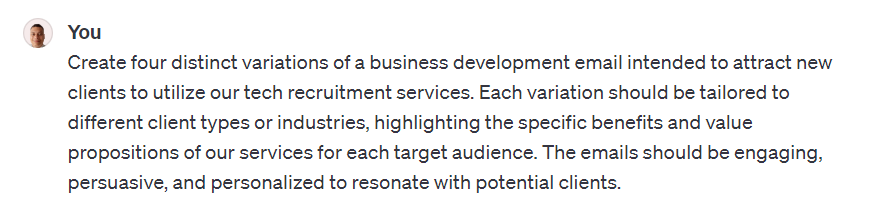
Prompt: Create four distinct variations of a business development email intended to attract new clients to utilize our tech recruitment services. Each variation should be tailored to different client types or industries, highlighting the specific benefits and value propositions of our services for each target audience. The emails should be engaging, persuasive, and personalized to resonate with potential clients.
Result:
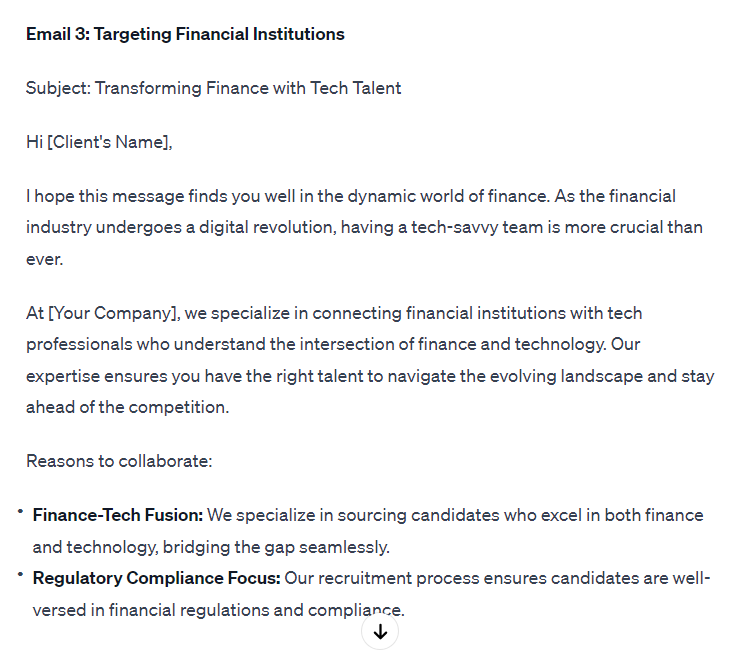
Note: It’s important to open separate threads for each one to get better variations.
8. Legal
Like with any business, it’s important to cover your back at all times. The only thing stopping your competition or client from poaching your candidate is a legally binding contract.
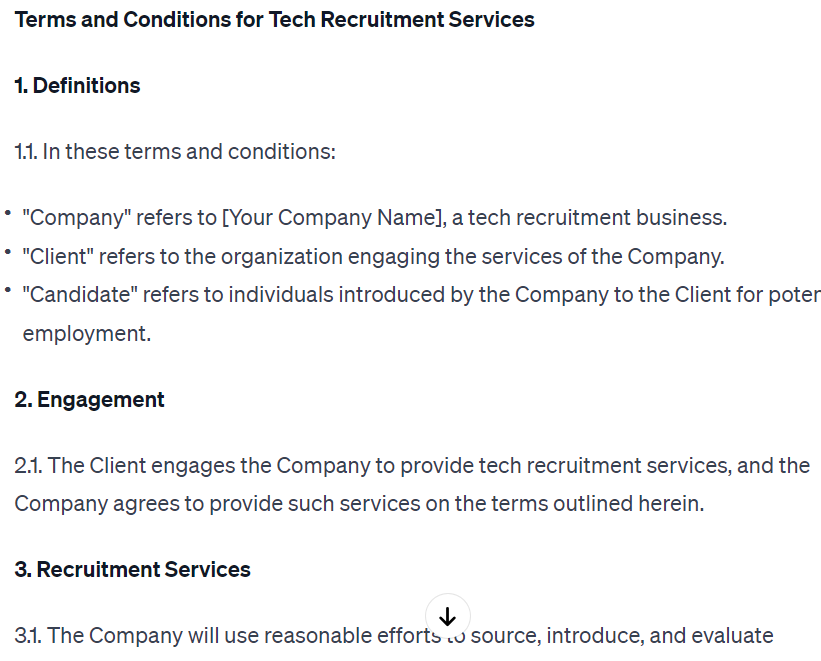
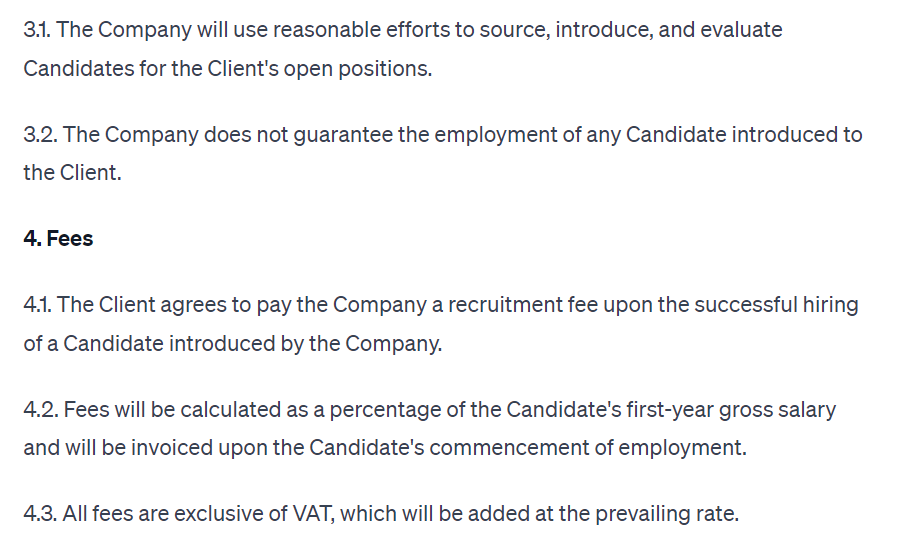
ChatGPT can help you draft basic terms and conditions that can be sufficient to cover yourself. However, as you grow your recruitment business, it’s important to get professional legal help.
Prompt: Draft up terms and conditions for a tech recruitment business operating in the UK, but working with clients from all over Europe

Result:
9. Eliminating Unconscious Bias
Unconscious bias has a large impact on the recruitment world. 48% of hiring managers admit bias affects their candidate choice.
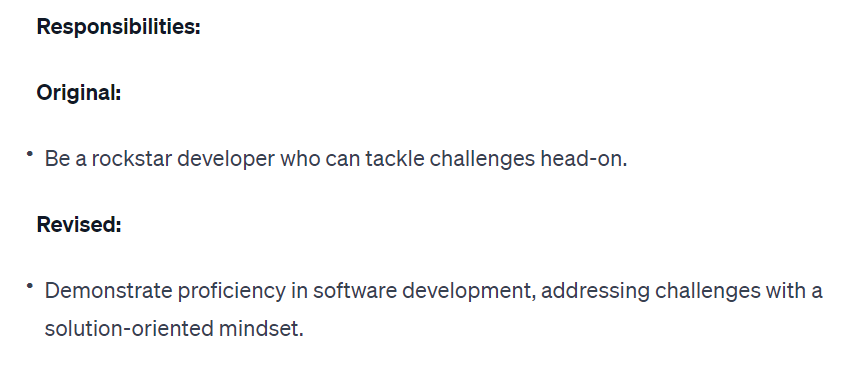
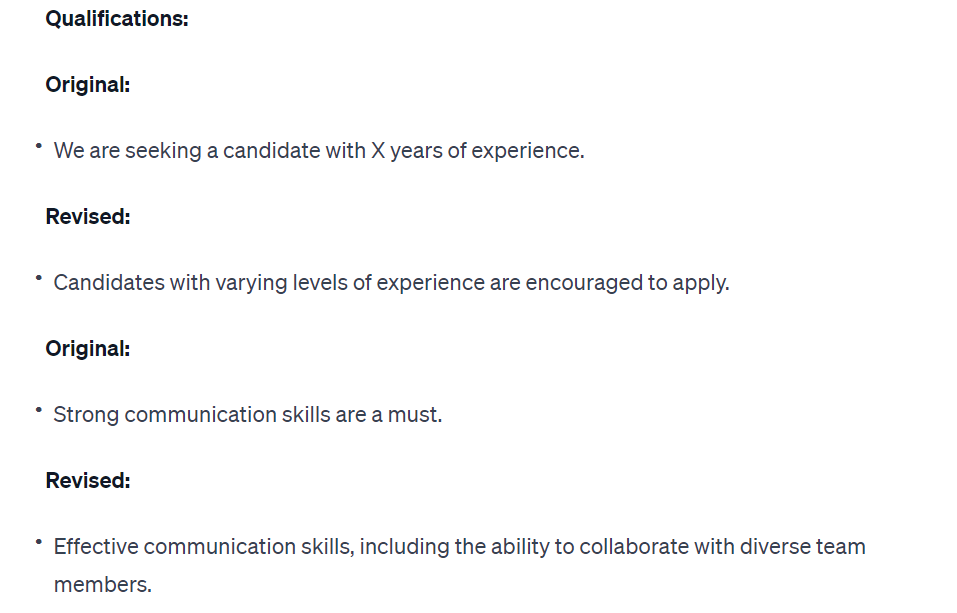
A substantial way to eliminate unconscious bias is to modify your job descriptions.
Prompt: Revise this job description to ensure that it is free from unconscious bias. Please consider the language used to describe the responsibilities, qualifications, and characteristics required for the role. Ensure that the revised job description promotes diversity and inclusivity.

Result:
10 . Crafting an Employer Value Proposition (EVP)
An EVP is a set of rewards and bonuses that companies offer employees for outstanding job performance. Studies have shown that having an effective EVP can decrease your company turnover by 69%.
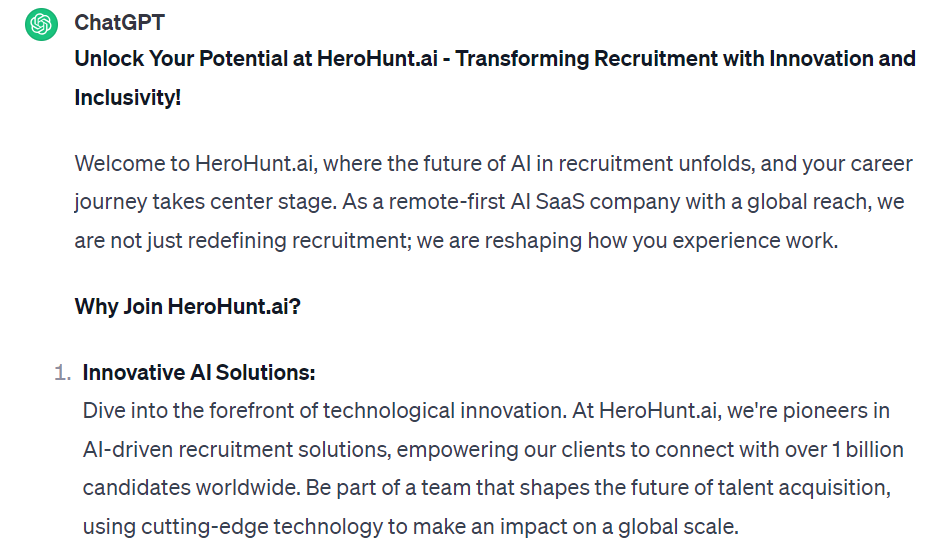
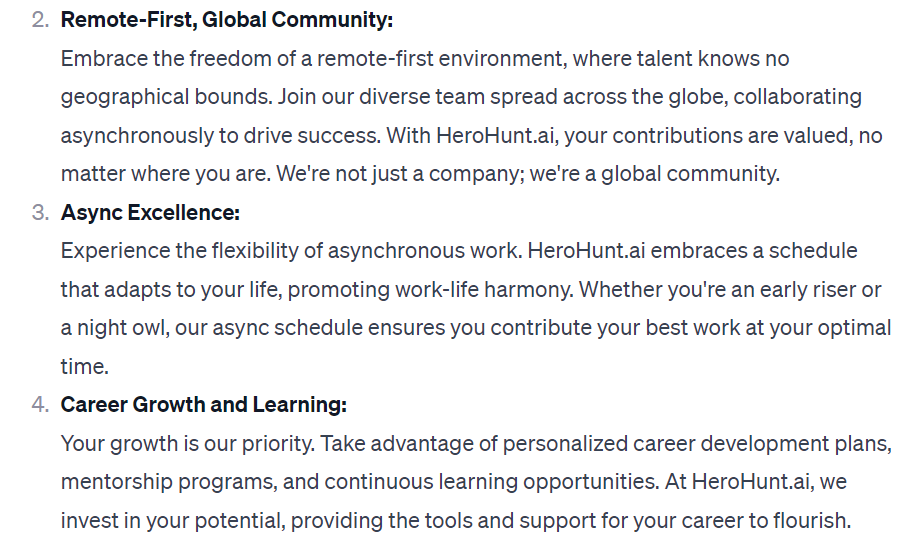
It is worth creating a draft with the help of ChatGPT to boost your company brand.
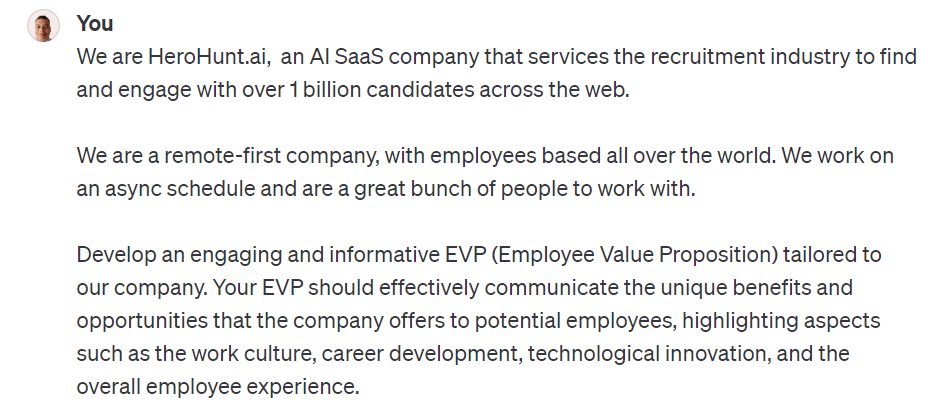
Prompt: We are HeroHunt.ai, an AI SaaS company that services the recruitment industry to find and engage with over 1 billion candidates across the web.
We are a remote-first company, with employees based all over the world, We work on an async schedule and are a great bunch of people to work with.
Develop an engaging and informative EVP (Employee Value Proposition) tailored to our company. Your EVP should effectively communicate the unique benefits and opportunities that the company offers to potential employees, highlighting aspects such as the work culture, career development, technological innovation, and the overall employee experience.
Result:

Further tips
Privacy matters
Redact names, addresses and contact details before you paste a resume into a personal ChatGPT account. When this article was first written the honest answer was “the model stores your data somewhere”, which was vague. The controls are specific now, so here is what actually governs it:
- On a personal account, open Settings, then Data Controls, and turn off “Improve the model for everyone”. Your chats still show up in your history, but per OpenAI’s Data Controls FAQ they are no longer used to train ChatGPT.
- Temporary Chat is the better habit for a one-off resume or a client’s salary data. Those chats are not used for training, are not saved to your history, and are deleted from OpenAI’s systems after 30 days. They can still be reviewed to monitor for abuse.
- On the business tiers (ChatGPT Business, Enterprise and Edu, plus the API), OpenAI’s enterprise privacy page states it directly: “We do not train our models on your data by default.” OpenAI will also sign a Data Processing Addendum, which is the document your client or your DPO will ask for.
One thing worth being clear about: none of the above is a legal basis. Turning off training is a toggle. GDPR is about whether you were entitled to send that candidate’s data to a third party at all, and whether the candidate knows you did. Redacting first remains the cheapest way to never have the argument.
Formatting
You can go fully autonomous and let ChatGPT give you responses that are formatted in a variety of different ways including:
1. Tabular Form
Clearly state that you'd like the response in a tabular format. Include instructions on the columns and data points you want to include. For example: Provide a tabular summary of the key attributes of three candidates, including columns for technical ability, years of experience, software language proficiency, and location.
2. Code snippets
For those who are more tech-savvy, you can ask the AI to give you code snippets for Excel spreadsheets, PowerPoint docs, and Canva. For example: Give me VBA source code for a company brochure of an AI recruitment company made with Microsoft PowerPoint.
3. Summaries
You can request to have multiple pieces of information synthesized into one single document. Example: Summarize the above job descriptions and create a Boolean search for the median candidate. Or summarise the resumes provided and format them into a CSV using ‘first name’ ‘last name’ and 'location’.
Prompts for other LLMs
Bard, which this article originally sent you to, is gone: Google renamed it Gemini in February 2024, and the old bard.google.com address now simply redirects there. That is a useful lesson about tying your process to a brand name.
The good news is that nothing on this page is a ChatGPT feature. These prompts are just well-structured briefs, so they port to Claude, Gemini or whatever replaces them next with almost no editing. Rather than trusting a “best LLMs” listicle that was frozen the day it was published, check a live leaderboard such as LMArena, which ranks models on blind head-to-head votes. Better still, run your own test: paste the same job description into two models, and keep the one whose output sounds least like it came from a model.
Remember, ChatGPT is merely an arm to your recruitment efforts, not a body, so always review and iterate!