


What AI engineers really cost in India in 2026, where to find them, and how to employ them legally from abroad
A machine learning engineer in India earns a median of ₹34.8 lakh a year, about $36,900, against $282,750 in the United States. Those are the Levels.fyi total-compensation medians for the same job title, both updated in October 2026 - Levels.fyi. At an exchange rate of roughly ₹94.5 to the dollar, the US engineer costs about 7.7 times as much in pay alone. That gap is why almost every company that builds AI products now has an India hiring plan, or is being asked by its board why it does not.
But the salary gap is the least useful number in this decision. The engineers worth hiring in Bengaluru are fielding offers from global capability centres, Indian AI labs and US companies at the same time. Notice periods of 60 to 90 days turn a signed offer into a three-month wait in which counteroffers arrive. The employment model you choose (contractor, employer of record, your own subsidiary, or a full capability centre) changes your cost, your legal exposure and your ability to keep the intellectual property. And India rewrote its labour law in November 2025, so a lot of the advice still circulating is out of date.
This guide works through all of it with 2026 data. It starts with the short answer and a reference budget, then covers why India, what AI engineers are paid by level and city, the fully loaded employer cost, the four ways to employ someone in India, the legal setup (contracts, IP, data protection, tax), where to find the engineers, how to engage and assess them, how to survive notice periods and counteroffers, where India hiring fails, and how AI agents are changing the process. Where a platform genuinely lowers a cost line, including HeroHunt.ai for sourcing and Deel for employment, it is named with its real price and its limits, like every other option.
A quick note on units, because Indian salaries are quoted in a format most foreign hiring managers do not use. One lakh is ₹100,000 and one crore is ₹10 million (100 lakh), and salaries are usually stated as lakh per annum (LPA) of "CTC", cost to company, which bundles fixed pay, variable pay and the employer's provident fund contribution into one number. All dollar figures in this guide use the October 2026 rate of about ₹94.5 per US dollar, derived from European Central Bank reference rates - ECB.
Written by Yuma Heymans (@yumahey), founder of HeroHunt.ai, the AI Recruiter that searches more than a billion profiles worldwide and runs candidate outreach on autopilot. He has been building AI recruiting tools since 2021, and writes about where AI engineering talent can actually be found and hired.
Contents
- The Short Answer: Hiring AI Engineers in India in 2026
- Why India Is Where AI Engineering Teams Get Built
- What AI Engineers Earn in India in 2026
- The Fully Loaded Cost: Labour Codes, On-Costs and Fees
- Four Ways to Employ AI Engineers in India
- The Legal Setup: Contracts, IP, Data and Tax
- Where to Find AI Engineers in India
- Outreach and Offers That Work in the Indian Market
- Assessing AI Engineers Without Getting Fooled
- Notice Periods, Counteroffers and Offer Dropouts
- Where India AI Hiring Fails
- How AI Agents Are Changing AI Hiring in India
- The Outlook for 2027
- The Decision Framework
1. The Short Answer: Hiring AI Engineers in India in 2026
For most foreign companies hiring their first one to fifteen AI engineers in India, the answer in 2026 is the same: source the engineers directly, employ them through an employer of record for the first year or two, budget ₹25 to 50 lakh for a strong mid-level engineer and ₹50 to 90 lakh for a senior one, and plan on a three-month gap between a signed offer and a first day. Once you pass roughly fifteen to twenty people, or once you know India is a permanent part of your engineering organisation, set up your own subsidiary. Global capability centres (GCCs) make sense at a hundred people and up, not before.
Why this matters: each of those choices has a failure mode that costs more than the salary saving. Hiring through a staffing vendor puts a margin and a middleman between you and the engineer, and the engineer's loyalty sits with the vendor. Paying contractors without an EOR or entity saves the employment fee but leaves you exposed to misclassification claims and a tax presence you did not plan for. Setting up a subsidiary for two engineers buys you directors, audits and transfer-pricing filings before you know whether the team works. The point of the short answer is to start light and get heavier only when the headcount justifies it.
The reference budget below makes the cost concrete for one hire: a mid-level machine learning engineer at ₹35 lakh CTC, close to the national Levels.fyi median, employed through an EOR at the most common list price. Every line is either sourced later in this guide or marked as an assumption you can replace with your own figure.
| Year-one cost line (reference hire) | Amount (₹) | Approx. US$ | Basis |
|---|---|---|---|
| CTC, including employer provident fund | ₹35,00,000 | $37,000 | Near the Levels.fyi India ML engineer median |
| Gratuity provision | ₹84,000 | $890 | 4.81% of wages, with wages at 50% of CTC |
| EOR fee at $599 a month | ₹6,79,000 | $7,188 | Deel and Remote published list price |
| Joining bonus or notice buyout (one month) | ₹2,92,000 | $3,090 | Common answer to 60 to 90 day notice |
| Laptop, health cover and AI tools | ₹2,50,000 | $2,650 | Assumption |
| Total year-one cost | ≈ ₹48 lakh | ≈ $51,000 |
Read against a US hire, that is the headline. A US machine learning engineer at the $200,000 median base costs about $279,000 in year-one cash when hired in-house - True Cost to Hire an AI Engineer. A fully loaded Indian hire at the national median therefore costs roughly one-fifth to one-sixth of a US hire, not the one-eighth the raw salary comparison suggests, because fixed per-head costs like the EOR fee weigh much more heavily on a smaller salary. Senior engineers in Bengaluru close part of that gap again.
How to apply this section: decide your two-year headcount in India before you choose anything else, because it drives the employment model, and the employment model drives most of the non-salary cost. Then budget from the CTC band for the level you need (section 3), add the on-costs and fees that come with your model (section 4), and plan the timeline around notice periods (section 10) rather than around your interview loop.
2. Why India Is Where AI Engineering Teams Get Built
India combines three things few other countries offer at the same time: a very large software workforce, a fast-growing pool of engineers with real AI experience, and an established playbook for foreign companies to employ them. The scale is the first argument. GitHub counted 21.9 million developers in India in its 2025 Octoverse report, up from 4.5 million in 2020, and India alone added more than 5 million developers in a single year - GitHub. India also overtook the United States as the largest contributor base to public and open source projects by number of contributors, although the US still produces more total contributions.
GitHub's forecast is the image most hiring leaders remember from that report. It projects India's developer base to reach 57.5 million by 2030, ahead of the United States at 54.7 million, using the mean of five forecasting models.
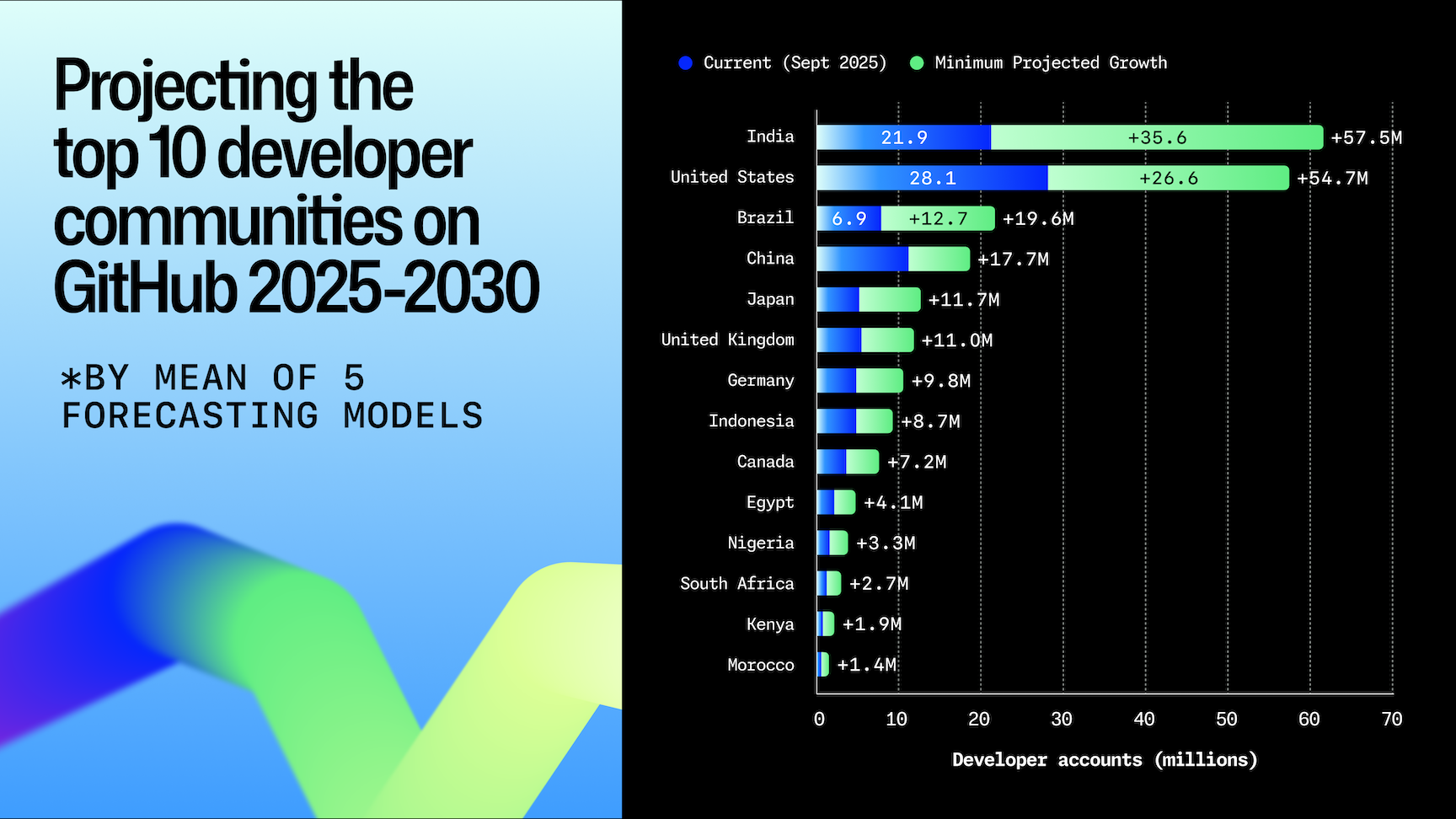
The chart shows India's bar starting below the US (21.9 million against 28.1 million) and finishing above it, because India's projected growth of 35.6 million is larger than any other country's. For a recruiter, the more useful reading is what sits inside those numbers: most of the growth is young developers, so the pool of juniors is enormous while the pool of engineers with five or more years of production machine learning experience is far smaller. That shapes everything in the cost and sourcing sections below.
The AI-specific talent pool
The AI talent pool specifically is the second argument, and it is newer. The Stanford AI Index 2026, using Zeki's data on top AI authors and inventors, ranks India as the world's second-largest hub of AI talent with 50,460 such people in 2025 - ETV Bharat. On GitHub, India is the second-largest contributor to generative AI repositories after the United States. And the companies that train the most experienced AI engineers are now physically in India: Anthropic opened a Bengaluru office in February 2026, its second in Asia after Tokyo, and describes India as Claude's second-largest market - Outlook Business. OpenAI announced a New Delhi office in August 2025 - TechCrunch.
The money behind the ecosystem is large enough to keep producing experienced people. Microsoft committed $17.5 billion over 2026 to 2029, Google $15 billion for an AI hub in Visakhapatnam, and Amazon more than $35 billion by 2030 - IANS. The government's IndiaAI Mission carries a budget of ₹10,371.92 crore over five years and had reached about 38,000 GPUs by February 2026, when Sarvam AI, Gnani.ai and BharatGen showed sovereign models at the India AI Impact Summit in New Delhi.
Global capability centres set the market
The third argument, and the one that sets the price, is the global capability centre. A GCC is a foreign company's own engineering or operations centre in India, and the Nasscom-Zinnov report published in July 2026 counts 2,117 GCCs employing about 2.36 million professionals as of FY26. More than 1,200 of them have embedded AI and machine learning capabilities, together employing around 250,000 AI professionals - Tribune India. Nearly half of all GCCs set up since FY2021 were built with AI as a core focus from the start.
GCCs are also where hiring is growing while the rest of Indian tech is not. foundit projects 510,452 GCC hires in 2026 across about 2,120 centres, with AI, data and automation making up 64% of new GCC roles - Business Today. Xpheno's June 2026 count found only 93,000 active tech openings across India, a 28-month low, with entry-level openings down 44% year on year while GCC openings rose 31% - People Matters. Demand for AI skills specifically keeps climbing: LinkedIn data reported in April 2026 showed AI engineering job postings in India up 59.5% year on year, faster than in the US, UK, France or Germany - IANS.
The split market (a weak overall tech market, a hot AI and GCC market) is the context every India hiring plan sits inside. Firstpost's September 2026 explainer covers the same tension from the Indian side: strong seasonal hiring alongside layoffs at some capability centres as companies restructure around AI.
India's Festive Hiring Boom Amid GCC Layoffs: Jobs Story Explained
The practical reading for a foreign employer is that India is not a cheap, slack market for AI engineers. It is a deep market for general software talent and a competitive one for proven AI talent, and your real competitors for the second group are the GCCs of companies much bigger than you.
What this means for your hiring plan
Why this matters: the reasons to hire in India (scale, AI depth, an established employment playbook) are real, but they apply unevenly by level. Juniors and generalist software engineers are abundant and comparatively easy to hire. Engineers who have shipped retrieval systems, fine-tuned models in production, or run evaluation pipelines at scale are scarce everywhere, and in India they are courted by employers who pay a premium. The LinkedIn survey of recruiters published in February 2026 found 74% of Indian recruiters struggling to find qualified candidates, even with hiring well above pre-pandemic levels - Outlook Money.
Time zones are the last structural factor. India Standard Time is UTC+5:30 with no daylight saving, which gives a European team an overlap of roughly three to five hours of the normal working day and a US East Coast team almost none, so US teams rely on a narrow window at the start or end of the Indian day. Teams that work well across that gap usually design for it explicitly, with a daily overlap hour and written handovers, rather than hoping engineers will work US hours indefinitely.
How to apply this: decide which kind of AI engineer you need before you decide to hire in India. If the role is applied AI engineering on top of existing models (integration, retrieval, agents, evaluation), India's pool is deep and the economics are excellent. If the role is research-grade model training, the pool is real but thin, and you will compete directly with labs and big-tech GCCs, so budget toward the top of the bands in the next section.
3. What AI Engineers Earn in India in 2026
A strong mid-level AI engineer in India costs ₹25 to 50 lakh a year in 2026, and a senior one ₹50 to 90 lakh, with Bengaluru and GCC roles at the top of each band. Those planning bands are a synthesis of four independent 2026 sources that measure slightly different things, which is exactly why a single "average AI engineer salary in India" figure is misleading. Self-reported total compensation from engineers at well-known companies (Levels.fyi) runs higher than job-market surveys across all employers (foundit, 1 Finance), and GCC-specific data (Taggd) runs higher again.
The table puts the four sources side by side. Levels.fyi reports percentiles of total compensation (base, annualised stock and bonus) for the machine learning engineer title, while the other three report ranges or averages by years of experience.
| Source (2026) | Early career | Mid-level | Senior | What it measures |
|---|---|---|---|---|
| Levels.fyi, ML engineer, India (Oct 2026) | p25: ₹20.8L | Median: ₹34.8L | p75: ₹57.4L, p90: ₹79.8L | Self-reported total comp |
| foundit (Sep 2026) | 0-3 yrs: ₹8.9-15.4L | Not reported | 15+ yrs: ₹71.0-89.2L | AI roles across employers |
| 1 Finance (Jun 2026) | Entry: ~₹12L | 3-5 yrs: ~₹25L | 8+ yrs: ~₹60L average | Generative AI engineers |
| Taggd GCC Talent Lab | 1-3 yrs: ₹18-30L | 5-10 yrs: ₹50-75L | 10-15 yrs: ₹65-100L | AI/ML roles in GCCs |
The sources are consistent once you account for who they sample. The foundit report shows AI salaries compounding 23% between 2024 and 2026, with senior AI professionals in Bengaluru earning ₹61.7 to 91.3 lakh - IANS. The 1 Finance study puts generative AI engineers at about ₹12 lakh at entry, ₹25 lakh at three to five years and an average of ₹60 lakh at eight years and above - Business Today. Taggd's GCC data, which describes its bands as indicative, shows AI and ML roles in capability centres at ₹18 to 30 lakh in the first three years and ₹100 to 180 lakh or more beyond fifteen years, with GCCs paying roughly a 20% premium over non-GCC employers - Taggd.
The city premium
Location moves the number more than most foreign employers expect. The Levels.fyi median for machine learning engineers in Bengaluru is ₹44.0 lakh, about 26% above the national median, and the Bengaluru 90th percentile reaches ₹93.6 lakh - Levels.fyi. The chart compares the two distributions at each percentile.
Machine learning engineer total compensation, India vs Bengaluru (Oct 2026)
The gap is widest at the bottom of the distribution (about 37% at the 25th percentile) and narrows toward the top (about 17% at the 90th), which matches what recruiters see: Bengaluru inflates the price of ordinary experience, while the very best engineers command similar packages wherever they sit, because they are recruited nationally. Levels.fyi publishes separate pages for other metros, so check the city you are actually hiring in before setting a band; remote-friendly roles open up engineers in tier-2 cities, usually at lower pay, at the price of a smaller pool of senior people.
The title problem: "AI engineer" is not one job
The title itself distorts salary data more than location does. On Levels.fyi, the "AI engineer" title in India has a median of only ₹17.8 lakh, about half the machine learning engineer median - Levels.fyi. The likely reason is that "AI engineer" has become the label for a very wide range of work in India, from wiring a language model API into an internal tool at a services company to building agent platforms at a product company, while "machine learning engineer" still skews toward people who train, evaluate and deploy models.
For a hiring manager, this means a salary benchmark is only meaningful once the role is defined. A job ad that says "AI engineer" at ₹20 lakh will attract a flood of applicants who have completed short courses and built demo applications, while the engineers who have run models in production will not respond. The fix is to describe the actual work (training, fine-tuning, retrieval, evaluation, inference optimisation, agent orchestration) and price against the machine learning engineer distribution for anything beyond integration work.
Growth, hikes and what candidates expect
Indian pay moves faster than Western pay, and AI pay moves faster still. Aon's survey of more than 1,060 companies projects a 9.0% average increase for 2026, with technology platform and product companies at 9.4%, and attrition at 17.1% in 2025 - Aon. That is the annual raise you should budget simply to keep an engineer at market. The Michael Page India Salary Guide 2026 expects average hikes of 8 to 12% and notes that AI and ML professionals can command up to 30% when changing jobs - Business Today.
That switching premium shapes negotiations in a way Western managers often misread. Indian candidates anchor on their current CTC and think in terms of a percentage hike on it, so the first question in most conversations is "what is your current CTC and expected hike?" A candidate earning ₹30 lakh will typically be looking for ₹36 to 40 lakh to move (a 20 to 30% hike), regardless of what your band says, and will compare your number against parallel offers in the same percentage terms.
Why this matters: underpricing is the most common mistake foreign employers make in India, because they benchmark against national averages for "software engineer" and then wonder why strong AI candidates drop out. How to apply this: set the band from the machine learning engineer distribution for the city you hire in, assume a 20 to 30% hike over current CTC for the candidates you want, and budget a 9 to 10% annual increase on top so the hire is still at market in year two.
4. The Fully Loaded Cost: Labour Codes, On-Costs and Fees
In India, the offered CTC is already close to the full employment cost, so the real additions come from your employment model, not from payroll taxes. That is the opposite of the US, where employer taxes, health insurance and retirement matching add roughly a fifth to a salary. An Indian CTC normally includes the employer's provident fund contribution, and the remaining statutory items are small for engineers at AI salary levels. The lines that move the total are the EOR fee or entity overhead, gratuity, one-time hiring costs, and the currency.
The rules underneath changed recently, which is why older cost guides are unreliable. India's four Labour Codes, which consolidate 29 earlier labour laws, took effect on 21 November 2025 - PIB. Among other things they made appointment letters mandatory for all workers, gave fixed-term employees the same benefits as permanent staff with gratuity after one year instead of five, and introduced a uniform definition of "wages" that raises the base on which provident fund and gratuity are calculated.
The 50% wage rule and the provident fund ceiling
The single most important change for employers is the 50% wage rule. Under the Code on Wages, if allowances and other excluded components exceed half of total remuneration, the excess is added back into "wages" for statutory purposes - K&S Partners. Indian employers used to keep basic pay at 30 to 40% of CTC and route the rest through allowances, which kept provident fund and gratuity costs low. That structure no longer works. One payroll provider's worked example, for a ₹1 lakh monthly CTC, shows the employer's statutory cost rising from 5.0% to 8.4% of CTC when basic pay moves from 30% to 50% - Kredily.
The provident fund itself was then adjusted in September 2026. The EPF wage ceiling rose from ₹15,000 to ₹25,000 a month with effect from 17 September 2026, which lifts the maximum mandatory employer contribution from ₹1,800 to ₹3,000 a month for employers who contribute only on the ceiling - FoxMandal. Some employers contribute 12% on the full basic instead, which for a ₹35 lakh engineer is about ₹2.1 lakh a year rather than ₹36,000, so ask your EOR or payroll provider which policy applies before you compare quotes.
The statutory lines that matter for an AI engineer are short, because the schemes aimed at lower earners do not apply at these salaries:
- Provident fund: 12% employer contribution, mandatory on wages up to ₹25,000 a month, optional above it
- EDLI insurance: about ₹125 a month at the new ceiling, plus small EPFO administration charges
- Gratuity: 15 days' wages per year of service, an accrual of about 4.81% of wages
- State levies: professional tax (deducted from the employee) and small labour welfare fund contributions
- ESI and statutory bonus: not applicable, because both cover only much lower wage levels
The gratuity line deserves the most attention, because it is the one foreign employers forget. It is payable when a permanent employee leaves after five years of continuous service (one year for fixed-term staff under the new codes), and it is calculated on the last drawn wages, so a fast-rising AI salary makes the liability grow quickly. Most Indian employers either fund it through a group gratuity insurance policy or carry a provision on the balance sheet. Under an EOR, the provider handles it, but check whether the gratuity accrual is inside the quoted CTC or charged on top, because providers differ.
The employment-model fee is the biggest addition
The biggest non-salary cost for most foreign employers is the fee for the employment model itself. Deel and Remote both publish EOR prices starting at $599 per employee per month - Deel. Oyster lists $699 with unpublished annual discounts, and Skuad publishes the lowest starting price at $199 per employee per month - Skuad. Because the fee is flat, it weighs very differently on different salaries, and that is the most important cost insight for India specifically.
The chart shows the EOR fee as a share of CTC across the salary range, at the $599 and $199 list prices and an exchange rate of ₹94.5.
EOR fee as a share of annual CTC in India
At $599 a month, the EOR fee adds 45% to a ₹15 lakh junior but under 7% to a ₹1 crore principal engineer. In a US hire, the same fee is a rounding error on a $200,000 salary. This is why EOR is excellent value for senior AI hires in India and expensive for junior ones, and why companies building large junior teams move to their own entity much earlier than companies hiring a handful of senior engineers. Starting prices are exactly that, so ask each provider for its India quote, including what is bundled (health insurance, equipment, gratuity funding, offboarding).
One-time hiring costs and currency risk
Hiring costs are the next line, and they depend on how you source. Indian recruitment agencies and talent platforms price as a share of first-year CTC: Cutshort's assisted hiring is 8.33% of CTC on a successful hire - Cutshort, Uplers charges 10 to 15% of annual CTC per hire, and Arc charges 20% of annual salary for full-time placements. On a ₹35 lakh hire, that is ₹2.9 to 7 lakh, in line with the joining bonus or notice-period buyout that many offers now include to shorten a 60 to 90 day notice period.
Currency is the last line, and it cuts both ways. The rupee moved from about ₹96.7 to ₹94.5 per dollar within October 2026 alone, based on ECB reference rates, a swing of more than 2% in three weeks. Salaries are set and paid in rupees, so a foreign employer's dollar cost moves with the exchange rate even when nobody gets a raise. Budget in rupees, convert at a conservative rate, and remember that the 9 to 10% annual increments in section 3 are in rupee terms too.
Why this matters: the difference between a cheap and an expensive India hire is mostly decided by the employment model and the level you hire at, not by the statutory costs everyone worries about. How to apply this: compare employment models on the total of CTC plus fee plus gratuity, run the comparison at the actual salaries you expect to pay, and treat any provider's starting price as a floor until you have an India-specific quote in writing.
5. Four Ways to Employ AI Engineers in India
There are four ways to employ an engineer in India, and the right one depends almost entirely on how many people you will hire and how permanent the team is. You can engage independent contractors, use an employer of record that employs the engineer on your behalf, set up your own Indian subsidiary, or build a global capability centre, either directly or through a build-operate-transfer partner. Each step up costs more to set up and less per head to run, and gives you more control over the team and its IP.
Most companies should move through these in order rather than jump straight to the end. The decision tree below shows the usual path, keyed to expected India headcount over the next two years.
The path matters as much as the starting point. Contractors who become full-time, long-term members of the team should move to an EOR, and an EOR team that passes fifteen to twenty people is usually cheaper and easier to manage through your own subsidiary. Most EOR providers support transferring employees to your entity when you are ready, so starting with an EOR does not lock you in.
| Model | Setup time | Typical cost | Main risk | Best for |
|---|---|---|---|---|
| Contractor | Days | Platform fee from $19-49 a month | Misclassification, tax presence, IP gaps | Short, defined projects |
| EOR | 1-2 weeks | From $199-699 per employee a month | Fee weight on junior salaries | First 1-15 hires |
| Own subsidiary | 3-5 weeks to incorporate | Professional fees plus annual compliance | Fixed overhead before scale | 15-100 people |
| GCC / BOT | 6-18 months | Large fixed investment | Execution and leadership | 100+ people, strategic |
Independent contractors
Contracting is the fastest way to start and the riskiest way to keep going. An Indian engineer can invoice your foreign company directly as an independent professional, and contractor platforms handle contracts, invoicing and payment: Deel charges from $49 per contractor per month and Remote from $29, with Remote's Contractor Management Plus tier at $99 including indemnity of up to $100,000 per contractor against misclassification penalties - Remote. For services exported from India, the contractor can usually invoice without GST under a letter of undertaking, which keeps the paperwork light.
The risks grow with time and integration. Someone who works full-time, exclusively, under your direction, on your core product for a year or more looks like an employee, and a misclassification claim can bring back-dated provident fund and gratuity, along with a tax question about whether your company has created a permanent establishment in India. Indian law firms note that a consultant can create a permanent establishment if they habitually negotiate or conclude contracts for the foreign company - K&S Partners. For AI engineers, the more common problem is IP, which section 6 covers: a contractor's code does not belong to you unless the contract assigns it properly.
Use contractors for what they are good at: a defined project, a short evaluation sprint, or a trial period before an employment offer. If the work becomes open-ended, move the person to an EOR or a contractor-of-record service (Deel and Remote both list contractor of record from $325 a month), which takes on the classification risk for you.
Employer of record
An employer of record is an Indian entity owned by the provider that legally employs your engineer, runs Indian payroll and tax withholding, handles provident fund, gratuity and Labour Code paperwork, and issues the employment contract, while you direct the work day to day. For a foreign company hiring its first AI engineers in India, it is usually the right answer: no entity, no local directors, and an employee who has a proper Indian employment contract and benefits, which matters to candidates comparing your offer with a GCC's.
The published prices are summarised below. They are starting prices from each provider's pricing page, checked in October 2026, and India quotes can differ.
| Provider | EOR, per employee per month | Contractor management | Notes |
|---|---|---|---|
| Deel | From $599 | From $49; contractor of record from $325 | Month-to-month pricing |
| Remote | $599 | From $29; Plus tier $99 with indemnity | Contractor of record from $325 |
| Oyster | $699 | $29 | Annual discounts available, rate not printed |
| Skuad | From $199 | $19; agent of record $99 | Lowest published starting price |
| Multiplier, Papaya Global, Rippling | Quote | Quote | No verifiable list price in October 2026 |
The trade-offs are real. The flat fee is heavy on junior salaries, as the chart in section 4 showed. The IP chain runs through the provider (the engineer assigns work to the EOR, and the EOR assigns it to you), so the assignment clauses in both contracts need to be checked. And an EOR reduces but does not automatically remove permanent establishment questions if your India staff start selling or signing contracts for the parent company.
Deel
For a company hiring its first AI engineers in India, an employer of record is usually the right first structure, and Deel is where most foreign employers start: it publishes its price (from $599 per employee per month, month-to-month), acts as the legal employer for Indian payroll, provident fund, gratuity and the new Labour Code paperwork, and also offers contractor management from $49 a month if you begin with contractors and convert them later. The honest caveat is the chart above: a flat $599 adds about 19% to a ₹35 lakh salary and more than 40% to a junior one, Skuad publishes a lower starting price, and past fifteen to twenty people your own subsidiary is usually cheaper. Ask for the India quote in writing and read the IP assignment clause before the first engineer signs.
How to apply this: shortlist two or three providers, ask each for an India quote at your real salary levels, and compare the total, not the headline fee. Ask specifically how gratuity is funded, what health cover is included, how fast they can issue an offer letter, and what it costs to transfer employees to your own entity later.
Your own Indian subsidiary
A wholly owned private limited company is the standard structure once India becomes a permanent part of your engineering team. Software and IT services are open to full foreign ownership without prior government approval, and incorporation runs through a single online filing (SPICe+) with the Ministry of Corporate Affairs. A private limited company needs at least two directors, at least one of whom is resident in India, and a 2026 guide from Razorpay puts the timeline at 10 to 15 working days with Indian directors and three to five weeks with a foreign parent, mostly because of document attestation - Razorpay Rize.
The ongoing obligations are what make a subsidiary uneconomic for very small teams. You need a registered office, a statutory audit every year, corporate and payroll tax filings, Labour Code registrations in each state where you employ people, and transfer-pricing documentation for the services the subsidiary provides to its parent. Transfer pricing became simpler in 2026: Budget 2026-27 folded software development, IT-enabled services and contract R&D into a single "Information Technology Services" safe harbour with a uniform 15.5% margin on operating costs, and raised the eligibility threshold from ₹300 crore to ₹2,000 crore - Trilegal. India's new Income-tax Act, 2025 replaced the 1961 Act from 1 April 2026, so check that any tax advice you receive refers to the new law.
The crossover point is a judgment, not a formula. At fifteen engineers, EOR fees at $599 a month come to about $108,000 a year, which is in the range where an entity's fixed costs (accounting, audit, company secretarial work, a local finance lead) start to pay for themselves, and where owning the employment relationship directly starts to matter for retention and equity grants. Companies with mostly senior hires can stay on an EOR longer; companies hiring many juniors should move sooner.
Global capability centres and build-operate-transfer
A global capability centre is the large-scale version of the subsidiary: a dedicated centre, usually with its own leadership team, that owns whole products, platforms or AI programmes for the parent company. With more than 2,100 GCCs in India and roughly half of the newer ones built around AI, it is a well-trodden path for companies that expect hundreds of engineers in India. Zinnov, which co-authors the Nasscom GCC studies, summarises why companies build them in this short September 2026 clip.
Why Companies Set Up GCCs in India: Beyond Cost Savings
The argument in the clip (that GCCs have moved from cost centres to owners of products and capabilities) matches the hiring data: the best AI engineers in India increasingly want product ownership, and centres that only execute work designed elsewhere struggle to attract them. Many companies build through a build-operate-transfer arrangement, where a local partner sets up and runs the centre for two or three years and then transfers the entity, staff and processes to the parent. That buys speed and local know-how at the cost of a partner margin and a transition that has to be managed carefully.
Why this matters: the employment model is the decision that is hardest to reverse cheaply, and it decides who legally owns your engineers' work. How to apply this: start with an EOR unless you are confident you will exceed fifteen to twenty people within two years, keep contractors for genuinely project-shaped work, and only plan a GCC when India is a strategic part of your engineering organisation with a leader who will own it.
6. The Legal Setup: Contracts, IP, Data and Tax
The legal setup for an Indian AI hire comes down to four documents done properly: the appointment letter, the IP assignment, a data-protection position, and a clear view of your tax footprint. Most problems foreign employers run into in India come from importing a US or European contract template, which contains clauses Indian courts will not enforce and omits things Indian law requires. The good news is that an EOR handles most of the employment paperwork for you; the IP and confidentiality terms still need your attention.
The changes of the last twelve months matter here as much as in the cost section. The Labour Codes made written appointment letters mandatory for all workers, put fixed-term employees on equal benefits with permanent staff, and required final settlement of dues quickly after exit. The Digital Personal Data Protection Rules were notified in November 2025, starting the clock on India's first comprehensive data-protection regime. And the Indian courts reaffirmed in 2026 that post-employment non-compete clauses are void.
Non-competes do not work in India; use other protections
Section 27 of the Indian Contract Act makes void any agreement that restrains someone from exercising a lawful profession, trade or business, with a narrow exception for the sale of goodwill - K&S Partners. Indian courts apply this to employment contracts consistently: a restriction that operates during employment can be valid, but a clause that stops an engineer from joining a competitor after leaving is not, however senior the engineer or sensitive the work. In February 2026, the Calcutta High Court held again that a post-employment non-compete is prima facie void, while confidentiality and non-solicitation covenants remain enforceable - Verdictum.
The protections that do work are the ones built into the employment relationship and its exit. An enforceable package for an AI engineer in India usually includes:
- Confidentiality obligations covering models, data, prompts, weights and evaluation sets
- Non-solicitation of employees and customers for a reasonable period after exit
- A notice period (often 60 to 90 days for senior roles) with garden leave at your option
- Exclusivity during employment, including a rule on outside work and moonlighting
- Return and deletion of company data and credentials on exit
The notice period is the most practical of these. It is enforceable, it is culturally normal, and garden leave during it keeps a departing engineer away from your systems while they are still bound by their contract. The moonlighting clause matters more in India than elsewhere: in EY's 2025 analysis of background screenings, 45% of flagged IT candidates were found to be moonlighting, as reported by SHRM - SHRM. Make exclusivity explicit, and define what outside work (open-source contributions, teaching, research) is allowed with permission.
IP assignment: the five-year trap
Intellectual property is where AI hiring in India carries a risk most foreign companies have never heard of. Under India's Copyright Act, work created by an employee in the course of employment belongs to the employer, but anything created by a contractor must be assigned in writing, and the statute fills in defaults when an assignment is silent: if the period is not stated, the assignment is deemed to last five years, and if the territory is not stated, it is presumed to cover India only. The Delhi High Court applied exactly these defaults in the Pine Labs v. Gemalto software dispute - Khurana & Khurana.
The fix is simple drafting, but it has to be done. Every contractor agreement, and the IP clause in every EOR employment contract, should state that the assignment is perpetual and worldwide, cover all present and future rights in code, models, weights, datasets and documentation, include a waiver or consent for moral rights where possible, and oblige the engineer to sign further documents if needed. For EOR hires, confirm both links in the chain: engineer to EOR, and EOR to you.
Data protection under the DPDP Act
The Digital Personal Data Protection Rules, 2025 were notified on 14 November 2025, operationalising the DPDP Act of 2023 - PIB. The main obligations (notice, consent, security safeguards, breach reporting and data-principal rights) phase in over 18 months, with the core duties expected to apply from about 13 May 2027, although the government has floated shortening the window - MirvoLegal.
For employers, the Act allows processing of personal data for employment purposes, but lawyers caution that it does not give an unrestricted right to collect and process candidate data during recruitment, and background verification in particular should rest on the candidate's informed consent - K&S Partners. In practice, that means a clear candidate privacy notice, consent for background checks, retention limits for rejected candidates' data, and a vendor list (ATS, sourcing tools, assessment platforms) whose data handling you can explain.
Tax: permanent establishment and ESOPs
Tax is where a small India team can create a large problem. The two questions are whether your India activity creates a taxable presence (a permanent establishment) for the foreign parent, and how you handle equity. Engineers who build software for the parent are generally lower risk than staff who negotiate or sign contracts with Indian customers, but the line depends on facts, so get advice before an India-based person takes on a commercial role.
Equity needs particular care, because stock options are a major part of how AI engineers compare offers. In India, an employee's gain on exercising stock options is taxed as a perquisite at the time of exercise, with the Indian employer responsible for withholding tax - TaxGuru. If you employ through an EOR, confirm that it supports equity grants from your parent company and will run the withholding at exercise; if you have your own subsidiary, the subsidiary does it, and the cost is usually recharged within the transfer-pricing arrangement.
Why this matters: the legal mistakes that hurt in India are quiet ones (an IP assignment that lapses after five years, a non-compete that gives false comfort, equity that nobody withholds tax on) and they surface at the worst moment, usually during a fundraise or an acquisition. How to apply this: use an Indian-law employment template rather than a translated home-country one, fix the IP clause before the first engineer starts, and get a one-off tax review of permanent establishment and equity once you pass a handful of India hires.
7. Where to Find AI Engineers in India
The AI engineers you want in India are almost all employed, and most of them are not looking. They work at GCCs, product companies, Indian AI startups and the India offices of global tech companies, and they hear from recruiters every week. That makes India a sourcing market, not a job-posting market, for anyone above junior level: a job ad on a large Indian board will bring hundreds of applications within days, but very few from people who have built and run AI systems in production.
The job-board flood is getting worse rather than better. In LinkedIn's February 2026 survey, more than half of the Indian recruiters who said hiring had become harder pointed to a surge in AI-generated applications, and nearly as many said telling genuine applications from misleading ones added friction. Inbound still has its place for junior roles and for high-volume pipelines, but for experienced AI engineers, the work is finding the right people and starting a conversation with them.
Where the AI engineers are
Bengaluru is the centre of gravity, but it is not the whole market. CBRE's analysis of more than 64,500 AI-tagged job listings on Naukri in December 2025 found Bengaluru and Delhi-NCR almost level, with Mumbai, Hyderabad and Pune behind them - Business Today. The chart shows the share of AI job listings by city.
Share of AI job listings in India by city (December 2025)
Listings measure demand, not where the most experienced engineers live, so read the chart alongside capability-centre data. GCC hiring is more concentrated: foundit's 2026 data puts Bengaluru at 30% of GCC hiring and Hyderabad at 15%, with tier-2 cities growing fastest at 23%. For AI engineering specifically, that makes Bengaluru and Hyderabad, which together account for 45% of GCC hiring, the densest pools of engineers with big-tech and capability-centre experience, while Delhi-NCR and Mumbai carry large volumes of applied AI demand of their own. If you can hire remotely within India, you widen the pool considerably, particularly for engineers who have moved back to their home cities.
The channels that work, and what they cost
LinkedIn is the primary channel for experienced AI engineers in India, as it is everywhere, and Naukri is the dominant domestic job board, with its Resdex résumé database sold on quote rather than at a published price. Below them sits a layer of India-specific tech platforms with different strengths. Published prices are scarce, so the list below sticks to what each platform actually prints.
The reason to know these platforms is less about where senior AI engineers are found and more about what the market charges and what candidates see. Indian engineers use several of them at once, so a role posted on one tends to be visible on the others within days, and many recruiters and staffing vendors run searches across all of them. Knowing the price points also helps you judge agency and platform quotes: anything far above the published fees below should come with a correspondingly stronger shortlist.
- Cutshort: tech hiring platform, ₹2.99 lakh a year or ₹30,000 a month; assisted hiring at 8.33% of CTC
- Uplers: pay-per-hire at 10 to 15% of annual CTC, or contract engineers from $2,500 a month
- Arc: remote developers, freelance from $15 to $110+ an hour, full-time hires at 20% of salary
- Instahyre, Hirist and foundit: popular with Indian tech candidates, priced on quote
- Wellfound: startup-oriented, useful for engineers who want early-stage equity
The platform layer is useful but uneven for AI roles. Talent marketplaces like Uplers publish salary starting points (from $1,800 a month for engineers from anywhere in India to $4,000 a month for engineers with top big-tech backgrounds), which gives a useful outside view of what remote-first engineers expect, and their pay-per-hire fees sit at the low end of agency pricing; in practice they work best for well-defined roles. None of these platforms reliably surfaces the senior engineers who are not looking, which is why direct sourcing on LinkedIn and GitHub remains the core of any serious India AI search.
GitHub, open source and the research community
GitHub is the best place to verify what an Indian AI engineer has actually built, and India is now a major presence in AI open source. GitHub's 2025 Octoverse data shows India as the second-largest contributor to generative AI repositories, behind only the United States.
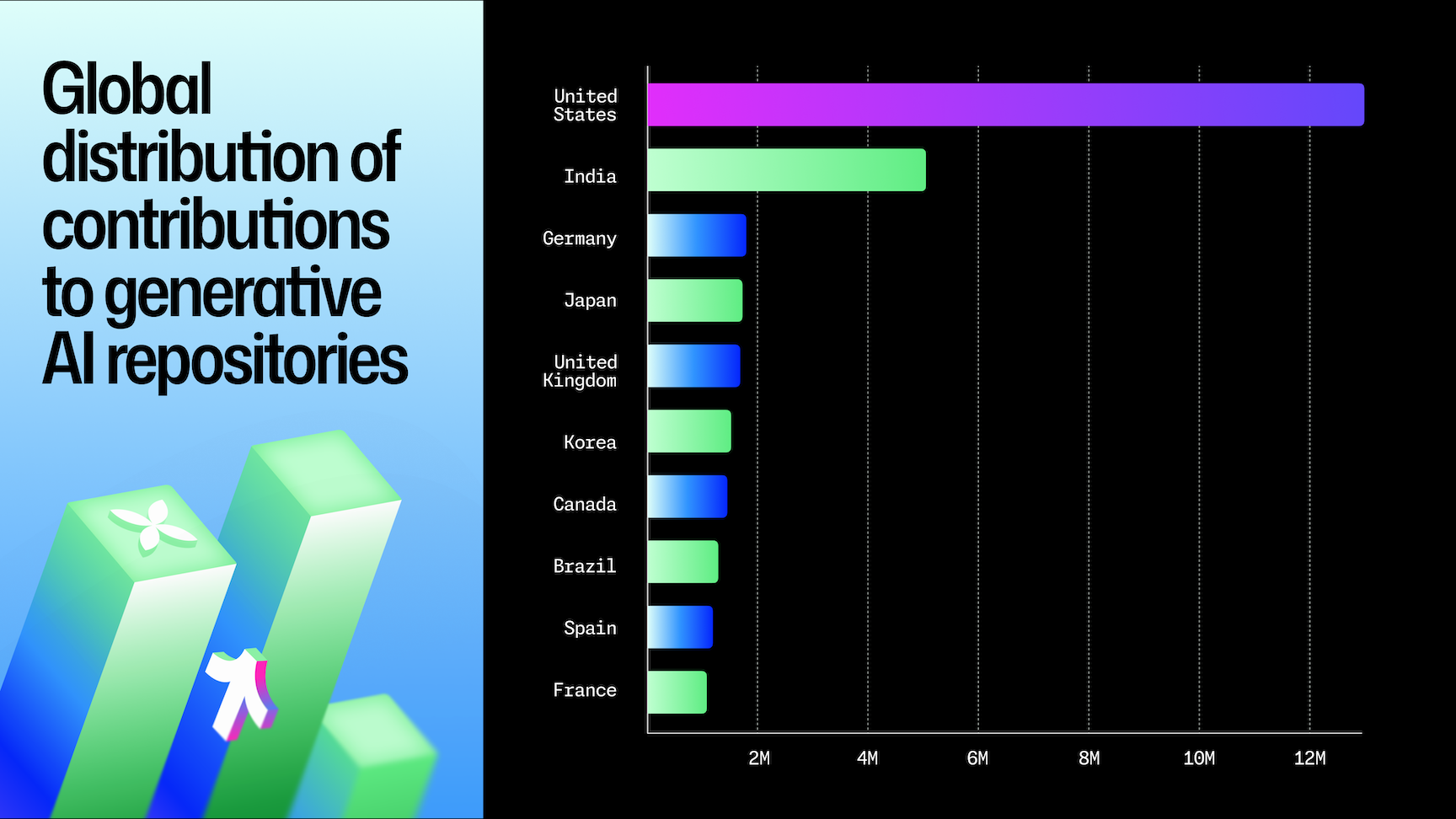
The chart shows the United States far ahead at around 12 million contributions, India second at around 5 million, and every other country under about 2 million. For sourcing, that second bar is the point: a large number of Indian engineers have a public record of work on model tooling, retrieval frameworks, agents and evaluation libraries, which makes GitHub one of the most reliable ways to separate builders from résumé keywords. HeroHunt's guide to sourcing AI engineers on GitHub covers the search techniques in detail - HeroHunt.ai.
The research and community layer is smaller but valuable for senior and research-leaning roles. India's top institutes (IISc, the IITs, IIIT Hyderabad) anchor the country's ML research, Microsoft Research India and Google's Bengaluru research teams have trained a generation of applied scientists, and Indian foundation-model companies like Sarvam AI have built teams with real pre-training experience. Hasgeek's The Fifth Elephant, India's long-running data and ML conference, runs its winter edition in Bengaluru on 4 and 5 December 2026 - Hasgeek. Speaker lists, paper authors and the contributor lists of popular Indian open-source AI projects are some of the best long-list sources you can build.
AI sourcing tools
AI sourcing tools have become the practical way for a foreign team without a local recruiter to work this market. Instead of building Boolean strings and reading hundreds of profiles, the recruiter describes the role and the tool screens profiles against that description, then drafts and sends outreach. LinkedIn's own Hiring Assistant, which went global in English in September 2025, pre-screens candidates and summarises their preferences inside LinkedIn Recruiter - Social Samosa. Independent AI recruiters such as HeroHunt.ai work across sources, including GitHub, and run multi-step outreach on autopilot.
HeroHunt.ai
If you are hiring AI engineers in India without a local recruiting team, the hard part is reaching the people who are not applying anywhere: the engineer shipping retrieval systems at a Bengaluru GCC or fine-tuning models at a startup in Pune. HeroHunt.ai screens public profiles, including GitHub, against your written brief with a language model instead of matching job titles, which matters in a market where "AI engineer" covers everything from API integration to model training, and then runs personalised outreach and follow-ups on autopilot. Plans are published: from $99 a month with unlimited positions and searches, after an 8-day trial (card required). The honest caveats: it is metered on monthly allowances of AI-screened profiles and candidate emails, it finds and engages candidates but does not employ them (pair it with an EOR or your own entity), and no sourcing tool shortens a 90-day notice period.
Indian recruiters are adopting these tools quickly. In the same LinkedIn survey, 71% of Indian recruiters using AI said it had helped them find candidates with skills they would otherwise have missed. The reason is structural: in a market with millions of engineers and inconsistent job titles, screening on what someone has actually done beats screening on what they call themselves.
Why this matters: the channel you choose decides which part of the market you see. Job boards show you the active, mostly junior market; direct sourcing shows you the passive senior market where the AI talent actually is. How to apply this: use inbound for junior roles, run direct sourcing (LinkedIn, GitHub, an AI sourcing tool) for anyone with three or more years of AI experience, and build a long list from community and open-source signals for the senior roles that matter most.
8. Outreach and Offers That Work in the Indian Market
Outreach to Indian AI engineers works when it is specific about the work, open about the money, and fast to follow up. Senior engineers in Bengaluru receive a steady stream of generic recruiter messages, most of them from IT services firms and staffing vendors, so the first job of your message is to show that this is a different kind of opportunity. The second is to answer the question every Indian candidate asks early: what is the CTC?
The specifics that earn replies are the same ones that work elsewhere, with a few local differences. Name the actual problem (the model, the product, the scale), say who the engineer would work with, and state whether the role owns work end to end or executes work designed elsewhere, because that last point is exactly what separates a global product team from the services work many Indian engineers want to leave. State the compensation range in rupees as an annual CTC band, and say how equity works if you offer it.
Follow-up matters as much as the first message. Interested candidates often reply briefly and expect the recruiter to move things forward quickly, to a call within days rather than weeks, and many are comfortable switching to a phone call or a messaging app once they have engaged. A sequence of two or three follow-ups spaced a few days apart, each adding something new (the team, the technical problem, the compensation range), usually outperforms a single message, as long as the sequence stops the moment someone replies.
What goes into a competitive offer
An Indian AI engineering offer is a package, and candidates compare packages component by component. The structure is familiar to anyone who has hired in India before, but foreign employers often send a single annual number, which forces the candidate to guess at the rest and invites comparison with a GCC offer that spells everything out.
The safest approach is to mirror the format Indian candidates already know: an annual CTC broken into its parts, with the one-time items and the benefits listed separately so nothing is double-counted. That also makes negotiation easier, because you can move one component (a larger joining bonus to cover a notice buyout, for example) without reopening the whole offer. A typical competitive offer from a foreign employer in 2026 contains:
- Fixed pay set from the CTC band, typically 85 to 100% of total cash for engineers
- Variable pay if any, usually a smaller share than in sales-heavy roles
- A joining bonus, often sized to cover a notice-period buyout or lost bonus
- Equity (stock options or RSUs from the parent), explained in rupee terms
- Benefits: group health insurance covering family members, and a clear remote or hybrid policy
Equity deserves a careful explanation, because many Indian engineers have seen startup options end up worthless and will discount them heavily unless you show the numbers. State the grant in units and in an indicative rupee value, explain the vesting schedule and what happens at exercise (including that tax is due at exercise, as covered in section 6), and be honest about liquidity. If your parent company is private, share the most recent valuation or preferred-share price you can disclose, and say plainly whether and how employees have been able to sell shares in the past.
Health insurance that covers spouse, children and often parents carries real weight in Indian offers, and it is cheap relative to its perceived value, so do not leave it out. The remote or hybrid policy also matters more than many foreign employers expect: Bengaluru commutes are notoriously long, and a credible remote-first or hybrid arrangement is a genuine differentiator against GCCs with strict office mandates.
Put all of it in writing. Since the Labour Codes took effect, a written appointment letter is mandatory for every worker, and Indian candidates expect a detailed offer letter before they resign, because resigning starts a notice period they cannot easily undo. If you hire through an EOR, the provider issues the employment contract, so agree the component structure with them before the offer goes out, to avoid a mismatch between what the candidate was told and what the contract says.
Negotiation norms
Expect a negotiation anchored on current CTC and a percentage hike. As section 3 showed, AI and ML engineers can command increases of up to 30% when they move, and strong candidates often hold more than one offer during their notice period. Ask for the current CTC and expectations early, decide your walk-away number before the conversation, and if you are paying at the top of your band, explain why the offer is strong (the scope, the equity, the remote policy) rather than only quoting the number.
Verification of current pay is also normal in India. Many Indian employers ask for recent payslips to confirm the current CTC a candidate states, and candidates are used to the request. Whether you ask is a policy choice, but be consistent: anchoring an offer on an unverified number invites inflation, while an offer anchored firmly on your own band, and explained that way, sidesteps the question and keeps pay fair across your India team.
Speed is the second half of negotiation. A candidate who interviews with you and two GCCs in the same fortnight will usually accept the first strong written offer, so compress your final stages, get approvals lined up before the last interview, and send the written offer within a day or two of the decision. HeroHunt's time-to-hire benchmarks show how much each extra stage costs in dropped candidates - HeroHunt.ai.
Why this matters: the strongest Indian AI engineers are choosing between several good options, and the employers who win are the ones whose offers are clear, complete and fast. How to apply this: write the CTC band into your first message, prepare a one-page offer explainer that converts equity and benefits into rupee terms, and set an internal target of a written offer within 48 hours of the final interview.
9. Assessing AI Engineers Without Getting Fooled
Assessment in India has a fraud problem that foreign employers rarely plan for, and it has grown with generative AI. Proxy interviews, where a skilled person interviews on behalf of the candidate who later shows up for the job, have been documented in Indian tech hiring for years, and SHRM reported in July 2026 that proxy interview fraud in Indian networks has evolved into semi-organised operations. The same report found that 18% of hiring managers had caught someone using a deepfake in an interview, with AI-generated video overlays used to impersonate qualified professionals.
This sits on top of the ordinary problem of title inflation. As section 3 showed, "AI engineer" covers a very wide range of work in India, and a candidate who has completed a course and built a chatbot demo can present a résumé that looks similar to one from an engineer who has run a recommendation model serving millions of users. Neither problem is unique to India, but the scale of the applicant pool makes both more visible, and a remote hiring process with no in-person stage is where they do the most damage.
A process that holds up
The assessment process that works for Indian AI hires is built around evidence of real work and continuity of identity across stages. Algorithm puzzles and take-home coding tests are the easiest stages to game, whether with a proxy, a language model or both, and they say little about whether someone can build and operate an AI system. Conversations about real systems, with follow-up questions that go deeper than any prepared answer, are much harder to fake.
The loop also needs to respect the candidate's time, because strong Indian AI engineers are interviewing elsewhere and will drop a process that runs to six or seven rounds. Four or five stages over two weeks is a reasonable target for a senior hire. A sound loop for an experienced AI engineer usually looks like this:
- Evidence review: GitHub history, papers, talks or a portfolio that predates the application
- Deep technical conversation about a system the candidate built, on camera, with follow-ups
- A practical exercise or system design close to your product (evaluation, retrieval, inference cost), discussed live
- Identity and background verification, with the candidate's consent, before the offer is final
The common thread is continuity: the same person, on camera, across every stage, discussing work they can explain in depth. A proxy can pass a coding test; it is much harder to sustain a 60-minute conversation about the failure modes of a production retrieval system the candidate claims to have built. It also helps to have the same interviewer join two different stages, so someone can confirm it is the same person, and to ask follow-up questions that build on answers from earlier rounds, which a proxy who attended only one round cannot answer.
Large employers have also turned to AI proctoring: HCLTech reports an 80% reduction in proxy hiring after deploying Talview's tools, a vendor-reported figure but a useful indication of how common the problem is - Talview. Background verification is standard practice in India and widely available, but under the DPDP regime it should rest on clear, informed consent.
Public work needs checking too. A GitHub profile is strong evidence when the history is long, the commits are spread over time, and the candidate can walk through the decisions in their own repositories or explain their contributions to someone else's project. It is weak evidence when it consists mostly of recent forks of popular projects or tutorial code. References work best when they come from engineering managers or technical colleagues rather than HR contacts, and for senior AI hires, a short call with a former manager about how the candidate handled a model that failed in production is worth more than any certificate.
Decide your policy on AI tools in interviews before the first candidate asks. Strong AI engineers use coding assistants every day, so banning them entirely tests a skill nobody uses at work. A practical compromise is to allow AI tools in the practical exercise and ask the candidate to talk through what they accepted, rejected and verified, while keeping the deep technical conversation unassisted. That tests judgement, which is what you are actually hiring for.
Background verification closes the loop. It is a mature industry in India, with checks typically covering identity, education, previous employment and sometimes court records. In EY's 2025 analysis of background screenings, cited in the same SHRM report, 79% of fraud incidents in IT and IT-enabled services involved previously employed candidates rather than freshers, which is a reason to verify experienced hires' employment history directly with former employers rather than relying on documents alone.
Why this matters: a bad hire in a remote team is expensive and slow to detect, and the hiring fraud that exists in the Indian market targets exactly the remote, fully online processes that foreign employers run. How to apply this: anchor your loop on deep conversations about real work, keep cameras on and interviewers consistent, verify identity before the offer, and run background verification with consent as a standard step rather than a sign of distrust.
10. Notice Periods, Counteroffers and Offer Dropouts
The most underestimated part of hiring in India is the time between a signed offer and the first day. Notice periods for experienced engineers commonly run 60 to 90 days, and one Indian HR publication estimates that roughly one in three IT roles carries a full 90-day notice period, while product companies and GCCs tend toward 30 to 60 days - The People's Board. During those weeks, the candidate is still employed elsewhere, still being recruited by others, and very likely to receive a counteroffer.
The overall hiring timeline reflects this. The same publication puts most Indian hires at 35 to 45 days from approval to acceptance, and senior AI/ML roles at 50 to 70 days, before the notice period even starts - The People's Board. Add a 90-day notice and a senior AI engineer you start searching for in January may not start until June. Plans that assume a US-style two-week gap will be wrong by months.
Counteroffers and how to protect an accepted offer
Counteroffers are routine, though the data on them is thin. One Indian hiring advisory estimates that employers now win back 35 to 45% of resigning engineers with a counteroffer, down from 60 to 70% through 2023, and that a growing share of tech employers will accept a 30 to 45 day buyout in place of the contractual notice period - The Hire Hub.
Treat those as practitioner estimates rather than measured rates, but the direction matches what recruiters in India describe: an accepted offer is not a hire until the person shows up. No independent survey measures offer-to-join dropout in India reliably, so the most useful number is your own: track how many accepted offers turn into first days, by sourcing channel and by notice-period length, from your very first hires.
The pressure comes from three directions at once. The current employer wants to keep a trained engineer and will often match or beat your number, other employers who interviewed the candidate in parallel may still send offers, and the candidate has weeks to second-guess a move to a company they have only met on video calls. The tactics that reduce dropouts are about staying present and removing reasons to reconsider. The approaches that work best in practice:
- Negotiate a buyout of the notice period where the current employer allows it, and pay for it
- Split the joining bonus, with part paid on joining and part after a few months
- Keep weekly contact through the notice (team calls, updates) and ship equipment early
- Keep a warm backup candidate for every critical hire until the first day
These steps matter because a 90-day gap is long enough for a candidate's situation to change completely: a promotion at the current employer, a better offer from a GCC that interviewed them in parallel, or simply doubt about leaving a familiar team. Employers who treat the notice period as part of onboarding rather than as dead time lose far fewer candidates, and the cost (a few hours of engagement and a buyout payment) is small compared with restarting a search.
Ask the right questions early. What is the notice period, does the current employer allow a buyout, and is there unused leave that can be set against the notice? Those three answers decide the realistic start date more than anything in your own process, and they tell you how much of a joining bonus or buyout payment to plan for. Product companies and GCCs with shorter notice norms may release an engineer early once the handover is done.
Documentation is part of the same process. Indian employers normally issue a relieving letter and an experience letter at the end of the notice period, and new employers usually ask for them during onboarding, so a candidate who has formally resigned and had the resignation accepted is far more committed than one who has only signed your offer. Ask the candidate to share the resignation acknowledgement once they have it, and treat a delayed resignation as an early sign that a counteroffer conversation is under way.
Some candidates use a foreign employer's offer mainly as leverage with their current employer or with a GCC. You cannot prevent this entirely, but you can reduce it: ask early whether the candidate has other processes running and where they stand, keep the offer valid for a short and defined period, and avoid reopening the package after acceptance. An engineer who renegotiates several times during the notice period is often telling you something about how long they will stay.
Why this matters: notice periods and counteroffers turn a hiring plan into a pipeline problem, and a pipeline with one candidate per role is fragile. How to apply this: plan start dates around the notice period, budget for buyouts and joining bonuses, keep engaging the candidate weekly until day one, and keep second-choice candidates warm for every critical role.
11. Where India AI Hiring Fails
Most India AI hiring failures are not about talent quality; they come from treating India as a cost line rather than as part of the engineering organisation. The engineers are there. The failures happen when the work, the structure or the process tells the best of them that this is a place to execute rather than to build, and they leave for a GCC or startup that offers more.
The first failure is hiring for cost instead of capability. A team of junior engineers at ₹12 to 15 lakh each looks efficient on a spreadsheet, but AI systems need people who can judge model behaviour, design evaluations and debug production failures, and juniors without senior guidance produce rework. A smaller team anchored by one or two senior engineers at ₹60 to 90 lakh usually delivers more than a larger junior team at the same total cost. The second failure is remote execution without ownership: when every design decision is made in another time zone and the India team only implements, the best engineers leave, and the Indian market's 17% attrition makes that easy for them.
The third failure is contractor sprawl. Companies that start with two contractors and grow to fifteen without changing structure end up with misclassification exposure, unclear IP ownership and no benefits to retain anyone. The fourth is underpricing and slow process, which shows up as offer dropouts and counteroffer losses rather than as an obvious pay problem. The fifth is no local leadership: India teams without a senior leader on the ground, someone who can hire, coach and represent the team, tend to plateau in both output and retention.
There are also genuine limitations, not just mistakes. Research-grade talent (people who have trained large models from scratch) is thin in India, as it is everywhere, and the best of it is concentrated at labs and big-tech research groups with packages a startup cannot match. The time-zone gap with the US is real and cannot be engineered away entirely. And the market moves quickly enough that a band set in January can be below market by December.
Why this matters: each failure has a recognisable early sign (rising attrition, slow offer acceptance, a team that never pushes back on designs) and a known fix. How to apply this: hire at least one senior engineer before scaling juniors, give the India team ownership of a product area rather than a queue of tickets, convert long-term contractors to proper employment, and put a local engineering leader in place by the time the team reaches ten people.
12. How AI Agents Are Changing AI Hiring in India
AI agents are changing both sides of AI hiring in India: recruiters use them to find and screen candidates at scale, and candidates use them to apply at scale. The recruiter side is moving fastest. About 8 in 10 Indian employers plan to expand their use of AI in hiring, including to evaluate applicants and source talent, and a majority plan to increase AI use for pre-screening interviews in 2026, according to the LinkedIn survey reported in February 2026.
The practical tools fall into three groups. Sourcing agents (LinkedIn's Hiring Assistant inside Recruiter, independent AI recruiters such as HeroHunt.ai) search, screen and contact candidates against a written brief. Assessment tools run AI-proctored tests and structured first-round interviews, which India's largest IT employers already use at campus-hiring scale. And scheduling and communication agents handle the coordination work that slows Indian hiring, from interview scheduling across time zones to keeping a candidate engaged through a 90-day notice period.
The candidate side and the skills shift
Candidates have the same tools, which is why the applicant flood and the fraud problems in section 9 are growing at the same time as recruiter productivity. A candidate can now generate tailored applications for hundreds of roles in an afternoon, and that pushes serious employers toward sourcing rather than inbound, and toward assessment based on real work rather than résumés. The net effect is that the value of a good inbound pipeline is falling while the value of a good sourcing process is rising.
AI agents are also changing what an AI engineer in India is hired to do. Demand for agentic AI engineers grew 260% in 2026 compared with the previous year, ahead of generative AI solutions architects at 120% and LLM engineers at 86.5%, according to CIEL HR data reported in September 2026 - Outlook Business. The roles growing fastest are the ones that build and operate agent systems, which is useful for sourcing: engineers who have shipped agent workflows, tool-calling systems and evaluation harnesses are a distinct and fast-growing group, and the job titles have not caught up with the work.
Why this matters: the cost of finding and screening candidates is falling quickly, while the cost of a wrong hire is not, so the advantage goes to teams that use AI to widen and sharpen their search and keep humans on judgement, assessment and closing. How to apply this: use AI sourcing to build your long list and first-touch outreach, use structured AI-assisted screening where volume justifies it, and keep the deep technical conversations, the offer and the notice-period relationship firmly human.
13. The Outlook for 2027
India's position as the second home of AI engineering will strengthen in 2027, and the cost advantage will narrow slowly rather than disappear. The structural drivers (the developer base, the growth of AI-focused capability centres, the presence of global labs and Indian model builders) all point the same way, and the most striking new evidence is that India is now keeping more of its best AI talent.
The Stanford AI Index 2026 tracks the net flow of top AI authors and inventors by country using Zeki data. India's line is the most dramatic on the chart: a steep outflow through the 2010s, a trough around 2022, and a sharp recovery since - Stanford HAI.
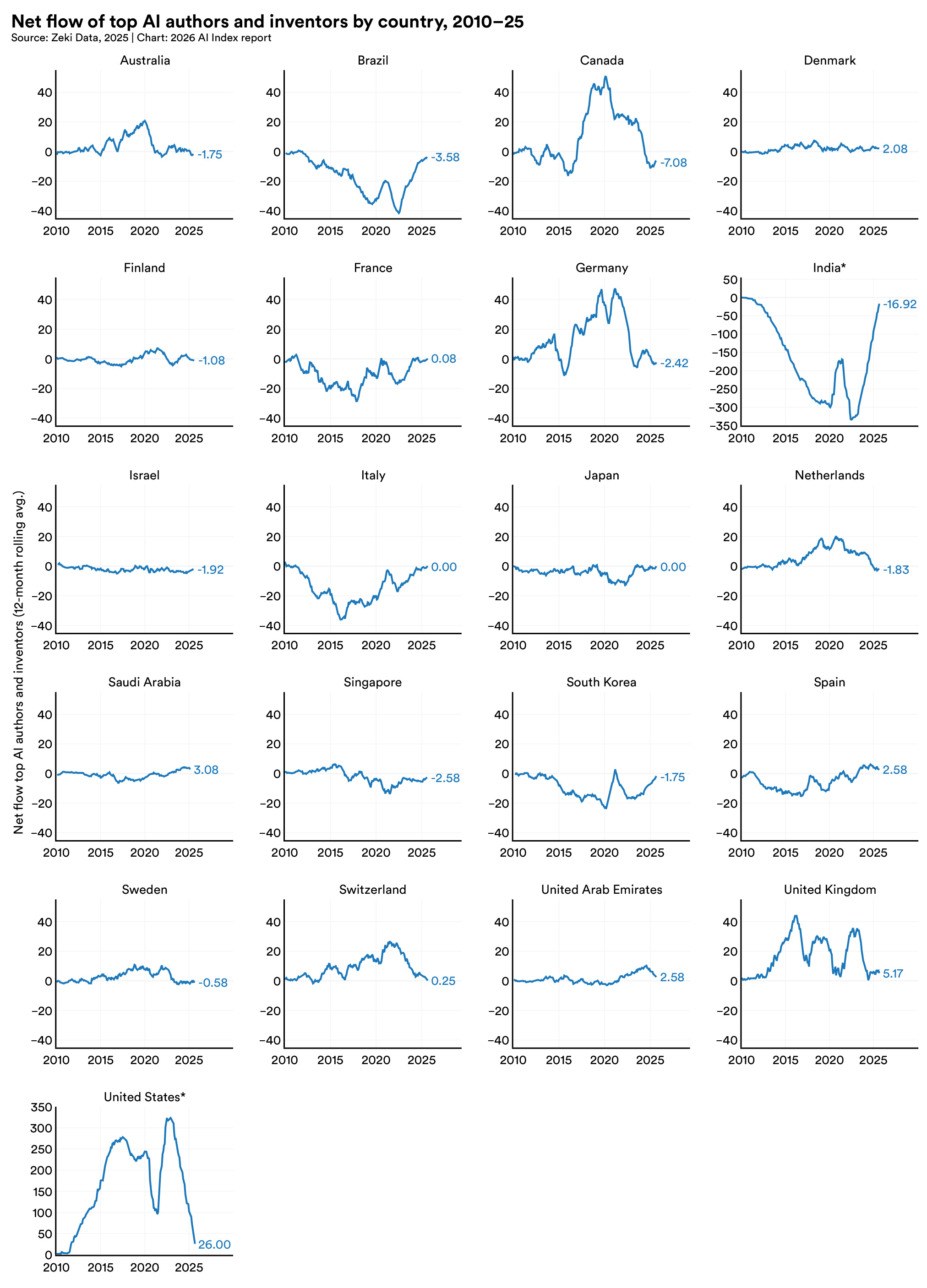
India's panel uses a different scale from most of the others, falling to roughly minus 330 around 2022 and recovering to about minus 17 by 2025. India still had a net outflow in 2025, the largest of the countries shown, but the outflow has shrunk by more than 90% from its trough. The United States panel tells the other half of the story, falling sharply from its 2022 to 2023 peak. For employers, that means more senior AI talent staying in or returning to India, which is exactly the group that has been scarcest.
What to expect next year
US immigration policy is one reason more companies are hiring AI engineers where they live. A federal court vacated the policies implementing the $100,000 H-1B fee (introduced in September 2025) in June 2026, but the proclamation was extended in September 2026 through 21 September 2027, and lawyers disagree on how it will be enforced - Mintz. HeroHunt's guide to hiring around the fee covers the alternatives in detail - HeroHunt.ai. Whatever the courts decide, the uncertainty itself pushes more AI hiring into India, through EORs, subsidiaries and capability centres.
Pay will keep rising faster in India than in the US: around 9 to 10% a year on average and faster for AI skills, which means the gap narrows a little each year for senior Bengaluru talent while staying very large for mid-level engineers elsewhere. The compliance calendar is also set: the DPDP Act's core duties arrive around May 2027 (earlier if the government shortens the transition), and state rules under the Labour Codes will continue to roll out. Expect the capability-centre model to keep shifting from cost to capability, and expect competition for engineers with agent and evaluation experience to be the defining feature of the 2027 market.
Why this matters: decisions made now (employment model, pay bands, team design) will run into these trends within a year. How to apply this: budget for 10%+ annual increases on AI talent, design your data-handling processes for the DPDP regime now rather than in 2027, and position your India team as an owner of products, because that is what the returning senior talent is looking for.
14. The Decision Framework
Hiring AI engineers in India in 2026 works when you match the employment model to your headcount, pay at the market for the level you need, source directly, and manage the notice period as part of onboarding. Everything else in this guide supports those four decisions. The cost advantage is real (a fully loaded mid-level hire at about ₹48 lakh, or $51,000, against roughly $279,000 for a comparable US hire), but it only materialises if the engineers you hire stay and do senior work.
The thread running through every section is that India rewards employers who treat it as part of their engineering organisation rather than as a cheaper way to fill seats. That shows up in pay (benchmarking against machine learning engineers, not generic developers), in structure (an employment model that gives engineers proper contracts and benefits), in process (fast offers, real assessments, a managed notice period) and in the work itself (ownership rather than execution). Each of those choices costs a little more up front and saves far more in retention and output.
The decision path for most foreign employers looks like this:
- One or two hires, project-shaped work: contractors through a contractor platform, with a perpetual, worldwide IP assignment
- First 1 to 15 long-term hires: an employer of record, priced on total cost at your real salary levels
- 15 to 100 people: your own private limited subsidiary, with safe-harbour transfer pricing
- 100+ people, strategic: a global capability centre, built directly or through build-operate-transfer
The order matters as much as the options. Companies that start with an EOR keep their options open and learn the market before committing to an entity; companies that start with a subsidiary for two people carry fixed overhead before they know whether the team works; and companies that stay on contractors too long accumulate risk they discover only during due diligence. On cost, remember that the EOR fee weighs most on junior salaries, so the more junior your hiring plan, the earlier an entity makes sense.
Two habits apply at every stage. Source senior AI engineers directly rather than waiting for applications, and run a fast, complete offer process, with a written offer within 48 hours of the final interview and weekly contact through the notice period, because in this market the process loses more candidates than the pay does.
On cost, plan from bands rather than averages: roughly ₹12 to 25 lakh for junior AI engineers, ₹25 to 50 lakh for strong mid-level engineers, ₹50 to 90 lakh for senior engineers, and ₹90 lakh to well over ₹1 crore for staff and principal engineers in Bengaluru, with GCC roles at the upper end. Add the employment-model fee, gratuity and one-time hiring costs from section 4, then add 9 to 10% a year to stay at market.
On the legal side, three documents protect most of the value: an Indian-law appointment letter or EOR contract, a perpetual, worldwide IP assignment, and a clear consent process for candidate data and background checks ahead of the DPDP Act's core duties in 2027. Get them right before the first hire, and the rest of the structure can grow around them.
On sourcing, the most valuable shift is from posting to searching. The Indian job-board market is enormous and increasingly flooded with AI-generated applications, while the engineers who have shipped AI systems are employed and passive. Whether you use LinkedIn Recruiter, GitHub searches, community long lists or an AI recruiter like HeroHunt.ai, the teams that build the strongest India AI groups are the ones that go and find the engineers rather than waiting for them to apply.
If you are starting from zero, the first month is straightforward. Write a role description that names the actual AI work, set a CTC band from the machine learning engineer distribution for your target city, get written India quotes from two or three EOR providers at that salary, and start a direct sourcing search at the same time, since the first hire will take three to five months from search to start once notice periods are included. By the time you have an accepted offer, you will know whether India works for your team and which structure to grow into.
Run your next India AI engineering search through an AI recruiter before you sign an agency agreement, and compare the shortlist, the reply rate and the cost side by side.
This guide reflects salary data, exchange rates, labour and data-protection rules, tax rules and provider pricing as of October 2026. Indian salary benchmarks move quickly, EOR prices are starting prices that vary by quote, the Labour Codes and DPDP Rules are still being phased in, and the H-1B fee is subject to ongoing litigation, so verify current figures and get local legal and tax advice before you make an offer or choose a structure.