



Disclosure: some links in this article are affiliate links. If you sign up through one, HeroHunt may earn a commission at no extra cost to you.
Tools to hire for growth
The high growth environment of startups, constant change and the need for the top 1% growth minded people requires good software that enables hiring at lightspeed.
But with limited recruitment resources and the vast variety of available tooling, it can be hard to decide on which tools fit your recruitment goals best.
Recruitment software for startups needs to be:
- Effective in terms of helping you find the right people enabled by data driven decision making
- Flexible in terms of pricing so you can change plans whenever your needs change
- Easy enough to start using it today and integrate it in your recruitment process
- Scalable in terms of functionality so the tool can grow with your rapidly changing team
So what tools are available on the market that meet your startup hiring goals?
We provide an overview of tooling based on three stages in your recruitment journey: sourcing, outreach and hiring.
Sourcing software
Sourcing is the process of finding the right candidates for your open position using different sources where candidates can be found.
Recruit'em (formerly Recruitin)
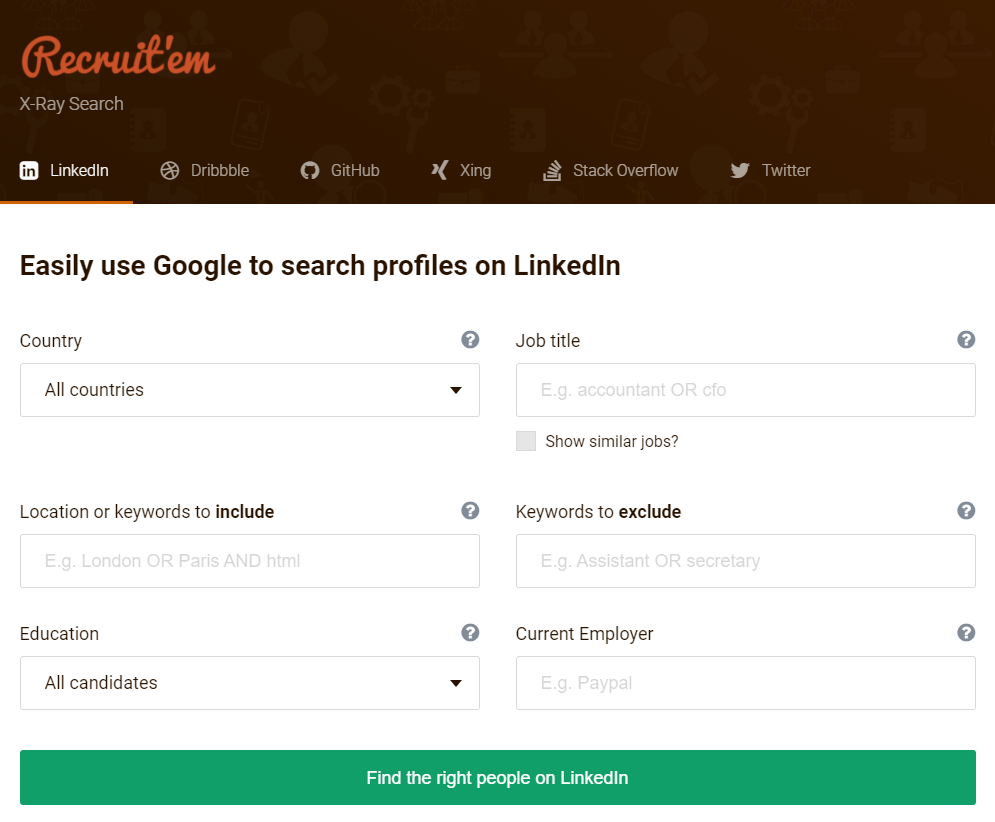
Recruit'em is an X-ray search string generator. It creates the right Boolean search strings based on the fields you choose to include in your search. You can create search strings for LinkedIn, GitHub, Dribbble, Xing, Stack Overflow and Twitter to find candidates based on your keywords. All straight from Google.
It has picked up two useful additions since we first wrote this: saved searches, and a converter that turns a pasted job description straight into a Boolean string. That second one matters more than it sounds. The hardest part of X-ray search for a founder who has never sourced before is not the syntax, it is knowing which keywords a good candidate would actually have on their profile.
Price: Free, no registration
Ease of use: Super easy
GlossaryTech
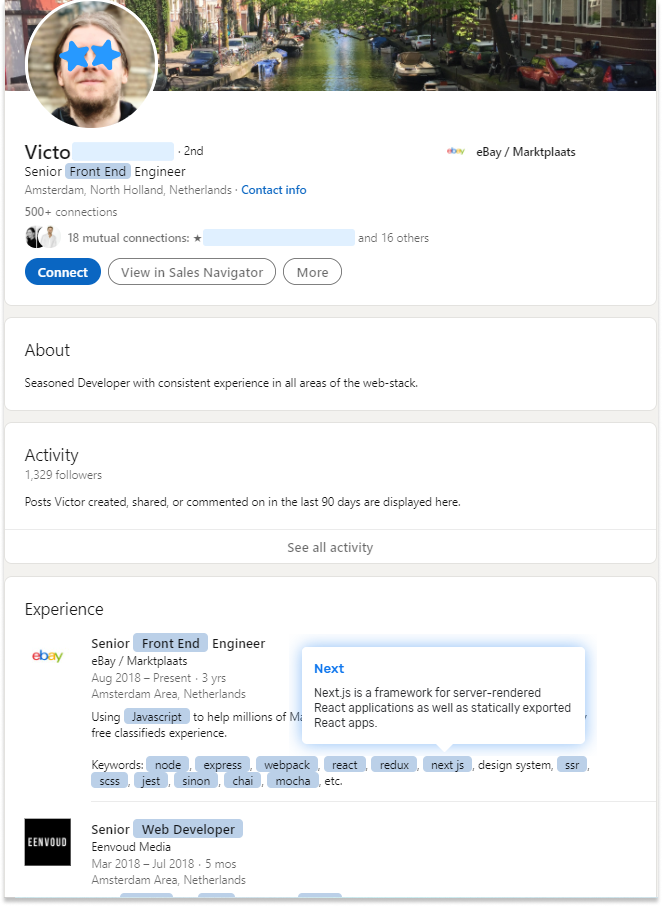
GlossaryTech is a Chrome and Edge extension that helps you identify the key technologies that engineers have on their LinkedIn profile. You can see in one glance what technical skills someone has, and it also gives you plain-English definitions of technologies for when you are not sure what they mean.
For a non-technical founder screening engineers, this is the single cheapest way to stop nodding along to acronyms you do not understand. In March 2026 Dice partnered with GlossaryTech and now bundles it into its Recruiter Hub, so it is more actively maintained than most free sourcing add-ons.
Price: Free
Ease of use: Super easy
HeroHunt.ai
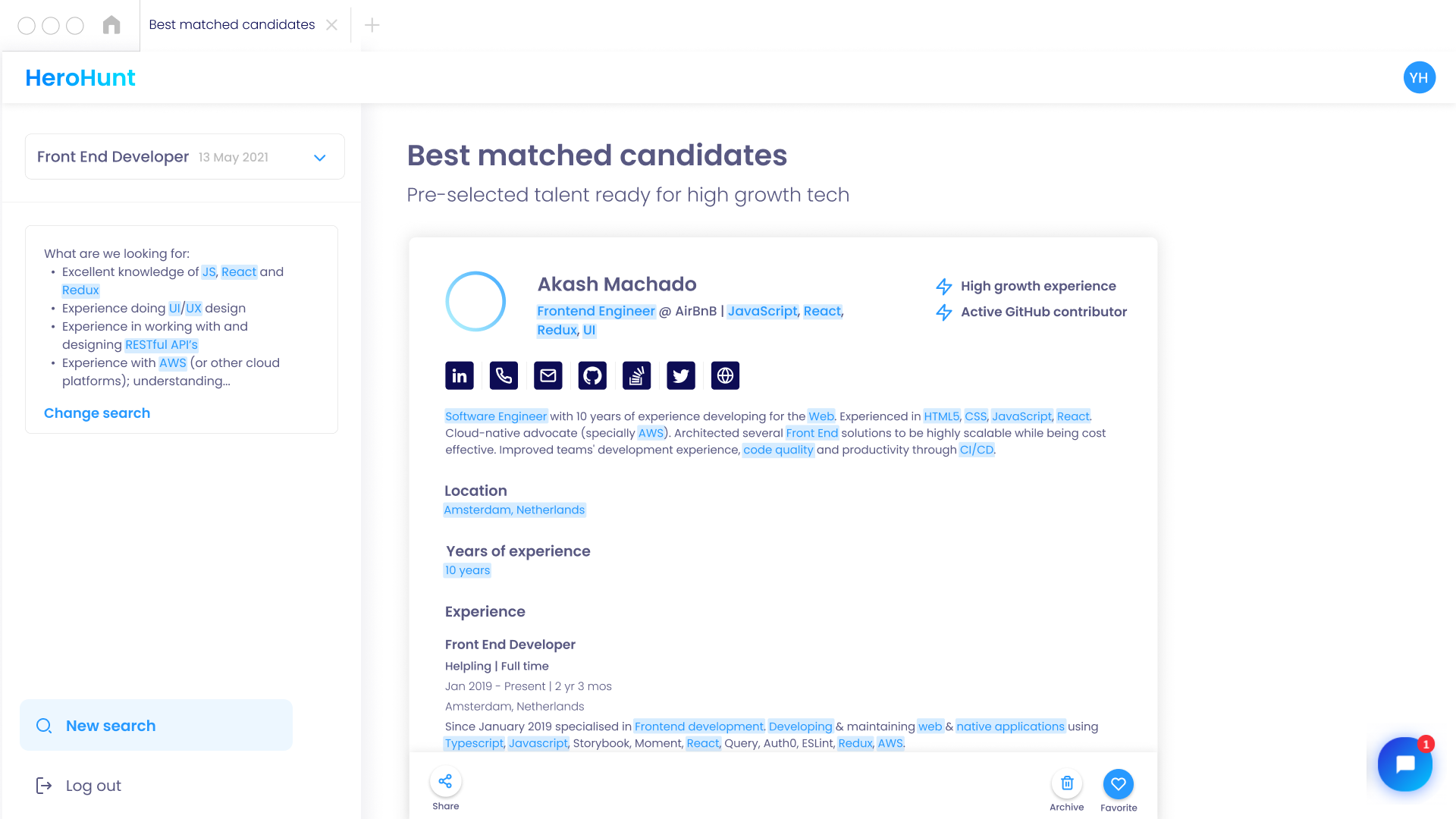
HeroHunt.ai started as a cross-platform talent search engine and has since become an AI Recruiter. It searches across more than a billion profiles on platforms like LinkedIn, GitHub and Stack Overflow, then its AI Recruiter drafts and sends the outreach for you, so for a startup it collapses the sourcing and outreach stages into one tool. For a founder doing this between other jobs, that autonomy is the whole point.
Price: Free to start, no credit card, with paid plans on top
Ease of use: Super easy
HeroHunt.ai
The reason this one is worth a founder's attention is structural, not featural: it is the only tool in this guide that covers two of the three stages below. Recruit'em and GlossaryTech hand you a search string and a skills readout, then leave you to write every message yourself, which is exactly where a founder hiring between other jobs stalls. Because the search and the messaging run in the same flow here, the outreach stage below (a contact-data tool plus a sequencer) collapses into the tool you already sourced with, which is one less subscription and one less handoff to maintain. The honest caveat: it is a sourcing and outreach tool, not an applicant tracking system, so you still need something from the hiring section to hold candidates and decisions once replies come in, and it is built for going out to people who are not applying, so it does little for a role already flooded with inbound applicants.
Outreach software
Outreach is the stage where you actually contact the people you sourced, and for a startup it is the stage that decides whether sourcing was worth the effort at all.
Founders lose most of their candidates here, not in sourcing. The engineers you want already have a job and are not on the market, so a generic InMail gets ignored. Two things move the reply rate: reaching them somewhere other than a crowded LinkedIn inbox, and following up more than once without doing it by hand. The tooling below solves those two problems and nothing else, which is exactly what an early team needs.
The first job is finding a real contact detail. Apollo.io is the tool most small teams reach for: it holds a large B2B contact database and finds work emails and direct-dial numbers, and its free tier gives 900 credits per seat per year released monthly, enough to test whether a personal email lifts your reply rate before you pay anything. It is built for sales, so expect to weed out stale records, but for finding one founder-to-engineer email it is more than enough.
The second job is sending and following up at scale. Meet Alfred runs multi-step LinkedIn and email sequences on autopilot, starting at $25 per user per month billed annually, which suits a founder who wants the follow-ups to happen without a reminder in their calendar. The honest caveat: any tool that automates LinkedIn actions carries a real account-restriction risk, so keep daily volumes conservative rather than blasting connection requests. If you would rather not run outreach yourself at all, this is where an AI Recruiter like HeroHunt.ai overlaps: it drafts and sends the messages as part of the same flow that sourced the candidate.
Hiring software
Hiring is where the applicants and replies you generated get organised into a process, and where a startup most often overpays.
The tool for this stage is an applicant tracking system (ATS): the shared place where every candidate, note, interview and decision lives so hiring does not run out of one founder's inbox. The trap is that the best-known systems are priced for companies with a full talent team, not for a startup making its first five hires. Held against the four tests we set at the top (effective, flexible pricing, easy, scalable), the entry-level ATS that clears all four for a cash-conscious early team is Manatal, which is why it is our pick for this stage.
Manatal
Manatal does AI candidate scoring, enriches profiles from public social data, posts to the big job boards and gives you a branded careers page, without the enterprise price tag. For an early team it clears all four tests: it is effective, genuinely cheap, easy to start today, and it scales up a tier when you do.
Manatal
For a startup making its first handful of hires, the deciding factor is rarely the feature list, it is whether the tool is cheap enough to keep once the hiring urgency fades. Manatal publishes a real price where most ATS vendors hide behind a demo call: $15 per user per month billed annually ($19 monthly), with a 14-day trial and no card. The honest caveat worth knowing before you sign up: that entry tier caps at 15 active jobs and 10,000 candidates, so a team hiring across more than 15 open roles at once is really pricing the $35 tier, which is still the cheapest full ATS here.
It is worth knowing the two obvious alternatives so the pick is a real choice, not a default.
Breezy HR
Breezy HR has the friendliest free plan on paper, but its free Bootstrap tier allows only one active position at a time and keeps candidate data for just 30 days, so it works as a sandbox rather than a working ATS. Paid plans start at $157 per month for unlimited users on annual billing, so it is flat-rate rather than per-seat, which can undercut Manatal once several people are hiring - Breezy.
Ashby
Ashby is the system scaling startups graduate into for its analytics, but it does not publish a low-end price: its Foundations plan is around $400 per month and pricing is tied to your headcount, so it only makes sense once you are hiring in real volume. For a team making its first hires, that is a lot of ATS you will not use yet.
Putting it together
Match the tool to the stage rather than buying one big suite on day one. For a startup making its first hires that means: source for free with Recruit'em and GlossaryTech (or let HeroHunt.ai's AI Recruiter source and message in one step), find contact details with Apollo's free tier, automate follow-ups with Meet Alfred, and hold everything together in a low-cost ATS. On that last, cheapest-that-still-scales point, Manatal is the safe default.
The cheapest full ATS here at $15 per user per month, with a 14-day trial and no card.
The right stack changes as you grow, so revisit it every few hires rather than locking in early. The whole point of the four tests, and especially the flexibility one, is that nothing above should be hard to leave.
Written by Yuma Heymans (@yumahey), who built HeroHunt.ai, the world's first AI Recruiter, and has been building recruitment tools for startups since 2021. He writes from hands-on experience sourcing and hiring on a founder's budget.
This guide was refreshed in July 2026. Software pricing and plans change often, so verify current details on each vendor's own pricing page before you buy.