



What Ashby really costs in 2026: the hidden headcount ladder, how AI credits are metered, what Plus and Enterprise buyers pay, and the alternatives worth comparing
Ashby is the only major all-in-one ATS that publishes a price, and the number everyone quotes is only one rung of it. The pricing page opens on $400 a month for the Foundations plan, which is why "Ashby costs $400" appears in nearly every comparison article. That figure is simply the default selection in a dropdown. Behind it sits a five-step ladder that runs from $300 a month for companies of 1 to 10 people to $900 a month for 76 to 100, with 10% off for paying a year upfront - Ashby.
The problem is that list price is no longer what decides an Ashby bill. Since the summer of 2026 the pricing page itemises a set of meters it did not show before: AI credits that power application review, fraud detection and talent rediscovery, texting allowances, email lookups, and a $100-a-month SSO fee on the entry plan. Above 100 employees the published price disappears entirely and the AI allowance switches from a pool per account to a pool per paid seat. Two companies on the "same" plan can end up with very different bills, and a company that crosses 100 employees can watch its AI allowance shrink while its invoice grows.
This guide decodes every published Ashby price, the exact AI credit rates from Ashby's own help center, three worked cost scenarios at different company sizes, the add-ons Ashby does not price publicly, how the pricing has changed since 2025, what buyers actually pay according to contract data, and the strongest Ashby alternatives in 2026. Every Ashby figure below was read from Ashby's pricing page, its knowledge base and its product announcements in October 2026.
Written by Yuma Heymans (@yumahey), founder of HeroHunt.ai, an AI Recruiter that sources and screens candidates across 1B+ profiles and sends them straight into ATSs like Ashby. Building on top of Ashby's API every day is why this guide looks past the headline price to the meters underneath it.
Manatal
If you are a small team weighing Ashby's Foundations plan mainly for the ATS, Manatal prices per recruiter instead of per company size: $15 per user per month billed annually ($19 month to month). Two recruiters at a 60-person company pay about $360 a year on that tier, against $7,560 a year for Ashby Foundations at the same headcount on annual billing. The honest caveat: the $15 tier caps at 15 jobs and 10,000 candidates, so most growing teams really compare against the $35 tier, and Manatal has nothing like Ashby's analytics depth, sequencing or scheduling automation. It replaces the tracking, not the all-in-one.
Contents
- Ashby Pricing at a Glance
- The Foundations Ladder: Every Price at Every Company Size
- Plus and Enterprise: What the Custom Tiers Add
- AI Credits: How Ashby Meters Its AI
- Three Worked Examples: What AI Credits Cost in Practice
- The Other Meters and Add-Ons
- How Ashby's Pricing Changed From 2024 to 2026
- What Ashby Buyers Actually Pay
- Where Ashby Wins and Where It Falls Short
- The Best Ashby Alternatives in 2026
- Full Comparison: Price, Meter and Best Fit
- How to Choose, and How to Buy Ashby Well
- The Bottom Line
1. Ashby Pricing at a Glance
Ashby sells one product, the All-in-One recruiting platform, on three plans whose price depends on how many people your company employs. Foundations covers companies up to 100 employees and is the only plan with a public price. Plus is "best for 101 - 1000 employees" and Enterprise is "best for 1,000+ employees", and both are custom quotes. Ashby says Plus pricing "is based on company size, usage, and commitment", while Enterprise accounts get "a predictable pricing model" meant to consolidate spend - Ashby. There is also a fourth product, Ashby Analytics, sold on its own to companies of 100+ employees who want Ashby's reporting on top of a different ATS, priced on usage.
The most important structural fact is that Ashby does not charge per module. Its pricing FAQ is explicit: "it's one price for the entire platform across ATS, Sourcing, CRM, Scheduling, and Analytics." Integrations are not charged either, and baseline onboarding and customer success are included for every customer, with a paid Enterprise Implementation Service reserved for the largest accounts. For startups, the FAQ adds that pricing is "based on the size of your organization at that point of purchase, not on a seat or talent team basis", that pricing is reassessed annually, and that the plan includes 200 email lookups a month.
| Plan | Who it is for | Published price | AI credits included |
|---|---|---|---|
| Foundations | Up to 100 employees | $300 to $900/month by headcount | 1,500/month (18,000/year) per account |
| Plus | 101 to 1,000 employees | Custom quote | 2,500/year per paid seat |
| Enterprise | 1,000+ employees | Custom quote | 12,500/year per paid seat |
| Ashby Analytics | 100+ employees on another ATS | Usage-based quote | Not applicable |
Why this matters: the table above already contains the two places where Ashby budgets go wrong. The first is the cliff at 100 employees, where a published $900-a-month ceiling gives way to a negotiated contract that, on contract data covered in section 8, typically lands at around twice that. The second is the change in how AI is metered: an account-wide pool on Foundations versus a per-seat pool on Plus and Enterprise. How to apply this: before you take a demo, write down three numbers: your current headcount, your expected headcount at renewal, and the number of people who will hold paid Ashby seats. Every price conversation with Ashby turns on those three figures, and having them ready lets you check the quote against the published ladder and the credit tables in the sections that follow.
2. The Foundations Ladder: Every Price at Every Company Size
Foundations is priced in five headcount bands, and the $400 on Ashby's pricing page is only the second of them. The page renders a company-size dropdown that defaults to the 11 to 25 band, which is why $400 is the figure that gets quoted. The underlying price list, which is embedded in the pricing page's own code, has five values: $300 for 1 to 10 employees, $400 for 11 to 25, $500 for 26 to 50, $700 for 51 to 75 and $900 for 76 to 100, all per month on monthly billing - Ashby.
Annual billing takes 10% off every band. Ashby's FAQ confirms that "annual plans include 10% savings relative to the equivalent monthly option", and that monthly plans must be paid by credit card while annual plans can also be paid by bank transfer or wire. The page also notes that emerging market pricing is available, without stating the discount, so companies based outside the US and Western Europe should ask for it explicitly.
| Company size | Monthly billing | Annual billing (per month) | Annual billing (per year) | Annual cost per employee at band top |
|---|---|---|---|---|
| 1 to 10 | $300 | $270 | $3,240 | $324 |
| 11 to 25 | $400 | $360 | $4,320 | $173 |
| 26 to 50 | $500 | $450 | $5,400 | $108 |
| 51 to 75 | $700 | $630 | $7,560 | $101 |
| 76 to 100 | $900 | $810 | $9,720 | $97 |
The chart below shows the same ladder on both billing terms. It makes the shape of the pricing obvious: the bands are cheap to climb at the bottom ($100 a month per step) and steeper near the top ($200 per step), but the price per employee keeps falling as you grow into each band.
Ashby Foundations Price by Company Size (2026)
Two things in this ladder catch buyers out. The first is the band boundary. Because price follows headcount rather than seats, a company that grows from 25 to 26 people pays $100 a month more for exactly the same product, and one that grows from 50 to 51 pays $200 more. Since the FAQ says startup pricing is set "at that point of purchase" and "reassessed annually", the step happens at renewal. A 24-person company that signs an annual Foundations contract at $4,320 and doubles to 60 people during the year should expect a renewal at the 51 to 75 band, $7,560 a year, a 75% increase for a team that has not changed its recruiting tooling at all.
The second is what "employees" means. Ashby's FAQ talks about "the size of your organization" and "your workforce", not about recruiters or users. That is the opposite of seat pricing: the founder doing all the hiring alone and a 90-person company with a five-person talent team are both priced on headcount. How to apply this: count the headcount Ashby will count (ask whether contractors are included), check how close you are to the next band boundary, and if you are just under one, sign annually now so the lower band is locked for twelve months. If you are a small company that hires rarely, the lowest band at $3,240 a year on annual billing is cheap for an all-in-one platform, but be aware that you are paying for the whole platform whether you use the CRM, scheduling and analytics or not.
What Foundations includes and what it leaves out
Foundations is a genuinely complete ATS, CRM and scheduling product, not a stripped-down trial tier. The plan comparison grid on Ashby's pricing page shows that every plan includes automated multi-channel sequences (email plus LinkedIn InMail or connection stages), the sourcing Chrome extension, sourcing projects, advanced and Boolean candidate search, AI Candidate Search (filters generated from a natural-language prompt), AI outreach personalization and AI-assisted reply tracking. On the ATS side it includes agency collaboration, auto-reject rules, fast application review, fraudulent candidate detection, AI-assisted application review, the AI Candidate Assistant, bulk actions, structured interview plans, direct-booking scheduling, debriefs, unlimited offers with e-signature and the core reporting dashboards.
Foundations also carries the newest AI tooling: the Ashby AI Assistant, Custom AI Agents, the MCP server that connects tools such as ChatGPT and Claude to your Ashby data, and the Ashby Assistant in Slack are all marked as included on all three plans. That matters for value: a 20-person startup gets the same agent features as a 5,000-person enterprise, metered by the same AI credits described in section 4.
What Foundations leaves out is mostly the machinery of a larger organisation. The grid marks these as unavailable on Foundations:
- Approvals and headcount: approval workflows, openings and headcount management, confidential jobs
- Custom data: custom fields on jobs, candidates and projects, form field connectors, bulk import of openings
- Advanced reporting: custom saved reports, custom dashboards, the AI-assisted report builder, custom alerts
- Sourcing controls: AI Talent Rediscovery, confidential projects and sequences, do-not-contact company lists
- Admin: SCIM directory sync, a sandbox instance, custom permission roles, and SSO only as a $100-a-month add-on
Read that list as a description of when you will outgrow the plan rather than as a set of defects. A 30-person startup rarely needs offer approval chains or a sandbox, but a 90-person company with a finance team that signs off every requisition will feel the missing approval workflows and headcount management quickly. Two smaller limits are worth noting too: Foundations allows one offer template and one candidate experience survey, where Plus allows unlimited. And AI Talent Rediscovery, the feature that searches your existing database for past candidates who fit a new role, is a Plus and Enterprise feature, so the Foundations credit pool in practice serves application review and fraud detection only. How to apply this: if three or more items on that list are things you need today, you are a Plus buyer regardless of headcount, and you should open the conversation with Ashby on that basis rather than buying Foundations and upgrading mid-contract.
3. Plus and Enterprise: What the Custom Tiers Add
Plus and Enterprise are where Ashby makes most of its money, and neither has a published price. Ashby positions Plus as "a powerful all-in-one recruiting product built for scale" for 101 to 1,000 employees and Enterprise as an "enterprise-grade, all-in-one recruiting solution" for 1,000+, and both buttons lead to "Get in Touch" - Ashby. What is published is the feature grid, and the grid tells you precisely what each step up buys.
Plus unlocks everything on the Foundations exclusion list above: approval workflows (including approvals from Slack and mobile), openings and headcount management, custom fields, custom saved reports and unlimited custom dashboards, the AI-assisted report builder, the interactive recruiting planner, post-hire quality-of-hire surveys, SCIM, a sandbox, up to three custom permission roles, up to five employer brands, recruiting events, an internal job board, AI Talent Rediscovery, and the contract integrations with Ironclad and Juro. SSO is included rather than charged at $100 a month.
Enterprise then adds a smaller set of capabilities aimed at large, regulated or complex organisations. These are the features the grid marks as Enterprise-only:
- Workday integration: two-way sync of positions and requisitions, with hires sent back
- Data export: Snowflake and AWS S3 data sharing of your full Ashby dataset
- Governance and scale: audit logs, unlimited custom roles and brands, an offer approval API, newsletters
- Advanced Scheduling: auto-scheduling, interviewer training and calendar holds, included rather than bought as an add-on
The interpretation is straightforward. Plus is the plan for a scaling company that needs control (approvals, custom data, permissions) and serious reporting. Enterprise is the plan for a company whose HR system of record is Workday, whose data team wants recruiting data in Snowflake, or whose compliance team needs organisation-wide audit logs. If none of those three applies, Enterprise is mostly buying a larger AI credit pool and included Advanced Scheduling, and you should price those two things separately before accepting the tier.
It also helps to read Ashby's own description of the Plus price literally: it is based on "company size, usage, and commitment". Company size means the same headcount logic as Foundations, usage now visibly includes the AI credit, texting and lookup meters, and commitment means term length, where multi-year deals are the main discount lever Ashby does not publish. A quote that does not break out all three is worth sending back with a request that it does.
Why the AI allowance changes shape at 101 employees
The most consequential difference between the tiers is not a feature but the AI credit formula. On Foundations the allowance is 1,500 credits a month, written in Ashby's own table as "1,500/mo. Or 18,000 per year account wide". On Plus it becomes 2,500 credits a year per paid seat, and on Enterprise 12,500 credits a year per paid seat - Ashby Knowledge Base. Enterprise's figure was raised to that "new, higher, baseline" on September 25, 2025.
The definition of a paid seat is therefore doing two jobs at once. It sets part of your Plus or Enterprise price, and it sets the size of your AI pool. A contract that excludes interviewers and hiring managers who only submit feedback keeps the price down, but it also keeps the credit pool small, and Ashby's AI features run on every applicant regardless of how many seats you pay for. This is the opposite of Foundations, where the pool is fixed per account and independent of how many people log in.
The arithmetic has a counterintuitive consequence. A Plus account needs eight paid seats to match the 18,000 credits a year that a Foundations account gets regardless of seats (seven seats give 17,500). A 110-person company with a four-person talent team that moves from Foundations to Plus goes from 18,000 credits a year to 10,000, while its contract price rises. At the same time, Enterprise's per-seat allowance is five times Plus's, which means the AI pool, not just the features, is a real reason to negotiate for Enterprise terms at the top of the Plus range. How to apply this: ask Ashby to define "paid seat" in writing (who counts: recruiters, coordinators, hiring managers who only submit feedback?), multiply it by the per-seat allowance, and compare the result with the application volume you expect. Section 5 walks through that calculation for three company sizes.
4. AI Credits: How Ashby Meters Its AI
Ashby's AI is mostly free, and the part that is not free is the part that runs on every applicant. The knowledge base puts it plainly: "While most AI features in Ashby are free to use without limitation, the ones that can run on a large volume of data (e.g. each inbound application) consume AI credits." Today three features consume credits: AI-Assisted Application Review, Candidate Fraud Detection, and AI Talent Rediscovery - Ashby Knowledge Base. Everything else marked as AI on the pricing grid, from AI candidate search to AI report interpretations, runs without a meter.
The rates are published, which is more than most vendors do. Application review costs one credit per evaluation of a job consideration, and one evaluation covers up to 50 criteria, so writing more criteria does not cost more; Ashby even says you can update criteria several times within that limit without being billed another credit for the same candidate - Ashby Knowledge Base. Fraud detection costs two credits per candidate, with fraud signal summaries adding nothing on top - Ashby Knowledge Base. Talent rediscovery costs one credit per returned candidate, capped at 250 credits per search, and nothing if a search returns no one - Ashby Knowledge Base.
| What consumes credits | Rate | Available on |
|---|---|---|
| AI-Assisted Application Review | 1 credit per candidate evaluation (up to 50 criteria) | All plans |
| Candidate Fraud Detection | 2 credits per candidate | All plans |
| AI Talent Rediscovery | 1 credit per returned candidate, max 250 per search | Plus, Enterprise, Legacy Plus |
| Ashby Assistant and custom agents | Free during beta; will use credits at general availability | All plans |
| Extra credits | $0.10 each (5,000 for $500/yr on annual; 1,000 for $100/mo on monthly Foundations) | All plans |
The last two rows deserve attention. The price of extra credits works out to $0.10 per credit on both purchase routes: blocks of 5,000 for $500 a year on annual and multi-year contracts, or blocks of 1,000 for $100 a month on month-to-month Foundations. That puts the marginal cost of screening one applicant with application review plus fraud detection at $0.30 once your allowance is gone. And the Ashby Assistant row is a forward-looking risk: when Ashby released the Assistant and custom agents on May 7, 2026, it said they "are free during the beta period. Once generally available, they will consume your existing allotment of AI Credits" - Ashby. No per-action rate for the Assistant has been published yet.
The diagram below shows how the meter works end to end, from the features that draw on the pool to what happens when it runs dry.
Follow the solid paths and the operational risk becomes clear. Ashby warns you in-app at 80% usage, and if you use all your credits "Ashby pauses new AI evaluations", resuming only once more credits are added. Unused credits are tied to the contract period and do not roll over. In-app, AI credits can only be bought as a recurring monthly addition, not as a one-off top-up, so a single busy month on a monthly plan turns into a standing charge until you remove it - Ashby Knowledge Base.
Bundles: how Ashby uses add-ons to sell credits
Ashby's two big add-ons double as credit packs, which changes how you should evaluate them. Buying the AI Notetaker bundle adds 18,000 credits a year to a Foundations or Legacy Plus account (doubling it to 3,000 a month) and 10,000 credits per seat per year on Plus and Enterprise. Buying the Advanced Scheduling Automation bundle on Plus adds another 10,000 per seat per year; Foundations cannot buy Advanced Scheduling at all, and Enterprise already includes it. A Plus account with both bundles therefore holds 22,500 credits per seat per year, nine times its baseline - Ashby Knowledge Base.
This bundling is deliberate. When Ashby launched fraud detection on September 16, 2025, it said the feature "uses your existing AI credits" and promised "updates to our AI credit system so you can take full advantage of Fraudulent Candidate Detection and Management and AI-Assisted Application Review without worrying about hitting a ceiling" - Ashby. The September 25 Enterprise increase and the bundle credits are that update. How to apply this: if you were going to buy the Notetaker anyway, its credits may cover all your screening volume; if you were not, price the Notetaker against the cost of the equivalent credit blocks at $0.10 each before letting the bundle sway you.
The screenshot below shows where the credit-consuming and free AI now meet: Ashby Assistant answering a question inside Slack through a custom "Debrief" agent, one of the agent features that is free during beta and is set to draw on AI credits later.
Ashby Assistant and custom agents in Slack
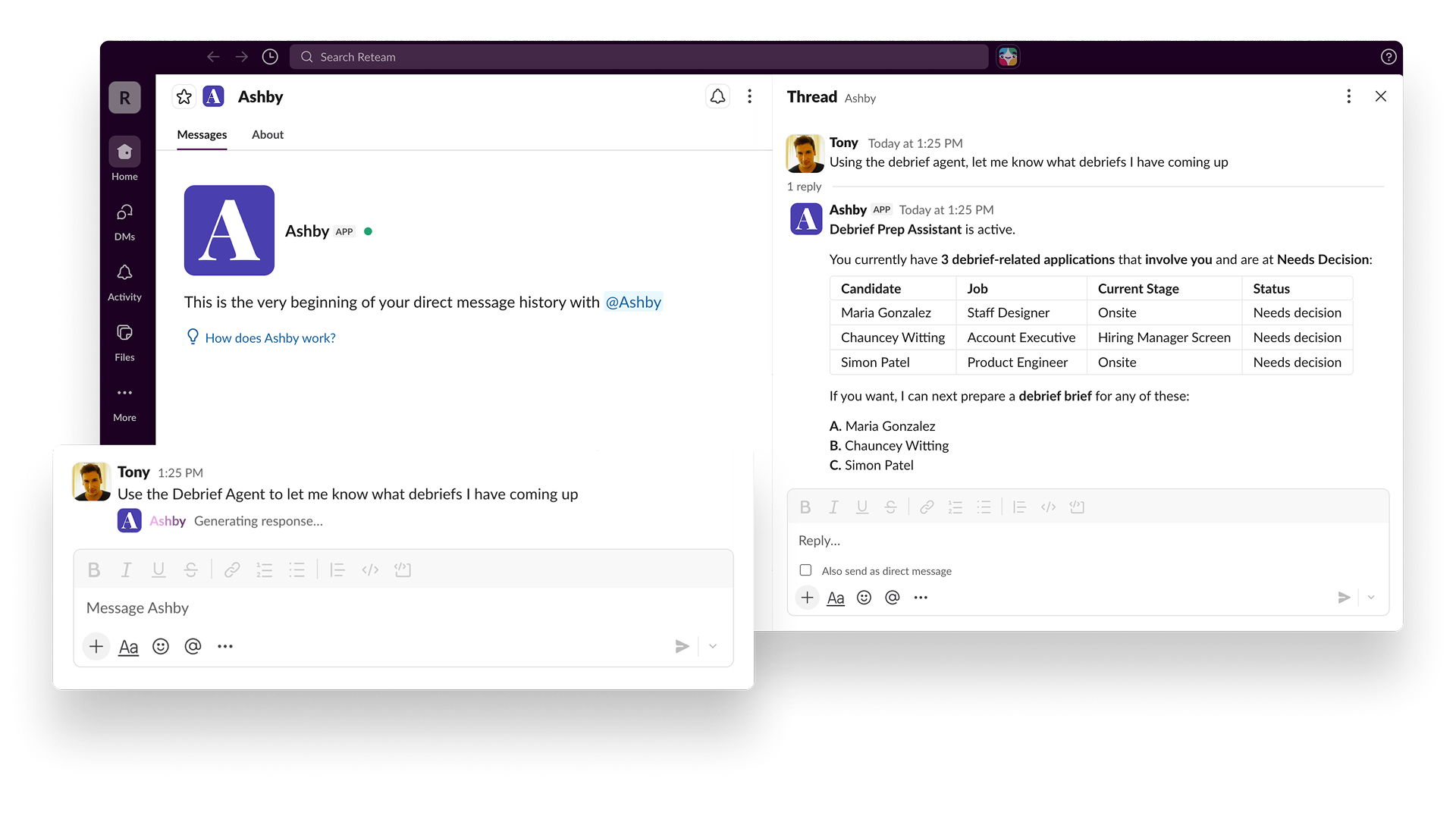
The table in that reply, listing candidates, jobs and stages that "Need decision", is the kind of cross-pipeline query that used to require a report. It also shows why agent pricing matters: an agent that scans the pipeline on a schedule could touch hundreds of records a day, and Ashby has not yet said how many credits such a run will cost after general availability. Ashby's May 2026 keynote, below, is where the Assistant, custom agents and the AI roadmap were introduced; it is worth watching for the agent demos before you sign a multi-year contract that will include their eventual metering.
Product Keynote | Ashby One 2026 San Francisco
5. Three Worked Examples: What AI Credits Cost in Practice
For most small companies Ashby's AI credits are a non-issue, and for high-volume hiring they become a real line item. The only way to know which group you are in is to run the numbers, using the estimation method Ashby itself recommends: "multiplying your historical applicants-per-role by your planned number of hires for the year" - Ashby Knowledge Base. The three scenarios below apply that method with the published rates (1 credit for review, 2 for fraud detection, 1 per rediscovered candidate) and the published overage price of $0.10 per credit. Applicant volumes are illustrative assumptions, labelled as such; substitute your own.
The first scenario is a seed-stage startup. An 18-person company on Foundations (11 to 25 band, annual billing, $4,320 a year) plans 6 hires this year at an assumed 250 applicants per role. That is 1,500 applications. Running application review on all of them costs 1,500 credits and fraud detection another 3,000, for 4,500 credits a year against an allowance of 18,000. The company uses a quarter of its pool, and its AI cost is zero beyond the subscription. Even a viral role that pulls 2,000 applicants in a month would use 6,000 credits. Ashby lists the annual allowance as 18,000 a year account-wide, so an annual account should absorb that from its yearly pool (confirm with Ashby that it is not released monthly); on a monthly plan, where the pool is 1,500 a month, the same spike would force a recurring purchase of five 1,000-credit blocks ($500 for that month) that someone then has to remember to cancel.
The second scenario is a scale-up on Plus. A 250-person company with 6 paid seats gets 15,000 credits a year. It plans 50 hires at an assumed 200 applicants per hire, or 10,000 applications. Review plus fraud detection on everything costs 30,000 credits, and one rediscovery search per role returning 100 past candidates adds 5,000 more. The total of 35,000 leaves a gap of 20,000 credits, which is four 5,000-credit blocks, or $2,000 a year at list price. The alternative is the AI Notetaker bundle, which would add 60,000 credits (10,000 per seat) and cover the gap entirely, at a Notetaker price Ashby does not publish. A third option costs nothing: enable fraud detection only on the jobs that attract fraudulent applicants (Ashby lets you switch it on per job or as an organisation default), since fraud checks are two-thirds of the per-applicant credit cost.
The third scenario is an enterprise with high-volume roles. A 2,000-person company with 30 paid seats gets 375,000 credits a year. It hires 400 people a year at an assumed 300 applicants per hire (120,000 applications), plus a customer-support hiring program that draws another assumed 80,000, for a total of 200,000 applications. Review plus fraud detection costs 600,000 credits, a gap of 225,000. At list price that is 45 blocks, or $22,500 a year; with the Notetaker bundle (an extra 300,000 credits) the gap disappears. This is the scenario where the credit allowance becomes a negotiation item in its own right, and where Enterprise buyers should ask for credits to be written into the contract rather than bought in-app.
The chart below compares the annual credit pool for an account with 10 paid seats on each plan, with and without the AI Notetaker bundle. It shows why bundling, not the base plan, determines how much AI screening you can run.
Annual AI Credits for an Account With 10 Paid Seats
Why this matters: at 10 seats, the Plus base pool (25,000) is barely larger than Foundations (18,000), but the Notetaker bundle multiplies it fivefold, and Enterprise's base pool is already five times Plus. The practical reading is that Ashby's AI meter is designed to be generous for teams that buy bundles and tight for teams that do not. How to apply this: before negotiating, compute three numbers: (1) your expected application volume per year, (2) the credits needed if you run review and fraud detection on all of it (three per applicant), and (3) the credits in the pool you are being offered. If (2) exceeds (3) by more than a few blocks, negotiate the credits into the contract or the bundle into the price, because buying them in-app later happens at the full $0.10 list rate.
6. The Other Meters and Add-Ons
AI credits are the newest meter on Ashby's pricing page, but not the only one. The plan grid also meters candidate texting, sourcing email lookups and, on Foundations, SSO, and it marks four capabilities as paid add-ons whose prices are not published at all. None of these is large on its own, but together they explain why two Ashby customers with the same headcount can pay noticeably different amounts.
Texting, email lookups and SSO
Candidate texting sends two-way SMS to candidates in the US and Canada from a shared company number. Foundations includes 1,000 outbound messages a month, Plus 2,000 per seat per year and Enterprise 3,000 per seat per year, and every plan buys more at $90 per 1,000 messages, in recurring blocks of 1,000 - Ashby. Note the same shape change as AI credits: a monthly account pool on Foundations becomes a yearly per-seat pool above 100 employees, so a five-seat Plus account holds 10,000 texts a year against Foundations' 12,000. For recruiting outside North America, Ashby added WhatsApp messaging in September 2026, which avoids the SMS geography limit for international hiring - Ashby.
Sourcing email lookups find candidates' personal email addresses through data enrichment. Every plan includes 200 a month, and extra lookups are sold in batches of 300, either as a one-off purchase that expires after 30 days or as a recurring monthly amount. Lookups are charged per lookup, not per email found: checking the same candidate three times uses three lookups if emails come back each time, while one lookup that returns two addresses costs one - Ashby Knowledge Base. Ashby's help article shows a recurring lookup purchase adding $100 a month in its worked billing example, but does not publish a per-batch price list. SSO costs $100 a month on Foundations, $1,200 a year, which is a 37% surcharge on the 1 to 10 band's annual price; it is included on Plus and Enterprise.
The add-ons Ashby does not price publicly
Four Ashby add-ons have no published price, and they are the ones most likely to move a quote. The AI Notetaker (records, transcribes and summarizes interviews and drafts feedback) is a paid add-on on every plan. Advanced Scheduling Automation (auto-scheduling, interviewer training, calendar holds, automatic replacement of declined interviewers) is a paid add-on on Plus, included in Enterprise and unavailable on Foundations - Ashby Knowledge Base. Candidate Data Enrichment is a paid add-on on Plus and Enterprise and unavailable on Foundations, and Advanced Diversity Analytics is a paid add-on on Plus and included in Enterprise.
The Notetaker deserves a closer look because Ashby markets it as more than a recorder. Its add-on page stresses that transcripts feed the AI Candidate Assistant, that consent and retention rules sit in the same permission system as the rest of Ashby, and that the bundle comes "with AI Credits" for application review and fraud detection - Ashby. The screenshot below, from Ashby's AI page, shows the interview recording view with a speaker timeline, a searchable transcript and an AI Assistant tab beside the notes.
Ashby's AI Notetaker interview view
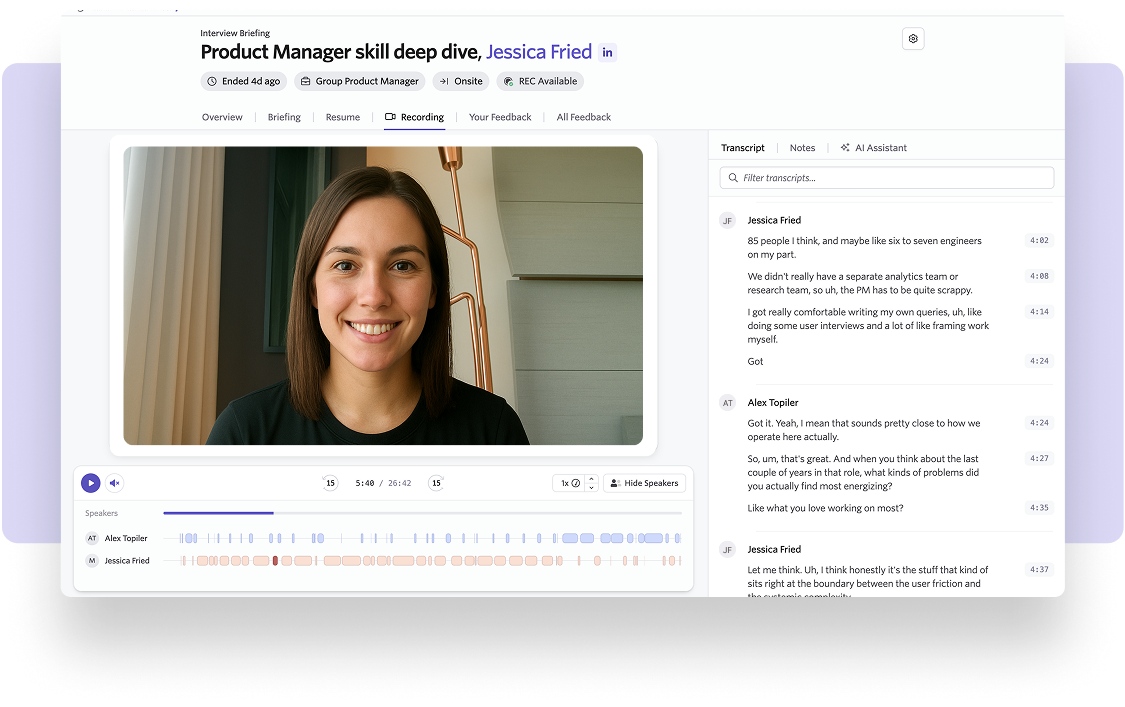
Note the "AI-generated Interview Summaries" feature listed as included on every plan: it summarizes recordings "captured by the AI Notetaker", so in practice the included summaries depend on the paid add-on. That is the main way the "everything included" message on Ashby's pricing page stretches. How to apply this: if interview intelligence matters to you, compare the Notetaker quote with a standalone tool before bundling it. Specialist interview-intelligence vendors price in very different ways, as our breakdown of Metaview's pricing shows, and the credits bundled with Ashby's Notetaker are only valuable if you would otherwise run out.
7. How Ashby's Pricing Changed From 2024 to 2026
Ashby's list prices have not moved in almost two years; what changed is how much of the bill is metered. Archived copies of the pricing page show the same five Foundations values, $300, $400, $500, $700 and $900, in snapshots from January 2025 - Wayback Machine, June 2025, October 2025, February 2026 and June 2026, and the live page still carries them. In February 2024 the archived page showed Foundations at $400 a month for companies up to 100 employees, and described Plus as offering "two pricing models to allow you to decide between flexibility or predictability" - Wayback Machine.
The metering arrived in steps. The sequence below is reconstructed from Ashby's product announcements, its knowledge base and archived pricing pages.
| Date | What changed |
|---|---|
| September 16, 2025 | Fraud detection launches on all plans using existing AI credits, with a promised credit-system update |
| September 25, 2025 | Enterprise's AI allowance rises to 12,500 credits per seat per year |
| May 7, 2026 | Ashby Assistant and custom agents launch in beta, free until general availability, then on credits |
| June to September 2026 | MCP server, conversational agent creation and Scheduled Agents ship as included features |
| July 12 to August 21, 2026 | The pricing page adds AI credit, SSO, texting and email lookup rows |
The pattern is that Ashby kept its entry price stable and has been moving AI cost into a usage meter. That is visible in the archive: the July 12, 2026 snapshot of the pricing page contains none of the AI credit, SSO or texting rows, and the August 21 snapshot contains all of them - Wayback Machine. The knowledge base also carries a Legacy Plus plan, which keeps the Foundations-style 1,500-credits-a-month allowance, a sign that Plus itself was restructured and older Plus customers were left on their previous terms. How to apply this: if you are an existing customer on Legacy Plus, check whether moving to current Plus would raise or lower your credit pool before accepting any "upgrade", because with fewer than eight paid seats it lowers it.
Ashby's growth explains why it can afford to hold the list price. When it raised a $50 million Series D in July 2025, Ashby said it had grown from 1,300 to over 2,700 customers in just over a year, grown revenue 135% year over year, crossed 220 employees, and that over 50% of customers already used Ashby AI in daily workflows - Ashby. A company growing that fast with a usage meter in place does not need list price increases; volume growth does the work.
8. What Ashby Buyers Actually Pay
Contract data puts the typical Ashby deal at about $21,000 a year, more than double the most expensive published Foundations price. Vendr, which aggregates purchase data from software buyers, reports a median of $20,878 a year across 167 Ashby purchases, with buyers saving 21% on average against the initial quote and contracts ranging from $9,012 to $110,664 - Vendr. Because the low end of that range sits close to Foundations' $9,720 annual ceiling, most of the dataset is evidently Plus and Enterprise business.
The same page offers narrative guidance that companies of 100 to 300 employees typically see annual platform costs of $30,000 to $70,000, and 300 to 500 employees $60,000 to $120,000. Treat those ranges as Vendr's commentary rather than measured medians, since they are not tied to a stated sample. The measured numbers are the median, the range and the average saving, and the comparison with peers is the useful part. The chart below sets Ashby's median against the three rivals buyers most often shortlist with it, using the same Vendr source for each.
Median Annual Contract Value, Vendr (October 2026)
Why this matters: Ashby's median sits between Lever's $15,492 (320 purchases) and Greenhouse's $26,553 (886 purchases), with Gem at $25,699 (234 purchases) - Vendr. Medians mix company sizes, so they do not mean Ashby is cheaper than Greenhouse for your company, but they do show that a typical Ashby contract is not a premium outlier despite Ashby's reputation as the analytics-heavy option. The 21% average saving is the more actionable number: it is the highest of the four (Greenhouse and Lever show 16%, Gem 20%), which suggests Ashby's first quotes leave meaningful room. How to apply this: treat any first Plus quote as an opening position, bring a competing Greenhouse or Gem quote, and use the 21% figure as the floor of what to ask for rather than the ceiling.
9. Where Ashby Wins and Where It Falls Short
Ashby's pricing is genuinely good value for a company that uses the whole platform, and poor value for one that only needs an ATS. The single-price, no-modules model means a startup gets sourcing sequences, a CRM, scheduling automation, analytics and AI screening for $270 to $810 a month on annual billing, where assembling the same stack from separate tools would mean an ATS, a sourcing CRM, a scheduling tool and a BI layer, each with its own contract. The analytics in particular are why Ashby sells a standalone Analytics product to companies on other ATSs, and they are included on every plan.
Ashby is also unusually transparent for its category. Greenhouse, Lever, Teamtailor and Pinpoint publish no prices at all; Ashby publishes the full Foundations ladder, the AI credit allowances, the per-action credit rates and the overage price. For an AI-heavy product, publishing the meter is the honest choice, and the knowledge base's guidance (an 80% warning, a pause rather than a surprise overage charge) is buyer-friendly. The keynote below, from Ashby One in London in September 2026, includes a 20-minute day-in-the-life demo starting at 42:45 that shows application review, rediscovery, scheduling and reporting working together, which is the best way to judge whether you would use enough of the platform to justify the all-in-one price.
Ashby One 2026 London Product Keynote
Where Ashby falls short on price is more specific. Two weaknesses have already come up: headcount bands move you up a price step at renewal even if your recruiting usage is flat, and the unpriced add-ons (Notetaker, Advanced Scheduling, enrichment) make the true cost of a Plus or Enterprise deal impossible to estimate before a sales call. Three more show up in real bills:
- The 100-employee cliff: published pricing stops at $9,720 a year and typical contracts above it run about twice that
- Shrinking AI pools: Plus accounts with fewer than eight paid seats get fewer credits than Foundations
- Thin sourcing data: 200 email lookups a month and no candidate database of its own
The last point matters most for teams that hire through outbound sourcing. Ashby's sourcing tools are excellent at running outreach: sequences, AI-personalized emails and reply tracking are all included, as the screenshot below shows. What Ashby does not do is find people who are not already in your database or on a page you are browsing with its Chrome extension, and the 200 monthly email lookups cover roughly ten per working day across the whole company. For a recruiter running a few outbound searches a week that is enough. For a team that sources most of its hires, it is the binding constraint, and buying extra lookups in batches of 300 only raises the ceiling without adding new people to search.
Ashby's AI-personalized outreach sequences
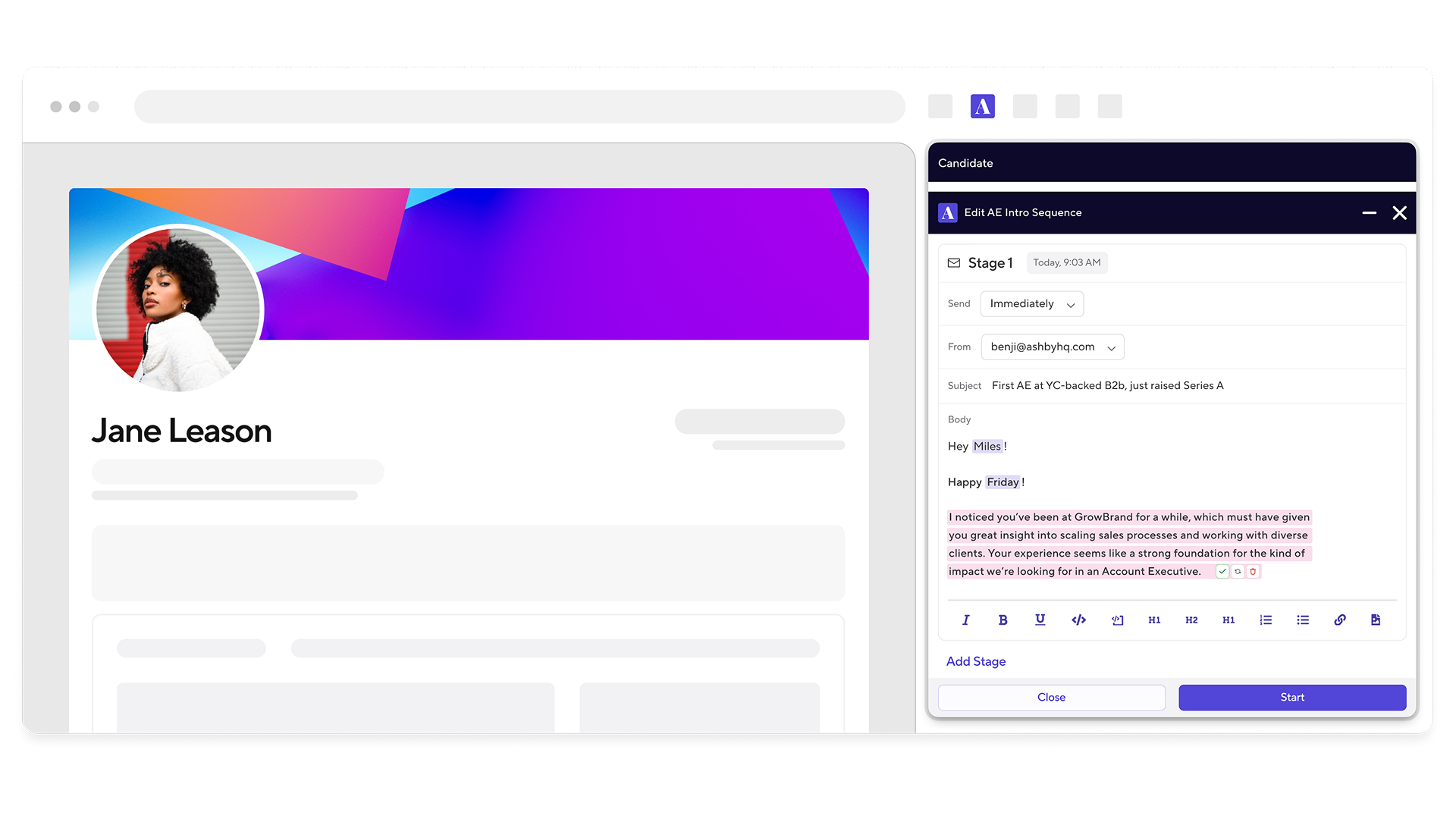
The highlighted paragraph in that email is Ashby's AI personalization token, written from the job posting and the candidate's resume. The weakness is upstream of this screen: the sequence is only as good as the list of candidates fed into it. How to apply this: if more than a third of your hires come from outbound sourcing, budget for a sourcing data layer alongside Ashby (section 10 covers the options) rather than buying extra lookups in batches of 300. If your hiring is mostly inbound and referrals, Ashby's included sourcing tools are more than enough.
10. The Best Ashby Alternatives in 2026
The right Ashby alternative depends on which part of Ashby's price you are trying to avoid. Teams leaving over the post-100-employee contract price usually compare Greenhouse, Lever and Gem. Teams that find the all-in-one more than they need compare Workable, Teamtailor and Manatal. Teams whose real problem is finding candidates, not tracking them, do not need a different ATS at all. The seven options below cover all three cases, with prices read from each vendor's own page in October 2026.
Two smaller options are worth a line before the main list. Pinpoint prices only on request - Pinpoint. Rippling Recruiting is priced per employee per month inside Rippling's platform, whose plans "start at $8 per employee per month" - Rippling. It is a sensible choice only if you already run payroll on Rippling.
Greenhouse
Greenhouse is the default enterprise alternative, and it publishes even less than Ashby. Its pricing page lists three plans, Core, Plus and Pro, with no dollar figure on any of them - Greenhouse. Greenhouse has added AI features including an AI notetaker and AI report filters, but its pricing page shows no AI credit meter or separately priced AI add-on, which is a meaningful difference from Ashby's metered approach for high-volume teams.
On contract data, Greenhouse's median is $26,553 a year across 886 purchases, with a range of $10,215 to $74,007 and a 16% average saving. The larger sample makes it the most reliable benchmark in the category. Greenhouse's strengths are its structured-hiring methodology, its very large integration marketplace and its familiarity to experienced recruiters, many of whom have used it for years. Its weaknesses relative to Ashby are thinner native CRM and sourcing, which many Greenhouse customers fill with a separate tool, and analytics that are less flexible than Ashby's.
Best for: companies above 300 employees that want the most established structured-hiring platform and expect to buy a separate sourcing CRM. Our Greenhouse pricing guide breaks down its tiers in detail.
Lever
Lever is the cheapest of the established mid-market ATSs on contract data, but it is quote-only. Its pricing page says pricing is "available upon request" and shows no figures - Lever. Lever is owned by Employ, the group that also owns Jobvite, and it has been an ATS-plus-CRM product since before Ashby existed, which is why it is often the first alternative a scaling startup evaluates.
The Vendr median is $15,492 a year across 320 purchases, ranging from $6,718 to $51,648, with a 16% average saving - Vendr. That is about $5,400 below Ashby's median. Lever's combined ATS and CRM model is closest to Ashby's in philosophy, and for nurture-heavy recruiting it remains competitive. Where it lags in 2026 is the pace of AI shipping: Ashby has released agents, an MCP server, rediscovery and scheduled agents in the past six months, and buyers comparing the two should ask Lever for a dated AI roadmap.
Best for: 100 to 500-person companies that want ATS and CRM in one, prioritise a lower contract price over the newest AI features, and are comfortable negotiating. See our Lever pricing breakdown for more.
Gem
Gem is the closest like-for-like competitor to Ashby, and it has the most aggressive startup offer in the category. Gem sells two products: "Gem + Your ATS", which layers its sourcing CRM on an existing ATS, and Gem All-in-One, which includes its own ATS. Both are priced on company FTE count. For startups, Gem's page states that companies under 30 employees get Gem All-in-One "free for six months, then 50% off when you move to a paid plan", and that 30 to 100-person companies get reduced rates from day one without a sales call - Gem. Its startup calculator shows $130 a month for a 1 to 10 person company on yearly billing, struck through from $270.
On contract data, Gem's median is $25,699 a year across 234 purchases, ranging from $7,000 to $73,076 - Vendr. Gem's historic strength is outbound sourcing and CRM, which is exactly where Ashby is thinnest, so a sourcing-led team may find Gem All-in-One a better fit. The trade-off is that Gem's ATS is newer than Ashby's and its analytics are less deep.
Best for: startups under 30 people (the six free months are hard to beat) and sourcing-heavy teams that want CRM depth inside their ATS. Our Gem pricing guide covers its tiers.
Workable
Workable is the transparent mid-market alternative, with published prices at every company size and its own AI credit meter. Its Standard plan costs $299 a month on annual billing ($360 on monthly billing) for companies of 1 to 20 employees, with Premier at $599 a month and Enterprise at $719, both annual-only, and prices rising by headcount band - Workable. Add-ons are priced openly: texting at $89 a month, video interviews at $109 and assessments at $59.
The Workable Agent is the closest analogue to Ashby's AI credits. Every ATS plan includes 3,000 credits to start, and packs cost $600 for 5,000, $1,000 for 10,000 and $4,750 for 50,000, about $0.095 to $0.12 per credit, expiring after one year. That is close to Ashby's flat $0.10. The difference is scope: Workable's agent charges per action across evaluation, sourcing and chat, while Ashby meters only three high-volume features and keeps the rest free. Workable is also a broader HR suite option for companies that want recruiting and HR in one bill.
Best for: SMBs that want a published price, a 15-day trial and a simpler product than Ashby. Our Workable pricing guide decodes every band and the Agent's credit rules.
Teamtailor
Teamtailor is the employer-brand alternative, and it takes the opposite approach to AI pricing. It publishes no price and quotes every customer, but its pricing page promises unlimited job postings and unlimited users and lists "Teamtailor AI" as included with unlimited usage - Teamtailor. For a company that expects to run AI screening on large inbound volumes, an unmetered AI promise removes the planning exercise in section 5 entirely, provided the contract says the same thing.
Teamtailor's strength is its career-site builder and candidate experience, which suits brand-led employers that hire at volume. Its weakness relative to Ashby is analytics and outbound sourcing depth: it is built to attract and convert inbound applicants, not to run multi-stage sourcing sequences or a heavy reporting function.
Best for: inbound-heavy, brand-led hiring, especially in Europe, where unmetered AI and a strong careers site matter more than analytics.
Manatal
Manatal is the budget alternative for small teams that need tracking, not a platform. It is priced per recruiter seat, not by company size: Professional costs $15 per user per month billed annually ($19 monthly) and is capped at 15 jobs and 10,000 candidates; Enterprise costs $35 ($39 monthly) with unlimited jobs and candidates; and Enterprise Plus costs $55 ($59 monthly) - Manatal. There is a 14-day trial.
The seat-based model is what makes Manatal interesting against Ashby. Ashby charges a 90-person company with two recruiters the 76 to 100 band, $9,720 a year on annual billing. The same two recruiters on Manatal's unlimited Enterprise tier pay $840 a year. The trade-off is everything that makes Ashby an all-in-one: Manatal has AI candidate scoring and a recruitment CRM, but nothing comparable to Ashby's analytics, sequencing or scheduling automation, and agencies form a large part of its customer base.
Best for: small in-house teams and agencies whose recruiting is simple enough that an all-in-one platform would be paid for and left unused.
HeroHunt.ai
HeroHunt.ai is not an ATS, and for many Ashby customers that is the point. The gap identified in section 9 (Ashby runs outreach well but does not find candidates it does not already have) is the gap HeroHunt.ai fills. Its AI Recruiter searches over 1 billion profiles, screens candidates against your criteria with language models, finds their emails and runs personalized outreach, and RecruitGPT builds a shortlist from a single prompt. HeroHunt.ai connects to Ashby directly, so approved candidates land in your Ashby pipeline instead of a spreadsheet.
The pricing model is the opposite of Ashby's in a useful way. HeroHunt.ai publishes its price on its plans page: an 8-day free trial (card required), then plans from $99 a month with unlimited positions and searches, metered on AI-screened profiles delivered and candidate emails found rather than on headcount. A team that keeps Ashby as its system of record and adds HeroHunt.ai for outbound gets the sourcing volume Ashby's 200 monthly lookups cannot provide, without renegotiating its Ashby contract.
HeroHunt.ai
If Ashby's 200 monthly email lookups are your bottleneck, HeroHunt.ai is built for exactly that half of the job: it searches over 1B profiles, screens each one against your criteria with AI and finds the contact details, then pushes the candidates you approve straight into Ashby through the built-in integration. Plans start at $99 a month with unlimited positions and searches. The honest caveat: it is a sourcing tool, not an ATS, so it adds to an Ashby bill rather than replacing one, and it only earns its place if outbound is a real share of your hires.
Best for: Ashby customers (or Ashby evaluators) whose hiring depends on outbound sourcing, and who want to keep Ashby for tracking while automating the search. Our guide to sourcing candidates in Ashby shows how the two work together.
11. Full Comparison: Price, Meter and Best Fit
The table below compresses the alternatives into the three facts that decide a shortlist: what is published, what the bill is metered on, and how AI is charged. Contract medians come from Vendr and published prices from each vendor's own pricing page, both read in October 2026. Where a vendor publishes nothing, the table says so rather than estimating.
The comparison is most useful read column by column. The "meter" column explains why your bill will move: by headcount (Ashby, Workable, Gem), by seat (Manatal), by quote (Greenhouse, Lever, Teamtailor) or by sourcing usage (HeroHunt.ai). The AI column shows the newest source of variance, which is whether AI screening is metered per candidate, bundled, or unlimited.
| Platform | Published price | Bill is metered on | How AI is charged | Vendr median | Best for |
|---|---|---|---|---|---|
| Ashby | $300-$900/mo up to 100 employees | Company headcount; seats above 100 | Credits: 1 per review, 2 per fraud check, $0.10 overage | $20,878 | All-in-one with deep analytics |
| Greenhouse | None (Core, Plus, Pro) | Quote | No credit meter shown | $26,553 | Structured hiring at scale |
| Lever | None | Quote | Not published | $15,492 | ATS plus CRM at a lower contract price |
| Gem | $130/mo (1-10 FTE, yearly); free 6 months under 30 | Company FTE count | Not published | $25,699 | Sourcing-led teams, startups |
| Workable | $299/mo (1-20, annual) | Company headcount | Agent credits, 3,000 included, ~$0.10 each | Not used here | Transparent SMB pricing |
| Teamtailor | None | Quote; unlimited users | AI included, unlimited usage | Not used here | Employer brand, inbound volume |
| Manatal | $15-$55/user/mo | Recruiter seats | Included in plans | Not used here | Small teams on a budget |
| HeroHunt.ai | From $99/mo | Profiles screened and emails found | AI screening is the product | Not applicable | Outbound sourcing into Ashby |
Why this matters: the table shows that no alternative is simply "a cheaper Ashby". Lever is cheaper on contract data but slower on AI; Workable and Manatal are cheaper and transparent but far less capable; Gem matches Ashby's ambition and beats it for small startups; Teamtailor removes the AI meter but not the quote. How to apply this: circle the meter that matches how your company grows. A company adding headcount fast but hiring few recruiters is punished by headcount pricing and favoured by seat pricing; a company with a small team and huge inbound volume is punished by per-candidate AI credits and favoured by unmetered AI.
12. How to Choose, and How to Buy Ashby Well
Choosing comes down to four questions, and the answers map cleanly onto a plan or an alternative. How many employees will you have at renewal? Do you need approvals, custom fields or Workday? How many applications will your AI screening touch? And how much of your hiring is outbound? The decision tree below turns those questions into a recommendation.
The tree is deliberately simple. It assumes you have already decided you want an all-in-one ATS, and it treats sourcing as a separate decision because, as section 9 showed, Ashby's included sourcing data is the part of the platform most likely to run short.
Read the tree from the bottom node upward: whatever plan you land on, the final question about outbound sourcing applies to all of them. For the Ashby purchase itself, the tactics that consistently move the price are simple. These are the ones grounded in Ashby's own published terms:
| Tactic | What to do | Why it works |
|---|---|---|
| Buy annually | Pay a year upfront | Saves 10%, and Ashby lists the Foundations AI allowance as 18,000 a year on annual terms |
| Time the band | Sign just before you cross a headcount boundary | Locks the lower band for a year, since pricing is reassessed annually |
| Write credits in | Put the AI allowance in the contract | In-app blocks are recurring and billed at the full $0.10 per credit |
| Define "paid seat" | Agree in writing who counts as a seat on Plus | Seats drive both your price and your AI credit pool |
| Bring a rival quote | Get a Greenhouse, Lever or Gem quote first | Vendr's 21% average saving shows how far a first quote typically moves |
Each of these attacks a different part of the bill. Annual billing is the only discount Ashby publishes, and a yearly credit allowance is worth more than the 10% to a team with uneven hiring. Band timing matters because pricing is reassessed annually on headcount, so the date you sign is effectively a price lever. Contracted credits matter because in-app purchases are recurring and billed at list. The seat definition matters twice on Plus, since seats drive both price and the AI allowance. And the competing quote matters because Ashby, growing fast and holding its list price, competes on deals rather than on its rate card. If you are a startup, also ask for emerging market pricing if it applies, and note the small perks: Ashby gives a $200 Amazon gift card to both sides of a customer referral.
13. The Bottom Line
Ashby is fairly and transparently priced for companies under 100 employees, and becomes a negotiated, metered contract above that. Foundations costs $300 to $900 a month by headcount, 10% less on annual billing, and includes nearly the whole platform, AI agents and MCP included. Above 100 employees, contracts typically run around $20,878 a year on Vendr's data, the AI allowance switches to 2,500 credits per paid seat on Plus and 12,500 on Enterprise, and the Notetaker and Advanced Scheduling add-ons are quote-only. AI credits cost $0.10 each beyond the allowance, at 1 credit per application review, 2 per fraud check and 1 per rediscovered candidate, and the Assistant and custom agents will start drawing on the same pool once they leave beta.
The decision framework is short. If you are under 100 employees and will use the ATS, CRM, scheduling and analytics together, Foundations is excellent value and you should buy it annually. If you are crossing 100 employees with a small talent team, check the AI credit math before upgrading, because Plus with fewer than eight paid seats gives you a smaller pool than Foundations did. If you are an enterprise, push for Enterprise-level credits even on Plus terms, and only pay for Enterprise if you need Workday, Snowflake or audit logs. If Ashby's price above 100 employees is the problem, get quotes from Greenhouse, Lever and Gem; if the platform is more than you need, look at Workable, Teamtailor or Manatal.
And if your real constraint is finding candidates rather than tracking them, keep Ashby and add a sourcing layer: HeroHunt.ai searches over 1B profiles, screens them with AI and sends the ones you approve straight into Ashby, which is the part of hiring Ashby's 200 monthly lookups were never designed to cover. For a wider view of how every major recruiting tool is priced, see our recruiting software pricing guide, or our comparison of Greenhouse, Ashby and Workday as agentic ATSs.
This guide reflects Ashby's pricing page, knowledge base and announcements as of October 2026, and Vendr contract data read on October 24, 2026. Ashby revises its AI credit system and add-ons frequently, and the Assistant's credit rate had not been published at the time of writing. Verify current details with Ashby before purchasing.