



What SeekOut's plans cost in 2026, how its contact credits run out, what buyers really pay for the custom tiers, and the alternatives worth pricing
SeekOut finally publishes a price: $149 a month. That is its self-serve plan, SeekOut Sourcing Core, billed annually upfront at $1,788 a year, or $179 a month if you pay month to month - SeekOut Pricing. Until 2026 SeekOut sold only annual contracts through its sales team, listed a three-seat minimum from mid-2025, and published no number at all. That changed in June 2026, when it launched a credit-card plan for solo recruiters and small teams.
But the published price is only the entrance. The three tiers above it are still quoted by sales, and the median buyer pays $20,000 a year, across 65 tracked purchases ranging from $5,820 to $54,920 - Vendr. Between those two numbers sit the things that decide your real cost: a 500-credit monthly allowance that does not roll over, a plan card and a feature table that disagree about how many seats you get, filters (security clearance, diversity, healthcare) that only unlock on the custom tiers, and contract terms with no refunds on any prepaid period.
This guide breaks down every SeekOut plan and what it includes, how the contact and export credits actually work, what buyers pay for the unpublished tiers, how SeekOut's pricing changed between 2025 and 2026, the contract fine print for self-serve and sales-led deals, what the newer products (MCP, AI screening, the AI Coworker and the Spot service) cost, and the nine strongest SeekOut alternatives with their real prices. Every SeekOut figure below was read from SeekOut's own pricing page, help center, documentation or terms in October 2026.
Written by Yuma Heymans (@yumahey), founder of HeroHunt.ai, the AI Recruiter that sources candidates from a billion-plus profile index and runs outreach on autopilot. Having built a sourcing product that competes with SeekOut, he reads pricing pages the way a buyer should: by asking what one reachable, relevant candidate actually costs.
HeroHunt.ai
SeekOut's $149 plan buys a search seat: you still run every search, read every profile and spend a contact credit for each email you want. Its 500 credits a month do not roll over, and filters like inferred security clearance and diversity insights sit on the custom tiers, whose median contract is $20,000 a year. HeroHunt.ai sells the other half of the job. It searches a profile index that reaches past a billion profiles on its Pro and Team plans, screens each candidate against your role with language models and drafts and sends the outreach itself, on published plans from $99 a month after an 8-day free trial (card required). The honest caveat: HeroHunt.ai has no equivalent of SeekOut's cleared-talent filters, its diversity analytics or its ATS rediscovery of silver medalists, so an enterprise team that needs those still belongs on a SeekOut quote. For an individual recruiter or a small team that wants candidates in the inbox rather than another search tool, it is the faster route.
Contents
- SeekOut Pricing at a Glance
- Sourcing Core: What $149 a Month Actually Buys
- How SeekOut Credits Work
- The Custom Tiers: Sourcing, Integration and Full Funnel
- What Buyers Actually Pay
- How SeekOut Pricing Changed From 2025 to 2026
- The Fine Print: Self-Serve Terms and Order Forms
- MCP, AI Screening, AI Coworker and Spot: What Costs Extra
- Where SeekOut Wins and Where It Falls Short
- The 9 Best SeekOut Alternatives in 2026
- Full Comparison: Price, Meter and Best Fit
- How to Choose, and How to Buy SeekOut Well
- The Bottom Line
1. SeekOut Pricing at a Glance
SeekOut sells its recruiting software in four tiers, and only the first one has a price you can see. Sourcing Core is the self-serve plan at $149 a month on annual billing or $179 on monthly billing. Sourcing, Sourcing + Integration and Full Recruiting Funnel are all marked "Custom" and billed annually, with per-seat pricing that SeekOut says "adjusts with volume" - SeekOut Pricing. Annual billing on Core saves exactly $360 a year, the difference between $2,148 (twelve monthly payments) and $1,788.
The tier names changed twice in 2026, which matters if you are comparing quotes or reading older reviews. The self-serve plan first appeared in May as Recruit Lite, launched in June as Recruit Core, and now appears as "SeekOut Sourcing Core (Recruit Core)". The team tiers carry "(Recruit)" after their new names for the same reason. Older plan names you may still see in third-party articles, such as Professional, Enterprise and Ultimate, belong to the early 2025 lineup and no longer exist.
| Plan | Price | Billing | Seats | Contact credits | Exports |
|---|---|---|---|---|---|
| Sourcing Core | $149/mo ($1,788/yr) or $179/mo | Annual upfront or monthly, card | 3 in the table, "individual" on the card | 500/mo | 1,000/mo |
| Sourcing | Custom | Annual | Per seat | 750/seat/mo | 5,000/seat/mo |
| Sourcing + Integration | Custom | Annual | Per seat | 750/seat/mo | 5,000/seat/mo |
| Full Recruiting Funnel | Custom | Annual | Custom | Custom | Custom |
Two features cut across all four tiers. Every plan includes unlimited search across SeekOut's 1B+ profiles with no query limits, and every plan includes email integration, AI multi-step outreach campaigns and Excel, PDF or ATS export. What changes as you climb is the data you can filter on, the credit allowance, the ATS connection, and the service wrapped around the software.
Why this matters: the tier you need is decided less by team size than by which filters your roles require. A recruiter hiring cleared engineers for a defense contractor cannot use Core at any team size, because inferred security clearance starts at the Sourcing tier. How to apply this: list the three filters you use most on your hardest roles, find the cheapest tier that has all three, and treat that tier's quote as your real SeekOut price.
2. Sourcing Core: What $149 a Month Actually Buys
Sourcing Core is a genuine product, not a crippled demo, and SeekOut built it for a specific buyer. Its launch post describes a plan "for small businesses and solo recruiters who need to source, evaluate, and engage candidates without an elaborate contract or a six-figure budget", and promises the same 1B+ talent index and AI search its enterprise customers use - SeekOut. The post went live on 11 June 2026 and is the clearest statement of what the plan is meant to be: "Pay monthly, cancel any time, run it on a credit card. Or pay $1,788 upfront which works out to $149 per month."
In practice Core gives you Smart Match search (paste a job description and SeekOut builds the query), more than 30 filters plus standard power filters, Workspaces for scoring candidates against a rubric and building shortlists, multi-step outreach sequences sent from your own mailbox, talent pool insights, and the help center with on-demand training. It also includes SeekOut MCP, which lets you run the same searches from inside Claude, ChatGPT, Copilot or Gemini, at no extra cost.
The seat count SeekOut cannot agree on
SeekOut's own pages describe Core in two incompatible ways. The plan card calls it "for individual recruiters getting started with AI-powered talent search" and "best for solo sourcers and teams getting started with their first dedicated recruiting seat". The comparison table directly below it lists "Seats included: 3" for Sourcing Core, with additional seats "Not included" - SeekOut Pricing. The same three-seat row appeared in the July 2026 version of the page, so it is not a one-day typo.
The credit allowance is where this stops being academic. Core's 500 contact credits are listed without a "per seat" qualifier, while the next tier states "750/seat". If Core really is three seats sharing 500 credits, each recruiter gets about 167 contact lookups a month; if it is one seat, that one person gets all 500. Budget for the shared reading until SeekOut confirms otherwise in writing, because it is the reading that makes you run out of credits.
There is a simple way to settle it for your own account. During the trial, open the account page, where SeekOut shows your plan's credit balance, and ask support by chat which seat count and credit pool your paid plan would carry. Then keep the answer. Under SeekOut's self-serve terms the plan page you buy from is your order form, so a written answer from support is the closest thing to a contract term you will get on a card purchase.
What Core leaves out
The exclusions are the real price of the cheap tier, and they are listed in SeekOut's comparison table rather than hidden. That is to SeekOut's credit: several rivals bury the same limits in a sales call. It also means you can check, before you start a trial, whether the plan you can afford covers the roles you actually recruit for.
The gaps fall into three groups. Some are filters (clearance, diversity and inferred attributes), some are enterprise controls such as single sign-on, and some are data sources that SeekOut treats as separate entitlements. Each one pushes a particular kind of buyer onto a custom quote, and none of them can be bought as an add-on to Core: the only way to get them is to move up a tier. Core does not include:
- Advanced inferred power filters, including inferred security clearance
- Diversity filters and insights, which start at the Sourcing tier
- SSO or SAML, so IT-managed companies usually cannot buy it
- ATS rediscovery and integration, reserved for Sourcing + Integration
- Healthcare search, which needs a separate entitlement
The healthcare line deserves a second look, because SeekOut contradicts itself here too. The Core launch post lists "specialized healthcare data" as part of the index you get. The pricing table marks Healthcare search "Not included" for Core, and SeekOut's MCP documentation says Recruit Core covers public profiles, GitHub and academic search "but not Healthcare or Nursing search", which "require the Healthcare search entitlement" - SeekOut Docs. The free trial, meanwhile, includes the Healthcare and Nursing pools. So a healthcare recruiter can trial a capability on Core that the paid plan does not include. If you hire nurses or physicians, get healthcare access confirmed on your order before you pay.
The SSO line quietly decides more purchases than any filter. Many companies above a few hundred employees require single sign-on for every SaaS tool that holds candidate data, which means their IT or security team will reject Core regardless of price. If your company has that rule, skip the self-serve plan entirely and start the conversation at the Sourcing tier, where SSO is included.
The trial itself is generous: 14 days, no credit card, a work email only, with unlimited search, MCP access and outreach included - SeekOut free trial. SeekOut says that is enough time to run a complete workflow for one or two open roles. When it ends you keep read-only access to the workspaces you built, and SeekOut's team "will reach out" to sell you a plan.
SeekOut's own graphic of Workspace Express, launched in March 2026, shows the core loop the plan is built around: paste a job description, let the AI extract must-haves, adjust, and get a ranked shortlist.
Workspace Express: from job description to ranked shortlist
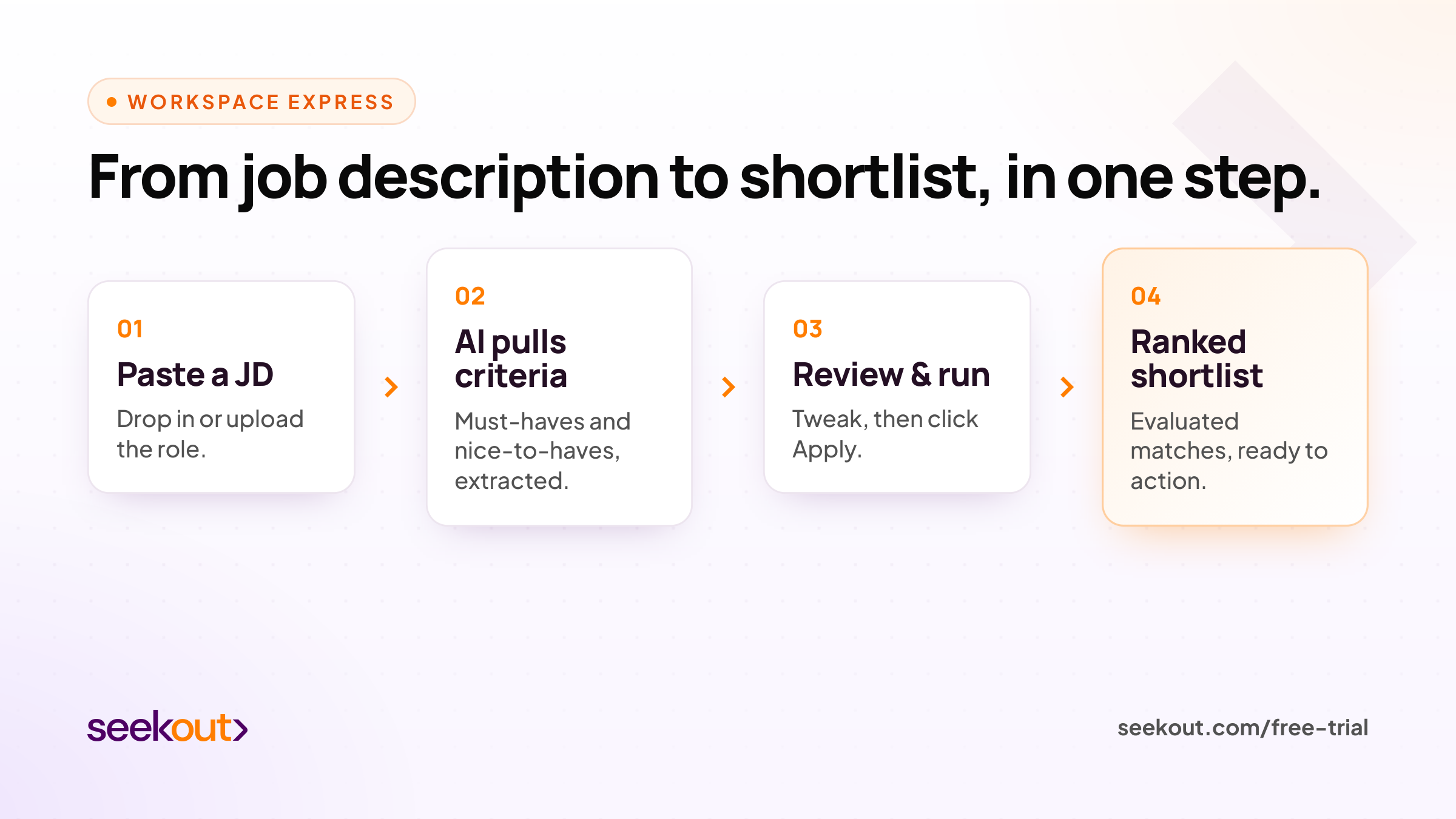
Notice that every step in the graphic ends before the expensive part. Searching and ranking are unlimited on Core, but turning a ranked candidate into someone you can contact spends a credit, and the shortlist only becomes useful once you have their email. That is why the credit section below matters more than the feature list above.
3. How SeekOut Credits Work
SeekOut meters two things: contact credits for revealing emails and phone numbers, and export credits for downloading profiles. Searching, filtering, viewing profiles and building shortlists cost nothing, which is why SeekOut can honestly advertise unlimited search on every plan. The meter only starts when you want to reach someone or take their data out of the platform.
The rules come from SeekOut's help center, updated on 1 September 2026, and they are more buyer-friendly than most rivals in one respect and stricter in another. On the friendly side, SeekOut only charges for successful lookups. It deducts credits when you request contact details and refunds them for any candidate where it cannot find a valid email or phone number: ask for ten emails, get eight, and two credits come back - SeekOut Help Center. On the strict side, plan credits do not roll over.
Email credits and phone credits are separate
SeekOut splits contact information into two categories. "Each email contact info credit retrieves email addresses for one candidate. Each phone number contact info credit retrieves phone number information for one candidate", and if SeekOut finds three email addresses for the same person, it still costs one credit - SeekOut Help Center. The pricing page, however, just says "500 contact credits" for Core and does not say whether that covers emails and phones together or each separately. Ask before you sign, because a recruiter who calls candidates needs both for every person.
That ambiguity matters most for phone-heavy recruiting, such as healthcare, trades or agency work, where a call converts better than an email. If 500 covers both types, a recruiter who wants an email and a mobile number for each candidate can only fully reach 250 people a month. If it covers each type separately, the same recruiter can reach 500. The practical rules worth knowing before you plan a month of sourcing are these:
- No rollover: "Credits do not roll over from month to month"
- Add-on credits never expire, unlike plan credits
- Packs of 100: extra contact credits are bought in the app by card
- Exports: one credit per candidate exported, re-downloads are free
- Pooling: on request, credits and revealed contacts are shared team-wide
The no-rollover rule and the never-expiring add-ons pull in opposite directions, and you can use that. Plan credits are use-it-or-lose-it, so a slow month wastes them, while purchased packs sit in your account until needed - SeekOut Help Center. SeekOut does not publish the price of a 100-credit pack, so ask for it in writing before you rely on top-ups. Note also that teams on pooled credits cannot buy packs in the app; their CSM handles it.
Credit pooling changes who sees what
Pooling is not just an accounting setting. When it is on, "both credits and retrieved contact details are shared across your organization": if one recruiter spends a credit on an email, every licensed user sees it - SeekOut Help Center. That saves a team from paying twice for the same candidate. The catch is the off switch. If your organization later disables pooling, all shared emails and phone numbers disappear from every profile and each recruiter has to spend their own credits to retrieve them again.
The same help article gives an example that hints at the standard allowance on older licenses: ten standard licenses pooled into 5,000 contact credits a month, which is 500 per license. Today's Sourcing tier lists 750 per seat. If you are renewing an older contract, check which figure your order form uses, because a 250-credit difference per seat is 3,000 lookups a year per recruiter.
Pooling pays off when recruiters overlap. Two sourcers working the same engineering market will often reveal the same people, and a shared pool means the second reveal is free. It pays off less when recruiters work separate markets and want their contacts private, because pooling also removes that privacy. Decide on one setting at the start of the contract and keep it, given what switching it off does to previously revealed contacts.
What a contact really costs on Core
At full use, Core's credits work out to about 30 cents per contact on annual billing ($149 divided by 500) and 36 cents on monthly billing. Exports cost about 15 cents each on annual billing. Those are the best-case figures: unused credits at month end push the real number up, while the refund rule means a lookup that finds nothing never does.
Exports are the second ceiling, and on Core they are the looser one. With 1,000 exports against 500 contact credits, most solo users will run out of contacts long before exports. That flips on the team tiers, where the export allowance was halved to 5,000 per seat in mid-2026 but still sits far above 750 contacts. Either way, the number that limits your month is the contact allowance, so plan around it.
For one recruiter working three or four roles at a time, 500 successful lookups a month is workable. A sourcer who contacts 40 candidates per role across six live roles needs 240 emails, plus phones if they call, and a team of three sharing one pool will hit the ceiling in the second or third week.
How to apply this: in the trial, count how many lookups a typical role consumes before you hire, then multiply by your monthly role load. If the answer is above 500, price the Sourcing tier (750 per seat) or a cheaper contact-data tool alongside Core before you sign.
4. The Custom Tiers: Sourcing, Integration and Full Funnel
Above Core, SeekOut stops publishing prices and starts selling packages. All three team tiers are billed annually, carry per-seat or package pricing, and are sold through a demo - SeekOut Pricing. What you are paying for at each step is laid out in the comparison table, and it is more useful to think of the tiers as capability unlocks than as bigger versions of Core.
Sourcing is the tier SeekOut aims at teams "focused on outbound sourcing". It is Core plus additional seats priced per seat, 750 contact credits and 5,000 exports per seat per month, SSO, a dedicated customer success contact, and the filters Core lacks: advanced inferred power filters, inferred security clearance, and advanced diversity filters and insights. If you recruit for defense, government contractors or diversity-focused programs, this is effectively the entry tier.
Sourcing + Integration adds the ATS connection. That unlocks ATS rediscovery and silver medalists (re-surfacing past applicants who fit a new role), unified search across SeekOut's external profiles and your own ATS, market intelligence, messaging analytics, and recruiter usage reports and benchmarks, plus dedicated integration and onboarding help. SeekOut's 2025 pricing FAQ said integrations were not charged separately but came with the package - Wayback Machine, June 2025. That is worth confirming on a current quote.
Full Recruiting Funnel is the whole platform. On top of everything above, it includes inbound applicant evaluation and AI screening, job-specific workflows and rubrics, "agentic AI workflows" (marked NEW), custom integrations, benchmark dashboards, white-glove implementation, executive business reviews, training and change management, and custom SLAs. Applicant Evaluation, an add-on on the middle tiers, and Healthcare search are both included here.
The pattern across the three is worth naming. Each tier is priced to the job you are doing, not to how many people you have. A two-person team that needs ATS rediscovery pays for Sourcing + Integration, and a twenty-person team that only sources externally can stay on Sourcing. In negotiation, that makes scope at least as important a lever as seat count: a module you will not use in the first year is worth removing before you argue about the per-seat rate.
Why this matters for budgeting: the published Core price tells you almost nothing about these tiers. SeekOut's sales motion is built around demos and annual commitments, and the only public evidence of what these packages cost comes from buyer data rather than from SeekOut. How to apply this: before the demo, decide which single capability is pushing you above Core (clearance filters, diversity insights, ATS rediscovery or AI screening), and ask for a quote on the lowest tier that includes it, rather than the tier the rep suggests.
5. What Buyers Actually Pay
The best public evidence for SeekOut's custom tiers is Vendr's marketplace data. It shows a median contract of $20,000 a year across 65 purchases, a low of $5,820, a high of $54,920, and buyers saving 16% on average against the first quote - Vendr. The page says it was last updated in February 2026, so its figures most likely predate SeekOut's self-serve plan.
Read the rest of that Vendr page carefully. Below the transaction figures, the page's written guide describes SeekOut tiers called "Essentials, Professional, and Enterprise" and gives team-size ranges such as "$100,000 to $250,000+" for 16 to 50 seats. Those plan names do not match SeekOut's current or recent lineup, and the bottom of that range is nearly twice the highest contract in Vendr's own dataset. Treat the median, the low, the high and the savings figure as data, and the narrative ranges as generic guidance that should not anchor a negotiation.
The chart below puts SeekOut's routes on one axis: the two published self-serve prices and the three points of Vendr's distribution for custom contracts.
What SeekOut costs per year, by route
The gap is the story. The median custom contract costs 11 times Core's annual price, and even the cheapest recorded deal is more than three times Core. That gap is not pure margin: the custom tiers buy extra seats, 750 credits per seat, SSO, clearance and diversity filters, ATS integration and a customer success contact. But it means "SeekOut costs $149 a month" is true only for the buyer who can live without all of those.
The 16% average saving also tells you something about the first number you will hear. Vendr does not publish opening quotes, but as an illustration, a buyer who negotiates 16% off a $24,000 opening offer lands near the $20,000 median. Expect room to move on the first proposal, especially at quarter end and on multi-year terms, and use Core's published price as a reference point: if a quote for a small team comes in near the $5,820 low, ask what it includes that $1,788 of Core does not.
What Vendr does not show is seat count, so do not divide the median into a per-seat price and treat it as a benchmark. A $20,000 deal could be three Sourcing seats with healthcare search or eight seats on a multi-year discount. How to apply this: when you receive a quote, ask SeekOut to break it into seats, credits per seat, modules and services, then compare each line against the published table rather than against the headline total.
6. How SeekOut Pricing Changed From 2025 to 2026
SeekOut's pricing changed repeatedly between January 2025 and October 2026, and the archived versions of its pricing page show each step. In January 2025 it listed three Recruit packages, Professional, Enterprise and Ultimate, each behind a "Book a demo" button, with "access to over 800 million profiles" and the line that plans "are billed on an annual basis" - Wayback Machine, January 2025. From mid-2025 to early 2026 the page described SeekOut Recruit as "3 seat minimum, billed annually" and sold the new Spot service in "packs of candidate slates with no annual commitment" - Wayback Machine, June 2025.
The self-serve plan arrived in steps during spring 2026. SeekOut's release notes list a self-service free trial and SeekOut MCP in April 2026. In May the pricing page showed a plan called Recruit Lite at $179 a month "paid annually, upfront", or $2,150 a year, with every plan still billed annually - Wayback Machine, May 2026. In June the release notes record that "Recruit Core now offers monthly and annual self-service plans paid by credit card" - SeekOut release notes. The annual price dropped to $1,788 and the old $179 became the month-to-month price.
SeekOut's own timeline graphic, published with its June 2026 product round-up, shows the same sequence from the product side:
SeekOut's release timeline, December 2025 to June 2026
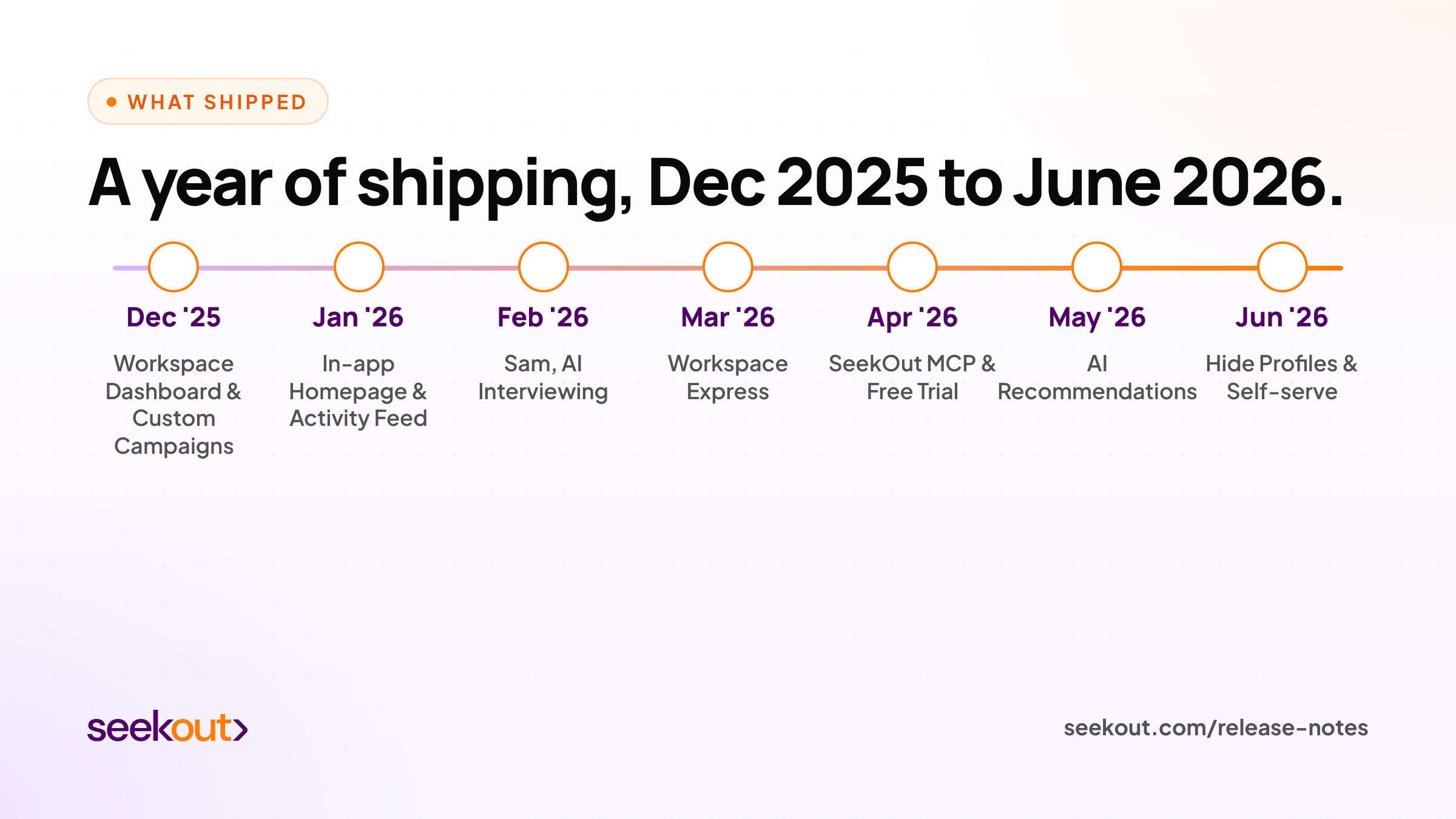
The last dot on that line, "Self-serve" in June 2026, is the pricing change. Two smaller moves followed that the graphic does not show. Between May and July the Sourcing tier's export allowance was halved from 10,000 to 5,000 per seat per month - Wayback Machine, July 2026. And by early October the self-serve plan had been renamed Sourcing Core, while the SeekOut Spot section that had sat on the pricing page in May and July was removed.
The direction is clear even if the motive is not stated. SeekOut has gone from enterprise-only, three-seat-minimum annual contracts to a credit-card plan a single recruiter can cancel monthly, and has rebuilt its product around being used from inside AI assistants. The company also changed leadership: co-founder Anoop Gupta handed the CEO role to Sean Thompson on 4 May 2026, and GeekWire reported that SeekOut has raised $189 million, has roughly 150 employees and 750+ corporate customers, and holds over $100 million in the bank - GeekWire. For a buyer, that combination (cash in the bank, a new CEO, a product line in motion) argues for shorter commitments: prices and packaging are clearly still being tuned, so an annual deal you can revisit beats a three-year lock-in at today's packaging.
7. The Fine Print: Self-Serve Terms and Order Forms
SeekOut has two sets of contract terms, and which one applies depends on how you buy. A card purchase through the website falls under the Self-Serve Subscription Supplemental Terms, last updated 8 June 2026; a deal signed with a sales rep falls under the main Terms of Service and an Order Form. The differences are bigger than most buyers expect, and both are stricter on refunds than the "cancel any time" language in the marketing suggests.
Self-serve: auto-renewal and no refunds
The self-serve terms make the subscription "automatically recurring", charged in full at the start of each period: one month in advance on the monthly plan, one year in advance on the annual plan - SeekOut Self-Serve Terms. You can cancel at any time in account settings or by email, but cancellation takes effect at the end of the current billing period. Fees already charged are non-refundable, and SeekOut "does not provide partial-period or pro-rata refunds, including for the unused portion of an Annual Plan", except where the law requires it.
That last clause is the one to weigh before choosing annual billing. The $360 saving assumes you use SeekOut for all twelve months; if you stop after month four, you have paid $1,788 for something that would have cost $716 on the monthly plan. Several smaller provisions are also worth knowing before checkout. SeekOut must give at least 30 days' notice of a price increase, which then applies from your next renewal, so an annual plan locks the price for its year. Upgrades take effect promptly and may carry a prorated charge, while downgrades wait until the next period and earn no refund. Billing disputes must be raised within 60 days of the charge, and the main terms' arbitration clause applies, with a 30-day window to opt out.
The practical reading is simple. For a first year with an unproven tool, the monthly plan is the safer buy even at $30 a month more, because the trial is only 14 days and a real verdict on candidate quality usually takes a few roles. Switch to annual once SeekOut has earned it; the terms allow switching between monthly and annual, taking effect at the next renewal unless checkout applies it sooner.
Order Form deals: annual, non-cancelable, auto-renewing
The sales-led terms are classic enterprise software terms. Fees are "invoiced in full and in advance annually" and due in 30 days, payment obligations are "non-cancelable", and "quantities purchased cannot be decreased during the relevant subscription term" - SeekOut Terms of Service. Subscriptions renew automatically for one year unless either party gives written notice at least 30 days before the term ends, and SeekOut can change fees at renewal with 60 days' written notice. Late invoices can accrue interest at 1.5% a month.
Two of those clauses are where buyers lose money. The no-decrease rule means a team that shrinks mid-year keeps paying for every seat until renewal, so start with the seats you are sure of and add later (additional licenses can be bought mid-term, prorated). The 30-day notice window means a missed calendar reminder commits you to another full year. How to apply this: put the renewal date minus 45 days in your calendar on the day you sign, and ask for a renewal price cap in the Order Form, since the default only promises 60 days' notice of an increase, not a limit on it.
8. MCP, AI Screening, AI Coworker and Spot: What Costs Extra
SeekOut now sells more than search, and its pricing page lists four product names in its navigation: SeekOut Sourcing, Applicant Evaluation and AI Screening, SeekOut MCP, and the SeekOut AI Coworker. Each has a different commercial model, and of the three that sit beyond core sourcing, only MCP comes free with the plan you already have. Knowing which is which keeps an add-on from appearing in your renewal quote by surprise.
SeekOut MCP is included. MCP access "is included with your existing SeekOut Recruit license" and "does not expand your subscription": you can only reach the data sources and integrations your plan already covers - SeekOut Docs. SeekOut's launch graphic puts it more bluntly:
SeekOut MCP: included in every Recruit tier
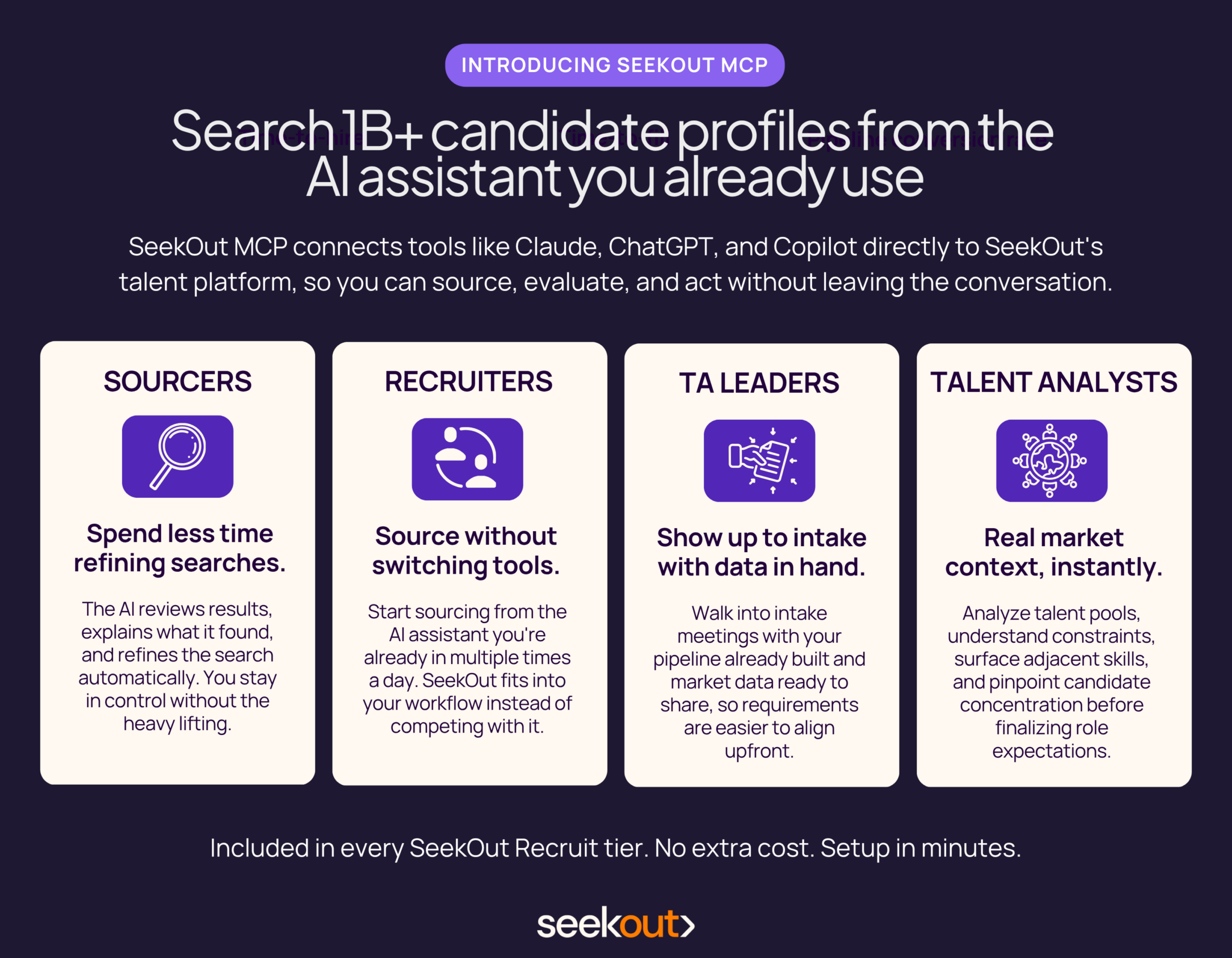
The line at the bottom of that graphic, "Included in every SeekOut Recruit tier. No extra cost", is accurate but incomplete. MCP actions that reveal contacts or export profiles draw on the same contact and export credits as the web app, and large batches prompt for confirmation and are refused once the balance runs out - SeekOut Docs. There is also a default rate limit of 1,000 requests per day and 10 per second per user. In other words, using SeekOut from Claude or ChatGPT is free, but it spends your credits faster, because an assistant asked for "the top ten candidates' emails" will happily request ten.
SeekOut's official demo shows what that looks like in practice. In this 94-second video, published on 24 June 2026, a Staff Machine Learning Engineer search runs inside ChatGPT from market map to shortlist, contact retrieval and drafted outreach:
Stop searching. Start hiring. SeekOut is now an app in ChatGPT
Watch for the step where contacts are pulled "right in the chat". That is a credit-spending action triggered by a sentence, which is convenient for a recruiter and something a budget owner should know about before rolling MCP out to hiring managers who also hold SeekOut accounts.
Applicant Evaluation and AI Screening is an add-on. The product SeekOut first launched as Sam scores inbound applicants against role requirements, runs asynchronous AI interviews and flags signs of candidate fraud - SeekOut. The comparison table marks it "Add-on" on the Sourcing and Sourcing + Integration tiers and "Included" in Full Recruiting Funnel; it is not available on Core. No price is published.
The AI Coworker is early access. SeekOut's newest product is pitched as "AI agents that learn from you, follow your lead, and earn your trust by doing the job your way", and the page offers a film and a "Get early access" form rather than a plan - SeekOut. There is no published price and no indication of which tiers will include it.
Spot's status is unclear. SeekOut Spot, the managed service pairing AI agents with SeekOut's own recruiters, was the stated priority of the new CEO in April 2026. In May and July the pricing page still listed three Spot models with no dollar figures: a fixed cost per role, a per-contractor model and an outcome-based agency fee "70% lower cost than traditional agencies". By October the Spot section was gone from the pricing page and the old Spot URLs redirected to a general agentic AI page, while the Spot services agreement with its slate-pack, hire-pack and agency-hire supplements is still published - SeekOut Spot Services Agreement. If Spot is part of why you are talking to SeekOut, ask directly whether it is still sold and on what terms. The Partner API, for building SeekOut search and contact data into your own software, is likewise provisioned through a SeekOut representative with no public rate card - SeekOut Docs.
9. Where SeekOut Wins and Where It Falls Short
SeekOut's strengths are real and specific, and they are not the ones a feature checklist shows. Its advantage is breadth of specialized data: alongside public professional profiles it indexes GitHub developers, academic researchers and patent holders, 31M+ healthcare profiles, nursing professionals, and inferred attributes such as security clearance that most rivals do not attempt. For a recruiter hiring a cleared systems engineer or a clinical specialist, those indexes are the product, and nothing at a similar price replicates them.
The second strength is the new MCP and assistant layer. SeekOut can be used from Claude, ChatGPT, Copilot, Gemini or Amazon Quick, with workspaces, contact retrieval and ATS pushes available from the conversation, so the database comes to the assistant rather than the other way round. For a company that has already standardised on Copilot or ChatGPT Enterprise, that removes a training problem. The third is the refund-on-miss credit rule, which means you never pay for a lookup that returns nothing.
The weaknesses are mostly about access and transparency rather than quality. Everything specialist is gated above the published plan, so the features that make SeekOut distinctive are exactly the ones a self-serve buyer cannot get. Credits are tight on Core and do not roll over. Self-serve billing is strict, with no pro-rata refunds on an annual plan. The custom tiers are opaque, with a median contract eleven times the list price. And SeekOut's own pages contradict each other on Core's seat count and on healthcare access, which a buyer has to resolve in writing.
None of these is a reason to rule SeekOut out, but together they describe the buyer it suits. SeekOut works best for a team that needs one of its specialist indexes, can negotiate an annual contract, and has the discipline to use its credits every month. It works least well for a solo recruiter in a mainstream market (where cheaper tools search the same public profiles), or for a team that wants the outreach and follow-up done for them rather than a better search box. Note also that SeekOut is a search-and-engage tool: it ranks and drafts, but you still decide whom to contact and run the sequences, which is a different product from an AI recruiter that runs the whole outbound loop.
10. The 9 Best SeekOut Alternatives in 2026
The right alternative depends on which part of SeekOut you actually wanted. Some teams want the search, some want the contact data, some want an ATS-connected platform, and a growing number want the sourcing done for them. The nine below cover all four, with prices read from each vendor's own pricing page, documentation or public marketplace listing in October 2026.
Where a vendor publishes no price, we give the best public evidence instead (Vendr's buyer data or a marketplace listing) and say so. For deeper breakdowns of several of these vendors, our recruiting software pricing guide compares 40 tools by how they meter.
10.1 LinkedIn Recruiter: The Default Incumbent
LinkedIn Recruiter is the tool most SeekOut deals are compared against, and the comparison is mostly about network access rather than data. LinkedIn's own pricing page now says Recruiter "does not have a single standard price" and shows no dollar figures, steering buyers to sales or to its pay-per-click Hiring Pro plan - LinkedIn. The clearest published rate card is LinkedIn's UK public-sector price list, which charges £8,925 per seat per year for one or two Recruiter licenses, falling to £6,350 at 251 or more, with at least 150 InMails a month per license - G-Cloud 14.
The trade is straightforward. LinkedIn gives you InMail, a direct channel to members who never publish an email, and the freshest self-reported job data; SeekOut gives you emails, phones, GitHub and specialist indexes, and does not depend on candidates replying inside LinkedIn. Even at the 251-seat rate, one LinkedIn seat costs several times SeekOut Core's $1,788 a year. Our LinkedIn Recruiter pricing guide covers Lite and the Hiring Assistant add-on in detail.
Best for: teams whose candidates live and respond on LinkedIn, and who can afford to keep at least one seat whatever else they buy.
10.2 hireEZ: The Closest Like-for-Like
hireEZ is the most direct SeekOut equivalent: an outbound sourcing database with contact data, ATS rediscovery and AI agents. Its pricing page says "Solo recruiters start at $494/mo" with a seven-day free trial, and quotes enterprise deals against the stack it replaces - hireEZ. On AWS Marketplace the same Growth Tier is sold at $549 per user per month on a one-month contract, with hireEZ noting it is "not recommended for mid-market or enterprise organizations" - AWS Marketplace.
When we read hireEZ's checkout in September 2026, the $494 figure was the annual plan paid upfront and Growth carried 300 contact credits per seat a month, which makes each credit far more expensive than SeekOut Core's. Across hireEZ contracts, Vendr records a median of $13,000 a year, from $7,000 to $25,000 - Vendr, below SeekOut's $20,000. Our hireEZ pricing guide has the full tier history.
Best for: teams that want SeekOut's shape (search plus ATS rediscovery plus outreach) at a lower enterprise median, and do not need clearance or healthcare indexes.
10.3 Juicebox: AI Search With Published Seats
Juicebox (the company behind PeopleGPT) sells natural-language candidate search with contact data on transparent per-seat plans. Starter costs $99 per seat per month on yearly billing or $119 monthly, with unlimited searches, 500 contact credits and 500 export credits for one seat; Growth costs $179 yearly or $199 monthly per seat with 1,500 contact credits per seat, up to five seats and talent insights - Juicebox. Read the credit table before comparing: an email costs one credit, but phone numbers are not available on Starter at all and cost 3 credits each on Growth. ATS and CRM integration, SSO and unlimited contact credits are reserved for the custom, annual-only Business plan, and Juicebox Agents cost $199 per agent per month on top.
Against SeekOut Core, Juicebox Starter gives one recruiter the same 500 email lookups for $50 to $60 less a month, and Growth gives three times the credits per seat, though a phone-heavy recruiter burns them three at a time. What it does not have is SeekOut's specialist depth (clearance, healthcare, academic indexes) or an ATS connection below the custom tier. Juicebox also bought Fetcher's IP and other assets before Fetcher's platform shut down in October 2026, covered in our Fetcher alternatives guide.
Best for: small teams in tech and mainstream professional roles who want published per-seat pricing and more contact credits than Core.
10.4 Pin: AI Sourcing With a Free Plan
Pin combines a candidate database with AI agents that source and run multichannel sequences. It has a genuine free plan (five contact lookup credits a week, one job, one AI agent), a Solo plan at $100 per user per month billed annually only with 500 credits, and Professional at $135 per user per month annually or $179 monthly, with 1,000 credits per seat - Pin. Each personal email, work email or phone number costs one credit.
At $179 a month, Pin Professional and SeekOut Core cost the same on monthly billing, but Pin gives one seat twice the contact credits plus two AI agents that run outreach. SeekOut counters with its specialist indexes, Workspaces scoring and the MCP layer. ATS integration on Pin is an add-on below Enterprise. See our Pin pricing guide for the plan detail.
Best for: solo recruiters and small agencies who want AI-run sequences and more credits per dollar, and can test for free before paying.
10.5 Gem: CRM and Sourcing for In-House Teams
Gem is less a sourcing database than a recruiting CRM with sourcing, outreach analytics and (in its All-in-One product) a full ATS. Both of its packages are custom-priced on your company's employee count rather than on recruiter seats; companies under 30 employees get All-in-One free for six months and then at 50% off - Gem. Vendr records a median of $25,699 a year across 234 purchases, from $7,000 to $73,076 - Vendr.
Gem and SeekOut overlap on outbound sourcing and ATS rediscovery, but Gem's strength is the pipeline and reporting layer, while SeekOut's is the data. Many enterprise teams run both. If you are replacing SeekOut primarily to rediscover past applicants in Greenhouse or Lever and measure outreach, Gem is the stronger tool; if you need to find people who are not in your ATS yet, it is not a replacement.
Best for: in-house TA teams that want a CRM and analytics layer over their ATS, and whose pricing scales better by company size than by recruiter count.
10.6 Findem: Enterprise Talent Intelligence
Findem competes with SeekOut's Full Recruiting Funnel tier: attribute-based search over a talent data cloud, inbound review, outbound, referrals, alumni and ATS rediscovery in one platform. It publishes no pricing page; its AWS Marketplace listing shows a Talent License at $25,000 for a 12-month contract, with usage-based fees on top for overages - AWS Marketplace. Vendr's median is much higher at $58,000 a year, ranging from $7,225 to $94,840 - Vendr.
Findem is the alternative for enterprises that are buying SeekOut's top tier for its intelligence and full-funnel features rather than for its specialist indexes. It is more expensive at the median, and its usage component makes budgeting less predictable than SeekOut's seat-plus-credit model.
Best for: large enterprise TA functions that want talent intelligence and full-funnel automation in one contract, and can absorb a median near $58,000.
10.7 Loxo: Sourcing Built Into an Agency ATS
Loxo combines an ATS and CRM with its own sourcing graph and AI agents, which makes it the natural alternative for recruiting agencies. Core "starts at $149 per user / month, billed annually", but it does not include Loxo Source, the 850M+ profile database; that sits in Professional, which includes 2,500 pooled credits per seat per month and whose price is no longer published - Loxo. Professional comes with a seven-day free trial and no credit card.
The headline match with SeekOut Core ($149 against $149) is misleading, because the Loxo plan at that price has no sourcing database. The fair comparison is SeekOut plus your existing ATS against Loxo Professional, which replaces both. Our Loxo pricing guide covers the credit tiers.
Best for: agencies that want one system for jobs, candidates, clients and sourcing, and would otherwise pay for an ATS and SeekOut separately.
10.8 ContactOut: When You Only Need the Contact Data
ContactOut is the alternative for teams that already find candidates (on LinkedIn, GitHub or by X-ray search) and use SeekOut mainly for emails and phone numbers. Its Email plan costs $49 a month and Email + Phone $99 with US and UK data included, or $25 and $49 if you exclude US and UK data - ContactOut. The "unlimited" plans run under a fair-use cap of 2,000 email credits and 1,000 phone credits per account per month - ContactOut Terms.
That is roughly four times SeekOut Core's contact allowance for a third of the price. The trade-offs are significant: every self-serve ContactOut plan is limited to one user per company, it is a lookup tool rather than a search platform, and you lose SeekOut's ranking, workspaces and specialist indexes. Our ContactOut pricing guide explains the caps.
Best for: a single recruiter who already knows whom to contact and needs cheap, high-volume emails and phones.
10.9 HeroHunt.ai: Candidates Delivered, Not Another Search Box
HeroHunt.ai takes the opposite approach to SeekOut. Instead of giving a recruiter a better database to search, its AI Recruiter runs the search itself (across an extended index of more than a billion profiles on the Pro and Team plans), screens every candidate against the role with language models, finds emails, and sends personalized outreach on autopilot, while RecruitGPT turns a single prompt into a candidate shortlist. More than 15,000 recruiters have used it.
Plans are published and self-serve: an 8-day free trial (card required), then plans from $99 a month with unlimited positions and searches. Each plan is metered on matching profiles delivered and candidate emails found; Starter includes 2,000 profiles and 500 emails a month at $99, and the Team plan shares one larger pool across a small team - HeroHunt.ai plans.
The honest comparison is about which job you want done. HeroHunt.ai has no security clearance inference, no diversity analytics, no healthcare-specific index and no ATS rediscovery of past applicants, so a defense or hospital recruiting team should stay with SeekOut's specialist tiers. Where HeroHunt.ai wins is time: a recruiter who would spend hours in SeekOut building searches, scoring profiles and writing sequences gets screened candidates and sent messages instead. You can start the trial on a live role and compare the output with a SeekOut trial on the same role.
Best for: individual recruiters and small teams who want sourcing and outreach handled end to end, on a published price.
11. Full Comparison: Price, Meter and Best Fit
The table below compares SeekOut with the nine alternatives on the three things that decide cost: the entry price you can actually buy, what the price is metered on, and where the specialist features sit. Prices are per month unless stated, read in October 2026.
| Tool | Entry price | Metered on | ATS integration | Best fit |
|---|---|---|---|---|
| SeekOut Sourcing Core | $149 annual / $179 monthly | Plan + 500 contact credits | Custom tiers only | Small teams needing SeekOut's index |
| SeekOut custom tiers | Median $20,000/yr (Vendr) | Seats + 750 credits/seat | Sourcing + Integration up | Clearance, diversity, ATS rediscovery |
| LinkedIn Recruiter | £8,925/seat/yr (G-Cloud, 1-2 seats) | Seats + InMails | Yes | Candidates who reply on LinkedIn |
| hireEZ | $494 (annual) / $549 (monthly) | Seats + credits | Yes | Like-for-like at lower median |
| Juicebox | $99 annual / $119 monthly | Seats + credits | Business plan only | Per-seat AI search |
| Pin | $0 free; $100 Solo (annual) | Seats + credits | Add-on below Enterprise | AI sequences, credits per dollar |
| Gem | Custom by FTE; median $25,699/yr | Company size | Yes (or built-in ATS) | CRM and analytics layer |
| Findem | $25,000/yr licence (AWS) | Licence + usage | Yes | Enterprise full funnel |
| Loxo | $149 Core (no sourcing data) | Seats + credits | Built-in ATS | Agencies |
| ContactOut | $49 Email / $99 Email + Phone | Fair-use caps | Team plan only | Contact data only |
| HeroHunt.ai | $99 after the trial | Profiles + emails | Pro and Team plans | Done-for-you sourcing and outreach |
A price table hides the most useful comparison for a SeekOut buyer, which is what one contact credit costs on each tool's entry plan. The chart below divides each plan's monthly price (on monthly billing) by its monthly contact allowance at full use. Credits are not identical across tools (Juicebox Starter's buy emails only, ContactOut's figure is its fair-use email cap, and hireEZ's 300 credits come from its checkout as we read it in September 2026), so read it as an order of magnitude rather than a precise ranking. HeroHunt.ai is left out because it meters screened profiles and emails together rather than standalone lookups, and Gem, Findem and LinkedIn are left out because they publish no self-serve allowance.
Cost per contact credit on entry plans, monthly billing, full use
Two conclusions follow. First, SeekOut Core is mid-priced per contact, cheaper than hireEZ by a factor of five but roughly double Pin and 50% above Juicebox, so a buyer choosing purely on contact volume will not pick SeekOut. Second, the per-credit view understates SeekOut's case when you need its specialist indexes, because finding the right cleared engineer or ICU nurse is worth more than a cheaper email for the wrong one. How to apply this: if most of your roles are mainstream tech, sales or operations hires, compare on cost per contact; if most need clearance, healthcare or academic data, compare on whether the candidates exist in the tool at all.
12. How to Choose, and How to Buy SeekOut Well
Choosing comes down to three questions asked in order: do you need search at all or just contact data, how many people will use it, and which specialist capability (if any) your roles require. The decision tree below maps those questions to a SeekOut tier or an alternative. It is deliberately conservative: when in doubt, it points to the trial or the cheaper route first.
The left branch is where many SeekOut evaluations should end. If your team already finds candidates on LinkedIn or through X-ray search and only lacks emails, a contact finder solves the problem for a fraction of the cost, and the money saved can go on a LinkedIn seat or job ads instead. Be honest about this branch: a surprising number of "we need SeekOut" conversations turn out to be "we need phone numbers".
The "hands-off sourcing" branch covers teams whose real constraint is recruiter time rather than data. If nobody on the team has hours a week to build searches and write sequences, a better search tool does not help, because the bottleneck is the work after the search. An AI recruiter such as HeroHunt.ai, or Pin's sourcing agents, replaces the searching, the screening and the sequencing, and the recruiter's job becomes reviewing replies.
The right side of the tree is SeekOut's home ground, and it splits on the two capabilities SeekOut charges most for: specialist filters and ATS rediscovery. A single recruiter without either need is the one buyer for whom Sourcing Core is clearly the right SeekOut product. Everyone else on the right side is buying a custom tier, and should run the trial with that tier's features in mind.
A worked example shows how quickly the branches diverge on cost. Take a three-person agency desk hiring software engineers, each recruiter contacting about 200 candidates a month, or 600 contact lookups in total. SeekOut Core's 500 credits fall short even if all three can share them, so the realistic SeekOut option is the Sourcing tier at 750 credits per seat, a custom quote in a market where the median contract is $20,000. The same desk on Pin Professional would pay $135 a seat on annual billing, about $4,860 a year for three seats with 3,000 credits a month between them. What the desk gives up for that saving is SeekOut's clearance, diversity and healthcare depth, which an engineering agency may never use.
Buying SeekOut well
If SeekOut is the right tool, the way you buy it matters as much as the tier. Most overpayment on SeekOut does not come from a bad list price; it comes from buying the wrong billing period, the wrong tier or the wrong number of seats, and then being unable to undo it because the contract does not allow refunds or mid-term reductions.
The good news is that every one of those risks is visible in SeekOut's own documents, so each can be managed before signature rather than discovered at renewal. None of them requires leverage you do not have; they only require asking before you click buy or sign. The tactics below come directly from the terms, the credit rules and the buyer data covered above:
- Run the trial on live roles and count credit use per role
- Start monthly on Core, then switch to annual once it proves out
- Quote the lowest tier that has your must-have filter
- Ask for line items: seats, credits, modules, services
- Negotiate renewal protection: a price cap and an early notice reminder
Each of those protects against a specific clause. The trial count tells you whether 500 credits is enough before you discover it mid-month, and monthly billing avoids the no-refund annual trap during the period when you are least sure the tool fits.
The last three are about the sales-led tiers. Quoting the lowest qualifying tier stops a rep from bundling modules you will not use, and line items let you challenge each one against the published table. The renewal cap matters because the default Order Form only guarantees 60 days' notice of a fee increase, and the 30-day non-renewal deadline is easy to miss.
In the demo itself, ask three questions that the pricing page does not answer: whether contact credits cover emails and phones together or separately, what a 100-credit add-on pack costs, and whether Spot and the AI Coworker are included, priced separately or not yet sold. The answers change the value of every quote, and a rep who cannot answer them in writing is a signal to slow down.
Two further levers are worth trying. Vendr's data shows buyers save 16% on average, so do not accept the first proposal, especially near SeekOut's quarter end. And if you are a larger buyer, ask whether credit pooling can be enabled from day one, since pooled teams avoid paying twice for the same candidate's email, then confirm in writing what happens to revealed contacts if pooling is ever switched off.
Finally, treat the first renewal as a second negotiation rather than a formality. By then you will have a year of SeekOut's own usage data: how many credits each recruiter actually spent, how many exports, and which filters mattered. Bring those numbers to the renewal call, cut seats or modules that went unused, and compare the renewal quote with the self-serve and alternative prices in this guide before the 30-day notice window closes.
13. The Bottom Line
SeekOut's pricing in 2026 has two faces. The public one is $149 a month on annual billing or $179 monthly for Sourcing Core: unlimited search over 1B+ profiles, 500 contact credits, 1,000 exports, outreach sequences and MCP access, with a 14-day trial and no card needed. The private one is a set of custom annual tiers with a $20,000 median, which is where SeekOut's genuinely distinctive features live: clearance and diversity filters, healthcare search, ATS rediscovery and AI screening.
The decision framework follows from that split. Buy Sourcing Core on monthly billing if you are a solo recruiter or a small team in a market SeekOut indexes well, and test it hard on credit use before going annual. Go to a custom tier only when a specific filter or the ATS connection is the reason you need SeekOut, and negotiate it line by line against the published table. Choose an alternative when your roles are mainstream and contact volume matters most (Pin, Juicebox or ContactOut), when you want SeekOut's shape at a lower enterprise median (hireEZ), when you are an agency (Loxo), or when the real bottleneck is recruiter time rather than data, which is where an AI recruiter like HeroHunt.ai replaces the search, the screening and the outreach together.
Whatever you choose, read the contract before the plan card. SeekOut's self-serve terms refund nothing once a period starts, its Order Forms renew for a year unless you give 30 days' notice, and its own pages still disagree on how many seats the cheapest plan includes. A buyer who knows those three facts will pay a fair price for SeekOut; a buyer who does not can easily pay for a year of seats and credits they never use.
This guide reflects SeekOut's pricing, terms and product lineup as of October 2026. SeekOut renamed and repriced its plans several times in 2026, and alternative vendors change prices often, so verify current details on each vendor's pricing page before you buy.