


The Practical Guide to Braintrust AIR Pricing, Real Costs, and the Best AI Interviewer Alternatives in 2026
Braintrust AIR has run 367,842 AI voice interviews and logged more than 1 million interview-minutes in a single 90-day window, yet it will not tell you what a single interview costs. Those usage numbers are self-reported on the product page, and they are genuinely large for a product that only launched in April 2024 - Braintrust AIR. The company was also named to TIME's "America's Top WorkTech Companies of 2026" and a G2 Leader for AI Recruiting in May 2026, so the momentum is real - Braintrust press. But go to the pricing page to find out what it actually costs, and you hit a wall: the model is described (volume-based, per interview) and not a single dollar figure appears anywhere - Braintrust AIR pricing.
That opacity is the reason this guide exists. When an AI interviewer hides its rate behind a sales call, a talent team ends up in a demo before it knows whether the tool fits the budget, and worse, before it can compare per-interview economics against a competitor that does publish them. The one genuinely priced alternative in this category, Ribbon, starts at $499 per month for 100 interviews and prints its overage rate on the page - Ribbon pricing. That single fact reframes the whole evaluation: you can anchor every demo-gated quote against a real number instead of negotiating blind.
This guide breaks down exactly how Braintrust AIR is priced, what its volume model means for your real cost, where the product genuinely wins, and the five strongest alternatives in 2026, from a transparent self-serve interviewer to the enterprise incumbent to the sourcing engine that feeds the top of the funnel. Every price is sourced, every claim is linked, and the alternatives are ranked on merit.
Written by Yuma Heymans (@yumahey), who built HeroHunt.ai and its AI Recruiter. Because his product sources and screens candidates before anyone reaches an interview stage, he has watched the AI-interviewer category emerge from directly upstream of it, and writes from inside the funnel rather than from a vendor brochure.
Contents
- What Braintrust AIR Actually Is
- Braintrust AIR Pricing: What It Really Costs in 2026
- Where Braintrust AIR Wins and Where It Falls Short
- The 5 Best Braintrust AIR Alternatives in 2026
- Full Comparison: Pricing and Capabilities
- How to Choose the Right Alternative
- The Bottom Line
1. What Braintrust AIR Actually Is
Braintrust AIR is an enterprise AI interviewer that conducts conversational voice interviews at scale, scores and stack-ranks candidates against a role's criteria, and writes structured scorecards straight into the applicant tracking system. It is the recruiting-intelligence product of the Braintrust talent network, and its pitch is high-volume screening: "80% faster screening," "1000s of interviews per day," results auto-populated into Workday, iCIMS, Greenhouse and SmartRecruiters across 50+ ATS integrations - Braintrust AIR. The job it does is the interview and assessment layer, not sourcing: AIR does not find candidates, it screens the ones who apply or get imported, which is a distinction that decides half of this comparison.
One point of confusion is worth clearing up before anything else, because it changes how you read every number online. There are two unrelated companies called "Braintrust." The subject here is the AI recruiter at usebraintrust.com, part of the web3 talent marketplace founded in 2018 by Adam Jackson, Gabriel Luna-Ostaseski and Brian Flynn - Braintrust about. A completely different developer-tools company at braintrust.dev sells LLM evaluation software with a widely-quoted "$249 per user" tier. If you see a "$249" figure attached to "Braintrust," it is almost certainly the wrong company, and it has nothing to do with the AI interviewer this guide covers.
The core capability that separates AIR from a legacy video-interview tool is the adaptive voice interview. Instead of asking a candidate to record answers to fixed prompts, AIR holds a conversation, follows up on answers, evaluates responses with semantic scoring, and produces a consistent scorecard for every candidate in 16+ languages - Braintrust AIR. The company reports candidate-experience metrics that are unusually strong for automated screening, including 94% completion and 90% of candidates saying they would repeat the experience, alongside cost claims like "clients save over $300k a year" and 10 to 20x ROI. Those are vendor figures, self-reported and not independently audited, so treat them as claims rather than benchmarks.
It helps to see the interface to understand the design philosophy, because AIR is built so a recruiter reviews AI decisions rather than conducting each screen. The product surfaces a candidate card with criteria-level ratings and the interview transcript, so the human manages a ranked pipeline instead of a call schedule.
Braintrust AIR's AI scoring and candidate profile view

What the screenshot shows in practice is the product's real value proposition: every applicant arrives pre-interviewed and pre-scored, so a recruiter opens a ranked shortlist with rationale attached rather than a stack of resumes to triage by hand. That is a genuine time saver for a team drowning in applicants, and it is the specific capability enterprises pay AIR a premium to deliver. The trade-off is that you are trusting an AI to conduct and grade the first-round conversation, which is powerful when the model is tuned to your role and risky when it is not. AIR carries SOC 2 Type II and a third-party bias audit with, per the vendor, zero adverse findings across demographic groups, which is exactly the assurance a large employer needs before automating an interview - Braintrust about.
To see the conversational interview in motion rather than as a static card, the official AIR demo walks through a voice interview end to end, which is the part prose cannot fully convey.
Braintrust AIR: conversational AI voice interview walkthrough
2. Braintrust AIR Pricing: What It Really Costs in 2026
Braintrust AIR does not publish a price. The disclosed model is volume-based per interview, where the per-interview cost decreases as monthly volume rises, and every real quote comes only through a sales conversation. That is the single most important fact for anyone evaluating the tool, and it is the one the company makes hardest to pin down - Braintrust AIR pricing. The pricing page describes three separate product lines with three separate pricing logics, but attaches a dollar amount to none of them, which means every prospect negotiates without an anchor.
The structure underneath the demo wall is not a simple per-seat license, and understanding the three lines matters because they are priced on completely different bases. AIR (the interviewer) is metered per interview conducted, with tiered rates that fall as you move from screening 100 candidates a month toward 10,000. Nexus (the managed AI solution) is performance-based: the vendor states "you keep 75% of savings, we take 25%" of measured cost reduction, with no upfront development cost. The Talent Marketplace side is contingency-style, described as "zero platform fees for talent" and "30 to 70% savings vs. traditional agencies," with the exact fee percentage unpublished. Scoped free pilots are offered for all three - Braintrust AIR pricing.
| Braintrust product line | Pricing model | Public dollar figure |
|---|---|---|
| AIR / AIR Recruiter | Volume-based per interview, rate decreases with volume | None published |
| Nexus (managed) | Performance-based: you keep 75% of savings | None published |
| Talent Marketplace | Flexible / contingency, "zero platform fees for talent" | None published |
Third-party marketplaces do not rescue the picture, and this is where AIR differs sharply from a tool like HireVue. Capterra lists a starting price of "$10.00, Usage Based, Per Year," but that is a marketplace placeholder rather than a real quote and should be read as meaningless, not as a floor - Capterra. G2's pricing page references four pricing editions and a free trial but discloses no figures - G2. SelectSoftware Reviews confirms only that pricing is "custom-based on company needs" with a try-before-you-buy pilot - SelectSoftware Reviews. Critically, Vendr, the buyer-data source that gives real median contracts for enterprise software, has no Braintrust AIR page at all, so there is no independent estimate of what buyers actually pay.
The reason the volume model deserves scrutiny is that it makes your effective per-interview cost a moving target that only your own volume can reveal. AIR's own anonymized case studies hint at the range: one healthcare provider reportedly moved cost-per-interview from $125 to $18 after adopting AIR, and an 80-location restaurant group claims $280K a year in savings - Braintrust resources. Those are self-reported and describe outcomes, not list prices, but they signal that AIR is priced and sold to organizations screening thousands of candidates, where a falling per-interview rate compounds. For a team hiring a handful of roles a month, that same model offers no published entry point to test against, which is precisely the friction that sends smaller buyers toward a transparent alternative.
3. Where Braintrust AIR Wins and Where It Falls Short
Braintrust AIR's strongest card is high-volume conversational screening backed by real compliance rigor, and its weakest is the total absence of public pricing and independent reviews. For an enterprise fielding thousands of applicants, an AI that conducts a consistent voice interview, scores every candidate the same way, and writes the result into the ATS is a real operational upgrade over recorded one-way video. The SOC 2 Type II certification and the third-party bias audit are not decoration: they clear the exact procurement and legal checkboxes that block AI hiring tools inside large organizations - Braintrust about. The multilingual coverage and 50+ ATS integrations make the "live within days" claim plausible for teams that would wait months to deploy a legacy platform.
The limitations matter just as much, and they cluster around transparency, social proof, and scope. The demo-gated, volume-tiered pricing is the first friction point, because it forces a sales conversation before a budget check and gives the buyer no anchor. The second is a strikingly thin independent review footprint: PeerSpot states outright that it has "not yet collected reviews" for Braintrust AIR, and no G2 or Capterra star rating and review count for AIR could be independently verified as of July 2026 - PeerSpot. For a category where buyers lean heavily on peer reviews, that is a genuine objection, and it is consistent with a product that only launched in 2024.
Part of what makes AIR credible on the "live within days" promise is how the interview itself is configured, which is worth seeing rather than describing. The setup flow walks a recruiter through defining the role, the evaluation criteria, and the conversation structure before the AI ever speaks to a candidate, so the consistency of scoring is a product of design choices made once rather than judgment applied ad hoc on each call.
Braintrust AIR's interview design workflow
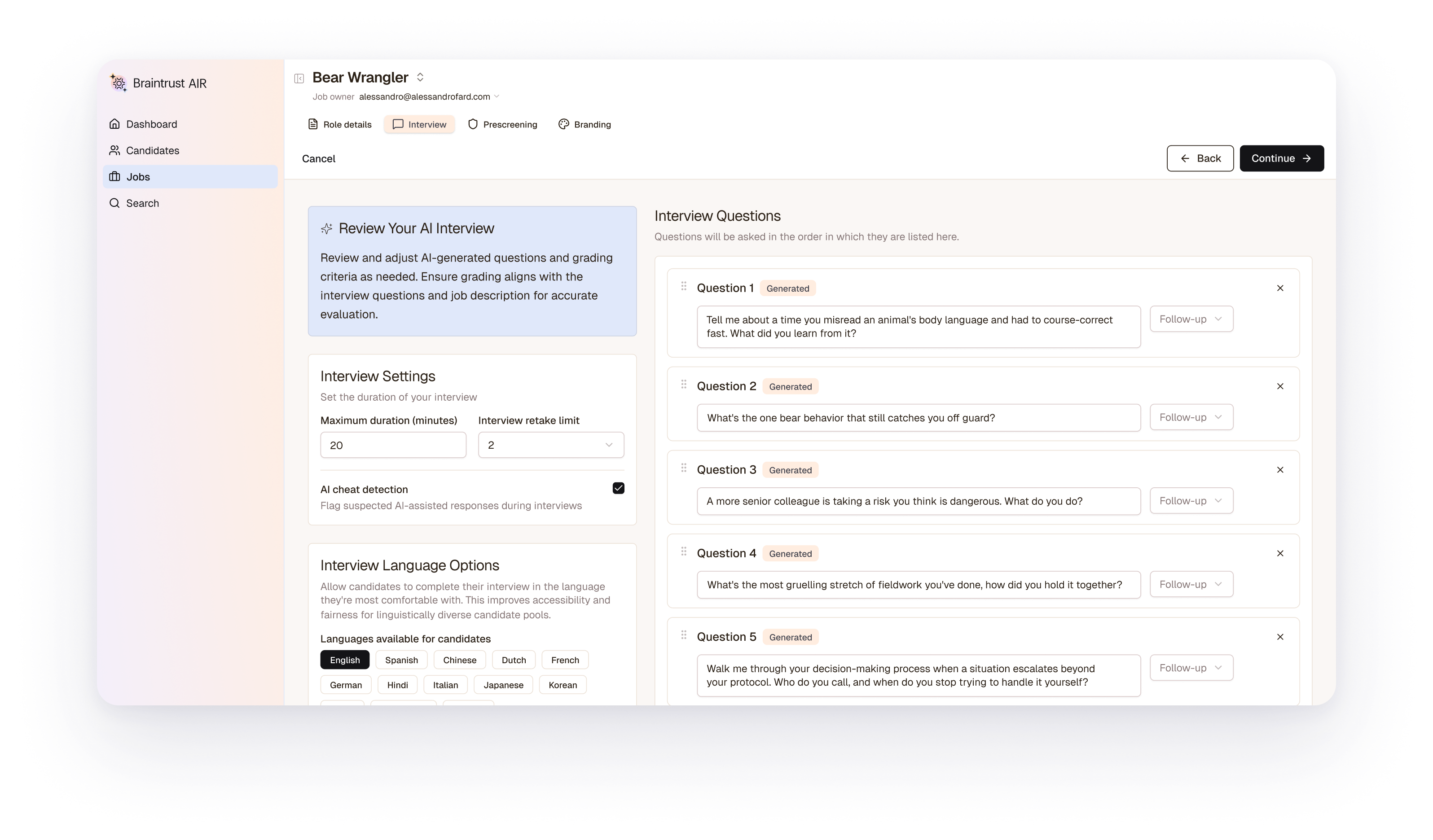
What the setup step reveals is why AIR can claim consistent scoring at volume: the criteria are fixed before any interview runs, so every candidate is measured against the same rubric rather than against whichever human happened to screen them. That standardization is the real product, and it is also the reason the bias-audit story matters, because a fixed rubric is auditable in a way an ad-hoc phone screen never is. The limitation hiding inside that strength is that a poorly specified rubric gets applied consistently too, which is why the pilot has to test the rubric, not just the technology.
There is also a scope point and a reputational nuance that an honest evaluation has to name. On scope, AIR is a screening and interview layer, not a sourcing tool: it interviews the candidates you already have, so a team still needs a top-of-funnel source to fill the pipeline AIR then assesses. On reputation, the parent network's web3 heritage is a double-edged story: the BTRST token that funded a $100M private sale in 2021 now carries a market capitalization of roughly $14M, a steep decline that complicates any "well-funded and stable" framing even though AIR itself is sold in ordinary fiat SaaS terms - CoinMarketCap. None of this makes AIR a weak product, but it does explain why a buyer would want to compare it against alternatives that publish prices, carry visible review corpora, or solve the sourcing gap AIR leaves open.
It is worth being precise about the customer evidence, because AIR's marketing blends two different things. The named enterprise logos on the site, Nestlé, Porsche, PayPal, Google, NASA, Goldman Sachs and others, are marketplace clients of the broader Braintrust network, self-reported and not confirmed as AIR interviewer buyers - Braintrust homepage. The AIR-specific proof points are mostly anonymized case metrics ("2,000+ interviews per month" at a Fortune 500 financial-services firm, a healthcare provider cutting time-to-fill from 45 to 12 days). Those are directionally useful, but they are vendor claims, so the signal to trust most is your own pilot: run a real role through AIR and measure whether the ranked, scored shortlist would actually have saved your team interviewing hours, because that is the specific value it charges a premium to deliver.
4. The 5 Best Braintrust AIR Alternatives in 2026
The alternatives below are chosen because each solves a specific problem AIR leaves open, whether that is price transparency, a lighter self-serve entry point, an enterprise incumbent's track record, a staffing-agency focus, or the sourcing that AIR does not do at all. They are ordered to move from the most transparent and accessible option to the enterprise incumbent, then to the niche and the complementary tool, so you can stop reading once you reach your budget and use case. Every entry lists what the tool does, real pricing where it is public, and who it is genuinely best for.
Before the write-ups, it helps to see the one place this category is transparent about cost. The chart below plots the entry monthly price for the tools that actually publish one, which is a short list. The demo-gated players (Braintrust AIR, Alex, ConverzAI) cannot be plotted honestly because no vendor or marketplace discloses a real figure, so their absence from the bars is itself the point.
Published Entry Cost per Month, AI Interviewer Tools (2026)
The chart makes the strategic picture obvious. Among the interviewers, only Ribbon publishes a true self-serve ladder, and its three tiers ($499, $999, $1,999) map cleanly to interview volume. HireVue's bar is a monthly equivalent of its Vendr median annual contract of $20,900, so it sits in the same band as Ribbon's top tier but represents a negotiated enterprise deal rather than a self-serve price - Vendr. HeroHunt.ai sits at the low end of the chart because it solves a different problem, sourcing rather than interviewing, at a published monthly price. Braintrust AIR, Alex and ConverzAI would all appear somewhere across this range if they published, but none do, which is exactly why buyers use Ribbon's public numbers as the anchor for every demo.
4.1 Ribbon: The Transparent Self-Serve Interviewer
Ribbon is the direct answer to AIR's pricing opacity and the best-documented tool in this category. It runs AI-led video and voice interviews with SMS and email candidate outreach, supports 10+ languages, offers white-label branding and API access, and integrates with ATS platforms, so functionally it competes with AIR on the core screening job - Ribbon. The difference that matters is that Ribbon prints its price ladder on the page: Growth at $499 per month (2 seats, 2 active roles, 100 interviews, $4.00 overage), Business at $999 (5 seats, 400 interviews, $3.00 overage), and Scale at $1,999 (10 seats, 1,000 interviews, $2.50 overage), all billed annually with a 7-day free trial - Ribbon pricing.
That published overage rate is the detail buyers should weigh most, because it is the one number AIR hides. Ribbon's per-interview cost falls from $4.00 to $2.50 as you move up tiers, which is the same volume-discount logic AIR describes but with actual figures you can model against your monthly interview count. The honest trade-off is that Ribbon has no free tier (only a 7-day trial) and, as a younger and lighter platform, does not carry AIR's enterprise compliance surface or 50+ ATS breadth. It is best for a team that wants exactly AIR's conversational screening but insists on knowing the per-interview price up front and starting without a sales call.
4.2 Alex (Apriora): The Full-Funnel AI Recruiter
Alex, the AI recruiter from Apriora, is the strongest head-to-head alternative to AIR on capability. It conducts AI interviews across phone, video, SMS and WhatsApp, screens resumes, verifies candidate identity to fight interview fraud, schedules, and matches talent, spanning 26 languages and 33+ ATS integrations - Alex. The company reports more than 1 million candidates interviewed and 96% candidate satisfaction, with enterprise clients including EY, Randstad and Kelly, and it raised a $20M Series A - Alex blog. Its identity-verification layer is a genuine differentiator as AI-assisted candidate cheating becomes a real screening problem.
The catch is that Alex matches AIR's biggest weakness rather than fixing it: pricing is entirely demo-gated. The former apriora.ai domain now redirects to alex.com, and the pricing URL is simply a "Schedule a 30-minute demo" form with no figure anywhere - Alex pricing. So while Alex is arguably the most complete AIR competitor on features, choosing it over AIR is not a way to escape the sales-call, negotiate-blind dynamic. It is best for enterprise teams that want a broad multichannel AI recruiter with strong anti-fraud verification and are prepared to run a procurement process to get a price.
4.3 HireVue: The Enterprise Incumbent
HireVue is the established enterprise AI and video-interviewing platform that AIR is trying to displace, and it is the one alternative with real independent buyer data. It automates interview workflows across named Essentials, Premium and Enterprise tiers, layers assessments and an ROI calculator on top, and carries the deepest enterprise track record in the category - HireVue pricing. Its vendor site is demo-gated like the others, but Vendr's buyer data fills the gap: a median annual contract of $20,900, with real purchases ranging from $9,794 to $41,056 per year - Vendr.
That data is the reason to shortlist HireVue even though it does not publish a self-serve price: you can walk into the negotiation already knowing the median, which is leverage AIR does not give you. The trade-offs are cost and modernity. HireVue historically carries an enterprise entry minimum in the mid five figures per year, which prices out smaller teams, and its heritage is one-way recorded video rather than the adaptive conversational interview that newer tools lead with - SelectSoftware Reviews. It is best for large enterprises that value a proven incumbent with a known price band and deep assessment science over a newer conversational-AI approach.
4.4 ConverzAI: The Staffing-Agency Specialist
ConverzAI narrows the category to one buyer: staffing and recruiting agencies. It markets an agentic "virtual recruiter" that conducts autonomous voice interviews and engages candidates end to end, with SOC 2 Type II, HIPAA and third-party bias audits, integrating with the systems agencies actually run like Avionté, Bullhorn and Ceipal - ConverzAI. That staffing-native integration set is its real differentiator: AIR is built for enterprise in-house teams, while ConverzAI is tuned to the high-volume, high-velocity world of agency placement where speed to candidate contact directly drives revenue.
Pricing is, once again, demo-gated with no published figure, and the model is understood to be usage or volume-based enterprise pricing - ConverzAI pricing. The honest caveat is scope: because ConverzAI is purpose-built for staffing firms rather than general corporate hiring, it is a narrower fit than AIR for an in-house talent team, and a broader fit for an agency desk. It is best for staffing and recruitment-process-outsourcing firms that want an autonomous voice interviewer wired into agency-specific tooling rather than a general enterprise ATS.
4.5 HeroHunt.ai: The Sourcing Engine That Feeds the Interview
HeroHunt.ai is on this list for an honest reason that sets it apart: it solves the gap AIR explicitly leaves open. AIR interviews the candidates you already have, but it does not find them. HeroHunt.ai is the top-of-funnel source, an AI Recruiter that finds candidates from over 1 billion profiles across LinkedIn, GitHub, Stack Overflow and more in 190+ countries, then reaches out on autopilot across multiple channels - HeroHunt.ai. Its companion, RecruitGPT, turns a plain-language description of a role into a shortlist of engaged candidates, which is the input any AI interviewer needs before it can interview anyone.
The reason to consider it alongside AIR rather than instead of it is workflow logic: sourcing precedes screening, so a team comparing interview tools often discovers the real bottleneck is upstream. HeroHunt.ai starts with an 8-day free trial (card required) covering 150 AI-screened and matched profiles and 75 candidate emails, then runs from $99 a month with unlimited positions, and it offers 2 months free on annual billing; the full ladder is published on its plans page - HeroHunt.ai plans. With 15,000+ recruiters using it globally, it has an adoption base a 2024-launched interviewer is still building. It is best for teams whose actual constraint is finding qualified candidates in the first place, who can then screen that pipeline with AIR, Ribbon or Alex - start a free trial.
5. Full Comparison: Pricing and Capabilities
The table below distills Braintrust AIR and the five alternatives into the dimensions that drive a buying decision: entry price, whether pricing is public, the core job the tool does, and who each is best for. Use it as a shortlist filter, then read the individual sections above for the tools that survive your budget and use case. Prices are the lowest publicly verifiable figure and change frequently, so confirm current numbers before purchasing.
| Tool | Entry Price | Pricing Public? | Core Job | Best For |
|---|---|---|---|---|
| Braintrust AIR | Not published | No (demo) | Enterprise AI voice interviewer | High-volume enterprise screening |
| Ribbon | $499/mo | Yes | Self-serve AI interviewer | Teams wanting a transparent per-interview price |
| Alex (Apriora) | Not published | No (demo) | Multichannel AI recruiter + verify | Enterprises needing anti-fraud interviews |
| HireVue | ~$20,900/yr (median) | No (Vendr data) | Enterprise video + AI interviewing | Large orgs wanting a proven incumbent |
| ConverzAI | Not published | No (demo) | Agentic interviewer for staffing | Staffing and RPO agencies |
| HeroHunt.ai | $99/mo | Yes | AI sourcing + outreach | Filling the pipeline before screening |
The pattern in the table is the real takeaway. Braintrust AIR sits in a category where transparency is the exception, not the rule: four of the six tools here, including AIR itself, will not publish a price, and only Ribbon offers a true self-serve ladder while HireVue's cost is knowable only through third-party buyer data. That means the practical evaluation is not "which tool is cheapest," it is "which tool lets me model my cost before I commit," and on that axis Ribbon wins outright and HireVue comes second on the strength of Vendr's median.
One column the table cannot capture is the total cost of a full hiring stack, and it is where these tools stop competing and start combining. An AI interviewer, whether AIR, Ribbon or Alex, only earns its price if the pipeline feeding it is full, which is why the honest comparison for many teams is not AIR versus Ribbon but "interviewer plus source" as a system. A team that pairs a transparent interviewer with a published-price sourcing engine like HeroHunt.ai can stand up the entire find-then-screen workflow for a known, modelable cost, whereas a team that buys a demo-gated interviewer alone still has an empty top of funnel and no published number to plan around. Build a twelve-month total for the whole workflow at your real volume, not a single tool's sticker, because the sticker is the number vendors optimize and the total is the number your finance team pays.
6. How to Choose the Right Alternative
Choosing among these tools comes down to four questions in order: is your real bottleneck sourcing or screening, do you need a price you can model today, how large is your interview volume, and is your context enterprise in-house or staffing agency. Answering them in sequence eliminates most of the list quickly, because these tools are genuinely differentiated rather than interchangeable. The decision tree below maps the most common paths a talent team takes through those questions.
The tree encodes the practical logic most teams follow. If your pipeline is empty, no interviewer solves your problem, and the decision narrows immediately to a sourcing engine like HeroHunt.ai before you spend a dollar on screening. If you are genuinely drowning in applicants and want a number you can plan around, Ribbon is the only tool that hands you one on the page. And if you are prepared to run enterprise procurement, the split is by context: Alex for a modern multichannel interviewer with identity verification, HireVue for a proven incumbent with a known price band, and ConverzAI for a staffing desk that lives in Bullhorn and Avionté.
The one factor the tree cannot decide for you is how much you value AIR's specific combination of enterprise compliance and 16-language conversational scoring, which is its clearest differentiator. If your context is a large regulated employer screening thousands of candidates across markets, AIR's SOC 2 Type II, its documented bias audit, and its 50+ ATS integrations may justify the demo and the opacity, and the honest move is to run the pilot while explicitly asking for the per-interview rate at your projected volume, plus the tiered rate at the next volume band, in writing before you commit - Braintrust AIR pricing. If your context is smaller or more price-sensitive, Ribbon's published ladder almost certainly fits better.
Whatever the tree points you toward, run the same structured trial across your top two choices rather than committing on a demo alone. Pick one live role that represents your typical hiring, then measure three things on each tool over two weeks: how consistently it scored candidates you already know, how candidates rated the experience, and how many interviewing hours it actually saved versus your manual baseline. Because both Ribbon (7-day trial) and HeroHunt.ai (8-day free trial) cost little or nothing to pilot, you can run them in parallel with a demo-gated interviewer and let results, not the sales pitch, break the tie. This is also the only reliable way to test whether an AI interviewer's scoring model is tuned to your roles, since model quality varies enormously by industry and seniority and no aggregate review score, especially for a product as thinly reviewed as AIR, will tell you how it performs on your specific reqs - PeerSpot.
7. The Bottom Line
Braintrust AIR is a capable enterprise interviewer wrapped in a frustrating pricing model. Its adaptive voice interviews, multilingual scoring, SOC 2 Type II certification and documented bias audit are real strengths, and for a large employer screening thousands of applicants across markets it can genuinely earn its keep - Braintrust AIR. The problem is that you cannot confirm what "its keep" costs without a sales call, the volume-tiered model makes your true per-interview rate a function of usage you have to negotiate blind, and the independent review base a buyer would normally lean on barely exists yet.
For most teams evaluating AIR in 2026, the smarter path is to anchor every demo against a transparent number and to check whether the real bottleneck is even the interview at all. If you want an AI interviewer with a price you can model today, start with Ribbon and its published $499-per-month ladder. If you need an enterprise incumbent, use HireVue and walk in knowing Vendr's ~$20,900 median. If your context is a staffing agency, ConverzAI is the native fit, and if you want the most complete multichannel interviewer with anti-fraud verification, Alex is the strongest head-to-head on features. And if your pipeline is empty, no interviewer helps until you fill it, which is where a published-price sourcing engine like HeroHunt.ai does the upstream job AIR does not.
Whichever way you go, insist on two numbers before signing anything demo-gated: the per-interview rate at your projected monthly volume, and the rate at the next volume tier up. Those two figures, not the marketing and not the case studies, determine what an AI interviewer actually costs you over a year.
This guide reflects the AI interviewing landscape as of July 2026. Pricing and features in this category change frequently, so verify current details on each vendor's own site before purchasing.