



The recruiter's field guide to finding, winning and keeping registered nurses in a market where job posts alone no longer fill a unit
It now takes the average US hospital 78 days to recruit one experienced registered nurse - NSI Nursing Solutions. That figure comes from the 2026 edition of the most widely used hospital staffing benchmark, which surveyed 527 hospitals in 40 states, and it sits next to two others that explain why nurse recruiting feels so relentless: hospital RN turnover rose to 17.6% in 2025, and the average hospital still carries an 8.6% RN vacancy rate. In the past five years, the typical hospital turned over 102% of its entire RN workforce. Recruiters are not filling a gap once. They are refilling a leaking bucket every year.
The demand side is not slowing down either. The US Bureau of Labor Statistics projects about 180,800 RN openings every year through 2035 - BLS Occupational Outlook Handbook. Nearly 40% of nurses told the National Council of State Boards of Nursing they intend to leave the workforce or retire within five years, and more than 138,000 nurses had already left since 2022 - NCSBN. Meanwhile the escape valves of the pandemic years are closing: travel nurses cost hospitals an average of $91.23 an hour against $59.46 for a staff RN including benefits, and 70.7% of hospitals say they want to cut their reliance on travel and agency staff. The fix everyone reached for in 2021 is now the line item every CFO wants gone.
Here is the uncomfortable truth: most nurse recruiting still runs on a 2015 playbook. Post the requisition, boost it on a job board, wait for applicants, add a sign-on bonus when nobody comes, and call an agency when the unit manager escalates. That playbook assumes nurses are actively looking. Most are not. They are employed, licensed in a specific state, loyal to a schedule more than to an employer, and reachable only through a handful of channels that most talent teams barely use. The hospitals that are actually closing their vacancy gaps in 2026 run a portfolio of distinct sourcing plays, each matched to a specific kind of nurse, and they connect all of them with speed.
This guide covers those 10 sourcing plays in depth. It starts with the 2026 market numbers and how to segment the nurse market before you source anything, then walks through each play: new-graduate pipelines, grow-your-own programs, referrals and boomerangs, nurse marketplaces, license-based sourcing, AI sourcing and text outreach, converting your flexible workforce, selling flexibility, ethical international recruitment, and winning on speed. It closes with how AI agents are changing nurse recruiting, where each play fails, and a decision framework for choosing the right mix for your organization. It assumes no clinical background, only that you have nurses to hire.
Written by Yuma Heymans (@yumahey), founder of HeroHunt.ai, the AI Recruiter used by 15,000+ recruiters to find and reach passive candidates on autopilot. Healthcare is one of the fastest-growing hiring categories on the platform, and this guide draws on what separates the nurse searches that fill from the ones that stall.
HeroHunt.ai
Play 6 in this guide is about the nurses who never apply: experienced specialty RNs, nurse practitioners, CRNAs, nurse leaders and informatics or case-management nurses who keep a professional profile but ignore job boards. HeroHunt.ai is built for that search. Describe the role once (unit, specialty, certifications, state license, shift), and its AI Recruiter searches up to 1B profiles, screens each one against your criteria and sends personalised outreach automatically. Plans start at $99 a month with unlimited positions and searches, metered on AI-screened and matched profiles and candidate emails found, after an 8-day free trial (card required). The honest caveat: it searches professional profiles, so it is strongest for experienced, specialty and leadership nurses, while many bedside staff nurses keep thin profiles or none. It also never replaces primary-source license verification, so pair it with the license lookups in Play 5 and the nurse marketplaces in Play 4.
Contents
- The 2026 Nurse Market in Numbers
- Segment Before You Source: The Six Nurse Markets
- Play 1: Lock In New Graduates Before They Graduate
- Play 2: Grow Your Own Nurses
- Play 3: Referrals and Boomerangs
- Play 4: Work the Nurse Marketplaces and Job Boards
- Play 5: Source by License, Not by Resume
- Play 6: AI Sourcing and Text Outreach for Passive Nurses
- Play 7: Convert Your Flexible Workforce
- Play 8: Sell Flexibility, Not Just Pay
- Play 9: Recruit Internationally, Ethically
- Play 10: Win on Speed
- How AI Agents Are Changing Nurse Recruiting
- Choosing Your Plays: A 2026 Decision Framework
1. The 2026 Nurse Market in Numbers
The headline for 2026 is that the nurse shortage has changed shape rather than disappeared. Vacancy rates have fallen sharply from their pandemic peaks, hospitals are hiring more nurses than they lose, and travel pay has normalized. Yet turnover ticked back up in 2025, the time to fill an experienced RN role is still measured in months, and the structural drivers (an aging workforce, constrained nursing school capacity and a slowing international pipeline) are all pointing the wrong way. For a recruiter, that means the emergency is over but the grind is permanent. You are no longer firefighting with agency contracts; you are expected to build a cheaper, steadier supply of employed nurses, often with the same or a smaller team.
The numbers below come from the sources hospital executives actually use to set targets, so they are worth knowing by heart when you sit down with a CNO or CFO. They also tell you where to aim: which specialties are hardest, which costs are biggest, and which levers move the most money.
The core benchmarks
The 2026 NSI report, which covers calendar year 2025 and excludes travel and agency staff from its counts, is the best single snapshot of hospital nursing labor. Hospitals lost 324,090 acute care RNs in 2025 and hired 377,650, a net gain of about 53,500 nurses, but that 2.9% "add rate" was roughly half the prior year's 5.6%, a sign that hiring has slowed even as demand holds - NSI Nursing Solutions. The same report estimates the current US hospital shortage at 158,600 RNs, or about 43 unfilled RN full-time equivalents in the average hospital.
Cost is where these benchmarks become a business case. NSI puts the cost of turning over one bedside RN at $60,090, and every percentage point of RN turnover costs or saves the average hospital about $295,000 a year. Hospitals lost $5.19 million on average to turnover in 2025. The flip side is the strongest argument any nurse recruiter has: NSI calculates that every travel nurse replaced by an employed RN saves $66,081 a year, and every 20 travel nurses eliminated saves about $1.32 million.
The benchmarks to keep in front of your leadership team:
- 17.6% RN turnover in hospitals in 2025, up 1.2 points, with a range from 5.6% to 40%
- 8.6% RN vacancy rate, with a third of hospitals at 10% or higher
- 78 days to recruit an experienced RN, five days faster than the prior year
- $60,090 cost of turnover per bedside RN
- $66,081 saved per year for each travel nurse replaced by staff
Taken together, these numbers frame nurse recruiting as a margin lever rather than an HR cost. A recruiting team that cuts time to fill by two weeks and replaces ten travelers with staff nurses saves the hospital more than most supply chain initiatives. That framing matters in 2026, because NSI found that while 71.8% of hospitals plan to grow their RN workforce, only 26.7% plan to increase their recruitment budget and just 6.8% plan to add recruiters. The average acute care hospital runs on 0.26 recruitment FTEs per 100 employees. In plain terms, talent acquisition is being asked to deliver more nurses with roughly the same people, which is exactly why the plays in this guide lean on pipelines, automation and conversion rather than more manual effort.
The trend line is worth seeing, because it explains why 2026 feels different from 2022. The chart below plots the two NSI headline metrics across the last five editions of the report. Note that NSI changed its vacancy formula in the 2026 edition to unfilled RN FTEs divided by budgeted FTEs, so the last point is not perfectly comparable with the earlier ones.
Hospital RN Turnover and Vacancy Rates, NSI Reports 2022-2026
The story in that chart is one of recovery that stalled. Turnover fell by ten points from its 2021 peak and vacancy nearly halved, which is why many health systems cut travel contracts and declared victory. But 2025 broke the downward trend in turnover, and the vacancy rate is still roughly double what most hospitals consider healthy. The practical consequence for recruiters is that the easy wins (cancelling expensive travel contracts as nurses came back) have been taken. What remains is the harder work of building supply in specialties and regions that never recovered.
Where the pain concentrates
Averages hide the real fights. NSI's specialty data shows that telemetry nurses are the hardest to recruit at 87 days, with med/surg close behind at 83 days, while emergency department roles fill fastest at 70 days. Over the past five years, telemetry, step-down and emergency RNs turned over at cumulative rates of 117.8%, 115.4% and 113.6%, meaning those units effectively replace their entire nursing staff in under four and a half years. Surgical services and pediatrics are far more stable, at 78.8% and 75.6%. Regionally, the West and South-Central regions fill fastest (70 and 74 days), while the North-Central region is slowest at 82 days. Magnet-recognized hospitals fill RN roles in 68 days on average, ten days faster than the benchmark, a gap worth remembering when we discuss employer brand.
The supply side has its own bottlenecks. Nursing schools are not short of applicants; they are short of capacity. In 2025, schools turned away 93,176 qualified applications, most of them for entry-level baccalaureate programs, even as BSN enrollment grew 7.6% - AACN. Faculty shortages, limited clinical placement sites and preceptor burnout cap how many nurses the system can produce. That is not just a policy problem. As Play 1 and Play 2 show, it is a sourcing opportunity, because hospitals that supply clinical placements and faculty get first access to the graduates.
The long-term outlook depends on the role. BLS projects RN employment to grow 6% from 2025 to 2035, faster than average, with a median wage of $97,550 in May 2025. Nurse practitioners, nurse anesthetists and nurse midwives are projected to grow 36% over the same decade, with about 32,200 openings a year - BLS. Licensed practical nurses grow just 3%, but still generate about 51,800 openings a year because so many leave or retire.
What changed in 2025 and 2026
Four shifts define the current market, and each one reshapes how you should source. First, hospital finances tightened. The 2025 federal budget law cut Medicaid by more than $900 billion over ten years, according to the Congressional Budget Office, and some systems responded with layoffs: Alameda Health System in California cut 296 jobs and pointed to those cuts - Alameda Post. The result is budget pressure on recruiting teams even in hospitals where nurse demand has not fallen.
Second, nurse labor got louder. Nearly 15,000 New York City nurses struck in January 2026 at Mount Sinai, Montefiore and NewYork-Presbyterian, in the largest nurse strike in the city's history. The 41-day walkout ended with contracts that include enforceable safe staffing standards, raises of more than 12% over three years and, for the first time, safeguards on how hospitals use artificial intelligence - NYSNA. Staffing ratios and AI policy are now recruiting messages, not just bargaining issues.
Third, the international pipeline narrowed. In the UK, the number of internationally educated nurses and midwives joining the register fell by 47% in a single year, to 10,961 in 2025-26 - NMC. In the US, visa backlogs for the green cards most foreign nurses rely on remain long, which Play 9 covers in detail. Fourth, AI moved into recruiting. Conversational AI now screens and schedules hourly and nursing applicants at large health systems, and autonomous sourcing agents can now find and message passive candidates without a recruiter running every search, which Play 6 and section 13 unpack.
The common thread is that cheap, fast, external fixes are scarcer. That pushes the advantage toward organizations that build their own supply and run disciplined, fast processes. Before choosing plays, though, you need to know which nurse you are actually hiring, because the right play for a new graduate is the wrong play for a CRNA.
2. Segment Before You Source: The Six Nurse Markets
The most common mistake in nurse recruiting is treating "nurse" as one market. A new graduate RN, a travel ICU nurse, a nurse practitioner and a director of nursing differ in what they want, where they can be found, how quickly they decide and which licenses they hold. A sourcing plan that does not separate them ends up using the same job post and the same sign-on bonus for everyone, which overpays some segments and fails to reach others. Segmentation is the step that makes every later play efficient.
The segmentation that works in practice uses two questions: how experienced and specialized is the nurse, and how attached are they to a single employer? Combining them produces six markets that behave differently enough to need separate tactics. The point is not academic taxonomy. Each market has a distinct "where they are" answer, and once you know it, the right sourcing play becomes obvious.
The six nurse markets in 2026:
- New graduates and students - abundant in spring, decide early, want residencies and support
- Experienced bedside generalists - med/surg and telemetry RNs, mostly passive, schedule-driven
- High-acuity specialists - ICU, OR, ED, L&D, NICU nurses with certifications, scarce and courted
- The flexible workforce - per diem, gig-app and travel nurses who chose flexibility over loyalty
- Advanced practice and leaders - NPs, CRNAs, nurse managers and directors, recruited like professionals
There is also a sixth, often overlooked market: non-bedside and returning nurses, including informatics, case management, virtual nursing and the inactive or retired licensees who might come back for the right role. It is the market most hospitals never source deliberately, even though these nurses already hold licenses, often live locally and need far less orientation than a new graduate. The five markets in the list differ mainly in experience and attachment, while this sixth one differs in what kind of work nurses want. These six markets map onto the plays in this guide in a fairly clean way, and the diagram below shows the primary match for each.
Read the diagram as a starting allocation, not a rule. Experienced generalists respond to referrals and marketplaces because they are passive but networked; specialists need targeted sourcing because there are too few of them for broad channels to work; the flexible workforce is already working in your building, so conversion beats sourcing. International recruitment (Play 9) cuts across segments and is mostly used for experienced generalists and specialists in markets that cannot fill locally. Speed (Play 10) is missing from the diagram only because it applies to every market, which is why it sits at the end as the multiplier.
What each market actually wants
Motivations differ as much as channels, and getting them wrong wastes your best offer. New graduates rank structured onboarding and a residency program highly because they know their first year is the riskiest of their career. Experienced bedside nurses are overwhelmingly driven by schedule, staffing ratios and their manager, with pay as the tiebreaker rather than the decider; that is why a better shift pattern often beats a bigger bonus. Specialists care about acuity, autonomy and certification support, and they compare offers across employers more carefully than any other group. The flexible workforce values control over when they work above almost everything else, which is why converting them requires offering staff jobs that feel flexible.
Advanced practice nurses and nurse leaders behave like other professional hires: they respond to direct, personalized outreach that names their specialty and scope of practice, and they expect to negotiate. This is the segment where professional networks and AI-powered sourcing tools work best, because these nurses tend to keep fuller professional profiles than bedside staff. Returning nurses, by contrast, need reassurance more than persuasion: refresher training, a gentle reentry and roles that do not demand twelve-hour shifts on a high-acuity floor.
How to apply segmentation this week
The practical application is simple. Pull your open RN requisitions and tag each one with its primary market. Most hospitals discover that a few specialties (often telemetry, step-down, ICU and the OR) account for most of their days-to-fill, and that those requisitions are being sourced with the same generic job post as everything else. Assign each market an owner and a primary play, set a target time to fill per market rather than one blended number, and track sources of hire per market. Within one quarter, you will know which plays work for which nurses in your region, and you can move budget from the channels that produce applicants to the channels that produce hires.
With the markets defined, the plays follow. The first one targets the largest and most predictable source of new nurses: the students who will graduate next spring.
3. Play 1: Lock In New Graduates Before They Graduate
The cheapest experienced nurse you will ever hire is the student you met on a clinical rotation two years earlier. Every spring, a large and predictable cohort of new nurses enters the market, and the hospitals that win them are not the ones with the best job posts in May. They are the ones that hosted those students' clinical placements, employed them as nursing assistants or techs while they studied, and made conditional offers in the fall before graduation. By the time most employers open their new-graduate requisitions, the strongest students have already said yes to someone else.
The cohort is large enough to matter. In 2025, 192,916 US-educated candidates sat the NCLEX-RN licensing exam for the first time, and 86.7% passed - NCSBN. That is the annual flow of new RNs, and it is constrained at the source: nursing schools reported a 7.2% faculty vacancy rate in their October 2025 survey, and faculty and clinical placement shortages are the main reason qualified applicants get turned away - AACN. Schools need clinical sites and instructors as badly as hospitals need graduates, which is the basis for a trade.
Turn clinical placements into a recruiting channel
The core mechanic of this play is simple: become the place where students learn, and you become the place where they want to work. Students spend hundreds of hours on clinical rotations and a final preceptorship or capstone, usually on one or two units. That is the longest job interview in any profession, running in both directions. A unit with a welcoming preceptor, a manager who learns students' names and a clear path from capstone to offer converts students at rates no job board can approach. A unit that treats students as a burden teaches them where not to apply.
Most hospitals waste this channel because nobody in talent acquisition owns it. Clinical placements are coordinated by education departments, preceptors are chosen for clinical skill rather than recruiting instinct, and the recruiter only meets the student when an application arrives months later. The fix is to give recruiters a formal role in the student pipeline: a list of every student placed in the building, their units and graduation dates, and a structured touchpoint during the capstone.
What the strongest new-graduate pipelines do:
- Host capstones deliberately on the units with the hardest vacancies, not just the easiest ones
- Hire students as techs or nursing assistants, so they learn your systems while studying
- Make fall offers for spring graduates, contingent on passing the NCLEX
- Lend nurses as clinical faculty to partner schools, which expands seats and builds loyalty
- Track every student by school, unit and graduation date in your recruiting CRM
The lending of faculty deserves emphasis because it addresses the root constraint. When a hospital pays some of its experienced nurses to teach clinical groups for a partner school, the school can admit more students, and those students spend their clinical hours with your nurses on your units. It is one of the few recruiting investments that grows the total supply of nurses rather than just reshuffling it. The early-offer tactic matters for the opposite reason: it shortens the window in which competitors can reach your best students. A conditional offer in October, with a start date after licensure, takes a student off the market seven months early.
Residencies are the retention half of this play
Winning new graduates is only half the job; keeping them through their first year is the other half, and it is where many hospitals lose their investment. The 2026 NSI report found that 22.7% of newly hired RNs left within a year, and first-year departures accounted for 29% of all RN separations. A structured nurse residency program is the proven answer. Participants in the Vizient/AACN Nurse Residency Program reached an 89% first-year retention rate, a two-point gain from the prior year and nearly 13 points above the national benchmark for first-year employment - Vizient. The American Nurses Credentialing Center now accredits 342 practice transition programs across 1,303 healthcare sites, so accredited residencies are no longer rare - ANCC.
Residencies are also a recruiting asset in their own right, because new graduates compare them explicitly. The video below, from Mayo Clinic's 2026 "Launch Your Career" web series, shows how a large academic system pitches its residency to students. Notice how much of the message is about support, preceptors and the transition into practice rather than pay, which is exactly what this segment is optimizing for.
Navigate the Transition: Learn about the Nurse Residency Program at Mayo Clinic
The lesson for recruiters is to market the residency, not just the job. Specialty residency tracks (critical care, perioperative, emergency) let you hire new graduates straight into hard-to-fill units with a structured path, which is how many hospitals now fill ICU and OR roles that once required two years of med/surg experience.
Where this play fails, and how to apply it
This play fails in three predictable ways. First, it is slow: a school partnership started today produces graduates in two to four years, so it cannot fix this quarter's vacancies. Second, units can only absorb so many novices; a unit with more than a handful of first-year nurses at once loses the experienced preceptors it needs, and quality and retention suffer. Third, about one in eight first-time US-educated candidates fails the NCLEX, so conditional offers need a plan for retakes rather than an automatic withdrawal.
To apply it, start with your two or three hardest-to-fill units and ask your education department which schools place students there. Assign a recruiter to each partner school, build the student list, and schedule a recruiting touchpoint in every capstone. Offer the strongest students tech roles and conditional fall offers. If you do not have a residency, joining an established program is faster than building one from scratch. New graduates are the base of the pyramid, but they cannot staff a hospital alone, which is why the next play builds nurses from people who already work for you.
4. Play 2: Grow Your Own Nurses
The most reliable future nurses already wear your badge. Nursing assistants, patient care technicians, unit secretaries, LPNs and even environmental services staff know your culture, your patients and your systems, and many of them would become nurses if someone removed the financial and scheduling barriers. "Grow your own" programs do exactly that, by paying for education, flexing schedules around classes and guaranteeing a nursing job at the end. They are the slowest play in this guide, but they produce nurses who stay.
The economics favor employers more than they appear to. Every nurse produced internally is a hire that does not need a sign-on bonus, an agency fee or a relocation package, and grow-your-own graduates tend to stay because the program itself builds loyalty and often includes a service commitment. The constraint is lead time: an LPN-to-RN bridge takes one to two years, and a CNA-to-RN path takes longer, so the investment has to start years before the vacancies it fills.
The health systems that built their own schools
The largest example of this play is HCA Healthcare's ownership of Galen College of Nursing. Galen had five campuses when it joined HCA in 2020; it now serves more than 19,000 students at 25 campuses in 13 states, and its April 2026 commencements took its total graduates past 50,543 - Galen College of Nursing. HCA does not publish how many Galen graduates it hires, but Galen markets its place in the HCA family as a route into employment across HCA's hospitals, which is the whole point: a hospital operator that cannot buy enough nurses has started manufacturing them.
The photo below, from one of Galen's spring 2026 commencement ceremonies, is a useful reminder of what this play looks like at scale. Each graduate in that room came through a school that a health system funds and expands precisely because it needs the output, and the "Class of 2026" stoles mark a cohort that was recruited, in effect, the day it enrolled.
Galen College of Nursing commencement, spring 2026

Few organizations can buy a nursing college, but the same logic scales down. A regional health system can fund a cohort at a local community college, guarantee clinical placements and jobs for its graduates, and reserve seats for its own employees. That captures most of the benefit of owning a school at a fraction of the cost.
Apprenticeships and career ladders
Registered apprenticeships are the fastest-growing version of this play, because they let employees earn a wage while they study. Mobile Infirmary in Alabama has enrolled more than 90 nursing apprentices since its program began in 2022, first for LPNs and then for RNs. Graduates commit to one year at the hospital after finishing, most stay longer, and only five had left by late 2025 - The Hechinger Report. According to the US Department of Labor figures cited in the same reporting, about half of states now offer apprenticeships for LPNs and about half for RNs.
What makes apprenticeships work as a sourcing play is that they solve the two problems that stop employees from becoming nurses: lost income and inflexible schedules. A nursing assistant supporting a family cannot quit work for two years of full-time school, but they can study while earning an apprentice wage that rises as competencies are signed off. For the employer, the apprentice is productive from the first month, the program can be partly funded through state workforce grants where available, and the service commitment protects the investment. Recruiters should treat each apprenticeship cohort as a requisition with a long lead time: source applicants internally first, then from the community.
A grow-your-own ladder usually has three rungs:
- CNA or tech to LPN, often a 12-month program with paid release time
- LPN to RN bridge, typically one to two years, ideally as an apprenticeship
- RN to BSN or MSN, through tuition support tied to a service commitment
The interpretation is that each rung is a sourcing channel for the one above it. A hospital with a strong CNA-to-LPN program has a pipeline into its LPN-to-RN bridge, which feeds its RN workforce, which feeds its nurse practitioner and leadership pipeline through tuition support. The ladder also works as a recruiting message for entry-level hires: "join as a tech, leave as a nurse" is a powerful pitch in communities where college feels out of reach. Keep service commitments reasonable and transparent, because aggressive repayment clauses deter exactly the people the program is meant to attract and have drawn legal scrutiny in international recruitment, as Play 9 explains.
The graduate-loan wildcard for advanced practice
The top rung got more complicated in 2026. A federal rule that excluded graduate nursing degrees from the "professional degree" category would have held nursing graduate students to lower federal loan limits. In June 2026, a federal judge blocked part of that rule, and the Education Department issued a temporary revised rule letting graduate nursing students borrow higher amounts "at least for now" while it continues to fight in court - Associated Press via ABC7. For recruiters, the uncertainty is the point: if federal loans for nurse practitioner and nurse anesthesia programs become harder to get, employer tuition support becomes a much stronger recruiting and retention lever for experienced RNs who want to advance.
To apply this play, map your entry-level workforce and ask how many would pursue nursing if tuition and scheduling were solved; internal surveys usually surprise leaders. Partner with one community college for an LPN-to-RN cohort, register it as an apprenticeship if your state supports it, and publish the ladder on your careers site. The payoff is measured in years, which is why the next play focuses on something you can start next Monday: the nurses your nurses already know.
5. Play 3: Referrals and Boomerangs
Nurses trust other nurses more than any job post, recruiter or employer brand campaign. An experienced med/surg nurse who is quietly unhappy with their current schedule will not answer a cold message from a hospital they have never heard of, but they will listen when a former classmate says the unit down the road has good ratios and a manager who protects the staff. Referral programs and boomerang (rehire) programs turn that trust into a sourcing channel, and they are the highest-yield play for the large, passive middle of the nurse market.
The two plays belong together because they rest on the same asset: relationships your organization already has. Referrals use the networks of current nurses; boomerangs use the relationships with nurses who left. Both produce candidates who arrive with realistic expectations, which is why they tend to stay longer than cold hires. Both are also chronically underfunded, because their costs show up in HR budgets while their savings show up in agency and overtime lines that recruiters do not own.
Referral bonuses have become serious money
Hospitals that take referrals seriously now pay bonuses that rival sign-on bonuses. Guthrie in Pennsylvania pays its employees $10,000 for referring a full-time RN, $5,000 for a part-time RN or LPN and $2,500 for a CNA or PCT, with enhanced bonuses of $20,000 and up to $40,000 for hard-to-fill roles such as OR, cath lab and emergency nurses at specific hospitals - Guthrie. The logic is straightforward: a $10,000 referral bonus is a fraction of the $60,090 cost of turnover NSI calculates, and far less than a year of the $66,081 premium a travel nurse costs over a staff RN.
Referral programs also show strong retention where they are measured. Toronto's University Health Network reported that its employee referral program hired 295 people into full-time roles, 206 of them nurses, with an 82.6% retention rate for referred hires - UHN. The program did not publish a comparison group, so treat that as a directional signal rather than proof of causation, but it matches what most nurse leaders see on their own units.
The mechanics that make referral programs work:
- Split the payout, part at hire and part after 6 to 12 months, to reward retention
- Make referring a 30-second action, ideally a link a nurse can text to a friend
- Ask specific questions in huddles: "who is the best nurse you have worked with?"
- Close the loop fast, telling the referrer within 48 hours what happened
- Recognize top referrers publicly, because status motivates as much as cash
The common thread is friction. Most referral programs fail not because the bonus is too small but because referring is too hard: a nurse has to find a portal, fill in a form and then hears nothing for weeks. The best programs treat every referral as a hot lead, call the referred nurse within a day and keep the referrer informed. Asking the specific question ("who is the best nurse you have worked with?") also matters, because it generates names that nurses would never volunteer unprompted.
Boomerangs: the nurses who already know you
Boomerang nurses, former employees who return, are the fastest hires in nursing because they need almost no orientation and already know whether they like the culture. Many nurses who left for travel contracts during the pandemic have since discovered that travel pay has normalized and that constant relocation is exhausting. Advocate Health's Midwest region built boomerangs into its internal agency, explicitly offering travel-style assignments both to nurses who were about to leave and to those who had already left - Advocate Health.
There is also a larger, quieter pool: licensed nurses who are not working in nursing at all. NCSBN's workforce study found that 87.7% of RN licensees were actively employed in nursing, which means more than one in ten licensed RNs were not - NCSBN. Some are retired for good, but many left because of burnout, family obligations or schedules, and would return to a part-time, low-acuity or virtual role with a refresher course.
To apply this play, build a rehire list from every exit in the past three years, flag the nurses eligible for rehire, and contact them on a schedule, especially 60 to 120 days after they leave, when the new job's honeymoon has worn off. Bridge seniority for returners so they do not lose their place on the pay scale. Then put real money and a 48-hour response promise behind your referral program. These relationship plays reach the passive middle of the market, but they depend on your existing network. To reach beyond it, you need the marketplaces where nurses actively look.
6. Play 4: Work the Nurse Marketplaces and Job Boards
Job boards are still where most nurse applications start, but in 2026 the more effective channel is the nurse marketplace, where the model is reversed: nurses build a profile once, and employers apply to them. The distinction matters because the scarcest nurses rarely scroll job boards, yet many keep a marketplace profile open "just to see what is out there." A marketplace profile is a passive candidate raising a hand, which is exactly the signal recruiters need.
Volume is not the problem on general boards. Indeed says more than 1.5 million registered nurses in the US are active job seekers on its platform, and that 76% of US healthcare workers have a searchable resume there - Indeed. The problem is conversion: a generic RN posting on a general board attracts hundreds of applications from nurses licensed in the wrong state, with the wrong specialty or no recent acute experience, and recruiters burn hours screening them. Indeed's Sponsored Jobs are priced per job with minimums set by Indeed, which our guide to Indeed pricing for employers breaks down line by line.
The nurse-specific marketplaces
Incredible Health is the clearest example of the marketplace model for permanent nurse roles. Employers pay a flat monthly or yearly subscription rather than a fee per hire, every candidate is license-verified, and the company describes its network as more than 1 million licensed nurses and clinicians connected to about 1,500 healthcare employers. It also claims hospitals cut time to hire from an industry average of 82 days to under 20 days on its platform, a vendor figure worth testing in your own funnel rather than taking on faith. Its 2026 State of Nursing report, a survey of 2,240 US nurses, found that 39% of nurses already use AI in their job search (60% of those under 28), while only 4% of healthcare employers use AI in hiring - Incredible Health. Nurses are moving faster than the employers trying to hire them.
Vivian Health (formerly NurseFly) covers travel, staff and per diem roles in one marketplace and is especially strong for reaching travelers you might convert to staff (Play 7). Specialty association job boards are the other niche channel worth paying for. The Emergency Nurses Association career center charges $400 for a 30-day single posting, $680 for 60 days and $960 for 90 days - ENA Career Center. The American Association of Critical-Care Nurses sells recruitment ads tied to its National Teaching Institute conference, at $4,250 for a full page with a 30-day career center posting included - AACN.
The table below summarizes the main channels and what they actually cost. Where a vendor publishes no price, the table says so rather than guessing.
| Channel | Model | Published price | Best for |
|---|---|---|---|
| Indeed | Pay-per-click or per started application | Per-job minimums set by Indeed | Volume, LPNs and generalists |
| Incredible Health | Marketplace, nurses apply to you | Flat subscription, no public price | Permanent experienced RNs |
| Vivian Health | Marketplace for staff, travel, per diem | No public employer price | Travelers and per diem conversion |
| ENA Career Center | Specialty job board | $400 per 30-day post | Emergency nurses |
| AACN NTI ads | Conference and career center bundle | $4,250 full page | Critical care nurses |
The pattern in that table is that price and specificity rise together. General boards are cheap per applicant but expensive per hire once you count screening time, while specialty channels cost more per posting and reach fewer nurses, almost all of them relevant. For hard-to-fill specialties, a $400 posting that reaches emergency nurses specifically is usually better value than a boosted generic post.
Write postings nurses actually read
Whatever the channel, the posting itself decides conversion, and most nurse job posts are written for compliance rather than for nurses. Nurses scan for a short list of facts: the unit and specialty, the shift pattern and length, the patient ratio, the pay range, the scheduling model and whether a sign-on or relocation bonus applies. A post that leads with the hospital's mission statement and buries the shift pattern in paragraph six loses the reader in seconds.
To apply this play, rewrite your top ten RN postings so the first three lines answer those questions, then test one nurse marketplace for 90 days on your hardest-to-fill specialty and compare cost per hire, not cost per applicant, against your general boards. Marketplaces and boards reach nurses who are at least partly looking. The next play reaches nurses who are not looking at all, by starting from the one credential every nurse must hold.
7. Play 5: Source by License, Not by Resume
Every practicing nurse in the United States holds a state license, and that single fact makes nursing one of the most sourceable professions in the economy. A software engineer can call themselves anything on a profile, but a registered nurse cannot practice without a license that names their state, type and status, and much of that data is public. Recruiters who start from license data instead of from resumes can define their real addressable market precisely: how many RNs live within commuting distance, how many hold a multistate license, and how many have the specialty credentials a unit needs.
License-based sourcing matters even more in 2026 because licensure portability has expanded dramatically. The Nurse Licensure Compact (NLC) lets a nurse whose primary residence is in a member state hold one multistate license that is valid in every other member state. According to the official compact site, 43 jurisdictions are now part of the NLC - Nurse Licensure Compact. The biggest recent additions changed the map for millions of nurses: Pennsylvania fully implemented the compact on July 7, 2025, and Connecticut followed on October 1, 2025 - NCSBN.
What the compact means for sourcing
The compact turns geography into a sourcing variable you can work with. A hospital in a compact state can hire a nurse from any other compact state without waiting for a new license, which removes weeks or months from the hiring timeline and makes relocation and remote roles (telehealth, virtual nursing, case management) far easier. It also creates natural target markets: metro areas near state lines where nurses already hold multistate licenses, and compact states with surplus nurses relative to yours. One detail trips up recruiters: the multistate license follows the nurse's primary state of residence, and a nurse who moves from one compact state to another must apply for a license in the new home state within 60 days.
The non-members matter just as much. As of October 2026, nine states are outside the compact (California, New York, Illinois, Michigan, Minnesota, Oregon, Nevada, Alaska and Hawaii) along with the District of Columbia, and Massachusetts has enacted the compact but is not yet operational. Hiring into those states means licensure by endorsement, which adds lead time and cost; hiring out of them means the nurse holds a single-state license and must apply for a compact state's license before starting. Building that lead time into your offer process, and starting the endorsement the day the offer is accepted, is the difference between a 60-day and a 120-day start.
The license data sources every nurse recruiter should know:
- Nursys QuickConfirm, a free NCSBN service to retrieve license status and any discipline
- Nursys e-Notify for Institutions, free real-time alerts on the nurses you employ
- State board lookups, which confirm a single state's license and expiration date
- State licensee files, which some boards sell or publish for bulk analysis
- Specialty certification lookups, which confirm credentials such as critical care certification
The first two are the backbone of compliant hiring: NCSBN describes QuickConfirm as "a free service that allows employers and recruiters to retrieve licensure and any applicable discipline documentation in one convenient location," covering RNs, LPNs and APRNs in participating jurisdictions, including every compact state - NCSBN Nursys. Running QuickConfirm at the application stage, rather than after the offer, catches license problems before anyone invests interview time. The licensee files are the sourcing tool. The Texas Board of Nursing, for example, describes electronic files of its RN, LVN and APRN databases that can be ordered either as the entire database or as only currently licensed nurses - Texas Board of Nursing. Aggregated, that kind of data tells you how many RNs live in each county, which is the starting point for every geographic campaign.
How to apply license-based sourcing responsibly
The practical workflow has three steps. First, size your market: use licensee data and BLS employment figures to estimate how many RNs and LPNs live within a 30- or 45-minute commute of each facility, and how many hold multistate licenses. Second, target: concentrate paid campaigns, marketplace searches and outreach on the counties and compact states where supply exceeds local demand, and on border metros where your facility is the closest large employer. Third, verify: run QuickConfirm on every serious candidate early, and enroll every hire in e-Notify so you learn about license changes in real time.
Two cautions keep this play compliant. Licensee data is public for verification purposes, but states set rules on how bulk files may be used, and marketing rules (including consent rules for text messages) still apply when you contact nurses. Treat license data as a way to find and prioritize markets, then reach individual nurses through permission-respecting channels.
A simple test tells you whether the play is working: after one quarter, you should know your addressable RN market per facility, the share of your applicants who hold a multistate license, and how many days license endorsement adds for hires from non-compact states. If those three numbers are unknown, the data has not yet changed how you source. Also note that the separate APRN Compact for advanced practice nurses has been enacted by only a few states and is not yet operational - NCSBN, so nurse practitioners still need a license in each state where they practice. License data tells you where nurses are; the next play is about reaching the ones who matter most, one at a time.
8. Play 6: AI Sourcing and Text Outreach for Passive Nurses
For the scarcest nurses, searching and reaching out beats posting and waiting by a wide margin. A CRNA, an experienced NICU nurse or a nurse manager with Magnet experience is almost never browsing job boards, but they will answer a specific, respectful message that names their specialty, their likely schedule preferences and a concrete reason the role is better than what they have. The challenge has always been the labor involved: finding those nurses one search at a time and writing personal messages to each is exactly the work that thinly staffed talent teams cannot afford. AI sourcing agents now do most of that work.
This play is strongest for the top of the nurse market: advanced practice nurses, nurse leaders, high-acuity specialists and non-bedside roles such as informatics, quality and case management. These nurses tend to keep fuller professional profiles, list their certifications and respond to professional outreach the way other senior professionals do. It is weaker for bedside generalists, many of whom keep thin profiles or none and respond better to text messages and referrals. Knowing that boundary is what keeps this play efficient.
The sourcing tools, from manual to autonomous
The baseline tool is LinkedIn Recruiter. Its entry-level Recruiter Lite seat costs about $170 a month or $1,680 a year, while the full Corporate seat is quote-only and buyer data puts it at roughly $8,000 to $12,000 per seat per year - Pin. LinkedIn gives you the profiles but leaves the searching, screening and messaging to the recruiter, which is why it scales poorly for teams with dozens of open specialist roles. Recruiters on a budget can approximate the search with Google X-ray strings, and our guide to X-ray search for recruiters covers the syntax and its limits in depth.
Example X-ray strings for nurse sourcing (paste into Google):
site:linkedin.com/in ("registered nurse" OR RN) (CCRN OR "critical care" OR ICU) ("Dallas" OR "Fort Worth")
site:linkedin.com/in ("nurse practitioner" OR FNP OR "NP-C") ("urgent care" OR "primary care") "Arizona"
site:linkedin.com/in (CRNA OR "nurse anesthetist") -student -recruiter "Ohio"
site:linkedin.com/in ("nurse manager" OR "director of nursing") (Magnet OR "shared governance") "Florida"
Strings like these surface nurses who list a specialty, credential and location, but they return only what search engines have indexed and they still leave you to read every profile. That manual reading and messaging is where sourcing time disappears, and it is the step the newer AI tools automate.
AI sourcing platforms replace the manual loop with an agent. hireEZ searches across public profiles and lists solo recruiter plans from $494 a month on an annual commitment, and our hireEZ pricing guide explains what that figure actually buys. HeroHunt.ai goes a step further with an autonomous AI Recruiter: you describe the role in plain language (for example, "ICU nurse with CCRN, three or more years of experience, compact license, open to nights, within 40 miles of Tampa"), and it searches more than a billion profiles, screens each candidate against those criteria with an explanation, and sends personalized outreach automatically. Its plans start at $99 a month with unlimited positions and searches - HeroHunt.ai plans, and you can start with an 8-day free trial at uwi.herohunt.ai. The trade-off with every AI sourcing tool is the same: it is only as good as the profiles it can see, so it shines for specialists and leaders and adds less for bedside generalists without professional profiles.
Text is the channel bedside nurses actually answer
For the large group of bedside nurses, text is usually the channel that actually gets read, because nurses spend their shifts away from desks, rarely check work-style email during the day and look at personal phones on breaks. A short, specific text ("Hi Maria, I recruit for the cardiac step-down unit at St. Mark's. We just moved to self-scheduling with 1:4 ratios. Open to a 10-minute call this week?") gets read in a way a long email does not. Our guide to text messaging in recruiting covers templates, timing and consent requirements.
Texting also changes the rhythm of recruiting. A nurse coming off a night shift at 7:30 in the morning will not call back during business hours, but they will answer a text before they sleep. Recruiters who accept that rhythm, and who use tools that let candidates reply and self-schedule at any hour, reach nurses that a nine-to-five phone process never connects with.
Outreach rules nurses respond to:
- Lead with unit and schedule, not the hospital's mission
- Name one concrete improvement over their likely current situation (ratio, shift, pay)
- Keep it short, under 300 characters, and ask for a small next step
- Respect consent and opt-outs, and never text a number you have no right to use
- Follow up once or twice, then stop; nurses talk, and spam damages your brand
The thread running through those rules is respect for a nurse's time and attention. Nurses receive constant recruiting noise from agencies, and the messages that cut through are the ones that read as written by someone who understands the job. A message that names the right unit, the right shift and a real improvement signals that the recruiter has done their homework. AI tools help here as well: the best ones draft each message from the nurse's actual background, so a CCRN-certified ICU nurse hears about your ICU's ratios and certification support rather than a generic "exciting opportunity."
How to apply this play
Start with your five hardest specialist or leadership requisitions, the ones where days to fill are highest and agency use is heaviest. Run them through an AI sourcing tool for 30 days alongside your current process, measure response rate, qualified conversations and hires, and compare cost per hire with what those vacancies cost in agency premiums. Use text for bedside roles where you have consent, and keep humans in the loop for the conversation itself: the AI finds and opens the door, and a recruiter or nurse manager walks the candidate through it. The nurses you reach this way are usually employed elsewhere. The next play looks at nurses who are already working in your building but not on your payroll.
9. Play 7: Convert Your Flexible Workforce
The best sourcing pool most hospitals ignore is the flexible workforce already working on their units. Travel nurses, agency nurses, per diem staff and nurses booked through gig apps have already been credentialed, oriented and observed in action, often for months. Converting even a fraction of them to staff positions is the fastest, lowest-risk hire in nursing, and it attacks the single most expensive line in the nursing budget.
The financial case is stark. NSI's 2026 report puts the hospital average travel nurse fee at $91.23 an hour, or about $189,758 a year, against $59.46 an hour for a staff RN including 25.8% in benefits, a gap of $66,081 per nurse per year - NSI Nursing Solutions. That is why 70.7% of hospitals say they want to reduce their reliance on travel and agency staff. Yet NSI also notes that the previous year, 73.5% of hospitals projected a decrease in travel use and still leaned on it whenever shortages hit. Wanting to cut agency spend is not a strategy; converting agency nurses is.
The agency market is shifting again
Travel demand has stopped falling, which makes conversion more urgent, not less. AMN Healthcare, the largest US healthcare staffing firm, reported that travel nursing volume and revenue grew year over year in the first quarter of 2026 "for the first time since 2022," in a quarter that also brought $722 million of revenue from strike-related staffing - AMN Healthcare. In the second quarter, its nurse and allied segment revenue was $422 million, up 11% year over year, and the company guided for continued growth into the third quarter. Consolidation has stalled at the top: Cross Country Healthcare terminated its planned merger with Aya Healthcare in December 2025, with Aya owing a $20 million termination fee - Cross Country Healthcare.
Those numbers matter for recruiters because they signal where agency pricing is heading. When travel volume grows, bill rates and availability tighten, and every month a traveler stays on contract costs more than the month before. The window for converting today's travelers at today's prices is open now.
The gig layer keeps growing too. ShiftKey raised $300 million at a valuation above $2 billion in 2023 and said it worked with more than 10,000 healthcare facilities - Dallas Innovates, and IntelyCare acquired the on-demand acute care staffing company CareRev in a deal announced in January 2026, creating a combined offering of clinician job boards, sourcing tools, contingent labor and internal resource pool software - Hospice News. These platforms are useful surge capacity, but every shift they fill is a nurse who has chosen flexibility over your staff job. Your task is to offer flexibility on staff terms.
Internal agencies: flexibility on your payroll
The most effective conversion tool is an internal agency or internal travel program, which pays a premium for flexible, short-term assignments but keeps the nurse on your payroll at far below external bill rates. Advocate Health's Midwest region set its internal agency rates at 60% of the average external agency bill rate and saved more than $12 million in the first year - Advocate Health. Allegheny Health Network's "Work Your Way" program offers six-week internal travel assignments with premium pay, mileage reimbursement beyond 50 miles and lodging beyond 75 miles - AONL. Both programs give nurses the variety and premium pay that drew them to agencies, while the hospital keeps the margin and the relationship.
The conversion playbook for flexible nurses:
- Track every contract nurse by unit, performance rating and contract end date
- Ask managers monthly which travelers and per diem nurses they would hire tomorrow
- Offer early, 4 to 6 weeks before a strong traveler's contract ends
- Add internal travel options for nurses who will not take a fixed schedule
- Review conversion fees in your agency and managed service contracts before you need them
The interpretation is that conversion is a recurring process, not a one-off campaign. The window to convert a traveler is narrow: once they sign their next assignment, they are gone for 13 weeks or more. Teams that run a standing monthly review with unit managers, and that know their conversion-fee terms in advance, convert far more nurses than teams that react when a manager says "we should try to keep that traveler." Per diem nurses deserve the same attention: many work per diem at your hospital because they are full-time elsewhere and testing you, which makes them warm leads.
To apply this play, pull a list of every contract and per diem nurse who worked at least 200 hours for you in the past six months, ask managers to rank them, and make tailored offers to the top quartile, including an internal travel option for those who value flexibility. Then measure the result in agency dollars avoided, a number your CFO will understand. Flexibility is clearly what these nurses value, which leads to the next play: offering it to everyone.
10. Play 8: Sell Flexibility, Not Just Pay
Pay gets nurses to read your message, but schedule, staffing and support decide whether they say yes and whether they stay. This is the most important insight in nurse recruiting and the most consistently ignored, because pay is the easiest lever for a hospital to pull. Incredible Health's 2026 survey found that only 20% of nurses rank pay as their top reason to stay, three in four had applied for or seriously considered a new role in the past three years, and only 41% expect to still be at the bedside in five years - Incredible Health. A sign-on bonus does not fix a schedule a nurse cannot live with.
Flexibility is a sourcing play, not just a retention tactic, because it opens entire candidate pools that rigid twelve-hour schedules exclude. Parents who can work school hours, experienced nurses who no longer want three consecutive nights, semi-retired nurses who would work two short shifts a week, and nurses with physical limitations who could thrive in virtual roles are all invisible to a hospital that only posts full-time twelve-hour positions. With nearly 40% of nurses intending to leave or retire within five years, according to NCSBN, keeping experienced nurses working in some capacity is one of the highest-value recruiting moves available.
The flexibility menu
The flexibility that matters to nurses is concrete and operational, not a vague "work-life balance" line in a job post. Hospitals that use flexibility well design specific schedule products and market them like jobs, with their own postings, pay rules and recruiters.
The design work is mostly done by unit leaders, not recruiters, but recruiters should push for it because they hear every day which schedules candidates turn down. Each schedule product needs clear rules on minimum hours, holiday and weekend obligations and how it interacts with full-time staff, or it will create resentment on the unit. The menu below covers the options with the broadest appeal, and most hospitals can pilot several of them on a single unit before scaling.
Schedule products that widen the candidate pool:
- Self-scheduling, where nurses build their own schedules within unit rules
- Short shifts of four, six or eight hours to fill peak hours and attract returners
- Weekend and night-only programs with premium pay and guaranteed time off
- Virtual nursing roles that support bedside teams from a remote hub
- Phased retirement with reduced hours, mentoring and precepting duties
Each item on the list targets a different hidden pool. Short shifts and self-scheduling bring back parents and returners; weekend programs attract nurses who want concentrated work; phased retirement keeps the most experienced nurses precepting the new graduates from Play 1 instead of leaving entirely. Marketing matters as much as design: a schedule product that is only mentioned in an interview never reaches the nurses it was built for. Virtual nursing deserves a closer look, because it is the newest option and the one with the most evidence behind it as both a retention and a recruiting lever.
Virtual nursing as a recruiting lever
Virtual nursing places experienced nurses in a remote hub, where they monitor patients by video and handle admissions, discharges, education and documentation for bedside teams. The image below, from Epic's report on WellSpan Health, shows what the role looks like in practice: a nurse at a workstation, connected by camera to patient rooms, supporting several units at once.
A virtual nurse at work at WellSpan Health
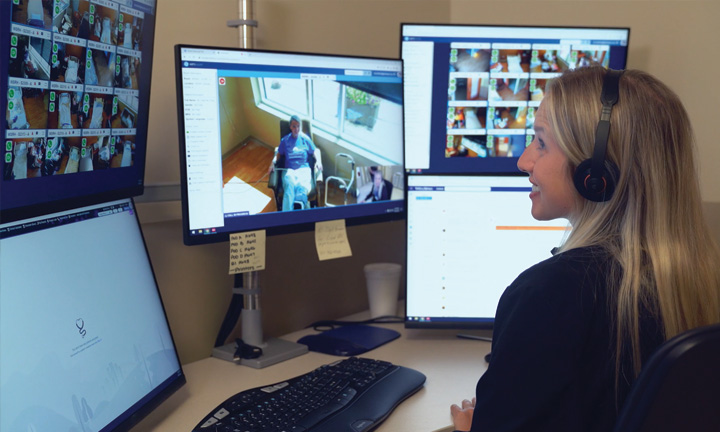
The setup in that photo is why virtual nursing works for recruiting: the work is clinical and experience-dependent, but it does not demand twelve hours on your feet. Advocate Health reported that virtual nursing saved more than 43,000 hours across 25 hospitals, and that reduced nursing turnover produced $6.3 million in cost avoidance, with virtual nursing a contributor; at WellSpan, one hospital reported an 8% decrease in nurse turnover - Epic. Nurses in these programs often rotate between virtual and bedside roles, which spreads the physical load and gives experienced nurses a reason to stay.
Staffing, culture and the Magnet signal
Flexibility only works if the core job is sustainable. Staffing ratios are now explicit bargaining and recruiting issues, as the 2026 New York contracts with enforceable safe staffing standards showed, and nurses ask about ratios early in every conversation. Employer reputation also shows up in the data: the American Nurses Credentialing Center lists 690 Magnet facilities, including 657 US hospitals, or 10.8% of US hospitals - ANCC, and NSI found that Magnet hospitals filled RN roles in 68 days on average, ten days faster than the benchmark. NSI is careful to note the survey did not test why, but nurses' attraction to the standards and culture Magnet signals is a plausible explanation.
To apply this play, survey your current nurses and recent leavers about which schedule products they would actually use, pilot two of them on a hard-to-staff unit, and post them as distinct jobs with their own titles. Put ratio and schedule information in the first lines of every posting and every outreach message. If your hospital has Magnet status, lead with it; if not, lead with the specific practices (shared governance, staffing commitments, education support) that Magnet hospitals are known for. Flexibility widens the domestic pool, but some markets simply do not have enough nurses, which is when organizations turn abroad.
11. Play 9: Recruit Internationally, Ethically
International recruitment remains a real source of experienced nurses for US hospitals, but in 2026 it is a long-horizon play with tighter limits and higher ethical stakes than at any point in the past decade. Done well, it brings in experienced, highly motivated nurses who often stay for years. Done badly, it produces nurses stuck in visa queues for years, contracts that end up in court and reputational damage that follows a health system for a long time. The organizations succeeding with it treat international nurses as a multi-year pipeline, not a quick fix for this year's vacancies.
The scale of interest is still large. In 2025, 52,827 internationally educated nurses took the NCLEX-RN for the first time to qualify for US licensure, and 47.3% passed - NCSBN. That is roughly one in five of all first-time NCLEX takers. CGFNS International, which issues the VisaScreen certificate most foreign nurses need, reported 24,733 VisaScreen applications in fiscal 2024, down 4.6% from 2023 but nearly 200% above 2018 levels, and found that 76% of certificates went to nurses seeking permanent green cards - CGFNS International.
Where international nurses come from
The source countries are concentrated, and pass rates vary widely by country, which matters for anyone recruiting candidates before they have passed the exam. The chart below shows the largest sources of first-time internationally educated NCLEX-RN candidates in 2025, from NCSBN's annual exam statistics.
First-Time Internationally Educated NCLEX-RN Candidates, 2025
The Philippines dominates, with 43% of all first-time international candidates, followed at a distance by India and Kenya. The pass rates behind those bars differ sharply: 45.8% for Philippine-educated candidates, 33.3% for Indian-educated candidates and 58.2% for Kenyan-educated candidates, according to the same NCSBN data. The practical lesson is to recruit nurses who have already passed the NCLEX, or to budget for exam preparation and accept that many candidates will not pass on the first attempt. Ghana and Nigeria also carry an ethical flag, which the section below explains.
The visa queue is the real constraint
Most foreign nurses enter the US on employment-based green cards in the third preference category (EB-3), and those visas are capped by year and by country. When demand exceeds supply, the State Department's monthly Visa Bulletin sets a cutoff date, and a nurse can only proceed once their petition's priority date is earlier than that cutoff. In the October 2026 bulletin, the EB-3 final action date for most countries retrogressed (moved backward) by 3.6 months to May 15, 2024, while the Philippines sits at August 15, 2023 and India at January 1, 2014 - Visa Lawyer Blog. In plain terms, the queue for most countries is running about two and a half years behind, so a petition filed today should not be expected to produce a visa quickly, and Indian nurses face a far longer queue.
The H-1B route does not solve this for staff nurses. A September 2025 presidential proclamation requires a $100,000 payment for new H-1B petitions for workers outside the US, and a September 2026 proclamation extended it to September 21, 2027 - The White House. As the American Organization for Nursing Leadership notes, most foreign nurses use EB-3 permanent visas, while advanced practice and other highly skilled nurses can qualify for H-1B - AONL. The fee therefore mainly affects foreign nurse practitioners and other advanced roles. Industry estimates put the overall EB-3 process at 12 to 30 months from start to arrival - OR Manager, so international hiring decisions made today mostly fill vacancies in 2028.
Ethics: the part that ends up in court
The ethical risks in international nurse recruitment are no longer theoretical, and they now carry legal consequences. In 2025, the New York Attorney General recovered more than $660,000 for foreign-recruited nurses from Advanced Care Staffing, whose contracts required nurses who resigned or were fired to pay as much as $20,000; the agency had collected that termination penalty from 71 nurses - Hudson Valley Press. A separate New Jersey class action against Towne Nursing over similar repayment terms reached a $1.85 million settlement that received preliminary approval in June 2026 - Open Class Actions.
There is also the question of where you recruit. The World Health Organization's Health Workforce Support and Safeguards List identifies 55 countries with health workforce shortages severe enough that active international recruitment from them is discouraged - WHO. The UK nursing regulator's latest register report notes that Nigeria and Ghana, two of the largest sources of its international nurses, are "red list" countries under the UK's ethical recruitment rules. US law does not bind American employers to the WHO list, but ethical recruitment codes and certification programs expect it to be respected, and nurse unions and journalists increasingly check.
The safeguards that separate ethical programs from risky ones:
- No trapping breach fees; any repayment must be proportionate and transparent
- Use certified ethical recruiters that follow a recognized international recruitment code
- Respect the WHO safeguards list and avoid active recruitment in listed countries
- Pay prevailing wages and the same benefits as domestic nurses in the same role
- Fund real onboarding: housing support, cultural orientation and clinical transition
Every item on that list costs money, and every one is cheaper than a lawsuit or a nurse who leaves in the first year. The organizations that do international recruitment best treat it like a residency for experienced nurses, with mentoring and a structured transition into US practice, rather than a staffing transaction. They also vet the agencies they work with, asking to see the contracts nurses actually sign, because the employer's name is on the front page when an agency's repayment terms become a story.
The global picture: competition for the same nurses
The US is not the only country competing for internationally educated nurses, and the competition is shifting. In the UK, internationally educated joiners to the nursing and midwifery register fell by 47% in a single year, from 20,669 to 10,961 in 2025-26, Indian joiners fell 54% and the Philippines dropped out of the UK's top three source countries for the first time since 2015-16 - NMC. Australia, which projects a nursing undersupply of about 70,707 full-time equivalents by 2035 - Australian Government, opened faster registration pathways for experienced nurses from the UK, Ireland, the US, Singapore, Spain and two Canadian provinces, which its health media reported could cut waits by up to 12 months - Medical Republic.
To apply this play, decide first whether your vacancies can wait two or more years. If they can, partner with an ethical recruiter, prioritize nurses who have already passed the NCLEX, fund the transition properly, and write contracts you would be comfortable seeing on the front page. If they cannot, international recruitment is not your answer for this year, and the domestic plays deserve your budget. Whatever mix you choose, every play in this guide loses value if your process is slow, which is the subject of the final play.
12. Play 10: Win on Speed
Speed is the multiplier on every other play. A nurse sourced through a referral, a marketplace or an AI agent is usually talking to several employers at once, and the one that schedules the interview first and makes a clear offer first wins most of the time. Yet the average hospital still takes 78 days to recruit an experienced RN, according to NSI, and the GoodTime 2026 Hiring Insights report found that time to hire increased across healthcare in 2025, with 34% of healthcare respondents naming it as a hiring challenge - Medical Economics. Most of those days are not spent searching for candidates; they are spent waiting for a reply, an interview slot, a manager decision or a background check.
The vendors in this space make strong claims about how much faster the process can be, and while their figures deserve skepticism, the direction is consistent. Incredible Health says hospitals hiring on its platform cut time to hire to under 20 days, and that hospitals using its AI voice screening can interview every applicant rather than roughly 10% and shave more than 11 days off time to hire - Incredible Health. Whatever the exact number, the gap between a 78-day process and a two- or three-week process is mostly self-inflicted delay.
The 72-hour standard
The most useful target is simple enough for every recruiter and nurse manager to remember: a qualified nurse should go from first contact to an interview within 72 hours, and from interview to offer within 72 hours. The diagram below lays out a process built around that standard, with license verification and scheduling running in parallel rather than in sequence.
The key move in that flow is running license verification and interview scheduling at the same time, immediately after the first response, so neither waits for the other. The second key move is starting nurses in frequent orientation cohorts (weekly or every two weeks) instead of a single monthly start date, which can otherwise add up to four weeks of dead time after the offer.
The speed killers to eliminate first:
- Manager calendar gridlock: pre-block interview slots on unit managers' schedules every week
- Sequential approvals: pre-approve pay ranges and bonuses so offers do not wait on sign-offs
- Slow first response: answer every qualified nurse within one business day, even if only by text
- Monthly start dates: move to weekly or biweekly orientation cohorts
- Late credential checks: verify licenses at application, not after the offer
The interpretation is that speed is mostly a design problem rather than an effort problem. Each of those killers is a policy or calendar decision that can be changed without adding recruiters. Pre-blocking manager interview slots alone often removes a week from the process, because the bottleneck in nurse hiring is rarely the recruiter; it is the unit manager who is also running a short-staffed floor. Pre-approved offer ranges remove another, since they let a recruiter make a verbal offer at the end of a strong interview instead of waiting for a compensation review.
Automation and offers that close
Conversational AI is the main technology lever for speed, especially for high-volume nurse and support roles. Workday completed its acquisition of Paradox, whose AI assistant Olivia screens candidates, answers questions and schedules interviews by text around the clock, on October 1, 2025 - Workday. Paradox's healthcare page cites a 97% reduction in interview scheduling time and quotes a talent acquisition manager saying almost 60% of candidates scheduled for interviews came in through the AI assistant after hours - Paradox. Those are vendor claims, but the after-hours point rings true for nurses, who job-hunt on breaks and after night shifts when recruiters are offline.
The offer itself also needs to close quickly, and bonuses remain part of the toolkit even if they are not the main reason nurses choose a job. Pine Rest in Michigan announced sign-on bonuses of up to $25,000 for inpatient RNs in June 2026, varying by unit and shift - Pine Rest, while the University of Toledo Medical Center offers $10,000 for experienced RNs and $7,500 for new graduates, plus up to $15 an hour in incentive pay - UTMC. Structure bonuses to reward staying (split payments over a year or two) and pair them with the schedule and staffing commitments from Play 8, which are what nurses actually weigh.
To apply this play, measure your current process stage by stage for the last 50 RN hires: days from application to first contact, to interview, to offer, to start. The longest stage is your first fix. Set the 72-hour standard, pre-block manager interview slots and move to frequent start dates. Speed done well makes every other play more productive, and it is also where AI agents are having the most visible impact, which the next section examines.
13. How AI Agents Are Changing Nurse Recruiting
AI agents are moving nurse recruiting from a manual relay of searches, emails and calendar invites to a system where software handles most of the repetitive steps and recruiters handle judgment and relationships. The shift is uneven: nurses are adopting AI faster than their employers, and the tools that work best automate narrow, well-defined tasks rather than replacing recruiters outright. Understanding where agents help and where they fail is now part of the job.
The adoption gap is the most striking number in the field. Incredible Health's 2026 survey found that 39% of nurses use AI in their job search, rising to 60% of nurses under 28, while only 4% of healthcare employers use AI in hiring and only 8% of nurses report a clear AI strategy from their employer - Incredible Health. Nurses are using AI to find roles, draft applications and compare offers, and they increasingly expect employers to respond at the same speed.
The four jobs AI agents now do
AI in nurse recruiting clusters into four jobs, each automating a different part of the funnel. Sourcing agents find and contact candidates; conversational agents screen and schedule; interview agents run first-round conversations; and matching agents rank applicants against requirements. Most hospitals will use more than one, often embedded in tools they already own, such as their applicant tracking system.
The common feature of the tools that work is that they take over waiting time and repetitive steps, not decisions. An agent that answers a nurse's question about shift differentials at midnight, or books an interview into a manager's pre-blocked slot, removes days from the process without anyone having to trust it with a hiring judgment. That is why adoption is fastest at the top of the funnel and slowest at the offer stage.
Where AI agents are doing real work in 2026:
- Sourcing agents such as HeroHunt.ai's AI Recruiter find passive nurses and send personalized outreach
- Conversational agents such as Workday Paradox screen and schedule candidates by text
- AI voice interviews such as Incredible Health's Lyn agent run structured first-round screens
- Matching and ranking inside ATS and marketplace platforms sorts applicants by fit
- Career agents for nurses, such as Incredible Health's Gale, help candidates on the other side
The interpretation is that the recruiting funnel is becoming two-sided automation: AI agents working for employers increasingly talk to AI tools working for candidates. For recruiters, the advantage moves to whoever defines the role most precisely and responds fastest, because agents amplify both good and bad inputs. A vague requisition produces a flood of poorly matched outreach; a precise one ("CCRN, three years of ICU, compact license, nights") produces a short list worth calling. Our broader guide to autonomous AI recruiters compares the main platforms across industries.
Where AI fails in nurse recruiting
AI agents have clear limits in healthcare, and ignoring them creates real risk. First, they cannot verify licenses or clinical competence; license checks must come from primary sources such as Nursys, and clinical skills still need a human interview with a nurse leader. Second, sourcing agents only see candidates with a digital footprint, which underrepresents bedside nurses who do not maintain professional profiles. Third, automated screening can encode bias, and regulators are paying attention: New York City, for example, requires bias audits and candidate notices for automated employment decision tools - NYC Department of Consumer and Worker Protection.
Nurses themselves are wary. The 2026 New York nurse contracts included safeguards on how hospitals use artificial intelligence for the first time, a sign that AI policy is now a labor issue in nursing. Candidates notice when automation is used carelessly, and in a profession built on trust, a clumsy bot can cost you a nurse who would otherwise have joined.
For recruiters, the practical answer is transparency: tell candidates when they are talking to an AI assistant, keep a human decision-maker on every offer, and use AI to remove waiting time rather than to make hiring decisions on its own. Used that way, AI agents make the ten plays in this guide cheaper and faster to run, which brings us to choosing among them.
14. Choosing Your Plays: A 2026 Decision Framework
No hospital needs all ten plays at full strength, and no hospital can fill its vacancies with just one. The right mix depends on three questions: how fast you need nurses, which segments your vacancies sit in, and how much you currently spend on travel and agency staff. Answering those questions honestly tells you where to put your next dollar and your next recruiter hour.
The table below summarizes the plays by time to impact, relative cost and the nurse market each serves best. Use it as a starting point for a portfolio: a few fast plays for this quarter's vacancies, a few slow plays for next year's, and speed (Play 10) underneath everything.
| Play | Time to impact | Relative cost | Best for |
|---|---|---|---|
| 1. New-graduate pipeline | 6 to 24 months | Medium | New graduates |
| 2. Grow your own | 1 to 4 years | Medium to high | Entry-level staff becoming nurses |
| 3. Referrals and boomerangs | Weeks | Low | Experienced generalists |
| 4. Marketplaces and job boards | Weeks | Low to medium | Active and semi-passive RNs |
| 5. License-based sourcing | Weeks | Low | Geographic and compact targeting |
| 6. AI sourcing and text | Days to weeks | Low to medium | Specialists, APRNs, leaders |
| 7. Convert flexible workforce | Weeks | Low, high savings | Travelers and per diem |
| 8. Sell flexibility | 1 to 6 months | Medium | Returners, parents, veterans |
| 9. Ethical international | 12 to 30 months | High | Long-term experienced supply |
| 10. Win on speed | Immediate | Low | Every segment |
Reading the table as a portfolio produces a few rules of thumb. If your vacancies are concentrated in a handful of specialties, lean on Plays 5, 6 and 10, because broad channels cannot find enough specialists. If travel and agency spend is your biggest pain, start with Play 7, because every conversion saves tens of thousands of dollars a year. If your problem is a structural shortage in a rural or fast-growing region, Plays 1, 2 and 9 are the only ones that add nurses to your market rather than moving them around. And if your process takes longer than six weeks, fix Play 10 first, because it multiplies everything else.
Measure what matters
Most nurse recruiting dashboards measure the wrong things: applicants, postings and time to fill as a single blended number. The metrics that drive good decisions are segment-specific and tied to money. Track source of hire by nurse market, so you know which plays produce hires for which segments; track time from application to offer, stage by stage; track first-year turnover by source, because a cheap hire who leaves in six months is the most expensive hire of all; and track agency dollars avoided, because it is the number that turns recruiting from a cost center into a margin lever.
Review those numbers quarterly and move budget toward the plays that produce retained hires at the lowest total cost. Over a year, most hospitals find that referrals, conversions and pipeline programs outperform paid job boards on cost per retained hire, and that AI sourcing pays for itself on specialist roles where a single filled vacancy offsets months of agency premiums.
AI sourcing and personalised outreach for specialist, advanced practice and leadership nurses, from $99 a month with unlimited positions and an 8-day free trial (card required).
The bottom line
Recruiting nurses in 2026 is no longer an emergency, but it is a permanent discipline. The averages tell the story: 78 days to fill an experienced RN role, 17.6% annual turnover, an 8.6% vacancy rate and roughly 180,800 RN openings a year for the next decade. The hospitals pulling ahead are not the ones with the biggest bonuses. They build supply through schools and their own staff, they reach passive nurses through referrals, license data and AI-powered outreach, they convert the flexible workforce already in their buildings, they offer schedules nurses can actually live with, and they move faster than everyone else.
The simplest decision framework is this: fix your speed first, convert your agency nurses second, put referrals and AI sourcing to work on your hardest specialties third, and start the slow pipeline plays now so that next year's vacancies are smaller than this year's. Tools like HeroHunt.ai can take the searching and first outreach off your team's plate for the specialist roles, but the plays that matter most in nursing still depend on relationships, schedules and respect for the people you are trying to hire.
This guide reflects the nurse recruiting market as of October 2026. Workforce statistics, visa bulletin dates, compact membership, vendor features and pricing change frequently, so verify current details with the original sources before making decisions.