



What Workable really costs in 2026: every plan at every company size, how the new Agent credits are billed, the fine print, and the alternatives worth comparing
Workable's headline price has barely moved in three years, but what you actually pay for Workable has changed a lot. The pricing page still opens on $299 a month for the Standard plan, the same figure it showed in December 2023 - Wayback Machine. Since then Workable has retired its cheaper Starter plan, added a third tier called Enterprise, raised Premier for companies above 100 employees, cut the discount for buying recruiting and HR together, and launched an AI agent whose pricing took three different forms in six months before settling on a per-action credit meter.
The problem is that $299 is the price for one buyer only: a company of 20 people or fewer, paying a year upfront, on the cheapest plan. Workable prices by company headcount, across nine bands, so a 150-person company sees a different number on every tier. Premier and Enterprise can only be bought annually. The Workable Agent sits on top of all of it, consuming AI credits at 1, 2 or 10 credits per candidate depending on what it does. Two companies on the "same" plan can end up with bills that differ several times over.
This guide decodes every Workable plan at every company size, the real discounts behind the "save 20%" labels, exactly how the Agent's credit meter charges you (with three worked cost scenarios), the contract terms that decide what you pay at renewal, how the price has changed since 2023, and the strongest Workable alternatives in 2026. Every Workable price below was read from Workable's own pricing page, help center and announcements in October 2026.
Written by Yuma Heymans (@yumahey), founder of HeroHunt.ai, an AI Recruiter that sources and screens candidates across 1B+ profiles and contacts them on autopilot. Building that kind of agent is why this guide prices Workable's Agent one action at a time rather than taking the credit packs at face value.
Manatal
If Workable's headcount bands are what is pushing your bill up, Manatal charges per recruiter instead: $15 per user per month billed annually ($19 month to month), whether you have 20 employees or 2,000. A three-recruiter team at a 150-person company pays around $540 a year on that tier, against Workable Standard's $11,388 for the same headcount. The honest caveat: the $15 tier caps at 15 jobs and 10,000 candidates, so most growing teams really compare against the $35 tier, and Manatal has no HR suite, so it only replaces the recruiting half of a Workable bundle.
Contents
- Workable Pricing at a Glance
- The Headcount Meter: Every Plan at Every Company Size
- Standard vs Premier vs Enterprise: What Each Tier Adds
- The Workable Agent and AI Credits
- The Fine Print: Billing, Bundles, Renewals and Downgrades
- How Workable's Pricing Changed From 2023 to 2026
- What Workable Buyers Actually Pay
- Where Workable Wins and Where It Falls Short
- The Best Workable Alternatives in 2026
- Full Comparison: Price, Meter and Best Fit
- How to Choose, and How to Buy Workable Well
- The Bottom Line
1. Workable Pricing at a Glance
Workable costs $299 to $719 a month for the smallest companies (1 to 20 employees) on annual billing, across three plans: Standard, Premier and Enterprise - Workable Pricing. Standard is the only plan you can pay monthly, at $360 a month for the same band. From there, every price rises with your employee count through eight published bands up to 1,000 employees, and companies above 1,000 get a quote. At the top published band (801 to 1,000 employees), Standard costs $2,799 a month on annual billing and Enterprise $4,749.
On top of the plan sits the Workable Agent, Workable's AI recruiting agent, which is sold separately on AI credits. Every paid account receives 3,000 free credits once, after which credits cost $0.12 each in a 5,000-credit pack ($600), $0.10 in a 10,000 pack ($1,000) or $0.095 in a 50,000 pack ($4,750). The Agent spends 1 credit to screen a candidate, 2 to source one and 10 for a candidate chat. Credits expire a year after purchase and cannot be refunded.
The table below shows the self-serve entry point of each plan, for the smallest company band:
| Plan | Annual billing | Monthly billing | Add-ons included | Who it is for |
|---|---|---|---|---|
| Standard | $299/mo ($3,588/yr) | $360/mo | None (Texting, Video, Assessments extra) | Steady hiring, tight budget |
| Premier | $599/mo ($7,188/yr) | Not offered | Texting, Video, Assessments, Referrals, SSO | Strategic hiring, more tools |
| Enterprise | $719/mo ($8,628/yr) | Not offered | Everything in Premier, plus custom reports and permission sets | Companies that need reporting and access control |
| Workable Agent | 3,000 credits free, then $0.095 to $0.12 per credit | Pay as you go | Add-on to any plan | Teams that want screening, sourcing and chat automated |
The table hides the most important fact about Workable pricing, which is that the meter is company size, not usage. You pay for how many people work at your company, including part-timers and contractors, not how many recruiters log in or how many jobs you post. That makes Workable cheap for a small company that hires constantly and expensive for a large company that hires rarely. It also explains why our recruiting software pricing guide found that the median Workable buyer pays roughly four times the $3,588 sticker.
Why this matters: the number on the pricing page is almost never your number, so budgeting off it understates the real cost for any company above 20 people. How to apply this: find your band in the next section before you read anything else, then add the Agent separately, because it is a usage meter with its own logic.
2. The Headcount Meter: Every Plan at Every Company Size
Workable bills on company size bands, and it defines company size broadly: "the total number of employees working for your company and any of its affiliates or subsidiaries", including full-time, part-time and contractors - Workable Help Center. There are nine bands: 1-20, 21-50, 51-100, 101-200, 201-400, 401-600, 601-800, 801-1000 and 1000+. The pricing page only renders the 1-20 band until you pick another one from a dropdown, which is why most third-party articles quote only $299, $599 and $719.
We read the full price list from the pricing page's own data, and it is below. All prices are per month for the Recruiting package. Standard has two columns because it is the only plan sold month to month. Premier and Enterprise are annual-only, so their monthly figure is one twelfth of an upfront annual payment.
| Company size | Standard (monthly billing) | Standard (annual billing) | Premier (annual) | Enterprise (annual) |
|---|---|---|---|---|
| 1-20 | $360 | $299 | $599 | $719 |
| 21-50 | $500 | $419 | $829 | $989 |
| 51-100 | $800 | $669 | $1,229 | $1,469 |
| 101-200 | $1,140 | $949 | $1,759 | $2,109 |
| 201-400 | $1,560 | $1,299 | $2,269 | $2,719 |
| 401-600 | $2,100 | $1,749 | $2,809 | $3,369 |
| 601-800 | $2,700 | $2,249 | $3,369 | $4,039 |
| 801-1000 | $3,360 | $2,799 | $3,959 | $4,749 |
| 1000+ | Quote | Quote | Quote | Quote |
The chart below turns those monthly figures into the annual amount you actually commit to at each band. It makes two things visible that the table does not: the relative gap between plans narrows as companies grow (Premier costs double Standard at 1-20 employees but only 41% more at 801-1000), and the steepest step in the whole ladder is the move from the 21-50 band to the 51-100 band.
Workable Annual List Price by Company Size (Recruiting, Annual Billing)
Three patterns in that ladder decide most Workable budgets. First, crossing 50 employees raises Standard by 60% ($419 to $669 a month), the largest single jump on the page, and crossing 20 or 100 employees adds about 40% each. Second, per employee the price falls steeply: Standard works out to $14.95 per employee per month at 20 people, $4.75 at 200 and $2.80 at 1,000. A company of 21 pays $19.95 per employee, a third more than a company of 20, because it has just entered a band priced for up to 50.
Third, the bands are reviewed by Workable, not just chosen by you. Moving up a band mid-contract triggers a prorated charge for the rest of the billing cycle, and if Workable's support team applies a band override to your account, you cannot select a lower band yourself - Workable Help Center. Because contractors count, a company with 40 staff and 15 regular contractors belongs in the 51-100 band, not 21-50.
Why this matters: the headcount meter rewards companies that hire a lot relative to their size and punishes those that hire a little. A 700-person company filling five roles a year pays $26,988 a year for Standard, the same as a 700-person company filling two hundred. How to apply this: divide your expected annual Workable cost by the number of hires you plan, and if that figure is high, compare per-user tools like Manatal or Zoho Recruit in section 9 before you sign.
3. Standard vs Premier vs Enterprise: What Each Tier Adds
Every Workable plan includes the core product: the applicant tracking system, the candidate sourcing suite with a database of 400M+ candidate profiles, posting to 200+ job boards, a careers page builder, interview scheduling and scorecards, reporting, GDPR and EEO tools, and API access - Workable Pricing. All three also list unlimited active jobs, with a tooltip that says "subject to fair usage limits". Workable does not publish what that limit is, and we found no number for it in the help center either.
The tiers differ in three ways. Premier adds the premium hiring tools (Texting, Video interviews, Assessments, Referrals), a hiring plan with requisitions, nine native language options, single sign-on and priority support. Enterprise adds two things on top of Premier: a custom report builder and additional permission sets. Standard users can still buy Texting, Video interviews and Assessments as add-ons, priced by company size. Without them, Standard accounts can use those tools only "in a limited capacity" - Workable Help Center.
The add-on prices matter because they determine whether Premier is worth it. Here they are per month on annual billing, from the same pricing data:
| Company size | Texting | Video interviews | Assessments | All three | Premier minus Standard |
|---|---|---|---|---|---|
| 1-20 | $89 | $109 | $59 | $257 | $300 |
| 21-50 | $129 | $159 | $99 | $387 | $410 |
| 51-100 | $199 | $299 | $169 | $667 | $560 |
| 101-200 | $269 | $409 | $209 | $887 | $810 |
| 401-600 | $419 | $619 | $319 | $1,357 | $1,060 |
| 801-1000 | $569 | $849 | $449 | $1,867 | $1,160 |
The last two columns contain the most useful number in this guide. Up to 50 employees, Standard plus all three add-ons is cheaper than Premier, by $43 a month at 1-20 and $23 at 21-50, though Premier still adds Referrals, SSO, the hiring plan and priority support for that small premium. From 51 employees upward the logic flips: Premier costs less than Standard with all three add-ons, by $107 a month at 51-100 and $707 a month at 801-1000. A mid-sized company that wants video interviews and assessments should never be on Standard.
Enterprise is a simpler decision. It costs roughly 20% more than Premier at every band, from $120 a month extra at 1-20 to $790 at 801-1000, and the only things that buys are custom reports and finer-grained permissions. That premium makes sense for companies with HR analysts who build their own reports or with strict access rules across departments, and very little sense for anyone else. Downgrading later is awkward: Workable says you keep custom reports visible but greyed out, and you can no longer edit permission sets - Workable Help Center.
Why this matters: the plan choice is really a choice about add-ons, and the break-even sits at 50 employees. How to apply this: below 50 employees, start on Standard and add only the tools you will use; above 50, price Premier first, and only step up to Enterprise if someone on your team has a concrete report or permission requirement that Premier cannot meet.
4. The Workable Agent and AI Credits
The Workable Agent is an AI recruiting agent built into the ATS. It runs an intake conversation to define the role, then screens applicants against an ideal candidate profile, sources passive candidates from Workable's 400M+ profile database, chats with candidates to check interest and fill gaps, scores them out of 100 and moves the strongest forward - Workable. Workable launched it on 12 March 2026 and in September presented it as four cooperating agents (job brief, sourcing, screening and engagement), alongside a Workable MCP server that connects the ATS to Claude, ChatGPT and other assistants.
Workable's own three-minute introduction, published on its official channel the day the credit-based agents launched, shows the screening and engagement flow in the product. It is worth watching before reading the credit math, because it shows which actions the Agent takes on its own and therefore which actions you are paying for.
The Workable Agent: An AI Recruiting Agent Built Into Your ATS
The Agent is billed on a per-action meter, and the actions stack on the same candidate. Workable charges 1 credit to evaluate a candidate against your ideal candidate profile, 2 credits to source a passive candidate into your pipeline, and 10 credits for a chat - Workable Help Center. A chat counts as soon as the candidate gives at least one answer, even if they never finish. So an applicant who is screened and chats costs 11 credits, and a sourced candidate who is evaluated and chats costs 13.
The screenshot below is the screen that the 1-credit evaluation produces: a fit score with written reasoning, and a must-have and nice-to-have checklist for each candidate.
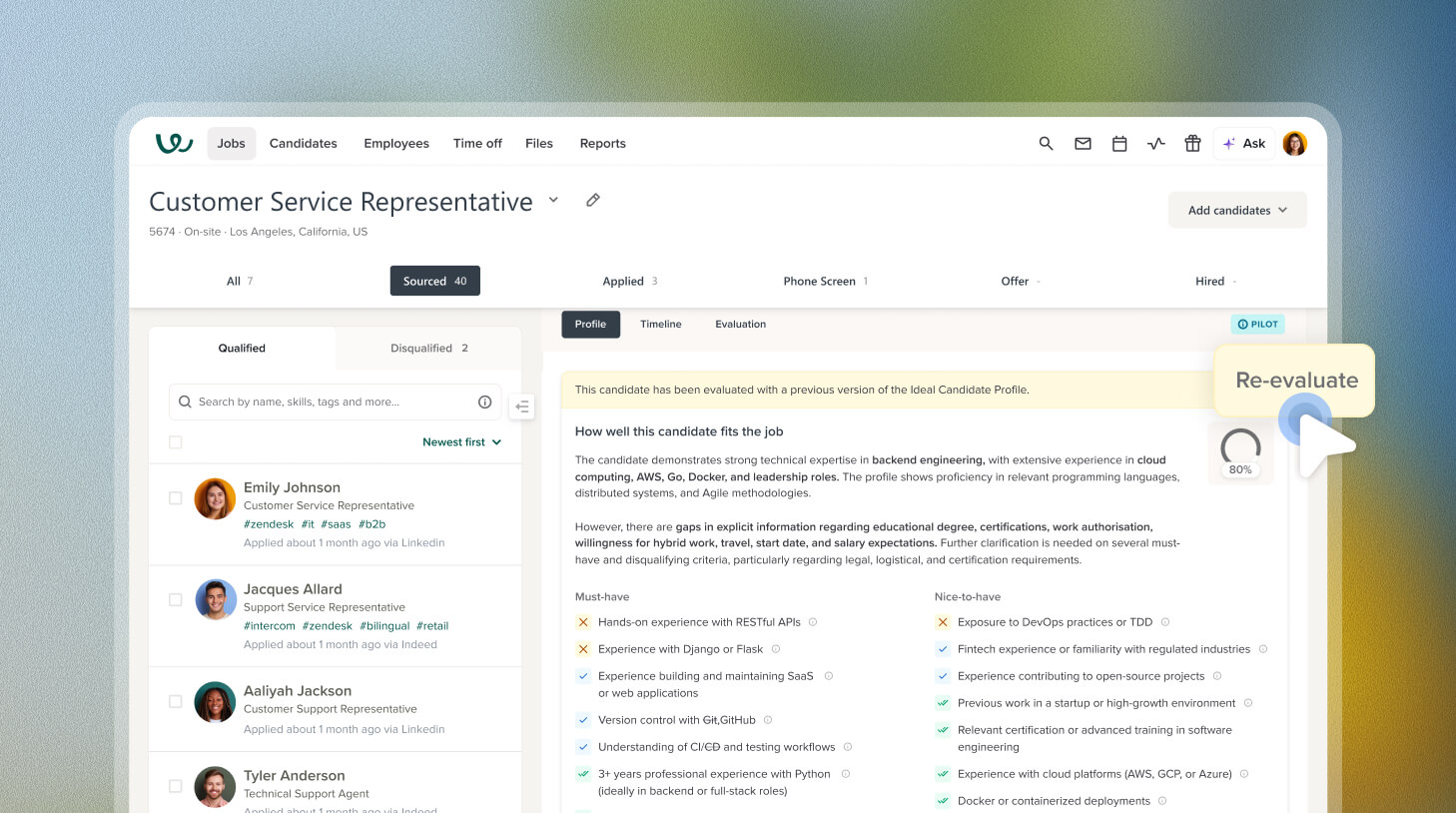
Notice the "evaluated with a previous version of the Ideal Candidate Profile" banner and the Re-evaluate button in that screen. Workable charges a credit "each time a candidate is screened against your ideal candidate profile", so editing your criteria halfway through a job and re-scoring the pipeline should be budgeted as fresh evaluations. The cheapest moment to get the ideal candidate profile right is before the job goes live, which is also where our AI candidate screening software comparison found Workable's screening succeeds or fails.
How the credit packs, free credits and expiry work
Every paid Recruiting account gets 3,000 free AI credits as a one-off grant, not every year, and they expire one year after your plan is activated - Workable Help Center. After that you buy packs of 5,000, 10,000 or 50,000 credits under Settings, or ask your account manager for an invoice. Purchased credits also expire after 12 months, are spent oldest first, are shared across every job in the account, and are non-refundable. Workable will build custom packs above 50,000 credits.
The pack prices reward commitment unevenly. Moving from the 5,000 pack to the 10,000 pack cuts the per-credit price by 17% ($0.12 to $0.10), but moving from 10,000 to 50,000 cuts it by only 5% ($0.10 to $0.095). Given the 12-month expiry, the 50,000 pack only makes sense if you expect to use more than about 45,000 credits within a year. Below that, four 10,000 packs plus a 5,000 pack ($4,600) cost less than the $4,750 bundle. Two operational details also matter: the Agent keeps working on candidates already in progress when your balance hits zero, and the resulting negative balance is deducted from your next purchase.
Workable added an AI credit usage report in September so admins can see where credits go. Its own example screenshot is instructive, because one of the six bars in the waterfall is credits that expired unused.

In that example, 2,395 credits expired against 3,695 used, so roughly two credits were wasted for every three spent. It is sample data, but it is a fair warning about how the meter behaves when you buy a bigger pack than your hiring needs. Workable alerts users with purchase rights at 80%, 90% and 100% consumption, which helps with running out. The help center describes no equivalent alert for credits about to expire, so check each bundle's expiry date, which shows when you hover over the balance on the Plan page.
Three pricing models in six months
Workable's Agent pricing has had three different shapes since launch, and older articles (including some comparison sites) still describe the first or second one. The diagram shows the sequence, with the source of each step.
At launch, Workable wrote that the full Agent was a paid add-on and that "pricing is flat by company size, not usage-based, so there are no surprises as hiring volumes change" - Workable. Three months later the general availability release switched to credits, with 1,000 free credits and one credit per candidate processed - Workable. By July the help center described the current per-action meter, and the September launch of four agents confirmed it at 3,000 free credits with the pack prices above - Workable.
Nothing about that evolution is unusual for a new AI product, but it has two practical consequences. Anything you read about Workable Agent pricing from before July 2026 is probably wrong, and the current meter is young enough that it may change again before your renewal. If the Agent is a large part of your business case, ask for the credit price and the action weights to be fixed in your order form.
What the Agent will really cost: three worked scenarios
The credit cost depends on three inputs: how many applicants reach the Agent, how many passive candidates it sources, and how many candidates answer its chat. Workable does not publish typical figures, so the scenarios below use explicit assumptions you can replace with your own. Each one assumes the 3,000 free credits are already spent, so it shows the steady-state yearly cost.
Scenario A, a 40-person company hiring 8 roles a year with 150 applicants each, inbound only. The Agent evaluates 1,200 applicants (1,200 credits) and 20% of them answer its chat (240 chats, 2,400 credits): 3,600 credits a year. The cheapest way to buy that is one 5,000 pack at $600, with 1,400 credits left to expire. Against Standard at $5,028 a year for the 21-50 band, the Agent adds about 12%.
Scenario B, a 150-person company hiring 30 roles a year with 200 applicants each, plus 40 sourced candidates per role. Evaluations cost 6,000 credits, the 1,200 sourced candidates cost 3,600 (2 to source plus 1 to evaluate), and 600 chats cost 6,000: 15,600 credits. Two 10,000 packs cover it at $2,000 a year, about 18% on top of Standard's $11,388.
Scenario C, a 700-person company in high-volume hourly hiring, filling 150 roles a year with 400 applicants each, where 15% of applicants chat. That is 60,000 evaluations and 9,000 chats, or 150,000 credits, which costs about $14,250 at the 50,000-pack rate. Standard for 601-800 employees costs $26,988 a year, so the Agent adds 53%, and chat accounts for 60% of the credits.
Workable Plan vs Agent Credits per Year (Illustrative Scenarios)
The pattern is the opposite of the plan meter. The subscription scales with headcount, the Agent scales with applicant volume and engagement, so the Agent is a rounding error for a small company with modest hiring and a major line item for a high-volume employer. The chat action is the lever: at 10 credits it costs ten times an evaluation. Workable's own advice for controlling spend is to use application knock-out questions, because candidates rejected by a knock-out are never evaluated and cost nothing, whereas a disqualifier inside the ideal candidate profile still costs 1 credit, since the candidate is evaluated first.
That distinction is easy to miss in the product, because the ideal candidate profile editor looks like the natural place to put hard requirements. The "Disqualify if missing" column below filters candidates out, but only after the Agent has screened them.
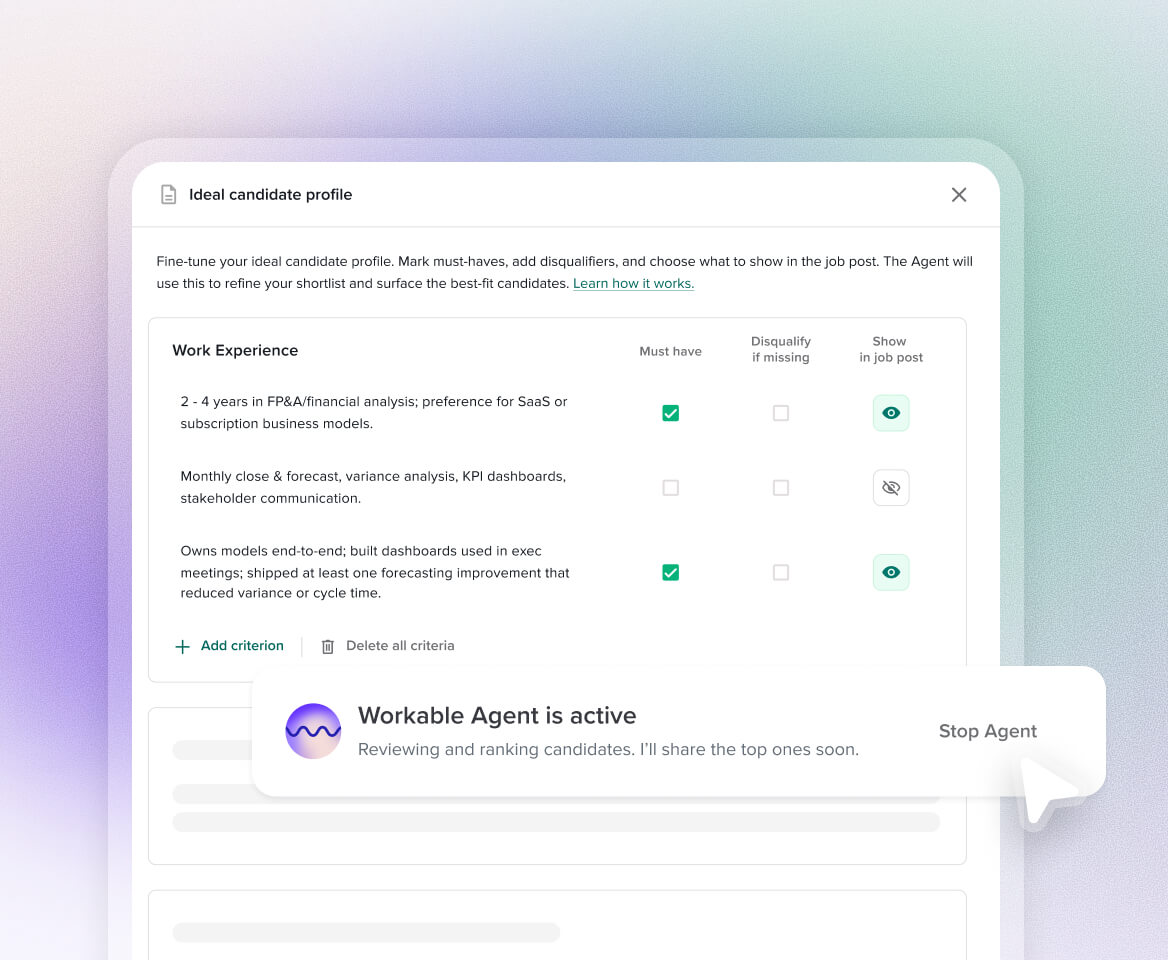
For a requirement that is a genuine yes-or-no (a work permit, a licence, a location), the cheaper place is a knock-out question on the application form, and the "Disqualify if missing" column is better kept for criteria that need judgement. On a job with 400 applicants where half fail a hard requirement, moving that requirement into a knock-out saves 200 evaluations, plus any chats those candidates would have triggered.
Why this matters: the Agent turns Workable from a fixed annual cost into a fixed cost plus a usage meter, and the usage part is driven by candidates you do not control. How to apply this: estimate applicants per role from your last year of hiring, decide which jobs genuinely need the Agent (it can be switched on per job), put knock-out questions on high-volume roles, and buy the smallest pack that covers 12 months.
5. The Fine Print: Billing, Bundles, Renewals and Downgrades
Workable's labels round in its own favour twice. The billing toggle says "Annually - save 20%", but the annual price is 16% to 17% below the monthly price at every band ($299 against $360 at 1-20). The 20% is true only the other way round: paying monthly costs about 20% more than paying annually. And the banner above every plan says "Bundle recruiting and HR to save up to 20%", which is accurate only for companies above 400 employees.
Here is how the bundle discount actually works out when you add Workable's HR package (HRIS, onboarding, time off, time tracking, payroll preparation) to Recruiting. Under 100 employees the bundle saves about 10%: on Standard at 51-100 employees, Recruiting at $669 plus HR at $489 would be $1,158 a month, and the bundle is $1,039. Between 101 and 400 employees it saves about 15%, and only from 401 employees does it reach 20%. The same proportions hold on Premier and Enterprise. Workable's banner said "up to 30%" until early 2026, so the bundle has also become less generous, which section 6 covers.
The contract terms are where Workable is least flexible, so they deserve as much attention as the price:
- Annual plans are paid upfront and renew automatically every year, with a reminder email shortly before - Workable Help Center.
- Downgrades are blocked while a subscription is active. To move to a cheaper plan you must cancel renewal or let the plan expire, then buy the lower plan.
- Cancelling mid-term brings no refund: Workable "cannot provide refunds for the time remaining on the account" - Workable Help Center.
The same rules reach the add-ons. Removing a Texting or Video add-on also requires cancelling renewal and repurchasing at expiry, so a tool nobody uses stays on the bill until the renewal date. And once you cancel, the account drops to a Free plan where you cannot post jobs or interact with candidates, only view the candidate data already there.
The common thread in those terms is that Workable makes it easy to move up and slow to move down. Upgrades are prorated and instant, from Standard monthly to annual, from Standard to Premier, or to a higher band. Every move in the other direction waits for the renewal date. That asymmetry is not unusual in SaaS, but combined with headcount bands that Workable can override, it means an annual Workable contract is closer to a one-year commitment at your peak size than a subscription you can trim.
Two more details trip up first-time buyers. The 15-day free trial needs no credit card and, according to the pricing page, includes the full Standard feature set (a help center article says Enterprise features instead), but it does not include the Workable Agent - Workable Help Center. You can only test the Agent after paying, using the 3,000 free credits. And legacy plans such as Starter cannot be repurchased if they lapse, even through a failed card payment, so a forgotten expired card can force a legacy customer onto a far more expensive current plan.
Why this matters: the cost of a Workable mistake is a year, not a month. How to apply this: start on Standard monthly (it renews monthly and can be cancelled at any time), use the month to confirm your band, add-ons and Agent usage, then switch to annual, which Workable treats as an upgrade and credits for unused days.
6. How Workable's Pricing Changed From 2023 to 2026
Workable's price history explains a lot of the contradictory numbers you will find online, including several in older articles on this blog. The short version: the entry plan was removed, the headline price stayed flat, and the increases happened in places the headline does not show. We reconstructed the timeline from archived copies of Workable's pricing page.
In December 2023 Workable had three plans. Starter cost $149 a month, billed monthly only, for companies of up to 50 employees, with 2 active jobs and 200 AI sourcing profile views a month. Standard was $299 a month on annual billing with 1,000 sourcing profile views a month, and Premier $599 with 20,000 views a year. Add-ons on Standard were cheaper too: video interviews at $99, texting at $79 and assessments at $59 - Wayback Machine. By June 2024 Standard had risen to $313 and Premier to $628, a level that some 2026 comparison articles still quote - Wayback Machine.
By mid-2025 the page had settled into today's structure. Starter was gone, Standard and Premier were back at $299 and $599, and the bands had been re-cut into the nine ranges used today. Starter survives only as a legacy plan: existing customers can keep it as long as they change nothing, but "if you cancel your Starter plan, it cannot be repurchased" - Workable Help Center. For a small company, removing Starter roughly doubled the cost of entry, from $149 to $299 a month (or $360 paying monthly).
The 2026 changes are subtler, and we found them by comparing the full price table behind the January 2026 page with today's - Wayback Machine. Three of them matter most:
- Standard Recruiting is unchanged at every band, which is why the headline never moved.
- Premier rose about 7% for companies above 100 employees (101-200 went from $1,649 to $1,759 a month) and is unchanged below that.
- The bundle discount fell from "up to 30%" to "up to 20%", and HR prices rose, so Standard Recruiting plus HR at 51-100 employees went from $779 to $1,039 a month, a 33% increase.
Two further changes landed in the same window. Enterprise appeared as a new third tier in early 2026 (first archived in March), giving Workable a higher price point above Premier. And Texting and Video interviews each rose $10 a month at the smallest band by April 2026, with larger increases at bigger bands: Video interviews for 801-1000 employees went from $799 to $849 a month.
The pattern is a familiar one in software pricing: protect the number everyone compares (Standard at $299), and recover margin in the bundle, the higher tiers and the add-ons that fewer buyers price carefully. A company that bought Recruiting plus HR at 51-100 employees in early 2026 and renews today on the same plan faces a much larger increase than the headline suggests. The Agent then added a new usage-based line on top.
Why this matters: when two sources disagree about Workable's price, both may have been right on the day they were written, and renewal quotes can rise even when the pricing page looks unchanged. How to apply this: when you renew, ask for your current-year price at your band and package next to the list price, and check the bundle and add-on lines separately, because that is where the 2026 increases sit.
7. What Workable Buyers Actually Pay
Workable is one of the few mid-market ATS vendors that publishes a complete price list, which makes its list price a usable guide to what buyers really pay. Vendr, which negotiates software contracts for buyers, reports a median Workable contract of $14,718 a year, with a range of $10,500 to $21,040, based on 38 deals and last updated in February 2026 - Vendr.
That median lines up closely with Workable's own list: $14,718 is within $30 a year of Premier at 51-100 employees ($14,748), and close to Standard at 201-400 ($15,588). The low end of Vendr's range sits just under Standard at 101-200 ($11,388), and the high end almost exactly matches Standard at 401-600 ($20,988). Vendr does not say which plan or band each buyer bought, and 38 deals is a small sample, so this is consistent with modest discounts rather than proof of them. But it suggests that Workable's typical buyer is a company of roughly 50 to 600 people paying something close to list.
Compare that with quote-only competitors, where the published information is the plan name and nothing else. Vendr puts the median Greenhouse contract at $26,570 a year across 884 purchases - Vendr - and Lever at $15,400 across 318 - Vendr. Greenhouse's median is about 1.8 times Workable's, consistent with its focus on larger, more structured hiring teams, which our Greenhouse pricing guide covers in detail.
Where does negotiation room exist at Workable? Not much on the published self-serve price, which is presented as fixed and bought in-product. The room is in what the price list does not fix: the band you are placed in, add-ons bundled into a Premier deal, the size and price of an AI credit package (Workable explicitly offers custom credit pricing above 50,000), multi-year terms, and manual invoicing for annual contracts.
Why this matters: a published price list is a negotiating anchor, not only a ceiling, and it means you can check any quote against the list in seconds. How to apply this: before you talk to sales, write down the list price for your band and plan from section 2, then ask for credits, add-ons or a price lock for a second year rather than a discount on the base fee.
8. Where Workable Wins and Where It Falls Short
Workable's biggest strength is transparency at the mid-market. Among the ATS vendors in this guide, Greenhouse, Lever, Teamtailor, Pinpoint and Recruitee publish no prices and quote on request, while Workable publishes every band from 1 to 1,000 employees and lets you buy without talking to anyone. That matters most to small HR teams without a procurement function. Workable says more than 35,000 companies have used it - Workable.
Its second strength is breadth for the price. Every plan includes the ATS, a sourcing database of more than 400 million profiles, job distribution to over 200 boards, and API access, and the HR package turns it into a light HRIS on the same bill. The new MCP server, which lets Claude or ChatGPT read and update Workable data with more than 90 tools under the user's own permissions, is included on all plans at no extra cost - Workable Help Center. Few ATS vendors include that.
The weaknesses come from the same pricing design. The headcount meter is unforgiving for large companies that hire rarely, and the band jump at 50 employees is steep. Contract terms are one-directional: easy to upgrade, impossible to downgrade mid-term, with no refunds. The Agent cannot be trialled before purchase, its credits expire after a year, and its pricing has taken three different forms in 2026 alone. And since Starter was retired, there is no Workable plan below $299 a month (or $360 paying monthly), which prices out the very smallest employers.
There is also a positioning gap worth naming. Workable's sourcing agent searches Workable's own profile database and writes to candidates by email, which works well for mainstream roles but less well for niche technical or senior roles where candidates are scattered across GitHub, research papers, portfolios and professional networks. That is a limit of any ATS-native agent, and it is one reason many teams pair their ATS with a dedicated sourcing tool. Our LinkedIn vs Indeed vs Workable AI recruiter comparison looks at that trade-off in depth.
Why this matters: Workable is a strong buy in one specific situation, and an expensive one outside it. How to apply this: Workable fits best when your company has roughly 20 to 600 employees, hires steadily relative to its size, wants recruiting and HR in one tool, and values a published price over customisation. If you are a large company with low hiring volume, an agency, or a team whose main problem is finding candidates rather than managing them, read the alternatives first.
9. The Best Workable Alternatives in 2026
The right alternative depends on why Workable is not working for you. If the issue is the headcount meter, per-user tools such as Manatal and Zoho Recruit are cheaper for large companies with small recruiting teams. If it is entry cost, Breezy HR and JazzHR start lower. If it is depth, Ashby and Greenhouse go further on analytics and structured hiring, at a higher price. And if the real bottleneck is finding candidates, an AI sourcing tool on top of any ATS may beat the Workable Agent.
The nine options below were chosen on that basis, and each price was read from the vendor's own pricing page in October 2026 unless stated otherwise. Where a vendor publishes no price, we say so rather than guess. This matters because switching an ATS is expensive in time, so the alternative should fix the specific reason Workable does not fit, not just cost less on paper. To apply it, identify which of the four problems above is yours, then read the two or three alternatives that address it.
9.1 Manatal: Per-User Pricing That Ignores Headcount
Manatal is the most direct answer to Workable's headcount meter, because it charges per recruiter instead of per employee. Professional costs $15 per user per month billed annually ($19 monthly), Enterprise $35 ($39) and Enterprise Plus $55 ($59) - Manatal Pricing. The 14-day trial needs no credit card. AI candidate recommendations and scoring are included in the plans rather than sold on a credit meter.
The catch is the entry tier: Professional caps at 15 jobs and 10,000 candidates, so a team with more open roles really compares against the $35 Enterprise tier. Even then the arithmetic is lopsided for larger companies. Three recruiters on Enterprise cost $1,260 a year, against $11,388 for Workable Standard at 101-200 employees. Manatal also includes a recruitment CRM for client work, which makes it popular with agencies. It does not have an HR suite, so it replaces only Workable's Recruiting package.
9.2 Breezy HR: A Free Plan and Flat Company Pricing
Breezy HR is the cheapest way to start: its free Bootstrap plan allows one active position with unlimited users and candidates. Paid plans are flat per company with unlimited users: Startup at $157 a month billed annually ($189 monthly), Growth at $273 ($329) and Business at $439 ($529) - Breezy HR Pricing. Every paid plan has unlimited positions.
Breezy's AI layer, Breezy Intelligence, is credit-based like Workable's, but much cheaper per unit: credits start at $30 per 100,000 and never expire, and the 14-day trial includes 100,000 credits. Breezy's limits are depth and HR: it has no full HRIS (onboarding is a separate add-on), its reporting is simpler, and it does not advertise a passive-candidate database on the scale of Workable's 400M profiles. For a company under 50 people with simple pipelines, Startup costs about half of Workable Standard at 1-20 employees and about a third at 21-50.
9.3 Ashby: More Analytics, Company-Size Pricing Under 100
Ashby has started publishing prices for its Foundations plan, which covers companies up to 100 employees: $300 a month for 1 to 10 employees, $400 for 11 to 25, $500 for 26 to 50, $700 for 51 to 75 and $900 for 76 to 100, with a 10% discount for annual commitment. Larger companies on Plus and Enterprise get a quote. Like Workable, Ashby meters on company size, so it is not an escape from headcount pricing.
What Ashby offers instead is depth: built-in analytics, scheduling and CRM, which is why analytics-heavy tech teams often choose it. Its AI credits are included rather than sold first: 1,500 credits a month on Foundations, with more available to buy (the price is not published). On annual terms Ashby costs about $630 a month at 51-75 employees after the 10% discount, against Workable Standard's $669 at 51-100, so the two are close in price, and the decision comes down to whether you value Ashby's analytics or Workable's HR suite and sourcing database.
9.4 JazzHR: The Lowest Entry Price for Small US Companies
JazzHR prices per company and bills annually: Hero at $1,000 a year, Plus at $3,480 and Pro at $5,508. Plus adds AI-powered candidate matching, structured interviews and up to 200 active jobs, and Pro adds offers, e-signatures and custom reporting. JazzHR's own footnote says its standard pricing does not apply to agencies, staffing firms, franchises, multi-location businesses or organisations over 250 employees.
That footnote defines the fit. JazzHR is for small, single-location US employers with occasional hiring who want a simple applicant tracker at the lowest possible cost. Hero costs less than a third of Workable Standard's annual price at the smallest band. It has no HR suite comparable to Workable's and no AI agent comparable to the Workable Agent, so the saving comes with a much narrower product.
9.5 Zoho Recruit: Per-User Pricing Inside the Zoho Stack
Zoho Recruit also charges per user rather than per employee. Its corporate HR plans cost $25 and $50 per user per month on annual billing ($30 and $60 monthly), according to Zoho's own pricing data, and there is also a free plan. The 15-day trial includes Enterprise features and then drops to the free plan, and Zoho offers a 45-day money-back guarantee.
Zoho Recruit makes the most sense for companies already on Zoho People, Zoho CRM or Zoho One, where it plugs into tools they already pay for. For a 300-person company with two recruiters, $50 per user comes to $1,200 a year, a fraction of Workable Standard's $15,588 at 201-400 employees. The trade-off is breadth: Zoho's HR system, Zoho People, is a separate product, so a like-for-like comparison with Workable's recruiting and HR bundle has to add its cost.
9.6 Teamtailor: Employer Branding With AI Included
Teamtailor does not publish prices; every plan is a quote. What its pricing page does state is useful for comparison: unlimited job postings and unlimited users on all plans, and Teamtailor AI marked as included with unlimited usage, with no credit meter. Requisitions and approval flows, and multi-brand setups, are premium features.
Teamtailor's strength is the careers site and employer brand, which suits companies that recruit heavily from their own audience. Its AI-included model is the cleanest contrast to Workable's credits: you pay once and use AI as much as you like, at the cost of not knowing the price until you ask. Without a published figure, it is impossible to say whether that ends up cheaper than Workable plus Agent credits, so get a written quote at your headcount.
9.7 Greenhouse: Structured Hiring at a Higher Price
Greenhouse sells three plans (Core, Plus and Pro) with no published price. Vendr's data puts the median contract at $26,570 a year, with a range of roughly $10,200 to $74,300. Greenhouse is the reference product for structured hiring: interview plans, scorecards, approvals and a large partner ecosystem, which makes it a common upgrade path for scale-ups whose hiring process is formalising.
The trade-off is cost and complexity. Greenhouse's median contract is about 1.8 times Workable's, and Greenhouse has no HRIS of its own, so there is no equivalent of Workable's recruiting and HR bundle. For companies under 100 employees it is rarely worth the premium. For companies of several hundred people with multiple recruiting teams and compliance requirements, it is a natural next step after Workable.
9.8 Recruitee: European Mid-Market, Metered on Job Posts
Recruitee, now part of Tellent, no longer publishes prices. Its pricing page says plans are tiered by plan, number of employees and billing period, with a 20% discount for annual payment and a one-year minimum commitment - Recruitee Pricing. The entry Start plan caps at five active job posts, while Advance and Optimize are unlimited.
Recruitee meters its AI by plan rather than by purchase: Advance includes 100 AI screening credits a month and three matching searches, while Optimize includes full screening and 65 searches a month. It is a strong collaborative ATS for European mid-market teams, but with no published price it lacks Workable's main advantage, and the five-job cap makes its entry plan narrower than Workable Standard's unlimited jobs.
9.9 HeroHunt.ai: An AI Recruiter for the Sourcing Half
HeroHunt.ai is not an ATS, and it does not replace Workable's pipeline, scheduling or HR features. It competes with the sourcing side of the Workable Agent: finding, screening and contacting candidates who have not applied. Its AI Recruiter searches over a billion profiles across platforms, screens each one against the role with language models, and runs personalised outreach, with unlimited positions and searches on every plan.
Pricing is published and metered on two allowances, AI-screened and matched profiles delivered and candidate emails found, rather than on company headcount. Starter costs $99 a month for 2,000 profiles and 500 emails, and Pro $199 for 5,000 profiles - HeroHunt.ai Plans. An 8-day free trial (card required) includes 150 profiles and 75 emails. For comparison, each candidate the Workable Agent sources costs at least 3 credits (2 to source, 1 to evaluate), or $0.29 to $0.36. HeroHunt.ai fits teams that already have an ATS, or are happy on Workable Standard, and need more outbound reach than an ATS-native database provides, especially for technical and specialist roles.
10. Full Comparison: Price, Meter and Best Fit
The table below puts the alternatives side by side on the three things that decide the bill: the entry price, what the price is metered on, and how AI is charged. Read the meter column first, because it determines how the price behaves as your company grows.
The AI column matters more in 2026 than it did a year ago, because applicant tracking systems now split into three camps. Teamtailor and Manatal include AI in the subscription; Ashby and Recruitee include an allowance and sell more; Workable and Breezy sell AI by the credit from the first unit after a free grant. The entry price tells you what the software costs, and the AI column tells you how that cost will behave as your applicant volume grows.
| Platform | Entry list price | Meter | AI pricing | Best for |
|---|---|---|---|---|
| Workable | $299/mo annual ($360 monthly) at 1-20 employees | Company headcount band | 3,000 one-off credits, then $0.095-$0.12 per credit | 20-600 employee companies wanting ATS + HR |
| Manatal | $15/user/mo annual | Per user (entry tier capped at 15 jobs) | Included, no credits | Agencies, large companies with small TA teams |
| Breezy HR | Free (1 position); $157/mo annual | Flat per company | Credits from $30 per 100,000 | Small teams with simple pipelines |
| Ashby | $300/mo (1-10 employees) | Company size up to 100, then quote | 1,500 credits/mo included | Tech startups wanting analytics |
| JazzHR | $1,000/yr | Flat per company, annual | AI matching on Plus | Small single-site US employers |
| Zoho Recruit | $25/user/mo annual | Per user | AI matching on higher tiers | Companies on the Zoho stack |
| Teamtailor | Quote only | Quote; unlimited users and jobs | Included, unlimited | Employer-brand-led hiring |
| Greenhouse | Quote only (Vendr median $26,570/yr) | Quote | Not published | Structured hiring at scale |
| Recruitee | Quote only | Plan, employees, job posts | 100 screening credits/mo on Advance | European mid-market teams |
| HeroHunt.ai | From $99/mo | Profiles + emails, unlimited positions | Screening built in | Outbound sourcing on top of any ATS |
The chart shows what each published option would cost a 50-person company with three recruiting users, using each vendor's cheapest annual plan without a tight cap on open jobs (for Zoho Recruit, whose job caps we could not confirm, the higher $50 tier). Quote-only vendors are excluded because there is no list price to plot.
Annual List Price for a 50-Person Company With 3 Recruiting Users
At 50 employees, Workable Standard costs roughly what Ashby does and about two and a half times Breezy's Startup plan, and per-user tools are cheaper still. The gap widens fast as headcount grows, because of the published options here only Workable and Ashby charge for employees who never touch the hiring process. That is the strongest argument against Workable for a large company with a small recruiting team, and the weakest one for a 30-person startup that hires every month, where Workable's sourcing database, HR package and Agent are hard to match at the price.
Why this matters: the cheapest tool at 50 employees is not the cheapest at 500, and the meter tells you which way each price will move. How to apply this: project your headcount for the next two years, recompute this chart at that size using section 2's ladder, and only then compare features.
11. How to Choose, and How to Buy Workable Well
Most Workable decisions come down to four questions: how big your company is relative to its hiring, whether you want HR in the same tool, how much of your hiring is inbound versus outbound, and whether you can commit annually. The diagram turns those into a decision path.
The left branch is about entry cost: below 20 employees, Workable's minimum of $299 a month is hard to justify unless you hire constantly. The middle branch is Workable's home ground, where the plan choice follows the 50-employee break-even from section 3.
The right branch is about the headcount meter: above 600 employees, what you pay depends far more on headcount than hiring, so per-user tools usually win unless your hiring volume is high. The last node applies to everyone, because no ATS-native agent covers every niche.
If Workable is the right choice, these buying tactics come straight from its own terms:
- Start monthly, then switch. Standard monthly can be cancelled any time, and moving to annual is treated as an upgrade with unused days credited.
- Price Premier above 50 employees. It undercuts Standard plus Texting, Video and Assessments from 51 employees upward.
- Buy credits small and often. The 10,000 pack is 17% cheaper per credit than the 5,000 pack; the 50,000 pack saves only 5% more and expires after a year.
Two more habits protect the budget once you are live. Count your headcount honestly, because contractors and part-timers count and Workable can override your band, so budget for the band you will be in at renewal rather than today. And put knock-out questions on every high-volume job, because knocked-out candidates never reach the Agent and cost nothing.
Behind those tactics is one principle: Workable's pricing is generous to buyers who commit carefully and expensive for those who commit early. The monthly plan gives you a cheap way to find your real band, add-ons and Agent usage before you lock them in for a year. The credit packs reward matching purchases to usage rather than buying ahead. And because downgrades wait for renewal, anything you add should be something you will use for the whole term.
Why this matters: with no refunds and no mid-term downgrades, the decisions you make in the first month are the ones you pay for all year. How to apply this: run one real hiring cycle on Standard monthly with the Agent on a single high-volume job, read the AI credit usage report at the end of the month, and size your annual plan and credit pack from those numbers.
12. The Bottom Line
Workable is one of the most honestly priced applicant tracking systems in 2026. It publishes every band from 1 to 1,000 employees, sells self-serve, and its median contract sits close to its list price. For a company of roughly 20 to 600 people that hires steadily and wants recruiting and HR in one place, Standard (below 50 employees) or Premier (above 50) is a strong buy at $299 to $3,959 a month on annual billing, depending on size and plan.
The cost risks are structural rather than hidden. The headcount meter makes Workable expensive for large companies that hire rarely. The "save 20%" labels are really about 17% for annual billing and, below 100 employees, about 10% for the bundle. Annual contracts cannot be trimmed mid-term or refunded, and the 2026 increases landed in bundles, Premier and add-ons rather than the headline price. The Workable Agent adds a usage meter that costs little for small inbound hiring and a great deal for high-volume hiring with candidate chat.
If the headcount meter is the problem, per-user tools such as Manatal or Zoho Recruit cost a fraction of Workable at the same company size. If entry cost is the problem, Breezy HR and JazzHR start lower. If you need deeper analytics, Ashby and Greenhouse go further at a higher price. And if your hiring bottleneck is finding candidates rather than managing them, an AI sourcing tool such as HeroHunt.ai on top of any ATS covers the part of the Workable Agent that matters most for hard roles.
For teams priced out by headcount bands: $15 per user per month billed annually, the same at 20 employees or 2,000. The entry tier caps at 15 jobs, so most growing teams use the $35 tier.
Whatever you choose, compare on the two numbers that decide the bill: what the price is metered on, and what it will cost at the company size you expect to be in two years from now.
This guide reflects Workable's pricing page, help center and product announcements as of October 2026. Workable changed its pricing several times in 2025 and 2026, and competitor prices change often, so verify current details on each vendor's own site before purchasing.