



A field guide to adapting your craft, your workflow, and your career as AI rewrites recruiting in 2026.
More than half of talent leaders now plan to add autonomous AI agents to their recruiting teams this year - Korn Ferry. Not chatbots that answer benefit questions, but agents that read a role, run searches across millions of profiles, screen the results, draft outreach, and book interviews while you are asleep. When the same survey finds that 84% of talent leaders plan to use AI in some form in 2026, the debate about whether AI belongs in recruiting is effectively over. The only open question is what a recruiter becomes on the other side of it.
That is what this guide is about. It is not another list of tools to try. It is a practical answer to the question quietly nagging most recruiters right now: the ground under my job is moving, so what exactly do I do about it? The honest starting point is that the threat is real but misread. The risk in 2026 is not that a machine replaces you outright. It is that adoption is still shallow, most teams are dabbling rather than transforming, and the recruiters who redesign their work around AI will quietly out-produce, and eventually replace, the ones who do not.
This guide starts high and works down. It covers what actually changed in the last year, whether AI is truly coming for recruiter jobs, and the new operating model where you direct agents instead of doing every task by hand. Then it goes into the nitty-gritty: the specific platforms and their real pricing, a stage-by-stage rebuild of your workflow, the skills that now separate the best recruiters, the legal and ethical traps that can end a program, a change-management roadmap for adopting AI without a team revolt, and where all of this is heading through 2027. Every number here is current to late 2025 or 2026, because in this field a statistic from two years ago is already folklore.
This guide is written by Yuma Heymans (@yumahey), who has spent the past several years building autonomous recruiting technology and writing about how AI is reshaping the craft. He approaches the shift from the operator's side: less about the hype cycle, more about what actually changes on a recruiter's Tuesday morning.
Contents
- What Actually Changed: The State of AI Recruiting in 2026
- Will AI Replace Recruiters? The Honest 2026 Answer
- Your New Job Description: From Sourcer to Orchestrator
- The New Sourcing Stack: When Recruiters Get Their Own Agents
- Screening, Interviews, and the Rise of the AI Voice Recruiter
- Rebuilding Your Workflow Around AI Agents
- The Skills That Now Separate the Best Recruiters
- Where It Breaks: Bias, Deepfakes, and the Law
- How to Adopt AI Without Blowing Up Your Team
- The 2026-2027 Outlook: Toward the Autonomous Desk
- Your Playbook for the New Era
1. What Actually Changed: The State of AI Recruiting in 2026
The single most important shift of the past year is that AI in recruiting stopped being a feature and became an operating layer. For most of the last decade, AI in hiring meant a resume parser or a keyword match buried inside an applicant tracking system. In 2026 it means autonomous agents that carry out multi-step work on a recruiter's behalf, and adoption has crossed from early experiment into the mainstream. Roughly 62% of employers now use AI in talent acquisition, up from about 40% in 2020 - Aptitude Research. Broaden the definition slightly and the figure climbs higher: 69% of companies use AI somewhere in hiring in the latest industry data - iCIMS.
The defining word for 2026 is agentic. The market moved past single-task assistants toward systems that string tasks together: source, screen, sequence outreach across email and messaging, and schedule, all under a recruiter's direction. The scale of intent is striking, with 46% of companies using or planning agentic AI in talent acquisition - iCIMS. This matters because it changes the unit of work. You are no longer buying a faster search box. You are hiring a tireless junior teammate that runs in the background, and your job shifts toward briefing and reviewing it.
It is worth being precise about the difference between the AI most recruiters already know and the agentic AI now arriving, because that gap is what explains the disruption. An assistive tool waits for you: you ask it to write a job description or rank a list, it answers, and it stops. An agent is handed a goal and then works out the steps itself, chaining searches, evaluations, and drafts together without a fresh prompt for each one. The old tool made you faster at a task you still owned. The new one owns the task and reports back. That is a categorical change, not an incremental one, and it is why so many recruiters describe a strange unease this year: the work is not being sped up so much as handed off, with the recruiter moving up a level to supervise it rather than perform it.
To see how mainstream the underlying technology has become, it helps to zoom out to the whole economy. Organizational AI adoption jumped sharply as generative tools matured, a curve that recruiting is riding rather than leading.
AI adoption went mainstream across organizations
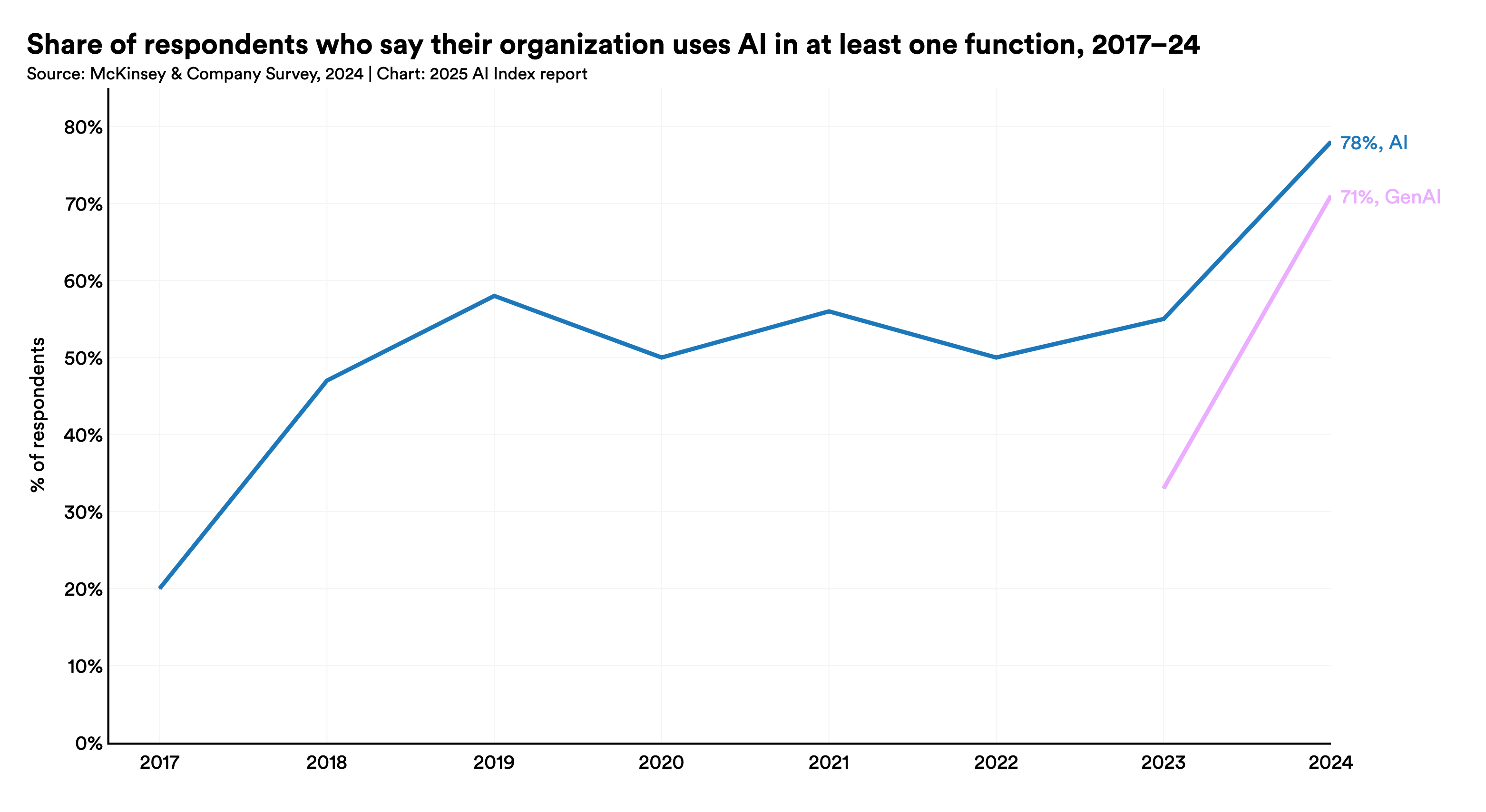
That broad surge is confirmed at the enterprise level, where 88% of organizations regularly use AI in at least one business function and 72% now use generative AI, up from roughly 33% in 2024 - McKinsey. Recruiting sits near the front of this wave rather than at the back of it. In HR specifically, recruiting is the single most common use case for AI, cited by 27% of organizations ahead of HR technology, learning, and employee experience - SHRM. The reason is simple: recruiting is full of repetitive, high-volume, text-heavy work, exactly the shape of problem current AI is best at.
The trajectory becomes clearer as a picture. The share of employers touching AI in hiring has moved in one direction, and it has accelerated as agentic tools arrived.
Employers Using AI in Talent Acquisition
Here is the crucial caveat, and the reason this section matters for how you should act. Adoption is wide but shallow. Just 6% of companies have automated more than three-quarters of their hiring, and nearly half use AI in only a thin sliver of the funnel - Aptitude Research. Most teams have one tool doing one thing. That gap is your opportunity. The competitive edge in 2026 does not come from being the only recruiter using AI, because almost everyone now touches it. It comes from being one of the few who use it deeply and deliberately, across the whole funnel, while the rest keep dabbling. Governance is lagging just as badly, with 45% of companies lacking any formal AI governance framework, which means the recruiters and leaders who bring structure to this will stand out fast - iCIMS.
None of this is slowing down. Gartner projects that by 2028, 30% of recruitment teams will rely on AI agents for high-volume hiring and early-stage tasks, and the market underneath that shift has been growing at roughly 39% a year, on a path from under a billion dollars in 2024 toward the tens of billions within a decade - Gartner. For a working recruiter, the practical reading of those numbers is not that you must chase every release. It is that the direction is settled. The open question is no longer whether AI becomes part of the job, but whether you shape how it enters your workflow or have it handed to you by a vendor and a budget line you did not set.
2. Will AI Replace Recruiters? The Honest 2026 Answer
The honest answer, supported by the best 2026 data, is that AI is absorbing recruiting tasks, not recruiter jobs, but the number of recruiters per team is going to fall. Those two statements sound contradictory and are not. The clearest macro signal comes from the World Economic Forum, which projects 170 million new jobs created and 92 million displaced by 2030, a net gain of about 78 million roles even as roughly a fifth of all jobs churn - World Economic Forum. Work is being reshaped, not deleted, and recruiting follows that pattern.
Look inside the work itself and the picture sharpens. The WEF expects the share of tasks handled by humans alone to fall from 47% to 33% by 2030, with the rest split between full automation and human-machine collaboration - World Economic Forum. In recruiting terms, the automatable slice is obvious: manual sourcing, first-pass resume screening, interview scheduling, and status-update emails. The slice that stays human is just as obvious once you name it: reading a hiring manager's unspoken priorities, coaching a nervous candidate, negotiating an offer, and making the final call.
The clean way to predict which of your own tasks are exposed is to ask whether each one is mostly pattern-matching or mostly judgment. Pattern-matching work, scanning a thousand resumes against a set of criteria or firing off a first-touch message, is what agents do tirelessly and well. Judgment work, deciding whether a candidate's unconventional path is a risk or a hidden asset, is what they do poorly and what employers increasingly pay a premium for. This is why the analysts who study hiring keep landing on the same non-technical ability as the durable one: in a 2026 survey, 73% of talent leaders rank critical thinking as their top skill priority for human hires, placing AI skills only fifth - Korn Ferry. Leaning into judgment is not nostalgia. It is leaning into exactly the ability the machines still lack.
Independent analysts frame this as the biggest structural change to the profession in decades. To hear it argued directly, this session from one of the most-cited voices in the field is a useful primer on why the shift is strategic rather than cosmetic.
The AI Revolution in Talent Acquisition
Where the comfortable narrative gets uncomfortable is headcount. The Josh Bersin Company predicts AI-powered agents will drive HR teams to become roughly 30% to 40% smaller by 2030, framing it as a shift in the mix of roles rather than pure loss, with new higher-value positions emerging as routine ones disappear - Josh Bersin. The near-term market already shows the pattern. Only about 24% of companies plan to add recruiter headcount, while a meaningful share reduced it, even as most increase technology spending - Pin. The blunt translation is that teams are choosing to spend on tools instead of people.
It is worth doing the arithmetic on what that actually means for a team, because it is less grim than the headline suggests. If each recruiter reclaims about a fifth of their week, as the one-workday figure implies, a five-person team effectively gains the output of a sixth member without adding a single hire. From a budget holder's chair, that is precisely why spending shifts from people to tools. From a recruiter's chair, it is why the survivors of a smaller team are not the overworked but the re-pointed, carrying a larger requisition load with agents doing the grinding underneath. The teams that handle this transition well tell their recruiters plainly what the reclaimed capacity is for, which is deeper candidate and hiring-manager work, rather than banking the productivity quietly and letting people wonder whether they are next. The math only becomes a morale problem when leaders capture the gain and say nothing about where the freed time should go.
The reason this does not spell doom for individual recruiters is capacity and value. Recruiters using generative AI report saving about one full workday per week, roughly a 20% workload reduction they can redirect into higher-value work - LinkedIn. A smaller team where each recruiter is 20% more productive is not the same as a team being eliminated. It is a team being concentrated.
And the work it concentrates on is human. Employers were 54 times more likely to list relationship development as a required recruiter skill year over year, a stunning signal of where value is migrating - LinkedIn. That is the tell for every recruiter deciding where to invest their own development: the market is repricing relationships and judgment upward at the very moment it automates the mechanics of the job.
There is also a hard limit on how far automation goes, and it is set by people, not technology. The public is deeply uneasy about machines making the call: Pew Research found 71% of Americans oppose AI making a final hiring decision - Pew Research Center. Recruiters agree in practice, with 85% insisting on retaining final decision authority over AI recommendations - Aptitude Research. So the realistic 2026 answer to the replacement question is this: the recruiter who does only transactional tasks is genuinely at risk, because those tasks are being automated. The recruiter who owns relationships, judgment, and outcomes is not being replaced, but is being asked to do that job for a larger requisition load with a team of agents underneath. How to become the second kind of recruiter is the rest of this guide.
3. Your New Job Description: From Sourcer to Orchestrator
The most useful mental model for 2026 is that your title stayed the same but your job description quietly rewrote itself. The recruiter is moving from executor to orchestrator: less the person who runs every search and sends every message, more the person who directs a set of agents, reviews their output, and owns the human moments that decide a hire. Bersin's research names the new role a strategic orchestrator who sets the parameters for AI systems rather than performing manual screening by hand - Josh Bersin. LinkedIn uses a parallel term, the talent advisor, for the recruiter whose value is judgment and relationships. The labels differ; the direction is identical.
This is not a rebrand of the same daily work. It is a genuine reallocation of where a recruiter spends hours. As AI takes over screening, scheduling, and first-touch communication, teams report recruiters spending more time on the parts of the job that were always supposed to matter most. In the field, 80% of organizations say recruiters now spend more time engaging candidates, 73% on strengthening hiring-manager partnerships, and 64% on strategic talent planning - iCIMS. The hours freed by automation are not vanishing into thin air. They are being poured back into relationships and advice, which is precisely the work that resists automation.
Picture the contrast on a single Tuesday. The executor's Tuesday is a to-do list to grind through: run six searches, screen forty resumes, send thirty messages, book nine calls, update the tracker. The orchestrator's Tuesday opens by reviewing what the agents did overnight, correcting a shortlist that over-indexed on brand-name employers, rewriting two outreach drafts that missed the tone, and then spending the reclaimed afternoon on the things only a person does well: a candid conversation with a hiring manager about an unrealistic brief, and a call to steady a hesitant finalist. The tasks did not vanish. They moved under the recruiter rather than through them. That reallocation is the whole point of the orchestrator model, and it is also where it most often goes wrong, because a team that simply piles on more requisitions until the freed hours disappear has captured none of the value and merely runs faster on the same treadmill.
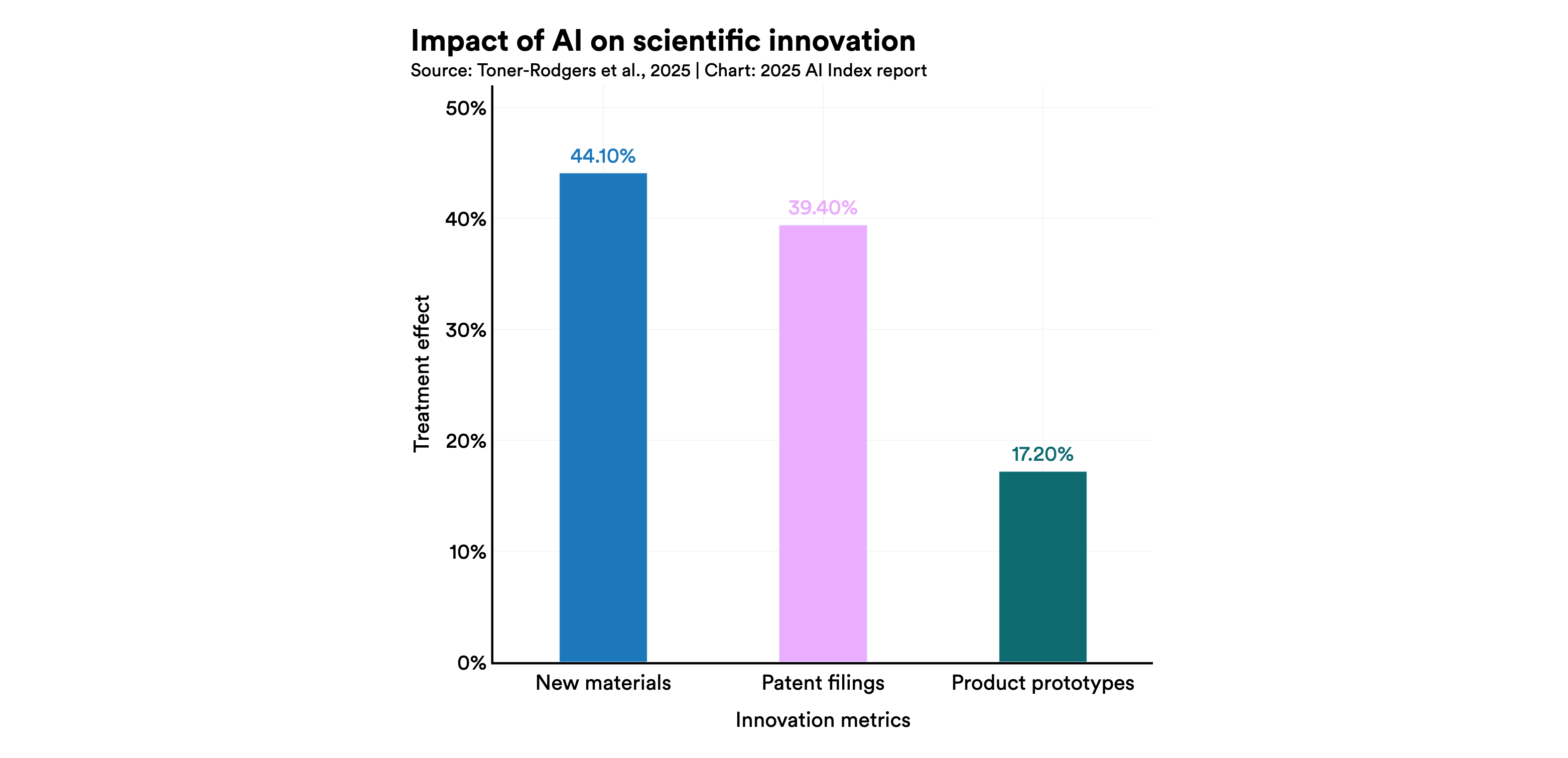
It helps to see how AI changes the distribution of value across the workforce, because it explains why the orchestrator model rewards different people than the old sourcing grind did. AI tends to lift productivity most for those doing routine work and to reward the judgment layer above it.
AI reshapes where human value sits
The orchestrator role rests on a division of labor that is worth stating plainly, because getting it wrong is how AI programs fail. Agents are good at breadth, speed, and tirelessness, while humans are good at context, empathy, and accountability, and a workable split follows that seam. Agents handle the breadth work: sourcing, first-pass screening, scheduling, and drafting. You handle the depth work: the intake conversation, candidate relationships, and the final judgment. Crucially, you review everything an agent produces before it reaches a person, and you own the outcome, including any mistake the agent makes on your behalf.
That last point is the whole ballgame. When an agent misfires, whether it overlooks a qualified candidate or sends a tone-deaf message, the accountability lands on the recruiter, not the software. This is why the orchestrator is a more senior posture than the executor, not a lazier one. You are now responsible for the quality of work you did not personally perform, which demands that you understand the tools well enough to catch their errors. The recruiters who thrive treat their agents the way a good manager treats a talented but literal-minded new hire: clear briefs, tight feedback, and a firm hand on anything that touches a candidate's experience.
The practical way to apply this shift is to audit your own week against it. If most of your hours still go to tasks an agent could do, you are operating as an executor in a market that increasingly pays for orchestration. The move is not to work faster at sourcing. It is to hand sourcing to a tool you trust, then reinvest the reclaimed time into the hiring-manager relationship and the candidate experience that no tool can fake. That reinvestment is what turns the productivity dividend into a career advantage rather than a quiet prelude to a smaller team.
4. The New Sourcing Stack: When Recruiters Get Their Own Agents
The sourcing category is where the agentic shift is most visible, and it has split into three tiers you should be able to tell apart. The first tier is the incumbent platform agent, dominated by LinkedIn. The second is the established sourcing suite, tools like SeekOut, hireEZ, Gem, and Fetcher that bolted AI agents onto large profile databases they already had. The third is the AI-native challenger, newer tools such as Juicebox that were built around natural language and autonomy from day one, plus a small set of fully autonomous recruiters that aim to run the entire top of the funnel on their own. Knowing which tier a tool sits in tells you what it is really selling.
LinkedIn's Hiring Assistant is the single biggest mover and the reference point everyone else is measured against. It became globally available in English at the end of September 2025 and automates intake, sourcing, applicant evaluation, and message drafting inside Recruiter - LinkedIn News. Its differentiator is native access to the world's largest professional graph, and the early scale is real: LinkedIn's AI hiring agents were on track for roughly $450 million in annual revenue as disclosed in Microsoft's spring 2026 earnings, the first time the company broke out revenue for one of its AI tools - Reuters. Pricing is sales-quoted as an add-on to Recruiter seats rather than published, which is typical for enterprise agents. The tool is worth seeing rather than just describing, since the interface is the clearest example of what delegating sourcing to an agent looks like.
An agent returns a ranked shortlist for recruiter review

Among the AI-native challengers, Juicebox (its search product is called PeopleGPT) is the clearest example of transparent, self-serve pricing meeting real autonomy. It searches over 800 million profiles across 30-plus sources using plain-English prompts instead of Boolean strings, and its paid plans run $139 per month for Starter and $199 per month for Growth - Juicebox. Its genuinely agentic feature is an add-on AI Agent, also $199 per month, that runs candidate searches around the clock and learns from which profiles you approve or reject. For a small team that wants an always-on sourcer without an enterprise contract, this tier is the most accessible entry point into agentic sourcing.
The established suites trade transparency for depth and typically sell annual, sales-gated contracts. SeekOut starts at $149 per month billed annually for its entry plan, with enterprise deals clustering around a $20,000 median, and it adds diversity and technical filters plus a managed-sourcing option - SeekOut. hireEZ publishes no price page and sells annual contracts around a $13,000 median, positioning its EZ Agent as agentic AI layered directly on your existing ATS data - Pin. Gem consolidates ATS, CRM, sourcing, and analytics into one platform, with in-house pricing from $270 per month annually and a median contract near $24,900, making it one of the pricier all-in-one plays - Pin. Fetcher leans into hands-off managed sourcing, starting around $379 per month and delivering vetted candidates to your inbox, though its entry plan caps sourced candidates and skips LinkedIn and SMS channels - Vendr.
At the frontier sits the fully autonomous recruiter, a category that promises to run sourcing, screening, and first outreach end to end rather than hand you a filtered list. Moonhub offers success-based pricing alongside subscriptions and built deep enough agent technology that its team joined Salesforce in 2025 to accelerate Agentforce - Moonhub. In the same category, tools like HeroHunt.ai run an autonomous agent that searches across roughly 1 billion web profiles, screens candidates with AI, and initiates outreach on autopilot, aiming to replace the filter-database model rather than speed it up. The pitch across this tier is the same: less a better search box, more a teammate that works the funnel while you do everything else.
The trade-off between these tiers is real, and pretending it away leads to expensive mistakes. The AI-native self-serve tools win on speed and price: a small team can switch one on this week, judge it on live results, and cancel if it disappoints, with no procurement cycle and no annual lock-in. What they give up is deep integration, an enterprise security review, and the audited compliance posture a large employer needs. The enterprise suites invert that bargain: they wire into your ATS, survive a security questionnaire, and carry the bias-audit documentation regulators increasingly expect, but they cost five figures a year and are frequently used at a fraction of their depth. A sound rule of thumb is to buy the cheapest tool that clears your two hard constraints, usually integration and compliance, and to refuse to pay for capability the team will never touch. A staffing agency chasing speed and a regulated enterprise managing risk should almost never buy the same platform, and the fact that they so often do is why a great deal of sourcing software sits idle.
The practical guidance is to buy for your tier, not the hype. A three-person agency team gains more from a transparent self-serve agent it can turn on this week than from a six-figure enterprise suite it will use at 10% depth. A large enterprise with an existing ATS and compliance obligations will value the audited, integrated suites more than a scrappy challenger. The common mistake in 2026 is buying the most powerful platform available rather than the one your team will actually adopt across the whole funnel. Depth of use beats breadth of features, every time.
5. Screening, Interviews, and the Rise of the AI Voice Recruiter
If sourcing is where agents got good first, screening and interviewing are where they became controversial, and where 2026 introduced the year's most consequential new category: the AI voice recruiter. Screening is already the most common place AI shows up in hiring, ahead of candidate communication and assessments, which is exactly why it draws the most scrutiny. The tools here fall into three practical groups: conversational assistants that screen and schedule at volume, voice and video interview agents that actually talk to candidates, and ATS copilots that quietly assist recruiters inside the system they already use.
The conversational assistant category is led by Paradox, whose Olivia assistant screens, schedules, and answers candidates around the clock in dozens of languages, aimed squarely at high-volume and frontline hiring. Its significance jumped in late 2025 when Workday acquired it, folding conversational hiring into a full HCM suite - Index.dev. Pricing is custom and enterprise-oriented, but the results customers publish are the reason it spread: fast-food and retail employers use it to run screening and scheduling that would otherwise consume entire coordinator teams. For anyone hiring hourly workers at scale, this category is often the highest-ROI place to start.
The reason this category spreads fastest in hourly and frontline hiring is that the numbers turn dramatic when volume is high. Paradox publishes customer results that show the pattern: Tractor Supply cut its time-to-apply by more than half with conversational AI, and a large convenience chain reclaimed tens of thousands of coordinator hours a week - Paradox. Treat vendor figures as directional rather than audited, but the shape is believable, because scheduling and knockout screening are exactly the repetitive, rules-based tasks that consume a frontline recruiter's day. For a team hiring hundreds of hourly workers a month, automating the top of that funnel is often the fastest, clearest win available, which is why this unglamorous category, and not the flashier voice interviewers, is where many organizations should actually begin.
The genuinely new arrival is the AI voice interviewer, and it is the fastest-moving sub-segment of the year. Ribbon AI runs 24/7 asynchronous voice and video interviews with fully public pricing, starting at $499 per month for 100 interviews and scaling to $1,999 per month for 1,000 - Ribbon AI. Competitors are multiplying fast: Micro1 offers an AI interviewer named Zara from around $399 per month, HeyMilo and Apriora run live conversational interviews with built-in cheat detection for generative-AI use and tab-switching, and each is racing to own high-volume and technical screening. The category exists because the economics are extreme, with vendors reporting AI voice screens completing at far higher rates than scheduled human phone screens because candidates can take them at midnight on a Sunday.
What makes this category more than hype is that the outcomes are starting to be measured rigorously, not just marketed. In the largest controlled field experiment to date, spanning 70,884 applications, AI-conducted voice interviews led to about 12% more job offers and candidates who were more likely to still be employed a month later, with roughly 78% of applicants preferring the AI interviewer to a human one - SSRN. That result cuts against the intuition that candidates hate talking to machines, and it is the strongest evidence yet that voice agents can match or beat human screeners on outcomes. It does not, however, settle the trust question, which the next section takes up in full.
Before rushing a voice agent into production, it pays to understand where these tools quietly fail, because the failures land on real candidates. Conversational agents can penalize strong accents and non-native speakers, misread the pauses of an anxious or neurodivergent applicant, and stumble over anyone whose situation does not fit the script, which turns an efficiency tool into an accessibility problem and, potentially, a discrimination claim. The mitigation is not to avoid the category but to design around its blind spots: offer a human alternative on request, never let a single automated score be a hard gate, and monitor pass-through rates by group for drift. Newer entrants such as Micro1, whose Zara interviewer starts around $399 per month, increasingly compete on how gracefully they handle these edge cases - Capterra. The real buying question is therefore less whether an agent can conduct an interview and more how it behaves when a candidate does not perform to type.
The third group, the ATS copilot, is the quietest but may touch the most recruiters, because it lives inside the system of record. Metaview started as an AI interview notetaker and expanded into a modular agent suite, with rare transparent pricing at $100 per user per month for Pro - Metaview. For a smaller agency, Manatal sits at the budget end of the same category, an AI-assisted ATS and CRM with candidate scoring and transparent pricing around $15 per user per month. Ashby embeds AI across its ATS for application review, filtering, and outreach, reporting a 46% lift in reply rates, and prices on total company headcount rather than recruiter seats - Pin. Greenhouse is rolling out notetaker and setup agents plus a connector that lets assistants like Claude or Gemini work directly against the ATS - Greenhouse. And the enterprise heavyweight Workday is going agentic across its suite, pairing a HiredScore-powered recruiting agent with the Paradox-powered candidate experience agent it acquired.
Two names sit slightly outside these buckets and are worth knowing because they signal where the market is bending. Eightfold AI matches people to roles by inferred skills using a talent model trained on well over a billion career profiles, and added its own AI interviewer for high-volume roles. Mercor reframed recruiting entirely, using roughly 20-minute AI interviews to place specialist experts with AI labs, and raised a $350 million round at a $10 billion valuation in late 2025 - Mercor. The lesson for a working recruiter is not to chase every tool, but to understand the shape of the category: screening and interviewing now happen through agents that talk, and your job is to configure them well, audit them for fairness, and keep the human decision where it belongs.
6. Rebuilding Your Workflow Around AI Agents
The biggest mistake teams make in 2026 is dropping agents into an unchanged process and expecting magic. The data is unambiguous that value comes from redesign, not insertion. McKinsey found that only 21% of generative-AI users have redesigned any workflows, yet workflow redesign is the practice most correlated with real financial impact, and AI high performers are about 2.8 times more likely to have fundamentally rebuilt how work flows - McKinsey. Bolting a sourcing agent onto a broken intake process just produces bad shortlists faster. The work is to rethink the pipeline so that agents and humans each do what they are best at.
Start by looking honestly at where the hours actually go today, because that is what you are redesigning away. A study of UK recruiters found they spend an average of 17.7 hours of manual admin per vacancy, more than two full working days, split across reviewing applications, scheduling, and processing notes - Totaljobs. That admin load is the raw material for automation. Every hour an agent absorbs there is an hour you can move to the front of the funnel, where getting the brief right, and to the back, where relationships close hires.
Where a Recruiter's Manual Admin Hours Go, Per Vacancy
The redesigned pipeline keeps a clear line between what agents draft and execute and what humans direct and decide. A practical version looks like the flow below, where automated stages feed a recruiter review gate before anything reaches a candidate, and where the final decision stays firmly with people.
The review gate at the center of that diagram is the most important design choice you will make, and it is where the orchestrator role becomes concrete. Everything upstream of it can be automated aggressively, because a human still inspects the output before it has consequences. Everything downstream of the interviews stays human, because those stages carry judgment and accountability. Vendors report large stage-level gains inside this shape: LinkedIn says Hiring Assistant users review far fewer profiles and save time per role, and conversational assistants at high-volume employers have cut time-to-apply and reclaimed enormous coordinator hours - LinkedIn. Treat these as directional, since they are company-supplied, but the direction is consistent.
A concrete redesign makes the abstraction real. Take a role you hire constantly, say a customer-support representative. In the old flow, a coordinator posts the job, manually screens hundreds of applicants, plays scheduling tag over email, and types up interview notes, burning most of those seventeen-plus admin hours a vacancy consumes. In the redesigned flow, a sourcing agent builds the pipeline, a screening agent runs a structured first round, a scheduling assistant books the human interviews automatically, and a notetaker captures and summarizes them. The recruiter's job narrows to three high-leverage acts: writing a sharp intake brief, inspecting the shortlist at the review gate, and running the final human interviews. Tools like Metaview advertise saving recruiters upward of 10 hours a week precisely by absorbing that notes-and-summary layer - Metaview. The trade-off to watch is over-trust: if the recruiter stops genuinely inspecting the shortlist, the redesign quietly curdles from augmentation into unaccountable automation, which is the exact failure the review gate exists to catch.
It is just as important to be clear about what does not get automated, because the back half of hiring stays stubbornly human and is getting heavier, not lighter. Even as agents compress sourcing and screening, the interview load has grown, with hiring teams now running on the order of twenty interviews per hire, up from roughly fourteen a few years ago, across a cycle that still averages into the forties of days - SHRM. That is the judgment-heavy, relationship-heavy work agents assist but cannot own, and it is where the recruiter's reclaimed hours should flow. A redesign that speeds up the top of the funnel only to dump more unscreened noise into an already-strained interview stage has helped no one. The point is to hand agents the front so that humans can do the back half better, not merely faster.
The way to apply this without chaos is to redesign one requisition type at a time rather than the whole function at once. Pick a role you hire repeatedly, map its current stages, and decide deliberately which stages an agent will own, which you will review, and which stay fully human. Then instrument it, run it for a few weeks, and compare against your old baseline before rolling the pattern out. This staged approach matters because agent adoption is still early even at the frontier, with no more than about 10% of organizations scaling agents in any single function, so the teams that win are the ones that redesign carefully rather than the ones that automate recklessly - McKinsey. The reclaimed hours only become an advantage if you consciously redeploy them into hiring-manager advisory and candidate relationships, rather than simply taking on more requisitions until the new capacity disappears.
7. The Skills That Now Separate the Best Recruiters
The uncomfortable truth is that the skills that made someone a strong recruiter in 2020 are not the ones that will distinguish them in 2026. The old craft rewarded Boolean fluency, high-volume outreach stamina, and mastery of an ATS. Those are exactly the abilities agents now replicate cheaply. The new differentiators cluster into two groups: the AI-fluency skills that let you direct and audit machines, and the durable human skills that become more valuable precisely because machines cannot do them. The WEF captures the backdrop bluntly, projecting that 39% of core skills will change by 2030 and naming AI and big data the single fastest-growing skill area - World Economic Forum.
AI literacy is now a baseline, not a specialty, and it is more concrete than the buzzword suggests. It breaks into four learnable competencies: writing clear prompts, critically evaluating AI output for tone and accuracy, using AI responsibly, and assessing it for bias - Join. None of these require coding. They require the same judgment a good editor applies to a junior writer's draft: knowing what good looks like, spotting where the machine went wrong, and correcting it before it ships. The recruiters pulling ahead are the ones who can look at an agent's shortlist and immediately sense which candidates it over-weighted and which it missed.
Make that judgment skill concrete, because it is the one most recruiters underrate. Suppose your sourcing agent returns ten candidates and eight of them come from three famous companies. A recruiter without output judgment sees a strong list. A recruiter with it sees a warning sign: the agent has likely treated employer brand as a lazy proxy for quality, which is both a quality risk and a diversity risk, and it has quietly buried capable people from less prestigious backgrounds. Noticing that, and rewriting the brief to correct it, is the entire difference between a tool that amplifies your judgment and one that launders your blind spots into a tidy shortlist. This kind of fluency is not a certificate you earn once but a standing practice, which fits the larger reality that the half-life of professional skills keeps shrinking. The recruiters who treat learning as a permanent part of the job, rather than a project with an end date, are the ones who stay a step ahead of their own tools.
The market is pricing this fluency aggressively, which is why treating it as optional is a career risk. The number of US job postings requiring AI skills grew roughly sevenfold in two years, and workers with AI skills now command a wage premium that has more than doubled - McKinsey. Recruiters feel this from both sides: they must screen candidates for AI fluency they may not yet possess themselves, and they must build it to stay competitive in their own role. The recruiter who can confidently evaluate an engineer's AI skills, and who visibly uses AI well in their own workflow, has an authority in the hiring conversation that a Boolean-only recruiter no longer commands.
Data literacy is the second pillar, and it is where many recruiters have the furthest to travel. The profession is shifting from a gut-feel craft to a measured one, with 89% of talent professionals agreeing that measuring quality of hire is growing in importance, even though only a quarter feel confident they can actually measure it - LinkedIn. An orchestrator who cannot read a funnel, interpret a pass-through rate, or tell a hiring manager what the data says about their unrealistic brief is flying blind. The specific skills to build here are labor-market interpretation, reading hiring analytics, and translating those numbers into decisions, which is exactly the skill set Bersin's research names as core to the new recruiter.
The counterintuitive part is that the human skills get more valuable, not less, and the sources agree emphatically. Around three-quarters of HR professionals believe AI will heighten the value of human judgment over the next five years, not diminish it - SHRM. As routine work commoditizes, empathy in an interview, honesty in feedback, persuasion in an offer, and trust in a hiring-manager relationship become the scarce goods. The best 2026 recruiter is therefore a hybrid: fluent enough with AI to direct a team of agents, and human enough to do the advisory and relationship work those agents will never touch. If you are choosing what to learn next, learn to direct the machine and to be more human, in that order, and resist the temptation to compete with agents at the tasks they already win.
8. Where It Breaks: Bias, Deepfakes, and the Law
Every recruiter adopting AI needs to understand the failure modes before the tools, because the failures are legal, ethical, and reputational all at once, and they are no longer hypothetical. The landmark case is Mobley v. Workday, where a court allowed a nationwide age-discrimination collective action to proceed and, critically, held that an AI hiring vendor can be liable as an agent of the employers who use it - Seyfarth Shaw. Roughly 14,000 applicants opted in before the window closed in March 2026, and the exposure now extends to the thousands of employers running that software - AI Governance for HR. The precedent is simple and sobering: using an AI tool does not outsource your liability for the discrimination it produces.
The regulatory backdrop to all this is genuine whiplash, and recruiters should not mistake the direction of the wind for the end of the weather. In early 2025 the federal EEOC withdrew its technical-assistance guidance on assessing AI for adverse impact, part of a broader federal pullback - Husch Blackwell. It would be easy to read that, alongside the delayed state and EU deadlines, as a green light. It is not. The underlying statutes never changed, private litigation like Mobley is expanding rather than contracting, and a patchwork of active state laws still imposes real duties on employers. The practical stance is to build to the strictest rule you plausibly face rather than the most lenient one currently enforced, because a compliance program is far cheaper to run continuously than to reconstruct under a subpoena.
The bias risk is not theoretical hand-wringing; it shows up in large-scale audits. A study of 3.4 million applicants found AI screening can produce systematic racial disparities, with a substantial share of Black and Asian applicants applying into systems that disadvantaged their group, an effect amplified when one dominant vendor's model shapes an entire industry - Stanford HAI. Controlled testing of the underlying language models is starker still, with one study finding resumes carrying White-associated names preferred vastly more often than identical resumes with Black-associated names - Brookings. An agent trained on historical hiring data will faithfully reproduce historical bias unless someone actively tests for and corrects it.
The legal patchwork you must navigate is real, fast-moving, and inconsistent across borders. In 2026 it looks like a genuine patchwork. NYC Local Law 144 requires annual bias audits of automated hiring tools, backed by daily penalties. Illinois enacted a law effective January 2026 that bars AI use which discriminates and requires candidate notice. Colorado's broader AI Act was delayed to January 2027 and narrowed in scope. And the EU AI Act treats hiring as high-risk, with its obligations now slated for December 2027.
Read together, those moves look like softening, and in the near term the deadlines did slip. The EU pushed its high-risk hiring obligations from August 2026 toward December 2027, and Colorado delayed and scaled back its framework - Gibson Dunn. But treating delay as reprieve is a trap. The underlying anti-discrimination laws never went anywhere, and even after federal guidance was withdrawn in early 2025, Title VII, the ADEA, and the ADA still fully apply to AI-driven hiring - K&L Gates. The compliant move is to run bias audits, disclose AI use to candidates, and keep a human decision-maker accountable, regardless of which deadline is currently in force.
Turning that principle into practice is more concrete than it sounds, and the specifics are where teams get caught. A defensible program has four moving parts: an annual independent bias audit of any tool that scores or ranks candidates, a plain-language notice to candidates that AI is involved, a genuine human decision-maker on every consequential call, and retained logs showing the human actually reviewed the output. New York's Local Law 144, the most-tested rule of its kind, carries penalties of $500 to $1,500 per violation, per day and requires exactly this audit-and-notice pattern - New York State Comptroller. Do not read the recent finding that the law is weakly enforced as permission to skip it, because a state review flagging weak enforcement usually precedes a crackdown rather than an amnesty - DLA Piper. The cheapest insurance against a Mobley-style claim is boring documentation created before you ever need it.
A second failure mode arrived faster than most teams expected: fraud on the candidate side. Gartner predicts that by 2028, one in four candidate profiles worldwide will be fake, driven by AI-generated audio and video used to slip past screening - Gartner. This is not a forecast about a distant future; it is already operational. Roughly 17% of hiring managers report encountering a deepfake in a video interview - CNBC. The consequences are not abstract either: one North Korean fake-worker scheme infiltrated more than 300 US companies before an operator was sentenced to prison for enabling it - U.S. Department of Justice. Identity verification and live, adaptive interviewing are becoming defensive necessities, not nice-to-haves.
The defense against candidate-side fraud is a blend of process and tooling, and it is worth building before you become the cautionary tale. On the process side, that means verifying identity at a defined checkpoint, preferring live and adaptive interviews over asynchronous recordings for sensitive roles, and treating a suspiciously polished, oddly generic candidate as a reason to look closer rather than to move faster. On the tooling side, several interview platforms now flag generative-AI use, tab-switching, and copy-paste during a live session, which raises the cost of casual cheating. None of this is an argument against AI in hiring. It is an argument for an adversarial mindset, because the same generative tools that speed up your funnel also speed up the people trying to game it, and the recruiter who assumes good faith by default has quietly become the easiest mark.
The quietest failure mode, and the one most likely to hurt your employer brand, is candidate trust. Only about 26% of job candidates trust AI to evaluate them fairly, and a meaningful share say they trust an employer less for using it - Gartner. The experience is often worse than the intent: a 2026 study found 63% of job seekers have faced an AI interview, most were never clearly told AI would evaluate them, and 38% have walked away from a process because of it - Greenhouse. The applied lesson is that transparency is not just compliance, it is retention of your pipeline. Tell candidates when AI is involved, give them a human path, and design the AI experience to feel respectful, because the alternative is watching qualified people abandon your funnel.
9. How to Adopt AI Without Blowing Up Your Team
Adopting AI in recruiting fails far more often from bad change management than from bad technology, and the numbers prove it. Gartner found that 88% of HR leaders say their organizations have not realized significant business value from AI tools, despite widespread adoption - Gartner. The bottleneck is rarely the model. It is unclear use cases, no measurement, and teams that were never brought along. The good news is that this makes success mostly a matter of discipline, which any team can choose, rather than a matter of having the best tools, which not every team can afford.
The gap between dabbling and value is the single clearest pattern in the 2026 data, and it defines what a serious adoption program has to close. Wide adoption sits alongside shallow depth, weak governance, and absent measurement.
The first discipline is to define success before you deploy, because you cannot improve what you never measured. Nearly a quarter of organizations have no mechanism at all to measure the ROI of their AI initiatives, which turns every tool into an act of faith - SHRM. Pick your baseline metrics up front and hold the pilot to them. The most useful ones are concrete: time-to-hire, cost-per-hire, recruiter capacity measured as requisitions per recruiter, sourcing pass-through rates, and quality of hire. Anchor them to real economics, since median time-to-fill sits around 44 days and average cost-per-hire near $4,700, so even a modest reduction in vacancy time is money you can point to.
The second discipline is to pilot narrow and deep rather than wide and thin. Choose three or four named bottlenecks, not a vague mandate to use AI, and redesign the workflow around them as Section 6 describes. Deep adoption is where attributed results actually appear: Chipotle, using a conversational AI assistant, cut time-to-hire from 12 days to 4 and raised application completion from 50% to over 85% - Paradox. Notice that this is a whole-workflow result at one stage done thoroughly, not a light sprinkle of AI across everything. The buy-versus-build decision usually resolves toward buy for most capabilities, because AI-native vendors iterate faster than an internal team can, but the governance and metrics must be yours regardless of whose software runs underneath.
It helps to see the disciplines assembled into a single believable pilot. A mid-market team drowning in high-volume applications picks one measurable bottleneck, first-round screening, and writes down a baseline: current time-to-hire, cost-per-hire, and recruiter hours spent screening. It buys one proven conversational assistant rather than building from scratch, redesigns the screening stage around it, and keeps a recruiter reviewing every advance. After a quarter, it holds the numbers up against the baseline and decides whether to expand. That is roughly the shape of every deep-adoption success story, and it stands in stark contrast to the far more common pattern of buying five tools, measuring none, and concluding a year later that AI simply did not work. The measurement gap is not a footnote, since nearly a quarter of organizations have no way to gauge AI ROI at all, which means most programs cannot even tell whether they succeeded. Deciding what winning looks like, in numbers, before a dollar is spent is the single highest-leverage habit in this entire playbook.
The third discipline, and the one most often skipped, is managing the fear. It is legitimate: around half of workers worry about losing their job to AI, and only a small fraction of managers are seen as ready to use AI well - Gartner. The evidence-based reframe is that AI in HR reshapes roles far more than it eliminates them, with 57% of HR professionals reporting more upskilling and only 7% reporting displacement - SHRM. To hear how employer-side leaders are actually navigating this in practice, this recent panel is a grounded counterweight to vendor optimism.
The Future of Recruiting: How AI Is Changing Talent Acquisition
The way to make change management stick is to give people a stake in the reallocation, not just an instruction to adopt. Show recruiters that the hours AI frees are theirs to spend on higher-value work, back it with visible executive alignment, and train managers before you train tools, since manager readiness is the binding constraint. When a team sees automation as the thing that finally lets them do the parts of recruiting they actually enjoy, the resistance fades. When they see it as a black box imposed from above that might cost them their job, it calcifies into quiet non-adoption, and quiet non-adoption is how that 88%-no-value statistic gets made.
10. The 2026-2027 Outlook: Toward the Autonomous Desk
The consensus among analysts heading into 2027 is that recruiting is the leading proving ground for agentic AI, and the direction of travel is toward multi-agent systems that handle whole stretches of the funnel under human oversight. Gartner projects that 40% of enterprise applications will feature task-specific AI agents by the end of 2026, up from less than 5% a year earlier, and names resume screening, scheduling, and candidate evaluation as proven early use cases - Gartner. The architecture is evolving from one assistant that helps a recruiter toward a small team of specialized agents, one sourcing, one screening, one coordinating, that a recruiter supervises the way a manager supervises a pod.
It is worth picturing this architecture concretely, because it is clearly where the field is heading. Instead of one monolithic recruiting brain, analysts describe a hierarchy: narrow sub-agents each own a slice of the work (parsing resumes, running a search, drafting a message), coordinating agents chain those slices into a full stage, and a superagent oversees the whole flow while a human supervises at the decision points - Josh Bersin. The recruiter's role in that world is unmistakably managerial: you are running a small team of specialists that happen to be software rather than people. The practical implication for right now is that the skill to start building today is agent supervision, writing the brief an agent works from, judging the quality of what it returns, and knowing when to overrule it. That is a management competency, not a technical one, and it is the ability the next few years will reward most.
To understand where the biggest platform is steering the whole market, it is worth hearing from the people setting the roadmap. This late-2025 conversation with LinkedIn's COO lays out how the company sees agents, voice screening, and the recruiter's evolving role developing over the next few years.
Inside LinkedIn's AI Roadmap: What's Next for Talent Leaders
The intent to move this direction is not speculative; it is already booked into next year's plans. Beyond the majority of talent leaders adding autonomous agents, some organizations have begun creating employee-style records for their AI agents, treating them as members of the team rather than features of a tool. You can see the always-on model taking shape in the newer platforms, where agents run recurring sourcing and outreach in the background and surface work for review rather than waiting to be told what to do.
Always-on agents run sourcing in the background

The essential counterweight to all this optimism is that a significant correction is coming, and planning for it is part of being a good orchestrator. Gartner warns that more than 40% of agentic-AI projects will be cancelled by the end of 2027 due to escalating costs, unclear value, and inadequate controls - Forbes. The takeaway is not to avoid agents, but to choose them for a measurable use case with real governance, so that your program lands in the surviving 60% rather than the abandoned 40%. The teams that get burned will be the ones that bought autonomy for its own sake; the teams that win will have tied every agent to a metric and a human owner.
Two developments will shape 2027 in ways recruiters should prepare for now. First, evaluation is turning back toward the human as AI floods the top of the funnel. Gartner expects that by 2027, most hiring processes will include some testing for workplace AI proficiency, and that a large share of organizations will reintroduce AI-free skills assessments to see what a candidate can actually do unaided - Gartner. Second, the market itself is expanding fast, with AI recruitment software on a steep multi-year growth curve, which means more tools, more consolidation, and more noise to filter. The durable bet through all of it is unchanged: agent-augmented workflows become standard, human judgment and AI fluency become the differentiating skills, and the recruiter who has both owns the desk that the agents work for.
11. Your Playbook for the New Era
Everything above reduces to a decision you can make this quarter, and the framework is deliberately simple because complexity is where adoption goes to die. The recruiters and teams who will thrive in the new era are not the ones with the biggest tool budget. They are the ones who moved from executor to orchestrator early, redesigned their workflow deliberately, built the two skill sets that matter, and put governance around it before a lawyer or a candidate forced them to. The good news, given that only 18% of companies use AI broadly, is that the bar to stand out is still low and the window is still open.
If you are an individual recruiter, your first ninety days have a clear shape. The goal is to become the person on your team who most credibly directs AI and most visibly owns the human work it cannot do. Concretely, that means building fluency and redeploying the hours you reclaim. Start by auditing your week and labeling every task as executor or orchestrator work, so you can see how much of your time a machine could already absorb. Then adopt one agent for your single biggest time sink and, just as importantly, learn to review its output critically rather than trusting it blindly. Alongside that, build AI literacy as a named skill covering prompting, output judgment, and bias-checking, and reinvest the reclaimed hours into hiring-manager advice and candidate relationships rather than a bigger requisition pile. Finally, learn to read your funnel well enough to argue with data instead of instinct, because the orchestrator who brings numbers to the conversation is the one hiring managers actually listen to.
The reason this sequence works is that it compounds. Each reclaimed hour you move into relationship and advisory work makes you more valuable in exactly the dimension AI cannot touch, while your growing fluency makes you the natural person to orchestrate the agents your team adopts next. That combination, fluent director plus irreplaceable human, is the safest position in a shrinking-team market, and it is a far better use of energy than trying to out-source an agent that never sleeps.
If you are a leader, the playbook is about discipline over enthusiasm. Define success metrics before you buy anything, pick a few real bottlenecks and redesign their workflow rather than sprinkling AI everywhere, and keep a human accountable at every consequential decision. Put a governance framework in place now, since nearly half of companies still lack one and that gap is both a legal risk and a competitive opening. When you evaluate the tool landscape, match the tier to your reality: transparent self-serve agents like Juicebox for a small team, integrated enterprise suites for scale and compliance, and autonomous recruiters such as HeroHunt.ai or Moonhub when you genuinely want the funnel worked end to end. The right tool is the one your team will use deeply, not the one with the longest feature list.
For a leader, the governance piece deserves more than a checkbox, because it is what separates a program that scales from one that gets frozen after the first complaint. A workable framework names who is accountable for each AI tool, requires a bias audit before a tool touches candidates and on a schedule after, defines what the tool may and may not decide on its own, and sets a plain rule that a human signs off on every rejection and every offer. When you evaluate vendors against that framework, weigh four things over the feature list: whether the tool integrates with your existing systems, whether it can produce the audit and logging evidence regulators expect, how transparent its pricing and its decisions are, and how deeply your team will realistically use it. A cheaper tool your recruiters adopt across the whole funnel beats an expensive one they open once a week, every single time.
The through-line of this entire guide is that AI is not ending the recruiting profession; it is raising the floor on what a recruiter is expected to be. The transactional work is going to agents, and it is not coming back. What remains, and what grows in value, is judgment, relationships, and the ability to direct a set of increasingly capable tools toward a good hire. That is a more demanding job than the one many recruiters hold today, and also a more interesting one. The new era does not reward the fastest sourcer. It rewards the best advisor with the best-run agents. Deciding to become that person, starting this quarter, is the whole game.
If there is one line to carry out of this guide, it is that the new era does not eliminate the recruiter; it raises the bar on what the word means. The profession is quietly splitting into two paths. One path keeps doing the transactional work that agents now do faster and cheaper, and it leads somewhere uncomfortable. The other leans into judgment, relationships, and the skill of directing capable tools toward a good hire, and it leads to a more valuable and more durable role than the one most recruiters hold today. The tools will keep changing, the vendors will keep merging, and the regulations will keep moving. The choice underneath all of it stays the same, and it is yours to make this quarter: become the recruiter who runs the agents, or wait to be told which ones now run your desk.
This guide reflects the AI recruiting landscape as of July 2026. Adoption data, pricing, product features, and regulatory deadlines in this field change quickly, so verify current details before making a purchase or compliance decision.