



The insider's recruiting playbook for staffing the human experts who train frontier AI models, including the parts vendors will not tell you.
Each frontier AI lab now spends on the order of $1 billion a year on human training data - Cognitive Revolution. That figure, from Labelbox CEO Manu Sharma, is the reason data annotation stopped being a quiet procurement line and became one of the most cut-throat recruiting contests in technology. The people who source and vet annotators no longer sit next to facilities. They sit next to research, because the input that now decides whether a model is good or mediocre is verified human judgment, bought and screened at scale.
This guide is written for the person who actually has to staff that work: the recruiter, the data-operations lead, the founder standing up a human-data function for the first time. It is not a market overview. It is a tactical playbook, and it is deliberately honest about the parts of this market that are ugly, because staffing annotation well is impossible if you believe the marketing. The pay is bifurcated, the churn is brutal, a startling share of your applicants are trying to cheat you, and the workers behind the world's best models are frequently paid two dollars an hour and deactivated the night before payday. All of that is operationally relevant to how you hire.
We will start high and go deep: the money and the power map, then role definition, sourcing channels by tier, assessment design, the two chapters on fraud and the labor market that most guides skip, the real economics, quality and retention, how to structure your own org, and where the work is heading. For a broader landscape companion, HeroHunt.ai's data-annotator recruiting guide covers the ecosystem in encyclopedic form. This one is about tactics.
Written by Yuma Heymans (@yumahey), who built HeroHunt.ai to source scarce, specialized talent from over a billion profiles on autopilot. He has spent years on the exact problem this guide describes: finding and engaging hard-to-reach specialists at scale, then getting them to say yes.
Contents
- The Recruiting Problem Behind the AI Boom
- Read the Power Map Before You Source
- Define the Role or You Will Mis-hire
- The Sourcing Playbook: Channels That Actually Convert
- Vetting Without Getting Fooled
- The Fraud Chapter: How Candidates Game You
- The Dirty Truth of the Labor Market
- What It Really Costs: Pay Bands and Vendor Margins
- Quality Is a Recruiting Problem
- Structuring Your Human-Data Org: Build, Buy, or Blend
- The Next 18 Months: From Labelers to Verifiers
- Your 90-Day Annotator Recruiting Plan
1. The Recruiting Problem Behind the AI Boom
The single most important thing to grasp before you post a job or sign a vendor is that "data annotation" is now two completely different labor markets wearing one name, and staffing them the same way is the most expensive mistake a hiring team makes. One market is the legacy crowd tier, where workers still draw bounding boxes and moderate content for a few dollars an hour. The other is the frontier tier, where credentialed professionals author reasoning, write rubrics, and grade model outputs for $85 to $200 an hour and up. These two tiers are sourced, vetted, paid, and retained in almost opposite ways. Confusing them is how buyers overpay for commodity work and underpay for the scarce expertise that actually moves a model.
The frontier tier exists because of a specific change in how models are built. Pre-training on scraped web text has plateaued, and the gains now come from post-training: supervised fine-tuning, reinforcement learning from human feedback, expert evaluations, and red-teaming. All of that depends on humans who can produce or judge outputs the model cannot yet produce reliably. You cannot crowdsource a correct cardiology diagnosis or a valid securities-law argument from a worker paid two dollars an hour, so the labs went looking for the actual experts, and an entire industry reorganized to recruit them. The money underneath is real: the data collection and labeling market was roughly $3.77 billion in 2024 and is forecast to reach $17.1 billion by 2030, a compound annual growth rate near 28% - Grand View Research.
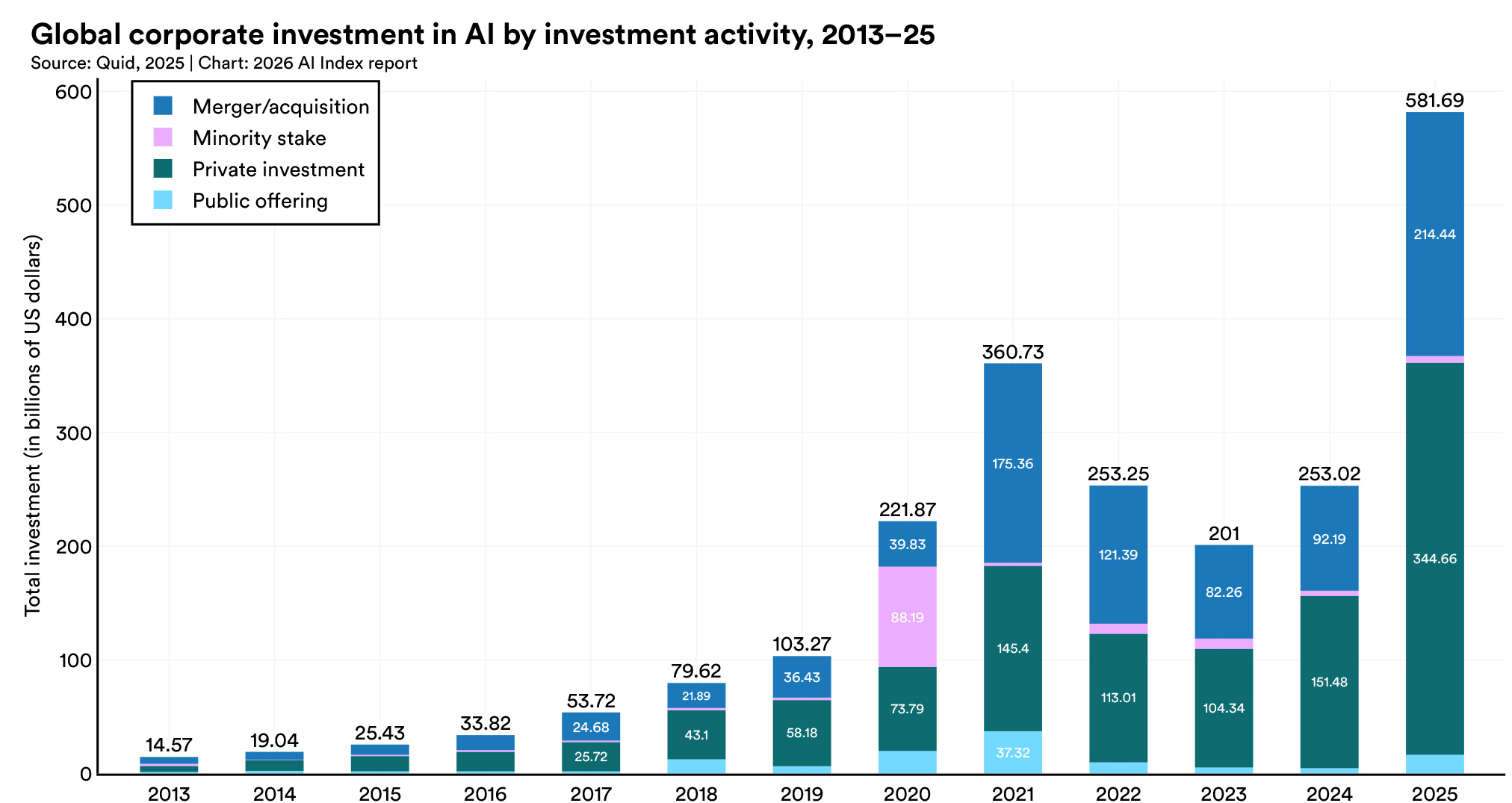
That number understates the strategic weight, because the dollars are small next to compute budgets but decisive for model quality. To ground the scale of capital flowing in, global corporate AI investment more than doubled in a single year, and the chart below shows how steeply the money funding all of this has climbed.
Global corporate AI investment, 2013 to 2025
The reason this matters for recruiting is asymmetry: a lab can spend hundreds of millions on GPUs and still ship a weak model if its post-training data is poor. Human judgment has moved from a cost to control into a capability to build. The recruiting challenge that follows is unusual, because you are not filling seats, you are assembling a distributed, on-demand bench of verified specialists who mostly have lucrative day jobs and treat this as premium side work. That is a persuasion problem and a verification problem stacked on top of a sourcing problem, and the rest of this guide is about solving all three.
The practical cost of ignoring the split is easy to see once you look for it. A team that budgets one blended rate for "annotation" will either overpay a crowd vendor for work a marketplace does for pennies, or, far worse, try to staff expert reasoning work at generalist rates and end up with confident, plausible, wrong data that poisons a model in ways nobody catches until an evaluation regresses. The bifurcation also shows up in demand: the generalist and crowd tiers are commoditizing and even shrinking as models automate rote labeling, while the expert and verification tiers are inflating into a bidding war. That divergence is why the market fragmented into dozens of vendors, and why a recruiter's first job is not to source but to classify, because every downstream decision, the channel, the assessment, the pay, and the retention plan, follows from which of these two economies a given workload belongs to.
There is one more framing you need before the tactics. The scarce resource is no longer the labeler, it is the expert and the person who can verify the expert's work. Human data now costs more than marginal compute for frontier post-training, running roughly 3.1 times marginal compute across major providers in 2024 and growing far faster - Daniel Kang. When the input is this expensive and this decisive, the recruiting function that supplies it is not back office. It is the frontier.
2. Read the Power Map Before You Source
Before you decide where to source, you have to understand who controls the supply, because in 2026 the vendor landscape was reshaped by a single transaction and its aftermath. In June 2025, Meta invested $14.3 billion for a 49% non-voting stake in Scale AI, valuing the company above $29 billion and pulling founder Alexandr Wang into a new Meta superintelligence team - TechCrunch. Scale had defined industrial data labeling. Overnight, its neutrality became a liability, because no competing lab wanted its research roadmap flowing through a company partly owned by a rival. The person now at the center of Meta's AI effort is worth listening to directly, and the recent interview below is the primary-source face of that shift.
Meta AI Chief Alexandr Wang on Winning the AI Race (Bloomberg, June 2026)
The fallout is the important part for a recruiter, because it tells you where talent and reliability now sit. Within days, Google, Scale's largest customer at a planned roughly $200 million in 2025, moved to split, and OpenAI confirmed it was winding down its Scale work as well - CNBC. The shared fear was simple: no lab wanted its research roadmap visible to a company partly owned by Meta. That single anxiety, confidentiality, became the defining purchasing criterion in human data almost overnight, and it is why a cohort of neutral, unaffiliated vendors suddenly had more demand than they could staff.
The human cost of that reversal fell on the contractors, which is a pattern you must internalize before you trust any single vendor's pipeline. Scale cut about 200 full-time staff, roughly 14% of its workforce, plus around 500 contractors in July 2025, installed Jason Droege as interim CEO, and redirected the company toward government and defense work - CNBC. Its realized 2025 revenue landed near $1 billion, well below early projections, once the customer flight hit. The blunt lesson is that a vendor's ownership can vaporize your project pipeline overnight through no fault of the people doing the work, so concentration risk in a single supplier is now a live operational exposure rather than a theoretical one.
Alexandr Wang, Scale AI founder and Meta Chief AI Officer

That vacuum redistributed roughly a billion dollars a year, per lab, to a cohort of challengers, and knowing the shape of that cohort is your power map. Surge AI is the quiet leader, bootstrapped and profitable, with $1.2 billion in 2024 revenue that surpassed Scale, roughly 50,000 expert contractors, and founder Edwin Chen owning about 75% of a company he took no outside money to build - Forbes. It is Anthropic's primary human-feedback provider and prized precisely because no Big Tech company owns it. Alongside it sit the fast risers you will hear named in every procurement conversation.
- Mercor - expert marketplace, $10 billion valuation on an October 2025 round, pays contractors over $1.5M a day
- Handshake AI - a campus network turned data labeler, roughly $1.1 billion annualized gross revenue by April 2026
- Turing - the coding and reasoning data provider for OpenAI, $2.2 billion valuation, around $300M revenue
- Labelbox - tooling plus its Alignerr expert network, positioned as a neutral one-stop vendor
- Invisible, Toloka, Snorkel, micro1 - hybrids spanning ops, evals, and specialist marketplaces
Each of these names is covered in depth below, but the strategic read is what matters here: the market fragmented on purpose, because labs now deliberately spread work across several neutral vendors so no single supplier, and no single supplier's owner, can see the whole picture. Meta paid $14.3 billion and still triggered its own suppliers to diversify away from the company it bought. For a recruiter, that fragmentation is opportunity, because it means no vendor has a monopoly on the experts you need, and the same specialists are often reachable through several channels at once, including directly.
The vendor that benefited most from the neutrality premium is worth studying, because it reveals what buyers now reward. Anthropic adopted Surge AI's platform after finding that generic crowdsourcing lacked the language-model expertise and quality-control infrastructure it needed, and later described that human data as a game changer for its research - Surge AI. The signal for your own vendor selection is that quality and neutrality now beat scale and price, a reversal from the era when Scale won on sheer throughput. When you evaluate a supplier in 2026, treat its ownership structure and its willingness to prove annotator quality as first-order criteria rather than fine print, because those are precisely the two attributes the most sophisticated buyers in the world just reorganized their entire supply chains around. Even Meta's own researchers reportedly came to prefer Surge and Mercor for higher-quality data over the company Meta had bought - TechCrunch.
Rounding out the map matters, because the roster is deeper than the headline names, and knowing the full field keeps you from overpaying a fashionable vendor for work a quieter one does better. The useful hybrids include Toloka, which took a strategic round led by Jeff Bezos's Bezos Expeditions and now spans crowd microtasks to vetted experts across a hundred countries - SiliconANGLE; Invisible Technologies, which pairs expert humans with software for RLHF and enterprise automation at a rare positive margin; and micro1, an AI-vetted specialist marketplace reportedly raising at around a $2.5 billion valuation. Each occupies a slightly different point on the crowd-to-expert spectrum, so the practical filter is to match a vendor's real model to the tier of work you defined rather than to its press coverage.
The legacy end of the market is fading fast, which is itself instructive. Appen, once dominant in crowd labeling, lost its Google contract and saw group revenue fall sharply, a cautionary tale about betting a business on volume in a market that repriced around expertise - Staffing Industry Analysts. Underneath the expert tier, a new low-cost crowd layer is forming, with Uber repurposing its gig network into a labeling arm across dozens of countries and publicly traded incumbents like Innodata pivoting from old-line outsourcing into AI data engineering for the largest tech firms. The lesson for a buyer is that vendor fortunes here turn on a single customer decision, so you should treat any supplier's stability as contingent and keep a second source qualified at all times.
3. Define the Role or You Will Mis-hire
The most common failure in annotation recruiting is writing a requisition for "data annotator" and getting back a pile of candidates who are either wildly overqualified or completely unable to do the actual task. The fix is to define the role against the four tiers that really exist, because each tier has its own supply pool, pay band, sourcing channel, and failure mode. Getting the tier wrong cascades: you source in the wrong place, you assess for the wrong thing, and you either overpay a commodity worker or lose an expert to a competitor who understood the market better. Before you name a title, decide which of these four jobs you are actually filling.
The bottom tier is the crowd labeler, who tags images, transcribes audio, and moderates content, priced by geography rather than skill and typically sourced through high-volume platforms. Above that is the generalist AI trainer, who rates chatbot responses, writes instruction-following examples, and does light preference labeling, the band most people mean when they say "get paid to train AI." Higher still is the domain expert, the physician, litigator, quant, or PhD who authors reasoning traces and grades outputs only a credentialed professional can judge. At the top, and newest, is the environment builder, an engineer or expert who constructs the interactive tasks and graders that models train against, a role that barely existed two years ago. These are not seniority levels of one job. They are four different jobs.
The pay ladder makes the tiers concrete, and it is the single best lever you have for setting expectations with hiring managers who think annotation is cheap. The chart below shows representative 2026 hourly rates by tier, drawn from vendor rate cards and reported worker pay.
Representative 2026 Annotation Pay by Tier (USD/hour)
Read that chart as a warning against averaging. The crowd tier is priced near $2 an hour in Kenya and the Philippines and around $15 an hour in the US, the generalist band clusters near $20 to $40 an hour, and the expert band runs from roughly $75 to over $200 an hour, with senior domain specialists at Mercor averaging about $85 an hour and reaching $200 or more for a profile equivalent to $400,000 a year - TIME. If you write one budget number for "annotation," you have already lost, because the same word spans a hundredfold pay range. Define the tier first, and let the tier set the rate, the channel, and the assessment. A useful discipline is to write the requisition around the output you need (a graded legal brief, a labeled lidar frame, a working test harness) rather than the title, because the output tells you the tier and the tier tells you everything else.
The top tier deserves special attention, because the environment-builder role is the fastest-growing and the least understood, and hiring managers routinely conflate it with either engineering or annotation when it is genuinely both. These are people who do not just mark an answer right or wrong; they build the test harness, the edge cases, and the grading logic that let a model practice a task thousands of times automatically. A single well-designed environment can produce effectively unlimited training signal, which is why one great hire at this tier can be worth a hundred at the tiers below. The output looks like a product: Turing, for instance, shipped a pack of 1,106 expert-authored PhD-level reasoning tasks spanning computer science, data science, and chemistry, the kind of artifact that only a credentialed specialist who also thinks like a test designer can produce - TechCrunch. When you write a requisition at this tier, you are not hiring a labeler at all, you are hiring a curriculum designer with a graduate degree, and the sourcing, pay, and assessment all change accordingly.
One more definitional point that will save you money: the terminology is rebranding faster than the work is changing. "Annotator" is becoming "AI trainer," "AI tutor," "human data specialist," and "RLHF evaluator," often for the same underlying task at a higher advertised rate. When you source, search the new labels and the old ones together, because a physicist who would never answer an ad for a "data labeler" will happily consider an "AI reasoning expert" role, and the pay premium sometimes reflects nothing but the framing. HeroHunt.ai's guide on finding AI trainers maps this vocabulary shift in detail.
4. The Sourcing Playbook: Channels That Actually Convert
Sourcing annotators is fundamentally a distribution problem, and the vendors winning this market won it by owning a channel, not by inventing better technology. The hardest part of expert-annotator recruiting is that the people you want already have full-time jobs and were not looking for side work, so the question is never "where do I post" but "whose existing network can I activate." Understanding how the leaders solved this tells you exactly which channels to build and in what order, whether you are sourcing directly or choosing a vendor to do it for you. The playbook splits cleanly by tier, and the channels that convert at the top are almost the opposite of the channels that convert at the bottom.
At the top, the most powerful channel is an owned, pre-credentialed network, because it collapses acquisition cost to near zero. Handshake is the clearest case: it turned a campus job board into an AI-training business by activating its graph of roughly 500,000 verified PhDs and three million advanced-degree holders through a push notification, reaching $1.1 billion in annualized gross revenue in about fifteen months - Sacra. Its edge is what one analysis called structural arbitrage: verified .edu credentials cut fraud, and the work is marketed as a prestigious "Fellowship" rather than gig labor - AI Native GTM. You probably do not own a university database, but the principle generalizes to any credentialed list you can reach: an alumni association, a professional society, a conference roster, or your own product's user base of domain professionals.
Mercor's founders, whose marketplace pays experts over $1.5M a day

The second channel is referrals, which for expert work convert better than any cold outreach because experts trust other experts. At Mercor, reportedly more than 60% of expert hires came through referrals, and the company pays bounties structured to reward quality, not just names - Mercor. The third channel is AI-driven outbound at machine scale, now standard rather than novel: micro1's AI recruiter, named Zara, scours LinkedIn and GitHub, runs first-round interviews, and helped take the firm past $200 million in annualized revenue as it recruits hundreds of experts a week - Sacra. This is where general recruiting technology meets annotation, because the same autonomous sourcing systems that fill engineering roles work to find moonlighting specialists, which is why tools like HeroHunt.ai that source and reach candidates across a billion-plus profiles on autopilot are increasingly used to build annotator benches directly rather than through a middleman.
Beyond those three primary channels, specific talent pools map to specific annotation needs, and knowing where each congregates is most of the battle. The productive hunting grounds for technical and scientific annotators are the communities where those professionals already publish, compete, and argue.
- Kaggle and competitive programming - for elite coders and quantitative reasoners
- GitHub and open-source projects - for senior software and infrastructure experts
- Professional licensing bodies - for verified doctors, lawyers, and accountants
- PhD programs and academic Slack or Discord - for scientists and specialists
- Reddit communities like r/dataannotation - for the generalist and gig tiers
Each pool demands different messaging, which is the part teams botch most often. A litigator will not answer the outreach that lands a Kaggle grandmaster, and the conversion rate depends heavily on framing the work as flexible, intellectually interesting, and paying at or above the person's professional rate. Surge built a billion-dollar business partly by pitching exactly that to university departments and expert communities instead of running generic ads, and the reason it works is that the binding constraint at the top of this market is motivation, not awareness. The people you want are not unemployed and not searching, so winning them is a persuasion problem, and generic recruiting copy fails instantly because a cardiologist or a staff engineer can smell a low-effort mass message. As Yuma Heymans has argued about sourcing scarce technical talent, the highest-value people in 2026 "have different visibility patterns and congregate in different communities," which is precisely why boolean keyword search misses them and channel ownership beats broadcast every time.
Two tactical refinements separate teams that fill a bench in weeks from those that stall for months. The first is treating referral design as a core sourcing strategy rather than an afterthought, with bounties large enough to move busy professionals: Mercor pays $250 to $15,000 per successful hire plus a percentage of the referred person's future earnings, structured so the incentive rewards quality of placement rather than volume of names - Mercor. The second is sourcing where the credential already lives and speaking that field's language natively. AfterQuery, which supplies reasoning datasets to frontier labs, deliberately recruits people who left quantitative trading, software engineering, and consulting, because those career transitions are exactly where deep, verifiable domain expertise pools up and becomes reachable at a moment when the person is open to interesting side work - AfterQuery. If you are reading this from the other side of the market, a specialist who wants to do the work rather than hire for it, platforms like micro1 and Terac take direct applications for exactly these AI-training roles.
Geography is the other lever, and in 2026 it is moving in two directions at once. Volume work still routes to the Global South, where rates run a few dollars an hour, while premium expert work is visibly re-shoring to the US and Europe, where Handshake's Fellowship, for example, is US-only and requires US work authorization - Handshake AI. The implication for a recruiter is to map each tier to a geography deliberately rather than defaulting to the cheapest labor pool, because the cheapest labor is also where identity and location fraud concentrate, and where a sudden regulatory or platform shift can strand your pipeline. Cheap is not the same as low-risk, and for expert work it is usually neither cheap nor low-risk, so the geography decision belongs in your sourcing plan from the first day rather than as a cost optimization bolted on later.
5. Vetting Without Getting Fooled
Once you have candidates, vetting is the make-or-break stage, because the entire value proposition of expert data collapses if the "expert" is not real or not good, and in 2026 verifying that has become a two-layer problem. The competence layer asks whether the person can do the work. The authenticity layer asks whether the person is even who they claim to be, and whether a human is doing the work at all. Ten years ago the second layer barely existed. Today it consumes as much of a serious screening pipeline as the first, because the same models your annotators are hired to train have become the primary tool candidates use to fake their way in. Design your assessment around both layers or you will ship poisoned data with the authority of expertise attached.
The competence layer is classic crowdsourcing hygiene scaled up, and the primitives are worth naming because they still work. Qualification exams gate entry; the long-running Google search-quality-rater program famously required passing a demanding exam, scored against expert consensus, before a rater could touch live data, and modern vendors copy that model. Gold-standard or honeypot items, tasks with known answers salted invisibly into the queue, give each worker a rolling accuracy score and flag anyone who drifts below roughly 85%. Trial or pilot tasks of 50 to 500 items precede full onboarding, and inter-annotator agreement serves as a live trust signal, with serious vendors targeting a Cohen's or Fleiss' kappa at or above 0.8 for objective tasks, a mechanism-design approach now formalized in research on using hidden golden questions to deter corner-cutting - arXiv. The diagram below shows how these two layers fit together in a modern screening stack.
The authenticity layer is where the money and the paranoia have gone, and the dominant approach is what you could call the Mercor model: a roughly 20-minute AI video interview that generates questions from the candidate's resume, transcribes and scores the answers, and logs browser telemetry such as tab-switches, paste events, camera state, and response latency to catch scripted or AI-assisted replies - Mercor. Credential-first players like Handshake lean on registrar and .edu verification so that "physics PhD" is proven rather than self-reported. The most selective networks treat a low acceptance rate as a feature: Labelbox's Alignerr reports roughly a 3% acceptance rate after assessments and interviews - Labelbox. For expert data, selectivity is not a bottleneck, it is the product, because the cost of a bad expert is not a wasted seat, it is corrupted training signal that carries the credibility of a credential.
There is a stage between passing the screen and producing usable data that teams routinely underestimate: calibration. Even a genuine specialist needs to be tuned to your specific rubric before their judgment counts, because two equally qualified experts will disagree on edge cases until they share a working definition of what good looks like. The historical benchmark is Google's search-quality-rater program, where contractors absorbed a lengthy guidelines document and passed an exam before rating anything, which produced unusually consistent judgments at scale. Modern practice borrows the same idea through paid training periods, worked examples, and a gold-standard set that new annotators must match before their output flows into the real dataset. Skipping calibration is how teams end up with credentialed people producing inconsistent data, which is worse than useless because it wears the authority of expertise while quietly corrupting the signal. Budget for a paid onboarding week the way you would budget for the assessment itself, because an uncalibrated expert and a lazy generalist produce the same failure, just at a higher hourly rate.
The tactical mistake to avoid is treating any single gate as sufficient, because each one is individually beatable. An AI interview alone can be defeated by a coached impostor, a credential check alone can be defeated by a rented identity, and a skills test alone can be defeated by a language model. What works is stacking gates so a candidate has to defeat all of them at once, and designing the competence tasks so a model cannot simply solve them: use novel, unpublished problems, time-box and proctor them, require oral follow-up that probes the written answer, and, as some research teams now do, embed prompt-injection tripwires inside the task guidelines to catch anyone pasting the task into a chatbot - arXiv. The elite move in 2026 is quietly reintroducing a live or in-person round for high-trust roles, because when verifying the human is harder than testing the skill, a real conversation is the cheapest reliable signal you have.
6. The Fraud Chapter: How Candidates Game You
Here is the dirty truth nobody puts in a vendor deck: a large and growing share of the people applying to do your annotation work are actively trying to deceive you, and if your pipeline is not designed for adversaries, you are already hiring them. This is not a rounding error. An analysis of 19,368 live interviews by the screening firm Fabric found 38.5% of candidates flagged for AI-assisted cheating, a rate that tripled from roughly 9% to 45% inside three months of late 2025, and 61% of flagged cheaters still scored above the passing threshold - Fabric. Read that last number twice. The majority of detected cheaters were passing. Whatever your current screen catches, the people it does not catch are getting through, and in annotation they go on to generate the "human" data you are paying a premium for.
The methods have professionalized into tooling. The same Fabric data attributes about 45% of cheating to dedicated assistants like Cluely and Interview Coder, 34% to language-model voice modes, and the remainder to tab-switching and live human help. Detection now relies on behavioral tells such as a consistent three-to-five-second lag after each question and mechanical left-to-right reading eye movements. The chart below shows how fast the AI-cheating rate climbed across the back half of 2025, which is the trend line every screening pipeline is now fighting.
Candidates Flagged for AI-Assisted Interview Cheating
Above the everyday cheating sits organized, sometimes state-level fraud, and it targets exactly the remote, credential-light roles that annotation offers. The North Korean IT-worker scheme alone generated roughly $2.8 billion over two years across 40 countries using stolen identities, US-based laptop farms, and real-time voice and deepfake tooling, and per Mandiant nearly every Fortune 500 CISO interviewed admitted their company had hired at least one such worker - Fortune. In one case a US facilitator ran a farm of 90 devices that placed fraudulent workers at 309 companies and generated $17.1 million - Department of Justice. The direction of travel is stark enough that Gartner projects one in four candidate profiles worldwide will be fake by 2028, and human reviewers detect deepfakes barely above a coin flip.
The fraud does not stop once someone is hired, which is the part most directly relevant to your data quality. The same instincts that get a candidate through a screen get them through the work: annotators mask their location with residential proxies to collect Western pay from low-wage regions, run multiple accounts through separate virtual machines, and, most damaging of all, quietly route the actual labeling through a chatbot. Detection leans on browser fingerprinting, VPN analysis, and repeated geolocation coordinates, and even then it is imperfect, with one crowdwork study finding more than a quarter of responses were possibly bots - Prolific. The synthesis is uncomfortable: interview fraud and work fraud are the same problem viewed at two moments, so a screen that checks the door once and never re-checks the work has a hole in it. Task-time analytics, where suspiciously fast completions flag likely automation, have become a standard post-hire honeypot precisely because the person who cheats to get in tends to keep cheating to stay in.
The defensive playbook follows directly from the threat model, and it is worth stating as concrete practice rather than principle. The moves that actually reduce fraud are the ones that raise the cost of faking faster than they raise the cost of applying honestly.
- Instrument the interview with paste, tab, and latency telemetry
- Verify identity and credentials against registrars and licensing bodies, not self-report
- Use novel, unpublished tasks that a model cannot retrieve or auto-solve
- Add a live or in-person round for any high-trust expert role
- Cross-check location against VPN and device fingerprints before paying Western rates
None of these is sufficient alone, which is the whole point of the fraud chapter: authenticity is a system property, not a single check. In-person interview requests jumped from around 5% of processes in 2024 to about 30% in 2025 precisely because instrumented remote screening, however good, keeps getting beaten - The Interview Guys. The uncomfortable implication for a lean team is that vetting is now expensive on purpose, and the vendors charging a premium are partly charging you for the fraud they absorb. If you build in-house to save the vendor margin, you are also buying the fraud problem, and you need to budget for it in headcount and tooling, not pretend it away.
7. The Dirty Truth of the Labor Market
Any honest recruiting guide has to sit with the fact that the data-annotation market runs on a deliberate invisibility, and that invisibility is not incidental, it is load-bearing. The concept the researchers Mary Gray and Siddharth Suri named ghost work is now the operating model: humans do the labeling but are presented to customers, and often to one another, as automation - Ghost Work. Non-disclosure agreements, project code names, and layers of subcontracting mean a worker in Nairobi or Manila frequently cannot say whether they are training OpenAI, Meta, or Google. That opacity hides two things a recruiter needs to see clearly: the wages, and the wage theft. You cannot design a humane, stable, low-churn annotation program if you do not understand what the incumbent model actually does to the people in it.
The exploitation is two-tier by design, and the canonical example is documented. To make ChatGPT less toxic, OpenAI paid the outsourcer Sama $12.50 an hour, while the Kenyan workers doing the labeling took home between $1.32 and $2 an hour to read descriptions of child sexual abuse, torture, and murder - TIME. The human cost was not abstract: of 144 former Sama and Meta content moderators later assessed, 81% were diagnosed with severe PTSD - CNN. The documentary below, from a major public broadcaster, follows these workers directly and is the clearest single window into the labor the marketplace hype leaves out.
How big AI companies exploit data workers in Kenya (DW Documentary)
Then the platforms weaponize access itself, which is the part that should most alarm anyone building a bench they intend to keep. Scale AI's Remotasks abruptly shut down in Kenya, Nigeria, and Pakistan in March 2024, locking out workers, some of whom had labeled since 2018, with no warning they ever received - Rest of World. Workers described a recurring pattern of pre-payday account bans justified by vague policy violations, a mechanism that conveniently avoids paying for completed work. This is not a fringe complaint. The US Department of Labor opened an investigation into Scale over potential wage-and-hour and misclassification violations before quietly closing it, and Surge AI was hit with a California class action in May 2025 alleging it misclassified annotators and imposed unpaid training and impossible deadlines - Bloomberg Law via Clarkson.
When platforms vanish overnight, workers lose access and unpaid earnings

The structural driver behind all this churn is an economics that quietly favors replacement over retention, and it is the single most important thing to understand if you want a stable bench. When onboarding a fresh worker from an effectively endless queue costs almost nothing, platforms re-queue rather than invest in the people they already have, which is why deactivations feel arbitrary and appeals go nowhere. The same disposability shows up in how entire labor pools rise and vanish: Venezuelans became a backbone of AI data labeling during their country's economic collapse, forming up to three-quarters of some platforms' workforces for a few cents per task, and are now being displaced again as generative AI eliminates the simplest clickwork - Rest of World. For a recruiter building anything you intend to keep, the lesson is that a disposable-worker mindset is a false economy when applied to expert work, because every churned specialist walks out with calibrated judgment you cannot cheaply replace, and the cost of re-earning it dwarfs whatever you saved by treating people as interchangeable.
The loop then closes on itself in a way that directly threatens your data quality, which is why this section is not just an ethics aside. When workers are paid below a living wage and rated by opaque algorithms, cheating the system that is cheating them becomes rational, and a landmark EPFL study estimated that 33 to 46% of Amazon Mechanical Turk workers secretly used language models to complete a text task - arXiv. A parallel black market sells proxied Western "expert" accounts, with EU annotation logins advertised at $35 an hour resold for $70 plus a residential proxy so Global South workers can capture Western pay - AlgorithmWatch. The counterweight is that workers are organizing: Kenya's Data Labelers Association drew 339 members in its first week, built alongside the African Content Moderators Union by the same whistleblowers the industry tried to erase - Computer Weekly. The operational takeaway is not sentimental. Underpay and destabilize your workers, and you get exactly the gaming, contamination, and churn that ruin the dataset you are paying for. Fair, stable pay is a data-quality strategy, not a charity line.
8. What It Really Costs: Pay Bands and Vendor Margins
To budget annotation correctly you have to understand where the money actually goes, because the gap between what a lab pays and what a worker receives is the single most important, least advertised number in this market. The crowd tier is priced by geography, not skill, and the markup is enormous: in the documented Kenya case the vendor kept roughly 85% of the bill rate, paying out $1.32 to $2 an hour against $12.50 billed. Managed-service economics are structurally similar even at the premium end, where Surge AI reportedly charges clients 50% to 10 times more than rivals while paying contractors around 30 to 40 cents per working minute, or roughly $18 to $24 an hour - Forbes. When you buy through a vendor, you are paying for recruiting, coordination, quality assurance, and absorbed legal risk, which is often worth it, but you should know that is what the spread buys.
The generalist tier is where most recruiters will spend, and the real take-home is lower than the advertised ceilings because pay is per-task, not per-hour, and gated by project access. DataAnnotation.tech advertises $20 to $40 an hour and up to $60 for coding, with a Glassdoor median nearer $25 to $30 - Glassdoor. Outlier, owned by Scale, effectively pays $12 to $45 an hour, with most standard work at $18 to $28 and the floor lower than it was a year ago - Breaking Even. Alignerr averages around $29 an hour despite a $150 headline reserved for rare credentials. The pattern to internalize is that commodity and generalist rates are deflating, so any advertised number should be discounted for access, speed, and the very real possibility of a mid-project cut.
That deflation is not hypothetical, and it is the nuance that separates people who understand this market from people reading rate cards. In November 2025 Mercor, the same company paying senior experts $200 an hour, cut a Meta moderation project from $21 to $16 an hour, a roughly 24% reduction across thousands of workers, and offered rehire at the lower rate - Forbes. Commodity rates fall even at premium platforms, while scarce-expert rates inflate, and the two move in opposite directions inside the same company. If you are staffing volume work, do not assume today's rate holds; if you are staffing expert work, do not assume you can lowball, because the specialists have leverage and know it.
Underneath the tiers sits a geographic rate map that every buyer should keep in their head, because location, not skill, sets the commodity price. In 2026, hourly bill rates for general annotation run roughly $25 to $60 in the US, $20 to $45 in Western Europe, $10 to $25 in Eastern Europe, and $5 to $15 in India and the Philippines, with parts of Africa lower still, while credentialed expert labeling clears $50 to $100 an hour and up almost regardless of geography - Second Talent. The practical use of that map is to price each workload against the cheapest geography that can actually do it well, not the cheapest geography overall, because sending expert reasoning work to a two-dollar market does not save money, it manufactures the gibberish the quality section describes. Match the tier to the geography, and the geography to the risk, or the savings evaporate downstream in re-work and failed evaluations.
The expert tier is a genuine auction, and the rate card is worth stating plainly so you can set competitive offers. Surge quotes medical fellows at $250 to $450 an hour and VC partners or startup founders at $500 to $1,000 an hour for the rarest judgment - Sacra. Mercor's public bands put physicians near $130 to $170, lawyers near $110 to $130, and full-time specialist "tutors" at $90,000 to $200,000 a year - Built In. Handshake pushes medicine, law, and finance experts to $175 to $300 an hour and up. The reason labs tolerate this is the asymmetry established earlier: high-quality RLHF annotations run on the order of $100 each, human data now costs multiples of marginal compute, and a single well-designed expert contribution can be worth a hundred cheap labels. The dirty truth for a buyer is that the leverage lives in two places, either sourcing verified experts directly rather than renting them through a marketplace at a 30% or greater take rate, or pressure-testing a vendor's markup by knowing the underlying pay bands cold. If you cannot see the spread, you are almost certainly on the wrong side of it.
It is worth being concrete about why labs pay these premiums rather than economizing, because that logic is what justifies your own budget requests. The relevant comparison is not annotation versus salaries, it is annotation versus compute, and human data now dwarfs compute on the projects that matter: one reasoning model reportedly spent on the order of $14 million on data against $500,000 of compute, a nearly thirty-to-one ratio, with smaller research efforts showing even wider gaps - Daniel Kang. Against a training run costing hundreds of millions, a few hundred million on the data that decides whether the model is any good is simply rational. That is the sentence to bring into a finance conversation, because it reframes annotation from a cost to be minimized into the highest-leverage spend in the training budget, and it explains why the recruiting function that supplies it keeps getting more resources rather than fewer.
9. Quality Is a Recruiting Problem
Most teams treat annotation quality as a QA function that happens after hiring, and that framing is exactly why their datasets rot, because in expert data quality is decided at the moment you choose who does the work. The industry runs on statistics precisely because it does not trust its workers: every serious pipeline assumes some fraction of labelers are lazy, gaming, or secretly a model, and defends with redundancy and consensus math, honeypots, and reviewer hierarchies. But those defenses are downstream mitigations for an upstream hiring failure. The research consensus, from the influential LIMA result showing that 1,000 meticulously curated examples could match a far larger training set, is that a small number of excellent labels beats a mountain of mediocre ones - arXiv. That finding is a recruiting mandate: hire fewer, better people, and the quality problem shrinks before QA ever runs.
The failure mode when you get hiring wrong is now well documented, and it is worse than simple noise. Scale AI's program training Google's models was reportedly flooded with spam that internal documents described as "writing gibberish, writing incorrect information, GPT-generated thought processes," to the point that supervisors were reduced to running submissions through a consumer AI-text detector - Inc via Futurism. This is what happens when sourcing prioritizes headcount over verification, and it is a major reason labs fled toward neutral, expert-vetted vendors after the Meta deal. The contamination is not just a quality issue, it is a security one: Anthropic showed that as few as 250 malicious documents can plant a backdoor in a model regardless of its size, which means a single determined bad actor in your annotation pool is a genuine threat surface - Anthropic.
The reason to obsess over who does the work, rather than only how it is checked, is that label noise degrades models measurably and sometimes catastrophically. In controlled experiments, a vision model's test accuracy fell from about 74% to 64% at 30% label noise, and under fully random labels an overparameterized network can collapse toward chance because it memorizes the corrupted labels wholesale - Taylor & Francis. The security community now treats this as more than a quality problem, cataloguing bad and adversarial labels as data-and-model poisoning, because a lazy annotator and a deliberate poisoner leave the same fingerprint in the dataset. The cheapest defense against both is upstream, and it is a hiring decision: bring in people who have no incentive to cut corners, which in practice means paying and treating them well enough that gaming is never the rational move in the first place.
The operational defenses are worth knowing, but only as backstops to good hiring, not substitutes for it. The standard toolkit in 2026 is layered and statistical, and it is what a competent data-operations function runs continuously.
- Consensus weighting via Dawid-Skene or MACE, which down-weights unreliable annotators
- Rotating gold and honeypot tasks that score quality without full review
- Reviewer hierarchies with maker-checker adjudication for subjective work
- Dynamic sampling that increases QC on new or low-accuracy workers
- Agreement thresholds enforced live, with removal below the bar
The reason these matter to a recruiter is that they only work if the underlying pool is honest and capable, and the root cause of gaming is the sub-minimum-wage economics that made cheating rational in the first place. Preference noise above roughly 20% measurably wrecks alignment, and the entire reason methods like targeted human feedback exist is to concentrate scarce expert effort on the hardest cases rather than spreading cheap labor thin - Taskmonk. Quality, retention, and pay are therefore the same lever viewed from three angles. Hire verified experts, pay them fairly and promptly, keep them engaged with interesting work, and your agreement scores rise and your contamination falls. Churn your bench and squeeze its pay, and no amount of downstream statistics will save the dataset. HeroHunt.ai's guide to assessing human data labelers goes deeper on the mechanics of scoring quality at scale.
10. Structuring Your Human-Data Org: Build, Buy, or Blend
The structural decision every serious buyer faces is whether to build an in-house annotation org, buy through vendors, or blend the two, and the right answer in 2026 is almost always a blend, but the composition of that blend is where the real strategy lives. The reason is that the market itself blended: after the Scale-Meta rupture, every frontier lab moved to spread work across several neutral vendors while keeping strategy, taxonomy, and increasingly the tooling in-house. OpenAI runs a dedicated Human Data team with program managers and a technical PM for "Expert AI Trainer Acquisition," plus an internal labeling platform reportedly called Feather - OpenAI Careers. Anthropic hires a Data Operations Manager, Human Data at $270,000 to $365,000 to own strategy across RLHF and safety while orchestrating outside vendors - Anthropic Careers. The pattern is consistent: keep the brain in-house, rent the hands.
The rent-the-hands pattern takes many shapes, and seeing a few makes the choice concrete. OpenAI's original instruction-tuning work leaned on a screened in-house team of roughly 40 contractors to write and label the datasets behind its first aligned models, a reminder that directly managed labelers have been core to alignment since the very beginning - OpenAI. Google's DeepMind sits nearer the other end, sourcing raters and super raters through a third-party contractor at roughly $18 to $32 an hour, a decentralized model that made headlines when hundreds were laid off amid unionization and pay disputes - Android Police. The modern lab runs internal ops teams, directly recruited experts, and external vendors in parallel rather than choosing one, which means your own structure should be a portfolio of models matched to workloads rather than a single bet on build or buy.
The counter-example is just as instructive, because it shows the risk of over-building. xAI staffed a large in-house org of roughly 1,500 full-time AI tutors, then reversed course in September 2025, cutting about 500 generalist tutors and announcing it would "surge our Specialist AI tutor team by 10x" - TechCrunch. The lesson is that building in-house makes sense for stable, high-security, or highly customized workloads, but generalist volume is exactly the work you should not lock into fixed headcount, because demand is spiky and the commodity tier is deflating. The decision tree below captures the logic a data-ops leader should apply per workload rather than as a blanket policy.
Applying that tree in practice means matching each workload to the model that fits its risk and stability, and being honest about what you are optimizing. Spiky evaluation campaigns and one-off datasets should be bought, because a vendor absorbs the recruiting surge and the legal risk. Confidential, long-running work that touches your core IP should be built in-house, because that is precisely the data you do not want flowing through a marketplace, a concern Mercor's own CEO acknowledged when noting that at scale "it's possible there are things that happen" with proprietary data - TechCrunch. Scarce-expert work is the classic blend, where you source the rarest specialists directly to control cost and relationship while using a marketplace for burst capacity.
The recruiting implication of all this is that the highest-leverage hires you make may not be annotators at all, but the people who run the annotation function: the data-operations managers, RLHF program leads, and expert-acquisition specialists who design the taxonomy, choose the vendors, and own quality. Those roles command real salaries because they determine whether millions in annotation spend produces gold or gibberish. When you build the blend, staff the brain first, and treat direct sourcing tools that reach specialists across a billion-plus profiles, whether an in-house AI recruiter or a platform like HeroHunt.ai, as the mechanism that lets a small in-house team punch above its weight against vendors whose entire moat is recruiting.
11. The Next 18 Months: From Labelers to Verifiers
The dominant misconception heading into 2027 is that AI will eliminate annotation work, when the reality is that the annotator is getting promoted, and recruiting ahead of that shift is the single best move a talent leader can make now. Frontier labs largely exhausted the open web for pre-training, so gains now come from post-training and reinforcement learning, which have no pre-existing corpus and must be manufactured. The market has already renamed itself around this, from "data labeling" to "data foundries" and RL environments, the interactive gyms where agents act, get graded, and learn. The budgets are enormous: Anthropic reportedly discussed spending more than $1 billion in a single year on environments alone, with contracts often running six to seven figures per quarter - Epoch AI. This is not a niche. It is where the next wave of hiring is going.
Three corrections to the conventional wisdom will save you from mis-hiring. First, synthetic data does not remove humans, because unanchored model-on-model training risks model collapse, so the consensus 2026 pipeline has AI pre-label roughly 80% of the work while humans verify the hard 20% and define what "good" means. The human role shifts from labeler to verifier, auditor, and rubric author. Second, the scarce skill is now verification itself, because reward hacking is the field's top fear; one study found that 28.5% of a benchmark's tasks had test suites weak enough that a wrong answer still passed - arXiv. Someone has to build graders robust enough that high reward means the task was actually solved, not gamed. Third, environments need a three-layer workforce, and the profiles are specific.
The 'environments' economy: gyms where AI agents train and get graded
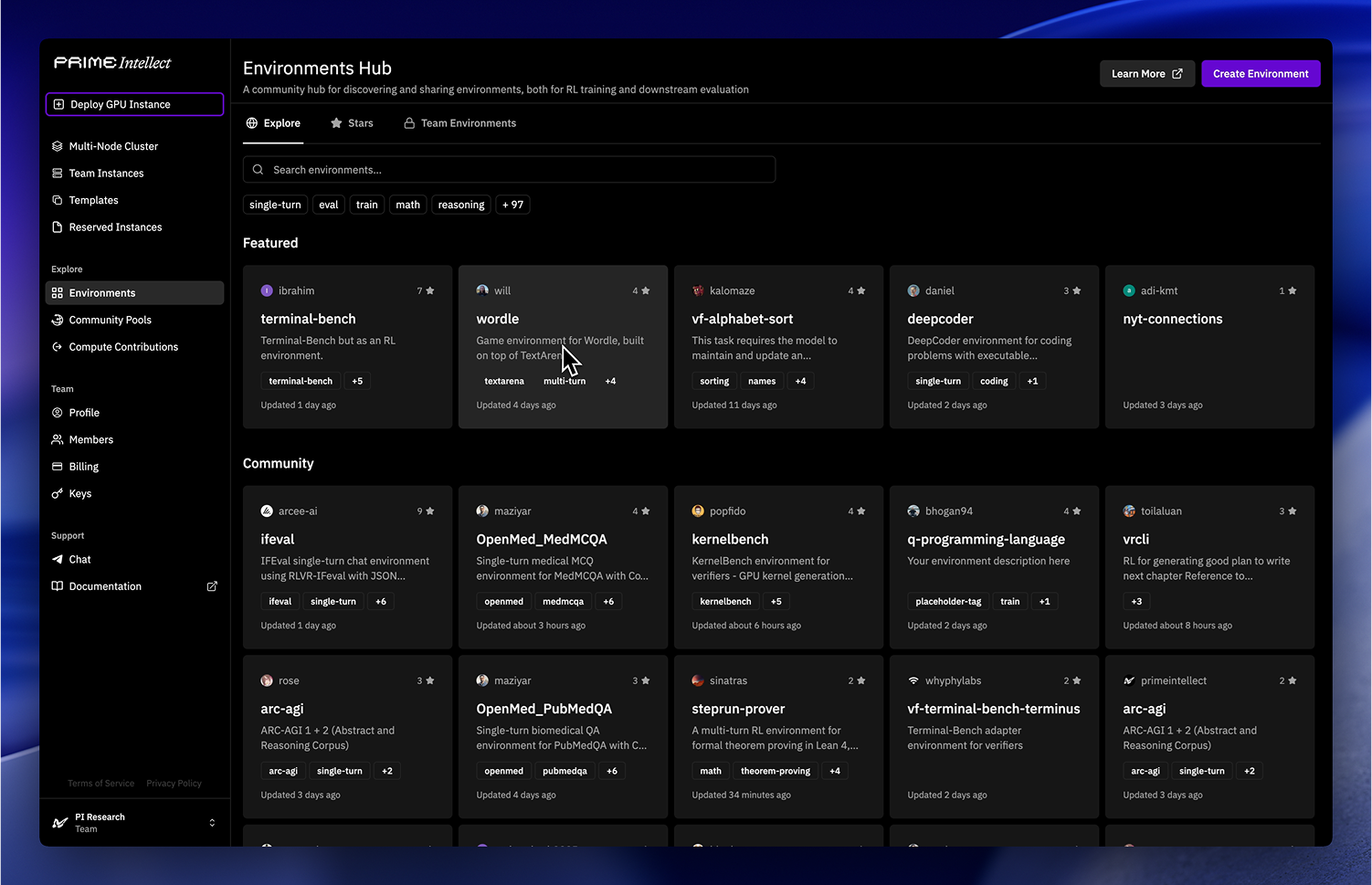
That three-layer workforce is the recruiting map for the next cycle, and each layer pulls from a different pool with a different pitch. Software engineers build the simulation infrastructure, and the pay signals how scarce they are: the startup Mechanize dangled $500,000 salaries to build environments - Fortune. Domain experts, the doctors, lawyers, and bankers, author the tasks and rubrics that define success, because as one environment founder put it, "domain knowledge and expert-level prompting is more important than ML skills" - Epoch AI. Marketplaces and your own sourcing function match the two. The through-line for recruiters is that you should hire fewer pure labelers and more verifiers, evaluators, red-teamers, and engineer-plus-domain environment builders, because that is where demand is migrating.
The compensation structure of this new tier is worth internalizing, because it tells you where the leverage sits. Individual RL-environment tasks reportedly run $200 to $2,000 each, rare complex ones reach five figures, a full interactive gym for a website can cost around $20,000, and vendor contracts often run six to seven figures per quarter, with exclusive deals commanding a four-to-five-times premium - Epoch AI. That economics splits the workforce cleanly: commodity labeling stays cheap and offshore, while the expert task authors and environment designers who define and grade the work command premium, sometimes eye-watering, contracts. The recruiting consequence is that a handful of exceptional environment builders can be worth more than a large annotation team, which flips the old headcount logic on its head.
The evidence that this expert work matters keeps strengthening, which is the strategic case for hiring ahead of it. OpenAI's GDPval benchmark, built with experts averaging fourteen years of experience, found frontier models tying or beating human specialists on a majority of professional tasks, a result that does not eliminate the humans but relocates their value to designing and verifying work the model cannot yet do reliably - SemiAnalysis. Nations are treating the underlying labor as strategic infrastructure, with China announcing plans to expand its data-labeling workforce and lead the field by 2027. For a recruiter, the signal is durability: the specific job titles will churn, but demand for people who can produce and check expert judgment is a structural feature of how models improve, not a passing product cycle.
A necessary dose of skepticism keeps this from becoming hype. Plenty of environment startups are seed-stage with under 20 employees and one or two customers, and respected voices are cautious: Andrej Karpathy says he is "bullish on environments and agentic interactions but bearish on reinforcement learning specifically" - TechCrunch. Some of the valuations are frothy and some of the roles will not survive the next funding winter. But the underlying demand for human judgment, verification, and domain expertise is structurally rising, not falling, even as the demand for rote labeling shrinks. Recruit for the durable trend, which is verification and expertise, and treat the specific company names as volatile. HeroHunt.ai's overview of how AI is trained tracks this migration from labeling to verification in more detail.
12. Your 90-Day Annotator Recruiting Plan
Everything above resolves into a concrete build sequence, and the reason to work in 90-day phases is that annotation demand is spiky and your pipeline has to be able to expand and contract without collapsing. The goal of the first phase is not volume, it is a defensible tier definition and a working assessment, because getting those two things right prevents the expensive mistakes, over-hiring the wrong tier and shipping gamed data, that sink most first attempts. Spend the first month deciding, per workload, which of the four tiers you are staffing, writing requisitions around outputs rather than titles, and building an assessment that stacks an authenticity layer and a competence layer. Do not source a single candidate until you can tell a real expert from a coached impostor, because in this market that is the binding constraint.
The second phase is about proving one channel end to end before you scale it, and the discipline here is to resist the temptation to open every channel at once. Pick the tier that matters most to your roadmap and build the single channel that best reaches it: an owned credentialed network if you have one, a referral loop with real bounties if you have experts already, or AI-driven direct sourcing if you are hunting moonlighting specialists cold. Run 20 to 50 people through your full pipeline, measure your true acceptance rate and your fraud-flag rate, and calibrate your pay against the bands in section eight so you are neither overpaying a middleman nor lowballing a specialist who will walk. This is also where you decide, per workload, the build-buy-blend split from section ten, and sign a vendor only for the burst capacity you genuinely cannot source yourself.
The third phase is about durability, and it is the phase most teams skip because the first hires are already working and the pressure eases. Do not skip it. Retention of expert annotators looks like professional-services talent management, not gig management: flexible, interesting work, prompt and transparent pay, and a sense that the work matters, because these are people with lucrative day jobs who will quietly disappear the moment the experience turns extractive. Build the quality loop from section nine as a live system, instrument your channels so you know which ones convert, and staff the brain of the function, the data-operations lead who owns taxonomy and vendors, before you staff more hands. The teams that win the annotation-recruiting contest in 2026 are not the ones with the biggest pool. They are the ones that defined the role precisely, screened for authenticity ruthlessly, paid fairly enough to keep quality high, and built a pipeline that flexes. Do that, and you will have turned the scarcest input in modern AI, verified human judgment, into a capability you own rather than a bottleneck you keep hitting.
This guide reflects the AI data-annotation labor market as of July 2026. Valuations, pay bands, and vendor relationships in this space change monthly, so verify current figures before committing budget or signing a contract.