



A practical 2026 guide to using Claude and other LLMs to inform talent decisions, without letting them make the call.
Recruiting is now the single most common place companies use AI, yet only about 10% let AI touch the final hiring decision - SHRM State of AI in HR 2026. That gap is the whole story. In 2026, Claude drafts the job description, structures the interview, and summarizes the resume, but a trained human still decides who gets hired. Treating that boundary as optional is how teams end up in court.
The reason is not squeamishness, it is evidence. A peer-reviewed audit of language-model resume screeners found they preferred white-associated names 85% of the time and disadvantaged Black male names in nearly every comparison - University of Washington. A follow-up study found that when people are handed a biased AI recommendation, they mirror it up to 90% of the time, even when they rate the tool as poor - University of Washington. So the naive version of "AI screens, human approves" quietly becomes "AI decides, human rubber-stamps." The advisor framing exists to prevent exactly that.
This guide is for the talent leader, founder, or lab operator deciding how to actually use Claude in hiring. It covers where Claude genuinely helps, where it fails and must never decide, the tool landscape you choose among, the legal layer (the EU AI Act, NYC's bias-audit law, Illinois, California, the EEOC, GDPR, and the Workday litigation), a defensible workflow with real prompt patterns, the trust gap and the AI-versus-AI arms race, what it costs and returns, and where this all heads by 2027.
Written by Yuma Heymans (@yumahey), founder of HeroHunt.ai. With a background in management consulting and years building AI recruitment technology, he writes about how AI is actually reshaping talent acquisition, including where it should and should not be trusted.
Contents
- Why "Advisor" Is the Right Frame
- Where Claude Genuinely Helps in Hiring
- Where Claude Fails, and Must Never Decide
- The AI-Hiring Tool Landscape
- The Legal Layer: What Actually Binds You
- Building a Defensible Claude Hiring Workflow
- The Trust Gap and the AI-vs-AI Arms Race
- What It Costs and What It Returns
- A Decision Framework: Raw Claude, a Tool, or an ATS
- The 2027 Outlook: Agentic and Reasoning-Based Hiring
- Conclusion: How to Use Claude as a Hiring Advisor
1. Why "Advisor" Is the Right Frame
The defensible model for AI in hiring is "augment, do not automate," and it is not just an opinion, it is what Claude's own maker requires. Anthropic's Usage Policy, effective September 15, 2025, names employment as a high-risk domain: when Claude's outputs affect decisions about a person's employability, "a qualified professional in that field must review the content or decision prior to dissemination or finalization," and you must disclose to affected people that AI is being used - Anthropic. In plain terms, Anthropic forbids using Claude to auto-reject a resume. The vendor of the model has drawn the line for you.
That line matches how Claude is actually used at work. Anthropic's Economic Index, which measures real usage patterns, found that augmentation (collaborative use) overtook automation on Claude.ai, at roughly 52% versus 45%, and that about 49% of jobs now use Claude for at least a quarter of their tasks - Anthropic Economic Index. People reach for Claude to think alongside them, not to hand off the decision. Hiring is the domain where that instinct is not just healthy but legally load-bearing.
How people actually use Claude at work
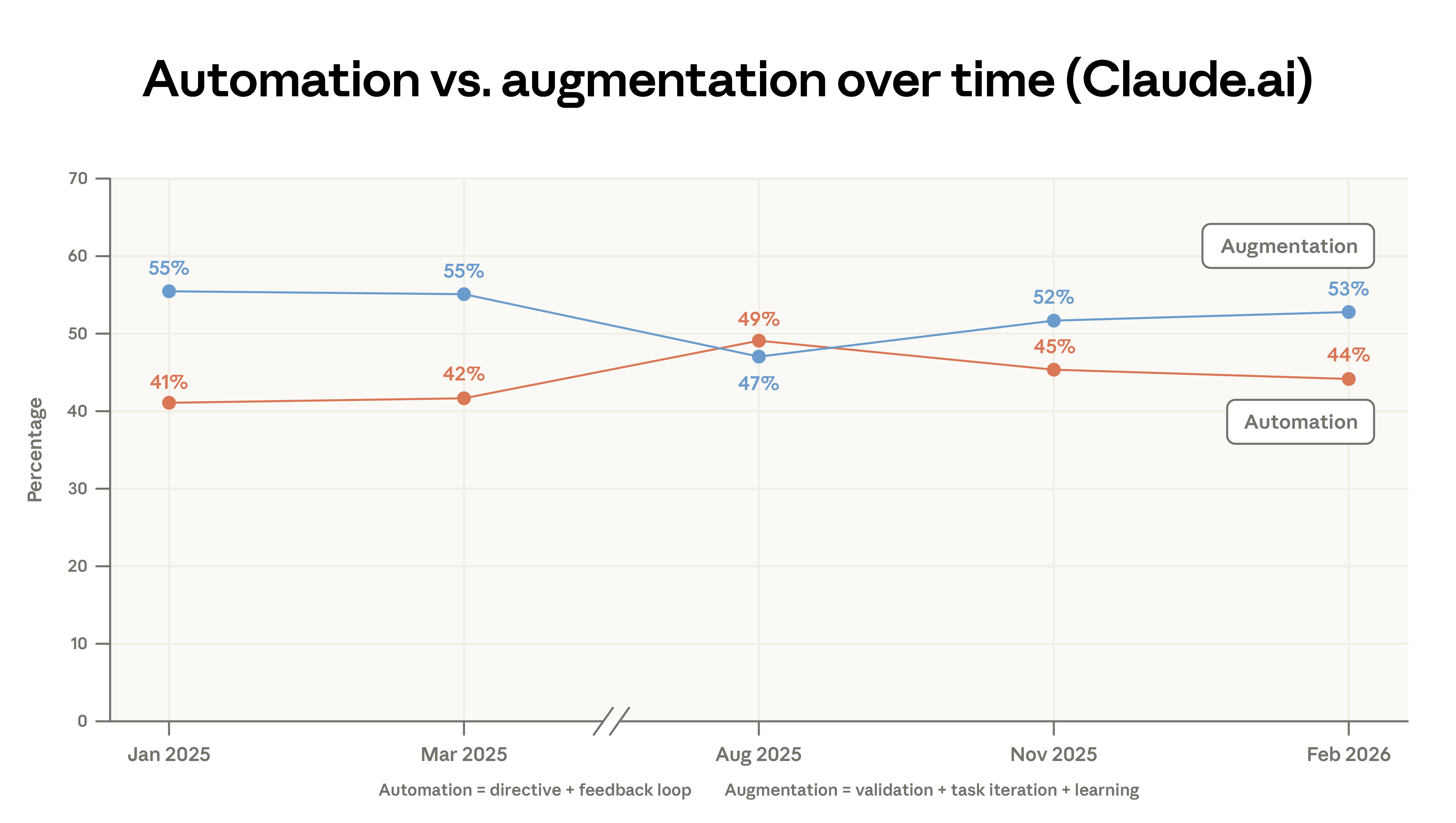
The practical consequence is a clean division of labor. Claude is strong at generative and structuring tasks: writing and de-biasing a job description, summarizing a resume against explicit criteria, building a structured interview guide, synthesizing messy interview notes into a calibrated writeup. It is weak, and dangerous, at unsupervised judgment: ranking candidates on raw resume text, inferring anything about a protected attribute, or issuing a hire or reject. The whole art of using Claude well in hiring is keeping it on the first list and off the second.
This is also where the productivity actually shows up, which makes the discipline easy to sell internally. Recruiters using generative AI report saving roughly one full workday per week - LinkedIn Future of Recruiting, and that time comes almost entirely from drafting and summarizing, not from replacing judgment. Anthropic itself is the proof of concept: it says it uses Claude across every stage of its recruiting funnel to write job descriptions, develop interview questions, draft communications, and analyze metrics, but explicitly "does not let Claude make hiring decisions" - Anthropic. If the company that builds the model runs its own funnel this way, that is the template.
That augment-first pattern is not an accident of the consumer app, it is where the value concentrates. Anthropic's usage data shows Claude is used disproportionately for higher-skill knowledge work, on tasks that require more education than the economy average - Anthropic Economic Index, and its own estimate of the productivity gain is candidly hedged: a baseline of roughly 1.8 percentage points a year, revised down once you account for how reliably the model actually completes a task. For a hiring team, that hedge is the useful part. The upside is real on the tasks Claude does reliably, which are the short, well-scoped drafting and structuring jobs, and it thins out precisely on the open-ended judgment calls that hiring decisions are made of. Designing your workflow around that curve, heavy AI use where it is reliable and human ownership where it is not, is how you capture the gain without inheriting the risk.
2. Where Claude Genuinely Helps in Hiring
Start with the tasks Claude is reliably good at, because that list is longer and more useful than the hype suggests. The unifying trait is that each task takes unstructured input and produces structured, reviewable output that a human then owns. Anthropic's own usage data reinforces the fit: Claude's success rate is highest on short, well-scoped generation and analysis, and it drops as tasks get long and open-ended - Anthropic Economic Index. Hiring has a lot of the former.
The most common and lowest-risk use is writing and de-biasing job descriptions, which is also the single most popular AI task in HR overall at 66% of AI-using teams - SHRM. This is not cosmetic. Decades of research show masculine-coded wording in ads measurably deters women by lowering their sense of belonging, independent of their actual skill - Gaucher, Friesen & Kay, so asking Claude to flag gendered language and rewrite for neutral, outcome-focused phrasing directly widens the funnel. In one documented deployment, a recruiting platform found that job descriptions written with a Claude-powered generator drew 25% more applicants - Anthropic / Braintrust.
The chart below shows where AI actually lands across the hiring workflow, and the shape of it is the argument: drafting and screening dominate, while letting AI make the final decision is rare.
How Teams Actually Use AI in Hiring
Beyond writing, Claude is strong at structuring the parts of hiring that research says matter most. Structured interviews, where every candidate faces the same pre-defined questions scored against the same rubric, are the single strongest common predictor of job performance, with validity around 0.42 to 0.51 versus far lower for unstructured chats - SIOP, and a defined scoring rubric can cut interviewer bias by more than half - SHRM via The Recruitability. Yet only about a third of organizations use structured interviews as standard practice. Claude removes the excuse: it will generate a competency-mapped interview kit and anchored 1-to-5 scorecard from a job description in seconds, which is a task where its strengths (consistency, structure) and the human's authority (the actual scoring) line up perfectly.
The other high-value zone is synthesis, turning volume into something a human can review. Claude summarizes a stack of resumes into a comparison against explicit criteria, drafts Boolean and semantic search strings, personalizes outreach, and condenses hour-long interview transcripts into structured notes mapped to your competencies. Interview-intelligence tools now connect Claude to recorded interviews so recruiters can query them in plain language - Metaview, and practitioners report saving 8 to 12 hours a week on these tasks. Anthropic has leaned into this directly with a first-party HR plugin that drafts offer letters, onboarding plans, and reviews - Anthropic, and its capabilities stack supports the workflow end to end: a large context window to hold a whole hiring packet, vision to read resume PDFs directly (up to 600 pages per request) - Anthropic docs, structured JSON output for auditable field extraction, and Model Context Protocol connectors to wire Claude into your ATS.
The value is not only candidate-facing; it shows up inside the HR team itself, which is often where adoption starts. In one company-wide Claude rollout, the HR function alone implemented 21 distinct use cases and saved an estimated 838 hours a month on drafting, analysis, and summarization - Anthropic / Jamf. A concrete example makes the pattern tangible. After a debrief, a panel's raw interview notes are inconsistent, scattered across four reviewers, and full of gut reactions. Handing Claude the transcript and the scorecard rubric and asking it to map each comment to the relevant competency, quote the supporting moment, and flag where reviewers disagreed turns an hour of reconciliation into a two-minute structured summary that the panel then discusses. The model did not decide anything; it made the human debate faster and better-organized, which is the entire point.
Two adjacent tasks round out the reliable list because they are structuring problems in disguise. The first is search-string generation: describe the role in plain language and Claude produces the Boolean and semantic queries a sourcing tool needs, iterating as you refine the target, which removes the arcane-syntax barrier that keeps many recruiters from sourcing at all. The second is outreach personalization at scale, drafting a distinct, specific message per candidate from their public profile rather than blasting a template. Both save real time, and both stay firmly advisory because a human still approves the query and the message. The common thread across every task in this section is worth restating: Claude converts unstructured input into structured, reviewable output, and a person owns the result.
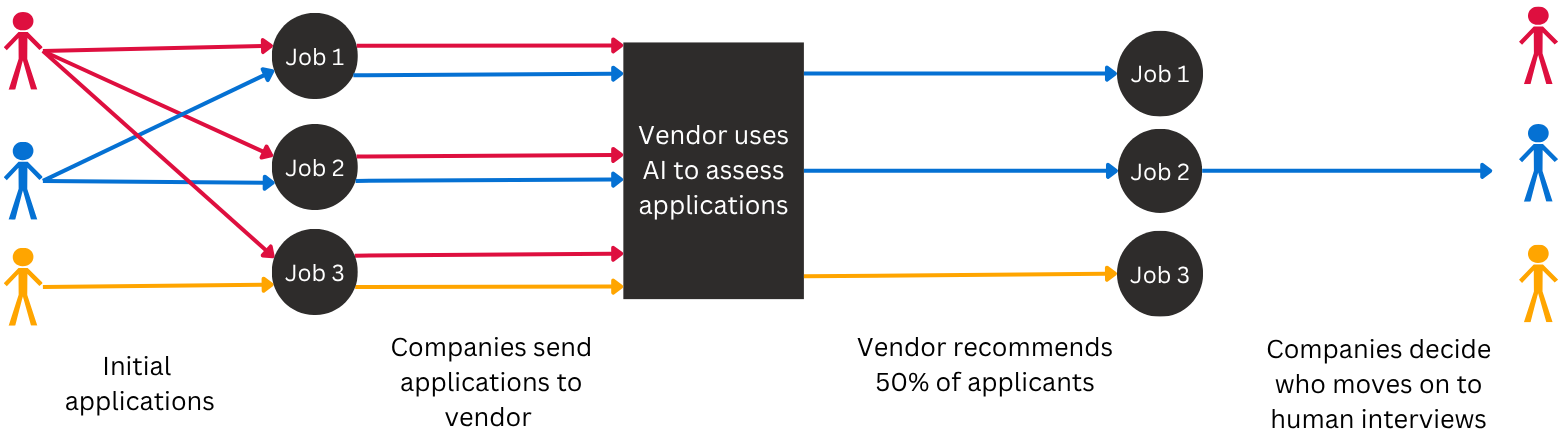
To see where AI enters the funnel and why the entry point matters, it helps to visualize the pipeline itself. The diagram below, from Stanford's Human-Centered AI institute, shows the standard automated-screening flow, and the thing to notice is how early the "recommend / do not recommend" label gets attached.
Where AI enters the hiring funnel
It is worth naming where the biggest documented wins actually come from, because it is not resume filtering. The strongest Claude-in-hiring results appear in skills demonstration and screening reimagined around evidence: one platform that uses Claude to generate realistic job simulations reports candidates evaluated on demonstrated skills convert to full-time hires ten times better than resume-driven methods, with a 50% shorter hiring cycle and 70% lower cost to hire - Anthropic / Skillfully. Another returns AI-assisted talent screens in minutes rather than weeks. The common thread is that value concentrates where AI structures a richer signal (a work sample, a transcript, a rubric-scored answer) rather than where it merely ranks the thin, bias-laden signal of a resume. That is a useful compass: point Claude at building and organizing better evidence, not at squeezing a verdict out of a document that never contained one.
The takeaway from this section is that Claude earns its place by making human judgment faster and more structured, not by replacing it. Every task above ends with a document a person reads and owns. That is the pattern to institutionalize, and the next section explains why the tasks not on this list are the ones that get organizations sued.
3. Where Claude Fails, and Must Never Decide
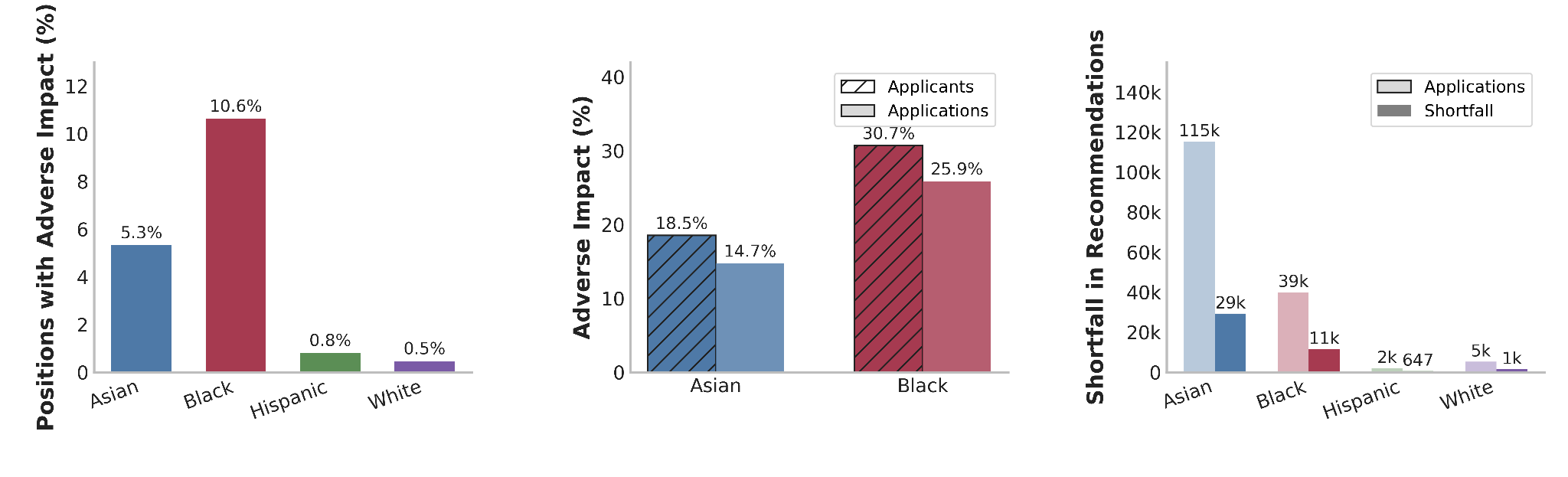
The hard boundary is unsupervised judgment on people, and the evidence for why is specific, peer-reviewed, and damning. When University of Washington researchers ran three language-model resume screeners across more than three million resume-to-job comparisons, varying only the names, the models preferred white-associated names 85% of the time and female-associated names just 11%, and in intersectional testing Black male names were disadvantaged in close to 100% of comparisons - University of Washington. Bloomberg found the same pattern running a mainstream model a thousand times on identical resumes: names associated with Asian women were ranked top candidate more than twice as often as names associated with Black men - Bloomberg. Feed a model raw, name-bearing resumes and ask it to rank, and it will reproduce the discrimination baked into the text.
Documented adverse impact in AI screening
The obvious response, "we keep a human in the loop," is where most teams fool themselves, because the same research shows the human loop is leaky. In a 2025 experiment with 528 reviewers, biased AI recommendations swung human resume choices to match the AI up to 90% of the time, and reviewers followed the tool even when they rated it as low quality or unimportant - University of Washington. This is automation bias, the documented tendency to over-trust a machine's recommendation, and a 2025 review of 35 studies concluded that AI assistance can "reduce scrutiny and create a misleading appearance of robust human oversight" - AI & Society. The EU AI Act names the exact failure mode in its human-oversight article: overseers must be able to resist "the tendency of automatically relying or over-relying on the output" and to "decide not to use" or "disregard" it - EU AI Act, Article 14. A human who only ever agrees with the model is not oversight.
For a clear-eyed account of how these tools fail real candidates, the investigative journalist Hilke Schellmann, author of the definitive critical book on algorithmic hiring, is worth the twenty minutes.
Is the algorithm hiring the wrong people?
Two further failure modes matter even for the advisory tasks Claude is good at. The first is that newer models are not automatically fair: a June 2026 audit of fourteen models found the direction of bias flips by model generation, with older models skewing one way and newer ones sometimes over-correcting the other way, which means you cannot assume your model is neutral and must test the specific one you use - arXiv. The second is inconsistency and hallucination on hard facts. An LLM score is not reproducible by default: research on using models as judges documents "stochastic self-inconsistency," where the same input yields different scores across runs - ACL Anthology, and an independent hands-on test of Claude for HR found it excellent for drafting but wrong on hard numbers, with 61% of its compensation figures off by more than 15% - AIHR. Treat any number Claude produces about a candidate or a market as a draft to verify, never a fact.
The most important mitigation is also the oldest, and it long predates AI: keep the demographic signal out of the input. The classic field experiment by Bertrand and Mullainathan found identical resumes with white-sounding names drew 50% more callbacks than those with Black-sounding names - Harvard Business Review, which is exactly the signal a language model latches onto, so stripping names, addresses, ages, and photos before Claude ever sees a resume removes the largest and most-litigated source of bias at the door. But blind screening is necessary, not sufficient, for two reasons. Bias reenters downstream in phone screens, interviews, and debriefs, so the gains evaporate unless the whole pipeline stays disciplined. And the model can still infer proxies, which is why Illinois law specifically bans using ZIP codes as a stand-in for protected class. Strip the obvious attributes, watch for the proxies, and keep testing the specific model on your own data.
The advisor frame also reshapes what you tell candidates and what you let them do, and here Anthropic's own funnel is a usable template. It discloses AI use and sets a clear candidate policy: applicants may use Claude to refine a first draft they wrote themselves, but not to complete take-home assessments or live interviews, on the principle "use AI to refine your ideas, not replace them" - Anthropic. Two things make this defensible rather than hypocritical. It is transparent, which is what candidate trust and most of the new laws require, and it is symmetric, holding the employer to the same augment-not-automate standard it asks of applicants. Publishing a short, honest AI policy for candidates, and telling them when AI touches their application, is low-cost and increasingly non-optional.
Testing the model on your own data is more concrete than it sounds, and it is the step most teams skip. The practical version is to run the same four-fifths screen on your AI-assisted outcomes that you would on any selection procedure: compare the shortlist rate for each protected group against the highest group's rate, and if any group falls below 80% you have a signal to investigate before, not after, someone complains. Pair that with a re-run check, scoring a sample of candidates twice and flagging large swings, and you catch both the systematic bias and the random inconsistency the research documents. This is not exotic data science, it is the ordinary discipline of validating a selection tool applied to a new kind of tool, and untested is precisely where the risk lives. The four-fifths screen is how you find a problem before a plaintiff does.
The rule that follows is simple and absolute. Never let a model rank raw resumes, infer demographics or proxies for them, issue a hire or reject, or "analyze" a one-way video for personality or fit. Keep protected attributes and their proxies out of every input, require the model to cite evidence for anything it says, test the specific model on your own data, and keep a human who genuinely can and sometimes does overrule it. Everything in the rest of this guide is built to make that discipline operational rather than aspirational.
4. The AI-Hiring Tool Landscape
The first real choice is not which vendor, it is which layer, because "AI in hiring" spans at least four distinct product categories a talent leader buys among. Getting the layer right per problem matters more than picking a logo, and the categories increasingly overlap as everyone bolts a language model onto their existing product. Understanding the map keeps you from paying enterprise prices for a task raw Claude does for cents, or from trusting a lightweight tool with a consequential decision it should never touch.
At the sourcing and talent-intelligence layer sit tools that search vast profile databases and rank for fit. SeekOut indexes over a billion public profiles and lists from $149 to roughly $1,999 per month - SelectSoftware Reviews, Juicebox's PeopleGPT searches 800 million profiles from $99 per seat with an autonomous agent add-on - Juicebox, Gem and hireEZ layer AI agents over the ATS, and Eightfold, valued around $2.1 billion, matches against 1.6 billion career profiles - Pin. Autonomous AI recruiters live here too, including HeroHunt.ai's agent Uwi, which searches roughly a billion profiles, screens with language models, and runs personalized outreach - HeroHunt.ai, and LinkedIn's own Hiring Assistant, whose pilot users reviewed 62% fewer profiles per role - Pin.
HeroHunt.ai
Sourcing is the one layer this guide tells you to buy rather than build, because a billion-profile index and its refresh pipeline is not a reasonable internal project. HeroHunt.ai is our own autonomous AI recruiter: its agent Uwi searches roughly a billion profiles across LinkedIn, GitHub and the open web, screens them with language models against your criteria, and drafts personalized outreach, which is the search-string and personalization work section 2 identifies as Claude's reliable zone, run end to end. The honest caveat is the same one this whole guide is built on: the fit score Uwi returns is an AI ranking, so it is an automated employment decision tool in the eyes of NYC Local Law 144 and the EU AI Act, and a qualified human still has to make the shortlist and reject calls. It is also a sourcing tool, not a system of record, so your ATS remains where the four-year California retention and bias-audit trail actually lives.
The conversational and interview layer covers high-volume screening and interview intelligence. Paradox's assistant Olivia became a Workday company in a roughly $1.1 billion acquisition that closed October 2025 - HireTruffle, HireVue runs enterprise video interviewing at an average contract near $49,855 a year - SelectSoftware Reviews, and interview-intelligence tools like Metaview (from $20 per user) - Metaview and BrightHire transcribe interviews and generate scorecards. A growing number of these expose Model Context Protocol servers, so you can query your pipeline directly from Claude, which is the practical bridge between a purpose-built tool and the raw model.
Above these layers sit fully autonomous recruiters and AI-training marketplaces whose own agents vet talent, and they are worth understanding mostly for the caution they teach. Marketplaces like Mercor, now valued around $10 billion, and Micro1, whose agent "Zara" interviews and scores expert applicants, screen candidates at scale with proprietary AI - TechCrunch, and Salesforce absorbed the AI-recruiting startup Moonhub to accelerate its agent strategy. The caution is that "agentic" is now a marketing label more than a capability: Gartner estimates only about 130 of the thousands of self-described agentic vendors are genuine, a phenomenon it calls "agent washing" - Gartner. The rare vendor that states its AI is periodically audited by independent AI, law, and policy experts, as one sourcing tool does - Covey, is signaling exactly the diligence the others gloss over. Buy the capability, not the adjective.
The ATS layer is where the affordable, Claude-connected option lives, and it is worth calling out because it is the cheapest way to give a whole team AI features without a five-figure contract. Ashby ships an MCP server and AI interview summaries, and Manatal, a low-cost AI-native ATS, adds AI candidate scoring, CV parsing, and an AI interviewer, plus an MCP server that connects your recruitment data to Claude, ChatGPT, and Gemini. For a small team that wants Claude reasoning over its own pipeline data without building an integration, that combination is hard to beat on price.
Manatal
If you want AI features and a Claude connection without an enterprise contract, Manatal is the affordable AI-native ATS: it publishes a real price, $15 per user per month billed annually, and ships an MCP server so Claude can reason over your live pipeline. Worth knowing before you commit: that $15 tier caps at 15 active jobs and 10,000 candidates, so a busy team is really on the $35 unlimited tier, and its AI candidate scoring is an automated employment decision tool, which means it is subject to bias-audit laws like NYC's and to the same rule this whole guide is built on: a qualified human, not the score, makes the call.
The connective tissue that makes "raw Claude over your own pipeline" practical is the Model Context Protocol, an open standard for wiring Claude into business systems that has spread quickly across HR tools - Anthropic. In plain terms, an MCP connection lets you ask Claude a question in natural language and have it pull the answer from your ATS or interview records without exporting spreadsheets or building a custom integration. Ashby, Metaview, and Manatal all expose MCP servers for exactly this, so a recruiter can ask "summarize every candidate for the staff-engineer role against our rubric and flag the two with the strongest ownership evidence" and get a grounded answer from live data. It is the difference between copy-pasting resumes into a chat window and having the model reason over the system of record, and it is what turns the advisor pattern from a manual habit into an integrated workflow.
The through-line across every layer is that the tool does not absolve you. Whether an AI recommendation comes from Claude directly, from Eightfold, or from your ATS's scoring, it is an automated employment decision tool in the eyes of the law and a source of automation bias in the eyes of the research. The vendor's marketing will call it "bias-free"; one platform in this space told a case study that AI has "no bias from past experiences" - Braintrust, a claim the University of Washington data directly contradicts. Buy for genuine time savings on drafting, structuring, and search, demand bias-audit documentation and human-override controls from any vendor, and keep the decision human regardless of which layer you standardized on.
5. The Legal Layer: What Actually Binds You
The compliance picture is fragmented, shifting, and genuinely consequential, so a talent leader needs the map even though it changes quarterly. The single most important development is that Anthropic's own Usage Policy now makes the safe posture mandatory for Claude users: hiring, resume screening, and employment determinations are high-risk uses requiring a qualified human reviewer before any decision is finalized and disclosure to candidates that AI is used - Anthropic. Comply with that and you are already most of the way to compliance with the laws below, because they demand the same two things: real human oversight and transparency.
The EU AI Act is the heaviest regime, and it recently moved. Annex III classifies AI used to recruit, filter applications, and evaluate candidates as high-risk, triggering risk management, bias testing, human oversight, transparency, and worker notice, with deployer fines up to EUR 15 million or 3% of global turnover - EU AI Act, Annex III. The critical update: the "Digital Omnibus" agreement pushed the high-risk employment obligations from August 2026 to 2 December 2027 - Gibson Dunn. That buys European employers time on the heavy obligations, but not a pass: the Act's AI-literacy duty on staff has applied since 2 February 2025 - EU AI Act, and GDPR already governs candidate data independently.
US federal enforcement is moving the opposite direction, which creates a trap for the unwary. The EEOC removed its 2023 AI hiring guidance in January 2025, and an April 2025 executive order directed agencies to deprioritize disparate-impact enforcement - K&L Gates. The trap is that none of this changed the underlying law: Title VII's disparate-impact standard and the four-fifths rule (a selection rate below 80% of the top group's rate signals adverse impact) remain fully in force under 29 CFR - Cornell LII, and private plaintiffs retain full standing. Deregulation of the agency is not deregulation of your liability.
The state patchwork is where the real 2026 obligations live, and it is filling the federal void fast. Four laws matter most, and they share a spine of notice, testing, and non-discrimination:
- NYC Local Law 144 requires an annual independent bias audit of any automated employment decision tool, public posting of results, and candidate notice, with penalties of $500 to $1,500 per day - NYC DCWP
- Illinois HB 3773 (effective 1 January 2026) bars AI that produces a discriminatory effect, requires notice when AI is used, and specifically bans using ZIP codes as a proxy for protected class - National Law Review
- California's FEHA regulations (effective 1 October 2025) make discriminatory automated-decision systems a FEHA violation and require four-year retention of the system's data and outputs - Paul Hastings
- Colorado's AI Act was repeatedly delayed and then scaled back to a disclosure-and-transparency framework, now slated for 1 January 2027 - Hunton
These laws are not symmetric, but they rhyme, and the pattern is the operating guidance: disclose AI use, keep records, test for adverse impact, and never let the tool make the call. The overlap is a gift, because a single defensible process satisfies most of them at once. It is also worth noting that NYC's own enforcement was found "ineffective" by a state audit in December 2025 - NY State Comptroller, which means the real exposure is not regulators knocking, it is private litigation, and that is escalating.
For teams that deploy AI hiring inside the EU, the high-risk regime is worth understanding even with the deadline pushed to 2027, because the obligations are substantive and take time to build. A deployer of a high-risk hiring system must run it under genuine human oversight, keep automatically generated logs for at least six months, inform workers' representatives and affected employees before deployment, and in many cases complete a fundamental-rights impact assessment - EU AI Act, Annex III. None of that is exotic if you already keep the audit trail and human-decision discipline this guide describes, and the deadline move simply buys European employers time to formalize what a defensible process does anyway. The strategic read is that the heavy obligations are coming, the light ones already apply, and building the muscle now is cheaper than scrambling in 2027.
Two more regimes complete the picture. GDPR Article 22 gives individuals the right not to be subject to a decision based solely on automated processing, and the EU court's SCHUFA ruling extended it to scoring that "substantially influences" a decision even when a human nominally signs off, so meaningful human involvement requires genuine authority to deviate from the AI - GDPR Info. And the ADA obligations flagged by the EEOC in 2022 still bite: AI assessments can unlawfully "screen out" people with disabilities, and you must offer accommodations and alternative formats - EEOC.
Underneath all of this sits a data-protection baseline that applies everywhere, not just in Europe. Candidate resumes and interview transcripts are personal data, so you need a lawful basis to process them, a retention limit, and a clear answer to the question every serious candidate and regulator now asks: is our data used to train someone else's model? Anthropic's answer for its own funnel is an explicit no on both counts, that it does not train Claude on candidate data or let Claude make the decision - Anthropic, and that is the posture to demand contractually from any vendor. Getting the data handling right is unglamorous, but it is the part of compliance that applies on day one regardless of which high-risk deadline moves next.
Title VII did not go away

Regulators and plaintiffs have already put teeth on all of this, and a few concrete cases make the exposure vivid. The EEOC's first AI-hiring settlement, against iTutorGroup for $365,000, involved software programmed to auto-reject women over 55 and men over 60, and it was exposed when a rejected applicant simply reapplied with a more recent birth date and got an interview - EEOC. The ACLU has filed complaints against the assessment vendor Aon for marketing tools as "bias-free," and against Intuit and its video-interview vendor over a deaf applicant denied human captioning and rejected with feedback to improve her "communication" - Public Justice. The pattern is instructive: the trouble comes from letting the tool make or heavily shape a consequential decision, and from marketing claims the vendor cannot back up. A process that keeps a human deciding and does not overclaim is far harder to attack.
If any single case explains why this section is not academic, it is Mobley v. Workday. In May 2025 a federal court conditionally certified a nationwide age-discrimination collective action over Workday's AI screening tools, and Workday represented that roughly 1.1 billion applications were rejected through its system in the relevant period, so the collective could reach hundreds of millions of people - Holland & Knight. The court also allowed a theory holding the AI vendor itself potentially liable. The precedent, still developing, is that "the algorithm did it" is not a defense, and that the exposure scales with the volume the tool touches. That, not any single statute, is the reason to keep AI advisory and the human accountable.
6. Building a Defensible Claude Hiring Workflow
A defensible workflow is one where the model structures evidence and a human makes every consequential call, and Anthropic's own prompting guidance maps almost perfectly onto good hiring practice. The core principle is to treat Claude "like a brilliant but new employee who lacks context," being fully explicit about criteria - Anthropic. In hiring terms, that means fixing the rubric before you see candidates, wrapping the job criteria, the rubric, and the candidate packet in clearly separated sections, and forcing the model to quote its evidence before it rates anything. Each of those steps has an independent basis in the selection-science literature and in the law, which is what makes the resulting process both better and more defensible.
The diagram below shows the boundary the workflow enforces: Claude drafts and structures throughout, and a human owns the two decision points that carry legal weight.
The single highest-leverage pattern is evidence-anchored scoring: require Claude to quote the exact supporting text before it assigns any rating, and to score a criterion as zero when no supporting quote exists. Anthropic explicitly recommends this "ground responses in quotes" technique for long-document tasks - Anthropic, and it does double duty in hiring: it improves reproducibility and it creates the audit trail that adverse-impact defense and laws like California's four-year retention rule demand. A score with a citation is reviewable; a bare number is not. The template below shows the shape of a defensible screening prompt.
<role>You help a hiring panel screen candidates. You do not decide.
You summarize evidence against fixed criteria and cite it.</role>

<job_criteria>
- Must-have: 3+ years production Python (rate 1-5)
- Must-have: owned an ML system end to end (rate 1-5)
- Nice-to-have: mentoring experience (rate 1-5)
</job_criteria>

<rubric>
5 = clear, specific evidence of independent ownership
3 = some evidence, scope unclear
1 = no evidence in the material provided
</rubric>

<candidate_packet>
[resume text with name, address, age, and photo removed]
</candidate_packet>

<instructions>
For each criterion, quote the exact supporting text first, then give a 1-5
score. If there is no supporting quote, score 1 and write "no evidence".
Do not infer demographics. Do not recommend hire or reject.
</instructions>
Three details in that template are load-bearing. The XML-style tags keep the model from confusing the rubric with the resume, a structure Anthropic recommends for exactly this kind of mixed-input prompt. The stripped protected attributes keep names, addresses, ages, and photos out of the input, which matters because the bias research shows the model reproduces name-based discrimination and because Illinois law bans even proxies like ZIP codes. And the explicit non-decision instruction keeps Claude on the advisory side of the line Anthropic's own policy draws. Add a few worked examples of what a 1, a 3, and a 5 look like for each criterion, since Anthropic notes that three to five examples are one of the most reliable ways to steer output, and you have converted a fuzzy judgment into a consistent, evidenced one.
The same structure applies to the front of the funnel, not just screening. To de-bias a job description, give Claude the draft plus an explicit instruction to flag masculine- and feminine-coded language and return two neutral variants, and it will surface the belonging-reducing phrasing that research links to a narrower applicant pool. To build an interview kit, feed it the job criteria and ask for competency-mapped questions with an anchored 1-to-5 scorecard. Two prompting details lift quality on both: put the long inputs at the top and the instruction at the very end, which Anthropic reports can improve response quality by up to 30% on multi-document tasks, and add a final self-check step asking the model to verify its output against the criteria before returning - Anthropic. Neither step turns Claude into a decider; both make its drafts sharper and more consistent for the human who uses them.
Two operational habits close the gap between a good prompt and a defensible process. First, manage inconsistency: because model scores vary across runs, run each candidate through the rubric more than once and treat a large swing as a signal to review manually rather than trusting a single pass, and keep the temperature low for scoring tasks. Second, calibrate against a gold standard: give Claude a handful of already-scored anchor candidates and confirm it reproduces the human scores before you trust it on new ones, the same way you would calibrate a new interviewer. Bundling the job description, rubric, and interview kit into a persistent workspace keeps scoring consistent across every candidate for the role, which is precisely the consistency that structured interviews derive their predictive power from.
One more habit turns this workflow from good practice into a defensible record: keep the trail. Every element the process already produces, the fixed rubric, the version of the job criteria, the model and settings used, and the evidence-cited score for each candidate, is exactly the documentation an adverse-impact defense or a bias audit needs, and laws like California's now require retaining automated-decision data for four years. Because the prompt forces Claude to quote its evidence, the artifact is self-documenting: anyone reviewing a decision can see which resume line drove which score. Storing those outputs alongside the human's final notes costs almost nothing and converts "we used AI to help screen" from a liability into a paper trail showing the AI informed a human judgment rather than made it. In a world where the leading case turns on the sheer volume of decisions a tool touched, being able to show a human owned each one is the strongest position available.
A small operational choice affects both cost and quality: which Claude tier to point at each step. Match the model to the difficulty. A fast, inexpensive tier is right for bulk mechanical work like parsing a resume PDF into structured fields, a mid tier handles the bulk of drafting and rubric scoring well, and the most capable tier is worth reserving for the judgment-heavy synthesis where a subtle read of the evidence matters, such as reconciling a split interview panel. Anthropic's own usage data supports the split, since the model is most reliable on short, well-scoped tasks and less so as tasks grow long and open-ended, so spending on the top tier is best concentrated where that reliability is scarcest. In practice this keeps per-candidate cost low without sacrificing quality on the calls that matter, and it is a cleaner lever than trying to squeeze everything through one setting. Prompt caching compounds the saving, because loading the same job description and rubric once and reusing them across a whole batch of candidates costs a fraction of re-sending that context with every request, which is exactly the repeated-context shape a hiring workflow produces.
The point of all this machinery is not to make Claude the decider by another name. It is to make the human decision better: faster to reach, anchored to job-related evidence, consistent across candidates, and documented well enough to defend. That is the difference between "we used AI to screen" as a liability and as an asset.
7. The Trust Gap and the AI-vs-AI Arms Race
Even a perfectly governed workflow runs into a market problem: candidates do not trust AI hiring, and both sides are now weaponizing it. The trust gap is stark. Seventy percent of hiring managers believe AI enables faster and better decisions, but only 8% of job seekers call AI hiring fair - Greenhouse, and just 26% of candidates trust AI to evaluate them fairly even though a majority assume it is screening them - Gartner. That gap is not a PR nuisance, it is a pipeline problem: nearly 38% of candidates have abandoned a hiring process that required an AI interview - Fortune. Push AI too far toward the candidate-facing decision and your best applicants walk.
The AI Hiring Trust Gap
The distrust is fueling an arms race that is degrading the funnel for everyone. Roughly 90% of employers now screen with AI while more than half of candidates apply with it, and generative tools have pushed LinkedIn to about 11,000 applications per minute, up 45% year over year, with the average opening drawing 242 applications - eWeek. Candidates are gaming the filters right back: 41% of job seekers admit using tricks like hidden text to beat AI screeners, and 91% of recruiters say they have caught candidate deception - Greenhouse. One career coach called it "an AI arms race that no one wins... mutually assured destruction" - Fortune. When both sides automate, signal collapses, and the pressure to verify a real human's real skills goes up, not down.
Employers are already countering, and the counter-measures reveal how far trust has eroded. A majority of companies now run software to detect AI use during interviews, and in-person interview requests at major recruitment firms surged roughly fivefold, from 5% of processes in 2024 to about 30% in 2025 - InCruiter, a striking reversal for an industry that spent a decade going remote. Candidate resistance is the mirror image: a 2026 survey found 66% of job seekers would not apply to an employer that uses AI to hire and 71% oppose letting AI make the final decision - HireVue. The signal for a talent leader is unambiguous. The market will tolerate AI that helps a human evaluate more candidates and communicate better; it recoils from AI that appears to judge and reject on its own. Keeping the decision visibly human is not only the legal and ethical posture, it is now a competitive advantage in attracting the candidates who have options.
The way out reinforces the advisor frame rather than contradicting it. The teams handling this best use AI to widen the top of the funnel and to structure evidence, then reintroduce genuine human contact and skills demonstration where trust is won or lost. Greenhouse's own people chief put it well: candidates "aren't walking away from AI, they're walking from bad experiences caused by bad AI... a feeling of being processed rather than considered" - Fortune. Disclosing AI use (which the law and Anthropic's policy already require), offering a human alternative, and moving evaluation toward demonstrated skills rather than resume parsing all rebuild the trust that indiscriminate automation burns. Skills-based approaches are rising for exactly this reason, with 70% of employers now using them - NACE, and one Claude-powered skills-simulation platform reports candidates evaluated on demonstrated skills convert to hires ten times better than resume screening - Anthropic / Skillfully.
8. What It Costs and What It Returns
The honest headline on ROI is "wide adoption, thin measured payoff," and a talent leader should budget and message around that reality rather than the vendor promise. Adoption is near-universal: 69% of recruiters use AI, up from 51% the year before - SHRM. But the business value lags badly. Gartner found 88% of HR leaders say their organization has not realized significant business value from AI tools - Gartner, and a widely cited MIT study found 95% of enterprise generative-AI pilots delivered no measurable profit-and-loss impact - MIT NANDA. The gap between adoption and value is the single most important planning fact in this space.
That gap is not really about model quality, it is about how the saved time is used and whether anyone measures it. SHRM found that while 89% of AI-using recruiters say it saves time, only 36% say it reduces cost - SHRM, and Gartner found only 7% of organizations even give guidance on how to use the time AI frees up, and only 8% of HR leaders think their managers can use AI effectively - Gartner. The lesson is that ROI is gated by change management and skill, not by the tool. The teams that win reinvest saved hours into higher-touch candidate relationships and structured evaluation, and they baseline time-to-hire, cost-per-hire, and quality-of-hire before and after so the value is legible.
Two structural facts explain most of the variance in who gets value. The first is size: AI adoption in HR runs about 60% at organizations over 5,000 employees versus roughly a third at small ones - SHRM, because scale creates both the volume that makes automation pay and the governance to do it safely. The second is buy-versus-build: the MIT study found that buying from specialized vendors succeeded about 67% of the time, roughly twice the rate of internal builds - MIT NANDA. For most talent teams the implication is to buy the parts that are genuinely hard, like the sourcing index and the audit tooling, and to use raw Claude for the reasoning you want to control directly, rather than attempting a bespoke platform the odds say will underdeliver.
The raw model economics, by contrast, are genuinely cheap, which is the strongest argument for starting with Claude directly rather than a five-figure platform. Claude comes in tiers you can match to the task: Haiku 4.5 at roughly $1 and $5 per million input and output tokens for cheap, high-volume parsing; Sonnet 5 at about $3 and $15 (with an introductory rate through August 2026) for the bulk of drafting and screening; and Opus 4.8 at $5 and $25 for the judgment-heavy synthesis where quality matters most - Anthropic. Two features make the per-candidate cost lower still. Prompt caching lets you load a job description, rubric, and interview guide once and reuse them across every candidate at roughly a tenth of the cost, which is exactly the repeated-context pattern hiring produces. And a large context window plus PDF vision means a single request can hold an entire hiring packet. In practice, screening a candidate against a rubric with Claude costs cents, and a documented deployment reported saving over $150,000 by moving screening onto Claude - Anthropic / Braintrust.
Measurement is where the ROI story is won or lost, and it is chronically weak. Nearly everyone says quality-of-hire matters, but only about 25% of talent professionals feel confident their organization can even measure it - LinkedIn, which means most AI-in-hiring "wins" are asserted rather than proven. The teams that break out of the adoption-without-value trap do two unglamorous things: they baseline the metrics that matter (time-to-hire, cost-per-hire, offer acceptance, and a real quality signal such as early-tenure performance) before turning AI on, and they explicitly redirect the freed-up recruiter time toward higher-touch work, since only 7% of organizations give any guidance on how to use the time AI saves. The encouraging data point is that AI-assisted messaging correlates with a 9% higher likelihood of a quality hire, so the value is there when the process captures it.
The synthesis for a budget conversation is this: the model is cheap, the time savings are real but modest, and the business value depends almost entirely on process and people. Do not buy AI hiring to cut headcount cost; buy it to make a fixed team faster and more consistent, measure quality-of-hire honestly, and expect the payoff to come from better decisions and reinvested recruiter time rather than a line-item saving. And note the encouraging counterpoint that outcomes track effort: an aggregation of over 150 bias audits found 85% of audited AI hiring systems met accepted fairness thresholds - Warden AI, which says the technology can be fair when teams actually test and govern it.
9. A Decision Framework: Raw Claude, a Tool, or an ATS
The build-versus-buy question resolves cleanly once you separate the workflow into the three things AI touches, because each has a different right answer. The mistake is treating "AI hiring" as one purchase. In reality you are making three decisions: how to source, how to structure and screen, and how to store and audit. Sizing each to the tool that fits keeps you from overpaying and from trusting the wrong layer with a consequential call.
For structuring and screening, raw Claude, through the app or the API, is usually the right starting point, and it is where this guide has focused. It is cheap, it is flexible enough to encode your exact rubric and evidence-citation rules, and it keeps you in direct control of the prompt and the human-review boundary. The tradeoff is that you own the workflow: there is no built-in audit dashboard, no candidate-notice flow, and no ATS integration unless you build one or connect via MCP. For a team comfortable writing a good prompt and keeping records, that tradeoff is worth it. For a team that wants the governance scaffolding out of the box, a purpose-built tool or an AI-native ATS with an MCP connector to Claude closes the gap.
There is a natural graduation point from raw Claude to a purpose-built tool, and knowing where it sits saves money in both directions. Below roughly a handful of open roles, a well-structured Claude workspace with a fixed rubric and a records habit is genuinely enough, and paying five figures for a platform is waste. The signals that you have outgrown it are operational, not conceptual: you are copy-pasting candidates by hand at a volume that invites errors, you cannot easily produce the bias-audit summary or candidate-notice trail a regulator or plaintiff would ask for, or you need several recruiters working the same pipeline with shared state. At that point an AI-native ATS or a dedicated tool with an MCP connection to Claude buys you the governance scaffolding and the shared workflow without giving up reasoning quality. The decision is not raw Claude versus a tool forever; it is raw Claude until the record-keeping and collaboration burden justifies the platform.
For sourcing, buy, because reproducing a billion-profile index and its refresh pipeline is not a reasonable build. This is where dedicated tools and autonomous AI recruiters earn their price, and where the "screen but do not decide" rule still applies to whatever ranking they produce. For storage and audit, the ATS is the system of record and the place your four-year California retention and bias-audit obligations live, so an AI-native ATS that also connects to Claude gives you one system for records and reasoning. The vendor due-diligence checklist is short and non-negotiable regardless of layer:
- Bias-audit documentation you can actually obtain and post, not a "bias-free" marketing claim
- Human-override controls and a real alternative process for candidates who request one
- Data-protection posture (SOC 2, GDPR, and a clear stance that your candidate data is not used to train someone else's model)
- Transparency support so you can disclose AI use to candidates as the law and Anthropic's policy require
The checklist is only as good as the contract behind it, so a few clauses deserve a hard look before you sign. Pin down in writing that the vendor does not use your candidate data to train its or anyone else's model, that data is retained and deleted on terms you control, and where it is stored. Ask for the bias-audit results as a deliverable, not a promise, and confirm you can obtain the underlying documentation a regulator or plaintiff might demand. Clarify who is liable if the tool produces a discriminatory outcome, because the Workday case shows a vendor can be pulled in but does not show the employer gets off. And confirm the human-override and candidate-alternative flows are real product features, not marketing language. A vendor that answers these cleanly is signaling the maturity you want; one that deflects is telling you where the risk will land.
Run that checklist against every vendor and every layer, and the framework becomes a single sentence: buy the index, own the judgment, keep the records, and hold a human accountable for the decision. Anthropic's own funnel is the reference implementation, using Claude across sourcing, drafting, and analysis while explicitly never letting it decide - Anthropic, and reporting an 88% offer-acceptance rate for technical roles, which is the outcome the discipline is meant to protect.
10. The 2027 Outlook: Agentic and Reasoning-Based Hiring
The near-term trajectory is unmistakable: AI is moving from a recruiter's assistant to an autonomous, multi-agent layer that sources, screens, and interviews, and a talent leader should plan for it without being swept up in it. Gartner expects task-specific agents in 40% of enterprise applications by the end of 2026, up from under 5% a year earlier, and predicts most talent-acquisition teams will use agents for proactive sourcing by 2027 - Gartner. Analyst Josh Bersin frames the shift as the largest HR transformation in decades, projecting AI "superagents" that automate 30 to 40% of existing HR roles by 2030 - Josh Bersin. The direction is real, and the tooling is arriving fast.
The most important underlying change for how AI informs decisions is the shift from keyword matching to reasoning-based matching. A legacy system asks whether a resume contains the word "Python"; a 2026 model asks whether the candidate demonstrably has the underlying competency, and most enterprise platforms now run hybrid search that pairs keyword filters for hard requirements with semantic understanding for narrative fit - Aqore. This is genuinely better at surfacing non-obvious candidates, and it is exactly the kind of judgment task where the bias and consistency cautions from earlier sections apply most sharply, because "reasoning about fit" is one keystroke away from "reasoning about people."
The most durable of these shifts is skills-based hiring, and it is where AI's matching power and the fairness imperative actually align. Employer use of skills-based hiring reached 70% in 2026, GPA screening fell from 73% in 2019 to 42%, and the companies doing the most skills-based searching are 12% more likely to make a quality hire - NACE. Evaluating demonstrated skills rather than resume claims sidesteps much of the name-based bias documented earlier and is exactly the kind of structured, evidence-based judgment Claude supports well. On the agent side, the concrete gains are real where they are well-scoped: LinkedIn's Hiring Assistant helped one large employer cut time-to-hire by 30 days, and one analyst blueprint maps 24 distinct agent workflows across talent acquisition - Josh Bersin. The winning pattern for 2027 is to let agents handle the high-volume, low-judgment steps and to concentrate scarce human attention on the consequential calls, which is the advisor frame extended to a multi-agent world.
Two cautions temper the agentic hype and belong in any 2027 plan. First, the backlash is regulatory and human at once: candidates are revolting against impersonal AI interviewers, and Gartner predicts more than 40% of agentic AI projects will be canceled by the end of 2027 over cost, unclear value, and inadequate controls, while warning that only a fraction of self-described "agentic" vendors are real - Gartner. Second, the management gap is wide: 84% of talent leaders plan to use AI in 2026 and 52% plan to add autonomous agents, but only 22% believe leaders can effectively manage hybrid human-AI teams - Korn Ferry. Buying agents is easy; governing them is the hard part that determines whether they survive contact with reality.
The regulatory trajectory is itself a planning input, and it points one direction: more disclosure, more testing, and more human-review requirements, not less. The EU's high-risk obligations land in 2027, more US states add notice-and-testing rules each session, and Gartner even projects that by 2027 three-quarters of hiring processes will include some test of a candidate's own AI proficiency - Gartner via VARINDIA, a sign of how thoroughly AI is reshaping both sides of the table. A team that builds the advisor discipline now, meaning disclosure, evidence-anchored scoring, adverse-impact testing, and audit-ready records, is not just compliant with today's patchwork, it is positioned for whatever the patchwork hardens into. The organizations that will struggle are the ones treating each new law as a fire drill rather than as instances of the same durable principle.
For a practitioner overview of where these talent-acquisition trends are actually landing day to day, this 2026 roundtable is a useful, plain-English companion to the analyst reports.
Top talent-acquisition trends for 2026
What to build for 2027 follows from all of this and is reassuringly continuous with the advisor frame. Adopt reasoning-based, skills-first AI for sourcing and structuring; keep a mandatory human on every consequential decision; make AI-use disclosure and bias testing standard; keep audit-ready records; and invest in the recruiter upskilling that the ROI data says is the binding constraint. The teams that thrive will not be the ones that automate the most, they will be the ones that automate the drafting and keep the deciding human, because that is what the law requires, what candidates will tolerate, and what the evidence says actually works.
11. Conclusion: How to Use Claude as a Hiring Advisor
The single idea to carry out of this guide is that Claude belongs on one side of a bright line and a trained human belongs on the other. Claude drafts the job description, structures the interview, summarizes the evidence, and synthesizes the notes; the human weighs that evidence and makes the call. This is not a compromise between capability and caution, it is the configuration that both the research and the law say produces better, more defensible hiring, and it is the one Anthropic's own Usage Policy requires of anyone using Claude for employment decisions.
The operating playbook is a short sequence, and taking it in order keeps every downstream step clean. First, keep AI advisory: use it for drafting, structuring, search, and synthesis, never for ranking raw resumes, inferring demographics, or issuing a hire or reject. Second, engineer the workflow for defensibility: fix a job-related rubric before you see candidates, strip protected attributes and proxies from every input, and require the model to cite evidence for every rating. Third, govern for the law you actually face: disclose AI use, keep records, test the specific model on your own data for adverse impact, and offer candidates a human alternative. Fourth, measure honestly: baseline time-to-hire, cost-per-hire, and quality-of-hire, and expect the payoff to come from better decisions and reinvested recruiter time rather than headcount savings.
The tools sit at every layer of this and are worth assembling deliberately: raw Claude for the reasoning and structuring you want to control directly, an AI-native ATS such as Manatal or an autonomous AI recruiter such as HeroHunt.ai's Uwi for the sourcing and record-keeping you would rather buy than build, and a bias-audit and disclosure process wrapped around all of it. Use AI to make a fixed team faster and more consistent, keep a real human accountable for every decision that changes someone's livelihood, and you will get the upside that 88% of leaders are still chasing while avoiding the litigation that the ones who skipped the human are now discovering. That is what it means to use Claude as a hiring advisor: let it inform the decision, and keep the decision yours.
This guide reflects the AI-in-hiring landscape as of July 2026. Models, prices, and especially regulations in this field change quickly (the EU AI Act's high-risk employment deadline moved to December 2027 while this was being written), so verify current details before acting on them.