



The insider guide to how AI labs and data vendors recruit, vet, and pay the human experts who now train frontier models.
Every major frontier lab spends roughly $1 billion a year on human-generated training data - TIME via micro1. That single number explains why data annotation, once treated as a low-status back-office chore, has become one of the most contested recruiting battlegrounds in technology. The job has not just grown. It has split in two. The cheap end, where crowd workers drew bounding boxes for a few dollars an hour, still exists. But the part that frontier labs actually fight over now looks nothing like it: physicians, litigators, quant traders, and machine learning PhDs writing reasoning chains and grading model outputs for $85 to $200 an hour and up.
The shift happened fast, and it happened in public. In June 2025, Meta paid $14.3 billion for a 49% stake in Scale AI, the company that defined industrial data labeling, and pulled its founder into a new superintelligence team - CNBC. Within weeks, rival labs fled, capital poured into a new tier of "expert data" marketplaces, and a startup founded by three college dropouts crossed a $10 billion valuation by recruiting doctors and lawyers to teach AI. For anyone who hires people, this is the clearest signal yet that the scarce input in artificial intelligence is no longer just compute or model architecture. It is verified human judgment, sourced and screened at scale.
This guide is the deep, practical version of that story. It covers why labs stopped buying cheap labels, who the major vendors and marketplaces are, what every annotation role pays, where to find expert annotators, how the best teams vet and retain them, which software and platforms to use, the real economics, the quality and fraud crisis, the labor ethics and law, and where AI agents are taking all of this next. The audience is recruiters, talent leaders, and data-operations managers who need to actually staff this work, not just read headlines about it.
Written by Yuma Heymans (@yumahey), who built HeroHunt.ai and its autonomous AI Recruiter to source niche talent from over a billion online profiles. He has spent years on exactly the problem this guide describes: finding and engaging scarce specialists at scale.
Contents
- From Cheap Labels to Frontier Data: The 2026 Shift
- Why Labs Recruit Experts Now: The Data Wall and RLHF
- The Players: Vendors and Expert-Data Marketplaces
- What a "Data Annotator" Is Now: Roles and the Pay Ladder
- Where the Experts Are: Sourcing Channels That Work
- The Recruiting Playbook: Vetting, Assessment, and Retention
- The Toolstack: Sourcing Software and Annotation Platforms
- The Economics: Vendor Margins, Lab Budgets, and Contractor Pay
- Quality Control and the Contamination Crisis
- The Ethics and Law of Annotation Labor
- The Future: Synthetic Data, Verifiers, and Agentic Recruiting
- Building Your Annotator Recruiting Pipeline
1. From Cheap Labels to Frontier Data: The 2026 Shift
The single most important thing to understand about data-annotator recruiting in 2026 is that the market has bifurcated into two completely different labor economies. One is the legacy crowd-labeling tier, where workers in the Global South still tag images and moderate content for $1 to $5 an hour. The other is the frontier-data tier, where credentialed professionals author the reasoning, preferences, and evaluations that post-train large models, and where pay routinely clears $100 an hour. These two tiers are recruited, vetted, paid, and managed in almost opposite ways, and confusing them is the most common mistake hiring teams make when they enter this space.
The frontier tier is the one driving the money and the headlines, and it exists because of a simple change in how models are built. Pre-training on scraped web text plateaued, and the gains now come from post-training: supervised fine-tuning, reinforcement learning from human feedback, expert evaluations, and red-teaming. All of those depend on humans who can produce or judge outputs that the model itself cannot yet produce reliably. You cannot crowdsource a correct cardiology diagnosis or a valid legal argument from a worker paid two dollars an hour. So labs went looking for the actual experts, and a whole industry reorganized to recruit them.
The growth underneath this is real and measurable. The global data-collection-and-labeling market was worth $3.77 billion in 2024 and is forecast to reach $17.1 billion by 2030, a compound annual growth rate near 28% - Grand View Research. The generative-AI slice specifically is projected to grow from roughly $2.95 billion in 2025 to nearly $29.75 billion by 2035, with large language model providers now the dominant buyers - Precedence Research. The trajectory is steep enough that the market roughly doubles every two to three years.
Global Data Collection and Labeling Market
That chart understates the strategic weight of the category, because the dollars are small relative to compute budgets but decisive for model quality. A lab can spend hundreds of millions on GPUs and still ship a mediocre model if its post-training data is weak. That asymmetry is why human data has moved from procurement to strategy, and why the people who source annotators now sit closer to research leadership than to facilities. The recruiting challenge that follows is unusual: you are not filling seats, you are assembling a distributed, on-demand bench of verified specialists who mostly have lucrative day jobs and treat this as premium side work.
The scale of the bet becomes clearer in the tooling market that has grown up around it. The data-annotation tools segment alone is worth about $3.07 billion in 2026 and is projected to compound at roughly 32% a year toward $12 billion and beyond by 2031, a pace that reflects how much spend now flows into human-in-the-loop data for post-training - Mordor Intelligence. For recruiters, the relevance of these forecasts is not the precise dollar figure but the slope. A category growing this fast and this consistently signals durable, escalating demand for the people who produce the data, which makes annotation sourcing a capability worth building rather than a temporary surge to staff through. It also explains why so much venture capital has rushed to fund the companies that recruit these workers, a dynamic covered in detail later in this guide.
To ground the macro picture before going deep, it helps to hear how the broader market frames the human workforce behind the AI boom. The Bloomberg segment below covers the infrastructure and people powering current AI investment, and it is a useful non-technical overview for talent leaders trying to understand where annotation fits in the larger build-out.
Powering the AI Boom (Bloomberg Technology, January 2026)
As the segment makes clear, the constraint in AI has quietly migrated from raw model scale toward the quality of the inputs feeding it. For recruiters, the practical translation is that demand for human data labor is not a temporary spike tied to one product cycle. It is a structural feature of how frontier models will be improved for the foreseeable future, which means building real competence in sourcing and vetting annotators is a durable investment rather than a one-off project.
2. Why Labs Recruit Experts Now: The Data Wall and RLHF
Labs recruit experts now because they are running out of the cheap alternative, and the technical name for that ceiling is the data wall. Researchers at Epoch AI estimate the effective stock of quality, repetition-adjusted human text on the public web at roughly 300 trillion tokens, and project with about 80% confidence that models will fully exhaust this stock somewhere between 2026 and 2032 - Epoch AI. Some forecasts are even tighter: open-web scraping could hit its useful limit as early as 2026, with under 5% of remaining content meeting the quality and licensing bar for frontier training - PBS NewsHour. When you cannot scrape more, you commission it, and commissioning means hiring people.
The second driver is the rise of reasoning models and a training method called reinforcement learning from verifiable rewards, or RLVR. Instead of rewarding a model on a human's subjective preference, RLVR rewards it against an objective, checkable ground truth: a unit test that passes, a math answer that matches, a proof that holds. This approach pushed models like DeepSeek R1 to expert-level reasoning and has become a dominant post-training paradigm - Emergent Mind. The catch for recruiters is that someone has to author those verifiable problems and their correct solutions, and in domains like advanced mathematics, competitive programming, law, and medicine, only qualified humans can do it.
The deeper consequence of RLVR is that it shifts the unit of expert work from a single label to an entire verification environment. To train a model on a coding task, an expert does not just mark one answer right or wrong, they build the test harness, the edge cases, and the grading logic that let the model practice the task thousands of times automatically. These reusable setups, sometimes called RL environments or gyms, are far more valuable and far harder to produce than a one-off label, and they require people who can think like both a domain expert and a test designer - Labelbox. For recruiters, this raises the credential bar again, because the most sought-after annotators in 2026 are not labelers at all but builders of the systems that generate and check the training signal. It also means a single great hire can be worth a hundred mediocre ones, since one well-designed environment produces effectively unlimited practice data.
Both forces point in the same direction: away from volume and toward credentials. The work that remains valuable is precisely the work that a cheap crowd cannot fake, which is why vendors now compete on the density of advanced degrees in their workforce rather than on headcount. One AI-tutor marketplace, Mindrift, reports that 70% of its roughly 10,000 contributors hold a master's or doctoral degree, paying them between $20 and $55 an hour depending on specialization. That is a profile that looks more like a professional services bench than a gig pool, and recruiting against it requires professional-services sourcing methods.
It is worth being precise about what "expert data" actually means, because the term gets thrown around loosely. In practice it covers several distinct outputs that experts produce or judge for a lab. The most common categories include the following, and each maps to a different kind of specialist you would need to recruit.
- Reasoning traces - step-by-step solutions in math, code, science, and logic
- Preference judgments - ranking which of two model answers is better and why
- Domain evaluations - structured tests that measure model skill in a field
- Red-team probes - adversarial prompts that expose unsafe or wrong behavior
- Rubric authoring - the grading criteria that scale judgment across a dataset
Each of those line items implies a different hire. Reasoning traces in oncology need a physician; preference judgments on legal drafting need a lawyer; red-teaming a bio-risk model needs someone who genuinely understands the science. The recruiting takeaway is that "data annotator" is no longer a single requisition. It is a portfolio of micro-specialties, and the teams that win treat each one as its own talent search with its own credential bar, its own assessment, and its own pay band. The rest of this guide is essentially a manual for running those searches well.
3. The Players: Vendors and Expert-Data Marketplaces
The fastest way to understand the recruiting landscape is to study the companies that already do it at scale, because most organizations will buy expert data through a vendor before they ever build an in-house bench. The market splits into three rough groups: the incumbent that got disrupted, the premium challengers that took its customers, and the marketplaces that turned recruiting itself into the product. Knowing who does what, and how each one sources talent, tells you which model to copy and which vendor to hire.
Scale AI is the incumbent, and its story is a cautionary tale about customer concentration. After Meta's $14.3 billion investment for roughly 49% of the company in June 2025, Scale's biggest customers left almost immediately. Google, reportedly its largest client at around $200 million a year, walked away, and OpenAI, Microsoft, and xAI pulled back, all unwilling to route sensitive roadmap data through a vendor now partly owned by a competitor - CNBC. A month later Scale laid off about 200 employees, 14% of staff, and cut ties with 500 contractors, with its interim chief executive admitting the company had scaled its generative-AI capacity too quickly - TechCrunch. Scale still runs the Outlier gig platform that absorbed Remotasks, but its near-monopoly is gone.
The premium challenger that benefited most is Surge AI, founded by MIT dropout Edwin Chen and bootstrapped without venture capital. Surge quietly passed $1.2 billion in revenue in 2024, overtaking Scale's reported $870 million, by selling smaller teams of higher-paid experts to roughly a dozen frontier labs including OpenAI, Anthropic, and Google - Sacra. In July 2025 it opened its first ever capital raise, seeking up to $1 billion at a valuation above $15 billion, with later reporting putting talks as high as $25 billion - Bloomberg. Surge coordinates a global pool of around 50,000 expert contractors with only about 130 full-time staff, an efficiency ratio that defines the new model.
Surge's relationships with labs are concrete and public, which makes it a useful reference for what "good" expert data looks like in practice. The company has documented work building well-known datasets and partnering directly with frontier labs, as the example below from its own materials shows.

The third and most important group for recruiters is the expert-data marketplaces, which sell sourcing and vetting as the core product rather than just labeled data. Mercor is the breakout. Founded in 2023 by three then 22-year-old Thiel fellows, it raised a $350 million Series C at a $10 billion valuation in October 2025, quintupling its February valuation in eight months - TechCrunch. Mercor connects more than 30,000 vetted experts (doctors, lawyers, ex-bankers, consultants, scientists) to labs like OpenAI and Anthropic, pays them an average above $85 an hour, and distributes over $1.5 million a day to contractors - CNBC. Its revenue run rate went from about $1 million to roughly $500 million in 17 months.
A second marketplace worth studying closely is Handshake AI, because it shows the power of owning a network. The former college job board launched its AI arm in early 2025 and activated a pre-existing campus database of 18 million users, including more than 500,000 PhDs, reaching roughly a $150 million run rate within months as demand tripled after the Meta-Scale deal - TechBuzz. Other credible names round out the field: micro1 scaled from $7 million to over $200 million in annualized revenue in about a year and runs a top-1%-acceptance marketplace of PhDs and senior engineers - Sacra. Snorkel AI raised a $100 million Series D at a $1.3 billion valuation and sells Expert Data-as-a-Service - BusinessWire. Turing raised $111 million at a $2.2 billion valuation on the strength of a four-million-developer network supplying coding data - TechCrunch.
Two more names matter for different reasons. Invisible Technologies pioneered RLHF-as-a-service with OpenAI back in 2022 and claims to have trained foundation models for more than 80% of leading AI providers, raising $100 million at a valuation above $2 billion on roughly $134 million of 2024 revenue - SiliconANGLE. Prolific, built originally to recruit academic research participants, has reinvented itself as an evaluation specialist, running hundreds of thousands of studies a year and launching a human-centered model-evaluation leaderboard staffed by thousands of vetted evaluators. The breadth of credible vendors is itself a recruiting insight, because there is no single right partner.
Underneath these marketplaces sits a consumer-facing gig layer that does the high-volume recruiting, and it is worth knowing by name because it is where most annotators actually enter the industry. Scale's Outlier and Surge's DataAnnotation.tech run paid acquisition across Reddit, TikTok, and Indeed to pull in generalist AI trainers at roughly $15 to $45 an hour, while Labelbox's Alignerr and the AI-tutor platform Mindrift target more credentialed contributors at higher rates - Breaking Even. These platforms are essentially self-serve recruiting funnels with assessments bolted on, and they expose the industry's two-speed structure: a broad, advertising-driven intake for commodity work, and a narrow, referral-and-network-driven intake for the experts who command premium rates. Knowing which funnel a given vendor leans on tells you a great deal about the quality of data you can expect to get from it. The best choice depends on whether you need high-volume labeling, premium RLHF, coding data, scientific expertise, or structured evaluation, and many large buyers deliberately split work across several vendors to avoid the concentration risk that burned Scale's customers.
The legacy crowd vendors have not disappeared, but their decline is instructive about where value moved. Appen, once a dominant crowd-labeler that depended on Alphabet for roughly a third of revenue, lost its Google contract worth about $82.8 million a year and saw revenue fall 14% in fiscal 2024 - Staffing Industry Analysts. Meanwhile Labelbox runs the Alignerr expert network paying credentialed specialists $90 to $200 an hour, Prolific delivered 380,000 research studies with a participant pool topping 200,000, and Toloka took a $72 million strategic investment led by Jeff Bezos's Bezos Expeditions - PYMNTS. The pattern across all of them is identical: every survivor is moving up-market from volume labeling toward credentialed expertise, because that is where labs now spend.
For companies that are not frontier labs, the realistic question is how to compete for this talent at all, and the answer is usually not to outbid Surge or Mercor on rate. Enterprises and startups win expert annotators the same way they win any scarce specialist: with narrower and more interesting problems, faster feedback loops, genuine ownership, and flexibility that a marketplace gig cannot match. A domain expert who finds a specific medical or legal AI problem meaningful will often choose it over a higher-paying but generic labeling queue, which means smaller players should compete on mission and problem quality rather than price. This is also where buying through a marketplace first pays off, because it lets a smaller team access vetted experts on demand without trying to out-recruit billion-dollar vendors, then graduate to direct sourcing only for the niches where it has a genuine network advantage.
4. What a "Data Annotator" Is Now: Roles and the Pay Ladder
If you take one practical lesson from this guide into your next requisition, make it this: there is no single "data annotator" role or rate anymore, and treating the work as one job will either overpay for commodity tasks or fail entirely to attract experts. The pay ladder now spans two full orders of magnitude, from about $2 an hour for crowd labeling in the Global South to as much as $1,000 an hour for the rarest specialists - Pin. Where a given hire lands on that ladder depends almost entirely on credential scarcity and how hard the output is to fake, not on hours or effort.
At the bottom sits commodity crowd work, which is still real and still large but no longer where frontier labs compete. Workers in Venezuela earn roughly $0.90 to $2 an hour doing the same labeling that pays $10 to $25 an hour in the United States, and labs historically concentrated this tier in the Philippines, Kenya, and India to cut costs - The Conversation. The global pool that underpins it is enormous: the World Bank estimated 154 million to 435 million online gig workers worldwide, a category that grew nearly tenfold in under a decade - World Bank. This tier is recruited through paid acquisition and self-serve signup, not through targeted sourcing.
The middle of the ladder is the US gig "AI trainer," a generalist who reviews and writes for $15 to $50 an hour on platforms like Outlier and DataAnnotation.tech. Above them sit the credentialed specialists who define the frontier tier, and their rates are striking. The list below shows representative 2025 to 2026 pay for the expert tier, drawn from platform disclosures and reporting, and it is the clearest illustration of how much credential scarcity is now worth.
- Software and STEM experts - roughly $40 to $80 an hour for coding and review
- Lawyers - about $110 to $130 an hour at Mercor for legal evaluation
- Physicians - around $130 to $170 an hour judging clinical outputs
- Medical fellows at Surge - $250 to $450 an hour for specialized work
- VC partners and startup CEOs - $500 to $1,000 an hour at the very top
Those numbers come from platform data and reporting on Surge and Mercor, where Surge alone has contracted more than 20,000 professionals holding doctoral degrees - Built In. Within this tier, the nature of the task also shifts the rate: safety red-teaming tends to pay a premium over routine preference ranking, with one platform listing red-team work near $80 an hour against roughly $45 for RLHF ranking - Second Talent. The implication for recruiters is that you must price the credential and the risk of the task together, not just the hour.
The 2026 Annotation Pay Ladder
The people filling the top of that chart do not look like traditional gig workers, and the visual identity of the work has changed with it. Marketplaces now profile their contributors the way consulting firms profile partners, foregrounding scientists and licensed professionals rather than anonymous crowds. The portrait below, from Mercor's own site, is representative of how the expert tier is presented and recruited.

It is also worth noting that demand for this work is now visible in mainstream labor data, not just vendor marketing. LinkedIn ranked Data Annotator the fourth fastest-growing US job for 2026, and unusually for an AI role it is 62% female, with top hiring in Austin, New York, and San Francisco and a median of just 3.5 years of prior experience - LinkedIn. That statistic captures the full breadth of the ladder, from entry-level reviewers to PhD verifiers, and it confirms that annotation has become a genuine career category rather than a temporary gig. For anyone planning headcount, the safe assumption is sustained, broad-based demand with a sharply rising premium at the credentialed end.
It also helps to distinguish the employment shapes this work now takes, because they recruit very differently. At the top, some marketplaces convert their best contributors into effectively full-time roles, with Mercor listing full-time AI tutor positions paying $90,000 to $200,000 a year filled by contractors who average several years of professional experience - Built In. In the middle sit part-time moonlighters who annotate a few hours a week around a primary career, and at the base sit high-volume gig workers who treat it as flexible income. Each shape needs a different pitch. Full-time roles compete on salary and mission, moonlighting roles compete on flexibility and intellectual interest, and gig roles compete on access and prompt payment. A common and costly mistake is to advertise one shape while actually offering another, which is why annotator job posts that promise stable income but deliver sporadic, unpredictable task flow churn through applicants so quickly.
5. Where the Experts Are: Sourcing Channels That Work
The hardest part of expert-annotator recruiting is not assessment or pay, it is finding qualified people who already have full-time jobs and were not looking for side work. The marketplaces that win have effectively solved this with three sourcing channels that any team can adapt: owned networks, referrals, and AI-driven outbound. Understanding why each works, and in what order to deploy them, is the difference between a bench that fills in weeks and a pipeline that stalls.
The most powerful channel by far is an owned, pre-credentialed network, because it collapses customer acquisition cost to nearly zero. Handshake AI is the clearest example: while a competitor like Scale had to spend heavily on advertising to recruit a single physics PhD, Handshake could activate that same person with a push notification because it already held verified records on 18 million students and alumni - Sacra. Most companies do not own a campus database, but the principle generalizes. A professional association, an alumni list, a conference attendee roster, or an existing user base of domain professionals is a sourcing asset, and the recruiting advantage of having credentials already verified is enormous.
The second channel is referrals, which for expert work convert better than any cold outreach because experts trust other experts. At Mercor, reportedly more than 60% of expert hires came through referrals, achieved with minimal advertising spend, and the company pays $250 to $15,000 per successful hire plus a percentage of the referred person's future earnings - Mercor. The lesson for recruiters is to treat referral design as a core sourcing strategy rather than an afterthought, with bounties large enough to motivate busy professionals and structured to reward quality of placement, not just volume of names.
The third channel is AI-driven outbound at machine scale, which has matured from novelty to standard practice. Micro1's AI recruiter agent, named Zara, interviews and vets applicants and can screen up to 250,000 candidates a month, and the company has recruited thousands of experts including Stanford and Harvard professors this way - TechCrunch. This is the channel where general-purpose recruiting technology meets annotation, because the same autonomous sourcing tools used to fill engineering roles work to find moonlighting specialists. The Mercor founder explains the marketplace logic behind this model in the talk below, which is a useful primer on how expert sourcing actually functions.
Mercor CEO Brendan Foody on the new future of work (TechCrunch Disrupt 2025)
What the founder describes in that talk is essentially recruiting reimagined as a data problem. Instead of a recruiter reading each resume by hand, an AI system interviews and scores candidates at a scale no human team could match, then routes each person to the specific lab project where their expertise fits. The reason this works for annotation in particular is that the supply is enormous but hidden, because the ideal annotator is a working professional who never applied to a job board and would never describe themselves as looking for annotation work. Reaching them requires going out to find them and making a compelling, personalized case, which is precisely what autonomous sourcing does well and what passive job-posting does not.
Beyond these three primary channels, there are specialized talent pools that map naturally to specific annotation needs, and knowing where they congregate is half the battle. The most productive hunting grounds for technical and scientific annotators include the communities where these professionals already publish and compete.
- GitHub and open-source projects - for senior software and infrastructure experts
- Academic networks and PhD programs - for scientists and quantitative specialists
- Professional licensing bodies - for verified doctors, lawyers, and accountants
- Competitive programming and Kaggle - for elite coders and data scientists
- Subject-matter conferences - for niche domain authorities in a given field
The reason this matters operationally is that each pool requires different messaging and different proof of credibility. A litigator will not respond to the same outreach as a Kaggle grandmaster, and the conversion rate depends heavily on how well you frame the work: flexible, intellectually interesting, and paying at or above their professional rate. Surge built a billion-dollar business partly by pitching exactly that to university departments and expert communities rather than running generic job ads, which is the single most replicable insight in expert sourcing. Source where the credential lives, speak the language of that field, and lead with the intellectual challenge and the pay, in that order.
The clearest proof that targeted sourcing beats broad advertising is Surge AI, which bootstrapped to its scale largely by recruiting directly from university departments, professional associations, and expert communities rather than running generic ads. Its pitch to a busy professional was simple and effective: flexible, intellectually stimulating work, often paying more per hour than their full-time salary. That framing matters because the binding constraint in expert annotation is not awareness but motivation, since the people you want are not unemployed and not searching. Winning them is a persuasion problem as much as a discovery problem, and the message that converts is autonomy, interesting problems, and pay that respects their expertise. The corollary is that generic recruiting copy fails badly here, because a cardiologist or a senior engineer can smell a low-effort mass message instantly and will not trade their scarce free time for it.
6. The Recruiting Playbook: Vetting, Assessment, and Retention
Once you have sourced candidates, the make-or-break stage is vetting, because the entire value proposition of expert data collapses if the "expert" is not real or not good. The dominant approach in 2026 is what could be called the Mercor model: a short, AI-led screening interview combined with automated analysis of a candidate's resume, portfolio, and code history. Mercor vets candidates with a single roughly 20-minute AI video interview whose transcript an LLM scores for clarity, technical reasoning, and the ability to weigh tradeoffs, which lets it evaluate hundreds of thousands of applicants across industries in parallel - Mercor. This is how a small company screens at a scale that would otherwise require a recruiting army.
That first-pass screen is necessary but not sufficient, because anyone can talk a good game for 20 minutes. The serious vetting happens through proctored skills assessments tied to the specific domain, where applicants are accepted only if their answers match expert consensus, and through gold-standard items with known answers secretly mixed into real work to catch drift over time. Selectivity at the top vendors is genuinely high: Labelbox's Alignerr network reports a roughly 3% acceptance rate after applicants complete skills assessments and a series of human and AI interviews - Labelbox. The recruiting principle is that for expert data, a low acceptance rate is a feature, not a bottleneck, because the cost of a bad annotator is poisoned training data, not just a wasted seat.
The assessment itself is where credentials get converted into evidence, and the better operators make it substantial. Mercor's initial qualification assessments run two to three hours and directly determine which tasks a candidate is matched to, sorting applicants into pay tiers that range from entry-level trainers near $12 to $25 an hour up to specialized experts at $75 to $200 an hour and beyond - Mercor. Self-serve platforms gate the same way at lower stakes, with DataAnnotation.tech using a four-step funnel of account creation, a timed and graded task-specific assessment, project matching, and weekly payment, where applicants who fail must wait before reapplying - Remote Online Evaluator. The common thread is that the assessment is the operation's real quality gate, so it should be hard enough to be meaningful and specific enough to predict performance on the actual work, not a generic aptitude quiz.
Onboarding the accepted experts is the step teams most often underestimate, because even a genuine specialist needs calibration to a lab's specific rubric before their judgment is usable. The historical benchmark is Google's long-running search-quality-rater program, where contractors had to absorb a guidelines document well over a hundred pages long and pass an exam before they could rate, a level of structured training that produced unusually consistent judgments at scale. Modern annotation calibration borrows the same idea through paid training periods, worked examples, and a gold-standard set that new annotators must match before their output counts toward the dataset. Skipping this stage is how teams end up with credentialed people producing inconsistent data, which is worse than useless because it carries the authority of expertise while quietly corrupting the training signal.
The full pipeline, from a lab's data gap through sourcing, vetting, work, and quality control, follows a consistent shape across the major vendors. The diagram below maps that flow so you can see where each recruiting decision sits and how the stages connect.
As the diagram shows, sourcing and vetting feed directly into a quality loop, which means retention is not a separate concern but part of the same system. Here the industry has a real and underappreciated problem: it tolerates high churn because the unit economics seem to favor replacement over retention. A former Surge employee estimated that retraining and an appeals process cost roughly $8 to $12 per worker retained, while onboarding a fresh worker from the queue costs effectively nothing, so platforms re-queue rather than invest - IcyTales. On commodity work that math may hold, but on expert work it is a trap, because every churned specialist takes irreplaceable calibrated judgment with them.
The retention playbook for expert annotators therefore looks more like professional-services talent management than gig management. The levers that actually keep credentialed specialists engaged are flexibility, intellectual variety, reliable and prompt pay, and a sense that the work matters, because these people are not financially dependent on the role. It is also worth remembering that vendors still run large generalist pools alongside the premium bench: a single recent Meta contract reportedly involved about 5,000 data labelers at $21 an hour through Mercor, sourced in parallel with $200-an-hour specialists - TIME. Running both tiers well means accepting that they need different retention strategies, and resisting the temptation to manage your scarce experts with the disposable-worker mindset that the commodity tier inherited.
7. The Toolstack: Sourcing Software and Annotation Platforms
Staffing annotation work in 2026 requires two distinct categories of software, and conflating them wastes money. The first category is sourcing and outreach tools that recruiters use to find and contact niche experts. The second is annotation platforms that manage the labeling and evaluation work once people are hired. Buying a great annotation platform does nothing to solve your sourcing problem, and vice versa, so it pays to understand the price and purpose of each layer before committing budget.
On the sourcing side, the established enterprise tools carry enterprise prices. LinkedIn Recruiter Corporate runs roughly $10,800 to $15,000 per seat per year, with the lighter Recruiter Lite at about $170 a month - Pin. SeekOut, used for deep technical sourcing, carries a median annual contract around $20,000 - Pin, while the AI sourcing platform hireEZ runs about $169 to $250 per user per month with a median annual contract near $13,000 - Pin. These tools are powerful for finding credentialed professionals, which is exactly the profile expert annotation requires, but their pricing assumes a dedicated recruiting function.
A newer, lower-cost wave of AI-native and autonomous sourcing tools has emerged specifically around natural-language search and hands-off outreach, and this is the category most relevant to teams building an annotator bench on a budget. The leading options span a tight price band, and each takes a slightly different approach to automating the top of the funnel.
- Juicebox (PeopleGPT) - searches 800M+ profiles, $139 to $199 per seat per month - Juicebox
- Fetcher - automated sourcing from $149 per user per month
- Gem - AI recruiting CRM listed from $99 per user per month
- HeroHunt.ai - autonomous AI Recruiter over 1B+ profiles, about $107 a month
- hireEZ - agentic sourcing on the ATS from $169 per user per month
The autonomous end of that list is where general recruiting technology and annotator sourcing converge most usefully. Tools like HeroHunt.ai, built by Yuma Heymans, run as an autonomous AI Recruiter that sources from over a billion online profiles, screens and ranks candidates against a brief, and sends personalized outreach on autopilot, which is well suited to finding the moonlighting specialists that expert annotation depends on. Juicebox, which crossed $10 million in annual recurring revenue and raised a $30 million Series A from Sequoia, offers a comparable natural-language sourcing approach with an optional autonomous agent add-on - MindHunt AI. The broader adoption signal is strong: Korn Ferry found that 52% of talent leaders plan to deploy autonomous AI agents in 2026 - Pin, though buyers should watch for "agent washing," where ordinary automation is rebranded as agentic.
On the annotation side, the platforms that manage the work itself range from free open source to custom enterprise contracts. Label Studio from HumanSignal is free as self-hosted open source, with a hosted plan at $50 a month and a custom enterprise tier - HumanSignal. Labelbox offers a free tier, usage-based pricing at $0.10 per Labelbox Unit, and managed labeling from $10 an hour, layering its Alignerr expert network on top for post-training work - Labelbox. The open-source computer-vision tool CVAT is free self-hosted with cloud plans from about $23 a month - CVAT, while enterprise platforms Encord, SuperAnnotate, Snorkel Flow, and V7 Darwin all use custom, contact-sales pricing aimed at regulated or high-volume teams. The practical guidance is to start with open-source tooling to prove out a workflow, then move to a managed or enterprise platform only when volume, compliance, or expert-network access justifies the jump.
Choosing among the enterprise annotation platforms comes down to data type and governance rather than headline price, since most quote custom anyway. Encord is strongest for multimodal and regulated-industry data where audit trails matter, Snorkel Flow specializes in programmatic labeling that encodes expert knowledge into reusable labeling functions instead of hand-tagging every item, SuperAnnotate bundles a managed expert workforce with its tooling, and V7 Darwin leans on AI-assisted labeling with unlimited seats - Encord. For a recruiting-led team, the deciding factor is usually whether you also need the vendor to supply the annotators. A pure software platform like Label Studio assumes you bring your own people, while a Labelbox or SuperAnnotate can supply the expert bench as well. Matching that build-or-supply decision to your own sourcing capability is far more consequential than saving a few cents per labeled unit, because the platform is the cheap part of this equation and the people are the expensive, scarce part.
8. The Economics: Vendor Margins, Lab Budgets, and Contractor Pay
Understanding the money flow through this industry is essential for any buyer or builder, because it reveals where margin sits and what you are really paying for when you hire a vendor. The headline is that expert-data marketplaces run on a recruiting-style take rate, not a traditional product margin. Mercor charges roughly a 30% fee and returns 60 to 70% of top-line revenue to its contractors, which is closer to a staffing agency's economics than a software company's - Sacra. That structure is why these businesses are valued like marketplaces and why the quality of their recruiting directly determines their margin.
The scale of the contractor payouts makes the model tangible. Mercor pays its bench more than $1.5 million a day, with senior domain experts averaging around $81 an hour, equivalent to roughly $400,000 a year for full-time work, and the company recruited professionals from Goldman Sachs, McKinsey, Latham & Watkins, and Mount Sinai to do it - TIME. Its revenue trajectory shows how quickly demand scaled: from about $75 million annualized in early 2025 to roughly $1.5 billion by May 2026. That curve is the clearest single picture of how fast money moved into human data.
Mercor Annualized Revenue Run Rate
The efficiency of these businesses is what makes the valuations rational, and Surge AI is the extreme case. It coordinates a global contractor pool numbering in the hundreds of thousands, of which roughly 50,000 are expert-tier, with only about 130 full-time employees, a ratio that looks far more like a marketplace than a traditional services firm. Scale AI, even after losing customers, was estimated to reach around $2 billion in revenue in 2025, up from $870 million the prior year - Sacra. The structural point worth internalizing is that human-data vendors monetize recruiting and coordination, not labor itself, which is why their economics reward whoever can source and vet the best people most efficiently. That is the same skill this guide is about, which is why the leading vendors are best understood as recruiting companies wearing data-infrastructure branding.
From the lab's side of the ledger, the per-unit cost of expert data is high but small relative to compute, which is exactly why labs tolerate it. Industry estimates put supervised fine-tuning examples at roughly $0.10 to $1 each and RLHF preference samples at about $0.50 to $5 each, while a curated expert campaign, such as a specialized chemical or biological dataset, can run $200,000 to $1.5 million - Olostep. Surge's largest customers reportedly spend at a different magnitude entirely, with Meta said to spend over $150 million a year and Google over $100 million with Surge alone - Sacra. For a frontier lab burning billions on training runs, a few hundred million on the data that determines model quality is rational, which is why the budgets keep rising.
The economics also carry a serious legal liability that buyers must weigh, because almost the entire workforce is classified as independent contractors. That model has triggered a wave of litigation: Scale AI and its Outlier subsidiary faced a January 2025 wage suit alleging effective pay around $15 an hour after unpaid training time, and Surge AI was hit with a May 2025 class action alleging it misclassified annotators as contractors to avoid minimum wage and overtime - Bloomberg Law. For anyone building an in-house bench rather than buying through a vendor, worker classification is not a footnote, it is a core design decision with real financial exposure, and it is one of the strongest arguments for routing the work through an established marketplace that carries that risk for you.
9. Quality Control and the Contamination Crisis
The defining technical risk in annotation recruiting is that your annotators secretly use AI to do the work, which silently poisons the very data meant to capture genuine human judgment. This is not hypothetical. The foundational study on the problem, from EPFL, re-ran a summarization task on Amazon Mechanical Turk and estimated that 33 to 46% of crowd workers used large language models to complete it, detected through keystroke logging and synthetic-text classification - arXiv. When a worker paid by the task uses ChatGPT to generate the "human" feedback a model trains on, the lab is effectively training on its own outputs, which degrades quality in ways that are hard to detect after the fact.
The fraud problem has since industrialized well beyond individual shortcuts. Investigators found a black market selling verified annotation accounts for around $70, with operators creating roughly 10 fake accounts a day and account owners in wealthy countries splitting wages with Global South workers who do the actual labor - AlgorithmWatch. At Scale, reporting described a contractor program training Google's AI being overrun when an allocations team "dumped 800 spammers" into a single project, forcing supervisors to screen submissions with an AI-detection tool - Futurism. Identity fraud is rising too, and a 2026 breach at Mercor reportedly exposed video interviews and biometric documents for around 40,000 contractors, material that could be used to build deepfakes that defeat video verification - Biometric Update.
Defending against this is now a layered discipline, and it is the part of annotation operations most worth investing in. The standard 2026 quality stack combines several overlapping controls, each catching failures the others miss, and recruiters should understand them because vetting and quality control are really the same problem viewed at two stages.
- Gold or honeypot tasks - hidden items with known answers, about one per five
- Inter-annotator agreement - kappa or alpha thresholds, often 0.8+ for objective work
- Consensus voting - multiple annotators on the same item to surface disagreement
- Tiered expert review - high performers audit the work of others
- LLM-as-judge screening - automated grading that flags low-confidence cases
Those controls, drawn from quality playbooks used across the industry, are why workers who score below roughly 85 to 90% on gold tasks are typically flagged or removed - TaskMonk. The newest layer, LLM-as-judge, deserves attention because it changes the economics of quality control: automated judges can review data at 500 to 5,000 times lower cost than humans while reaching roughly 80% agreement with human preferences, which lets teams reserve scarce expert reviewers for the genuinely hard cases - MLAI Digital.
The catch with automated judges is that they must be calibrated against a human gold set, or they simply launder their own biases into the data at massive scale. The disciplined approach measures the judge's agreement with expert humans using a statistic like Cohen's kappa before trusting it, then keeps people in the loop precisely on the cases where the judge is least confident - Label Your Data. This is why evaluation has quietly become one of the most valuable specialties in the field, and why vendors increasingly sell expert-built evaluation suites as a standalone product. Getting the judge right is a recruiting problem in disguise, because calibrating it well requires exactly the credentialed experts who are hardest to hire in the first place. The vendor landscape reflects this, with companies launching dedicated research and benchmarking efforts around evaluation, as the Labelbox initiative below illustrates.

The recruiting consequence of all this is that screening for fraud has to start at the sourcing stage, not the work stage. The same AI-cheating wave hitting annotation is hitting hiring assessments broadly. One analysis of more than 19,000 interviews found that 48% of candidates in technical roles used unauthorized AI, and that the share using it climbed from roughly 15% to 35% across the second half of 2025 alone - InterviewMan. Gartner, meanwhile, predicts that by 2028 one in four candidate profiles worldwide will be fake - HR Dive. For annotation, where a remote stranger is paid to produce data a model will trust, those numbers are not abstract, they are the threat model. In practice, this means identity verification, proctored assessments, and ongoing gold-task monitoring are not optional add-ons. They are the core of a credible expert-data operation, and any vendor or in-house process that cannot demonstrate them should be treated as a quality risk.
10. The Ethics and Law of Annotation Labor
No serious guide to annotation recruiting can skip the human cost, because the industry's foundation was built on labor practices that are now the subject of active litigation and tightening regulation. The anchor case is the 2023 revelation that OpenAI used Kenyan workers, through the vendor Sama, to label graphic and traumatic content for ChatGPT's safety filter, paying take-home wages of $1.32 to $2 an hour while the work left people psychologically scarred - TIME. That story is not ancient history. It set off a chain of consequences that are still unfolding and that directly shape how this work can be recruited and managed today.
The legal aftermath has been substantial and is still growing. More than 140 former content moderators in Kenya were diagnosed with PTSD, depression, or anxiety and filed suit, and a Kenyan court ruled that Meta can be sued in the country's courts, with related cases continuing into 2026 - CNN Business. Workers have also begun to organize: in 2023 more than 150 moderators formed Africa's first content-moderators' union, and Kenyan data labelers launched a Data Labelers Association to push for fair pay - Computer Weekly. A broad investigation by the research group SOMO mapped at least 30 data-work platforms supplying the major tech companies and found none paying a living wage, with Kenyan workers earning around $2 an hour against roughly $20 for US counterparts - SOMO.
The instability of the work is part of the harm, not separate from it. When Scale's Remotasks abruptly shut its Kenya operations in 2024, it stranded thousands of workers with little more than a brief email, and gig annotators across platforms report sudden deactivations that wipe out unpaid balances with no appeal. Litigation has also targeted alleged blacklisting, with claims that Meta directed a successor vendor not to rehire former moderators who had organized for better conditions - Business and Human Rights Resource Centre. For a recruiter or operations leader, the lesson is that how you exit workers is as much a compliance and reputational exposure as how you pay them, and incoming European rules will make opaque deactivation legally risky rather than merely unpopular.
Regulation is now catching up to these practices, and it changes the compliance calculus for anyone recruiting this labor in or near Europe. The EU AI Act, fully applicable from August 2026, carries fines up to 35 million euros or 7% of global turnover, and the separate Platform Work Directive, which member states must transpose by December 2026, presumes that gig workers are employees unless the platform proves otherwise and mandates human oversight of automated decisions like account deactivation - European Commission. Those rules attack two of the annotation industry's core practices at once: contractor misclassification and the "sudden deactivation" that strands workers without explanation or recourse.
The ethical and legal picture also has a strategic dimension that recruiters should not miss, because it reinforces the move up-market. The economics now reward expert annotation partly because it is harder to exploit and harder to fake: a credentialed physician earning $150 an hour with flexible hours is a fundamentally different labor relationship than a crowd worker earning $2 an hour moderating trauma. The shift toward verified experts is not only a quality decision, it is a reputational and legal de-risking, because the worst abuses concentrated in the commodity tier. For talent leaders, the practical guidance is to treat labor standards as a procurement criterion: ask vendors directly about pay floors, mental-health support for sensitive content, classification practices, and deactivation policies, and treat evasive answers as the warning sign they are.
11. The Future: Synthetic Data, Verifiers, and Agentic Recruiting
The most common question about this field is whether synthetic data will simply eliminate the need to recruit human annotators, and the honest 2026 answer is no, but it will change the job profoundly. The consensus among practitioners is hybrid, not either-or: synthetic data extends coverage and volume cheaply, while human experts produce the high-value labels, edge cases, and gold standards that keep models honest - Invisible Technologies. Human data also provides the correction signal that prevents model collapse, the degradation that occurs when models train repeatedly on their own outputs and lose the long tail of nuance. Scale's founder frames the endpoint the same way: synthetic generation reaches the necessary quality only when human experts stay in the loop to verify it - a16z.
The hybrid model is already visible in shipping systems, not just in commentary. NVIDIA's late-2025 Nemotron training run leaned heavily on synthetic data, adding billions of generated tokens including synthetic legal and encyclopedic text, while the company also open-sourced tooling for the verifiable-reward environments that human experts design - NVIDIA. The pattern is consistent across labs: generate at machine scale, then verify and correct with human expertise. That is why the demand curve for credentialed verifiers keeps pointing up even as raw labeling volume falls, and why the skills that matter are shifting from speed and throughput toward judgment and domain depth. The annotator of 2027 looks less like a data-entry worker and more like an auditor or reviewer who can adjudicate what a model and an automated judge could not settle between them.
What is changing is the nature of the human role, which is migrating from labeling toward verification and auditing. The shipping pattern in 2026 pairs an automated LLM judge that grades the full dataset with a sampled human verification slice, typically the lowest-confidence 5 to 10% routed to expert review - Label Your Data. This repositions the human-in-the-loop from a labeler into an expert verifier and system auditor, a shift that one analysis argues is now structural because AI makes more decisions per second than any human could supervise in real time - SiliconANGLE. The recruiting implication is that demand will keep concentrating at the high-credential end, because verifying an expert output requires at least as much expertise as producing it.
This human-in-the-loop verification model is also being written into law, which will sustain demand independent of any market trend. The image below, from Scale AI, captures how central the "human in the loop" framing has become to how the industry presents itself.
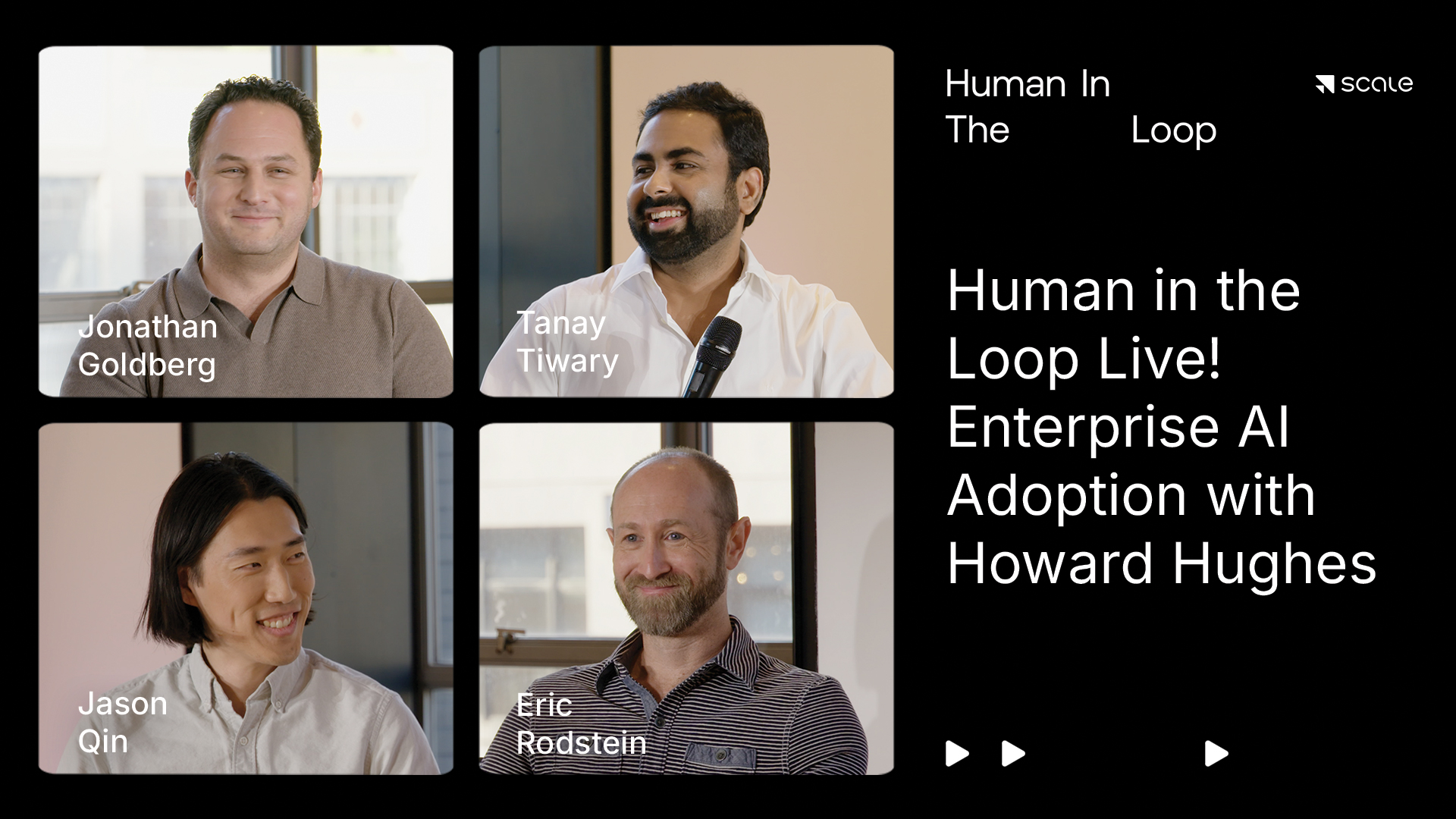
That framing is reinforced by regulation: the EU AI Act's high-risk provisions, with a key deadline in August 2026, require interfaces that let qualified people exercise meaningful oversight, structurally increasing demand for human verifiers with authority to intervene - Kiteworks. Even where synthetic data scales aggressively, the verification layer stays human, because RLVR's reward signals are hard to define outside clean domains like math and code, leaving expert-built verification environments as the genuine 2026 bottleneck - arXiv.
The same transition is reshaping what recruiters themselves screen for, in annotation and beyond. Korn Ferry's 2026 research found that 84% of talent leaders plan to use AI in talent acquisition and that 73% now rank critical thinking as the single most important skill to hire for, precisely because routine execution is being automated - Korn Ferry. Applied to annotation, this means the human you most want is the one who can catch the subtle error an automated judge missed, design the test that exposes a model's hidden weakness, or define the rubric that scales judgment across a million examples. Those are senior, expensive, hard-to-source people, and building a pipeline to reach them is the work this guide has described from the start.
The final shift is that AI agents are now reshaping how annotators themselves get recruited, closing the loop between this guide's subject and its methods. Autonomous sourcing and outreach agents that run the entire top of the funnel are mainstream, and Gartner projects that 40% of enterprise applications will embed task-specific AI agents by the end of 2026, up from under 5% in 2025 - GoPerfect. Meanwhile the macro labor data points the same way the pay ladder does: the World Economic Forum projects AI and data processing will create about 11 million roles while displacing 9 million by 2030, with commodity data-entry work among the fastest-declining and specialist AI-data roles among the fastest-growing - World Economic Forum. The throughline is consistent: cheap labeling shrinks, expert verification grows, and the teams that can source and vet credentialed specialists, increasingly with the help of AI agents, will hold the advantage.
12. Building Your Annotator Recruiting Pipeline
The practical conclusion of all this is a clear decision framework, and it starts with one question: are you buying expert data or building the capability to source it yourself. For most organizations the answer in 2026 is to buy first through a marketplace like Mercor, Surge, Handshake AI, or Labelbox, because they carry the worker-classification risk, the vetting infrastructure, and the existing expert networks that take years to build. Buying lets you start in weeks, validate that expert data actually improves your model, and learn the operational patterns before committing to headcount. The case for building in-house grows only when your volume is large, your domain is narrow enough to recruit directly, or your data is too sensitive to route through a third party.
A simple cost lens makes the build-or-buy call concrete. Buying through a marketplace typically means paying the vendor's blended expert rate plus a recruiting take of roughly 30%, so a physician-grade annotator who earns $150 an hour might cost you north of $200 an hour all-in, with zero classification risk and an instant bench. Building in-house removes that take rate but adds the cost of sourcing tools, assessment design, payroll or contractor compliance, and the management overhead of running a real quality loop, none of which is cheap and all of which takes months to stand up. The honest rule of thumb is that buying wins until your monthly expert-data spend is large enough that the cumulative take rate exceeds what an in-house team would cost to operate, at which point owning the pipeline starts to pay for itself and you gain control over quality that no vendor relationship fully provides.
If you do build, the sequence that works mirrors what the winning vendors do, and it is worth following in order rather than skipping ahead. First, identify the precise micro-specialty each data need requires and set a credential bar and pay band for it, because a vague "annotator" requisition will fail at both the cheap and expert ends. Second, prioritize an owned network or referrals before paid acquisition, since experts trust experts and verified credentials collapse your sourcing cost. Third, screen with a scalable first pass such as an AI interview, then gate on a proctored domain assessment, accepting a low pass rate as the price of clean data. Fourth, build the quality loop, gold tasks, agreement metrics, and an LLM-judge layer, from day one rather than bolting it on after contamination appears.
The tooling choices follow naturally from that sequence and do not need to be expensive to start. For sourcing scarce specialists, autonomous AI recruiters such as HeroHunt.ai, Juicebox, or Fetcher can run outreach at a fraction of the cost of an enterprise seat, while open-source annotation tools like Label Studio or CVAT let you prove out a workflow before paying for an enterprise platform. The throughline of this entire guide is that the binding constraint in modern AI is verified human judgment, and the organizations that treat annotator recruiting as a serious talent-acquisition discipline, with real sourcing strategy, rigorous vetting, fair pay, and a built-in quality loop, will consistently produce better data than those who treat it as commodity gig work. In a market where each frontier lab now spends a billion dollars a year on exactly this, that discipline is not overhead. It is the edge.
This guide reflects the data-annotation and AI-labor landscape as of June 2026. Valuations, pricing, and pay rates in this market change quickly, so verify current figures before making hiring or purchasing decisions.