


The 2026 field guide to three very different AI recruiters, and which one actually fits your hiring.
LinkedIn's AI recruiting agents crossed a $450 million annualized revenue run rate by April 2026, the first AI product Microsoft has ever broken out on an earnings call - Global Dating Insights. That number is the clearest signal you will find that AI recruiting has stopped being a demo and become a line item. It also frames the question this guide exists to answer, because the moment you decide to spend on an AI recruiter, you have to choose whose to buy.
The three names most talent teams put on the shortlist in 2026 are LinkedIn, Indeed, and Workable. Here is the problem: they are not three versions of the same product. They are three fundamentally different businesses that each bolted an AI agent onto the thing they were already good at. LinkedIn added an agent to a professional network. Indeed added an agent to a job board. Workable added an agent to an applicant tracking system. The agents look similar in a slide deck (source, screen, message, shortlist), and behave very differently the moment you put a real requisition through them.
This guide compares the three on the axes that decide a purchase: what each one actually is underneath the AI, how their agents work, who they reach, how they screen, what they really cost once the add-ons land, where each one wins, and where each one breaks. It uses only late-2025 and 2026 information, because in this category a benchmark from two years ago describes a product that no longer exists. It also puts the three incumbents next to the standalone AI recruiters that are quietly eating the sourcing job none of them fully owns.
Written by Yuma Heymans (@yumahey), who built HeroHunt.ai and has spent five years shipping autonomous sourcing software, which mostly means watching where each of these platforms stops being able to help.
Contents
- The Short Answer: Which of the Three, and When
- Three Companies, Three Machines
- LinkedIn: Hiring Assistant and Recruiter AI
- Indeed: Smart Sourcing, Talent Scout, and Sourcing Assistant
- Workable: AI Recruiter and the Workable Agent
- Head to Head: Reach and the Data Underneath
- Head to Head: Screening and Explainability
- Head to Head: Outreach and Autonomy
- What They Actually Cost
- Where Each Platform Wins
- Where They Break: The Honest Failure Map
- The Fourth Option: Standalone AI Recruiters
- Future Outlook: Agents, Convergence, and 2027
- The Decision, in Five Sentences
1. The Short Answer: Which of the Three, and When
If you only read one section, read this one, because the decision is more about your hiring shape than about which agent has the cleverer demo. LinkedIn is the right pick when your bottleneck is reaching passive, senior, or specialized professionals who keep an accurate profile on the network, and when message deliverability inside the LinkedIn inbox matters to you. Indeed is the right pick when your bottleneck is volume: frontline, high-turnover, or geographically dispersed roles where the challenge is processing a flood of inbound applicants and converting matched candidates fast. Workable is the right pick when you want the AI to live inside your system of record, screening and sourcing against your live pipeline at a flat, published price, without stitching a separate tool into your stack.
None of the three is primarily an open-web sourcing engine, and that gap is the single most useful thing to understand before you buy. Each agent is strongest inside its own walls: LinkedIn sees LinkedIn, Indeed sees Indeed, and Workable sees the pool it licenses plus whatever flows into your ATS. When your ideal candidate does not live inside any of those walls (the engineer with no LinkedIn presence, the researcher who publishes on GitHub and nowhere else), all three degrade in the same way, and a different category of tool takes over. That category, the standalone AI recruiter, gets its own chapter, because pretending the choice is only three-way is how teams end up disappointed.
A quick way to route your own decision, before the detail that follows:
- Passive, on-network talent: LinkedIn Hiring Assistant, if you already pay for Recruiter.
- High-volume inbound: Indeed, where the applicants already are.
- AI inside your ATS: Workable Agent, for pipeline-native automation.
- Hard, off-network roles: a standalone open-web agent alongside any of the above.
That routing holds for most teams, but it hides the trade-offs that actually cost money: LinkedIn's price and network lock-in, Indeed's application-quality problem, and Workable's coverage gaps on niche roles. The rest of this guide is those trade-offs in detail, starting with why the three behave so differently in the first place. The mechanism is not the marketing. It is the machine underneath each agent, and the machine is what you are really buying.
2. Three Companies, Three Machines
The reason these products feel similar and perform differently is that each company trained its agent on the asset it already owned, and those assets could not be more different. LinkedIn owns a professional graph of self-reported profiles and the connections between them. Indeed owns a job-board firehose of applications, resumes, and behavioral signals from people actively looking. Workable owns an applicant tracking workflow plus a licensed pool of candidate profiles. An AI agent is only as good as the data it reasons over, so the shape of that data determines what each agent is naturally good at and where it goes blind.
That single fact explains most of the head-to-head results later in this guide. LinkedIn's agent is superb at judging seniority, career trajectory, and who is worth an outbound message, because the graph encodes exactly that. Indeed's agent is superb at matching a live opening to the enormous population of people already applying and searching, because that is what the board measures every second. Workable's agent is superb at running the top of your funnel without leaving your ATS, because it was built to operate on the pipeline you already keep there. None of these strengths transfers cleanly to another company's problem, which is why "best AI recruiter" is the wrong question and "best for my hiring" is the right one.
The at-a-glance version, before the detail, looks like this:
| Indeed | Workable | ||
|---|---|---|---|
| Core identity | Professional network | Job board | Applicant tracking system |
| AI agent | Hiring Assistant | Talent Scout + Sourcing Assistant | Workable Agent |
| Candidate pool | 1.2B members | 370M profiles | 400M profiles |
| Primary motion | Outbound to passive | Inbound plus matched | Sourcing inside the ATS |
| Agent GA | Sept 2025 | Sept 2025 / June 2026 | June 2026 |
| Best for | On-network passives | High-volume hiring | ATS-native automation |
Each row in that table becomes a chapter below, because the one-word answers hide the trade-offs that actually decide a purchase. The candidate-pool numbers, for instance, are not measuring the same thing, and the "best for" column collapses a dozen edge cases into three words. Treat the table as a map, not the territory: it tells you roughly where each platform sits, and the sections that follow tell you where each one breaks.
The broader backdrop is that AI in recruiting became normal in 2025 and near-default in 2026, which is why all three shipped agents in the same eighteen months rather than one pioneering and the others copying. Adoption is real but uneven, and it helps to see how wide the spread is between "we use AI somewhere" and "we have actually delegated work to an agent." The chart below stitches together several 2025-2026 surveys, and the gaps between the bars are the story.
How widely AI has entered recruiting (2025-2026)
Read those bars as four different definitions rather than one trend, because they come from four different surveys. The 82% who plan to deploy agentic AI within a year come from Gartner's CHRO research, the 69% using AI somewhere in talent acquisition come from Aptitude Research and iCIMS, the 43% using AI across HR tasks come from SHRM, and the 37% experimenting with generative AI specifically in recruiting come from LinkedIn's Future of Recruiting. The distance between intent and practice is the real 2026 condition: nearly everyone plans to buy an agent, far fewer have one doing work, and the difference is almost always operating model rather than product. The market itself is compounding fast, estimated at roughly $5.2 billion in 2025 heading toward $17.9 billion by 2034 at a 14% growth rate - Intel Market Research. That is the tide lifting all three of the boats this guide compares.
3. LinkedIn: Hiring Assistant and Recruiter AI
LinkedIn's AI recruiter is Hiring Assistant, and its defining trait is that it is native to the network rather than reaching into it from outside. You describe a role, and instead of returning a search screen for you to grind through, the agent builds a sourcing strategy, runs dozens of searches across LinkedIn's graph, produces a shortlist, and drafts personalized outreach to the people on it. LinkedIn positions it as its first true AI agent for recruiters, announced on October 29, 2024 at its Talent Connect event and pitched as a way to hand the repetitive middle of recruiting to software - HR Brew. After nearly a year in closed pilot, it reached general availability at the end of September 2025 - LinkedIn Newsroom.
Underneath, Hiring Assistant is not one model answering prompts. It is a plan-and-execute agent that breaks a hiring goal into steps and hands each to a specialized sub-agent for intake, sourcing, evaluation, outreach, and learning, coordinated so a live chat with the recruiter runs alongside large-scale asynchronous work in the background - ZenML. The intelligence layer is where LinkedIn's structural advantage shows up, and it is exactly what rivals cannot copy: an internal model tuned on LinkedIn's own Economic Graph of job postings, member profiles, and the links between them. When you brief the agent and walk away, it keeps evaluating profiles without you, which is the line that separates an agent from a copilot.
The clearest way to understand what "delegated screening" looks like is to see how the agent presents a candidate. It does not hand back a single opaque match score. It lists the qualifications it checked, marks which ones the person meets, and cites the evidence it used.
What delegated screening looks like inside LinkedIn

Notice what that panel does and does not do. It does not give a number out of 100 with no explanation. It names the requirements, marks each met, and shows which source it read to decide, which is the structure that lets a recruiter supervise the agent without redoing its work. LinkedIn's self-reported results are strong: it claims recruiters review 81% fewer profiles to find a qualified match, see 66% higher InMail acceptance, and save about 1.5 hours per role on applicant review - LinkedIn Talent Solutions. Treat those as marketing outputs rather than audited benchmarks, because the same figures were 62%, 69%, and 4-plus hours at the September 2025 launch, meaning they get re-cut over time.
There is a subtler cost to LinkedIn's approach that never appears on the price sheet, and it is worth naming before the money. The longer Hiring Assistant runs, the more it encodes about how your team specifically hires, which raises switching costs in a way that is genuinely useful and quietly sticky. That learned preference lives inside LinkedIn's product and does not travel with you if you leave, so the same feature that makes the agent better over time also makes it harder to abandon. LinkedIn cites Expedia Group cutting time-to-hire by roughly 30 days, the kind of concrete outcome that survives a skeptical read better than a review-count percentage does. One question the public record does not settle is whether the agent's automated outreach draws down your existing InMail allotment or runs on separate capacity, so ask that directly rather than assuming, because it changes the real cost of running the agent at volume.
The commercial reality is the catch. Hiring Assistant has no standalone product and no public price. It is sold only as a negotiated add-on to LinkedIn Recruiter, itself one of the most expensive and opaque products in the HR stack, and early pilot leaders said their top worry was not accuracy but cost - ERE. The one place a list price is published is a UK government rate card, where the add-on appears at £6,350 per licence per year on top of a Recruiter seat - UK Digital Marketplace. We break the full stacked bill down in our LinkedIn Hiring Assistant cost guide; the short version is that the agent rides on a five-figure seat, so nobody buys it cheaply. What you get for that money is genuine: the deepest professional graph in existence, native InMail deliverability, and an agent that learns your preferences. What you do not get is anyone who is not on LinkedIn.
4. Indeed: Smart Sourcing, Talent Scout, and Sourcing Assistant
Indeed's AI plays a different game entirely, because Indeed is not a network of professionals but the largest job marketplace in the world, and its agent is built to work the enormous population of people who are actively applying and searching. The foundation is Indeed Smart Sourcing, the AI-powered rebrand of the old Indeed Resume database, relaunched on April 2, 2024 with access to profiles of nearly 300 million workers and an AI matching engine that surfaces Matched Candidates, writes candidate summaries, and drafts outreach - Indeed. By 2026 that pool had grown to a claimed 370 million sourceable profiles, and Indeed says matched candidates are roughly 15x more likely to apply than people who find a job on their own - Indeed.
Indeed's agentic push arrived in two waves, and both matter for a 2026 comparison. At its FutureWorks 2025 event in September, Indeed introduced Talent Scout, a conversational hiring agent that sources, screens resumes, ranks candidates, optimizes job posts, and does outreach, with over 1,000 employers using it shortly after launch - Indeed. Then in June 2026 it shipped Sourcing Assistant, a more autonomous "sources while you sleep" agent available on the Professional and Enterprise tiers that takes natural-language prompts instead of Boolean strings and monitors the full 370-million-profile pool. Indeed claims applicants surfaced by Sourcing Assistant are 2.9x more likely to be hired, hired about six days faster, and that it saves recruiters roughly seven hours a week - Indeed.
Around that sourcing core Indeed has built a wider AI suite that is easy to miss but matters for a full comparison. It added Career Scout, a job-seeker-side AI coach; Premium Sponsored Jobs; Indeed Connect, which streams pre-qualified matched candidates and AI summaries directly into partner ATSs; and Advanced Screening with dynamic questions and credential verification - Indeed. The matching engine underneath draws on an Indeed Profile built from tens of thousands of skill types that the company says it updates continuously, which is what lets it rank a live opening against a vast, constantly moving applicant population rather than a static resume file.
The customer evidence Indeed publishes is self-reported but unusually specific. It cites BrightSpring Health Services posting a 45% increase in hard-to-fill hires within four weeks and saving recruiters about eight hours a week, and says 92% of Smart Sourcing adopters call it their preferred tool. Those figures describe the platform at its best, on high-volume roles where the board's population runs deep, and they are worth holding next to the application-quality complaints covered later, because both are true at once: Indeed is unmatched at moving volume and routinely criticized for the quality of that volume.
The product itself is best understood as a matching-and-outreach layer sitting on top of the board's raw scale. The screenshot below shows the Smart Sourcing surface where those matched candidates appear.
Indeed Smart Sourcing, the matched-candidate surface

The scale claim is the part that is hard to argue with: Indeed said in May 2026 that 31 people are hired every minute through the platform, up from 27, which it attributes to AI-driven matching - BusinessWire. To see Talent Scout in motion rather than in a press release, Indeed's own FutureWorks 2025 session walks through the agent conversationally briefing a role and returning ranked candidates.
Smart Recruiting Just Got Smarter with Indeed's Talent Scout | FutureWorks 2025
The catch with Indeed is the mirror image of LinkedIn's. Where LinkedIn's problem is reach beyond its walls, Indeed's problem is quality inside them. The same AI that makes applying frictionless has flooded employers with applicants who do not fit, and the pricing model rewards clicks rather than qualified hires. That tension is worth its own treatment later, because it is the single biggest reason teams pair Indeed with something more selective rather than relying on it alone.
5. Workable: AI Recruiter and the Workable Agent
Workable is the odd one out in the best possible way: it is not a network or a board but an applicant tracking system, so its AI is designed to run inside the pipeline you already keep. The long-standing feature is AI Recruiter (its AI Sourcing engine), which parses a job's title and description, then surfaces matched passive candidates from a database of 400 million-plus profiles that you scroll through and add to your pipeline - Workable. Alongside it, Workable's AI scores each candidate against up to fourteen job-specific criteria, normalizes each to a 0-100 scale with written reasoning, and excludes protected characteristics from processing, which is a compliance posture the other two are less explicit about.
That compliance posture is not incidental, it is a design choice aimed squarely at the regulatory wave hitting AI hiring. Workable documents that every AI score carries written reasoning, that recruiters keep a full human override, and that the system is built to satisfy transparency requirements like the EU AI Act, which classifies recruitment AI as high-risk - Workable. For a European employer, or a US one facing bias-audit rules, an ATS that bakes explainability and protected-characteristic exclusion into the model is a materially easier product to defend than one that returns an opaque score. The trade-off is that this rigor lives inside Workable's own pool and pipeline, so the compliance story is only ever as strong as the coverage, which is precisely where Workable trails LinkedIn on niche and international roles.
The 2026 headline is Workable Agent, announced on March 13, 2026 and generally available on June 16, 2026, pitched as a full-cycle "AI teammate" that lives in the ATS and runs the top of the funnel around the clock - Workable. It opens with a structured intake conversation to define must-haves, nice-to-haves, and disqualifiers before the job description is even written, then sources from the 400-million pool, sends personalized outreach that Workable says gets about twice the response rate of bulk templates, chats with candidates to fill gaps, scores everyone, and keeps a continuously updated interview-ready shortlist. CEO Nikos Moraitakis framed the ambition plainly: the agent is "built to act as a true teammate inside your ATS."
What distinguishes Workable Agent from the other two is where it starts: with the brief, not the search. Its opening move is a structured intake conversation that forces must-haves, nice-to-haves, and disqualifiers to be written down before anything is sourced, which is a small design decision with an outsized effect, because most bad AI sourcing traces back to a vague brief rather than a weak model. By making the requirements explicit and machine-readable up front, the agent gives itself something concrete to screen against and gives the recruiter something to correct. The intake step is free on every plan, which signals that Workable treats the brief as the product's foundation rather than an add-on, and it is the clearest example in this comparison of an agent designed around the recruiter's workflow instead of the vendor's data.
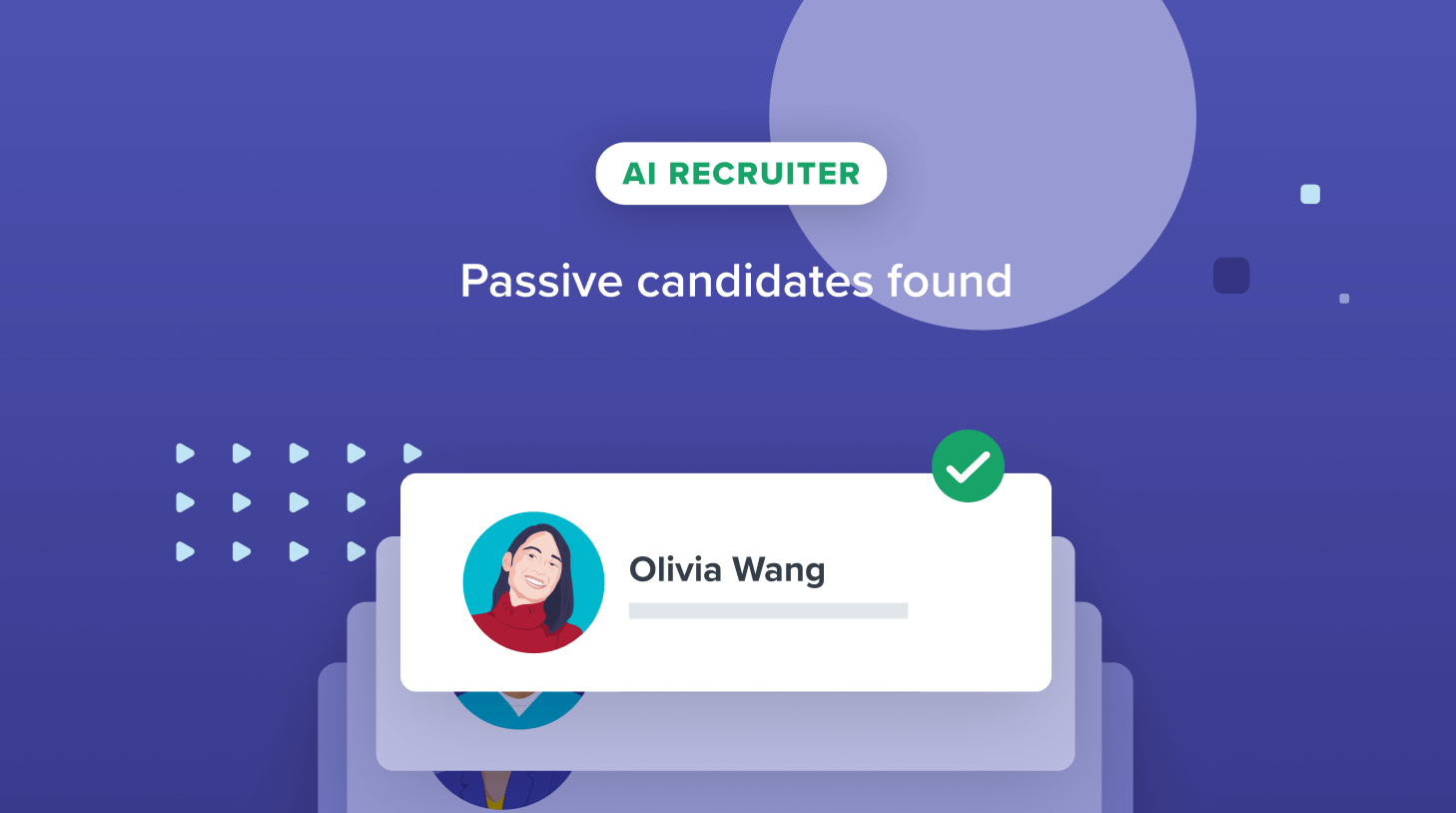
The graphic below shows how Workable presents the AI Recruiter sourcing surface.
Workable AI Recruiter, sourcing inside the ATS
Workable's scale is genuine for a company its size: it reports 35,000-plus companies, 2.1 million hires facilitated, and 100-plus countries served, and says its AI is trained on data from 260 million candidates and more than two million hires - Workable. It was named by Forbes as the best AI-powered recruiting platform in both 2024 and 2025, and it has been building AI for close to a decade rather than bolting it on in 2024. The introduction video for Workable Agent shows the intake-to-shortlist loop the way a recruiter would experience it.
Introducing Workable's AI Agent
There is one more thing about Workable that makes it unusually relevant to this specific comparison: it does not only compete with Indeed, it also partners with it. Workable is one of only three ATS platforms (with Workday and isolved) in the early-access launch of Indeed's Talent Scout, meaning Indeed's agent can source and match against a Workable customer's live pipeline - Workable. That detail is a preview of where the whole category is heading, which is the subject of the outlook chapter.
6. Head to Head: Reach and the Data Underneath
Reach is where the three diverge most, and it is the first thing to compare because an agent cannot contact someone it cannot see. The honest comparison is awkward, because the three "candidate pools" are not the same kind of object. LinkedIn's number counts members who maintain a profile on the network. Indeed's counts sourceable profiles built from resumes and applications. Workable's counts a licensed database of profiles it aggregates. Putting them on one chart is useful for scale but misleading if you read the bars as interchangeable, so read them as "how many people can this agent theoretically touch," not "how many equivalent candidates."
Self-reported candidate pool by platform (millions)
The numbers only tell you volume, and volume is not the same as fit. LinkedIn's 1.2 billion members are overwhelmingly white-collar professionals who chose to build a public career profile, which makes the graph unbeatable for knowledge-work sourcing and much thinner for frontline and trade roles - DemandSage. Indeed's 370 million skews toward people who are actively job-seeking, which is exactly what you want for volume hiring and exactly what you do not want when the best candidate is happily employed and never touches a job board. Workable's 400 million is a licensed aggregation that reviewers describe as strong for common software, sales, and marketing roles and noticeably thinner for niche, specialized, or non-English-speaking markets.
A single worked example makes the trade-off concrete. Suppose you are hiring a staff-level infrastructure engineer who left LinkedIn three years ago, never appears on Indeed because she is not looking, and has never touched your Workable pipeline. On the reach chart she is theoretically inside a billion-plus profiles, and in practice she is invisible to all three agents, because none of them indexes the GitHub commits, conference talks, and personal site where she actually lives. Now flip the requisition to a retail store manager hiring push across forty locations. Here Indeed's actively-searching population is the asset and LinkedIn's professional graph is expensive overkill. The same three tools, ranked in opposite orders, purely because the shape of the pool changed. That is why sophisticated teams stop asking which platform is biggest and start asking which pool actually contains the person for this specific role.
The practical lesson is that "biggest pool" is a category error. For a staff-level engineer who left LinkedIn years ago, the 1.2-billion graph is empty and a smaller, fresher, open-web index wins. For a warehouse hiring push, Indeed's actively-searching population beats a professional network that barely indexes the role. The right way to apply this chapter is to match the pool's shape to your requisition, then treat any single vendor's reach as a ceiling you should assume you will hit on your hardest roles. That is the exact point where standalone open-web agents enter the picture, because their entire pitch is reaching the people the walled pools miss.
7. Head to Head: Screening and Explainability
Screening is where these agents earn or lose your trust, because a shortlist you cannot audit is a shortlist you have to redo. The dimension that matters most is not raw accuracy (which every vendor claims and none lets you independently test) but explainability: does the agent tell you why it advanced or rejected someone in a way a human can check and overrule? On this axis the three have converged more than on reach, and all three now ship some version of reasons-with-evidence rather than a bare number, which is a genuine improvement over the black-box match scores of a few years ago.
LinkedIn's approach is qualification-by-qualification: it lists the requirements it checked, marks each met or unmet, and cites whether it read the profile, the resume, or a screening answer to decide. Workable's is the most structured of the three, scoring each candidate against up to fourteen criteria on a 0-100 scale with written reasoning for each and an explicit exclusion of protected characteristics, which reads like it was designed with the EU AI Act in mind - Workable. Indeed's screening leans on dynamic questions, credential verification, and AI candidate summaries that compress an applicant into a readable snapshot, which is well suited to high volume but less granular than Workable's per-criterion scoring.
The cautionary tale that should shape how you configure any of these is Tezi, whose fully autonomous agent "Max" was marketed as the first end-to-end AI recruiter and shut down in 2026 after, among other things, screening out qualified people and breaking recruiter trust - PR Newswire. The lesson is not that AI screening does not work, it is that a false rejection is invisible: you never see the strong candidate the model filtered out, so the failure mode has no natural feedback loop. Compliance rules are starting to force that loop open. Frameworks like New York City's bias-audit law and the EU AI Act's high-risk classification push employers to document and audit how an agent decides, which is exactly the discipline that surfaces silent false rejections - YourDataConnect. Whichever platform you pick, the practical safeguard is to have a human review a sample of the rejects, not only the shortlist.
The interpretation for a buyer is that screening quality is now table stakes, and the real differentiator is how the explainability fits your accountability needs. A regulated employer that may have to defend a rejection to a candidate or an auditor will value Workable's per-criterion reasoning and protected-characteristic exclusion. A high-volume employer processing thousands of applications will value Indeed's fast summaries more than fine-grained scores nobody has time to read. A team hiring senior professionals will value LinkedIn's qualification checks tied to graph data. None of these is wrong, but they optimize for different failure modes, and the mistake is buying the screening model that fits someone else's hiring rather than yours. Always test screening on roles you know well, so you can catch the false rejections that vendor metrics never show.
8. Head to Head: Outreach and Autonomy
Outreach is where "AI recruiter" either means something or does not, because sourcing a name is cheap and getting a reply is the actual job. The three platforms differ on two things here: which channel the outreach runs through, and how much of the loop the agent will run without a human clicking. Channel is the simpler axis. LinkedIn sends InMail inside its own inbox, which is a real advantage because members read and reply there, but it is also a metered resource with overage costs. Indeed and Workable run outreach primarily over email and in-product messaging, which is cheaper and more flexible but competes with a candidate's crowded inbox rather than a professional channel they check on purpose.
The channel difference carries a direct cost consequence that buyers underestimate. LinkedIn's InMail is metered: a Recruiter seat includes a monthly allotment (the UK rate card lists at least 150 per seat), and heavy outbound quickly runs into overage credits that add a separate per-message line item on top of the seat. Email-based outreach on Indeed and Workable has no such per-message meter, which makes high-volume sending cheaper but also easier to abuse, and abuse is exactly what is happening across the category. As every agent makes it trivial to message thousands of people, aggregate response rates fall for everyone, so the platforms that win the next two years will be the ones that screen hardest before they send, not the ones that send the most. That is a quiet structural argument for brief-driven, selective agents over pure-volume ones, and it applies regardless of which of the three you start from.
Autonomy is the axis that changed most in 2026. A year ago, all three were closer to copilots that drafted messages for a recruiter to send. By mid-2026, each had shipped a version that will run multiple steps unattended: LinkedIn's Hiring Assistant sources and drafts outreach asynchronously, Indeed's Sourcing Assistant explicitly markets "sources while you sleep," and Workable Agent maintains a live shortlist and messages candidates on its own. The important nuance is that none of them removes the human entirely, and none should. Each keeps a review gate at the points that carry the most risk, which is the shortlist and the rejection, precisely because a wrong autonomous decision there propagates into a bad hire or a discrimination complaint.
The way to apply this is to separate the demo from the operating model. An agent that will "run the whole funnel" is only as safe as the gate you keep on it, and the teams that get results are the ones that let the agent do the volume work (searching, drafting, first-touch) while a human owns the two decisions that matter (who advances, who gets rejected and why). Outreach volume is also becoming its own problem: as every platform makes it trivial to message thousands of people, response rates fall for everyone, and the winners are shifting from "who can send the most" to "who can send the most relevant." That shift rewards agents that screen hard before they message, which is a quiet argument for the more selective, brief-driven tools over the highest-volume ones.
9. What They Actually Cost
Pricing is where the three become genuinely hard to compare, because they meter completely different things: LinkedIn charges per recruiter seat, Indeed charges per contact and per click, and Workable charges per company headcount. A like-for-like table therefore has to fix the unit, so the table below shows the realistic entry point to each platform's AI product, with the model spelled out, rather than a single misleading number.
| Platform | AI product | Entry price | How it meters | AI included? | Free tier |
|---|---|---|---|---|---|
| Hiring Assistant | ~$900/mo per seat (Recruiter Corporate) plus the agent add-on | Per recruiter seat, annual | Add-on to Recruiter, negotiated | No | |
| Indeed | Smart Sourcing + agents | ~$120/mo (Standard, ~30 contacts) | Per contact credit, plus pay-per-click job ads | Included; Sourcing Assistant needs Professional+ | Small trial |
| Workable | AI Recruiter + Workable Agent | ~$299/mo (Standard, 1-20 employees) | Per company headcount band | 3,000 AI credits/yr included; Agent is a paid add-on | 15-day trial |
| Standalone agent | Open-web AI recruiter | $0 to start | Per seat or per role | Core to the product | Yes, no card |
Those entry numbers hide where the money actually goes, so they need prose to be useful. LinkedIn is by far the most expensive: a Recruiter Corporate seat runs roughly $10,800 to $12,960 per year before you add Hiring Assistant on top, and Vendr's transaction data puts the median LinkedIn contract near $38,445 a year across thousands of deals - Vendr. Indeed's Smart Sourcing looks cheap at around $120 a month for the Standard tier's roughly 30 contacts, rising to $300 to $400 a month for Professional (which unlocks Sourcing Assistant), but that ignores the separate, unpredictable cost of Sponsored Jobs, which runs pay-per-click with a $25-per-day minimum and can reach $15 to $50 per application - hireTruffle.
It helps to walk one realistic bill through end to end. A five-person recruiting team on LinkedIn Recruiter Corporate faces roughly $54,000 to $65,000 a year for the base seats alone, before a single add-on; layer Hiring Assistant on all five at standard rate and you add tens of thousands more, and a few hundred InMail overage credits plus some promoted posts across a busy quarter push the stack comfortably past $100,000 a year. The equivalent Indeed spend is deceptively lumpy: a Professional Smart Sourcing subscription is a few thousand dollars a year, but a single aggressive Sponsored Jobs campaign for a hard-to-fill role can spend that again in a month, because pay-per-click has no natural ceiling. Workable is the outlier for predictability: a 200-person company on Premier pays a known monthly figure by headcount band, its Agent add-on is a flat fee rather than usage-metered, and the only variable is extra AI credits at published per-credit rates. For a finance team that has to forecast, that predictability is worth a premium the pricing page never shows.
Workable sits in the middle and is the most transparent of the three, publishing $299 a month for Standard and $599 for Premier at the smallest headcount band, with unlimited active jobs and 3,000 free AI credits a year, though Workable Agent is a paid add-on priced by company size and its value-for-money is the lowest-scoring dimension in Capterra reviews - Workable. The pattern across all three is the same: the sticker is not the bill. The chart below compares only the published monthly entry price to each AI product, which is the fairest single view, but the interpretation underneath matters more than the bars.
Published monthly entry price to the AI product (USD)
The takeaway is that price tracks the business model, not generosity. LinkedIn charges the most because its graph has no substitute and its buyers are inelastic. Indeed's low entry hides variable ad spend that can dwarf the subscription. Workable's flat, published pricing is the easiest to forecast, which for a finance team is worth real money on its own. And the free-to-start tier on standalone agents exists precisely because those tools have to prove reach on your hardest role before you will believe they see people the incumbents cannot.
10. Where Each Platform Wins
Every platform in this guide wins somewhere, and the fastest way to a good decision is to match your dominant hiring pattern to the tool built for it rather than to the one with the loudest launch. The decision tree below routes the four most common situations. It is deliberately simple, because most teams have one bottleneck that dominates, and solving that one is worth more than optimizing the other three.
Reading that tree left to right, LinkedIn wins when the job is convincing a passive, on-network professional to take your call, because the graph and native InMail were built for exactly that motion. Indeed wins when the job is converting and filtering a large inbound population fast, because that population already lives on the board and its matching engine is tuned to it. Workable wins when you want automation without adding another tool, because the agent operates on the pipeline your team already manages and prices predictably. The fourth branch is the one most three-way comparisons omit, and it is often the deciding one, because the roles that break your sourcing are usually the roles none of the walled pools cover well.
The mistake to avoid is buying for a bottleneck you do not have. A team that mostly hires senior engineers should not optimize for inbound volume, and a team drowning in applicants should not pay LinkedIn's premium for passive reach it barely uses. Match the tool to the dominant problem, keep the runners-up in mind for the roles that fall outside it, and you will spend far less than a team that buys the most-hyped agent and tries to force every requisition through it. That framing also makes it easy to run more than one tool without guilt, since the incumbents increasingly assume you will.
11. Where They Break: The Honest Failure Map
Knowing where a tool fails is worth more than knowing where it shines, because the failures are what you discover after the contract is signed. Each of the three breaks in a way that follows directly from its underlying machine, which is oddly reassuring: the weaknesses are predictable if you understand the data model. LinkedIn breaks on reach and price. Its greatest strength and its greatest weakness are the same thing: it lives entirely inside LinkedIn, so for roles where your candidate keeps no active profile, the walls of the garden become the walls of a box, and the bill for staying inside that garden is the highest in the category.
Indeed breaks on application quality and cost predictability, and this is the most documented failure of the three. Employers widely report being flooded with unqualified applicants, with reporting citing that a large majority of applicants miss basic qualifications and that fewer than 5% of applications lead to a callback, because AI made applying easier without making matching better - GoPerfect. The pricing compounds it: pay-per-click Sponsored Jobs costs swing widely by role and market, free postings lose visibility fast, and critics note Indeed earns from clicks whether or not they become hires, which is an incentive misaligned with quality. Its Trustpilot rating sits around 2.3 to 2.4 out of 5 across more than 12,000 reviews, which is the market registering exactly this frustration.
It is worth being precise about what that Indeed criticism does and does not mean, because it is easy to overcorrect. The flood of low-fit applicants is real, and reporting attributes it to AI lowering the effort of applying while doing nothing to improve fit, with employers saying applicants lack relevant experience and that they cannot evaluate self-taught skills. But the same volume that produces the complaint is also what produces the 31-hires-a-minute scale, so the honest read is that Indeed is a volume instrument that punishes teams who use it without a filter and rewards teams who pair it with hard screening. The failure is not the tool being bad, it is the tool being used for a job (selective, passive sourcing) it was never built to do.
Workable breaks on coverage and cost-for-value on small teams. Its AI sourcing is genuinely useful for common, well-represented roles and gets broad and manual-filtering-heavy for niche, specialized, or non-English-speaking searches, which is the natural limit of a licensed pool that is a fraction of LinkedIn's graph. On price, it scales by company headcount rather than recruiting activity, so a 300-person company with two open roles pays for its size, not its usage, and reviewers rate value-for-money as Workable's weakest dimension even while rating the product 4.4 out of 5 overall on both G2 and Capterra - G2. The unifying lesson across all three failure maps is that vendor-reported AI metrics (LinkedIn's 81%, Indeed's 2.9x, Workable's 2x response rate) are marketing outputs, not audited benchmarks, and the only number that matters is the one you generate on your own roles in a two-week pilot.
12. The Fourth Option: Standalone AI Recruiters
The comparison so far has a hole in it that the three incumbents cannot fill, and pretending otherwise would make this guide useless on exactly the roles that hurt most. All three agents are strongest inside their own data and weakest outside it, which means the candidate who is not on LinkedIn, not job-searching on Indeed, and not already in your Workable pipeline is invisible to all three at once. This is the specific gap that standalone AI recruiters were built to close, and it is why the category is growing fast enough that Microsoft now breaks out LinkedIn's agent revenue to defend the flank. These tools do not own a network or a board, so they compete on the one thing the incumbents cannot: reaching across the open web rather than one walled pool.
The category is real and it is consolidating, which is worth saying plainly so you do not buy a tombstone. Two of the most-hyped autonomous startups are already gone: Moonhub was acquihired by Salesforce in mid-2025 and wound down - The Letter Two, and Tezi's "Max," marketed as the first fully autonomous recruiter, shut down in 2026 after full autonomy proved hard to deliver - PR Newswire. The survivors that matter fall into two camps: enterprise suites like Eightfold and SeekOut that wrap agents around a talent-intelligence platform, and focused open-web sourcing agents like Findem and hireEZ that reach across dozens of public sources. What unites the good ones is that they screen against a written brief with a language model rather than matching keywords inside a single network.
The two camps are worth telling apart, because they solve different problems. The enterprise suites bundle an agent into a broader talent-intelligence platform: SeekOut, for instance, turns a job description into structured search criteria, runs specialized agents for job-specific workflows, and even ships an AI interviewer, with list pricing around $833 a month per seat - SeekOut. The focused sourcing agents go narrower and deeper on reach: hireEZ launched its Agentic AI in 2025 to run the chain from sourcing to outreach behind a human approval gate, sourcing across dozens of platforms and more than a billion profiles, starting around $494 a month - PR Newswire. Findem takes yet another angle, building attribute-based search over an enriched profile graph. The common thread is open-web reach the incumbents structurally lack, and the common weakness is that none of them is your system of record, so they layer onto an ATS rather than replacing it.
HeroHunt.ai
If the roles that break your sourcing are the ones where the best person is not on LinkedIn, not applying on Indeed, and not already in your ATS, that is the specific bet worth testing an open-web agent against. HeroHunt.ai sources across the wider web (GitHub, personal sites, and public profiles rather than one network), screens each candidate with a language model against your written brief, and runs the outreach on autopilot. The checkable difference is the entry cost: there is a free tier with no credit card, where LinkedIn's agent requires a five-figure Recruiter seat before you can even buy the add-on. The honest caveat: it is a sourcing and outreach layer, not an applicant tracking system, so it sits next to your system of record rather than replacing it, and its reach is thinnest in roles where people never publish anything publicly.
The way to use this fourth option is not to replace an incumbent but to cover its blind spot. Most teams that hire hard, off-network roles end up running one walled tool for the roles it is good at (LinkedIn for on-network passives, Indeed for volume, Workable for pipeline automation) and one open-web agent for the roles the walled tool cannot see. That pairing is cheaper than it sounds, because the standalone agents start free and you only lean on them for the searches that were failing anyway. The strategic point is that "which of the three" is the wrong frame if your hardest roles live outside all three, and the teams that source best in 2026 have quietly stopped choosing one pool and started choosing per role.
13. Future Outlook: Agents, Convergence, and 2027
The most reliable prediction for 2027 is convergence, and the Indeed-Workable partnership is the early proof. When Indeed's Talent Scout can source directly into a Workable customer's pipeline, the neat categories this guide uses (network, board, ATS) start to blur into a single agentic layer that reaches across whatever data it can integrate. Expect more of this: agents that no longer respect the boundary of the company that built them, brokered by partnerships and, increasingly, by open protocols. Josh Bersin's 2026 analysis of multi-agent talent acquisition describes exactly this shift, with agents from different vendors beginning to hand work to one another rather than each running a closed loop - Josh Bersin.
The mechanism making that convergence possible is standardization, specifically the spread of open protocols that let one company's agent call another's tools and data. Recruiting vendors are beginning to expose their systems to external agents through these interfaces, which is what turns a pile of separate products into an interoperable layer where a single assistant could, in principle, drive sourcing across several platforms at once. SeekOut already lets recruiters work through general assistants like Claude and ChatGPT via such an integration, a genuinely 2026-native idea that would have read as science fiction two years ago. For a buyer, the takeaway is to prefer tools that integrate openly over tools that trap your data and your agent's learned preferences, because interoperability is the direction the market is moving and deep lock-in is the bet most likely to age badly.
The second force is that the technical precondition for all of this arrived recently, which is why 2026 and not 2024 is the year of the recruiting agent. Autonomous agents only became trustworthy once models got good enough at multi-step computer work to be handed a loop, and that capability crossed a usable threshold in the last eighteen months. The Stanford AI Index tracks the jump directly, and the chart below is the single best picture of why "autonomous sourcing" stopped being a demo.
Why recruiting agents became possible in 2026, not 2024
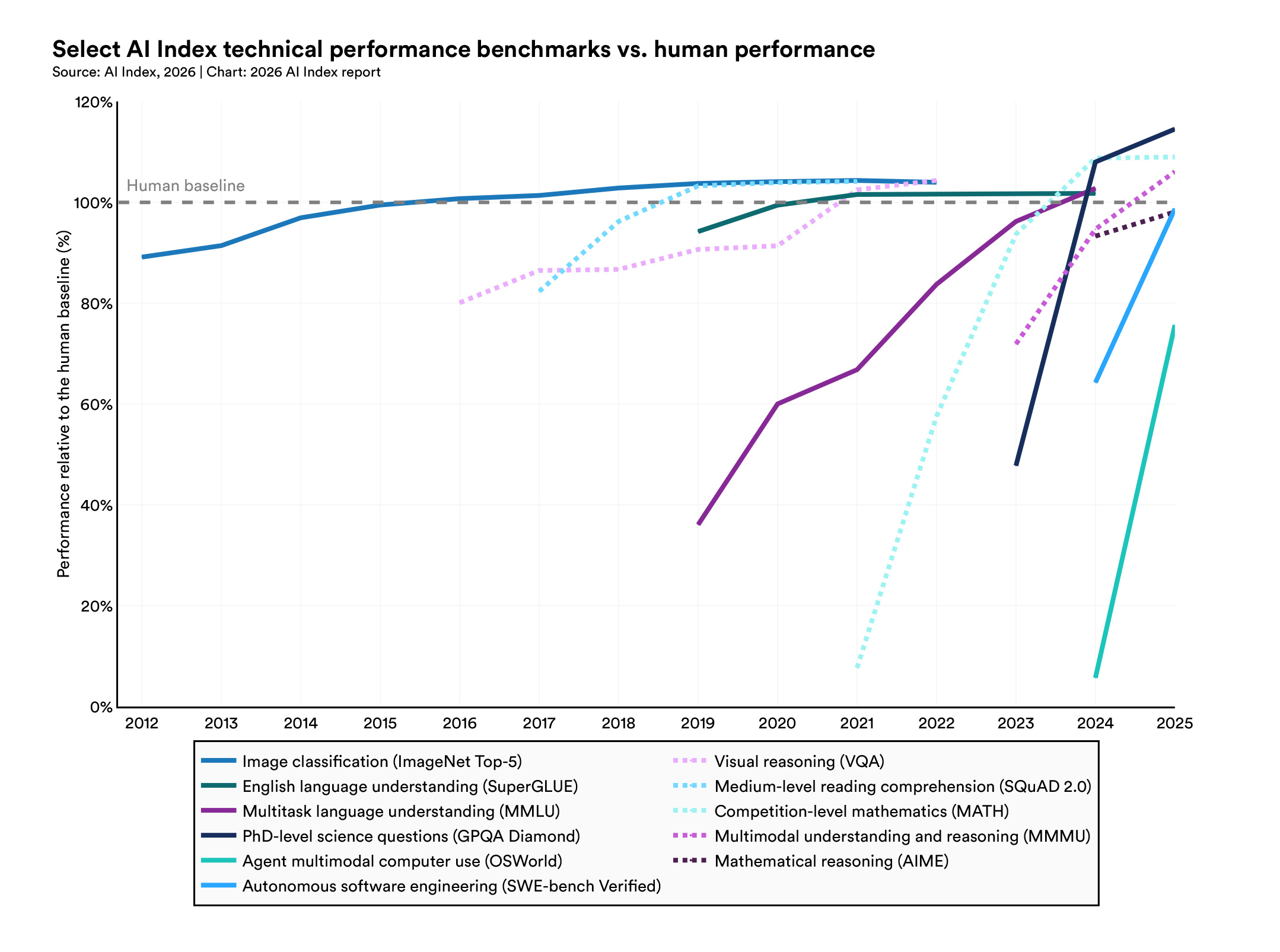
Sourcing is itself a multi-step computer task (open a source, read a profile, judge it against a brief, decide the next query), so when agent performance on those tasks climbed toward the human baseline, the whole category became commercially plausible at once. The third force is competitive: LinkedIn is now defending its graph against not just recruiting startups but general-purpose platforms, including reported moves by OpenAI into hiring - HR Dive. For a buyer, the practical implication of all three forces is to avoid deep lock-in you cannot exit, because the tool that wins your category in 2027 may not be the one that leads it today, and the switching cost of an agent that has learned your preferences is exactly the trap to watch.
14. The Decision, in Five Sentences
Buy LinkedIn if your hardest hires are passive professionals who live on the network and you can absorb the highest price in the category for native reach and InMail deliverability. Buy Indeed if your problem is volume and inbound, you need the largest active-applicant pool in the world, and you can manage the application-quality and ad-cost tax that comes with it. Buy Workable if you want AI sourcing and screening to live inside your ATS at a flat, forecastable price, and your roles skew toward well-represented functions rather than deep niches. Pair any of them with a standalone open-web agent for the roles that fall outside every walled pool, because that is where all three incumbents degrade in the same way. And whichever you choose, run a two-week pilot on roles you have failed to fill before, measuring the qualified-candidate rate rather than the vendor's percentage, because in this category the only benchmark that means anything is the one you generate yourself.
Test the fourth option on one role you have not been able to fill: brief it in writing, and see what a language model screening the open web returns before you sign a five-figure contract.
This guide reflects the AI recruiting landscape as of August 2026. Pricing, product names, and feature sets in this category change on a monthly cadence, so verify current details against each vendor's own pages before you buy.