


The definitive read on what Stanford's payroll data reveals about AI, young workers, and how to hire when the bottom rung is disappearing.
Employment for workers aged 22 to 25 in the most AI-exposed jobs has fallen 16% relative to their older colleagues since generative AI went mainstream in late 2022 - Stanford Digital Economy Lab. That single number, drawn from the payroll records of millions of real American workers, is the most concrete evidence yet that the entry-level job market is not merely soft. It is being reshaped, and the youngest workers are absorbing the shock first.
The problem is that most commentary on this topic is either breathless ("AI is ending all jobs") or dismissive ("it's just interest rates"). Both miss what the data actually says. The Stanford study, nicknamed Canaries in the Coal Mine, is careful, replicated against the payroll provider's own analysis, and stress-tested against the obvious objections. It does not show mass unemployment. It shows something subtler and, for anyone who hires, more important: a narrow, age-specific, occupation-specific decline that is concentrated exactly where AI automates rather than assists.
This guide breaks down what the Stanford data really found, the six facts the paper is built on, the corroborating evidence from the New York Fed, Indeed, and SignalFire, the mechanism that explains why juniors get hit while seniors thrive, the honest counter-arguments, and the practical playbook for recruiters and employers who still need to build a talent pipeline in 2026. It starts high with the headline and then goes deep into the parts that matter for decisions, because a reader who stops after the introduction should already walk away knowing the shape of the problem: the entry rung is thinning fastest exactly where AI does the work, and the fix is to redesign that rung, not abandon it.
Written by Yuma Heymans (@yumahey), who built HeroHunt.ai to source scarce, specialized talent from over a billion profiles. The questions this data raises, where the next generation of experienced hires comes from once the entry rung erodes, are the questions the sourcing world will spend the next decade answering.
Contents
- The Collapse in One Chart: What Stanford Actually Found
- Inside the Study: The Six Facts of Canaries in the Coal Mine
- The Age Gradient: Who Gets Hit and Who Does Not
- Beyond Stanford: The Corroborating Data
- Why AI Hits the Bottom Rung First
- The Honest Counter-Case: Is It Really AI?
- What Employers Are Already Doing
- The Experience Paradox and the Broken Career Ladder
- How AI Is Changing Entry-Level Sourcing and Screening
- The 2027 Outlook: Agents and the Shape of the Ladder
- Conclusion: A Decision Framework for Hiring in the Collapse
1. The Collapse in One Chart: What Stanford Actually Found
The clearest way to understand the entry-level squeeze is to look at one occupation split by age, and software developers are the textbook case. Since late 2022, employment for software developers aged 22 to 25 has fallen nearly 20% from its peak, while employment for developers over 30 in the exact same field kept climbing - ADP Research. Same job, same tools, same firms, opposite trajectories, separated only by age. That divergence is the heart of the story, and it is not a rounding error or a seasonal blip. It is a sustained, widening gap that began right around the moment ChatGPT launched.
Software developers are the vivid case, but they are not the only one. Early-career customer service representatives show the same signature, with employment for the youngest reps down roughly 11% from a late-2022 peak on the same payroll data - ADP Research. Two very different occupations, one writing code and one answering tickets, share a common thread: both are heavy in codified, teachable tasks that a language model now performs competently. That is the tell. When the same age-specific decline appears in jobs that have almost nothing else in common except high AI exposure, coincidence becomes an unconvincing explanation.
The image below is the single most important chart in this entire debate. It shows normalized headcount for software developers and customer support agents, broken out by age band, from 2021 through 2025. Watch the blue line, the youngest cohort, peel away from every other group after 2022.
The canary in the coal mine
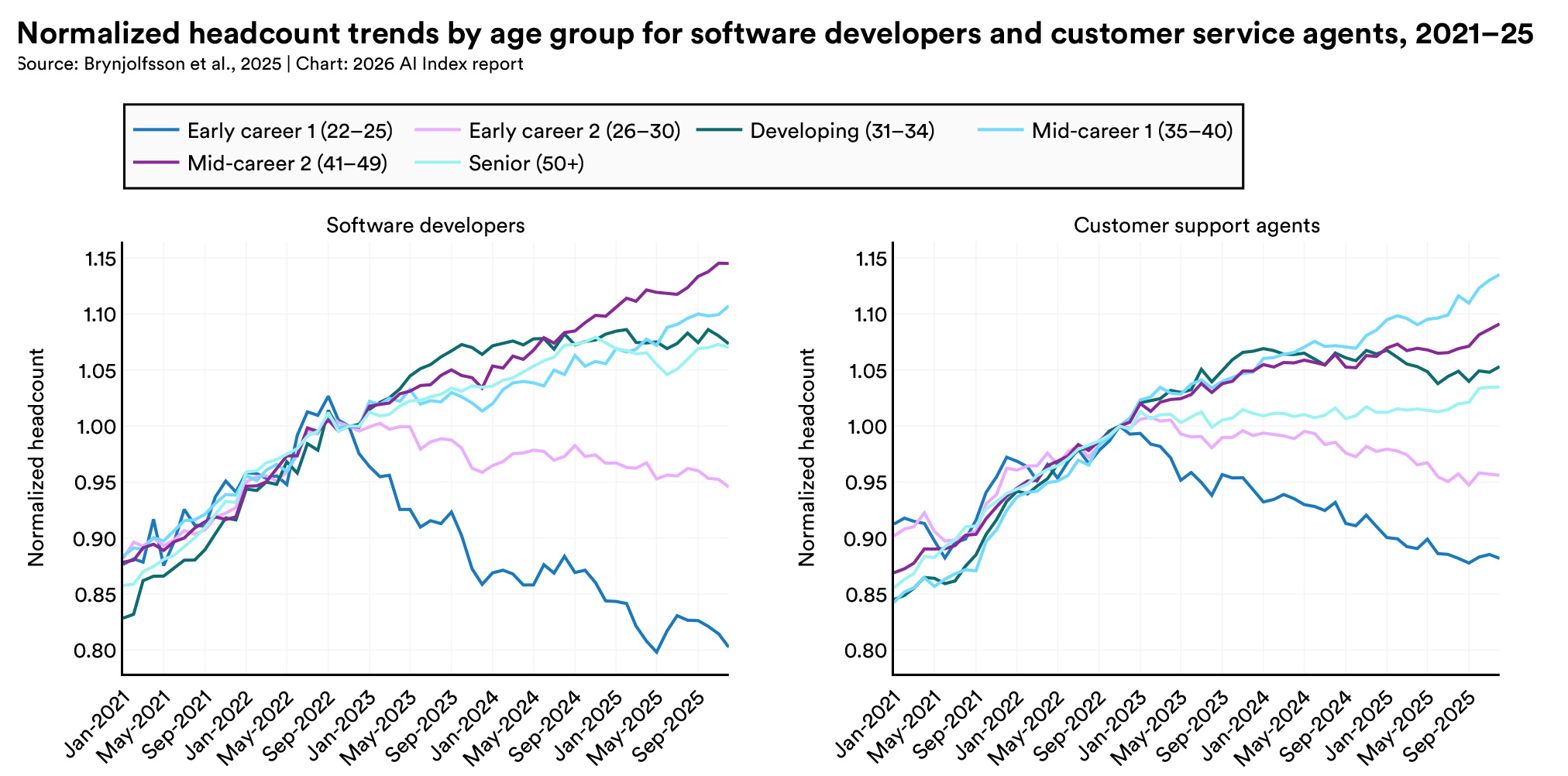
What makes this chart credible is where the data comes from. The study behind it, formally titled "Canaries in the Coal Mine? Six Facts about the Recent Employment Effects of Artificial Intelligence," was written by Erik Brynjolfsson, Bharat Chandar, and Ruyu Chen of the Stanford Digital Economy Lab - Stanford Digital Economy Lab. Rather than relying on surveys or scraped job boards, the authors used high-frequency, individual-level monthly payroll records from ADP, the largest payroll processor in the United States, covering 4.6 million workers across more than 730 occupations, roughly one in six American workers - Fortune. This is administrative reality, not sentiment, and the frequency matters: monthly records catch a turning point in near-real time, whereas the annual government surveys most labor research relies on would not surface a shift this recent for another year or more.
The headline figure has moved as the data has extended. The original August 2025 draft reported a 13% relative decline for the youngest cohort in the most AI-exposed jobs through July 2025. The revised November 2025 version pushed that to a 16% relative decline through October 2025 - TIME. For a 2026 reader, 16% is the current number, and it is worth internalizing exactly what "relative" means: young workers in the most exposed occupations lost ground compared with both older workers in those same jobs and younger workers in less-exposed jobs. In absolute terms the youngest exposed cohort fell around 6% while their less-exposed peers grew, so the relative gap captures a real divergence rather than an artifact of a shrinking denominator. This matters for hiring because it tells you the effect is not general economic weakness. It is targeted.
ADP, which owns the underlying data, did not simply hand it over and stay silent. The firm's own research arm ran a parallel analysis and reached the same conclusion, with chief economist Nela Richardson summarizing it crisply: "In the aggregate, AI's impact on jobs remains modest. But when AI's impact is measured by career stage, dramatic differences emerge" - Fortune. That sentence is the whole guide in miniature. The economy-wide numbers look calm, which is why casual observers keep declaring the AI-jobs story overblown, but the calm average hides a sharp redistribution of who gets hired underneath it. Averages are exactly the wrong lens for a phenomenon this concentrated.
Why should a recruiter or hiring manager care about an academic payroll study? Because it changes where your pipeline breaks. If entry-level attrition were purely cyclical, it would rebound with the next upswing. If it is structural and tied to which tasks AI can now do, then the roles you used to fill with new graduates may not come back in the same shape, and the talent you counted on training into senior positions may never enter the funnel. The rest of this guide is about telling those two situations apart and acting on the difference.
2. Inside the Study: The Six Facts of Canaries in the Coal Mine
The paper earns its authority by refusing to make one big claim and instead stacking six specific, falsifiable facts, each of which survives scrutiny on its own. Understanding them individually is what separates informed hiring strategy from headline panic, so it is worth walking through the logic the authors actually used rather than the compressed version that reached social media. The co-author's own primer is the cleanest summary of the six - Bharat Chandar.
The first three facts establish the pattern. Fact one is the software-developer case already described: employment for the 22-to-25 group fell about 20% from its late-2022 peak while older developers grew. Fact two is that for older workers (the 41-to-49 band), there is essentially no divergence between high-exposure and low-exposure occupations, meaning the AI signal is concentrated at the young end. Fact three is the pivotal nuance for anyone tempted to read this as "AI destroys jobs": declines showed up in occupations where AI automates work, while occupations where AI augments workers actually saw robust employment growth. The technology's effect depends entirely on how it is deployed, which is the single most actionable idea in the entire study.
The next three facts close off the escape hatches. Fact four is that overall employment for 22-to-25 year-olds has been roughly flat since late 2022 while older cohorts grew, so the youngest workers are being left behind in aggregate, not just in tech. Fact five is that the adjustment runs through headcount, not wages: the authors found no meaningful difference in pay growth by age or exposure, which means firms are hiring fewer juniors rather than cutting their salaries - Stanford Digital Economy Lab. Fact six is robustness: the pattern holds after excluding the entire tech sector, after controlling for remote-work-friendly jobs, and among less-educated occupations, where the effect even extends up to age 40.
Fact five deserves a moment of interpretation because it is the least intuitive and the most consequential for recruiters. In a normal downturn, employers often protect headcount and let real wages erode. Here the opposite is happening: pay for the roles that remain is stable, but the number of openings for inexperienced candidates is shrinking. That is the signature of a substitution effect, not a budget squeeze. When a task that used to justify a junior hire can now be handled by a senior person plus a model, the rational move for a cost-conscious employer is not to pay the junior less. It is to not open the requisition at all. The consequence is a quieter, less visible form of disruption than layoffs, which is precisely why it took payroll microdata to surface it.
The statistical backbone under these facts is worth understanding because it is what makes the finding hard to dismiss. The authors do not just plot raw trends, which could reflect any number of confounders. They compare workers within the same firm at the same time, using what economists call firm-time fixed effects, so that a struggling company cutting everyone cannot masquerade as an AI effect. With those controls, young workers in the most AI-exposed occupations show a decline of roughly 15 log points in relative employment against the least-exposed group, a large and statistically significant gap, while the estimates for older age groups are much smaller and not significant - Stanford Digital Economy Lab. In plain terms, even after removing the effect of which companies are doing well or badly, the youngest exposed workers still fall behind. That is a demanding test, and the effect survives it.
The choice of payroll data over the usual government surveys is itself part of why the study landed with force. Most labor research leans on the Current Population Survey, a monthly household survey of roughly 60,000 homes that is excellent for national aggregates but thin when sliced down to a single age band within a single occupation, and slow to reflect a turning point. ADP's records, by contrast, capture the actual paychecks of millions of workers every month, which is what let the authors see a 22-to-25 software-developer trend break in near-real time rather than waiting a year for survey-based confirmation - Bharat Chandar. The tradeoff is representativeness, since ADP's client base is not a perfect mirror of the whole economy, but for detecting a fast, narrow shift the high-frequency administrative data is the sharper instrument. It is the reason this finding arrived while the trend was still forming rather than as a retrospective years later.
The practical takeaway from the six facts is that this is a precision phenomenon, not a blanket one. It concentrates in specific ages, specific tasks, and specific deployment patterns. That precision is good news for strategy, because it means the response is not "panic about AI" but "identify which of your roles sit in the automation zone and redesign them." A hiring leader who can map their own requisitions onto the automate-versus-augment axis has already done most of the analytical work the rest of this guide operationalizes. The following sections do exactly that, starting with who is inside the blast radius and who is safely outside it.
3. The Age Gradient: Who Gets Hit and Who Does Not
The most robust finding in the entire literature is that AI's early labor-market effect is age-graded, and the gradient is steep. As of April 2026, employment in the most AI-exposed occupations was shrinking about 3.8% per year for 22-to-25 year-olds, contracting a milder 1.7% for the 31-to-34 group, and actually growing around 2% for workers aged 35 to 40 - Fortune. Crucially, the youngest workers in the least exposed jobs were still growing at roughly 2% a year, which rules out "young people just have it hard everywhere" as an explanation. The problem is specifically young plus exposed.
The chart below makes the gradient concrete. It is not that all young workers are struggling and it is not that all exposed occupations are shedding staff. It is the intersection: youth and high AI exposure together produce the decline, while either one alone does not.
Annual employment growth in AI-exposed jobs, by age (as of April 2026)
Read carefully, this pattern tells you something reassuring and something alarming at once. The reassuring part is that experienced workers in AI-exposed fields are, so far, doing fine or better. Their tacit knowledge, judgment, and context still command a premium, and AI appears to be making them more productive rather than redundant. The alarming part is that the on-ramp to becoming one of those experienced workers is narrowing. If firms stop hiring 23-year-old developers, analysts, and support reps, the supply of 33-year-old seniors five years from now is mechanically constrained. The gradient is not just a snapshot of today's pain, it is a preview of tomorrow's skills shortage, and it is arithmetic rather than speculation.
That the decline has not merely persisted but accelerated is what separates this from an ordinary soft patch. The annual rate of contraction for the youngest exposed cohort deepened from about 2.8% in April 2024 to more than 3.8% two years later, growing by roughly half a percentage point per month rather than mean-reverting - Fortune. A cyclical dip fades as conditions normalize. This one has done the opposite, steepening even as the broader economy stabilized, which is exactly the behavior you would expect from a structural force that compounds as the technology improves and adoption widens.
It helps to place the payroll data inside the wider youth-employment picture, because the two reinforce each other. Government statistics show unemployment for 16-to-24 year-olds running well above the adult rate, in the vicinity of 9%, with the 20-to-24 band around 7% even as overall unemployment sat near 4% - BLS. Young-worker unemployment is always higher than the adult rate for ordinary reasons (job-hopping, first-job search, seasonal work), so the level itself is not the news. The news is the direction of the gap relative to history, and the fact that the widening concentrates in the AI-exposed slice of the young labor market rather than spreading evenly across it.
There is also a distributional wrinkle worth flagging for anyone building equitable hiring processes. Stanford's continuously updated Canaries Dashboard shows the effect is not uniform within the young cohort: early-career women in the most-exposed quintile were contracting faster than early-career men of the same age - Stanford Digital Economy Lab. The reasons are still being studied and likely reflect occupational sorting (which jobs each group tends to hold) more than anything intrinsic, but it is a reminder that a broad structural shift can land unevenly on the groups a fair hiring program is supposed to protect. Employers who care about diversity at the entry level cannot treat this as a gender-neutral trend and should watch their own funnel data for the same skew.
For employers, the age gradient reframes the core question. The old question was "how do we hire cheaper juniors?" The new question is "which of our junior roles still make sense to open, and how do we build the ones that do so they still create a path to senior?" Answering that requires understanding the mechanism, which is where the guide turns next. First, though, it helps to see that Stanford is not alone in its conclusions.
4. Beyond Stanford: The Corroborating Data
One study, however careful, is one study. The reason this finding has stuck is that independent datasets built on completely different methods point the same direction. The most striking is that recent college graduates now suffer higher unemployment than the workforce as a whole, a reversal of a decades-long pattern in which a degree bought lower joblessness. In early 2026, unemployment for recent grads aged 22 to 27 sat at 5.6% while underemployment reached roughly 42%, the highest since 2020, even as all college-educated workers aged 22 to 65 posted just 3.1% - Forbes. The diploma still helps over a lifetime, but its entry-level insurance value has weakened sharply.
The chart below stacks the key unemployment benchmarks side by side. The bar that should not be there, historically, is the recent-graduate bar sitting above the overall adult rate.
Unemployment rate by group, early 2026
That reversal is not a one-month quirk. The New York Fed, which maintains the authoritative series on the recent-graduate labor market, has shown the recent-grad rate exceeding the national rate by the widest margin in more than three decades, a genuine break with the historical norm in which graduates enjoyed a clear employment advantage - New York Fed. Underemployment, the share of graduates working jobs that do not require a degree, is arguably the more painful number, because 42% means that even many of the graduates who are employed are not doing graduate-level work. A generation was told a degree was the safe path, and the safe path now delivers a coin-flip on whether the first job uses the credential at all.
The demand side tells the same story from a different angle. On the job-postings front, Indeed's Hiring Lab found that as of mid-2026 the labor market was visibly tilting toward seniority: entry-level postings were down about 7.5% year over year while senior-level postings rose nearly 15% - Indeed Hiring Lab. Zoom out further and the contraction is dramatic: entry-level job postings in the United States are down roughly 35% since early 2023, according to labor-market analytics firm Revelio Labs - Forbes. Whatever is happening, it is showing up in openings, not just in outcomes, and it predates the current cycle's low point.
Big employers have quietly rewired their intake. The venture firm SignalFire, drawing on a platform that tracks hundreds of millions of professionals, reported that new graduates now make up just 7% of Big Tech hires, down about 25% from 2023 and more than 50% below 2019 levels - SignalFire. The companies that most aggressively adopted AI coding tools are the same ones that pulled back hardest on junior hiring. That correlation is not proof of causation, and later sections take the counter-arguments seriously, but the convergence of payroll data, unemployment statistics, posting volumes, and hiring-mix analytics is hard to wave away.
The graduating class itself has internalized the shift. In Handshake's Class of 2026 outlook, entry-level postings on its platform fell around 16% year over year while applications per posting rose about 26%, a widening supply-demand gap that turns every remaining opening into a scrum - Handshake. The share of full-time job descriptions on Handshake mentioning generative AI has risen nearly fivefold since 2023, so students are watching the language of the roles themselves change in real time. Fewer doors, more applicants per door, and job postings that increasingly name the technology reshaping the work: that is the lived experience behind the aggregate statistics.
It would be dishonest to present only the alarming numbers, and there is a genuine stabilizing signal too. Employers surveyed by NACE initially projected a meager 1.6% increase in hiring for the Class of 2026, but revised that up to 5.6% in a spring update as more than a third planned additional hires - NACE. A market that revises its hiring plans upward is not in freefall, and treating "collapse" as a literal cliff would overstate the case. The accurate synthesis is that the datasets agree the entry-level market has deteriorated meaningfully and unusually for the young, while disagreeing on how much of that owes to AI specifically. Holding both truths at once, the reality is real and the cause is contested, is the mark of reading this honestly. To adjudicate the cause, you have to understand the mechanism.
5. Why AI Hits the Bottom Rung First
The mechanism is elegant and, once you see it, hard to unsee: generative AI is best at exactly the kind of knowledge entry-level workers sell, and worst at the kind experienced workers sell. The paper's own framing is that AI is "exceptionally good at the sort of knowledge that can be learned from books," the codified, teachable, look-it-up knowledge a new graduate brings, but "less capable at the tacit knowledge that comes from experience on the job" - Bharat Chandar. A junior analyst's core value proposition, retrieving information, summarizing documents, writing boilerplate code, formatting decks, is precisely the bundle of tasks a large language model now performs in seconds. A senior's value, knowing which analysis matters and why, is not.
The diagram below traces how a single technology produces opposite outcomes for two groups doing nominally similar work. The fork is task type, and task type maps onto career stage.
This is where the augmentation-versus-automation distinction from Fact three becomes the whole ballgame. When a company deploys AI to augment a person, output per worker rises and the firm often wants more of those workers, not fewer. When it deploys AI to automate a task end to end, the task no longer needs a person at all. Anthropic's Economic Index, which measures how AI is actually used, found that computer and mathematical tasks (overwhelmingly coding) are the single largest category of use, and that enterprise deployments skew heavily toward automation rather than assistance - Anthropic. Coding is both the most common AI task and the occupation with the sharpest young-worker decline. That is not a coincidence, it is the mechanism operating in the open.
The Anthropic data adds useful texture to what "exposure" actually means in practice. In its first index, computer and mathematical tasks made up 37.2% of all Claude usage, and usage split roughly 57% augmentation to 43% automation across the consumer app - Anthropic. By the September 2025 report, the share of occupations using Claude for at least a quarter of their tasks had climbed to 49%, up from 36% earlier in the year, and enterprise API traffic was overwhelmingly automation-oriented. The direction of travel is the point: adoption is broadening across occupations and, when businesses rather than individuals deploy it, tilting toward completing tasks rather than assisting with them. Automation is where the job losses live, and automation is exactly where corporate deployment is heading.
The exposure-versus-employment relationship shows up cleanly when you sort occupations by how much AI touches them. Across the full sample, year-over-year employment fell about 3% in the most AI-exposed occupations while it was roughly flat to slightly positive in medium- and low-exposure work - Fortune. Layer the age gradient from Section 3 on top of this exposure gradient and you get the full picture: the damage concentrates where high exposure and youth overlap. The chart below shows the exposure axis on its own, all ages pooled, so the age effect is not doing the work.
Year-over-year employment change by AI exposure level (all ages)
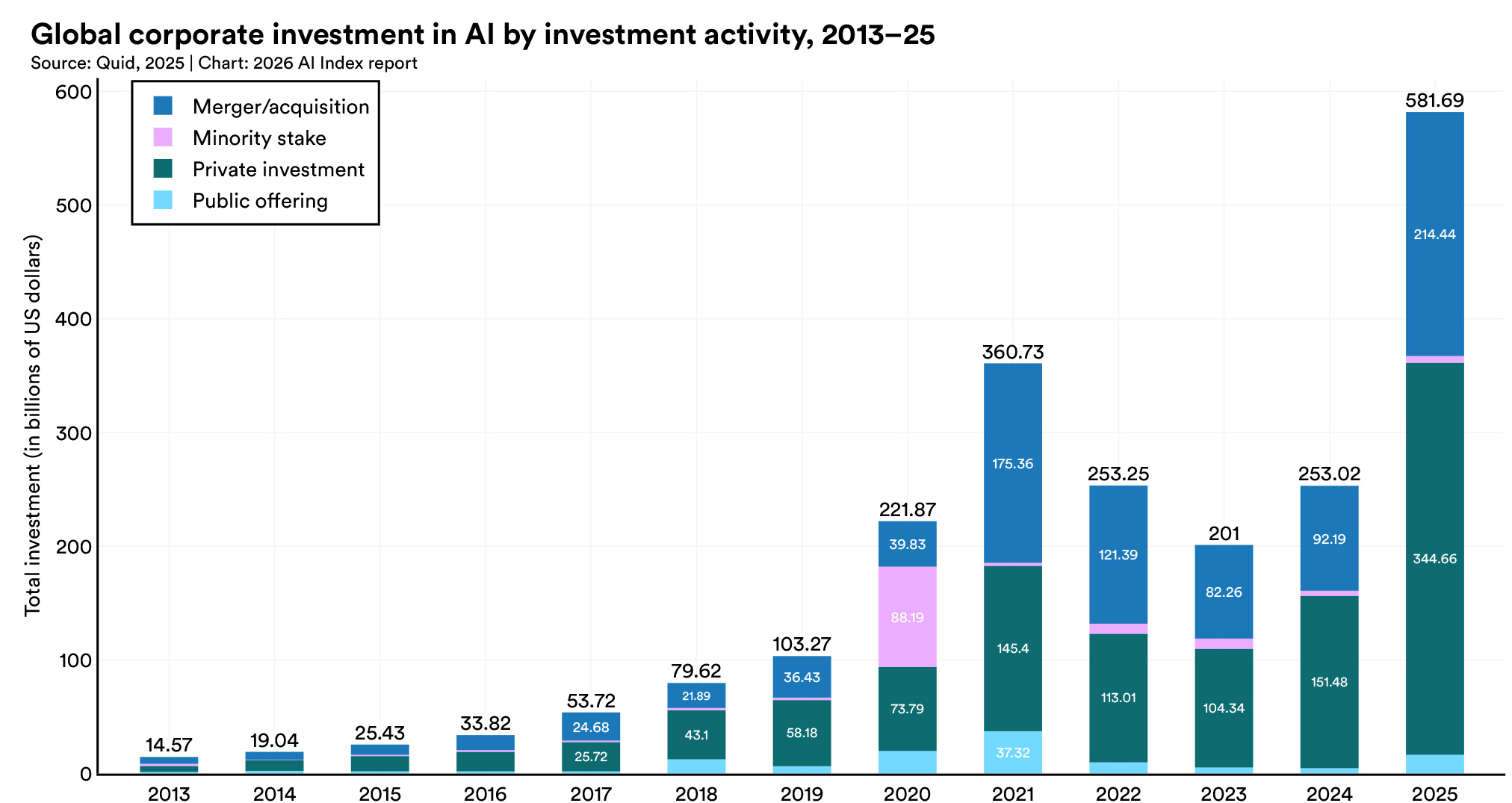
The macro backdrop amplifies the incentive. Capital is flooding into the systems that perform these tasks: global corporate AI investment reached $581.7 billion in 2025, with private AI investment growing more than 127% in a single year and generative AI capturing nearly half of all private funding - Stanford HAI. When that much money is spent making a tool better at codified knowledge work, the tool gets better at codified knowledge work, fast, and the economic pressure to route entry-level tasks through it compounds.
Capital is pouring into the thing that does the tasks
Independent forecasters have tried to quantify the net effect, and their numbers, while contested, point the same way. Goldman Sachs estimated that AI was eliminating roughly 16,000 net US jobs per month over the prior year, the product of about 25,000 jobs a month lost to substitution against 9,000 a month added back through augmentation, with the burden falling hardest on Gen Z workers in routine white-collar roles like data entry, billing, and legal support - Fortune. Goldman also found that a one-standard-deviation increase in an occupation's substitution exposure widens the entry-to-experienced wage gap by around 3.3 percentage points. The substitution-minus-augmentation framing is the same one Stanford uses, arrived at independently, which is part of why the finding has proven durable.
It helps to make the apprenticeship problem concrete, because it is easy to talk about "tasks" in the abstract and miss what is actually being lost. Consider what a first-year role used to consist of before 2023. A junior consultant spent months formatting slides, pulling data, and summarizing documents, and while none of that was glamorous, it was how they absorbed how the firm thought, which analyses mattered, and how partners reached decisions. A junior developer fixed small bugs and wrote tests, learning the codebase one commit at a time. Strip those tasks out and hand them to a model, and the output arrives faster but the learning channel quietly closes. The junior who remains is then expected to exercise judgment they were never given the low-stakes repetitions to build, which is why simply keeping a few junior seats open is not a sufficient answer. The seats have to be redesigned so the human still does the learning-bearing work, with AI handling the drudgery around it rather than the apprenticeship itself.
The uncomfortable implication for workforce planning is that the tasks most exposed today are the tasks companies have historically used to train their juniors. Reviewing contracts, reconciling spreadsheets, writing first-draft code, answering tier-one support tickets: these were never just output, they were the apprenticeship. If AI does them, the output still happens, but the learning does not. That is the deeper cost hiding inside the headcount numbers, and it is why the smartest employers are not celebrating the efficiency but worrying about the pipeline. Before designing a response, though, an honest guide has to give the skeptics their due, because the case against a pure-AI reading is stronger than the headlines admit.
6. The Honest Counter-Case: Is It Really AI?
A responsible reading of this data requires taking the counter-arguments seriously, and there are good ones. The strongest comes from The Budget Lab at Yale, which examined the first roughly 33 months after ChatGPT's launch and found no broad, economy-wide labor disruption attributable to AI: the occupational mix of the US workforce has not shifted meaningfully faster than it did during the arrival of the personal computer or the early internet, and standard exposure metrics showed little relationship to aggregate employment change - The Budget Lab at Yale. Yale and Stanford can both be right: a sharp effect concentrated in one age band and a handful of occupations can be genuinely real while remaining nearly invisible in economy-wide averages. The tension is not necessarily a contradiction, it is a difference in resolution, with Stanford zooming into a slice that Yale's wide-angle lens averages out.
The second objection is macroeconomic. Interest rates rose steeply from 2022, tech companies had massively over-hired during the pandemic, and both forces would independently depress entry-level hiring regardless of AI. Prominent skeptics have pressed this case: Apollo's chief economist has publicly questioned whether an AI jobs crisis exists at all, and some Google economists attribute the young-worker weakness to rates rather than models - Fortune. This is not a fringe view. The 2025 tech layoffs, around 123,000 across the year, were actually lower than 2024's total, which fits a story of post-pandemic normalization more than an AI-driven collapse - Salesforce Ben. A broader read of the labor market supports the caution: hiring and firing rates have both been unusually low, a "no-hire, no-fire" stasis in which employers are simply not opening new positions, and new positions are exactly where graduates enter.
A separate strand of skepticism targets not the timing but the magnitude. MIT's Daron Acemoglu, a Nobel laureate who has studied automation for decades, has argued that AI's near-term productivity effects are far smaller than optimists like Brynjolfsson estimate, which would imply a correspondingly smaller labor-market footprint than a 16% cohort decline suggests. The logic cuts both ways: if the productivity gains from AI are genuinely modest so far, then something other than AI-driven substitution must be doing much of the work in the entry-level numbers, whether that is the rate cycle, the over-hiring correction, or plain weak demand. Reasonable economists disagree here in good faith, and a hiring leader who treats the AI attribution as certain is overreading data that its own authors describe as suggestive rather than dispositive.
There is also a pointed critique of the data plumbing itself. Some analysts note that the ADP sample skews toward service-oriented firms and does not perfectly match the distribution of American employers, and that pairing ADP payroll with an AI-usage dataset associated with the authors' own commercial ventures raises fair questions about independence - Antonio Casilli. None of this makes the finding wrong, but it is the kind of caveat a rigorous hiring leader should keep in view rather than treating a single working paper as settled science. Skepticism about datasets is healthy precisely because administrative data, powerful as it is, always carries the fingerprints of who collected it and why.
Stanford's authors anticipated the interest-rate objection and tested it directly in a February 2026 follow-up. Their rebuttal is that the most rate-sensitive occupations, construction being the classic example, have low AI exposure, while the AI-exposed occupations are on average less interest-rate sensitive, so rate hikes cannot easily produce a gradient that tracks AI exposure specifically - Stanford Digital Economy Lab. Brynjolfsson has been blunt that the pattern is durable: "If you take out the entire tech industry, or slice it different ways, you still get this effect," and, on whether it will reverse, "Whatever it is, it's not going away" - Fortune.
To their credit, the authors also concede where the data is soft. In the same follow-up they acknowledge that when the broadest statistical controls are applied, the AI-exposure decline becomes clearly significant only from 2024, meaning part of the earlier 2022-to-2023 dip is probably driven by factors other than AI, and they state plainly that they "do not believe AI is always and everywhere the sole determinant of employment" - Stanford Digital Economy Lab. That timing concession matters, because it means anyone attributing the entire 2023 graduate slump to AI is overreaching, while anyone denying an AI contribution in 2024 and beyond is ignoring the authors' own strengthening evidence.
Where does that leave a decision-maker? The most defensible position is that AI is a real and growing contributor to the entry-level squeeze, layered on top of genuine cyclical and structural forces, and that its share of the blame has been rising over time even if it was not the whole story in 2023. You do not need AI to be the sole cause to justify changing how you hire. You need it to be a durable, growing cause, and on that the evidence, including the skeptics' own timelines, increasingly agrees. That is enough to act on, which is what employers are already doing.
7. What Employers Are Already Doing
Employers are not waiting for economists to settle the causation debate, and their behavior is itself a data point. The most-cited example is Salesforce, whose CEO Marc Benioff said the company cut roughly 4,000 customer-support roles as AI agents took over, taking that function from about 9,000 people to 5,000 while AI handled half of all support interactions - Fortune. His phrasing, "I need less heads," is exactly the substitution logic the Stanford data implies, applied to precisely the kind of tier-one, codified-knowledge role that used to be an entry point. Support costs at the company reportedly fell 17% as a result, which is the efficiency gain that makes the headcount decision look rational on a spreadsheet even as it removes a rung of the ladder.
Salesforce is not alone in naming AI directly. The 2025 layoff trackers catalogued firms explicitly citing automation as the reason for cuts, from payroll-software maker Paycom trimming roles "due to AI and automation improving back-office efficiencies" to freelance marketplace Fiverr cutting around 30% of staff in an "AI-native" restructuring - TechCrunch. Larger reductions at Amazon, Intel, and Microsoft ran into the tens of thousands, and while those had multiple causes, the willingness of executives to attach AI to the narrative is itself telling. When AI becomes the acceptable public rationale for a workforce decision, it changes the incentives around junior hiring even in firms that have not yet automated a single task.
There is a gap between what firms say and what they do that is worth holding in mind when reading these announcements. Naming AI as the reason for a cut is convenient: it signals technological sophistication to investors, sidesteps the awkward admission of over-hiring, and reframes a cost decision as a forward-looking strategy. Analysts who tracked the 2025 layoffs repeatedly found that "AI made us do it" was often layered on top of ordinary financial pressure and post-pandemic correction rather than driving the cut on its own - Salesforce Ben. For a hiring leader reading competitors' press releases, the practical rule is to weight revealed behavior, the actual shift in hiring mix toward seniority, over stated rationale, because a hiring mix is much harder to spin than a quote. The mix, as Section 4 showed, has moved unmistakably away from the young.
Expectations, not just actions, are shifting. In the 2026 AI Index survey data, roughly a third of organizations expect AI to shrink their workforce over the coming year, with only a small minority expecting AI-driven growth in headcount. The chart below shows the distribution, and the mass sitting on the "decrease" side of the ledger is the number that should shape pipeline planning.
What companies expect AI to do to headcount
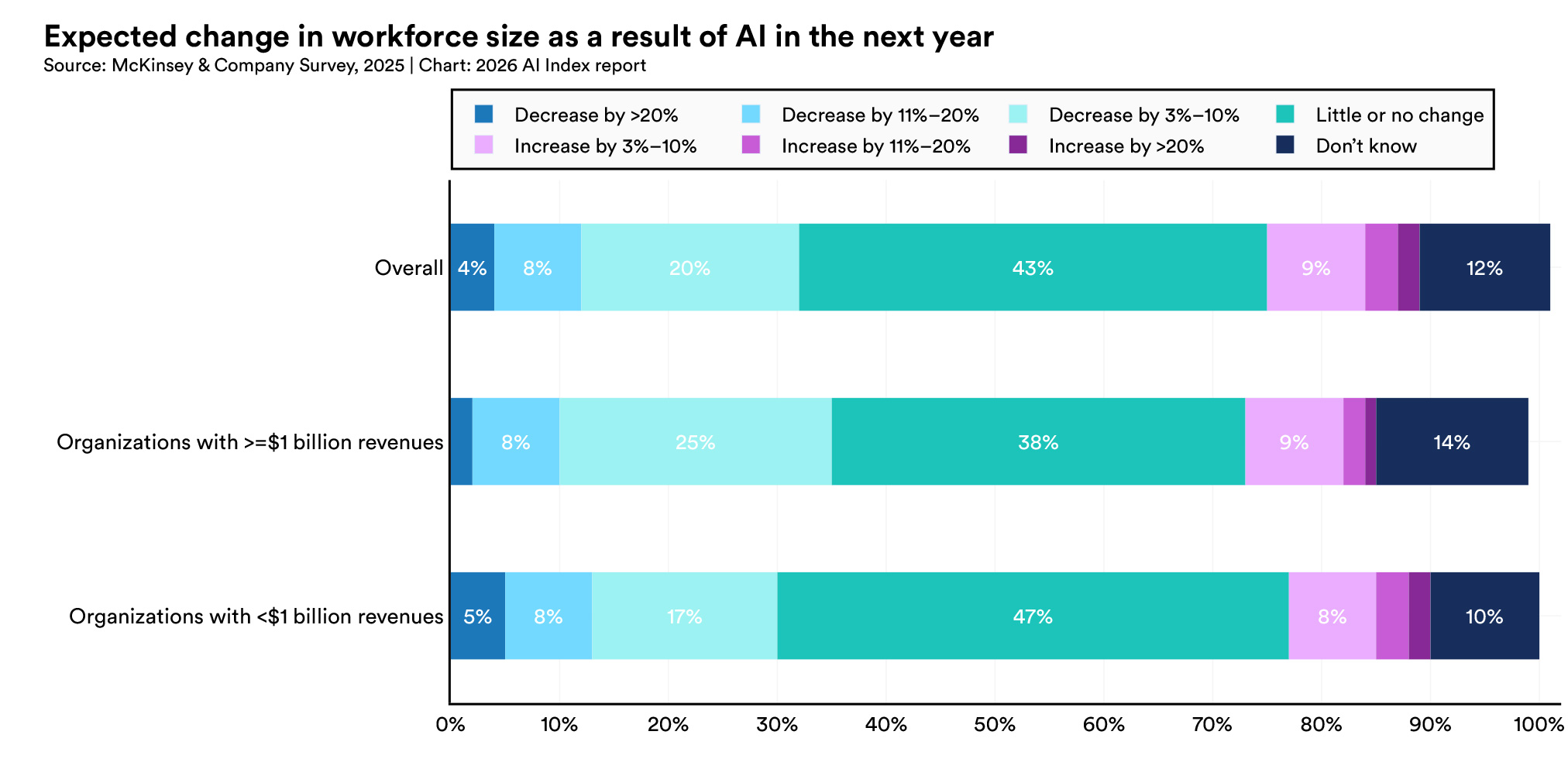
That expectation is landing on top of near-universal adoption, which is why it carries weight. Organizational AI use reached 88% of surveyed organizations in 2025, with generative AI in productive use in at least one business function at roughly 70% of them - Stanford HAI. When almost every company already uses AI somewhere and a third of them expect it to reduce headcount, the entry-level requisition becomes the natural place to economize, because it is the requisition whose tasks overlap most with what the tools already do. None of this requires a dramatic layoff. It just requires quietly not backfilling the junior seat when someone leaves, multiplied across an economy.
At the same time, the loudest predictions have been walked back, which is instructive. Anthropic CEO Dario Amodei warned in 2025 that AI could wipe out half of all entry-level white-collar jobs within five years and push unemployment to 10-to-20% - Marketing AI Institute. That forecast drew heavy criticism as alarmist, and the measured reality so far, a concentrated 16% relative decline in specific roles rather than a 50% wipeout, is far milder than the prophecy. The honest framing for employers is that the near-term evidence supports targeted redesign, not mass elimination, and that planning around the catastrophic forecast would be as much a mistake as ignoring the trend.
The most forward-leaning organizations are drawing a specific conclusion from all this: the failure mode is not hiring too many juniors, it is hiring juniors into roles that AI has hollowed out. If a graduate's job is 80% tasks a model now does, the role will feel redundant, the new hire will not learn, and the headcount will quietly disappear at the next budget review. The fix is to redesign entry-level work around what AI cannot do and to use AI as a training accelerant rather than a replacement. That redesign runs straight into a paradox that is now defining the graduate market.
8. The Experience Paradox and the Broken Career Ladder
The cruelest feature of this market is the experience paradox: employers increasingly want experience for roles that are supposed to build it. Part of this is inflated requirements, with a meaningful share of postings labeled "entry-level" now asking for multiple years of prior experience, but part is pure competition. As of mid-2026, roughly 30% of applications to entry-level postings came from workers with 10 or more years of experience - Indeed Hiring Lab. When a senior worker displaced from one role applies down the ladder, the genuine beginner is not just facing higher stated requirements, they are being outcompeted for the very jobs designed for beginners. The bottom rung is not only shrinking, it is crowded from above.
This crowding creates a vicious loop that is worth naming explicitly. Fewer junior openings push experienced applicants to apply downward, which raises the effective bar on the remaining junior roles, which makes those roles even harder for actual beginners to win, which pushes frustrated graduates into underemployment, which is exactly the 42% underemployment figure from Section 4 showing up as a lived outcome. The paradox is self-reinforcing, and it explains why a graduate can be told simultaneously that the unemployment rate is "only" in the mid-single digits and that they cannot find a job in their field. Both are true, because the aggregate rate hides how contested the entry-level tier has become.
Young workers feel this acutely, and their pessimism is now measurable. In Handshake's Class of 2026 outlook, 61% of graduating students were pessimistic about their careers, and nearly half of those pessimists attributed it at least partly to generative AI, even as more than 80% of them already used AI tools themselves - Handshake. There is a revealing perception gap underneath that number: more than half of hiring managers believe generative AI will ultimately create jobs, against only about a quarter of rising seniors who feel the same way. Students, closer to the entry-level coalface, are markedly gloomier than the managers doing the hiring, and Handshake's own analysts caution that the evidence for AI directly displacing early talent remains "mixed." That split between sentiment and proven causation is itself a caution against overclaiming.
The most useful reframe of the whole problem comes from one of the study's own authors. In a 2026 interview, Bharat Chandar argues the goal is to turn the linear career ladder into a career lattice, where AI functions as a learning accelerant that lets a motivated newcomer reach competence faster and move laterally into value the model cannot provide, rather than a wall that blocks entry entirely. It is the most constructive expert framing available, and it is worth hearing in his own words.
AI Is Killing the Career Ladder: A Stanford Economist Explains What Comes Next
The lattice idea has a concrete hiring implication. If AI can compress the time it takes a new hire to become genuinely productive, then the calculus of hiring juniors changes from "expensive to train, slow to contribute" toward "fast to ramp if paired with the right tools and mentorship." The employers who will win the next decade's talent are the ones that rebuild the bottom rung deliberately: junior roles defined around judgment, client contact, and AI supervision rather than the rote tasks AI absorbed, with the model used as a tutor. A first-year analyst whose job is to check, correct, and direct AI output is learning to exercise exactly the judgment that keeps senior workers valuable, which is the opposite of the hollowed-out role that disappears at the next budget review. That redesign is a hiring-process problem as much as a job-design problem, and the sourcing tools have already started to adapt.
9. How AI Is Changing Entry-Level Sourcing and Screening
The same technology reshaping demand is reshaping how the surviving roles get filled, and this is where hiring teams have the most direct leverage. On the demand side, employers have shifted decisively toward skills-based hiring: in NACE's Job Outlook 2026 survey, 70% of employers now use skills-based hiring for entry-level roles, up from 65% a year earlier, while the share screening candidates by GPA collapsed from 73% in 2019 to just 42% in 2026 - NACE. When a diploma and a transcript no longer signal readiness the way they once did, employers fall back on demonstrated ability, and the screening process moves toward assessments, work samples, and structured interviews. NACE found employers apply skills-based methods most heavily during interviewing, at 87%, and screening, at 65%, which is precisely where an inexperienced candidate can prove capability that a resume cannot convey.
That shift creates a sourcing problem that plays directly to AI's strengths. Finding candidates on the basis of demonstrated skills rather than pedigree means searching a far larger and messier pool than a shortlist of target schools, and that is a scale problem humans cannot brute-force. AI sourcing platforms now index enormous candidate universes and screen on signals a keyword search would miss, which is why the market has filled with autonomous sourcing tools. Among them, platforms such as HeroHunt.ai approach it by using an AI recruiter to search across more than a billion profiles and reach out to matched candidates automatically, rather than making a human recruiter run the search faster. The point is not any single vendor but the category: when the criterion becomes skills, the sourcing has to become AI-scale.
In practice the newest tools compress the old sourcing workflow down to a sentence. Instead of hand-building a boolean search string and paging through results, a recruiter describes the skills and background they need in plain language, the system returns a ranked shortlist, and it drafts and sends personalized first-touch outreach on its own. HeroHunt.ai's RecruitGPT works this way, generating candidate shortlists from a single prompt, while its AI Recruiter handles the outreach autonomously and the platform is free to start. For an entry-level search where the entire objective is to look past pedigree, the value of that automation is breadth: a small team can evaluate demonstrated ability across a pool no manual sourcer could ever read through by hand, which is precisely the reach that a shrinking, pedigree-blind funnel requires. The same capability, aimed at the wrong target, would just filter faster, which is why the objective set by the recruiter still governs the outcome.
There is a real risk here that a careful hiring leader has to manage. If entry-level roles are already scarce and every applicant pool is flooded, with applications per posting surging as openings fell, then leaning harder on automated screening can compound the squeeze, filtering out capable beginners whose potential does not fit a pattern trained on incumbents. Automated video assessments and resume scorers can quietly encode the very "needs experience" bias that is breaking the ladder, because a model trained to predict "looks like our current successful employees" will systematically down-rank the non-traditional candidate who has never held the job before. The tools are powerful, but pointed at the wrong objective they accelerate the problem rather than solving it, so the objective matters more than the tooling.
The failure mode is worth being concrete about, because it is easy to stumble into with good intentions. A team under pressure to cut through a flood of applications reaches for an automated screener, trains or configures it on the profiles of people who already succeeded in the role, and unknowingly builds a filter that rewards exactly the credentials the skills-based movement was trying to move past. The graduate from a non-target school with a strong portfolio but no brand-name internship gets scored down not because they lack ability but because they lack resemblance to the training set. Automating a biased shortlist faster is not progress, it is the same mistake at higher throughput, and it is the single most common way AI hiring tools make the entry-level problem worse rather than better.
Used well, AI in the hiring stack can do the opposite: widen the funnel rather than narrow it. Skills-based sourcing surfaces candidates from non-target schools and non-linear backgrounds that pedigree screening would never see, and AI outreach makes it economical to engage them at scale. A recruiter who used to fill graduate roles from a handful of campuses can, with AI sourcing, evaluate demonstrated ability across a national or global pool, which is exactly the kind of reach that helps rebuild a thinning pipeline. Tools that generate a shortlist from a plain-language description of the skills you need, then handle first-touch outreach, let a small team consider a far broader set of candidates than manual sourcing ever allowed. The technology is neutral. Whether it repairs the bottom rung or removes it depends entirely on what you ask it to optimize for, and that choice sits with the employer, not the model.
10. The 2027 Outlook: Agents and the Shape of the Ladder
Looking ahead, the trend that will most shape entry-level hiring is the move from AI as a tool to AI as an agent that completes multi-step work autonomously. Anthropic's usage data already shows enterprise deployments skewing toward automation rather than assistance, and as agentic systems mature, the set of end-to-end tasks that no longer require a human keeps expanding - Anthropic. The near-term implication is that the categories of entry-level work most exposed today, routine coding, data reconciliation, first-line support, basic drafting, will face more pressure, not less, and that the "collapse" framing is likely to persist through 2027 rather than reverse.
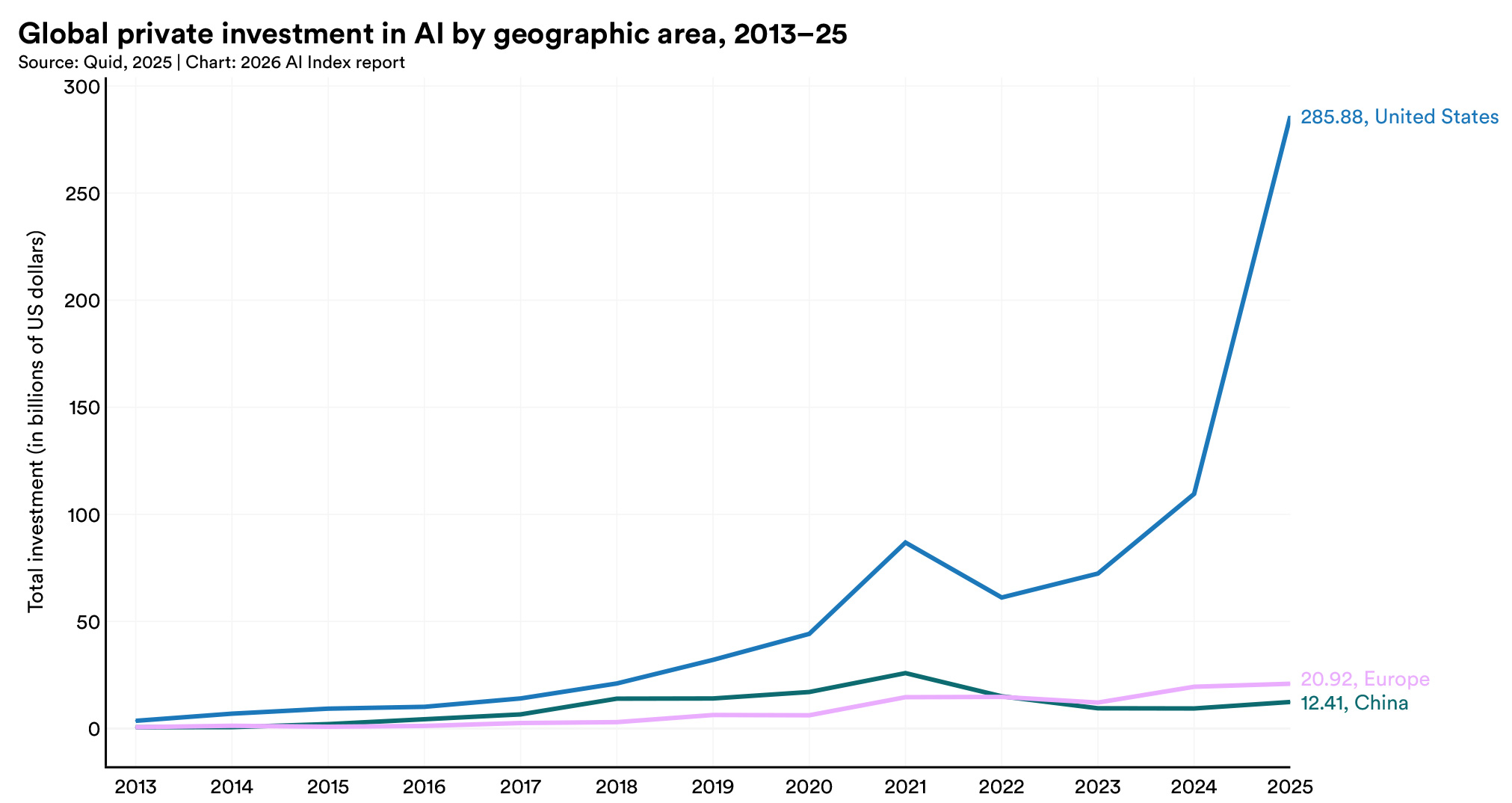
The scale of capital behind that shift is what makes the trajectory hard to bet against. AI investment is not only large but geographically concentrated, with United States private AI investment reaching $285.9 billion in 2025, more than twenty times China's $12.4 billion, and the gap widening rather than closing - Stanford HAI. That concentration of money and talent means the frontier of what agents can do reliably will keep advancing quickly, and the tasks that fall inside the "safely automatable" boundary will keep multiplying. Workforce planning that assumes today's capability boundary is stable will be planning for a world that no longer exists by the time the plan is executed.
The capital behind the automation curve
The optimistic scenario is not that these jobs return unchanged but that new entry points emerge alongside the agents, and history offers some support. Every prior general-purpose technology, from the spreadsheet to the internet, destroyed specific tasks while creating roles that did not previously exist, and the Yale Budget Lab's comparison to the PC and early internet transitions is a reminder that occupational churn is normal and survivable - The Budget Lab at Yale. The plausible new entry-level roles are ones defined around supervising, correcting, and directing AI: agent operators, model evaluators, and the human-in-the-loop reviewers that even highly automated workflows still require. These jobs are genuinely early-career, but they demand judgment about AI output rather than the codified tasks AI replaced, and demand for exactly this kind of expert-in-the-loop work is already visible in the booming market for people who train and evaluate models.
There is a hopeful signal in the postings data too, even amid the weakness. Job postings mentioning AI grew 134% between early 2020 and the end of 2025, and the share of all postings referencing AI hit a record even as overall postings declined - Indeed Hiring Lab. AI-related demand is the one bright spot in an otherwise soft market, which suggests the near-term winners among graduates will be those who can credibly claim to build with, supervise, or evaluate AI systems. The uncomfortable corollary is that the reward is flowing to a specific new skill set rather than to graduates broadly, so the transition genuinely disadvantages the cohort that trained for the pre-AI version of their field.
The scale of that AI-specific demand is easy to underestimate. AI-related skills now appear in roughly 2.5% of all US job postings, a share that has climbed nearly 300% over the past decade, and the growth continued even as total postings softened - Stanford HAI. For a graduate, the practical reading is that the safest entry point is no longer a generic version of their field but a version fluent in the tools reshaping it: the accountant who can supervise an AI-assisted close, the developer who can direct and review agent output, the support lead who manages a fleet of AI agents rather than answering tickets one by one. The field itself is not vanishing, but its entry requirements are being rewritten around AI fluency faster than most degree programs can update their curricula, which is part of why the graduates who trained for the old version feel the ground shifting under them.
Even Goldman Sachs, which quantified a real AI drag, was careful to note that its estimates likely overstate the damage because they do not fully count new hiring in AI infrastructure, data centers, and the productivity-driven demand that follows cheaper output - Fortune. The honest outlook is neither utopian nor apocalyptic: some entry-level roles are gone for good, some are being redefined, and some genuinely new ones are appearing, but the transition is not automatic and it is not painless for the cohort caught in the gap. Betting on either extreme, permanent collapse or effortless reinvention, is a way to be wrong.
For employers, the strategic move is to stop treating entry-level hiring as a cost to minimize and start treating it as a pipeline to protect. The firms that stop hiring and training juniors entirely will save money now and face an acute shortage of experienced talent in five years, when the seniors AI currently complements retire or move on with no one trained to replace them. Brynjolfsson's warning that "we are flying blind into one of the most consequential periods in world history" is really a call for deliberate action rather than passive drift - Fortune. The organizations that build the lattice now will own the talent advantage later.
11. Conclusion: A Decision Framework for Hiring in the Collapse
The Stanford data does not say AI is ending work, and reading it that way leads to bad decisions. What it says, precisely, is that AI has begun substituting for the codified tasks entry-level workers perform, that the effect is concentrated in the youngest cohort of the most exposed occupations, and that it is growing rather than fading - Stanford Digital Economy Lab. Layered on cyclical weakness and post-pandemic normalization, that structural shift has produced a genuine entry-level squeeze, visible in payroll records, unemployment rates, posting volumes, and hiring mix alike. The debate over exactly how much of the blame belongs to AI is real, but it does not change what a hiring leader should do.
The framework is straightforward. First, audit your junior roles by task: if a role is mostly retrieval, summarization, formatting, or first-draft production, assume AI is already competing with it and redesign the role around judgment, client contact, and AI supervision before you open the requisition. A role that survives this audit is one where a beginner still learns something the model cannot do for them, and that learning is the entire point of an entry-level job. A role that fails it will disappear whether you plan for it or not, so better to redesign it deliberately than to watch it erode.
Second, shift screening from pedigree to demonstrated skill, because GPA and school name have lost signal value and skills-based hiring is now the majority practice for good reason - NACE. Work samples, structured assessments, and portfolio review find the capable non-traditional candidate that a transcript filter would miss, and they are more defensible in a market where the traditional signals have decayed. Third, use AI to widen the funnel, not narrow it, sourcing demonstrated ability across a far larger pool rather than automating the same biased shortlist faster, and auditing any automated screener for the "looks like our incumbents" bias that quietly rebuilds the very barrier you are trying to remove.
Fourth, and most important strategically, protect the pipeline. The single worst move available to a company in 2026 is to quietly stop hiring and developing early-career talent, bank the savings, and discover in 2031 that its supply of experienced workers has evaporated. The seniors AI currently makes more productive were all juniors once, and the on-ramp does not rebuild itself. Turning the ladder into a lattice, with AI as an apprenticeship accelerator rather than a replacement, is not corporate altruism, it is talent-supply insurance, and the companies that understand this will be buying that insurance while it is still cheap.
For teams putting this into practice, the tooling choice follows the strategy, not the other way around. Skills-based sourcing at scale is where AI recruiting genuinely helps, and platforms like HeroHunt.ai exist to find and engage candidates from over a billion profiles on that basis, which is exactly the reach a thinning entry-level funnel demands. The collapse is real, the data is credible, and the counter-arguments are worth respecting. But the organizations that read it clearly, redesign the bottom rung, and keep building their pipeline will be the ones with the talent when the dust settles.
This guide reflects the labor-market and AI research landscape as of August 2026. The Stanford figures, unemployment data, and hiring statistics cited here are updated frequently, so verify the latest numbers, particularly the live Canaries Dashboard, before making decisions.