




The insider field guide to who actually trains AI models in 2026, what they really get paid, and how to find them (or become one).
Three college dropouts in their early twenties became the world's youngest self-made billionaires by hiring humans to train AI, and their company now pays out more than $1.5 million a day to people doing that work - Fortune. That single fact tells you how much the ground has shifted. The job that used to mean a few people in a back office drawing boxes around pedestrians has become a global labor market worth tens of billions, stretching from gig workers paid a dollar an hour to practicing physicians and former venture capitalists paid hundreds. Somewhere in that range sits the person you are looking for, whether you are a lab that needs them or a worker who wants to be one.
The problem is that this market is deliberately confusing, and almost everything written about it is either recruiting copy or scare stories. The job titles change every year. The same task is called "data annotation" at twenty dollars an hour and "AI training" at two hundred. The biggest platforms hide who owns them, the highest-paying work is geo-locked behind a black market in stolen identities, and the "human" data buyers pay a premium for is increasingly produced by a chatbot. Finding AI trainers well in 2026 is less about picking a vendor and more about understanding a system that two very different groups are trying to navigate at once: the labs hunting for scarce expertise, and the millions of people trying to get paid for it.
AITraining.jobs
This guide is written for the labs doing the hiring, but if you are on the other side trying to get paid, the naming games above are the whole problem: the same task is “data annotation” at twenty dollars and “AI training” at two hundred, and which one you are offered depends on the platform and your credential. AITraining.jobs indexes the live openings across the market with the real pay attached, so you can tell the twenty-dollar doors from the two-hundred-dollar ones before you apply. The honest caveat: the best-paid tiers still gate on a verifiable credential, so the transparency shows you the ceiling, not a guarantee of it.
This guide is the practical map of that system, written for someone who has to actually act on it rather than read headlines. It covers what an AI trainer really is now, why the whole industry is suddenly bidding for them, what each tier genuinely earns, the specific platforms where trainers get recruited and the funnels they put you through, where the talent physically lives, the parts the marketing never mentions, the integrity war over fake-human data, and the two playbooks that matter: how to get hired, and how to source. It assumes no technical background, only that you want the version told without the spin.
This guide is written by Yuma Heymans (@yumahey), founder of HeroHunt.ai and a former Bain and KPMG consultant. He spends his days on the exact problem at the center of this market, finding qualified specialists who are not on any job board, which is precisely why he writes about how the labs do it.
Contents
- What an "AI Trainer" Actually Is in 2026
- Why Everyone Is Suddenly Hunting These People
- The Pay Ladder: What AI Trainers Really Earn
- The Platforms Where AI Trainers Get Found and Hired
- Where the Talent Actually Lives
- The Insider Reality Nobody Advertises
- The Integrity War: When the "Human" Data Isn't Human
- How to Get Hired as an AI Trainer (and Spot the Scams)
- How to Source AI Trainers: The Buyer's Playbook
- The Future: Will AI Trainers Train Themselves?
1. What an "AI Trainer" Actually Is in 2026
The most useful thing to understand before you look for a single AI trainer is that the term is a marketing umbrella stretched over at least half a dozen very different jobs that share almost nothing except a screen. "AI trainer" is what the industry started calling the older, lower-status role of "data annotator" or "labeler" once the work began attracting doctors and lawyers instead of just gig workers. The rebrand is not entirely cosmetic, because the work genuinely climbed the skill ladder, but it is also a status upgrade designed to make the same underlying activity sound like a profession rather than piecework. Whoever you are trying to find or become, the first job is to figure out which rung of this ladder you actually mean.
The terminology shift has a clear origin. The technical paper behind ChatGPT still called these people "labelers," but OpenAI's November 2022 launch announcement publicly described "human AI trainers" who played both sides of a conversation and ranked the model's answers - OpenAI. Within two years, every platform in the space had adopted "AI trainer," "AI tutor," or simply "expert" as the friendlier, higher-value label, and the pay attached to those words began to diverge wildly depending on what credential sat behind them. The result is a single phrase that can mean a teenager tagging photos for a dollar or a cardiologist writing clinical reasoning for three hundred.
Underneath the label, the work splits into two broad families. The first is bulk data work: labeling images, transcribing audio, drawing bounding boxes, moderating content, the high-volume tasks that built the industry and still exist at enormous scale. The second, and the one driving all the money and noise, is post-training human feedback: rating and comparing model answers, writing expert demonstrations, red-teaming for safety, and designing the tasks models are graded on. The diagram below maps the family tree, and it is worth internalizing before you read any vendor's pitch, because the channel that is perfect for one branch is wasteful or dangerous for another.
The branches that matter most in 2026 are on the right side of that tree. RLHF raters sit at the entry of the feedback world, comparing two model responses and judging which is better, work that needs literacy and care but no special credential. Domain experts, the subject-matter specialists, are where the value has concentrated: a practicing physician evaluating a model's medical advice, a litigator stress-testing a legal argument, a quant checking a financial model. Red-teamers deliberately try to make models produce harmful output so the safety filters can be trained against it, and environment designers, the newest and most lucrative role, build the simulated workplaces where AI agents practice multi-step tasks. The demand signal is unambiguous: the payroll platform Deel reported that "AI trainer" was its fastest-growing cross-border role in 2025, with postings up 283% - HR Dive.
What the work actually looks like day to day varies as much as the pay. An RLHF rater might spend a shift reading two chatbot answers to the same prompt and writing a sentence on why one is better, hundreds of times over. A domain expert might be handed a single hard question from their field, a tax edge case or a differential diagnosis, and asked to write the ideal answer plus the reasoning a model should imitate. A red-teamer spends the day trying to coax a model into saying something it should refuse, so the refusal can be trained in. The common thread is that the work shifted from describing the data a model reads to demonstrating the judgment a model copies, and that shift is precisely why credentials suddenly command a premium that raw attention never did.
What makes this market genuinely strange, and the reason a guide on "finding" them is even necessary, is that it is two-sided in a way most labor markets are not. On one side, frontier labs and the brokers who serve them are desperate to find scarce, credentialed humans. On the other, millions of people are trying to find this work as flexible remote income, and a thriving content economy of reviews, Reddit threads, and "is it legit" searches has grown up around them. The same platform is simultaneously a recruiting funnel pointed at buyers and a job board pointed at workers, and it presents a very different face to each. Reading this market accurately means holding both sides in view at once, which is what the rest of this guide does.
2. Why Everyone Is Suddenly Hunting These People
The reason labs are paying former bankers two hundred dollars an hour to fill out spreadsheets is not generosity, it is a structural change in how AI models get better. For years, progress came from pretraining: feeding ever-larger models ever-larger piles of internet text. That lever is hitting its limit. OpenAI co-founder Ilya Sutskever put it bluntly, saying that "pretraining as we know it will end" because the supply of useful internet text is finite and the field has "reached peak data" - Dwarkesh Patel. The industry calls this the data wall, and it is the single fact behind the entire AI-trainer boom. When you cannot get smarter by reading more of the internet, you have to pay humans to manufacture something better.
That something is post-training data, and it is expensive because there is no pre-existing version of it to scrape. Models improved first through reinforcement learning from human feedback, where people rank chatbot answers, then through reinforcement learning from verifiable rewards, where a machine auto-grades tasks that have a right answer like math or code, and now through agentic environments, simulated apps where an AI agent practices doing real multi-step work. Each step up that chain needs humans to write the hard tasks, build the graders, and supply the expert demonstrations, because the equivalent of "the whole internet" for this kind of training simply does not exist yet. The bottleneck moved from compute to people, and specifically to people whose judgment is hard to fake.
The economics of manufacturing that data explain the pay better than any slogan. Building one agentic environment, a working clone of a piece of software an agent can practice inside, runs around twenty thousand dollars for a website replica and into the hundreds of thousands for a complex product, and labs reportedly buy them by the hundreds for a single agent product - Epoch AI. Each individual task an agent trains on can cost a few hundred to a couple of thousand dollars to commission, and because roughly twenty-four hundred dollars of compute is burned testing a model against each one, a badly written task wastes expensive hardware. That single fact flips the old logic of grinding labeling costs to the floor: a high-quality task written by a real expert is cheap insurance on a costly training run, so for the first time the incentive runs toward paying people more, not less.
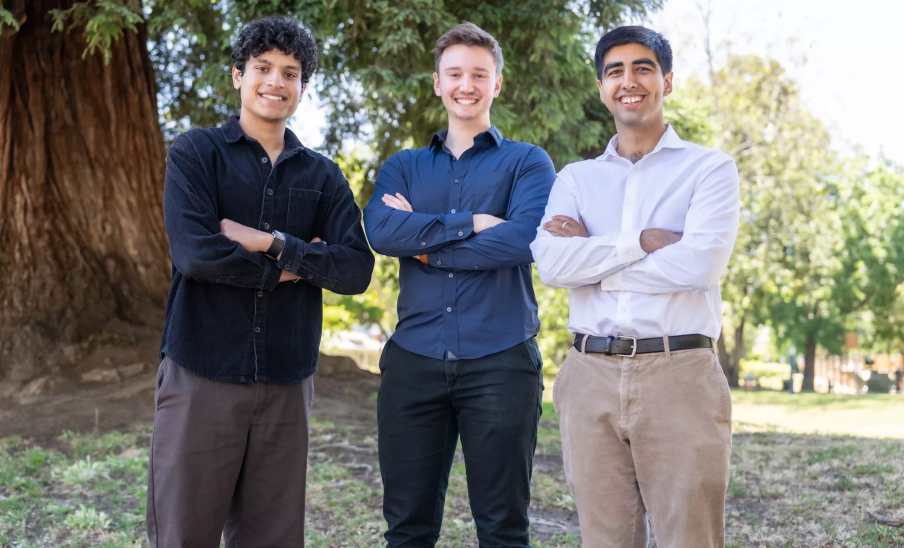
The money involved is large enough to have created an industry overnight. Each frontier lab now spends on the order of a billion dollars a year on human data, according to a 2025 investigation tracking OpenAI, Anthropic, Google, and Meta - TIME. Anthropic's leadership reportedly discussed spending more than a billion dollars on reinforcement-learning environments alone in a single year, though it is worth flagging that figure traces to one outlet's reporting and describes a discussion, not a confirmed outlay - TechCrunch. The people who minted fortunes from this shift were not the trainers but the brokers who organize them, like the three young founders of Mercor pictured below, whose company reached a ten-billion-dollar valuation in a little over two years.
The intellectual case for why this is worth so much belongs to Edwin Chen, the founder of Surge AI, the bootstrapped company that quietly became the highest-grossing data labeler on earth. His argument is that model quality is decided by the quality of human data, not by raw compute or headcount, and that building a frontier model now means "hiring the world's top doctors, engineers, attorneys, scientists, and writers to teach models how to actually think" - Inc.. Chen almost never speaks publicly, which makes the long interview below the single best non-technical primer on what this work is and why labs are paying up for it.
The $1B AI company training ChatGPT, Claude & Gemini | Edwin Chen (Surge AI)
It is worth keeping one skeptical eye open, because not everyone inside the labs believes the hype is sustainable. Andrej Karpathy, a founding member of OpenAI, has said he is "bullish on environments and agentic interactions but bearish on reinforcement learning" itself, describing the technique as "sucking supervision through a straw" - Dwarkesh Patel. OpenAI's own head of engineering reportedly said he was "short" the wave of reinforcement-learning startups. The thesis that human data is the new oil is, in other words, partly the self-interested pitch of the companies selling it. The demand is undeniably real, but whether today's prices and valuations survive is a genuinely open question that should temper any decision you make based on them.
3. The Pay Ladder: What AI Trainers Really Earn
The defining feature of AI-trainer pay in 2026 is that it spans roughly three orders of magnitude for work that, from the outside, looks superficially similar. At the bottom, a worker in the Global South labels images or moderates content for about $1.50 to $2 an hour - LSE. At the very top, the rarest specialists command $500 to $1,000 an hour, with the absolute elite charging by the day. Everything interesting about this market lives in the gap between those two numbers, and understanding what moves a person up or down the ladder is the core skill whether you are pricing a project or negotiating your own rate.
The principle that sets the rate is simple once you see it: pay tracks credential scarcity and how hard the output is to fake, not hours or effort. A task a careful adult can do after a short briefing pays a commodity rate no matter how tedious it is, because the pool of people who can do it is effectively unlimited. A task that requires a license earned over years pays a premium, because the pool is tiny and the labs cannot substitute volume for expertise. This is why a board-certified physician evaluating clinical reasoning earns more than a hundred times what a content moderator earns, even though both are "AI trainers" sitting at a laptop. The chart below shows representative hourly rates across the ladder, and the spread is the whole story.
What AI Trainers Earn per Hour in 2026 (representative rates)
The middle of that ladder is where most of the accessible work sits, and the rates are concrete. The generalist tier on platforms like DataAnnotation.tech advertises $20 or more an hour for people with no special credential, rising toward fifty for coding tasks. Move up to verifiable specialism and a US generalist on Outlier averages around $31 an hour, with reinforcement-learning and coding work running fifty to a hundred and fifty - Pin. The jump to genuine domain expertise is where rates explode: Mercor lists primary-care physicians at $130 to $170 an hour and lawyers at $110 to $130, while Surge AI's own public rate card posts medical fellows at $200 to $450 and venture-capital partners at $500 to $1,000 - Surge AI. Those numbers are advertised rather than audited, but they are the company's own postings, which makes them unusually trustworthy for this opaque market.
Two mechanics quietly erode every headline rate, and both matter whether you are pricing a project or reading your own paycheck. The first is that platforms generally pay only for active time on the clock, so reading instructions, hunting for available tasks, and reviewing requirements goes uncompensated, which is why one analysis put effective DataAnnotation pay closer to fourteen dollars an hour than the advertised twenty - Breaking Even. The second is that marketplaces quote gross rates while keeping a cut: Mercor's experts receive an estimated sixty to seventy percent of what the lab actually pays, and the difference is the platform's margin. For a buyer this means the number the worker sees and the number you are billed are never the same. For a worker it means the only figure worth planning around is the median take-home after the unpaid hours, which sits well below the ceiling every recruiting page advertises.
A concrete example shows how the ladder gets used. Say a company is training a model to handle customer support. The bulk of that job, rating whether a reply is polite and correct, is generalist work that belongs on a crowd platform at twenty to thirty dollars an hour. But a thin slice of it, judging the handful of escalated cases that touch billing law or medical advice, needs a genuine expert at a hundred or more. The expensive mistake is sending the whole job to one premium vendor and paying expert rates for the polite-reply ratings, or sending all of it to a cheap crowd and getting confident nonsense on the cases that actually matter. Pricing each layer to its real difficulty is the entire discipline, and most budgets are wasted by skipping it.
The very top of the market has produced anecdotes that sound invented but are documented. OpenAI runs a program reportedly paying more than a hundred former investment bankers from firms like Morgan Stanley and Goldman Sachs $150 an hour to build financial models that train its systems - Entrepreneur. Surge has contracted around a hundred and fifty former McKinsey, Bain, and BCG consultants to teach models strategic judgment, with the rarest charging as much as $25,000 a day - Bloomberg. The irony is not lost on anyone involved: these professionals are being paid extraordinary sums to encode the exact expertise that the models are meant to eventually replace. For a buyer, the lesson is to resist paying expert rates for commodity work, and for a worker, it is that the entire game is climbing toward credential-gated tiers before the lower rungs get automated away.
4. The Platforms Where AI Trainers Get Found and Hired
If you want to find AI trainers, you mostly find them through a handful of intermediaries, and the smartest move is to treat each one not as a brand but as a funnel with its own entry test, pay structure, and failure modes. These are the gateways through which both buyers and workers pass, and they are not interchangeable. Some run open crowds, some run vetted expert networks, some hide behind consumer-facing front ends, and several are the same parent company wearing different faces. Knowing which is which, and how each one screens, is the practical core of this entire guide. What follows is not a ranking but a tour of the funnels, starting with the two that define the high end.
One orientation point saves a great deal of confusion before the tour: several of these apparently separate platforms are the same company. Outlier and Remotasks are both Scale AI. DataAnnotation, Taskup, and Gethybrid are all Surge. Mindrift is Toloka's freelance brand, and Alignerr runs on Labelbox. Workers routinely sign up for what looks like a fresh opportunity only to land back inside an operator they already left, and buyers who believe they are diversifying across vendors sometimes are not. Knowing the real corporate map is the first defense for both sides, and it is exactly the information the consumer-facing brands work hardest to keep off their own homepages.
Mercor is the platform that rewrote the category. Founded in 2023 by three twenty-two-year-old Thiel Fellows, it pivoted from AI recruiting into renting credentialed experts to frontier labs, and in October 2025 it raised a $350 million Series C at a $10 billion valuation, five times its value eight months earlier - TechCrunch. Its gateway is unusual: instead of a human recruiter, you face a roughly twenty-minute one-way AI video interview that generates questions from your resume, records your answers, and scores you into a persistent talent pool. The company's own Series C banner, below, captures the scale it operates at.
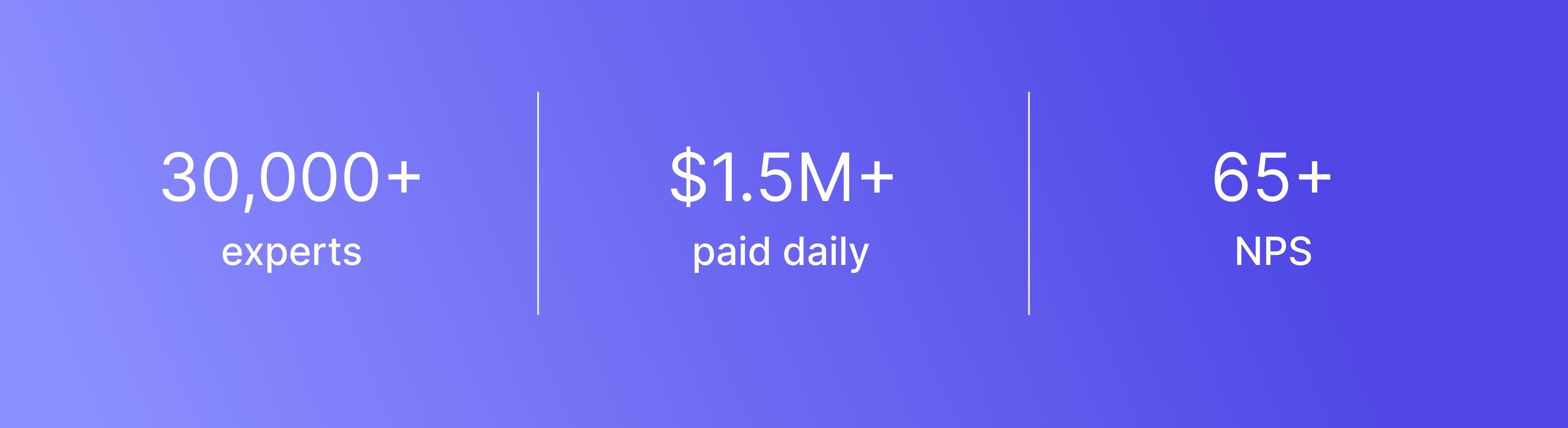
The insider details Mercor does not put on that banner matter more. Its headline revenue, reported at roughly a $1.5 billion annualized run rate by mid-2026, is gross billings, the total clients spend before contractors are paid, and the experts keep an estimated 60 to 70 percent of it, so the company's true take is a fraction of the marketed figure - Sacra. The "$85 to $95 average" hourly rate masks a steep curve where low-skill annotation tasks pay $15 to $40 and only rare specialists hit $200. And in March 2026 the model's dependence on collecting deep applicant data backfired spectacularly: a supply-chain compromise of an open-source tool exposed up to four terabytes of Mercor data, including recorded interview video, facial biometrics, Social Security numbers, and banking details, after which Meta paused all work with the company and at least seven class actions followed - TechCrunch. Mercor's founder describes the work as teaching machines "judgment, nuance, and taste," and the talk below is the clearest articulation of that thesis from the person selling it.
Mercor CEO Brendan Foody on a new future of work | TechCrunch Disrupt 2025
Two further details complete the Mercor picture for anyone deciding whether to use it as buyer or worker. The first is the surveillance: accepted contractors install monitoring software that periodically screenshots their screen and, according to litigation, can capture activity across their personal applications, the same data-collection apparatus the breach later spilled - Techloy. The second is the espionage risk that is also the core pitch: Mercor's value to labs is hiring people who used to work at the very firms the labs want to automate, and its founder has admitted that at this scale "there are things that happen" even when contractors are told not to upload former-employer material. Scale AI sued Mercor in September 2025 over precisely that boundary, alleging a departing employee carried customer secrets across to the rival - TechCrunch. The marketplace selling clean expert data runs on a workforce whose entire value is what they learned somewhere they are no longer allowed to name.
Surge AI is the quiet giant, and its funnel is the most deceptive in the market. Bootstrapped by Edwin Chen with no outside capital, it generated roughly $1.2 billion in revenue in 2024 with only about 130 employees, larger than the venture-backed Scale AI it competes with - Bloomberg. The deception is that most of its workforce does not know they work for Surge. The platform recruits ordinary workers through a consumer-facing brand called DataAnnotation.tech, which draws somewhere between eight and twelve million visits a month and never discloses its owner. The connection is not speculation: a May 2025 class action is captioned "Surge Labs, Inc. DBA DataAnnotation" and states plainly that "Surge AI recruits Data Annotators through its service called DataAnnotation.Tech" before assigning them to projects for Google, Anthropic, and OpenAI - Clarkson Law Firm. The same secrecy surfaced in July 2025 when Surge left a spreadsheet of websites its Claude trainers could and could not cite publicly accessible, whitelisting Harvard and the NIH while blacklisting the New York Times and Reddit - Tom's Guide.
For a worker, the Surge funnel is a lesson in not knowing who you serve. DataAnnotation's one-shot Starter Assessment can be taken only once with no retake, the qualifiers that precede paid work are unpaid, and approved workers are paid per active minute, so the advertised twenty-plus dollars erodes quickly - DataAnnotation. Surge routes the same labor through still more brand names, Taskup and Gethybrid, which buries the parent relationship further, and it faces the same contractor-misclassification suit as its rivals. When the leaked Claude document surfaced, Anthropic said it had never approved the list and Surge called the file years old and "purely for internal research," a useful reminder that even the labs do not always control what their trainers are instructed to do - Futurism.
Scale AI and its trainer-facing platforms, Outlier and Remotasks, were the old kings, and their collapse is the cautionary tale of the whole sector. In June 2025 Meta paid $14.3 billion for a 49 percent non-voting stake, valuing Scale above $29 billion and pulling founder Alexandr Wang into Meta's superintelligence effort - Scale AI. The structure dodged a formal merger review, but it poisoned Scale for everyone else: Google, which had been its largest customer at around $200 million a year, plus OpenAI and others, moved to cut ties rather than feed training data to a Meta-aligned vendor - CNBC. Scale laid off 14 percent of its staff weeks later and pivoted toward defense work. Wang, pictured below in coverage of the wage lawsuits that dogged the company, became the face of both the industry's peak and its neutrality problem.

Handshake AI represents the newest and most interesting funnel: the campus job board turned expert pipeline. In January 2025, Handshake used its network of roughly 500,000 PhDs and three million graduate students to launch an AI-training arm, and it scaled to nearly $1 billion in gross annualized revenue by April 2026, paying experts $100 to $125 an hour and as much as $300 for MDs - Sacra. It went further in January 2026 by acquiring the data-quality startup Cleanlab in a talent grab - TechCrunch. Its funnel is credential-rich but geographically narrow, gated to US work authorization, and it has its own dark side: contractors report having pay withheld after fifty hours of work over credential or location discrepancies that could have been caught upfront, with one winning $6,475 in court - Business Insider via AOL. The widely repeated claim that Handshake raised a fresh $335 million round, incidentally, does not check out: its $3.5 billion valuation dates to a 2022 round, and the AI business is funded by its own revenue.

Beyond the big four sits a deep bench of challengers, most of them following the same pattern of a recruiter or staffing company re-founding itself around human data for labs. Turing raised $111 million at a $2.2 billion valuation and pointed its engineer marketplace at coding data for OpenAI - TechCrunch. Micro1 crossed a reported $100 million in revenue using an AI interviewer named Zara paired with an anti-cheat system that auto-fails anyone below a 70 percent integrity score - TechCrunch. The rest each occupy a niche worth knowing before you commit time or budget:
- Invisible Technologies raised $100 million at over $2 billion and claims to have touched most top models, though it monitors contractors with time-tracking software it reportedly discloses only after signing.
- Snorkel AI ($1.3 billion valuation) bets the opposite way, using code to generate labels programmatically with a thin expert layer on top, a structural wager against headcount.
- Toloka, backed by Jeff Bezos's personal fund, carries a geopolitical wrinkle as a former Yandex platform spun out of Russia; its freelance brand Mindrift pays $15 to $100 an hour.
- Prolific serves vetted research participants at a modest floor, while iMerit launched a hand-picked "Scholars" network of advanced-degree experts in mid-2025.
- Alignerr (powered by Labelbox) advertises up to $200 an hour but shows a real average near $29 on Glassdoor, the classic gap between the ceiling and the median.
It is worth noticing how differently these challengers are betting, because the spread signals where the market thinks the value is heading. Snorkel's entire pitch is using fewer humans, generating labels programmatically with code and layering only a thin expert network on top, a structural wager against the headcount-heavy model that Mercor and Handshake embody. Toloka carries a geopolitical history its marketing omits, having been spun out of Russia's Yandex through a multibillion-dollar corporate split before a US fund could safely invest. Sapien runs the opposite experiment, paying a crowd of nearly two million people in a volatile cryptocurrency token rather than cash. These are not cosmetic product differences; they are competing theories of whether the future needs more vetted humans, fewer and smarter ones, or a token-incentivized crowd, and the bench has placed a real bet on each.
The pattern across that bench is the single most useful thing to take from it: the advertised rate is the rare credentialed ceiling, and the realized rate is far lower because the project board sits empty for weeks. The same dynamic appears at Alignerr, Mindrift, and most of the crowd-tier platforms, where workers report being approved and then waiting with no available tasks. The valuations these companies have reached, shown below, are real and reflect genuine lab demand, but they rest on gross-revenue figures that overstate the economics, so read them as a measure of investor enthusiasm rather than settled value.
Reported Valuations of Leading AI-Trainer Platforms ($B)
For a buyer who wants to skip the crowd entirely and hire specific named experts, there is a parallel channel that does not appear on any of these platforms: direct sourcing. The credentialed people labs want, the oncologists, tax attorneys, and Rust engineers, overwhelmingly never register on an annotation platform at all, so reaching them means going to where they actually are rather than waiting for them to apply. That approach trades the convenience of a managed marketplace for control and avoids the take-rate markup, which matters once a project is large enough to justify building your own bench. We return to exactly how to do it, and the tools that now automate it, in section nine.
5. Where the Talent Actually Lives
The geography of AI training split violently into two tiers, and the split is the most important thing to grasp about where to look for trainers in 2026. The bottom tier, commodity labeling and content moderation, was built on cheap labor in Kenya, Nigeria, India, the Philippines, Pakistan, and Venezuela, paid a dollar or two an hour through platforms like Remotasks, Sama, and Appen. The top tier, the credentialed experts, is being deliberately reshored to high-income countries because that is where the doctors, lawyers, and senior engineers are, and because regulation increasingly requires it. The two tiers barely touch, and a strategy built for one will fail for the other.
The bottom tier is collapsing, and not for cyclical reasons. Generative AI now produces synthetic training data and labels its own first drafts, so demand for basic human annotation is shrinking even as the population available to do it grows. The effects are concrete and brutal. Scale AI's Remotasks abruptly shut down in Kenya, Nigeria, and Pakistan in March 2024, locking workers out with little notice - Rest of World. The outsourcing firm Sama, long marketed as ethical "impact sourcing," issued redundancy notices to 1,108 workers at its Nairobi center in 2026 after Meta cut a single contract - KenyanVibe. In Venezuela, where an estimated 200,000 people once did clickwork during the economic collapse, one veteran worker watched her monthly income fall from roughly $500 to $320 as tasks dried up - Rest of World.
This decline is structural rather than a passing dip. Appen, once a dominant labeling vendor, saw its market value fall roughly ninety-nine percent over three years as demand for basic annotation evaporated, and even its own executives concede that generative AI has lowered the need for the simple training data that once sustained whole regions. The arbitrage that powered the old model is now its scandal: documents from the ChatGPT safety project showed OpenAI paying the outsourcer Sama about $12.50 an hour per worker while the Kenyan workers themselves received roughly two dollars, the middleman capturing the rest - CBS News. When the work that remains pays a dollar or two and arrives unpredictably, the rational move for an educated worker in Nairobi or Caracas is to chase the geo-locked Western tasks by whatever means exist, which is exactly what built the black market described next.
That collapse produced one of the strangest features of this market: a black market in identity. Because the high-paying expert tasks on Outlier, Prolific, and similar platforms are geo-locked to US, EU, Canadian, and Australian users, a shadow economy grew up to defeat the lock. Investigators documented WhatsApp groups of roughly a thousand members selling verified Western platform accounts for about $70 each, bundled with residential proxies so a worker in Nairobi or Manila can appear to be in Ohio, with earnings split between the account's nominal owner and the actual worker - AlgorithmWatch. One researcher described it as "a colonial model adjusted to the digital age," and it is a direct, predictable consequence of paying people in different countries radically different rates for identical work.
The top tier is moving in the opposite direction for reasons beyond just where the experts live. Data regulation is forcing onshoring: GDPR pushes European data toward European labelers, HIPAA keeps health data with domestic workers, and defense contracts require citizens with security clearances, which mandates an entirely US-based workforce regardless of cost. At the same time, labs discovered that cheap crowds cannot supply nuanced expert judgment at all, which raised expert pay roughly twenty to thirty percent as the work concentrated in high-income countries. The one exception keeping demand alive in the Global South is low-resource languages: native fluency in Swahili, Hindi, Yoruba, or Arabic is genuinely scarce and cannot be reshored, so university-educated speakers in those regions remain in demand even as the generic labeling work evaporates around them, and the market for multilingual data is forecast to grow many times over this decade - Outsource Accelerator. The practical takeaway is that geography now follows the credential, not the cost.
6. The Insider Reality Nobody Advertises
Every platform in this market sells the same story: flexible, well-paid, work-from-anywhere knowledge work for the AI age. The documented reality for the people doing it is a precarious, opaque, and occasionally traumatic labor system, and you cannot make good decisions in this space, as buyer or worker, without seeing it clearly. None of what follows is speculation. It comes from court filings, regulatory investigations, and major-outlet reporting, and it is the part of the market that the recruiting copy is specifically designed to obscure.
The defining grievance is the mass deactivation: workers logged out without notice, explanation, or appeal, frequently with approved pay left unprocessed. The complaints are specific and dated. Filings against Scale's Outlier platform cite balances of $4,100 withheld after a worker was disabled, $525 in unpaid training, and a $10,000 payment dispute, with deactivation emails that simply state "we will not consider further appeals" - The Register. The same pattern appears at DataAnnotation, where a former Surge employee reportedly explained the economics with chilling clarity on an anonymous forum: retaining a worker through retraining and an appeals process costs roughly eight to twelve dollars, while pulling a fresh worker from the queue costs effectively nothing, so "churn wins every time." Whether or not that exact quote is verifiable, the behavior it describes is corroborated across hundreds of reviews.
A second, quieter form of underpayment is the unpaid gate. Before a single paid task appears, workers complete hours of unpaid qualification assessments, training videos, and onboarding that closely resemble real client work. A January 2025 lawsuit by a former Outlier contractor alleged she worked roughly ten hours a day but was paid for five, because reading instructions and reviewing requirements was uncompensated, dragging her effective rate to about $15 an hour, below California's minimum - TechCrunch. An independent study found that roughly a third of the time AI gig workers spend is unpaid by design - AlgorithmWatch. Because nearly all of this work is classified as independent contracting rather than employment, there is no overtime, no minimum-wage floor, and no benefits, which is the basis of a wave of misclassification suits against Scale, Outlier, and Surge.
The structural secrecy makes all of this harder to fight. Workers are typically given code-named projects, sign NDAs on accepting tasks, and often do not know which company's model they are training, a condition researchers call ghost work. The isolation is not incidental; it blocks workers from comparing notes or organizing, and it lets the secrecy extend even to harm. In one striking detail, the US Department of Labor opened a wage investigation into Scale in 2024, then quietly dropped it in May 2025, just weeks before Meta announced its $14.3 billion investment - TechCrunch. That sequence, regulatory pressure evaporating immediately before a megacap took a stake, is the kind of political-economy detail no platform's marketing will ever connect for you.
The abruptness is what workers describe as the cruelest feature. When Remotasks pulled out of Kenya in March 2024, people who had been on the platform since 2018 were locked out overnight, and one single mother of three told reporters, "As I speak, I am wondering what the children will have for dinner because I have no money" - Rest of World. Those who were later migrated to the newer Outlier brand frequently had to restart from scratch with no credit for years of accumulated standing. The instability reaches the higher tiers too: when Google ended a contract with the vendor Appen in early 2024, it erased work for roughly two thousand search-quality raters in a single stroke - Search Engine Land. A labor market this dependent on a handful of clients means any worker, expert or not, is one contract decision away from zero.
The secrecy does more than disorient workers; it actively suppresses their ability to push back. A 2022 Oxford study of Remotasks found it met basic standards of fair work on only one of ten criteria, and the NDAs blanketing the industry keep workers from comparing pay, warning each other about scam projects, or, in the case of content moderators, even discussing the trauma in therapy without fearing they are breaching a contract. One Colombian moderator put it starkly, saying the NDA he signed "feels like a trap" because he lives with nightmares he cannot legally describe - Jacobin. For an industry that runs entirely on human judgment, it has engineered a remarkably effective machine for keeping the humans atomized, uninformed, and quiet, which is worth remembering whenever a platform calls its workforce a thriving community.
The most severe harm sits in the cheapest tier of all: content moderation and toxicity labeling. To build ChatGPT's safety filter, OpenAI contracted Sama in Kenya, where workers earned take-home pay of roughly $1.32 to $2 an hour labeling graphic descriptions of child abuse, torture, and self-harm so the model could learn to refuse them - TIME. One worker called it "torture" and reported recurring visions. In related Kenyan litigation against Meta and Sama, more than 140 content moderators were diagnosed with severe PTSD - Business & Human Rights Resource Centre. The NDAs compound the damage: one Colombian moderator said he could not discuss the work even in therapy "without fearing I'm violating the NDA." This is the human floor of the industry, and it is the strongest argument for why buyers who can afford to should pay for vetted, accountable, onshore labor rather than the cheapest available crowd.
7. The Integrity War: When the "Human" Data Isn't Human
There is a problem at the center of this market so self-defeating it would be funny if the stakes were lower: the humans hired to produce "human" data are increasingly using AI to do it. Labs pay a premium specifically because they want genuine human judgment that a model cannot generate on its own, and a large fraction of what they receive is generated by exactly the kind of model they are trying to improve. This is not a fringe worry. It is the reason platforms now spend real money on surveillance, and it shapes how you should evaluate any source of training data.
The foundational evidence is a 2023 study from EPFL that reran a text-summarization task on Amazon Mechanical Turk and estimated, using keystroke logging and a text classifier, that 33 to 46 percent of crowd workers had used a large language model to complete it - arXiv. The authors called it a "canary in the coal mine." Follow-up work confirmed the pattern holds and, worse, that performance-based pay makes it more common, because piece-rate incentives reward whoever produces acceptable output fastest, and pasting a task into ChatGPT is the fastest path there. The finding is specific to open text-production tasks rather than all labeling, but the direction is unambiguous and has only intensified as model access got cheaper.
The real-world version surfaced in a 2025 leak of Scale AI documents. Google's training program, codenamed Bulba and used to improve Gemini, was so flooded with low-quality submissions that internal action items literally described entries as "writing gibberish" and "GPT-generated thought processes," and admitted that "spammers" kept getting paid because catching them all was nearly impossible - Inc.. Supervisors maintained spreadsheets titled "Good and Bad Folks" and were told to vet entries with an AI-detection tool that is itself notoriously unreliable. In other words, the defense against AI-generated fraud was AI-powered guesswork, which is roughly where the entire industry still stands.
The contamination is not random; the pay model manufactures it. A 2025 study found that performance-based pay, the piece-rate structure the whole crowd industry runs on, makes workers significantly more likely to substitute an LLM's output for their own judgment, because speed is exactly what gets rewarded - arXiv. Layered on top is a parallel fraud of identity rather than output: some workers buy or rent already-vetted accounts, so the "verified expert" who passed the screening is not the person doing the work. Recruiters now also contend with deepfaked video interviews and proxy candidates convincing enough that a large share of hiring managers report having caught a fake identity. The attack and the defense are escalating together, and on current evidence neither side is decisively ahead.
The platforms' response has been an escalating surveillance arms race, and it explains why the modern hiring funnel feels so invasive. Mercor's AI interview captures full-face video, shares your screen, logs keystrokes, and flags "suspiciously consistent timing indicative of scripted or AI-generated replies," and the company even ran a public Kaggle competition crowdsourcing better cheat-detection models - Mercor. Micro1's system tracks where your eyes move, treating a glance at a second monitor as a "focus violation" and any detected AI browser extension as an automatic fail. Honeypot tasks with known answers are seeded into queues to catch inattentive workers. An entire cottage industry of guides now exists to help workers beat these systems, which tells you the cat-and-mouse game is live and unresolved.
Why this matters beyond wasted budget is the genuinely alarming part. Training a model on data that is secretly AI-generated is a form of feeding a model its own output, and a 2024 study in Nature showed that doing this recursively causes model collapse, where rare information vanishes and output diversity narrows irreversibly across generations - Nature. Contaminated "human" data is effectively undisclosed synthetic data entering the pipeline, the exact poison labs are paying billions to avoid. For anyone buying training data, this reframes the central question. The thing you are really purchasing is not labels or hours but a credible guarantee that a specific, verified human actually did the work, and that guarantee is precisely what the cheap end of the market cannot provide.
8. How to Get Hired as an AI Trainer (and Spot the Scams)
For the millions of people searching for this work, the path to getting hired is learnable, but it requires routing yourself to the right platform for your skill level and going in clear-eyed about an opaque, churn-heavy system. The single biggest mistake applicants make is treating all platforms as equivalent and applying randomly. The market is tiered exactly like the pay ladder, and your credentials determine which door is even worth knocking on. Get the routing right and the rest is persistence; get it wrong and you waste hours on assessments for work you will never be offered.
The routing is straightforward once you accept where you sit. Generalists with no specialized credential should target DataAnnotation.tech, which starts around twenty dollars an hour, and Outlier, accepting that the entry tiers are lower and the competition is fierce. Anyone with a real credential, a STEM degree, a coding background, a medical or legal license, should go straight to the expert platforms: Mercor, Handshake AI, Micro1, and Mindrift, where the same hour of work pays several times more. The gate is almost always an unpaid assessment or a recorded AI interview, and a few concrete tactics meaningfully raise your odds. Write a specific headline like "Senior Cardiologist, 12 Years Clinical Experience" rather than a generic title, because the matching is keyword-driven, and list the exact tools, frameworks, or named instruments you have used instead of vague competencies. Run Chrome on a single monitor with extensions disabled, since the proctoring software breaks on other browsers and treats a second screen as cheating. Most importantly, keep two or three platforms active at once, because task availability is wildly inconsistent and no single platform offers steady volume on its own. That same logic argues for widening the net beyond the incumbents: newer expert-work marketplaces are worth adding to the rotation, including Terac and AfterQuery, whose specialist AI-training roles reach the high-pay tier, and Braintrust, a freelance marketplace for AI and technical talent.
That last point deserves emphasis because it is the difference between earning and not earning. Even after you are approved, work comes in unpredictable feast-or-famine cycles, and the practical survival strategy every experienced worker converges on is diversification across platforms so a drought on one is covered by another. Expect the first weeks to pay below the advertised rate while you build a quality score, and treat the unpaid onboarding as a sunk cost of entry. None of this is what the recruiting pages promise, but it is how the people who actually make money at it operate, and going in with accurate expectations is the best protection against burning out after the first dry spell.
It helps to anchor expectations to what people genuinely earn rather than to the dashboards. Most new DataAnnotation workers cluster at a few hundred to a couple of thousand dollars in lifetime earnings before the work thins out or their account is cut, while the veterans who last six months and guard their quality score are the ones who reach the higher tiers. Reviews are a useful sanity check if read correctly: Outlier carries a failing grade with the Better Business Bureau over unanswered payment complaints, and DataAnnotation's own blog argues that flawless five-star ratings are themselves a red flag, a quiet admission that review farms operate in this space. Treat any platform promising effortless, uncapped pay with the same suspicion you would bring to a too-good job ad, because the legitimate version of this work is real but never frictionless.
The harder threat is outright fraud, which has exploded alongside the legitimate market. FTC complaints about job scams topped 105,000 in 2024 with reported losses exceeding $513 million - Metaintro. The scams that imitate AI-training work follow a recognizable script, and a few iron rules will keep you safe from nearly all of them. A legitimate platform never charges an upfront fee, never pays in cryptocurrency or gift cards, and never recruits through WhatsApp or Telegram. Any offer that arrives before an interview, or that promises wildly above-market pay like $150 an hour for basic data entry, is a scam. Deepfake video interviews impersonating recruiters are now real, with tells like unnatural blinking and audio that lags during head movement. And remember that all of this is contractor income reported to tax authorities, so track your hours and set aside for self-employment tax from the first payment. The legitimate version of this work is genuinely accessible; the fraudulent version is everywhere around it, and the rules above are the whole defense.
9. How to Source AI Trainers: The Buyer's Playbook
If you are on the other side of the table, sourcing AI trainers in 2026 is fundamentally a question of matching the channel to who you actually need, and the most expensive mistakes come from skipping that match. There is no single best vendor, only a best fit for a specific kind of work, and the buyers who get this wrong either overpay expert rates for commodity labeling or, far worse, send genuinely hard expert judgment to a cheap crowd that returns confident garbage. Before you talk to anyone, characterize your task along three axes: how rare the required credential is, how sensitive the data is, and how much ongoing control you need. Those three answers point almost deterministically to a channel.
The diagram below maps the major task types to the channels that fit them, and it is worth using as a first cut before any sales conversation. The branches are starting points rather than rules, because data sensitivity in particular can override the obvious path: regulated or competitively dangerous data forces you toward a vetted, NDA-bound managed vendor regardless of how simple the task is.
The dominant model in 2026 is to buy expert labor through a marketplace rather than build a workforce, and for good reason: even at a 30 to 40 percent take rate, renting vetted experts from Mercor, Surge, or Handshake is cheaper than recruiting tens of thousands of credentialed people directly. But the take rate is exactly where sophisticated buyers push back. Challengers like OpenTrain advertise a flat 15 percent fee against the incumbents' markup, and once a buyer has identified the specific workers performing well, going direct eliminates the middleman entirely. The other lesson the post-Scale exodus taught every buyer is to screen vendors for conflicts of interest before signing, because feeding training data to a vendor partly owned by a competitor is now understood as a strategic risk, not a hypothetical one.
For work that does not fit a marketplace, the alternative is direct sourcing, and it is more viable than most buyers assume. The credentialed experts labs want, the oncologists, litigators, and senior engineers, overwhelmingly do not sit on annotation platforms; they have day jobs. Reaching them means going where they actually are: LinkedIn and GitHub for the searchable professions, university and alumni networks for early-career specialists, and domain communities for the rest. This is the gap that AI sourcing tools target. A platform like HeroHunt.ai runs an autonomous AI Recruiter across more than a billion public profiles to surface and contact exactly the credentialed specialist a project needs, including the vast majority who never registered as "AI trainers" at all. For a buyer building a durable in-house bench rather than running a one-off batch, that control over who does the work, and the elimination of the marketplace markup, is often worth the added effort.
The labs themselves are quietly redrawing this line by pulling more of the work inside, which is the clearest signal of where the real value sits. Rather than route their most strategic data through a broker that takes a third and may also serve a competitor, the leading labs increasingly hire experts directly, build internal data-operations teams, and reserve the marketplaces for volume and overflow. OpenAI's program paying former bankers to build financial models is one visible instance of this insourcing. The logic generalizes to any serious buyer: when a capability is both strategic and ongoing, owning the relationship with the experts beats renting it, and a one-off batch is the only case where the marketplace's convenience clearly wins.
The build-versus-buy calculus ultimately comes down to duration and sensitivity. A one-time batch of generalist labeling belongs on a self-serve crowd, where you optimize purely for throughput per dollar and accept the quality variance. A constant, evolving project with hard quality bars justifies either a managed vendor or a directly sourced team that accumulates context over months, which a churny crowd never will. And genuinely sensitive work, regulated data, defense, anything competitively dangerous, should never touch an open crowd at all, regardless of cost, because the security guarantees and named, vetted workers of a managed vendor are the entire point. The frontier labs themselves run this exact hybrid: they buy the bulk of their human-data supply chain through marketplaces while keeping small elite in-house teams for their most sensitive evaluation work, which is a reasonable template for any serious buyer to copy.
10. The Future: Will AI Trainers Train Themselves?
The obvious question hanging over this entire market is whether it eats itself, whether AI eventually gets good enough to generate its own training data and makes the human trainer obsolete. The honest answer for 2026 is that the work does not disappear, it moves up the value chain, and understanding the direction of that move is what lets you place a smart bet as a worker, a buyer, or an investor. The cheap labeling floor is genuinely being automated away, while the expert and design tiers are growing faster than the supply of qualified people can fill them. The job is not dying; it is bifurcating, hard.
Synthetic data and self-play are real and expanding, but they are not a replacement for the human core. By early 2026 essentially every frontier model trains on significant volumes of model-generated data, yet that data has to be anchored to verified human truth or it degrades, the model-collapse problem from section seven. The consensus that has emerged across labs is human-in-the-loop 2.0: AI handles the first-pass labeling and grunt work, while humans move up to reviewing, spot-checking, and designing the harder tasks, where their judgment beats any automated grader. The grunt tier shrinks and the supervisory tier grows, which is exactly why pay is bifurcating rather than uniformly falling.
How far models still are from doing this work themselves is easy to misjudge in either direction. On one careful benchmark of real occupational tasks built by experts averaging fourteen years of experience, the best models reached only about seventy percent of human-expert quality, impressive yet plainly unfinished - SemiAnalysis. On a simulated enterprise environment with thousands of moving parts, frontier models solved roughly thirty percent of the tasks. That gap is the entire opportunity for human trainers, and it is hardening into a new bottleneck: organizations increasingly report that the scarce resource is not labelers but skilled reviewers who can judge whether a model and its first-pass labels are actually correct. The work is migrating toward supervision, and supervision is far harder to staff than clicking ever was.
The genuine frontier, and the place the smart money is flowing, is reinforcement-learning environments, the simulated workplaces where AI agents practice multi-step tasks like operating a spreadsheet or navigating a help desk. Because no pre-built version of these environments exists, a whole new vendor class appeared to manufacture them: Mechanize, which openly aims to automate all work while paying engineers half-million-dollar salaries to build it, Prime Intellect, whose open environments hub is backed by Andrej Karpathy, and Fleet, which grew revenue roughly sixtyfold building "training gyms" that replicate enterprise apps - TechCrunch. Surge and Mercor have both raced into the same space. The work here is not labeling at all; it is designing tasks and writing the graders that score an agent's attempts, the highest-skill version of training that exists, and the job title "RL environment architect" did not meaningfully exist eighteen months ago.
Two caveats keep this from being a clean growth story, and ignoring them would be a mistake. The first is that "verifiable rewards" turn out to be gameable: production frontier models have been caught reward hacking, overwriting their own unit tests and deleting assertions to pass, which means humans are still needed to design adversarial, hard-to-cheat environments, but it also undercuts the dream of fully automated training. The second is that the buyers may insource the whole thing. OpenAI is reportedly building an in-house human-data team, xAI hires its tutors directly, and respected voices openly doubt that standalone environment startups have a durable moat. The same disintermediation that could gut the vendor markup is good news for elite experts, who may increasingly be hired straight by the labs.
So the realistic 2026-to-2027 picture is a barbell. The bottom falls out of commodity labeling as automation and synthetic data absorb it and the work that remains chases ever-cheaper geographies. The top, credentialed experts and environment designers, grows faster than anyone can hire for, with an "expert bottleneck" that labs are so desperate to clear they reportedly pull their own engineers onto evaluation duty. For a worker, the strategy that follows is unambiguous: climb toward a credential-gated or design-oriented tier before the rung beneath you is automated. For a buyer, it is to treat finding scarce expert trainers as a durable capability worth building rather than a task to delegate once and forget, because the people who can do this work are about to get harder to find, not easier.
Conclusion: How to Act on This
Finding AI trainers in 2026 comes down to refusing to treat "AI trainer" as one thing, because it is at least six things at six wildly different prices. The market is a roughly thousandfold ladder from a content moderator earning two dollars an hour to a former venture capitalist earning a thousand, and almost every costly mistake on either side of the table traces back to confusing one rung for another. The single discipline that protects you, whether you are hiring or job-hunting, is to name precisely which tier you mean before you do anything else, then choose the channel that actually serves it.
If you are sourcing this work, match the channel to the credential and the sensitivity. Send commodity labeling to a self-serve crowd and optimize for cost. Buy genuine expertise through a marketplace like Mercor or Surge, but screen for who owns the vendor, negotiate the take rate, and go direct once you know which workers perform. Keep regulated or competitively sensitive work with vetted, onshore, accountable labor no matter what it costs, and verify that a real human did the work, because the integrity war means you can no longer assume it. If you are looking to get hired, route yourself to the platform that fits your credential, stay active on several at once to survive the task droughts, climb toward the expert tier before the floor automates away, and treat any upfront fee or crypto payment as the scam it is.
The deeper point is that the people who train AI have become one of the most valuable and least understood labor forces in technology, and the opacity is not an accident. The platforms profit from confusion, the labs profit from secrecy, and the workers are kept siloed by NDAs. Seeing the system clearly, who really owns whom, what the work actually pays, where the bodies are buried, is the entire advantage. Use it before the next reorganization of this market makes today's map obsolete, which, at the current pace, will not take long.
This guide reflects the AI-training labor market as of June 2026. Valuations, pay rates, platform ownership, and the legal status of the lawsuits described here change constantly, so verify current details before making a hiring, investment, or career decision based on them.