




The playbook for reaching people who are not looking, in a year when almost nobody is.
The quits rate has been stuck at 2.0% for most of a year, its lowest sustained level since 2020 and roughly a third below the 2022 peak - Indeed Hiring Lab. That single number is the whole story of sourcing in 2026. When people stop volunteering to change jobs, the applicant pool empties of the talent worth hiring, and the only way to fill a role becomes reaching someone who was not looking. That is what passive candidate sourcing is, and in a frozen market it stops being a nice-to-have and becomes the job.
Here is the trap most teams fall into. The market feels busy. Every posting is buried under hundreds of applications, inboxes are full, and it looks like talent is everywhere. It is not. The volume is noise from active seekers and auto-apply bots, while the engineers, clinicians, and operators you actually want are sitting still, three months into "I will wait and see," and they will never appear in your applicant tracking system on their own. A frozen market does not shrink the talent pool. It moves the good part of it behind a wall of silence, and sourcing is how you get past the wall.
This guide is the insider version. It covers what the frozen 2026 market actually looks like in hard numbers, why the best people are passive right now and what that does to their psychology, the proven tactics that still move a reply rate when cold outreach is collapsing, every serious platform and what it costs, and how AI sourcing agents are changing the economics of the whole thing (including where they quietly make it worse). It is written for a non-technical reader who has to make real decisions about where to spend a tight budget.
HeroHunt.ai
Passive sourcing in a frozen market is fundamentally an outbound problem: the people you want are not applying, so something has to search for them, qualify them, and open a conversation. That is the exact job an AI recruiter is built for, which is why HeroHunt.ai belongs at the top of this guide. It runs natural-language search across roughly 1.2 billion public profiles, screens each candidate against your brief with language models so a rejected person comes back with a readable reason, and automates personalized, multi-channel outreach. It is free to start and metered on open positions rather than per seat, which fits a lean team carrying a few precious reqs. The honest caveat: it finds and contacts people, it does not do the human reassurance a nervous, risk-averse passive candidate needs to actually move, and it is the wrong tool if your real problem is triaging inbound volume rather than generating outbound. Use it to build a durable pipeline you own, not to replace the recruiter relationship that closes the hire.
Contents
- The frozen market in numbers
- Why the best talent is passive right now
- What passive sourcing really is in 2026
- The economics of outreach have inverted
- The passive-sourcing playbook for a frozen market
- The established sourcing platforms and what they cost
- The AI-native shift: agentic sourcing and autonomous outreach
- How AI agents are actually changing the field
- Where passive sourcing fails in 2026
- The compliance map for AI-driven sourcing
- Building a passive-sourcing engine: a 30-60-90 plan
- The 2026-2027 outlook
- A decision framework
1. The frozen market in numbers
The 2026 labor market is best described by the phrase the Federal Reserve itself now uses: low-hire, low-fire. Hiring, quitting, and firing are all depressed at the same time, a rare configuration the Cleveland Fed has formally named and studied - Federal Reserve Bank of Cleveland. In June 2026 the hires rate sat at just 3.4%, the quits rate at 2.0%, layoffs at a contained 1.1%, and total openings had drifted down to 7.4 million. Nothing is moving. Employers are not adding people and not shedding them, so the churn that normally puts good candidates into circulation has largely stopped.
Why this matters for sourcing is direct: when voluntary movement collapses, your inbound applicant flow stops representing the market. It fills instead with people who have no choice but to be active, which is a very different population from the people you want. Fed Chair Jerome Powell described the balance bluntly, calling it "an unusual and uncomfortable kind of a balance where people who don't have jobs will have a hard time breaking in" - St. Louis Fed. The people breaking in are not your senior hires. Your senior hires are employed, comfortable enough to stay, and invisible to a job board.
The macro backdrop explains why the freeze set in. Employers announced 1,206,374 job cuts in 2025, up 58% year over year and the highest annual total since 2020, while planning only 507,647 hires, the weakest hiring intent since 2010 - Challenger, Gray & Christmas. A survey of more than 350 public-company CEOs found 66% planning to freeze or cut hiring through the rest of 2026, most of them betting AI tooling would absorb the work instead - Fortune. This is a deliberate freeze, not a cyclical dip, and it is not thawing quickly.
To hear the macro premise explained by an economics desk rather than a vendor, this Reuters segment lays out the "no hire, no fire" dynamic that underpins everything below.
Is the Labor Market Still Stuck in No Hire, No Fire Mode?
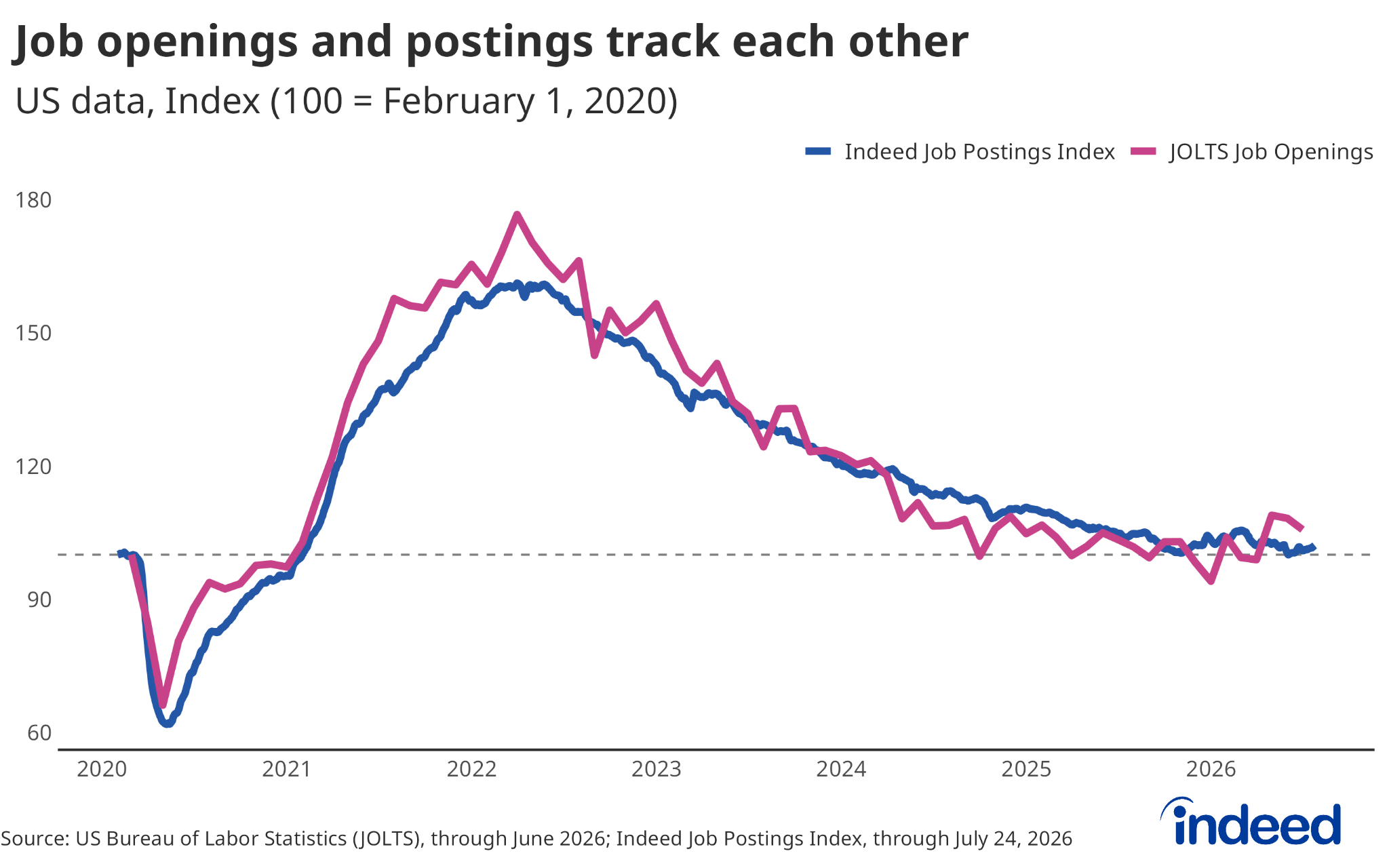
The freeze is not evenly distributed, and where it bites hardest is exactly where sourcing budgets are largest. White-collar and knowledge-work payrolls have contracted for roughly 29 straight months, pushing professional unemployment up to about 4.2% from 3.1% a year earlier, an unusual inversion in which office roles are weaker than blue-collar ones - Revelio Labs. The entry level has been hollowed out fastest: entry-level postings are down roughly 35% since early 2023 as AI absorbs the routine work that used to launch careers - Metaintro. The result is a market that looks calm on the surface and is deeply stuck underneath. The chart below, indexing openings and postings to their 2020 baseline, shows how far the air has come out since the 2022 peak.
The freeze also slows everything down, which quietly raises the cost of every open role. Average time-to-hire has climbed to about 44 days and has risen for four straight years, with roughly 60% of organizations reporting a longer hiring cycle - Management.org. A longer cycle is not a neutral inconvenience in a frozen market: every extra week a req stays open is another week a competitor can reach the same passive candidate, and it compounds the pressure to build a pipeline before the role opens rather than wait for the right applicant to show up. When roles take longer to fill and the applicant flow is low-signal, the math tips decisively toward sourcing proactively.
One more number sets up the rest of the guide. The average US opening now draws roughly 242 applications, about double the count of five years ago, which works out to a success rate near 0.4% per applicant - The Interview Guys. That flood is real, but it is the wrong flood. It is people who are between jobs or applying to everything, not the quiet senior operator you actually need. Understanding that gap, between the noise of the active market and the silence of the passive one, is the entire premise of proactive sourcing, and section 2 explains why the silence runs so deep.
2. Why the best talent is passive right now
The defining fact of 2026 is that the best people are staying put out of fear, not satisfaction, and that makes them both more passive and more reachable than usual. This is "the Great Stay," and the data behind it is stark. First-year employee turnover collapsed from 23.7% in 2024 to 12.1% in 2025, a nearly 49% drop across 6,640 employers - Employ Inc.. Turnover at public companies fell from 21.2% in 2023 to 15.9% in 2025, and average tenure climbed a full year - Pave. People are "job hugging," and the quits data confirms it held at 2.0% for month after month - BLS JOLTS.
Here is the part that matters for a sourcer, and it is counterintuitive: staying put is not the same as being content. Gallup's late-2025 data found 51% of US workers are either actively looking (11%) or watching for opportunities (40%), the highest share of would-be movers since 2015, yet only 28% think it is a good time to find a quality job, down from nearly 70% in mid-2022 - Gallup. The appetite to move is enormous and the confidence to act on it is gone. That 40% who are "watching but not applying" is the passive pool, and it has never been larger or more open, it just will not raise its hand.
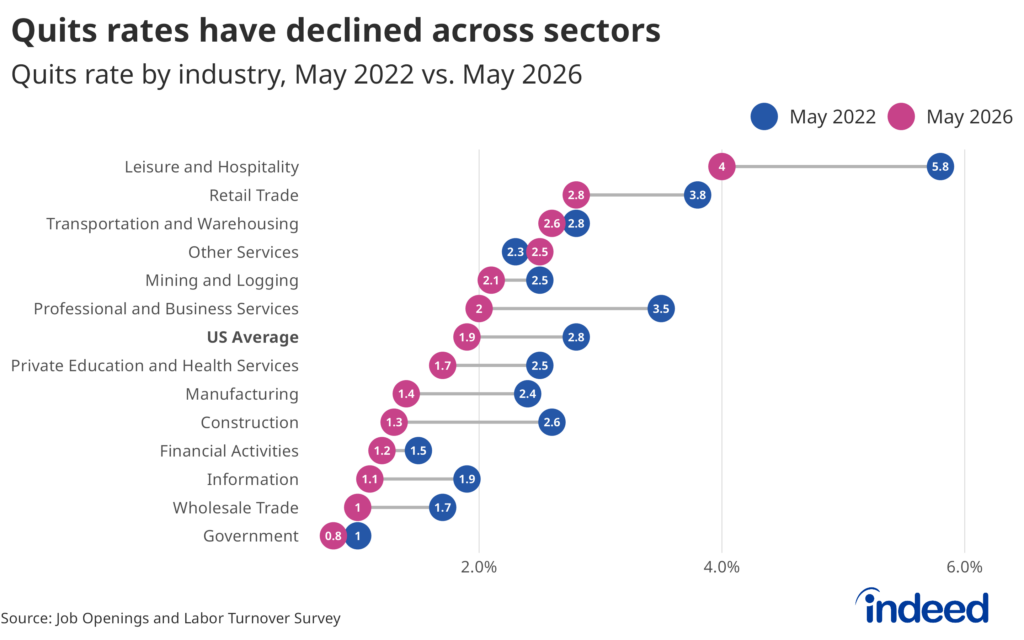
The psychology is worth sitting with because it changes how you write to these people. Gallup found 30% of workers feel "stuck" and 43% say they stay mainly because leaving would be too costly or difficult, with most citing the risk of losing current pay or the difficulty of finding a comparable role - Gallup. Confidence indices confirm the mood: Glassdoor's Employee Confidence Index hit a record low in July 2026, with just 43.5% of employees positive about their company's six-month outlook - Glassdoor. A passive candidate in 2026 is not a happy incumbent you have to seduce away. They are an anxious one you have to reassure and de-risk, which is a completely different outreach message.
That reframing changes the words you use. LinkedIn's Workforce Confidence Index fell to its lowest reading since the survey began, with 52% of workers saying a desired job would be hard to get - Forbes. Writing to that person, the message that wins leads with reassurance and specifics rather than hype: name why you are reaching out to them in particular, be concrete about stability and scope, and make the first step tiny and low-commitment, a fifteen-minute call rather than an application. The payoff for getting the tone right is large, because the quality of this pool is exceptional: SignalHire's 2026 research found 73% of top performers are open to a new role despite not searching - SignalHire. The best people are reachable. They just need the anxiety answered first.
Layer on the structural shift in who is even available. AI is compressing the entry level: a Stanford and ADP study of 4.6 million workers found employment for 22-to-25-year-olds in the most AI-exposed jobs shrinking about 3.8% per year, while older workers in the same roles grew - Fortune. New graduates now make up just 7% of Big Tech hires, more than half below 2019 levels - SignalFire. Employers are "seniorizing" roles, so the durable, experienced talent you most want to source is exactly the cohort least likely to be visible or active. The takeaway compounds: the passive pool is bigger, higher quality, more anxious, and more senior than in any recent year, and none of it is coming to you.
3. What passive sourcing really is in 2026
Passive sourcing is the practice of proactively identifying, contacting, and building relationships with people who are not applying to your jobs, and in 2026 it is the majority of all serious hiring. LinkedIn's long-running research classifies roughly 70% of the global workforce as passive at any moment, with only about 30% active, which means a job board, by definition, can reach at most a third of the market - Pin. In a normal year that third is workable. In a frozen year, when the active third is thinned to the people who cannot avoid being active, sourcing the other 70% is not a supplementary channel. It is the channel.
The distinction that trips teams up is between sourcing and recruiting. Recruiting processes people who have already entered your funnel; sourcing creates the funnel from scratch by going out and finding people. The reason it produces better hires is not folklore, it is measurable: sourced candidates are nearly 8 times more likely to be hired than inbound applicants, and outbound sourcing accounts for about 11% of hires from just 2.6% of applications - Gem. A sourced conversation starts with intent and relevance on your side. An inbound application starts with a stranger and a 0.4% base rate. The unit economics of the two are not close.
A concrete version makes the gap tangible. Picture two ways to fill one senior role. The inbound path posts the job, collects 242 applications, and a recruiter burns days screening a pile in which roughly one in 200 will get an offer, most of them active seekers who applied to fifty other companies the same week. The sourced path identifies twelve people who already do the exact job at comparable companies, none of whom applied anywhere, and opens a genuine conversation with each. The first path optimizes for volume and gets noise; the second optimizes for fit and gets a shortlist. In a frozen market the second path is not merely higher quality, it is frequently the only one that produces a hire at all, because the people who would actually say yes are simply not in the applicant pile.
What passive sourcing is composed of, mechanically, breaks into a few durable activities:
- Identification - finding the right people through search, referrals, and your own database
- Enrichment - getting a real contact channel (email, phone, or a warm intro)
- Outreach - a personalized, multi-touch message sequence across channels
- Nurture - staying in relevant contact with people who are not ready yet
Those four verbs have not changed in a decade, but the weight has shifted hard toward the ends. Identification is being transformed by AI natural-language search, and nurture has become the highest-yield activity of all because it is the only reliable way to keep a warm audience when cold response is collapsing. The middle two, enrichment and the first cold touch, are where most of the automation and most of the failure now live, which is the subject of the next section.
The practical reframe for a frozen market is this. Stop thinking of sourcing as "finding candidates for this req" and start thinking of it as "owning a relationship with a segment of the market before you need them." The teams that win in 2026 are not out-searching everyone. They are the ones a passive candidate already recognizes when the message lands, because a frozen market rewards the recruiter who was in the inbox six months early, not the one who showed up cold on the day the role opened. Everything in the playbook below is built on that shift.
4. The economics of outreach have inverted
The single most important operational fact of 2026 is that cold outreach has stopped working at volume, and any strategy that ignores this will burn budget for nothing. An estimated 89% of recruiter outreach messages now go unanswered, up from roughly a 23% response rate in 2020, as saturated inboxes and AI-generated sameness erode replies - SupportFinity. Passive candidates in high-demand fields report receiving 10 to 30 recruiting messages a week, and 72% say they simply ignore anything that reads as templated or mass-sent. The channel did not get more expensive. It stopped converting.
This is a multi-year secular decline, not a blip, and the trend line is unambiguous. Cold email reply rates have fallen from about 8.5% in 2019 to roughly 3.4% in 2026, and LinkedIn InMail reply rates have slipped below 10% - Martal. The chart below traces the collapse. What makes it dangerous in a frozen market is the feedback loop: because inbound is weak, teams pour more into outbound; because everyone pours more into outbound, candidates get buried; because candidates get buried, response rates fall further; which makes teams send even more. Volume is the disease, not the cure.
Cold email reply rate has fallen for years
There is a second inversion hiding underneath the first. While real job-switching is frozen, application volume has exploded because AI auto-apply tools let one seeker fire off hundreds of submissions, with LinkedIn now processing roughly 11,000 applications per minute, up about 45% year over year - CNBC. So the recruiter's world is simultaneously louder and quieter: drowning in low-signal inbound while the high-signal passive candidate gets harder to reach. This is why "just post the job and screen harder" fails in 2026. The signal you want is not in the pile.
It helps to make the loop concrete, because it explains why last year's tactics keep underperforming. A recruiter who got a 12% reply rate on a clean InMail template in 2023 reuses it in 2026 and gets 4%, concludes the problem is volume, and triples the send. Every other recruiter chasing the same scarce passive engineers does exactly the same thing, so that engineer's inbox goes from three recruiter messages a week to twenty, and the reply rate to any single one falls further. The template did not break because it was bad. It broke because it became one of twenty near-identical messages, and the only escape from that trap is to stop competing on volume and start competing on relevance, which no amount of extra sending can buy.
The strategic conclusion writes itself, and it is the thesis of the whole playbook. When volume stops working, precision is the only lever left. Every credible 2026 benchmark points the same way: the returns now come from reaching fewer, better-matched people with genuinely personalized, multi-channel, well-timed outreach, and from building owned audiences you do not have to reach cold at all. The recruiter who sends 500 generic InMails is not just wasting time, they are actively degrading the channel for their own next campaign. The one who sends 40 sharp, personal, well-sequenced messages to a pre-warmed list is the one filling roles. Section 5 is how to be the second recruiter.
5. The passive-sourcing playbook for a frozen market
The winning playbook in 2026 inverts the old order of operations. Instead of starting cold on the open market, you start with the warmest audiences you already own and work outward, spending your scarce personalization budget only where the base rates justify it. The logic is simple: in a market where a cold stranger replies 3% of the time, the entire game is finding people who are not strangers. This section walks that outward spiral, from your own database to the open communities where passive talent actually congregates, and then through the outreach mechanics that still move a reply rate.
Before the tactics, the mental model. Think of passive sourcing as a waterfall of decreasing warmth and increasing cost. Each layer down is colder, larger, and less likely to reply, so you exhaust the cheap warm layers before paying for the expensive cold ones. Most teams run this waterfall upside down, blowing their budget on cold InMail to strangers while a silver-medalist finalist from four months ago sits un-contacted in their own ATS. The diagram makes the order explicit.
5.1 Mine your own database first
The highest-yield, lowest-cost move in a frozen market is to source your own applicant tracking system before you touch the open market, because it is full of people who already raised their hand once. Talent rediscovery, the practice of mining past applicants, is now the single largest sourced channel: 46% of sourced hires come from a company's existing database, up from 26% in 2021 - Gem. These people already know your brand, already applied, and often already interviewed. They are the definition of warm, and most teams ignore them entirely.
The reason this is the first move and not the last is arithmetic. A team carrying eight open roles almost certainly has hundreds of relevant past applicants and dozens of near-miss finalists sitting in its own system, none of whom cost anything to contact and many of whom remember the company fondly. A single afternoon spent tagging and re-opening those conversations routinely produces more qualified pipeline than a week of cold sourcing, because the trust and context already exist. The newer tools make this easier, with rediscovery agents that automatically resurface past candidates matching a new brief, but the tactic works with nothing more than a saved search and a thoughtful note.
The sharpest version of this is re-engaging silver medalists, the candidates who reached your final stages and lost to someone else. They convert to hires at roughly three times the rate of fresh applicants, and structured rediscovery programs have been reported to cut time-to-fill from around 42 days to 12 and cost-per-hire from about $5,000 to $2,000 - The Hire Hub. A silver medalist already passed your bar; the only thing that went wrong last time was headcount math. In a frozen market where every req is precious, re-opening that conversation is the cheapest quality hire you will ever make.
Boomerang and alumni sourcing is the same idea extended past the ATS to people who once worked for you. Former employees made up 35% of all new hires in early 2025, a record share, and in the tech sector nearly two-thirds of new hires were returning employees - ADP Research. Alumni are pre-vetted on both sides: you know their work, they know your culture, and the ramp time is near zero. The practical move is to keep a living list, a private alumni channel or a simple nurtured segment, and to treat "who did we already know and like" as the first query on every new role, not an afterthought once cold sourcing stalls.
5.2 Referrals and warm networks
Referrals are the highest-quality external channel that exists, and a frozen market makes them more valuable, not less, because your own employees are connected to exactly the passive, senior talent the job boards cannot reach. Referred candidates convert from application to hire at about 28.2%, versus 2-to-5% for job boards, and they retain dramatically longer - Pin. Top-performing teams draw 30-to-35% of external hires from referrals. The reason is trust transfer: a warm introduction from a respected colleague clears the anxiety and risk-aversion that keeps a passive candidate frozen in place.
The mistake teams make is treating referrals as a passive bonus program rather than an active sourcing channel. In a frozen market you work them deliberately: you show employees a specific shortlist of their own second-degree connections and ask about named people, rather than blasting "we're hiring, know anyone?" The specificity is what converts. Asking an engineer "you worked with these three people at your last company, would any of them take a coffee?" is sourcing, and it consistently outperforms a generic referral bounty because it does the identification work for the referrer instead of offloading it onto them.
A concrete play makes this work even on a small team. Once a quarter, export your engineers' first-degree connections, filter to the titles you hire for, and hand each engineer a five-name list with a one-line prompt for each: "would any of these be worth a fifteen-minute intro?" You are not asking them to recruit, only to open a door, and the warm intro that follows converts because it arrives with borrowed trust attached. This is also why referral hires stay: warm-sourced people join with realistic expectations set by someone they trust, so they churn far less in the first year than a job-board hire who applied on a whim. In a frozen market, retention is a sourcing metric, and referrals quietly win it.
5.3 Community sourcing where passive talent actually lives
Passive candidates who never touch a job board are visibly, actively participating in communities built around their craft, and meeting them there converts far better than cold LinkedIn outreach. Community-based response rates run roughly 25-to-30% higher than generic outreach because the engagement is trust-first, and a platform like GitHub shows exactly how someone works rather than how they describe themselves - daily.dev. For technical talent, Discord has overtaken Slack as the primary real-time community, and the best sourcers run several channels at once rather than betting on one.
What this looks like in practice is specific. A sourcer hiring Rust engineers spends twenty minutes a week in two or three Rust Discord servers and the relevant subreddit, answering the occasional question and noting who gives genuinely good answers. Those people are the passive candidates, and the quality of their answers is a better signal than any resume. When a role opens, the outreach is not a cold pitch, it is a message from a familiar name that references something the person actually said. GitHub adds a second layer, since a steady contribution history and thoughtful pull-request reviews reveal how someone works under real constraints, which a keyword search can never surface. The channel is slow to build and nearly impossible for a competitor to copy overnight, which is exactly its advantage.
This matters more in 2026 than ever because the alternative got worse. The move here is participation before extraction: you contribute to the community, answer questions, share useful things, and become a recognizable name before you ever pitch a role. That is slower than firing off InMails, which is precisely why it works, since almost nobody is willing to do it. A frozen market punishes shortcuts, and community sourcing is the clearest example of an unglamorous, high-trust channel that quietly outperforms the scalable one everyone else is spamming.
5.4 Boolean and X-ray search in a degraded LinkedIn era
Boolean and X-ray search remain the backbone of identification, but the ground shifted under them in a way every sourcer needs to understand. X-ray search uses Google's site: operator to surface public profiles that a platform's own search buries behind filters and caps, and it is uncapped and free. The problem is that LinkedIn restricted Google from indexing profiles in January 2024, so LinkedIn X-ray now returns stale and partial results - Pin. The single most reliable free identification trick of the last decade quietly degraded, and many teams have not adjusted.
The adaptation is to redirect X-ray toward sources that are still openly indexed and richer in signal anyway. A practical starting set:
- GitHub and GitLab - actual code and contribution history
- Stack Overflow and dev.to - demonstrated expertise and reputation
- Conference speaker pages - self-identified experts by topic
- Personal sites and portfolios - the strongest signal of all
- Community member directories - Discord, Slack, and forum rosters
The interpretation matters more than the list. Each of these surfaces evidence of how someone actually works, which is worth more than a self-written headline, and none of them is saturated with recruiter outreach the way LinkedIn is. Pairing this with AI natural-language search, which section 7 covers, is the current state of the art: you describe the person in plain language, the tool assembles candidates from many indexed sources, and you spend your human time on the outreach rather than the query syntax. The identification problem is not solved by better Boolean strings anymore. It is solved by searching where the good signal still lives.
5.5 Personalization, cadence, and multi-channel sequencing
Once you have the right person, the outreach mechanics decide everything, and the 2026 benchmarks are refreshingly specific about what works. Personalization is the biggest single lever: outreach that includes even a candidate's first name replies at 5.13% versus 2.61% with none, and genuinely personalized messages that reference a real detail run far higher still - Pin. LinkedIn's own data agrees that individual, brief messages win: individually-sent InMails get about 15% higher response than bulk sends, and messages under 400 characters get 22% above-average response - LinkedIn Talent Solutions. Short, specific, and human beats long, polished, and generic every time.
Channel choice is the second lever, and it is larger than most teams assume. Across millions of messages, LinkedIn outreach replies at 17.08%, versus 6.31% for a recruiter-written cold email and 4.96% for automated email. The chart makes the gap plain. Stacking channels compounds it further: a two-step email-plus-LinkedIn sequence drove a 45.76% reply rate versus 19.73% for email alone. The lesson for a tight budget is to lead with the channel that converts and coordinate touches across channels rather than hammering one.
Recruiter reply rate by channel (2026)
Cadence is the third lever, and it saves you from wasting effort on the long tail. In a sequence, the first message earns about 43.8% of all replies, the second another 33.7%, and the third a further 15.7%, so three touches capture roughly 93% of every reply a sequence will ever produce. Beyond four touches yields almost nothing. The practical rule for a frozen market is to cap sequences at three or four well-spaced, individually-relevant touches rather than running eight-step gauntlets that only annoy the people you most want. Precision, brevity, the right channel, and a disciplined three-touch cadence together are the difference between a 3% campaign and a 20% one, and none of them cost money, only attention.
A workable three-touch sequence looks concrete in practice. Touch one, on LinkedIn, is three sentences: one that shows you know their specific work, one that names the role and why them in particular, and one low-pressure ask for a fifteen-minute call. Touch two, four or five days later, adds a single new piece of value rather than "just following up," whether a relevant data point, a note about the team, or an answer to the objection you expect. Touch three, a week after that, is a short and gracious close that leaves the door open for later. That is the whole sequence, and its discipline is the point: it respects the candidate's time, never repeats itself, and captures the overwhelming majority of replies you were ever going to get without adding to the inbox fatigue that is killing everyone else's outreach.
5.6 Nurture and pipelining: the durable edge
The tactic that outlasts all the others is nurture, because it is the only way to convert a frozen market's silence into a warm audience you never have to cold-source again. Recruiters who maintain consistent, useful contact with a nurtured pool fill roles in about 14 days, versus four to six weeks when cold-sourcing every requisition - Pin. Nurtured talent-community members reply to outreach at roughly three times the rate of cold prospects. Nurture is what turns the six-months-early presence described in section 3 into an actual hire, and it is the single best hedge against collapsing cold-response rates.
The reason this is urgent in 2026 specifically is that candidate trust is eroding from the other direction. 48% of applicants received no response at all from employers in 2025, up from 38% a year earlier and a three-year high, as AI multiplied application volume past what teams could handle - Pin. Every ghosted candidate is a small withdrawal from the market's willingness to engage. A recruiter who consistently follows up, shares useful things, and treats a "not now" as the start of a relationship rather than a dead end is doing something increasingly rare, and rarity is leverage. A simple, sustainable cadence works better than an elaborate one: a personalized touch, a genuinely useful share, and a light check-in over a rolling 90-day loop keeps a pool warm without burning out either side. Build the pool now, in the freeze, and you will be the recruiter who fills roles in two weeks when everyone else is starting cold.
6. The established sourcing platforms and what they cost
LinkedIn is the runaway leader in passive sourcing and nothing is close, which is both its strength and the reason its pricing keeps climbing. Roughly 97% of recruiters use it to find candidates, and it holds about 88% of the recruitment-software market - 6sense. That dominance is why it is unavoidable, but it is expensive and increasingly gated: Recruiter Lite lists at $1,680 a year while the full Corporate seat now runs roughly $10,800 to $15,000 or more per seat - Pin. It added AI-Assisted Search and its Hiring Assistant agent in 2025, but the X-ray shortcut into its profiles degraded when it cut Google indexing, so you increasingly have to pay to reach the data.
Below LinkedIn, the market splits cleanly into two camps, and knowing which one you are buying from prevents a lot of budget waste. The first camp is per-seat AI sourcing engines that resell aggregated open-web data, which is where most sourcing teams actually operate. hireEZ runs about $169 to $199 per seat per month with a roughly $13,000 median annual contract, and in 2026 layered its semi-autonomous "EZ Agent" over about 1 billion open-web profiles - hireEZ. SeekOut carries a $20,000 median annual contract with a self-serve Recruit Lite seat at $2,150 a year, strong in technical and diversity sourcing - Vendr. Gem, the recruiting-CRM leader, starts at $135 a month for startups and runs about a $24,900 median contract, and its rediscovery features make it a natural home for the mine-your-database tactic from section 5 - Vendr.
Two more names round out the practical mid-market. Fetcher sells a managed, done-for-you sourcing model priced on active job slots at roughly $499 to $849 a month rather than per seat, useful for teams without dedicated sourcers - Vendr. At the cheap end, point tools like AmazingHiring (about $3,600 to $4,800 per user per year, technical-focused) and ContactOut (an email finder at $99 to $199 a month) cover narrow jobs without a full platform commitment - BookYourData. The practical read is that a lean team should buy one open-web engine plus one cheap enrichment tool, not a stack of overlapping seats, because these products duplicate each other heavily and the marginal profile you gain from a fourth platform is rarely worth the seat.
The second camp is enterprise talent-intelligence suites priced in the six figures, which are a different purchase entirely. Eightfold is priced at roughly $7 to $10 per employee per month, which lands most enterprise deals between $150,000 and $500,000 a year, and is built on a model trained on 1.6 billion career profiles - Tracxn. Beamery (around a $1 billion valuation on $223M raised) and Findem, which raised a $51M Series C in October 2025 and sells attribute-based "3D" search across 800M profiles, complete the high end - Findem. These suites make sense only if you are buying internal mobility and workforce planning alongside sourcing.
Funding tells you which of these will still be standing, and the money is concentrated in a handful of capitalized incumbents: Eightfold (about $410M raised at a ~$2.1B valuation), Beamery ($223M), SeekOut ($189M at $1.2B), and Gem ($148M at $1.2B). The cautionary tale is Entelo, once a sourcing pioneer, which effectively exited as a standalone product after being folded into Rival - SyncGTM. The takeaway for a buyer in a frozen market is to favor the well-capitalized platforms and avoid betting a workflow on a thinly-funded tool that may be acquired and sunset, because migrating a sourcing operation mid-freeze is exactly the disruption you cannot afford. All of these vendors, notably, spent 2025 and 2026 bolting AI agents onto their platforms, which is the shift section 7 is really about.
7. The AI-native shift: agentic sourcing and autonomous outreach
The frontier has moved from natural-language search to autonomous agents that source, screen, message, and even schedule with minimal human input, and this is the single most important product change in the field. An agent takes a written brief, finds matching people across a large index, screens each one against the brief with a language model, drafts personalized outreach, and (usually after a human approves) sends it. The proof that this is real and not a demo is LinkedIn's Hiring Assistant, its first AI agent, which reached general availability in English in September 2025; charter customers reviewed 62% fewer profiles, saved more than four hours per role, and saw 69% higher InMail acceptance - Social Media Today. When the largest network in hiring ships an agent and breaks out revenue for it, the category has arrived.
The best-funded pure-play challenger is Juicebox, whose PeopleGPT lets recruiters search 800M-plus profiles from 30-plus sources in plain language; it raised an $80M Series B at an $850M valuation in March 2026 and reports more than 5,000 recruiting teams - Juicebox. Its seats run around $139 to $199 per month with a separately priced autonomous-outreach agent add-on. In the same cohort sits HeroHunt.ai, whose AI Recruiter autonomously sources and reaches candidates across 1.2 billion-plus public profiles via its RecruitGPT search, priced by open positions rather than seats. To see how the incumbent frames the agent shift, this conversation between industry analyst Josh Bersin and the LinkedIn product lead behind Hiring Assistant is the clearest primary source available.
Hari Srinivasan Explains The AI-Powered LinkedIn Hiring Assistant
A wave of venture-backed startups is pushing toward fuller autonomy, and a shortlist is worth knowing because several will matter by 2027:
- Tezi ("Max") - pitched as the first fully autonomous AI recruiter across 750M profiles
- Alex - $20M raised, 20-plus autonomous workflows including AI interviews
- Paraform - a $40M Series B blending a human-recruiter marketplace with agents
- Consider - network-graph sourcing that surfaces warm introduction paths
- HeroHunt.ai - autonomous source-and-outreach metered on open roles, free to start
The important interpretation is that these tools differentiate on three axes, not on a generic "AI" label: data breadth (open web versus LinkedIn-only), screening quality (a language model reading against your written brief versus keyword matching), and where the human gate sits. Tezi raised a $9M seed to push the fully-autonomous claim, but almost every serious vendor still keeps a human approving outreach before it sends - Tezi. Meanwhile the incumbents from section 6 all shipped their own agents, from SeekOut's MCP access inside ChatGPT and Claude to Gem's trio of sourcing, review, and fraud agents to Eightfold's Talent Agents 2.0, so the "AI-native versus legacy" line is blurring fast.
For a buyer, the honest framing is that no single tool wins outright, and the right choice depends on your constraint rather than the marketing. If your problem is generating outbound at a lean team with a few precious reqs, an AI recruiter metered on roles fits the budget better than a per-seat enterprise suite. If your problem is breadth and you already live in LinkedIn, Hiring Assistant plus an open-web engine covers most of it. The category is real, the efficiency gains are measurable, and the differentiation is genuine, which is exactly why section 8 looks at what these agents actually change about the day-to-day work, and what they do not.
8. How AI agents are actually changing the field
The concrete change AI agents bring is a shift from "search and list" to "describe and delegate," and it genuinely alters the sourcer's day. The old workflow was a human writing Boolean strings, scanning a list, and hand-writing outreach. The new one is a human writing a brief in plain language, an agent assembling and screening candidates against it, and the human editing drafts and making the human calls. The screening step is the real upgrade: a language model reading a candidate against a written brief can return a readable reason for a pass or reject, where the old keyword match just returned a score. Gem reports its application-review agent ranks applicants about five times faster with that kind of reasoning - Gem. This is a change in kind, not just speed.
A concrete walkthrough shows the difference. Under the old model, filling a staff-engineer role meant a sourcer writing a twenty-line Boolean string, exporting 300 profiles, reading each by hand, and pasting a template to the survivors over two days. Under an agentic model, the sourcer writes a paragraph describing the ideal hire, the agent returns a ranked shortlist with a one-line rationale for each match, drafts a personalized first touch that cites something specific about each person, and queues them for the recruiter to approve or edit. The human still makes every judgment call and sends nothing they have not read, but the two days of mechanical work collapse into an hour. That reclaimed hour is the whole point, and it is best reinvested in the human conversation rather than in sending more messages.
The second change is that autonomy now exists on a spectrum, and understanding where a tool sits on it matters more than whether it says "agentic." At one end is the copilot that only suggests; in the middle is "guided autonomy" like hireEZ's, which acts across the funnel but pauses at approval checkpoints; at the far end are the fully-autonomous claims from newer entrants. In practice the human approval gate remains the default because trust, compliance, and employer brand all demand it, which is why the "no human in the loop" pitch stays aspirational. AI is also reshaping something more fundamental than the workflow: which roles even exist to source for, as the chart below shows economists expecting AI to cut some occupations sharply while adding others.
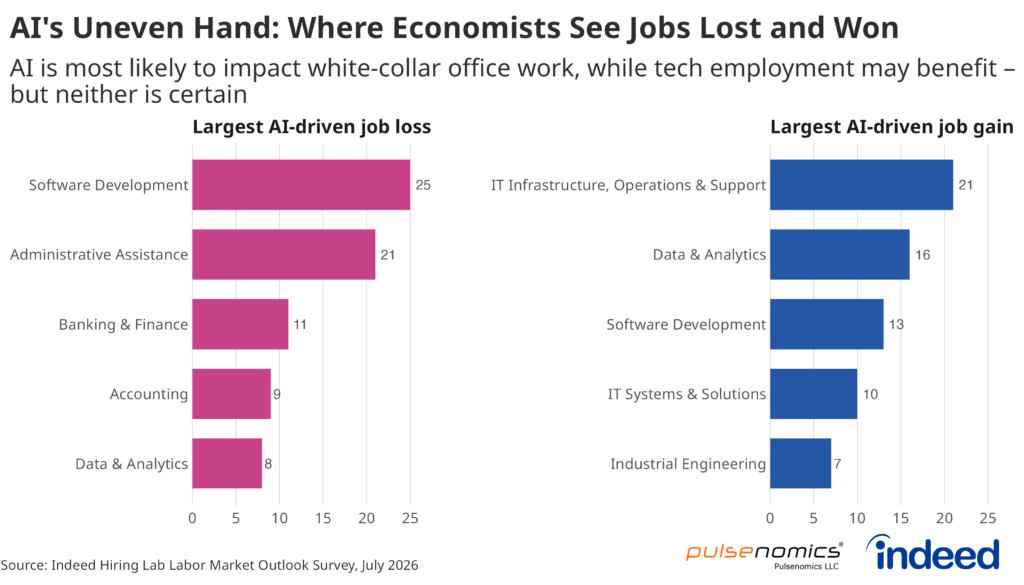
Separating what is genuinely new from what is hype keeps a budget honest. The real advances are three: natural-language search that lets a non-specialist source without Boolean expertise, rediscovery agents that automatically mine your own ATS for silver medalists, and language-model screening that explains itself. The overstated part is end-to-end autonomy replacing the recruiter, which the adoption data from section 12 shows is still mostly pilots. The efficiency numbers are real but narrow: the 62% fewer profiles and four-plus hours saved per role are efficiency metrics, and they say nothing about whether the anxious passive candidate on the other end actually replied and moved.
How to apply this in a frozen market follows directly from that distinction. Point the agents at the repetitive middle of the funnel, identification and first-draft outreach, where they save real hours, and keep your scarce human attention on the two things they cannot do: judgment about fit and the reassurance that moves a risk-averse person. A team that automates the drafting and personally handles the relationship is using AI correctly. A team that automates the relationship, blasting agent-written messages at a saturated market, is accelerating toward the failure modes in the next section. The tool is leverage on a good process and a multiplier of a bad one, and in 2026 the difference between those two outcomes is the whole game.
9. Where passive sourcing fails in 2026
The failure modes of modern sourcing are no longer theoretical, and the biggest one is that scaling outreach with AI degrades the very channel it depends on. A 2026 study of more than four million real recruiting messages found AI-drafted cold emails replied at just 4.97% versus 12.6% for hand-written first touches, roughly 2.5 times worse per message - Pin. AI's only real advantage was volume, not quality: teams sent vastly more messages, and the flood is exactly what pushed the market's response rate toward the 89%-ignored figure from section 4. The trap is seductive because the efficiency metrics look great while the outcome metric quietly craters.
The second failure mode is platform enforcement, which turned aggressive in 2026. LinkedIn sent a cease-and-desist to the automation tool HeyReach in March 2026 affecting around 30,000 users, and roughly 40% of accounts using non-compliant automation received restrictions in the first quarter alone - Wonda. LinkedIn's user agreement flatly bans bots, automated messaging, and scraping, so any sourcing stack that routes accounts through third-party automation is one enforcement wave away from losing its recruiters' accounts. Email has its own version of this: Google and Yahoo now define bulk senders as anyone sending 5,000-plus emails a day and require authenticated SPF, DKIM, and DMARC plus a spam-complaint rate under 0.3%, so high-volume automated recruiter email risks domain-level blocking, not merely low replies - PowerDMARC.
The third failure mode runs in the opposite direction: AI-generated candidates attacking your funnel. Gartner projects that by 2028 one in four candidate profiles worldwide will be fake, spanning AI-polished resumes, inflated skills, and deepfake identity fraud, with deepfake hiring attempts already reported up sharply year over year - HR Dive. A sourcing operation that automates identification without verification will increasingly pull synthetic people into its pipeline. The arms race now runs both ways, and the sourcer who trusts a profile at face value is exposed.
Underneath all three is a trust problem that makes over-automation self-defeating. Only 26% of job applicants trust that AI will evaluate them fairly, and just 8% believe AI makes hiring fairer, against 70% of hiring managers who do - Gartner. When 87% of candidates want transparency about AI involvement and a passive candidate is already anxious and risk-averse, an outreach process that feels machine-generated confirms their worst instinct to stay put. The practical guardrails are not complicated: keep a human visibly in the loop, personalize for real rather than with a merge field, verify before you trust, and treat volume as a liability to be managed rather than a virtue to be maximized. The teams that fail in 2026 are the ones who mistook automation for strategy.
10. The compliance map for AI-driven sourcing
Anyone deploying AI in sourcing needs a working map of the rules, because 2026 scattered them into a genuine patchwork with no single federal anchor. The single biggest change is that the EU AI Act's high-risk obligations for hiring were deferred from 2 August 2026 to 2 December 2027 under the bloc's "Digital Omnibus" package - DLA Piper. Recruitment and candidate-selection systems are still classified as high-risk, meaning eventual duties around human oversight, transparency, and adverse-impact logging, but vendors and employers got roughly sixteen extra months of runway. That is breathing room, not a reprieve, and building for those duties now is cheaper than retrofitting later.
The United States moved in the opposite direction at the federal level, creating a vacuum the states rushed to fill. The EEOC removed its 2023 AI-in-hiring guidance in early 2025, and an executive order directed federal agencies to deprioritize disparate-impact enforcement, but Title VII's disparate-impact prohibition still legally applies to AI selection tools, leaving employers exposed to private suits regardless of the guidance withdrawal - National Law Review. The absence of federal rules is not the absence of legal risk. It is the absence of a safe harbor, which is worse.
The state-level rules that actually bind you in 2026 come down to a short list worth knowing by name:
- Illinois HB 3773 - effective January 2026, strict liability, bans zip-code proxies, requires notice
- NYC Local Law 144 - annual independent bias audits of automated employment tools, publicly posted
- Colorado AI Act - effective January 2027, but scaled back from its original duty-of-care scope
The practical reading of this list is that notice and auditability, not a total ban, are the through-line. Illinois imposes strict liability regardless of intent and requires you to tell applicants when AI is used - National Law Review. NYC's Local Law 144 still mandates annual third-party bias audits, though a late-2025 state comptroller review found enforcement has been weak in practice - NY Office of the State Comptroller. For a sourcing team, the compliant posture is straightforward and worth adopting everywhere rather than jurisdiction by jurisdiction: disclose when AI is involved, keep a human decision-maker accountable for outcomes, retain records that would survive an adverse-impact review, and prefer vendors who can show you their audit trail. Compliance and candidate trust point the same way here, which is convenient, because doing right by the anxious passive candidate is also how you stay on the right side of the law.
One practical note lands specifically on sourcing rather than screening, and teams miss it. An agent that ranks and filters candidates is making an automated employment decision the moment it decides who to contact, so the audit and notice rules do not wait for the interview stage. If your agent screens a shortlist against a written brief, that is exactly the kind of automated tool NYC's audit rule and Illinois's notice rule contemplate. The safe posture is to keep the agent's ranking as a recommendation a human reviews, document the criteria it used, and disclose AI involvement in your first message rather than burying it. Done well, that disclosure doubles as a trust signal to an anxious candidate, which is the recurring theme of this guide: the compliant move and the effective move keep turning out to be the same move.
11. Building a passive-sourcing engine: a 30-60-90 plan
Everything above becomes useful only when it is sequenced into an operating rhythm, so here is how to stand up a passive-sourcing engine in ninety days without a big budget. The governing principle is the waterfall from section 5: build the warm, owned layers first, because they pay back fastest and cost the least, and only then extend outward into cold outbound and AI tooling. A team that reverses this order spends its first month buying seats and its ninetieth month still cold-emailing strangers. This practitioner conversation from iCIMS is a useful companion on which AI recruiting tactics actually cut through in 2026 rather than adding noise.
AI Recruiting Strategies That Work in 2026
The first thirty days are about harvesting the value you already own and cannot see. Before any new tool, run the rediscovery pass from section 5.1: pull every past finalist and silver medalist for roles resembling your open reqs, and re-open those conversations first, because they convert at three times the rate of fresh applicants and cost almost nothing. In parallel, stand up the simplest possible nurture mechanism, even just a spreadsheet and a calendar reminder, so that no warm relationship goes cold again. The goal of month one is not to source new people, it is to stop leaking the people you have.
The second thirty days build the durable warm channels that will still be paying off a year from now. This is where you turn on a deliberate referral motion, showing employees specific second-degree names rather than asking "know anyone," and where you start participating in the one or two communities where your target talent actually lives. It is also the right moment to choose your tooling, matching the platform to your real constraint: contact-data reach, natural-language search, or full outreach automation. A practical starter set of decisions:
- Pick one identification tool - natural-language search or a strong sourcing platform
- Pick one enrichment source - reliable email and phone data such as Apollo
- Pick one outreach engine - multichannel sequencing such as Reply.io
- Instrument reply rates by channel - so month three optimizes on data, not vibes
The interpretation of that list matters more than the brands on it: you are assembling a thin, coherent stack, not buying everything. The mistake teams make in month two is over-tooling, stacking four overlapping platforms nobody fully adopts. One tool per job, wired to measure reply rates by channel, beats a sprawling suite every time, because the constraint in a frozen market is rarely software and almost always the quality and personalization of the human touch on top of it.
The final thirty days are about layering AI and autonomy onto a system that already works, in that order and never the reverse. Once your warm channels are producing and your outreach mechanics are measured, an AI sourcing agent (covered in section 7) can take over the repetitive identification and first-draft work, freeing your human time for the reassurance and relationship-building that actually moves an anxious passive candidate. The sequence is deliberate: automate a process you have already proven by hand, because automating a broken process just produces broken outcomes faster. By day ninety you should have a warm pipeline you own, a measured outreach engine, and AI handling the grunt work, which is exactly the configuration that fills roles in two weeks while competitors start every search cold.
12. The 2026-2027 outlook
The near-term outlook is a slow, uneven thaw layered on top of a permanent structural shift, and passive sourcing sits at the center of both. The thaw is real but tentative: 63% of hiring managers expected to increase payrolls heading into 2026, the first meaningful loosening since early 2025, though still well below the 76% who expected expansion the year before - ZipRecruiter. When the freeze breaks, the teams that spent it building warm pipelines will hire in days while everyone else scrambles to start cold, which is the entire strategic argument for treating a downturn as pipeline-building season rather than a reason to stop sourcing.
The structural shift is that agentic AI sourcing has crossed from pilot to real business, and the money proves it. LinkedIn's Hiring Assistant reached roughly a $450M annualized revenue run-rate by April 2026, the first time the company broke out revenue for one of its AI tools - Reuters. Capital is pouring into the category: Juicebox raised an $80M Series B at an $850M valuation, and Paraform closed a $40M Series B, both in March 2026. Consolidation has started too, with Salesforce absorbing the AI recruiter Moonhub in mid-2025 to fold into its Agentforce platform - The Letter Two. This is not a fad cycle. It is a durable rewiring of how sourcing gets done.
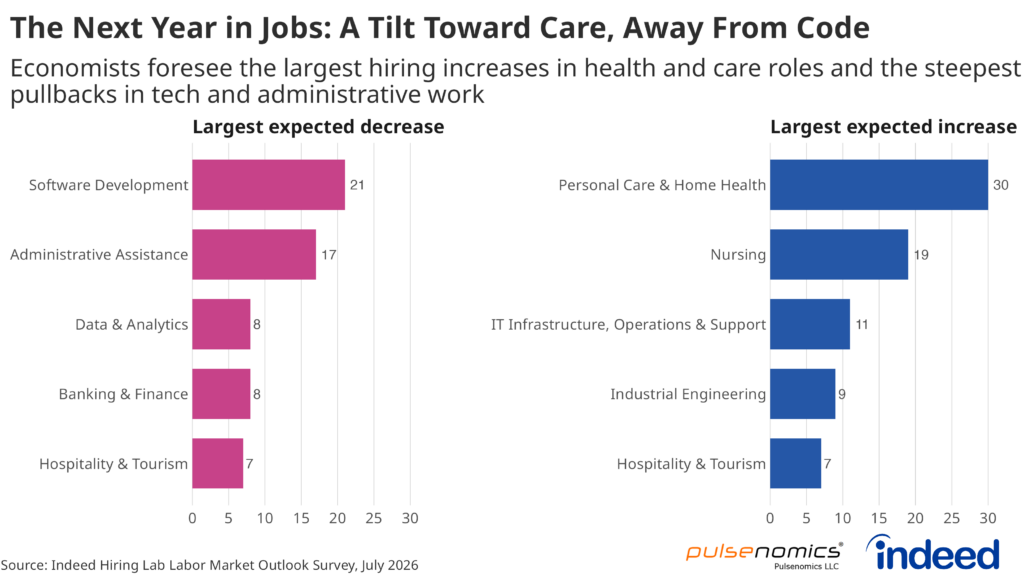
The forces reshaping demand are visible in where economists expect AI to cut versus add roles, which tells a sourcer where the passive pool will thin and where it will grow. The chart below maps that uneven hand across occupations.
The honest counterweight is that autonomy is still more marketing than default reality. Adoption is broad but shallow: 82% of HR leaders plan to use agentic AI by mid-2026, yet 83% still sit at the lowest maturity levels and only about 10% have fully embedded it - Pin. Almost every serious vendor keeps a human approval gate before outreach sends, so the "fully autonomous recruiter, no human in the loop" pitch is aspirational rather than shipped. A parallel arms race is emerging on the candidate side, where Gartner projects one in four profiles will be fake by 2028, pushing vendors to add integrity layers that screen the screeners.
The synthesis for 2026-2027 is that AI will handle more of the identification and drafting every quarter, but the scarce, winning capability moves in the opposite direction: human judgment applied to warm, owned audiences. As cold outreach saturates toward zero and agents commoditize the search, the durable edge is the relationship a passive candidate already trusts, built through nurture and community long before the role opened. The tools will keep getting better at finding people. Getting an anxious, risk-averse person to actually move will stay a human job, and that is where a sourcer should invest.
13. A decision framework
The right decision in a frozen market is not "which tool should I buy," it is "which layer of the waterfall am I underinvesting in," and almost every team gets this backwards. They spend on cold-outbound seats while a silver-medalist finalist sits un-contacted in their own ATS and a nurtured pool they never built would be replying at three times the rate. Fix the order first, then buy the tool that fits the layer you are actually weak on. Budget follows strategy here, not the other way around.
With that framing, the tool choice becomes simple and situation-specific. A short guide by circumstance:
- You have an ATS with history - start with rediscovery, manual or via Gem or SeekOut
- Lean team, few precious reqs, weak outbound - an AI recruiter metered on roles, such as HeroHunt.ai
- Enterprise, many reqs, need breadth and CRM - LinkedIn Recruiter plus hireEZ or Gem
- Highly technical talent - community sourcing and GitHub X-ray over any single platform
- No dedicated sourcers at all - a managed model like Fetcher or Wellfound Autopilot
The interpretation that ties it together is that tools are leverage on the tactics in section 5, never a substitute for them. The best-funded platform in the world will not make a generic message land in a market where 89% of outreach is ignored, and the cheapest manual rediscovery pass will out-hire it if the message is personal and the candidate already trusts you. Match spend to your weakest warm layer, keep a human on the relationship, and treat AI as the thing that buys back the hours you then reinvest in reassurance. That is the entire playbook, and it is why a downturn rewards the patient sourcer.
Written by Yuma Heymans (@yumahey), who built HeroHunt.ai, the world's first AI Recruiter, after years spent on the problem this guide is about: reaching the majority of talent that never applies. HeroHunt.ai now sources from over a billion profiles and runs outreach on autopilot for recruiters worldwide.
In a frozen market the hard part is the outbound: reaching people who are not applying. HeroHunt.ai runs natural-language search across 1.2B+ profiles, screens candidates with language models, and automates first-touch outreach. Free to start, metered on open positions rather than seats.
This guide reflects the labor market and sourcing landscape as of August 2026. Hiring conditions, platform pricing, and AI features change quickly, so verify current details before you buy.