




The real 2026 pay bands for the engineers who build AI agents, separated into base, equity, and bonus, from junior contractor to frontier-lab principal.
A software engineer building the Cursor coding agent reports a median package of $975,000, while the same work stamped with the literal title "AI Agent Engineer" on a job board averages $111,552. The first figure comes from verified offers on Levels.fyi; the second from ZipRecruiter. That is close to a 9x gap for roughly the same three words, and it is the single most important thing to understand before you read any "AI agent engineer salary" number anywhere: there is no such number. There are bands, and where you land depends on a handful of variables that this guide takes apart one at a time.
The problem with almost every salary article on this role is that it quotes one median, usually somewhere between $130,000 and $210,000, and stops. That figure is not wrong, it is just useless on its own. It blends a prompt-tuning contractor in a low-cost metro with a staff engineer who owns a multi-agent platform at a frontier lab, and the average describes neither. The people who actually negotiate these packages, whether engineers weighing offers or employers trying to close them, think in bands: level, employer tier, skill depth, location, and the cash-versus-equity mix. Get those right and you can predict a package within a fairly tight range. Get them wrong and you either lowball a builder out of your pipeline or overpay by a quarter of a million dollars.
This guide breaks down what AI agent engineers actually earn in 2026, with every figure linked to its source. It covers who the role actually is and why the title confuses pay, the market-composite bands by level, the extreme top of the market at frontier labs and on the forward-deployed path, what agent-native startups pay in equity, the specific agent skills that move the number, how geography and remote policy shift it, freelance and contract day rates, and whether any of this survives the bubble debate. The AI Agent Engineer is the newest and most sharply repriced subspecialty in software, and the numbers below show exactly how far it has detached from generalist engineering.
Contents
- The State of AI Agent Engineer Pay in 2026
- What an AI Agent Engineer Actually Is (and Why the Title Confuses Comp)
- The Five Variables That Set the Number
- Real Comp Bands by Level: The Market Composite
- Frontier Labs and the Forward-Deployed Path
- Agent-Native Startups: Equity as the Real Currency
- What Your Skills Are Worth: The Agent Premium
- Geography, Remote Work, and the Global Picture
- Freelance, Contract, and Fractional Rates
- Is It a Bubble? Demand, Agents, and the 2026 Outlook
- How to Use These Numbers: A Decision Framework
1. The State of AI Agent Engineer Pay in 2026
AI agent engineer compensation in 2026 is best understood as a two-tier market that shares a job title but almost nothing else. At the top, a few thousand engineers at frontier labs and hot agent startups command packages that read like professional-athlete contracts, with total compensation from roughly $600,000 to well over $1,000,000 a year. Below that, a much larger population of engineers building agentic features at enterprises, funded startups, and big-tech product teams earns strong but recognizable software salaries, roughly $150,000 to $500,000 depending on level and employer. The gap between the two tiers has widened every quarter since 2023, and it is the first thing to internalize before reading any average.
The reason for the split is scarcity meeting nearly unlimited budgets. For the first time ever, AI skills are the single hardest competency to find in the world, ahead of engineering and the skilled trades, according to ManpowerGroup's 2026 survey of more than 39,000 employers across 41 countries - ManpowerGroup. Demand data confirms the pressure is structural rather than a spike: AI Engineer ranks #1 on LinkedIn's 2026 Jobs on the Rise list in the United States, with four of the top five fastest-growing roles tied directly to AI - LinkedIn. When a handful of companies with effectively bottomless capital compete for a talent pool that cannot expand quickly, the result is less a labor market than an auction.
The agent-specific slice is the fastest-moving part of that market. Job postings mentioning agentic AI skills grew from 0.06% of US postings in 2024 to 0.23% in 2025, a roughly 280% jump in a single year to nearly 90,000 listings, the sharpest skill-demand shift tracked in the Stanford AI Index - Lightcast. That growth sits on top of a supply base that universities and bootcamps cannot expand at anywhere near the same rate, because the skills that command the premium, orchestration, evaluation, and production reliability, take years to build. It is worth putting that demand in the broader spending context, because the money behind the hiring is what makes the comp durable rather than a fad.
The chart below is not about salaries directly; it is the reason salaries look the way they do. Global corporate AI investment hit a record in 2025, more than double the prior year, and that capital is what funds nine-figure researcher packages and $975,000 startup offers alike.
Why the money is there: corporate AI investment hit a record in 2025
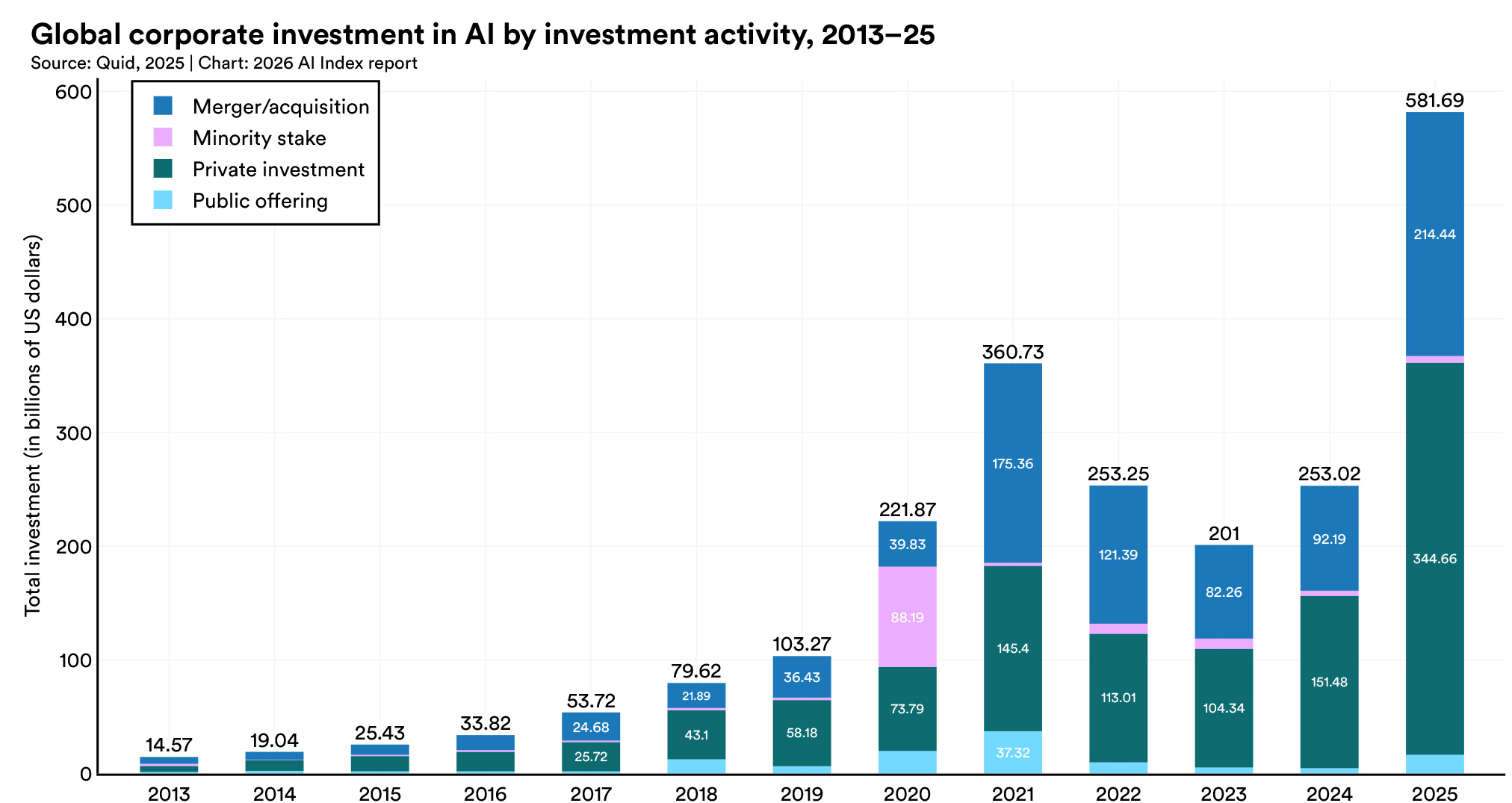
The takeaway from the investment curve is that agent-engineer pay is a downstream effect of capital, not a bet on any single company. When corporate AI investment more than doubles in a year to a record high, the marginal dollar competing for the same small pool of production-AI builders pushes the whole band up. That is why even conservative national benchmarks moved: Built In puts the average US AI Engineer total at $211,243 in 2026 (base $184,757 plus $26,486 in additional cash), up double digits year over year - Built In. Keep that $211,000 figure in mind as the broad-market anchor, because most companies outside the frontier labs hire against something close to it, and the rest of this guide is essentially a map of how far above and below that anchor the real offers sit.
2. What an AI Agent Engineer Actually Is (and Why the Title Confuses Comp)
The AI Agent Engineer owns the system around the model, not the model itself, and that distinction is the whole reason the role commands a premium. A useful working definition is someone who designs, builds, and maintains autonomous systems that reason, plan, use tools, and take action toward a goal with minimal human intervention, or more bluntly, who owns the difference between a language model that answers a question and a system that finishes a job - Lyzr. That means tool and function calling, sub-agent orchestration, memory design, retrieval, evaluation harnesses, guardrails, and the unglamorous reliability engineering that keeps an agent from looping, hallucinating a tool call, or quietly burning $3,000 of tokens on a task it will never finish.
This is a different job from the three roles it is constantly confused with, and the confusion is expensive because it corrupts salary benchmarks. A machine learning engineer trains and optimizes models. A prompt engineer tunes instructions. A general AI or applied engineer ships product features on top of pre-trained models but may never build a genuinely autonomous loop. The agent engineer sits on top of all of them and is measured on whether a multi-step system works in production, under real latency and cost budgets, against adversarial inputs. The market has not yet standardized a title for this, which is exactly why the numbers scatter so wildly.
The scatter shows up starkly in job-board data. The literal string "AI Agent Engineer" averages just $111,552 on ZipRecruiter, because that exact phrase attaches disproportionately to junior and integration-flavored postings - ZipRecruiter. Change one word and the number jumps: Glassdoor's "Agentic AI Engineer" averages $192,826, a roughly $80,000 swing driven by title alone - Glassdoor. The lesson for both sides of the table is to stop pricing the title and start pricing the work: the premium lives in demonstrated production experience, not in whichever noun a job board happened to index.
To see what "the work" concretely means, it helps to visualize the stack an agent engineer is responsible for, because each layer below is a place where a naive implementation fails and an experienced one earns its band.
The diagram makes the pay logic obvious once you read it top to bottom. Almost anyone can wire a model to a single tool; the value compounds at the orchestration, evaluation, and reliability layers, where mistakes are subtle and only surface at scale. That is why an engineer who can prove they shipped a multi-agent system with a real eval harness is worth multiples of one who has only built a chatbot wrapper, even though both can legitimately call themselves agent engineers.
A concrete failure mode makes the premium tangible. A naive agent handed a customer-refund tool will, under an adversarial prompt or an ambiguous ticket, happily issue refunds it should have escalated, retry a failing API call until it exhausts its budget, or loop between two sub-agents that each defer to the other. Each of those is invisible in a demo and expensive in production, and preventing them is not a prompt-writing skill but an engineering one: idempotent tool design, a policy layer that gates high-risk actions, an evaluation suite that replays real failure cases, and observability that surfaces a runaway loop before it bills thousands of dollars. The engineers who command the top bands are the ones who have been burned by these failures and built the machinery to prevent them, which is precisely why hiring managers pay for scars, not certificates.
The best short primer on this framing is Shawn "swyx" Wang's keynote, which argued that agent engineering is a distinct discipline rather than a rebrand of ML, and it is worth watching before you benchmark any offer.
Why Agent Engineering (swyx, AI Engineer Summit 2025)
The practical implication of the video's thesis is that comp benchmarks lag the role by a year or more, so anyone relying on a title-matched salary survey is pricing yesterday's job. Employers who understand this write requisitions around capabilities (has this person shipped an evaluated, tool-using agent to real users?) and pay for that, rather than anchoring to a "AI Agent Engineer" survey median that a junior integration hire would also match. For engineers, the same insight is leverage: the way to move from the $111,000 band to the $190,000-plus band is not a title change, it is a portfolio of shipped agentic systems you can point to.
3. The Five Variables That Set the Number
Before any specific band makes sense, fix the five variables that determine where an individual lands, because a surprising number is almost always one of these being different from what you assumed. Level (junior through principal) is the largest single factor within a given employer. Employer tier (enterprise, big tech, agent startup, or frontier lab) can move the same level by 3x to 5x. Skill depth (can you build a reliable multi-agent system with evals, or only a single-tool demo?) is the agent-specific premium layered on top. Location still matters, though less than it did. And the cash-to-equity mix determines how much of a headline number is real cash versus illiquid paper.
These variables stack, they do not simply add, which is why two people with identical resumes and the same "agent engineer" title can be $700,000 apart. Level and employer tier together explain most of the variance; skill depth and location are meaningful adjustments on top, usually in the 15% to 50% range; and the equity mix determines how much you should trust the top-line figure at all. A senior engineer moving from an enterprise to a frontier lab usually keeps the senior scope but can see total comp triple, because the equity component is denominated in a far more valuable currency. The level tells you the job; the employer tells you the price; the equity tells you how real the price is.
The decision tree below is the order experienced negotiators actually reason in, and it is the structure the rest of this guide follows.
Reading the tree in order keeps you from the two classic mistakes. The first is comparing offers by base salary alone, which gets progressively more misleading the more senior the role, because equity overtakes base by the senior and staff rungs at nearly every serious employer. The second is treating a frontier-lab headline as the market, when it is the extreme tail of one variable (employer tier) at its maximum. For employers, the framework doubles as a budgeting discipline: decide your tier honestly, then pay the band for that tier rather than apologizing for not matching a number from a different one. This is also where hiring platforms matter, because sourcing engineers who genuinely clear the skill-depth gate is the hard part; tools such as HeroHunt.ai exist to surface those builders from the wider pool rather than the loud minority who merely list the keywords.
4. Real Comp Bands by Level: The Market Composite
Here is the answer most readers came for: the total-compensation bands for a generalist AI/agent engineer across the broad US market, level by level, blending big tech, funded startups, and enterprises but excluding the frontier-lab extreme, which gets its own section. National composite medians cluster tightly and low. Glassdoor puts the average AI Engineer at $144,725, with a median base of $134,023 and a 90th percentile of $223,939 - Glassdoor. Robert Half's 2026 guide lists AI/ML Engineer base pay at $134,000 (new), $170,750 (mid), and $193,250 (advanced) - Robert Half. Those are honest national base benchmarks, and they are the floor of the conversation, not the ceiling.
The ceiling appears the moment you switch from survey averages to verified offers with equity included. On Levels.fyi, big-tech machine learning engineers, the closest tracked proxy with a large sample, run far higher because stock dominates at senior levels. The table below lays out the market composite by level, using Google's ML engineer ladder as the high-confidence anchor and folding in the broad national numbers for context. Treat these as the middle of the market for each rung, not the tail.
| Level | National base (Robert Half / Glassdoor) | Big-tech total comp (Google ML, Levels.fyi) | Base / stock / bonus at this rung |
|---|---|---|---|
| Entry / junior | ~$134,000 base | $199,000 (L3) | mostly cash |
| Mid | ~$170,750 base | $294,000 (L4) | cash-heavy, stock growing |
| Senior | ~$193,250 base | $393,000 (L5) | $214K + $151K + $27.4K |
| Staff | (off national scale) | $607,000 (L6) | $272K + $304K + $31.5K |
| Principal | (off national scale) | $743,000+ (L7) | stock exceeds base |
The Google figures come from Levels.fyi's machine-learning-engineer data, updated in mid-2026 - Levels.fyi. The single most important pattern in that table is the mix flip: at entry level, base salary is nearly the entire package, but by the senior rung annual stock ($151,000) is already a third of the total, and by staff ($304,000 in stock) equity roughly equals base. Meta pushes this even harder, with an E5 senior ML engineer at $497,000 where the $238,000 stock grant already exceeds the $228,000 base - Levels.fyi. This is why comparing two offers by base alone gets more misleading the more senior you go, and why staff engineers obsess over vesting schedules and stock performance in a way juniors rarely need to.
A concrete pair of packages shows the mix-flip in numbers. An entry-level engineer at Google (L3) earns about $199,000, of which the large majority is cash: base dominates, the annual stock grant is a modest slice, and the bonus is a rounding error. A staff engineer at the same company (L6) earns about $607,000, of which the $304,000 stock grant alone exceeds the $272,000 base, so cash is now a minority of the package. The same person, three levels apart, has gone from a salaried employee to what is effectively a shareholder who also draws a salary. That shift is the universal shape of the ladder, not a Google quirk, and it has a direct negotiating consequence: at junior levels you negotiate base, but at senior and staff levels you negotiate the equity grant and its refresh schedule, because that is where the money actually is.
The chart below visualizes the same ladder so the shape is unmistakable: comp roughly doubles from entry to senior, and can double again from senior to staff, with the acceleration coming almost entirely from equity.
Big-Tech ML/Agent Engineer Total Comp by Level (Google, 2026)
Interpreting that curve for practical use: if you are an engineer, the fastest dollar-per-year-of-effort gain is the jump from mid to senior and then senior to staff, because each step both raises base and multiplies the equity component. If you are an employer hiring below the frontier tier, the table is your budget: a senior agent engineer at a well-run big-tech-adjacent company should be priced somewhere between the $193,000 national base and the ~$393,000 big-tech total, and where inside that range depends on the skill-depth variable from section 3. One caution before moving up the tiers: verified-offer data pulls the true market above the survey medians, with Levels.fyi's AI-engineer average sitting near $245,000 against a Glassdoor composite closer to $173,000, so a candidate quoting Levels.fyi and an employer quoting Glassdoor are describing the same market from opposite ends - Pin. For a level-by-level breakdown of the broader AI engineer role (not only the agent subspecialty), the companion AI Engineer Salary 2026 guide goes deeper on the generalist ladder.
5. Frontier Labs and the Forward-Deployed Path
The top of the market for agent builders sits at the frontier labs, where compensation is driven overwhelmingly by private-company equity rather than base salary, and the numbers are genuinely in a different universe. On Levels.fyi, OpenAI software engineers (Members of Technical Staff) show a median total comp of $875,000, with the L5 senior band at $1.16M ($363,000 base plus roughly $800,000 a year in stock) and the highest reported package at $1,585,000 - Levels.fyi. Anthropic clusters at a similar altitude, with a median in the high six figures (reported between roughly $720,000 and $870,000 depending on the sample), a senior SWE around $591,000 and a staff SWE at $1.25M ($405,000 base plus $843,000 stock) - Levels.fyi. These packages are equity-heavy and stock-price-dependent, so treat them as directional rather than guaranteed cash, but the base pay alone is eye-watering: H-1B filings show Anthropic paid two Members of Technical Staff base salaries of $1.38M and $1.12M, before any equity - Inc..
The reason those equity numbers are so large is that lab stock is scarce and appreciating fast. OpenAI now pays an average of roughly $1.5M a year in stock-based compensation per employee, equal to about 46% of its revenue and the richest startup equity program on record, and in August 2025 it layered on special retention grants worth about $1.5M each, vesting over two years, to roughly 1,000 research and engineering staff to defend against Meta - Fortune. The 2025 talent war produced genuine outliers at the very top: Sam Altman said Meta dangled signing bonuses "as high as $100 million" - CNBC. Reporting since has tempered those headlines, clarifying they were mostly multi-year RSU packages for a handful of senior leaders rather than sign-on cash, and that one researcher reportedly declined an $18M offer - TechCrunch. The confirmed nine-figure cases are real but rare: Meta poached Apple's foundation-models lead Ruoming Pang with a package worth more than $200M over several years - Bloomberg.
For most agent engineers, the realistic top-tier path is not a $200M researcher package but the forward-deployed engineer (FDE) role, which has become the industry's hottest applied-AI title precisely because it means building and shipping agents into customer environments. Demand exploded in 2026: the share of companies planning to hire FDEs jumped from 5-10% at the start of the year to 70% by Q2, even though executive-search estimates suggest only about 2,000 US engineers can reliably deliver enterprise AI ROI - TechCrunch. The comp reflects that scarcity, and it fans out dramatically by employer, as the table shows.
| Role / employer | Median or band (total comp) | Notes |
|---|---|---|
| Palantir FDSE (originator) | ~$211,000 median ($171K-$295K) | up to $358K in NYC |
| Frontier-lab FDE, mid-level | $385,000-$510,000 | ~60-70% equity |
| Frontier-lab FDE, senior | $560,000-$785,000 | equity-dominated |
| Frontier-lab FDE, staff | $750,000-$1.0M | private-company stock |
| Frontier-lab FDE, principal | $1.2M+ | tail of the tail |
The Palantir figure is high-confidence Levels.fyi data - Levels.fyi, while the frontier-lab FDE bands come from an aggregated report analyzing 1,200 forward-deployed engineers and should be read as directional - Perspective AI. The forward-deployed path deserves special attention because it is the realistic aspiration for most strong agent engineers, in a way a $200M researcher package never will be. An FDE is not judged on publishing frontier research; they are judged on whether they can walk into a customer's messy environment, understand the domain, and ship a working agent against it, which is the exact skill set section 2 describes. That makes the role reachable through demonstrated production work rather than a doctorate and a publication record, and it is why forward-deployed listings surged over 800% during 2025 as every lab and consultancy raced to put agents into customer hands - Jobs by Culture. For an engineer choosing where to build a career, the FDE ladder offers frontier-lab equity exposure with a merit path that rewards shipping over academic pedigree.
The structural point is the one that matters: the base-salary spread between the highest and lowest FDE roles is only about 2.5x, but the total-comp spread is 5x or more, because the difference is almost entirely private-company equity. That is the frontier-lab bargain in one sentence: you are trading cash certainty for a leveraged bet on the most valuable private stock in the world, and whether it is a good deal depends entirely on your read of the equity, which brings us to the startups where that bet is even more concentrated.
6. Agent-Native Startups: Equity as the Real Currency
Agent-native startups became the highest-valued and highest-paying category in the 2025-2026 market, and their comp is a wager on equity far more than a salary. The valuations are the context you need to price the paper: Anysphere, the company behind the Cursor coding agent, raised $2.3B in November 2025 at a $29.3B valuation after crossing $500M in ARR - CNBC. Bret Taylor's customer-service agent company Sierra raised $950M in May 2026 above a $15B valuation - TechCrunch. Legal-AI agent company Harvey raised at an $11B valuation in March 2026 - CNBC, Devin-maker Cognition hit $10.2B in September 2025 - CNBC, and customer-support agent startup Decagon tripled to $4.5B in early 2026 - Forbes. Even the framework layer minted a unicorn: LangChain reached a $1.25B valuation on its October 2025 Series B - TechCrunch.
Those valuations translate into real, verified comp, and the agent premium is concentrated at the hottest coding-agent shops. Cursor's median software engineer package is about $975,000 (roughly $300,000 base plus $675,000 in annual stock, rising to $1.1M in the Bay Area and a reported high of $1.66M) - Levels.fyi. Enterprise-agent peers pay less but still far above traditional startup bands: Sierra's Bay Area median is about $520,000 ($320,000 base plus $200,000 stock) - Levels.fyi, Harvey's US median is about $408,000 - Levels.fyi, and Perplexity's is about $450,000 - Levels.fyi. The chart below stacks the tiers so the ladder from broad market to agent startup to frontier lab is visible at a glance.
Median Total Comp by Employer Tier (2026)
The defining structural feature of every bar past the big-tech tier is that base salary barely moves while equity explodes. Base pay clusters in the $250,000 to $320,000 range even at $10B-plus companies; the difference between a $408,000 Harvey package and a $975,000 Cursor package is almost entirely stock, and that stock is a leveraged, illiquid bet on the specific company's trajectory. A useful discipline when evaluating a startup offer is to separate the certain part (base plus any liquid component) from the wager (the equity), and to size the wager against the company's stage and your own read of its odds. Earlier-stage roles sharpen the trade further: seed-stage senior engineers report roughly $240,000-$275,000 base with founding-engineer equity of 2-5%, versus 0.1-0.4% at Series A, where the equity is worth more in expectation but each point is a smaller slice - Recruiting from Scratch.
Valuing that equity honestly is a skill in itself, and getting it wrong in either direction is costly. The naive approach multiplies the grant's headline dollar value by four years and treats it as salary, which overstates it, because the shares are illiquid, the valuation can fall, and most private companies never reach a liquidity event. The overly cynical approach treats all startup equity as lottery tickets worth zero, which understates the handful of Cursors and Harveys that repriced 3x in a single year. A more disciplined method is to discount the paper value by a rough probability of a meaningful exit given the company's stage and traction, then compare that risk-adjusted figure against the certain cash you would earn at a big-tech tier. Run that math and a $975,000 Cursor package and a $607,000 Google staff package can be closer in expected value than the headlines suggest, with the startup being the higher-variance bet. The point is not which is better but that you cannot compare them without doing the discount, and the people who negotiate best are the ones who do it explicitly.
The comparative lesson is that you are almost never choosing between two versions of the same offer. A frontier lab sells the most valuable equity in the world attached to a research pipeline where your work is one input among thousands. A Series B agent startup sells visible ownership of a shipping product, a faster path to staff, and more cash certainty relative to the equity wager. A big-tech team sells liquid stock, stability, and a legible ladder. Framed honestly, each trade genuinely appeals to different builders at different life stages, and the most expensive mistake either side makes is pretending the auction is the whole market. For a specialist Series B startup, a well-structured $230,000 base plus meaningful equity is not "losing" to a lab's million-dollar package; it is a different product for a different buyer.
7. What Your Skills Are Worth: The Agent Premium
The single clearest signal in this entire market is that AI-specific skills carry a large and growing wage premium, and agent skills sit at the top of that premium. PwC's 2026 Global AI Jobs Barometer, built on more than a billion job ads, found the AI-skills wage premium rose from 25% in 2024 to 56-57% in 2025 and about 62% in 2026, with AI-skill jobs growing roughly eight times faster than the market - PwC. Independent data corroborates the direction even where the exact figure differs: Lightcast measured a 28% premium worth about $18,000 a year, and noted that a majority of AI-skill postings are now outside traditional tech - Lightcast. The premium also widens with seniority, rising from roughly +6% at entry to nearly +19% at the staff level, which is why the agent premium compounds with the level premium rather than replacing it - Pin.
The trend line matters as much as the level, because a premium that doubled in twelve months is a different investment case than a flat one. The chart below plots the PwC premium over three years, and the slope is the reason "learn to build agents" has become the highest-ROI skill pivot in software.
AI-Skills Wage Premium Over Time (PwC Global AI Jobs Barometer)
Within the AI-skills bucket, the market pays specifically for the hard parts of agent engineering, and there is early data on which skills move the number. The clearest emerging discipline is evaluation: staff-level evals engineers can out-earn product engineers, and eval specialists have been hired among the first ten technical staff at Cursor, Harvey, Sierra, Perplexity, and Cognition - Jobs by Culture. Orchestration is the other differentiator. Framework-specific data suggests LangGraph and MCP integration correlate with higher pay while LangChain-only experience correlates with lower top-end pay, because the former signal production multi-agent work and the latter often signals tutorial-level projects - Presenc AI. Those per-skill dollar figures come from a career-guide aggregator and should be read as directional, but the pattern (orchestration and evals command premiums, wrappers do not) is consistent across every serious source.
It helps to see why these skills reprice so fast: demand is being pulled forward by the fastest technology-adoption curve on record. Generative AI reached broad workplace adoption in about three years, outpacing both the internet and the personal computer at the same point in their diffusion, which compresses years of normal hiring-cycle adjustment into a handful of quarters.
Agent skills reprice fast because the underlying technology diffused faster than anything before it
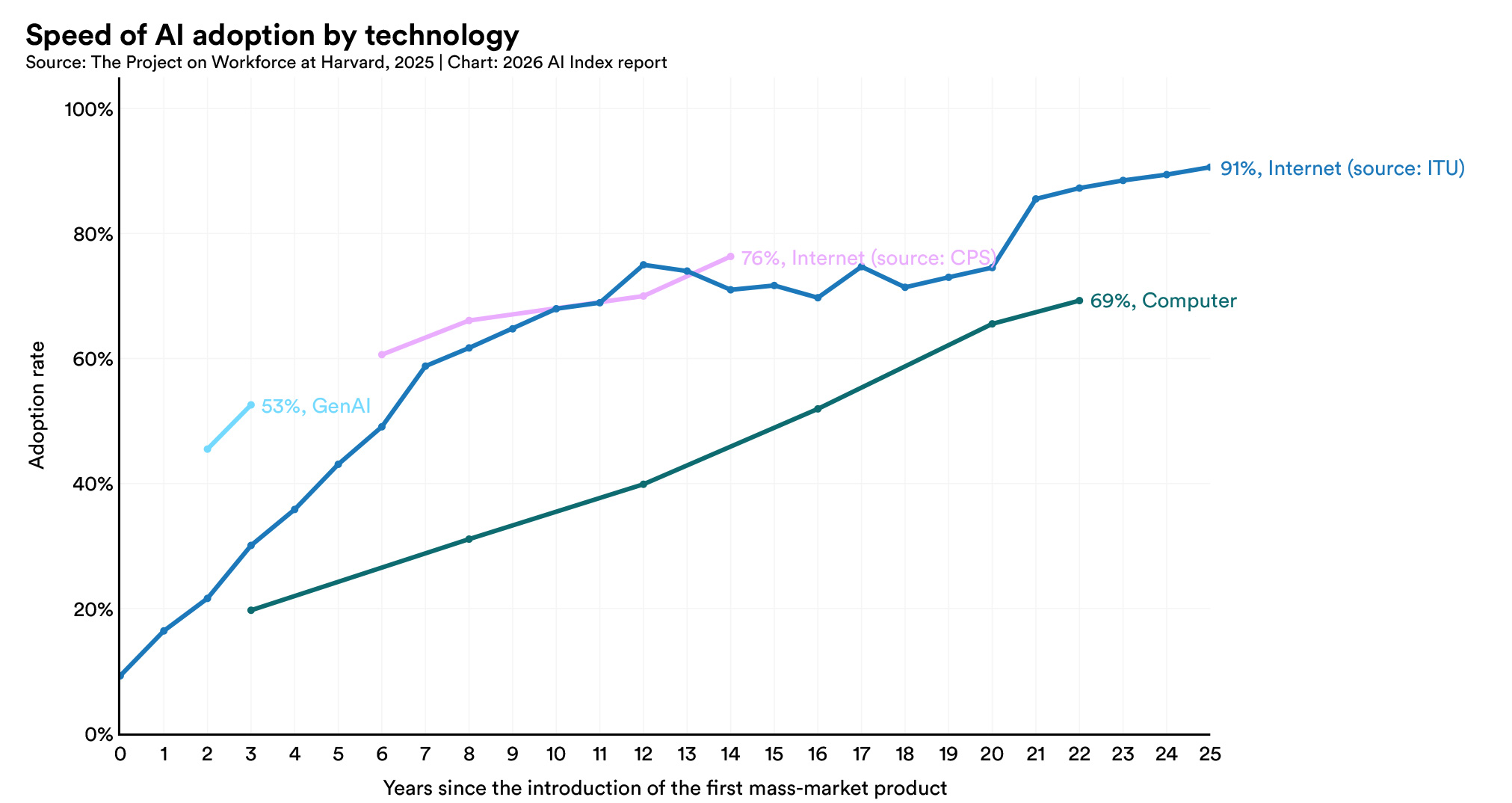
When a general-purpose technology diffuses that fast, the supply of engineers who can deploy it productively cannot keep pace, and the gap shows up as a wage premium that widens before training pipelines can respond. That is the macro reason an agent skill learned in 2026 is worth more than the same skill will be in 2028: you are being paid for scarcity, and scarcity erodes as bootcamps and universities catch up. The engineers who capture the most value are the ones who move early and go deep on the layers that are slowest to commoditize, which are the reliability and evaluation layers rather than whichever framework is trending this quarter.
The practical application differs by who you are. If you are an engineer, the highest-return investments are the layers from the section 2 diagram that are hardest to fake: a real evaluation harness, a shipped multi-agent system, and demonstrated cost and latency optimization, all backed by production artifacts rather than notebooks, because hiring managers consistently value deployed systems over certifications - Codecademy. If you are an employer, the same list is your screen: interview for orchestration and evaluation judgment, not framework trivia, because the framework is the cheap part and the judgment is what you are actually paying the premium for. Getting that screen right is the entire game on the hiring side, which is why teams increasingly lean on AI-native sourcing rather than keyword-matching a flooded applicant pool; the companion guide on how to recruit AI agent engineers walks through screening these skills without being technical yourself.
8. Geography, Remote Work, and the Global Picture
AI agent talent is extraordinarily concentrated, and geography still moves the number even in a remote-friendly era. Over 65% of US AI engineers are based in just San Francisco and New York, per SignalFire's talent research, and roughly 35% work within 40 miles of San Jose alone, with Seattle a distant second at 23% - KORE1. That concentration maps directly onto pay: the San Francisco Bay Area leads at roughly $210,000-$252,000 base and $270,000-$390,000-plus total comp for senior and staff, ahead of New York ($195,000-$235,000 base) and Seattle ($185,000-$220,000 base) - KORE1. The frontier-lab premium is almost entirely a Bay Area phenomenon, simply because that is where the labs are headquartered, so the auction dynamics of sections 5 and 6 barely touch most of the country.
Cost of living complicates the headline, and this is where candidates most often misprice their own options. On a purchasing-power basis the coastal premium inverts: an engineer earning $175,000 in Austin keeps more real spending power than one earning $240,000 in San Francisco - KORE1. Remote work, meanwhile, carries a real and specific discount for this specialty. AI and ML engineering shows the steepest remote-vs-onsite pay gap of 42 tech roles, at $42,126 (24%) in a study of 121,370 postings - JobLeads. Yet the Bay Area anchor follows you even when you go remote: the median remote AI engineer earns about $194,000, but San Francisco-headquartered firms pay a $217,000 median even for remote staff because they benchmark to local rates - Recruiting from Scratch. The tactical read is to target SF-HQ'd companies with national remote bands, which is the closest thing to arbitrage in this market.
That arbitrage has limits worth naming, because it is actively being competed away. As more Bay Area companies move to a single national band, the remote premium compresses toward the national median, and some labs and top startups have quietly reintroduced in-person expectations for their most senior agent work, on the theory that a multi-agent architecture debate happens faster at a whiteboard than in a thread. The durable version of the remote strategy is therefore to be senior enough that your output is legible regardless of location, and to target companies whose own product is distributed, since they tend to pay location-agnostic bands out of philosophy rather than concession. Junior remote agent engineers, by contrast, face both the 24% remote discount and the entry-level squeeze at once, which is the least favorable corner of the entire market.
Internationally the ladder descends steeply from the Bay Area, though local agent premiums exist everywhere. The table below sketches the major non-US hubs with real 2026 figures, converted loosely to context rather than a single currency.
| Hub | Typical AI engineer pay | Senior / notable |
|---|---|---|
| London | £89,500 median (£68K-£122.5K) | senior £110K-£200K total |
| Amsterdam | ~€110,000 median AI total comp | top firms €150K-€200K+; 30% ruling boosts take-home |
| Berlin | ~€65,200 average | senior ML ~€98,666 |
| Toronto | ~C$125,876 average ML | senior ~C$164,597 |
| Bangalore | ₹15-45 LPA (GenAI) | senior GenAI ₹20-70 LPA; agent skills +25-45% |
London leads Europe per Robert Half's UK data - Robert Half UK, Amsterdam's numbers are lifted by the 30% expat tax ruling - Zen van Riel, and India, the cheapest major hub in absolute terms, still pays a 25-45% premium for agent and LLM skills on top of base engineering pay - BuildFastWithAI. The interpretation for both sides is that the agent premium is a global phenomenon layered on top of local base rates, not a US-only story: an engineer in Bangalore or Berlin will not match a Bay Area number, but the relative reward for building agents over generic software is consistent everywhere. For employers, that makes international and remote hiring a genuine lever, provided you can actually identify agent-capable builders in markets where the talent map is less legible, which is exactly the sourcing problem AI recruiters are built to solve.
9. Freelance, Contract, and Fractional Rates
For the growing share of agent engineers who work independently, the market prices agent-building at the top of the AI freelance range, and it is worth knowing the day rates whether you are selling or buying. Independent work is priced explicitly by task: AI agent development runs $175-$300 an hour, RAG implementation $150-$250, voice and conversational agents $150-$275, and plain LLM API integration $125-$200 - Zen van Riel. Contract staffing firms tier the same work by seniority rather than task, with mid-level GenAI contractors (RAG, agents, API) at $120-$180, seniors at $160-$210, and principal-level AI architects at $200-$280 an hour - Overture Partners. The consistent signal across both framings is that the moment "agent" or "RAG" appears in the scope, the rate steps up from the generic-developer band.
Elite AI-talent marketplaces cluster at the high end but take very different cuts, which matters enormously for take-home pay. On Mercor, software roles pay $80-$200 an hour and specialized ML/AI roles $100-$250-plus, while a head-to-head comparison put senior contract rates at $130-$200 on Mercor, $140-$200 on Braintrust, and only $60-$100 on Scale AI - AI Gig Jobs. Platform economics are the hidden variable: Toptal bills clients $100-$200 an hour for AI/ML engineers but the engineer typically keeps only 40-70% after markup - Recruo, whereas Braintrust lets freelancers keep 100% of their rate on a 0-15% service fee - SideHusl. The lesson for contractors is to read the take rate as carefully as the headline, because a $200 rate on a 50%-margin platform is a $100 rate.
At the top of the independent market, structure shifts from hourly to day rates and retainers, and the numbers get serious. A fractional AI lead commands roughly $1,500 a day, an agency team $2,000-plus, and general US independent work spans $100-$300 an hour or $800-$2,000-plus a day - AI People Agency. Consulting tiers run from solo experts at $80-$200 up to Big Four firms at $300-$600 an hour. The practical takeaway is that an experienced agent engineer who can package their work as fractional leadership or productized agent builds, rather than staff-augmentation hours, roughly doubles their effective rate, because the buyer is paying for a shipped outcome and judgment rather than time.
The positioning move that separates a $150-an-hour contractor from a $2,000-a-day fractional lead is packaging. Selling hours invites the buyer to compare you against every other pair of hands and to squeeze the rate; selling a productized outcome (a deployed support agent with an eval suite and a reliability target, delivered in six weeks for a fixed fee) invites them to compare you against the cost of a failed internal build, which is far higher. Agent work is unusually well suited to this framing because the deliverable is discrete and the failure rate of do-it-yourself attempts is documented, so a credible independent builder can charge for de-risking rather than for time. The contractors who thrive also tend to specialize by vertical (support, legal, sales, healthcare) rather than by framework, because domain judgment is the part a generalist cannot quickly copy and the part that survives the next framework churn.
For companies, the corresponding insight is that contract rates this high make it cheaper, above a few months of engagement, to hire, which is why the sourcing question returns no matter how you slice the market.
10. Is It a Bubble? Demand, Agents, and the 2026 Outlook
The honest answer to the bubble question is that the market is diverging, not uniformly inflating, and the divergence is exactly what makes durable agent skills valuable. On the demand side, the money is real and growing: Gartner forecasts agentic AI spending will grow 141% in 2026 to $201.9B and overtake chatbot spending by 2027 - Software Strategies Blog. On the risk side, the same analyst house predicts over 40% of agentic AI projects will be canceled by the end of 2027 on costs, unclear value, and weak risk controls - Gartner, and an MIT NANDA study found 95% of enterprise generative-AI pilots failing to reach production value - Fortune. Those two facts are not contradictory: they are the precise reason engineers who can ship reliable, evaluated, production-grade agents command a premium while "toy-agent" builders do not. The failure rate is the moat.
The financial-markets debate is louder but less useful for career decisions. "Big Short" investor Michael Burry called the AI bubble "too big to save," while others such as Kevin O'Leary argue it is not a bubble at all, citing real productivity gains - Yahoo Finance. What matters for agent-engineer pay is the underlying labor market, and there the evidence points to resilience: engineering hiring held up far better than the rest of tech through the downturn, with software engineers now 55% of all big-tech hiring, up from 46% in 2019, even as new-grad hiring collapsed - SignalFire. The a16z outlook video below is a useful counterweight to the doom, arguing that multi-agent systems will create entirely new roles rather than eliminate the builders.
How AI Agents Will Transform in 2026 (a16z Big Ideas)
The most important structural shift, and the one that should shape any agent engineer's five-year plan, is that the role itself is moving up the stack toward orchestration and evaluation. a16z's Big Ideas for 2026 explicitly name new functions such as "AI workflow designers, agent supervisors, and governance leads" to orchestrate and audit fleets of agents - a16z. Meanwhile the evidence that coding agents are replacing engineers is weaker than the hype: a rigorous METR randomized trial found experienced developers were actually 19% slower with AI tools in early 2025, even though they felt faster, with 2026 updates only tentatively suggesting the gap is closing - METR. The practical read is that agents are raising the leverage of good engineers rather than replacing them, and the demographic data hints at where the risk actually lands: early-career headcount is already softening even as senior demand stays hot.
The squeeze is at the entry level, not the senior end
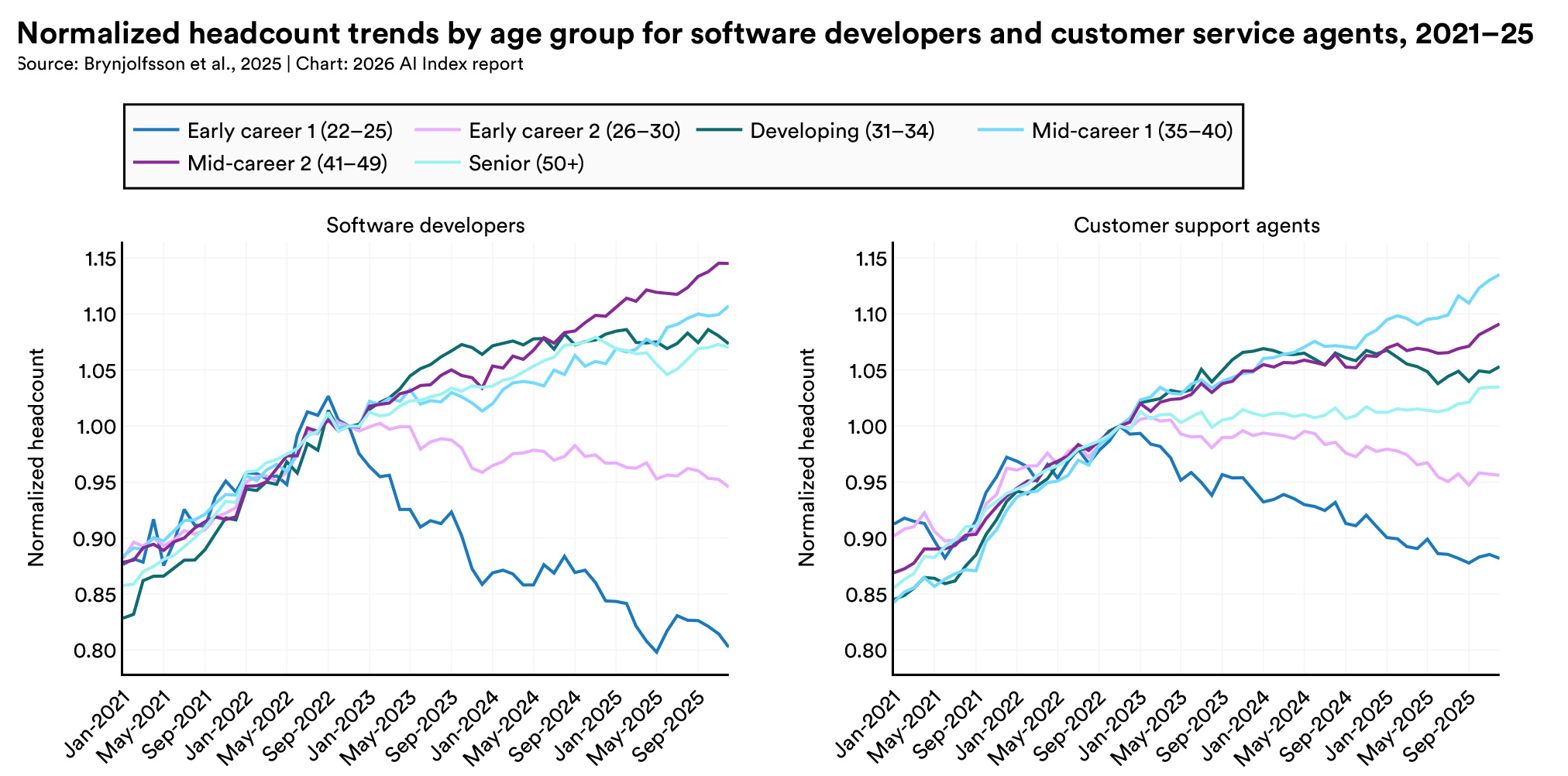
Reading that headcount chart alongside the comp data yields the clearest strategic conclusion in this guide: the durable premium sits with engineers who have crossed from "can use AI tools" to "can build and evaluate autonomous systems," and that crossing is getting harder to fake and more valuable to have. Yuma Heymans, who built HeroHunt.ai after years watching this exact talent market reprice from the hiring side, has argued that the winners of the agent era are the people who own the reliability layer, not the demo layer, and the 2026 data is now unambiguous on that point. For agentic specialists the premium already runs 15-20% over a comparable ML engineer and widens with scope - KORE1, and the enterprise share of applications incorporating agentic AI is projected to rise from under 1% in 2024 toward a third by 2028. The bubble may deflate valuations; it will not un-invent the need for people who can make agents work.
The closest historical parallel is the shift from on-premise to cloud engineering, and it is a useful guide to what comes after a hype peak. Cloud was mocked as overhyped around 2011, a wave of ill-conceived migrations failed, valuations wobbled, and yet a decade later "cloud engineer" was a permanent, well-paid discipline rather than a fad, because the underlying capability was real even where individual projects were not. Agent engineering is on the same arc: the projected cancellation wave is the failed-migration phase, not a verdict on the capability itself. By 2027 the likely shape is fewer but larger agentic deployments, a role that has moved further up the stack toward supervising fleets of agents, and a compensation market that has cooled at the frothy frontier-lab top while staying structurally tight in the enterprise middle, which is exactly the divergence the data already shows today.
11. How to Use These Numbers: A Decision Framework
If you take one thing from this guide, make it the discipline of pricing the five variables in order rather than reaching for a single median, because that habit is what separates a well-negotiated package from a mispriced one on either side of the table. Start with level, then employer tier, then skill depth, then location, then the cash-versus-equity mix, and only then compare offers, always on total comp rather than base. An offer that looks smaller on base can be far larger on total, and an offer that looks enormous on paper can be mostly an illiquid wager on a single company's stock. The frontier-lab and top-startup numbers are real, but they are the tail of one variable at its maximum, and treating them as the market is the most common and most expensive error.
For engineers deciding where to aim, the pragmatic path is legible in the data. The broad market anchors around $211,000 for a capable AI engineer, big tech runs a clean ladder to $607,000 at staff, agent startups trade cash for equity that can reach $975,000 at the hottest shops, and frontier labs sit in their own universe above $800,000 median. Your leverage to move up that ladder is not a title change but demonstrated depth at the orchestration and evaluation layers, the parts of the stack that the market is paying a widening premium for and that the entry-level squeeze cannot touch. The freelance market rewards the same depth even faster, at $175-$300 an hour for genuine agent work, for those who prefer independence to equity lottery tickets.
For employers, the framework is a budgeting and sourcing discipline in equal measure. Decide your tier honestly and pay its band without apologizing for not matching a different tier's headline; a Series B startup offering strong base plus real ownership is selling a different and genuinely attractive product to a different buyer than a lab's million-dollar package. Then invest the saved energy in the actual bottleneck, which is identifying the small minority of engineers who can build production agents rather than the large majority who list the keywords. That is a sourcing problem before it is a compensation problem, and it is the reason AI-native recruiting platforms such as HeroHunt.ai exist: to surface agent-capable builders from a flooded applicant pool and reach them before the competition does. You can start sourcing for free and calibrate your bands against the candidates you actually find. Whichever side of the table you sit on, the market rewards precision, and the numbers in this guide are the precision instrument.
Written by Yuma Heymans (@yumahey), who built HeroHunt.ai, the AI recruiter now used by 15,000+ recruiters to source and engage technical talent, and who has spent the last few years watching agent-engineering compensation reprice in real time from the hiring side of the table.
This guide reflects the AI agent engineer compensation landscape as of August 2026. Pay bands, valuations, and equity values move quickly in this market (Levels.fyi figures in particular update continuously), so verify current numbers against the linked sources before making a decision.