



The real 2026 cost of Juicebox and its PeopleGPT search engine, decoded tier by tier, with the credit traps and the alternatives worth pricing against it.
Juicebox raised $80 million at an $850 million valuation in March 2026, and then quietly cut the price of its entry plan four months later - BusinessWire. That combination, a company flush with capital and still repricing its cheapest tier, tells you most of what you need to know before you buy: Juicebox pricing is a moving target, and almost every number you will find in a search result is a snapshot from a different month.
Here is the problem that sends people looking for this guide. Type "Juicebox pricing" into Google and you will see a Starter plan quoted at $79, $99, $119, and $139, all on pages that look current, all confidently stated. They are not lies. They are four true prices captured at four different points in an unusually busy year, and the tool's own comparison grid gates features in ways the plan cards do not advertise. The result is that teams sign annual contracts for the wrong tier, discover the wall they actually hit only after they hit it, and pay for capabilities they never use.
This guide fixes that. It covers exactly what Juicebox costs in 2026 after its July repricing, what each tier really gates (the answer is contact credits, phone numbers, and getting your data back out), where the money quietly escalates, and the best alternatives with their real prices next to Juicebox's. It assumes you are evaluating this as a working sourcing tool, not reading a brochure, so it leads with the numbers and the trade-offs rather than the marketing. Tools like HeroHunt.ai appear here too, as one option among several, priced on the same honest basis as everything else.
Contents
- Juicebox pricing at a glance in 2026
- What Juicebox and PeopleGPT actually are
- The full 2026 pricing breakdown, tier by tier
- What each tier actually gates: credits, phones, and exports
- Juicebox Agents: autonomous sourcing at $199 per agent
- The real cost: team math and total cost of ownership
- Juicebox versus LinkedIn Recruiter: the value argument
- Where Juicebox is strong, and where it fails
- The best Juicebox alternatives in 2026, with pricing
- How to choose: a decision framework by buyer type
- The future: from per-seat pricing to per-outcome agents
- Verdict: is Juicebox worth it in 2026?
1. Juicebox pricing at a glance in 2026
The short answer is that Juicebox starts at $99 per seat per month on an annual commitment and climbs quickly once you add the two things most recruiters actually need, which are phone numbers and an autonomous agent. The published ladder runs from a genuinely free tier through a Starter plan, a Growth plan, and a custom-quoted Business plan, with an Agents add-on that sits on top of any paid plan at a flat fee. Searching is unlimited on every paid plan, which sounds generous until you notice that a search you cannot contact is just a list, and contacting people is what the credits meter.
The number that matters is not the headline. A solo recruiter who wants Juicebox to do real outbound pays for a seat plus the ability to reach candidates, and once phone numbers and background sourcing enter the picture the working cost lands closer to $300 to $400 per month than to the $99 sticker - MakerStack. That is still cheaper than the incumbent it is designed to replace, but it is three to four times the figure that pulls people in. The table below is the current picture in August 2026; the sections that follow explain every line in it.
| Plan | Billed annually | Billed monthly | Seats | Contact credits |
|---|---|---|---|---|
| Free | $0 | $0 | 1 | ~5 one-off (email templates, trial searches) |
| Starter | $99 | $119 | 1 | 500/mo + 500 export, email only |
| Growth | $179 | $199 | Up to 5 | 1,500/seat/mo + 1,500 export, email + phone |
| Business | Custom | Custom | Custom | Unlimited contact, ATS/CRM sync |
| Agents (add-on) | $199 per agent/mo | $199 per agent/mo | Any paid plan | Unlimited within the agent |
Read that grid with one rule in mind: every subscription figure is per seat, so a three-person team is three times the number you see, and the only flat fee on the page is the agent. The pricing is transparent, which already puts Juicebox ahead of most of the enterprise sourcing market where you cannot see a price without a sales call. Transparent is not the same as simple, though, and the rest of this guide is about the parts the plan cards do not spell out.
For readers who want the bottom line before the detail, here is the quick version by buyer. A solo recruiter or founder emailing candidates lives comfortably on Starter at $99 to $119. A desk that needs phone numbers is on Growth at $179 to $199 whether it likes the jump or not. A team that needs candidates synced into an applicant tracking system is a Business buyer whose price only a salesperson can quote. And anyone who wants sourcing to run in the background is really buying the $199 agent, on top of whichever seat they hold. Every number after this section is an elaboration of those four sentences, so if one of them already describes you, you can skim to the tier that fits and skip the rest.
HeroHunt.ai
Before you price Juicebox by the seat, it is worth seeing the model it is being challenged by. HeroHunt.ai is an AI recruiter rather than a faster search box: it searches over a billion profiles, screens them with language models against your criteria, and runs the outreach itself. The reason it belongs in a Juicebox pricing discussion is the metering unit. Juicebox charges per seat and then meters your contacts with credits; HeroHunt.ai charges per open position you are actively hiring for, starting at $149 per month for three roles at a time, with an 8-day trial and no per-contact credit to ration. The honest caveat is that this is the opposite trade from the one many Juicebox buyers want: if the appeal is sitting in the search box and tuning a query yourself, an autonomous agent will feel like it took the wheel, and it is not an applicant tracking system. Judge it the way this guide says to judge Juicebox: run searches you already know the answer to, and see whether the people you can name come back.
2. What Juicebox and PeopleGPT actually are
Before pricing anything, get the naming straight, because it changes what you are shopping for. PeopleGPT is not the product; it is the search engine inside the product, and the product is called Juicebox. The company, a Y Combinator alum from the Summer 2022 batch, launched PeopleGPT in late 2023 as a natural-language way to search candidate profiles, then built a full sourcing platform around it: projects, outreach sequences, exports, contact enrichment, and an autonomous agents layer - Y Combinator. So when you search "PeopleGPT pricing," you are really pricing Juicebox, and the two names are used almost interchangeably across review sites.
The core pitch has not changed since launch and it is genuinely good. You describe a role in plain English, something like "female software engineers in the US who contributed to open-source machine learning projects on GitHub but did not attend an Ivy League school," and PeopleGPT returns a ranked shortlist with the evidence attached, including the specific repositories that matched - TechCrunch. It draws from a pool the company describes as more than 800 million profiles across 30-plus data sources, including LinkedIn, GitHub, Google Scholar, Stack Overflow, and Medium, rather than a single network. That breadth, and the fact that you never have to assemble a Boolean string by hand, is why the tool got traction with recruiters who are not sourcing specialists.
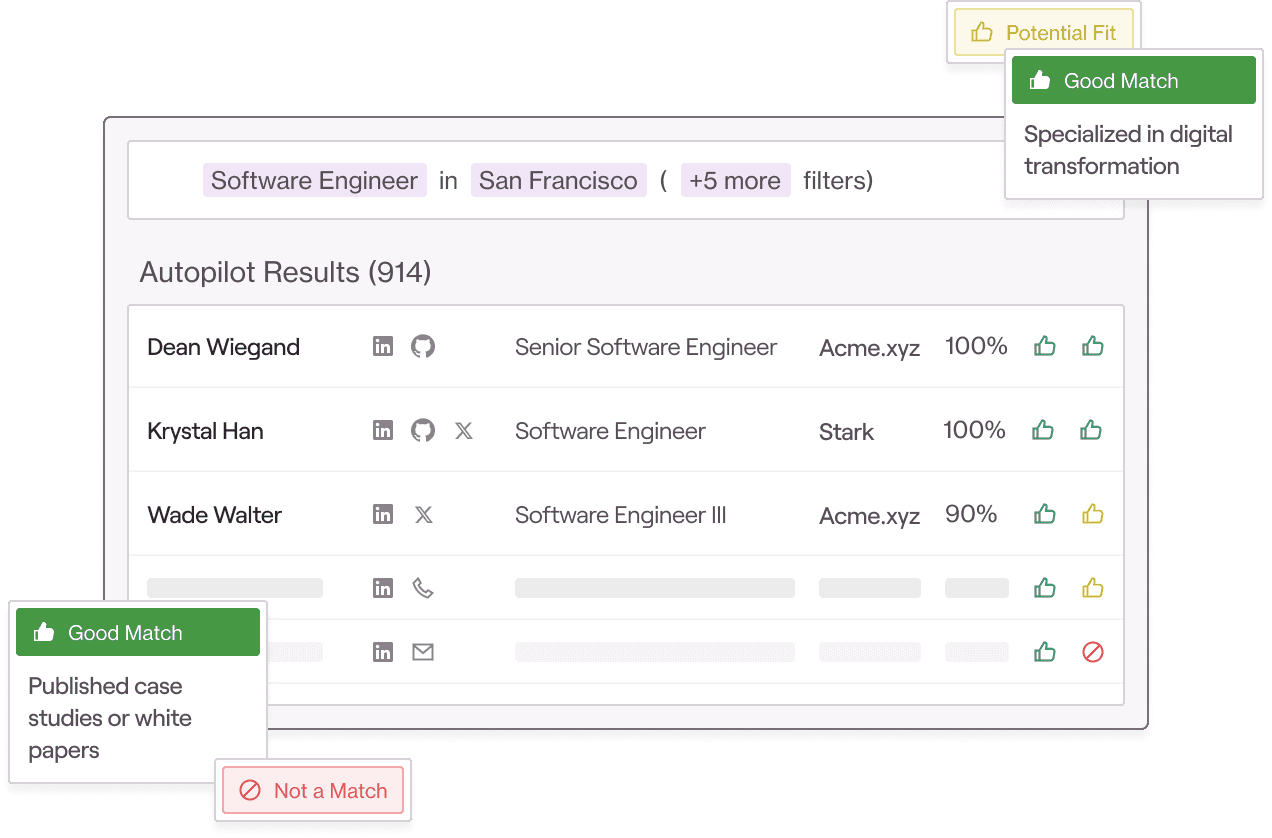
The image below shows the search experience that anchors the whole platform, the natural-language query box and the ranked results that come back from it.

What has changed is the scale of the company behind it, and that matters for pricing because a well-funded vendor prices for growth, not for survival. Juicebox has raised roughly $116 million in total: a $6 million seed, a $30 million Series A led by Sequoia in September 2025, and an $80 million Series B at an $850 million valuation led by DST Global in March 2026 - Axios. It reports more than 5,000 recruiting teams as customers, up from 2,500 a year earlier, and names OpenAI, Perplexity, Cursor, Cognition, and Ramp among them - Juicebox. A company with that trajectory is investing in autonomous agents and enterprise expansion, which is exactly where its pricing is heading.
The people behind the pricing are worth a sentence, because the company's confidence traces back to an unusually efficient origin. Juicebox was co-founded in 2022 by David Paffenholz and Ishan Gupta, who took it through Y Combinator and then bootstrapped it to a reported $1 million in annual recurring revenue with four employees before raising a dollar of venture money - TechCrunch. By the Series A the company said revenue had grown more than tenfold in a year and passed $10 million in ARR. That history matters for a pricing guide because a vendor that reached profitability before funding tends to price with conviction rather than desperation, and it explains why Juicebox is comfortable publishing its numbers when most competitors in the category hide them behind a form.
The breadth of the underlying data is the other thing worth understanding before you pay, because it is both the product's strength and the root of its weaknesses. Juicebox does not own a proprietary network the way LinkedIn does; it aggregates public profiles from dozens of sources, which is what lets it surface a candidate's GitHub commits, Stack Overflow answers, or Google Scholar citations alongside a resume. On top of that search layer sits Talent Insights, a market-data view that shows salary ranges, talent supply and demand, and diversity metrics for a given role or location, which the Growth tier unlocks. That combination, broad public data plus a market-intelligence overlay, is genuinely useful for planning a search, and it is a real point of difference from tools that only return a list of names with no context around them.
Two more capabilities round out what you are paying for. A Chrome extension brings PeopleGPT into the browser, so a recruiter can source from a LinkedIn profile and drop it straight into an outreach sequence without leaving the page. And the outreach itself is more configurable than the "email-only" shorthand suggests: sequences support variables, AI commands that inject a one or two sentence summary of a candidate's background, and reusable snippets, and they can be generated from a job description in multiple languages - Juicebox docs. The limitation, covered later, is that only the email steps actually send automatically; any LinkedIn or phone step is handed back to the recruiter as a manual task rather than executed by the platform.
The product itself got a meaningful upgrade in the same window. PeopleGPT 2.0 introduced a two-step flow, where you select filters with AI and then ask questions across your entire matched set of up to hundreds of millions of profiles, alongside a claimed 4x faster search, a central Profile Feed with an AI spotlight explaining why each person fits, and Smart Summaries that condense a profile into bullets or a short paragraph - Juicebox. To see the workflow in motion rather than described, this official demo walks through the natural-language search, the automated profile evaluation, and the outreach step in a few minutes.
Recruiting with AI: Juicebox Demo
3. The full 2026 pricing breakdown, tier by tier
Juicebox publishes four tiers plus one add-on, and the reason the internet cannot agree on the numbers is that the company repriced the whole ladder on 21 July 2026 - UsagePricing. Understanding that single date resolves the contradiction. Before it, Starter was $139 per month ($119 billed annually) with 250 contact credits and a three-project cap. After it, Starter is $119 per month ($99 annually), the contact and export credits doubled to 500 each, and the project cap disappeared. Growth held its price but had its bundled credits raised by half, and the Business export ceiling went up too. Every "old" price you see in the wild is a pre-July snapshot, and the "$79" figure is an even older annual rate from early 2026.
It helps to see the four contested Starter prices as one timeline rather than four competing claims. In early 2026, Starter sat near $79 per seat on an annual rate with 250 credits. It was then raised, reportedly by around 40%, to $139 monthly ($119 annually), still with 250 credits and a three-project cap, which is the version most review sites captured through the first half of the year. On 21 July 2026 it was cut to $119 monthly ($99 annually) and its credits doubled to 500 with the project cap removed - UsagePricing. Every apparently wrong price online is simply a correct price from an earlier point on that line, which is why the date attached to any Juicebox figure matters as much as the figure itself.
That churn is the single most important fact about Juicebox pricing, so it is worth internalizing before looking at any table: the direction of travel in July 2026 was cheaper and more generous, not more expensive, which is unusual and probably a response to competitive pressure from a crowded field of lower-cost AI sourcing tools. The volatility cuts both ways, though. If prices moved twice in one year, they can move again, and an annual commitment locks you into today's grid regardless. Buy the plan you need for the wall you actually hit, not the one whose credit allowance looks impressive on paper.
Here is the current published ladder in detail, drawn from the live pricing page and corroborated by the dated change log that recorded the July repricing - Juicebox.
| Plan | Monthly | Annual (per mo) | Seats | Contact credits | Export credits | Notable gates |
|---|---|---|---|---|---|---|
| Free | $0 | $0 | 1 | ~5 one-off | 0 | Trial searches, AI email templates |
| Starter | $119 | $99 | 1 | 500/mo | 500/mo | Email only, no phone, no ATS |
| Growth | $199 | $179 | Up to 5 | 1,500/seat | 1,500/seat | Adds phone, Talent Insights, 3 mailboxes |
| Business | Custom | Custom | Custom | Unlimited | ~2,250/seat | ATS/CRM sync, onboarding, priority support |
A word on how to read that grid, because Juicebox hides its real product boundaries in plain sight. The plan cards at the top of the pricing page are the marketing, all generous headline numbers and reassuring feature bullets. The comparison grid further down the same page is where the actual limits live: which tier gets phone numbers, where ATS sync begins, and what the export ceiling is. The two are consistent with each other, but they are written for different readers, and buyers who skim the cards and skip the grid are the ones who discover a wall after signing. Ten minutes on the comparison grid before you buy is the single highest-return piece of due diligence on this product.
The annual discount deserves a footnote because the marketing overstates it. Juicebox shows a "15% off" badge for annual billing, but the real per-tier saving is not uniform: Starter's $119 monthly falling to $99 annually is about 17% off, while Growth's $199 to $179 is closer to 10% off - UsagePricing. Annual plans grant the full year of credits up front rather than metering them monthly, which helps if your hiring is spiky, but it also means you have paid for the whole allowance whether or not you use it. The Free tier, meanwhile, is best understood as a demo rather than a working plan: you can run searches and inspect profiles, but with only a handful of one-off contact credits and no export credits, you cannot actually run outbound on it.
4. What each tier actually gates: credits, phones, and exports
The tier names tell you almost nothing about what you are buying. What matters is which of three walls you hit first, because that, and not the plan card, is the entire decision: contact credits, phone numbers, and the ability to get your data back out of the platform. Every recruiter hits one of them, and the tier you need is defined by which one comes first for your workflow. Get this wrong and you either overpay for an allowance you never spend or sign up for a plan that cannot do the one thing you needed.
Contact credits are the real currency, and the mechanics are more specific than most reviews admit. One credit reveals a candidate's contact information, but the pools are not interchangeable: revealing an email costs 1 credit while revealing a phone number costs 3 credits, and export credits are a separate pool spent at one per profile you download - Juicebox docs. Credits do not roll over month to month. Starter includes 500 contact plus 500 export credits, Growth includes 1,500 of each per seat, and Business is the only tier with unlimited contact credits. Because a phone reveal costs triple, a recruiter doing phone-heavy outreach burns a Growth allowance far faster than the "1,500" headline suggests.
Phone numbers are the Starter-to-Growth wall, and it is the one most solo recruiters hit. Starter's credits are explicitly email-only; if you want a direct dial, you are on Growth at $179 per seat annually or $199 monthly - Juicebox. That is roughly a 51% jump in seat price for the single capability of seeing a phone number, which is why it pays to ask whether you genuinely need dials before you climb. Dedicated contact-data tools sell phone numbers on their own, and at low volume they often do that half of the job for less than the Juicebox upgrade costs. A database like Apollo.io, whose paid plans start at $49 per user per month and include mobile-number credits, can sit alongside Juicebox Starter and cover the dials without the seat upgrade - Apollo.
The credit math is worth working through once, because the headline allowance is misleading the moment phones enter the picture. On Growth, a recruiter who reveals 200 emails and 100 phone numbers in a month has spent 200 plus 300 credits, or 500 of the 1,500 included, because phone reveals cost triple - Juicebox docs. Add the export credits consumed by downloading those profiles into a spreadsheet and the real capacity of a Growth seat is a few hundred genuinely worked candidates per month, not fifteen hundred. For a high-volume desk that is a hard ceiling, and it is the specific reason the $199 agent, with its unlimited internal credits, so often becomes the cheaper answer than buying a second seat.
Getting your data out is the Growth-to-Business wall, and it is the one that surprises people most. ATS and CRM integration is gated to the Business plan, not Growth, confirmed in Juicebox's own documentation, which states plainly that these integrations are included on the Business plan across 50-plus systems including Greenhouse, Lever, and Ashby - Juicebox docs. On Starter and Growth you move candidates out by CSV export, capped by your export credits. If your workflow assumes sourced candidates land in Greenhouse automatically, you are a custom-quote customer, not a $179 one, and you should get that quote before you fall in love with the Growth tier.
This gate has produced the platform's sharpest buyer complaint, and it is instructive. A Product Hunt reviewer described buying a full year of the Business plan expecting the ATS integrations and hiring-manager seats shown in the sales demo, only to find them absent and the platform "almost useless" for their workflow - Product Hunt. Whether that reflects a mis-set expectation or a genuine gap, the lesson is the same: on Starter and Growth your candidates leave the platform through a CSV export capped by credits, and manual export-and-import is the actual daily workflow, not the seamless pipeline sync the marketing implies. If that friction is unacceptable, you are a Business buyer, and you should confirm in writing exactly which integrations your quote includes before you sign.
Those three walls, taken together, mean the honest way to price Juicebox is to name your bottleneck first and let it choose the tier. The list below maps each constraint to the plan it forces, which is the reverse of how the pricing page invites you to shop.
- Just testing search quality: Free or Starter is enough to judge results
- Need email outreach at volume: Starter, watching the 500-credit cap
- Need phone numbers: Growth is mandatory, at roughly double the seat cost
- Need ATS or CRM write-back: Business, a custom quote, no way around it
- Bottleneck is credits, not seats: an Agent may be cheaper than upgrading
The practical implication is that two recruiters with identical headcount can have wildly different correct answers depending on a single workflow detail. A founder who just wants to find and email fifty engineers is a Starter customer forever. A staffing desk that lives on the phone is on Growth from day one. An in-house team that needs everything to sync into Greenhouse is a Business prospect whose real price is invisible until a salesperson quotes it. Deciding which of those you are, before you look at the plan cards, is the whole game.
5. Juicebox Agents: autonomous sourcing at $199 per agent
The most important line item on the Juicebox price list is not a tier at all; it is the Agents add-on at $199 per agent per month, a flat fee that sits on top of any paid plan - Glozo. This is where the company is heading, where its Series B money is going, and where the pricing model quietly stops being about seats. An agent is an autonomous sourcer that runs continuously against a single open role: it learns the talent bar for that role, sources across unstructured places like GitHub and Google Scholar, ranks candidates, adapts when priorities shift, and drafts personalized outreach in your team's voice, with a review checkpoint before anything sends - BusinessWire.
Agents matter for budgeting because they change the shape of the bill. Each agent comes with unlimited internal contact and email credits, which means a single $199 agent can be cheaper than upgrading seats when your bottleneck is credits rather than people. If a role would otherwise burn through a Growth seat's 1,500 credits in the first two weeks, an agent that never runs out and works the role around the clock is arguably better value than a second seat. Juicebox cites early results of up to 5x recruiter efficiency and a 50% reduction in sourcing time, which are vendor figures and should be read as such, but the structural point stands: the agent is the product's most interesting capability and it is not included in any published seat price.
The economics of an agent versus a seat are worth making concrete, because they run counter to intuition. A second Growth seat costs $199 monthly and brings 1,500 credits that, as shown above, a phone-heavy recruiter can exhaust in a couple of weeks. A single agent also costs $199 monthly but comes with unlimited internal credits and works its role continuously without a human tuning queries. So if your constraint is throughput on a specific hard-to-fill role rather than a shortage of recruiters, the agent is the better value at the same price, and this is precisely the substitution Juicebox is nudging buyers toward. Where the seat still wins is breadth: an agent is scoped to one role at a time, while a recruiter with a seat can jump across many searches in an afternoon.
The screenshot below shows the agents view, where sourced candidates are processed and queued rather than returned as a static search page.

The agents launched publicly on 20 May 2026 and have iterated quickly since, with a next-generation conversational version referenced on the company blog. Because this is the capability buyers increasingly pay for, it is worth watching the official walkthrough of how an agent works end to end before deciding whether it justifies its own budget line.
Juicebox: AI Agents for the Hiring Process
There is a strategic reading of the $199 agent worth stating plainly. Juicebox is transitioning from a tool you operate to a system that operates for you, and the agent is priced as a discrete unit precisely so that value can scale with the number of roles rather than the number of recruiters. That is a smarter alignment than per-seat licensing, because it ties cost to hiring activity. It also means the honest total cost of Juicebox in 2026 is rarely the seat price alone. If you intend to use the feature that the company is betting its future on, budget the agent from the start, and price it against alternatives that bundle autonomy into the base plan instead of charging for it separately.
One operational caveat separates a Juicebox agent from a fully hands-off system, and it is a feature rather than a flaw. The agent drafts outreach and builds shortlists, but it holds at a review checkpoint before messages send, so a human still approves what goes out in the team's voice. That keeps a recruiter in the loop on tone and targeting, which most teams want early on, but it also means the agent is not truly autonomous end to end; it is an extremely capable assistant that still asks permission. Buyers weighing the $199 line should decide whether they want that checkpoint or whether their goal is to remove themselves from the loop entirely, because that single preference points toward genuinely different products.
6. The real cost: team math and total cost of ownership
The published seat price is the beginning of the Juicebox bill, not the end, so the only sensible way to compare it against anything is to model the setup you will actually run. Start with the honest solo case. A recruiter who wants Juicebox to source in the background and reach candidates by phone needs a Growth seat plus one agent, which is $199 plus $199, or roughly $398 per month on monthly billing before annual discounting. A leaner setup, Starter plus one agent for email-only outreach, still lands at $318 per month. The $99 headline describes a version of the tool that most serious users outgrow within a month.
Team math compounds this because seats are linear. Growth is billed per seat up to five users, so a three-recruiter desk on Growth annual is about $537 per month, and adding a single shared agent brings the all-in figure to roughly $8,832 per year - Paraform. That is the number to hold against every alternative, not the sticker. The chart below lays out the most common configurations so the escalation is visible at a glance, from the entry sticker to a small team running one agent.
Juicebox Real Monthly Cost by Setup (2026, monthly billing)
What the chart makes obvious is that the interesting cost jumps are not between tiers but between configurations, and specifically at the agent. Moving from Starter to Growth adds $80; adding an agent adds $199, more than the seat itself. This is why the total cost of ownership conversation for Juicebox is really a conversation about how many agents you will run, because the agents, not the seats, dominate the bill once you commit to autonomous sourcing. A team that runs one agent per open role, which is the intended usage, will find the agent line growing faster than the seat line as hiring picks up.
Scale the model up and the divergence is stark. A five-recruiter agency on Growth running three agents against its three hardest roles is paying five seats at $199 plus three agents at $199, which is $1,592 per month, or roughly $19,000 a year even before annual discounting. That is still a fraction of what five LinkedIn Recruiter Corporate seats would cost, but it is no longer an impulse purchase, and it is the point at which a procurement conversation and a hard look at real usage make sense. The annual discount helps a little here, trimming the seat component by around 10% and the Starter component by around 17%, but the agents do not discount at all, so the more you lean on the feature that defines the product, the less the annual commitment saves you overall.
The annual-versus-monthly decision has a clean rule of thumb once you see the numbers. Because the agents never discount and the seat discount is modest, the blended saving on a realistic Growth-plus-agent setup is well under the advertised 15%. On a solo Growth seat plus one agent, annual billing saves roughly the Growth portion's 10%, or about $240 a year, in exchange for locking in twelve months against a tool that recut its own prices in July. For a first-time buyer that is rarely worth it; for a settled team that knows it will run the same configuration all year, it is close to free money. Decide based on how confident you are in your own usage, not on the size of the discount badge.
The comparison-shopping takeaway is to price the version you will actually use against the same configuration elsewhere. Against a tool that bundles unlimited contact reveals into a flat seat, Juicebox can be cheaper at low volume and more expensive at high volume. Against enterprise platforms that hide their pricing entirely, Juicebox usually wins on transparency and on the ability to start without a sales call. And against outcome-priced tools that charge per role rather than per seat, the math flips again depending on how many recruiters you would otherwise license. The point is that "how much is Juicebox" has no single answer; it has a configuration, and the configuration is yours to choose deliberately.
7. Juicebox versus LinkedIn Recruiter: the value argument
The comparison Juicebox's own positioning invites is against LinkedIn Recruiter, and on sticker price it wins that fight decisively. LinkedIn Recruiter Corporate runs roughly $10,800 to $15,000 per seat per year after a reported 15% price increase in 2026, and most contracts carry a multi-seat minimum, which puts three seats north of $32,000 annually - Pin. Three Juicebox Growth seats plus an agent come in under $9,000. That is a three-to-one gap on the same headcount, and it is the single strongest argument in Juicebox's favor. We break down the incumbent's real contract prices, including the cheaper Recruiter Lite tier, in a separate LinkedIn Recruiter pricing guide for anyone weighing that side directly.
The gap is real, but the products are not identical, and pretending otherwise leads to buyer's remorse. LinkedIn owns first-party data that is always current, because members update their own profiles, and it owns InMail delivery into an inbox nobody else can reach the same way. Juicebox aggregates from thirty-plus sources, which gives it breadth LinkedIn lacks, including GitHub commits and Google Scholar citations that never appear on a LinkedIn profile, but that data is scraped and stored rather than self-maintained, so it decays. The honest framing is that you are trading always-current, single-network data plus premium InMail for broader, multi-source data plus natural-language search and autonomous agents, at a third of the price.
Make it concrete with two roles. Hiring a regional sales manager, where the relevant signal is job history and location and almost everyone maintains a current LinkedIn profile, LinkedIn Recruiter's first-party freshness and InMail reach are hard to beat, and Juicebox's aggregated data offers little the incumbent lacks. Hiring a machine-learning engineer, where the real evidence is a GitHub history, a few papers, and a Stack Overflow reputation that never touch a LinkedIn headline, Juicebox's multi-source breadth surfaces people LinkedIn simply cannot describe, and the natural-language query does it without a Boolean marathon. The tool you should buy is the one whose data model matches where your candidates actually leave a trace, and for most technical and research hiring that tilts toward breadth over a single network.
The outreach channel is the other half of the value argument and it rarely gets priced. LinkedIn's InMail lands in an inbox many passive candidates check more reliably than a work email, and it carries an implicit legitimacy a cold email from an unknown domain does not. Juicebox's email-first outreach is cheaper and scales without InMail credit limits, but it depends on the accuracy of a scraped email address and on getting past a spam filter, which is precisely where the data-freshness problem resurfaces as a bounce. Neither channel is strictly better; they fail in different ways, and a serious outbound operation often ends up wanting both, which is itself an argument for pairing a cheap search tool with a separate outreach layer rather than expecting one vendor to do everything well.
Which side of that trade is right depends on what you source for. For a recruiter filling generalist business roles where LinkedIn coverage is dense and current, the incumbent's data quality can justify its premium. For technical and research roles where the signal lives in code and papers rather than in a polished LinkedIn headline, Juicebox's breadth is a genuine advantage that no amount of LinkedIn budget replicates. And for a team that wants sourcing to run without a human driving each query, neither LinkedIn Recruiter nor a Juicebox seat alone is the answer; the agent is, which is why the value argument increasingly turns on autonomy rather than on data or price.
8. Where Juicebox is strong, and where it fails
Juicebox earns real praise, and it is worth being specific about what for, because the strengths are the reason to pay at all. The consistent number-one compliment across independent reviews is that natural-language search genuinely beats Boolean: you describe a role in a sentence and get a usable, ranked list in seconds, with the evidence for each match shown on the card - SelectSoftware Reviews. Reviewers also single out the transparency of the entry price and the existence of a real free tier as unusual in a category that mostly hides behind sales calls, and they call the autonomous agents the platform's most differentiated feature. It is approachable enough that a founder or hiring manager can run it cold, with a first useful search inside half an hour.
That approachability is a genuine competitive moat worth paying for if it fits you. In a category where the incumbent tools assume a trained sourcer who can build Boolean strings and negotiate an enterprise contract, a product that a non-specialist can open and use productively in under thirty minutes expands who can source at all. A founder making the first ten hires, a hiring manager filling a role their recruiter is too busy for, or an agency owner between sourcers can all get value without a ramp. The flip side, and the reason this is not the whole story, is that ease of entry says nothing about data quality or cost at scale, which is where the caveats below live.
The weaknesses are equally specific, and the most-cited one is data freshness. Because Juicebox aggregates publicly scraped profiles rather than maintaining first-party data, users report outdated employment information and higher-than-expected email bounce rates, especially for niche roles and candidates outside North America and Western Europe - MindHunt AI. This is not a bug so much as an inherent property of the aggregation model: any stored profile decays, and the most-cited benchmark, HubSpot's database-decay analysis, puts B2B contact decay at roughly 2.1% per month, compounding to about 22.5% per year - HubSpot. A profile you pulled six months ago is meaningfully less accurate than one pulled today, and no "consistently refreshed" claim escapes that arithmetic.
The screenshot below shows the ranked results view where the match evidence appears, the feature reviewers praise, and also where the staleness shows up when a stored profile has drifted from reality.
Three other limitations show up often enough to price in. Outreach is email-only in practice: Juicebox automates email steps, but any LinkedIn message or phone call is created as a manual task for the recruiter rather than sent by the platform, and there is no native SMS or WhatsApp - Juicebox docs. Support is gated, with self-help only until the Business tier. And there is a subtler problem reviewers raise: candidate overlap. Because everyone using Juicebox queries the same aggregated pool, the same accomplished, easily discoverable candidates surface for every recruiter, with some estimates of 70 to 80% overlap with LinkedIn Recruiter results for common roles - The Daily Hire. If your edge is reaching people your competitors are not, a shared database works against you.
There is a related weakness that bites hardest exactly where sourcing is supposed to be hardest. Reviewers note that PeopleGPT's filter quality is inconsistent for niche, non-technical, or non-US roles, and that match density drops outside North America and Western Europe - Skillscouter. Combined with the overlap problem, this means Juicebox is often at its best for the searches you least need help with, the visible senior engineer everyone can already find, and weaker on the obscure or regional roles where a genuine sourcing edge would pay off most. The practical mitigation is to treat Juicebox as one input rather than the whole funnel: use it for speed on findable roles, and pair it with a warm-intro or specialist tool for the searches where a cold aggregated database returns thin results.
One widely circulated claim deserves careful handling rather than repetition. Several competitor comparison pages assert that recruiters have had LinkedIn accounts suspended after using Juicebox's Chrome extension, usually attributing it vaguely to "users on Reddit" - Leonar. We could not corroborate that against a single first-hand account, screenshot, or dated thread, and the sources making it are competitors with an incentive to disparage, so treat it as unverified. The underlying mechanism is nonetheless real and applies to every tool with a LinkedIn extension, not to Juicebox specifically: LinkedIn's user agreement prohibits automated extraction, and it does restrict accounts it judges to be scraping. If your LinkedIn account is critical, that is a category-wide risk to manage by using the standalone web platform rather than the browser extension, whichever vendor you choose.
Reviews also come with a data-quality warning of their own. The recruiting Juicebox has almost no footprint on G2, Capterra, or TrustRadius, and the "Juicebox" listings that do appear on those sites with star ratings belong to an unrelated data-visualization product by Juice Analytics, not to PeopleGPT. The most reliable public signals are a Product Hunt score of 3.5 out of 5 from a small number of reviews and an editor rating of 4.4 out of 5 from SelectSoftware across fifteen reviews - Product Hunt. Do not trust a G2 star rating for this product; it is almost certainly measuring something else entirely.
9. The best Juicebox alternatives in 2026, with pricing
If Juicebox is not the fit, the good news is that 2026 is the most competitive year this category has ever had, with credible options at every price point from budget contact data to enterprise talent intelligence. The alternatives split roughly into three groups: transparent self-serve tools priced like Juicebox, enterprise platforms that hide their pricing behind sales calls, and autonomous AI recruiters that shift the model from search to outcome. The comparison table below sets the landscape before the individual write-ups, using published prices where they exist and clearly flagging where a vendor is sales-gated.
| Tool | Entry price (per seat/mo) | Metering unit | Best for |
|---|---|---|---|
| Juicebox | $99-$119 | Per seat + credits | Natural-language search plus agents |
| SeekOut | $149 (annual, 3 seats) | Per seat + credits | Technical, diversity, cleared talent |
| hireEZ | ~$169-$250 (sales-gated) | Per license + credits | Enterprise ATS rediscovery |
| Gem | Custom (startup $130) | Per seat, FTE-scaled | All-in-one CRM plus sourcing |
| Fetcher | $115 | Candidates delivered | Managed, done-for-you sourcing |
| Findem | ~$6,000/yr (sales-gated) | Per seat + modules | Enterprise talent analytics |
| Apollo.io | $49 | Per seat + credits | Budget contact data plus outreach |
| Leonar | $95 | Per seat + credits | EU SMB sourcing plus light ATS |
| HeroHunt.ai | $149 | Per open position | Autonomous end-to-end recruiting |
The published prices span an order of magnitude, so the chart below plots the transparent self-serve options side by side to make the entry-cost gaps concrete. The sales-gated enterprise tools (hireEZ, Gem, Findem) are left off deliberately, because quoting a "from" number for a platform that only sells by custom contract would be inventing precision that does not exist.
Published Entry Price per Seat per Month (2026)
SeekOut
SeekOut is the enterprise-grade talent search engine most often cross-shopped against Juicebox, and its edge is depth of filtering rather than natural-language ease. It searches over a billion profiles with unusually specific filters for technical stack, diversity, and even security-clearance status, and it has added agentic workflows and an outcome-based sourcing service called SeekOut Spot. Its self-serve Recruit Core tier is $149 per seat per month billed annually and includes three seats plus 500 contact credits, while everything above it is sales-gated - SeekOut. Third-party contract data puts the median annual deal near $20,000. It is the right answer for a mid-market or enterprise team doing serious technical or diversity sourcing at scale, and overkill for a solo recruiter. Our full SeekOut pricing breakdown covers the higher tiers.
What tilts a team toward SeekOut over Juicebox specifically is depth on a hard filter. If you hire for security-cleared roles, need rigorous diversity filtering for a formal DEI program, or source deep technical stacks where a precise Boolean-plus-AI query beats a plain-English one, SeekOut's filtering earns its higher price. Its newer SeekOut Spot service also pushes into outcome-based sourcing, closer to what autonomous recruiters offer, for teams that want results delivered rather than a search tool to operate. Where Juicebox wins the comparison back is transparency and speed to first value: you can start for $99 without a call, whereas most of SeekOut sits behind sales.
hireEZ
hireEZ occupies similar territory to SeekOut but leans harder into enterprise integration and rediscovery of candidates already sitting in your applicant tracking system. It sources across 800 million-plus profiles from 45-plus sources and has added its own agentic "EZ Agent" workflows. There is no public pricing; it is fully sales-gated on annual contracts, with third-party data suggesting roughly $169 to $250 per seat per month and a median annual contract around $13,000 - Vendr. It suits enterprise talent teams that value deep ATS and CRM integration and want to mine their existing pipeline, and it is a poor fit for anyone who wants to start cheaply without a sales call. See our hireEZ pricing guide for the contract-level detail.
The reason a team pays hireEZ's premium over Juicebox is almost always rediscovery: hireEZ is built to mine the candidates already sitting in your applicant tracking system and re-engage them, turning a stale database into a live pipeline, which a pure sourcing search does not do. That capability, plus deep ATS and CRM integration out of the box, is worth real money to an enterprise with years of accumulated applicants. For a team without that legacy pipeline, though, the premium buys little that Juicebox plus an agent does not, and the sales-gated contract removes the ability to simply try it before committing.
Gem and Fetcher
Gem and Fetcher solve adjacent problems from opposite ends. Gem is an all-in-one recruiting CRM and lightweight ATS where AI sourcing is one module inside a system of record that also handles nurture sequences, analytics, and scheduling. Its pricing is custom and scales with company headcount, with a published startup rate of $130 per month for teams under ten people and a median annual contract near $25,000 for everyone else - Gem. Fetcher takes the opposite approach: it is a semi-managed service where a human sourcer curates batches of vetted candidates and delivers them with automated email outreach, priced by volume from a $115 self-serve tier up through $379 and $649 managed plans - Fetcher. Gem is for in-house teams wanting one platform; Fetcher is for lean teams who want candidates delivered rather than searched for.
The deeper distinction is about who does the work. Gem assumes you have recruiters and want to make them more organized and data-driven, so its value grows with the size of your team and its appetite for pipeline analytics. Fetcher assumes you would rather not do the searching at all and pays a human plus automation to hand you a curated list, so its value grows with how little sourcing time you have. Juicebox sits between them: more hands-on than Fetcher, more sourcing-specialized than Gem, and cheaper to start than either. Which of the three is right depends less on price than on whether your scarce resource is time, expertise, or organization.
Apollo, Leonar, and the budget tier
At the affordable end, three tools undercut Juicebox in different ways. Apollo.io is a B2B sales-intelligence database of 210 million-plus contacts that recruiters use for cheap contact data plus email and dialer outreach, with paid plans from $49 per user per month and a genuinely usable free tier - Apollo. It is not purpose-built for recruiting, so it lacks candidate-centric filters, but for teams that mainly need contact info and outreach, or that share a tool between sales and recruiting, it is dramatically cheaper. Leonar is the most direct low-cost Juicebox competitor: a European platform combining natural-language sourcing over 870 million profiles with a light ATS and email, LinkedIn, and SMS outreach, from $95 per seat per month - Leonar. A third option, Betterleap, pitches flat per-seat pricing around $200 with unlimited contact reveals and no credit system, which flips the math in your favor at high volume.
Two more names round out the field for specific situations. Loxo is a full agency operating system, an applicant tracking system, recruiting CRM, and sourcing in one, with a genuinely usable free tier and a Basic plan around $169 per user per month, which makes it a better fit than Juicebox for a staffing desk that needs a system of record rather than a best-of-breed search layer - Loxo. Consider takes the opposite tack entirely, mining a team's collective professional network to surface warm-introduction paths rather than searching a cold index, which makes it a complement to Juicebox rather than a replacement for teams whose people are well connected. Neither publishes the transparent self-serve pricing Juicebox does, but both solve a problem a pure search engine does not.
HeroHunt.ai
HeroHunt.ai approaches the problem from a different direction than everything above, which is exactly why it belongs in this list rather than as a footnote. Instead of selling a faster search box that you drive, it operates as an autonomous AI recruiter: it searches across more than a billion profiles, screens candidates with language models against your criteria, and runs personalized outreach itself, so the loop keeps moving without you tuning each query. Its pricing is metered on open positions rather than seats or credits, starting at $149 per month for three active roles, $249 for ten, and $499 for a three-user team with twenty, each with an 8-day trial - HeroHunt.ai. The trade is the mirror image of Juicebox's appeal: if you love sitting in the search box, autonomy will feel like it took the wheel, and it is not an applicant tracking system. But if your goal is to spend less time sourcing rather than to source faster, an outcome-priced agent is a fundamentally different value proposition than a per-seat search tool. For a fuller field, our Juicebox alternatives comparison ranks ten options in depth.
10. How to choose: a decision framework by buyer type
Choosing among these tools is less about ranking them and more about matching one to your actual constraint, because they are genuinely differentiated rather than interchangeable. The right sequence is to answer four questions in order: what is your budget tolerance, do you need phone numbers, do you need your data to sync into an applicant tracking system, and do you want to drive the search yourself or have it run for you. Answering them in that order eliminates most of the list quickly, because each answer rules out whole categories rather than individual products.
Budget tolerance sorts the field into three bands. Under roughly $150 per seat you are choosing among Juicebox Starter, Leonar, Apollo, and Fetcher's self-serve tier, all transparent and self-serve. In the middle, from $150 to $400 per seat, sit Juicebox Growth with an agent, SeekOut Recruit Core, and Betterleap. Above that, and behind sales calls, live hireEZ, Gem, and Findem, where you should expect annual contracts in the five figures and a procurement process to match. The diagram below maps the most common paths a team takes through those questions, from the cheapest test to the most autonomous setup.
The framework resolves most cases cleanly. A founder hiring a handful of engineers wants the cheapest transparent search, so Juicebox Starter or Leonar. A staffing desk that lives on the phone needs Growth or SeekOut from day one because email-only will not do. An in-house team standardized on Greenhouse needs ATS write-back, which forces a Business quote or a full CRM like Gem. A high-volume team whose real limit is credits rather than headcount is often better served by an agent than by another seat. And a small team whose goal is to reclaim sourcing hours entirely should look at an outcome-priced autonomous recruiter rather than any per-seat tool, because paying per role aligns cost with hiring in a way that paying per recruiter never will.
A worked example shows how fast the framework converges. Imagine a ten-person startup making its first five engineering hires with no dedicated recruiter. Budget tolerance is low, phone numbers are not essential for engineers who respond to email, ATS write-back is not yet a concern because there is no ATS, and the founder wants to drive the search personally to learn the market. Every answer points the same way: Juicebox Starter, or Leonar, tested first on the free tier. Now change one variable, a hiring manager who wants the roles filled without touching the search, and the same framework routes to an agent or an autonomous recruiter instead. The tool did not change; the constraint did, and that is the whole point of answering the questions in order.
11. The future: from per-seat pricing to per-outcome agents
The most important trend in this category is not a feature; it is a pricing model in transition, and Juicebox's own price list shows it happening. For a decade, sourcing tools charged per seat, because the unit of value was a recruiter operating a search interface. The arrival of autonomous agents breaks that assumption, because the agent, not the recruiter, is doing the work, and the natural unit of value shifts to the role being filled or the outcome being produced. Juicebox's $199 flat agent, priced independently of seats, is an early, hybrid expression of this shift, bolted onto a per-seat base rather than replacing it.
This matters for anyone signing a contract in 2026, because the model you buy into shapes what scaling costs. Per-seat pricing punishes you for adding recruiters even when software is doing more of their work, which is precisely backwards as automation improves. Per-agent and per-position pricing tie cost to hiring activity instead, so a team that fills more roles pays more only because it accomplished more, and a team in a hiring freeze does not keep paying for idle seats. Tools built around this idea from the start, where the metering unit is the open position rather than the license, are the clearest read on where the category is going, and they are worth evaluating even if you ultimately buy a per-seat tool, because they set the benchmark the incumbents are now pricing against.
There is a concrete way to use this trend even if you buy a conventional tool today. When you evaluate any per-seat sourcing platform, compute its cost per role filled rather than its cost per seat, by estimating how many hires a seat produces in a year and dividing. That single calculation puts a $99 Juicebox seat, a $10,000 LinkedIn Recruiter seat, and a $149 outcome-priced plan on the same footing, and it usually reveals that the sticker price and the cost of the thing you actually want, a filled role, are only loosely related. Buyers who run that math are the ones least likely to be surprised by a renewal, because they priced the outcome from the start rather than the license.
The competitive dynamic accelerates the shift. With Juicebox, SeekOut, hireEZ, and Leonar all launching agents within a year of one another, autonomy is becoming table stakes rather than a differentiator, and the differentiation moves to how autonomy is priced and how much of the funnel it covers. This is the context in which a company like HeroHunt.ai, founded on autonomous recruiting rather than retrofitting it, represents the direction of travel rather than a single product choice. The recruiter who understands this in 2026 is not asking "which tool searches best," a question the whole field has largely solved; they are asking "how much of the hiring loop can run without me, and what does that actually cost per role." That is the question the next generation of pricing pages will be built to answer, a shift that industry builders like Yuma Heymans (@yumahey) have been arguing was inevitable since autonomous sourcing first became technically viable.
12. Verdict: is Juicebox worth it in 2026?
Juicebox is worth it for a specific buyer, and the specificity is the point. If you are a recruiter or small team doing passive-candidate sourcing, currently either paying LinkedIn Recruiter prices or fighting Boolean strings by hand, then natural-language search over 800 million profiles at $99 to $179 per seat is a genuinely good deal, and the free tier lets you test the only thing that matters, which is whether the search finds the people you need. The company is well funded, the product is improving quickly, and the transparent pricing is a real virtue in a category built on opaque sales calls. For that buyer, Juicebox is one of the strongest options on the market.
It is the wrong tool in three cases, and recognizing yourself in them saves an annual contract you will regret. If you mainly need contact data rather than search, you are paying a sourcing-platform premium for a database function that Apollo does for a third of the price. If you need ATS write-back, your real price is a Business quote, so get it before you commit to the $179 tier that cannot do it. And if you hire at volume through inbound applications rather than outbound sourcing, this is the wrong category entirely: you need an applicant tracking system, not a search engine. In each of those cases, the sticker price is beside the point, because the tool does not do the job you are buying it for.
The practical buying sequence is the same one this guide has argued throughout, and it is worth following in order. Start on the free tier and run five searches you already know the right answer to, because a tool that cannot find the people you personally know exist will not find the ones you do not. If the results hold up, buy Starter monthly at $119 rather than committing annually, and spend the credits on real outreach for a month. Only then decide whether your bottleneck is phone numbers, in which case Growth, credits, in which case an agent, or ATS integration, in which case a Business quote. Buying the tier before you know which wall you hit is exactly how teams end up on annual contracts for features they never touch. And if, having done all that, your honest answer is that you want as little of the sourcing loop on your plate as possible, that is a signal to price an autonomous recruiter against Juicebox rather than another seat.
If your bottleneck is your own time rather than search speed, price an autonomous option against Juicebox before you sign. HeroHunt.ai searches over a billion profiles, screens with language models, and runs outreach on autopilot, metered by open position from $149 per month with an 8-day trial and no per-contact credits to ration.
Juicebox earned its reputation on one genuinely good idea, that describing a candidate in a sentence should be enough to find them. That idea now costs $99 per seat per month billed annually, $119 if you want to stay flexible, and considerably more once you add phone numbers, integrations, or the agents the company is betting its future on. Price the version you will actually use, watch the date on every number you read, and remember that in a year this volatile, the only pricing page you can fully trust is the live one on the day you buy.
Written by Yuma Heymans (@yumahey), who built HeroHunt.ai, the world's first AI Recruiter. He has been building AI sourcing tools since 2021 and has watched most of this category's pricing pages, including this one, change more than once.
Pricing reflects Juicebox's published tiers and third-party breakdowns as of August 2026, after the 21 July 2026 repricing. Vendors in this category revise tiers frequently, so confirm current figures on the live pricing page before committing to an annual plan.