


A data-driven map of where the world's AI skills actually live in 2026, which countries and cities own them, and how to source talent in each.
Written by Yuma Heymans (@yumahey), founder of HeroHunt.ai. He built an AI Recruiter that sources talent across more than a billion profiles in nearly every country on the map below, so the geography of AI skill is something he studies for a living.
There is no single map of AI talent. There are two, and they crown completely different winners. By raw headcount, the United States leads the world with roughly 220,520 AI authors and inventors, more than four times India's 50,460 and Germany's 48,520 - ThePrint. But flip to talent per head of population and the giants vanish: tiny Switzerland tops the table at 110.5 AI researchers and inventors per 100,000 people, just ahead of Singapore, with Israel leading on workforce concentration - Startupticker.
This split is the single most important thing to understand about hiring AI talent in 2026. If you read only the raw-volume map, you will pour your entire budget into the San Francisco Bay Area and lose every bidding war. If you read only the density map, you will miss the millions of capable engineers now coming online in India, Brazil, Nigeria and Vietnam. The recruiters and talent leaders who win this year are the ones who hold both maps in their head at once, and who know exactly which skill lives where.
This guide is the atlas. It breaks down where AI talent concentrates by continent and country, which specific skills cluster in which places, how the talent flows between them, what each pool costs, and how to source across borders legally and at scale. It draws on the latest 2025 and 2026 datasets: Stanford's AI Index, the MacroPolo Global AI Talent Tracker, LinkedIn and OECD.AI workforce data, GitHub's Octoverse, Coursera's Global Skills Report, and Tortoise's Global AI Index. Assume nothing you learned about this map two years ago still holds, because almost none of it does.
Contents
- The Two Maps of AI Talent: Volume Versus Density
- How AI Skill Density Is Measured (and Where the Data Lies)
- North America: The Talent Magnet Built on Imports
- China and India: The Two Demographic Engines
- The Density Champions: Israel, Singapore, Switzerland and the Nordics
- Europe: Deep Research, Leaky Pipeline
- The Fast-Rising Frontier: Latin America, Africa and the Gulf
- The Skill Map: Which AI Skills Live Where
- The Hidden Layer: Data Annotation and the Global South
- Talent Flows, Brain Drain and the New Geopolitics
- How to Source AI Talent Across Borders
- The 2026 to 2027 Outlook: Where the Next Hotspots Emerge
1. The Two Maps of AI Talent: Volume Versus Density
The most useful first principle in global AI hiring is that raw volume and per-capita density are different markets with different winners, different price points, and different recruiting tactics. Three countries own the absolute numbers. The United States, India and China together hold the overwhelming majority of the world's AI researchers, developers and AI-skilled professionals, simply because they are large, technically educated and economically central. When a job requires a deep bench of people who can ship machine learning systems today, these are the pools with the depth to draw from.
But absolute size hides where talent is most concentrated relative to the population around it. A country with a small population and a dense AI workforce can be a far richer hunting ground per recruiter-hour than a giant with talent scattered thinly across a billion people. This is why Switzerland, Israel, Singapore and the Nordic countries punch so far above their weight: they have engineered ecosystems where a remarkable share of the workforce works in or near AI. The headline ranking by raw count puts the US first, India second and Germany third for AI authors and inventors - ThePrint.
AI Talent by Raw Headcount (AI Authors and Inventors, 2025)
What this chart cannot show is the inversion that happens the moment you divide by population. On the density map, the United States falls to the middle of the pack at 64.8 AI researchers and inventors per 100,000 people, behind not just Switzerland and Singapore but also Sweden (80.6) and Finland (77.6) - Deep Tech Nation. India, despite ranking second in the world by raw count, is nowhere near the top by density. The practical lesson is that the country with the most talent and the country where talent is easiest to find are rarely the same place, and your sourcing strategy has to specify which one you are optimizing for.
This volume-versus-density tension is exactly what surprises most talent leaders when they first see the rankings, and a single short explainer captures it well. The clip below, built on LinkedIn's AI Talent Index, walks through why small nations like Israel, Singapore and Luxembourg dominate the concentration ranking even though they will never appear near the top of a raw headcount list.
AI Talent Hotspots: Countries Leading the Global Race
For recruiters, the takeaway is strategic rather than trivia. If you are filling a large engineering org, go where the volume is and accept that you are competing with everyone else there. If you are filling two or three senior research seats, the density map tells you where a higher fraction of the people you pass on the street can actually do the work, which compresses your search and your time-to-hire. The rest of this guide is essentially a tour of both maps, region by region and skill by skill, so you can decide which one each of your roles belongs on.
2. How AI Skill Density Is Measured (and Where the Data Lies)
Before trusting any country ranking, you have to know what it actually counts, because the major datasets measure very different things and quietly disagree. There is no global census of AI talent. Instead there are proxies, each capturing one slice of reality: published researchers, self-reported skills, job postings, open-source contributions, and course enrollments. A country can rank first on one and twenty-seventh on another, and both can be true. Understanding the instruments is the difference between a defensible sourcing decision and a viral but misleading headline.
The most rigorous datasets track elite research output. The MacroPolo Global AI Talent Tracker counts the authors of papers accepted at top conferences like NeurIPS, and the Stanford AI Index aggregates publications, patents, and the talent-analytics firm Zeki's count of AI authors and inventors - Stanford HAI. These capture the thin layer of people who can advance the frontier, but they tell you almost nothing about the millions of engineers who apply AI rather than invent it. For that you need broader instruments: LinkedIn's workforce data (used by both Stanford and the OECD), which estimates the share of members who list AI engineering skills, and GitHub's Octoverse, which counts developers and contributions to AI projects by country.
A third family of measures captures demand and diffusion rather than supply. Stanford and Lightcast track the share of job postings that explicitly require AI skills, a demand-side signal where small advanced economies dominate. Singapore leads the world with about 4.7% of all postings mentioning AI, ahead of Hong Kong, Luxembourg and Spain, with the United States at 2.6% - Lightcast. Coursera's Global Skills Report adds a learning-side view, ranking countries on how fast workers are enrolling in AI courses and how well-equipped they are to apply those skills.
Share of Job Postings Requiring AI Skills (Demand Density, 2025)
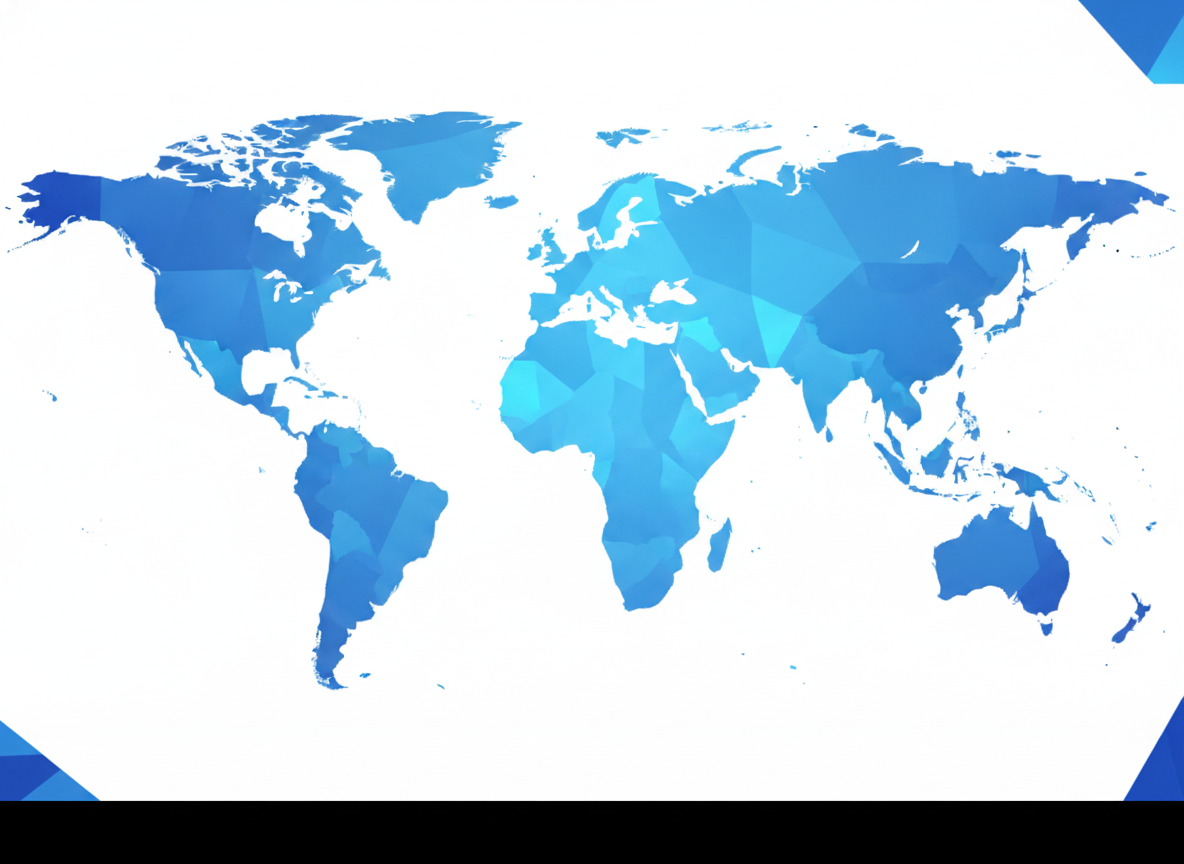
These instruments also disagree in revealing ways. Coursera's overall skills-proficiency ranking puts European nations in nine of the top ten spots, with Switzerland first and the United States only twenty-seventh, while the same report's AI Maturity Index, which weights the ability to actually apply AI, puts Singapore first - Coursera. GitHub's developer map, meanwhile, is the clearest picture of where the next generation of builders is physically coming online, and it points east and south. The image below shows the global concentration of developers, a useful base layer before we zoom into specific regions.
Where the world's developers actually sit

The honest conclusion is that you should never quote a single ranking as the AI talent map. Use the research-output trackers when you are hiring frontier researchers, the LinkedIn and GitHub data when you are hiring applied engineers at scale, and the job-posting and enrollment data when you are forecasting where supply is about to grow. Throughout this guide, every regional claim names which instrument it comes from, because the instrument is half the answer. With the measurement caveats in place, the rest of the atlas becomes far more reliable.
3. North America: The Talent Magnet Built on Imports
North America, and the United States above all, dominates the world in AI talent volume, but its lead rests on a foundation most people miss: it is built almost entirely on imported talent. The US employs close to 60% of the world's elite AI researchers, the people who publish at the field's top conferences, and it remains home to the majority of the most influential AI institutions - Paulson Institute. That concentration of frontier talent, more than any other single factor, is why the leading AI labs are headquartered there and why American models still set the pace.
The dependence on foreign-born talent is striking once you look under the hood. More than half of the US AI workforce was born abroad, nearly 70% of America's top AI researchers are foreign-born, and roughly two-thirds of current graduate students in AI-related fields are international - CSET Georgetown. The startup layer tells the same story: of the US companies on the 2025 Forbes AI 50, about 60% were founded or co-founded by immigrants, led by founders from India, China and France - Institute for Progress. The US is less a producer of AI talent than the world's most effective aggregator of it.
That talent is also extraordinarily concentrated geographically, which matters enormously for sourcing. Three metros do most of the work. The San Francisco Bay Area, Seattle and New York together account for 44% of the 285,235 AI tech jobs in the country, and adding Boston and Austin pushes the figure past half - Staffing Industry Analysts. At the state level, California alone posted 170,881 AI job openings in 2025, roughly 17% of the national total, ahead of Texas and New York - Stanford HAI. This concentration is why salaries are punishing: median total compensation for a Bay Area machine learning engineer runs around $316,000, and the national average AI engineer salary jumped to roughly $206,000 in 2025 - Levels.fyi.
The demand signals underneath those salaries are accelerating even faster than the pay. AI Engineer was the single fastest-growing job title in the US in LinkedIn's 2026 Jobs on the Rise report, with postings up roughly 143% year over year, and the specific skills employers ask for are shifting almost quarter to quarter - Lightcast. Mentions of agentic AI in job postings jumped more than 280% in a single year, and Python now appears in hundreds of thousands of US listings, a reminder that the American market is not just the largest but also the fastest to redefine what an AI role even requires. For recruiters this means a US AI job description written eighteen months ago is already describing a different job, and the candidates who matched it have moved on to whatever the labs are hiring for now. Sourcing into the US market is as much about keeping pace with a moving skill definition as it is about competing on salary.
The crucial 2026 development is that the import engine is now under political stress. The US imposed a $100,000 fee on new H-1B petitions effective September 2025 and introduced a wage-weighted lottery that favors higher-paid roles, taking effect in early 2026 - American Immigration Council. Analysts warn this threatens the very pipeline that supplies most of the US AI workforce, with chilling effects on international students and researchers - Brookings. For recruiters, the implication is concrete: the cost and friction of moving a foreign AI hire into the US has risen sharply, which makes hiring that same person remotely, in their home country a more attractive option than it was even a year ago.
Canada is the quieter North American story, and a strong one on density. It ranks first in the G7 for AI research publications per capita, anchored by three national institutes: the Vector Institute in Toronto, Mila in Montreal and Amii in Edmonton - CIFAR. Canada's pool of workers with AI skills grew more than 50% year over year to around 517,000 by mid-2025, and Toronto now houses roughly 24,000 AI workers, making it one of the largest hubs on the continent - CBRE. The persistent weakness is brain drain: US tech workers earn roughly 46% more than Canadian peers after adjusting for purchasing power, and a meaningful share of Canadian PhDs and AI startups end up south of the border - The Logic. Canada trains world-class talent; the open question is how much of it stays.
The encouraging counter-evidence is that targeted retention works when the local ecosystem is strong enough to hold people. About 92% of graduates from the Vector Institute's AI master's programs have stayed in Ontario since 2018, and Canada is projected to capture nearly $298 billion in AI-driven economic growth over the next decade, exactly the kind of domestic demand that gives talent a reason to stay - Vector Institute. For recruiters, Canada is therefore one of the most attractive sourcing markets in the world: genuine research depth, strong English, US-aligned time zones, and a cohort of talented people who would prefer to stay if given a competitive reason. The companies winning Canadian AI talent are the ones offering that reason before a US lab makes its relocation pitch, which usually means real ownership, interesting problems and a credible path to impact rather than a matching salary that few Canadian employers can fund.
4. China and India: The Two Demographic Engines
China and India are the two demographic engines of the global AI workforce, but they sit at opposite ends of the talent value chain, and conflating them is the most common mistake in global sourcing. China is the world's largest producer of frontier research talent. By undergraduate origin, China became the single biggest source of top-tier AI researchers, rising to roughly 47% of them as of the last full MacroPolo tracker (2022 data), up from 29% in 2019, with the United States a distant second - Paulson Institute. China also files close to 70% of the world's AI patents and leads on computer-vision research output - Stanford HAI.
For years the catch was retention: most of that elite Chinese-trained talent left for the US, which is how America built its researcher lead. That pattern is now visibly reversing, and it is one of the defining shifts of 2026. DeepSeek proved Chinese teams can reach the frontier with largely home-grown talent. Among its core researchers, a striking share were trained entirely inside China's own universities and never studied abroad - Rest of World. At the same time, migration of AI researchers into the United States has collapsed, falling 89% since 2017, as visa friction, cost of living and genuine domestic opportunity keep talent home - ThePrint. The capability gap reflects it: the top US-China model performance gap narrowed to about 2.7% by early 2026, even though the US still outspends China on private AI investment by more than twenty to one - The Next Web.
China's research talent concentrates in a handful of cities. Beijing, Shenzhen and Shanghai together account for more than 70% of national AI investment, fed by Tsinghua, Peking University and Shanghai Jiao Tong, while Hangzhou, home to DeepSeek and Alibaba, is rising fast - China Briefing. The domestic salary war is now real: DeepSeek and its rivals have pushed fresh-graduate packages for the best candidates toward 1.5 million yuan a year, roughly $210,000, with top researchers offered far more - Global Times. For most Western recruiters, China is effectively a closed market to source directly, but understanding its rising retention explains why the global elite-researcher pool is no longer flowing as freely toward the US.
The raw scale of China's research base is now broadly comparable to America's, which is a recent development. China's AI research workforce grew from under 10,000 in 2015 to roughly 52,000 researchers by 2024, led by the Chinese Academy of Sciences, Tsinghua and Peking University, against a US pool of a little over 63,000 - TMTPost. The two countries also specialize differently, which matters more for skill mapping than the totals do. China publishes far more computer-vision and knowledge-graph research than the US, reflecting its applied and automation-driven priorities, while American work keeps an edge in foundational theory and is still cited several times as often per paper. China builds the most and the US still builds the most influential, and that division of labor, volume on one side and citation impact on the other, runs straight through the entire global skill map.
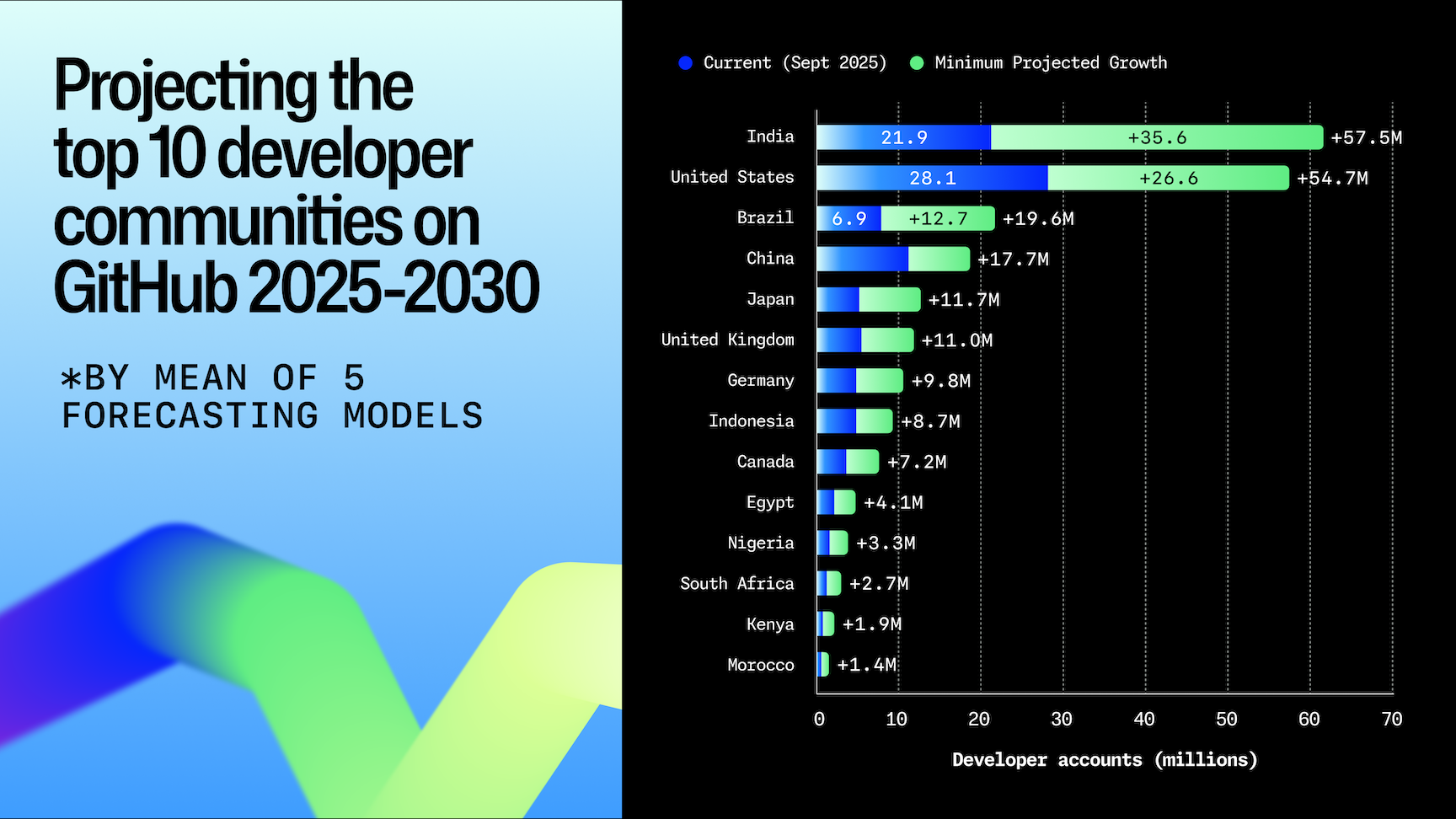
India is the volume story, but on the engineering side, not the frontier. It is the demographic phenomenon of the decade: India added more than 5.2 million developers to GitHub in 2025 alone, roughly one in every three new developers worldwide, reaching around 22 million, and GitHub now projects India will overtake the United States as the world's largest developer population by about 2030 - The Register. India also leads the world in LinkedIn's relative AI skill penetration, where AI skills appear on profiles at roughly three times the global average - Business Standard. The projection of how this developer population grows is worth seeing directly.
India's developer population is set to pass the US
India's real engine is its Global Capability Centers, the offshore hubs that multinationals run for their own AI and engineering work. The country hosts more than 1,700 GCCs employing over 126,000 people in AI-aligned roles, the majority clustered in Bengaluru and Hyderabad - Zinnov. Yet India faces a genuine depth-versus-breadth gap. It leads the world in generative-AI course enrollments but ranks only 89th on Coursera's overall skills-proficiency measure, and its flagship national models still trail the frontier on raw capability - Business Today. The strategic question of whether India becomes a builder of foundational models or primarily a supplier of engineering talent to everyone else is exactly the one this short Economist analysis takes on.
What's Fuelling India's AI Boom?
India's internal geography is worth knowing, because it is concentrating and spreading at the same time. Bengaluru remains the gravitational center, home to more than 880 capability centers and roughly a third of the national talent pool, but Hyderabad is now the fastest-growing tier-one hub and a wave of tier-two cities is absorbing overflow demand - Zinnov. Adoption runs unusually deep as well: more than 80% of Indian workers report using AI regularly at work, on par with China and the UAE and well above the roughly 50% rate across North America and Europe. The frontier-capability gap is real and the government is spending to close it, with hundreds of proposals submitted to build sovereign foundation models, but for now India's comparative advantage is the world's largest pool of AI-fluent applied engineers, not its thin top layer of frontier researchers. Recruiters who price India as a research market will overpay and underwhelm; those who price it as the planet's deepest applied-engineering market will consistently win.
The practical sourcing map for these two giants is clear once you separate them. China is where the densest frontier-research talent is produced and increasingly retained, but it is hard to recruit from directly and competes on its own rising salaries. India is where you source AI-literate engineering at enormous scale and strong cost arbitrage, especially through GCCs and remote hiring, provided you screen for genuine applied depth rather than enrollment counts. Treating them as one undifferentiated Asian talent pool is how teams end up with the wrong people in the wrong roles.
5. The Density Champions: Israel, Singapore, Switzerland and the Nordics
If the volume map belongs to the giants, the density map belongs to a cluster of small, wealthy, deliberately engineered ecosystems where an extraordinary share of the workforce works in AI. These are the places where a recruiter's hit rate per outreach is highest, where the ambient level of AI fluency is so high that even non-specialist hires tend to be capable, and where the competition is for a small, expensive and hard-to-retain pool. They will never top a headcount chart, but for senior and specialist roles they are often the most efficient hunting grounds on earth.
Israel is the clearest case. It ranks first in the world for AI talent concentration, with AI talent making up about 1.98% of its workforce on LinkedIn's index, and it leads on a remarkable set of per-capita measures: the world's highest R&D intensity at 6.3% of GDP, the most tech unicorns per capita, and more than 2,300 active AI startups - CNBC. A unique pipeline feeds it: elite military technology units such as 8200 train roughly a thousand AI-capable engineers a year who flow into the civilian economy and seed companies like Wiz and Check Point - TechEdge AI. Tel Aviv now ranks among the top handful of global AI cities by talent density, alongside San Francisco.
Singapore is the other standout, and it leads on the broadest set of measures of any country. It ranks second in the world for AI talent concentration, first on Coursera's AI Maturity Index, and first for AI demand, with nearly 5% of its job postings requiring AI skills - Tech Edition. This is no accident: the government's National AI Strategy 2.0 set an explicit goal to triple the pool of AI practitioners to 15,000 and poured public money into training and scholarships - CoinGeek. Singapore functions as the talent and headquarters hub for all of Southeast Asia, which makes it the natural base for any company building an AI team across the region.
AI Talent Concentration by Country (Share of Workforce, LinkedIn)
The rest of the density elite is overwhelmingly European and Nordic, which previews the next section. Switzerland leads the world on the Stanford measure of AI researchers and inventors per 100,000 people at 110.5, just ahead of Singapore, with Sweden and Finland both ahead of the United States - GGBA. Estonia, Luxembourg, Ireland and the Netherlands all appear near the top of the concentration ranking. South Korea is the only large East Asian economy in the global top ten, lifted by Samsung, Naver and the country's world-leading R&D intensity. Coursera's readiness map, which weights the ability to actually apply AI rather than just possess the skill, tells a complementary story.
AI readiness skews to small, advanced economies

East Asia outside China contributes sharp specialists rather than broad density, and Taiwan is the most strategically important of them. Through TSMC, Taiwan manufactures roughly 90% of the world's most advanced AI chips, which makes its semiconductor engineers among the most geopolitically valuable technical workers on earth, yet the island faces a shortage of about 34,000 skilled workers that its own chipmakers describe as their single biggest risk - Focus Taiwan. South Korea pairs the world's second-highest R&D intensity with deep corporate AI benches at Samsung and Naver, and is among the better Asian performers at keeping its own people. Japan, by contrast, openly acknowledges it has fallen behind, adopting a national AI plan in late 2025 with the explicit aim of becoming the easiest country in the world to build and use AI while contending with a shortfall of roughly 220,000 IT professionals - Hello World Japan.
Even the density champions carry a hidden weakness worth flagging, because high concentration does not guarantee high retention. Singapore and Japan rank among the worst in Asia-Pacific for holding onto the top-tier researchers they attract, since the same US labs that hunt Israeli and Swiss talent hunt theirs just as hard. The lesson for talent leaders is to treat concentration and retention as two separate problems. A dense ecosystem tells you where your outreach will convert best; it says nothing about whether you can keep the people once a frontier lab comes calling. In the density markets you are often competing not with local employers but with the richest companies on the other side of the world, which is a very different recruiting fight than the headcount markets demand.
For talent leaders, the density champions demand a specific playbook. The pool in each country is small, so you cannot build a large team locally; you build a beachhead of two to five elite people and let them anchor a distributed group, or you accept that you are competing on mission and equity rather than headcount. Retention is the real challenge, because these are exactly the people the US frontier labs target hardest, and the pay gap is severe. The density map tells you where to find the best people fastest; it does not tell you they will be cheap or easy to keep.
6. Europe: Deep Research, Leaky Pipeline
Europe is the world's clear third pole of AI talent, but its defining characteristic is a painful contradiction: it trains world-class researchers and then loses them. The continent produces elite, PhD-heavy AI talent at a rate that rivals anywhere on earth, yet a structural compensation gap pulls its best people toward the United States. Understanding Europe means holding both facts at once, because the same country can be a brilliant place to source from and a frustrating place to retain.
The United Kingdom is Europe's clear number one by volume, with roughly 145,000 AI professionals, the third-largest national pool in the world behind the US and India - Euronews. The UK AI sector ballooned 85% in two years to around 5,800 companies, and London, home to Google DeepMind, is the continent's largest AI ecosystem, with over 1,600 AI startups and a record $7 billion in AI venture funding in 2025 - Tech.eu. The UK also has the highest share of PhD holders among its top AI talent of any country, which signals genuine research depth rather than just headcount - Computer Weekly.
France punches far above its weight on the frontier specifically. Paris has become continental Europe's deepest frontier-AI cluster, concentrating Mistral AI, Hugging Face, Kyutai and the local labs of Google DeepMind and Meta FAIR - KiTalent. The pipeline is unusually elite and unusually loyal: it runs through the École Polytechnique and ENS, and Meta's FAIR Paris lab reports that 93% of its alumni stay in France, feeding companies like Mistral, which raised €1.7 billion in 2025 at an €11.7 billion valuation - Asteres. Germany, by contrast, leads on industrial and applied AI, with Munich as its enterprise hub and Heidelberg's Aleph Alpha pivoting toward sovereign AI infrastructure for European governments - Science Business.
On density, the European leaders are not the big three but the small states. Ireland tops Europe on AI professionals per capita, ahead of Switzerland, Luxembourg, the Netherlands and Denmark, and Switzerland leads the entire world on researchers and inventors per head, anchored by ETH Zurich, EPFL and a dense cluster of corporate labs - Euronews. Then there is Eastern Europe, the continent's deepest reservoir of lower-cost engineering talent. Poland, Ukraine, Romania, Czechia and their neighbors hold more than 1.8 million tech professionals, with Ukraine alone home to over 238,000 developers, at mid-to-senior rates of roughly $30 to $70 an hour - NCube. This makes the region the prime nearshoring base for Western European companies, and increasingly for American ones willing to work across the time difference.
Two further features sharpen the European picture in ways that affect where you actually source. The first is Zurich's extraordinary lab cluster: Google, Meta, Apple, Microsoft, DeepMind, Nvidia, OpenAI and others all run research facilities there, and Google's Zurich office alone employs more than 5,000 people, its largest outside the United States, anchored by ETH Zurich and EPFL - Deep Tech Nation. The second is the scale of unmet demand. Europe posted more than 623,000 AI job vacancies in a recent twelve-month window, with the UK, Germany and France alone accounting for well over half of them - Interface. The lower-cost half of the continent is responding with national ambition, as Romania's roughly €5 billion AI plan and its growing pool of specialists show that Eastern Europe sees itself as a producer of AI talent, not just an outsourcing back office. For recruiters, the practical reading is that Europe offers two distinct buys: a premium, research-grade layer concentrated in London, Paris, Zurich and a few university towns, and a deep, affordable engineering layer running east from Berlin to Kyiv.
The leaky pipeline is the part no European recruiter can ignore. Roughly 62% of AI postdoctoral researchers in the EU intend to eventually move to the US or China, and the reason is money: US salaries run 30 to 70% higher across the board, and the frontier-lab gap is brutal, with a senior European researcher earning perhaps €120,000 to €180,000 against $350,000 to $700,000 in total compensation at a top US lab - Euronews. Net tech-talent inflows to Europe have roughly halved since 2022. For recruiters, the strategic read is that Europe is an excellent place to source AI talent, especially research-grade and lower-cost engineering talent, but you must compete on factors other than cash: research freedom, work-life balance, equity, mission and the ability to stay near family. The companies that retain European AI talent are the ones that stop pretending they can match a Bay Area number and instead win on everything else.
7. The Fast-Rising Frontier: Latin America, Africa and the Gulf
The fastest growth on the entire map is happening outside the established centers, in three regions that each win on a completely different axis. Latin America competes on nearshoring, Africa on raw growth rate and youth, and the Gulf on capital. None of them yet rivals the US, China or Europe for frontier research, but ignoring them means missing where a large share of the world's next engineering talent is coming online, often at a fraction of the cost and, in the case of Latin America, in your own time zone.
Latin America's pitch is timezone overlap plus cost. Brazil is now the world's fourth-largest developer base on GitHub at 6.89 million developers, having grown more than fourfold since 2020, and the region as a whole holds roughly 2.2 million engineers producing about 350,000 graduates a year - Mismo. US companies have noticed: remote hiring in Latin America jumped 161% in 2023 and kept accelerating, with over 80% of US firms now exploring nearshore partnerships, drawn by near-total working-hour overlap with US teams - Combine. The economics are compelling: senior developers run roughly $35 to $70 an hour, 40 to 65% below US rates, with a modest premium for AI and machine learning skills - Curotec. Bogotá, Medellín, São Paulo and Buenos Aires are the emerging hubs, and the region also posted the fastest growth in generative-AI course enrollment of anywhere in the world.
Africa is the fastest-growing region on the planet by percentage, and it is young. Sub-Saharan Africa's GitHub activity is now more than five times its 2019 level, the steepest regional growth rate globally - GitHub Octoverse. Nigeria leads the continent with roughly 1.68 million developers, followed by Kenya, Egypt and South Africa, and the research community is organizing fast: the Deep Learning Indaba gathered over a thousand attendees from 43 African countries in 2025 - Deep Learning Indaba. Africa is also, controversially, the back-end of the global AI data economy, a layer we examine in detail in the next section. The constraints are real, including infrastructure, capital and the same brain-drain pull every emerging region faces, but the trajectory is unmistakable and the median age advantage is structural.
The within-region detail rewards a closer look, because per-capita density flips the African rankings the same way it does globally. Tiny Tunisia leads on developers per head at more than 4,000 per million people, far ahead of larger Morocco and Egypt, and both Egypt and Morocco are now setting explicit national targets to train tens of thousands of AI specialists a year - TechRound. Turkey has quietly become a serious engineering base with around 200,000 software professionals and a fast-expanding AI startup scene, while Vietnam is the standout of emerging Asia, with an IT workforce past 650,000 and Nvidia building an AI research center and factory in the country - NVIDIA. None of these are frontier markets yet, but they are precisely where the next five years of supply growth is being seeded, and early movers get first pick of the senior talent before everyone else crowds in and bids up the price.
The Gulf is the outlier because it wins on money rather than local headcount. The UAE ranks first in the world for growth in AI talent concentration, up 121% from 2019 to 2025, but it gets there largely by importing talent at scale - Digital Dubai. Abu Dhabi's MBZUAI, the world's first graduate AI university, has hired more than 100 faculty from China, the US and Europe, competing on tax-free pay, safety and long-term residency - Rest of World. Saudi Arabia's PIF-backed HUMAIN is pursuing a pure capital-and-compute strategy, planning to deploy up to 600,000 Nvidia units across new data centers - NVIDIA. Both Gulf states now rank among the world's top performers for government AI strategy - The National.
For recruiters, these three regions map onto three distinct plays. Source scalable, same-timezone engineering in Latin America when US-hours collaboration matters and budget is tight. Source the fastest-growing and youngest builder talent, plus large-scale data operations, in Africa, accepting that the senior layer is still thin. And recognize the Gulf less as a source pool than as a competitor, a well-funded buyer that can outbid almost anyone on cash for the specific senior people it wants. Each region rewards a different tactic, and treating "emerging markets" as one bucket wastes the opportunity.
8. The Skill Map: Which AI Skills Live Where
The deepest version of this atlas is not by country but by skill, because AI talent is not one thing and the different layers of it concentrate in very different places. A useful way to picture it is as a value chain that runs from a tiny, geographically concentrated layer of frontier research at the top, through a large and fast-growing layer of applied engineering in the middle, down to a vast, globally distributed layer of data work at the base. Each layer has its own geography, its own price, and its own scarcity, and a recruiter who maps roles to the right layer in the right place will out-hire one who chases everyone everywhere.
Frontier research, the ability to train new foundation models and invent novel architectures, is the most concentrated skill on earth. It lives in a handful of hubs: the US (the Bay Area labs plus Seattle), the UK (DeepMind and a new Imperial College frontier lab), Canada (Toronto and Montreal), France (Mistral in Paris) and increasingly China (Beijing, Hangzhou). These are the people behind the bidding wars, and there are only a few thousand of them worldwide. The US still employs the largest share, but China now trains the most, and the gap between those two facts is the central drama of the whole map - Paulson Institute.
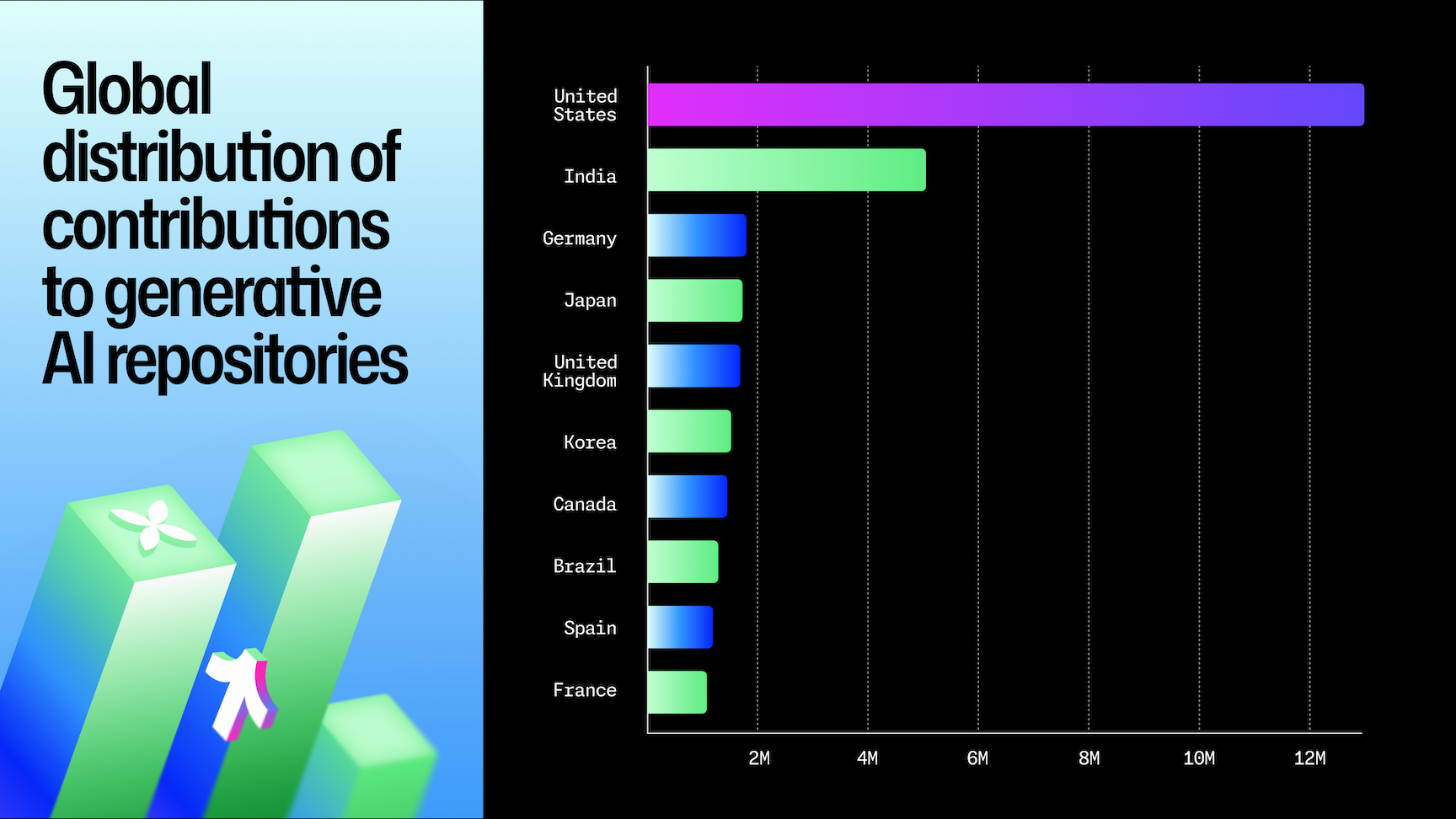
Applied ML and generative-AI engineering, the much larger layer of people who build products on top of existing models, is where the geography is shifting fastest. The depth is still in the US, but the volume and growth are in India, Latin America and Eastern Europe. GitHub's data makes this visible: the United States still dominates raw contributions to generative-AI projects, but India is now a clear second and rising, with Germany, Japan, the UK and Korea filling out the leaderboard - GitHub Octoverse. The chart of who contributes to AI projects, by country, is the single best picture of where applied AI building actually happens.
Where AI gets built, by country
The infrastructure and tooling layer has its own surprising geography. AI infrastructure, GPU systems and MLOps, the unglamorous but scarce skill of making models run reliably at scale, concentrates in US and Chinese-led open-source communities, where six of the ten fastest-growing GitHub repositories in 2025 were AI-infrastructure projects - GitHub Octoverse. Computer vision and robotics skew heavily toward China, which publishes far more computer-vision papers than the US and holds two-thirds of the world's robotics patents - TMTPost. Meanwhile, prompt engineering and general AI literacy are diffusing fastest into emerging markets, with India and Latin America leading enrollment growth.
One nuance separates the skill map from a simple headcount map: where skills are growing fastest is not where they are deepest. Stanford's data shows that hands-on AI engineering skills are accelerating fastest in the United Arab Emirates, Chile and South Africa, the rare places where practical building is outpacing general AI literacy, which signals emerging engineering depth rather than just awareness - Stanford HAI. At the same time, the quality gap at the very top stays stubbornly concentrated, because American research is still cited far more often than anyone else's, which is the difference between producing a lot of AI work and producing the work that everyone else builds on. For recruiters, the two signals do different jobs: fast skill growth tells you where to invest in a pipeline for the future, while citation and frontier-output data tell you where the people who can do the hardest work actually are today.
The scarcest skills are worth naming precisely, because they define your hardest searches. Senior ML researchers, GPU and AI-infrastructure engineers, and full-stack MLOps specialists are the three roles most teams cannot fill, with GPU and infrastructure engineers commanding $220,000 to $350,000 base salaries for seniors and researchers well beyond that - Keller Executive Search. Globally, the math is stark: there are roughly 1.6 million open AI roles against about 518,000 qualified candidates, a three-to-one gap - Second Talent. The practical upshot of the skill map is that you should source each layer where it lives: frontier research from the handful of elite hubs and pay accordingly, applied engineering from the fast-scaling volume markets, and infrastructure from the open-source communities where it is actually being built. Looking for all three in the same place is how roles stay open for six months.
9. The Hidden Layer: Data Annotation and the Global South
Underneath every impressive AI model sits a vast, largely invisible workforce that labels, ranks and cleans the data the model learns from, and this layer has its own sharply defined geography concentrated in the Global South. It is the base of the value chain, and it is the part of the AI talent map that recruiters and AI buyers understand least, even though it is where the largest number of AI-adjacent jobs actually exist. Understanding it matters both ethically and practically, because the economics of who labels data where are now a live business and reputational issue.
The bulk data-annotation work, the repetitive labeling of images, text and video that trains computer-vision and language systems, flows to wherever English is widely spoken and wages are low. India handles an estimated 36% of the world's image and video labeling, and Southeast Asia, led by the Philippines, Vietnam and Indonesia, handles well over half of all labeling tasks globally - Second Talent. Kenya became a particular hub through firms like Sama and Scale AI's Remotasks operation, prized for high English proficiency and cost efficiency. The wage gap across this layer is enormous, and it is the clearest illustration of how AI value is distributed around the world.
Typical Data-Annotation Pay by Region
The controversy in this layer is real and well documented. In one widely reported case, Kenyan workers labeling toxic content to make ChatGPT safer took home roughly $1.32 to $2 an hour, while the client paid the outsourcing firm several times that per worker - TIME. Venezuelan labelers have earned even less. This margin structure, where the value created sits oceans away from the people doing the work, is increasingly a governance and brand risk for AI companies, and a growing number of buyers now ask hard questions about labor conditions in their data supply chain - The Conversation.
The scale of this layer is easy to underestimate. Africa's data-labeling sector alone is projected to create on the order of 1.8 million jobs, and the work has become a genuine economic-development lever for countries with young, English-speaking populations and limited formal tech employment - Second Talent. That promise sits uneasily alongside the precarity, because some major operators have abruptly pulled out of markets like Kenya, leaving thousands without income almost overnight. The location of data work has therefore become a strategic and ethical decision rather than a purely economic one. For any team building AI, the question of who labels your data, where, and under what conditions has moved from an invisible procurement detail to something boards and customers now actively ask about, and the answer increasingly shapes brand risk as much as cost.
A fascinating counter-trend is the rise of a credentialed data layer in rich countries. As models get better, the hardest training tasks now require genuine expertise rather than raw labor, and a new category of marketplace has emerged to supply it. Mercor pays an average of $81 to $95 an hour, and well over $200 for senior domain experts like physicians and lawyers, while Surge AI has contracted more than 20,000 PhD holders for expert reinforcement-learning work - Mercor. The result is a bifurcated layer: bulk labeling stays in the Global South at a few dollars an hour, while expert "RLHF" work concentrates in the US and Europe at professional rates. For recruiters and AI teams, the lesson is that "data work" is no longer one job; it spans from the lowest-paid roles on the entire map to specialist contracts that rival senior engineering pay, and the two live in completely different places.
10. Talent Flows, Brain Drain and the New Geopolitics
The AI talent map is not static; it is defined by flows, and in 2026 those flows are changing direction for the first time in a decade. For years the pattern was simple and one-way: the world trained AI talent and the United States hired it. That is no longer reliably true. Global skilled-talent mobility actually fell 11.6% in 2025, from 3.7 million to 3.3 million cross-border movers, and AI-talent mobility specifically dropped 12%, as visa friction, geopolitics and better home-country opportunities all pushed in the same direction - BCG. For the first time, the US is no longer extending its lead in AI talent specifically, even as destinations like India, the UAE and Saudi Arabia gain share.
The reversal is being driven from both ends. On the US side, the new $100,000 H-1B fee and wage-weighted lottery raise the cost of importing talent just as the country's lead was already narrowing - American Immigration Council. On the other side, source countries are fighting to keep their people and attract others. China is actively reversing its historic brain drain, with roughly four of five Chinese students abroad now returning home, a new "K visa" to attract foreign tech talent, and, strikingly, exit controls that require senior AI personnel at firms like Alibaba and DeepSeek to get approval before traveling abroad - CKGSB. That last development, treating AI researchers as a national-security asset whose movement the state polices, is a genuine turning point, and it is the subject of this recent Bloomberg segment.
China Expands Travel Curbs to Top AI Talent
Other countries are competing on the opposite tactic: aggressive openness. The UAE offers a ten-year Golden Visa category specifically for AI specialists, Canada's Global Talent Stream provides two-week processing for senior tech roles, and the UK's Global Talent Visa assesses an achievements portfolio rather than degree pedigree - BCG. The UAE alone attracted nearly 194,000 highly skilled workers in 2025. Meanwhile US-China decoupling has intensified, with the US moving to revoke visas for Chinese students in critical fields and China responding in kind, fragmenting what used to be a relatively free global market for the highest-end talent - Rest of World.
The numbers behind the realignment are telling. India now holds an estimated 6% of the world's globally mobile AI talent and posted the largest single-year gain in AI-talent share of any major destination, while Saudi Arabia recorded the highest talent-retention ratio of any major hub as its capital-driven strategy started to bite - Business Standard. The shift is not lost on the people building the technology. Nvidia's Jensen Huang has observed that roughly half the world's AI researchers are Chinese, a single remark that captures why the US-China rivalry is the axis the entire map now turns on. The free-flowing global market for elite AI talent that existed five years ago is fragmenting into competing national pools, each ringed by its own incentives and restrictions, and recruiters who plan around that fragmentation will be far less exposed than those still assuming the old mobility holds.
For recruiters and talent leaders, these flows carry a clear and slightly counterintuitive message. The era when you could assume the best people would simply relocate to your headquarters is ending, and the friction is rising fastest precisely around the most senior talent. The winning response is to stop fighting geography and start working with it: hire people where they already are, build genuinely distributed teams, and treat the ability to employ talent compliantly across borders as a core competitive capability rather than an HR afterthought. The companies that master cross-border hiring will out-recruit those still trying to funnel everyone through a single visa pipeline, which is exactly what the next section is about.
11. How to Source AI Talent Across Borders
Once you accept that AI talent is globally distributed and increasingly hard to relocate, the practical question becomes mechanical: how do you actually find, hire and pay people across the countries on this map? The answer has matured a lot in the past two years, and it splits into two problems that are often confused. The first is employment: legally putting someone on payroll in a country where you have no entity. The second is sourcing: finding the right candidates in the first place across a planet's worth of profiles. Different tools solve each, and the best global teams run both deliberately.
For employment, the dominant solution is the Employer of Record, a provider that hires the person on your behalf in their country and handles local payroll, tax and compliance. The two largest are Deel and Remote.com, both priced at around $599 per employee per month for their standard EOR product, on top of salary and local employer taxes - Tarmack. This is what makes it realistic to hire a machine learning engineer in Brazil or a researcher in Poland without opening a local subsidiary, and it is the single biggest reason distributed AI hiring has become accessible to companies that are not multinationals. The same providers offer cheaper contractor-management tiers, typically around $29 a month, when you are engaging freelancers rather than employees - Remote.com.
For vetted talent that someone else has already screened, talent marketplaces are the faster but costlier route. Mercor has become the standout in AI specifically, reaching a $10 billion valuation by taking roughly a 30 to 35% margin on a network of vetted experts who average more than $85 an hour - Sacra. Andela offers a pool of more than 175,000 vetted technologists across 135 countries, originally rooted in Africa, at roughly $6,000 to $14,000 per developer per month, while Toptal sits at the premium end with top freelancers above $200 an hour - ReactSquad. These platforms trade a higher unit cost for speed and reduced screening risk, which is the right trade when you need a specialist quickly and cannot afford a long mis-hire.
The economics underneath these platforms reward a little scrutiny before you commit. The headline EOR fee is only part of the cost, because local employer taxes vary enormously, from the relatively light burdens of much of Eastern Europe to rates that can approach 70% on top of salary in Brazil, so a cheap nearshore hire is not always as cheap as the hourly rate suggests - Deel. Marketplaces, in turn, justify their margins partly through selectivity, with Andela admitting under 4% of applicants, and that vetting is much of what you are paying for when you accept a markup north of 30%. The practical discipline is to model the fully loaded cost of each route, the EOR fee plus taxes, or the marketplace rate plus margin, against the cost and risk of a slow direct hire, rather than comparing sticker prices that quietly measure different things.
The sourcing problem, finding the right people across a billion-plus profiles, is where AI itself has reshaped the tooling. The established AI sourcing platforms index enormous global candidate pools: hireEZ aggregates more than 800 million profiles from dozens of public sources and sells at roughly $13,000 to $20,000 per seat a year, while SeekOut indexes 600 to 750 million profiles at an average contract around $27,000 - Pin. A newer category goes further. Autonomous AI recruiters do not just search; they source and reach out on their own, working a global pipeline without a recruiter driving every step. HeroHunt.ai, for example, runs an autonomous AI Recruiter that sources across more than a billion profiles worldwide and contacts candidates automatically, which is one way smaller teams reach talent in countries where they have no local network. LinkedIn Recruiter remains the default for direct, manual outreach in most markets.
The right stack depends on what you are optimizing for, and the honest framing is a set of trade-offs rather than a single winner. If compliance and long-term employment are the priority, an EOR is the backbone. If speed and pre-vetting matter most, a marketplace earns its margin. If you are running high-volume outbound across many countries, an AI sourcing or autonomous-recruiter platform compresses the search dramatically but still needs human judgment on fit and closing. Most teams that hire AI talent well across borders end up combining all three: a sourcing layer to find people, a marketplace for urgent specialist gaps, and an EOR to employ the ones they want to keep. The capability that ties them together, hiring anyone anywhere on this map without friction, is fast becoming a real competitive advantage in the talent war.
12. The 2026 to 2027 Outlook: Where the Next Hotspots Emerge
The forward-looking question every talent leader is really asking is where this map will be in two years, and the data points to a clear thesis: the center of gravity is broadening, not because the US and China decline, but because the rest of the world is rising and the friction of distance keeps falling. The World Economic Forum projects that AI and machine learning specialists are among the three fastest-growing jobs through 2030, names AI and big data the single fastest-growing skill set, and expects 170 million new jobs created against 92 million displaced - WEF. Demand, in other words, keeps climbing faster than any single country can supply, which guarantees the map keeps spreading.
The supply side is responding in a specifically uneven way that recruiters should plan around now. The countries adding talent fastest are mostly adding it at the applied-engineering and data layers, not the frontier-research layer, which means the world is about to have far more people who can build with AI and only marginally more who can advance it. That widening base lowers the cost of shipping AI products almost everywhere while keeping the premium on the scarce senior layer high, the same two-speed pattern that runs through every section of this guide. Expect the gap between a globally abundant middle and a fiercely contested top to define hiring economics for the rest of the decade, and budget for it accordingly: cheap, plentiful builders in many countries, and a handful of seats at the top that will cost whatever the frontier labs decide they cost.
Three forces will reshape it. The first is demographic momentum: India's developer population is on track to overtake the United States by around 2030, and Africa and Southeast Asia are growing their developer bases faster than anywhere else, which means the raw-volume map tilts steadily east and south - The Register. The second is the retention reversal: as China keeps more of its researchers and the US makes immigration harder, the historic concentration of elite talent in a few American cities will slowly disperse, with more frontier work happening in the places talent already lives. The third is remote work and AI tooling, which together let a capable engineer in Lagos, Buenos Aires or Hanoi contribute to a frontier project without leaving home, something that was far harder even three years ago.
For the agents-in-recruiting angle, the change is already underway and will accelerate. Autonomous AI recruiters and agentic sourcing tools are turning what used to be a manual, geography-bound search into a continuous global one, and the AI-native companies leading this shift are famously small relative to their output, which changes which talent everyone fights for. The premium is moving toward people who can do the work of several, which raises the value of the scarce senior layer at the top of the value chain even as the broad base of applied engineering democratizes across countries. It is a useful reminder that founders thinking about this, including HeroHunt.ai's Yuma Heymans, increasingly frame recruiting itself as something AI agents will run end to end, sourcing globally on autopilot while humans focus on judgment and closing.
The practical forecast for recruiters is that the next density hotspots are already visible in the growth data: India for sheer scale, Vietnam and Indonesia for fast-rising Southeast Asian engineering, Nigeria and Kenya for the youngest and fastest-growing African talent, Brazil and Mexico for nearshore depth, and the Gulf as a deep-pocketed competitor importing the senior people it wants. The countries that will gain the most are the ones pairing a growing talent base with smart visa and retention policy, and the companies that will win are the ones that build the muscle to hire across all of it. The single map of AI talent never existed. In 2026, the winners are the ones fluent in all of them at once.
Conclusion: How to Read the Map for Your Own Hiring
The decision framework that falls out of this atlas is simpler than the data suggests. Start by asking which layer of the value chain a role belongs to, because that determines the geography more than anything else. For frontier research, accept that you are fishing in a tiny pool concentrated in the US, UK, Canada, France and China, that you will pay frontier-lab compensation, and that you win on mission, compute and named colleagues as much as cash. There is no cheap version of this layer, and pretending otherwise wastes a quarter of recruiting effort.
For applied AI and machine learning engineering, which is most of what most companies actually need, the volume markets are your friend. India offers unmatched scale and cost arbitrage, Latin America offers same-timezone collaboration, and Eastern Europe offers deep, research-adjacent engineering at moderate rates. The density champions, Israel, Singapore, Switzerland and the Nordics, are where your hit rate per outreach is highest for senior and specialist roles, provided you can compete for a small and contested pool. And for data and evaluation work, recognize that it now spans the entire wage map, from a few dollars an hour in the Global South to professional rates for credentialed experts in rich countries, and choose your provider with both economics and ethics in view.
Whichever layers you are hiring, the through-line is that geography is now a choice rather than a constraint. Employer-of-record platforms, vetted marketplaces and AI sourcing tools, including autonomous AI recruiters like HeroHunt.ai that work a billion-plus profiles across every country on this map, have made it genuinely practical to hire the right person wherever they happen to live. The talent leaders who internalize the two-map model, who know that the country with the most AI talent and the country where it is easiest to find are rarely the same, and who build the capability to hire across borders without friction, will out-recruit everyone still waiting for the world's best people to move to their city. That migration is slowing. The map is spreading. Learn to read all of it.
This guide reflects the global AI talent landscape as of July 2026, drawing on the latest Stanford AI Index, MacroPolo, LinkedIn, GitHub Octoverse, Coursera and BCG data. Rankings and figures shift quickly in this field, so verify the most current numbers before making major hiring or relocation decisions.