



The 2026 field guide to closing AI hires against counteroffers, keeping the ones you have, and winning on more than cash
In the 2026 AI hiring market, a counteroffer is no longer the exception. It is the default. One market analysis of AI/ML hiring puts the counteroffer rate on accepted offers at roughly 70%, with the median finalist sitting on 3.2 active offers at decision time - Recruits Lab. You are not competing for a candidate anymore. You are competing for their next thirty days, against their current employer, two other suitors, and a market where demand for AI engineers outruns supply by more than three to one - Lightcast.
Here is the uncomfortable truth that runs through this entire guide: you will almost never win a counteroffer fight on money. The companies with the deepest pockets on earth are losing these fights in public. Meta reportedly dangled $100 million signing bonuses and, in a handful of cases, packages worth hundreds of millions, and still watched hires walk back out the door within weeks - TechCrunch. Anthropic refuses to match individual counteroffers and keeps 80% of its people past year two, the best retention of any frontier lab - SignalFire. The lesson trickles all the way down to a five-person startup hiring its first machine learning engineer: the counteroffer is a symptom you should have diagnosed at week one, not a bidding war you enter at the finish line.
This guide is the operator's playbook for that reality. It starts high level with why counteroffers have become endemic to AI hiring and why they usually fail, then works down into the specifics: how to inoculate a candidate against a counteroffer before they ever resign, how to build an offer that a raise cannot unwind, how to handle the timing and the exploding-offer games, how to win when your first pick is holding three offers, how to coach the resignation itself, and, most importantly, how to retain your own AI talent so the rival never gets the phone call. Every number here is sourced and current to 2026, because in this market a statistic from eighteen months ago is already fiction.
This guide is written by Yuma Heymans (@yumahey), who built HeroHunt.ai after consulting stints at Bain and KPMG and has spent years on the operator's side of the AI talent market, where the hire you win on Friday is the one a competitor tries to unwind on Monday.
Contents
- Why Counteroffers Became the Default in AI Hiring
- Why Counteroffers Usually Fail (and the Fake Stat Everyone Cites)
- What the Frontier Labs Prove: Cash Alone Loses
- Diagnose It at Week One: Pre-Closing and Inoculation
- Build an Offer a Counteroffer Cannot Match
- Timing, Windows, and the Exploding-Offer Trap
- When Your First Pick Holds Three Offers
- Coach the Resignation: The Moment the Counteroffer Lands
- The Real Fix: Retention Before the Rival Calls
- Pipeline Depth: Never Be Hostage to One Candidate
- The Structural Endgame: Reverse-Acquihires and Lock-Ins
- Your 2026 Counteroffer Playbook and Outlook
1. Why Counteroffers Became the Default in AI Hiring
The single most important shift to internalize is that in AI hiring, the counteroffer is now a structural feature of the market, not a personal drama that happens to a few candidates. When demand for a skill outstrips supply by 3.2 to one, every qualified person is contested, and their current employer knows it - Lightcast. A resignation from a machine learning engineer is not a routine HR event for the losing company. It is a fire, because the person walking out is expensive, slow, and painful to replace, which is precisely the logic that makes the losing employer reach for a checkbook. Understanding that logic is the foundation for beating it.
The demand pressure behind all of this is not subtle, and it keeps accelerating. AI skills now appear in 2.5% of all US job postings, up 55% year over year and 297% over the decade, while the "agentic AI" skill cluster alone grew more than 280% in a single year - Stanford HAI. The wage premium for AI skills reached 62% in PwC's 2026 barometer, up from 56% a year earlier and just 25% the year before that - PwC. When a category reprices this fast, the market never settles. A candidate's comp expectations shift between the first interview and the offer, and the incumbent employer has every incentive to close whatever gap opens up rather than lose the person.
The clearest single indicator of how hot this has become is corporate adoption, because adoption is what turns a research field into a hiring stampede. The Stanford figure below shows organizational AI adoption climbing toward 88%, which is the demand curve that makes every AI engineer a target and every resignation a crisis for the company they are leaving.
Organizational AI adoption keeps climbing
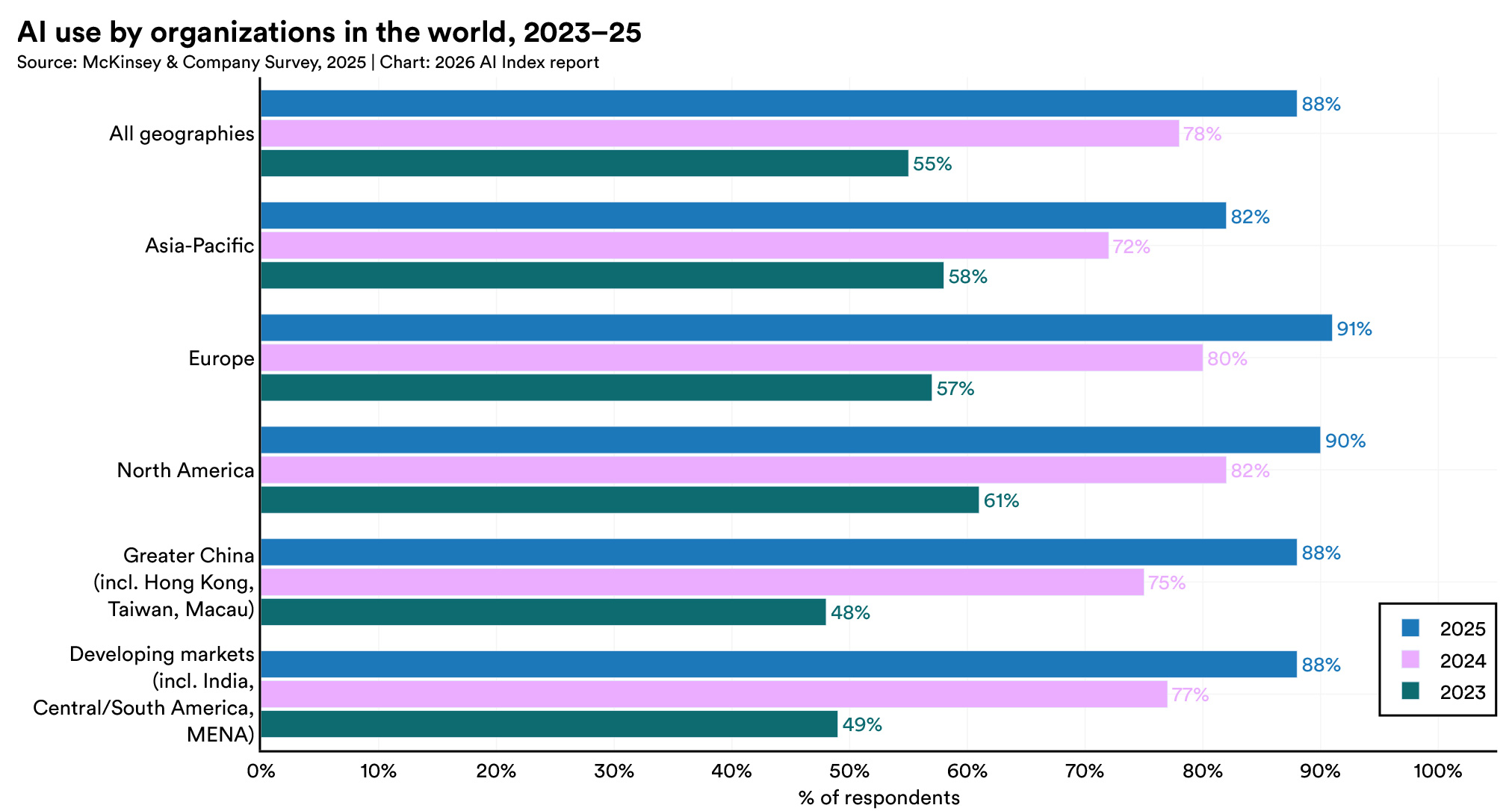
As that adoption curve shows, nearly nine in ten organizations are now deploying AI, which means nearly nine in ten are hiring, retaining, or fighting to keep the people who can build it. That universality is why the counteroffer has migrated from a big-tech phenomenon to a problem a regional bank, a healthcare system, and a Series A startup all face at once. The person you are trying to hire has options you cannot see, and the person you are trying to keep is getting messages you will never read.
There is also a macro headwind working against you that is easy to miss. Candidate leverage overall is actually falling: Gartner found that only 48% of candidates accepted their most recent job offer in the fourth quarter of 2025, down from 85% two years earlier, as multiple-offer situations became rarer in the broader economy - Gartner. AI talent is the glaring exception to that cooling. While the general market softens and "job hugging" keeps people in their seats, the fight for AI-fluent engineers has intensified, which means the counteroffers concentrated on this population have gotten more aggressive even as they fade elsewhere. You are operating in the one corner of the labor market where the bidding war is heating up, not cooling down.
Why this matters for your hiring is straightforward: if you treat a counteroffer as a surprise at the offer stage, you have already lost the strategic high ground. How to apply this: assume from the first conversation that any AI candidate you want will receive a counteroffer or hold competing offers, and design your entire process, from speed to storytelling to the structure of the offer itself, around that assumption rather than reacting to it at the end. The rest of this guide is that design.
2. Why Counteroffers Usually Fail (and the Fake Stat Everyone Cites)
The good news buried in the counteroffer panic is that counteroffers, as a retention tactic, mostly do not work, and the data on why is far more useful than the folklore you have probably heard. Robert Half's 2026 Salary Guide found that 85% of Australian employers and 95% of New Zealand employers extended a counteroffer to staff with an external offer in the past year, and yet roughly a third of those employees left anyway within twelve months (32% in Australia, 37% in New Zealand) - Robert Half. Employers themselves are not fooled by their own tactic: only a minority describe counteroffers as a genuine retention tool, and a large share admit they are a short-term fix that buys a few months of calm before the person leaves regardless.
Before going further, it is worth clearing away the most-cited statistic in this entire subject, because repeating it will quietly destroy your credibility with any candidate who checks. You have almost certainly seen the claim that "80% of people who accept a counteroffer leave within six months," often attributed to a vague study or a defunct trade body. It has no traceable primary source. Recruiter Ken Davies traced it to dead ends, and the figure mutates across citations as 48%, 66%, 80%, 89%, 90%, and 93%, which is the signature of a rumor, not a measurement - The Interview Guys. The only version with real institutional backing is CEB (now Gartner) data cited by Harvard Business Review in 2016, showing roughly 50% of counteroffer-accepters leave within twelve months, and even that should be treated as directional because the methodology was never published. Use the honest number. Half of accepted counteroffers unwinding within a year is a losing bet without any need to inflate it.
The deeper reason counteroffers fail is that money is rarely the real reason the person was leaving, so a raise treats the symptom and ignores the disease. iHire's 2025 Talent Retention Report, surveying nearly 1,400 US workers and employers, found the top drivers of departure were a toxic or negative work environment (26.8%), poor company leadership (24.2%), and unhappiness with a manager (22.8%), while unsatisfactory pay ranked well down the list at 15.1% and actually fell as a cited reason year over year - iHire. Gallup's global data tells the same story from a different angle: in 2024, pay and benefits was the single most common individual reason people left, yet it still accounted for only 16% of departures, while engagement and culture (37%) plus wellbeing and work-life balance (31%) together drove more than four times as many exits - Gallup. The chart below makes the imbalance concrete.
Why Employees Actually Leave (2024)
What that distribution means in practice is that a counteroffer aims its entire firepower at the smallest slice of the problem. When a person resigns because their manager is weak or the mission drifted, a raise changes who signs their paycheck and nothing about who they report to on Monday. This is why the honest framing matters more than the scary statistic: pay opens the door, because a large majority of employees say they would consider leaving for more money, but the reason they actually walked through it is almost always something a raise cannot buy back - BambooHR. Your job when a candidate faces a counteroffer is to make that distinction vivid to them.
It also helps to understand why the losing employer makes the counteroffer at all, because it reframes the whole transaction. When Robert Half asked managers why they extend counteroffers, the top answers were not about the employee. They were about not losing institutional knowledge and not wanting to spend the time and money to hire a replacement - Robert Half via TheLadders. A counteroffer is replacement-risk management dressed up as recognition. The candidate who understands that stops reading the raise as a compliment and starts reading it as what it is: the price the company will pay to avoid the hassle of losing them, offered only because they threatened to leave.
There is a second-order cost to accepting a counteroffer that rarely gets said out loud, and making it explicit helps a candidate see past the raise. The moment an employee accepts one, they have revealed themselves as a flight risk, and that knowledge does not evaporate. It quietly informs the next promotion decision, the next reorganization, and the next round of cuts, because the employer now files them under "was halfway out the door." The raise also proves something uncomfortable: the person was underpaid until they threatened to leave, which means the fair number was always available and simply was not offered until it became cheaper than replacing them. And because compensation was a symptom rather than the disease, the market gap tends to reopen within months as the underlying dissatisfaction resurfaces. None of this requires a mythical statistic to be persuasive. It just requires the candidate to think one move past the flattering number in front of them.
Why this matters: a candidate who believes the myth that everyone regrets a counteroffer will roll their eyes at you, while a candidate who understands the real mechanics, that the raise is reactive, that the underlying reason reopens fast, that trust is now quietly damaged, will talk themselves out of accepting it. How to apply this: retire the fake "80% in six months" line entirely, arm yourself with the traceable numbers, and shift the conversation from "counteroffers are bad" to "a raise cannot fix the specific reason you told me you were leaving."
3. What the Frontier Labs Prove: Cash Alone Loses
If you want the clearest possible proof that money does not win retention, watch the richest companies on earth fail at it in real time. The 2025 to 2026 AI talent war produced a live, public experiment in whether you can buy loyalty, and the answer was a resounding no. Meta spent the most and retained the least. It reportedly offered AI researchers packages worth up to $300 million over four years, with more than $100 million in the first year, on more than ten occasions - WIRED via TipRanks. It built a superintelligence lab around those checks. And within two months at least eight people had left, with two researchers returning to OpenAI after less than a month at Meta - The Decoder.
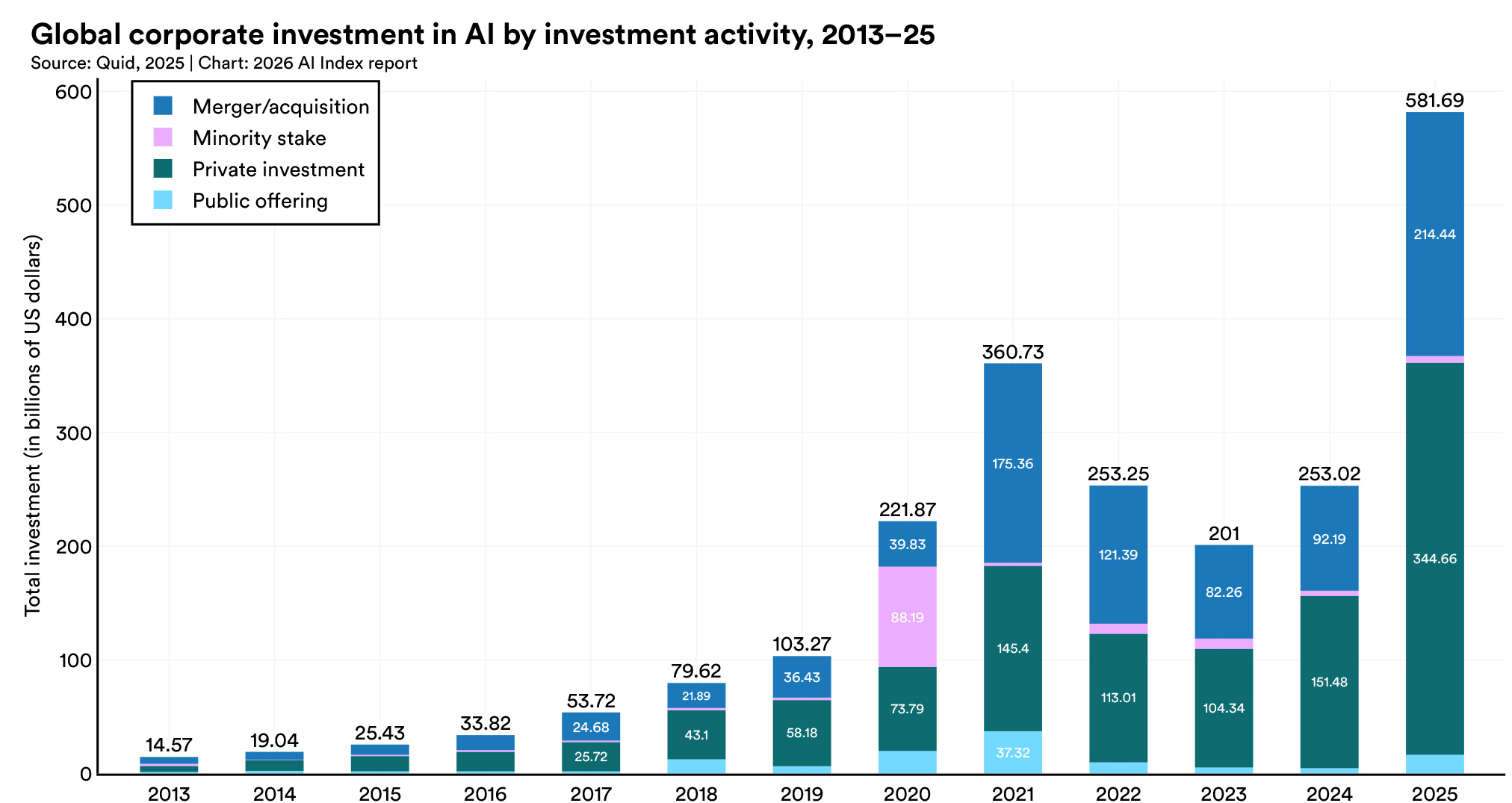
The capital fueling those offers is worth seeing, because it explains why the numbers detached from normal pay logic. Global corporate AI investment more than doubled in 2025, and when the prize is measured in trillions, a nine-figure package for a researcher who can move a model six months faster is a rounding error. The Stanford figure below traces that investment surge, the war chest behind every headline offer.
The capital behind the bidding war
Against that backdrop of near-infinite money, the company that wins retention is the one that refuses to compete on it. Anthropic keeps 80% of its two-year hires, ahead of DeepMind at 78%, OpenAI at 67%, and Meta at 64%, and engineers are roughly eight times more likely to leave OpenAI for Anthropic than the reverse, with the DeepMind-to-Anthropic flow running nearly eleven to one - SignalFire. Anthropic lost only two people to Meta's entire blitz. The retention spread across the four labs is stark enough to end the "just pay more" debate on its own.
Two-Year Retention at Frontier AI Labs
What makes this more than a curiosity is that Anthropic wins while explicitly declining to match individual counteroffers. CEO Dario Amodei has told colleagues he will not enter bidding wars because matching would fracture the internal fairness that holds the culture together, and has framed the pitch to poached staff bluntly: the thing a rival is trying to buy is commitment to the mission, and that is not for sale - MokaHR. Sam Altman made the same argument in different words when he described Meta's offers, insisting that "missionaries will beat mercenaries" and noting that none of OpenAI's best people had taken the money - Hacker News. You do not have to take these leaders at their word, because the retention data backs the claim. The company printing the biggest checks retained the fewest people.
The video below, from the height of the 2025 poaching war, captures the dynamic in the words of the person at the center of it. It is a useful primary-source document of the moment counteroffers went nuclear, and of how the target of the raids talked about defending his team.
OpenAI's Sam Altman on the AI Talent War
None of this means pay is irrelevant, and pretending otherwise would be its own kind of dishonesty. Anthropic pays extremely well, with total compensation for many roles running into the mid-six figures, and Amodei himself has reportedly worried that some new hires now arrive for the paycheck rather than the mission - Tech Times. The honest reading is a two-part rule that governs the rest of this guide. Pay to the point of fairness, so compensation is never the reason someone leaves, and then win on everything money cannot buy, because that is where the durable advantage lives. OpenAI, for its part, ran the same play under pressure: it publicly moved to "recalibrate comp," handed out one-time retention bonuses reported between $300,000 and $1.5 million, and eliminated its six-month vesting cliff, but it paired the cash with a relentless mission-and-speed message from leadership - HR Grapevine.
The counter-evidence that upside beats cash is just as concrete as the evidence that cash alone loses. xAI recruited at least fourteen engineers out of Meta's own AI division, and Elon Musk claimed many joined without any guaranteed initial compensation, betting instead on equity and a hyper merit-based culture rather than matching nine-figure bonuses - Yahoo Finance. The lesson is not that you should ask people to work for free, but that a credible upside story can out-pull a bigger fixed number, which is exactly the lever a cash counteroffer cannot match. Even OpenAI, defending against the raids, leaned on the same mechanism at enormous scale: it is projected to spend roughly $6 billion in a single year on employee equity and moved from a six-month vesting cliff to none at all, so a departing engineer is always leaving real, growing value on the table - SaaStr. Refreshing equity is the one financial lever that behaves like a non-cash one, because it rewards staying rather than simply raising the floor.
Why this matters for a company that is not a frontier lab: it is genuinely liberating. You were never going to win the cash war, and it turns out the cash war does not even work for the people who can afford it. How to apply this: stop benchmarking your counteroffer defense against the biggest check in the room, and start building the advantages, mission clarity, autonomy, speed, and a manager worth staying for, that the labs themselves are relying on. Those are affordable, and they are what actually hold.
4. Diagnose It at Week One: Pre-Closing and Inoculation
The most important move in beating a counteroffer happens before the candidate has even finished interviewing, and almost every experienced recruiter converges on this point. The counteroffer is won or lost in the first conversation, not at the offer stage, because that is when you learn whether money is the candidate's real motivator and when you plant the reasons they will later use to talk themselves out of staying. Top Echelon calls the whole discipline counteroffer prevention and is explicit that negotiation starts in the very first call, not when the offer is written - Top Echelon. Skipping this step is why so many recruiters get ambushed at the end by a raise they never saw coming.
The diagram below maps the full defense as a sequence rather than a last-minute scramble, and it is worth holding in mind for the rest of this guide. Each stage feeds the next, and a counteroffer that lands at the resignation step is only survivable because of the work done at the diagnosis step.
The heart of the diagnosis is uncovering what the person is actually running from or toward, and there are a few battle-tested questions for it. Top Echelon recommends asking a candidate to imagine they are their own boss and name five changes they would make, which surfaces the real grievances far better than "why are you looking?" - Top Echelon. ERE's long-running framework draws the cleanest line of all, distinguishing "going-away" motivation, a candidate escaping a genuinely bad situation, from "going-towards" motivation, a reasonably content person drawn by a shinier opportunity - ERE. The distinction is your counteroffer risk score. A going-away candidate is nearly counteroffer-proof, because the thing they are fleeing does not change when the salary does. A going-towards candidate is a flight risk the moment their employer waves more money, and needs a much stronger non-cash case.
Once you know the motivators, the single most tactical move in the entire corpus is to write them down verbatim and read them back later. Top Echelon literally advises drawing a box on the candidate's file and recording their stated reasons for leaving in their own words, so that when a counteroffer materializes you can replay the person's own case against staying - Top Echelon. This works because of a simple psychological asymmetry. In the emotional rush of a counteroffer, with a flattering raise and a nervous manager in front of them, candidates forget why they were leaving. Handing them their own words, spoken weeks earlier when they were clear-headed, is far more persuasive than any argument you could invent, because it is theirs.
The other half of inoculation is raising the counteroffer explicitly, early, and unemotionally, so it never arrives as a surprise. The best diagnostic questions here double as pre-closes. Lou Adler's rule is to never make a formal offer until it has been pre-accepted, testing with a question like "money aside, would you take this job today?" and treating any hesitation as a signal that something else has surfaced - LinkedIn. Pave frames the same work as four conversations to have before the counteroffer ever lands: curiosity about why they started looking, a value conversation ("if you weren't valuable enough for a raise before, why now?"), an operational one about what their departure signals, and a time conversation about how a raise is a short-term patch - Pave. Run through those and you have handed the candidate a ready-made rebuttal to their own boss.
A concrete version makes the difference obvious. Imagine two machine learning engineers you are recruiting, both asking for the same number. The first tells you, when you ask them to name five changes they would make as their own boss, that their manager takes credit for their work and the roadmap keeps changing under them. That is a going-away candidate, and a counteroffer of more money from that same manager fixes none of it, so your job is mostly to keep them steady through the resignation. The second is genuinely happy but excited by your problem and a faster path to staff engineer. That is a going-towards candidate, and they are the real counteroffer risk, because their current employer can credibly improve the one thing pulling them, often just by adding money and a vague promise of growth. The failure mode is treating both identically. Score them differently from the first call, and you know which one needs a fortress of non-cash reasons built around the offer and which one mostly needs your steady hand at the end.
Why this matters: a counteroffer that arrives after this groundwork lands on a candidate who has already named their reasons for leaving, already agreed money would not fix them, and already rehearsed what a raise really means. How to apply this: treat the first two conversations as the real closing work, score every AI candidate as going-away or going-towards, capture their reasons in their own words, and surface the counteroffer possibility yourself before their employer ever does.
5. Build an Offer a Counteroffer Cannot Match
The structure of your offer decides whether a counteroffer can beat it, and most offers are built to lose. An offer anchored on base salary is trivially matched, because the incumbent employer can read the number, add to it, and win. An offer anchored on things the current employer cannot replicate, scope, growth trajectory, ownership, the specific problem the person will work on, is structurally counteroffer-resistant, because a raise does not touch any of it. LinkedIn's research on what actually makes candidates accept found a near three-way tie between compensation (45%), advancement (44%), and challenging work (44%), which means an offer built only on the first lever ignores two-thirds of the decision - LinkedIn. Build on all three and you take away the incumbent's cheapest counter.
For AI talent specifically, the most effective offers lead with the technical scope of the work, not the perks. Recruiter playbooks for AI engineers are explicit that you should open the offer with something concrete like the systems the person will own or the scale they will work at, rather than the ping-pong table, because the people you want are optimizing for interesting, high-impact problems - Pin.com. This is also where a smaller company genuinely out-competes a giant. The same playbooks report that many AI professionals will accept a 10% to 15% pay cut in exchange for meaningful problems with visible impact, real autonomy, a publishing-friendly culture, and equity upside - Pin.com. A frontier lab can dangle more cash, but it often cannot offer the ownership and visibility that a well-scoped role at a focused company can, which is exactly the lever a counteroffer cannot pull.
The reason those non-cash factors carry so much weight is the shape of the AI labor market itself, which is bifurcating hard. Demand for AI-skilled talent is exploding while entry-level software employment shrinks, concentrating leverage in exactly the experienced, AI-fluent people you are fighting over. The Stanford figure below shows employment for young software developers falling nearly 20%, the underside of a market where AI-skilled specialists command a premium and set their own terms.
A bifurcating labor market
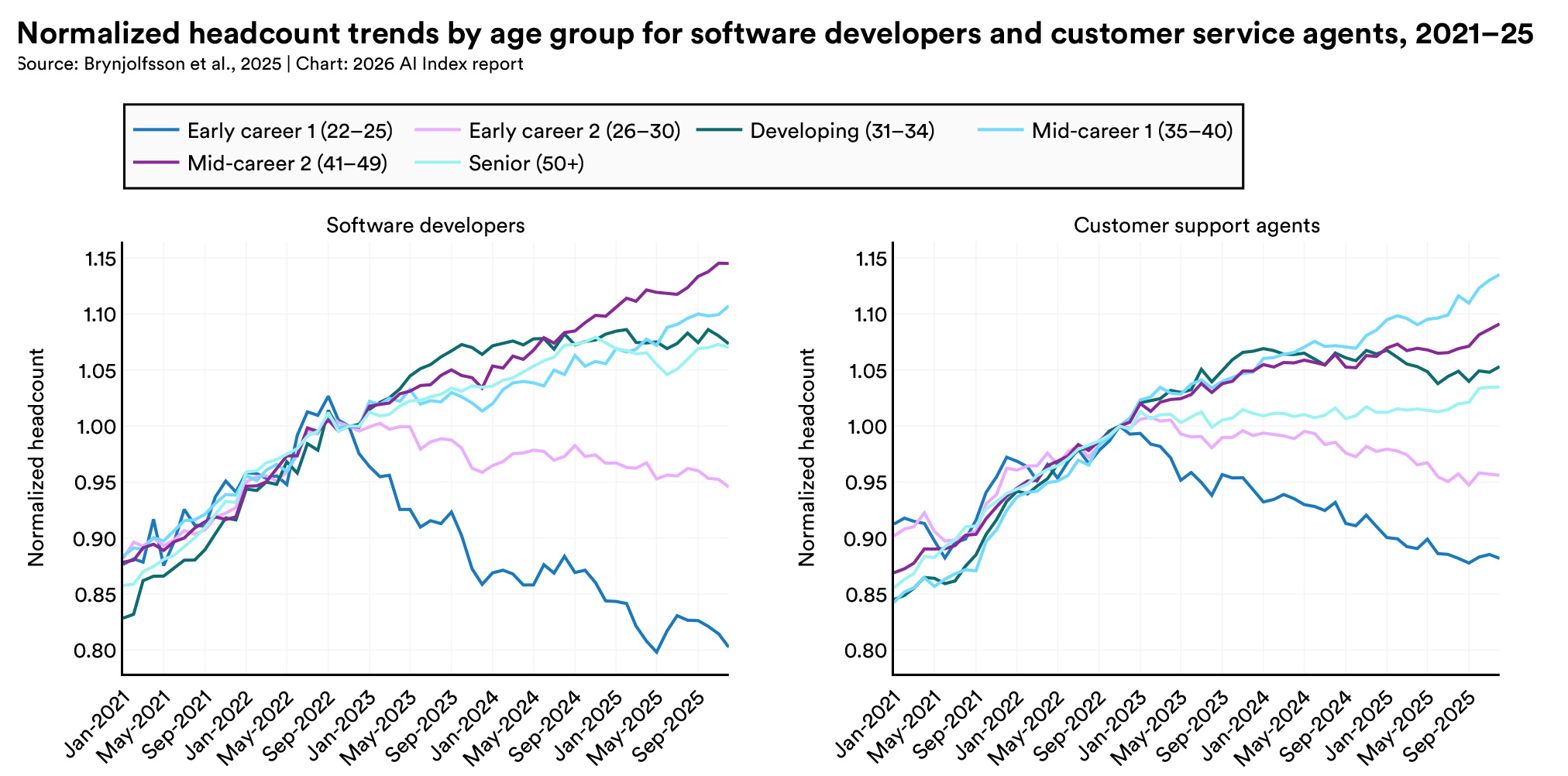
That bifurcation is why the experienced AI engineer you want has so much leverage, and why the structure of the offer has to do work that a number cannot. One of the most effective structural moves is to write a future comp commitment directly into the offer, which pre-empts the "but they'll match it" objection. A 2026 market report found that including a written 24-month equity-refresh commitment in the initial offer correlated with 30% fewer counteroffer acceptances, because it tells the candidate their upside keeps growing rather than plateauing the day they sign - Recruits Lab. Note that this is a vendor market report rather than peer-reviewed data, so treat the exact percentage as directional, but the mechanism is sound and matches how the frontier labs think. Equity that keeps refreshing is the mechanism behind the "golden handcuffs" every big lab now uses, and building a version of it into your first offer closes a door before a counteroffer can open it.
There is a fairness dimension here that the frontier war illustrates and that you should respect even at small scale. When Meta finally started making retention counteroffers of $400,000 to over $1 million to its own resigning engineers, it created exactly the internal-equity problem Amodei warned about, where the person who threatens to leave gets paid more than the loyal colleague sitting next to them - The Pragmatic Engineer. The offer you build to win one hire can quietly trigger two resignations if it blows past your internal bands. The cleaner path is to make offers strong and fair on the front end, structured around growth and ownership, so you are not forced into a distorting bidding war on the back end.
Why this matters: an offer designed around cash invites a counteroffer and usually loses it, while an offer designed around scope, growth, and refreshing upside gives the incumbent nothing to counter. How to apply this: for every AI role, lead the offer with the concrete technical work and the two-year trajectory, bake in a real forward compensation commitment, and hold the line on internal fairness so winning one hire does not cost you three.
6. Timing, Windows, and the Exploding-Offer Trap
Timing is the most misunderstood weapon in closing, and the instinct most recruiters reach for, a short deadline to force a decision, is the one that backfires hardest. Exploding offers, the ones that expire in hours or a couple of days, feel like leverage and function as an insult. Research from INSEAD found that candidates punish exploding offers at dramatically higher rates than generous ones, with MBA students rejecting short-fuse offers 55% of the time versus 10% for extended ones, and only about a third accepting exploding offers at all - INSEAD Knowledge. A deadline that expires before a candidate has finished their own search reads as desperation, and it poisons the relationship before it starts. The person you pressured into signing arrives resentful, which is its own retention problem down the line.
The frontier war made this vivid when OpenAI's head of recruiting publicly attacked Meta's tactics, and his framing is a gift you can reuse verbatim with your own candidates. He called it unethical and desperate to give people exploding offers that expire within hours and demand they sign before even telling their current manager, and then delivered the line that neutralizes the whole game: "deadlines on offers are fake. If they want you, you can always get more time to think" - OfficeChai. When a candidate you are trying to hire is being pressured by a competing exploding offer, telling them plainly that real deadlines are almost always soft removes the artificial urgency working against you. It is a rare tactic that helps the candidate and helps you at the same time.
The counterintuitive fix for your own timing is not an endlessly generous window either. INSEAD's prescription is to delay your offer, not your deadline: let the candidate's natural search window elapse so they do not feel cut off from their other options, then present the shortest deadline that is still socially acceptable, along with a stated reason for it - INSEAD Knowledge. This respects the candidate's process while still creating legitimate momentum. It pairs naturally with Deepak Malhotra's classic negotiation advice to think carefully about the timing of offers and to simply ignore ultimatums when they are thrown at you, giving the other side room to walk a demand back without losing face - Harvard Business Review. Pressure applied clumsily loses candidates; pressure applied with a rationale and an exit ramp closes them.
While patience governs the deadline, speed governs everything upstream of it, and here the AI market rewards velocity more than almost any other. The same 2026 hiring analysis found that a founder-led first interview within five business days correlated with 2.1 times higher offer acceptance, and that single-loop technical interviews closed 1.8 times faster than sprawling four-stage loops - Recruits Lab. Speed is itself a counteroffer defense, because the longer a process drags, the more time competing offers and incumbent counteroffers have to organize against you. A candidate you move from first contact to signed offer in ten days has had far less exposure to the counteroffer machinery than one you dragged through six weeks of scheduling.
Why this matters: the reflexive tools of urgency, short deadlines and pressure, actively lose AI candidates, while the disciplined version, a delayed offer with a rational short window plus a genuinely fast process, wins them. How to apply this: strip exploding deadlines out of your playbook, coach candidates that competing deadlines are usually negotiable, present your own offer only once the candidate has had room to weigh their options, and compress the interview loop so momentum stays on your side.
7. When Your First Pick Holds Three Offers
For AI talent, the sharpest version of the problem is often not a counteroffer from the current employer at all. It is a candidate weighing three to five live offers at once, which changes the math entirely. Recruiter playbooks for AI engineers report that these candidates typically juggle three to five active opportunities and advise securing an offer within seven to ten days of first contact by getting internal comp approval before interviews even begin - Pin.com. In a multiple-offer situation, a bidding war on base salary is the worst ground to fight on, because someone in the pack can always go higher, and the candidate learns to play suitors against each other. You win these on speed, clarity, and identity fit, not on being the highest number.
The counterintuitive move when a candidate is comparing offers is to coach them toward an open question rather than a match demand, and to sequence their choices deliberately. Executive coaches advise candidates weighing competing offers to ask their top choice something like "what more can you do on salary to make this an easy decision for me?" rather than a blunt "can you match X," because the open version invites the employer to solve the problem rather than defend a number - Forbes. The same advice tells candidates to negotiate with their preferred employer first, which gives that company time to run internal approvals before other deadlines force a decision. As the recruiter on the winning side, your job is to be the employer the candidate wants to sequence first, which you earn through the relationship and clarity you built earlier, not through the size of your opening bid.
Underneath the tactics sit two negotiation fundamentals worth naming because they quietly decide most of these outcomes: anchoring and BATNA. The anchoring effect means the first number on the table drags the final settlement toward it, so the better-informed party with the stronger position should usually anchor first - Program on Negotiation. A candidate's BATNA, their best alternative to your offer, is what gives them the confidence to hold out or walk, and in a counteroffer situation their incumbent employer is the default BATNA you are competing against - Program on Negotiation. Part of your work is to weaken the psychological pull of "just stay put" by making the risks of staying, the stalled growth, the unchanged manager, the mission drift, as concrete as the comfort of the known. You are not just presenting an alternative; you are strengthening the candidate's resolve to use it.
In practice, strengthening a candidate's resolve to use their alternative is a specific conversation, not a vague pep talk. A candidate whose only alternative to your offer is staying put will feel the gravity of the familiar, so the work is to make the cost of staying concrete: the promotion that has been a year away for two years, the model they never got to ship, the manager who will be the same on Monday as they were on Friday. When those costs are as vivid to the candidate as the comfort of the known, the incumbent employer's counteroffer stops looking like a lifeline and starts looking like the same situation with a slightly bigger number. You are not badmouthing their employer, which backfires, you are helping them weigh what they already know against what a raise actually changes, which is usually very little.
The through-line that every top recruiter names is that clarity beats negotiation. As one executive search firm puts it, when both sides understand what truly matters, counteroffers lose their power, because a candidate who is crystal clear on why this specific role advances their life is not swayed by a reactive number from a company they had already decided to leave - Protis Global. This is also why silence is the warning sign to watch. When a candidate who was engaged suddenly goes quiet during the offer stage, they are almost always weighing a counteroffer or a competing bid, and the right response is a direct, calm conversation rather than more pressure or a bigger number.
Why this matters: AI candidates rarely make you the only option, so treating a multiple-offer close like a salary auction guarantees you compete on your weakest dimension. How to apply this: pre-approve your comp range before interviews so you can move in days, be the employer the candidate wants to negotiate with first, coach them toward open questions instead of match demands, and read a candidate going quiet as a prompt to talk, not to escalate the offer.
8. Coach the Resignation: The Moment the Counteroffer Lands
Even a perfectly closed candidate faces one last high-risk moment, and most recruiters abandon them precisely when they need the most support: the resignation itself. This is the instant the counteroffer materializes, when a candidate walks into their manager's office and, instead of a clean goodbye, gets a flattering raise, an emotional appeal, and a plea to reconsider. A candidate who has not rehearsed this moment is vulnerable to it, no matter how committed they were the day before, because the counteroffer arrives wrapped in comfort, guilt, and the path of least resistance. Coaching the resignation is the difference between a signed start date and a candidate who ghosts you a week later.
The mechanics of coaching are concrete and repeatable. Prepare the candidate for exactly how their manager will react, because forewarned is inoculated: tell them a counteroffer is likely, that it will feel like recognition but is really replacement-risk management, and that the reasons they wanted to leave will still be there after the raise clears. Give them the language for the moment, a simple, firm line such as "I've thought about this carefully and I've made my decision, so I'd rather not get into a counteroffer conversation," which lets them decline without reopening the negotiation. Recruiters who do this well also ask the candidate to call them immediately after the resignation conversation, so any wobble gets addressed in real time rather than festering over a weekend - Top Echelon. This is the moment to replay the reasons you captured verbatim in the first conversation.
This is also where the psychology of why people cave has to be met head-on, because the pull is real and predictable. Candidates accept counteroffers for reasons that have nothing to do with the merits: the comfort of the known over the uncertainty of the new, guilt about leaving colleagues in the lurch, a flattered ego, and simple inertia. Data on why people accept counteroffers ranks familiarity and comfort, perceived job security, and fear of change well above the money itself - Achievers via Momentum. Naming these forces in advance drains them of power. A candidate who has been told "you will feel guilty, you will feel flattered, and neither of those is a reason to stay" recognizes the feeling when it arrives and moves through it instead of being ruled by it.
The final piece is multi-threading, which spreads the relationship beyond the recruiter so a single wobble does not collapse the hire. Have the hiring manager or a future teammate build a genuine relationship with the candidate before the start date, so the person feels a pull toward the new team, not just away from the old one. Stay engaged through the gap between signing and starting, because that quiet window is when doubt and counteroffers do their work. The candidate who already feels like part of the new team, who has traded messages with their future manager and can picture the first project, is far harder for an incumbent employer to reclaim with a check.
Why this matters: the resignation is the counteroffer's home turf, and a candidate who faces it unprepared can undo weeks of closing in a single emotional conversation. How to apply this: script the resignation with every AI hire, predict the counteroffer and the feelings it will trigger, hand them a clean line to decline it, ask them to call you the moment it is done, and knit them into the new team before they ever walk into that meeting.
9. The Real Fix: Retention Before the Rival Calls
Everything up to this point helps you win a counteroffer fight, but the strategic goal is to never have one, because the cheapest counteroffer to beat is the one that never gets made. That means retention, and specifically retention that starts long before a rival's recruiter dials your best engineer. The frontier labs prove the ceiling of what is possible here: Anthropic's 80% two-year retention and its 88% offer-acceptance rate for technical roles come from a culture designed to make people not want to leave, not from a compensation team that wins every bidding war - SignalFire. The reassuring part for everyone else is that the highest-leverage retention tools are cheap, underused, and entirely within a small team's control.
The most underused tool in the entire subject is the stay interview, the simple practice of asking people why they stay and what would make them leave, before they have decided to go. Only 28% of organizations conduct stay interviews while 72% rely on exit interviews, which gather feedback after the decision is already irreversible - People Element. Best practice is to run them at least every six months, and to check in with new hires at 90 and 180 days, precisely the window when a mis-set expectation quietly hardens into a resignation - AIHR. A stay interview surfaces the manager friction, the stalled growth, and the drifting mission while you can still fix them, which is the whole game, because those are the reasons a counteroffer cannot touch once the person is already out the door.
The reason to obsess over managers in particular is that they explain the outcome more than any other single factor. Gallup finds that managers account for at least 70% of the variance in team engagement, and that one in two employees have left a job at some point specifically to get away from their manager - Gallup. McKinsey's attrition research found the top reasons people quit were relational, not financial: feeling undervalued by their manager (54%), undervalued by the organization (52%), and lacking a sense of belonging (51%) - McKinsey. A brilliant AI engineer stuck under a weak or absent manager is a resignation waiting for a trigger, and the trigger is usually a recruiter's message. Fixing the manager is retention spending that costs nothing and pays back in exactly the currency counteroffers cannot buy.
There is cash to spend on retention too, but the trick is spending it proactively rather than reactively, so a vesting cliff or a stale salary never becomes a rival's opening. Off-cycle compensation reviews have become mainstream for exactly this reason: more than half of small companies now run off-cycle merit increases, and 80% cite retention as the primary driver, up from 50% the year before - Sequoia. The same logic applies to equity, where the move is toward frequent, performance-based refreshes so a person always carries meaningful unvested upside. Recognition compounds all of it: well-recognized employees are 45% less likely to leave after two years - People Element. Spending here, before a counteroffer is ever needed, is a fraction of the cost of losing the person and re-hiring.
For AI talent specifically, the highest-value retention levers are the ones money cannot easily buy, and they map directly onto what researchers and engineers actually optimize for. A short list of what pulls this population and keeps it:
- Compute and infrastructure access - guaranteed budgets and no-queue GPU access are a leading reason researchers leave academia for industry - Springer.
- Freedom to publish - conference papers, open-source contribution, and visible work are a specific retention lever for research-minded engineers - Veris Insights.
- Research and problem autonomy - the ability to work on problems they care about with fewer constraints often outranks salary.
- Talent density and mission - working alongside people they respect on a mission they believe in is what SignalFire credits for Anthropic's pull - SignalFire.
The reason these levers punch so far above their cost is that they attack the actual drivers of departure rather than the symptom. An engineer who has real autonomy, visible impact, a manager worth staying for, and a mission they believe in is not shopping their resume, and when a recruiter does call with a bigger number, they have every reason to decline before it reaches you. Internal mobility deserves a special mention here, because it is a quiet super-lever: employees who move internally have a 64% chance of still being there after three years, versus 45% for those who do not, yet only about a third of organizations run real internal mobility programs - LinkedIn. Giving a restless engineer a new problem inside your company is often cheaper and more effective than any counteroffer.
Anthropic's approach shows what these levers look like as an actual mechanism rather than a slogan. The company runs a universal culture interview on every candidate and is, in its own words, comfortable turning away even top-tier talent who do not resonate with its mission, which means the people it hires are pre-selected for the exact commitment a counteroffer cannot shake - SignalFire. Amodei reportedly spends around 40% of his time on culture, treating it as a core executive responsibility rather than an HR program - Paraform. You do not need a frontier-lab budget to copy the substance: screen for mission fit so you are not hiring people who will leave for the next bigger number, and put real leadership time into the culture that keeps them. Done consistently, this is what turns retention from a series of reactive counteroffers into a default, the state Anthropic reached when it largely stopped needing to fight the bidding war at all.
Why this matters: a counteroffer is a symptom of a retention failure that happened months earlier, and the companies that rarely fight counteroffers are the ones that invested in the boring, cheap fundamentals first. How to apply this: run stay interviews every six months, treat manager quality as a retention metric, move comp and equity proactively rather than in a panic, and build the compute, autonomy, publishing, and mission levers that make your best AI people stop answering recruiters' messages at all. For a fuller treatment of the compensation side, our AI talent compensation guide goes deeper on structuring pay itself.
10. Pipeline Depth: Never Be Hostage to One Candidate
The final structural defense against counteroffers is the one most teams neglect entirely, and it is the most powerful: never let a single candidate become a single point of failure. The desperation that makes hiring managers overpay, cave, or lose a fight comes from having no second option deep in the process. When one AI engineer is the only viable hire you have in play, they hold all the leverage, and their current employer can simply outbid you to keep them, because you have nowhere else to turn. A deep, warm pipeline converts a hostage situation into a portfolio, where losing any one candidate to a counteroffer costs you a few days rather than restarting a three-month search.
The economics make this vivid, and they cut in both directions. Replacing a highly skilled employee can cost up to 213% of one year's compensation once you account for the vacancy, the hiring effort, and lost productivity, and voluntary turnover costs US businesses roughly $1 trillion a year - Center for American Progress. For AI roles the vacancy itself is brutal: senior AI positions routinely take three to five months to fill in-house, and a new hire then needs eight to twelve months to reach full productivity - AIHR. Add the hidden multiplier that 42% of institutional knowledge is unique to the person and walks out with them, and the fully loaded cost of losing a specialist AI engineer is well over a year of degraded output - Panopto. That math is exactly why the losing employer makes an aggressive counteroffer, and exactly why you should never be the team on the wrong end of it.
The way you avoid being on the wrong end is proactive sourcing, because the data on where good hires come from is decisive. A sourced, outbound candidate is five times more likely to be hired than an inbound applicant, while job boards generate nearly half of all applications but only a quarter of actual hires - Gem. "Post and pray" leaves you hostage to whoever happens to apply, which in a 3.2-to-one market is rarely enough. Proactive, continuous sourcing gives you a bench of qualified, engaged alternatives, and a bench is leverage. When your first pick weighs a counteroffer, a deep pipeline lets you negotiate from strength, or walk away entirely, because you already have parallel candidates in motion.
This is where autonomous AI sourcing has changed the economics, because the historical problem with keeping a deep bench was that it was expensive and slow to build by hand. AI-assisted sourcing now delivers roughly two to three times faster time-to-hire, and real deployments of autonomous sourcing have cut time-to-fill by 65% while building niche talent pools in a single day - Skillfuel. Continuous background sourcing means the bench is always warm, so you can afford to lose any one candidate to a counteroffer instantly, which quietly weakens the leverage every candidate has going in.
HeroHunt.ai
The most durable counteroffer defense is never depending on a single candidate, which is why autonomous sourcing earns a place in this playbook. HeroHunt.ai's AI Recruiter continuously sources from 1 billion+ profiles across the open web and auto-engages matches, so a team keeps a warm bench of AI talent moving in parallel rather than betting a role on one person. The honest caveat: automated sourcing widens the top of your funnel and keeps options alive, but it does not close anyone. The motivator-discovery, speed, and resignation-coaching in this guide still decide the offer. What it changes is your leverage, because negotiating with three qualified alternatives in play is a different conversation than negotiating with none. It starts with a free 8-day trial, then plans from $99 a month.
The deeper point is that pipeline depth and the retention work in the previous section are the same insight viewed from two sides. Strong retention means you rarely have to source a replacement under pressure, and a deep pipeline means that when you do lose someone, or when you are hiring against a counteroffer, you are never desperate. Tools like HeroHunt.ai sit on the sourcing side of that equation, but the strategic principle stands regardless of tooling: leverage in a counteroffer situation comes from having alternatives, and alternatives come from sourcing continuously rather than only when a seat opens. If you want the broader sourcing playbook, our AI talent sourcing guide covers where this talent actually hides.
Why this matters: the single biggest reason teams lose counteroffer fights is that they had no plan B, which turns every negotiation into a hostage situation. How to apply this: source continuously so you always carry a warm bench of AI candidates, treat pipeline depth as your primary counteroffer insurance, and let the math of what a lost specialist really costs justify the investment in never being caught with a single option.
11. The Structural Endgame: Reverse-Acquihires and Lock-Ins
At the extreme end of the counteroffer spectrum sit two structures worth understanding, because they show where the logic goes when normal retention fails and because both carry lessons and warnings for ordinary hiring. The first is the reverse-acquihire, which is effectively the ultimate counteroffer: when a company cannot retain a founder or a whole team, a larger player buys the entire group and licenses the technology, sidestepping a formal merger. Microsoft's 2024 Inflection deal paid roughly $650 million to license the models and hire nearly all 70 staff including the CEO, and Google's $2.4 billion Windsurf arrangement pulled the CEO and around 40 senior staff into DeepMind days before another company bought the remaining shell - CNBC. Meta's $14.3 billion payment for 49% of Scale AI, which installed founder Alexandr Wang atop its superintelligence effort, is the same move at giant scale - Entrepreneur.
The lesson in these deals is not that you should try one, but that retention failure at startup scale becomes an acquisition problem, and that even the most extreme structures do not guarantee the people stay. Meta's aggressive team-buying still produced a resignation wave and 600 AI layoffs by October 2025, and its attempt to buy Mira Murati's Thinking Machines Lab for a reported $1 billion was rejected, with not a single one of its roughly 50 staff reportedly taking Meta's follow-up offers - Entrepreneur. A team bound by mission and equity in a company they believe in resisted the largest counteroffer structure money can build. That is the same lesson as the rest of this guide, written in nine figures: what people will not sell is belief in what they are building, and no acquisition structure manufactures it.
The second structure is the coercive one, and it is a cautionary tale rather than a tactic to copy. Google DeepMind has used noncompetes of up to a year in the UK, placing some AI staff on paid garden leave where they are still paid but forbidden to work for a rival - TechCrunch. The human cost showed up fast, with departing researchers describing the experience in despair and noting that "a year is forever in AI," where being sidelined for twelve months can end a career's momentum - TechRepublic. Locking people in place is retention by force, and it breeds exactly the resentment that makes people leave the moment the lock releases. It is also increasingly unavailable in the US, where regulatory pressure has moved sharply against noncompetes, which is why the durable strategies in this guide are the ones that make people want to stay rather than the ones that trap them.
The reason these extremes belong in a practical guide is that they clarify the whole thesis by exaggerating it. The reverse-acquihire is a counteroffer so large it buys the company, and it still fails when the mission is not for sale. Garden leave is a counteroffer that pays you to do nothing, and it produces engineers counting the days until they can leave. Both prove the same thing the frontier retention data proves and that your own hiring will confirm at smaller scale: you cannot buy or coerce your way out of a retention problem you created, and the money spent trying is almost always better spent earlier, on the culture, autonomy, and pipeline that prevent the fight.
Why this matters: the most expensive and coercive counteroffer structures on earth still lose to belief and still breed resentment, which is the clearest possible signal about where your own effort should go. How to apply this: read the acquihire and garden-leave stories as proof that force and money have a ceiling, and invest instead in the retention fundamentals and pipeline depth that make the extreme measures unnecessary.
12. Your 2026 Counteroffer Playbook and Outlook
Pulling the threads together, beating counteroffers for AI talent in 2026 is not a moment of heroic negotiation at the finish line. It is a discipline that runs from the first conversation to the first year of employment, and it rests on a single reframing: the counteroffer is a symptom you diagnose early, not a battle you win late. The teams that consistently land and keep scarce AI talent are the ones that treat every candidate as counteroffer-bound from day one, uncover the real motivators before writing anything, build offers around scope and growth rather than cash, move fast, coach the resignation, and, above all, retain so well that the rival's recruiter rarely gets a warm reception.
The role of AI agents in recruiting itself is the accelerant that makes this playbook executable at scale, and it is worth being concrete about where it helps. The parts of counteroffer defense that AI genuinely automates are the mechanical ones: continuously sourcing a deep bench so you are never hostage to one candidate, surfacing warm alternatives the moment a hire wobbles, and freeing recruiter hours for the human work that decides outcomes. Autonomous sourcing tools, including HeroHunt.ai, now do that background sourcing continuously, which is why pipeline depth, historically the most expensive defense to maintain, has become the most accessible one. What AI does not do is have the motivator conversation, coach the resignation, or build the manager relationship that keeps someone from leaving. Those remain stubbornly, valuably human.
As a decision framework, prioritize your effort in the order that the evidence supports. First, retention, because the cheapest counteroffer is the one never made, and stay interviews plus good managers plus proactive comp cost far less than a re-hire. Second, pipeline depth, because a warm bench is the leverage that lets you win or walk every counteroffer fight without desperation. Third, the closing discipline itself, the early diagnosis, the motivator-based offer, the coached resignation, for the candidates who reach the offer stage. Spend on cash last and only to the point of fairness, because the frontier labs proved in public that money is the weakest lever and that the company printing the biggest checks retained the fewest people - SignalFire.
The outlook for 2026 and into 2027 is that this pressure intensifies rather than eases. Demand for AI skills is still accelerating, the wage premium is still climbing, and the supply gap is not closing, which means counteroffers will remain the default for anyone hiring AI talent for the foreseeable future - PwC. The teams that thrive will not be the ones with the deepest pockets. They will be the ones that internalized the lesson the entire frontier war taught for free: you beat a counteroffer by making it irrelevant, through people who do not want to leave and a pipeline that means no single person can hold you hostage. For the wider strategic picture of competing for this talent, our guide to winning the AI talent war maps the full battlefield this counteroffer playbook sits inside.
Conclusion
The counteroffer feels like a crisis because it arrives at the worst possible moment, but treating it as a moment is the core mistake. By the time a raise is on the table, the outcome was mostly decided weeks earlier, in the conversations you did or did not have, the offer you did or did not structure around what the person actually wants, and the retention work you did or did not invest in before a rival ever called. The richest companies on earth spent 2025 and 2026 proving that you cannot out-cash your way through this, that Meta's nine-figure offers retained fewer people than Anthropic's mission, and that the durable advantages are the affordable ones.
So the decision framework is simple even if the execution is not. Diagnose counteroffer risk at week one and capture the candidate's reasons in their own words. Build offers on scope, growth, and refreshing upside so a raise has nothing to counter. Move fast, kill exploding-offer pressure, and coach the resignation like it matters, because it does. And spend the bulk of your energy upstream, on retention that makes your own people stop answering recruiters and on pipeline depth that means losing any one candidate is a Tuesday, not a disaster. Do that, and the counteroffer stops being a threat you fear and becomes a symptom you rarely have to treat.
This guide reflects the AI hiring landscape as of August 2026. The AI talent market moves fast and compensation figures, retention data, and company tactics change frequently, so verify current details before acting on any single number here.