




Disclosure: some links in this article are affiliate links. If you sign up through one, HeroHunt may earn a commission at no extra cost to you.
There are many places where engineering talent can be found online. But if you're not looking in GitHub and Stack Overflow, you can be sure you're missing out on the biggest pool of engineering talent available.
GitHub and Stack Overflow are both platforms for engineers to share knowledge and code with each other.
GitHub is focussed on sharing code repositories with each other and being able to improve that code in a collaborative way.
Stack Overflow is a platform for software engineers to share their questions and answers regarding technology with each other.
The scale is the reason to care. GitHub passed 180 million developers in 2025, having added more than 36 million in a single year, which works out at roughly one new developer per second - GitHub's Octoverse 2025 report. Stack Overflow sits at around 29 million registered users - Wikipedia.
One caveat that most sourcing guides skip, and that changes how you should use Stack Overflow: registered is not active. Monthly question volume on Stack Overflow has been falling since 2014, fell off a cliff after ChatGPT launched in November 2022, and by May 2025 was back to the level of May 2009, ten months after the site launched - The Pragmatic Engineer. Engineers now ask the model instead of the forum.
That does not make Stack Overflow useless for sourcing. It makes it an archive rather than a feed. The 29 million profiles and their answer histories are still there, still tagged by technology, still ranked by reputation. You are just no longer looking at what someone is doing this month. You are looking at what they proved they knew in 2018, which is fine for judging depth and useless for judging their current stack or employer. GitHub is the opposite: activity is at a record high, so a GitHub profile tells you what someone is doing right now.
Why neither platform is built to find people
The hard thing about finding GitHub and Stack Overflow profiles is that those platforms are not made for finding engineers. They're made for finding code repositories (GitHub) and Q&A topics (Stack Overflow). Type a query into either search bar and you get content back, not humans. Every technique below is a way of forcing them to return people instead, and each one has a specific failure mode worth knowing before you spend an afternoon on it.
1. Force GitHub's search to return people
GitHub has a real user search, it is just not the default. Adding type:user switches the index from repositories to accounts, and from there you get a small set of qualifiers: location, language, followers, repos, created and in (which restricts matching to login, name or email) - GitHub docs.
A realistic sourcing query for a senior Go engineer in the Netherlands looks like this:
type:user language:go location:amsterdam followers:>50 repos:>10Two things to understand before you trust the results. First, language: reflects public repositories, not employment. It tells you what someone chooses to publish, which is a genuinely good signal of interest and often a bad signal of what they are paid to do all day. Plenty of excellent Java engineers have nothing but hobby Python on GitHub. Second, location is free text that the user typed themselves. "Amsterdam", "AMS", "the Netherlands", "NL" and "🇳🇱" are five different searches, and a large share of developers leave the field blank or write something like "earth". Run the variants, and never treat an empty location as evidence of anything.
2. X-ray both platforms with Google
Where the native search runs out, Google's index picks up. X-ray search means restricting Google to one site and letting it match text the platform's own search will not filter on. This is the only practical way to filter Stack Overflow users by location and tag at the same time, because the site's own user directory does not expose that combination.
For Stack Overflow, the pattern targets the user profile URLs:
site:stackoverflow.com/users "kubernetes" ("location * berlin" | "location * germany")For GitHub, the same idea against profile pages, which is useful when you want to match text in a bio that the native qualifiers ignore:
site:github.com "rust" "berlin" -inurl:repositories -inurl:issuesX-ray results are limited by what Google has crawled and how fresh that crawl is, so it skews towards profiles with some authority and against accounts created last month. Use it to widen a shortlist, not to measure a market.
3. The real bottleneck is the email, not the profile
Finding the profile is the easy half. Almost every recruiter who tries GitHub sourcing hits the same wall: you have a handle, maybe a real name, and no way to contact the person. Most developers do not publish an email on their profile, and GitHub actively helps them hide it. When a developer enables the privacy setting, GitHub substitutes a noreply address in the form ID+USERNAME@users.noreply.github.com for accounts created after 18 July 2017 - GitHub docs. Those addresses are not mailboxes. Mail to them goes nowhere, by design.
There are two honest routes past this, and they suit different people.
Route one: read the commit history. Git stores an author email inside every commit, and GitHub's API exposes it. GET /repos/{owner}/{repo}/commits returns commit.author.email and commit.author.name in the response, and the endpoint takes an author parameter so you can filter to one person - GitHub REST docs. If someone committed from a laptop where git config user.email was set to their personal address, before or outside the privacy setting, it is sitting in the history. Budget for the rate limit: 60 requests per hour unauthenticated, 5,000 per hour with a personal access token - GitHub docs. Two notes of caution. This yields a lot of noreply addresses and a lot of dead personal accounts from 2016. And a commit email is personal data: if you are hiring in the EU you need a lawful basis to process it, and you should say where you found someone in your first message anyway, because engineers notice and respect it.
Route two: resolve the person, not the account. If the profile gives you a real name and a current employer, the problem stops being GitHub's and becomes ordinary contact enrichment: turn "Priya Raman, engineer at Adyen" into a mailbox that accepts mail. A B2B contact database does exactly this, and Apollo.io is the one most recruiters end up on for it, largely because it is the only one you can test properly without a sales call or a budget conversation. Be clear-eyed about the trade-off before you build a workflow on top of it, because it is structural rather than a question of quality: these databases are organised around companies, so they resolve engineers who have a public work identity, and they simply do not resolve the ones who don't.
Apollo.io
At this exact step, when GitHub has given you a name and an employer but a dead noreply address, Apollo is the cheapest way to find out whether enrichment works for your roles at all. Its free plan gives each seat 900 credits per year, released monthly, so plan for roughly 75 lookups a month rather than 900 in your first week. Basic is $49 per seat per month billed annually, or $65 month to month - Apollo pricing. Where it will disappoint you on GitHub specifically: coverage tracks employment, so the pseudonymous handle, the student, the freelancer and the contributor who lists no company come back empty on every tier, and no upgrade fixes it. Budget it for the identifiable half of your shortlist and use the commit history for the rest.
If your shortlist is Europe-heavy, or you want a phone number rather than an email, Lusha is the other obvious option, at $49.90 per user per month on its entry paid tier - Lusha pricing. It has the same structural blind spot: no employer, no match.
4. Stack Overflow: mine the archive with the API
Stack Overflow's user directory is thin, but its API is not. The Stack Exchange /users endpoint lets you pull users by name fragment and sort by reputation, and the answer history behind each profile is the actual signal: which tags someone answered in, how deeply, and how the community scored it. Quota is 300 requests per day without a key and 10,000 per day with a free one - Stack Exchange API docs.
The API will never give you an email, so Stack Overflow is best treated as a hop rather than a destination. A high-reputation profile in a niche tag usually links out to a personal site, a GitHub account or an X handle, and that is where the trail continues. Combine that with the archive problem above and the workflow becomes: use Stack Overflow to find who is genuinely deep in a technology, then use GitHub to check whether they are still active, then solve the email.
The faster path: one search across both
Everything above works, and it is a lot of tab switching for one shortlist. The alternative is a tool built to return people rather than content, which is the problem HeroHunt.ai was built for: it searches GitHub and Stack Overflow profiles alongside LinkedIn, and handles the screening and the outreach in the same place.
There is a free version. If you don't have an account yet, you can sign up here.
HeroHunt.ai
This is the step that collapses the tab switching described above: one query returns GitHub, Stack Overflow and LinkedIn profiles together, screened against your brief, instead of four separate techniques run in four tabs and reconciled by hand afterwards. The honest limit is the same one that binds every method in this article: no tool can invent contact details for a developer who publishes none, so the pseudonymous handle with no real name and no employer still comes down to the commit history route in section 3.
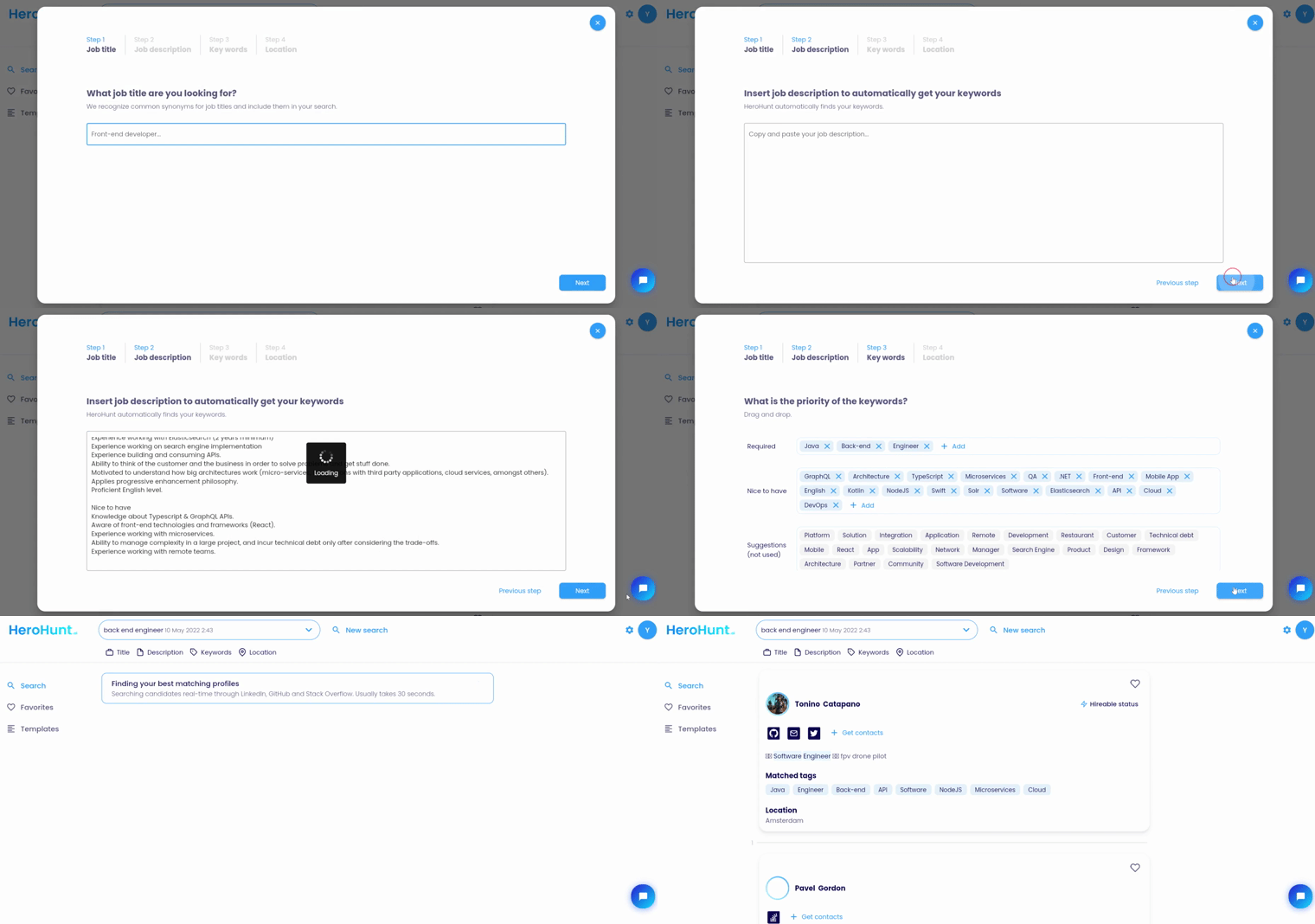
1. Create your search for talent
Creating a search is simple, just include the job description or any text related to the profile you're searching for and HeroHunt.ai will generate your search for you.
2. Find and review candidate profiles
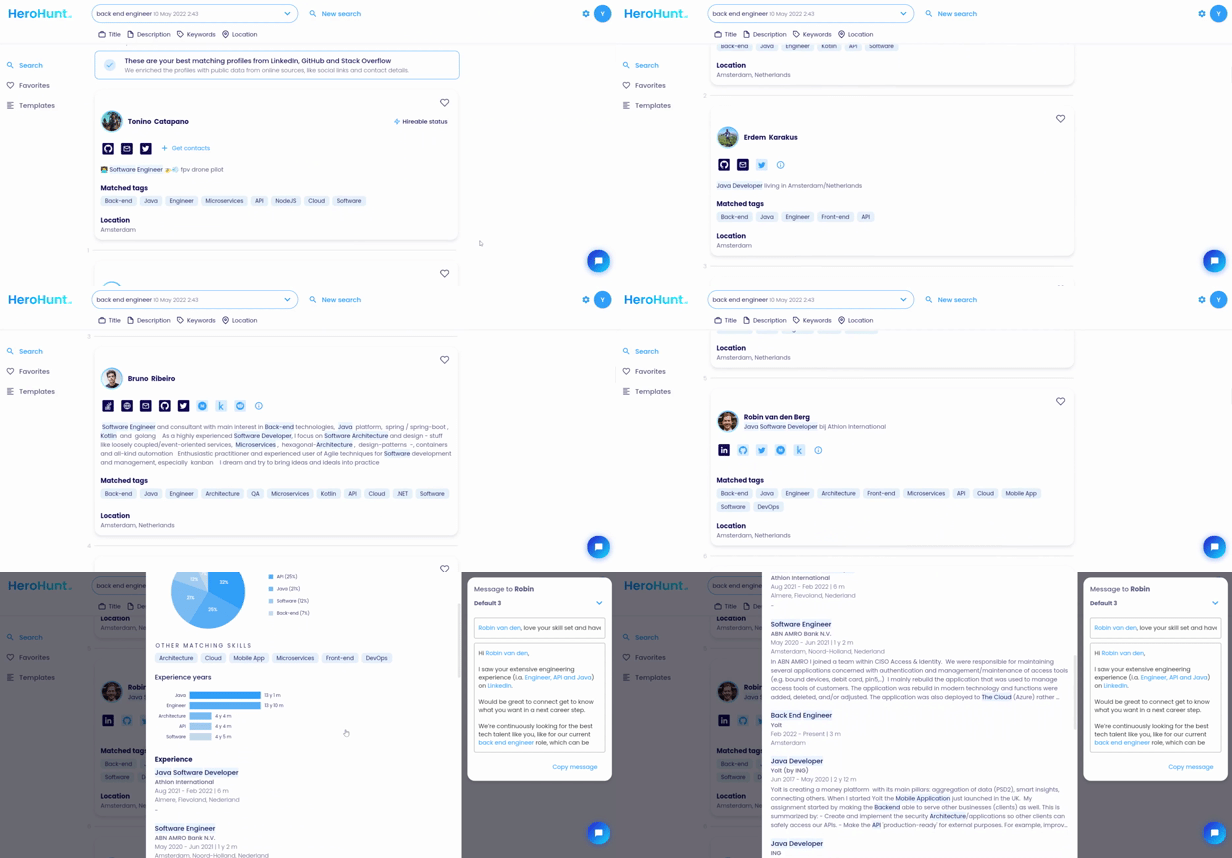
When you find an interesting profile, you can screen the profile for relevancy. In HeroHunt.ai the skills of the engineer are analyzed and summarized. You can use that snapshot of the engineer's skills to make a quick and accurate assessment of their skills, interests and experience. This is the step that replaces reading three repositories to work out whether someone writes Go for a living or writes it on Sundays.
3. Save profiles to favourites
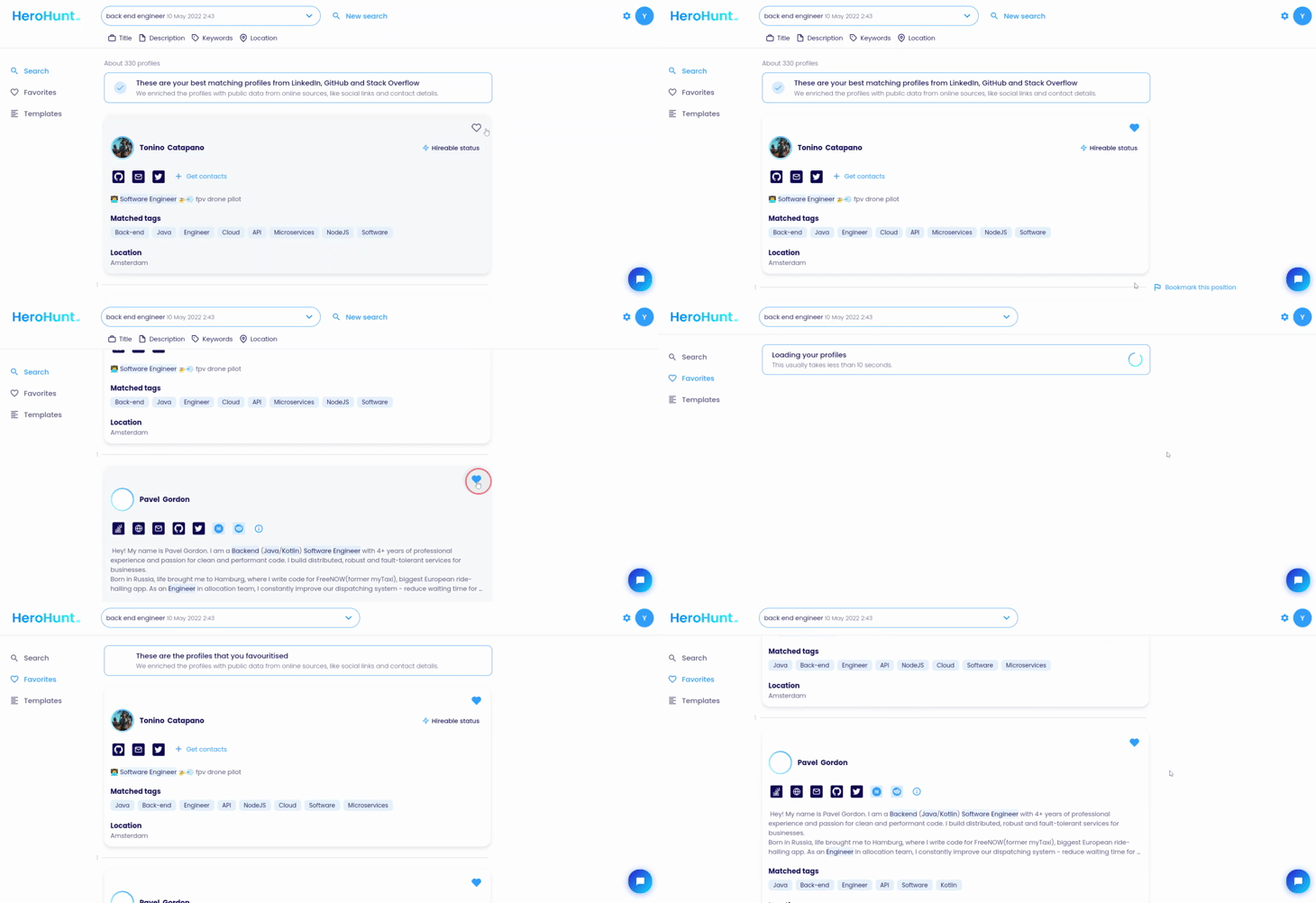
When you find interesting software engineers, you can save them to your favourites. This way you can keep track of your favourite candidates for an open position you're looking to fill.
4. Reach out to your favourite candidates
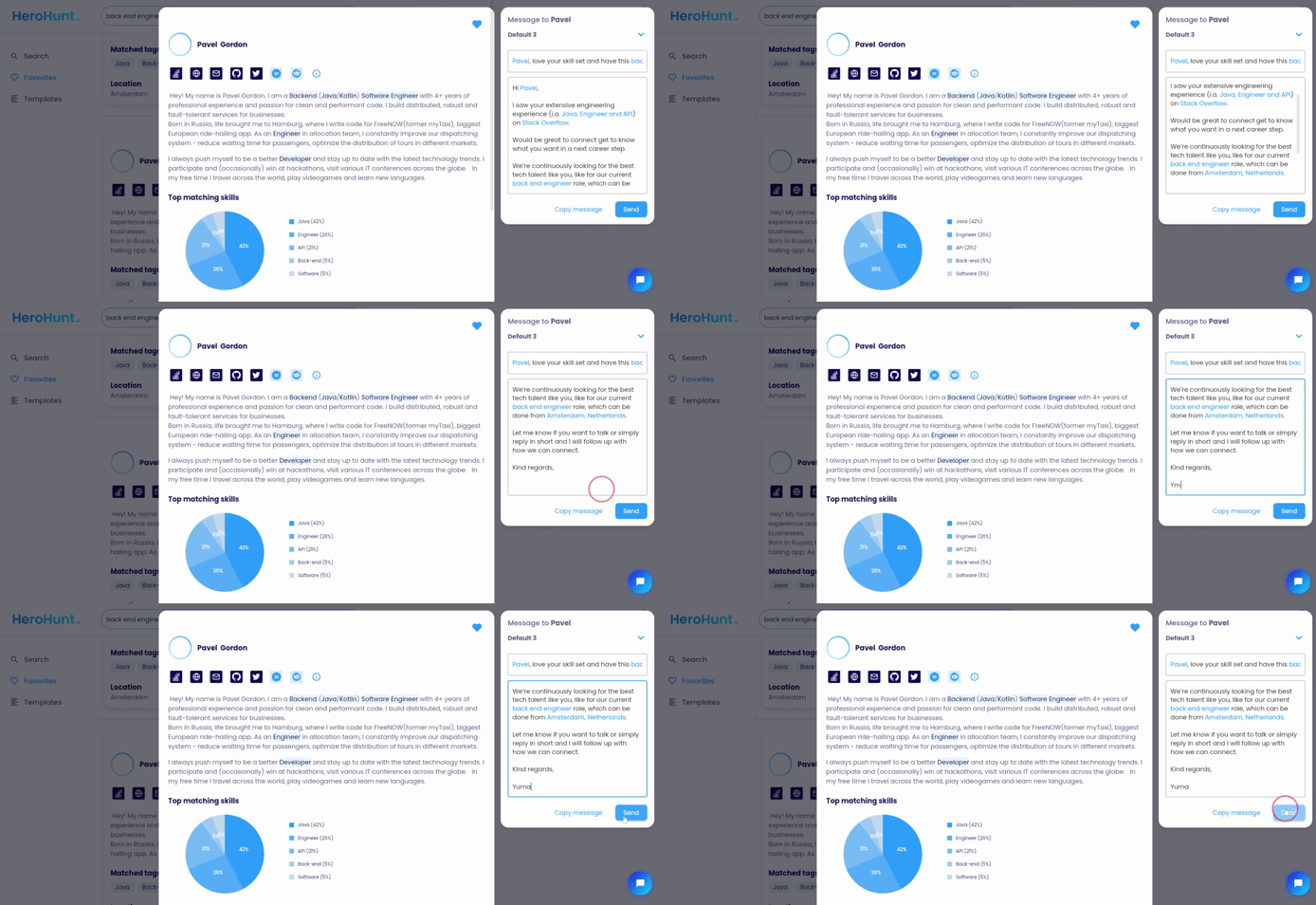
Based on their contact information you can reach out to them. A personalized message is automatically generated with personalizations like first name, current job title, platform where you found them and their location. You can customize and create your own message templates so you make sure your message fits your style of communicating. You can send your messages in one click. The candidate will receive your message including the personalizations.
Try it for yourself in this interactive demo
Which approach to use
Pick by what is scarce for you. If you have time and one hard role, GitHub's own search plus the commits API costs nothing and gets you closer to the person than any database will, because you are reading their actual work. If you have many roles and no time, a tool that returns people across both platforms plus LinkedIn is worth more than any single clever query. And in both cases, the step that quietly decides whether the whole exercise produces hires is the email: a shortlist you cannot contact is a bookmark folder.
For the half of your GitHub shortlist that lists a real name and a current employer, this is the fastest way past the noreply wall.
If you want your own 14-day free trial of HeroHunt.ai, simply sign in here for free.