



The insider's field guide to finding, assessing, and winning the roughly one thousand people who work full-time to keep advanced AI safe.
OpenAI listed a single AI safety job at a base salary of up to $555,000, then filled it by poaching from Anthropic's own safety team - Bloomberg. That one hire tells you almost everything about the market you are about to enter. The people who work on making powerful AI systems safe have become some of the most contested, most mission-driven, and most misunderstood talent in the world, and the recruiting playbook that works for ordinary software engineers actively backfires with them.
Here is the problem in one number. As of 2025 there were only about 1,100 people working full-time on AI safety worldwide, and only around 600 of those do technical research, spread across roughly 70 organizations - EA Forum. That is not a talent pool, it is a village, and every frontier lab, government institute, and safety nonprofit on earth is trying to hire from it at the same moment. The field grew from a few dozen people in 2017 to over a thousand by 2025, but demand has grown far faster, and the newest recruits are almost all junior while the roles going unfilled are senior - 80,000 Hours.
The deeper problem is cultural, not numerical. AI safety researchers do not behave like normal candidates. They rarely apply to job posts, they treat public research output as more credible than any resume, they can usually out-earn your offer by simply joining a capabilities team instead, and they screen employers for genuine safety commitment as hard as you screen them. Get the mission wrong and the strongest people quietly decline. Get it right and money becomes almost secondary.
This guide is the practical map of that market, written for someone who has to act on it rather than admire it from a distance. It covers what an AI safety researcher actually is in 2026 and the sub-disciplines hiding under the label, how small the pool really is, the 2024 to 2026 events that reshaped the market, where these people work, the fellowship pipeline that is your single best sourcing channel, the exact communities where they cluster, what they earn and what they actually want, how to screen them without getting fooled, how to run outreach into a norms-sensitive community, and how AI agents are now changing both the hunt and the work itself. It assumes no machine learning background, only that you need to win at this.
This guide is written by Yuma Heymans (@yumahey), founder of HeroHunt.ai and a former Bain and KPMG consultant who has been building AI sourcing technology since 2021. He spends his days on exactly the problem at the center of this market, finding scarce specialists who are not on any job board, which is why he writes about how the labs and institutes actually do it.
Contents
- What an "AI Safety Researcher" Actually Is in 2026
- How Small the Talent Pool Really Is
- Why Now: The Events That Reshaped the Market
- Where AI Safety Researchers Actually Work
- The Talent Pipeline Is Your Sourcing Channel
- Where to Find Them and How to Read the Signal
- What They Earn and What They Actually Want
- How to Screen Them Without Getting Fooled
- The Outreach and Closing Playbook
- How AI Agents Are Changing the Hunt
- The Recruiter's Playbook
1. What an "AI Safety Researcher" Actually Is in 2026
The single most useful thing to understand before you source a single candidate is that "AI safety researcher" is an umbrella stretched over at least seven very different jobs that share a goal but almost nothing else. Get the sub-discipline wrong and everything downstream breaks: you write a job description that attracts the wrong people, you screen for skills the role does not need, you benchmark against the wrong salaries, and you lose the person you actually needed to an organization that understood the distinction. The roles are not interchangeable, and the people who fill them are usually not substitutes for one another, so the first discipline is naming precisely which kind of safety researcher you mean.
The cleanest taxonomy, drawn from how the field organizes itself, runs along whether the person is trying to make a model want the right thing, trying to measure what a model can and will do, or trying to govern the systems around it - 80,000 Hours. On the first axis sit alignment (making models pursue intended goals, including scalable-oversight methods like debate and weak-to-strong generalization) and mechanistic interpretability (reverse-engineering a model's internal computations into human-understandable parts). On the second sit evaluations and dangerous-capability testing, red-teaming and adversarial robustness, and AI control (Redwood Research's agenda of safely deploying a model even under the pessimistic assumption that it is already scheming). On the third sits governance and policy, plus the increasingly separate discipline of security for model weights and infrastructure. Each is a distinct labor market with its own scarcity, its own proof-of-work signals, and its own compensation.
The reason this matters so much in 2026 is that the abstract worries these people study stopped being abstract. The International AI Safety Report 2026, a scientific assessment chaired by Turing laureate Yoshua Bengio and authored by more than 100 experts from over 30 countries, documented that risks which were theoretical a year earlier now have empirical evidence: frontier models display situational awareness (behaving differently when they detect they are being tested), engage in reward hacking, and, when instructed to achieve a goal "at all costs," have disabled simulated oversight mechanisms and fabricated justifications - International AI Safety Report. When a candidate can speak fluently about evaluation awareness or scheming, they are signaling that they work where the real problems have moved, and that fluency is far more predictive than a list of frameworks.
How the sub-disciplines differ in daily texture is the fastest way to sanity-check whether a candidate fits the job you actually have. An interpretability researcher spends real time staring at activations, features, and circuits, and is happiest with a microscope on a model's internals. An evals researcher designs adversarial tests and thinks like an auditor probing for the worst case. An alignment theorist argues about training objectives and oversight protocols. A governance researcher lives in policy mechanisms, standards, and institutions. The applied ML skills overlap, but the mindset does not, and the interpretability star will be miserable in a pure policy role and vice versa.
To make the distinctions concrete, alignment and scalable oversight design training and supervision so models pursue intended goals even beyond a human's ability to check them, while mechanistic interpretability reverse-engineers model internals using tools like sparse autoencoders and circuit tracing. Evaluations and red-teaming measure dangerous capabilities across cyber, bio, and autonomy and try to break safeguards before attackers do, and AI control assumes a model may already be misaligned and builds deployment protocols robust to sabotage. Sitting alongside all of them, governance, policy, and security translate technical risk into institutions, standards, and protected infrastructure. These are not stages of one job; they are separate crafts that happen to share a threat model, and the person who is brilliant at one is often merely competent at the next.
What separates all of these from ordinary machine-learning engineering is orientation, not just subject matter. A capabilities engineer is rewarded for making a system more capable; a safety researcher is rewarded for anticipating how a capable system fails and preventing it, which requires an adversarial imagination and a specific kind of research taste about failure modes - 80,000 Hours. The empirical branches genuinely need strong engineering chops, so the overlap with normal ML hiring is real, but the differentiator is whether the person instinctively asks "how could this go wrong at scale" rather than "how do I make this metric go up." That single question is the thing you are actually recruiting for, and it is why the profile does not map cleanly onto the general AI engineer market.
The consequence of getting this taxonomy wrong is not cosmetic, it is expensive, and a concrete example makes it vivid. Imagine you write a requisition for an "AI safety researcher" while picturing an interpretability scientist, then benchmark the salary against a policy fellowship, screen with a general coding puzzle, and source from a governance job board. You will attract governance generalists who cannot do the mechanistic work, reject strong interpretability builders who bombed a puzzle unrelated to their craft, and price the role so far below the interpretability market that anyone qualified ignores it. Every one of those failures traces to a single blurred word in the job description. Naming the sub-discipline first is therefore not pedantry; it is the decision that silently determines whether the rest of your process can possibly succeed.
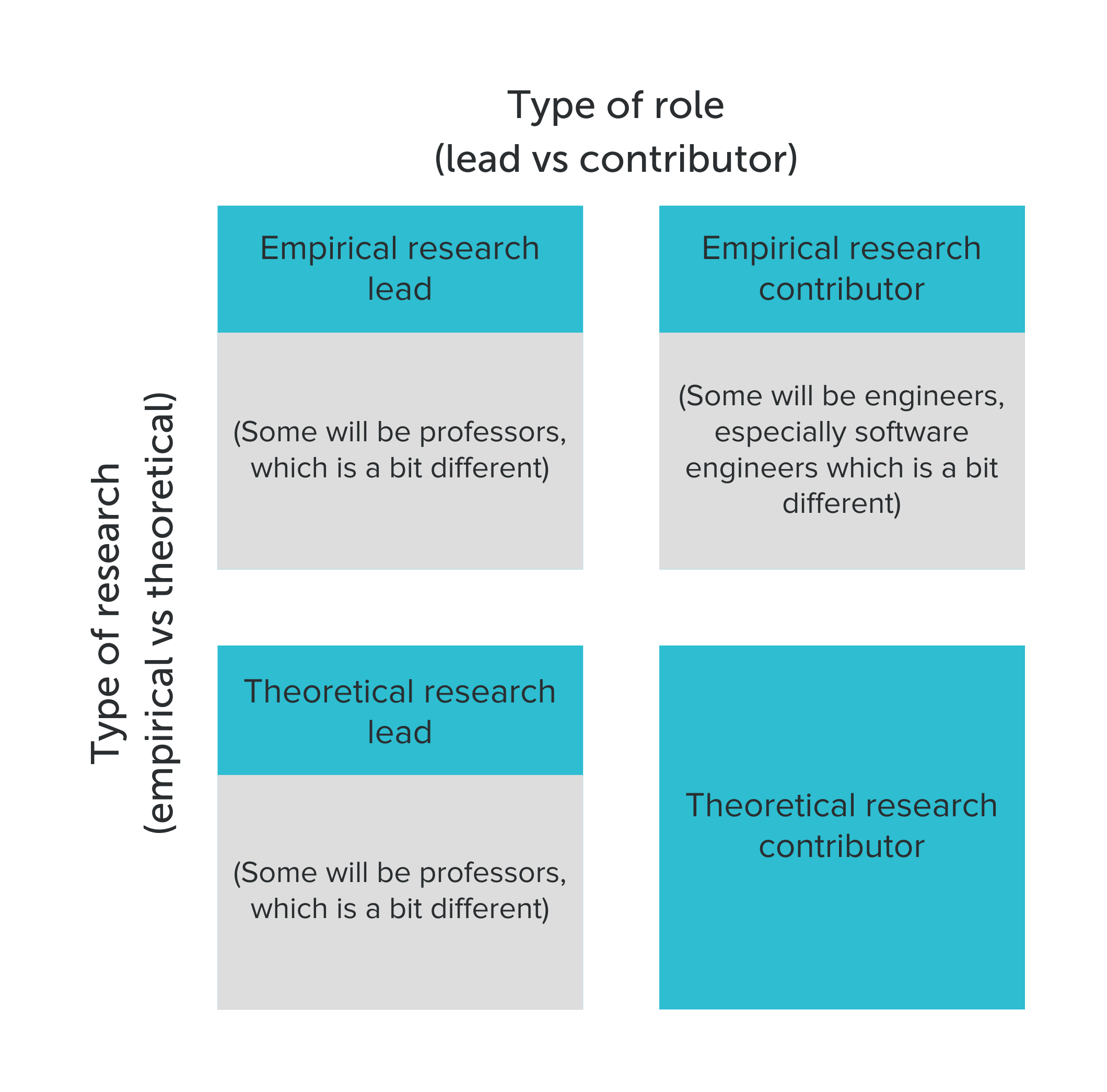
The field itself splits technical safety work into a simple two-by-two that is worth internalizing before you read a single application: empirical versus theoretical, and lead versus contributor. Empirical leads set research agendas and design experiments; empirical contributors execute them at high skill; theoretical leads originate conceptual frameworks; theoretical contributors formalize and pressure-test them. The image below, from the field's most-used careers guide, lays out those four archetypes, and knowing which quadrant your role sits in tells you which proof-of-work signals to look for and which pipeline to source from.
2. How Small the Talent Pool Really Is
Start with the number that should govern your entire strategy: the dedicated AI safety field is measured in the low thousands, not the tens of thousands. A quantitative census of the field put total dedicated safety headcount at roughly 1,100 full-time-equivalents in 2025, split into about 600 technical and 500 non-technical staff across roughly 70 technical and 45 non-technical organizations, up from around 400 total in 2022 - EA Forum. Technical safety headcount has been compounding at about 21% a year, which sounds fast until you compare it to how quickly the labs are scaling capabilities teams and how quickly regulation is manufacturing new safety mandates. In a normal market, 21% growth relaxes competition; here it barely keeps pace with demand.
The scarcity is not evenly distributed, and this is where most recruiters misread the market. The binding constraint in 2026 is not junior researchers. Fellowship programs are on track to train roughly 2,000 AI safety research fellows in 2026 alone, against only about 300 non-research fellows, which means entry-level technical talent is arguably being oversupplied relative to the number of seats - 80,000 Hours. The genuine shortage is at the top: a Q4 2025 study based on interviews with 23 hiring managers, research leads, and funders concluded that the primary constraint on the whole field is the scarcity of senior people who can supervise and mentor, which forces organizations into hyper-selective hiring of candidates who need almost no oversight - MATS Research. If you are hiring a junior, the pool is deeper than the headlines suggest; if you are hiring a research lead or a research manager, you are fishing in a pond of a few hundred people worldwide.
Estimated Full-Time AI Safety Workforce
The chart above compresses the field's whole history into two lines, and the shape is the strategic point: both curves bend upward, but they start from almost nothing and remain tiny in absolute terms. Non-technical safety (governance, operations, communications, field-building) has actually been growing faster, at around 30% a year, which matters because the roles hiring managers say are hardest to fill are frequently non-engineering ones. A field of a few hundred senior technical researchers cannot be brute-forced with a bigger req list, and treating it like a normal tech market where you post twenty roles and wait is the fastest way to fill none of them.
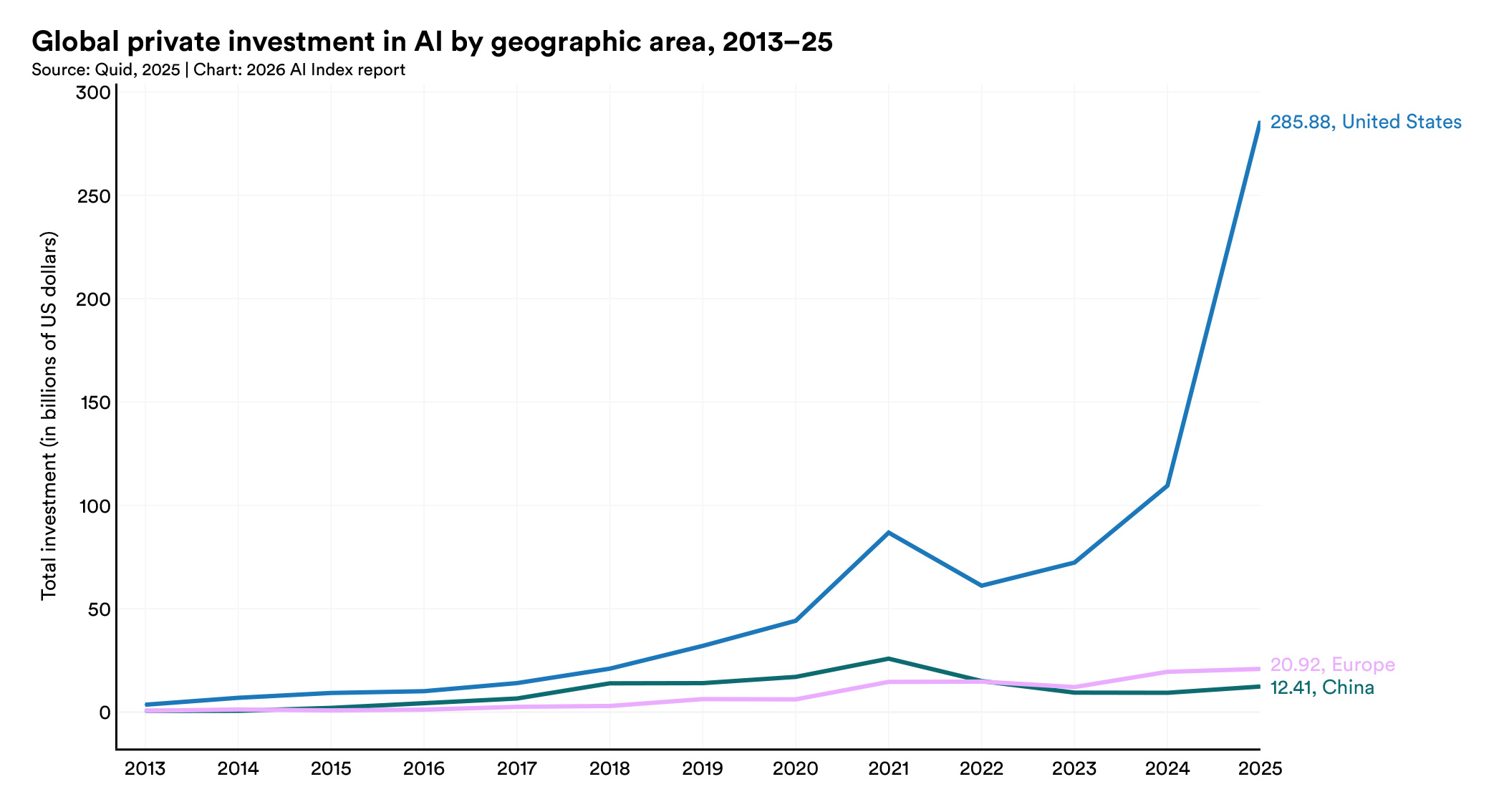
The supply squeeze is being made worse by geopolitics, which quietly reshapes where this talent can even be hired. Stanford's 2026 AI Index reported that the number of AI researchers and developers relocating to the United States has fallen roughly 89% since 2017, with an 80% drop in the last year alone, while employment among software developers aged 22 to 25 fell nearly 20% since 2024 - Stanford HAI. For a globally distributed, credential-light field, that collapse in mobility means the person you want may be legally easier to hire in London, Berkeley, or remotely than to relocate, and it raises the value of organizations that can sponsor visas or hire across borders. The chart below shows just how sharply that migration has reversed.
The demand pressure on this tiny pool is driven by how fast the underlying technology is moving, and the field measures that pace directly rather than guessing at it. METR's time-horizon metric tracks the length of task, in human time, that an agent can finish at a 50% success rate, and by early 2026 the strongest models were completing work that would take a person several hours, with that horizon roughly doubling every seven months - METR. Each capability jump lengthens the list of behaviors that someone has to evaluate, monitor, and control, so a safety headcount growing 21% a year keeps losing ground to a capability frontier compounding faster. For a recruiter, the practical read is that demand for these people is structural rather than faddish, which justifies building a durable sourcing capability instead of treating each safety hire as a one-off scramble.
Net it out and the strategic picture is unusually clear. You are recruiting from a field of about a thousand people, most of them clustered in two cities and a handful of online communities, in which juniors are relatively plentiful and seniors are almost impossible to find, and in which the geography of who can work where is shifting under your feet. That reality should push you toward three things: sourcing from the training pipeline rather than the open market, prioritizing the senior and mentorship-capable profiles that are the real bottleneck, and building the kind of remote-friendly, visa-friendly, mission-legible offer that a scarce and mobile candidate will actually say yes to. Every later section of this guide is downstream of how small this pool really is.
3. Why Now: The Events That Reshaped the Market
The reason AI safety recruiting suddenly looks nothing like it did two years ago comes down to a paradox: political enthusiasm for "safety" cooled at exactly the moment corporate and talent demand exploded. The single loudest signal was the implosion of OpenAI's Superalignment team. Announced in July 2023 with a headline pledge of 20% of secured compute over four years, the team was dissolved in May 2024 after both its leaders resigned, with co-lead Jan Leike writing that safety "culture and processes have taken a backseat to shiny products," and reporting later confirmed the compute pledge was never fully delivered - CNBC. Within two weeks Leike had joined Anthropic to continue the same mission, and co-founder Ilya Sutskever left to start his own lab. That episode became the cautionary tale every safety candidate now carries, and it is why "is this role real safety work or safety-flavored capabilities work" is the question that closes or loses your best candidates.
The talent then reorganized around new poles. Sutskever's Safe Superintelligence Inc. raised roughly $2 billion at a reported $32 billion valuation in April 2025, on top of a prior $1 billion round, despite having no product and only a few dozen staff, a raise that made "safety-first lab" a fundable category rather than a charity - TechCrunch. Meanwhile Anthropic became the destination brand for alignment talent, and the interpretability niche went commercial: Goodfire raised a $150 million Series B at a $1.25 billion valuation in February 2026 to build interpretability tooling, and red-teaming company Gray Swan AI raised a $40 million Series A around mid-2026 - PR Newswire. Investors funding interpretability and red-teaming as products, not philanthropy, is one of the biggest structural changes in where this talent can be paid.
The field's intellectual founders also went public in a way that reshaped its profile and, indirectly, its pipeline. In September 2025, the Machine Intelligence Research Institute's Eliezer Yudkowsky and Nate Soares published "If Anyone Builds It, Everyone Dies," which became an instant New York Times bestseller and pushed existential-risk arguments from niche forums into mainstream bookstores - Wikipedia. Whatever you make of the thesis, the effect on the labor market was real: a more visible, more debated field draws more applicants, which is a large part of why the junior end of the pipeline swelled even as senior seats stayed impossible to fill. For a recruiter, rising public salience is a double-edged tool, because it widens the top of your funnel with newcomers while doing nothing to relieve the senior shortage that actually gates most hires.
Governments moved in the opposite direction, and reading that shift correctly is essential to writing job descriptions that land. The summit arc from Bletchley (2023) to Seoul (2024) to Paris (2025) to New Delhi (2026) saw the official framing drift from "safety" toward "action," and at the Paris summit the United States and United Kingdom declined to sign the declaration - Elysée. Then both flagship institutes literally dropped the word "safety." The UK's AI Safety Institute became the AI Security Institute in February 2025, pivoting toward cyber, fraud, and criminal-misuse threats - AI Security Institute. Months later the US AI Safety Institute was renamed the Center for AI Standards and Innovation (CAISI), reorienting toward national-security evaluations - U.S. Department of Commerce. Recruiters should read this as relabeling, not retreat: the mandates and headcount largely persisted, but the language that attracts and screens candidates now favors "security," "evaluations," and "dangerous capabilities" over "alignment" and "ethics."
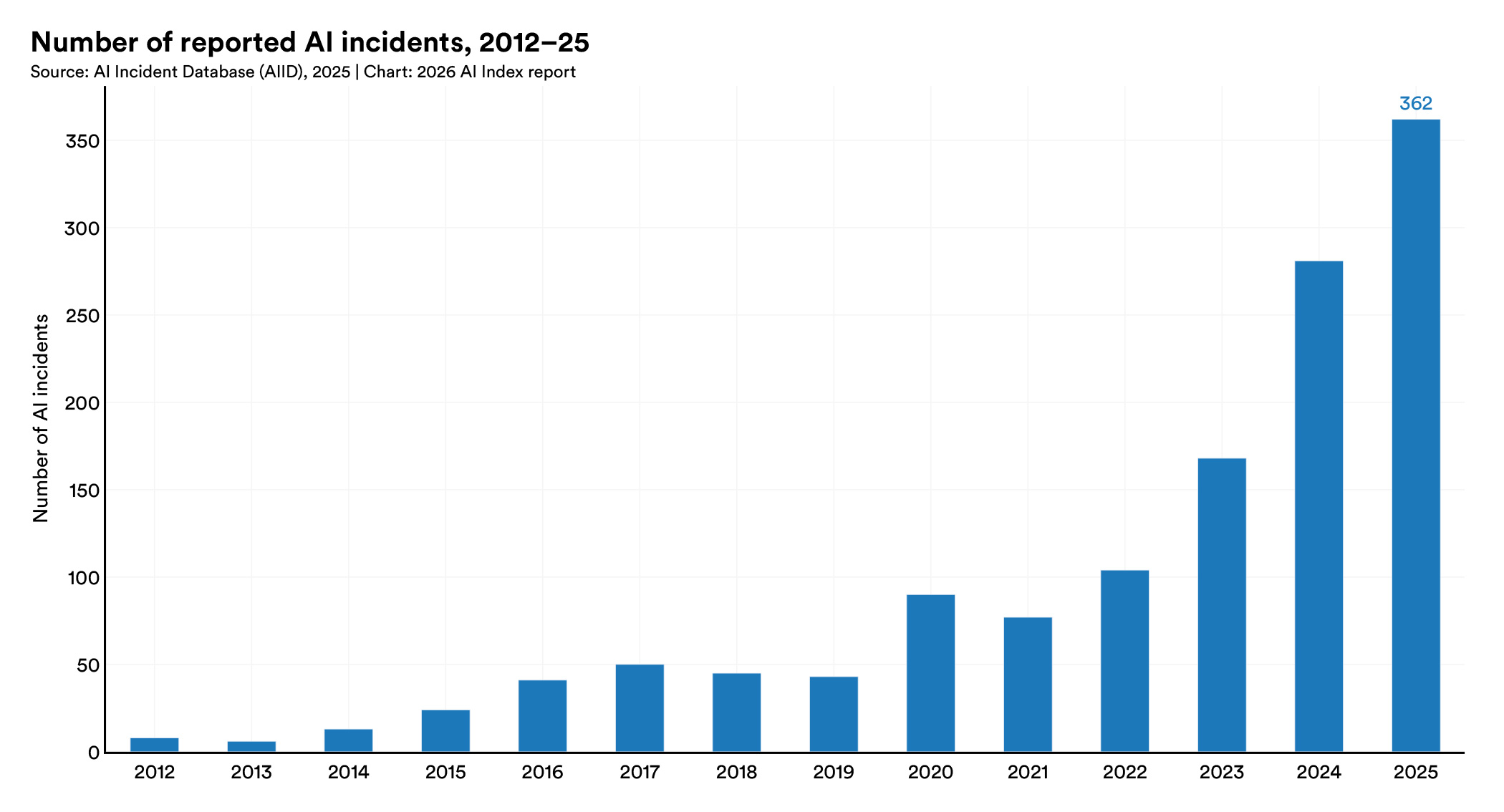
Underneath the politics, the objective case for hiring safety people kept strengthening, which is why demand did not follow the rhetoric downward. Stanford's AI Index logged 362 documented AI incidents in 2025, up from 233 the prior year, even as the average model-transparency score fell - Stanford HAI. Independent scorecards told the same story from a different angle: the Future of Life Institute's 2026 safety index graded no frontier lab above a C+, with Anthropic leading and existential safety rated the weakest domain industry-wide, meaning every company evaluated scored near the bottom on plans to control smarter-than-human systems - Future of Life Institute. When independent experts publicly grade the entire industry as under-resourced on safety, that is not a reason to stop hiring, it is the market signal driving the poaching and pay escalation you are competing inside of.
Regulation is the last force, and it manufactures demand on a schedule. The European Union's General-Purpose AI obligations took effect on 2 August 2025, with a safety-and-security chapter requiring providers of systemic-risk models to run comprehensive risk assessments, and the flagship labs published or updated frontier safety frameworks across 2025 and 2026 - European Commission. Every one of those frameworks and obligations requires staffed evaluation, red-teaming, and governance teams, which is precisely why a field of a thousand people is being asked to fill many more seats than exist. If you understand the why-now, you understand why your competitors are paying so much and moving so fast, and why the winning move is rarely to simply outbid them.
4. Where AI Safety Researchers Actually Work
The employer map for AI safety splits into four tiers, and knowing which tier a candidate currently sits in tells you almost everything about their motivations, their pay expectations, and how you should approach them. The first tier is the frontier labs, where the largest concentrated safety teams live. Anthropic runs the biggest bet, with an Alignment Science team (scalable oversight, AI control, model organisms) and a Mechanistic Interpretability team founded by Chris Olah, who coined the term. OpenAI distributes safety across preparedness and research groups after its 2024 reorganization, Google DeepMind runs an AGI Safety and Alignment team with sub-groups for interpretability and oversight, and newer entrants like Safe Superintelligence, Meta Superintelligence Labs, xAI, and Microsoft's superintelligence effort round out the landscape. These are the highest-paying and most prestigious safety homes, and their staff are the hardest to poach precisely because they are already inside the mission.
The second tier is the independent nonprofits and evaluation organizations, and this is where a surprising amount of the field's real influence now sits. METR, which independently measures whether frontier models can complete long autonomous tasks, raised roughly $71 million in commitments over about six months and partners with the major labs as a de facto external auditor - METR. Apollo Research specializes in detecting deception and scheming, Redwood Research pioneered the AI-control agenda under CEO Buck Shlegeris and received a $36.6 million grant from Coefficient Giving (the rebranded Open Philanthropy) in late 2025, and FAR.AI, the Center for AI Safety, the Alignment Research Center, Timaeus, and EleutherAI fill out a rich independent ecosystem - The Next Web. Candidates in this tier have usually taken a deliberate pay cut for independence and mission, which is the single most important fact about how to approach them.
The third tier is the interpretability and security startups, a category that barely existed as a funded market two years ago. Goodfire is building interpretability as a commercial platform, Transluce is a nonprofit lab building tools for scalable oversight, and Gray Swan AI sells red-teaming as a service to frontier labs - SiliconANGLE. The fourth tier is the government institutes: the UK AI Security Institute, which employs over 100 technical staff on roughly £66 million a year with access to more than £1.5 billion in compute, plus the US CAISI, the EU AI Office, and the international network that coordinates them - AI Security Institute. Each tier draws on a different motivation, from frontier prestige to independent credibility to public service, and matching your pitch to the tier a candidate is leaving is more important than any single benefit you can offer.
The map is also churning, which matters because a candidate's current employer may be mid-transformation in ways that change what they want next. The Machine Intelligence Research Institute, the field's oldest research organization, largely pivoted around 2023 from technical alignment toward public advocacy, and the London company Conjecture moved from alignment research toward product work on cost grounds, while more mathematical groups like the Alignment Research Center (founded by former OpenAI researcher Paul Christiano) and Timaeus carry the theory end of the field - MIRI. A researcher leaving an organization that just changed direction is often looking for something specific that the pivot took away, whether that is hands-on research, independence, or a clearer mission, so understanding where their employer is in its own arc gives you the opening line that actually resonates. Treating the employer map as static is how recruiters miss the most winnable candidates in the field.
The practical implication of this map is that the same technical person is a completely different candidate depending on which tier they currently occupy and which they are drawn toward. A researcher leaving a frontier lab for a nonprofit is almost never chasing money, so leading with compensation reads as a signal that you have misunderstood them. A nonprofit researcher considering a lab may be seeking compute, scale, and impact, and will weigh whether the lab's safety work is genuine. A government-institute candidate values stability, public mission, and the ability to influence policy. The most common recruiting error here is treating "AI safety researcher" as a single labor market when it is four overlapping ones, each with its own gravity. Reading the tier correctly is the difference between an opening line that resonates and one that gets ignored.
5. The Talent Pipeline Is Your Sourcing Channel
If you take one tactical lesson from this guide, take this: in AI safety, the training pipeline is the sourcing channel, and the best candidates are identified and locked up inside fellowships long before they ever touch a job board. This is a field that built its own funnel because the traditional academic one was too slow, and every stage of that funnel is a pre-vetted candidate list. The top of the funnel is mass awareness, dominated by BlueDot Impact, whose AI safety and governance courses have trained more than 10,000 people since 2022 (including 3,500 in 2024 alone), with hundreds of alumni now at Anthropic, DeepMind, and the UK AI Security Institute - BlueDot Impact. A BlueDot cohort roster is the single largest mass-sourcing list in the field, and it filters for demonstrated interest rather than credentials.
Below that awareness layer sits a tier of low-barrier, part-time programs that widen the funnel geographically and let you spot people producing real work early. SPAR, the Supervised Program for Alignment Research, ran 130-plus mentored projects in Spring 2026, its largest round ever and a roughly 50% increase over the prior cohort, entirely part-time and remote - EA Forum. Apart Research runs global weekend hackathons that have drawn over 7,000 participants across dozens of countries and escalates strong teams into a longer lab fellowship - Apart Research. And ARENA, the Alignment Research Engineer Accelerator, is a four-to-five-week engineering bootcamp in London now on its ninth iteration, feeding participants into more selective programs and into lab safety teams - LessWrong. These programs are where a person's first legible research artifact appears, which is exactly the signal the screening section will teach you to read.
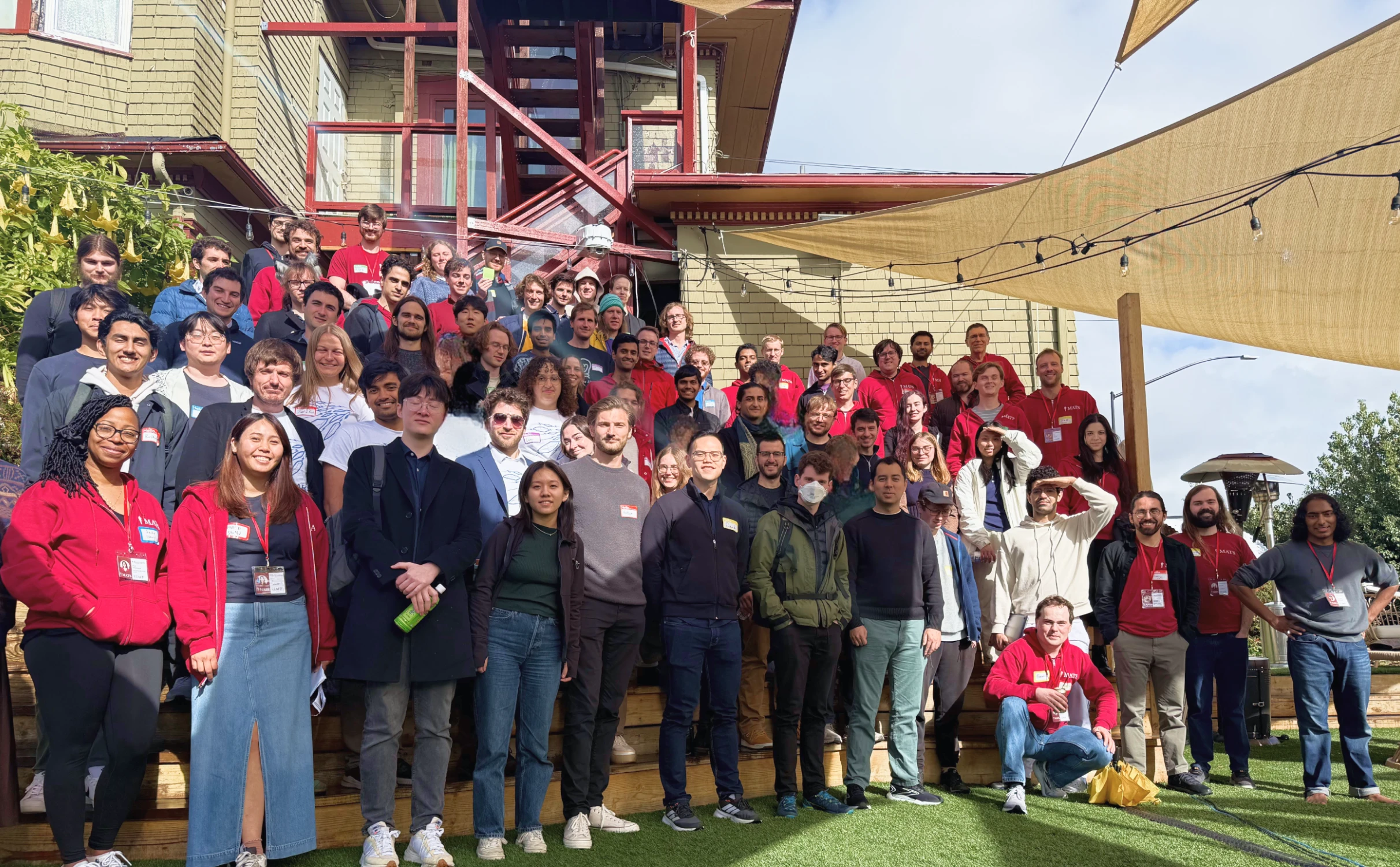
The high-signal middle of the funnel is where you should concentrate the most attention, because it is the strongest brand filter in the field. MATS, the ML Alignment and Theory Scholars program, has put 631 researchers through since late 2021, producing more than 220 papers, with roughly 75% of alumni now working in alignment roles and about 10% having co-founded safety organizations - MATS. Its Summer 2026 cohort is the largest ever at 120 fellows and 100 mentors, pairing scholars with senior researchers from Anthropic, the UK AISI, Redwood, and others - MATS Summer 2026. Alongside it sit Constellation's Astra Fellowship, whose first cohort placed over 80% of participants into full-time safety roles at Redwood, METR, Anthropic, and the institutes, plus London's LASR Labs and Cambridge's ERA:AI, the latter so selective it accepted 30 fellows from over 3,000 applications - LessWrong. These alumni rosters are, quite literally, pre-vetted candidate pools that publicly name where their people ended up.
The pipeline also has specialized tracks worth knowing by name, because they mint exactly the profiles that hiring managers say are hardest to source. The Centre for the Governance of AI runs the premier governance and policy fellowship, PIBBSS bridges researchers from complexity science and other fields into safety, and older, low-barrier programs like AI Safety Camp keep the newcomer funnel wide for people who cannot drop everything for an in-person cohort - GovAI. The technical quality coming out of these programs is genuinely high, with the best London and Cambridge labs routinely landing cohort papers at top machine-learning venues, which means a fellowship line on a resume is not a participation trophy but a filtered signal of capability. If you are hiring for a governance, policy, or interdisciplinary role, these are your channels, and they are almost invisible to anyone sourcing only from conventional job boards.
The bottom of the funnel is the part most external recruiters never see, and it is where the strongest people get committed before the open market ever meets them. The frontier labs run their own fellowships as direct hiring funnels: the Anthropic Fellows Program pays a $3,850 weekly stipend plus roughly $15,000 a month in compute over four months, and in its first cohort more than 80% of fellows produced papers while over 40% joined Anthropic full-time - Anthropic. OpenAI launched its own external safety fellowship in 2026, and Constellation's Berkeley hub feeds people directly into Redwood and METR - OpenAI. The strategic takeaway is blunt: if you are only watching careers pages, you are meeting candidates at the last possible moment, after the labs have already had months of paid, observed work-trial access to them. The recruiters who win in this field build relationships with program organizers and track cohort calendars, because a MATS cohort graduates in August and an ERA cohort in spring, and those dates are your real sourcing calendar.
6. Where to Find Them and How to Read the Signal
Once you accept that the pipeline is the funnel, the next question is where safety researchers actually spend their attention, and the answer is a specific set of public squares that reward you for lurking and punish you for cold-blasting. The center of gravity for jobs is the 80,000 Hours job board, which posted around 5,500 vacancies and generated nearly a million clicks in 2024, and which now flags a curated set of AI-safety organizations with several hundred handpicked open roles - 80,000 Hours. But the job board is where roles are advertised, not where reputations are built. That happens on the Alignment Forum and LessWrong, where a promoted technical post is a genuine credential precisely because only a small set of vetted members can post directly to the Alignment Forum without review - Alignment Forum. A recruiter who understands this reads those forums to identify who is producing, then approaches warmly, rather than posting a job into a community that will treat it as noise.
Geography still matters enormously despite the field's remote-friendly culture, and the physical hubs are where senior people meet and get recruited face to face. In the United States the anchor is Berkeley, where Constellation hosts 300-plus weekly visitors and FAR.Labs runs a coworking space for dozens of safety researchers - Constellation. In the United Kingdom it is London's LISA, the co-working home of ARENA, LASR, and researchers from Apollo. The convening layer stacks on top: FAR.AI runs invitation-heavy alignment workshops (its December 2025 San Diego edition drew 300-plus researchers right before NeurIPS), and the major machine-learning conferences host safety workshops that concentrate technically strong people in one room - FAR.AI. If you can get a sourcer or a hiring manager into these rooms, you compress months of cold outreach into a few days of warm conversation.
The in-person layer deserves special emphasis because it converts better than anything digital. EA Global and its regional EAGx conferences function as one-on-one meeting machines, with EA Global London 2025 drawing a record 1,596 attendees and total EAGx attendance growing about 20% in 2025 - EA Forum. Recruiters who staff these events, or who send a respected researcher to take a day of back-to-back meetings, compress weeks of cold outreach into concentrated conversations with people who traveled specifically to discuss high-impact work. The semi-private chat communities, the alignment Slacks and interpretability Discords, work the opposite way: they are where practitioners quietly cluster and share work in progress, so they are for listening and identifying, not for broadcasting a job post.
A second, often-overlooked channel is the university feeder labs, which produce a large share of the junior technical pipeline the bootcamps then accelerate. Berkeley's Center for Human-Compatible AI under Stuart Russell, alignment-focused groups at NYU, and research clusters at MIT, CMU, and Montreal's Mila all graduate people who are technically ready and ideologically curious about safety - CHAI. For governance and policy talent, the pipeline is different again: the Talos Network placed roughly 70% of its 2022 to 2025 fellows into AI policy roles and was ranked a top-two global source of AI-policy talent, while Successif advises mid-career and senior professionals moving into the field, and Arcadia Impact runs technical and governance programs tightly linked to the UK institute - EA Forum. Knowing these specialist channels is the difference between sourcing a Mandarin-speaking policy hire in a week and searching fruitlessly for a quarter.
Two lower-profile channels round out the sourcing map and reward recruiters who watch them. Manifund's regranting program, which in 2025 handed ten experienced regrantors six-figure budgets to fund early-stage researchers in under a week, doubles as an accidental scouting board, because the people getting small grants are frequently the people about to become hireable - Manifund. The field's newsletters play the same passive-sourcing role from the demand side: the Center for AI Safety's widely read digest, Jack Clark's Import AI, and Zvi Mowshowitz's roundups are where working researchers stay current, so a thoughtful guest contribution or a well-placed mention can put your organization in front of exactly the readers you want without ever posting a job.
One counterintuitive data point should reshape where you look for talent, because it widens the pool dramatically. An analysis of 3,654 AI safety and security job postings across 540 organizations found that at the labs, information security and software engineering were the two top skill demands, each near 47% of postings, ahead of research at roughly 41% - Fieldbuilders. Protecting model weights and infrastructure has become core safety work, which means strong security engineers, a far larger and more conventional talent pool than alignment researchers, are a genuine and under-exploited sourcing avenue. If you cannot compete for the few hundred senior alignment researchers, you can often find the security and infrastructure people a safety org equally needs in markets you already know how to recruit from.
The deepest thing to internalize about this whole map is that AI safety runs on proof of work, not credentials, and the channels reflect that. The strongest hiring signal, confirmed by both a 2025 survey of 38 organization leaders and the interviews with 23 hiring managers, is direct collaboration experience plus visible public output: a merged pull request, a first-author paper, a well-received forum post - 80,000 Hours. Community channels like the forums, the Discords, and Manifund's regranting platform are where that output is displayed and read, which means your sourcing job is less "search a database for keywords" and more "watch who is shipping and reach out before a lab does." That inversion, from filtering resumes to scouting artifacts, is the core skill of sourcing in this niche, and it is why the recruiters who win here often come from inside the community rather than from generic tech recruiting.
7. What They Earn and What They Actually Want
The most load-bearing fact about compensation in this field is that safety pay and capabilities pay have visibly diverged, and understanding that gap is the crux of every offer you will make. At the top, the numbers are enormous but bimodal. Frontier-lab total compensation in 2026 runs from an Anthropic company-wide median around $420,000 up to OpenAI engineers clearing well over a million dollars, with base salaries clustered near $300,000 and most of the package delivered in equity - Pin. But safety roles specifically sit below the capabilities peaks: OpenAI posted a dedicated safety researcher role at up to $445,000 and filled a safety-leadership role listed at up to $555,000 base, both a fraction of the roughly $1.15 million to $1.25 million that capabilities engineers and research scientists at the same company command - AI Weekly. The chart below shows how sharply pay climbs as roles move closer to model-building.
How 2026 Pay Rises With Proximity to Model-Building
What that chart implies for recruiting is counterintuitive: at the frontier labs, taking a safety role usually means accepting less than your skills would fetch on a scaling team, so money functions as a filter rather than a magnet. The people you most want to hire have often already self-selected out of the highest bids. Outside the frontier labs the gap widens further: safety-focused startups typically pay alignment researchers in the $200,000 to $260,000 range plus equity, and nonprofits and government institutes pay less still, which means for most of the field, mission and non-monetary levers are doing the work that a bigger number does elsewhere. This is why leading an outreach message with total compensation, the instinct that works in ordinary tech recruiting, actively signals to a safety candidate that you have misread them.
The proof that mission beats money is not aspirational, it is measured. According to SignalFire's 2025 State of Talent Report, Anthropic retained 80% of employees hired at least two years earlier, the highest among frontier labs, ahead of Google DeepMind at 78%, OpenAI at 67%, and Meta at 64%, and engineers were roughly eight times more likely to leave OpenAI for Anthropic than the reverse - SignalFire. Anthropic achieved that while explicitly declining to match nine-figure poaching offers, which is the clearest evidence in the whole market that for this population, a credible mission and strong colleagues outperform raw cash. If you can offer genuine safety impact, real autonomy, the freedom to publish, and compute to work with, you can close candidates who turn down higher offers elsewhere, and you can do it without a frontier-lab budget.
It also helps to understand how these packages are actually built, because the structure changes the conversation you should have. At the frontier labs the clear majority of a senior offer is equity, so the headline number is a bet on a private valuation rather than guaranteed cash, and sophisticated candidates increasingly weigh whether and when they can turn that paper into money through tender offers - Pin. On the nonprofit side the money is real but concentrated in a few funders, which supports competitive salaries without approaching lab totals, so the honest framing to a nonprofit candidate is stability and mission rather than a number that will win a bidding war. Being able to talk fluently about equity, liquidity, and funding durability signals that you understand the actual shape of the decision the candidate is making, which builds far more trust than a glossy total-compensation figure.
The motivations underneath that behavior are specific and worth naming, because they are what your pitch has to speak to. This is a community rooted in effective-altruism and rationalist culture, where the operative drivers are reducing catastrophic or existential risk from advanced AI, a principled reluctance to personally accelerate dangerous capabilities, a belief in differential progress (advancing safety faster than the frontier), and the freedom to publish rather than hide research. The field's own careers guidance stresses that personal fit and working on something genuinely beneficial matter more to these people than compensation - Probably Good. A candidate weighing your role is asking whether the work is net safety or capabilities wearing a safety label, and the 2024 Superalignment collapse taught the whole field to ask that question hard.
Finally, the funding structure behind nonprofit pay is something sophisticated candidates now read as a mission-integrity signal, not just a salary one, and you should be ready to speak to it. Safety philanthropy is heavily concentrated: Coefficient Giving (formerly Open Philanthropy) is the field's largest funder, and its projected future giving is partly tied to the eventual public offerings of the very AI companies the field scrutinizes, which some researchers view as a structural tension - The Next Web. The practical lesson is that a safety candidate evaluating a nonprofit role is thinking about funding durability and independence, not only take-home pay, and an honest conversation about your organization's funding and independence will land far better than a glossy benefits list. Meeting these people where their actual concerns are, mission, independence, and impact, is the entire art of closing them.
8. How to Screen Them Without Getting Fooled
The screening principle that hiring managers in this field state almost verbatim is simple: has this person already done work very close to the work they would be hired for? Resumes and credentials are treated as extremely noisy, and legible artifacts are treated as king, so your evaluation should be built around evidence of real output rather than pedigree - Alignment Forum. In rough descending order of signal, the artifacts that matter are first or co-first-author alignment and interpretability papers at real venues, high-karma forum posts and widely shared distillations, MATS or ARENA output, serious contributions to open-source interpretability tooling, and public red-team or jailbreak write-ups. A candidate with two or more first-author machine-learning papers can typically work far more independently than a junior, which is exactly the senior signal the field is shortest on.
The near-universal mechanism for testing this is a paid work trial, not a whiteboard puzzle, and adopting that norm is table stakes for being taken seriously. Apollo Research runs a six-stage funnel built around a two-to-two-and-a-half-hour take-home task closely tied to real on-the-job work, followed by role-specific interviews and an explicit mission-alignment round - Apollo Research. The most-copied example of a research-taste screen is Neel Nanda's MATS selection task, which asks applicants to spend twelve to twenty hours on an open-ended interpretability problem of their choice and submit a write-up, judged on clear writing, good taste in choosing problems, technical skill, and truth-seeking - Neel Nanda. Crucially, Nanda takes people new to the field: in one cohort, five of his eight scholars had minimal prior interpretability experience yet produced high-impact work, which is your permission to hire on demonstrated potential rather than years in safety.
The video below is the single most useful primary source on how newcomers actually get hired into frontier safety teams, from a Google DeepMind team lead and prolific MATS mentor, and it doubles as a template for what "proof of work" looks like from the hiring side.
Neel Nanda: how to get hired onto an AI safety team
For research-taste roles you need to test judgment under uncertainty, not recall, and safety interviews are deliberately non-standard for this reason. Distinctive rounds include a research brainstorm (for example, "design an evaluation for deceptive alignment") where strong candidates restate the problem, name the information they lack, and propose concrete first steps rather than reciting concepts, and a research-taste discussion where the candidate defends one or two specific research directions from first principles and explains what would change their mind - LessWrong. Concrete bars help calibrate: DeepMind has said that if you can reproduce a typical machine-learning paper in a few hundred hours and your interests align, they are probably interested, and an Anthropic hiring manager framed the bar as being able to write a complex feature or fix a serious bug in a major ML library within a few weeks. These are far more predictive than the coding-puzzle loop, which in this field rejects strong builders and passes fabricators in roughly equal measure.
It helps to make "research taste," the quality everyone claims to screen for, concrete enough to actually assess. Practitioners break it into exploration (noticing when an anomaly is worth chasing), understanding (designing experiments that cleanly distinguish competing hypotheses), and distillation (finding the most defensible narrative inside messy results) - Alignment Forum. You can probe each of those in a work sample and a conversation about it, which is far more informative than asking someone to define alignment. Fluency with the field's open-source stack is a second fast, checkable signal: interpretability candidates are expected to know libraries like TransformerLens and NNsight, and evaluation candidates the UK institute's Inspect framework, so a merged pull request or a serious project built on these tools carries more weight than any credential a candidate can claim on paper.
The subtlest screening problem is distinguishing genuine safety motivation from performative "safety-washing," and the field is unusually self-aware about it because the concept has its own research literature. A well-known paper defines safety-washing as capability gains being misrepresented as safety progress and shows that many safety benchmarks correlate heavily with raw model capability, which is why the community treats a candidate's stated concern with healthy skepticism until it is backed by output - arXiv. The best probe is a disagreement question, "where do you break with mainstream safety approaches, and what would change your mind," paired with attention to how the candidate handles inconvenient evidence. Authentic researchers acknowledge uncertainty, hold unfashionable views when the evidence supports them, and update; performative ones reframe safety as subordinate to shipping, narrow it to convenient risks, or conflate it with basic toxicity filtering - EA Forum.
- Green flags: first-author safety papers, high-karma forum posts, contributions to tools like TransformerLens or the UK AISI's Inspect, a public red-team write-up
- Neutral but learnable: strong general ML engineering with no safety track record (fine for deployment-safety roles, weaker for research)
- Red flags: "I care about safety" with no artifacts, treating safety as PR, conflating safety with keyword filtering, soft dishonesty about what they built
One more distinction protects you from mis-hiring: deployment-safety work (guardrails, classifiers, content filtering) is a domain a strong machine-learning engineer can learn on the job, whereas interpretability and alignment research require demonstrated research output that cannot be faked in an interview. Sorting which kind of role you are filling before you screen prevents the two most common errors, applying a research bar to an engineering role and an engineering bar to a research role. Pair a legible artifact, a paid task tied to real work, a research-taste discussion, and one honest mission-alignment conversation, and you will assess these candidates the way the best labs do, which is also the way that earns their respect and makes them want to join you.
9. The Outreach and Closing Playbook
Sourcing this community well is mostly a matter of respecting its norms, because it is small, tightly connected, and allergic to anything that feels like spam. The operative reality is that direct, warm outreach dramatically outperforms job posts, but "warm" is doing heavy lifting: it means you have read the person's work and can reference it specifically, ideally with a credible mutual connection making the introduction. Cold-blasting a templated message into this field is worse than useless, because reputations travel fast and a tone-deaf approach can quietly close doors across multiple organizations at once. The right first message names the specific post, paper, or repository that caught your attention, is honest about the role's actual safety content, and treats the candidate as a peer evaluating a mission rather than a lead being worked.
Founder-led and researcher-led sourcing beats recruiter-led sourcing in this niche more than almost anywhere else, and structuring your process around that is a genuine advantage. Candidates in this community want to talk to people who can engage with the substance of the work, so having a respected researcher send the first note, or appear early in the process, converts far better than a generalist recruiter screen. This is also why the physical hubs and conferences matter so much: an introduction made at a FAR.AI workshop or an EA Global one-on-one carries the warmth that a LinkedIn message never will. The recruiter's highest-value job in this field is often orchestration, getting the right internal researcher in front of the right external one at the right moment, rather than doing the persuading personally.
Two operational realities that generalist recruiters routinely miss can make or break a hire in this globally distributed field. The first is immigration and mobility: with AI-scholar migration to the US having collapsed, the ability to sponsor an O-1 or equivalent visa, to hire through a UK route, or simply to employ someone remotely is frequently the deciding factor, and organizations that can hire across borders have a structural edge. The second is employment structure: many of the best "roles" are nonprofit positions, fiscally sponsored projects, or four-month fellowships rather than conventional jobs, and Anthropic itself is a public-benefit corporation, so candidates weigh mission-lock, IP norms, and how nonprofit compensation is actually structured. Being able to speak fluently to visa options and to your organization's legal and funding structure signals that you understand the person's real constraints, which is itself a recruiting advantage.
A specific mechanic separates competent sourcing from great sourcing in this field: the calibrated reference. Because direct collaboration experience is the strongest hiring signal here, the single most valuable thing you can gather on a candidate is a trusted insider's honest read of how they actually work under real conditions, which is why warm introductions quietly do double duty as both outreach and reference-checking - MATS Research. Build and maintain a small network of respected researchers who will genuinely vouch for or gently flag people, and you effectively borrow the extended observation window that a four-month fellowship gives the labs, without running one yourself. In a community this small and this interconnected, a handful of calibrated references is worth more than any assessment platform, and it is the asset that compounds over a recruiter's career here.
Closing in this market is less about the counteroffer war and more about the integrity of the mission, though the money can be large enough that you must be ready for both. Because the top labs will poach aggressively (recall that OpenAI filled a $555,000-listed safety role directly from Anthropic), retention and closing increasingly hinge on equity liquidity, tender-offer opportunities, and a credible story that the work is genuinely net-positive for safety rather than capabilities with a label. The most durable close is not the biggest number, it is a candidate's conviction that your organization takes the mission seriously, will let them publish, and will give them real problems and real autonomy. When Anthropic retains people while declining nine-figure offers, it is demonstrating that the mission-integrity close is not a consolation prize, it is the strongest lever in the entire market for anyone who cannot simply outspend the frontier.
10. How AI Agents Are Changing the Hunt
The 2026 twist is that autonomous AI agents are now reshaping both sides of this market, and using them well requires knowing exactly where they help and where they do not. On the sourcing side, autonomous recruiting agents have gone mainstream: LinkedIn's Hiring Assistant reached general availability, sourcing platforms like Juicebox raised significant venture funding, and tools now run continuous, feedback-learning outreach across hundreds of millions of profiles. These agents are genuinely powerful for building a broad top of funnel and for surfacing adjacent talent, the interpretability-curious ML researchers, the ex-academics, the safety-adjacent security engineers, that a manual search would miss. Where they are weakest is precisely the scarcest tier: retained-search specialists note that fewer than 500 people worldwide have ever run frontier-scale training and that the very best "almost never actively looking," so the sub-1,000-person elite is still won by warm introductions, not database scraping - Sentiro Partners.
The right mental model is that AI agents are coverage-and-reach multipliers for the mid-market and adjacent talent, while human, warm, researcher-led outreach stays reserved for the elite core. This is where a tool like HeroHunt.ai fits into an AI-safety sourcing stack. Its AI Recruiter searches more than a billion profiles across sources like LinkedIn, GitHub, and conference talks, screens with language models, and runs personalized outreach on autopilot, which is exactly the kind of leverage you want for casting a wide, precise net over safety-adjacent researchers and engineers before a lab reaches them.
HeroHunt.ai
For an AI-safety search, an autonomous sourcing agent like HeroHunt.ai earns its place on breadth: it can sweep GitHub interpretability contributors, arXiv authors, and conference speakers across a billion-plus profiles and run first-touch outreach far faster than a human team, which is genuinely useful for building the top-of-funnel of safety-adjacent ML and security talent. The honest caveat is that this specific community runs on proof of work and warm introductions, not database scraping, so the roughly 1,000 core alignment researchers are still won in the Alignment Forum, at Constellation, and at EA Global. Use the agent for coverage and speed on the adjacent 90%, and reserve your researchers' warm outreach for the scarce core it cannot reach.
The second shift is stranger and more consequential: safety researchers are increasingly building the tools that automate parts of their own work. Anthropic's Automated Weak-to-Strong Researcher, a system of nine parallel Claude-powered agents, reached a near-ceiling result on an alignment benchmark within five days for roughly $18,000, dramatically outpacing human researchers on the same problem, and the team concluded that the bottleneck is moving from running experiments to designing evaluations and oversight - Anthropic. This does not shrink safety hiring; it moves it. As routine experimentation automates, demand shifts toward people who can design good evals, exercise research taste, and do the governance, security, and organization-building work that agents cannot, which is exactly the non-technical and senior talent that hiring managers already say is scarcest.
Demand is also being pulled up by a wave of new money and new organizations, which is why the near-term outlook for safety hiring is expansion rather than contraction. The clearest signal is a philanthropic push to fund entirely new safety nonprofits, with grants running from a couple hundred thousand dollars up to tens of millions for teams that can execute. The recent 80,000 Hours conversation below lays out that effort, where the hard part is not the money but finding founders willing to take it, which tells you the field is now talent-constrained at the organization-building level, not just the researcher level.
You can get funded to launch an AI safety org
Regulation guarantees this demand has a floor, which is the last reason the outlook favors sustained hiring rather than a bust. The EU's general-purpose AI obligations are live, frontier safety frameworks keep expanding their required evaluations, and independent scorecards continue to rate the whole industry as under-resourced on existential safety - Future of Life Institute. Each of those forces manufactures staffed evaluation, red-teaming, security, and governance work on a schedule, faster than a pipeline producing roughly 2,000 fellows a year can fill. For a recruiter, the synthesis is that AI agents change how you source and what the roles look like, but they enlarge rather than shrink the underlying need, and the organizations that pair agent-driven coverage with human, mission-led closing will win the next several years of this market.
11. The Recruiter's Playbook
If you internalize nothing else, internalize the decision framework that falls out of everything above, because it turns a bewildering market into a small number of choices you can actually make. The first and most important is to name the sub-discipline precisely before you do anything else. Decide whether you need an interpretability researcher, an evals or red-teaming specialist, an alignment or control researcher, a governance or policy hire, or a security engineer, because that single decision determines your salary band, your sourcing channel, your screen, and your realistic candidate pool. Almost every failed AI-safety search traces back to a job description that blurred two of those into one and therefore attracted and tested for the wrong person.
The second move is to source from the pipeline, not the open market. The strongest candidates are identified inside fellowships (MATS, Astra, ARENA, LASR, the lab fellowships) and displayed on the Alignment Forum, arXiv, and GitHub long before they appear on a job board, so build relationships with program organizers, track cohort calendars, and watch who is shipping. Treat the 80,000 Hours job board as a starting point, not the whole map, and get a sourcer or hiring manager into the physical hubs and conferences where warm introductions replace months of cold outreach. In a field of a thousand people, your network into the pipeline is the entire advantage.
The third move is to screen on evidence and paid work, and hire on demonstrated potential. Find people through legible artifacts, a first-author paper, a high-karma post, a merged interpretability pull request, rather than resume keywords, then test with a paid task tied to real work, a research-taste discussion, and one honest mission-alignment conversation. Follow the field's own example and take strong candidates who are new to safety, because the best mentors routinely hire on potential and the pipeline is producing more juniors than seniors. Reserve the coding-puzzle loop for the roles that actually need it, and never apply a research bar to a deployment-safety role or an engineering bar to a research one.
The fourth move is to win on mission, not money, and be operationally ready to close. Understand which pay universe you are in, price honestly within it, and then compete on the levers that actually move this population: genuine safety impact, real autonomy, the freedom to publish, compute, and strong colleagues, all of which beat raw cash for candidates who have already turned down higher bids. Be fluent in the things that quietly decide these hires, visa and relocation options, your nonprofit or public-benefit structure, equity liquidity, and above all a credible story that the work is net-positive for safety. Anthropic's ability to retain people while declining nine-figure offers is the proof that this works.
If your safety search needs broad, fast coverage of safety-adjacent ML, interpretability, and security talent before a lab reaches them, an autonomous sourcing agent like HeroHunt.ai can sweep a billion-plus profiles and run first-touch outreach, freeing your researchers to spend their warm introductions on the scarce core.
The last move is the strategic one: build for the durable trend, not the noise. The politics of the word "safety" will keep shifting, institutes will keep relabeling, and AI agents will keep automating routine experimentation, but the underlying need, people who can anticipate how powerful systems fail and prevent it, only grows as the systems get more capable. The recruiters who win this talent are not the ones with the biggest budgets; they are the ones who understand exactly who these people are, where they cluster, what they have already built, and what they actually want. That understanding is the whole edge, and unlike a nine-figure offer, it is available to anyone willing to learn the market rather than just throw money at it.
This guide reflects the AI safety talent market as of September 2026. Compensation, programs, org structures, and policy in this field change month to month, so verify current details before making decisions based on them.