



The 2026 playbook for finding, evaluating, and reaching AI engineers where they actually publish their work: GitHub.
GitHub crossed 180 million developers in 2024, and it is now adding a new one roughly every second - GitHub Octoverse 2024. The people who build modern AI systems live on that platform, and most of them are not on the job market. They are shipping code: merging pull requests into PyTorch, publishing models on Hugging Face, and answering issues on the inference engine your competitor is about to standardize on. They do not send resumes. They leave commits.
That is the entire premise of sourcing AI engineers on GitHub. A resume is a claim; a commit history is evidence. When a candidate tells you they "have experience with large language models," you have to take their word for it. When you can open their profile and see three merged pull requests into huggingface/transformers, a personal project that quantizes models to run on a laptop, and a green contribution graph stretching back four years, you are no longer guessing. This is why 83% of technical hiring managers say they trust a GitHub profile more than a traditional resume - daily.dev, citing a 2025 Beamery study.
But here is the problem: GitHub was never built for recruiters, and 2026 has made it harder, not easier. AI now writes roughly half of the code committed to the platform - Gloss, which means the old shortcuts (count the green squares, sort by stars) no longer separate strong engineers from prolific prompt-typers. The search interface is powerful but undocumented for talent use. Contact information is deliberately hidden. And GitHub's own Acceptable Use Policies explicitly forbid scraping the site to spam developers. Doing this well is a craft, and most recruiters do it badly.
This guide is the craft, start to finish. It covers what an "AI engineer" actually is in 2026 and how to tell the sub-types apart from their code, the exact search operators that turn GitHub into a candidate database, the AI-specific hunting grounds (Hugging Face, arXiv, OpenReview, Kaggle) that raw GitHub search misses, how to go from an anonymous handle to a verified inbox, the sourcing and contact tools with real 2026 pricing, how autonomous AI agents are rewriting the whole workflow, and the outreach tactics that get senior engineers to reply instead of ghosting you. Tools like HeroHunt.ai now automate large parts of this loop, and we will treat it as one option among many, but the fundamentals below work whether you do them by hand or hand them to software.
HeroHunt.ai
If assembling the sourcing-plus-enrichment-plus-sequencer stack this guide describes sounds like a lot, HeroHunt.ai collapses it into one tool: it searches 1 billion+ public profiles (GitHub included), screens each candidate against your written brief with a language model instead of keyword-matching, and runs the outreach. It is a flat monthly plan with unlimited positions and searches, metered on AI-screened and matched profiles delivered and candidate emails found: $99/month for Starter (750M profiles searched, 2,000 matches and 500 emails a month) up to $399/month for Team (3 users sharing 25,000 matches and 4,000 emails), with an 8-day free trial (card required). The honest caveat: the monthly profile and email allowances cap volume, so a large agency juggling dozens of simultaneous reqs will need the larger plans, and no automated screen fully replaces reading a candidate's actual pull requests.
Contents
- Why GitHub is the highest-signal place to find AI engineers
- What "AI engineer" actually means in 2026
- The GitHub profile signals that matter (and the ones that lie)
- Searching GitHub like a sourcer: operators, code search, and the API
- Beyond raw GitHub: Hugging Face, arXiv, OpenReview, and Kaggle
- From a GitHub handle to a real inbox
- The 2026 sourcing tool landscape, with real pricing
- How AI agents are rewriting GitHub sourcing
- Outreach that engineers actually answer
- A repeatable GitHub sourcing workflow, end to end
- Where GitHub sourcing fails, and the lines you cannot cross
- The future of sourcing AI engineers
- Conclusion: a decision framework
1. Why GitHub is the highest-signal place to find AI engineers
GitHub is where the AI talent pool is largest, most active, and most honestly documented, which is exactly why it should be the first place you source and not the last. The scale is not subtle. The platform passed 180 million developers and added more than 36 million in a single year - GitHub Octoverse 2024. More important than the raw count is the composition: the growth is being driven by AI work. In 2024, Python overtook JavaScript to become the most-used language on GitHub for the first time, a shift GitHub attributes directly to data science and machine learning. The number of generative-AI projects grew 98% year over year, and contributions to them rose 59% in the same window. GitHub is not a general developer site that happens to contain some AI people; it is becoming an AI platform.
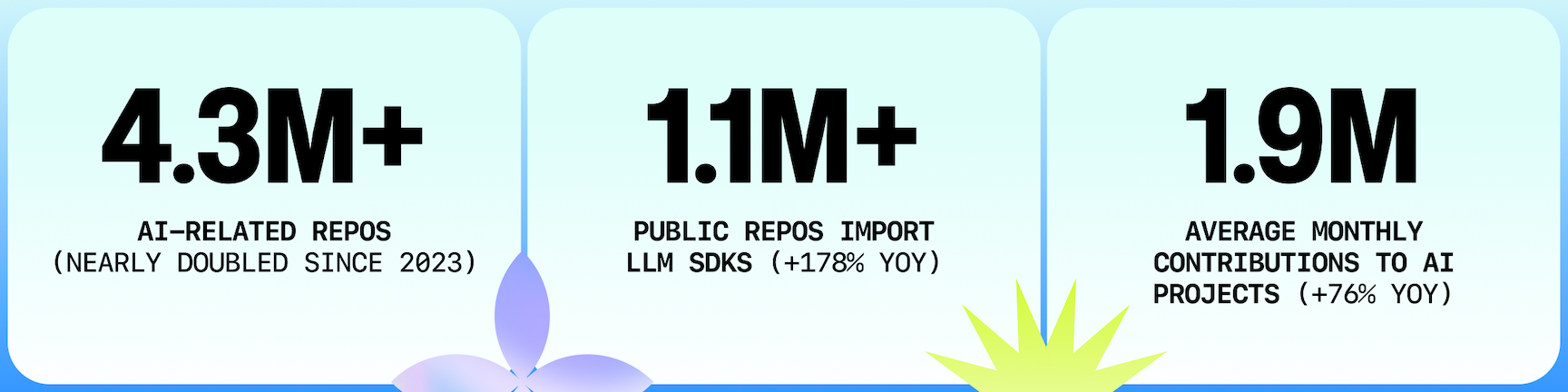
The 2025 data made the trend undeniable and gave sourcers a sharper filter. GitHub reported that more than 1.1 million public repositories now import a large-language-model SDK, and that 693,867 of them were created in the past twelve months, a 178% jump - GitHub Octoverse 2025. That single metric is a gift: it means you can find people who are not merely curious about AI but who have actually wired an LLM into working software, because their repositories carry the import statements that prove it. We will use exactly that fact in the search section. The visual below, from GitHub's own 2025 report, shows how the generative-AI footprint has expanded across the platform.
The AI footprint on GitHub in 2025
Those headline numbers matter for one practical reason: demand for AI engineers vastly outstrips supply, so the recruiter who waits for applicants loses. AI-related roles have added roughly 1.3 million new jobs to the global economy in two years - World Economic Forum, and "AI engineer" has ranked as the fastest-growing job title on LinkedIn for two years running - CBS News. US job postings mentioning generative AI as a required skill jumped from about 16,000 in 2023 to 66,000 in 2024 - Stanford AI Index 2025. When a skill is that scarce and that expensive (median total compensation for a machine learning engineer sits near $279,000 - Levels.fyi), the winners are the teams that go and find people who match on evidence, not the teams that post a job and hope.
There is a second, quieter reason GitHub beats the alternatives: the strongest developers are drifting away from the platforms recruiters are comfortable with. A 2025 analysis found that 53.8% of candidates now use niche, code-first platforms (GitHub, Stack Overflow, Kaggle, Discord) over a LinkedIn-only presence, up from 49.2% - Pin. The same research notes that the majority of developers are passive: 45.6% are not actively looking for a job at all, per Stack Overflow's 2025 survey. That combination, high-value people who are not on the job market and increasingly not on LinkedIn, is precisely why cold, evidence-based sourcing on GitHub outperforms inbound. You are reaching people no job board will ever surface to you.
To ground the scale in a primary source, GitHub's own Octoverse team walks through the 2024 data (Python's rise to number one, the surge in generative-AI projects) in the short official video below. It is worth two minutes because it frames the macro trend every sourcing decision in this guide rests on.
Octoverse 2024: The rise of Python and AI
The takeaway for how you spend your week: treat GitHub as the primary index of proven AI builders and everything else (LinkedIn, resumes, referrals) as enrichment on top of it. The rest of this guide is about doing that precisely, because scale without precision just means you drown faster.
2. What "AI engineer" actually means in 2026
Before you search, you have to know what you are searching for, and in 2026 "AI engineer" is not one job but a family of them with very different GitHub fingerprints. Getting this wrong is the most common sourcing failure: a recruiter is briefed to find an "AI engineer," searches for people who contribute to LangChain, and hands the hiring manager a list of application developers when the team actually needed someone who can write CUDA kernels. The words on the req are the same; the humans are completely different. The single most useful distinction in the market right now is captured by one data point: LinkedIn reports AI-engineer postings grew 74% year over year while machine-learning-engineer postings grew 33% - KORE1, and the two titles describe different work.
The clean mental model is "what versus how." A machine learning engineer builds and trains models: they own training loops, data pipelines, evaluation, and the systems that serve a model at scale. An AI engineer, in the 2026 usage, is usually a system integrator who wires pre-trained models (often someone else's LLM) into products through APIs, retrieval-augmented generation, agents, and orchestration. Neither is more senior than the other; they solve different problems. On GitHub the difference is visible in the code: a profile heavy on training scripts, custom loss functions, and GPU code reads as an ML engineer, while a profile full of LangChain glue, vector-database wiring, and prompt-orchestration reads as an AI engineer. You can literally see which problem a person likes to solve.
Around those two poles sit several specializations you will be asked to find, each with a distinct signal:
- Research scientist - drives a research agenda and publishes; on GitHub they appear more as paper authors than as prolific committers.
- Research engineer / applied scientist - bridges research to production, so they show both papers and heavy repository activity on training or infrastructure code - Recruiting from Scratch.
- Inference / systems engineer - optimizes how models run; their fingerprint is C++, CUDA, and contributions to serving engines.
- MLOps / platform engineer - owns the pipelines and infrastructure; their repos are full of orchestration, containers, and deployment code.
- Agent / LLM-application engineer - the newest bucket, building autonomous agents and tool-use systems.
That list is not academic taxonomy; it changes where you look. If you need a research engineer, the contributor list of a training framework is a better pool than a job board. If you need an inference engineer, you want the people optimizing kernels in a serving project, and no amount of LangChain experience substitutes for that. The practical move is to translate the hiring manager's one-line request into a target profile before you touch the search bar: which frameworks would this person have touched, what language would their code be in, and would they more likely have a paper, a popular repo, or a merged pull request into a well-known project. Answer those three questions and the search operators in the next sections almost write themselves.
One caution that will save you a bad shortlist: titles on GitHub bios are unreliable, because the strongest people often describe themselves modestly or not at all. A staff-level researcher at a frontier lab may have a bio that just says "I like tensors." Source on the work, not the label. When you evaluate someone, you are looking for the shape of their contributions, and that is what the next section is about.
3. The GitHub profile signals that matter (and the ones that lie)
The core skill of GitHub sourcing is reading a profile correctly, and in 2026 that means aggressively discounting the metrics that are easy to game and weighting the ones that are hard to fake. Start with what is now actively misleading. Stars and followers are popularity, not proof of skill. A star costs one click and says nothing about whether the person who clicked it can write the code; a repository can trend on Hacker News and collect 20,000 stars while its author has not shipped anything else of note. Followers are similar. They are a fine tie-breaker and a legitimate search filter, but if you rank candidates by star count you will systematically surface self-promoters over the quiet senior engineer who has 40 followers and has been maintaining a critical library for six years.
The metric everyone points to, the green contribution graph, is genuinely useful but only if you know what it does and does not count. Officially, the graph counts commits (only on a repository's default branch or its gh-pages branch), opened issues, opened and answered discussions, proposed pull requests, and submitted pull-request reviews - GitHub Docs. The critical caveat for vetting is what it silently omits: commits made in a fork do not count, and commits whose author email is not linked to the account do not count. This matters enormously for senior engineers, who very often commit under a corporate email that is not attached to their personal GitHub. Their graph can look sparse while their real output is enormous. A thin graph is a question, not a verdict.
Because AI now writes a large share of code, raw commit volume has quietly become one of the weakest signals on the platform. By early 2026, an estimated 51% of committed code is AI-generated or AI-assisted - Gloss, and one survey found 92.6% of developers use AI coding assistants at least monthly - Kula. A wall of green squares in 2026 might mean a person is a machine of an engineer, or it might mean they let an agent open a lot of pull requests. Evaluators have adjusted accordingly: the signals that now carry weight are system-level thinking, sensible architecture, and thoughtful documentation, the things a model still does not produce on its own. You are looking for judgment, not throughput.
So what should you actually weight? The hierarchy that survives 2026 puts authored, merged work into projects that matter at the top:
- Merged pull requests into major AI repositories - the single strongest signal; someone whose code was accepted into PyTorch or transformers has been peer-reviewed by that project's maintainers.
- Original, substantive projects - a repo they designed and built, ideally one that solves a real problem, with a readable README and a coherent commit history.
- Depth in a specific domain - repeated contributions in one area (inference, diffusion models, RAG) rather than scattered one-off commits.
- Code you can read - open two or three source files and look at how they structure a problem.
- Issue and review activity - answering hard questions and reviewing others' code signals seniority better than commit count.
To verify a claimed contribution rather than trust a badge, open the target repository's Contributors or Insights view and then filter that person's pull requests with author:USERNAME is:merged. That one query tells you whether they actually landed code in the project or just forked it. This is the move that separates real sourcing from resume-reading: you are checking primary evidence, in public, in under a minute. Treat every impressive-looking profile as a hypothesis and let their merged pull requests confirm or kill it.
Consider a concrete read to see how this inverts the naive approach. Suppose a search surfaces a developer with 60 followers, a bio that just says "inference nerd," and a contribution graph that looks moderate rather than dazzling. A recruiter sorting by popularity skips them. Instead you open their pinned repositories and find a small library that implements paged attention, then filter their pull requests in vllm-project/vllm with author:USERNAME is:merged and find four merged pull requests touching the CUDA kernels. That is a far stronger signal than a 20,000-star trending repository, because landing kernel code in a major serving engine required a maintainer to review and accept it. In ten minutes you have moved from an unremarkable-looking profile to high confidence that this is exactly the inference engineer your team needs, which is precisely the judgment an automated star-sort would have gotten backwards. The skill is not finding profiles; it is reading them correctly. With that framework in place, we can now go find these people at scale.
4. Searching GitHub like a sourcer: operators, code search, and the API
GitHub's search bar is a genuine candidate database once you learn its qualifiers, and almost no recruiter uses it to a fraction of its power. There are three distinct search surfaces, and using the right one for the job is most of the skill. The first is user search, which filters people by account-level attributes. Switch to the "Users" tab and you can combine location:, language: (their most-used repository language), followers:, repos:, created:, and type:user (which excludes organizations) in a single query - GitHub Docs. Numeric and date qualifiers accept operators and ranges, so followers:>500, repos:10..30, and created:<2021-01-01 all work. A concrete starting query for a senior Python engineer in a given city looks like this:
language:python location:"San Francisco" followers:>500 repos:>20 type:user
The second surface, and the one that changes everything for AI sourcing, is code search. User search finds people by who they are; code search finds them by what they have actually written. In the modern code-search syntax, a bare term matches file content or file path, exact phrases go in quotes, and you can scope results to a person or company with user: and org: - GitHub Docs. It supports Boolean AND, OR, NOT, parentheses for grouping, and regular expressions wrapped in slashes. Most powerfully, the symbol: qualifier matches where a name is defined, not merely mentioned, so it surfaces the person who wrote a function rather than the thousands who called it. That distinction is how you find the author of a model layer instead of everyone who imported it. A few queries that map directly onto AI skills:
"import torch" language:python- people writing PyTorch code, not just starring it."from transformers import"- Hugging Face users in their own repositories.language:cuda "__global__"- engineers writing raw CUDA kernels."import vllm" OR "from vllm"- inference and model-serving engineers.language:python symbol:forward- people implementing neural-network layers, sinceforwardis where a model's computation is defined.
These strings are the difference between sourcing AI engineers and sourcing people who follow AI. Anyone can star pytorch/pytorch; far fewer have torch.nn and a custom forward method in their own commit history. You can tighten any of these with a location or language filter, or scope them to a specific employer's public repositories with org:NAME to find who wrote a particular piece of a company's open-source code. The third surface, repository search, works top-down: find the important AI projects with qualifiers like topic:llm stars:>=500 pushed:>2025-06-01 archived:false, then open each project's Contributors graph and treat that list as a pre-vetted pool. Contributing to a well-known repo is itself the filter.
You must also know the mechanical limits, because they shape everything a serious sourcing effort can do. Any single search (in the UI or the API) returns at most 1,000 results, and the Search API paginates at a maximum of 100 per page - GitHub Docs. You cannot page past result number 1,000 even when more matches exist, so large searches must be segmented by location, language, or creation-date windows to get underneath the cap. Rate limits are stricter for search than for the rest of the API: authenticated search allows about 30 requests per minute (only 10 per minute for the code-search endpoint), while unauthenticated requests get just 10 per minute. The general REST API gives an unauthenticated caller only 60 requests per hour versus 5,000 per hour with a personal access token, and GitHub tightened unauthenticated limits further in May 2025 - GitHub Changelog. The lesson is simple: authenticate, and segment your searches.
Two 2026 caveats keep you honest about coverage. First, GitHub's code-search index covers only the default branch of more than five million of the most popular public repositories - The GitHub Blog, so niche projects, feature branches, and private code will not surface; the absence of a code hit is not proof the skill is absent. Second, GitHub has been shipping semantic search across the platform (a new Copilot embedding model improved retrieval quality by 37.6% - The GitHub Blog, and semantic issue search reached general availability in April 2026), which means meaning-based discovery is arriving alongside the keyword operators above. For now, the operators are what you can rely on, and they are more than enough. The next problem is that the very best AI people often do their most important work somewhere GitHub search alone will never show you.
5. Beyond raw GitHub: Hugging Face, arXiv, OpenReview, and Kaggle
GitHub is the hub, but the highest-signal AI people leave tracks on a handful of adjacent platforms that function as pre-filtered talent pools, and the best sourcers move fluently between them. The most important of these is Hugging Face, which has quietly become a people-search surface, not just a model registry. The Hub organizes everything into Models, Datasets, Spaces, Organizations, and Users, and a user profile behaves much like a GitHub profile - HIVE. The scale is now serious: Hugging Face hosts over 2 million public models and reached roughly 13 million registered users - Hugging Face. Because a person only ends up authoring a downloaded model if they actually do applied AI work, a Hugging Face profile is a narrower and higher-signal pool than raw GitHub. When you evaluate a model's author, sort their work by downloads rather than likes: likes measure attention, downloads measure adoption - Hugging Face.
The move that makes Hugging Face powerful for sourcing is the model-card-to-person path. Every model or dataset lists its author organization and the individual who published it, and that person's profile carries an "AI and ML interests" section plus links off-platform. From there you pivot to their GitHub, and from GitHub to contact. You can also enumerate a whole team at once: Hugging Face Organizations group accounts, and the Hub's API can list an org's members, so finding the org behind a hot open-weights model gives you a named roster to source - Hugging Face Docs. The other rich vein is the repositories that are themselves talent pools. Contributing to any of these is a strong, specific signal, and each maps to a different sub-type from section 2:
- pytorch/pytorch - roughly 1,187 contributors; a merged core PR is a top-tier systems-and-ML signal - GitHub.
- vllm-project/vllm - the dominant LLM inference engine, with over 2,000 contributors; signals CUDA, kernel, and serving depth - GitHub.
- huggingface/transformers - around 164,600 stars; adding a model architecture here proves someone implements papers in production code.
- ggml-org/llama.cpp - about 1,016 contributors (note the repo moved from ggerganov); the pool for low-level and edge inference.
- langchain-ai/langchain - crossed 100,000 stars in January 2026; contributors here skew toward agent and LLM-application work.
Reading that list as a sourcer, the strategy writes itself: pick the repository whose domain matches your req, open its Contributors graph, and you have a ranked shortlist of people who have shipped exactly the kind of work you are hiring for. A fast-growing project is often a better bet than an established one, because its contributors are less picked-over. Ollama, the local-inference runtime, doubled its contributor count in six months on the way to roughly 9 million users and a $65 million raise in July 2026 - TechCrunch; its early contributors are exactly the local-model runtime engineers many teams now need and few recruiters know to look for. Watch for repository moves, too, since they scatter the trail: JAX now lives at jax-ml/jax rather than google/jax, and its AUTHORS file lists the significant contributors directly.
The research community leaves an even cleaner paper trail, and 2025 reshuffled it in a way every sourcer must know. Papers with Code, long a go-to for connecting a result to its authors and code, shut down on 24 July 2025 and now redirects to Hugging Face's trending papers - Coursera. Live discovery of hot research now flows through huggingface.co/papers, where community-upvoted papers show their institutions and link to author profiles. To go deep on one person, arXiv gives every author a canonical publication list at arxiv.org/a/<author_id> - arXiv, so a single paper becomes a map of their entire body of work. And for the frontier of the field, NeurIPS, ICML, and ICLR all run on OpenReview, where clicking an author's name in an accepted paper opens their profile and every co-author must hold an account - ICLR 2026. An accepted-paper author list is, in effect, a clickable directory of elite research talent.
The velocity of that research pipeline is why this matters more every year: the volume of publications is exploding, which means an expanding, continuously refreshed pool of people who have demonstrably done real AI work. The chart below shows arXiv submissions in the three core AI categories nearly tripling in five years.
arXiv AI research submissions by year (2020-2025)
Combined across those categories, submissions grew from 40,431 in 2020 to 114,891 in 2025 - Presenc AI, drawing on the arXiv public API. For a recruiter, each of those papers is a potential thread to pull: a name, an institution, and usually a linked GitHub repository implementing the method. The cross-link chain is always the same, paper to code to GitHub to person to contact, and once you internalize it you can start from any surface (a trending model, a conference paper, a Kaggle leaderboard) and end at an inbox.
Kaggle deserves a specific mention because it offers something the other surfaces do not: a public, vetted competence ranking. Its five-tier ladder (Novice, Contributor, Expert, Master, Grandmaster) is earned through medals, and Competitions Grandmaster requires five gold medals including at least one solo gold - Kaggle. That bar is high enough that the population is small and enumerable: only around 400 Grandmasters exist across all categories, which is why firms like H2O.ai treat recruiting them as an explicit strategy - H2O.ai. Filtering Kaggle rankings to Competitions Grandmasters yields a globally finite list of applied-ML talent you can work through by hand. Where AI contributors physically cluster also shapes your search; GitHub's own data shows the geographic concentration, which directly informs the location: qualifier from the last section.
Where generative-AI contributions come from
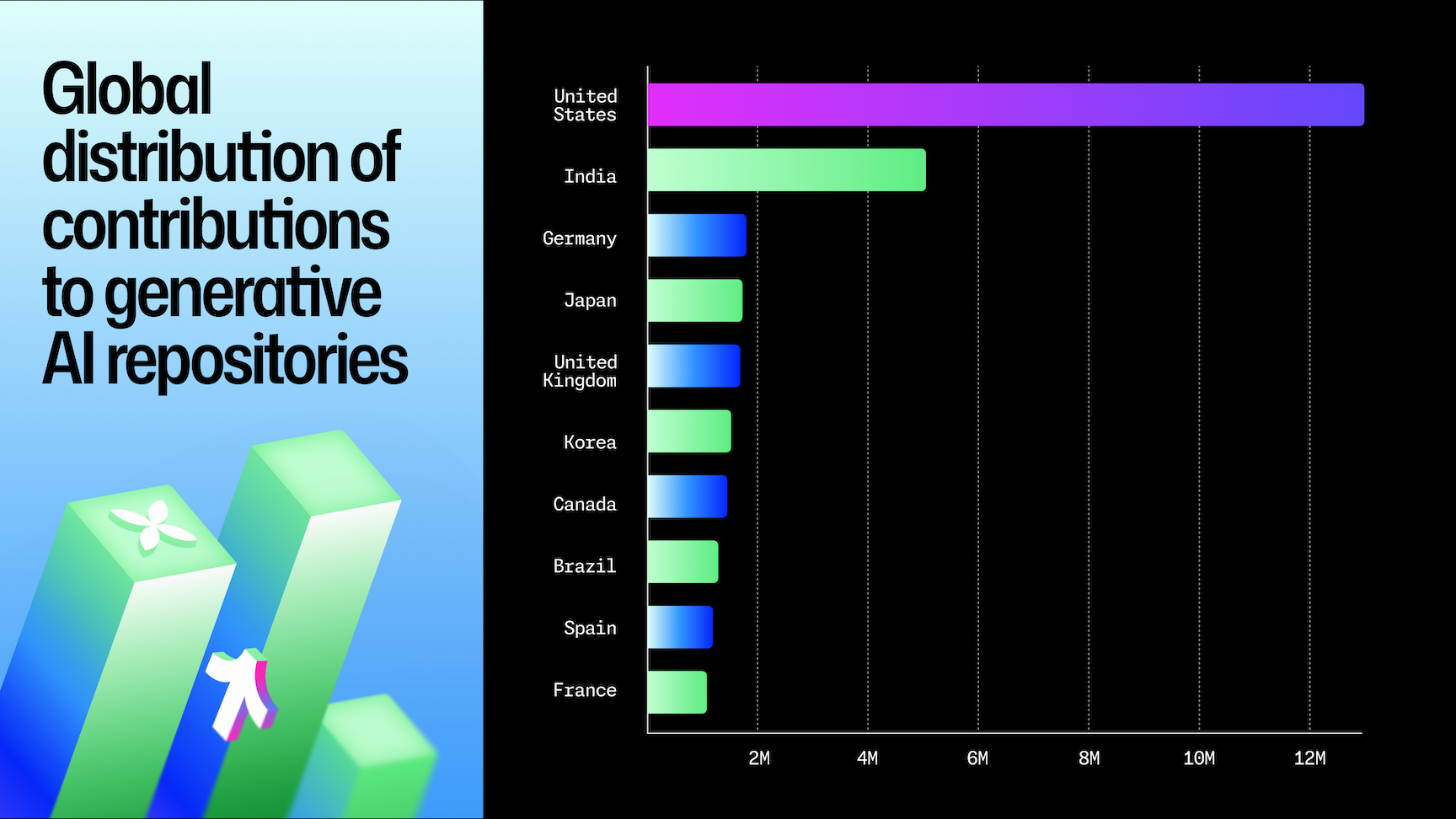
The distribution is a sourcing map. The United States leads with roughly 31.8% of generative-AI contributions and India follows near 12.5%, with strong showings from Germany, Japan, the United Kingdom, and Korea - GitHub Octoverse 2025. India in particular is worth a dedicated search stream: it added more than 5.2 million developers in the year and is projected to reach 57.5 million by 2030. If your compensation band or remote policy allows global hiring, running the same skill-based code searches with location:India (or specific cities) opens a fast-growing, less-saturated pool that LinkedIn-first competitors underweight. The surfaces in this section all lead back to a person; the next problem is turning that person into someone you can actually contact.
6. From a GitHub handle to a real inbox
Once you have identified the right engineer, sourcing becomes a contact-data problem, and GitHub gives you a genuinely unusual advantage that most recruiters overlook: the platform quietly exposes many developers' real email addresses through their public commit history. Every git commit records the author's email, and unless a developer has enabled the privacy setting that masks it, that address is visible in the commit metadata of their public repositories. This is the single most GitHub-native contact path, and a class of free, often open-source Chrome extensions (GitHub Email Extension, GitHub Email Getter, and similar) reads those public push events and surfaces the address right on the profile - Chrome Web Store. It costs nothing and it returns the exact email the person commits with, which is frequently a personal address they check.
The commit-email method has two honest limitations. It only works for people who have actually committed with a visible email to a public repository, and it sometimes returns a noreply@github.com masked address or a stale account the person no longer uses. It also performs no verification, so before you send anything you should confirm deliverability. That is where the enrichment layer comes in, and the reliable pattern is to combine sources rather than trust any single one. Once you know a person's name and can infer their current employer (from their GitHub bio, their profile, or the email domain in their commits), a tool like Hunter.io can find and verify the work-email pattern for that domain, and its verifier meaningfully reduces bounce rates on cold outreach. A generous free tier (25 searches and 50 verifications a month) makes it cheap to test.
For contact data at scale, three distinct approaches exist, and knowing which to reach for saves both money and bounced emails:
- Commit-email extraction - free, GitHub-native, returns the developer's own committed address, but only for public committers and with no verification.
- On-profile reveal extensions - tools like ContactOut and SignalHire work directly on a GitHub page and surface work and personal emails plus mobile numbers as you browse.
- Name-and-employer enrichment databases - Apollo.io, Lusha, and RocketReach take an identity and return a verified work email or direct-dial phone from a large B2B database.
In practice you layer them. Start with the free commit email because it is often the person's real inbox and it is the most personal channel; fall back to an on-profile reveal extension when the commit email is masked; and use a large enrichment database when you need a verified work address or a phone number for a senior candidate you intend to call. Each has a different accuracy profile (ContactOut, for example, self-reports email accuracy around 70 to 75% with no built-in verification, which is precisely why pairing it with a verifier matters), so treat the first address you find as a lead, not a fact, and verify before you hit send.
One caution belongs here rather than later, because it governs everything you do with these addresses. Finding an email is easy; using it lawfully and within GitHub's rules is the constraint. GitHub's Acceptable Use Policies state, verbatim, that you may not use information from the service "for spamming purposes, including for the purposes of sending unsolicited emails to users or selling personal information, such as to recruiters, headhunters, and job boards" - GitHub Docs. The compliant reading is narrow but workable: contacting an individual developer, at an address they themselves made public, about a genuinely relevant and specific opportunity is defensible; bulk-scraping profiles to blast a generic template is not, and it is exactly the behavior the policy exists to stop. We return to the legal detail in section 11, but keep it in mind as we discuss the tooling, because a tool that makes it easy to spam at scale is a liability, not an asset.
7. The 2026 sourcing tool landscape, with real pricing
The tool market for GitHub sourcing splits into three layers, and buying well means understanding which layer solves your actual bottleneck rather than paying for all three. The first layer is GitHub-aware sourcing platforms, which ingest GitHub data and stitch it to other public profiles so you can search on languages and contributions and then message people. The strongest of these for engineer sourcing is SeekOut, which ingests commit history and programming-language data and merges it with work and education history, surfacing deep-tech engineers that LinkedIn-only sourcing misses. hireEZ (formerly Hiretual) aggregates candidates from 45-plus open-web sources including GitHub and adds contact enrichment and outreach sequencing in one seat. AmazingHiring is purpose-built for technical sourcing, pulling from GitHub, Stack Overflow, and Kaggle and inferring skills from activity. These are powerful and priced accordingly, almost always through an annual, quote-based contract rather than a public price:
| Platform | What it adds for GitHub sourcing | Indicative 2026 price | Pricing basis |
|---|---|---|---|
| SeekOut | Commit history + language data stitched to work/education; cleared-talent filter | ~$10,000-$30,000 per seat/yr (Vendr median ~$20,000) | Annual, quote-only |
| hireEZ | 45+ sources incl. GitHub, enrichment + sequencing | ~$169-$250 per seat/mo (Vendr median ~$13,000/yr) | Annual, per seat |
| AmazingHiring | GitHub/Stack Overflow/Kaggle signal, skill ranking | ~$3,600-$4,800 per user/yr | Annual, quote-only |
| Gem | Chrome capture from GitHub + CRM + outreach | from ~$135 per user/mo (Vendr median ~$24,900/yr) | Annual, per seat |
| Draup | Talent-market intelligence, skill mapping (not click-to-contact) | Enterprise custom (no public price) | Annual, quote-only |
Those numbers, drawn from vendor disclosures and aggregators like Vendr, are ranges for a reason: none of these companies publishes a list price, and actual contracts swing widely with seat count and negotiation - Vendr. Gem belongs in the same layer but is really an all-in-one recruiting platform (sourcing, CRM, sequencing, analytics) whose Chrome extension captures GitHub profiles into automated email sequences. Draup is the odd one out: it is talent-market intelligence rather than a click-to-contact scraper, mapping where AI and engineering talent concentrates so you can plan a campaign, and it is enterprise-custom with no verified public price. The buying lesson for this layer is that you are paying four and five figures a seat for aggregation and workflow, which is justified for a team hiring engineers continuously and hard to justify for a handful of roles a year.
The second layer is contact-data enrichment, and here the economics are completely different: these tools publish real prices, offer usable free tiers, and cost tens of dollars a month rather than thousands a year. They are how you turn a GitHub-found identity into a verified email or phone. The practical differences are about database coverage, whether the tool works directly on a GitHub page, and how phone numbers are priced.
| Tool | Free tier | Entry paid plan | Best for |
|---|---|---|---|
| Apollo.io | ~1,200 email credits/yr | Basic $49/mo, Pro $79/mo | Cheapest high-volume email enrichment |
| Hunter.io | 25 searches + 50 verifications/mo | Starter $34/mo | Finding + verifying work-email patterns |
| RocketReach | A few lookups/mo | Essentials $329/yr, Pro $69/mo | API-driven bulk enrichment |
| ContactOut | ~4 email reveals/day | Sales $79/mo (~$49 annual) | One-click reveal on a GitHub profile |
| SignalHire | 5 credits/mo | Emails $49/mo | Verified email + mobile on a profile |
The reason to name specific prices is that this layer is where a small team can be effective for almost nothing. Apollo.io gives access to a 200-million-plus contact database on a free plan and is the default cheap way to enrich a list of GitHub-found engineers into verified work emails - Apollo. If you need a direct-dial mobile number to call a passive senior candidate rather than email them, Lusha and RocketReach are stronger on phones. And if you want the reveal to happen without leaving the candidate's GitHub page, ContactOut and SignalHire both operate directly on the profile. A sensible starter stack for an individual recruiter is a free commit-email extension plus Hunter's free verifier plus Apollo's free tier, which together cost zero and cover most of what manual sourcing needs.
The third layer is the newest and the most disruptive: autonomous AI recruiters that collapse source, screen, and contact into one loop. Rather than handing you a list to work, these platforms read a written brief, search across GitHub and the wider web, screen candidates with language models, and initiate outreach. HeroHunt.ai is the clearest example aimed at this exact problem: its RecruitGPT turns a plain-language role description into a screened shortlist and its AI Recruiter runs personalized multichannel outreach, searching 1 billion-plus profiles across GitHub, LinkedIn, and the open web, and it is used by 15,000-plus recruiters. Its pricing is unusual in being both public and flat, with unlimited positions and searches metered on two monthly allowances (AI-screened and matched profiles delivered and candidate emails found) rather than per-seat licences: $99/month for Starter (2,000 profiles and 500 emails, 750M profiles searched), $199/month for Pro (5,000 profiles and 1,000 emails, 1B profiles searched), and $399/month for Team (3 users sharing 25,000 profiles and 4,000 emails), each with an 8-day free trial. Competing agents price differently: Juicebox's PeopleGPT starts around $139 per seat per month with always-on agents as a paid add-on, and Fetcher runs managed sourcing-as-a-service from roughly $149 per user per month.
Choosing between the three layers comes down to your bottleneck and your volume. If the constraint is finding people, a sourcing platform earns its keep; if the constraint is contacting people you have already found, an enrichment tool at a fraction of the cost is the right buy; and if the constraint is that you do not have the hours to run the whole loop, an autonomous recruiter is the category to test. Most teams over-buy the first layer and under-use the second. The honest trade-off with the third layer is that automation is only as good as your brief and it still cannot read a candidate's pull requests with a senior engineer's judgment, so treat it as leverage on volume rather than a replacement for taste. That tension, between what agents now do brilliantly and what they still cannot do, is the whole story of the next section.
8. How AI agents are rewriting GitHub sourcing
The biggest change to GitHub sourcing since the last edition of this guide is that autonomous agents are moving from novelty to default, and the talent-acquisition industry knows it is not ready. Korn Ferry's 2026 trends report, surveying more than 1,670 global talent leaders, found that 52% plan to deploy autonomous AI agents in 2026 and 84% plan to use AI in some form, yet only 11% feel well-prepared to manage them - Korn Ferry. That gap between adoption and readiness is the defining condition of sourcing right now: the tools are arriving faster than the skills to wield them. For a recruiter, the winning position is neither to ignore the agents nor to hand them the wheel, but to understand precisely what they now do well.
What they do well is the mechanical middle of the funnel. A new class of agents reads a job brief, weights candidates against your past successful hires, and returns ranked matches aggregated across LinkedIn, GitHub, publications, and patents. Metaview reports 93.5% precision on Exa's 1,400-query People Search benchmark, and notes that platforms like HireEZ now pull from 45-plus sources including GitHub - Metaview. Fully autonomous "AI recruiter" agents go further and run the whole funnel: Qureos's agent Iris sources from 100 million-plus profiles and screens candidates in under 15 seconds - Qureos, while GoPerfect connects to 60-plus ATS systems and returns explainable "Match Cards" that show why a candidate fits - GoPerfect. Underneath these products, the research is maturing too: academic multi-agent screening frameworks (an extractor, a retrieval-augmented evaluator, a summarizer, and a scorer working in sequence) run roughly 11 times faster than manual screening - arXiv. The summarization and ranking work that used to eat a sourcer's afternoon is now genuinely automatable.
The subtler shift is that agents have not just changed how you source; they have changed what "good" looks like on the profiles you are sourcing. GitHub's own Copilot coding agent reached general availability in September 2025 as an autonomous system that explores a repository, makes changes, and validates its own work before pushing - GitHub Changelog. When agents are opening pull requests, the historic proxies for skill degrade, which is why the evaluation framework from section 3 matters more than ever. The chart of what dominates AI repositories still points overwhelmingly at Python, but the volume of code a person produces is no longer the tell.
Top languages on GitHub, 2025
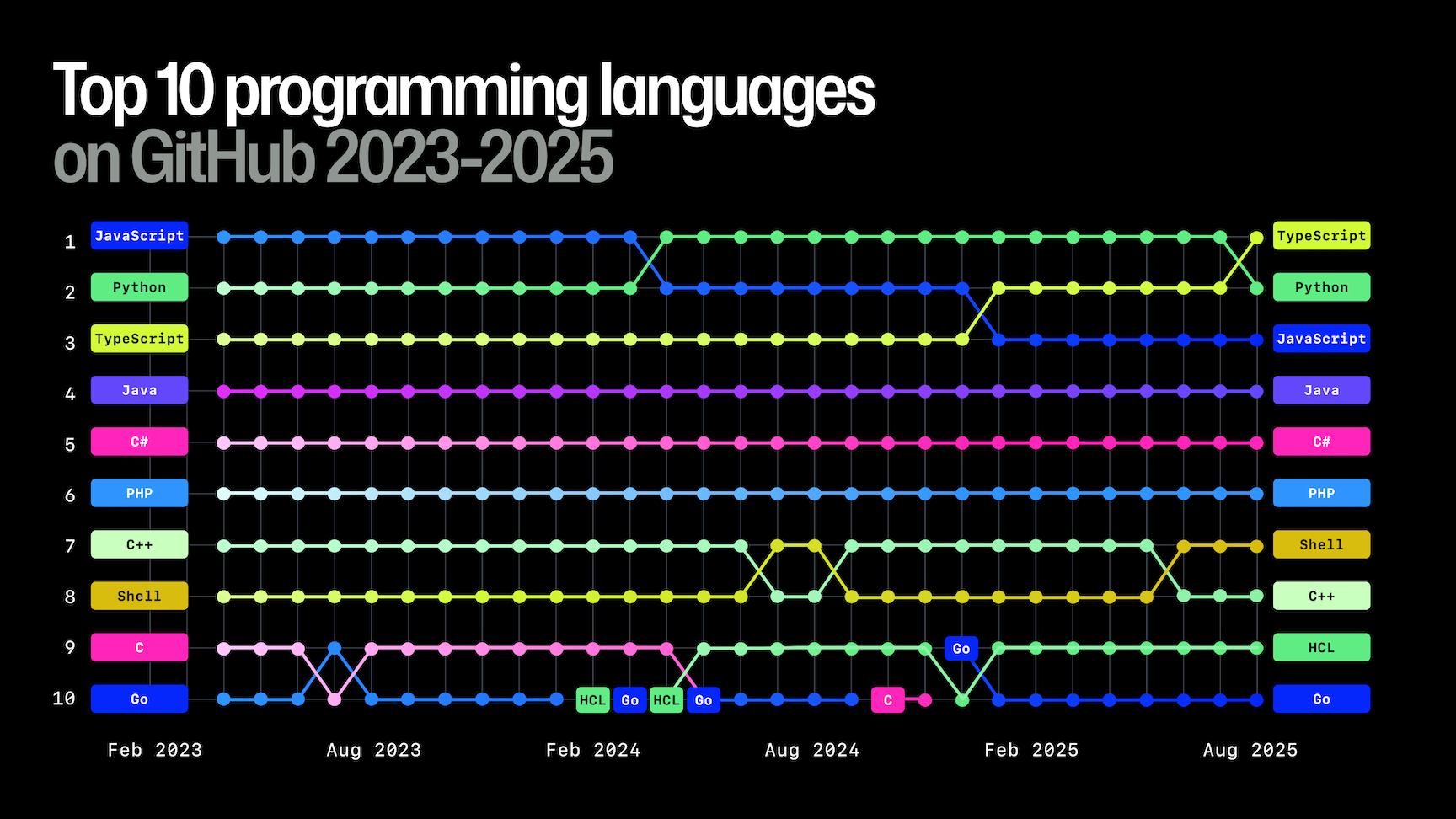
That language chart carries a nuance worth reading correctly for AI sourcing. TypeScript overtook Python for the number-one spot overall on GitHub in 2025, reaching 2,636,006 contributors - GitHub Octoverse 2025, a rise driven by web and AI-application development. But inside AI-tagged repositories, Python still dominates, and it added 850,579 contributors in the year. The practical implication is that your language filter should follow the sub-type: Python for model and research work, but do not be surprised to find strong agent and LLM-application engineers whose primary language is TypeScript, because the tooling for building on top of models increasingly lives in the JavaScript ecosystem. An agent that screens purely on "Python experience" will now miss a real and growing slice of AI engineers.
Where does this leave the human sourcer? In a strong position, if they specialize in what agents cannot do. Agents are excellent at breadth (scanning millions of profiles), speed (screening in seconds), and tireless summarization. They remain weak at judgment (is this messy-looking repo actually brilliant), relationship (a warm, credible first message to a skeptical senior engineer), and taste (which of two equally-qualified people will thrive on this specific team). The most effective 2026 workflow is a hand-off: let an agent or an autonomous platform like HeroHunt.ai do the wide sourcing and first-pass screening across GitHub and the web, then spend your saved hours reading the shortlisted candidates' actual code and writing outreach a human would want to answer. Which is the perfect segue, because outreach is where most GitHub sourcing quietly dies.
9. Outreach that engineers actually answer
Most GitHub sourcing dies at the outreach step, not the search step: recruiters find exactly the right engineer and then send a message that guarantees silence. The market context is brutal and getting worse. Average cold-email reply rates have fallen from around 8.5% in 2019 to roughly 5% in 2025 to about 3.43% in 2026, a decline driven in part by low-effort, AI-generated outreach flooding inboxes - Belkins. Senior software engineers experience the sharp end of that flood: they receive 10 to 30 recruiter messages a week, and generic outreach to them performs below even the dismal market average, with reported response rates under 3% because roughly 78% of that outreach shows no research into the candidate's work - Jobs by Culture. If your message reads like the other twenty they got this week, you are not competing; you are noise.
The escape from that trap is the entire reason GitHub sourcing is worth doing: it hands you the raw material for personalization no other channel can match. You are not guessing what this person cares about; you can see it. Referencing a specific commit or pull request in your outreach is reported to lift reply rates dramatically, in some accounts to as high as 60%, roughly five times more effective than a templated message - daily.dev. That is not a marginal optimization; it is the difference between a channel that works and one that does not. The pattern holds across the research: highly personalized cold emails can lift replies by as much as 142%, and personalization that goes beyond merge-tag tokens drives around 52% more replies - Shno. The chart below shows the gradient from spray-and-pray to genuine, GitHub-grounded personalization.
Reported reply rate by outreach approach
Read those bars as a spectrum of effort rather than four fixed numbers, because the exact figures vary by source and are self-reported by vendors. The direction is what is robust and repeatable: the more your message proves you actually looked at the person's work, the more they answer. The "references a commit or PR" bar is high because it does something no template can fake, it demonstrates that a human spent real attention on this specific engineer, which is the scarcest and most flattering thing a busy developer can receive. Even LinkedIn InMail, which runs below the platform average for engineering because that function receives more InMails than any other, improves materially when messages are short (under 400 characters) and specific - LinkedIn Talent Blog. Personalization is not a nicety here; it is the mechanism.
Channel choice compounds the effect, and the data points clearly toward email. Developers overwhelmingly prefer to be approached about jobs by personal email (64%) over social media (4%), per Stack Overflow data - DeveloperDB. This is why the commit-email path from section 6 is so valuable: it hands you the exact channel engineers say they want, an address they chose to make public, rather than the InMail channel they actively dislike. A short email that names a specific piece of their work, explains plainly why you are reaching out, and respects their time will out-convert a polished template on any channel. Keep it honest and specific, and keep it brief.
A few tactical rules turn a good message into a good sequence:
- Lead with their work - name the repo, the PR, or the paper in the first line, before you mention your company.
- Be transparent - say why this role is genuinely relevant to what they build; do not oversell.
- Send one follow-up - a first follow-up can add up to 49% more responses, and two to three can add around 65.8% - Shno.
- Mind the timing - most replies arrive within 24 hours, and mid-week sends (Thursday) tend to outperform Mondays.
- Respect a no - one polite follow-up, then stop; developers talk, and a reputation for spamming spreads.
Those rules are not interchangeable with volume. The entire economic logic of GitHub sourcing is to send fewer, sharper messages to better-matched people, and a follow-up sequence only works if the first message earned attention in the first place. A researched, transparent, single-follow-up sequence to a genuinely relevant engineer is reported to reach 25 to 30% reply rates, an order of magnitude above generic outreach - Jobs by Culture. The recruiters who win on GitHub are not the ones who contact the most people; they are the ones whose messages are worth answering. Now let us assemble everything into one repeatable process.
10. A repeatable GitHub sourcing workflow, end to end
A good sourcing process is a pipeline you can run the same way every time, so this section stitches the previous nine into a single repeatable workflow. The goal is to move deliberately from an ambiguous request to a short list of contacted, well-matched engineers without skipping the steps that protect quality. The workflow has seven stages, and the discipline is to finish each stage before starting the next, because the most common failure is jumping straight to outreach on half-vetted profiles. Before any searching, translate the hiring manager's request into a concrete target: which sub-type from section 2, which frameworks they would have touched, and what the strongest possible evidence of fit would look like. That target profile is the specification the rest of the pipeline executes against.
The diagram below maps the full loop, from defining the target to landing a reply, so you can see how the surfaces and tools connect.
Walking the stages in order makes the logic concrete. Stage one, define the target, is the specification step above. Stage two, build searches, means writing the user-search and code-search queries from section 4 that map onto the target: language and location qualifiers for the person, and content or symbol: queries for the specific AI code they would have written. Stage three, build candidate pools, adds the adjacent surfaces from section 5, opening the Contributors graphs of matching repositories and pulling authors from Hugging Face, arXiv, and Kaggle so you are not limited to what keyword search returns. These first three stages are about coverage: casting a wide but targeted net before you narrow.
Stages four through seven are about precision and conversion, and this is where the hours you save by automating stages two and three should be reinvested:
- Read and verify - open each profile, read a little of their code, and confirm claimed contributions with
author:USERNAME is:mergedin the target repo. - Enrich - get a contact address, starting with the free commit email and verifying it before use.
- Reach out - send a short, specific message that references their actual work, on email where possible.
- Follow up and track - one follow-up, then log the outcome so you learn which pools and messages convert.
The reason the diagram loops stage seven back to stage four is that sourcing is iterative: what you learn about which profiles convert should feed back into which pools you prioritize, tightening the funnel over time. A recruiter who runs this loop weekly builds an increasingly sharp instinct for which repositories and which signals predict a hire for their specific roles, which is an advantage no tool sells. For a hands-on demonstration of the search-and-evaluate half of this workflow inside the GitHub interface itself, the recent walkthrough below is a useful companion to this section.
How to use GitHub for sourcing (2026 tutorial)
If you would rather not run all seven stages by hand, this is exactly the loop that autonomous platforms automate: they execute stages two, three, and much of five, and increasingly draft stage six, leaving you the judgment-heavy stage four and the relationship-heavy final message. Whether you run it manually or with software, the shape is the same, and the shape is what makes it repeatable. What the workflow cannot fix is the situations where GitHub simply is not the right tool, which is the honest subject of the next section.
11. Where GitHub sourcing fails, and the lines you cannot cross
GitHub sourcing is powerful, but treating it as a complete solution will quietly cost you good candidates, so it is worth being clear-eyed about where it breaks. The most important limitation is a selection bias: not every excellent AI engineer has a rich public GitHub. Many of the strongest people work at companies where the important code is private, commit under corporate emails that never touch their personal account, or simply do not maintain side projects because their day job is demanding enough. Their contribution graphs look thin not because they are weak but because their best work is invisible to you. If you rank purely on public GitHub activity, you will systematically miss senior people at frontier labs and over-index on those who happen to build in the open. GitHub is a high-signal positive filter (strong public work is strong evidence) but a poor negative one (a quiet profile proves nothing).
The mechanical limits compound this. The code-search index covers only default branches of the most popular public repositories, so niche work and private code never surface. Search results cap at 1,000, so any broad query is showing you a slice, not the whole. And because AI now writes so much committed code, the platform is noisier than it was: a busy profile can reflect an engineer or an enthusiastic agent, and telling them apart takes the judgment work from section 3. None of this makes GitHub less valuable; it makes GitHub one input in a portfolio that should also include the adjacent surfaces from section 5, referrals, and, for private-work candidates, LinkedIn. The failure mode is monoculture, believing GitHub sees everything, when its blind spots are precisely where some of the best people sit.
Then there are the lines you cannot cross, and they are not optional. GitHub's Acceptable Use Policies forbid using data from the service to send unsolicited emails or to sell personal information to recruiters and job boards, full stop. The compliant path is individual, relevant, permission-respecting contact, not bulk scraping into a spam sequence. On top of the platform's rules sits data-protection law. Under GDPR, the correct lawful basis for sourcing a candidate's data is legitimate interest, but that basis comes with obligations most recruiters ignore:
- Inform the candidate that you hold their data, typically within about a month and before you use it further - Workable.
- Document a Legitimate Interest Assessment showing you weighed your interest against their privacy rights.
- Do not build a speculative database of candidates "just in case"; process data for a specific, current role.
- Honor deletion requests promptly when a candidate asks.
- Keep it relevant - contacting someone about a role that genuinely matches their public work is defensible in a way that mass templating is not.
Those obligations are not merely legal hygiene; they align almost perfectly with what actually works. Everything in section 9 pointed to the same conclusion from a conversion standpoint: specific, relevant, respectful outreach to well-matched individuals is what gets replies. The compliant way to source is also the effective way to source, which is a rare and convenient alignment. A recruiter who scrapes ten thousand profiles and blasts a template is breaking GitHub's rules, risking GDPR exposure, and getting a sub-3% reply rate all at once. A recruiter who finds forty perfect-fit engineers, contacts them individually about a real and relevant role, and deletes the data of anyone who asks is on solid ground legally and converting at ten times the rate. Do the right thing and the results follow, which is a good note on which to look forward.
12. The future of sourcing AI engineers
The direction of travel is clear: sourcing is shifting from keyword-matching resumes toward evidence-based, semantically-searched, agent-assisted evaluation of real work, and GitHub sits at the center of that shift. The first force is semantic search becoming the default. GitHub has already shipped meaning-based search across issues and code, with a new embedding model improving retrieval quality by 37.6%, and the logical endpoint is that you will increasingly describe the kind of engineer you want in natural language and let the platform find people whose work matches the description rather than the keywords. The operators in section 4 will not disappear, but they will be joined by, and for many recruiters replaced by, search that understands what forward and torch.nn actually imply about a person.
The second force is the maturation of autonomous agents into trustworthy funnel operators. Today's agents are fast and broad but require supervision; the trajectory, given that 52% of talent leaders plan to deploy them in 2026, is toward agents that reliably run source-screen-contact end to end while surfacing explainable reasoning for each recommendation, the "Match Card" pattern GoPerfect and others are pushing. As that reasoning becomes auditable, the recruiter's job moves up the stack: less time spent finding and first-passing candidates, more time spent on judgment, relationships, and closing. The teams that thrive will be the ones that learn to direct agents well, writing the sharp briefs and exercising the taste that agents still lack, rather than the ones that either ignore the tools or abdicate to them.
The third and most consequential force is the collapse of the resume as the unit of evaluation. With 83% of technical hiring managers already trusting GitHub profiles over resumes - daily.dev, and with AI writing half of committed code, the industry is being pushed toward evaluating demonstrated judgment: how someone structures a system, what they choose not to build, how they reason in an issue thread. Proof-of-work is becoming the currency, and the surfaces that host proof of work (GitHub, Hugging Face, OpenReview, Kaggle) are becoming the primary talent market for AI. The recruiter of 2027 will spend less time reading claims and more time reading evidence, aided by agents that pre-digest that evidence at scale. That is a better world for good engineers and for the recruiters who take the craft seriously, and a worse one for spray-and-pray.
13. Conclusion: a decision framework
Sourcing AI engineers on GitHub comes down to a simple sequence executed with discipline: know exactly which sub-type you need, search on the code they actually write rather than the badges they collect, verify contributions against merged pull requests, enrich contact through the most personal channel available, and reach out with a message that proves you read their work. Everything in this guide is elaboration on those five moves. The reason the approach beats job boards and generic outreach is that it is built on evidence: on GitHub you can see who has done the work, and developers reward the recruiter who noticed.
To turn that into a decision, match your situation to the right tooling. If you hire engineers occasionally and have time, run the manual workflow from section 10 with free tools: GitHub search, a commit-email extension, and Hunter's free verifier cost nothing and cover most needs. If you hire engineers continuously and finding them is your bottleneck, a GitHub-aware sourcing platform like SeekOut or AmazingHiring earns its four-to-five-figure seat. If your bottleneck is that you have found people but cannot reach them efficiently, buy the cheap enrichment layer (Apollo, Hunter, or an on-profile reveal tool) and skip the expensive platforms. And if you simply do not have the hours to run the loop, test an autonomous recruiter that does the sourcing, screening, and first outreach for you, then spend your time on the judgment and relationship work no agent can do.
For teams that want the whole loop in one place rather than a stack of point tools, HeroHunt.ai sources across GitHub and the wider web from 1B+ profiles, screens candidates against your brief with language models, and sends the first personalized message, on a flat plan with unlimited positions from $99 a month and an 8-day free trial.
Whichever path you choose, the fundamentals do not change. The AI talent pool is on GitHub, it is growing every second, and it is documented in public in a way no resume can match. The recruiters who win are the ones who treat that documentation as the asset it is: reading code instead of claims, contacting individuals instead of lists, and respecting both GitHub's rules and the people behind the profiles. Do that consistently and you will out-source competitors who are still waiting for applications that the best engineers were never going to send.
Written by Yuma Heymans (@yumahey), who built HeroHunt.ai, an AI Recruiter that sources engineers from GitHub, LinkedIn, and over a billion profiles and reaches out on autopilot. He has been writing code since he was six, and reads a candidate's repositories the way he reads his own.
This guide reflects the AI-engineer sourcing landscape as of August 2026. GitHub features, tool pricing, and platform data change frequently, so verify current details before you buy or build a process on them.