


The 2026 buyer's guide to SignalHire's credit packages, the real cost per contact, the fine print that decides your bill, and the alternatives worth comparing
SignalHire's "Unlimited" plan is, by SignalHire's own arithmetic, a 2,000-credit plan. The struck-through "regular" price printed beside every Unlimited package on the pricing page ($163 a month for emails, $327 a month for phones) is exactly what 2,000 credits would cost at the entry package rate, and the terms of use spell the cap out: spending on unlimited packages "is limited to 2,000 credits per month" - SignalHire Terms. That is not a scandal. It is still one of the cheapest ways to buy recruiter and sales contact data in 2026. But it is the clearest example of why SignalHire pricing needs decoding before you buy.
SignalHire publishes its prices, which already puts it ahead of half this market. The problem is the structure behind them. There are three products (Emails, Phones, and Emails & Phones), each with a three-step slider, each on two billing periods, plus a free plan and a sales-led Scale tier. That is eighteen self-serve price points for what is essentially one decision: how many people do you need to reach each month, and do you need their phone numbers? Two of those three products turn out to cost exactly the same, the cheapest plan per credit is not the one the page recommends, and the Unlimited allowance you do not use in a month simply disappears.
This guide breaks down every SignalHire plan and what it costs, the real price per contact at each tier, how the credit system charges you (including through the API and the new MCP server), the contract terms that decide what you actually pay, and the eight strongest alternatives in 2026, from like-for-like contact finders to an AI recruiter that skips the contact-buying step entirely. Every price below was read from the vendor's own pricing page or documentation in October 2026.
Written by Yuma Heymans (@yumahey), who has been building AI sourcing tools since 2021 as the founder of HeroHunt.ai, an AI Recruiter that finds candidates across 1B+ profiles and reaches out on autopilot. Contact data is the plumbing under every one of those messages, which is why this guide judges every tool on the cost of a contact you can actually use.
Apollo.io
If most of what you buy from SignalHire is email, Apollo is the cheaper credit. Basic costs $49 per seat per month billed annually ($65 month to month) and includes 2,500 credits per seat per month, about 2.6 cents per email on monthly billing against SignalHire's 6.9 cents on its $69 package, with sequences built in. The honest caveats: Apollo charges per seat, a mobile number costs 8 credits, and unused credits expire every billing cycle, so for phone-heavy recruiting on a shared account SignalHire's Emails & Phones package stays cheaper (section 8 has the side-by-side numbers).
Contents
- SignalHire Pricing at a Glance
- How SignalHire Credits Actually Work
- Every Plan Decoded: The Real Price per Contact
- The Fine Print: Fair Use, Expiring Credits, Renewals and Refunds
- What the Money Buys: Data, Extension, API, MCP and Sequences
- Where SignalHire Wins and Where It Falls Short
- The 8 Best SignalHire Alternatives in 2026
- Full Comparison: Price, Meter and Best Fit
- How to Choose, and How to Buy SignalHire Well
- The Bottom Line
1. SignalHire Pricing at a Glance
SignalHire costs $0 to $99 a month on self-serve plans, and every paid plan covers unlimited users. The free plan gives you 5 credits at sign-up, or 10 credits every month once you install the browser extension. Paid packages start at $49 a month billed monthly (600 email credits, or 300 credits that return phone numbers), drop to $39 a month on annual billing, and top out at the Unlimited packages: $79 a month for emails or $99 a month for phones, or $63 and $83 a month billed annually - SignalHire Pricing. Above that sits Scale, a sales-led bulk license with no published price.
The single most important structural fact is that SignalHire does not charge per seat. Its pricing FAQ says you can invite an unlimited number of users and "all the contacts are shared between the team," which makes it unusual in a market where most contact-data and recruiting tools price per user. For a three-person agency, that alone can make SignalHire a third of the price of a seat-based competitor before you even compare credits. The trade-off is that the credit pool is shared, so one heavy user can drain the month for everyone.
Here is the full self-serve ladder as it appears on the pricing page today, including the credit volumes that sit behind each slider position.
| Package | Monthly billing | Annual billing (per month) | Credits |
|---|---|---|---|
| Free | $0 | $0 | 5 at sign-up, or 10/month with the extension |
| Emails, entry | $49 | $39 ($469/yr) | 600/month, or 7,200/yr |
| Emails, standard | $69 | $57 ($689/yr) | 1,000/month, or 12,000/yr |
| Emails, Unlimited | $79 | $63 | Fair use: 2,000/month |
| Phones or Emails & Phones, entry | $49 | $39 ($469/yr) | 300/month, or 3,600/yr |
| Phones or Emails & Phones, standard | $69 | $57 ($689/yr) | 435/month, or 5,400/yr |
| Phones or Emails & Phones, Unlimited | $99 | $83 | Fair use: 2,000/month |
| Scale | Contact sales | Contact sales | Bulk license, custom |
Two things jump out of that table, and both matter more than the headline price. First, the Phones package and the Emails & Phones package are priced identically at every tier, so there is no situation in which buying phones only saves you money: if you need phone numbers, buy the combined package and get the emails for free. Second, the yearly totals are encoded in SignalHire's own product names ("1-year-469-for-7200-credits", "1-year-689-for-12000-credits"), which is how the per-month annual figures above were reconciled. The marketing badge says "save up to 74%," but that saving is measured against a list price nobody pays, as section 3 shows.
SignalHire itself is a Warsaw-registered company, SignalHire Sp. z o.o., and it claims a database of 900M+ profiles and 30M+ companies, more than 3 million users, and over 100,000 companies as customers. Those are vendor claims, not audited numbers, and the only database size that matters is the share of your own target list it can actually reach.
2. How SignalHire Credits Actually Work
One SignalHire credit buys one person, and you are charged only when something comes back. The pricing FAQ is precise about the trigger: clicking Get Contacts "subtracts 1 contact if at least 1 email address or phone number is returned" - SignalHire Pricing. That is a per-person meter, not a per-data-point meter. If a profile returns three emails and two phone numbers on an Emails & Phones package, you still pay one credit. Compare that with Apollo, which charges 8 credits for a mobile number. Lusha charges 5 credits per phone reveal. Next to both, SignalHire's model is noticeably kinder to anyone who needs phone numbers.
The package you buy decides what a credit returns. An Emails credit returns email addresses, a Phones credit returns phone numbers, and an Emails & Phones credit returns both. There is no mixing: you cannot spend email credits on a phone lookup. Because Phones and Emails & Phones cost the same, the practical rule is simple. Buy Emails if you only ever email, and buy Emails & Phones the moment phone outreach is part of your process.
The "charged only on a match" rule sounds like a full guarantee, but it has a gap worth understanding before you plan a budget. It protects you from paying for nothing, not from paying for something stale.
- A returned email counts even if it later bounces
- One returned field is enough to trigger the charge, so a single outdated personal email costs a full credit
- Credits are pooled across the website, extension and API, and across every user
In practice, this means your real cost per contact is your price per credit divided by the share of returned contacts that actually work. If 75% of the emails you get back turn out to be deliverable, a recruiter paying $0.069 per email credit is really paying about $0.09 per working email. That correction applies to every vendor in this guide, which is why the comparison in section 8 talks about cost per usable contact rather than sticker price per credit. The vendors that let you test before buying (SignalHire's free credits, Lusha's 40 free monthly credits, ContactOut's daily free reveals) are worth using exactly for this: measure your own hit rate on your own candidate pool before committing to a year.
Credits through the API and the Search API
API use draws on the same credits, but search and contact lookup are metered separately. SignalHire's Person API "consumes standard SignalHire credits for each successfully matched profile," accepts up to 100 identifiers per request, and delivers results to a callback URL - SignalHire Docs. The callback detail is more important than it looks: if your endpoint does not answer within 10 seconds, SignalHire retries three times and then discards the results, and the credit is still charged, so a flaky integration can lose data you have already paid for. Teams building on the API should log every request and reconcile it against the X-Credits-Left header the API returns with each response.
The Search API works differently. It is not billed per credit at all: it counts against a daily search quota that tracks both the number of queries and the number of profiles returned, and it returns brief profiles without contact details - SignalHire Search API. You then pass the profile IDs to the Person API, which is where credits are spent. A maximum of three search requests can run at once. For a team wiring SignalHire into an ATS or an AI agent, the practical pattern is to search freely within the quota, then spend credits only on the shortlist you actually intend to contact.
That two-step design is sensible, and it mirrors how most modern data APIs separate cheap discovery from expensive enrichment. The weakness is visibility: the docs say the quota "varies by plan and is set individually," with trial accounts on a much lower limit, but publish no numbers, so you find your ceiling by hitting it (the API answers with HTTP 402 when the quota is exhausted). If API volume is central to your use case, ask sales for the quota in writing before you buy, because it is the one meter on SignalHire that the pricing page never mentions.
3. Every Plan Decoded: The Real Price per Contact
The cheapest SignalHire credit is the Unlimited package used to its 2,000-credit cap, at about 3 to 4 cents per email. Every other tier costs more per credit, and the entry packages cost two to four times as much per contact as Unlimited. That ordering is the opposite of what most buyers assume: the "save" badges push you toward annual billing, but the bigger lever by far is moving from a capped credit package to the fair-use Unlimited package once your volume justifies it.
The arithmetic is straightforward once you know the credit volume behind each slider position. Dividing each price by its credits gives the cost per credit SignalHire charges at every tier. The table below uses the Unlimited fair-use cap of 2,000 credits a month, which is the best case: if you use only 1,200 credits in a month, your real Unlimited cost per credit rises accordingly.
| Package | Price | Credits | Cost per credit |
|---|---|---|---|
| Emails, entry, monthly | $49/mo | 600 | $0.082 |
| Emails, standard, monthly | $69/mo | 1,000 | $0.069 |
| Emails, standard, annual | $689/yr | 12,000 | $0.057 |
| Emails, Unlimited, annual | $63/mo | up to 2,000/mo | $0.032 at full use |
| Emails & Phones, entry, monthly | $49/mo | 300 | $0.163 |
| Emails & Phones, standard, annual | $689/yr | 5,400 | $0.128 |
| Emails & Phones, Unlimited, annual | $83/mo | up to 2,000/mo | $0.042 at full use |
The same numbers are easier to compare as a chart. The gap between the entry packages and the Unlimited packages is the single biggest pricing decision on SignalHire, much bigger than the monthly versus annual choice.
SignalHire Cost per Credit by Package
The chart shows why the Emails & Phones Unlimited package is the most interesting product SignalHire sells. At the standard tier, a phone-capable credit costs about 16 cents; on Unlimited annual, used fully, it costs about 4 cents, a quarter of the price for more than four times the volume. The "save 74%" headline is computed against a list price (2,000 credits at the entry rate, which is the $327 struck-through figure), but the underlying point holds: Unlimited is genuinely where SignalHire's value is.
The break-even points tell you which package to buy. On emails, the Unlimited annual package ($63 a month) beats the 12,000-credit annual package ($689 a year, about $57 a month) as soon as you need more than roughly 1,100 credits in a typical month. On Emails & Phones, Unlimited annual ($83 a month) beats the 5,400-credit annual package (about $57 a month) once you pass roughly 650 credits a month. Below those volumes, the smaller packages are cheaper. Above them, the smaller packages are simply a worse deal for the same data.
There is one honest caution about Unlimited. Because the 2,000-credit allowance resets monthly and does not carry forward, it rewards steady use and punishes bursty use. A recruiter who sources hard for one big project in March and barely touches the tool in April pays for 4,000 credits and uses 2,000. If your demand is lumpy, the fixed annual credit packages may be the safer buy even at a higher per-credit price, and it is worth asking SignalHire's support whether annual credits are released upfront or monthly on your plan before you decide.
4. The Fine Print: Fair Use, Expiring Credits, Renewals and Refunds
SignalHire's contract terms are buyer-unfriendly in three specific ways: no refunds, automatic renewal, and an Unlimited allowance that expires every month. None of these is unusual in contact data (Apollo's unused credits also expire, and most vendors auto-renew), but together they mean the price you pay is driven as much by your discipline as by the plan you choose. The terms are short and public, so read them before your first purchase, not after your first renewal.
The refund clause is the strictest. SignalHire says it does "not offer any refunds" unless you can prove unauthorised third-party use of your account, and that subscription packages are not refundable "in whole or part, upon membership termination" - SignalHire Terms. Billing renews automatically, and the terms put the burden on you to terminate the subscription before the end of the paid period to avoid the next charge. The pricing FAQ adds a softer note: after you cancel, you can keep using remaining credits until the end of the current billing cycle.
The terms that most affect your real cost come down to five rules: no refunds, including for unused credits; automatic renewal until you cancel in your profile; a cap of 2,000 credits a month on Unlimited; no carryover of unused Unlimited allowance; and higher caps only through sales, for an extra fee. Each one is reasonable on its own. Together they shift the risk of a bad purchase almost entirely onto the buyer.
The practical consequence is that the annual plans, which look like the obvious way to save 16 to 20%, carry the most risk. You pay upfront, you cannot get money back if the data disappoints, and the plan renews unless you remember to stop it. The safer sequence for most buyers is to spend the free credits on a real test list, then buy one month of the package you think you need, measure your bounce rate and usage, and only then commit to a year. The roughly 20% you save on annual billing is worth less than the cost of a year locked into the wrong package.
If you do buy annual, put the renewal date in your calendar the day you pay, and cancel immediately if you are unsure, since the terms let you keep using what you paid for until the period ends. That one habit avoids the most common complaint pattern in SignalHire's public reviews, covered in section 6.
5. What the Money Buys: Data, Extension, API, MCP and Sequences
Every paid SignalHire package unlocks the same features; the package only changes how many contacts you can reveal. That is a cleaner model than vendors that gate features by tier. On the pricing page, all paid packages list unlimited users, access to the 900M+ profile database and 30M+ companies, unlimited exports, CSV enrichment, team management, the browser extension, ATS/CRM integrations and API access. The Scale tier adds a bulk license and job-change tracking. You are buying volume, not features, which makes the decision in section 3 the only decision that really matters.
The database is the core asset, and SignalHire's own claims about it are bold: profiles "updated every 7-10 days," emails and phones "for up to 80% of people," and "95%+ email accuracy with live verification" - SignalHire. Treat those as vendor claims to test, not facts to budget on. Hit rates vary enormously by geography, seniority and industry, and an 80% find rate for US sales leaders says little about your find rate for nurses in Germany or engineers in Brazil. Bulk enrichment runs up to 1,000 people at a time, which is enough for most recruiting and sales lists without touching the API.
The browser extension is where most recruiters actually use SignalHire. It overlays a panel on a profile page and returns the person's corporate email, personal email and phone numbers in one reveal, as SignalHire's own product image shows.
The SignalHire extension on a single profile
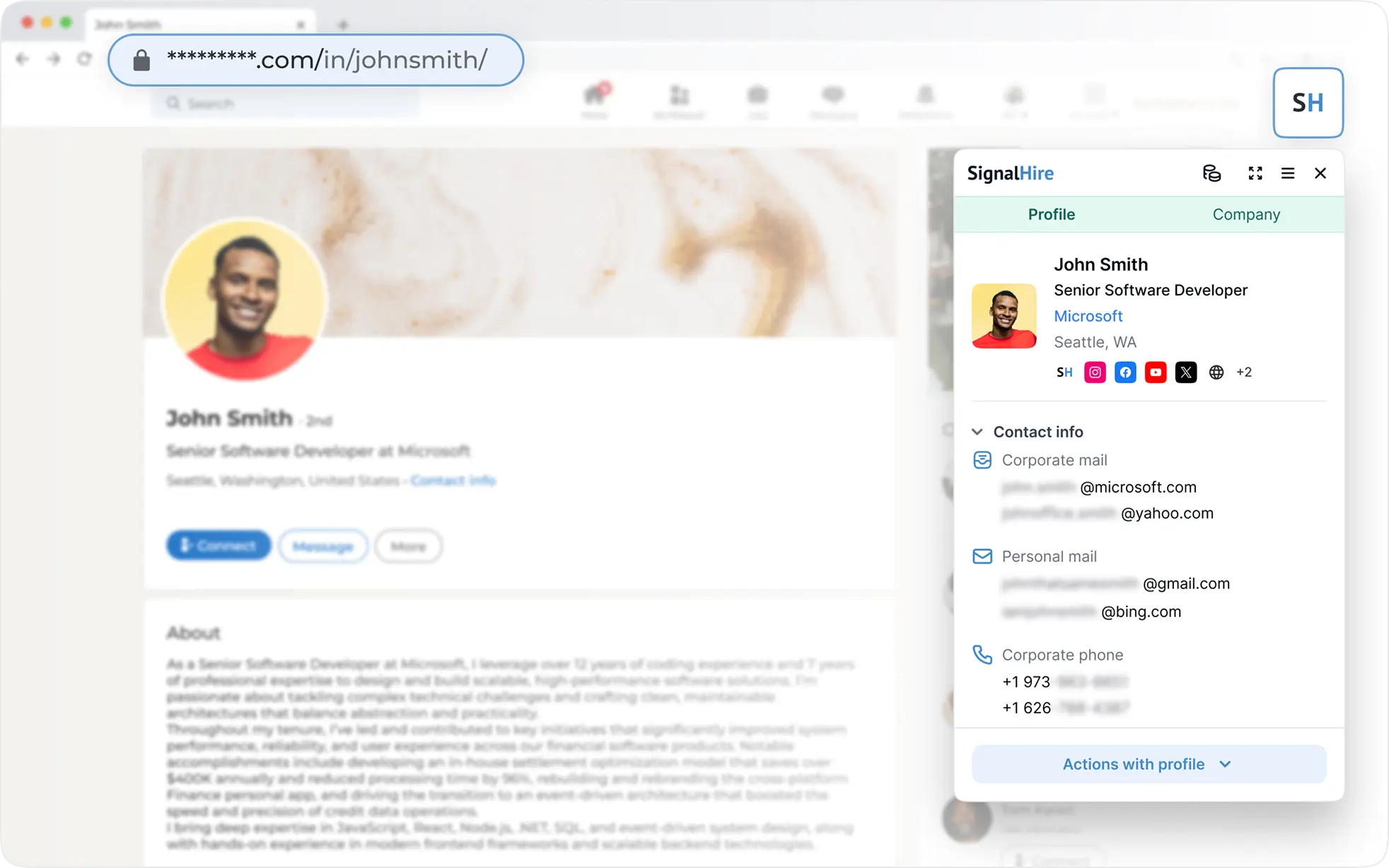
The panel makes the value proposition visible: one reveal returns corporate mail, personal mail and phone numbers together, plus links to the person's other social profiles. Personal emails matter more for recruiting than for sales, because a candidate who is not job hunting rarely wants a recruiter writing to a work inbox. The pricing FAQ lists support for profiles on LinkedIn, GitHub, Facebook, X and Meetup, which covers the main places technical recruiters source from.
The same extension also works on search result pages, where it lists every visible profile and lets you reveal them in one batch. This is where the shared credit pool can drain quickly, because a single click on a ten-person results page spends up to ten credits.
Bulk reveal from a search results page
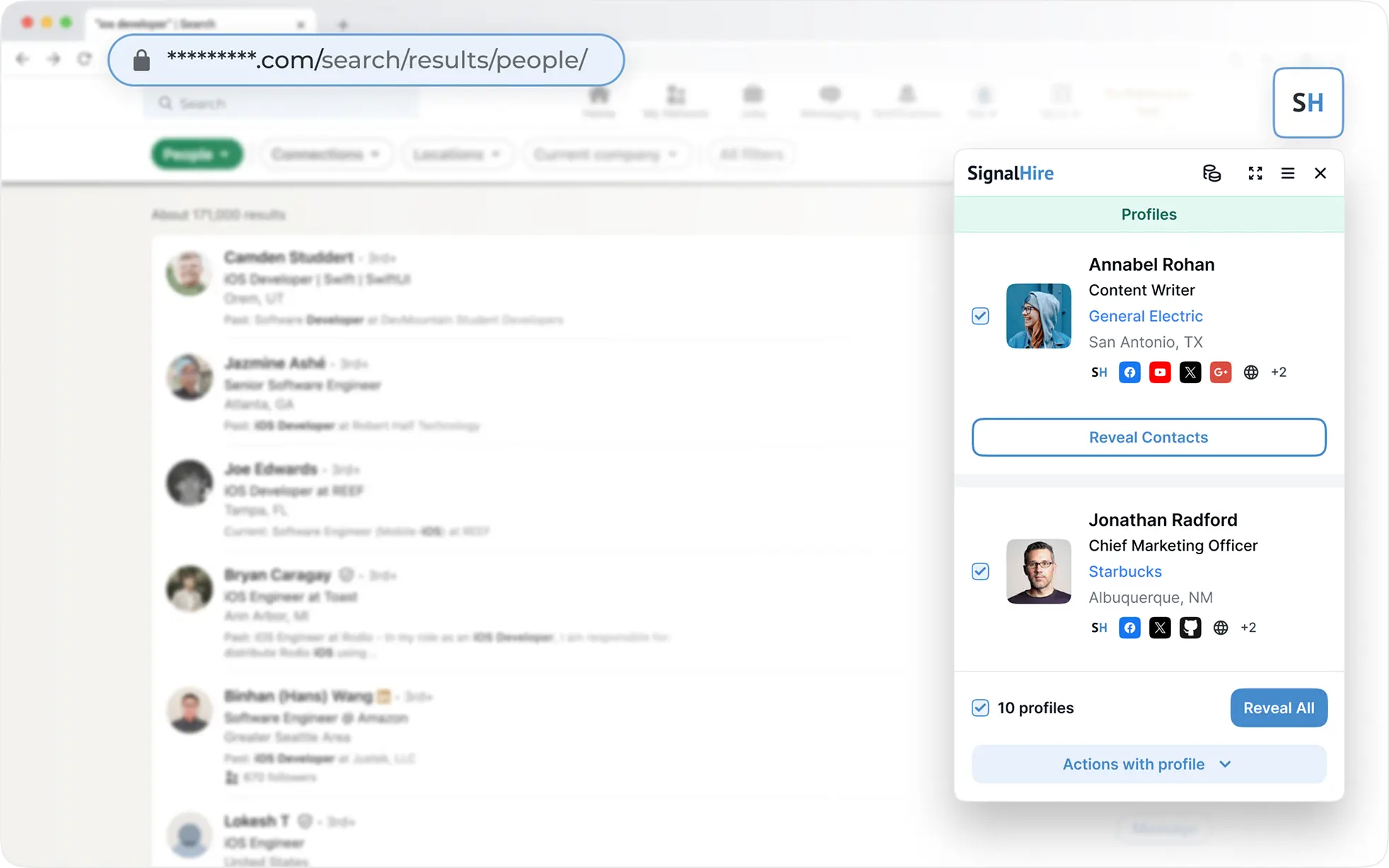
The Reveal All button for ten profiles is convenient, and it is also the fastest way to burn a month of a 300-credit Emails & Phones package in thirty clicks. Teams that share an account should agree on when bulk reveals are allowed, or reserve them for lists that have already been filtered.
The MCP server and email sequences
SignalHire launched a hosted MCP server in September 2026, and it is available on every plan, including the free tier. The Model Context Protocol connection lets an AI assistant such as Claude, ChatGPT or Cursor search SignalHire and enrich contacts directly, and SignalHire says enrichment through MCP "is only charged on successful matches" - SignalHire MCP Server. The announcement post is dated 11 September 2026 and frames it as connecting AI agents to the contact database without writing code - SignalHire Blog. For teams already running research inside an AI assistant, that removes the copy-paste step between finding a person and getting their contact details.
The catch with MCP is the same as with the API: an agent spends credits as fast as you let it. An AI assistant asked to "find the VP Engineering at these 40 companies and get their contacts" will cheerfully spend 40 credits in a minute, and on a 300-credit package that is more than a tenth of the month. If you connect SignalHire to an agent, give it explicit limits in the prompt and check the remaining balance afterwards.
SignalHire has also added email sequences: multi-step campaigns with automatic follow-ups, open and reply tracking, and an auto-pause when a contact replies - SignalHire Email Sequences. Mailboxes connect through Outlook / Microsoft 365 or custom SMTP/IMAP, and Gmail is not listed on the page. The editor looks like a standard sequencer, with steps, a prospect list, settings and a sending schedule.
SignalHire's email sequence editor
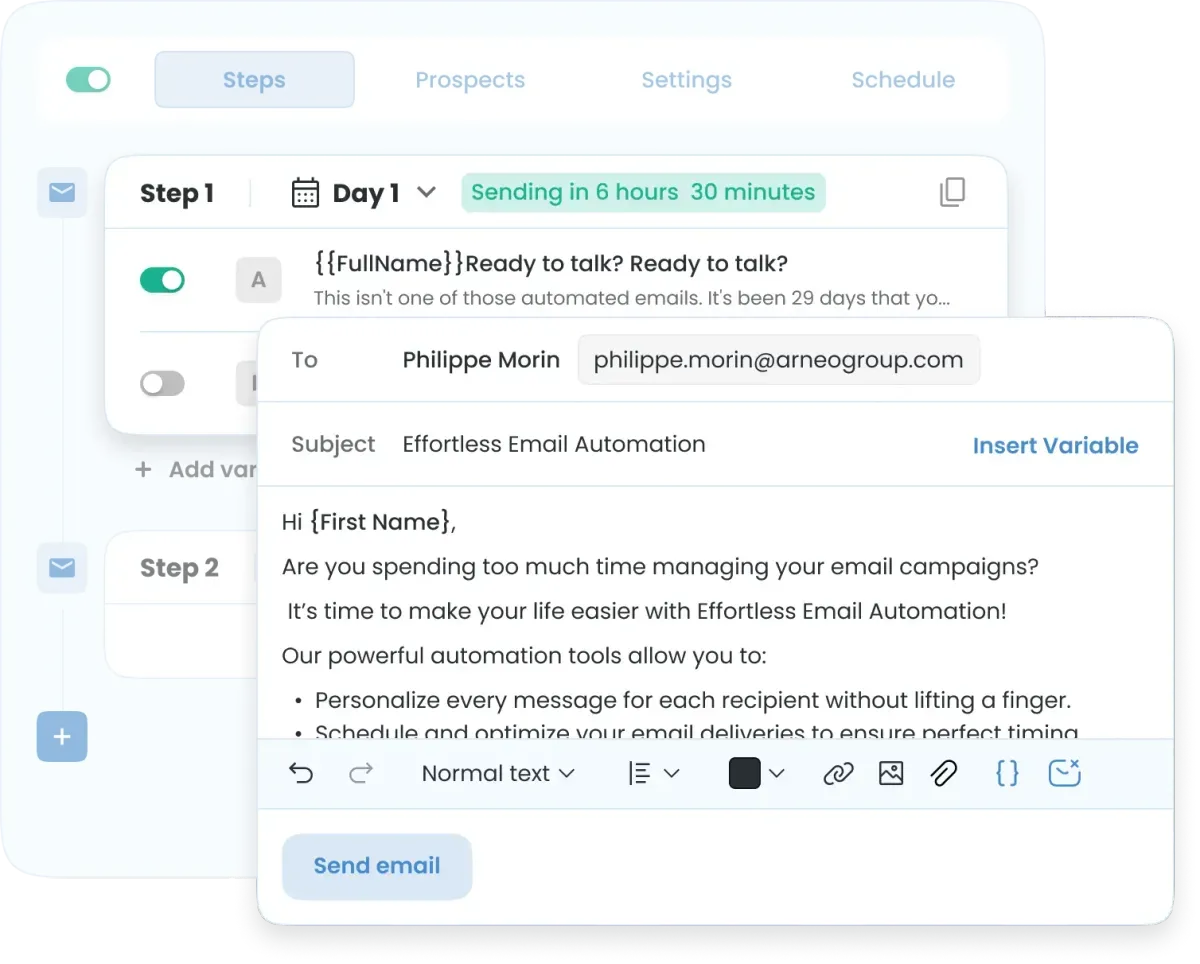
Sequences make SignalHire a lighter version of the "find and send" bundle Apollo has offered for years, though without Gmail support and without published sending limits it is better seen as a convenience than as a replacement for a dedicated outreach tool. The pricing page does not say whether sequences are metered separately, so ask before building a campaign around them. SignalHire's official channel also published a short walkthrough of the database and its AI email generator in August 2026, which is a useful way to see the search filters and reveal flow before signing up.
SignalHire B2B contact database walkthrough
The video quotes an 850M-contact database, while the website now claims 900M+ profiles, which is a small reminder that database sizes in this market are marketing numbers that move with every product page update. What you should watch for in the walkthrough is the search-then-reveal flow: searching is metered by a daily quota, and only the reveal step spends credits.
6. Where SignalHire Wins and Where It Falls Short
SignalHire wins on price per phone number and on team pricing, and it loses on trust signals and contract flexibility. Both halves are real, and which one dominates depends on how you buy. A disciplined buyer who tests first, buys monthly, and uses the Emails & Phones package fully gets one of the best deals in contact data. A buyer who prepays a year on the wrong package and forgets the renewal date is exactly the customer who writes the one-star reviews.
The strengths are structural, not marketing. Because one credit covers all the emails and phones a profile returns, SignalHire's cost per phone-capable contact is low compared with tools that multiply credits for phones. Because there are no per-seat charges, the per-person cost falls as the team grows. And the features are the same on every paid package, so a $49 buyer gets the API and the MCP server too.
The product also has two practical strengths that matter more to recruiters than to sales teams. It returns personal emails alongside work emails, which is what most passive candidates actually read, and its charge-on-match rule applies consistently in the app, the API and the MCP server, so automation does not quietly cost more than clicking.
- No per-seat pricing, with unlimited users on every paid package
- One credit per person, phones included
- API and MCP on every paid package
The weaknesses show up in public reviews. On Trustpilot, SignalHire has 59 reviews, 61% of them one-star, and Trustpilot currently shows no TrustScore at all, displaying instead that "this company's rating is unavailable due to a breach of our guidelines" - Trustpilot. The complaints cluster around wrong or outdated contact data, refunds that were refused, and people who found profiles about themselves and struggled to remove them.
A September 2026 reviewer wrote that SignalHire publishes "profiles about people without consent, get the information wrong, and then make removing it a nightmare." To its credit, SignalHire replies to some complaints and asks for order numbers to review refunds, but the no-refund clause in its terms means that is goodwill, not a right.
The privacy point deserves attention from any recruiter in Europe. SignalHire is an EU company, and it offers a profile opt-out route, but once you download a candidate's personal email, you are the one processing their data. Under GDPR Article 14, if you obtain personal data from a source other than the person, you must tell them where it came from, generally within a month - GDPR Article 14. That obligation applies whichever contact tool you use, but it matters most with tools whose main selling point is personal contact details.
The honest summary is that SignalHire is a good-value tool with a thin safety net. The data is worth testing on your own target list, the pricing rewards high and steady volume, and the terms reward buyers who read them. If your usage is low and irregular, or you need a vendor with a stronger review record and softer terms, the alternatives below are worth comparing first.
7. The 8 Best SignalHire Alternatives in 2026
The best SignalHire alternative depends on whether you are buying emails, phone numbers, or candidates. Email-only buyers can pay a third of SignalHire's price per email elsewhere. Phone-heavy buyers will struggle to beat SignalHire's one-credit-per-person model. And recruiters who buy contact data only to feed outreach may not need a contact finder at all. The eight tools below were chosen because they are the tools SignalHire is most often weighed against, and each was priced from its own pricing page in October 2026.
To keep the comparison honest, every price below is the vendor's published self-serve rate, and every credit rule is the vendor's own. Cost per contact is calculated at the entry paid plan on monthly billing unless stated, so you are comparing like with like. Where a vendor's "unlimited" plan has a fair-use cap, the cap is stated, because in this market "unlimited" almost always means a monthly ceiling.
7.1 ContactOut: The Closest Recruiter-Focused Rival
ContactOut is the alternative most SignalHire recruiters shortlist, because it sells the same thing to the same buyer: personal emails and phones from a browser extension. Its pricing is simple. The Email plan costs $49 a month or $39 a month billed annually ($468 a year), and Email + Phone costs $99 a month or $79 a month annually ($948 a year), each with "unlimited" reveals and an export cap of 300 or 600 contacts a month - ContactOut Pricing. A free plan gives 5 emails, 5 phones and 5 exports a day.
The fine print is close to SignalHire's. ContactOut's unlimited plans are capped by a fair-use policy of 2,000 email credits and 1,000 phone credits per account per month - ContactOut Terms. The main difference is seats: every self-serve plan carries a one-user-per-company limit, and team plans and API access are sales-led. ContactOut also offers a 50% discount if you exclude US, UK and Canada data, which brings Email + Phone down to $49 a month, an unusually good deal for recruiters hiring only in Europe, Asia or Latin America.
At full use, ContactOut's Email + Phone plan works out to roughly 10 cents per phone number, about twice SignalHire's fully used Unlimited rate but well below its entry packages. The trade-off is that one user cannot share it, so a three-recruiter agency pays three times while SignalHire charges once. Best for: a solo recruiter who wants personal emails and phones, especially for non-US hiring.
7.2 Apollo.io: Cheaper Emails and Built-In Sequencing
Apollo.io is the cheapest major vendor per email, and it bundles a mature sequencer with the data. Basic costs $49 per seat per month billed annually or $65 month to month, with 2,500 credits per seat per month; Professional is $79 annually or $99 monthly with 4,000 credits; Organization is $119 per seat annually with a three-seat minimum - Apollo Pricing. There is also a free plan with 75 credits per seat per month.
The credit rules cut both ways. An email costs 1 credit, but a mobile number costs 8 credits, so Basic's 2,500 credits buy about 312 phone numbers, and unused credits expire at the end of each billing cycle, including add-on credits. That puts Apollo's email cost at about 2.6 cents on Basic monthly, a third of SignalHire's, but its phone cost at about 21 cents, higher than SignalHire's entry package. Apollo is also per seat, so a team of three on Basic pays $195 a month against SignalHire's single account price.
Apollo is built for B2B sales prospecting, with a large database of companies and work contacts and sequences that are far more mature than SignalHire's new feature. For recruiting, the workflow fits less naturally, and our Apollo pricing breakdown covers the free-plan limits in detail. Best for: email-led sales teams that want data and sequencing in one seat.
7.3 Lusha: Credits That Roll Over
Lusha is the alternative for buyers whose biggest SignalHire problem is unused credits. On Lusha's monthly plans, unused credits roll over and accumulate up to twice the plan's credit limit while you stay subscribed, which directly fixes the use-it-or-lose-it pressure of SignalHire's Unlimited package - Lusha Pricing. Starter costs $49.90 a month for one seat and 400 credits, Professional costs $69.90 a month for two seats and 600 credits, and Premium costs $399.90 a month for five seats and 3,400 credits. The free plan gives 40 credits a month, enough to test a few dozen emails on your own targets.
The price of that flexibility is phone cost. Lusha charges 1 credit per email but 5 credits per phone number, so Starter's 400 credits buy only 80 phone numbers, about 62 cents per phone, roughly four times SignalHire's entry rate. On annual plans, credits arrive upfront and reset at the end of the year, so the rollover benefit applies only to monthly billing. Lusha's API is available on every plan including Free, with rate limits that scale by tier - Lusha API.
Lusha is the better buy when usage is low and irregular, such as a hiring manager who needs 30 contacts one month and 120 the next, and the worse buy for phone-heavy recruiting. Best for: low-volume, irregular users who hate losing credits.
7.4 RocketReach: Unlimited Annual Lookups for Individuals
RocketReach is the strongest pick if you want "unlimited" with a high ceiling and are buying for one person. Monthly plans are tightly capped: Essentials is $39 a month for 100 email-only lookups, Pro + Phone is $79 a month for 250 lookups, and Ultimate + Phone is $169 a month for 1,000 lookups - RocketReach Pricing. The annual plans are where RocketReach changes character: Essentials is $229 a year, Pro + Phone $619 a year and Ultimate + Phone $1,379 a year, all with unlimited lookups.
That "unlimited" is subject to a fair-use ceiling of 10,000 lookups a month, five times SignalHire's 2,000 - RocketReach FAQ. The real constraint on the annual plans is the export allowance instead: 1,200, 3,600 or 20,000 exports a year depending on tier, and API lookups, bulk lookups and CRM pushes all consume exports. RocketReach prices per user, and its monthly plans roll unused lookups over while annual plans do not.
For a single power user, Pro + Phone annual at $619 a year is cheaper than SignalHire's Emails & Phones Unlimited annual (about $996 a year) and has a far higher lookup ceiling, as long as you work one profile at a time rather than exporting lists. Best for: one recruiter or seller doing high-volume, one-by-one lookups.
7.5 Kaspr: The European LinkedIn Option
Kaspr is the natural alternative for European teams that source mainly from LinkedIn and want unlimited work emails. Starter costs €45 per user per month billed annually (€59 monthly) and includes unlimited B2B emails plus 100 phone credits a month; Business costs €79 annually (€99 monthly) with 200 phone and 200 direct-email credits - Kaspr Pricing. The free plan includes 15 B2B email credits and 5 phone credits a month, and unused monthly credits roll over on paid plans.
Kaspr meters each data type in its own pool (work email, personal email, phone and exports), so one phone number costs one phone credit, much like SignalHire. Its "unlimited" B2B emails are capped at 10,000 credits per account per month, and the terms treat API or robot use of unlimited credits as abusive - Kaspr Terms. API access starts at Starter on request and costs an export credit per successful call.
The limitation is phone volume: 100 phone credits a month on Starter is tight for phone-led recruiting, and Kaspr is priced per user, so it loses SignalHire's team advantage. Best for: European recruiters and sellers who mostly need work emails from LinkedIn.
7.6 Wiza: Built for Sales Navigator Lists
Wiza is the right tool if your workflow starts with LinkedIn Sales Navigator lists rather than individual profiles. Starter costs $49 per user per month for 100 emails and 100 phone numbers, the Email plan costs $99 for 500 emails, and Email + Phone costs $199 for 500 of each, with overages at $0.15 per email and $0.35 per phone - Wiza Pricing. Annual billing unlocks unlimited one-by-one reveals at $990 a year for Email or $1,990 for Email + Phone.
Wiza's "unlimited" applies to individual reveals; list and CSV exports have a hard cap of 2,500 export credits a month on annual plans, and unused credits do not roll over - Wiza Help. The API is unusually flexible: pay-as-you-go credits at $0.025 each with a $50 minimum that do not expire, where an email costs 2 credits and a phone 5.
Wiza is more expensive than SignalHire per contact on monthly plans, but cleaner for list-based prospecting, and its non-expiring API credits (about 5 cents per email and 12.5 cents per phone) suit bursty automation. Best for: sales teams exporting Sales Navigator lists in bulk.
7.7 Prospeo: The Cheapest Verified Emails
Prospeo is the price leader for verified business emails, at about 2.5 cents each on its entry plan. Starter costs $49 a month for 2,000 credits, Growth $99 for 5,000, and Pro $249 for 15,000; annual billing saves 25% and grants the year's credits upfront - Prospeo Pricing. The free plan includes 100 credits a month with no time limit, and API access is free for all users - Prospeo API.
One credit buys one verified business email, and a direct mobile number costs 10 credits, so Prospeo's phone cost on Starter is about 25 cents, above SignalHire's. Searching is free, and you are charged only when an email is found. Prospeo is per user, and its focus is business email rather than the personal emails recruiters value most.
For email-only outbound, Prospeo's entry rate beats even a fully used SignalHire Unlimited package, and its free 100 monthly credits make testing easy. Hunter is a similar email-first option with team-shared credits (Starter is €49 a month for 2,000 credits) - Hunter Pricing. Best for: high-volume business email at the lowest cost.
7.8 HeroHunt.ai: For Recruiters Who Want Candidates, Not Contacts
HeroHunt.ai takes a different approach for recruiters: instead of selling you contact details for people you have already found, it finds the candidates, screens them and runs the outreach. Its AI Recruiter searches across 1B+ profiles, scores each candidate against your role with current language models, finds their emails and sends personalized outreach on autopilot. For a recruiter whose SignalHire workflow is "search LinkedIn, reveal emails, paste into a sequencer," it replaces all three steps.
The pricing model is different too. Plans start from $99 a month with unlimited positions and searches, and they are metered on AI-screened, matched profiles delivered and candidate emails found each month (Starter includes 2,000 profiles and 500 emails) - HeroHunt.ai Plans. There is an 8-day free trial, and it requires a card.
The honest limits: HeroHunt.ai is built for recruiting only, so it is not a fit for sales prospecting, and it is metered on profiles and emails rather than phone numbers, so it does not replace SignalHire for phone-led recruiting. Its value shows up when you count the hours spent searching and screening, not just the price per contact. Best for: recruiters who buy contact data only to feed candidate outreach and want the search, screening and messaging automated.
8. Full Comparison: Price, Meter and Best Fit
No tool is cheapest for everything: SignalHire leads on phones and team pricing, Apollo and Prospeo lead on email cost, and RocketReach leads on unlimited ceilings. The table below puts the entry price, the meter and the phone rule side by side, because the meter is what determines your real bill. A tool that looks cheap per month can be expensive per phone number, and a tool that looks expensive per seat can be cheap for a team that shares one account.
Read the table by your own usage, not by the cheapest headline. Count how many people you need to reach in a typical month, what share of them need phone numbers, and how many people will share the account. Those three numbers, more than any feature list, decide which row is cheapest for you.
| Tool | Entry paid plan (monthly billing) | Meter | Phone rule | Best for |
|---|---|---|---|---|
| SignalHire | $49/mo, unlimited users | Credits per person | 1 credit, all fields | Phone-heavy teams |
| ContactOut | $49/mo, 1 user | Fair use 2,000 emails | 1,000 phones/mo cap | Solo recruiters |
| Apollo.io | $65/seat/mo | Credits per seat | 8 credits per mobile | Email-led sales |
| Lusha | $49.90/mo, 1 seat | Credits, roll over | 5 credits per phone | Irregular use |
| RocketReach | $39/user/mo | Lookups per user | Included on + Phone | Solo power users |
| Kaspr | €59/user/mo | Pools per data type | 1 phone credit | EU LinkedIn sourcing |
| Wiza | $49/user/mo | Emails and phones per user | $0.35 overage | Sales Navigator lists |
| Prospeo | $49/user/mo | Credits per user | 10 credits per mobile | Cheapest emails |
| HeroHunt.ai | $99/mo | Profiles + emails | Not a phone tool | Automated recruiting |
The cost-per-contact view makes the pattern clearer. The chart below shows what one email and one phone number cost at each vendor's entry paid plan on monthly billing, using the vendor's own credit rules (for RocketReach, the email figure is Essentials and the phone figure is Pro + Phone; for Wiza, the email figure is the Email plan and the phone figure is its published per-phone rate).
Cost per Contact at the Entry Paid Plan, Monthly Billing
The chart shows SignalHire as a phone-number bargain and an average email tool. Apollo and Prospeo deliver emails at about a third of SignalHire's entry price, while SignalHire's phone-capable credit is the cheapest of the six, and it gets cheaper still on Unlimited (about 4 to 5 cents at full use). Lusha is the most expensive per phone because of its 5-credit phone rule, which is the price of its rollover credits. These are sticker prices per returned contact: multiply each by your own share of contacts that turn out to be wrong, and the gap between tools with better and worse data for your market can easily outweigh the gap in price.
9. How to Choose, and How to Buy SignalHire Well
Choose by what you actually need to buy each month: emails, phone numbers, or finished candidate pipelines. That one question removes most of the field. Email-only buyers should look first at Apollo or Prospeo; phone-heavy teams should start with SignalHire or ContactOut; and recruiters who mainly need candidates contacted should look at an AI recruiter rather than a data tool. The decision tree below maps the common paths.
The second question is how many people share the account. SignalHire's unlimited users change the maths for teams: a three-person agency on SignalHire's Emails & Phones standard package pays $69 a month in total, while three seats of a per-user tool at a similar price cost three times that. For a solo buyer, that advantage disappears, and per-user tools such as ContactOut and RocketReach become directly comparable.
The tree's most important branch is the phone one. If phone numbers are part of your outreach and the account is shared, SignalHire's Emails & Phones package is hard to beat on price, which is why it remains a favourite with agency recruiters. If you work alone, ContactOut and RocketReach compete directly. If your volume is low and lumpy, Lusha's rollover credits protect you from paying for contacts you never use, and if what you really want is candidates in conversation rather than a spreadsheet of numbers, HeroHunt.ai sits on its own branch.
If SignalHire is your pick, buy it in a way that avoids the traps covered above. Spend the free credits on a sample of 10 real targets from your own market and record how many emails bounce and how many phones connect. Then buy one month, not one year, of the package that matches your volume: Emails if you never call, Emails & Phones (never Phones-only, which costs the same) if you do. Move to Unlimited only once you know you will use more than about 1,100 email credits or 650 phone-capable credits a month, because that is where it starts to beat the fixed packages.
Finally, manage the account like a budget. Put the renewal date in your calendar on the day you pay, agree as a team when bulk "Reveal All" is allowed, and if you connect the API or MCP server, log every request and check the X-Credits-Left balance. The terms offer no refunds and the API charges a credit even if your callback fails, so the cheapest SignalHire plan is always the one you monitor. For a wider view of how contact-finder costs fit into total recruiting spend, the recruiting software pricing guide compares 40 tools by how they meter.
10. The Bottom Line
SignalHire is one of the best-value contact tools in 2026 if you need phone numbers for a team, and an ordinary one if you only need emails. Its pricing is public, its meter is fair (one credit per person, phones included, charged only on a match), and its no-seat model makes it unusually cheap for agencies and small teams. The Unlimited package, which is really a 2,000-credit monthly allowance, is the best deal on the page for anyone with steady, high volume.
The weaknesses are in the terms and the trust signals, not the price list. There are no refunds, plans renew automatically, the Unlimited allowance resets every month, and Trustpilot shows mostly one-star reviews and no score. None of that makes SignalHire a bad buy. It makes it a tool to buy carefully: test on your own targets, start monthly, buy Emails & Phones instead of Phones, and watch the renewal date.
If your use is mostly email, Apollo or Prospeo will do the same job for about a third of the price per email. If you are a solo recruiter hiring outside the US, UK and Canada, ContactOut's regional plan is worth a look, and if your usage is irregular, Lusha's rollover credits remove the use-it-or-lose-it pressure. And if contact data is just the step between finding candidates and messaging them, an AI recruiter such as HeroHunt.ai removes that step entirely.
For email-led teams: 2,500 credits per seat per month on Basic, about a third of SignalHire's price per email, with sequences built in. Phones cost 8 credits each.
Whichever tool you choose, compare on the two numbers that decide the bill: the cost of a contact that actually works in your market, and what happens to the credits you do not use.
This guide reflects SignalHire's pricing page, terms and documentation as of October 2026. Contact-data pricing changes often, so verify current details on each vendor's own site before purchasing.