


The insider playbook for finding, reading, and reaching the AI builders who never touch a job board, using the work they publish in the open.
Hugging Face now hosts roughly 2.96 million public models built and shared by around 13 million registered users - Hugging Face. That single fact reframes how anyone should think about sourcing artificial intelligence talent, because it means the most sought-after engineers and researchers in the world are already publishing a living, timestamped portfolio of exactly what they can do. They are not hiding. They are shipping models, datasets, and demos in public, and every one of those artifacts carries a name, a commit history, and a trail back to a real person.
The problem is that almost nobody in recruiting knows how to read that trail. The scarce AI talent that hiring managers fight over rarely applies to anything, almost never keeps an updated LinkedIn, and treats a cold recruiter template as noise to be ignored. Their real credential is a high-download model or a first-author paper, not a resume, and the platform where that credential lives is a technical site built for practitioners, not sourcers. Worse, as this guide will show, essentially no mainstream sourcing tool indexes Hugging Face as a first-class signal, which means the recruiters who learn to read it by hand hold an edge that money cannot yet buy off the shelf.
This guide is the practical map for doing exactly that. It covers why Hugging Face became the densest concentration of AI builders on the internet, how to read a profile and an organization page like a resume, how to prove who actually built a model, how to separate genuine skill from vanity metrics, how to pull a whole niche's talent programmatically through the Hub API, how to turn an anonymous handle into a real contact, how to write outreach that engineers actually answer, which tools help (and where they fail), and how AI agents are rewiring the whole hunt. It assumes no machine learning background, only that you have to win at this.
This guide is by Yuma Heymans (@yumahey), who built HeroHunt.ai and spends his days on the exact problem at the center of it: finding scarce specialists who are not on any job board. He writes about sourcing from open-source footprints because that is increasingly where the real proof of an AI engineer's ability lives.
Contents
- Why Hugging Face Is the AI Talent Goldmine in 2026
- The Hugging Face Profile as a Resume
- The Organization Page: A Free Directory of Every Lab's Team
- Who Really Built the Model: Authorship Forensics
- Papers, Verified Authorship, and Research Lineage
- Reading the Signal Without Getting Fooled
- Leaderboards After the Open LLM Leaderboard Died
- Sourcing at Scale: The Hub API and huggingface_hub
- From Profile to Inbox: Contact and Outreach
- The Sourcing-Tool Ecosystem and Its Hugging Face Blind Spot
- AI Agents, MCP, and Proof-of-Work Sourcing
- Staying Legal and the Recruiter's Playbook
1. Why Hugging Face Is the AI Talent Goldmine in 2026
Hugging Face has become the GitHub of AI, and that is not a marketing line but a structural fact about where practicing builders now congregate. As of the summer of 2026 the Hub hosts around 2.96 million public models, just over 1 million datasets, and roughly 1.44 million Spaces (live, hosted demo apps), every one of them public and browsable without a login - Hugging Face. The community behind those artifacts reached about 13 million registered users in 2025, up from the 5 million it had only just crossed in August 2024, which means the population roughly tripled in a single year - Hugging Face on X. More than 50,000 organizations maintain a presence, including over 30 percent of the Fortune 500, so the platform is simultaneously where independent hackers and frontier labs publish their work.
The reason this matters for sourcing is concentration, and the numbers here are the most important in the entire guide. Attention on the Hub follows a brutal power law: roughly 85.6 percent of models have fewer than 200 lifetime downloads, and just 1.5 percent of repositories account for 99.2 percent of all downloads, with the top 200 models alone pulling nearly half - Hugging Face. In plain terms, the overwhelming majority of the 2.96 million models are noise, and the small minority that people actually use point straight at the small minority of people worth recruiting. A recruiter who sorts by real adoption is not searching a haystack, they are reading a pre-ranked shortlist of the builders whose work the market has already validated.
The commercial trajectory underlines how central the platform has become. Hugging Face's annual recurring revenue reached roughly $150 million by August 2026, up from about $81 million at the end of 2025, on the back of more than 2,000 paying enterprise customers - Sacra. Its last confirmed priced round was a $235 million Series D at a $4.5 billion valuation in August 2023, backed by Salesforce, Google, Amazon, Nvidia, Intel, AMD, Qualcomm, and IBM, all of which read as a who's-who of the companies desperate for the exact talent that lives there - Axios. In late August 2026 multiple outlets reported that Nvidia had agreed to acquire the company for around $12.9 billion, though neither side confirmed it, a figure that only makes sense if you understand the strategic value of owning the place where open AI is built - CNBC.
Read the investor list and you are really reading a map of the talent war. The companies that backed Hugging Face, the cloud giants, the chip makers, the enterprise software leaders, are the same companies competing hardest for AI engineers, and they did not invest in a repository because they love version control. They invested because Hugging Face is where the people who build models congregate, and proximity to that community is proximity to the talent. For a recruiter, the lesson is to follow the same logic those strategic investors did: go to where the builders already are and make yourself useful there, rather than waiting for them to surface on a job board that they, almost by definition, ignore.
What Hugging Face actually is: Models, Datasets, and Spaces
Before diving into tactics, it helps to see the three object types you will keep returning to, because a candidate's footprint is spread across all of them. The official walkthrough above frames them for a non-technical viewer, and this guide builds directly on that mental model.
- Models are the trained artifacts, the closest thing to a portfolio piece
- Datasets show who assembles and curates training data, an underrated skill
- Spaces are live demo apps that prove someone can ship end-to-end
Understanding that split is the foundation of everything that follows, because different roles leave their strongest evidence in different places. A research scientist's fingerprint is on models and papers, a data-centric engineer's is on datasets, and an applied builder's is on Spaces. Reading a person means reading across all three, and the rest of this guide is about how to do that quickly, how to tell the signal from the noise, and how to turn a public handle into a hire. Where the growth is heading also tells you where to aim: model output is now driven by small fine-tuned models, robotics datasets exploded from 1,145 to 26,991 in a single year, and Chinese-origin models reached 41 percent of Hub downloads in 2025, so the fastest-moving talent pools are not where they were even eighteen months ago - Hugging Face.
The pace of that growth is what makes the platform such a moving target, and it is worth internalizing before you build a sourcing routine on top of it. The first million public models took more than 1,000 days to accumulate from the point Hugging Face began tracking in March 2022, but the second million arrived in only 335 days, roughly a 65 percent shorter interval, because the barrier to publishing a small fine-tuned model has collapsed - arXiv. The composition of who is publishing has shifted just as fast. Industry's share of model development fell from around 70 percent before 2022 to roughly 37 percent in 2025, while independent, unaffiliated developers rose from 17 percent to 39 percent of downloads, which tells a sourcer that a growing share of the best open work now comes from individuals rather than big labs, and those individuals are precisely the people no corporate directory will ever list.
Hugging Face Hub Growth in Eight Months of 2026
The chart makes the practical point vivid: in a single eight-month stretch the Hub added over half a million models, nearly 300,000 datasets, and more than 400,000 Spaces. For a recruiter, that velocity cuts both ways. It means the talent pool is expanding faster than any static database can index, which is the opportunity, but it also means a shortlist you built six months ago is already stale, which is the discipline. The correct response is not to snapshot the Hub once, but to build a repeatable query you can rerun, a habit that Chapter 8 turns into a few lines of code.

2. The Hugging Face Profile as a Resume
A Hugging Face user profile is the single richest talent document most AI builders will ever produce, and it is public by default. Navigate to huggingface.co/<username> and you get a self-declared, continuously updated record: a bio, external social links, the organizations the person belongs to, follower and following counts, a running contributions count, and tabs for the Models, Datasets, Spaces, Papers, Collections, Posts, and Articles they have authored. Take Victor Mustar, Hugging Face's head of product, whose public profile shows a PRO badge, several thousand followers, membership in more than 40 organizations, hundreds of contributions, and separate tallies for models, datasets, and Spaces he has shipped - Hugging Face. No resume you will ever receive is this honest, because none of it is self-reported prose. It is the actual output.
Two smaller elements of the profile reward attention because they add color a resume never would. The Collections tab shows how a person organizes and curates the field's work, which is a subtle seniority signal, since the people who build thoughtful collections of models and papers tend to be the ones with a mental map of their subfield. The Posts and Articles tabs, where practitioners announce releases and write up findings, reveal communication ability and reputation, and a Post with real upvotes is a small proof that peers value what this person says. The PRO badge itself is a weak signal (it is a paid tier anyone can buy), so do not over-read it, but a genuinely active PRO user tends to be someone who lives on the platform rather than passing through. Read these tabs last, as tie-breakers, after the harder evidence in the Models and Papers tabs.
The most underused part of the profile is the activity feed, and it is where you learn what someone truly does versus what they merely admire. The feed is filterable by category, and each filter is its own URL, so huggingface.co/<user>/activity/all shows the real pushes and creations (this person built a model, updated a dataset, created a Space last Tuesday), while huggingface.co/<user>/activity/upvotes reveals their interests and who they follow in the field - Hugging Face. For a sourcer, that distinction is gold. A profile with a steady stream of recent pushes is an active builder; one with lots of upvotes but few pushes is a spectator, and the two should never be scored the same.
Reading a profile well means knowing which tab answers which question, and once you internalize the mapping a profile takes thirty seconds to triage rather than five minutes to puzzle over. The Models tab answers whether someone can train or fine-tune, the Datasets tab answers whether they can build and curate data (an underrated skill that separates the people who feed models from the people who only consume them), and the Spaces tab answers whether they can ship a working product end to end rather than just publish weights. The Papers tab answers whether they originate research or merely apply it, and the activity feed answers the question that overrides all the others, which is whether they are active right now or coasting on old work.
Those five reads, taken together, give you a role-shaped picture no keyword search can. A candidate heavy on Spaces and light on Papers is an applied engineer, not a research scientist, and pitching them a pure-research role wastes everyone's time. The profile also carries the person's chosen social links, which become the bridge to actual contact in Chapter 9, so treat the profile page not as a destination but as the trailhead. The important discipline here is to always read the activity before you judge the totals, because a large but stale model count means someone who was strong two years ago, and in this field two years is a long time.
3. The Organization Page: A Free Directory of Every Lab's Team
If the user profile is a resume, the organization page is a company directory that most labs would never publish anywhere else, and it is sitting in the open. Navigate to huggingface.co/<org> for any lab or company on the Hub and, alongside its models, datasets, Spaces, and papers, you will often find a Team members heading with the members listed as clickable avatars. The Allen Institute for AI's page, for example, publicly displays a roster of 173 team members next to its follower count, and every one of those avatars is a live profile you can open and read - Hugging Face. For a sourcer trying to map who works at a target lab, this collapses days of guesswork into a single scroll.
The activity feed on an organization page is arguably even more valuable than the roster, because it attributes work to individuals. AI at Meta's public org page exposes thousands of models, dozens of datasets, and a Recent Activity feed that names the exact member who pushed each new release - Hugging Face. That means you are not just learning who is on a team, you are learning who on that team is actually productive, on what, and how recently. A researcher whose name keeps appearing on new pushes is doing the work; a member listed on the roster but absent from the activity feed may be a manager, a service account, or someone on their way out. Reading the feed tells you which of the 173 avatars to prioritize.
To turn org pages into a repeatable sourcing motion, work from the directory inward and then back out to individuals. Start at the directory at huggingface.co/organizations to find which labs even have a presence, then open the target org and scan its Team members block for the full roster. From there, read the activity feed to see who is actually pushing work and how often, which is what separates the productive members from the names on a list. Finally, open each promising avatar to read that person's profile in full, and cross-reference the names against LinkedIn to confirm titles and assemble an informal org chart. The whole sequence flows in one direction, from the company down to the individual and back out to a verified identity, and it rarely takes more than an hour even for a large team.
There is a structural reason org rosters are as reliable as they are, and it is worth knowing. An organization can verify an email domain, after which any Hub user with an address at that domain can auto-join, which means a verified corporate domain reliably clusters real employees under one org rather than a loose group of fans - Hugging Face. That is why the roster on a serious lab's page tends to be genuine staff rather than hangers-on. Used across your competitive set, this turns the organizations directory into a live map of which labs are staffing up in which areas, since a sudden run of new members on a company's page, all pushing work in one subfield, is an early signal of where that company is investing before any press release confirms it.
That loop turns a competitor's or partner's AI team into a named, ranked list in under an hour, which is a capability most recruiters do not realize they have. Two honest caveats keep you accurate. First, org membership is opt-in visible, and individuals can hide their affiliation, so the roster is a floor on headcount, not the full picture. Second, some listed members are bots or shared service accounts, so always confirm a name resolves to a human profile with real activity before you add it to a shortlist. Member email addresses, importantly, are never exposed publicly (they are visible only internally to an org that has verified its email domain), so do not expect to scrape contact details off these pages - Hugging Face.
4. Who Really Built the Model: Authorship Forensics
The single most common mistake in technical sourcing is crediting the wrong person for a piece of work, and Hugging Face gives you three independent ways to get it right. The first is the model card, the README.md file at the top of every model repo, whose annotated template defines explicit fields including "Developed by" and "Model Card Authors" - Hugging Face. These fields are the prose claim of authorship, and they are a fine starting point, but they are also the easiest to game, because anyone editing the card can write anything into them. So you treat the model card as the hypothesis, not the proof.
The proof lives in the second source: the git commit history. Every model repository on the Hub is a full git repo, and its Files-and-versions view exposes the complete commit log, which reveals the exact username that pushed the weight files rather than merely who is credited in the prose - Hugging Face. When the person named in "Developed by" is also the person whose commits pushed the actual model, you have corroboration. When they diverge, the committer is usually the real engineer and the credited name may be a team lead or an organization. This one habit, checking who pushed the weights, separates recruiters who get fooled by a famous name on a card from those who find the quiet person who did the work.
A concrete example makes the method tangible. Suppose you find a fine-tuned model getting real traction in a niche you are hiring for. Open its Files-and-versions tab, click through the commit history, and you will often see that the weights and the tokenizer config were pushed by one specific handle, even though the model card credits an organization. That handle is your primary target, because they did the hands-on work of training and shipping. From there you open their profile, confirm they have other pushed, maintained repos rather than a single lucky release, and only then treat them as a serious candidate. The whole check takes two minutes and routinely surfaces the individual contributor behind a model that a less careful sourcer would have attributed to a famous lab or a well-known research lead who merely signed off on it.
The third source ties the model to the research and, through it, to a verified human identity. If a model card links an arXiv paper, the Hub automatically extracts the identifier into an arxiv:<id> tag on the page, and clicking that tag opens the paper and lets you filter every other model or dataset on the Hub that cites the same paper - Hugging Face. That is a research-lineage tool disguised as a hyperlink. From one strong model you can reach the paper that underpins it, the author list on that paper, and the entire downstream family of builders working on the same technique. The forensic method, then, is to triangulate: read the card's claimed authors, confirm them against the commit history, and anchor both to the paper's author list. The person who appears in all three is almost certainly the real builder, and that certainty is worth far more than a resume's assertion, because in this field the work is the only credential that cannot be faked.
5. Papers, Verified Authorship, and Research Lineage
For research-heavy roles, Hugging Face Papers has quietly become one of the best sourcing surfaces on the internet, and it got dramatically more useful in 2025. The reason is a feature called claim authorship: an author can claim an arXiv paper on the Hub (auto-matched by email, or by clicking their name and requesting validation), which earns a verified badge and links that paper directly to their Hugging Face profile - Hugging Face. This is the most reliable identity primitive on the platform, because it chains a specific piece of published research to a real, reachable profile and, from there, to the models and Spaces that person has shipped. A verified first-author paper on a technique you are hiring for is about as strong a signal of genuine seniority as exists in open data.
The discovery layer around Papers is built for exactly the "who is doing notable work right now" question. The Daily Papers feed lets anyone submit a paper, after which the community upvotes and comments, tagging authors for discussion, and the platform indexes arXiv, which accounts for roughly 95 percent of the paper URLs its users link - Hugging Face. The Trending Papers view ranks research by community upvotes and, for each paper, shows the submitter's avatar, the publishing organization as a clickable profile, co-author avatar groups, GitHub repo star counts, and a direct arXiv link - Hugging Face. Every one of those avatars is a one-click path to a person, which means a hot paper is really a pre-assembled list of the researchers behind a breakthrough, ranked by how much the community cares.
Walking a single example through the mechanism shows how tight the loop is. Say a new paper on efficient long-context attention trends on the Daily Papers feed. You open it, see the co-author avatars, and click the one carrying a verified badge, which lands you on that researcher's Hugging Face profile rather than a dead arXiv byline. On their profile you check the Models tab and find they have shipped a working implementation of the technique, plus a Space demoing it, which tells you they do not just theorize, they build. You then read their activity feed to confirm the work is recent, harvest the GitHub and homepage links off the profile, and you have gone from "an interesting paper" to "a verified, contactable, provably capable researcher" in about five minutes. That chain, paper to verified identity to shipped model, is the single most reliable sourcing primitive Hugging Face offers, and it exists nowhere else in such a clean form.
This matters because the alternative surfaces got worse at the same time Hugging Face got better. Papers with Code, for years the default place to connect research to implementations and leaderboards, was sunset on 24 July 2025, and the day after it closed, Hugging Face's CTO announced a Meta partnership to absorb its function, redirecting that traffic into HF's own Trending Papers - Hyperai. The practical upshot for a sourcer is that the research-to-person pipeline now runs through Hugging Face more than ever. To use it well, source by topic rather than by name: open Daily or Trending Papers, find a paper on the exact capability you need, click a verified author to land on their profile, and then read their Models and Spaces tabs to confirm they can build and not only publish. The combination of a claimed paper and shipped models is the profile of someone who does research that actually ships, which is precisely the person most labs are fighting to hire.
6. Reading the Signal Without Getting Fooled
Every number on Hugging Face means something, but almost none of them mean what a newcomer assumes, and getting this wrong produces expensive shortlisting errors. The headline metric, downloads, is the most misread of all. It is a rolling 30-day count, not a lifetime total, and it is triggered server-side by requests to a specific query file (usually config.json), which means automated CI/CD pipelines and Inference API calls can inflate a model's number by tens of thousands of phantom downloads that have nothing to do with human adoption - Hugging Face. A model showing 80,000 downloads might be genuinely popular, or it might be one team's nightly test suite hammering config.json. Getting true unique-downloader granularity requires the paid Publisher Analytics feature, so you should treat raw download counts as directional, not gospel.
The mechanics are worth understanding one level deeper, because they tell you when a number is trustworthy. Different libraries count a download off different files: the default is config.json, but PyTorch models count pytorch_model.bin, adapters count adapter_config.json, and quantized GGUF models count each GGUF file, which is why two equally-used models can show wildly different raw totals depending on how people load them - Hugging Face. Likes and downloads also correlate weakly and mean different things: a like says "this release matters" and clusters on frontier models within weeks of a launch, while a download says the model is wired into someone's real pipeline. The practical defense is to open the Files tab and ask a simple question: did the person you are evaluating actually push the weights, and does the download pattern look like genuine adoption rather than a config-file loop? If the answer is yes on both, the number is signal; if not, it is noise wearing a big number.
Likes, followers, and the Trending badge are attention metrics, and attention is not skill. A like signals "this release matters" and tends to cluster on frontier models within weeks of launch, while a download signals a model is wired into a real pipeline; the two correlate weakly and measure different things. The Trending sort, meanwhile, is driven by likes accrued over roughly the last seven days, and Hugging Face has never publicly documented its exact formula, which was confirmed only through a forum discussion rather than official docs - Hugging Face Forums. None of this makes the metrics useless. It makes them a starting filter that you must interpret rather than a scoreboard you can trust blindly.
The way out of the trap is to rank signals by how hard they are to fake, and to weight your shortlist accordingly.
The hierarchy above is the practical core of signal literacy. Pushed commits on repositories a person authored and maintains, plus first-author verified papers, are the high-confidence proof of work, because they cannot be manufactured by a CI loop or bought with a marketing push. Meaningful downloads that are clearly wired into real downstream use sit in the middle. Likes, followers, and trending badges sit at the bottom, useful for discovery but nearly worthless as evidence of individual ability. When you build a ranked shortlist, score a candidate who maintains a genuinely used repo far above one with a large follower count and little else, and always sanity-check a headline download number by opening the Files tab to see whether the person actually pushed the weights or merely edited a card. That habit alone will keep you from the field's most common sourcing error.
7. Leaderboards After the Open LLM Leaderboard Died
For years the reflexive answer to "who builds the best models" was the Hugging Face Open LLM Leaderboard, and in 2026 that answer is wrong, which is exactly the kind of stale knowledge that makes a recruiter look uninformed to a technical candidate. The Open LLM Leaderboard was retired on 13 March 2025 after evaluating more than 13,000 models, and it now exists only as a frozen, static archive; Hugging Face retired it because reasoning models had made its benchmarks obsolete and it was encouraging teams to optimize for irrelevant directions - Hugging Face. You can still read its historical scores across six benchmarks, but you must never cite it as a current ranking. Doing so signals to any builder that you have not kept up.
The live landscape that replaced it is more fragmented and, for a sourcer, more useful. Rather than one board, Hugging Face now points to more than 200 community-led leaderboards specialized by capability (math, code, language, performance) and built a search tool, the OpenEvals find-a-leaderboard Space, to navigate them - Hugging Face. For the specific question of which organizations built the top general models, the live authority is now LMArena, which rebranded simply to Arena on 28 January 2026 and ranks models by blind, crowd-voted head-to-head Elo. Stanford's 2026 AI Index confirms that the leading models from Anthropic, xAI, Google, OpenAI, Alibaba, and DeepSeek have converged tightly in capability, and that industry produced more than 90 percent of notable frontier models in 2025 - Stanford HAI. Those six names are, in effect, a map of where the most elite model-building talent is concentrated.
Engagement inside the community is a fourth signal, and it separates maintainers from one-time uploaders. Anyone can open Pull Requests and Discussions on any model, dataset, or Space through its Community tab, so a repo's contributor and discussion activity is a public record of who improves and sustains notable work, not just who posted it once - Hugging Face. The ecosystem-level version of this signal is even more useful for aim: in 2025 Alibaba's Qwen family alone spawned more than 113,000 derivative models, DeepSeek-R1 was the single most-liked model on the Hub, and NVIDIA was the strongest Big Tech repo contributor - Hugging Face. Those clusters tell you where the gravitational centers are, and the people who maintain the base models and the most-used derivatives inside them are a concentrated, high-value pool.
Competitions and cross-platform corroboration round out the picture, and they help you calibrate seniority. Kaggle remains a strong signal for applied and data-science talent, but its badges are meaningful only at the top: across more than 23 million accounts, there are only around 612 Grandmasters, and the Competitions Grandmaster tier requires five gold medals including at least one won solo - DataCamp. A Kaggle Grandmaster who also maintains used models on Hugging Face is a rare and verifiable profile.
The cross-referencing itself is worth doing deliberately rather than by feel, because a single platform can flatter or mislead. A strong practice is to require two-of-three corroboration before you commit a name: the Hugging Face footprint (authored, maintained models), the GitHub footprint (commit cadence and repo depth on the same handle), and a third anchor such as a claimed arXiv paper or a Kaggle tier. When the same person shows up independently across two of those, you are almost certainly looking at genuine, sustained ability rather than a one-off release that happened to trend. When they show up on only one, treat the profile as a lead to investigate, not a candidate to pitch. This habit is slower than eyeballing a follower count, but it is the difference between a shortlist your hiring manager trusts and one that wastes their interview slots. The practical method across all of this is to build a small daily feed of live signals (Trending Papers, models sorted by trending, and a relevant community leaderboard), convert each notable artifact into the person behind it, and then require two-of-three corroboration across Hugging Face, arXiv, GitHub, or Kaggle before you commit a name to your shortlist. That discipline filters out reshared or one-off work and leaves you with builders whose track record shows up independently in more than one place.
8. Sourcing at Scale: The Hub API and huggingface_hub
Everything so far is manual, and manual is fine for a handful of roles, but when you want to map an entire niche you graduate to the API, which is where Hugging Face sourcing becomes genuinely powerful. The Hub is queryable two ways that both surface the humans behind the models. The Python library huggingface_hub (now on its 1.x line) exposes an HfApi class with methods including list_models, list_datasets, list_spaces, model_info, and whoami; list_models accepts an author, a filter for task and library tags, a sort (downloads, likes, trending_score, created_at, or last_modified), a limit, and a token - Hugging Face. Every result carries the fields that matter for sourcing, above all the author, so you can pull the top models in any task and roll them up to the people and organizations who keep shipping them.
The core recruiter move is to query the same niche twice, once by all-time downloads to find established, adopted work, and once by trending score to find who is hot this week, then union the two lists and count authors. Established adoption tells you who has staying power; current momentum tells you who to reach before everyone else does.
# pip install "huggingface_hub>=1.2.0"
# Find the orgs and people behind a niche, ranked by how often they ship top work.
from collections import Counter
from huggingface_hub import HfApi

api = HfApi()  # add token="hf_..." (or set HF_TOKEN) for higher rate limits

top_downloads = api.list_models(          # established adoption (all-time downloads)
    filter="text-generation",
    sort="downloads", direction=-1, limit=100,
    expand=["author", "downloads", "likes", "trendingScore"],
)
trending_now = api.list_models(           # what is hot right now (this week's momentum)
    filter="text-generation",
    sort="trending_score", direction=-1, limit=100,
    expand=["author", "downloads", "likes", "trendingScore"],
)

authors = Counter()
for m in list(top_downloads) + list(trending_now):
    if m.author:                          # e.g. "Qwen", "meta-llama", "unsloth"
        authors[m.author] += 1

for org, n in authors.most_common(25):
    print(f"{org:28s} on {n:2d} top/trending models -> https://huggingface.co/{org}")
What that snippet returns is a ranked list of the organizations and individuals who repeatedly ship notable work in a niche, each with a clickable profile URL to pivot into. From an org handle you can drill into individuals by querying author=<handle> across models, datasets, and Spaces to size a person's real shipped footprint. If you cannot add a Python dependency, the raw REST endpoint at https://huggingface.co/api/models takes the same parameters (note that the raw API uses camelCase trendingScore where the library uses trending_score), requires full=true to expose the explicit author field, and paginates through a cursor in the standard HTTP Link header - Hugging Face. Verified live in August 2026, a query for the top text-generation models by downloads returns Qwen's Qwen3-0.6B at roughly 22.5 million downloads, followed by the classic GPT-2, which tells you instantly that the Qwen team is a talent cluster worth mapping.
# No huggingface_hub needed - pure HTTP, honours cursor pagination via the Link header.
import os, requests

BASE = "https://huggingface.co/api/models"
HEADERS = {"Authorization": f"Bearer {os.environ['HF_TOKEN']}"}  # optional, lifts limits

def iter_models(params):
    """Yield every model across all pages, following Link: rel='next'."""
    url, params = BASE, dict(params)
    while url:
        r = requests.get(url, params=params, headers=HEADERS, timeout=30)
        r.raise_for_status()
        yield from r.json()
        nxt = r.links.get("next")          # requests parses the HTTP Link header
        url = nxt["url"] if nxt else None  # the cursor URL already carries the query
        params = None

seen = set()
for m in iter_models({"pipeline_tag": "text-to-image", "sort": "trendingScore",
                      "direction": -1, "limit": 100, "full": "true"}):
    author = m.get("author") or m["id"].split("/")[0]
    if author not in seen:
        seen.add(author)
        print(author, "->", f"https://huggingface.co/{author}")
The raw version matters for anyone whose data lives outside Python, and it exposes two details worth remembering: pagination is cursor-based rather than page-numbered, so you follow the Link header rather than incrementing an offset, and full=true is what promotes the explicit author field into the response. For interactive spelunking there is now also a unified command-line tool: hf models ls --search llama --sort downloads --limit 5 lists top models without writing any code, and hf datasets ls --author Qwen sizes an organization's dataset output in one line - Hugging Face. Whichever interface you use, the sourcing logic is identical: rank a niche by adoption and momentum, roll the results up to authors, and open each profile. The API simply lets you do it for a hundred niches before lunch instead of one.
There is one rule that separates people who get throttled from people who do not: always authenticate. The Hub enforces rate limits over five-minute windows, and passing a free HF_TOKEN roughly doubles your quota from the anonymous 500 API requests to 1,000, with PRO, Team, and Enterprise tiers climbing to 2,500, 3,000, and 6,000 respectively; exceeding a limit returns an HTTP 429, which the library auto-parses and retries - Hugging Face. Beyond lifting the ceiling, staying authenticated and throttling well under the limit is also how you stay inside acceptable use, which Chapter 12 covers in full. Get a read token at your settings page, export it once, and pass it on every call even for public data, because it is the single biggest fix for the throttling that otherwise derails an ambitious sourcing sweep.

9. From Profile to Inbox: Contact and Outreach
Here is the fact that surprises every recruiter new to Hugging Face: there is no message button. A live profile surfaces links to X, GitHub, LinkedIn, Bluesky, and a personal website, alongside all the tabs and follower counts, but nowhere on the platform can you send a private message - Hugging Face. The only native contact surfaces are a repository's Community tab, meant for discussing that repo, and public @mentions in Posts, and neither is a place for a recruiting pitch. Dropping a job offer in a model's Discussions is spam that burns the lead and embarrasses you in public. So the profile is a starting node, never an endpoint, and the real work is cross-referencing off-platform.
The reliable chain runs from the Hugging Face profile to GitHub first, because a developer's GitHub bio or README often lists a public email, and from there to their commit metadata, their X or Bluesky bio, their personal or academic homepage, and finally LinkedIn. You can pull an author's email straight from a repo's commit history, but a critical 2026 caveat makes this less useful than it once was: many engineers now use GitHub's privacy noreply address, formatted as {ID}+{username}@users.noreply.github.com, which is non-deliverable, and GitHub can enforce it so that commits never expose a real address - GitHub. Any address ending in users.noreply.github.com will bounce, so discard it and chase the personal homepage or an enrichment tool instead. A practical sourcing tutorial for Hugging Face recommends exactly this: mine GitHub bios, verify identity by testing the username on other platforms, enrich to a work email with a contact-finding tool, and use a Google X-ray such as site:huggingface.co "research interests" to surface context - Hivello via LinkedIn.
The whole motion, from an open-source artifact to a reply, is worth seeing as one flow, because skipping a step is what produces wrong-person outreach.
Once you have a contact, the message itself has to earn a reply, because these people do not need you. Generic copy-paste outreach is auto-ignored, and a full 73 percent of talent-acquisition leaders named engineers the single hardest profile to hire, which means the bar for a response is high - Index.dev. What works with engineers and researchers is specificity and respect: open with one correct, concrete detail about their actual work (name the exact model, the benchmark score, or the paper), state the role in two or three sentences, and make clear you respect async by inviting a reply whenever. Never lead with a job-title dump or an "exciting opportunity." The currency here is open-source reputation, so acknowledging what a repo solves or a design choice they made lands far better than comp puffery.
The difference is stark when you see it side by side. The message that gets ignored reads like "Hi, I came across your profile and think you'd be a great fit for an exciting Senior ML Engineer opportunity at a fast-growing company, are you open to a quick chat?" It could have been sent to ten thousand people, and the recipient knows it. The message that gets a reply reads more like "I saw your quantized GGUF build of the 8B reasoning model, the one that keeps latency under control on a single consumer GPU, and the inference tradeoffs you documented are exactly the problem my team is hiring to solve. Two sentences on the role below, no rush at all on a reply." One of those proves you looked; the other proves you did not. The proof-of-looking is the entire game, and it is only possible because Hugging Face let you read the person's real work before you ever typed a word.
You also have to calibrate the offer to the leverage before you hit send, because the numbers are not normal. Machine learning engineer base salaries in 2026 run roughly $128,000 to $207,000 depending on city and seniority, with senior total compensation well past that - Kore1. AI skills carry a 28 percent wage premium, nearly $18,000 a year, rising to 43 percent for roles demanding two or more AI skills - Lightcast. At the extreme top, the leverage becomes absurd: Meta reportedly offered one AI researcher at least $10 million a year, and the scarcity behind such offers is that perhaps only around 2,000 people worldwide can build a foundational model at all - Euronews. Assume the candidate has competing options, lead with substance (the problem, the team, the autonomy, the compute), and treat a lowball number as an instant disqualifier in their eyes.
10. The Sourcing-Tool Ecosystem and Its Hugging Face Blind Spot
The single most important structural fact about the 2026 sourcing-tool market is a gap: essentially no mainstream platform ingests Hugging Face as a first-class signal. The major tools index GitHub, Stack Overflow, Kaggle, patents, and publications, and several do it very well, but a candidate's Hugging Face footprint (their model downloads, their dataset contributions, the downstream fine-tunes built on their work) is not parsed by any of them. That is precisely why the manual craft in this guide is a durable edge, and why the tools below are best understood as complements to reading Hugging Face by hand, not replacements for it. The 2026 stack splits into three tiers, and knowing which tier you are buying from matters more than any single feature.
The first tier is the GitHub-native technical specialists, which are the closest thing to a Hugging Face substitute and still fall short. AmazingHiring aggregates more than 600 million profiles from over 50 sources including GitHub, Stack Overflow, and Kaggle, and lets you sort candidates by GitHub commits or Kaggle rating, for a reported price around $4,800 per user per year, yet Hugging Face is notably absent from its source list - NextDev. SeekOut indexes over a billion profiles and infers skills from GitHub commit history via a "Coder Score," with its only public price being Recruit Lite at $2,150 per year and enterprise contracts running to a roughly $20,000 median - Pin. These tools find engineers by provable code activity, which is genuinely useful, but they read the wrong repository host for AI-specific work.
The second tier is the search-and-engage incumbents pivoting to "agentic" positioning. Juicebox, through its PeopleGPT search, publishes transparent self-serve pricing (Starter at $119 per month, Growth at $199, with autonomous Agents a $199 add-on) across roughly 800 million profiles - Juicebox. hireEZ repositioned in 2026 around an "EZ Agent" layered on the ATS, with real-world entry around $169 to $199 per recruiter and a roughly $13,000 median annual contract - Vendr. Gem pairs a recruiting CRM with AI sourcing at a roughly $24,800 median annual contract - Vendr. These reward teams that live in one system, but their coverage is LinkedIn-first, which means AI builders who barely maintain a LinkedIn slip through.
Approximate Entry Cost of Sourcing Tools (Monthly)
The chart is a rough guide, not a like-for-like comparison, and the differences hidden inside it matter. SeekOut's bar is its Recruit Lite list price of $2,150 a year expressed monthly, while the hireEZ and Gem figures are Vendr-reported estimates because neither publishes a list price, so treat the two rightmost bars as directional. More importantly, the tools meter differently: SeekOut, Gem, and Juicebox charge per seat, so cost scales with recruiters, whereas the third tier charges by usage or outcome. That distinction changes the math entirely for a small team hiring a lot, or a large team hiring a little.
The third tier is the autonomous AI recruiters that run the full funnel, and this is where HeroHunt.ai sits as one option worth weighing. It sources from more than a billion public profiles across LinkedIn, GitHub, and Stack Overflow and runs screening and personalized outreach on autopilot, on a flat monthly plan with unlimited positions, metered on AI-screened and matched profiles and candidate emails rather than seats. Newer entrants populate the same tier: Tezi raised a $9 million seed to launch its Max agent across 750 million profiles - Tezi, and Salesforce acquired the multi-agent recruiter Moonhub in June 2025, a clear signal of incumbents consolidating agentic sourcing - PitchBook.
HeroHunt.ai
If you want the sourcing-to-outreach funnel automated while you focus your manual Hugging Face reading on the hardest roles, HeroHunt.ai is worth a look. Its ladder is Starter $99/month (2,000 AI-screened and matched profiles, 500 emails), Pro $199/month (5,000 AI-screened and matched profiles, 1,000 emails, 1B-profile search, premium models), and Team $399/month (3 users sharing 25,000 profiles and 4,000 emails), with an 8-day free trial (card required). The unusual part is the meter: positions and searches are unlimited, and it counts only AI-screened and matched profiles delivered and emails found, which suits a spiky req load as well as a steady one, as long as your monthly volume fits the plan, since the allowances reset monthly. The honest caveat for this guide's purpose: like every tool in the market, it reads LinkedIn and GitHub, not Hugging Face, so pair it with the hand-sourcing above for genuinely AI-native talent.
Around these three tiers sits a cluster of newer, differentiated players worth knowing. Findem takes an attribute-based approach it calls "3D data," is priced from roughly $8,000 to well over $100,000 a year, and in 2026 introduced outcome-aligned pricing tied to actual hires while acquiring Glider AI to add skills validation - MindHunt AI. Harmonic repurposed its venture-deal-sourcing engine into a recruiting agent called Scout that reads a natural-language brief and returns a ranked cohort from more than 195 million people, at roughly $20,000 to $24,000 per seat - Harmonic. And GitHub-signal aggregators such as Pin search hundreds of millions of profiles with commit-activity insights starting around $149 a month - daily.dev. Each is genuinely useful for its niche, and each confirms the pattern: they index code, deals, or LinkedIn, never Hugging Face.
The takeaway for buyers is to match the tier to the pool and never expect any of them to do your Hugging Face reading for you. Use a GitHub-native tool to find engineers by code activity, use an autonomous recruiter to automate the funnel for volume roles, and reserve your own eyes for the Hugging Face profiles, model cards, and papers that no tool parses. Budget against verified contract data rather than list prices, always demand a trial, and remember that AI-sourcing pricing moves fast (Juicebox changed its tiers mid-2026), so treat any figure older than about six months as stale.
The metering model deserves as much scrutiny as the sticker price, because it determines whether a tool is cheap or ruinous for your specific hiring shape. Seat-metered tools like SeekOut, Gem, and Juicebox scale their cost with the number of recruiters, which suits a large team hiring steadily but punishes a small team running many searches. Role-metered tools bill by open position, which is efficient for a lean team carrying a heavy, stable requisition load but wasteful when your req count spikes and collapses month to month. The newest model, outcome or per-hire pricing of the kind Findem introduced, aligns cost with results but tends to carry a premium and a longer contract. The honest exercise before buying is to map your own hiring pattern (few recruiters or many, steady reqs or spiky, high volume or a handful of hard roles) and pick the meter that rewards it, because the wrong meter can double your effective cost without changing a single feature.
11. AI Agents, MCP, and Proof-of-Work Sourcing
The deeper shift underneath the tool market is a change in what sourcing is: it is moving from keyword matching against resumes to proof-of-work sourcing against a candidate's open-source footprint, and AI agents are accelerating that move. Semantic matching, where a language model reads a hiring brief and a candidate's actual output rather than checking for keyword overlap, materially outperforms Boolean search; industry benchmarks cited for 2026 claim semantic approaches expand candidate pools by around 340 percent and surface roughly 60 percent more relevant profiles, and adoption is climbing fast, with SHRM data showing 69 percent of HR professionals now using AI in recruiting - Pin. For AI talent specifically, this is the perfect match of method and medium, because Hugging Face is nothing but proof of work, and semantic tools can finally read it the way a human expert would.
In practice the smart move is to use semantic search to widen the top of the funnel and Boolean as a precision filter underneath it, rather than treating them as rivals. A semantic query like "people who have shipped efficient on-device inference for language models" surfaces a broad, relevantly-ranked pool that keyword matching on framework names would never assemble, and then a Boolean filter for a must-have ecosystem (a specific runtime, a particular quantization format) narrows it to the people who fit your exact stack. Layered that way, the two methods cover each other's weaknesses, and both feed on the same underlying evidence a candidate published in the open. This is also why the manual Hugging Face literacy in this guide compounds rather than becomes obsolete: the better you understand what a real signal looks like, the better you can steer, trust, and sanity-check whatever agent eventually does the first pass for you.
The plumbing making this real is the Model Context Protocol (MCP), open-sourced by Anthropic in late 2024 and donated to the Linux Foundation's Agentic AI Foundation in December 2025, which gives assistants a standard way to plug into sourcing tools and applicant tracking systems. The first governed ATS integrations are arriving, with Greenhouse announcing an MCP server in 2026, letting a recruiter search, enrich, and advance candidates conversationally - Crustdata. Adoption intent is strong: industry reporting citing Korn Ferry's 2026 trends found that 52 percent of talent leaders plan to add autonomous AI agents this year - GoPerfect. The near-term future is an assistant that can take "find me the people behind the top open reasoning models" and return a verified, contactable shortlist, with a human keeping approval over outreach and offers.
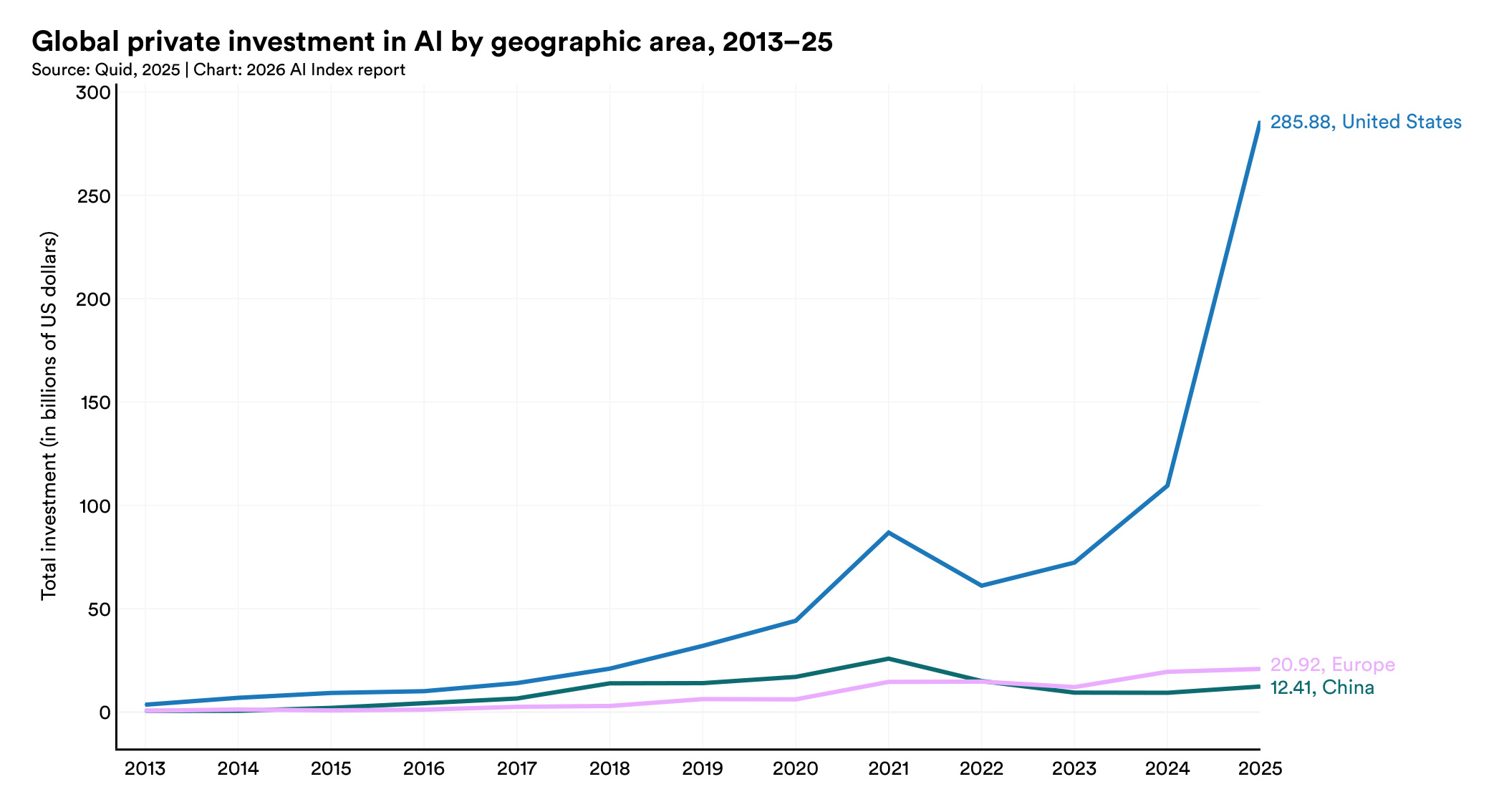
The urgency behind all of this is a talent shortage that has reached a genuine turning point, and it is the argument you make to a hiring manager who thinks open-source sourcing is exotic. ManpowerGroup's 2026 survey of more than 39,000 employers found that AI skills are, for the first time, the single hardest capability to fill worldwide - ManpowerGroup. Stanford's 2026 AI Index shows AI skills now appear in about 2.5 percent of US job postings, up roughly 300 percent over the decade, while the credentialed pipeline barely moved, with new AI PhDs rising only 22 percent from 2022 to 2024 - Stanford HAI. Meanwhile GitHub's Octoverse reported more than 180 million developers and a 178 percent year-over-year jump in public repositories using LLM SDKs, which is the open-source footprint the whole method rests on - GitHub. Demand is vertical, formal supply is flat, and the realistic answer is to reach the passive builders who publish in the open rather than wait for credentialed candidates to apply.
The shortage also has a shape, and knowing it sharpens where you point the method. ManpowerGroup found that 72 percent of employers report difficulty filling roles, with AI model and application development (cited by 20 percent) and AI literacy (19 percent) topping the list of hardest skills - ManpowerGroup. The demand is also more global than a US-centric recruiter assumes: AI skills appear in a higher share of postings in Singapore (about 4.7 percent) than anywhere else, ahead of Hong Kong, Luxembourg, and Spain, which matters because Hugging Face is a borderless surface where a builder in Singapore or Shenzhen is exactly as visible as one in San Francisco - Lightcast. And the fastest-growing sub-skill is agentic AI, which jumped from 0.06 percent of US postings in 2024 to 0.23 percent in 2025, so the people building and shipping agent frameworks on the Hub right now are the ones about to become the hardest hires of all.
12. Staying Legal and the Recruiter's Playbook
Sourcing on Hugging Face is legal and legitimate, but it is not lawless, and the constraints are worth stating plainly so you can act with confidence. On the platform side, Hugging Face's Terms of Service grant a perpetual, irrevocable, royalty-free license to access and use content in public repositories, and the ToS contains no explicit anti-scraping clause, delegating personal-data handling to its Privacy Policy - Hugging Face. The real operative limits are technical: the enforced rate limits described earlier, which you respect by authenticating and throttling, and the fact that member emails are never publicly exposed. The Privacy Policy is explicit that public profile information is viewable by anyone, lists legitimate interest among its lawful bases, and lets people request erasure - Hugging Face.
On the recruiter's side, a Hugging Face profile is personal data, so EU sourcing rests on the GDPR's legitimate interest basis under Article 6(1)(f), and the European Data Protection Board's Guidelines 1/2024 require a documented three-part test of purpose, necessity, and balancing before you process it - EDPB. In practice, sourcing someone for a role they plausibly fit is a recognized legitimate interest, but you must run and record a short Legitimate Interest Assessment, inform the candidate once you store their data in a CRM (a roughly 30-day notice window is the widely-cited norm), and honor deletion and objection requests promptly - Taleva. None of this is onerous. It is a one-paragraph assessment per project and a timely privacy notice, and doing it protects both you and the candidate.
It is just as important to be honest about where this method fails, because no channel is complete and overconfidence here is expensive. The biggest blind spot is that Hugging Face only shows you people who publish openly, and some of the most valuable talent, the core researchers inside closed frontier labs, deliberately do not, so a pure Hugging Face search will systematically miss a slice of the very top of the market. The signals also decay and mislead if you read them lazily: download counts inflate, the trending formula is undocumented, org rosters are an opt-in floor rather than a full headcount, and commit-mined emails increasingly bounce off GitHub's privacy address. There is a practical reachability problem too, since a growing share of the best open builders sit in the Qwen and DeepSeek ecosystems where timezone, language, visa, and compensation expectations complicate a hire. The method is a powerful complement to LinkedIn, referrals, and inbound, not a replacement for them, and the recruiters who win treat it as one strong lane in a multi-channel strategy rather than a silver bullet.
Pulling the whole guide together, the playbook for sourcing AI talent on Hugging Face is a short, repeatable loop you can run for any role. You define the niche as a task or model family rather than a job title, because that is the unit the Hub is organized around. You rank by adoption and momentum and roll the top models up to their authors, so the platform does your first-pass shortlisting for you. You verify the builder through commit history and claimed papers rather than trusting a model card's prose, which is the step that stops you crediting the wrong person. You cross-reference to a real contact off-platform, discarding the noreply emails that will only bounce. And you reach out with specificity, calibrated to the candidate's genuine leverage, because a message that proves you read their work is the only kind these people answer.
That loop is the entire method, and its power comes from discipline at each turn: reading the activity feed before the totals, weighting proof of work over vanity metrics, and always confirming a name in two places before you commit it. The reason this works is that the scarcest, most valuable AI builders have already told you what they can do, in public, in a format that cannot be faked, and most recruiters simply have not learned to read it. The ones who do are sourcing from the front of the line while everyone else waits for applications that never come. And because the platform rewards steady presence, the recruiters who build a real reputation in these communities, who show up, understand the work, and treat builders as peers rather than leads, will find the best people starting to reply faster and refer their friends, which compounds in a way no purchased database ever will. Whether you run this by hand, augment it with a semantic tool, or hand the volume roles to an autonomous recruiter, the underlying edge is the same: go to where the work lives, read it honestly, and reach the person behind it like someone who understands what they built.
Reading Hugging Face by hand is the edge no tool yet automates, but for the volume roles around it, an autonomous recruiter that sources from a billion profiles and runs outreach on autopilot frees your attention for the hard hunts. HeroHunt.ai starts with an 8-day free trial (card required), then a flat plan from $99 a month with unlimited open roles.
This guide reflects the AI talent landscape and the Hugging Face platform as of August 2026. The Hub's inventory, pricing across sourcing tools, and the reported Nvidia acquisition all change quickly, so verify current details before acting on any single number.