



Searching engineering talent on Stack Overflow
Stack Overflow is a question and answer website for engineers. On the platform users vote questions and answers up or down similar to Reddit. Users can earn reputation points and "badges" by giving valuable answers that get upvoted. Their reputation, score and technology tags are strong indicators of the technologies a user has actually worked in, because they are earned by solving real problems in public rather than typed into a profile.
One thing has changed fundamentally since this guide was first written, and it changes how you should use the platform: Stack Overflow is now an archive, not a live community. The back catalogue is enormous and still the best public record of who genuinely solved hard problems in a given technology. But the flow of new questions has effectively stopped, so a profile tells you what someone was deep in a few years ago, not necessarily what they are doing this quarter. Source it as a historical skills record and it works well. Treat it as a real-time interest signal and you will be wrong most of the time.
Key facts
- Engineer profiles, 31.4 million registered users
- An archive of 24.3 million questions and 36.1 million answers
- Skills evidence based on demonstrated Q&A activity, but mostly historical
- No recruiter messaging: profiles carry no email address
Those totals come from Stack Exchange's own info endpoint, which reports live site totals and is worth checking yourself rather than trusting a stats blog. The user count is the number most often quoted wrong: many sourcing guides still cite the 18 million figure from several years ago, when the real total has since passed 31 million.
What changed: the Q&A collapse
New question volume has fallen by roughly 98% since ChatGPT launched, and this is the single most important fact for anyone planning to source here. Developers now ask an AI assistant the question they would previously have posted publicly. The numbers below are counted directly from the Stack Exchange API, using the questions endpoint with a date range for each month, so you can reproduce them yourself.
| Month | New questions posted |
|---|---|
| June 2014 (near peak) | 161,807 |
| November 2022 (ChatGPT launch) | 109,375 |
| June 2024 | 31,990 |
| June 2025 | 7,761 |
| June 2026 | 2,172 |
The practical consequence for sourcing is specific. A candidate's top tags are a durable record of proven competence, and competence in Postgres or Kubernetes does not evaporate. But the recency claim that older sourcing guides make about Stack Overflow no longer holds, so you have to establish recency separately, from the profile's last access date and the date stamps on their top posts. Do not open an outreach message with "I saw you're active in the Rust community" if their last answer was in 2019. That is the fastest way to prove you did not actually look.
One trap to know about: reputation keeps rising passively. Old answers keep collecting upvotes for years, so a growing reputation score is not evidence that a person still participates. Checking a sample of the top answerers across popular tags, nearly all had gained reputation in the past year, but only around two thirds had logged in within the past 90 days. Reputation growth measures traffic to their old work, not their presence today.
Information
You can really deep dive into the people you want to learn more about on Stack Overflow. Because of the Questions & Answers (Q&A) set up, most of the information like top technology tags, reputation, badges and scores is based on actual activity rather than the candidate's own input, which makes it far more reliable than a self-reported skills list on a CV. The trade-off, as above, is that this evidence is time-stamped, so always read it together with the dates.
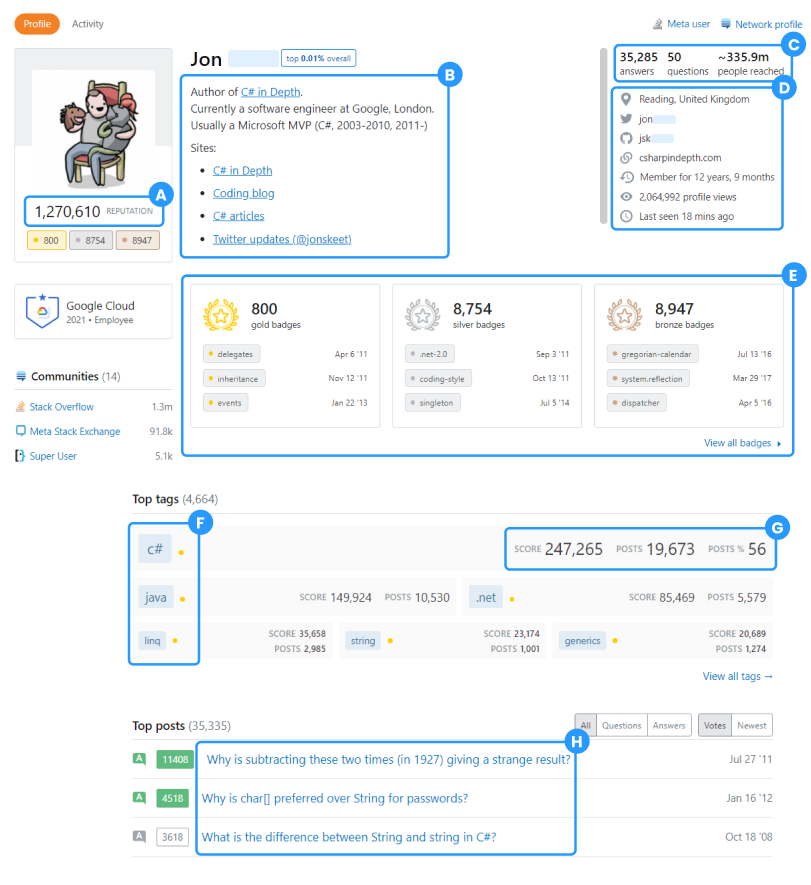
B: About section (free text)
C: Answers, questions and people reached
D: Location, links to socials and contact info
E: Earned badges for posting questions and answers
F: Top tech tags assigned related to the posted questions and answers
G: Score (the sum of all values of upvotes minus the downvotes) and the amount of posts
H: Titles of the top posts (questions and answers)
How much of this is actually filled in matters for planning. Sampling the top 100 users by reputation, 88% had a location and around 65% had a website link, which is the field that most often leads to a real name. Fill rates drop sharply as you move down the reputation table, so the further into the long tail you source, the more of these profiles will be an anonymous handle and nothing else.
How to search Stack Overflow
Stack Overflow used to offer licenses for recruiters to source directly on the platform. It shut that business down: Jobs, Developer Story and the Salary Calculator were all retired on 31 March 2022, with the company stating that talent acquisition was not a space where it had a competitive advantage - Stack Overflow. Only the advertising and employer branding products remain. There is no seat you can buy that lets you message developers here, which is why every method below is a free one.
Stack Overflow user search
The user directory lets you filter people directly by tag and location, which is the fastest way in and the one most recruiters miss. It takes a location string and a tag, then ranks by reputation. Start there before you reach for anything cleverer.
You can also search technology tags to find questions and answers, then work back to the people, ranking results by votes. This is slower but surfaces the person who wrote the definitive answer on a niche problem, who is often exactly the specialist you want.
Google search (X-ray) Stack Overflow users
X-ray Stack Overflow by searching user profiles in Google with operators and keywords to filter for profiles. Keep the query short: long strings of copied operators tend to return nothing.
For example, to find Java developers in Germany:
site:stackoverflow.com/users java "germany" -"Keeping a low profile"The final operator is the useful part. "Keeping a low profile" is the placeholder text Stack Overflow shows on profiles with an empty About section, so excluding it strips out the blank profiles that would otherwise dominate your results.
The API shortcut: top answerers per tag
The fastest route to a shortlist is the public API, and it needs no key for light use. The top-answerers endpoint returns the people with the highest answer score in a tag, which is a ranked list of proven experts in one request:
https://api.stackexchange.com/2.3/tags/rust/top-answerers/all_time?site=stackoverflowSwap rust for any tag, and all_time for month or quarter to bias towards people who are still active. That period switch is the single most useful control you have now that the site is mostly archive: all_time returns the legends of 2015, while quarter returns people who showed up recently. The user objects it returns include location, website, about text and last access date, but never an email.
The Data Explorer for precise filtering
Stack Exchange Data Explorer runs SQL against a copy of the public database, refreshed weekly, for free. It is the most powerful sourcing tool on the platform and almost nobody in recruitment uses it. This query finds people who answered in a tag, in a location, and have logged in within six months:
SELECT TOP 200
  u.Id AS [User Link],
  COUNT(*) AS [Answers in tag],
  u.Reputation,
  u.Location,
  u.WebsiteUrl,
  u.LastAccessDate
FROM Posts a
  JOIN Posts q ON q.Id = a.ParentId
  JOIN Users u ON u.Id = a.OwnerUserId
WHERE a.PostTypeId = 2
  AND q.Tags LIKE '%<##tag##>%'
  AND u.Location LIKE '%##location##%'
  AND u.LastAccessDate > DATEADD(month, -6, GETDATE())
GROUP BY u.Id, u.Reputation, u.Location, u.WebsiteUrl, u.LastAccessDate
HAVING COUNT(*) >= 3
ORDER BY [Answers in tag] DESC
Two details make this work. Answers do not carry tags themselves, so the query joins each answer back to its parent question to read the tags from there, which is why it targets answerers rather than askers. And the LastAccessDate filter is what rescues the results from the archive problem: it drops everyone who has not logged in recently, which on Stack Overflow in 2026 is most of the database.
Getting from a profile to a conversation
This is where Stack Overflow sourcing actually succeeds or fails, and it is the step most guides skip. You now have a ranked list of engineers who demonstrably know the technology. You have no way to contact any of them. There is no InMail, no recruiter seat, and no email in the profile or the API. Every message you send has to start somewhere else.
The reliable path runs through the profile's own links. The website field, present on roughly six in ten strong profiles, usually points to a personal site, a blog or a GitHub account, and that is where the handle turns into a real name and often a current employer. GitHub is the highest-yield hop, since many developers publish a contact address there. Once you have a real name and a company, a B2B contact database like Apollo.io can find the work email.
Apollo.io
Stack Overflow is the rare sourcing channel where you can identify exactly the right engineer and still have no way to reach them. Apollo.io is the cheapest way to close that last step: the free plan issues 900 credits per seat per year, released monthly rather than upfront, so roughly 75 lookups a month. For Stack Overflow work that is usually enough, because you are chasing twenty strong Rust answerers, not a list of thousands. The honest caveat matters more here than on most channels: Apollo is indexed on company, so it only helps after you have turned a Stack Overflow handle into a real name and an employer via the profile's website or GitHub link. Against a bare anonymous handle, the hit rate is poor and no contact database will fix that. If you do need volume, the next tier is $49 per seat/month billed annually ($65 month to month).
Whatever you use to find the address, the message itself has to earn the reply. These are people who chose not to list an email, so a generic template lands badly. Reference the specific answer, name the problem it solved, and be honest that you found them through their public work. Tools like HeroHunt.ai automate the same find-and-contact loop across a much larger pool of profiles if you would rather not run the chain by hand, but on Stack Overflow specifically the manual read of someone's top answer is often what makes the message work.
When Stack Overflow is worth it
Use Stack Overflow when you are hiring for depth in a specific technology and you want evidence rather than claims. For a hard Rust, Postgres or Kubernetes problem, a person with several thousand answer score in that tag has proven something a CV cannot. The channel is free, it is uncrowded because most recruiters left when Jobs shut down in 2022, and the people you find are rarely being messaged by anyone else.
Do not use it as your primary channel for volume hiring, for junior roles, or for anything outside a well-tagged technology. The activity collapse means recent graduates have barely used the site, so it now skews heavily towards engineers who were mid-career a decade ago. Combined with the missing contact details, the cost per contacted candidate is high. It is a scalpel for specialist roles, not a pipeline.
HeroHunt.ai
That last paragraph is the case for pairing the channel rather than relying on it. Stack Overflow's 31.4 million registered users are a closed pool with no email field and, as of June 2026, just 2,172 new questions in the month, so the archive stops growing while your requisitions do not. HeroHunt.ai runs the same find-then-contact loop across a far larger index of public profiles and handles the contact step for you, which is what makes it a pipeline rather than a scalpel. The honest caveat: it will not reproduce what makes Stack Overflow special. Nothing replaces reading a person's top-voted answer in a tag and seeing they actually solved the problem, so for one deep Rust or Postgres specialist the Data Explorer query above is still the better signal. Use it for breadth, keep Stack Overflow for proof.
Written by Yuma Heymans (@yumahey), who built HeroHunt.ai, the world's first AI Recruiter, now used by 15,000+ recruiters to source engineers from over a billion profiles. Figures here were counted from the Stack Exchange API in July 2026; the platform moves, so re-run the numbers before you rely on them.