


A recruiter's field guide to the one 1970s privacy law that decides whether your shiny AI sourcing stack is a convenience or a lawsuit.
In January 2026, two job applicants sued an AI hiring vendor for acting like a credit bureau it never registered as. The proposed class action, Kistler v. Eightfold AI, alleges that Eightfold scored candidates from 0 to 5 on their predicted likelihood of success, drawing on more than 1.5 billion data points including roughly a billion worker profiles scraped from LinkedIn, GitHub and Stack Overflow, and then let no applicant see or dispute that score. The legal theory is not discrimination. It is that the tool quietly became a consumer reporting agency under a statute written in 1970, and skipped every obligation that status carries.
That statute is the Fair Credit Reporting Act, and most recruiters have never read it. For decades the FCRA lived in the world of background-check vendors and credit bureaus, a compliance chore you outsourced to a screening company. The AI sourcing boom has dragged it into the open. When a platform aggregates public data you did not gather, evaluates a person against other people, and hands you a rank or a fit score you use to decide who advances, the same law that governs Equifax can attach to your recruiting workflow, along with statutory damages of $100 to $1,000 per applicant for willful violations - 15 U.S.C. 1681n.
Here is the good news, and it is the spine of this guide: sourcing is usually safe, and screening is where the FCRA bites. Finding candidates from public profiles and reaching out to them is not, on its own, a consumer report. The risk lives in the evaluation step, the moment a third-party-assembled score, dossier or ranking is used to filter people for a hiring decision. Getting that line right is the difference between a tool that saves you time and one that quietly signs you up as a regulated data operation.
This guide breaks down what the FCRA actually regulates, the exact line between sourcing and screening, when your vendor becomes a CRA, the duties you personally inherit as an employer, the enforcement and litigation record that makes this concrete, the patchwork of state and EU laws now stacking on top of the FCRA, how the major AI sourcing platforms handle the line, and a practical compliance playbook you can run this quarter. Everything here is grounded in the law as it stands in 2026, because this is a fast-moving area where a memo from last year can already be withdrawn.
Written by Yuma Heymans (@yumahey), who built HeroHunt.ai and has spent five years building autonomous sourcing agents, which meant living inside exactly this question: where does finding a candidate end and evaluating one begin. This is a practical guide, not legal advice.
AI in the workplace is no longer an edge case, which is exactly why this matters now. By 2024, 78% of organizations reported using AI in at least one business function, up from 55% a year earlier, according to the Stanford HAI AI Index.
AI adoption crossed into the mainstream in 2024
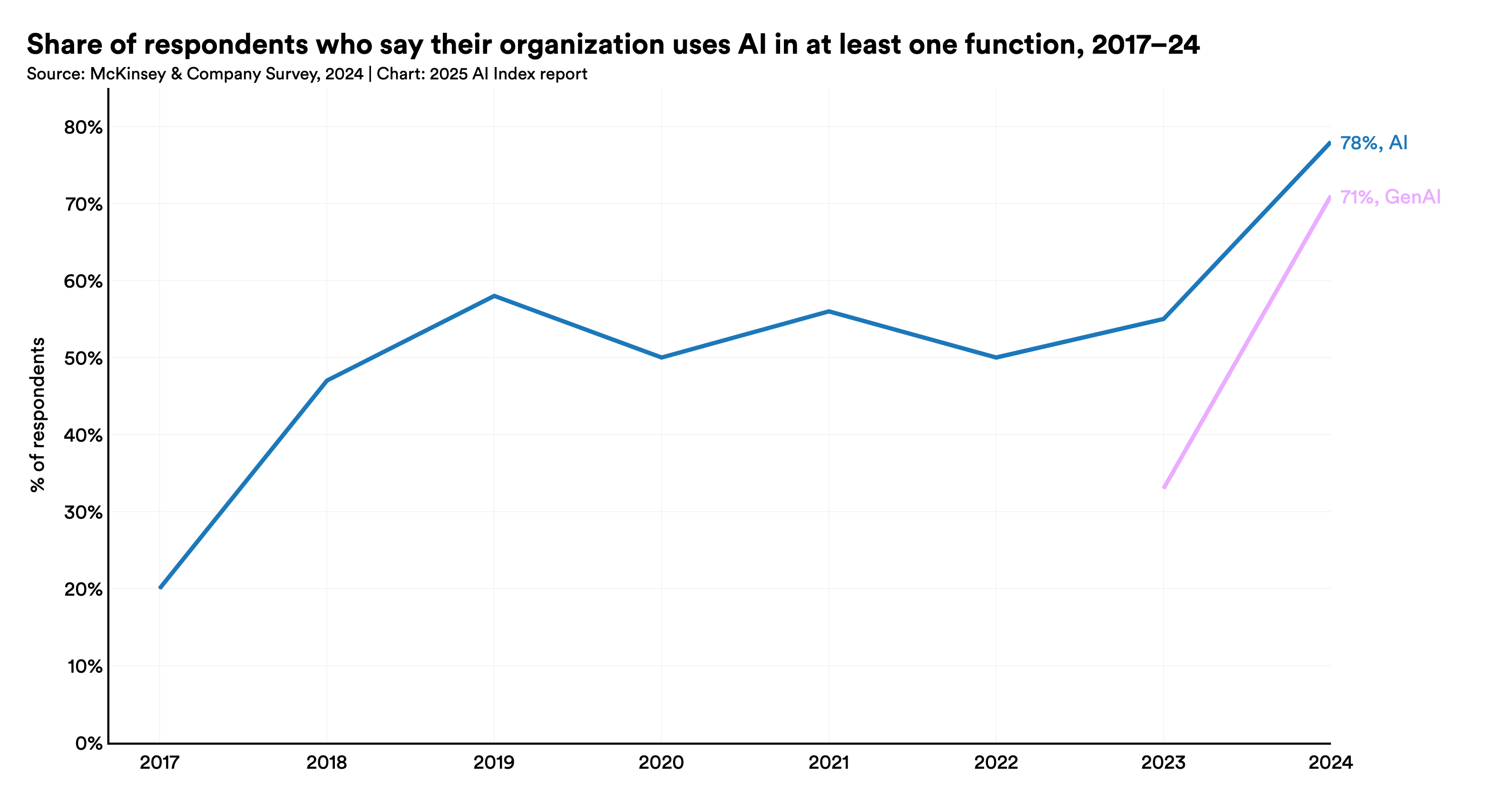
When a technology moves from 20% adoption to 78% in a few years, the compliance questions that used to affect a handful of specialist vendors suddenly affect nearly everyone who hires. That is why the FCRA question has gone from niche to unavoidable, and why the sections that follow spend as much time on your own workflow as on the tools you buy.
Contents
- The Short Answer: Sourcing Is Safe, Screening Is Where It Bites
- What the FCRA Actually Regulates
- The Line That Decides Everything: Finding vs. Evaluating
- When Your AI Sourcing Tool Becomes a Consumer Reporting Agency
- What You Owe as the Employer
- The Enforcement Record and the CFPB Whiplash
- The Litigation Wave: Eightfold, Workday, and Disclosure Class Actions
- The Laws Stacking on Top of the FCRA
- How the Major AI Sourcing Tools Handle the Line
- A Vendor-and-Workflow Compliance Playbook
- The Future: Agentic Sourcing and Automated Reports
- Conclusion: A Decision Framework
1. The Short Answer: Sourcing Is Safe, Screening Is Where It Bites
If you remember one thing from this guide, remember that the FCRA does not care what your tool is called or how its marketing describes it. It cares about what the output is and what you do with it. A platform that helps you discover people who might fit a role, and lets you contact them, is doing sourcing, and sourcing sits outside the FCRA. A platform that assembles information about a person and evaluates them so you can decide their eligibility is producing something that starts to look like a consumer report, and that is a regulated activity with a long list of obligations attached.
This distinction is not a technicality invented by lawyers. It follows directly from how the statute is written, and it maps cleanly onto the product flow of every AI recruiting tool on the market. The same vendor can sit on both sides of the line depending on the feature you use. Its search index, the part that surfaces candidates, is almost certainly fine. Its predictive scoring, the part that ranks candidates by a number you use to cut the list, is where the exposure concentrates. Understanding that split lets you keep the productivity of AI sourcing without walking into a regulated posture you did not intend.
The practical shape of the risk comes down to three questions you can ask about any tool. Answer them honestly and you will know roughly where you stand before you ever call a lawyer.
- Where does the data come from? Data the applicant gave you directly is lower risk than data the tool pulled from third parties.
- Does the tool evaluate the person? A raw list is lower risk than a score, rank, flag or recommendation.
- Do you act on that evaluation? Using the output to reject, rank or shortlist is the trigger, not merely receiving it.
Those three questions are the whole ballgame, and the rest of this guide is essentially a careful walk through each one. The reason the framing matters so much is that vendors and buyers both tend to reach for reassurance in the wrong place. They point to a disclaimer in the terms of service, or to the fact that the data was public, as if either settles the question. Neither does. As the following sections show, the FCRA has spent fifty years being clear that use defines the report, and courts and regulators have repeatedly refused to let a contract clause or a public-data argument override how the information actually functions in a hiring decision.
To make the line concrete, picture two versions of the same Tuesday. In the first, you type a natural-language query into a sourcing tool, it returns twenty public profiles of people who look like a fit, and you send each of them a personal note. Nothing there is a consumer report: you found people and you contacted them. In the second version, the same tool hands you those twenty profiles each stamped with an 82% fit score, silently ranks a further eight hundred candidates below a cutoff, and you interview only the top of the list and never look at the rest. Now a third party has assembled information and evaluated people, and you have used that evaluation to decide who is eligible to advance. The tool did not change between the two Tuesdays; your use of its output did, and that is the only variable the FCRA is watching. Almost every hard call in this guide is really a version of these two Tuesdays, and learning to feel the difference is most of the skill.
2. What the FCRA Actually Regulates
The Fair Credit Reporting Act regulates three things, and once you can name them you can reason about almost any tool. It regulates a kind of document called a consumer report, a kind of company called a consumer reporting agency, and a set of duties that fall on whoever uses the report. The genius and the trap of the law is that all three definitions turn on purpose and use rather than on labels, which is exactly why AI sourcing tools keep wandering into scope without meaning to.
A consumer report is any communication from a consumer reporting agency bearing on a person's character, general reputation, personal characteristics or mode of living that is used or expected to be used as a factor in establishing eligibility for credit, insurance, or employment - 15 U.S.C. 1681a(d)(1). Read that phrase again, because it is the hinge of the entire statute: used or expected to be used. The information does not become a consumer report because of what it contains. It becomes one because of what it is for. A list of a candidate's past employers is inert data in a spreadsheet and a consumer report the moment it is assembled by a third party and used to judge someone's fitness for a job.
A consumer reporting agency is any person or company that, for fees, dues, or on a cooperative nonprofit basis, regularly engages in whole or in part in the practice of assembling or evaluating consumer information in order to furnish consumer reports to third parties. The operative words are assembling or evaluating. A vendor that merely passes through data a candidate typed into an application is on very different footing from one that gathers data from across the web and runs it through a model to produce a judgment. That second activity, evaluating consumers to furnish reports, is the textbook definition of a CRA, and it is precisely what an AI scoring engine does when you strip away the branding.
Two words in that definition carry more weight than their size suggests: in whole or in part. A company does not dodge CRA status by making evaluation a minor side activity, or by reselling data that another firm originally assembled. Regularly evaluating consumer information to furnish reports, even as one slice of a broader business, is enough to qualify - FTC. This is exactly why the analysis reaches AI platforms whose headline pitch is search or workflow rather than reporting. If a scoring feature that ranks people for employers is a regular part of what the product does, the fact that most of the product is something else offers no shelter. The statute was drafted to catch precisely the firm that insists reporting is not really its business, and a modern AI vendor insisting the same thing is standing exactly where the law expects to find it.
When the report is used for hiring, promotion, reassignment or retention, the FCRA calls it a report for employment purposes - 15 U.S.C. 1681a(h). That definition is broader than most recruiters expect. It reaches beyond the initial hire to promotions and even to ongoing retention decisions, which is why continuous-evaluation tools that keep scoring your existing workforce can fall in scope too. Employment is one of the statute's enumerated permissible purposes - 15 U.S.C. 1681b(a)(3)(B), meaning a CRA is allowed to furnish an employment report only to someone who certifies they will use it for employment and nothing else, and the agency must make a reasonable effort to verify that user and that certified use - 15 U.S.C. 1681e(a).
The reason all of this should hold your attention is the penalty structure sitting underneath it. For willful violations, a consumer can recover actual damages or statutory damages between $100 and $1,000 per violation, plus punitive damages and attorney's fees, with no need to prove any out-of-pocket loss - 15 U.S.C. 1681n. For negligent violations, recovery is limited to actual damages and fees - 15 U.S.C. 1681o. Multiply a $1,000-per-person statutory figure across a candidate pool of tens of thousands and you understand why FCRA class actions are a cottage industry, and why a scoring feature nobody thought about legally can become the most expensive line item in your recruiting budget.
3. The Line That Decides Everything: Finding vs. Evaluating
The single most useful mental model in this whole area is a decision tree with one branch point: are you finding people, or are you evaluating them? Sourcing is finding. You surface candidates who might fit, using public information, and you reach out on your own initiative. Screening is evaluating. You take an assembled body of information about a person and use a judgment derived from it to decide whether they advance. The FCRA switches on at the evaluation branch, not the finding branch, and almost every hard case is really an argument about which branch a given feature falls into.
Legal analysts have converged on a set of concrete tests for spotting the crossover, and they are worth internalizing because they are more reliable than any vendor's self-description. A tool is far more likely to be producing a consumer report if it pulls data beyond what the applicant gave you, if it makes inferences or comparisons against external benchmarks or other workers, or if it generates a score, rank or recommendation that you then use to filter candidates - Fisher Phillips. Each of those is a step away from neutral discovery and toward regulated evaluation. Finding a Rust engineer in Berlin from public GitHub activity is sourcing. Receiving a ranked shortlist where each engineer carries a proprietary fit score you use to decide who to interview is much closer to screening.
The diagram below shows the branch point and why the same platform can be safe on one screen and exposed on the next.
Notice that the branch is decided by the output and your use of it, not by the underlying technology. This is why a "public data" defense so often fails. The fact that a profile was publicly visible on LinkedIn tells you nothing about whether the tool that harvested and evaluated it produced a consumer report, because the FCRA has never turned on whether the source data was secret. It turns on whether a third party assembled or evaluated that data and whether you used the result to judge eligibility. Public inputs and a regulated output are entirely compatible, and pretending otherwise is one of the most common and expensive mistakes in this space.
A related myth deserves killing here, the belief that keeping a human in the loop automatically keeps you out of the FCRA. It does not. The statute attaches to the assembling or evaluating done by the third party and to the use of the resulting report, not to whether a person rubber-stamps the machine's output at the end. If a vendor assembled data and produced a score, that score can be a consumer report the instant you rely on it, even if a recruiter formally makes the final call. A human reviewer changes the discrimination analysis, because it can break a claim of fully automated decision-making, but it does not convert a consumer report back into ordinary data. Recruiters routinely conflate these two questions, assuming that because a person signs off, no report exists. The cleaner way to think about it is that the human decides whether to act, while the FCRA governs what they are acting on, and those are different things the law treats separately.
The practical upshot for recruiters is liberating rather than frightening, if you organize around it. You can lean hard on AI for the finding half of the job, where the exposure is minimal, and treat every scoring, ranking or automated-rejection feature as a checkpoint where you slow down and ask whether you have crossed into report territory. Teams that draw the line cleanly get most of the speed benefit of AI sourcing without inheriting a compliance regime built for credit bureaus. Teams that blur it tend to discover the line only when a demand letter arrives.
4. When Your AI Sourcing Tool Becomes a Consumer Reporting Agency
A vendor becomes a consumer reporting agency by behavior, not by choice, and this is the fact that catches product teams off guard. You do not opt in to CRA status by registering somewhere. You back into it by regularly assembling or evaluating consumer information and furnishing the result to employers who use it for hiring. If your AI sourcing platform ingests data from across the web, builds a profile of a person, scores or ranks them, and delivers that to customers who screen candidates with it, the platform is doing the exact activity the statute describes, whatever the pitch deck says.
The most important corollary is that a disclaimer does not save you. The FTC has been explicit about this for more than a decade: simply announcing that you are not a consumer reporting agency, or that your data is "not for employment purposes," does not exempt a company from the FCRA if it is in fact assembling or evaluating consumer information used for eligibility decisions - FTC. To actually stay out of CRA status, a vendor has to do more than post terms of service. It has to genuinely not market to HR, train its people not to sell for FCRA-covered purposes, and enforce those limits in practice, because intended or foreseeable use can transform data into a consumer report even against a sender's stated wishes - Carlton Fields.
There is a second, quieter risk hiding in where these tools get their data, and it travels alongside the FCRA question rather than replacing it. Many AI sourcing platforms are built on scraped public profiles, and the legality of that scraping is genuinely contested. In the long fight between hiQ Labs and LinkedIn, the Ninth Circuit held in 2022 that scraping public data does not violate the federal Computer Fraud and Abuse Act - Justia, a ruling widely misread as a blanket green light. The same case then ended in December 2022 with a $500,000 judgment and a permanent injunction against hiQ for breaching LinkedIn's user agreement, which bans scraping outright - Morgan Lewis. The takeaway for recruiters is that a tool's underlying data can be lawful to access under one statute and a contract breach under another, at the same time. That provenance exposure is separate from, and stacks on top of, the consumer-report exposure this guide centers on, and a vendor cavalier about one is often cavalier about both.
This is the trap that swallowed the original data brokers, and AI sourcing tools are walking the same path with better graphics. The FTC's landmark 2014 study, "Data Brokers: A Call for Transparency and Accountability," documented brokers operating at almost unimaginable scale, with one holding data on more than 1.4 billion consumer transactions and 700 billion data elements, and another adding 3 billion new data points monthly, all assembled about people who had no idea it was happening - FTC. Modern AI sourcing platforms are, functionally, data brokers with a recruiting interface and a language model on top. When they add an evaluative score for employers, they inherit the same legal exposure the FTC has been pursuing since the last decade.
The line, then, is not "does the tool use AI" but "does the tool assemble and evaluate people, and sell that to employers as an input to hiring." A pure search index that returns public profiles and stops there is sourcing infrastructure. A predictive-fit engine that hands employers a ranked verdict is a strong candidate for CRA status, no matter how the vendor labels itself. If you are evaluating tools, this is the question to press hardest, because the answer determines whether the compliance burden lands on a specialist vendor who has built for it or lands, unexpectedly, on you.
5. What You Owe as the Employer
Even when your vendor is unquestionably a compliant CRA, the FCRA hands you, the employer, a set of non-delegable duties, and "the vendor said it was handled" has never been a defense. This is the part recruiters most often miss. The obligations of the user of a consumer report are separate from the obligations of the agency that produced it, and you own your half regardless of how buttoned-up your background-check provider is. If any AI tool in your stack produces something that qualifies as a consumer report and you act on it, these duties attach to you.
Before you obtain a report, you must give the candidate a clear and conspicuous written disclosure, in a standalone document that consists solely of that disclosure, and obtain their written authorization - 15 U.S.C. 1681b(b)(2). The word "solely" is doing enormous work here. Courts have treated it strictly, and adding extra content, a liability waiver, at-will language, even a helpful-looking footnote, can turn the form itself into a per se violation. The Ninth Circuit reinforced this in Gilberg v. California Check Cashing Stores, holding that a disclosure crammed with extraneous state-law notices flunked the standalone requirement even though nothing in it was false. A tidy, single-purpose form is not a nicety; it is the law.
If you then decide not to hire someone based even partly on the report, a two-step adverse action process kicks in, and the timing matters. First, you send a pre-adverse-action notice that includes a copy of the report and the CFPB's "A Summary of Your Rights Under the FCRA" - 15 U.S.C. 1681b(b)(3). You then wait a reasonable period so the candidate can dispute an error before the decision is final; the FTC has long treated roughly five business days as reasonable - FTC advisory opinion. Only after that do you send the post-adverse-action notice, which must identify the agency and state that the agency did not make the decision, along with the candidate's dispute and free-report rights - 15 U.S.C. 1681m. Note the 2023 refresh of the Summary of Rights form, which replaced the older version and became mandatory in March 2024, so an outdated PDF in your workflow is its own small liability.
It helps to see the adverse-action rules as a timeline rather than a checklist, because the sequence and the pauses are the whole point. Picture an AI tool in your pipeline flagging a candidate you are now inclined to pass over. On day one you send the pre-adverse-action notice with a copy of the report and the summary of rights, and then you deliberately stop. You do not send the rejection, mark the requisition closed, or tell the hiring manager it is settled. You wait, roughly five business days, so the candidate has a real window to say the report is wrong. If they surface an error, you pause and let it be investigated before going further. Only once that window closes without a valid dispute do you send the final post-adverse-action notice and end the process. The single most common way employers blow this is compressing every step into a single day, which feels like efficiency and litigates as a willful violation carrying statutory and punitive damages - ABA.
The reason this section deserves real attention is that the cheapest violations to commit are the procedural ones, and they are also the most litigated. You can run an accurate, well-sourced report and still get sued for handing a candidate a disclosure form with one extra sentence on it, or for pulling the trigger on a rejection before the waiting period elapsed. These are not judgment calls about a candidate's character; they are mechanical steps, which is exactly why plaintiffs' firms love them. If any part of your AI stack is producing consumer reports, the fix is not to hope the vendor covers you. It is to build the standalone disclosure, the waiting period, and the two-notice sequence into your own process and treat them as load-bearing.
6. The Enforcement Record and the CFPB Whiplash
The regulators got to AI sourcing years before the AI did, because they had already spent a decade chasing the data brokers underneath it. The anchor case is Spokeo, a people-search company that marketed consumer profiles to HR departments, recruiters and employers as an employment-screening resource while ignoring the FCRA duties that came with it. In June 2012 the FTC settled for an $800,000 civil penalty, its first case addressing the sale of internet and social-media data in the employment-screening context, and the consent order bound Spokeo to compliance reporting for twenty years - FTC. Read Spokeo's fact pattern next to any modern AI sourcing pitch and the resemblance is uncomfortable: aggregate public and social data, package it for employers, let them make decisions with it.
The Spokeo action was not a one-off. In 2013 the FTC sent warning letters to ten data brokers, six of which appeared willing to sell consumer data for employment purposes without honoring the FCRA, putting the entire people-search industry on notice that selling profiles to employers could make them CRAs - FTC. That posture, that the activity defines the agency, has been the government's consistent through-line, and it is the reason the current wave of AI-scoring litigation feels less like a new frontier and more like the same argument with new defendants.
The data-broker cases also seeded a second FCRA duty that AI vendors underestimate: accuracy. A consumer reporting agency must follow reasonable procedures to assure maximum possible accuracy of what it reports, and a vendor that resells or infers data inherits that duty for the output it furnishes. That obligation is easy to state and hard to meet for a model that infers a person's skills, seniority or fit from scattered public signals, because an inference is a guess dressed as a fact. When the guess is wrong and it costs someone a job, the accuracy duty is the hook, independent of any disclosure defect. The through-line from the 2012 and 2013 data-broker actions to the 2026 AI-scoring suits is that regulators and plaintiffs treat an evaluative output as something a company is answerable for, not a neutral readout, and an AI score is about as evaluative as an output gets.
Where the ground has genuinely shifted is federal guidance, and here recruiters need to hold two facts in mind at once. In late 2024, the CFPB issued Circular 2024-06, which took the aggressive position that background dossiers and algorithmic scores obtained from third parties and used for hiring, promotion or other employment decisions are often consumer reports, pulling AI scoring vendors squarely under the FCRA - CFPB. It read like a roadmap for exactly the kind of case now being filed. Then the administration changed, and in May 2025 the Bureau withdrew that circular as one of dozens of guidance documents pulled back at once - Federal Register. A proposed rule that would have expressly treated many data brokers as CRAs was withdrawn the same month - Federal Register.
It is tempting to read the 2025 withdrawals as an all-clear, and that would be a serious mistake. Guidance documents interpret the statute; they are not the statute. Withdrawing a circular changes the enforcement mood in Washington, but it does not touch a single word of the FCRA's definitions of consumer report or consumer reporting agency, which are what actually decide the cases. The private plaintiffs' bar does not need a CFPB circular to file, and as the next section shows, it is filing anyway. If anything, a lighter federal enforcement posture shifts the action toward class-action litigation and state regulators, which are harder to predict and, for many employers, more dangerous.
It is worth being precise about what did and did not change in 2025, because the nuance is the whole ballgame. What changed was interpretation and mood: a circular telling companies how the Bureau read the statute, and a proposed rule that would have spelled out data-broker coverage, both went away. What did not change was the statutory text, the case law built on it, or the ability of any private plaintiff to sue under it. Regulators can decline to bring cases; they cannot repeal a definition by press release. So the 2025 rollback is best read not as deregulation of the risk but as a relocation of it, out of federal agencies and into courtrooms and state capitals, where the incentives to enforce are, if anything, sharper and less subject to the swings of a single administration. The following webinar, recorded in October 2025, walks through exactly this collision of background-check compliance and AI in hiring for a practitioner audience.
Background Checks, AI & FCRA: What's Next for Employers
7. The Litigation Wave: Eightfold, Workday, and Disclosure Class Actions
The theory that AI hiring tools can be consumer reporting agencies stopped being academic in January 2026. In Kistler v. Eightfold AI, filed January 20, 2026 in California's Contra Costa County Superior Court, two applicants allege that Eightfold operates as an unregistered consumer reporting agency under both the FCRA and California's ICRAA by ranking candidates 0 to 5 on predicted success, analyzing more than 1.5 billion data points including around a billion worker profiles, without ever letting applicants access or dispute the resulting evaluation - Norton Rose Fulbright. Whatever its outcome, the case is a template. It takes the exact product pattern of modern AI sourcing, aggregate widely, score predictively, deliver to employers, and asks a court to call it consumer reporting.
Running in parallel is the case every HR leader should be able to name, Mobley v. Workday, which attacks the same problem from the discrimination side and expands who can be sued. In July 2024, a federal judge in the Northern District of California ruled that Workday could be liable under Title VII, the ADA and the ADEA as an agent of the employers who used its AI screening tools, because those employers had delegated their traditional function of rejecting or advancing candidates to the software - Epstein Becker Green. Then in May 2025 the court granted conditional certification of a nationwide collective of applicants aged 40 and over who had been rejected through Workday since September 2020 - Proskauer. By early 2026 the court-authorized opt-in was open, turning a single plaintiff into a potential mass action - Forbes.
The mechanism the Workday court accepted is the part worth sitting with, because it generalizes well beyond Workday. The judge did not find that Workday finds employees the way a staffing agency does; it found that when employers hand the software the job of rejecting or advancing applicants, they delegate a traditional employer function, and the delegate can be liable as their agent - Civil Rights Litigation Clearinghouse. That reasoning is indifferent to whether the tool is an applicant tracking system or a sourcing platform with a scoring feature bolted on; it turns on whether a machine is making or shaping the call. Any vendor whose output decides who moves forward is exposed to the theory, and so is the employer who switched it on. Set that beside the Eightfold consumer-reporting claim and you have two independent legal routes, one through discrimination law and one through the FCRA, arriving at the same defendant from opposite directions.
Underneath these headline AI cases runs a much older and steadier stream of FCRA class actions built on pure paperwork, and it is the one most likely to touch an ordinary employer. These suits rarely allege that anyone was actually harmed by an inaccurate report. They allege that the disclosure form was defective, that it bundled extra language into a document the law says must stand alone. Barnes & Noble paid $600,000 to settle a case triggered by little more than a "not legal advice" footnote in its disclosure - Top Class Actions. Because statutory damages need no proof of loss, a single formatting decision replicated across thousands of applicants becomes a seven-figure exposure. A separate line of cases targets genuine inaccuracy rather than paperwork, such as the $5.695 million CoreLogic settlement over consumers wrongly flagged as deceased in resold reports - Top Class Actions, a reminder that both your process and your data can generate liability.
The chart below puts three of these outcomes side by side to make the scale legible. They are not identical claims: Spokeo was a federal civil penalty, Barnes & Noble a private disclosure-defect settlement, CoreLogic a private accuracy settlement. What unites them is that a piece of the recruiting or data-broker pipeline that felt routine became a six or seven-figure event.
FCRA Money on the Table (Selected Actions)
There is one more lesson buried in the litigation record, and it is a jurisdictional one that shapes every case above. In Spokeo, Inc. v. Robins (2016), the Supreme Court held that a bare procedural FCRA violation is not automatically enough to sue in federal court; a plaintiff must show a concrete injury - Hunton Andrews Kurth. That standing hurdle is real, but it is a speed bump rather than a wall, and it has pushed a great deal of FCRA litigation into state courts like the Contra Costa venue Eightfold now faces, where standing rules are friendlier to plaintiffs. The net effect for employers is that "it was only a technical violation" is a weaker shield than it sounds.
It is worth being blunt about who ends up on these complaints, because recruiters often assume the vendor absorbs the risk. They do not, or at least not alone. In the consumer-report framework the employer is the user of the report and carries its own non-delegable duties, so a disclosure defect or a skipped adverse-action step names you, not your software provider. In the discrimination framework, Workday shows the vendor can be dragged in as an agent, but the employer who deployed the tool remains a primary defendant. The realistic picture is joint exposure: employer and vendor both named, each pointing at the other, with the plaintiff happy to collect from whoever pays first. A contract that shoves all responsibility onto the vendor feels reassuring right up until a court reads the FCRA, which assigns the user's duties to the user regardless of what the two companies agreed between themselves.
8. The Laws Stacking on Top of the FCRA
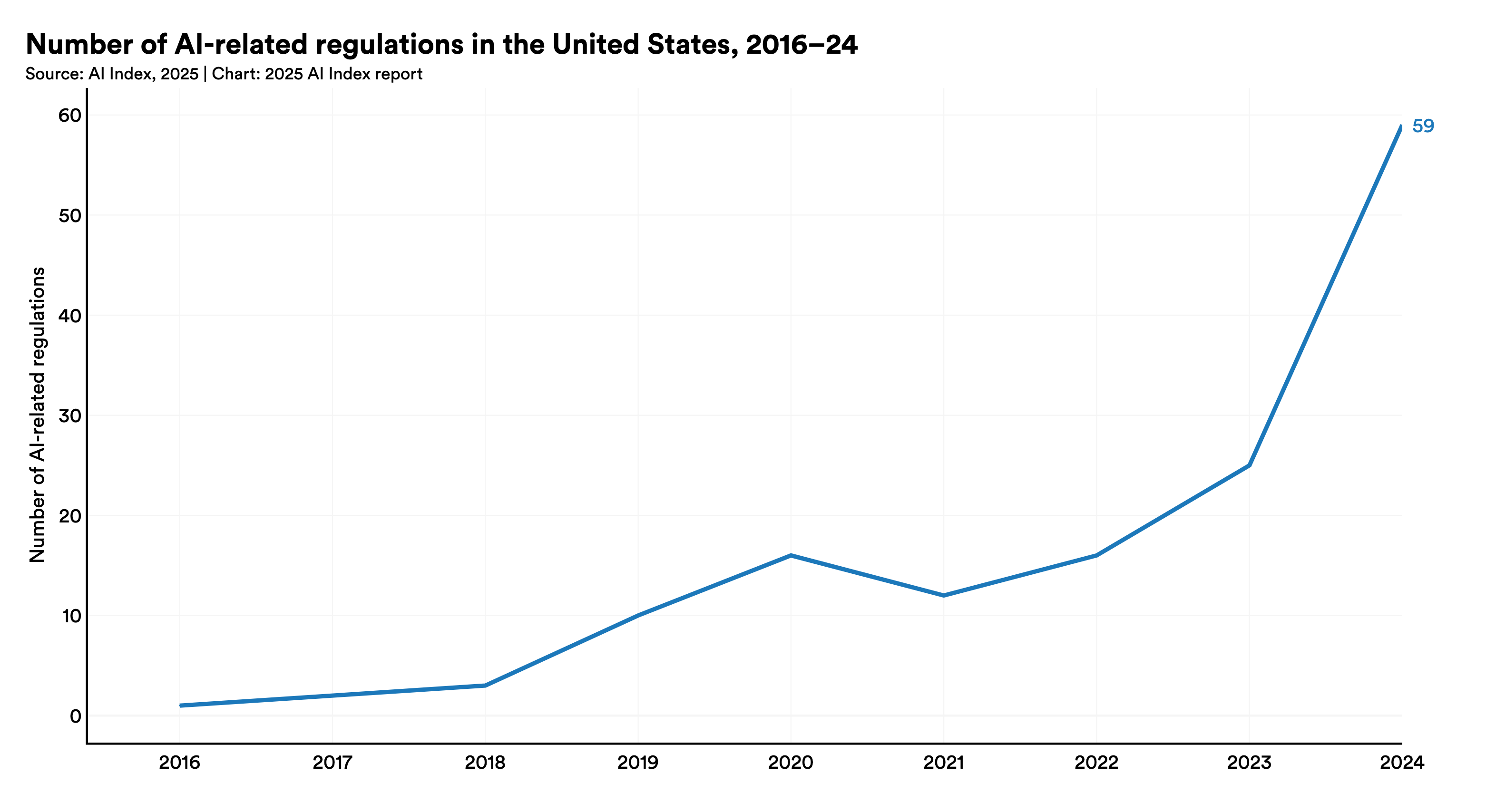
The FCRA is the floor, not the ceiling, and in 2026 the floor is crowded. A distinct body of state and international law now governs AI in hiring on top of the federal consumer-report rules, and these regimes target bias, transparency and human oversight rather than credit reporting. They do not replace the FCRA; they stack on it, so a single AI sourcing workflow can owe duties under several regimes at once. The overall trend line is unmistakable, as the Stanford HAI AI Index makes plain: the number of AI-related regulations in the United States has climbed steeply, reaching 59 in 2024.
US AI regulation is compounding, not slowing
New York City set the template with Local Law 144, in force since July 2023, which requires an annual independent bias audit of automated employment decision tools, publication of a summary, and notice to candidates at least ten business days before the tool is used - HR Dive. Illinois followed by amending its Human Rights Act, effective January 1, 2026, to make it unlawful to use AI that discriminates in employment and to require that employers notify applicants when AI is used in a hiring decision - DISA. California went further on the enforcement machinery, with Civil Rights Council regulations effective October 1, 2025 that treat an automated-decision system as potentially unlawful when it produces a discriminatory result, and require employers to retain automated-decision data for four years - Paul Hastings.
Illinois deserves a closer look, because it has been layering these obligations for years rather than only since 2026. Its Biometric Information Privacy Act, the strictest biometric law in the country, has driven some of the largest privacy settlements on record and reaches any AI tool that processes a candidate's face or voice without prior consent, which pulls in video-interview analysis and voice screening. Its earlier Artificial Intelligence Video Interview Act already required notice, consent, and an explanation whenever AI analyzes recorded interviews - DISA. Stack the 2026 Human Rights Act amendment on top of those, and a single Illinois hire can implicate three separate AI or biometric statutes, none of which the FCRA even addresses. It is the sharpest illustration of why a federal-only posture is a trap: the most demanding rules you face in any given hire may come from whichever state the candidate happens to sit in, not from Washington.
The most instructive story here is Colorado, because it shows how fast this ground moves. Colorado passed the first comprehensive US AI law, imposing developer and deployer duties on high-risk systems including hiring tools, then, before it ever took effect, substantially rewrote it, with the governor signing an amendment in May 2026 that narrowed employer obligations - Littler. Texas took a lighter approach in its Responsible Artificial Intelligence Governance Act, effective January 1, 2026, which bars AI systems deployed with intent to discriminate but imposes no disclosure duty on private employers and can be enforced only by the state attorney general - Norton Rose Fulbright.
The contrast between California and Texas is the whole regulatory story in miniature. California's rules define an automated-decision system broadly, add concepts like agent and proxy so employers cannot escape by outsourcing, and even treat some AI assessments that probe for a disability as an unlawful medical inquiry - Ogletree. Texas, by contrast, requires intent to discriminate, exempts private employers from disclosure, and hands enforcement to a single attorney general with no private right of action. A recruiter operating in both states cannot split the difference; they have to build to California's stricter bar and let Texas take care of itself. That asymmetry, where the strictest jurisdiction effectively sets your national standard, is the practical reason compliance teams stopped tuning their programs state by state and started designing for the high-water mark. At the federal level, the EEOC removed its earlier AI technical-assistance documents in 2025, leaving employers with less guidance rather than fewer obligations - K&L Gates.
If you hire in Europe, the calculus changes again. The EU AI Act classifies AI used to screen, rank or select job candidates as high-risk, which triggers obligations around risk management, data governance, human oversight, transparency and accuracy, with fines for deployers reaching up to 15 million euros or 3% of global turnover - McCann FitzGerald. The timeline has proven as movable as Colorado's, with the high-risk obligations originally set for August 2026 and then postponed toward the end of 2027 under a 2026 political agreement, but the direction is fixed. The practical takeaway across all of these regimes is that FCRA compliance is necessary and not sufficient. You can be perfectly clean on consumer-report duties and still be exposed on a bias audit you never ran or a notice you never sent, which is why the playbook in the next section treats them as one combined program rather than separate chores.
The EU obligations are worth understanding in a little detail if any of your candidates sit in Europe, because they bite regardless of where your company is based. A recruiting tool classified as high-risk must run a risk-management system, govern its training data, keep technical documentation and logs, guarantee meaningful human oversight, and hit accuracy and robustness standards, with deployers, not just developers, on the hook - McCann FitzGerald. There is no small-employer carve-out, and the fines are calibrated to hurt, reaching millions of euros or a percentage of global turnover. For a US recruiter sourcing engineers in Berlin or Dublin, the uncomfortable reality is that the same scoring feature that raises an FCRA question at home raises a high-risk-AI question abroad, under a regime with its own documentation and oversight demands. Treating these as one integrated program, rather than a US pile and an EU pile, is the only way to keep the overlap from turning into duplicated work or missed obligations.
9. How the Major AI Sourcing Tools Handle the Line
The AI sourcing market has quietly sorted itself into two camps defined by exactly the line this guide is about, and knowing which camp a tool sits in tells you where the compliance burden lands. On one side are the sourcing and outreach platforms, which find candidates and help you contact them and generally disclaim any consumer-report use in their terms. On the other are the background-check CRAs, which are registered, regulated, and built from the ground up for FCRA duties. The tools that create the most confusion are the ones adding predictive scoring to the first camp, because that is the feature that can quietly move a sourcing tool toward the second camp's obligations without the vendor changing its self-description.
Most pure sourcing platforms take the same defensive posture in their contracts. SeekOut, for instance, explicitly prohibits using its data for any purpose that would make it a consumer report under the FCRA or state law, pushing that compliance responsibility onto the employer - SeekOut. That is the industry-standard move, and it is why a disclaimer alone should never reassure you: the vendor is not claiming the activity is safe, it is contractually handing the risk to you. Others in this camp include hireEZ, which aggregates public profiles and reveals contact data, Findem, whose model is built specifically on inferring attributes about candidates from aggregated data (the inference step most relevant to the "evaluating consumers" language), Fetcher, Gem, and newer natural-language search tools like Juicebox, whose PeopleGPT searches more than 800 million profiles across dozens of sources.
The subtlety that trips buyers up is that a single product usually contains both a safe feature and a risky one. The same platform that runs a harmless public-profile search may also offer a predictive fit score, and the score is the piece that can be a consumer report even though the search plainly is not. Contextual AI that reads a candidate's history and infers, for example, that they have effectively done product-management work despite never holding the exact title is genuinely useful for finding people. The instant that same inference hardens into a ranked verdict you use to cut a list, it has slid from finding into evaluating. So the practical discipline is to assess tools feature by feature, not brand by brand, because your exposure is set by which screen you are standing on, not by the logo at the top of it. Pricing shows how far down-market these scoring features have traveled: Fetcher publishes tiers from roughly $379 a month - Pin, and natural-language tools have pushed entry points toward $99 a seat per month, which puts evaluative AI in the hands of plenty of teams that have no compliance function at all.
The pricing of these tools spans an enormous range, which matters because it shapes who adopts them and how carefully. Published and market-reported figures put hireEZ near a $13,000 median annual contract - Vendr, Gem around $24,900 - Pin, Findem in enterprise territory from roughly $6,000 per seat per year upward - Pin, and LinkedIn Recruiter Corporate near $32,000 a year once you clear its common three-seat minimum - Manatal. The chart below shows typical annual spend for four of these, to make the point that this is enterprise software with enterprise budgets, and enterprise budgets attract enterprise plaintiffs.
Typical Annual Cost of Major Sourcing Tools
The second camp is unambiguous about what it is. Checkr and HireRight are registered consumer reporting agencies, with Checkr appearing on the CFPB's official list of consumer reporting companies - CFPB and HireRight legally responsible for the accuracy and reinvestigation of what it reports - Consumer Attorneys. If you run a background check, you run it through one of these, and the full FCRA machinery applies by design. The clean mental model is that background-check vendors have opted into being regulated so that you can rely on them, while sourcing vendors have opted out and handed you the risk. Neither posture is wrong; they are simply different, and you need to know which you are buying.
The registered-CRA camp is also expanding into territory that keeps the FCRA live long after the hire. Checkr acquired GoodHire and offers continuous, post-hire monitoring that re-checks employees on an ongoing basis - CFPB, which matters because the FCRA's definition of employment purposes explicitly covers retention, not just hiring. A tool that keeps scoring your existing workforce is producing employment reports on a rolling basis, each with its own notice obligations, a subtlety that catches employers who assumed compliance ended at the offer letter. The lesson is that the sourcing-versus-screening line is not just an entry-gate question; it recurs every time a machine evaluates a current or prospective employee, and a mature program watches for it across the entire lifecycle rather than only at the top of the funnel.
HeroHunt.ai
If your goal is to widen the top of the funnel without wandering into consumer-report territory, the cleanest tools are the ones that only find and contact people. HeroHunt.ai sources from 1B+ public profiles across networks like LinkedIn, GitHub and Stack Overflow and sends personalized outreach on autopilot; it is a sourcing and outreach layer, not a background-check CRA, so it does not hand you a third-party "hireability score" to reject someone on. It has a free 8-day trial, then a flat monthly plan from $99 with unlimited roles rather than per-seat pricing, which makes a single hard requisition a cheap test. The honest caveat that matters here: no sourcing tool is a compliance shield. The moment you run an actual background check (through a CRA like Checkr or HireRight) or use any tool's score to filter candidates, the full FCRA disclosure and adverse-action process attaches to that step, and you own it.
A few market moves are worth noting because they show where this is all heading. Moonhub, an AI talent-sourcing platform, was acquired by Salesforce in 2025 - Vendr, and Juicebox raised a large growth round at a reported $850 million valuation in 2026, signaling that AI sourcing is consolidating into, and being funded like, serious infrastructure. As these tools get more capable and more autonomous, the scoring features that carry FCRA risk will become more central to the product, not less, which means the diligence questions in the next section are only going to get more important.
10. A Vendor-and-Workflow Compliance Playbook
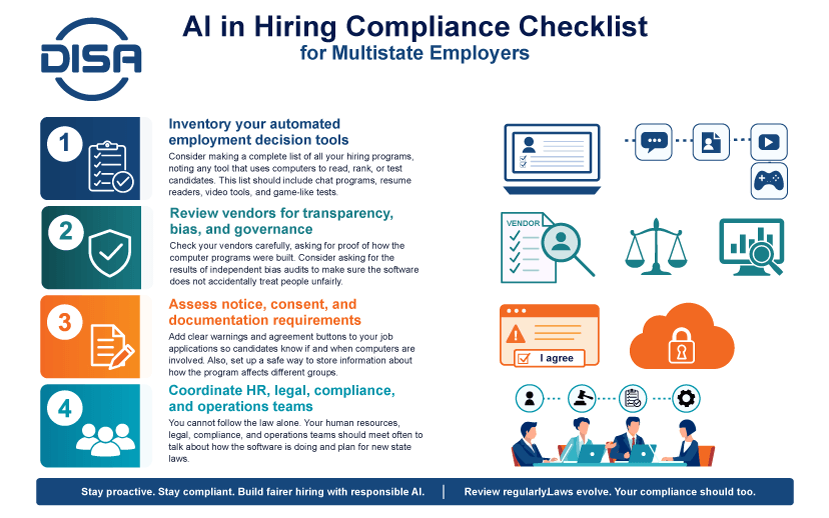
The good news is that staying clean is mostly a matter of process discipline, not legal genius, and you can put the core of it in place in a quarter. The organizing principle is simple: treat every AI tool in your funnel as a question mark until you know which side of the sourcing-versus-screening line it falls on, and treat every place where a machine output influences a human decision as a control point. The playbook below folds the FCRA duties and the newer state and EU duties into a single program, because auditing them separately is how gaps appear. A useful way to visualize the whole thing is the multistate compliance checklist below.
The compliance program in one picture
Start with diligence on the vendor, because the cheapest time to catch a problem is before you sign. The questions that actually separate a sourcing tool from a latent CRA are specific, and a vendor who cannot answer them crisply is telling you something. Ask each of these before you buy, and get the answers in writing.
- Data provenance: does the tool use data beyond what the applicant gives us, and from where?
- Evaluation: does it produce a score, rank, or recommendation about a person?
- CRA status: will you certify in the contract whether you are or are not a CRA?
- Audit support: can you provide bias-audit results and documentation for NYC, Illinois, California?
- Dispute path: can a candidate see and correct the data or score you hold?
Those five questions map directly onto the law. Data provenance and evaluation tell you whether the output is a consumer report; CRA status tells you where the burden sits; audit support and the dispute path tell you whether you can satisfy the newer state regimes and the EU AI Act's human-oversight and accuracy duties. A vendor built for this will have ready answers and contractual language to match. A vendor that waves the questions away with "our terms say we are not a CRA" has just told you the risk is being handed to you, and you should price that accordingly. This is also the point where you should insist on indemnification that actually tracks the vendor's representations, rather than a boilerplate clause that evaporates the moment a class action names you both.
How you implement the disclosure and adverse-action steps is a genuine build-versus-buy decision, not a formality to rush. Most modern applicant tracking systems and background-check providers ship FCRA-compliant disclosure and adverse-action workflows out of the box, and leaning on them usually beats hand-rolling your own forms, because they keep the standalone-disclosure format and the current summary-of-rights version maintained for you. The catch is that these built-in workflows typically fire only around a formal background check, so any AI scoring that happens earlier in the funnel, before the official check runs, sits in a blind spot the ATS never sees. That gap, between where your compliance tooling switches on and where your AI actually begins shaping decisions, is where most real exposure quietly lives. Closing it means extending the very same disclosure-and-adverse-action discipline to any pre-check step where a machine output filters candidates, even, and especially, when the vendor assures you that step is not a background check at all.
One organizational detail does more to prevent violations than any single control: naming an owner and giving the program a cadence. The most common failure mode is not a wrong decision but diffused responsibility, where HR assumes legal is handling the FCRA, legal assumes the background-check vendor is, and the vendor's contract says the risk is the employer's. Put one person or one small cross-functional group in charge of the AI-hiring compliance program, with authority over both the tooling and the workflow, and give them a standing review, quarterly is a reasonable default, to re-inventory the tools in use, confirm the disclosure forms are current, check that any new scoring feature was assessed against the sourcing-versus-screening line, and track which state and international rules have shifted. This matters because the landscape moves faster than an annual policy refresh can absorb: in a single recent stretch the CFPB withdrew major guidance, California's automated-decision rules took effect, Illinois added an AI notice duty, and Colorado rewrote its law before it ever applied. A program with a clear owner and a real cadence handles those changes as routine maintenance. A program without one discovers them in a demand letter.
The second half of the playbook is your own workflow, and it is where the non-delegable duties from Section 5 become concrete daily habits. Build a standalone disclosure and authorization into your application flow and keep it ruthlessly free of extra content. Wherever a consumer report can influence a decision, wire in the two-step adverse action sequence with a genuine waiting period, not a same-day rejection. Keep the automated-decision records California now requires for four years, run the bias audit New York and others expect, and send the notices Illinois and the EU require. Assign a single owner for this program, because the most common failure is not a wrong decision but a diffused responsibility where HR assumes legal has it and legal assumes the vendor has it. When ownership is clear and these controls are wired into the pipeline rather than bolted on, AI sourcing becomes what it should be: a speed advantage that does not quietly accumulate legal debt.
11. The Future: Agentic Sourcing and Automated Reports
The direction of travel is toward more autonomy, and more autonomy pulls directly against the grain of a law built around human decisions and paper notices. The current generation of AI recruiting tools mostly surfaces candidates and scores them for a human to act on. The next generation, marketed as agentic, aims to run the loop itself: search, evaluate, rank, reach out, and in some designs advance or reject without a person in the middle. Every step that moves from "assist a recruiter" to "make the call" moves the tool closer to producing and acting on consumer reports at machine speed, which is to say it raises FCRA exposure precisely as it raises capability.
Consider what a consumer report becomes when it is generated autonomously thousands of times an hour. Under the FCRA, each such evaluation, if it is a report used to reject someone, carries its own disclosure and adverse-action duties, and each is a discrete potential violation with its own statutory-damages exposure. A human recruiter turning down fifty people a week can, in principle, be walked through the notice process by hand. An agent screening fifty thousand applicants a week cannot be, unless the notices are engineered directly into the automation. The uncomfortable implication is that the more you automate the deciding, the more you are obligated to automate the compliance alongside it, and vendors selling autonomy have far stronger incentives to build the first than the second. Buyers who never ask where the automated notices live will discover that the speed they purchased shipped with a matching multiple of legal risk, quietly compounding with every extra applicant the agent processes.
This is not a hypothetical tension; it is visible in the funding and the product roadmaps right now. Vendors are racing to add autonomous agents, and the market is rewarding them for it, which means the scoring and decisioning features that carry the most legal risk are becoming the centerpiece of the pitch rather than a side feature. At the same time, the human-oversight requirements in the EU AI Act and the notice-and-audit requirements spreading across US states are explicitly designed to slow autonomous decisioning down and keep a person accountable. Recruiters are going to be caught between vendors optimizing for hands-off automation and regulators optimizing for human accountability, and the tools that thread that needle, automating the finding while keeping a human on the deciding, will be the durable ones.
The regulatory picture will stay volatile, and it would be a mistake to plan around any single agency's current mood. Federal guidance swung from the aggressive CFPB circular of late 2024 to the wholesale withdrawals of 2025, and the practical lesson is that the enforcement center of gravity is migrating away from federal agencies and toward two more durable forces: private class actions and state regulators. Kistler v. Eightfold and the Workday collective are the leading edge of the first; the compounding patchwork of state AI-hiring laws is the second. Neither depends on who runs the CFPB. Both mean that "the federal government eased off" is a dangerously incomplete read of your actual risk in 2026 and beyond.
For recruiters, the strategic response is to build for the strictest plausible regime rather than the current one, because the strict requirements are converging and the lenient ones keep getting rewritten. A workflow that keeps humans on decisions, sends candidates notice, retains records, and treats every score as a potential consumer report will satisfy almost any direction the law turns. A workflow tuned to today's lightest-touch jurisdiction is one election or one class action away from being non-compliant. The teams that will look prescient in two years are the ones treating agentic sourcing as a power tool with a guard on it, not as a way to remove humans from the one part of hiring the law most wants a human to own.
12. Conclusion: A Decision Framework
The FCRA question sounds intimidating and resolves into something you can hold in your head. Sourcing is finding people, and it is generally safe. Screening is evaluating people, and it is where the FCRA, and much of the newer AI-hiring law, actually attaches. Almost every real-world decision about a tool is a decision about which of those two things a given feature is doing, and you now have the tests to tell them apart: where the data comes from, whether the tool evaluates the person, and whether you act on that evaluation. Keep the finding and slow down at the evaluating, and you capture most of the upside of AI sourcing without inheriting a regulated posture.
For a practical default, sort your stack into three buckets. Pure sourcing and outreach tools that surface public profiles and help you contact candidates, from search platforms to AI recruiters like HeroHunt.ai, are low-risk for the finding work, provided you do not repurpose their output as a screening verdict. Predictive scoring features, wherever they live, are the checkpoint: assume the score could be a consumer report, and wrap it in disclosure and adverse-action process before you let it filter anyone. Background checks belong with a registered CRA like Checkr or HireRight, run through the full FCRA sequence every time, with no exceptions for "it was just a quick check."
Then run the workflow controls regardless of which tools you choose, because your duties as an employer do not disappear behind a vendor's compliance. Keep a standalone disclosure, honor the waiting period, send both adverse-action notices, retain your automated-decision data, run the bias audits your jurisdictions require, and give one person clear ownership of the whole program. None of this is exotic, and all of it is cheaper than a single statutory-damages class action across your applicant pool. The recruiters who get burned in the next few years will not be the ones who used AI. They will be the ones who could not say, when it mattered, whether their tool was finding candidates or judging them. If you can answer that question for every tool in your funnel, you are already ahead of most of the market.
This guide reflects the FCRA and AI-hiring legal landscape as of August 2026. It is general information for recruiters, not legal advice; laws, cases and agency guidance in this area change quickly (the CFPB withdrew major guidance in 2025 and Colorado rewrote its AI law in 2026), so verify current requirements with counsel before relying on any of it.