



The Practical Guide to Paraform Pricing, Real Placement Costs, and the Best Alternatives in 2026
Paraform raised a $40 million Series B in March 2026, led by Scale Venture Partners, taking the recruiter marketplace to $65 million in total funding and a network of more than 10,000 independent recruiters. That is real momentum, and it is backed by named usage at companies like Palantir and Cursor - Forbes. But if you go looking for what Paraform actually costs a company that wants to hire, you hit a wall: the site has no pricing page (paraform.com/pricing returns a 404), and every route on the product page points to "Get a demo" or "Sign up" instead of a number.
That opacity is the reason this guide exists, because Paraform is not a software subscription you can price per seat. It is a contingency marketplace: you post a role, Paraform matches it to a pool of independent recruiters who compete to submit candidates, and you pay only when you actually hire someone. The publicly reported cost of that hire is roughly 20% to 25% of the candidate's first-year salary, which on a typical engineering role means a fee in the tens of thousands of dollars per placement - Jack & Jill. For a startup that needs a hard-to-fill role closed fast, that can be worth it. For a team hiring at volume, or one that would rather own its pipeline, it is a very different math problem.
This guide breaks down exactly how Paraform charges, what a placement really costs, where the marketplace genuinely wins, and the seven strongest alternatives in 2026, ranging from rival recruiter marketplaces to flat-rate AI sourcing software that skips the percentage fee entirely. Every price is sourced, every claim is linked, and the alternatives are ranked on merit rather than marketing.
Written by Yuma Heymans (@yumahey), who built HeroHunt.ai and has spent since 2021 building AI recruiting technology that competes with exactly this category of done-for-you hiring. He writes from inside the market, weighing where a recruiter marketplace beats software and where it does not.
Contents
- What Paraform Actually Is
- Paraform Pricing: What a Hire Really Costs in 2026
- Where Paraform Wins and Where It Falls Short
- The 7 Best Paraform Alternatives in 2026
- Full Comparison: Pricing and Models
- How to Choose the Right Alternative
- The Bottom Line
1. What Paraform Actually Is
Paraform is a contingency recruiter marketplace that sits between companies with open roles and a network of independent, specialized recruiters. A company posts a role, Paraform matches it to recruiters who know that talent pool, ten or more of them can work the same requisition simultaneously, and the company pays only when a Paraform-sourced candidate is hired. The founders, John Kim and Jeffrey Li, launched it in 2023 out of San Francisco, and the pitch is that it fixes the two things companies hate about traditional agencies: slow single-recruiter coverage and opaque, non-competitive fees - Paraform. It has become especially popular with venture-backed startups, which is why its named logos skew toward the YC and AI-lab world.
The model is best understood as agencies unbundled. Instead of contracting one agency that assigns one recruiter to your role, Paraform opens the role to a competitive pool and handles the billing, collections, and quality controls centrally. On the recruiter side, that is the whole appeal: recruiters keep the majority of the placement fee, reportedly around 70% versus the roughly 50% split at a traditional firm, and Paraform removes the 60-day payment hold that agencies typically impose - Paraform. The company has leaned into an "agentic" framing, pairing human recruiters with AI agents that help with sourcing and coordination, but the core product is still a human recruiter network, not autonomous software.
The traction behind the model is genuine, even though most operating numbers are self-reported. Paraform says it has paid out over $50 million to recruiters cumulatively and now serves 1,000+ companies including Palantir, Cursor, Ramp, and Rippling - Paraform. Its funding trail is the part with independent corroboration: a $3.6 million seed led by A* in April 2024, a $20 million Series A led by Felicis in June 2025, and the $40 million Series B in March 2026 - TechCrunch. Felicis described the company as having scaled revenue 40x to a "mid-eight-figure run rate," which signals real revenue without a precise ARR figure - Felicis.
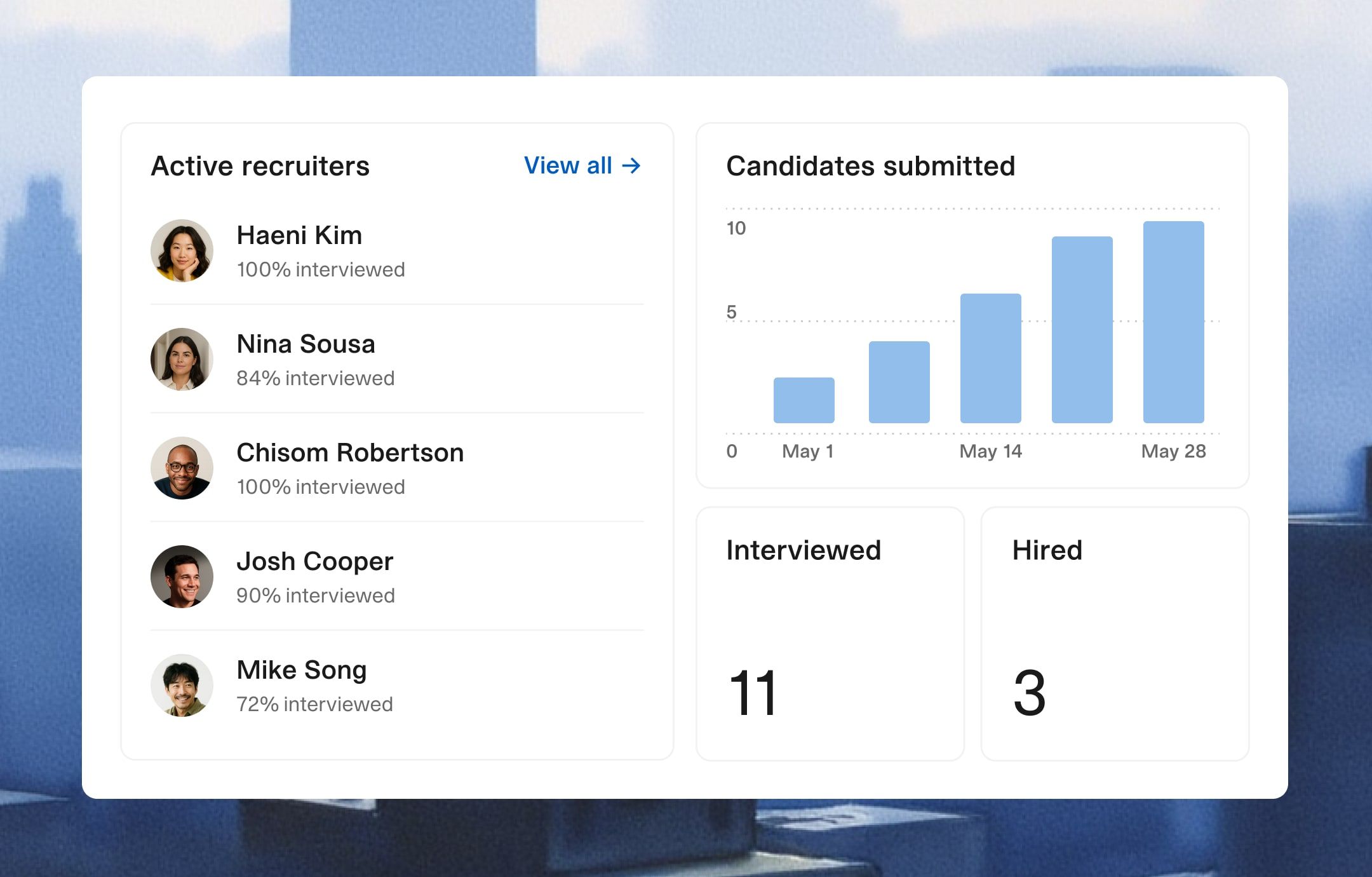
To see what a company actually interacts with, it helps to look at the product itself. Paraform gives both sides a shared workspace: companies track submissions and interview stages, while recruiters get sourcing and follow-up tools layered with AI assistance.
Paraform's marketplace workspace

What the interface reveals is Paraform's real design philosophy: it is a coordination layer, not a database you search. The company defines the role and the bounty, recruiters compete to fill the pipeline, and the platform tracks who submitted whom and at what stage. For a short overview of how the marketplace positions itself against traditional hiring, the company's own explainer is a useful primer before you weigh the cost.
How Paraform's recruiter marketplace works
2. Paraform Pricing: What a Hire Really Costs in 2026
Paraform does not publish a price. Based on multiple independent reviews, a hire costs roughly 20% to 25% of the candidate's first-year salary, paid only on a successful placement, or a fixed bounty of about $10,000 to $30,000 per role that the company sets in advance. That is the single most important fact for anyone evaluating it, and it is the one the marketplace makes hardest to find, because there is no pricing page at all - Dover. On a $150,000 role at 20%, that is a $30,000 fee; at 25%, it is $37,500 - Jack & Jill. One independent review pegged a mid-level software engineering hire at $160,000 to $200,000 as roughly a $32,000 to $40,000 fee - joinnextdev.
The table below distills every publicly reported component of Paraform's cost into one place, since the marketplace itself publishes none of it. Treat these as sourced estimates from independent reviews rather than an official rate card, and confirm the exact terms in writing before you commit.
| Cost component | Publicly reported figure | Notes |
|---|---|---|
| Success fee (percentage) | 20% to 25% of first-year salary | Paid only on a successful hire |
| Success fee (bounty option) | ~$10,000 to $30,000 per role | Fixed amount the company sets in advance |
| Example fee on a $150,000 role | $30,000 (20%) to $37,500 (25%) | Recurs on every hire |
| Example fee on a $260,000 average placement | ~$52,000 to $65,000 | Based on Paraform's reported average comp |
| Per-role listing fee | Reported but amount not disclosed | Cited by at least one review |
| Replacement guarantee | 90-day replacement search | New search, not a cash refund |
| Pricing page | None (paraform.com/pricing 404s) | Demo-gated only |
The structure underneath that headline has two parts that are worth separating. The first is the success fee, the percentage or bounty you pay when you hire, which is the number most people mean when they ask what Paraform costs. The second, according to at least one review, is a per-role listing fee to post a job into the marketplace, though the exact amount is not disclosed anywhere public - Dover. Paraform's own take-rate, meaning how much of your fee it keeps versus what it pays the recruiter, is likewise not published. What is disclosed is the guarantee: a 90-day replacement search if a placement does not work out, delivered as a new search rather than a cash refund - Jack & Jill.
The bounty option deserves its own note, because it changes the risk profile for the buyer. Instead of a percentage, a company can set a fixed bounty per role, commonly in the $10,000 to $30,000 band depending on seniority and difficulty, and recruiters compete knowing exactly what the payout is - tooldirectory.ai. This is attractive for two reasons: it caps your cost regardless of the final salary, and it lets you dial the bounty up on a genuinely hard role to attract more recruiter attention. The trade-off is that a low bounty on a difficult req simply will not get worked, because recruiters allocate their time toward the roles most likely to pay. In practice, the pay-on-hire structure means your worst case is an unfilled role at no cash cost, and your realistic cost per successful hire lands in the same five-figure range as a traditional agency.
This is the exact point where price sensitivity peaks, so before going further it is worth naming the honest alternative for a team that would rather own the sourcing than rent it.
HeroHunt.ai
A single Paraform placement on a $150,000 role costs roughly $30,000 to $37,500 in contingency fees, and you pay it again on every hire, because the fee tracks salary rather than effort. The direct substitute for that spend is not an ATS but an AI recruiter that does the sourcing itself: HeroHunt.ai searches over 1 billion profiles, screens them against your criteria, and runs the outreach and follow-up across LinkedIn, email, and WhatsApp on a flat subscription instead of a percentage per head. The honest caveat: this replaces the sourcing, not the judgement. You still run the interviews and close the candidate, and on a genuinely rare skill set where Paraform's real edge is ten specialist recruiters working the same req at once, software does not reproduce that human coverage.
The reason the contingency model deserves scrutiny is that the fee scales with salary, not with effort, and that is precisely where it becomes expensive. A percentage-of-salary fee means hiring a $250,000 staff engineer costs the same as three separate $80,000 hires, even if the $250,000 role took the recruiter less time. Paraform reports that the average total compensation of a placed candidate is around $260,000 per year, which puts the typical placement fee near $50,000 to $65,000 at a 20% to 25% rate - Paraform. Before committing, model your annual hiring volume against that fee structure, because a team making ten hires a year through a contingency marketplace can spend more on placement fees than it would on an entire in-house recruiting function plus software.
3. Where Paraform Wins and Where It Falls Short
Paraform's strongest card is speed on hard-to-fill roles, and its weakest is the winner-take-all economics that make its own recruiters unreliable on any given req. For a startup that needs a specialized engineer yesterday and has no in-house sourcing muscle, opening a role to ten competing recruiters widens the funnel dramatically, and the case studies reflect it: one customer reportedly hired four engineers in a month at roughly 5x faster time-to-hire with about 90% less recruiting overhead - Paraform. The company reports an average of about 12 days to a first candidate meeting, which is fast for competitive technical talent - Paraform.
The limitations cluster around cost predictability, incentive design, and thin independent proof. The first friction is the same demo-gated opacity as the pricing: you cannot compare Paraform to a budget before a sales conversation. The second is structural. Because ten or more recruiters chase one bounty and only one gets paid, the incentive is to submit fast to win, which can favor candidates who look strong on paper over genuine fit, and reviewers have flagged exactly this quality-versus-throughput tension for engineering roles - joinnextdev. The third is maturity: Paraform has almost no footprint on G2, Capterra, or TrustRadius, so the real sentiment lives on Glassdoor (recruiter side, 3.7 out of 5) and Trustpilot (a "Poor" 2.5 out of 5 across a small number of reviews) - Trustpilot.
It is worth weighing the recruiter-side and candidate-side complaints honestly, because they shape the buyer experience. Recruiters report that the "recruiter-first" marketing does not always match support quality, and that payouts can take a long time, while some candidates describe completing take-home projects and then being ghosted when a role was pulled - Glassdoor. None of this makes Paraform a bad product, but it does mean the experience depends heavily on how well you scope the role, set the bounty, and manage feedback. The signal to trust most is a live pilot: run one real, well-defined role, set a competitive bounty, and measure whether the submitted candidates would genuinely pass your bar.
To make the cost differences concrete before the individual write-ups, here is what it costs to fill one $150,000 role across the field. The contingency and marketplace options cluster in the tens of thousands per hire, while flat-rate software sits an order of magnitude lower because you do the sourcing yourself.
Cost to Fill One $150,000 Role (2026)
The chart makes the strategic picture obvious, with one honest caveat: it compares different things on purpose. The three tall bars (Paraform, BountyJobs, and Contrario) are per-hire fees you pay every time you make a placement, so ten hires means ten fees. Dover's roughly $5,000 sits in between as a fractional-recruiter per-hire rate. The three tiny bars (Manatal, Juicebox, and HeroHunt.ai) are monthly software subscriptions, shown at their entry price, that you pay whether you hire one person or ten in that month. The real takeaway is not that software is 300 times cheaper per literal dollar, but that the two models bill on completely different axes: marketplaces bill per outcome, software bills per time, and which is cheaper depends entirely on your hiring volume and how much sourcing work you are willing to do in-house.
Paraform's done-for-you coordination layer
4. The 7 Best Paraform Alternatives in 2026
The alternatives below are chosen because each solves a specific problem Paraform leaves open, whether that is a more integrated AI-plus-recruiter model, transparent flat-rate pricing, a lower per-hire cost, an established enterprise marketplace, or simply the option to skip the percentage fee entirely by doing the sourcing yourself. They are ordered to move from the closest done-for-you competitors toward the do-it-yourself software that inverts the whole cost model, so you can stop reading once you reach the approach that fits your team. Every entry lists what it does, real pricing where it is public, and who it is genuinely best for.
4.1 Contrario: The Direct AI-Plus-Recruiter Rival
Contrario is the closest positioning mirror to Paraform, and arguably its strongest direct competitor. It markets itself as an AI recruiting platform "powered by expert recruiters," blending a recruiter network with vertical AI agents that handle sourcing and coordination inside Slack, which is very nearly Paraform's own pitch - Contrario. Its early traction is real: the company reported roughly $6 million in annualized revenue and more than $1 million paid to recruiters within six months of launch, claiming candidates delivered 3x faster and an 80% first-round interview rate - Yahoo Finance.
On price, Contrario is as demo-gated as Paraform, with no public rate card, and it runs a hybrid subscription plus contingency model that generally lands around 25% of first-year salary depending on role difficulty - Contrario. The recruiter-side split runs 50% to 70% per hire, similar to Paraform's economics. The reason to choose Contrario over Paraform is if you want a slightly more AI-forward workflow with tighter Slack integration and a leaner, hungrier team courting your business. The reason to hesitate is the same opacity and the same percentage-of-salary math. It is best for startups that like the marketplace model but want a challenger that is fighting harder for their roles.
4.2 HeroHunt.ai: Skip the Percentage Fee Entirely
HeroHunt.ai attacks the problem from the opposite direction: instead of paying a recruiter network 20% to 25% of salary per hire, you run a fully autonomous AI recruiter that does the sourcing, screening, and outreach itself. Its AI Recruiter sources candidates from over 1 billion profiles in real time, screens them against your criteria, writes personalized messages, and follows up across LinkedIn, email, and WhatsApp without manual steps at each stage - HeroHunt.ai. The companion feature, RecruitGPT, generates a candidate shortlist from a single plain-language prompt, which turns "describe the role" into "here are engaged candidates."
The structural advantage over Paraform is the cost model, not just the technology. HeroHunt is flat-rate software that starts with an 8-day free trial (card required) and then runs from $99 per month, with unlimited positions and searches on every plan and a Pro plan covering 5,000 AI-screened and matched profiles and 1,000 candidate emails a month - HeroHunt.ai plans. For a team making several hires a year, replacing even one $30,000 contingency fee with a monthly subscription changes the annual budget by an order of magnitude, and you keep the tooling permanently rather than renting a recruiter per role. With 15,000+ recruiters using it globally, the trade-off is honest: you supply the effort a marketplace outsources, so it suits teams that want to own their pipeline. Start a free trial at the HeroHunt.ai sign-up. It is best for companies that hire regularly and would rather build an internal sourcing engine than pay per placement.
4.3 Juicebox (PeopleGPT): DIY Natural-Language Sourcing
Juicebox, marketed as PeopleGPT, is the tool that popularized natural-language candidate search, and it is the do-it-yourself alternative for teams that want to source without a marketplace fee. You describe your ideal candidate in plain English and the AI returns matches from a database of 800 million+ profiles - Juicebox. It has real staying power, having crossed $10 million in ARR with more than 2,500 customers and raised a $30 million Series A from Sequoia in September 2025.
Juicebox is fully transparent on price, which is the opposite of Paraform's demo wall. Its live pricing page shows a free tier, a Starter plan at $99 per month with unlimited searches and 500 contact credits, a Growth plan at $179 per month for up to five seats, and an autonomous Agents add-on at $199 per agent per month - Juicebox pricing. The trade-off is that Juicebox is a copilot for in-house recruiters, not a done-for-you service, so you still run the outreach and qualification yourself. It is best for teams that have someone to drive the sourcing and want the most proven natural-language engine to do it, at a fraction of a single placement fee.
4.4 Manatal: The Transparent Budget System of Record
Manatal is the budget-conscious answer to Paraform's opacity and per-hire fees: an AI-powered applicant tracking system and recruitment CRM with candidate recommendations, a LinkedIn sourcing extension, and a fully published price of $15 per user per month billed annually ($19 monthly), with a 14-day free trial and no demo required - Manatal. For a small team or agency that wants an affordable place to manage candidates and run light AI-assisted sourcing without any five-figure commitment, it is the most accessible option on this list by a wide margin.
The honest trade-off is scope, and it matters here more than on a pure software comparison. Manatal is an ATS with AI features layered in, not a done-for-you recruiter network, so it does not replace the human sourcing effort that Paraform outsources: you or your team still do the work. Its entry tier also caps at 15 open jobs and 10,000 candidates, which means a high-volume desk is really evaluating the $35 per user Enterprise tier - Manatal. It is best for cost-sensitive teams and boutique agencies that want a transparent, all-in-one system they can turn on today and grow into, rather than paying a percentage of salary on every hire.
Transparent pricing from $15 per user per month, a 14-day free trial, and no percentage-of-salary fee every time you make a hire.
4.5 Dover: The Fractional Recruiter Between the Two Models
Dover sits between a marketplace and software, offering recruiting-as-a-service with transparent per-hire pricing that is far below contingency. Its managed sourcing and outreach is done-for-you like Paraform, but it charges roughly $2,000 to $8,000 per hire rather than a percentage of salary, and it prices recruiting support at about $80 per hour with no long-term contract - Dover. On a $150,000 engineering role, Dover's own example puts its cost near $5,000 versus roughly $30,000 at a 20% contingency rate, which is the single sharpest cost contrast on this list among done-for-you options.
Dover also runs a historically free ATS with unlimited jobs and users plus AI applicant scoring, using the managed sourcing as the paid upsell - Dover ATS. The reason to choose Dover over Paraform is straightforward: if you want humans doing the sourcing but refuse to pay a percentage of salary, a flat per-hire fee is dramatically cheaper on well-paid roles. The reason to hesitate is coverage. Dover is a single embedded recruiting engine rather than a competitive pool of ten recruiters, so it may move slower on a genuinely rare skill set. It is best for startups that want done-for-you recruiting on predictable, transparent per-hire economics.
4.6 BountyJobs: The Incumbent Enterprise Marketplace
BountyJobs is the established, enterprise-grade version of what Paraform does for startups: a recruiter-engagement marketplace connecting employers with a network of 14,000+ agency recruiters, skewed toward mid-market and enterprise rather than the venture-backed startup world - BountyJobs. Instead of Paraform's competitive-pool-and-bounty design, employers engage agencies directly through the platform and pay standard contingency fees to the placing agency, with BountyJobs sitting on top as the management layer.
Its economics work differently, and the fee structure is unusually transparent for the category. BountyJobs takes a cut of the recruiter's fee: 25% if the recruiter is not on the client's preferred-vendor list, and just 2.5% if they are, on top of an annual platform fee that varies by company size and is not public - BountyJobs. Guarantees are strong, with 90-day full money-back terms on fees of 20% or more. The reason to choose BountyJobs is scale and governance: large organizations managing dozens of agency relationships get a single system to track spend, performance, and guarantees. The reason to look elsewhere is that it is built for enterprise agency management, not for a startup that wants a lean, competitive pool on a handful of roles. It is best for mid-market and enterprise talent teams consolidating agency spend.
4.7 Traditional Contingency Agencies: The Baseline Paraform Displaces
Traditional contingency agencies are the default that Paraform, Contrario, and BountyJobs are all built to improve on, and they remain a legitimate option for a company that already has a trusted agency relationship. The industry-standard fee is 15% to 30% of first-year salary, typically landing at 20% to 25%, paid only on a successful hire with a 90-day replacement guarantee, which is functionally the same headline rate as Paraform - BountyJobs. The difference is structural rather than in the sticker price.
Where a traditional agency differs is coverage model and recruiter incentive. You get one agency assigning one or two recruiters to your role, with no competing pool, which can mean deeper attention on a single req but a narrower funnel and slower coverage than a marketplace that puts ten recruiters on it at once - hrtechadvisor. The recruiter also typically splits the fee roughly 50/50 with their firm, which is the exact economic inefficiency Paraform markets against by letting recruiters keep the majority. The reason to stick with a traditional agency is an existing relationship and specialized domain expertise you already trust. The reason to switch is speed, competitive coverage, and better recruiter economics. It is best for teams with a proven agency partner in a niche where relationships matter more than funnel width.
5. Full Comparison: Pricing and Models
The table below distills the seven alternatives plus Paraform into the dimensions that actually drive a decision: the pricing model, the entry cost or fee, whether pricing is public, and who each option is genuinely best for. Because these span two fundamentally different models (pay-per-hire marketplaces versus flat-rate software), read the "model" column first, since it determines whether the cost is a recurring fee per placement or a monthly subscription regardless of hiring volume. Confirm current numbers before committing, as fees and plans change frequently.
| Option | Model | Entry Cost / Fee | Pricing Public? | Best For |
|---|---|---|---|---|
| Paraform | Marketplace (contingency) | 20-25% of salary or $10k-$30k bounty | No | Startups filling hard technical roles fast |
| Contrario | Marketplace + AI (hybrid) | ~25% of salary | No | Startups wanting an AI-forward challenger |
| BountyJobs | Enterprise marketplace | Agency fee + platform fee | Partial | Enterprises consolidating agency spend |
| Traditional agency | Single-agency contingency | 15-30% of salary | Varies | Teams with a trusted niche agency |
| Dover | Fractional recruiter | $2k-$8k per hire | Yes | Done-for-you at flat per-hire cost |
| HeroHunt.ai | Flat-rate AI software | Free trial, from $99/mo | Yes | Owning an autonomous in-house pipeline |
| Juicebox | Flat-rate AI software | Free, then $99/mo | Yes | DIY natural-language sourcing |
| Manatal | Flat-rate ATS + AI | $15/user/mo | Yes | Affordable, transparent system of record |
The pattern in the table is the real takeaway, and it splits cleanly down the middle. The top four rows are pay-per-hire models where a single placement costs tens of thousands of dollars and recurs on every hire, and three of the four hide their exact numbers behind a sales process. The bottom four rows are flat-rate software with published prices, where a monthly subscription in the double or low-triple digits covers ongoing hiring activity with no fee per hire, but you supply the sourcing effort yourself. Paraform is not the most expensive option in its own band, and its recruiter economics are genuinely better than a traditional agency's, but it shares the category's core trait: your cost scales with salary and volume, not with a predictable subscription.
One column the table cannot capture is total annual cost at your real hiring volume, and that is where the two models cross over. A company making one difficult hire a year almost certainly comes out ahead paying Paraform's fee once rather than staffing and licensing an in-house function. A company making ten hires a year, several of them at $200,000-plus salaries, could spend $300,000 or more in placement fees, money that would fund a recruiter plus a flat-rate sourcing stack many times over. The honest decision is not "marketplace versus software" in the abstract but "how many hires, at what salaries, and how much sourcing work will we do ourselves," and the answer flips the economics entirely depending on those inputs.
6. How to Choose the Right Alternative
Choosing among these options comes down to four questions in order: how many hires you make per year, whether you want done-for-you or do-it-yourself, how specialized the roles are, and how much cost predictability you need. Answering them in sequence eliminates most of the list quickly, because these options are genuinely differentiated rather than interchangeable. The decision tree below maps the most common paths a hiring team takes through those questions.
The tree encodes the logic most teams follow. If you want humans doing the work and you hire infrequently on genuinely hard roles, a marketplace like Contrario or an enterprise platform like BountyJobs earns its fee by closing a role you could not fill alone. If you want done-for-you but refuse a percentage of salary, Dover delivers the same outcome at a flat per-hire rate that is dramatically cheaper on well-paid roles. If you would rather build internal capability, the split is between full automation (HeroHunt.ai running an autonomous AI recruiter) and lighter tooling, where Juicebox handles sourcing and Manatal handles tracking and pipeline at the lowest entry price on the list.
The one factor the tree cannot decide for you is how much you value competitive coverage on a specific hard role, since that is Paraform's clearest differentiator. If your real pain is a rare skill set that a single recruiter keeps failing to fill, opening it to a competitive pool of ten recruiters is a genuine advantage that flat-rate software does not replicate, and the honest move is to run one role through Paraform (or Contrario) while explicitly asking for the listing fee, the bounty structure, and the guarantee terms in writing before you commit. If your pain is recurring, predictable hiring across many roles, the software options almost certainly win on annual cost.
Whatever the tree points you toward, run the same structured trial across your top two options rather than committing on a demo alone. Pick one live role that represents your typical hiring, then measure three things over two to four weeks: how many qualified candidates each approach surfaced, how many reached a real interview, and what the fully loaded cost per qualified candidate worked out to. Because the software options (HeroHunt.ai, Juicebox, and Manatal) cost little or nothing to pilot, you can run one in parallel with a marketplace and let the results, not the sales pitch, break the tie. This is also the only reliable way to test whether a marketplace's competitive pool actually delivers better candidates on your specific reqs, since the quality of a contingency network varies enormously by role type and seniority.
7. The Bottom Line
Paraform is a genuinely useful marketplace with a cost model that only makes sense at low hiring volume. Its competitive recruiter pool, fast time-to-candidate, and better-than-agency recruiter economics are real, and for a startup that needs one hard technical role closed fast, a single 20% to 25% fee can be money well spent. The problem is that you cannot confirm the terms without a sales process, the percentage-of-salary structure gets expensive quickly as salaries and volume rise, and the winner-take-all incentives can push throughput over fit. In a category this crowded, paying a five-figure fee per hire is a choice worth pressure-testing.
For most teams evaluating Paraform in 2026, the smarter path is to first decide which cost model your hiring volume actually favors, then trial one option from that side before paying a placement fee. If you make hard, infrequent hires and want humans competing to fill them, Contrario is the closest challenger and Dover is the cheapest done-for-you option on well-paid roles. If you hire regularly and would rather own the pipeline, start a free trial with HeroHunt.ai and its autonomous AI Recruiter, or run natural-language sourcing through Juicebox. And if you simply want an affordable, transparent system to manage candidates without any percentage fee, Manatal is the most accessible option on this list.
Whichever way you go, insist on two numbers before signing anything: the all-in cost per hire at your real salary levels, and the total you would spend across a full year of your actual hiring volume. Those two figures, not the headline percentage, determine whether a recruiter marketplace or flat-rate software is genuinely cheaper for your team.
This guide reflects the AI recruiting and recruiter-marketplace landscape as of July 2026. Pricing, fees, and features in this category change frequently, so verify current details on each vendor's own site before purchasing.