


The insider's guide to hiring the engineers who build humanoid and embodied robots: who is competing for them, what they cost, where to find them, and how to actually close them in 2026.
Robotics and physical-AI startups pulled in $47.4B across 521 deals in the first half of 2026, nearly four times the $12B raised in the back half of 2025 - Crunchbase News. That capital is not chasing software margins. It is chasing robots that walk, grasp, and work, and every dollar of it eventually turns into a job requisition for an engineer who can make a machine move in the real world.
Here is the problem underneath the money: the people who can do this work barely exist. One widely cited analysis estimates only about 2,000 engineers in the United States can credibly combine vision-language-action models, sensor fusion, and kinematics, against 65,000-plus open robotics roles - Fruition Group. Every funded humanoid program, every autonomous-vehicle refugee team, and every frontier AI lab is fishing in the same small pond, and they are paying startup-lottery money to do it. For a recruiter or hiring manager, "post a job and wait" is not a strategy. It is a way to lose.
This guide breaks down what "physical AI" actually is and why it turned robotics hiring into a bidding war, who the players are and what they raised, the distinct engineering role families you are really sourcing, the tools and skills to screen for, the true compensation reality, the scarcity math, exactly where the talent hides (labs, conferences, open-source repos), the cross-industry pools that convert well, how to assess and close these engineers, the visa map, and how AI sourcing agents are rewriting the top of the funnel. Everything here is anchored to late-2025 and 2026 sources, because in this field a salary survey or funding number from two years ago describes a different market.
Written by Yuma Heymans (@yumahey), who built HeroHunt.ai and has spent five years building autonomous sourcing agents. Chasing robotics engineers is the hardest sourcing problem he has watched those agents take on, because the best candidates are hiding in GitHub commit histories and conference proceedings, not job boards.
Contents
- Why Physical AI Turned Robotics Hiring Into a War
- The Players: Who Is Hiring and What They Raised
- What "Robotics Engineer" Actually Means in 2026
- The Skills and Tools You Are Screening For
- What This Talent Actually Costs
- The Scarcity Math: 2,000 Engineers, 65,000 Jobs
- Where the Talent Actually Is
- Cross-Industry Conversion: AV, Warehouse, Aerospace
- How to Assess a Robotics Engineer
- Selling the Job Against FAANG and AI Labs
- Visas and the Global Talent Map
- AI Agents Are Rewriting Sourcing
- The Future: Foundation Models Reshape the Team
- Conclusion: A Hiring Playbook for Physical AI
1. Why Physical AI Turned Robotics Hiring Into a War
The single most important fact for anyone hiring in this space is that demand exploded faster than the talent pool could possibly grow. "Physical AI" is the term the industry settled on for artificial intelligence that perceives and acts in the physical world, the software brain inside a humanoid or a robot arm rather than a chatbot in a browser. Nvidia popularized the phrase, and by 2026 it had become the label for the hottest slice of venture investing, precisely because the same foundation-model techniques that transformed text and images finally started to work on hardware. When a category goes from research curiosity to deployable product in eighteen months, hiring becomes the bottleneck, and that is exactly what happened here.
The reason 2026 is the inflection year, and not 2024 or 2028, is that three curves crossed at once. Robot foundation models matured to the point of real generalization, with Nvidia's open Isaac GR00T models, Google DeepMind's Gemini Robotics, and Physical Intelligence's pi-series all shipping in a twelve-month window. At the same time, real deployments began inside automakers and logistics operators, and manufacturing costs fell far enough that pilots turned into purchase orders. The result is that every company building a robot suddenly needed to staff a full engineering organization, and they all started at the same moment. A recruiter who understands this timing understands why a mid-level controls engineer now fields three competing offers in a week.
It helps to understand what changed technically, because it explains the new job titles. For decades, a robot's behavior was hand-programmed: an engineer wrote explicit code for every motion, and the machine broke the moment reality deviated from the script. The breakthrough was importing the recipe that worked for language models, training a single large neural network on vast demonstration data so the robot learns general behavior instead of memorizing scripts. Google's RT-2 in 2023 showed that a model trained on web images and text could transfer that knowledge to robotic control, and by 2025 that idea had hardened into deployable vision-language-action models. The consequence for hiring is that a robotics team now needs people who can train and scale neural networks sitting right next to people who understand gearboxes, and that pairing barely existed as a job description three years ago.
What makes this different from a normal tech hiring boom is the shape of the required skill set, which sits at the intersection of three historically separate disciplines.
- Machine learning at frontier scale, the ability to train and fine-tune large neural policies.
- Classical robotics, meaning kinematics, dynamics, control theory, and real-time systems.
- Hardware fluency, an understanding that a motor has torque limits, sensors have noise, and physics does not forgive a bug.
Very few people carry all three, and the ones who do were mostly trained inside a short list of academic labs or a handful of autonomous-vehicle and legged-robotics companies. This is the crux of the whole guide: you are not recruiting for an abundant skill that needs filtering, you are recruiting for a scarce combination that needs finding.
For a non-technical recruiter, that inversion is good news, not bad, because it means the job is detective work more than gatekeeping. You do not need to be able to write a diffusion policy to recruit the person who can; you need to recognize the signals that separate someone who genuinely built one from someone who merely mentions it, and to know where those people gather. Everything in this guide is built to give you those signals: the vocabulary to read a profile, the map of where the talent hides, and the assessment questions that expose real depth. The recruiters who win in physical AI are rarely the most technical ones in the building. They are the ones who learned just enough of the domain to source with precision and speak to engineers as peers, then paired that with relentless, well-instrumented outreach. That inversion changes every downstream decision, from where you source to how you assess to what you can credibly offer. Before we get into tactics, it helps to see what these companies actually build, because the product defines the profile.
2. The Players: Who Is Hiring and What They Raised
The market splits cleanly into two camps, and knowing which camp a company sits in tells you what it hires for. On one side are the humanoid-hardware makers that build the physical robot: Figure, Tesla with Optimus, Apptronik, 1X, Agility Robotics, Boston Dynamics, and China's Unitree. On the other are the robot-brain foundation-model labs that build the software intelligence and let many robot bodies run it: Physical Intelligence, Skild AI, and the robotics groups inside Nvidia and Google DeepMind. Hardware makers weight their hiring toward mechanical, actuator, controls, and manufacturing talent alongside AI. The brain labs hire almost entirely research and machine-learning engineers. A recruiter who mixes these profiles up will send the wrong candidates to the wrong company.
The valuations tell you how much firepower each player brings to a bidding war, and they are staggering. Figure AI raised over $1 billion in a Series C at a $39 billion post-money valuation in September 2025, up roughly fifteenfold from its $2.6 billion mark just eighteen months earlier, backed by Parkway, Nvidia, Microsoft, and the OpenAI Startup Fund - TechCrunch. Figure builds the Figure 03 humanoid around its in-house Helix vision-language-action model and a mass-production line it calls BotQ. The clip below is Figure's own reveal of that robot, and it is a useful reference for the kind of integrated hardware-and-AI product that defines the profile you would source for a company like this.
Introducing Figure 03
The rest of the hardware camp is nearly as well funded. Tesla is repurposing its Fremont Model S and Model X lines to build Optimus, targeting a one-million-unit annual production line, with the Optimus 3 reveal pushed to around the middle of 2026 rather than the first quarter - Electrek. Apptronik, maker of the Apollo humanoid, added a $520 million Series A extension in February 2026 at roughly a $5.5 billion valuation, backed by Google and Mercedes-Benz - CNBC. 1X Technologies, the OpenAI-backed maker of the home humanoid NEO, sought up to $1 billion at a $10 billion-plus valuation - Tech Startups. And Agility Robotics, whose Digit robot already works in warehouses, agreed to go public through a SPAC valuing it at about $2.5 billion - TechCrunch.
The brain-lab camp raised sums that would have been unthinkable for pre-revenue software companies a few years ago. Skild AI, building a general-purpose robot "brain" that runs across many embodiments, raised about $1.4 billion at a valuation above $14 billion in January 2026 in a round led by SoftBank, described as the largest robotics-AI financing on record - TechCrunch. Physical Intelligence, founded in 2024 by researchers from Google DeepMind, Stanford, and Berkeley, raised a $600 million Series B led by Alphabet's CapitalG at a $5.6 billion valuation in November 2025, and was reportedly in talks in March 2026 to raise again at roughly $11 billion - Bloomberg. The chart below lines up the headline valuations so you can see the scale of the balance sheets competing for the same engineers.
Physical-AI company valuations (2025-2026)
Read those bars as recruiting budgets, not just paper wealth, because equity is the currency these companies use to close candidates. The macro picture reinforces it: robotics and physical AI drew a record $27.6 billion across more than a thousand deals in 2025 by PitchBook's count, and Crunchbase separately tracked robotics startups raising $18.8 billion in the first half of 2026 alone, already more than all of 2025 - Crunchbase News. Analysts expect the demand to compound: Goldman Sachs projects a $38 billion humanoid market by 2035 - Goldman Sachs, while Bank of America forecasts around 3 billion humanoids in service by 2060 - Bank of America Institute. Whether or not those long-range numbers hold, they explain why every one of these companies is hiring as if the future depends on staffing up this year. Also note the international dimension: China's Unitree completed a Shanghai STAR Market IPO in August 2026 that closed its debut up nearly 487 percent, valuing it near $53 billion, on roughly $250 million of 2025 revenue and more than 5,500 humanoids shipped - CNBC.
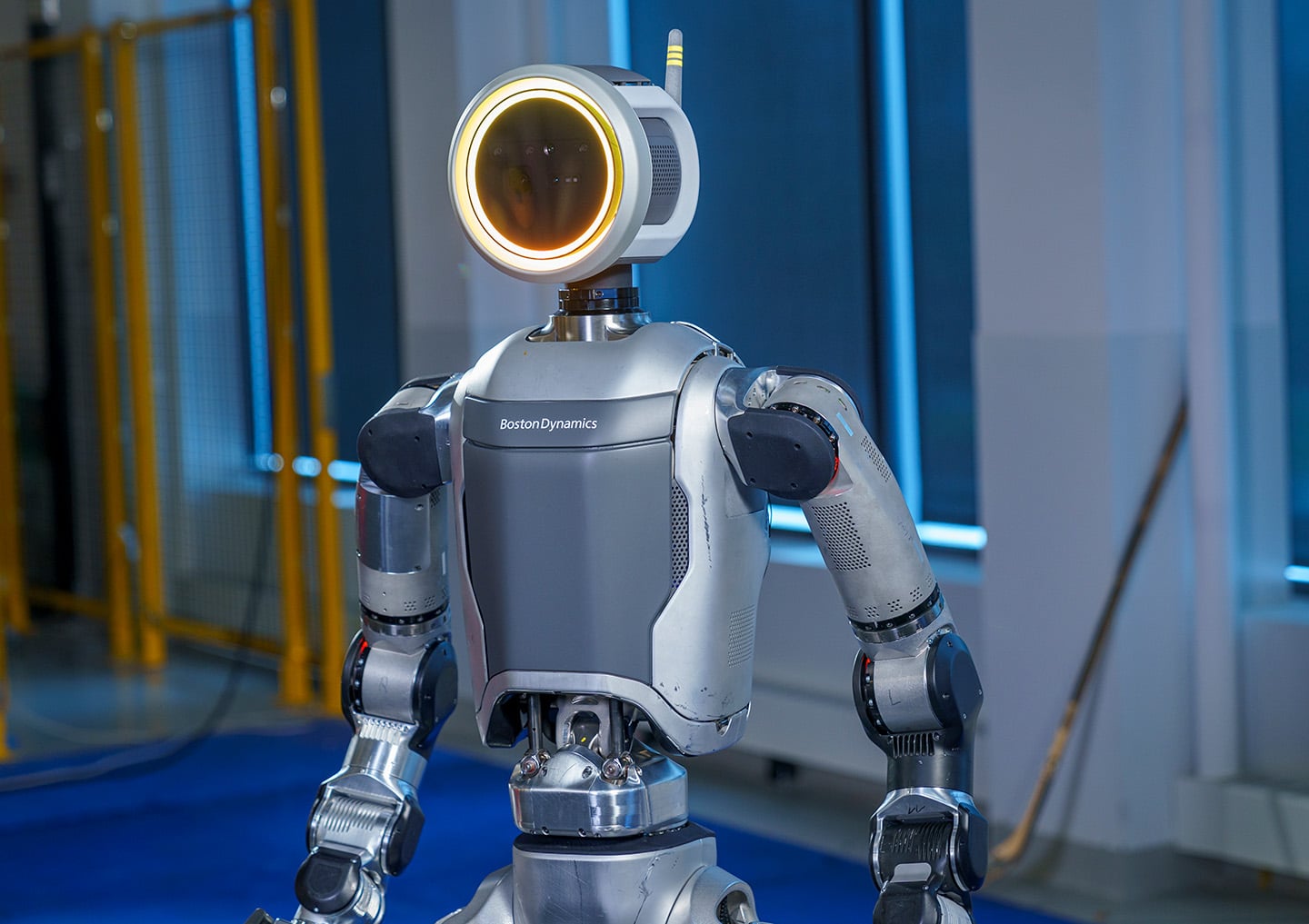
Two more categories round out the field and shape who you recruit. Boston Dynamics, the most storied name in the business, paired its electric Atlas with a Large Behavior Model from Toyota Research Institute and unveiled a product version of Atlas at CES in January 2026, with its entire 2026 fleet already committed to customers - Boston Dynamics. And a layer of pure-software and open infrastructure now underpins everyone: Nvidia supplies the Isaac simulation stack and GR00T models, Google DeepMind supplies Gemini Robotics, and Hugging Face, after acquiring the maker of the open Reachy 2 humanoid, turned its LeRobot library into the field's shared open-source backbone. For a recruiter this matters because engineers increasingly build careers across these open tools rather than inside one company's proprietary stack, so the skills are portable and the sourcing signals are public.
These strategies diverge in ways a candidate cares about, which makes the difference worth articulating to anyone you source. Tesla bets on vertical integration and manufacturing scale, so it prizes engineers who can build a robot the way it builds cars. Figure keeps its Helix model in-house and hires for tight hardware-and-AI co-design. The brain-first labs like Physical Intelligence and Skild bet that one model will run across many robot bodies, so they hire almost pure research and machine-learning talent and let hardware partners supply the bodies. The open-infrastructure players, Nvidia and Hugging Face, win by enabling everyone else. For a recruiter, this map answers the candidate's real question, which is not just "how much," but "whose bet do I want to join," and being able to explain a company's specific thesis is often what separates a compelling pitch from a generic one.
3. What "Robotics Engineer" Actually Means in 2026
The most expensive mistake a non-technical recruiter makes is treating "robotics engineer" as one job. It is not. A modern physical-AI company staffs roughly six to eight distinct engineering families, each with its own tools, degrees, and resume signals, and a candidate who is elite in one is often useless in another. A brilliant reinforcement-learning researcher cannot design a hip actuator, and a world-class actuator engineer cannot train a diffusion policy. The 2026 hiring guides converge on this point: the baseline shifted from generic mechatronics toward a set of specialized tracks, unified only by a shared foundation of ROS 2, C++, Python, and at least one physics simulator - Kore1. Your first job on any robotics req is to figure out which family you are actually filling.
Getting the family right matters because it determines everything downstream: the keywords you search, the portfolios you weight, the interviewers you assign, and the comp band you quote. It also protects you from the classic failure where a hiring manager says "we need a robotics engineer," you deliver ten strong perception candidates, and the manager reveals they actually needed a whole-body-control specialist who can tune a bipedal gait. Those are different people who overlap almost nowhere. The diagram below maps the families a humanoid company typically runs so you can hold the whole org in your head at once.
Working through the map, the robot software and ROS 2 platform engineers build the middleware plumbing that lets every other system talk, and they live in C++, ROS 2, and real-time Linux. Perception and SLAM engineers turn cameras, LiDAR, and radar into a machine's understanding of where it is and what it sees, blending computer vision with sensor fusion - ZipRecruiter. Controls and locomotion engineers make the robot move without falling, using model predictive control and whole-body control at high frequency, and they are the hardest bipedal-humanoid roles to fill. Robot learning and VLA researchers train the neural policies that are eating the field, which we cover in the next chapter. Rounding out the org, mechatronics and actuator engineers design the physical joints, simulation engineers build the virtual worlds where policies are trained, and two newer families, teleoperation and data operations plus functional safety, have grown into full hiring categories of their own as robots move near people and need mountains of demonstration data.
Two of these families are easy to under-appreciate and expensive to miss. Motion-planning engineers, a close cousin of controls, compute the collision-free paths a robot arm or body follows, and they live in specialized tools like MoveIt 2, OMPL, Drake, and the kinematics libraries Pinocchio and CasADi rather than in machine-learning frameworks - Kore1. Mechatronics and actuator engineers, at the other end, treat mechanical geometry as a hard constraint that propagates through motor torque, frame size, and gearbox inertia, and the 2026 trend toward integrated joint modules that pack a motor, gearbox, sensors, and drive electronics into one compact unit makes them scarcer still, because it demands someone fluent across mechanical, electrical, and control domains at once - RoboticsTomorrow. These are not interchangeable with the AI roles, and a company that over-indexes on machine-learning hires while neglecting them ends up with a brilliant policy and no reliable body to run it on.
That last point deserves emphasis because it is the newest and most misunderstood. The rise of learned policies created a large teleoperation and data-collection workforce, operators who wear VR rigs and perform tasks on real robots to generate training demonstrations, typically paid $30 to $50 per hour in on-site labs - OpenTrain AI. It also elevated functional-safety engineers who must know standards like the updated ISO 10218-1:2025 for industrial robots and ISO 13482 for personal-care robots, because a humanoid working next to a person is a system-level risk with human consequences - ANSI. A recruiter who knows these families exist can staff the whole robot, not just the glamorous AI roles, and in practice the data-operations and safety headcount often gates a deployment more than the research headcount does.
4. The Skills and Tools You Are Screening For
If you screen robotics candidates on a single technical axis in 2026, screen on the simulator and the stack, because that is where the real signal lives. The unifying tools underneath every role family are ROS 2 (the middleware that replaced the now end-of-life ROS 1), C++ for anything real-time, and Python for everything else. Above that baseline, the dividing line that matters most is which physics simulator a candidate lives in. MuJoCo, from Google DeepMind, dominates fast contact-rich reinforcement-learning research, while Nvidia's Isaac Sim and Isaac Lab dominate large-scale, GPU-parallelized training and photorealistic synthetic perception data - Robotics Center of Silicon Valley. A manipulation-heavy shop will also value Drake, the toolbox from Toyota Research Institute and MIT. When a resume names the right simulator for the role, you have a real candidate; when it names none, you usually have an academic who has never shipped.
The simulator choice is a sharper signal than it looks, because it encodes what kind of work a candidate has actually done. Someone deep in MuJoCo, and especially its GPU-accelerated MJX variant, has almost certainly trained reinforcement-learning policies where fast, accurate contact dynamics matter. Someone deep in Isaac Lab has run large-scale parallel training and generated synthetic perception data, the workflow that dominates industrial humanoid programs. Neither is better in the abstract, but each fits a different role, and a candidate who chose the right one for your problem, and can explain the trade-off, is showing judgment that no credential captures. This is also a domain that moves monthly: Nvidia's GR00T line advanced to N1.7 by folding in its Cosmos reasoning model and thousands of hours of human video, so a candidate's currency with the latest releases is itself a useful proxy for how actively they work in the field - Pebblous.
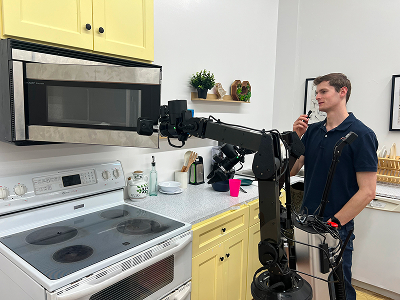
The defining shift of the last eighteen months, and the one that reshaped what "senior" means, is the arrival of vision-language-action (VLA) models. These are large neural networks that take in what a robot sees, plus a plain-language instruction, and output motor actions directly, and they are collapsing years of hand-tuned control code into a single learned policy. Physical Intelligence's pi-0.5 generalizes to homes it has never seen, coached in natural language, which is exactly the capability that makes a generalist robot commercially interesting. The image below, from Physical Intelligence's own research post, shows the robot being told to close a microwave in an unfamiliar kitchen, a concrete picture of what "embodied AI" now means in practice.
The three leading VLA architectures differ in ways a recruiter can actually use as screening vocabulary. Nvidia's GR00T N1 is an open, roughly two-billion-parameter dual-system model: a slow "System 2" that reasons and plans, and a fast "System 1" diffusion transformer that produces smooth motor actions at 120 hertz - Pebblous. Google DeepMind's Gemini Robotics runs a think-then-act pipeline and, in its on-device version, can adapt to an entirely new robot body with fewer than 200 examples - Google DeepMind. Physical Intelligence's pi-series stacks a flow-matching diffusion policy on a vision-language backbone. A candidate who can explain the difference between these, and why you would pick one, is doing real work in the field. Nvidia's own overview of GR00T N1 below is a good primer on the model class that now shapes these job specs.
NVIDIA Isaac GR00T N1: An Open Foundation Model for Humanoid Robots
Two practical screening rules fall out of all this. First, treat open-source contribution as a competence filter: the Hugging Face LeRobot library, led by an ex-Tesla Optimus engineer, has grown to roughly 27,000 GitHub stars and its hub surpassed 58,000 community datasets, so a candidate who has uploaded real-robot datasets or merged code there is demonstrably hands-on - GitHub. Second, learn the resume red flags that separate real engineers from padded ones. The most reliable are a candidate stuck on ROS 1 with no migration story, a resume that cannot survive three "why" questions deep on any claimed project, and a pure deep-learning background with no grasp of kinematics or embodiment - Kore1. That third flag is the common one in a VLA-hyped market: plenty of machine-learning engineers now claim robotics because they fine-tuned a policy in a notebook, but they have never confronted a real actuator's torque limit or a sensor's noise floor, and on a hardware team that gap surfaces fast and expensively.
One more stack is worth recognizing by name, because perception is where many robotics teams concentrate their headcount. A strong perception or SLAM engineer typically works in C++ and Python with OpenCV, deep-learning libraries, and sensor toolchains for cameras, LiDAR, and depth sensors, plus factor-graph libraries like GTSAM for fusing noisy measurements into a coherent map - ZipRecruiter. The ROS 2 platform engineers underneath them lean on the navigation stack Nav2, the DDS middleware that carries messages between components, and real-time Linux tuning. None of this is something a non-technical recruiter needs to master, but recognizing the vocabulary lets you tell, in half a minute of reading a profile, whether a candidate has actually done the work or has only brushed against it, and that recognition is most of what effective technical screening requires.
5. What This Talent Actually Costs
Robotics compensation in 2026 is bimodal, and quoting the wrong mode loses candidates before you start. The broad-market average for a US robotics engineer sits around $148,600 in base salary and roughly $183,500 in total compensation by Built In's data - Built In. But that average is nearly meaningless for the roles physical-AI companies fight over, because the specialists command far more. The most detailed 2026 bands, from robotics recruiting firm Kore1, run $150,000 to $240,000 base for mid-level engineers, $200,000 to $345,000 for senior, and $280,000 to $475,000 for principal and staff, with the very top of that range reserved for VLA and robot-learning specialists - Kore1. On top of those bands, hands-on humanoid and whole-body-control experience carries a documented 15 to 35 percent premium, because the pool of people who have actually shipped a walking robot is tiny.
The reason those numbers keep climbing is that robotics startups are not competing only with each other. They are competing with the machine-learning organizations at the largest technology companies, which set the anchor price for anyone who can train large models. The Levels.fyi data makes the pressure concrete: median machine-learning-engineer total compensation runs about $261,000 at Nvidia, $288,000 at Google, $380,000 at Tesla, $401,000 at Apple, and around $492,000 at Meta, with individual senior packages stretching past a million - Levels.fyi. A humanoid startup that wants a strong ML engineer is implicitly bidding against those medians. The chart below shows the anchor prices a robotics recruiter is quietly negotiating against on every offer.
Median ML engineer total comp by employer (2026)
Specialist sub-roles have their own market prices worth knowing at the offer stage. Perception engineers average close to $56 per hour in advertised pay, dedicated SLAM engineers average around $105,600 per year with a range up to roughly $127,000, and some robotics-perception postings reach $300,000 at the top - ZipRecruiter. Controls-engineer base pay alone climbed from about $180,000 in 2022 to north of $260,000 in 2026, usually with pre-IPO equity layered on top - Fruition Group. All of these figures are point-in-time snapshots that drift monthly, so treat them as anchors for a conversation rather than fixed truths, and always confirm the current band before you quote a candidate.
It also helps to know the full range, from floor to ceiling, because a physical-AI company staffs all of it. At the low end sits the teleoperation and data-collection workforce, paid roughly $30 to $50 per hour to generate the demonstrations that train learned policies, often on rigs that themselves cost between $5,000 and $50,000 - Robotics Center of Silicon Valley. At the high end sit the VLA researchers you are cross-shopping against AI labs, where average AI-engineer base pay runs near $227,000 and pre-training or alignment specialists closer to $338,000, with total compensation often one-and-a-half to two-and-a-half times base once equity is counted - Noon. The equity multiplier is where startups actually compete, but only if they explain it honestly: a candidate weighing a frontier-lab cash package against startup equity needs a credible story about the company's trajectory, the strike price, and the liquidity path, or the equity reads as monopoly money. Recruiters who can speak fluently about how the equity could outweigh the cash gap, with real numbers, close offers that a vague "huge upside" pitch loses.
The extreme tail of this market is worth understanding even if you never touch it, because it sets expectations for the whole field. In the broader AI-talent war, Meta reportedly offered signing bonuses as high as $100 million and packages up to $300 million over four years to poach top researchers - CNBC, and one reported offer to a single researcher approached $1.5 billion before it was declined - Entrepreneur. Embodied AI is not immune: Chinese humanoid maker UBTech advertised a chief-scientist role paying up to $18 million a year - Bloomberg. No startup competes at that altitude, and understanding that you cannot is the beginning of a realistic strategy, which we return to in Chapter 10.
6. The Scarcity Math: 2,000 Engineers, 65,000 Jobs
Every tactic in this guide follows from one ratio: the demand for physical-AI engineers exceeds the qualified supply by more than an order of magnitude. The estimate that only about 2,000 US engineers can genuinely combine VLA models, sensor fusion, and kinematics, set against 65,000-plus open robotics roles, is the number to keep in your head - Fruition Group. Even using looser definitions, the picture holds: one 2026 recruiting analysis pegs the AI-and-automation market at roughly one qualified candidate for every 3.1 open roles, with robotics time-to-hire averaging more than five months - RentASourcer. When supply is this tight, the winner is not the company with the best job description. It is the company that finds people the others have not found yet.
The forward projections only widen the gap. The United States is expected to have roughly 172,300 robotics-engineering roles by 2029, about nine percent above 2024, and one commonly cited global estimate puts AI-related roles at 4.2 million against just 2.1 million qualified professionals worldwide - RentASourcer. Surveys of technology companies find around 76 percent citing a hard talent shortage as a direct constraint on their plans - Qubit Labs. None of these figures should be treated as precise, but they all point the same direction, and the direction is what matters: the imbalance is structural, it is getting worse, and it will not be solved by the supply side within the planning horizon of any company hiring today. That is the premise every downstream decision has to accept.
The supply side simply cannot grow fast enough to relieve this in the near term, and the pipeline data explains why. US universities awarded about 58,131 doctorates in 2024, and while robotics and computer vision rank among the top specializations for computer-science PhDs, only a fraction of those graduates each year have the specific embodied-AI profile these companies want - NSF NCSES. You cannot manufacture a decade of robotics experience in a bootcamp, and the hands-on, hardware-in-the-loop skills that matter most are the slowest to teach. That structural lag is why compensation keeps rising and why poaching, not growing, dominates the market.
Geography concentrates the scarcity further, which is both a problem and an opportunity. An analysis of more than 3,000 active robotics postings found California alone accounted for roughly 33 percent of the US market, with the top hirers being Amazon, Nvidia, and the defense-technology company Anduril - CareersInRobotics. That concentration means a Bay Area role competes against the densest possible field of rival offers, but it also means a company willing to hire remotely, or in a secondary hub like Pittsburgh or Austin, can reach candidates who are not being bid on ten times a week. The practical takeaway is that scarcity is not uniform, and a recruiter who maps where the competition is thin, by geography, by seniority, and by sub-specialty, can find slack in a market that looks fully saturated from the coasts.
7. Where the Talent Actually Is
Because job boards fail for this population, sourcing has to happen at the source, and the sources are surprisingly concentrated. The highest-density academic pools are a short list of labs: Carnegie Mellon's Robotics Institute, MIT CSAIL, Stanford, UC Berkeley's BAIR, Georgia Tech, the University of Michigan, and, for legged locomotion specifically, ETH Zurich's Robotic Systems Lab under Marco Hutter, whose ANYmal platform trained a generation of the field's best walkers - ETH Zurich RSL. For research hires, program fit and faculty alignment matter more than raw prestige, so a recruiter should learn which lab specializes in what. A candidate from Michigan's Dynamic Legged Locomotion Lab is a bipedal-controls person; a BAIR graduate is more likely a deep-RL person. Those distinctions let you match a resume to a req before the first call.
The venues where these people gather in person are equally concentrated and equally sourceable. The flagship 2026 conferences are ICRA in Vienna, RSS in Sydney, IROS in Pittsburgh, CoRL in Austin, and Humanoids in Santa Clara, with NeurIPS remaining the key venue for the learning-heavy embodied-AI crowd - IEEE ICRA 2026. Paper authorship at these conferences is a durable, public signal of research capability, and the author lists are free to read. Attending in person, or simply mining the proceedings, is one of the highest-yield sourcing activities available, because the same names recur across the venues and the strongest researchers are legible from their publication record long before they update a LinkedIn headline.
Beyond the marquee research conferences, two more gathering points reward attention. ROSCon is where the middleware and autonomy engineers who keep robots actually running congregate, a different and more production-minded crowd than the research venues, and Open Robotics even publishes an annual metrics report tracking the most active packages and contributors, which doubles as a sourcing list - Open Robotics. At the early-career end, competitions like RoboCup, whose 2026 edition runs in Incheon with a newly unified humanoid soccer league, put student team captains on public rosters solving exactly the perception, locomotion, and coordination problems humanoid startups hire for - RoboCup. The same logic applies to specific university labs: the University of Michigan's Dynamic Legged Locomotion Lab, which built the Cassie bipeds, is a direct pipeline for walking-robot controls talent, and its alumni are identifiable from their published work.
The most underused sourcing surface, though, is open source, which doubles as a live, public skills assessment. The diagram below lays out the channels in rough order of signal quality so you can build a repeatable sourcing routine rather than a one-off search.
Each branch of that map is a concrete search you can run this week. LeRobot Hub dataset uploaders are, almost by definition, people who have operated real robots and captured real data, which is exactly the hands-on signal a padded resume cannot fake - TechTimes. Maintainers of core ROS 2 packages and contributors to Nvidia Isaac Lab (which is adopted by Figure, Boston Dynamics, Agility, and Skild) are proven systems engineers whose work you can read before you ever message them. Even legacy competitions pay off: alumni of the DARPA Robotics Challenge and Subterranean Challenge, such as ETH Zurich's SubT-winning CERBERUS team, went on to seed a striking share of today's robotics startups - IEEE Spectrum. The unifying principle is that this talent leaves a public trail of work, and sourcing it is a matter of reading that trail rather than waiting for applications.
8. Cross-Industry Conversion: AV, Warehouse, Aerospace
The fastest way to expand a robotics pipeline beyond the tiny pool of humanoid-native engineers is to convert adjacent talent, and in 2026 the richest conversion pool is autonomous-vehicle talent. General Motors wound down Cruise, cutting roughly half of its staff in February 2025, releasing a large cohort of senior perception, planning, and sensor-fusion engineers into the market - TechCrunch. Those skills transfer almost directly to humanoids, because a self-driving car and a walking robot solve the same core problems of perceiving a messy world and deciding how to move through it. Reporting on the talent flows names Figure, Apptronik, and 1X as the largest destinations for senior Tesla Optimus alumni, and the same magnetism pulls in ex-Cruise and ex-Zoox engineers - Kore1. For a recruiter, the practical move is to filter for ex-AV engineers whose profiles mention perception, planning, or full-self-driving work.
The second high-value conversion pool is warehouse and industrial robotics, and it brings something the humanoid startups often lack: production discipline. Engineers from Locus Robotics, GreyOrange, Symbotic, Vecna, and Amazon Robotics have shipped fleets of real machines into real operations, where uptime and reliability are non-negotiable - Kore1. Many are ready to move after three or four years and are drawn to the frontier appeal of humanoids. The signal to search on is a multi-year tenure paired with evidence of shipped fleet software, because that combination indicates someone who has taken a robot from demo to dependable product, which is precisely the muscle a research-heavy humanoid team is usually missing. The image below shows what "shipped and dependable" looks like: Agility's Digit working through totes in a live logistics deployment.

Conversion sourcing works because it reframes scarcity as a matching problem rather than a supply problem. There may be only a couple thousand humanoid-native engineers, but there are tens of thousands of adjacent engineers whose skills map cleanly onto the work with a few months of ramp. The art is knowing which adjacencies transfer and which do not: AV perception and warehouse fleet engineering transfer well, while, say, a pure web-backend background does not, regardless of how strong the engineer is. A recruiter who builds two or three well-defined conversion funnels, one from AV, one from warehouse robotics, and perhaps one from aerospace or drones, effectively multiplies the addressable talent pool without lowering the bar. That is often the difference between a role that fills in a quarter and one that stays open for a year.
A third adjacency worth building is aerospace, defense, and drones, where engineers routinely work on real-time control, sensor fusion, and safety-critical systems under tight reliability constraints. Companies like Anduril already rank among the top robotics hirers, which signals how naturally that talent crosses over - CareersInRobotics. The ramp is not free: an autonomous-vehicle perception engineer still needs a few months to learn a humanoid's kinematics, and an aerospace controls engineer needs to adjust from free-flight dynamics to contact-rich manipulation. But that ramp is measured in months against a hire that might otherwise take more than five, and the converts often bring exactly the reliability mindset a research-first team lacks. The discipline is to define the ramp explicitly, pair the convert with a humanoid-native mentor, and set expectations that the first quarter is partly a retraining investment rather than immediate output.
9. How to Assess a Robotics Engineer
Once you have candidates in the funnel, the assessment has to match the work, and the single biggest mistake is using a generic coding quiz. For robotics roles, algorithm puzzles "introduce noise without signal," and they actively drive strong specialists to disengage, because a whole-body-control expert does not spend their days inverting binary trees - RentASourcer. The assessments that actually predict performance are the ones that mirror the job: a simulation-based debugging task, a scoped ROS 2 challenge, an architecture walkthrough of a system the candidate built, and an honest discussion of a failure mode and how they diagnosed it. These reveal whether someone can reason about a real robot, which a puzzle never will.
The most efficient assessment signal, though, is one you can read before any interview: the portfolio. Well-documented GitHub repositories with logged metrics, public datasets, and conference papers prove deployment capability far better than credentials do, and portfolio-first sourcing consistently outperforms keyword-based search for this population - Intelligent Employment. When you request evidence explicitly and weight it over titles, you filter out the padded resumes cheaply and early. A candidate who can point to a repository that actually runs, with commit history showing they solved real problems over time, has already passed the hardest part of the screen. This is also why the open-source sourcing surfaces from Chapter 7 are so valuable: they are assessment and sourcing in the same motion.
A concrete example makes the difference tangible. Instead of asking a controls candidate to solve an abstract algorithm puzzle, hand them a small simulated robot in MuJoCo or Isaac with a deliberately broken controller, and watch how they diagnose it: do they check the sign of a gain, reason about the contact model, or instrument the system to see what the robot actually senses? A perception candidate can be given a noisy sensor log and asked to explain what would break downstream and why. These tasks take real effort to design, but they surface the exact reasoning the job requires, and strong candidates enjoy them because they finally get to show what they can do rather than perform interview theater. The failure-mode conversation is equally revealing: ask what went wrong on their last hard project and how they knew, because engineers who have genuinely shipped can always tell that story in specific, unflattering detail, while padded resumes turn vague under exactly that question.
Two logistical rules protect the quality of the process. First, do not run remote-only interview loops for controls and hardware roles, because those candidates need lab access to demonstrate their real ability, and evaluating them purely over video systematically underrates the best hands-on engineers - Kore1. Second, keep the loop short and respectful of the candidate's time, because in a market with a five-month average time-to-hire, a slow or bloated process is where offers are lost to faster competitors. The strongest candidates are usually in multiple pipelines at once, so every extra week of deliberation is a week a rival can use to close them. A tight, job-relevant, portfolio-anchored loop is not just more accurate, it is faster, and in this market speed is itself a competitive advantage.
10. Selling the Job Against FAANG and AI Labs
The uncomfortable truth is that most robotics companies cannot win on cash, so they must win on everything else. Frontier AI labs still pay 30 to 50 percent above FAANG for senior machine-learning talent, with median total compensation at the top tier reaching $600,000 to $795,000 - techinterview. A Series-B humanoid startup cannot match that in cash, and pretending otherwise wastes everyone's time. What it can offer instead is the thing money cannot buy at a giant: end-to-end ownership of a system that moves in the physical world, direct line of sight from a commit to a robot doing something new, and equity in a company that might be worth many multiples more in three years. For a certain kind of engineer, watching a robot you programmed take its first stable step beats another fraction of a percent on an already large salary.
This is why the non-cash levers have become central to the recruiting playbook rather than a consolation prize. Companies are restructuring around them: roughly 89 percent report rethinking their pay structures and about 67 percent have adopted remote-first or hybrid models specifically to widen access to scarce talent - RentASourcer. Deployment visibility is a genuine differentiator too: an engineer who can tell their peers that their code runs on robots inside a named automaker or logistics operator carries real status, and that story recruits other engineers. The mission itself, building the machines that will define the next industrial era, is a legitimate draw for people who find it more meaningful than optimizing an ad auction.
Speed and candidate experience are themselves a form of compensation in a market this tight. A robotics engineer holding three offers weighs not just the numbers but which company treated them as a peer: whether the interviews were technically serious, whether the team clearly understood the work, whether the process respected their time. A dragging loop or a generic recruiter interaction signals an organization that does not really understand what it is hiring for, and top candidates read that signal accurately. The practical lever is to compress decision time, put strong engineers in front of candidates early, and communicate with genuine technical fluency, all of which cost nothing and consistently swing decisions that money alone would lose. In a field where everyone is short on talent and long on capital, the binding constraint is rarely budget, it is the ability to move decisively and make a candidate feel understood.
The highest-leverage channel of all remains referrals, and it is underused precisely because it is unglamorous. Referred candidates are hired substantially faster and stay materially longer, with data pointing to roughly 55 percent faster hires and 45 percent higher two-year retention - daily.dev. In a field this small and this reputation-driven, a warm introduction from a respected engineer outweighs any job advertisement, because the robotics community is tight enough that people know each other's work directly. The tactical implication is to treat your existing engineers as your best recruiters, make it easy and rewarding for them to refer, and invest in the kind of authentic engineering-brand storytelling, real technical blog posts and conference talks, that makes their referrals land. Employer branding for this audience is not slogans; it is credible evidence that the work is hard and interesting.
11. Visas and the Global Talent Map
Immigration policy has quietly become one of the most important variables in physical-AI hiring, because so much of the world's robotics talent is internationally mobile. In the United States, the H-1B route grew markedly less reliable heading into fiscal 2027: registrations dropped roughly 38.5 percent, and a new wage-weighted selection now gives the highest-paid roles multiple lottery entries while entry-level roles get one, pushing some talent toward Canada, the UK, and the Gulf - Rest of World. For a recruiter, this means the visa path is no longer a back-office formality; it is a live sourcing variable that determines whether an offer can even be made, and candidates increasingly ask about it early.
Because the lottery is unreliable, employers of top robotics talent are leaning harder on the O-1A extraordinary-ability visa and the EB-2 National Interest Waiver, both of which suit researchers with strong publication and citation records, exactly the profile these roles attract. Large employers still dominate the traditional route, with Amazon leading initial H-1B approvals in fiscal 2025 at 4,644, ahead of Meta, Microsoft, and Google - Robotics & Automation News. A smaller startup cannot match that volume, but it can move faster and offer the extraordinary-ability path to a candidate whose conference record clearly qualifies.
The mechanics of those two paths are worth understanding because they change your sourcing math. The O-1A has no annual cap and no lottery, so a candidate with strong publications, citations, and conference talks can often be moved in a matter of months rather than waiting a year for a draw that may never hit. The EB-2 National Interest Waiver is a green-card path rather than a temporary visa, which appeals to candidates who want permanence and lets a startup offer something the lottery cannot: a credible route to staying. Robotics and AI both sit on the government's critical-and-emerging-technology lists, which strengthens these petitions. For candidates who cannot or will not relocate at all, the fallback is genuine remote or nearshore hiring, and the two-thirds of companies that adopted remote-first models did so precisely to reach talent the visa system would otherwise wall off. Knowing which visa fits which candidate profile, and building the immigration conversation into the process early, turns a common deal-breaker into a differentiator.
The global dimension also reshapes where you look. China has become a genuinely separate, rapidly growing talent pool for embodied intelligence, with domestic champions like Unitree, AgiBot, and UBTech hiring aggressively and paying at the extreme top end for research leaders. Europe holds deep strength in legged locomotion and industrial robotics, anchored by ETH Zurich and a dense cluster of German and Nordic robotics companies, and Eastern Europe has emerged as a strong region for advanced robotics engineering talent that is often more accessible than the Bay Area - Qubit Labs. A recruiter who treats the talent map as global, and who pairs that reach with a realistic immigration or remote-hiring plan, competes for candidates that a US-only search never surfaces. The scarcity is real, but it is also unevenly distributed, and geographic flexibility is one of the few ways to genuinely expand supply.
12. AI Agents Are Rewriting Sourcing
The structural response to a talent pool this scarce is automation of the search itself, and this is the fastest-moving part of the recruiting stack in 2026. The intent data is unambiguous: 84 percent of talent leaders plan to use AI in recruiting this year and 52 percent plan to deploy autonomous AI agents, while overall AI use in recruiting has climbed to 51 percent from just 26 percent in 2024 - Pin. The reason is arithmetic. When qualified candidates leave a public trail across GitHub, arXiv, conference proceedings, and a billion web profiles, but a human sourcer can only read so many pages a day, an agent that reads all of them and screens each against a written brief is not a convenience, it is the only way to cover the surface area. AI is now absorbing an estimated 60 to 80 percent of transactional recruiting work, freeing human recruiters for the parts that require judgment and warmth.
The tool landscape has consolidated around a few serious platforms, and they differ in ways that matter for robotics specifically. SeekOut indexes over a billion profiles and is strong on technical signals, sourcing from GitHub, patent filings, and academic publications, which maps well onto deep-tech research talent - SitePoint. Juicebox and hireEZ each aggregate hundreds of millions of profiles and lead on natural-language search and outreach. And a newer category of autonomous AI recruiters, including HeroHunt.ai, goes a step further by running the whole loop: searching across more than a billion web profiles, screening each person with contextual language-model reasoning rather than keyword matching, and sending personalized multichannel outreach on autopilot. That contextual-screening distinction matters most for robotics, where the difference between a candidate who "worked on robots" and one who shipped a whole-body-control policy is invisible to a keyword filter but obvious to a model reading the work.
HeroHunt.ai
If your bottleneck is that the best robotics engineers never apply and are scattered across GitHub, arXiv and a dozen niche communities, an autonomous sourcing layer is the natural first experiment. HeroHunt.ai runs its agent loop over an aggregated index of 1B+ profiles from sources like LinkedIn, GitHub and Stack Overflow, and screens each person with a language model against your actual brief ("ROS 2 plus real bipedal whole-body-control experience," not just the word "robotics"), then drafts personalized outreach. It is a flat monthly plan with unlimited positions and searches, metered on AI-screened and matched profiles delivered and candidate emails found rather than per seat, and there is an 8-day free trial, so one genuinely hard robotics req is a cheap way to test it. The honest caveat: it is a sourcing layer, not an applicant tracking system, and for the few hundred elite VLA researchers a warm introduction from a former advisor still closes better than any cold message, so use the agent to cover the wide top of the funnel and keep your human warmth for the final stretch.
The mechanism behind that distinction is worth making explicit, because it is the whole reason autonomous recruiters matter for robotics. A keyword search treats "robotics" as a token and returns everyone who typed it, including thousands of hobbyists and adjacent engineers. A language model reading the same profile can weigh whether the person shipped a whole-body-control policy, contributed to a serious open-source stack, or merely took one robotics course, and it can do that reading across a billion profiles without tiring. Tools built on this idea, such as HeroHunt's AI Recruiter and its RecruitGPT shortlisting, are effectively applying the same foundation-model advance that is transforming the robots to the problem of finding the people who build them. The judgment is not perfect, and it still needs a human to confirm the final list, but it turns the top of the funnel from a keyword lottery into something closer to a genuine first-pass screen.
The measurable payoff is why adoption is accelerating despite the hype fatigue around AI. Personalized, AI-assisted outreach achieves three to four times the response rate of generic templates, and multichannel sequences that combine email, LinkedIn, and other touchpoints have been reported to lift responses far higher still - HeroHunt.ai. On cost, engineering roles average around 62 days to fill at $8,400 to $12,000 per hire, with specialized AI and ML roles exceeding $15,000, yet teams using AI sourcing report 35 to 45 percent lower cost-per-hire than relying on job boards and agencies alone - Pin. The strategic reading is not that agents replace recruiters. It is that in a market where the qualified pool is two thousand people deep and hidden in plain sight, the teams that instrument their sourcing with AI simply see more of the pool than the teams that do not, and seeing more of a scarce pool is the whole game.
None of this removes the human from the loop, and pretending otherwise is where AI sourcing goes wrong. An agent can misread a profile, over-index on keywords in its own way, or draft outreach that lands as obviously automated, and a robotics researcher who gets a message confusing their subfield will dismiss the sender instantly. The teams that get the most from these tools treat the agent as a tireless first-pass sourcer whose output a human reviews, edits, and personalizes before it goes out, not as a fire-and-forget spam cannon. Used that way, the automation expands how much of the scarce pool you can see and engage, while human judgment protects the credibility that outreach in a small, reputation-driven field depends on.
13. The Future: Foundation Models Reshape the Team
The most important trend for anyone planning robotics headcount past 2026 is that robot foundation models are changing which engineers a company needs, not just how many. As learned VLA policies replace hand-tuned control code, the marginal value of a bespoke controls engineer per robot behavior falls, while the value of the people who feed and evaluate the models rises. Google DeepMind's on-device Gemini Robotics adapting to a new robot body with fewer than 200 examples is a preview of a world where less per-embodiment hand-engineering is required and more of the work shifts to data and evaluation - Google DeepMind. The team of 2028 will likely carry a higher ratio of data engineers, machine-learning engineers, and evaluation specialists to classical controls engineers than the team of 2024 did.
That shift creates a genuinely new hiring frontier around the data wall. Robot learning is bottlenecked by demonstration data, and closing that gap means large teleoperation and data-operations organizations, plus the pipeline engineers who curate and scale the resulting datasets. This is the fastest-growing and most overlooked hiring category in physical AI, and it spans a wide compensation range, from hourly teleoperators to well-paid data-infrastructure engineers who build the collection and curation systems. The image below, Nvidia's own depiction of the synthetic-data and simulation workflow behind GR00T, is a useful mental model for the kind of data-centric roles that will dominate robotics org charts as foundation models scale.
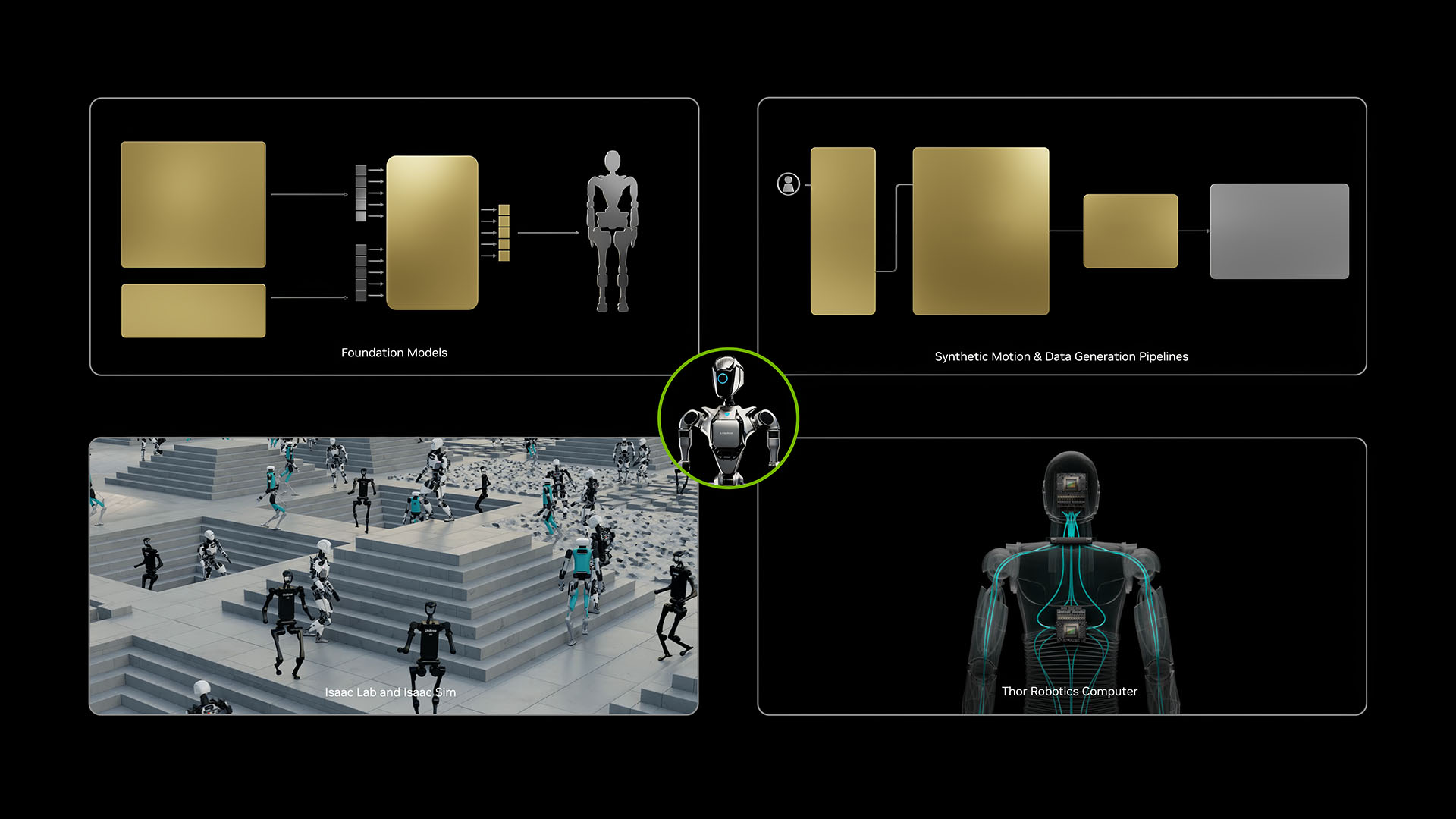
It is worth being concrete about the new roles this creates, because they are not the ones today's robotics job boards emphasize. Scaling from hundreds of robots to millions turns manufacturing engineering, actuator-production and supply-chain expertise, field-service and fleet-reliability engineering, and functional safety from afterthoughts into core functions. A humanoid that works flawlessly in a lab but cannot be built at volume, serviced in the field, or certified as safe near people is a research demo, not a product, and the engineers who close those gaps will be in as much demand as the researchers who got the robot walking. The recruiters who start building relationships in those adjacent pools now, in automotive manufacturing, in industrial reliability, in safety certification, will have a pipeline when the deployment wave arrives, while those still fixated only on VLA researchers will be starting from zero.
Zooming out, the deployment forecasts imply a hiring wave that has barely begun. Bank of America projects annual humanoid shipments rising from roughly 20,000 units in 2025 to 10 million by 2035, on the way to about 3 billion humanoids in service by 2060 - Bank of America Institute. Even if reality lands at a fraction of those numbers, scaling from thousands of robots to millions requires an enormous expansion in manufacturing, field-deployment, reliability, and safety engineering, categories that barely register in today's research-heavy org charts. The companies that win the next phase will be the ones that staffed those functions early, and the recruiters who understand that the profile is shifting, from lone genius researchers toward data, evaluation, safety, and scale-up teams, will be the ones who build them. AI sourcing agents will be doing much of the top-of-funnel work to find all these people, which is a fitting symmetry: the same foundation-model wave that is reshaping the robots is reshaping how their builders are recruited.
14. Conclusion: A Hiring Playbook for Physical AI
The decision framework for recruiting robotics engineers in 2026 comes down to accepting one reality and acting decisively on it: the qualified pool is tiny, everyone is hiring from it, and the winners are the teams that find and close talent the fastest, not the ones that pay the most. No startup out-cashes Meta or the frontier labs, so the strategy is never to try. Instead, define the exact role family you are filling, because a perception engineer, a whole-body-control specialist, and a VLA researcher are different people who need different pitches and different assessments. Get that right and everything downstream sharpens.
From there the playbook is concrete. Source at the source, meaning open-source contributors, conference authors, and specific academic labs, rather than job boards. Widen the pool with disciplined conversion funnels from autonomous vehicles and warehouse robotics, where thousands of adjacent engineers map cleanly onto the work. Assess with job-relevant, portfolio-anchored loops instead of generic coding puzzles, and keep those loops fast, because in a five-month market speed closes candidates. Sell end-to-end ownership, deployment visibility, real equity, and mission, and let your own engineers' referrals do the heaviest lifting. Build the immigration conversation in early, and treat the talent map as global. Finally, instrument the wide top of your funnel with AI sourcing so you actually see more of a pool that hides in plain sight, and reserve your scarce human attention for the warm, high-touch closing that the best few hundred researchers still respond to. Platforms that automate that first mile, from talent-intelligence tools like SeekOut to autonomous AI recruiters like HeroHunt.ai, exist precisely so a lean team can cover a billion-profile search surface without a billion-dollar budget.
For a small robotics or physical-AI team, the practical starting point is to let an agent handle the wide search while your engineers handle the close. HeroHunt.ai sources from 1B+ profiles, screens each candidate against your written brief with contextual AI, and drafts outreach on autopilot, with an 8-day free trial so a single hard req costs nothing to test.
The robots are coming faster than the people who build them, and that gap is the defining recruiting challenge of the decade. The companies that treat hiring as a core engineering problem, worthy of the same rigor they apply to their control stack, will be the ones with robots on the floor while their competitors are still screening resumes. Yuma Heymans has spent five years building the autonomous sourcing systems that make that search tractable, and the lesson that carries into physical AI is simple: when the talent is scarce and hidden, the advantage goes to whoever looks in the right places first, and looks at more of them than anyone else.
This guide reflects the physical-AI hiring landscape as of August 2026. Funding rounds, valuations, and compensation figures move quickly in this market, so verify current details before acting on any specific number.