


Recruitment funnel, recruiting pipeline, 360 recruitment cycle, recruitment marketing funnel… 😐 Let’s settle this once and for all.
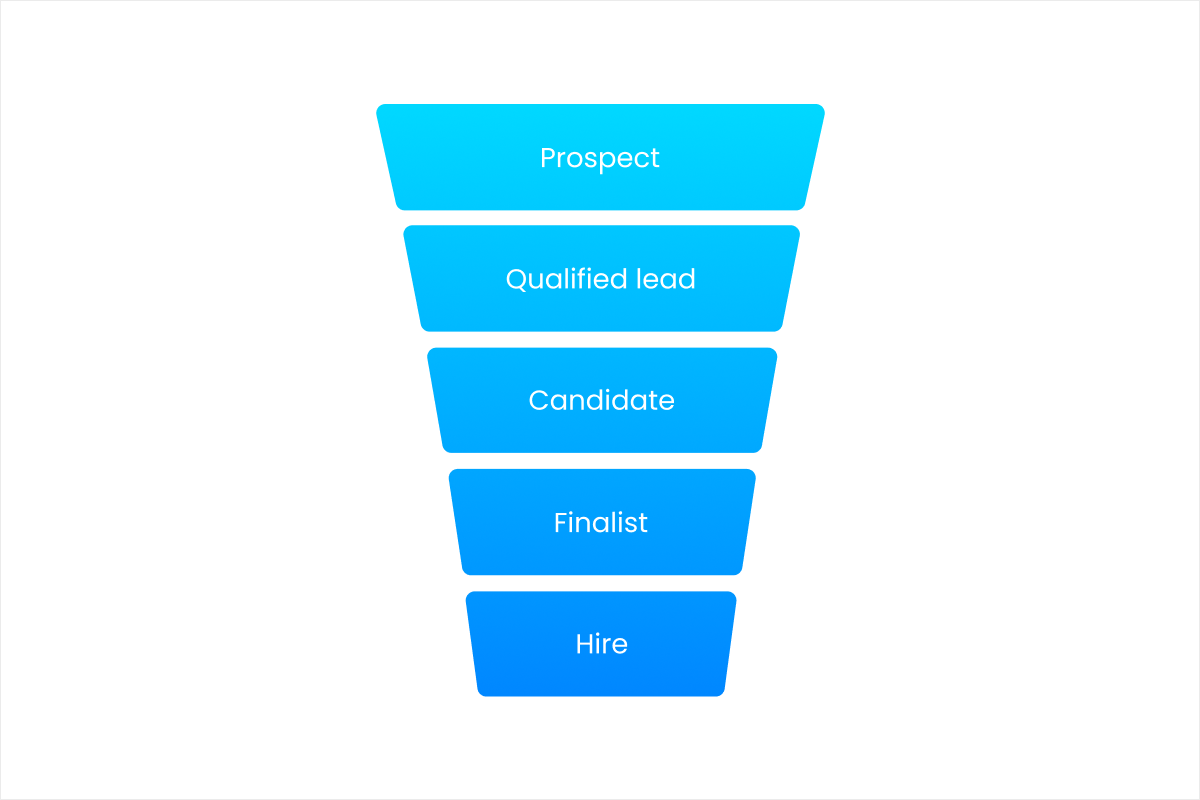
The recruitment funnel is a concept that represents a process or literally a ‘funnel’ through which candidates progress through several stages of the hiring experience.
An eventual ‘hire’ only becomes a hire after completing certain milestones like learning about the job in the first place, doing a job application, meeting job requirements and signing the contract.
Getting to these milestones can be visualized and managed in stages.
That’s what the recruitment funnel is all about.
What is a recruitment funnel?
A funnel is usually visualized as a pipe or tube that is wide at the top and narrow at the bottom.
A recruitment funnel is a pipeline with several stages that a contact moves through.
The terms recruitment funnel and recruitment pipeline are used interchangeably. Although the word ‘funnel’ emphasizes the fact that the amount of contacts that move through the funnel becomes less in later stages since not all contacts progress through subsequent stages in the funnel.
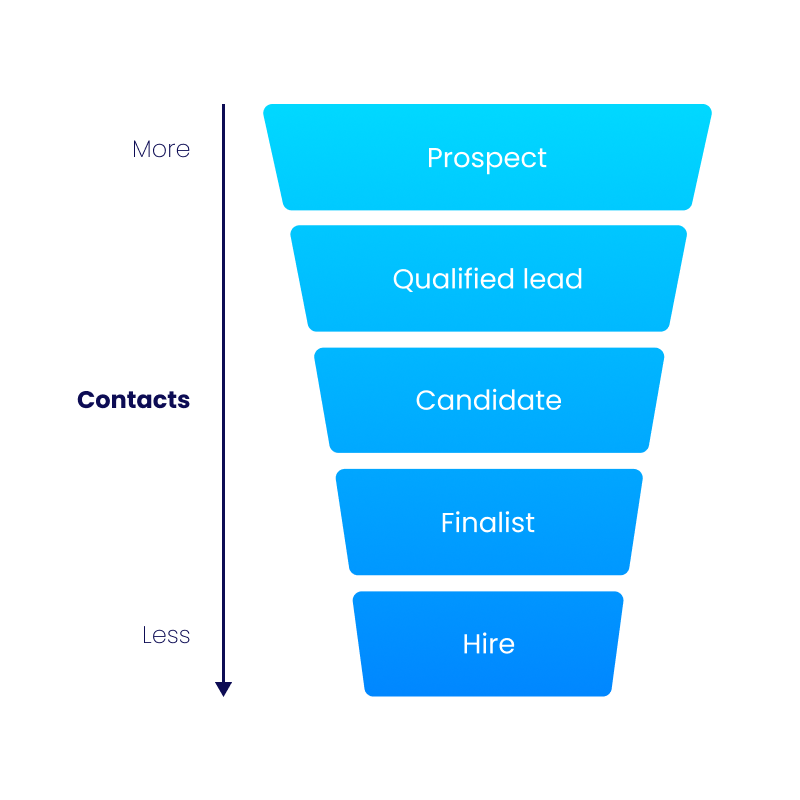
As you can see, there are several stages in the funnel defined by where the contact resides. A ‘Contact’ is a collective name for anyone who goes through your recruitment funnel regardless of the stage they are in.
The funnel stages and their meaning can vary across recruiting teams. But generally speaking the stages are defined by the stage the contact is in.
For this example of the funnel the stages are:
- Prospect: An individual who could be interested in your job and targeted for recruiting purposes.
- Qualified lead: An individual who has shown an intent of applying to the job.
- Candidate: An individual who has applied for your job or has otherwise actively expressed interest in the job.
- Finalist: A candidate who is part of the last round of interviews and assessments
- Hire: A candidate who signed the employment contract and will be an employee soon.
What about the recruitment marketing funnel?
The recruitment marketing funnel is a very similar concept to the more generic recruitment funnel but is more targeted to the marketing efforts of the hiring company.
A popular way of framing the recruitment marketing funnel, or a marketing funnel in general is in the AAARRR, or pirate approach, stages:
- Awareness: How many people do you reach?
- Acquisition: How many people visit your career page?
- Activation: How many people take the first important step like completing a form?
- Retention: How many people come back for a second, third or tenth time?
- Revenue (or in recruitment application): How many people complete a job application?
- Referral: How many people refer your company or job to other potential candidates?
In this blog we’ll focus on the more generic recruitment funnel for a broader application throughout the entire recruiting process.
Why are recruitment funnels used by recruiters?
The recruiting process is increasingly becoming more data driven.
Where we used to do a hundred phone calls a day back in the days and not have any overview of which contacts were interested and what actions they performed at what stage, we now can track every little step and milestone in the recruiting process.
This enables recruiters to make their process more data driven and therefore better measurable and controllable.
Knowing exactly which steps a potential candidate completed in the process, helps to better support the candidate in the rest of their hiring process.
In addition, when all of this data on individual contacts is combined, recruiters are better able to create an overview of the overall effectiveness of the recruiting process and find points of improvements.
Where managing thousands of contacts for several jobs used to be almost impossible, with today’s technology, like a recruitment CRM, we can easily manage all those different data points.
Doing so with the concept of the recruiting funnel enables better visualization and management of contacts and underlying information.
Manatal
Everything on this page depends on one unglamorous thing: every contact has to sit somewhere that records which stage they are in and when they moved. You cannot calculate a single conversion rate from a spreadsheet of names and a mailbox. Manatal is the cheapest credible place to keep that pipeline, at $15 per user per month billed annually ($19 month to month), and the 14-day trial takes no credit card. Read the ceiling before you commit, though: the $15 tier stops at 15 active jobs and 10,000 candidates. On the funnel further down this page, 1,000 prospects buy you one hire, so a sourcing-heavy team burns through 10,000 candidate records in roughly ten hires and is realistically choosing the $35 tier, not the headline one. Workflow automations are also withheld from that entry tier, so the stage moves get logged by hand until you reach $35.
How does a recruitment funnel work?
Every stage in the recruitment funnel has its own milestones, also called stage criteria.
Stage criteria are important moments of conversion through which the contact progresses to a next stage of the funnel.
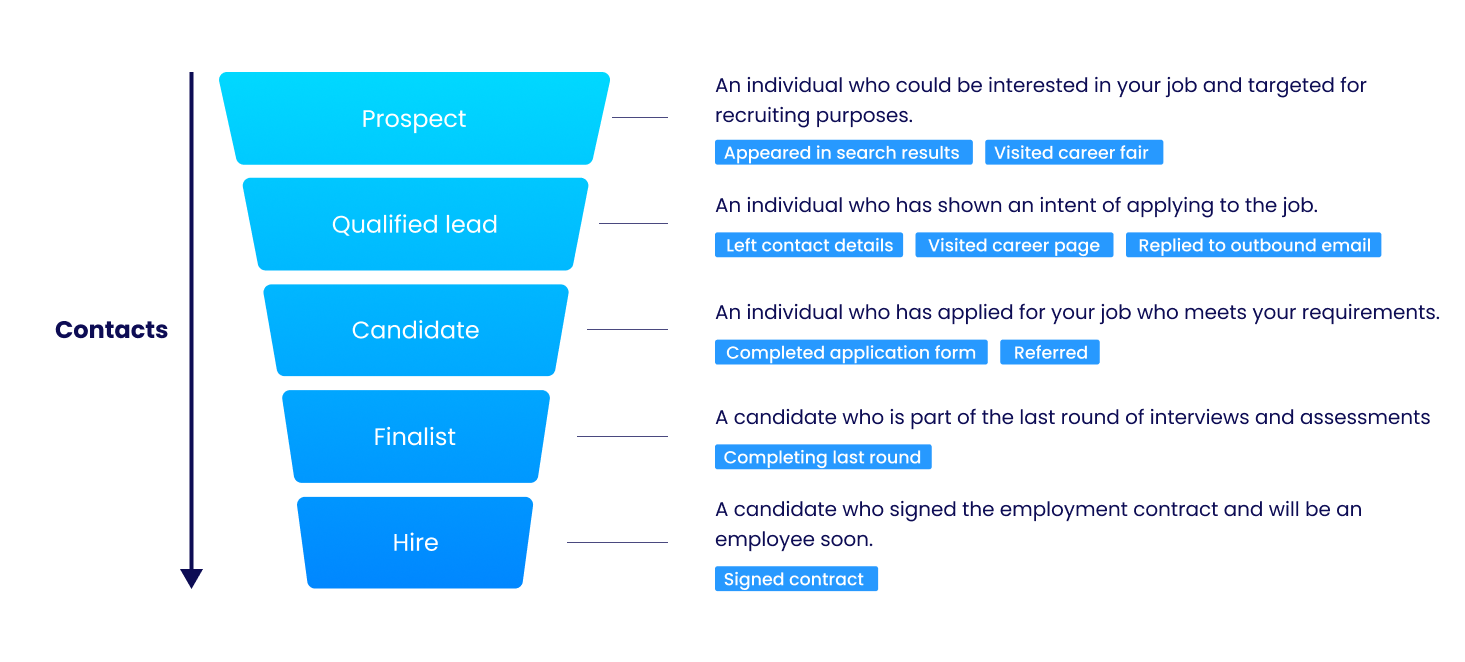
For example, in the ‘qualified lead’ stage, a contact can have left their contact details, visited a career page or replied with interest to an outbound email. When they progress through the funnel, they might complete an application form and they become a ‘candidate’, which is the next stage of the funnel after qualified lead.
Recruitment funnel conversion
Conversion is the process of progressing contacts through the next stages of the funnel.
When a contact goes from prospect to qualified lead for example, we can say they ‘converted’ to qualified lead.
To know the conversion of each stage, you need to know the amount of contacts per stage.
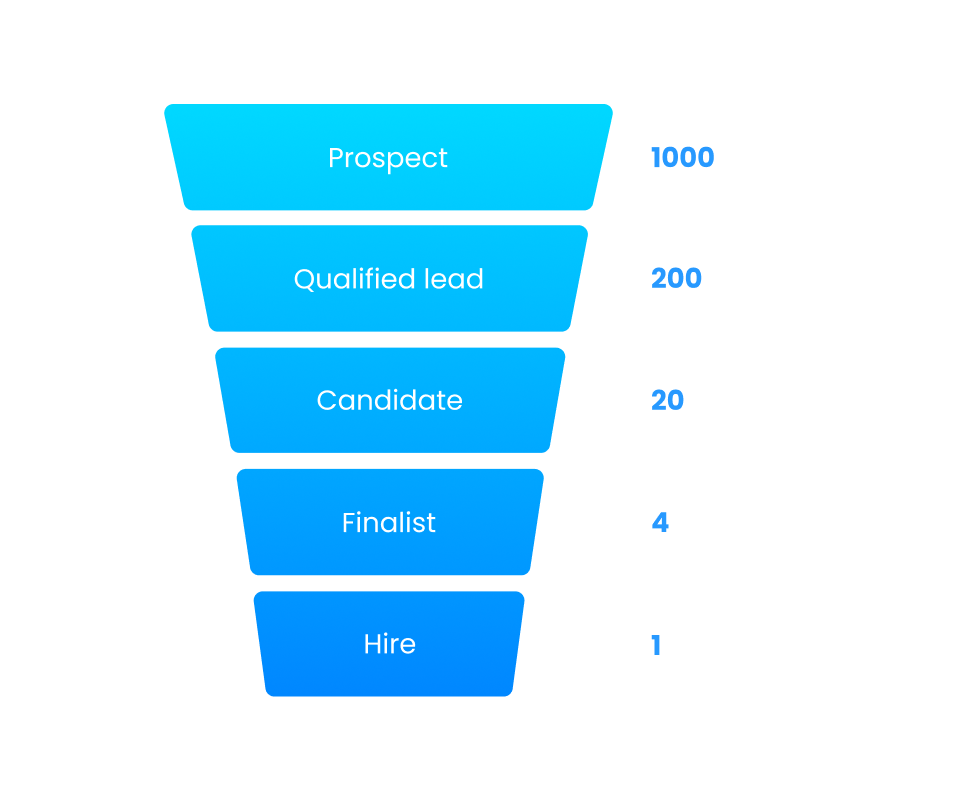
As you can see, in this case there were 1000 prospects needed to end up with 1 hire. This can realistically be the case for hard to find roles like software developers.
The conversion rate from ‘prospect’ to ‘hire’ here would be 1/1000 = 0.01%. The conversion from ‘prospect’ to ‘qualified lead’ however, would be 200/1000 = 20%.
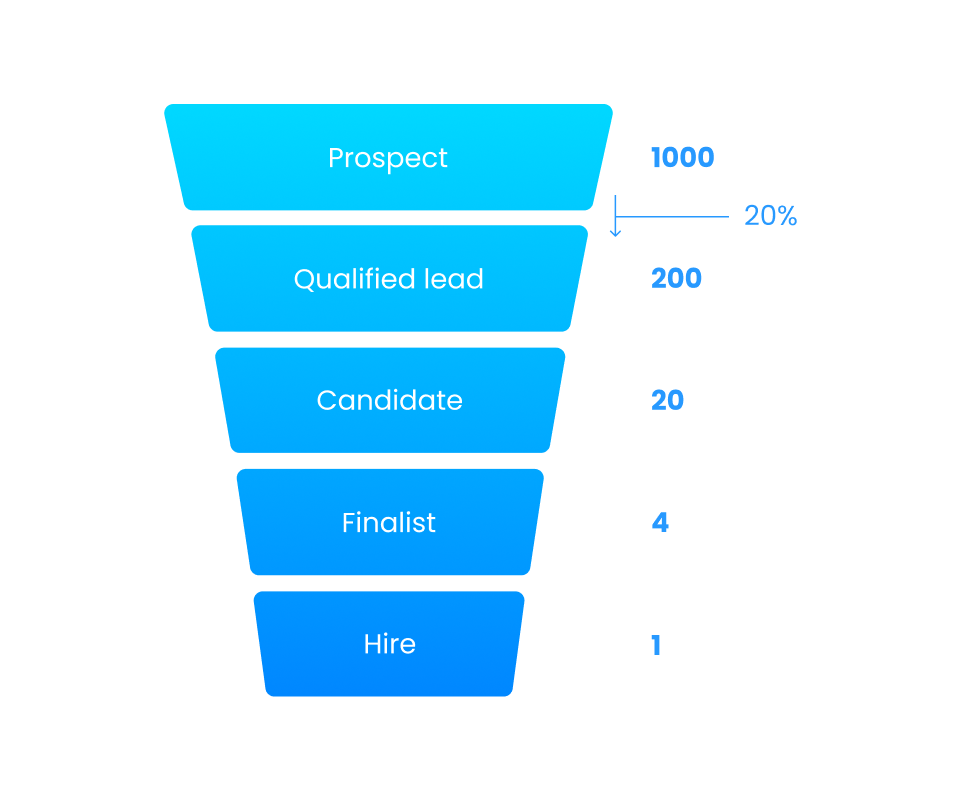
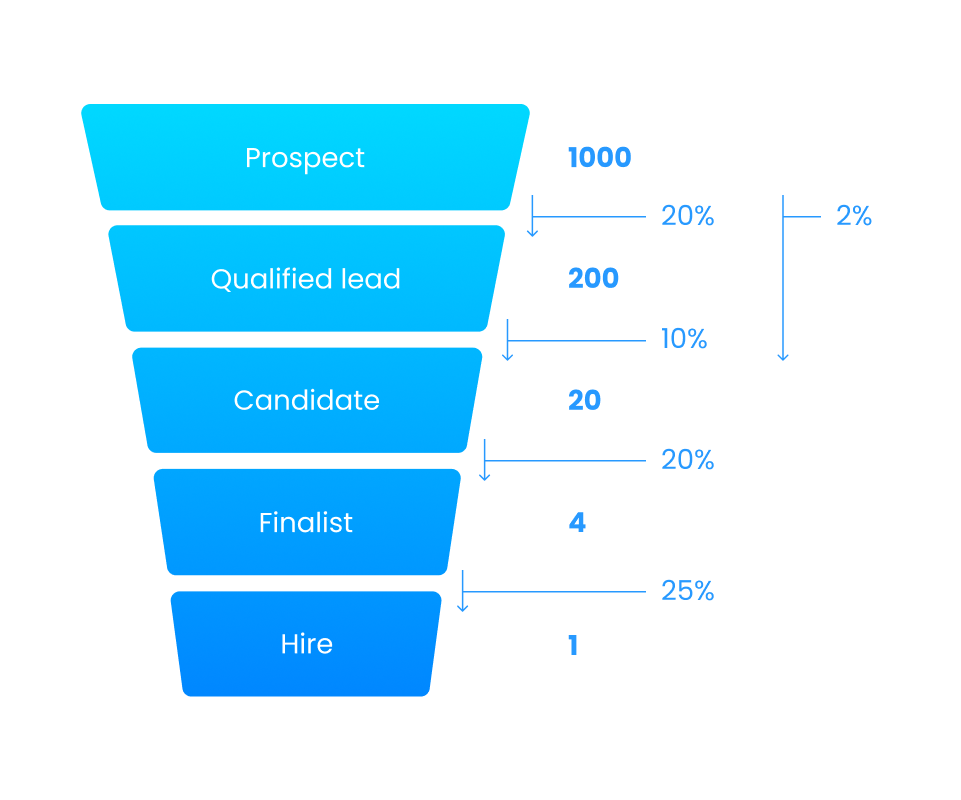
You can measure the conversion rate for any two stages. Every conversion can say something different about the effectiveness of your recruitment funnel. For example, the conversion from ‘qualified lead’ to ‘candidate’ can say something about how effective you are at convincing people who have already shown initial interest in a job or company to people who follow through to officially apply for the job.
What is a good recruitment funnel conversion rate?
The moment you have counts per stage, the obvious question follows: is 20% from prospect to qualified lead good or bad?
There is no single honest answer, because conversion varies enormously by role, seniority, channel and employer brand. But published benchmarks give you reference points, and they are more useful than a gut feeling.
CareerPlug’s 2025 Recruiting Metrics Report analysed 2024 hiring activity from more than 60,000 small businesses, covering over 10 million applications. Their averages:
- 6% click-to-apply: 94 of every 100 people who open your job post never start the application.
- 3% applicant-to-interview.
- 27% interview-to-hire.
- 180 applicants per hire, on average, across industries.
Ashby’s Talent Trends benchmarks, drawn from 54 million applications across 93,000 jobs, show what happens deeper in the funnel:
- ~35% passthrough at the recruiter screen, the harshest stage in most processes.
- 95% passthrough post-onsite.
- 81% offer acceptance.
| Conversion | Benchmark | Source |
|---|---|---|
| Job post view to application | 6% | CareerPlug, 2024 data |
| Application to interview | 3% | CareerPlug, 2024 data |
| Recruiter screen passthrough | ~35% | Ashby Talent Trends |
| Interview to hire | 27% | CareerPlug, 2024 data |
| Offer acceptance | 81% | Ashby Talent Trends |
| Applicants per hire | 180 | CareerPlug, 2024 data |
One caveat before you compare yourself to these. Those benchmarks describe inbound funnels that start at ‘applicant’. The funnel in this guide starts one stage earlier, at ‘prospect’, where you contacted the person rather than the other way around. An outbound funnel has a far worse top-of-funnel number (the 1,000-to-1 example above is realistic for engineers) and a much better bottom, because you pre-selected everyone in it. Comparing your sourced pipeline to a 3% applicant-to-interview average will tell you nothing.
The shape is the real lesson: the funnel is brutally lossy at the top and forgiving at the bottom. Almost all of your loss happens before the first interview, and almost none of it after the onsite. That is where your attention should go, and it is usually the opposite of where it goes.
How to improve each stage of the funnel
A conversion rate is only useful if it changes what you do. Each stage fails for a different reason, and the fix is different at each one.
Prospect to qualified lead
This is the response rate on your outbound. Recruiters almost always try to fix it with volume, which is the one lever that does not work: sending twice as many generic messages doubles the work and holds the rate flat.
The rate moves on targeting and relevance. It is worth the effort, because outbound converts: Gem’s benchmarks, built on 140 million applications and 1.3 million hires from 2021 to 2024, found a sourced applicant is 5x more likely to be hired than an inbound applicant. A prospect who is a genuine fit and gets a message that proves you read their profile is a different funnel from a mail-merge.
This is also the stage where the tooling is not your ATS. Sourcing tools, ours (HeroHunt.ai) included, exist to build a prospect stage that does not exist yet, which is a different job from tracking the people already in your pipeline.
HeroHunt.ai
The funnel in this guide starts at ‘prospect’, so somebody has to build that top stage before a single conversion rate exists, and this section’s whole argument is that doing it with more volume holds the rate flat. HeroHunt.ai is our own AI recruiter, built for exactly that job: it searches candidates across public profile sources, screens each one against the criteria you wrote down rather than against keyword matches, and drafts outreach per person, which is the targeting and relevance work that actually moves prospect-to-qualified-lead. The honest caveat: it does not hold your funnel. It has no stages and no dates per contact, so it fills the top and hands you people, and you still need the ATS or CRM covered further down to do the counting. If your funnel is purely inbound and starts at ‘applicant’, this stage is not your bottleneck and you can skip this entirely.
Qualified lead to candidate
Someone showed interest and then did not apply. This is nearly always friction, not persuasion: the application form, the account creation, the CV re-typing. That 6% click-to-apply average is where most job posts quietly lose everything.
Time the application yourself on a phone. If it takes more than a few minutes, you now know your problem.
Candidate to finalist
This is your screening, and the ~35% recruiter-screen passthrough is the benchmark to hold it against. Converting far above it is not the win it looks like: it usually means your requirements were loose and you are pushing unqualified people into interviews, which just moves the loss one stage later and wastes your hiring manager’s time.
Consistent, written stage criteria are what make this rate meaningful. Without them, ‘finalist’ means something different for every recruiter on the team and the number is noise.
Finalist to hire
Against an 81% offer-acceptance benchmark, a low number here is rarely a mystery: it is compensation, speed, or a candidate who was never really sold. This is also the most expensive stage to lose in, since everything upstream has already been paid for.
The stage most teams never count
Everyone you rejected, and everyone who went cold, is still in the funnel. Gem’s data shows talent rediscovery (re-engaging people already in your CRM) grew from 29.1% to 44.0% of sourced hires between 2021 and 2024. Nearly half of sourced hires now come from contacts a team already had. That is the cheapest source of hire in the funnel and it only exists if you kept the records.
Tracking the funnel in practice
None of this works from memory. To calculate a conversion rate you need, per contact, the stage they are in and the date they entered it. That is the whole data requirement, and it is why the funnel and the tooling are the same conversation: an ATS or recruitment CRM is not admin overhead, it is the thing that turns your process into numbers.
Two rules matter more than which tool you pick. First, define your stage criteria in writing before you measure anything, so a ‘qualified lead’ means one thing across the team. Second, keep your stage count small. Five stages that everyone applies consistently beat twelve that people skip, because skipped stages produce conversion rates that are confidently wrong.
On the tool itself, the honest guidance is that almost any ATS will do this, so buy on what your funnel actually looks like rather than on feature lists.
If your funnel starts at ‘prospect’ like the one in this guide, you need CRM-style handling of people who never applied, which is precisely where a pure applicant tracker gets awkward: it wants an application to exist before it will track anyone. Manatal handles both sides in one pipeline and is the cheapest of the credible options at $15 per user per month billed annually. Its entry tier does include the CRM and the reporting and analytics suite, so the stage counting this guide describes sits on the cheapest plan rather than behind an upsell. Its limits are real and worth knowing: that tier caps at 15 active jobs and 10,000 candidates, workflow automations are withheld from it and only start at the $35 tier, and API access for pulling funnel data into your own BI stack arrives at $55. If you are running a high-volume inbound funnel with heavy compliance requirements, an enterprise system like Greenhouse or Workday is the better fit and you should expect to pay for it. Compare a broader set of ATS options if you want the long list.
If you do not have a system holding stage and date per contact yet, this is the cheap way to start measuring: 14 days, no card, then $15 per user per month annually.
Conclusion
The recruitment funnel is not a reporting exercise. It is a way of asking, at every stage, where you are losing people and whether that loss is the process working or the process failing.
The takeaways worth keeping:
- Track contacts by stage. Without a stage and a date per contact, you have no conversion rates at all.
- Write down your stage criteria so the stages mean the same thing to everyone.
- Benchmark against the right funnel. Outbound and inbound are not comparable.
- Fix the top first. Roughly 180 applicants per hire, 6% click-to-apply and 3% applicant-to-interview say that is where the losses are.
- Do not throw away the people you already sourced. Close to half of sourced hires now come from contacts a team already had.