



Disclosure: some links in this article are affiliate links. If you sign up through one, HeroHunt may earn a commission at no extra cost to you.
The SaaS business model and workforce
SaaS business models have been increasingly successful because of several reasons.
A SaaS business model lives and grows on:
- Scalability: Once you've built the product, you can sell a subscription to anyone anywhere
- Recurring revenue: Subscription models consistently generate revenue on a monthly (MRR) or yearly basis (ARR)
- High profit margins: The cost per additional customer is very low
To succeed with a SaaS product and business model you basically have two major activities:
Build ⛏️ the SaaS product driven by software development and continuous product improvement
Grow 🌱 the base of recurring customers by attaining, converting and retaining users
You see these two activities clearly represented in the workforce of SaaS companies.
The workforce distribution of the biggest SaaS companies in the world represent exactly those two main goals. building and growing:
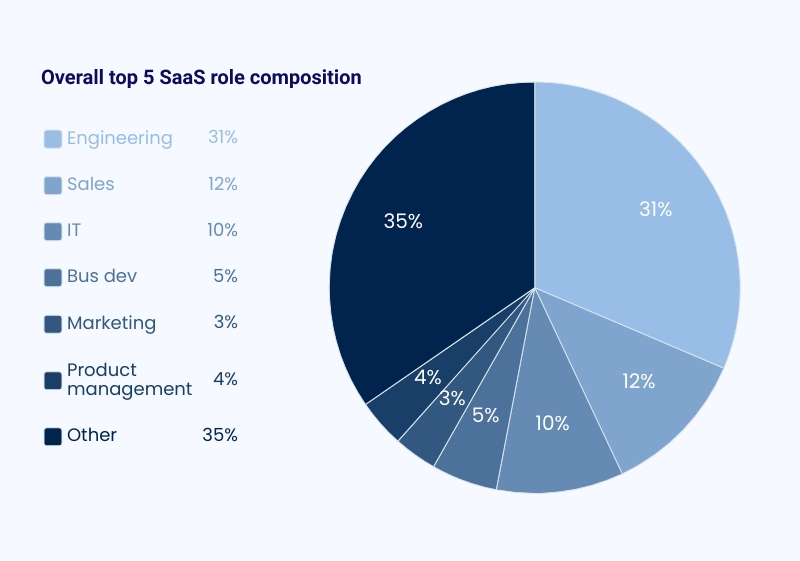
(full analysis of the workforce distribution of the top 5 SaaS companies)
Engineering and sales roles dominate SaaS and make up for almost half of the workforce on average.
HeroHunt.ai
The two halves of that org chart need two different searches, and LinkedIn Recruiter gives you one. As this guide argues further down, it indexes the title and the company name, not the business model behind them, so "Account Executive" returns every agency seller and every services closer in the same undifferentiated list as the product sellers you actually want. HeroHunt.ai is built for the other approach: search across a billion profiles from sources beyond LinkedIn, then have a language model read each profile against a written brief such as "sold a recurring-revenue product, not consultancy hours" or "shipped production code, not slide decks". The honest caveat is scope. It sources, screens and runs outreach, and it is not an ATS, so pipeline stages, interview scheduling and offer records still have to live somewhere else. It also judges only what a candidate made public, which is generous to an engineer with a GitHub history and thin on someone who publishes nothing.
The challenge of SaaS recruitment
The mentioned roles are typically very high in demand and limited in supply.
That makes recruiting these candidates very challenging.
You can presume that you will not fill open positions for these roles with just job ads.
So you need to add passive candidate sourcing to your sourcing and recruitment strategy.
The roles that are the hardest to find for SaaS companies are typically:
- Software engineers
- SaaS sales executives
- and Business development representatives
One of the challenges with SaaS recruitment is that you might find a lot of candidates that worked at traditional commodity companies or services companies like consultancies or agencies. In some rare cases they might be a good fit for the job, but typically they are not.
So in most cases you want to look for candidates with product experience (product being the digital solution delivered over internet).
But unfortunately a platform like LinkedIn (Recruiter) is not built for finding people with product experience.
Still the absolute majority of recruiters is entirely dependent on LinkedIn.
Which makes LinkedIn an even worse place to find SaaS talent because it is over competitive.
Candidates are flooded with recruiter outreach.
General recruitment tactics for SaaS recruitment
Since you have to differentiate yourself to win talent for you, you have to look in different places, search smarter and do smarter outreach.
Here are some guidelines to find people with product experience, whether it’s in engineering or sales.
Nail the search
The candidate search seems to be a simple task but is one of the most complicated and technical parts of the recruitment cycle.
A lot of recruiters do not nail the search.
So if you do, you win talent for you that others never reached.
When you search for candidates on LinkedIn you might experience that you end up with a lot of unwanted results as the examples stated above.
To nail the search you can do a couple of things:
🧠 Search in alternative platforms: Many profiles will never pop-up in LinkedIn's search but will on niche platforms. Try different platforms to cover the full range of candidates that other recruiters are not targeting and get richer information on skills data.
☁️ Use a SaaS specific sourcing tool: There are tools on the market (including our own, HeroHunt.ai) that pre-screen candidate profiles based on SaaS specific criteria like product experience, speed of growth of companies they worked at and SaaS keywords.
🔎 Use Google PSE to include company lists: With the Google Programmable Search Engine (PSE) you can search with up to 500 keywords including names of SaaS companies so you can find SaaS talent that has already proven themselves at related companies.
🕵️ Know your search operators: Many recruiters are familiar with Boolean operators (AND, OR, NOT), but many recruiters don't use advanced search operators properly in their search. By using advanced operators you can make your search a lot more targeted.
🎨 Get creative in your talent search: Recruiters often get stuck when they are sourcing for passive candidates because they end up with the same results. When you get stuck, you can use new ways to source talent like using unconventional places to source in, using people analytics or using Google Alerts.
➕ Use the right job title synonyms: Job titles come in many different forms. Sales executives for example go by many names: Sales Rep, Sales Advisor, Account Executive, Client Success Manager, Sales Associate and many more. Include those synonyms in your search. Below you can find a list of synonyms per role.
💬 Know how and where to reach candidates: Every candidate has their own preferred way of being contacted. But many times you don’t find the relevant contact details. By cross referencing profiles and using the right contact finder tools (like Apollo.io for finding B2B sales and business development contacts) you can find the platform or medium they want to be contacted on.
Recruit the person with the right work related needs
You want to know if the person you are talking to is the right person for the current growth dynamic of your company.
There are big difference in the work environment of startups, scaleups and established companies.
The startup work environment for instance, is one which is characterized by a mission driven nature, visible impact, constant flux, undefined processes and a strong variety in work activities.
Established companies are kind of the opposite. And scaleups are somewhere in between.
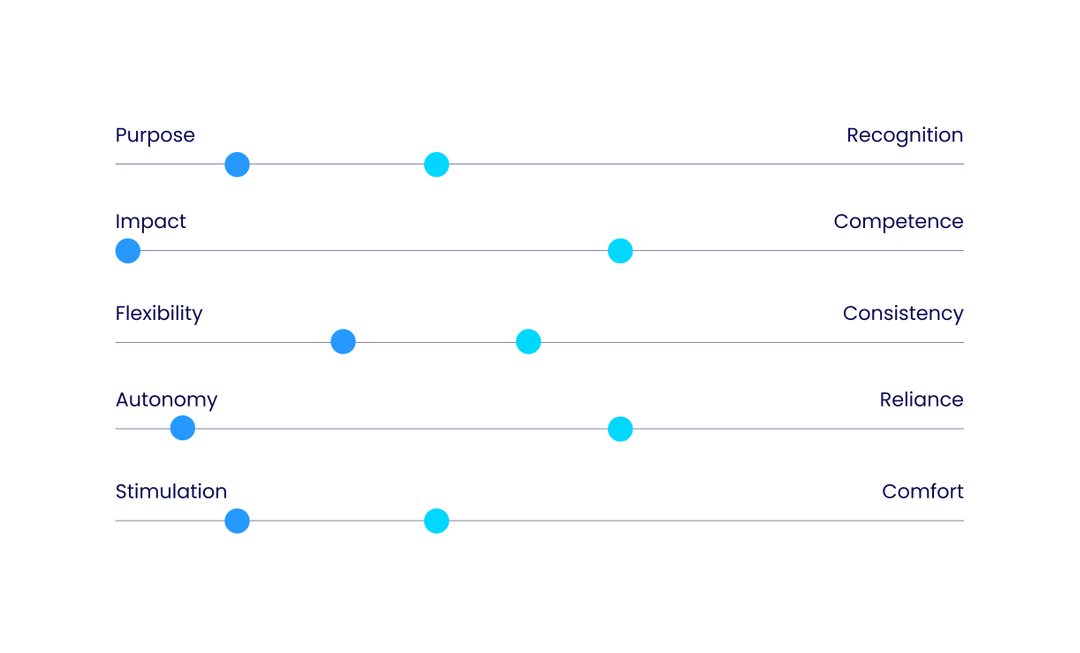
To do well and be happy in a usually fast growing SaaS company your needs should be aligned with the work environment you're working in.
Talent that is the right fit for a startup (or early scaleup) environment usually value:
Purpose (over recognition), matching the mission driven nature
Impact (over expertise), matching the visible effects of efforts
Flexibility (over consistency), matching the constantly changing environment
Autonomy (over reliance), matching the undefined inputs, processes and outputs
Stimulation (over comfort), matching the variety in work activities
When you ask the right questions and you hear candidates talk about what they like and dislike in regards to their work environment, you should be able to get a fair view on their preference for a work environment in a startup, scaleup or established company.
This guide for assessing work related needs can help you ask the right questions.
Recruitment tactics and tools per SaaS role
There are some typical roles that need to be filled in order to build and grow the SaaS company. These include engineers, sales executives and business developers.
Every individual role requires a separate approach to sourcing.
Software engineers
Common synonyms for Software Engineer: Developer, Programmer
Characteristics
Software engineers obviously come in many forms; front-end engineers, back-end engineers, full stack engineers, QA engineers, DevOps engineers, security engineers and data engineers.
Engineers are excited about complex problems and self learning. Developers who picked up coding in the past year leaned on technical documentation (68%) more than any other resource, far ahead of university or bootcamps.
That self-directed streak is what you are actually hiring for, and it is why credentials tell you so little about an engineer.
Most of them are also reachable. 75% of developers describe themselves as complacent or not happy at work. They are not applying to your job ad, but they are not settled either.
What keeps them somewhere is worth knowing before you write your pitch. The same survey ranks autonomy and trust, competitive pay and solving real-world problems as the strongest drivers of developer satisfaction.
Note the order: autonomy outranks money. That maps directly onto the work related needs above, and it is why "we pay top of market" is a weak opening line for this audience.
Recruitment approach for engineers
- Do a talent mapping for hard to find roles (how to do a talent mapping)
- Have your job description reviewed by an engineer, preferably an experienced engineer who is going to work with the future hire
- Prioritize your search for candidates on GitHub and Stack Overflow since those are the primary platforms where engineers can be found (how to source on GitHub and Stack Overflow)
- Research candidates by cross referencing their profiles (how to cross reference candidates)
- Send a (hyper)personalized outreach message based on personal and work related information that you could find on public (!) sources on the interwebs
SaaS sales executives
Common synonyms for SaaS Sales Executive: Account Executive (AE), Sales Executive, Sales Rep, Sales Advisor, Sales Associate, Client Success Manager, Enterprise Sales, Commercial Lead
Characteristics
Sales executives are the easiest SaaS role to find and the hardest to judge.
Easy to find, because being reachable is literally their job and because they publish their own numbers.
Hard to judge, because the title tells you almost nothing. Two people who are both called Account Executive can be doing completely different jobs.
What actually predicts fit is what they sold and to whom, not how senior the title sounds:
- ACV band: an enterprise AE closing $500k contracts on a nine month cycle usually struggles with $8k deals that close in two calls, and the reverse is just as true
- Sales motion: product-led self-serve, inbound SMB, outbound mid-market and enterprise land-and-expand are four different jobs wearing one title
- Product vs service: someone who sold consultancy hours has never carried a recurring revenue number, which is the exact distinction this whole guide turns on
This is where the product experience filter from the start of this guide bites hardest. A recruiter searching "Account Executive" in LinkedIn Recruiter gets every agency seller, every commodity rep and every services closer in one undifferentiated list, because the platform indexes the title and the company name, not the business model behind them.
Recruitment approach for sales executives
Search for the evidence, not the title. Quota attainment is one of the few things sales people put in writing about themselves: "President's Club", "115% of quota", "$1.2M ARR closed", "top 3 of 40 reps". Those strings are searchable, and they are conspicuously absent from the profiles of people who did not hit their numbers.
Then reverse the company filter. Instead of guessing job titles, list the 50 to 200 SaaS companies in your ACV band and stage and search inside them. This is exactly what the Google PSE approach above is for: 500 company keywords in one query beats guessing at synonyms.
Reaching them is the easy part, and the part most recruiters overthink. Sales people answer cold approaches, because ignoring cold approaches would make them hypocrites. What they will not forgive is a lazy one.
Apollo.io
Reaching them still needs an address, and this is the one role family where buying contact data pays off. Apollo.io is built around exactly these people: its own data page names its six target personas as Sales Leaders, Account Executives, Sales Development Representatives, RevOps, Marketers and Founders, which is this section and the next one almost word for word. They carry findable work emails because being reachable is their job. Worth knowing before you sign up: the free plan is 900 credits per seat per year released monthly (roughly 75 a month, not 900 a month), and paid starts at $49 per seat per month billed annually, or $65 month to month. The honest caveat is that persona list itself: engineers are not on it. Developers have no buyer-facing footprint, so coverage thins out fast for the engineering half of this guide. Source those on GitHub and Stack Overflow instead.
Business development representatives
Common synonyms for BDR: Sales Development Representative (SDR), Business Development Rep, Inside Sales Rep, Lead Generation Representative, Market Development Representative
Characteristics
BDRs are the entry point into the SaaS sales org and the highest churn seat in the company.
Most of them do not want to be a BDR. They want to be an AE, and the BDR seat is the toll they pay to get there. Tenure in the role is usually counted in months, not years.
That single fact should shape everything about how you hire them.
Recruitment approach for BDRs
Time the approach. A rep who is 12 to 18 months into a BDR seat and has not been promoted is the most winnable candidate in SaaS, because their own employer has already given them an answer by not promoting them. A rep at three months is not going anywhere, and a rep who just made AE is out of your funnel entirely.
Sell the path, not the seat. "BDR role at a Series A" is not a pitch. "BDR with a written promotion track to AE inside 12 months, and here are the three people it already happened to" is.
And know that this audience grades your outreach harder than any other role you will ever source. Cold outreach is their day job. Your email is a work sample, and they recognise every template you are using because they use it too. Send a BDR a mail merge with a broken first name token and you have not just lost the candidate, you have shown them precisely how good your sales team is.
For the AE and BDR profiles above: work emails and direct dials, without burning InMail credits on people who are contractually obliged to reply to you anyway.