



The 2026 field guide to catching North Korea's fake remote IT workers before they reach your payroll, from the earliest red flags to the tools that actually work.
North Korea now earns close to a billion dollars a year by getting its operatives hired as ordinary remote engineers. In its March 2026 sanctions action, the U.S. Treasury stated the fraudulent IT-worker scheme generated nearly $800 million in 2024 alone - Chainalysis. The money does not fund a startup. It funds the ballistic-missile and weapons programs of a sanctioned state, which is why the U.S. government treats a bad remote hire here as a national-security event rather than an HR mistake.
Here is the uncomfortable part for recruiters: this is a hiring-pipeline attack, not a firewall attack. The 2026 Verizon Data Breach Investigations Report added an entire section on North Korean IT workers, and the reason is structural: a standard background check confirms that an identity is real, not that the person on the video call actually owns it - Nisos. The breach does not come through an unpatched server. It comes through your applicant tracking system, walks through four polished video interviews, and signs an offer letter. In a survey of 668 security and risk leaders at large enterprises, 41% said their company had already hired and onboarded a fraudulent candidate - GetReal Security.
This guide breaks down exactly how the scheme works, the real cases that show how it slips past standard checks, the specific red flags at every stage of hiring, the live-interview deepfake tells and why they expire fast, the onboarding and device controls that actually catch operatives, the vendor landscape with real 2026 pricing, the legal and sanctions exposure for employers, and a 90-day decision framework you can act on. Everything here is grounded in late 2025 and 2026 reporting, because the tradecraft changes month to month and a playbook from two years ago describes a threat that has since industrialized.
Written by Yuma Heymans (@yumahey), who built HeroHunt.ai and has spent years on the sourcing and vetting side of remote hiring, where the hardest question was never "can we find talent" but "is this person actually who the profile says they are."
Contents
- Why Recruiters Are Now the Front Line
- The Scale and the Stakes
- Inside the Operation: The People Behind the Screens
- The Tradecraft: Laptop Farms, KVM Switches, and Stolen Identities
- The AI Layer: Real-Time Deepfakes Across the Funnel
- Anatomy of Real Cases: KnowBe4, Chapman, and the DOJ Sweeps
- Detection Part 1: Red Flags at Application and Sourcing
- Detection Part 2: Beating the Live Interview Deepfake
- Detection Part 3: Onboarding, Device, and Network Controls
- The End-to-End Detection Playbook
- The Vendor and Tooling Landscape
- Legal and Sanctions Exposure for Employers
- The Extortion Pivot: When the Insider Turns on You
- The 2026 to 2028 Outlook
- Decision Framework: Your Next 90 Days
1. Why Recruiters Are Now the Front Line
The single most important shift to understand is that talent acquisition has become a security function, whether or not anyone told your recruiting team. For years, the mental model was that cyber threats belong to IT and physical fraud belongs to finance, while hiring was a matter of finding the best-qualified person. North Korea broke that model on purpose. Its operatives do not hack their way in. They apply, they interview well, they accept the offer, and they collect a salary, all while sitting in Pyongyang, Shenyang, or Vladivostok behind a stolen American identity. The first person who can stop them is not a firewall. It is the recruiter reading the resume and the hiring manager running the video call.
This matters because the controls most companies trust were never designed for this attack. A criminal background check searches court records tied to a name and a Social Security number, and it will come back clean because the identity being checked is a real American's, purchased or stolen, not the operative's. As Nisos noted in its analysis of the 2026 Verizon DBIR, verification of a valid identity is not the same as verification that the presenting person matches it, and remote hiring is precisely where that gap lives - Nisos. The person who passes the check and the person who shows up to work can be two different people, and nothing in a traditional screening pipeline is built to notice.
There is an economic logic to why the recruiter, not the analyst, is the decisive actor. Every control downstream of hiring is more expensive and less certain than the ones at the top of the funnel. Catching an operative during a resume screen costs minutes; catching one after they have a laptop, credentials, and repository access costs an incident response, a forensic review, and often a breach disclosure. The scheme is engineered to push the point of detection as far downstream as possible, because that is where it is costliest for you and safest for them. Moving detection upstream, into the application and the interview, inverts that economics. It is the rare security investment that also makes hiring better, because the same signals that catch fraud also surface the low-quality applicants you would have wasted time on anyway.
The threat has also gone mainstream at the government level, which tells you how seriously to take it. The first comprehensive U.S. guidance came on May 16, 2022, when the State Department, Treasury, and FBI jointly warned employers that DPRK workers were posing as non-North Korean nationals to win remote contracts - U.S. Treasury advisory. By July 31, 2026, the warning had gone international: the U.S. and ten partner governments issued a joint alert, the first to formally include France, Germany, Italy, and the Netherlands, confirming the problem is no longer a U.S.-only concern - Baker McKenzie. And the operatives are reaching sensitive targets: in August 2026, the FBI disclosed that a disguised North Korean worker had been hired by a U.S. federal government agency, a rare confirmed penetration of government itself - TechCrunch.
So the practical takeaway for anyone who owns hiring is direct. The controls that catch this threat are hiring controls: how you screen an application, how you run a video interview, how you ship a laptop, and how you verify who is actually logging in on day one. Everything that follows in this guide is organized around those decision points, because that is where recruiters and hiring managers have leverage that no downstream security tool can replicate. Treating this as "a problem for the SOC" is the mistake the scheme is counting on.
2. The Scale and the Stakes
Start with the number that reframes everything: this is a program measured in hundreds of millions of dollars a year, funneled directly into weapons development. The FBI states that North Korea dispatches thousands of skilled IT workers using stolen and fake identities, that individual workers can earn up to $300,000 annually, and that the schemes have defrauded more than 300 U.S. companies while generating hundreds of millions of dollars for entities tied to the DPRK's weapons of mass destruction and ballistic-missile programs - FBI. This is not petty fraud. It is a state revenue stream disguised as a payroll line item.
Estimates of the total vary because different bodies measure different things over different windows, and it is important not to add them together. The UN Security Council Panel of Experts put roughly 3,000 workers abroad plus about 1,000 inside the country, generating an estimated $250 million to $600 million per year - Radio Free Asia. The Center for Strategic and International Studies estimated $350 million to $800 million annually - CSIS. Treasury's newest single-year figure is nearly $800 million for 2024 specifically - Chainalysis. These are not cumulative; they are competing sizings of the same phenomenon, and the direction of travel is up.
The chart below shows those annual figures side by side. Read it as three different authorities sizing the same problem with different methods, not as a running total, since combining them would double-count the same wages.
Annual DPRK IT-worker revenue, by estimating body
The bars use the midpoint of each reported range, with Treasury's 2024 figure as a firm single-year number, and the practical message is that even the conservative reading puts this in the mid-hundreds of millions. These are also almost certainly undercounts, since they capture only the operations investigators have managed to trace, and the estimates have climbed with every new sweep. However you frame it, the scale means a single missed hire is not an isolated cost. It is a contribution to a sanctioned weapons program.
It helps to see the IT-worker program inside North Korea's broader overseas-labor economy, because it explains why Pyongyang protects it so fiercely. The same UN reporting behind those revenue figures also estimated that roughly 100,000 North Koreans worked abroad in 2023, earning around $500 million for the regime across all forms of labor. IT work is the premium tier of that economy: a single laptop and an internet connection replace a construction crew or a garment line, the wages are far higher, and the work crosses borders invisibly. That is why the regime doubled quotas and poured money into AI tooling rather than letting the scheme wither under sanctions. For an employer, the implication is that this pipeline is neither opportunistic nor temporary, so treating detection as a short campaign misreads the adversary badly.
Reach is as alarming as revenue, and here the honest framing is that the best figures are expert estimates rather than court-verified counts. Mandiant Consulting CTO Charles Carmakal has said hundreds of Fortune 500 organizations have hired North Korean IT workers, and when Mandiant sampled 20 Fortune 500 companies it found evidence that DPRK workers had applied to, worked for, or targeted 18 of the 20 - CyberScoop. Insider-risk firm DTEX reported that 7% of its Fortune 2000 customer base had been infiltrated. Those are practitioner estimates from the firms cleaning up the mess, and they should be read that way, but even discounted heavily they describe a threat that has touched a large share of the biggest employers in the world. If you hire remote engineers, assume you are in the target set.
3. Inside the Operation: The People Behind the Screens
The people behind the fake profiles are not freelancers chasing a paycheck; they are state employees working under quota and coercion, which shapes how the fraud behaves. Understanding this changes how you interpret the red flags later. These operatives are not lazy or careless; they are relentless because their alternative is punishment. Reporting on their working conditions describes competitive four- to five-person delegations, workers keeping less than 20% of their earnings (one documented worker kept just $200 of a $5,000 monthly wage), doubled monthly quotas in China during 2025, sixteen-hour days up to six days a week, and beatings for missing targets - Fortune. The volume and persistence you will see in your applicant pool is a direct product of that pressure.
The Bloomberg investigation below is the clearest mainstream look at the human side of the scheme, following an American laptop-farm operator and interviewing an actual North Korean IT worker about quotas and how the money reaches Pyongyang. It is worth watching before you read the detection chapters, because it makes the abstract mechanics concrete.
How North Korea Hid an IT Workforce Inside US Companies
Above the individual workers sits a machinery of front companies and money movers that makes the earnings usable. On July 24, 2025, OFAC sanctioned the front company Korea Sobaeksu Trading Company and three individuals, noting explicitly that the DPRK government withholds most of the workers' wages to fund its weapons and missile programs - U.S. Treasury. SentinelOne mapped a network of front companies that cloned the websites of legitimate U.S. and Indian software firms to lend the personas credibility, including Independent Lab LLC (copied from Kitrum) and Shenyang Tonywang Technology (copied from Urolime), several of whose domains the U.S. government has since seized - SentinelOne. The fake employer that "verifies" a candidate's past job may itself be part of the operation.
The money-out pipeline is the final piece, and it increasingly runs through cryptocurrency because crypto and money-transfer services have weaker identity verification than banks. Treasury detailed how one front company arranged overseas jobs while a Vietnam-based partner laundered wages back to North Korea via peer-to-peer crypto trading on Facebook and Telegram - Korea Times. Independent blockchain investigator ZachXBT exposed a 390-account payment network moving roughly $1 million per month, with workers reporting earnings to a central administrator who converted funds to fiat through Chinese bank accounts and Payoneer - The Block. The reason this matters for hiring is subtle but real: a candidate who insists on unusual payment arrangements, frequently changes bank details, or routes pay toward money-transfer services is showing you the exit end of that pipeline.
The coercion at the top of this system shapes what you will actually observe at the bottom, which is why the human context is operational and not just moral. Workers under quota do not behave like ordinary job-seekers who can afford to be selective. They apply to everything, accept almost any offer, negotiate little, and start immediately, because idle time is punished. They tolerate awkward requests, invasive verification, and odd hours that a genuine senior engineer with options would push back on. Paradoxically, a candidate who is suspiciously agreeable, available at any hour, and eager to skip the parts of onboarding that involve showing up in person can be as much of a signal as one who resists. The pressure that makes these operatives relentless also makes them predictable, and predictability is something a well-designed process can exploit.
4. The Tradecraft: Laptop Farms, KVM Switches, and Stolen Identities
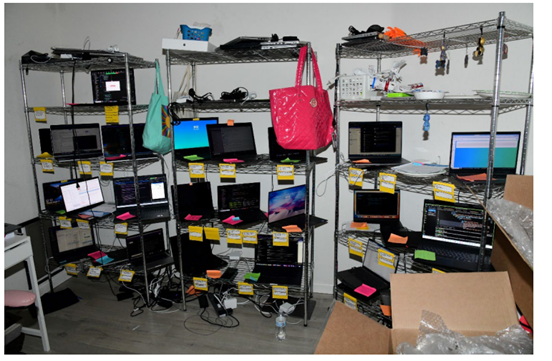
The core trick is geographic disguise: making a worker in Asia look like a remote employee in Ohio, and the centerpiece of that disguise is the U.S. laptop farm. When a company ships a corporate laptop to a new hire, that laptop goes not to Pyongyang but to a facilitator inside the United States, often a willing accomplice paid per device, who plugs it into an internet-connected KVM (keyboard, video, mouse) switch. The overseas operative then controls the machine remotely, so all the traffic your security team sees originates from a residential U.S. address. Microsoft, which tracks the group as Jasper Sleet, documents the use of IP-based KVM devices such as PiKVM and TinyPilot, remote-access tools including RustDesk, TeamViewer, AnyDesk, and AnyViewer, persistent use of Astrill VPN, and even a "Faceswap" tool to paste the operative's photo onto stolen ID documents - Microsoft.
The diagram below traces how a single worker in Asia is reshaped into a plausible domestic hire, and why each layer exists to defeat a specific check you might run.
Palo Alto's Unit 42 catalogs the full concealment stack in the same shape: workers mostly based in China use TinyPilot or PiKVM devices and remote-desktop tools, mask source IPs with VPNs and proxies, set up U.S. mailing addresses via mail-forwarding services and VoIP phone numbers, and move funds through cryptocurrency and money-transfer services - Unit 42. Mandiant, which tracks the operation as UNC5267, found that connections into victims' systems primarily originated from Astrill VPN addresses tied to Chinese provinces near the North Korean border - SecurityWeek. Google's threat researchers add one memorable operational tell: "mouse jiggling" software that keeps several company laptops showing as active at once, because a single operative is often holding down multiple full-time jobs simultaneously - Google Cloud.
The identity layer is a marketplace of its own, which is why "the background check came back clean" is cold comfort. Real Americans' identities are bought, rented, and reused at scale. A Ukrainian facilitator named Oleksandr Didenko ran a service called Upworksell that sold and rented stolen U.S. identities, managing as many as 871 proxy identities and helping North Korean workers get hired at about 40 U.S. companies before he was extradited from Poland and sentenced to 60 months - U.S. Department of Justice. What this means in practice is that the identity documents a candidate presents can be entirely genuine and entirely stolen at the same time. The document is not the person, and verifying the document only tells you the paperwork is real.
It is worth pausing on why the laptop farm exists at all, because the reason reveals a weakness you can attack. The farm solves one specific problem for the operative: corporate security and payroll systems increasingly check where a device and a login originate, and a connection straight from China or Russia is an immediate red flag. Routing through a U.S. home defeats that geographic check, but it introduces a physical dependency, a real person in a real house holding real hardware, which is the single most arrested-and-prosecuted node in the entire scheme. Every facilitator you will read about in the case studies was a laptop-farm operator. That dependency is also why shipping and geolocation controls are so effective: they target the one part of the operation that cannot be virtualized away. The disguise needs a physical U.S. anchor, and a physical anchor is something you can verify and something law enforcement can raid.
The image below, released by the Department of Justice, shows what an actual laptop farm looks like inside a facilitator's home. Each machine is tagged with the U.S. company and the stolen identity it is tied to, which is how one person quietly maintained dozens of "remote employees" at once.
A laptop farm, seized
5. The AI Layer: Real-Time Deepfakes Across the Funnel
Generative AI is the reason this threat industrialized in 2025 and 2026, and it now touches every stage of the hiring funnel rather than just the interview. The old mental image of a language barrier giving the fraud away is obsolete. AI writes the resume, tailors it to your applicant tracking system, drafts the cover letter, translates the interview in real time, and, most alarmingly, swaps the operative's face for a synthetic or stolen one on a live video call. Okta's threat team broke down the DPRK's AI use by stage and found services that iteratively test CVs against applicant tracking systems, generative tools that draft and critique cover letters, unified-messaging tools that do real-time translation and transcription so one person can juggle dozens of personas, and personas that used real-time deepfake video during interviews - Okta.
The barrier to entry has collapsed, which is the part recruiters most need to internalize. Unit 42 showed that a single researcher with, in their words, "no image manipulation experience, limited deepfake knowledge, and a five-year-old computer" built a job-interview-ready synthetic identity in 70 minutes using free real-time face-swap software and an AI-generated face - Unit 42. If a curious researcher can do it in about an hour, a state program with quotas and dedicated tooling can do it at scale and around the clock. Eleven allied nations warned in 2026 that operatives now run a deepfake model during live interviews, routing a synthetic face through a virtual-camera driver that video platforms treat as an ordinary webcam, which lets one operator interview for the same role under multiple personas - TechTimes.
The photo below is the kind of artifact this produces. It is the AI-manipulated headshot a North Korean operative submitted to the security-awareness firm KnowBe4, built by editing a stock photograph. To the human eye on a resume, it reads as a normal professional headshot, which is exactly the point.
The face that got hired

The scale numbers confirm AI is doing the heavy lifting. CrowdStrike's 2025 Threat Hunting Report found that the DPRK-nexus group it tracks as FAMOUS CHOLLIMA infiltrated over 320 companies in the prior twelve months, a 220% year-over-year increase, using generative AI for resumes, real-time deepfakes in video interviews, and AI coding tools to actually do the job once hired - CrowdStrike. Pindrop's analysis of its own remote-hiring pipeline found that 1 in 6 applicants showed clear signs of fraud, that 1 in 343 was linked to DPRK infrastructure, and that a quarter of those DPRK-linked applicants used deepfake technology during live interviews - Pindrop. The uncomfortable implication is that the manual "tells" you will learn in the next chapters are real but perishable, because the same AI that creates the deepfake is being trained to defeat the tests that expose it.
This is the core reason to distrust any defense that depends on a human spotting an artifact, and to plan for its expiry from the start. Face-swap quality rides the same improvement curve as every other generative model, which means the visual glitch that betrays a deepfake this quarter may be gone the next. The DEF CON researchers who interviewed suspected operatives in 2026 already found disguises polished enough that the giveaway was buried in image metadata, not visible on screen - The Hacker News. The strategic response is not to abandon perceptual tells, which still catch the many operatives running older tooling, but to treat them as a decaying asset. Budget for the assumption that within a year your interviewers will not be able to see the seam, and make sure the controls that do not depend on human perception are already carrying most of the load by then.
6. Anatomy of Real Cases: KnowBe4, Chapman, and the DOJ Sweeps
Nothing makes the threat concrete like the cases, and the most instructive one happened to a company that sells security awareness training. In July 2024, KnowBe4 hired a North Korean operative as a Principal Software Engineer after a clean background check on a valid (stolen) identity, verified references, and four video interviews - KnowBe4. The submitted headshot was an AI-enhanced stock photo. What saved them was not the hiring process at all; it was endpoint detection. The company-issued Mac came online, and roughly 25 minutes later the EDR tooling fired on malware loaded via a Raspberry Pi, and the device was contained shortly after. A security-first company with rigorous hiring still got to the point of shipping a laptop, which tells you how good the front end of this fraud has become.
The image below is the original stock photograph KnowBe4 later published, the base image that was AI-edited into the fake headshot from the previous chapter. Seeing the before-and-after is the fastest way to understand why a profile photo can no longer be trusted as evidence that a real, specific person exists.
The original, before the edit

The laptop-farm side of the operation is best illustrated by the Arizona case of Christina Marie Chapman, sentenced on July 24, 2025 to 102 months (about 8.5 years) in prison - U.S. Department of Justice. Chapman's laptop farm helped North Korean workers pose as U.S. persons at 309 U.S. companies plus two international firms, using 68 stolen identities and generating more than $17 million. The FBI seized more than 90 labeled laptops from her home. Her case is the human infrastructure behind the abstract diagram in Chapter 4: an ordinary house, rows of company laptops, and a paid facilitator making overseas workers look domestic. It also shows the model does not require a criminal mastermind, only a willing address inside the country.
The enforcement response has scaled into coordinated national sweeps, which is useful context because it tells you the government now shares detailed indicators you can use. On June 30, 2025, the DOJ announced a nationwide action that included searches of 29 laptop farms across 16 states, the seizure of 29 financial accounts and 21 fraudulent websites, and a Massachusetts case in which workers used 80-plus stolen identities at more than 100 companies and stole export-controlled data from a California defense contractor - U.S. Department of Justice. A parallel Georgia indictment charged four North Korean nationals who got hired at an Atlanta blockchain company and stole over $900,000 in cryptocurrency. Earlier, on December 11, 2024, a grand jury had indicted fourteen North Korean nationals in a scheme that generated more than $88 million through front companies over roughly six years - U.S. Department of Justice.
The pattern across every case is the same, and it is the reason this guide exists. Standard hiring checks passed. The identities were real. The interviews were convincing. What eventually caught these operations was either downstream security telemetry, financial-network analysis, or a facilitator's operational slip, none of which are things a recruiting team controls. A quieter but equally important milestone came on November 14, 2025, when five people pleaded guilty in cases affecting about 136 U.S. companies and earning North Korea roughly $2.2 million, underscoring that the pipeline of facilitators keeps refilling even as prosecutions mount - U.S. Department of Justice. The lesson is not that detection is hopeless. It is that detection has to move upstream, into hiring itself.
7. Detection Part 1: Red Flags at Application and Sourcing
The cheapest place to stop a fraudulent hire is before a human recruiter ever spends time on them, and the highest-yield technique is to screen the whole applicant pool rather than each candidate in isolation. Because operatives reuse near-identical resumes, provide references for one another, and apply in coordinated bursts, the fraud is often visible only when you compare candidates against each other. Security researchers describe pool-wide resume clustering, comparing CV text across the entire applicant pool, as a check that catches fabrication on the first pass because the same phrasing and structure recur across supposedly unrelated people - Kraven Security. A single resume can look flawless; ten resumes that share a skeleton cannot.
The official indicators give recruiters a concrete starting checklist, and the FBI has published two rounds of them. The January 2025 IC3 advisory flagged multiple logins to one account from various IP addresses, reused phone numbers and emails across applicants, claims of attendance at non-U.S. educational institutions, and unusual resume nomenclature - FBI IC3. The July 2025 advisory added more, and these are the ones worth committing to memory:
- Document misspellings in names or details across supposedly official identity documents
- Photo-to-contact mismatches where the picture does not line up with contact info across platforms
- Frequent bank-account changes during or shortly after onboarding
- Shipping-address requests that differ from the address on the identity document
- Similar documentation appearing across multiple separate employees
Each of these is individually explainable, which is why no single flag should sink a candidate, but they cluster in fraudulent applications in a way they do not in genuine ones - FBI IC3. A candidate whose ID address is in Texas but who asks you to ship the laptop to Nevada, pays into an account opened last month, and shares a phone number with two other applicants is not a coincidence. That is the signature of a laptop farm and a shared identity pool, and it is visible entirely within data you already collect during hiring.
Portfolio forensics is the other underused technique, and it is powerful because it is hard to fake convincingly. For engineering roles, pulling GitHub commit metadata exposes fabricated history: unsigned commits with author dates set years before the repository's real activity mean a project that appears to date from 2011 was actually assembled last year - Kraven Security. SpyCloud's investigators describe finding a real developer's genuine resume sitting on a desktop right next to a near-identical fraudulent copy with only the name, contact details, and photo changed, alongside abnormally high application volumes across platforms like Upwork, Workday, and Greenhouse - SpyCloud. The forged identity is a thin layer over a stolen life, and metadata is where that layer tends to crack.
The scale of the application flood is worth seeing, because it explains why manual, one-at-a-time screening loses. Investigators at Nisos documented a single cell of 22 operatives that submitted 166,893 job applications between December 2024 and September 2025, obtaining more than 21,000 interviews and landing 76 job offers, coordinating through Discord and a custom dashboard - BankInfoSecurity. The chart below shows that funnel, and the takeaway is stark: the strategy is industrial spray-and-pray, so any defense that depends on a tired recruiter noticing something on the hundredth application will eventually let one through.
One 22-operative cell's funnel (Dec 2024 to Sep 2025)
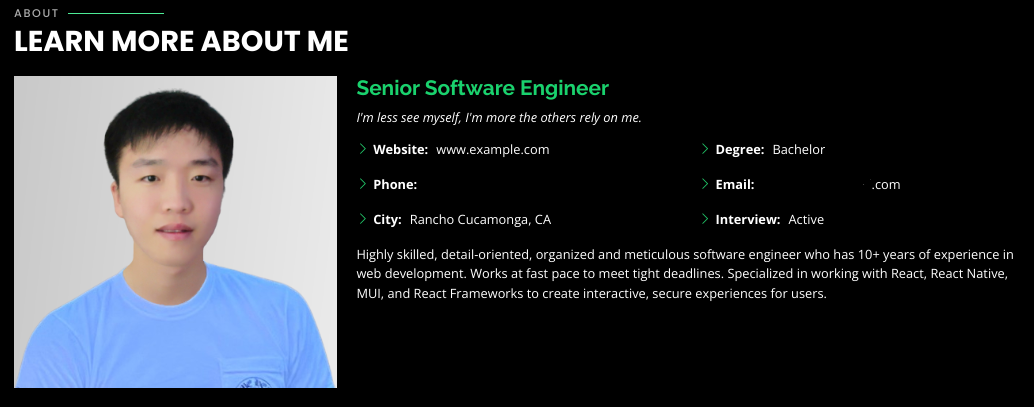
Mandiant's guidance rounds out the sourcing picture with patterns to watch during proactive outreach and screening. It recommends monitoring for AI-modified profile pictures, heavy resume reuse across personas, and the recurring pattern of a U.S.-based address paired with education credentials from universities outside North America, chosen precisely because low foreign-student verification rates make the claims hard to check - Google Cloud. The image below is a Mandiant example of a fraudulent DPRK worker resume, useful as a reference for what these documents actually look like: competent, generic, and just slightly too smooth.
What a fake resume looks like
There is also a structural point worth making here about where this fraud concentrates, because it points to a defensive posture rather than just a checklist. Operatives overwhelmingly attack through inbound applications and open freelance marketplaces, where anyone can submit a synthetic identity into an anonymous queue. Teams that lean more on proactive, outbound sourcing of identifiable people from real professional profiles, rather than sifting an unvetted inbound flood, shrink the surface area where an anonymous synthetic applicant can even enter. This is one honest argument for AI sourcing platforms such as HeroHunt.ai that build shortlists from real profile data and reach out to known candidates: they change the shape of your pipeline from "who applied" to "who we found," which is a harder pool to seed with fakes. It is not a fraud-detection product, and it does not replace identity verification, but the pipeline shape matters.
8. Detection Part 2: Beating the Live Interview Deepfake
The live interview is your highest-leverage detection point, because it is the one moment you can force the fraud to perform in real time, but you have to use it deliberately. A passive interview where you ask standard questions and admire the answers plays directly into the operative's strengths, since the answers are coached, translated, and sometimes read from a second screen. The goal instead is to make the deepfake and the disguise do something they are bad at. Unit 42 documented four repeatable tells an interviewer can trigger: rapid head movements cause landmark-tracking artifacts, a hand passing over the face breaks the face-swap reconstruction, sudden lighting changes reveal edge inconsistencies, and slight lip-sync delays become detectable when you listen for them - Unit 42.
The single most famous physical test is the hand-wave, and it is worth understanding why it works. Vidoc Security Lab co-founder Dawid Moczadlo documented a live interview in which a suspected operative flatly refused to wave a hand in front of his face, because doing so disrupts the real-time face-swap model and exposes the underlying person, prompting Moczadlo to end the call - Vidoc Security. Reality Defender's guidance compiles the broader set of manual tells, including lighting inconsistencies, boundary and edge issues around the face, unnatural eye movements, and delayed responses, and notes that ResumeGenius found 17% of hiring managers have already encountered deepfake job candidates - Reality Defender. These are genuinely useful, and any interviewer can learn them in an afternoon.
Behavioral questions attack a different weakness, which is that the operative is pretending to live somewhere they do not. Flare's guidance recommends asking unprepared questions about local landmarks, the current weather where they claim to be, or that day's local news, then watching for unusually long pauses before common-knowledge answers, and rotating the question set so it cannot be memorized in advance - Help Net Security. One crypto founder, Harrison Leggio, popularized a blunter filter: asking the candidate to say something negative about Kim Jong Un, which tends to make operatives panic and end the call, alongside softer flags like camera reluctance, time-zone inconsistencies, and shared-workspace background noise - Fortune.
In practice these techniques work best woven into a normal conversation rather than deployed as an obvious test, because a tipped-off operative simply disconnects and re-applies under a new persona. A workable pattern looks like this: open with genuine rapport, then somewhere in the middle ask the candidate to reposition their camera or grab a document, which forces natural movement and a lighting change; later, drop in a throwaway question about their morning commute or a well-known spot in their claimed city, and note the latency before the answer; near the end, ask them to hold a hand near their face while explaining a diagram, framed as nothing more than a casual gesture. None of these should feel adversarial. The point is to collect several weak signals without ever announcing that a test is underway, so a real candidate experiences a slightly quirky interview while a fraudulent one accumulates tells they cannot all pass at once.
Here is the essential caveat, and it is not optional: these manual tells are perishable, and treating them as a permanent solution is dangerous. Researchers who described them are explicit that face-swap models are improving, that the hand test and the insult filter are being engineered around, and that they may already fail against operatives working from China or Russia rather than North Korea itself - TechCrunch. At DEF CON 34 in August 2026, researchers who ran a fake crypto startup and interviewed three suspected operatives found the disguises had already advanced: one candidate photo's metadata revealed Google Gemini processing and a SynthID watermark, and all three used AI job-application tools and Astrill VPN exit nodes - The Hacker News. Use the manual tells, but use them as tripwires that trigger deeper verification, never as the verification itself.
9. Detection Part 3: Onboarding, Device, and Network Controls
For any operative who passes the interview, onboarding is your last clean shot, and the controls here are technical, unglamorous, and highly effective. The reason they work is that the disguise that beats a human interviewer cannot easily beat a device that reports its own location and behavior. Mandiant's most actionable single recommendation is to verify the corporate laptop's serial number at IT onboarding and confirm that the shipped laptop is geolocated where the person says they live, because the entire laptop-farm model depends on the machine ending up somewhere other than the employee's stated address - Google Cloud. If the laptop provisioned for "New York" phones home from London, you have caught the fraud with a single check.
The FBI's July 2025 advisory translates this into a concrete onboarding protocol that any company can adopt without exotic tooling. Its recommended controls are worth listing precisely, because they map cleanly onto steps recruiting and IT already perform:
- Require unobscured video with a plain background, and capture employee images for later comparison
- Ship equipment only to the address on the identity document, never a redirect
- Delay system access until background checks and identity verification are complete
- Verify phone numbers to catch VoIP, and require U.S. banks for payroll
- Restrict uncommon remote-admin tools and monitor for IP-based KVM devices
These map directly onto the tradecraft from Chapter 4, which is why they work: each one removes a layer of the disguise - FBI IC3. Mandiant adds the network view: review IP addresses for VPNs like Astrill, restrict remote-admin tools such as LogMeIn, Chrome Remote Desktop, AnyDesk, TeamViewer, and RustDesk, watch for mouse-jiggling utilities like Caffeine, and enforce hardware-based multi-factor authentication so a stolen password alone cannot grant access - Google Cloud.
Two of these controls deserve emphasis because they are cheap and disproportionately effective. The first is phone verification: operatives lean heavily on VoIP and Google Voice numbers because a real U.S. mobile line is harder to obtain and easier to trace, so a simple lookup that flags non-mobile or freshly-provisioned numbers catches a surprising share of them at almost no cost. The second is payroll banking discipline: requiring a genuine U.S. bank account in the employee's verified name, and treating early or repeated bank-detail changes as a review trigger, closes the money-out pathway and forces the operative to expose a real financial identity. Neither control requires new software. Both attack parts of the disguise that are expensive for the adversary to fix, which is exactly the property you want in a control: cheap for you, costly for them.
Endpoint detection is the backstop, and the KnowBe4 case is the proof it works even when everything upstream fails. There, EDR telemetry fired about 25 minutes after the workstation came online, catching session-history manipulation and Raspberry-Pi-staged malware, and the device was contained shortly after - KnowBe4. The lesson is that day-one monitoring is not paranoia; it is the specific control that has repeatedly caught operatives who beat the interview. The growing blind spot, which Google warns about explicitly, is bring-your-own-device: personal machines lack endpoint monitoring, and Google cited a corporate laptop provisioned for New York use that was found operating in London, a mismatch that only surfaced because the device was managed - Google Cloud. If you allow unmanaged devices for engineering roles, you have removed the control that works best.
10. The End-to-End Detection Playbook
Pulling the three detection layers together, the winning posture is a staged, passive-first program that spends expensive scrutiny only where cheap signals say it is warranted. Trying to run deep identity verification and live deepfake analysis on every applicant is neither affordable nor necessary, and trying to catch everything by hand at the interview is too late and too fragile. Instead, screen the entire pool cheaply at application, escalate only the suspicious to document-plus-selfie verification, apply live deepfake detection to final-round interviews, and enforce device and network controls at onboarding. Identity-verification firm Socure advocates exactly this passive-first escalation and quantifies the stakes: each fake applicant that reaches an interview wastes roughly $800 to $1,000 in recruiter time, while a single bad placement can cost $1 million or more - Socure.
The prevalence data explains why the cheap first stage is non-negotiable. Across 127,000 job applications at three companies, Socure reported that 20% to 27%, roughly one in four, were flagged as high-risk, which means volume screening has to happen before human recruiters engage or they will drown - Socure. The diagram below shows the staged funnel and who owns each control, and the key design principle is that every stage should be able to pass a legitimate candidate through with minimal friction while forcing a fraudulent one to keep spending effort against controls that get harder.
The durable core of the program is the set of controls that do not degrade as deepfakes improve, and this is where recruiting leaders should invest first. The July 2026 joint alert from eleven governments recommends verifying prior employment and education directly with the institutions, requiring in-person meetings where feasible, comparing payment accounts across employees to catch shared bank details, and shipping equipment only to the identity-document address - Baker McKenzie. Law firm Skadden frames the same idea as a defensible compliance program: in-person or AI-assisted verification, direct education and employment checks, phantom-payroll audits, and geographic device restrictions - Skadden. These are structural, not perceptual, which is why they last.
Ownership is the quiet failure point in most programs, so it is worth naming who does what before an incident forces the question. Recruiting owns the top of the funnel: pool-wide screening, resume clustering, and the behavioral portion of interviews. Talent acquisition and security jointly own escalation, deciding which flagged candidates get document-plus-selfie verification and running the deepfake check on final rounds. IT owns onboarding: serial-number and geolocation verification, shipping discipline, and remote-tool restrictions. Security owns day-one monitoring and the response if something fires. When these responsibilities stay implicit, each group assumes another is handling verification, and the operative walks straight through the gap between them. The KnowBe4 case is instructive precisely because the handoff worked there: hiring did its part, and when the front end was beaten, endpoint monitoring caught the miss. A program is only as strong as its least-owned stage.
The one rule that ties the playbook together is to never rely on a single control, especially a perceptual one. The manual interview tells belong in the program as tripwires, not as the gate, because they are explicitly temporary and can fail against better-disguised operatives. Layer them with identity proofing and device controls so that defeating your defenses requires beating a real background verification, a live liveness check, a laptop geolocation, and day-one endpoint monitoring all at once. That is a fundamentally harder problem for the operative than fooling one tired interviewer, and it is the difference between a program that catches this threat and one that merely hopes to.
11. The Vendor and Tooling Landscape
The market that has grown up around this threat splits cleanly into three layers, and understanding the split prevents the common mistake of buying one tool and assuming you are covered. The layers are pre-hire identity proofing (confirming the applicant is the real person behind the ID), live interview deepfake detection (confirming the face on the call is real and present), and post-hire device and identity monitoring (confirming the person who was hired is the one logging in). Traditional background checks sit outside all three, and that is the point: they verify that an identity is real, not that the applicant owns it, which is why they miss stolen-identity operatives entirely - checkthat.ai.
Pre-hire identity proofing is where the newest, most targeted products launched. Persona shipped a dedicated Candidate Verification product on March 11, 2026, matching a government ID to a live selfie with device, behavioral, and network signals to catch impersonation and deepfakes before access is provisioned, with integrations into Ashby, Greenhouse, Workday, and Okta - PR Newswire. Socure launched Workforce Verification in July 2025 and claims to block over 70% of fraudulent applicants before they reach recruiters - Help Net Security. Established KYC vendors including Veriff, iDenfy, Jumio, Onfido (now Entrust), and CLEAR cover the same job with broad document coverage, and CLEAR's own guidance frames the core value as verifying the person, not just the credential or device - CLEAR.
Live interview deepfake detection is the fastest-moving layer, populated by both cybersecurity firms and hiring-specific startups. GetReal Security, co-founded by deepfake pioneer Hany Farid, offers real-time detection across video and voice and was named a Market Shaper in Gartner's 2026 Emerging Market Quadrant for Deepfake Detection - GetReal Security. Reality Defender offers Zoom and Teams plugins and launched a public API with a free tier of 50 scans per month - Biometric Update. Pindrop brought its voice-fraud expertise to a meetings product recognized in TIME's Best Inventions 2025 - Pindrop, while InterviewGuard and InteleScreen target the hiring workflow directly, detecting proxies, VPNs, remote-desktop tools, and AI assistants during the call - InterviewGuard.
The table below summarizes the landscape with published pricing where it exists, and the honest caveat is that most enterprise tools in this space are quote-only, so treat the blank prices as "expect a sales conversation" rather than "cheap."
| Vendor | Layer | What it does | Published price |
|---|---|---|---|
| Persona | Pre-hire IDV | ID-to-selfie match with device and behavioral signals; ATS integrations | Quote-only |
| Socure | Pre-hire IDV | Phone, email, device, geo risk at application; blocks 70%+ pre-recruiter | Quote-only |
| Veriff | Pre-hire IDV | 9,000+ ID types across 230+ countries | $49-$249/mo tiers |
| iDenfy | Pre-hire IDV | Document-plus-selfie KYC; pass-only billing | ~$0.55-$1.35 per pass |
| Checkr | Background check | Criminal and identity screening (identity is real, not owned) | $29.99-$89.99 per report |
| GetReal Security | Interview deepfake | Real-time video and voice deepfake detection | Quote/demo |
| Reality Defender | Interview deepfake | Zoom and Teams real-time impersonation detection | Free tier 50 scans/mo |
| InterviewGuard | Interview deepfake | Detects proxies, VPN, RMM, 100+ AI assistants live | $100/mo + $10/interview |
| CrowdStrike | Post-hire EDR | Falcon Identity Protection plus threat hunting for RMM tools | Quote-only |
| Okta | Post-hire identity | Workforce identity with built-in ID verification | Quote-only |
The published pricing above comes from vendor and analyst pages. Veriff, for instance, lists public monthly tiers from $49 to $249 - Veriff, while iDenfy publishes a pass-only rate as low as $0.55 per verification - G2. The practical reading is that the cheap, high-volume layer (background checks and KYC per-verification) is where public pricing lives, while the specialized deepfake and EDR layers are enterprise sales motions. For a mid-market team, a defensible starter stack is a per-verification IDV tool for suspicious applicants, a free or low-tier deepfake plugin for final-round interviews, and endpoint monitoring you almost certainly already own, which gets you meaningful coverage across all three layers without an enterprise contract. CrowdStrike's own threat teams, worth noting, actively track and disrupt these operatives as part of identity protection - CyberScoop.
Choosing between these tools comes down to where your pipeline is weakest and how much friction you can add without losing real candidates, which is a genuine trade-off rather than a solved problem. Heavy identity proofing on every applicant will cost you good hires who abandon a clunky verification flow, so the passive-first model that reserves deep checks for flagged candidates is usually the right default. Live deepfake detection is attractive as a first purchase precisely because it is low-friction: it runs in the background of a call you were already going to have, adding security without adding steps a candidate can resent. Endpoint monitoring, by contrast, is something most companies already own and simply fail to enforce on day one. The build-versus-buy answer for most teams is therefore to buy the specialized detection where it does not yet exist internally, and to build the process discipline (shipping rules, staged access, pool-wide screening) that no vendor can install for you.
12. Legal and Sanctions Exposure for Employers
The legal stakes are the reason a missed hire here is categorically different from a normal bad hire, and every hiring leader should understand where the line sits. The reassuring half is that companies which inadvertently hire these workers are generally treated as victims. The sobering half is that this protection is not unconditional. Skadden warns that firms with deficient compliance programs that lead to hiring such workers could face criminal exposure, with the DOJ able to bring charges, deferred-prosecution agreements, or fines, and OFAC able to levy penalties for what amounts to transacting with sanctioned entities - Skadden. Paying a North Korean operative, even unknowingly, can mean sending money to a sanctioned program, and "we did not know" is a weaker defense if you also did not check.
Sanctions are a live and expanding tool, which raises the compliance temperature every year. On July 24, 2025, OFAC sanctioned the front company Korea Sobaeksu Trading Company and three individuals - U.S. Treasury, and on March 12, 2026, it sanctioned six individuals and two entities across the DPRK, Vietnam, Laos, and Spain, along with 21 cryptocurrency addresses, stating the schemes generated nearly $800 million in 2024 - Chainalysis. Each new designation expands the set of names and wallets a company could inadvertently pay. The baseline compliance reference remains the original May 16, 2022 State, Treasury, and FBI advisory, which laid out the legal exposure and remains the document your general counsel will point to - U.S. Treasury advisory.
The enforcement posture in 2026 signals momentum a compliance program should get ahead of rather than react to. The July 2026 joint alert noted that eight individuals had already been sentenced for roles in these schemes in that year alone - The National Desk, and the State Department has stacked bounties on top of sanctions, offering rewards of up to $15 million for information leading to the arrest of seven North Korean nationals, with a $7 million bounty on a single financial facilitator - CyberScoop. For an employer, the takeaway is not that you are likely to be prosecuted, since victims are treated as victims, but that regulators and prosecutors are investing heavily and expect companies to meet a rising standard of care. A vetting program that looked reasonable in 2023 may look negligent in 2027, and the documentation you keep now is what shows you moved with the standard rather than behind it.
Two facts round out the legal picture in ways that are directly useful. First, there is a bounty: the State Department's Rewards for Justice program offers up to $5 million for information on the scheme, which it says used the stolen identities of more than 60 real U.S. persons and generated at least $6.8 million tied to the office overseeing ballistic-missile development - Rewards for Justice. Second, facilitators face serious prison time, which signals how aggressively prosecutors treat the domestic enablers: two U.S. nationals, Kejia Wang and Zhenxing Wang, were sentenced to 108 and 92 months respectively for a scheme that generated more than $5 million for the DPRK and used shell companies to make overseas workers look U.S.-affiliated - U.S. Department of Justice. The compliance implication is that a documented, reasonable vetting program is not just good security; it is your evidence of good faith if an operative ever slips through.
13. The Extortion Pivot: When the Insider Turns on You
The most dangerous recent shift is that a caught or fired operative increasingly does not go quietly; they turn to extortion, which raises the cost of a single missed hire far beyond wasted payroll. For years the model was quiet: collect a salary, send most of it home, avoid attention. Since late 2024, threat researchers have documented operatives who steal proprietary data and source code, then demand a ransom to keep it private. The FBI's IC3 warned that North Korean workers shifted from wage-earning to data extortion, holding stolen data and code hostage, publicly releasing code when ransoms went unpaid, and copying repositories to personal cloud accounts - FBI IC3. The insider you failed to detect can become the breach you have to disclose.
The pattern is well documented and fast. Secureworks described a DPRK contractor who exfiltrated proprietary data almost immediately after starting in mid-2024 and, after being fired, sent a six-figure cryptocurrency ransom demand threatening to publish it - The Record. Google's Threat Intelligence Group assessed that since late October 2024, operatives escalated extortion against larger organizations, threatening to release source code and proprietary data, and increasingly resorting to extortion after termination in bring-your-own-device scenarios that lack endpoint monitoring - Google Cloud. The BYOD connection is not incidental. When the operative works from an unmanaged machine, you cannot see the exfiltration happening and you have no forensic record afterward, which is exactly the leverage they want.
Crypto and blockchain firms sit at the center of the target list, because there the insider access and the payout are the same thing. In the Georgia case, workers stole over $900,000 in virtual currency after gaining insider access, and reporting shows operatives ramping up infiltration of crypto and tech firms across Europe as well - crypto.news. Several workers in the December 2024 indictment supplemented their pay by stealing employer data and threatening to leak it, which tells you extortion is now baked into the operating model rather than an occasional improvisation - U.S. Department of Justice.
Picture how this plays out for a company that catches the hire late. An engineer who has been on the team for two months has, by then, legitimate access to source repositories, internal documentation, and cloud storage, and has quietly copied what matters to a personal account. When suspicion finally lands and the company moves to terminate, the operative flips instantly from employee to extortionist: the same access you granted becomes the leverage used against you, and the ransom demand arrives in cryptocurrency within days. Because the theft happened under a valid login during normal work, there may be no alert to point to and little clean forensic trail, especially if the work ran on an unmanaged device. This is why the earlier controls are not merely about saving a salary. Every day a fraudulent hire holds real access is a day of accumulating exposure, and the cost of catching them on day sixty is measured in incident response and disclosure, not payroll. For a hiring leader, the practical consequence is that the return on prevention has gone up. A fraudulent hire is no longer just a salary you should not have paid; it is a potential data breach, a ransom demand, and a disclosure obligation waiting to happen.
14. The 2026 to 2028 Outlook
The trend line points in one direction: more volume, better disguises, and wider geography, which means the pressure on hiring teams will keep rising rather than easing. The clearest structural signal is geographic expansion. Google's Threat Intelligence Group reported operations spreading into Europe, with activity in Germany, Portugal, and the UK, and one worker running at least 12 personas across Europe and the U.S. while seeking defense and government roles, recruited through Upwork, Freelancer, and Telegram - Google Cloud. The July 2026 addition of France, Germany, Italy, and the Netherlands to the joint alert confirms this is now a European hiring problem, not only an American one.
The intensity numbers are the other signal, and they are moving fast. CrowdStrike found that North Korea's FAMOUS CHOLLIMA accounted for 47% of all state-backed hands-on-keyboard intrusions against the technology sector, and that North Korea stole roughly $2 billion in cryptocurrency during 2025 - TechCrunch. Its 2026 Global Threat Report noted DPRK-linked incidents rose more than 130% year over year, with average breakout time for intrusions falling to just 29 minutes - CrowdStrike. These figures cover a threat actor that spans both hacking and the IT-worker scheme, but the direction is unambiguous: North Korea is investing more, not less, in getting inside companies.
The operation is also professionalizing in ways that make it harder to fingerprint, which is the real story behind the raw growth numbers. The Nisos-documented cell did not run on improvisation; its operatives coordinated through Discord and a custom dashboard built on mainstream developer tooling, with each person managing up to four personas at once - BankInfoSecurity. Defenders are professionalizing too, and the advantage of the specialized ecosystem is shared visibility: a detection vendor watching thousands of hiring pipelines at once can recognize a reused persona, a repeated device fingerprint, or an Astrill exit node that any single employer would see only as noise. That cross-customer view is something no company can assemble alone. The contest is becoming infrastructure against infrastructure, and the companies that fare best in 2027 will be the ones that plugged into a detection network rather than trying to spot each operative by hand. Isolated, manual vetting does not scale against an adversary that has industrialized.
The most cited forward-looking projection deserves careful framing, because it is often misquoted. Gartner predicts that by 2028, 1 in 4 job-candidate profiles globally will be fake, and in one Gartner survey, 6% of 3,000 candidates admitted to participating in interview fraud - HR Dive. That "one in four" figure covers all forms of AI-enabled hiring fraud, not North Korea specifically, so do not present it as a DPRK statistic. What it does tell you is that candidate fraud is going mainstream, and the verification muscle you build against North Korean operatives will increasingly be needed against ordinary fraud too. Experts expect Pyongyang to keep investing in audio and video deepfake technology and paid surrogate infrastructure, and warn the scheme is becoming a playbook other sanctioned states may copy - SC Magazine.
The policy response is maturing but lagging, which means employers cannot wait for regulation to solve this. CSIS has recommended a U.S. employment-verification framework analogous to I-9 and E-Verify, along with whistleblower protections and mandatory reporting, and predicted operations will persist with increasingly sophisticated multimodal AI disguise - CSIS. Until something like that exists, the burden sits with individual companies, and the ones that fare best will be those that treated verification as a permanent capability rather than a one-time project. The threat is compounding, and so should your defenses.
15. Decision Framework: Your Next 90 Days
If you take one thing from this guide, make it this: build layered verification into hiring now, prioritized by your risk, rather than waiting for a perfect solution or a regulatory mandate. The threat is real, it is growing, and the controls that stop it are ones a recruiting and IT team can deploy without exotic budget. The right sequence depends on your hiring volume and your current tooling, but the priority order is consistent across almost every company, because it front-loads the cheapest, highest-yield controls.
Start with the free and structural controls in the first thirty days, because they cost little and close the biggest gaps. Turn on pool-wide resume and contact-detail comparison so you catch reused identities across applicants, adopt the FBI's onboarding rules (ship only to the ID address, delay access until verification completes, require unobscured video), and confirm your endpoint monitoring is active on day one for every corporate device. These are process changes, not purchases, and they would have caught a meaningful share of the documented cases on their own. Socure's escalation model is the organizing principle: screen everyone cheaply, and spend real scrutiny only on the applicants who trip a signal - Socure.
In the next sixty to ninety days, add the tooling layers where your risk justifies the spend. If you hire remote engineers at volume, a per-verification identity tool for flagged applicants and a deepfake-detection plugin for final-round interviews are the two highest-return purchases, and both have accessible entry pricing. The market bifurcates cleanly into pre-hire identity proofing (Persona, Socure, Veriff, iDenfy), live interview detection (GetReal, Reality Defender, Pindrop, InterviewGuard), and post-hire device and identity monitoring (CrowdStrike, Okta), and a defensible program touches all three rather than betting everything on one. Match the layer to your gap: if your interviews are strong but your onboarding is loose, fix devices first.
Two principles should govern every choice you make. First, favor the durable controls over the perceptual ones, because manual interview tells degrade as deepfakes improve, while direct education and employment verification, in-person or high-assurance identity proofing, payment-account comparison, and strict equipment-shipping rules do not - Baker McKenzie. Second, never rely on a single layer. The operatives beat clean background checks, four-round interviews, and verified references at a security-awareness company; the only reliable defense is to force them to beat identity proofing, liveness detection, device geolocation, and endpoint monitoring all at once. Do that, and you turn your hiring pipeline from the softest target in the company into one of its hardest. That is the whole objective, and it is achievable in a quarter.
This guide reflects the North Korean IT-worker threat landscape as of September 2026. Tactics, tooling, and pricing in this area change quickly; verify current details with primary sources before acting on them.