



Stack Overflow is a question and answer website for engineers. With over 29 million registered users and an archive of 24 million questions and 36 million answers - Wikipedia, it is still one of the largest pools of named, skill-tagged engineers on the open web, alongside GitHub and LinkedIn.
Stack Overflow used to have a feature to find engineers on the platform (direct hiring). Also Stack Overflow used to provide job slots for job advertising.
However, both functionalities are cancelled. Stack Overflow is “moving away from job slots and direct hiring… to focus more on customer employer branding and company awareness needs”.
It did try again. In May 2024 Stack Overflow relaunched a co-branded job board with Indeed at stackoverflow.jobs and openly called it an experiment - I Programmer. The experiment is over. As of July 2026 that domain 301s to stackoverflowjobs.com, which then 302s straight to stackoverflow.com/questions. There is no job board left at the other end.
What Stack Overflow sells employers today is advertising and employer branding (Stack Ads): banner and native ads, sponsored topic tags, company pages, podcast and newsletter placements, targeted by technology tag. Pricing is not published, you have to contact their team for minimum spends - Stack Overflow. Nothing in that lineup lets you search candidates or contact them.
Luckily there are still ways of recruiting on Stack Overflow.
In this blog we will give you the options. But first, the one thing that has changed since this playbook was written, because it changes how you should run every search below.
What changed: Stack Overflow is an archive now, not a live feed
New questions on Stack Overflow have effectively stopped. Only 3,862 questions were posted in December 2025, a 78% drop in a single year, against a peak of more than 200,000 questions per month in early 2014 - DevClass. Engineers now ask an LLM instead: 84% of respondents to Stack Overflow's own 2025 survey were using or planning to use AI tools in their workflow - Stack Overflow Developer Survey.
For a recruiter this is good news and bad news, and it is important to be clear about which is which. The bad news: you cannot treat a Stack Overflow profile as a statement about what someone is doing this month, the way you could in 2022. Most accounts in that 29 million are dormant, and a tag list is a record of what that person was deep in during their active years, which for many is 2015 to 2021. The good news: the archive did not disappear, the profiles are still public, and almost nobody is sourcing here any more, so the engineers you do surface are not getting six InMails a day off the back of it. The whole game in 2026 is filtering for recency, and the methods further down differ mainly in whether they let you do that.
Now a bit more on the platform itself.
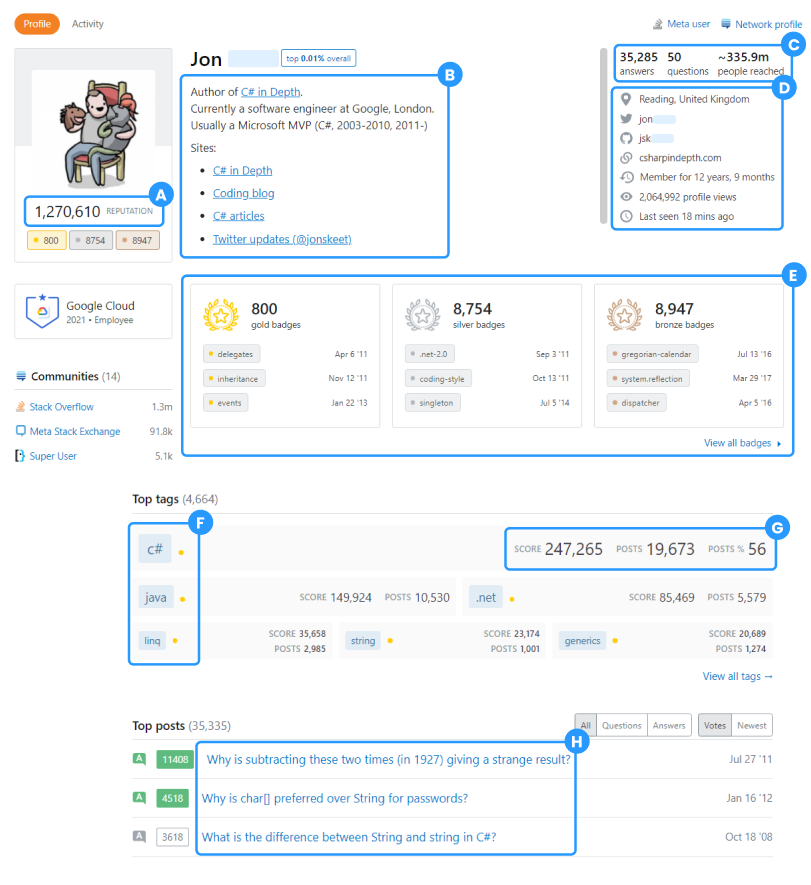
On Stack Overflow, users vote questions and answers up or down similar to Reddit. Users can earn reputation points and "badges" by giving valuable answers that get upvoted. Their reputation, score and technology tags can be important indicators of the technologies the user is most skilled in and in which ones they are interested in learning more.
Stack Overflow identifies the top technologies an engineer uses based on their activity, similar to GitHub (technology tags, reputation, badges and scores). This is still the platform's real advantage: the skill signal is earned, not self-declared. A LinkedIn headline is a claim, a gold badge in kubernetes is 200 upvoted answers other engineers found correct.
What you can no longer assume is that the signal is current. Engineers ask and answer based on the technologies they are using at that moment, so a tag list is an accurate photograph of a stack, taken on a date you have to go and check. Always read the timestamps next to the top posts, not just the tags. A 40k reputation Angular specialist whose last answer was in 2019 has probably not touched Angular in years, and the pitch that lands with them is about their current stack, which Stack Overflow will not tell you.
Finding engineering talent on Stack Overflow
Finding engineers on Stack Overflow can be tricky if you don’t know what tools to use or don’t know how to search the platform. There are many ways of finding engineers, but a few work decently enough to highlight.
You can find engineers on Stack Overflow in four different ways:
- Use free tools to search engineers on Stack Overflow
- X-ray Stack Overflow
- Search directly in Stack Overflow
- Query Stack Overflow's own data (Data Explorer and API)
They are not equivalent, and the difference is the recency problem from the last section. Options 1 to 3 hand you a list of profiles and leave you to open each one and check the dates by eye. Option 4 is the only one where you can put "answered something in the last twelve months" into the search itself, which is why it is worth the twenty minutes it takes to learn even if you have never written a line of SQL.
1. Use free tools to search engineers in Stack Overflow
Using tools is the easiest and the most accurate way of finding the right engineers. With these tools you can skip the process of creating complex search strings yourself. And some tools like HeroHunt.ai also include contact details for profiles.
HeroHunt.ai
HeroHunt.ai finds the best matching engineers based on your requirements. The profiles are automatically searched in real time.
Any contact details that are found across several online sources are added to the profile so you can directly reach out to the candidate.
HeroHunt.ai doesn’t only find Stack Overflow profiles, but also GitHub and LinkedIn profiles, and combines all the information from several platforms so you get the most accurate matches. HeroHunt.ai has an 8-day free trial, then plans from $99 a month.
HeroHunt.ai
Every method on that list except the Data Explorer leaves you opening profiles one at a time to work out when that person last posted, which is the exact problem this article keeps running into. HeroHunt.ai attacks it from the other end: rather than ranking the Stack Overflow archive, it searches engineers across Stack Overflow, GitHub and LinkedIn together and attaches the contact details it can find, so a tag list that went quiet in 2019 gets checked against a profile that is current. The honest caveat is that this is a different instrument from method 4, not a strictly better one. It will not answer "top Java answerers in Germany in the last twelve months, ranked by answers in that tag", because that question is about Stack Overflow's own reputation data and only the Data Explorer holds it. Write the SQL when the Stack Overflow signal itself is the point, and use a cross-platform search when what you need is a shortlist of engineers who are still active somewhere.
Recruit’em
Recruit’em is a tool that creates search strings. You can select a platform, for example Stack Overflow or LinkedIn, and Recruit’em automatically creates an x-ray search string for that platform.
Recruit’em does not find anything else than the search engine results page on Google, so it doesn’t find contact details. It just creates the search strings.
It is still live and Stack Overflow is still one of its supported targets, alongside LinkedIn, GitHub, Xing, Wellfound and a handful of niche sites, and it has since added a feature that turns a pasted job description into a boolean string. Treat that as a convenience rather than an edge: what comes out is a Google query, so it inherits every limitation of x-ray described in the next section, including the fact that you cannot filter on when the person was last active.
2. X-ray Stack Overflow
X-raying is searching profiles using Google or other generic search engines (like Bing or DuckDuckGo).
The advantage of Stack Overflow compared to for example GitHub is that Stack Overflow profiles always include /users in their url. This makes x-raying a lot easier.
You can for example find Java developers in Germany with this search string:
site:stackoverflow.com/users "java" "germany"Three parts, and it is worth knowing what each one does. site:stackoverflow.com/users restricts Google to profile pages only, so you get people instead of questions. The quoted technology matches the tag list Stack Overflow prints on the profile. The quoted location matches the location field, which is optional free text that a lot of people leave blank, so also try the city ("berlin") and the language spelling ("deutschland") rather than only the country. Adding a company name or a second tag narrows it further, and dropping the location widens it a long way.
Be realistic about what x-ray can and cannot do here. You are searching Google's index of Stack Overflow, not Stack Overflow, so you only reach the profiles Google has bothered to keep, and low-reputation accounts are largely not worth its crawl budget. You cannot filter by reputation, by badge or, critically, by date of last activity, so you will spend most of your time opening profiles to find out they went quiet in 2018. Older versions of this trick added exclusions like -"0 reputation" to strip empty accounts, and they are unreliable now. If the recency filter matters to you (in 2026 it should), skip to method 4.
3. Search directly in Stack Overflow
On the questions page of Stack Overflow you can search for certain technology tags and content of questions and answers.
This way you can find engineers that are active within certain technologies.
You can for example search for technology tags in Stack Overflow to find questions, answers and users.
You can create your own search strings in the search bar.
Optionally you can rank the search results by for example votes.
4. Query Stack Overflow's own data (Data Explorer and API)
This is the method almost no recruiter uses, and in 2026 it is the best one. Stack Overflow publishes its entire public dataset, and it gives you two free front doors to it: the Stack Exchange Data Explorer, which runs SQL against a copy of the public data dump refreshed on a weekly cadence, and the Stack Exchange API, which returns the same objects as JSON. Neither costs anything and neither requires a sales call.
Why bother, when methods 1 to 3 already produce profiles? Because this is where the recency filter lives. Google cannot answer "Java answerers in Germany who posted in the last two years, ranked by how many answers they wrote in that tag". The Data Explorer answers it in one query, and that single condition is the difference between a list of engineers and a list of engineers who still exist. Paste this into the Data Explorer and change the tag, the location and the window:
SELECT TOP 200
  u.Id AS [User Link],
  u.Reputation,
  u.Location,
  u.WebsiteUrl,
  MAX(a.CreationDate) AS LastAnswer,
  COUNT(a.Id) AS AnswersInTag
FROM Users u
  JOIN Posts a ON a.OwnerUserId = u.Id AND a.PostTypeId = 2
  JOIN Posts q ON q.Id = a.ParentId
WHERE q.Tags LIKE '%<java>%'
  AND u.Location LIKE '%German%'
  AND a.CreationDate > DATEADD(year, -2, GETDATE())
GROUP BY u.Id, u.Reputation, u.Location, u.WebsiteUrl
ORDER BY AnswersInTag DESC
Naming the first column [User Link] is the one trick worth memorising: the Data Explorer recognises it and renders each row as a clickable profile instead of a bare numeric id. PostTypeId = 2 means answers rather than questions, which matters because answering is the signal of competence and asking is the signal of being stuck. Results export to CSV, so the output drops straight into a sourcing sheet.
If you would rather not write SQL, the API gives you most of the value in a URL. This one returns the engineers who wrote the highest-scoring Java answers in the last month, complete with profile links:
https://api.stackexchange.com/2.3/tags/java/top-answerers/month?site=stackoverflowSwap java for any tag and month for all_time. The month window is the useful one now: on a platform where new posts have collapsed, the people still answering this month are a very short, very self-selecting list. To add the fields recruiters actually need, call /users/{ids} with a custom filter (built at create-filter), which unlocks location, website_url, about_me and the reputation deltas. reputation_change_year is the field to sort on: it is a direct measure of who has been active in the last twelve months, which is precisely what no other method here can tell you.
Two honest limits. The quota without an API key is 300 requests per day per IP, which you will burn through fast on a real search, and registering a free app key raises the default to 10,000 per day - Stack Exchange. And Location is optional, unvalidated free text: plenty of engineers leave it empty, and plenty write "remote", "/dev/null" or nothing useful, so a location filter always undercounts. Cast wide and filter afterwards rather than trusting the field.
Reaching out to engineers
Once you have picked your preferred way of finding engineers on Stack Overflow, you obviously want to reach out to the engineers that you have found.
Some engineers have contact details on Stack Overflow, like a personal email address or a link to their socials, but most have not mentioned them on their profile.
There are three ways you can reach out to someone you’ve found on Stack Overflow:
- Use a tool like HeroHunt.ai that finds contacts details for you
- Use the contact details on their profile pages
- Cross reference the profiles to find their other social media profiles
Apollo.io
Stack Overflow hands you a handle, a tag list and sometimes a location. It almost never hands you a work email, which is the gap this whole section exists to close. Once you have cross-referenced a profile to a real name and an employer (step 3 below), a B2B contact database fills in the address, and Apollo.io is the usual first stop because you can test it for nothing: the free plan is 900 credits per seat per year, released monthly, and paid Basic is $49 per seat per month billed annually ($65 month to month) for 30,000 credits granted upfront. Two honest caveats before you sign up. Apollo is keyed to people at companies, so it has nothing to match a pseudonymous Stack Overflow handle against: do the cross-referencing first or you will burn credits on nothing. And 900 free credits a year works out at roughly 75 a month, which is enough to evaluate it and not enough to run a sourcing sprint on.
1. Use a tool to finds profiles including contacts details
Ideally you use an all in one tool that finds Stack Overflow (and other) profiles and also gives you the best contact details to reach the candidate on.
Many times the contact details are missing on a Stack Overflow profile but can be found elsewhere online.
Tools like HeroHunt.ai finds those contact details automatically without you having to search for them manually or guess them.
2. Use the contact details on their page
Some engineers include contact details on their Stack Overflow profile. Engineers can choose to include their personal email address for example, but also sometimes link their socials or their personal website, where outreach options may be available.
All of that lives in one place: the free-text About me box, which the API exposes as the about_me field, next to website_url. That is worth knowing because it means you do not have to open profiles one at a time. Pull a batch of user ids from method 4, request them with a filter that includes about_me, and grep the results for an @ sign. It takes one request per 100 users.
Read what you find before you use it. Jon Skeet, the highest-reputation user on the site, publishes an email address in his About me box and puts a link next to it to a blog post asking people to read it first. That is the norm here rather than the exception: an email in an About me box is usually offered for questions about that person's work, not for recruiting. It is still a valid channel, and it will still work, but only if your message reads like it was written by someone who actually looked at their answers.
3. Cross reference profiles
You can also find the same person on different social media platforms. You can do this in several ways.
Here’s a guide on how to cross reference profiles.
Once you have matched an engineer to their company or LinkedIn, a contact database like Apollo.io can surface their work email so you can reach out directly.
Outreach message examples to engineers
Engineers are receiving loads of messages weekly and most of them are automated, so you can stand out by personalizing your message to them. By doing that, not only your response rates will improve but also your chances to hire the engineer since they will remember you better.
The bar moved, though. When most outreach was written by hand, mentioning someone's side project was proof you had done the work. Now that the average sequence is written by an LLM, a line about their GitHub is exactly what an engineer expects a bot to produce, and it gets read as noise. What still cannot be faked at scale is a specific technical opinion about a specific thing they wrote. This is the one place where sourcing on Stack Overflow beats sourcing anywhere else: an accepted answer is a concrete artefact, with an argument in it, that you can react to like a peer.
This is an example of a longer personalized outreach message:
Hi [first name], your answer on the Angular change detection question is the one I keep forwarding to people on my team, so apologies in advance for the recruiter email.
I’ve been looking at your GitHub repos and was impressed with your Angular projects, especially the dev tools projects, not something I have seen a lot of people working on but seems to be very relevant.
With [your company name] we’re building out our [subject] app which is reaching 50k business clients and we’re looking for someone who’s able to not only write great code using Angular but who takes the junior team to the next level.
This is the product and tech stack we’re building on.
With the variety of your Angular projects and the level of complexity you’re handling, it seems to be something that you might love to do.
If you want to have a chat over this you can reply in short and I'll take care of arranging our chat. Enjoy this sunny day! [your name]
A message this specific is wasted if it bounces. Once the handle is matched to a company, Apollo's free 900 credits a year are enough to check whether it has your shortlist before you pay for a seat.