



Tech recruitment has always been one of the most challenging types of recruitment.
Tech candidates are hard to find and tough to convince because there are so many job opportunities being offered to them.
There are always more companies looking for tech candidates than there are candidates offering themselves to companies.
In other words, demand is a lot higher than supply of tech talent.
This makes tech recruiting challenging, but not impossible.
The biggest opportunity for you as a (aspiring) tech recruiter is to do things a little bit differently than most recruiters.
When you expand your view and skills beyond sending InMails on LinkedIn, you already have a big advantage over recruiting competition in the market.
In this guide you’ll learn everything you need to know about tech recruiting and you’ll get the right material to put your new skills into practice.
In this guide we cover:
- A tech recruitment introduction
- Why tech recruitment is different
- Practical guide to tech recruitment
- Tech recruiting per role
- The tech recruiter’s profile
- The future of tech recruitment
- Get started with tech recruitment
1. A tech recruitment introduction
Tech recruitment is the recruitment of, typically hard to find, technical candidates.
A technical candidate can be for example:
- Software developer
- UX designer
- Technical product manager
- DevOps engineer
- Architect
- or IT specialist
Because these roles are very much sought after, there are more companies looking for these candidates than there are available candidates.
Therefore tech recruiting has a competitive nature; many recruiters are chasing the same candidates.
The issue is that those recruiters all use very similar approaches. The biggest majority of them post generic job advertisements or go to LinkedIn to send InMails to candidates.
These methods have become less effective because too many recruiters are using them.
For tech recruiters to be effective in this competitive market, they need to adopt a more proactive and personalized approach to recruiting and be able to target the right potential candidates very specifically.
2. Why tech recruitment is different
What makes the one type of recruitment different from the other is defined by the candidates that are sourced for. Every candidate segment has its own characteristics and dynamics in terms of interests, skills, tenure and job opportunities (demand).
Since tech recruitment is focussed on technical candidates, the tech recruitment job is heavily influenced by the evolution of the tech industry, how technology changes and how talent is reacting to that by quickly adapting skills and needs.
Tech talent: demand and supply issue
When you’re in tech recruiting there’s an important fact about the market you have to be aware of. There is a consistent and growing shortage of tech talent compared to the demand for tech talent.
Demand for tech talent is ever increasing. The amount of tech candidates available however, is not keeping up.
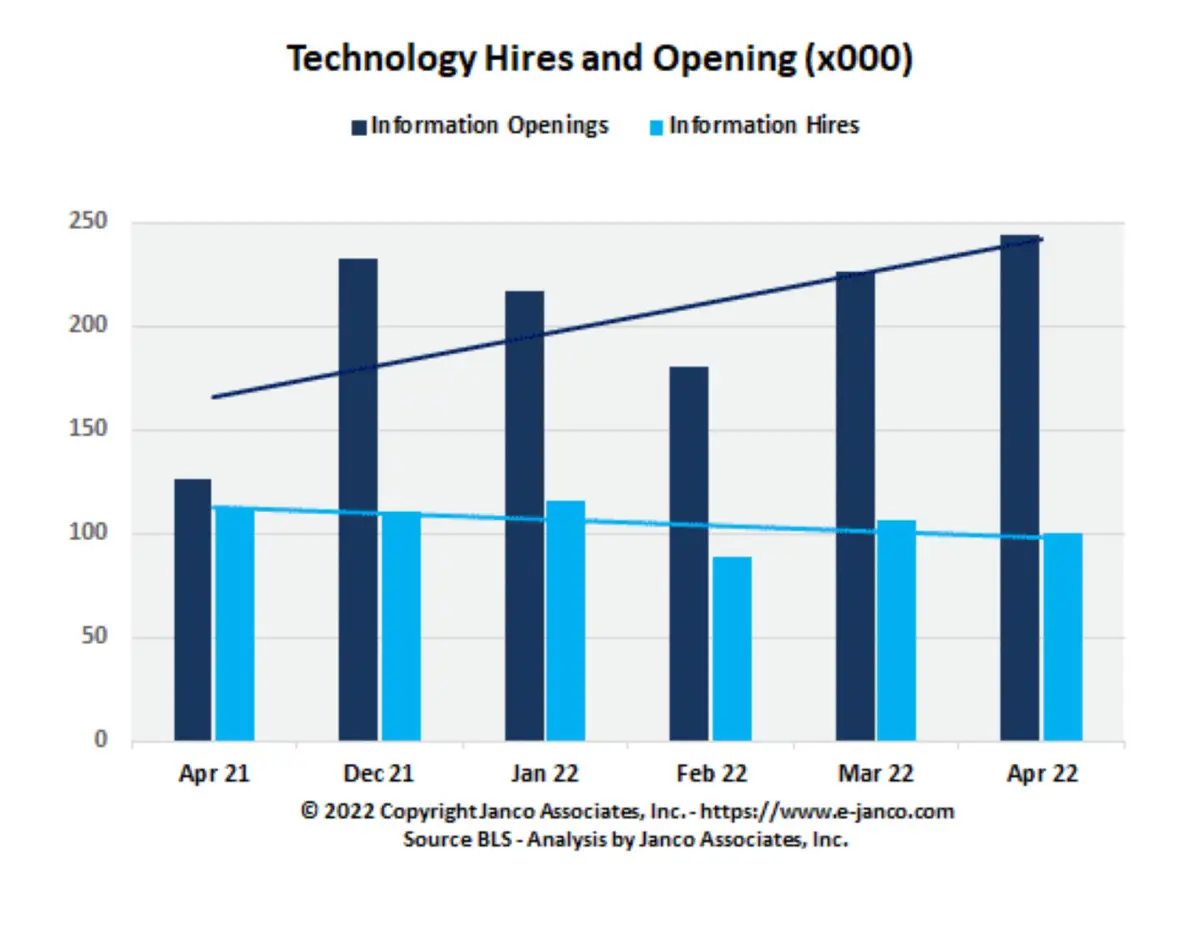
Because of this shortage you need to differentiate your approach from the rest. Otherwise you risk piling up in the candidate’s InMail box with generic messages that the candidate is not slightly impressed by because they get a dozen of those outreach messages daily.

Many vacancies can mean different things. It can mean that a lot of positions are left unfilled because of, again, the demand/supply issue. But it can also mean that tech jobs are just a vast and quickly growing job market.
The truth is, it’s both.
What changed: the market split in two
The charts above are from 2022. If you are reading this now, treat them as history, not as today’s market.
The blanket “there aren’t enough developers” story stopped being true in a uniform way. What replaced it is a split market, and knowing which side of the split your role sits on is the most useful thing you can work out before you start a search.
The side that got easier. Entry-level and generic mid-level roles. Junior developer postings have fallen a long way from the 2021-2022 peak, and a junior req today can pull hundreds of inbound applicants. If you are hiring a junior front-end developer, you do not have a sourcing problem. You have a screening problem, and this guide’s section 3 matters more to you than section 2.
The side that got harder. Senior engineers, and anyone who has genuinely shipped AI systems into production. This is where demand has run furthest ahead of the number of people who have actually done the work, and it is where the old InMail playbook fails hardest.
Meanwhile the long-term direction has not changed. The US Bureau of Labor Statistics projects employment of software developers to grow about 15.8% between 2024 and 2034, against roughly 3% across all occupations, and data scientists about 33.5%. On the demand side, The Pragmatic Engineer’s 2026 job market analysis reports top tech companies hiring roughly 20% more software engineers than a year earlier, with AI engineering listings up 50-100% at many large employers.
Tech hiring is not going away. It is getting pickier, in both directions.
What this means for how you recruit: outbound is still the answer, but you have to aim it. Firing outbound at a role with 400 inbound applicants wastes your week. Firing generic outbound at a senior AI engineer who gets ten messages a day is worse than sending nothing, because it confirms you are one of the ten. The rest of this guide is about aiming.
3. The practical guide to tech recruitment
So how do you find and engage tech talent?
To find and reach tech candidates you have to do more than just posting a job advertisement on a job board. Most tech candidates are not actively looking for a job and that means you have to proactively reach out to them.
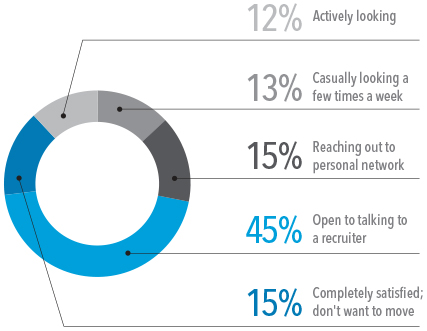
85% of the talent market is open to job opportunities but 4 out of 5 of those potential candidates are not actively looking for a job. Candidates who are not actively looking for a job don’t look on job boards. That means that for 4 out of 5 of those potential candidates you need to reach them in a different way than job posts.
That’s why a more proactive approach, often referred to as outbound recruiting, is an absolute necessity to be successful in tech recruiting.
Outbound recruiting is searching for potential candidates and reaching out to them proactively. It’s different from inbound recruiting, where candidates land on your career page through job ads or other marketing channels.
Outbound recruiting is spearfishing. Inbound recruiting is casting a big fishing net.
In tech recruiting, outbound recruiting is the more successful approach because of the reason highlighted earlier; most tech candidates don’t have to go look for jobs and view career pages because they already get a lot of opportunities coming their way.
For the full outbound recruiting guide, follow this link:
The outbound recruiting process consists of three steps:
- Targeting
- Screening
- Engaging
We’ll now go over how you can do outbound recruiting from targeting, to screening, to engaging.
Targeting
Targeting is about figuring out which candidates you want to reach out to. You need to have a good idea of where your candidate prospects hang out (do they spend most of their time on LinkedIn, GitHub, Medium, Stack Overflow or Kaggle?).
Also, you need to know how to search those platforms for tech talent. When you do your search in one of those platforms you want to end up with a longlist or shortlist of candidates who you want to reach out to.
The targeting step should result in three things:
Ideal Candidate Profile (ICP)
The ICP is a description and/or visualization of what the ideal candidate looks like. This can be a profile, real-life or fictional, put together by the hiring manager and recruiter. The ICP should at least give a description of the most important skills, interests and work preferences of the ideal candidate.
Talent market analysis
Your talent market analysis is the step where you will answer the question: where can I find my Ideal Candidates and how many of them are available in the market. With a so called talent mapping you can figure out roughly how many candidates there are in the market and what the difficulty level will be to engage them.
Target list
Your target list is your complete list of potential candidates that meet your search criteria. The profiles in your list can come from several sources. You translate your requirements into a search with certain keywords and filters so you get a targeted list of profiles. A tool like HeroHunt.ai can help build your search automatically from your job description, or even from your Ideal Candidate Profile. Based on that it finds your list of best matching profiles from several platforms.
Valuable resources for targeting:
- Google X-ray guide
- Find LinkedIn profiles without LinkedIn Recruiter
- How to find GitHub and Stack Overflow profiles
Valuable tools for targeting:
- HeroHunt.ai: find and reach 1 billion candidates worldwide (8-day free trial)
- Phantombuster: scrape profiles from several platforms (free version available)
Screening
Screening is the process of looking at all the candidate’s information from skills to interests to job history and job switching pattern to decide whether they are a good fit for your job.
The goal of screening is to decide which candidates to spend your time on to reach out to.
While screening, a tech recruiter looks at several things:
- Knowledge and skills
- Job history
- Job switching pattern
- Interests and personality
Knowledge and skills
The tech recruiter reviews the knowledge and skills built up by the candidate by looking at previous job titles and skills mentioned on the profile. But since anyone can put anything on their profile and information could be exaggerated, it pays off to validate the profile information found.
Validation of knowledge and skills can be done through for example looking at deliverables of candidates.
Examples of skills validation:
- Software developer: look at (open source) code shared by the candidate on for example GitHub or their other contributions to developer communities
- Data scientist: look at data models they helped build and possibly their projects on Kaggle
- UX Designer: look at their portfolio of apps they helped design and build
Job history
One of the most obvious things to look at while screening candidates is looking at their previous job titles and the companies they have worked for. It’s helpful to look at the details of a position that someone held because a job title alone can be misleading or just too vague.
Job switching pattern
To make an estimation whether the candidate is open to moving from their current job and to estimate how long a candidate might stick at your company, it’s wise to look at how often the candidate has switched jobs before.
A candidate who has switched every half year might also switch relatively fast in your company.
On the other hand a candidate who has been working 20 years for the same employer might not make a next move quickly so might not be worth your time reaching out to.
Interests and personality
A social media profile of a candidate can say a lot about a person. They might have a profile or background that says something about their passion, maybe they have posted something about their personal life or mention their hobbies.
Even though this information is less tangible than for example skills, it is still very important information especially when estimating if the candidate fits your company culture and team dynamics.
Valuable resources for screening:
Valuable tools for screening:
- Manatal: AI candidate scoring and resume screening inside an affordable ATS
- Harver: behavioural and soft-skill assessments. This is where pymetrics ended up: Harver acquired it in 2022 and now sells it as pymetrics game-based assessments. The old pymetrics.ai domain is dead, so ignore anything that still links to it.
- Sense: chatbot screening and resume analytics. Skillate, which used to be the standalone product here, was acquired by Sense in September 2022 and folded into its platform.
A note on that list, because it is the most honest thing in this section: two of the three screening tools recruiters were told to use in 2022 no longer exist as standalone products. That is normal in this category. Assessment vendors get bought, and the buyer keeps the engine and drops the brand. Before you build a process around any screening tool, check that the company still ships it.
HeroHunt.ai
This guide’s screening step is one decision made repeatedly: who is worth your time, before you spend twenty minutes writing to them. That is the step HeroHunt.ai automates. It searches across LinkedIn, GitHub and other public sources, then reads each profile with a language model against your actual requirements rather than matching keywords, so a target list of 300 comes back ranked and explained instead of raw. On the tech roles in this guide that matters most for the four criteria above: job switching pattern and seniority are things a model can read off a profile far faster than you can.
The honest limit is the one this section just made. A language model reads text. It can tell you a profile claims four years of Kubernetes; it cannot open the repository and judge the commits, and on developers that artefact is the real signal. Use it to triage the list down to the twenty people worth opening GitHub for, then make the call yourself. It is also a sourcing and outreach tool, not an ATS, so once candidates start replying you still need somewhere to run interviews, offers and compliance.
Engaging
Targeting told you who to talk to. Screening told you who is worth your time. Engaging is where most tech recruiters lose, because it is the step where you look identical to everyone else.
The candidate you picked is, by definition, the candidate every other recruiter picked too. They are getting the same “exciting opportunity” message from a dozen people this month. Your message is not competing with silence. It is competing with a queue.
Reach them where the queue is shorter
The cheapest advantage in tech recruiting is channel choice. LinkedIn InMail is the most crowded inbox a developer owns. Their personal email, a GitHub profile, a thoughtful reply to something they actually wrote or shipped: all far less crowded.
This is why finding a real contact detail matters more in tech recruiting than in almost any other segment. It is not about spamming more channels. It is about arriving somewhere the candidate is not already numb.
Valuable tools for engaging:
- HeroHunt.ai: find contact details and send personalized outreach from the same place you sourced (8-day free trial)
- Apollo.io: work emails and direct dials, with a free tier you can use to test coverage before paying
- How to find candidate email addresses: the manual methods, for when no tool has a record
Apollo.io
This section argues you should get off the InMail queue, and that argument only cashes out if you can find an actual email address or phone number. Apollo is the cheapest way to find out whether your target list is reachable at all. Its free plan gives 900 credits per seat per year, released monthly (roughly 75 a month), which is enough to test coverage on a sample before you commit. Paid starts at $49 per seat/month billed annually, or $65 month to month.
The caveat matters more here than on a sales blog: Apollo’s database is built for B2B sales prospecting. It is richest on sales, marketing and executive titles at companies that sell things, and thinnest exactly where tech sourcing is hardest, on individual engineers at small startups and outside the US. So do not buy it on the size of the database. Run 20 of your real targets through the free tier first and count the hits. If it misses your list, it will keep missing your list at $49 a seat.
What to actually say
There is no clever template that fixes a bad message. There are only a few things that separate a message a developer answers from a message they swipe away.
- Prove you looked. One specific, true sentence about their work beats three paragraphs of adjectives. Not “I was impressed by your profile”, but “you have been on the same payments platform for four years, which is unusual”.
- Lead with the technical problem, not the company. Engineers choose problems and teams. Your funding round is not a hook. “We are re-writing our matching engine because it falls over at 2,000 requests a second” is a hook.
- Be concrete about the boring things. Salary band, remote policy, stage, team size. Vagueness reads as a waste of time, because it usually is.
- Make the ask small. “Worth a 15-minute call?” converts better than “are you interested in this role?”, which is a yes/no question they can answer with silence.
- Keep it short enough to read on a phone. If it needs scrolling, it needs cutting.
The one thing not to do: send AI-generated outreach that sounds AI-generated. Developers are the single audience most likely to spot it, most likely to be annoyed by it, and most likely to post a screenshot of it.
Valuable resources for engaging:
4. Tech recruiting per role
“Tech candidate” is not a segment. It is five or six segments that behave very differently, and treating them as one is the most common mistake a new tech recruiter makes. Here is what changes per role.
Software developers
Where they are: GitHub, Stack Overflow, LinkedIn, plus language and framework specific communities (Discord servers, subreddits, conference speaker lists).
What to read: the code, not the resume. Commit history shows what they actually work on, how they write, and whether they finish things. A profile that lists nine languages and shows commits in one is telling you something.
What they care about: the problem, the codebase they will inherit, who they will learn from, and how much of their week is meetings.
Data scientists and ML engineers
Where they are: Kaggle, GitHub, arXiv, Medium, and increasingly the model hubs and open-source repos around whatever is current.
What to read: the hardest signal to fake is having put a model in front of real users. Plenty of people have trained something in a notebook. Far fewer have owned it in production, with monitoring, drift, and someone complaining about it at 2am. Screen for that specifically, because titles do not distinguish it.
What they care about: data access and compute. A brilliant ML role with no data and no GPU budget is not a brilliant ML role, and they will find that out on the call.
DevOps and platform engineers
Where they are: GitHub, Stack Overflow, tool-specific communities (Kubernetes, Terraform, the observability vendors’ Slack channels).
What to read: breadth plus one deep thing. Tooling lists are cheap. Look for evidence of scale: what size estate, how many services, who was on call.
What they care about: whether you are asking them to build a platform or to be a human ticket queue. Ask this on their behalf during intake, because it is the question that decides whether the good ones stay.
UX designers
Where they are: Dribbble, Behance, personal portfolio sites, LinkedIn.
What to read: the case study, not the screenshot. A beautiful shot proves visual taste. The write-up of what was wrong, what they tried, and what the numbers did afterwards proves they can design.
What they care about: whether design has a seat at the table or arrives after the decisions are made.
Technical product managers
Where they are: LinkedIn mostly, plus writing: Substack, Medium, conference talks.
What to read: scope and outcomes. “Managed the roadmap” means nothing. What shipped, who used it, what got killed.
What they care about: authority. Whether they own a problem or take orders about a feature list.
Two rules cut across all of them. First, the signal you want is almost never on the resume, it is in the artefact. Second, if you cannot describe the role’s technical problem in one sentence a practitioner would respect, you are not ready to source it yet. Go back to the hiring manager.
5. The tech recruiter’s profile
Tech recruiters are not just recruiters who happen to be assigned to engineering roles. The job asks for a specific mix, and it is worth being honest about where you sit on each of these.
Technical literacy (not technical ability)
You do not need to code. You do need to know that React is not a language, that a backend engineer is not interchangeable with a DevOps engineer, and roughly why someone would pick Postgres over Mongo. The bar is simple: can you have a five-minute conversation with an engineer without them realising you are reading from a keyword list? Everything below that bar costs you replies.
Sourcing craft
This is the skill that separates tech recruiters most sharply, and it is learnable. Boolean, X-ray search, and knowing how to search platforms that were never built for recruiting. If your entire pipeline comes out of one tool’s search box, you are fishing in the same pond as everyone else, with the same bait.
Writing
Outreach is writing. So are job descriptions, so are the updates that keep a candidate warm for three weeks. Recruiters underrate this constantly because it does not feel like a recruiting skill. It is the recruiting skill with the highest leverage per hour.
Hiring manager partnership
The best tech recruiters push back. They run a real intake, they challenge a requirements list that describes four people, and they tell an engineering manager when the salary band will not buy what the job description describes. A recruiter who only takes orders will run a search that cannot succeed, and will get blamed for it.
Data
Know your funnel numbers well enough to argue with them: response rate by channel, screen-to-interview, interview-to-offer, offer acceptance. Without these you cannot tell a sourcing problem from a selling problem from a process problem, and you will fix the wrong one. See key sourcing and recruiting metrics for what to track.
6. The future of tech recruitment
Two things are happening at once, and they point in opposite directions.
The mechanical parts of this job are being automated, fast. Finding profiles, ranking them, drafting a first message, chasing a follow-up: AI agents already do all of this, and they do it at a volume no human desk can match. If your value to your employer is that you can run a boolean search and send 200 InMails, that value is falling every quarter.
At the same time, the value of the human parts is rising. When outreach volume becomes free, volume stops working. Everyone can send 200 messages, so 200 messages get ignored. What survives is the thing a model cannot do for you: the judgement call on a non-obvious candidate, the conversation that changes someone’s mind about moving, the relationship with a hiring manager that lets you say “this requirement is fantasy”.
Three shifts worth planning for:
- Candidates use AI too. Applications are getting cheaper to send, and they will keep flooding. Inbound volume goes up, inbound signal goes down. Skills-based evidence and real artefacts get more valuable precisely because the written application means less.
- Screening moves earlier and gets stricter. If the top of the funnel is infinite, the constraint moves to how well you can decide. That is a quality problem, not a volume problem, and buying a bigger database does not solve it.
- The AI-skills split widens. The people who can actually ship AI systems will stay the hardest hire in the market for a while, and the generic mid-level role will keep getting more competitive for candidates. Sourcing AI talent is close to a separate discipline now.
The recruiters who do well here are not the ones who avoid the tools. They are the ones who hand the tools everything mechanical and spend the recovered hours on the four conversations that actually decide the hire.
7. Get started with tech recruitment
If you read one section, read this one. Here is the whole guide as a sequence you can run this week.
- Work out which side of the split your role is on. Inbound-heavy junior role, or scarce senior/AI role? This decides whether you spend your week screening or sourcing. Getting this wrong wastes the whole week.
- Run a real intake. Come out with a one-sentence technical problem statement, a salary band you believe, and an Ideal Candidate Profile the hiring manager actually agreed to.
- Map the market before you message anyone. Roughly how many people match, and where they are. If the answer is “about 40 people worldwide”, that is not a sourcing plan, that is a conversation to have with the hiring manager today.
- Build the target list from more than one place. LinkedIn plus at least one platform your competition is not searching.
- Screen on artefacts, not adjectives. Code, models, portfolios, case studies. Triage in a tool, decide with your eyes.
- Find a contact detail and get out of the InMail queue. Test coverage on a sample before you pay for a database.
- Write like a person to a person. One true specific sentence, the technical problem, the boring facts, a small ask.
- Measure response rate by channel and per message variant. Change one thing at a time. Most recruiters never do this, which is why most recruiters have no idea why their outreach fails.
None of this is complicated. It is just further than most of your competition is willing to go, and that gap is the whole opportunity. The market has more recruiters sending the same message to the same 200 people than it has recruiters who read the code, aimed properly, and wrote something worth answering.
Be the second kind.
Steps 3 to 6 above are the ones that eat the week. HeroHunt.ai runs the search, the screen and the contact lookup from one place, and leaves the judgement calls to you.