


Almost every recruiter in the industry feels like they need a LinkedIn Recruiter seat to be successful in their recruiting efforts.
The truth is that you do not need a paid subscription for LinkedIn Recruiter.
The assumption is that to access all of LinkedIn’s data, the candidate profiles, you need a paid license to access all of these profiles and filters.
But LinkedIn profiles are largely public by default, and a Recruiter seat is not the only way to reach the people behind them.
Why LinkedIn Recruiter is not your best option
❌ LinkedIn Recruiter is very expensive, and LinkedIn will not tell you how expensive. The only price LinkedIn publishes is Recruiter Lite: $170 per month for a single license ($1,680 a year), with additional seats at $270 per month each. For Recruiter Corporate, the tier most agencies actually want, the price field says "Contact our Sales team". Buyers reported roughly $10,800 to $12,000 per seat per year through early 2026, so call it about $900 a month, but you will not know your number until you are in a sales cycle.
❌ LinkedIn Recruiter forces serious limitations with outreach. InMail credits are capped per seat per month: 30 on Recruiter Lite, 100 on Recruiter Professional Services, 140 on RPS+, and 150 on Recruiter Corporate. On a hard-to-fill role, 150 messages a month is often not enough to fill one position. Extra credits are sold in packs, at roughly $10 a message.
❌ LinkedIn Recruiter is the most competitive place to be as a recruiter. Every other recruiter is running the same filters, getting the same result set, and messaging the same shortlist in the same inbox.
❌ LinkedIn Recruiter is not the only source of profiles. Communities like GitHub, Kaggle and Stack Overflow still expose real evidence of a person's work, which a LinkedIn headline never will. (Worth knowing: Stack Overflow closed its Jobs and Developer Story products in March 2022, so it is a place to research people, not to advertise to them.)
Two things worth knowing before you pay
If you are on the fence, two details in LinkedIn's own documentation are worth the read.
The first is network reach. Recruiter Lite and RPS only search to your 3rd-degree connections. RPS+ adds 50 out-of-network unlocks a month. Only Recruiter Corporate gets full access to the entire network. So the cheap seat is not a small version of the expensive seat, it is a smaller candidate pool.
The second is Open Profile. Members with Open Profile enabled can be messaged without spending an InMail credit at all: up to 350 messages per calendar month on Recruiter, and 50 on Recruiter Lite. Most recruiters burn paid credits on people they could have messaged for free.
Your best alternative to LinkedIn Recruiter
The best alternative to paying for a LinkedIn Recruiter seat is using an alternative talent search engine that lets you find all LinkedIn profiles.
A talent search engine like HeroHunt.ai:
✅ Finds all LinkedIn profiles
✅ Lets you find contact details of the candidate so you can send emails instead of having to rely on limited InMails
✅ Usually also provides a more automated and faster way of reaching out to many candidates
✅ Is generally a lot more affordable
HeroHunt.ai
This is the category that actually replaces a Recruiter seat, because it does the search, the contact lookup and the outreach in one pass instead of charging a credit for every message. HeroHunt.ai searches over a billion public profiles, screens them with language models against your brief rather than keyword filters, and writes personalized outreach that goes out over email, so the 150 InMails a month described above stops being your ceiling. It also reaches the communities a Recruiter seat cannot see, GitHub and the rest, where a person's work is visible instead of self-reported. The honest caveat: it is a sourcing tool, not an applicant tracking system, so you still need somewhere to run the pipeline once people reply, email deliverability and list hygiene become your problem rather than LinkedIn's, and for a candidate who genuinely has no email footprint anywhere, an InMail is still the only door.
The three layers you are actually paying for
A Recruiter seat bundles three separate jobs into one invoice, and that bundle is the reason it costs what it costs. Separating them is what makes it replaceable:
1. Search. Finding the right profiles. This is the part a talent search engine replaces directly.
2. Contact. Turning a profile into an email address or a phone number. This is the layer LinkedIn charges the most for, because the Recruiter seat's answer to it is the metered InMail.
3. Outreach. Actually sending the messages, in sequence, without doing it by hand.
The InMail cap only hurts if contact and outreach have to run through LinkedIn. Once you have the person's email, layers 2 and 3 are commodity products, and they are priced like commodities: contact databases such as Apollo.io or Lusha sell the email lookup outright, and most of them bundle the sequencing in.
Apollo.io
If you have a way to find profiles but no way to contact them off-platform, a B2B contact database closes that gap for a fraction of a Recruiter seat. Apollo.io publishes its numbers where LinkedIn does not: the free plan gives each seat 900 credits per year, released monthly, and paid starts at $49 per seat per month billed annually (or $65 month to month) for 30,000 credits per seat per year, with email sequences included. Set that against the 150 InMails a month a Recruiter Corporate seat gives you. The honest caveat: Apollo is a sales database indexed by company and job title, not a LinkedIn index, so it will not reproduce Recruiter's candidate filters, and its coverage is thinnest exactly where recruiters often need it most, on students, freelancers, and people at companies too small to leave a data footprint. It replaces the InMail bottleneck, not the search.
How accessing LinkedIn profiles through an alternative solution works
A talent search engine that finds LinkedIn profiles provides you exactly what LinkedIn Recruiter provides: being able to search LinkedIn profiles.
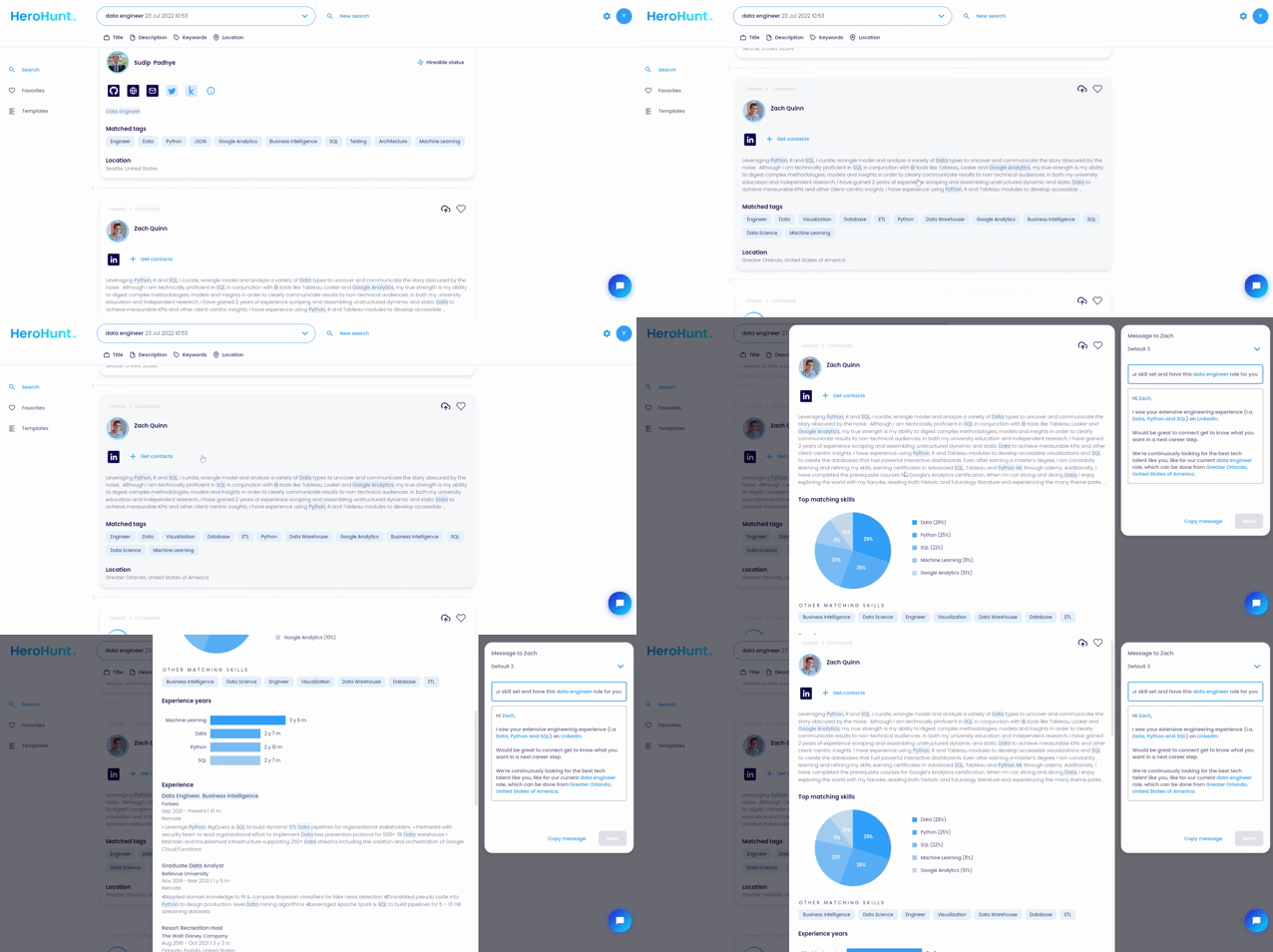
It typically also provides a way of reaching out quickly and in a personalized way to the candidates that you like.
The talent search engine finds contact details automatically and automatically generates a hyper personalized message that you can send in one click.
Which means the honest test is not "can I afford LinkedIn Recruiter". It is "am I paying $900 a month for a search filter, a metered message, and the queue every other recruiter is standing in". For most desks, on most roles, the answer is that you can buy the search and the contact separately, for less, and reach people in an inbox that is not saturated.
Run a real search against your next open role and see how far you get before any seat is involved.