


The buyer's guide to how AI recruiting tools charge in 2026, why the meter matters more than the sticker, and when paying per hire beats paying per seat.
Recruiting software in 2026 is sold on at least nine different meters, and the one you pick can swing your cost per hire by more than 10x. Two vendors can quote you numbers that look one screen apart and behave two orders of magnitude apart once you actually start hiring. The sticker price is the question buyers argue about. The meter is the question that decides the invoice.
The clearest way to see it is a single ratio. A contingency agency placing one engineer on a $100,000 salary at a standard 20% fee charges you $20,000 the day that person starts - Leonar. A year of LinkedIn Recruiter for two seats costs roughly the same - Pin. One of those bills arrives only when you succeed. The other arrives whether you hire ten people or nobody. That is the whole seat-versus-per-hire debate in one line, and in 2026 it is being reopened by AI agents that do the work a seat used to represent.
Here is the problem this guide solves. Almost every comparison you will read ranks tools by price. That is the wrong axis. A $15 per seat ATS and a $10 per employee talent suite are not cheap and expensive versions of the same thing; they are billed against completely different populations, and the gap between them widens every time your company grows. This guide is about the models, not the logos: what each meter is, who it rewards, where it quietly punishes you, and how AI is pulling the entire market from paying-for-access toward paying-for-outcomes.
This guide breaks down the nine metering units behind every recruiting quote, the real 2026 prices attached to each, the break-even math that tells you when a seat licence beats a per-hire fee, and the agentic shift that is making "per seat" look like a legacy idea. It leans on primary pricing pages and negotiated-deal data wherever they exist, and it says so plainly wherever they do not. For a tool-by-tool index of what forty specific products cost, this pairs with our companion reference on recruiting software pricing in 2026; here the subject is the pricing model itself.
Contents
- The Pricing Model Decides Your Cost Per Hire
- The Nine Meters: A Map of How Recruiting Software Is Billed
- Per-Seat Pricing: The Default That AI Is Breaking
- Headcount and PEPM: The Meter You Never Agreed To
- Job Slots, Credits and Messages: Where Consumption Creeps In
- Per-Hire and Outcome Pricing: Paying Only When Someone Starts
- The AI Agent Disruption: Why Seats Are Cracking in 2026
- Seat vs Per-Hire: The Break-Even Math
- The Hidden Costs Nobody Puts in the Quote
- How to Choose: A Framework by Hiring Profile
- The Future: Toward Priced-Per-Hire Recruiting
HeroHunt.ai
If the seat model is what you are trying to escape, HeroHunt.ai is a useful reference point because it meters on something unusual: AI-screened and matched profiles delivered and candidate emails found, not recruiter seats, with unlimited positions and searches on every plan. Starter is $99/month for 2,000 AI-screened and matched profiles and 500 candidate emails a month, Pro is $199 for 5,000 profiles and 1,000 emails, and Team is $399 for 3 users sharing 25,000 profiles and 4,000 emails, after an 8-day trial (there is no permanent free tier). The honest caveat: those allowances reset monthly and do not roll over, so the model rewards a steady flow of live reqs and is the wrong fit if what you actually want is an unlimited seat to browse a database all day. It is included here as the clearest example of pricing that tracks the work, not the login.
1. The Pricing Model Decides Your Cost Per Hire
The single most important decision in a recruiting-software purchase is not which vendor you choose, it is which meter you agree to be billed on. Everything else, the discount you negotiate, the feature checklist, the onboarding, is secondary to the unit, because the unit is what compounds. A price is a number that applies once. A meter is a rule that applies every month for the life of the contract, and it keeps applying as your headcount, your req load, and your hiring volume all change underneath it.
Consider what each meter is really charging you for. A per-seat licence charges you for access: the right for a named human to log in, regardless of whether they source one candidate or a thousand. A per-employee or PEPM licence charges you for scale: your total company size, most of whom will never open the product. A per-hire or contingency fee charges you for results: nothing until someone starts, then a real bill. These are not three prices for the same thing. They are three different theories of what you are buying, and they align the vendor's incentives with yours to wildly different degrees.
The consequence shows up in the distribution, not the sticker. Vendr's transaction data puts the median Greenhouse contract at roughly $26,646 a year, but the same product runs from about $10,215 to $75,125 across buyers - Vendr. That is a 7x spread for identical software, and it exists because Greenhouse is metered on employee headcount, so the population the price is multiplied against differs enormously from one customer to the next. Any guide that hands you "the price" of a headcount-metered tool has collapsed a distribution and thrown away the part that mattered.
The compounding is easy to underestimate because a meter looks like a small decision at signing. A recruiting team that picks a per-seat tool at $1,000 a month and one that picks a headcount tool at the same monthly price have made identical-looking choices, yet three years later, after one team doubled its recruiters and the other doubled its employees, those two bills have diverged by tens of thousands of dollars. The meter is a multiplier on a quantity that moves, and the moving quantity, not the rate, is where the money is. This is why sophisticated buyers spend more time on the unit than on the discount, because a 20% discount on the wrong meter loses to list price on the right one.
The pyramid to hold in your head is simple. First, decide whether your hiring is better matched to paying for access, for scale, or for outcomes. Second, inside that family, pick the specific meter and negotiate it, not just the rate. Third, only then compare vendors. Most buyers do this in exactly the reverse order, start with a shortlist of logos, argue about monthly price, and discover the meter in year three when a hiring freeze fails to lower the bill or a great hiring year sends it up. The rest of this guide walks the meters from the most access-oriented to the most outcome-oriented, because that spectrum is also the direction the market is traveling.
2. The Nine Meters: A Map of How Recruiting Software Is Billed
Recruiting and talent software in 2026 bills on at least nine distinct meters, and they sort cleanly into three families: access, consumption, and outcome. Naming them precisely is the whole skill of reading a quote, because vendors rarely label the meter in the headline. They lead with a monthly number and leave you to discover, usually in the order form, whether that number multiplies by seats, by employees, by job slots, by messages, or by hires.
The access family bills you for the right to use the tool at all. It contains per-seat or per-user pricing (you pay for each recruiter who logs in), per-employee or PEPM pricing (you pay for total company headcount), and per-job-slot pricing (you pay for each concurrently open requisition). The defining property of the access family is that your bill is decoupled from results: you can pay the same amount in a quarter where you hire nobody as in a quarter where you hire fifty, and in the PEPM case your bill can even rise in a year when your recruiting workload falls, because the company grew.
The consumption family bills you for units of work the software performs. It contains per-credit pricing (contact reveals, AI actions, enrichment lookups), per-message pricing (InMails, SMS, email sends), and per-click or per-application pricing (programmatic job advertising). Consumption pricing feels fair because you pay for what you use, but it has a failure mode of its own: costs are variable and hard to forecast, and a busy hiring month is also your most expensive software month. The diagram below groups the nine meters so you can place any quote you receive.
The outcome family is the smallest today and the fastest growing. It contains per-interview pricing (you pay for each completed screen), per-hire or per-placement pricing (you pay only when someone starts), and percentage-of-salary pricing (the agency model, where the fee scales with the hire's pay). Outcome pricing is where the vendor takes on real risk: if nobody gets hired, nobody gets paid. That risk transfer is exactly why buyers like it and why, historically, only services firms and marketplaces were willing to offer it. The story of 2026 is software vendors starting to cross that line, a shift the venture community has been mapping in detail.
The pricing archetypes, mapped

That market map is worth studying because it captures the direction of travel: AI-native companies clustering toward usage and outcome models on the right, while incumbents adding AI features stay anchored to per-seat on the left. The nine meters have coexisted for years, but the center of gravity is moving from the access family toward the outcome family, and recruiting sits close to the front of that move because so much of recruiting is now work an agent can do. The following chapters take each family in turn, with real 2026 numbers.
3. Per-Seat Pricing: The Default That AI Is Breaking
Per-seat pricing is still the default in sourcing and agency software, and it is also the model with the shakiest future, because a seat is a proxy for a working human and AI is dissolving that proxy. When you pay per seat, you pay for a named recruiter's right to log in, month after month, whether that seat is heavily used or mostly idle. For a small, fully-utilized sourcing team this is the most controllable meter on the market, which is precisely why so many vendors are quietly trying to move off it.
The canonical example is LinkedIn Recruiter. LinkedIn does not publish a rate card, but buyer-reported data and negotiated-deal medians tell a consistent story: Recruiter Corporate runs roughly $10,800 to $15,000 per seat per year with a three-seat minimum, so the practical entry point is around $32,400 a year before any add-ons - Pin. Recruiter Lite lists near $170 a month for a single seat, and the enterprise product bundles a monthly InMail allowance on top - Litespace. Vendr's marketplace data puts the median LinkedIn Talent Solutions contract at about $38,502 a year across 1,698 deals, with a range that stretches past $166,000 - Vendr. The seat is the unit, but the real bill is a bundle of seats plus messages plus renewal increases.
The rest of the sourcing category prices the same way, with a recurring trick: the published number is rarely the per-seat number. SeekOut advertises $149 a month, but that headline is a three-seat bundle, and higher tiers move to custom per-seat pricing that Vendr data places in the thousands of dollars per seat per year, with a median annual contract near $20,000 - Vendr. hireEZ now starts solo recruiters at $494 a month and declines to publish a flat team seat rate, which quietly retires the old $169 figure that still circulates - hireEZ. Gem publishes no list price at all; Vendr shows a median of about $25,700 a year - Vendr. The pattern is a small published anchor and a much larger negotiated reality.
The buyer's defense against the small-anchor tactic is to ignore the published number and ask two specific questions: what is the real per-seat rate at my seat count, and what is bundled versus metered on top. SeekOut's $149 headline tells you almost nothing about what four sourcers will pay, because the moment you exceed the three-seat bundle you are in custom pricing that Vendr data shows landing in the thousands of dollars per seat. Treat every published sourcing price as a marketing anchor built to get you into a demo, and reserve your real evaluation for the quote that comes back with your actual seat count on it.
Not every seat-priced tool hides the number, and the ones that publish it are instructive. In the ATS world, Manatal meters strictly per user and shows its whole ladder: $15 per user per month billed annually on Professional, $35 on Enterprise, $55 on Enterprise Plus, with a 14-day trial and no card required - Manatal. The honest catch is that the $15 tier caps at 15 active jobs and 10,000 candidates, so a team running more than fifteen requisitions is really comparing against the $35 tier, not the headline. That transparency is the exception; Bullhorn, the staffing-agency standard, publishes nothing and lands somewhere around $99 to $315 per user per month depending on tier and negotiation - Pin.
The structural weakness of per-seat pricing is what practitioners call the empty-seat tax. You buy seats for a team's peak size, then hiring slows, a recruiter leaves, or a role goes unfilled, and you keep paying for a login nobody uses until renewal. AI makes this worse for the vendor, not the buyer: if one recruiter plus an agent can do the work of three, a company needs fewer seats, and a business whose revenue is seats times price has just watched its own product shrink its market. A concrete version of the empty-seat problem plays out every January. A team buys five seats of a sourcing tool in the third quarter to staff up for a hiring push, the push lands, and by the following year two of those recruiters have moved on and one has shifted to running interviews. The tool still bills for five logins until the annual renewal, so the company pays for two idle seats for months, often at the exact moment a hiring slowdown made the budget tightest. Seats are easy to add and painful to remove, and vendors price the annual commitment precisely because it smooths over that asymmetry in their own favor.
This is the tension pulling the whole category toward other meters, and it is why tools whose value is the work performed, rather than the login, have started to price on the work. Platforms such as HeroHunt.ai sit deliberately on the other side of this line, metering on AI-screened and matched profiles delivered rather than seats, precisely to avoid selling access to a database that a recruiter has to operate by hand.
| Seat-priced sourcing / ATS tool | Published entry | What the seat really costs |
|---|---|---|
| LinkedIn Recruiter Corporate | Not published | ~$10,800-$15,000 per seat/yr, 3-seat min |
| SeekOut | $149/mo (3-seat bundle) | Custom; ~$20,000/yr median contract |
| hireEZ | $494/mo (solo) | Team pricing quote-only |
| Gem | Not published | ~$25,700/yr median contract |
| Manatal | $15/user/mo | Transparent; $15 tier caps at 15 jobs |
The table makes the category's habit visible: only Manatal lets you read your real per-seat cost off the website. For every other row, the published figure is either a bundle or a floor, and the number that governs your budget lives in a sales conversation. That opacity is not an accident of the seat model, but it thrives inside it, because a seat is easy to discount visibly while the real leverage sits in seat counts, InMail bundles, and renewal clauses.
4. Headcount and PEPM: The Meter You Never Agreed To
The most consequential meter in enterprise recruiting is per-employee-per-month pricing, and most buyers do not realize they are on it until their bill rises in a year when their hiring did not. PEPM, sometimes described as headcount or FTE-based pricing, charges you against your total company size rather than your recruiting team or your hiring volume. A 4,000-person company with six recruiters is billed on 4,000 people, the other 3,994 of whom will never open the applicant tracking system. The logic from the vendor's side is that the platform serves the whole workforce; the logic from the buyer's side is often bewilderment.
The modern ATS market has moved decisively to this model, and the leaders barely hide it. Ashby's own pricing page states that price is based on "company size, usage, and commitment," and publishes exactly one number, Foundations at $400 a month for up to 100 employees, with everything above that quoted - Ashby. Lever prices at roughly $6 to $8 per employee per month, so a 500-person company pays for all 500 regardless of how many recruiters it employs, with negotiated medians around $36,778 a year at that size - Pin. Greenhouse scales on employee count and hiring volume rather than seats, which is why its buyer range runs from about $5,100 to well past $36,000 - Pin. Workable bands the same idea into headcount tiers of $299, $599, and $719 a month on annual billing - Workable.
Talent-intelligence suites push PEPM to its logical extreme. Eightfold prices per employee per month on total workforce headcount at an estimated $7 to $10 PEPM, with typical enterprise contracts of $150,000 to $500,000 a year and no free trial - Pin. A 10,000-employee organization can therefore pay close to a million dollars annually for a product its recruiters touch and its 10,000 employees mostly do not. The appeal to a vendor is obvious: PEPM grows automatically with the customer, decoupled from anything the recruiting team does or fails to do. The appeal to a buyer is real too, in one specific way, which is worth stating fairly.
PEPM's genuine advantage is predictability of the unit and immunity to seat-count games. You cannot accidentally overspend by adding recruiters, and your per-head rate is stable, so budgeting is a headcount forecast rather than a usage forecast. That is a legitimate reason large, steadily-growing companies accept it. The disadvantage is the one that bites during downturns: PEPM is the only recruiting meter where a hiring freeze does not cut your bill, because the bill was never tied to hiring in the first place. In a year when you pause recruiting to control costs, your headcount-metered ATS keeps charging for every employee you retained, which is the opposite of the countercyclical relief a cost-conscious talent leader actually wants.
The way to negotiate PEPM is different from the way you negotiate a seat licence. You are not haggling a monthly rate; you are haggling the per-head figure, the headcount band you are placed in, and, critically, what happens at renewal when your headcount has grown. Ask for the per-employee rate to step down as you cross size thresholds, and get the renewal uplift capped in writing, because the compounding is the whole cost. A one-dollar difference in PEPM at 5,000 employees is $60,000 a year, which dwarfs any discount you will win on the sticker.
The failure mode to war-game before signing PEPM is the downturn, because that is when the model diverges most sharply from your interests. Picture a 6,000-person company that pauses hiring for two quarters to protect margin. Its recruiters go quiet, its req load falls to almost nothing, and its headcount-metered ATS keeps invoicing for all 6,000 employees the whole time, because the meter was never connected to hiring in the first place. A per-seat tool in the same freeze could be trimmed to the recruiters still working, and a per-job-slot tool would shrink as reqs closed; only PEPM bills you the same in a freeze as in a boom. If your industry is at all cyclical, that single property can outweigh a favorable per-head rate.
5. Job Slots, Credits and Messages: Where Consumption Creeps In
Between the flat access meters and the pure outcome meters sits a middle band, job slots, credits, and messages, where you pay for units of activity, and this is where 2026's costs are quietly inflating. These meters feel fair because they scale with use, but they share a treacherous property: your busiest, most important hiring month is also your most expensive software month, exactly when you can least afford a surprise.
The job-slot meter charges for each concurrently open requisition. Recruitee meters on active job posts, with its entry plan capping at five active posts and higher tiers going unlimited - Recruitee. Workable keeps a pay-as-you-go option at $99 per active job alongside its headcount tiers - Pin. ZipRecruiter is the purest example, pricing per job slot at roughly $299 to $899 a month per slot, and its defining feature is that the bill stays flat no matter how many applicants arrive - Pin. A slot is a reusable container; you pay for the container, not for what flows through it, which makes slots predictable but wasteful if your open roles sit idle.
The credit meter is now bolted onto almost everything, and it is where AI cost is showing up first. Juicebox (PeopleGPT) prices seats at $99 to $179 a month but bundles contact and export credits into each tier and meters its autonomous agents separately at $199 a month per agent - Juicebox. Contact-data tools run on the same logic: Apollo.io meters reveals in credits at an effective cost around $0.02 each, with a phone number costing eight credits - Enrich, and Hunter.io sells 2,000 email-finding credits for 34 euros a month - Hunter.io. Credits are consumption pricing wearing a subscription costume: you buy a monthly allotment, and the moment you exceed it you are paying variable overage at the vendor's least-negotiated rate.
The message meter is the oldest consumption model in recruiting and still one of the largest line items. LinkedIn includes about 150 InMails per seat per month on Corporate and roughly 30 on Lite, and charges around $10 per credit in overage, refunding one credit when a candidate replies within 90 days - HeroHunt. SMS outreach is metered per segment: Twilio charges about $0.0083 to send each US text plus carrier fees, landing near $0.0118 all in - Twilio. These fractions of a cent feel trivial until you multiply them by a high-volume campaign, at which point the message meter becomes a real budget you have to actively manage.
At the far consumption end sits programmatic job advertising, which is pure pay-per-click or pay-per-application. Appcast's benchmark data put the US median cost per click near $1.00 and cost per application around $16.87 at the end of 2024, with a median cost per hire of $851 from programmatic ads - Appcast. Its 2026 report, drawing on 302 million clicks and 27 million applications, found those costs rose again in 2025, driven not by candidate scarcity but by job-board and programmatic pricing shifts - HR Dive. Indeed now enforces a $25 daily minimum per sponsored posting and charges per click in an auction, having retired its old pay-per-application product at the end of 2023 - Pin. Consumption pricing rewards efficient operators and punishes sloppy ones, which is the point, but it also transfers all the forecasting risk to you.
The way to defang a consumption meter is to size the plan against your peak month, not your average, and to instrument usage from day one. A team that averages 400 InMails a month but spikes to 900 during a first-quarter hiring surge should either buy the allowance for the spike or budget explicitly for overage at roughly $10 a message, because discovering that overage on the invoice is how a $4,000 tool quietly becomes a $9,000 one. The same discipline applies to AI credits and enrichment lookups: the vendor's margin lives in the gap between the bundle you bought and the usage you actually hit, so the buyer who forecasts the peak keeps that margin and the one who forecasts the average hands it over.
6. Per-Hire and Outcome Pricing: Paying Only When Someone Starts
Per-hire pricing is the meter buyers say they want and vendors are most reluctant to offer, because it is the only model where the software company shares your risk: no hire, no fee. Historically this model belonged almost entirely to services and marketplaces, not software, and understanding why reveals the exact frontier the AI vendors are now testing.
The classic per-hire meter is the contingency agency fee, charged as a percentage of first-year salary. The market standard is 15 to 25%, with a 20% benchmark, rising to 25 to 35% for executive and specialist roles - Leonar. Retained executive search runs 25 to 35% of first-year total compensation with minimum fees around $100,000, billed in three installments - Floodgate Medical. Recruitment process outsourcing prices per hire too, typically $3,000 to $10,000 a hire, or on a management fee of $8,000 to $15,000 per embedded recruiter per month - EORHQ. Every one of these is outcome-aligned, and every one of them scales with the hire, which is the trade the buyer accepts in exchange for paying nothing up front.
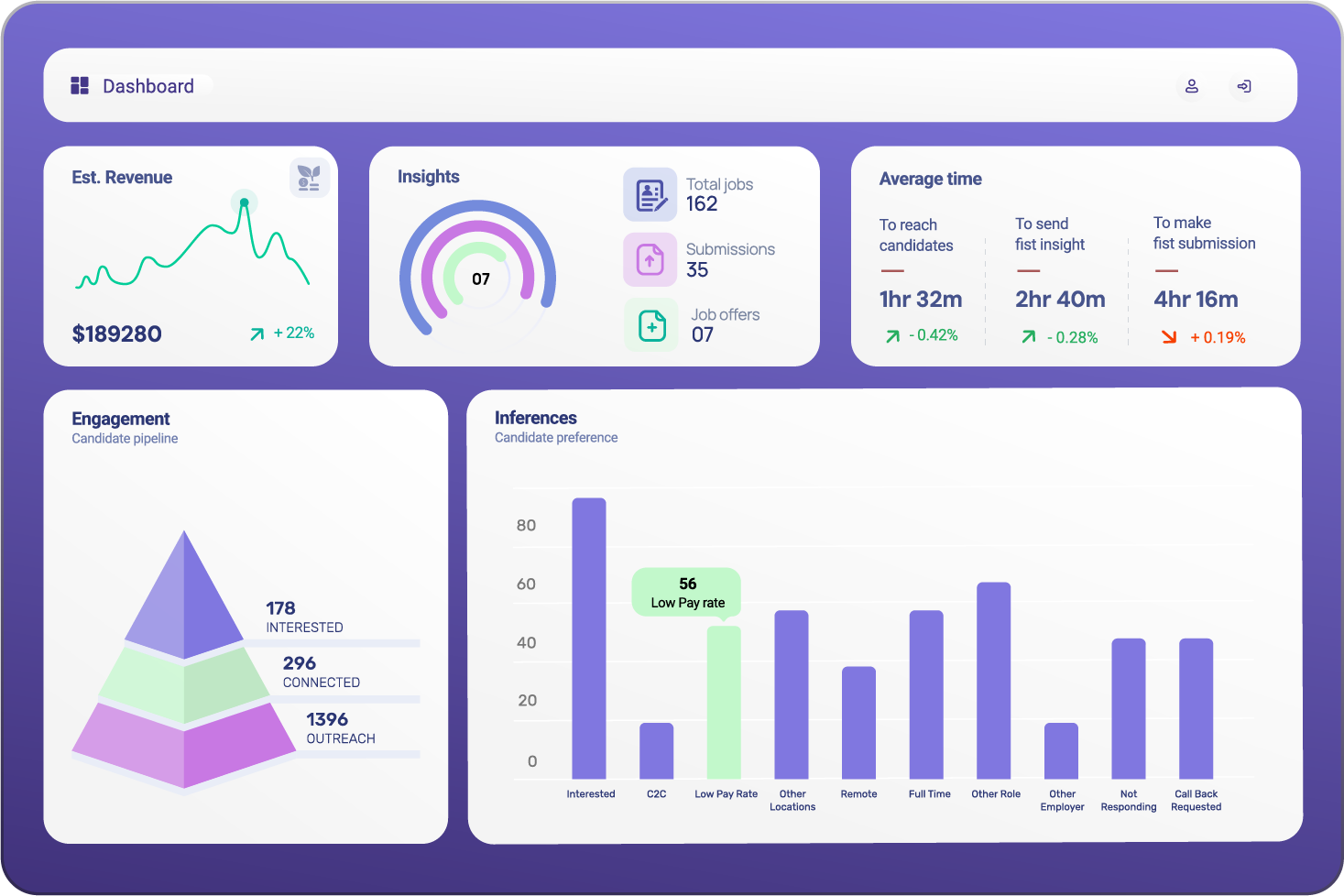
The reason per-hire pricing stayed a services model for so long is economics. When your fee is a percentage of salary, you are effectively being paid for the outcome and the labor that produced it, so it only pencils out for a business that supplies labor. Pure software could never justify a $20,000 fee for a hire its code helped make, because its marginal cost was near zero and the risk of non-hire was uncontrollable. That is exactly the assumption AI is now breaking, and a handful of 2026 vendors are pricing accordingly. ConverzAI, an agentic voice recruiter for staffing, states plainly that you "pay only for placements," an unambiguous outcome meter for software - ConverzAI. Noxx charges 3% of the hire's annual salary, roughly $2,400 on an $80,000 engineer against $16,000 or more with a traditional agency - Noxx.
An AI recruiter that bills per placement
Between full per-hire and per-seat sits per-interview pricing, the interview-as-a-service meter. Karat charges roughly $200 to $450 per completed technical interview, with Vendr showing an average annual contract near $175,695 - Vendr. AI interviewers are pushing that unit cost down: HireVue effectively works out to about $25 per interview through a credit model - Pin, and Sapia.ai prices genuinely per hire, with published tiers around £15,000, £28,000, and £75,000 a year for 150, 500, and 1,000 hires respectively - HeroHunt. Per-interview is outcome-flavored consumption: you pay for a completed unit of screening work, and if AI performs that screen for a fraction of a human interviewer's cost, the whole rate card resets.
The cleanest way to see why per-hire pricing is spreading is to look at what a hire actually costs across industries, because that is the number a per-hire fee is competing against. SHRM's 2025 benchmark puts the average cost per hire at $5,475 for non-executive roles and $35,879 for executives - InterviewCost. But the spread by sector is enormous, and it is exactly that spread that determines whether a percentage-of-salary fee looks cheap or ruinous for a given role.
Cost per hire by industry, 2025-2026
Read that chart alongside the fee models and the logic of per-hire pricing snaps into focus. In retail and hospitality, where a hire costs about $2,700 to make in-house, a 20% agency fee on even a modest salary is wildly uncompetitive, which is why high-volume employers live in the consumption family instead. In legal and professional services, where a hire costs $16,000 to $20,000 to make in-house - Pin, a per-hire fee is competitive and often cheaper than the fully-loaded internal cost, which is why agencies and outcome-priced software thrive there. The meter that wins is the one that beats your internal cost per hire for that specific role, and that is a different answer at the top and bottom of the salary distribution.
Per-hire pricing is not a free lunch, and the reasons it stayed rare are worth stating so you can price the risk on both sides. Its first failure mode is cost at volume: a fee that looks generous on three hires a year becomes brutal on eighty, which is why high-volume employers avoid percentage-of-salary entirely. Its second is definition gaming: when a fee triggers on a defined event, both sides have an incentive to argue the definition, so a per-hire contract lives or dies on how it handles early attrition, renegotiated offers, and candidates the tool merely surfaced versus ones it actually closed. Its third is adverse selection: a vendor confident enough to work purely on outcomes can quietly favor the easy roles, so the hard-to-fill req that most needs help is the one an outcome model is least eager to touch. None of these kill the model, but together they explain why hybrid base-plus-outcome contracts are winning the transition rather than pure per-hire.
7. The AI Agent Disruption: Why Seats Are Cracking in 2026
The reason pricing models are in flux in 2026 is that AI agents do the work a seat used to represent, so vendors are being forced to move the meter from who logs in to what got done. This is not a recruiting-specific fashion; it is a whole-of-software realignment, and recruiting is near the front of it because so much of sourcing, screening, and outreach is now agent-performable. Andreessen Horowitz put the thesis bluntly: "per-seat is no longer the atomic unit of software," and once an agent resolves the work, "the natural pricing metric becomes successful outcomes" - a16z.
The evidence is clearest in adjacent categories that moved first. Intercom prices its Fin support agent at $0.99 per resolution, charging only when the AI actually resolves a conversation - Intercom. Zendesk shifted to $1.50 to $2.00 per automated resolution - eesel AI. Sierra, Bret Taylor's agent company, sells purely on outcomes at roughly $1.50 per resolved interaction, with the framing that "the atomic unit of AI productivity is a process, not a person" - Sierra. Even Salesforce cycled Agentforce through three models in eighteen months, from $2 per conversation to consumption-based Flex Credits at about $0.10 per action - Salesforce. The common thread is that the value metric is migrating from seats to units of completed work.
AI Has Changed SaaS Pricing Forever
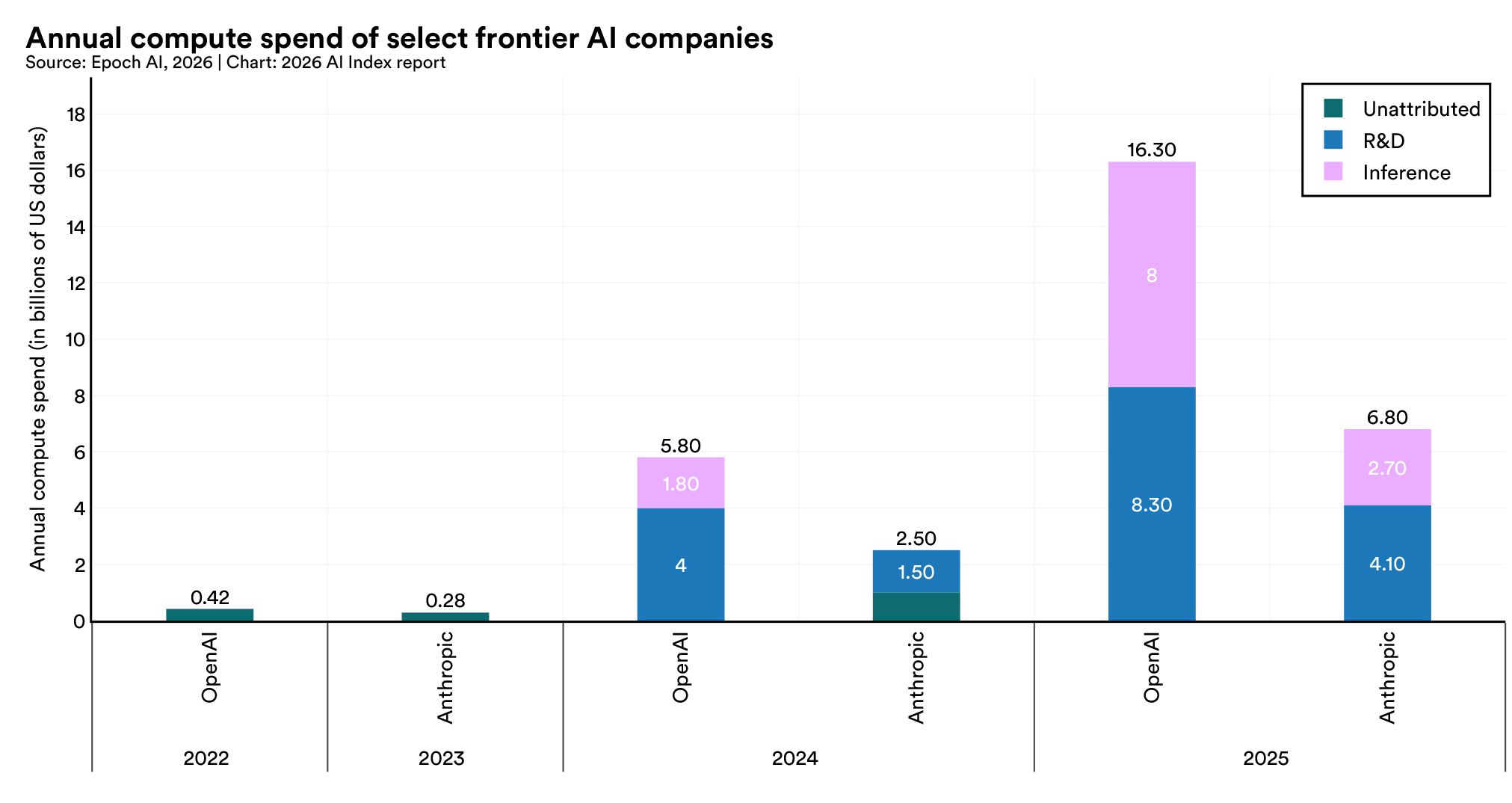
The macro data backs the anecdotes. Metronome's 2025 survey found 85% of SaaS companies now use some form of usage-based pricing, with nearly half having adopted it in the past two years - Metronome. Gartner projects that by 2030 at least 40% of enterprise SaaS spend will run on usage, agent, or outcome models, with outcome-based pricing roughly doubling from about 15% in 2022 to 30% in 2025 - Monetizely. Bessemer's AI pricing playbook explains the deeper mechanism: AI products carry real marginal cost, running 50 to 60% gross margins against the 80 to 90% of classic SaaS, so a flat per-seat fee that ignores usage can quietly sell a loss - Bessemer. When every action costs the vendor compute, charging by the login stops working.
Outcome-based pricing adoption in enterprise software
That trend line is a projection, not a promise, but the direction is corroborated from too many angles to dismiss, and the underlying cause is structural rather than faddish. Stanford's AI Index reports organizational AI adoption reaching 88% in 2025, with AI-company revenue rising fast even as compute costs hit record levels - Stanford HAI. Rising adoption plus rising marginal cost is precisely the combination that makes flat per-seat untenable: more usage means more cost, so the vendor has to meter the usage. The chart's climb from 15 to a projected 40 percent is what that pressure looks like aggregated across the market.
Why flat per-seat cannot hold
Recruiting has its own front-row seat to this shift, and the biggest player is leading it. LinkedIn launched Hiring Assistant, its first AI recruiting agent, at Talent Connect in late 2024 and made it generally available in English by the end of September 2025 - LinkedIn. Crucially, LinkedIn did not fold the agent into the base seat; it sells Hiring Assistant as a paid add-on to Recruiter Corporate, layered on top of an already five-figure seat contract - LinkedIn. The market voted with its wallet: Microsoft disclosed that LinkedIn's agentic hiring products passed a $450 million annualized run rate by April 2026, the first time it broke out an AI product's revenue - Staffing Industry Analysts.
LinkedIn's Hiring Assistant, an agent sold on top of the seat

Beneath LinkedIn, a wave of AI recruiters is experimenting with every meter at once, and the M&A tells you the category is consolidating fast. Apriora's AI interviewer Alex raised $20 million in September 2025 - PR Newswire. ConverzAI raised a $16 million Series A to price purely on placements - PR Newswire. Paradox, the conversational recruiter behind Olivia, was acquired by Workday, completing October 2025 - Workday. Not everyone survived the transition: Moonhub, an early autonomous AI recruiter, wound down in June 2025 in an acqui-hire by Salesforce - Maginative. The category is young, well-funded, and volatile, and the one thing its pricing has in common is a move away from the pure seat.
Marketplaces are pushing the outcome logic furthest by pricing on human-expert hours with a take rate rather than a subscription. Mercor monetizes AI-vetted experts at roughly a 30% take rate, hitting a $2 billion annualized run rate by mid-2026 - Sacra, while Micro1 lets vetted professionals set their own rates averaging about $72 an hour and passed $100 million in annualized revenue by late 2025 - AI Gig Jobs. These are outcome models in marketplace clothing: you pay for delivered work, not for access to a tool. Purpose-built AI recruiters aimed at in-house teams, such as HeroHunt.ai, take the software version of the same idea, metering on the AI-screened and matched profiles actually delivered rather than on seats, which is the recruiting-specific expression of a16z's "price the work, not the login" thesis.
For a recruiting buyer, the practical upshot of the agentic shift is that the question is no longer only how much a tool costs, but which unit its price will settle on as agents absorb more of the work. A tool still selling pure per-seat in 2026 is either confident its seats map to irreplaceable human judgment or it simply has not repriced yet, and both are worth probing in a sales call. A tool metering on outcomes or positions is betting its agents can carry the work, which aligns its incentives with your hiring but also exposes you to variable cost when your volume spikes. Neither stance is automatically better, but the meter now tells you what the vendor believes about its own automation, and that belief is a signal worth reading before you sign.
8. Seat vs Per-Hire: The Break-Even Math
The seat-versus-per-hire choice comes down to a single break-even calculation: below a certain hiring volume, per-hire pricing is cheaper, and above it, flat access pricing wins. Most buyers argue this on instinct when it is actually arithmetic, and the arithmetic is worth doing explicitly because the crossover point is often surprisingly low.
Take a concrete case: a company hiring engineers at a $100,000 salary. A contingency agency at 20% charges $20,000 per hire, scaling linearly with volume. An in-house recruiter equipped with two seats of sourcing software costs roughly $24,000 a year flat, regardless of how many people that recruiter hires. And a modern AI per-hire tool priced at 3% of salary, like Noxx's model, charges $3,000 per hire. Plotting all three against annual hiring volume shows exactly where each model wins.
Seat vs per-hire, where each model wins
The lines tell a clean story. The agency beats the flat seat licence only until about 1.2 hires a year; past a second hire, the flat licence is already cheaper, which is why any company hiring more than a couple of people a year brings sourcing in-house. The AI per-hire tool stays the cheapest option all the way to roughly eight hires a year, where its rising line finally crosses the flat licence. In other words, a low per-hire percentage does not just undercut the agency, it extends the range over which paying-per-result beats paying-for-access, pushing the crossover from one hire out to eight.
This is why the meter and the rate have to be judged together, never separately. A 20% agency fee and a 3% AI fee are both "per hire," but they live in completely different regions of the chart, and treating them as the same model would lead you to the wrong tool. It is also why the flat access family will not disappear: above the crossover, a company with steady, high hiring volume genuinely is better served by a fixed cost it can amortize across many hires. The error is not choosing one family; the error is choosing without knowing your own hiring volume, because that number is what the whole decision pivots on.
Run the same math at high volume and the answer flips hard, which is exactly the point. A company hiring forty engineers a year pays an agency $800,000 at 20%, pays the 3% AI tool $120,000, and pays the flat two-seat licence still just $24,000. At that volume the flat access model is not merely cheaper, it is an order of magnitude cheaper than either outcome model, because the entire value of a fixed cost is that it amortizes across a large denominator. This is why the biggest employers run sourcing in-house on flat tools and reserve agencies for the handful of searches, usually executive or highly specialized, where volume is low and the per-hire premium is genuinely worth paying.
The practical move is to compute your own crossover before you take a single sales call. Estimate your annual hires for the roles a tool would cover, multiply by any per-hire or percentage fee to get the outcome-model cost, and compare it to the flat annual cost of the access-model alternative. If your volume sits comfortably above the crossover, negotiate hard on the flat model and ignore the per-hire pitch; if it sits below, a per-hire or percentage fee transfers risk to the vendor for free and you should take it. Models like HeroHunt's flat plan metered on delivered profiles are deliberately engineered to sit low and flat on this chart, giving steady-volume teams the amortization of an access model without the empty-seat tax of a per-seat one.
9. The Hidden Costs Nobody Puts in the Quote
The number in the quote is rarely the number on the invoice, because every pricing model carries a set of costs that surface only after you sign. These are not scams; they are structural features of each meter that vendors have no incentive to foreground. Knowing them turns a naive price comparison into a real one.
The largest hidden cost in 2026 is renewal inflation, and it is worse for anything with AI in the name. General SaaS renewal uplifts that used to run 3 to 9% are now landing far higher on AI SKUs, and LinkedIn specifically pushed roughly a 15% increase on 2026 Recruiter renewals - Leonar. Compounded over a three-year contract, a 15% annual uplift turns a $10,800 seat into more than $14,000 by year three without adding a single feature. The defense is contractual: cap the renewal uplift in writing before you sign, because the compounding, not the first-year price, is what determines your total cost.
The three-year picture is where that renewal cost becomes concrete enough to negotiate against. A $32,400 three-seat Recruiter contract renewing at 15% a year is about $37,260 in year two and $42,849 in year three, roughly a 32% increase over the term for the same three seats. Across the full three years you will have paid close to $112,500, not the $97,200 that three times the first-year sticker implies. Buyers who model only year one systematically understate their commitment by double digits, and that understatement is exactly the gap a capped-uplift clause is designed to close.
The second hidden cost is the empty or mismatched unit, and which unit bites depends on your model. On per-seat, it is the idle login you keep paying for after a recruiter leaves or hiring slows. On PEPM, it is the thousands of employees you are billed for who never open the product, and the fact that a hiring freeze cannot lower that bill. On per-job-slot, it is the open req that attracts no applicants but still consumes a paid slot. Each meter has a characteristic form of waste, and you can only manage the one you are actually exposed to, which is why naming your meter precisely is the prerequisite to controlling it.
The third hidden cost is the overage cliff on consumption models. Credits, InMails, and messages come in monthly allotments, and the price per unit above the allotment is almost always higher and almost never negotiated, because you agreed to the bundle, not the overage rate. A team that blows through its InMail allowance in a hot hiring month pays LinkedIn's roughly $10 per credit list rate on every extra message, and a credit-metered sourcing tool behaves the same way. Consumption pricing quietly assumes you will exceed your bundle, which is where its margin lives, so forecast your peak month, not your average one, when you size the plan.
Finally, watch for the costs that sit entirely outside the pricing table: implementation and integration fees on enterprise deals often run $15,000 to $50,000, minimum spends and multi-seat floors gate the cheap tier out of reach, and credits frequently expire monthly rather than rolling over, so unused allowance is simply lost. None of these appear in the headline number, and all of them are negotiable if you raise them before signing. The discipline is the same across every model: price the meter over three years including its characteristic waste and its renewal path, not the first monthly figure, because the meter is what you are really buying.
10. How to Choose: A Framework by Hiring Profile
The right pricing model is not a matter of taste; it is determined by your hiring profile, and five common profiles map cleanly onto five different meters. The decision framework below is the practical payoff of everything above: match your volume, your role mix, and your growth pattern to the family that rewards them, then negotiate the specific unit.
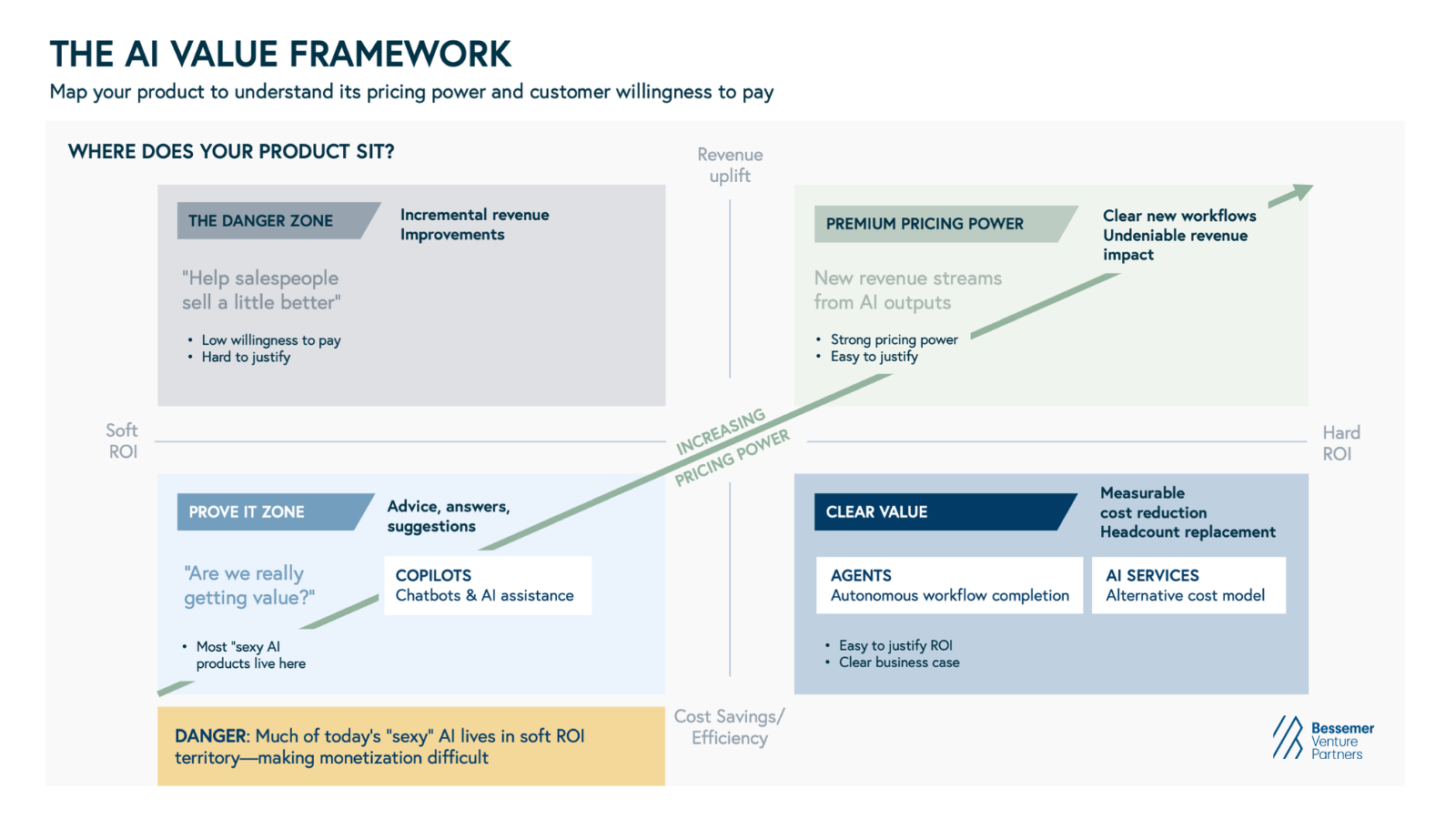
Bessemer's AI value framework is a useful lens for the final choice, because it plots pricing against how clearly you can measure the outcome. Where the return on a hire is hard and measurable, an outcome meter is both fair and attractive; where the value is diffuse and continuous, an access meter is easier to live with. Holding that map in mind keeps you from forcing a per-hire fee onto a workflow whose value is not really a discrete, attributable hire, and vice versa.
Matching the meter to the value
The high-volume, lower-salary employer (retail, hospitality, warehousing, frontline healthcare) should live in the consumption and job-slot families, never in percentage-of-salary. Your cost per hire is low, so any fee scaling with salary is uncompetitive, and your challenge is applicant flow, which is what programmatic advertising and per-slot job boards are built for. Optimize cost per applicant, cap daily spend, and treat the ATS as a flat, predictable base cost underneath the variable advertising.
The low-volume, high-value hirer (executive, specialist, or a startup making a handful of critical hires a year) should prefer outcome pricing, because you sit below the break-even where per-hire beats flat access. Paying $3,000 on a 3% AI tool or even a contingency fee for a small number of pivotal hires transfers risk to the vendor and avoids a five-figure annual licence you would barely use. The recruiting agency and the outcome-priced AI recruiter are your natural options, and between them the AI tool is usually an order of magnitude cheaper per hire.
The steady in-house team hiring continuously (scaling companies making dozens of hires a year across many roles) is the profile where flat access pricing genuinely wins, and the only real question is which flat unit. Per-seat rewards a small, fully-utilized sourcing team; a flat plan with unlimited positions like HeroHunt's rewards a team with steady req flow that does not want to pay for idle logins; PEPM is worth accepting only if you are large enough that the per-head math is favorable and you can cap the renewal. For most teams in this bracket, an AI recruiter that sources and screens across 1 billion profiles on a flat monthly plan delivers the amortization of an access model without the per-seat empty-seat tax, which is why it fits the continuous-hiring profile so well.
For a steady in-house team, HeroHunt.ai prices on AI-screened and matched profiles delivered rather than seats, with unlimited positions, so the meter tracks the candidates you actually get instead of your logins.
The staffing agency should expect per-seat software (Bullhorn is the category standard) because your recruiters are your product and their logins genuinely map to revenue, while your own client pricing stays percentage-of-salary. The large enterprise will mostly be quoted PEPM by the ATS and talent-suite vendors, and the winning move there is not to escape PEPM but to negotiate the per-head rate, the headcount band, and a written renewal cap, since at enterprise scale a small per-employee difference dominates every other line item. The framework is not about finding the cheapest vendor; it is about refusing to be billed on a meter that fights your hiring pattern.
11. The Future: Toward Priced-Per-Hire Recruiting
The direction of travel is unmistakable: recruiting pricing is migrating from paying for access toward paying for outcomes, and by the late 2020s the per-hire meter that was once exclusive to agencies will be a mainstream software option. The forces driving it are structural, not cyclical, so the shift will outlast any single hype cycle. AI agents are collapsing the link between headcount and work, compute costs are giving software real marginal cost for the first time, and buyers burned by seat licences and PEPM bills that ignore their hiring reality are actively demanding meters that track results.
Three developments will shape how far this goes. First, the definition of an "outcome" will be fought over, because a per-hire or per-resolution price is only as trustworthy as the definition of the unit; the same debate playing out in support software, where vendors and buyers argue over what counts as an AI resolution, is coming to recruiting, where "a hire" has edge cases (early attrition, renegotiated offers, internal transfers) that every outcome contract will have to define. Second, hybrid models will dominate the transition, pairing a modest access base fee with variable usage or outcome charges, because pure outcome pricing is too volatile for vendors to forecast and pure access pricing is too disconnected from value for buyers to accept. Third, consolidation will continue, as the LinkedIn, Workday, and Salesforce acquisitions of AI recruiting startups show the incumbents intend to own the agentic layer rather than cede it.
For buyers, the practical implication is that the meter will become the primary thing you negotiate, ahead of the rate. As outcome and usage pricing spread, the skill that protects your budget is the one this guide has argued for throughout: identify the unit, compute your own break-even, price the meter over three years including its characteristic waste, and refuse any model that charges you more when you hire well or freezes your bill when you pause. The vendors moving fastest toward outcome pricing, from Sierra and Intercom in support to ConverzAI, Noxx, and profile-metered AI recruiters like HeroHunt.ai in talent, are betting that buyers will pay more willingly for results than for logins, and the adoption data suggests they are right.
The recruiter's job is not going away, but the thing recruiters buy is being repriced around what their tools accomplish rather than how many of them hold a licence. The winners among buyers will be the ones who saw the meter, not just the sticker, and chose the model that pays only when hiring actually happens.
Conclusion: Read the Meter, Not the Sticker
The seat-versus-per-hire question has a clean answer once you make it quantitative rather than emotional. Below your break-even hiring volume, per-hire and outcome pricing win, because you pay only when you succeed and the vendor shares your risk. Above it, flat access pricing wins, because you amortize a fixed cost across many hires. Compute that crossover for your own numbers before any sales call, and most of the decision makes itself.
The deeper lesson is that the meter matters more than the price. A per-seat licence bills you for access whether you use it or not; a PEPM licence bills you for a whole workforce that never logs in and rises when you grow; a consumption meter makes your busiest month your most expensive; and an outcome meter, the one spreading fastest in 2026, bills you only when someone starts. Each family rewards a specific hiring profile and punishes the others, so the first move in any purchase is to name your own meter and check that it is not fighting the way you actually hire. Do that, cap your renewals in writing, and price every option over three years including its hidden waste, and you will beat the buyer next to you who negotiated the sticker and never looked at the unit.
Written by Yuma Heymans (@yumahey), who built HeroHunt.ai, an AI recruiter that sources from over a billion profiles and prices on AI-screened and matched profiles delivered rather than seats. He has spent five years on the vendor side of recruiting software watching buyers get quoted numbers they had no way to benchmark, which is exactly the problem this guide exists to fix.
This guide reflects the AI recruiting pricing landscape as of August 2026. Pricing, meters, and vendors change frequently in this market (LinkedIn repriced its renewals, Salesforce cycled Agentforce through three models in eighteen months, and several vendors named here were acquired mid-year), so verify current details on the vendor's own page before purchasing.