



The buyer's guide to what recruiting software actually sells for, what it is metered on, and what the people who negotiated it really paid
Of the 40 recruiting tools priced in this guide, only 14 publish a real number on their own website. The other 26 route you to a demo. Yet almost every one of them has a price sitting in public somewhere else: on a UK government procurement framework, in a quarterly earnings filing, in a buyer platform's transaction database, or in a university's board minutes. LinkedIn does not publish a rate card for Recruiter, and LinkedIn Ireland Unlimited Company simultaneously publishes a full seven-band GBP price list for it as a supplier on the UK G-Cloud 14 framework. Both things are true.
The bigger problem is not the sticker, it is the meter. Ashby and Workday bill you on total company headcount. SmartRecruiters bills on recruiter seats. Recruitee bills on active job slots. Ribbon bills per interview. Sapia bills per hire. Paraform bills a percentage of first-year salary. A 400-person company with four recruiters comparing two "similar" quotes is often comparing numbers that differ by two orders of magnitude in what drives them. The unit decides your bill in year three, and almost nobody negotiates it.
This guide gives you the published list price, the metering unit, what buyers actually paid (with sample sizes and dates), the discount benchmark, and the one gotcha that costs money for 40 tools. It also does something no vendor-funded comparison will: it publicly adjudicates the places where the pricing figures on this blog's own 60-plus vendor pages contradict each other, and corrects our own price, which was published four different ways.
Written by Yuma Heymans (@yumahey), who built HeroHunt.ai and has spent five years on the vendor side of this market watching buyers get quoted numbers they had no way to benchmark. That is the specific problem this index exists to fix, including where the fix is embarrassing for us.
Contents
- What Recruiting Software Actually Costs in 2026
- The Seven Meters, and Which One Will Burn You
- How to Find a Real Price When the Vendor Publishes None
- Applicant Tracking Systems: 10 Tools Priced
- Agency and Enterprise ATS: 5 Tools Priced
- Enterprise Talent Suites: 5 Tools Priced
- Sourcing and Talent Intelligence: 7 Tools Priced
- Contact Data: 3 Tools Priced
- AI Interviewers and Assessment: 5 Tools Priced
- Job Boards, Marketplaces and Outcome Pricing: 5 Tools Priced
- The AI Meter: What a Credit Actually Costs to Make
- Where Our Own Archive Contradicts Itself
- Negotiating: Discounts, Renewals and the Clauses That Bite
- Buying in a Market That Deletes Vendors
- The Complete Pricing Index
- The Bottom Line
1. What Recruiting Software Actually Costs in 2026
The single most useful number in this guide is a ratio, not a price: what a mid-market company pays for its entire ATS in a year is roughly what one agency placement costs. Vendr's transaction data puts the median Greenhouse contract at $26,646 a year across 866 recorded purchases, and the median Ashby contract at $22,896 across 157 deals. A single contingency placement on a $120,000 salary at a standard 20% fee costs $24,000. That comparison needs no forecast and no vendor claim to be persuasive, and it is the reason software budgets in talent acquisition keep surviving cost reviews that kill everything else.
The second useful number is the spread. The same Greenhouse dataset runs from $10,215 to $75,125, a 7x range for one product. Workday runs from $19,410 to $532,311 across 368 transactions. That is not sloppy data, it is what per-employee metering does to a price: the product is identical and the population it is billed against is not. Any article that gives you one number for what an ATS costs is describing a distribution it has collapsed, and the collapse is where the useful information lived.
The third thing to understand about 2026 specifically is that the ground is moving under all of these figures. Vertice's SaaS Inflation Index recorded 16.4% in June 2026, an all-time high on roughly $75bn of processed spend, against 8.7% in 2023. Tropic's buyer data separates the cause cleanly: a normal annual uplift is 3% to 9%, while anything with AI in the SKU is asking 20% to 37%, and buyers who actually negotiate land at around 12% - Tropic. Recruiting software is close to the epicentre of that, because nearly every vendor in this guide shipped an AI SKU in the last eighteen months.
Set against that, the demand side is not moving nearly as fast as the pricing side. Aptitude Research audited 200-plus enterprise hiring experiences and surveyed 300-plus organisations for its 2026 study and found average post-apply automation maturity at 21%, with 1% of employers actually running voice-based screening agents - Aptitude Research. The industry is repricing around agents faster than employers are deploying them, which is exactly the market condition in which a buyer with a benchmark has leverage and a buyer without one does not.
We can measure the appetite for that benchmark directly. Across the six months to 24 July 2026, the 53 vendor pricing pages on this blog were served 1,284,619 times in Google search results, mostly to people typing queries like "zoominfo pricing", "how much is linkedin recruiter" and "greenhouse ats pricing", according to our own Search Console data. The single highest-volume query in that set, "zoominfo pricing", generated over 66,000 impressions on its own. That is enormous, sustained, commercially-motivated demand for a number that most of these vendors have decided not to publish.
The rest of this guide is the answer to those queries, assembled from primary pages where they render, government rate cards where they exist, earnings filings where the vendor is public, and buyer-platform transaction data where nothing else is available. Where a number could not be verified, it says so rather than filling the gap, because a fabricated price in a pricing guide destroys the only thing a pricing guide has.
Median annual contract vs published entry price, 2026
The gap in that chart is the entire subject of this guide. Where a vendor publishes nothing, the published bar is zero and the buyer has no anchor at all. Where a vendor does publish, the published figure is almost always the smallest company's price rather than the typical customer's price: Workable's $3,588 sticker is the 1-to-20-employee band, and the median Workable buyer pays roughly four times it. Treat every published entry price in this guide as an anchor for negotiation, never as a forecast of your invoice.
2. The Seven Meters, and Which One Will Burn You
Recruiting software in 2026 is sold on seven distinct meters, and the difference between them matters more than the difference between vendors. A buyer who compares two sticker prices without comparing units is not comparing anything, because the unit determines how the bill behaves when the business changes. Four of the seven have the property that your bill rises when you hire well, which is a strange thing to discover in the third year of a contract you signed to help you hire well.
The most common and least understood is per total employee headcount, sometimes written PEPM. Workday's own published rate card prices every bundle in "GBP per Year Per Employee" banded by company size, and Vendr states plainly that Greenhouse "scales by employee count and hiring volume, not per-seat". Gem's pricing page says its price is "Based on your company's FTE count". The consequence is blunt: a 20,000-person company with 40 recruiters is billed on 20,000 people, 19,960 of whom will never open the product. A hiring freeze does not cut the bill, and a successful year raises it.
The second is per recruiter seat, which is what most buyers assume they are buying and what SmartRecruiters, Bullhorn, Manatal, SeekOut and LinkedIn actually use. Seats are the most controllable unit on this list, which is precisely why vendors have been moving away from them. The third is per active job slot, used by Recruitee at its entry tier and by ZipRecruiter, where a slot is a reusable container that bills whether or not anyone applies to the role sitting in it.
The remaining four are where 2026 has changed things. Per credit is now bolted onto almost every ATS, with Workable publishing an explicit ladder at $0.12, $0.10 and $0.095 per AI credit depending on pack size. Per interview is Ribbon's model, at $2.50 to $4.00 per interview in overage. Per hire is Sapia's, and it is the only genuine outcome meter with a published rate card. Percentage of first-year salary is Paraform's and every staffing agency's, at 20% to 25%.
The branch on the left is the one that catches people. A PEPM contract is the only unit on that diagram whose growth is completely decoupled from recruiting activity, which means it is the only one where a cost-cutting year and a hiring-freeze year still produce a bigger invoice. Ashby's published bands make this vivid: $400 per month up to 100 employees, then quote-only above it, where Vendr's guidance is $20,000 to $50,000 at 50-150 employees and $50,000 to $100,000 at 150-400 employees. The recruiting team may not have grown at all across that range.
The subtler trap is that the unit can change inside a single vendor's ladder. Ashby meters AI credits at 1,500 per company per month on Foundations and 2,500 per seat per year on Plus, which are not comparable quantities and which invert as you scale - Ashby. Indeed does something similar with advertising: choose a daily budget and you are billed per click, choose a monthly budget and you are billed per started application, and the switch is presented as a cadence toggle rather than a pricing decision. Read the unit on every line of a quote, then model it at twice your current size before you sign anything.
The practical application is a single question to put to every vendor in a first call, before features and before discounts: what exactly do I have to do more of for this invoice to go up? If the honest answer is "employ more people", you are buying a tax on business growth and should price it accordingly over a three-year horizon. If the answer is "open more roles" or "make more hires", the cost tracks the value and you can budget it per hire. If the answer is "add recruiters", you have the most controllable contract on this page and should be pushing for a multi-year rate lock while you have it.
3. How to Find a Real Price When the Vendor Publishes None
The single highest-value skill in software buying is knowing where the prices that vendors will not publish are published anyway, by law or by contract. Four channels reliably work, and three of them are free. This section is the method behind most of the figures in the rest of this guide, and it is reusable for any vendor not covered here.
The best channel by a distance is government procurement frameworks, and specifically the UK's G-Cloud. Suppliers who want to sell to the British public sector must upload a pricing document, and those documents are public. LinkedIn Ireland Unlimited Company's G-Cloud 14 submission, uploaded 20 October 2025, contains the complete Recruiter licence ladder in seven volume bands, plus the Hiring Assistant add-on ladder, plus Job Slots, Talent Insights, Career Pages and Work With Us rates. Workday's equivalent document prices every bundle per employee per year across six headcount bands. Sapia.ai's contains a full three-tier rate card with add-on pricing. None of the three publishes any of this on its own website.
The second channel is buyer platforms with transaction data. Vendr publishes per-vendor median contract values with stated sample sizes on its marketplace pages, and SpendHound publishes segmented averages from contributed contracts, with a genuinely free tier for smaller companies - SpendHound. These are negotiated outcomes rather than list prices, which is more useful for benchmarking a quote and less useful for understanding a vendor's ladder. Treat both with care: Vendr's own pages drift between renders, and its HireVue marketplace page says the median is $20,900 while its HireVue buyer guide says the average is $49,855 from "more than 5 completed deals and 3 unique purchasers". Both numbers are real and they measure different things on a tiny sample.
The third channel is public company disclosure, which is the only place some numbers exist at all. ZipRecruiter does not publish a rate card, but its Q1 2026 10-Q discloses 63,329 quarterly paid employers and revenue per paid employer of $1,698, down 2% year over year and 10% sequentially from $1,889 in Q4 2025. That is a better answer to "what does ZipRecruiter cost" than any tier table, because it is the actual average. Korn Ferry's Q4 FY26 materials disclose a realised consulting bill rate of $442 per hour, up 7% year over year, which is a published price for a service that has no price list - Korn Ferry.
The fourth channel is US public sector award records, which work but require more digging than the tidy version of this advice suggests. USAspending.gov's API is open and returns award records without authentication, and searching a vendor name will surface federal relationships. The catch worth knowing before you spend an afternoon on it is that parent award records frequently show $0.00 obligated, with the money booked against child task orders, so a hit proves the relationship exists rather than revealing the price. The higher-yield route in practice is university board-of-regents and school-district board minutes, where contract values get approved in public in plain text with dollar amounts attached.
Two contaminated numbers are worth clearing out of your head before you benchmark anything. The "$4,129 average cost per hire" still cited across the industry is SHRM's report on fiscal year 2015 data collected in early 2016; the current figure from SHRM's 2025 benchmarking, on 2,371 members surveyed between January and March 2025, is $5,475 for nonexecutive roles and $35,879 for executives - SHRM. And "the average SaaS discount is about 10%", which appears in nearly every negotiation article, traces to a Vendr trends report from Q2 2023. Vendr's own current per-vendor pages show average realised savings of 16% on Greenhouse, 16.26% on Lever, 15.24% on Workday and 20.86% on Ashby. Anchoring at 10% in 2026 leaves money on the table.
How software companies are actually pricing AI

That chart is worth sitting with before you read the vendor sections, because it contradicts most of what recruiting vendors say about their own pricing. Only 11% of software companies price AI purely on usage and only 5% price it on outcomes, while 53% simply fold it into a subscription and 31% run a hybrid. That is exactly the pattern in recruiting: what has actually shipped is a base subscription with a credit meter bolted on, not the consumption revolution the category talks about. Knowing that lets you push back when a vendor claims its credit pack is an industry-standard model rather than a revenue line.
4. Applicant Tracking Systems: 10 Tools Priced
The ATS market splits cleanly into vendors who publish a real price and vendors who publish a demo button, and the split does not track quality, it tracks who the vendor sells to. Every tool in this section aimed below about 200 employees publishes something. Every tool aimed above it does not. That is a sales-motion decision, not a complexity one, and it is why an eleven-person startup can price its stack in an afternoon while a 900-person company cannot price a single line of it without entering a sales cycle.
The pattern that matters commercially is that published entry prices in this category are converging downward while real contract values are not. Manatal sells a full ATS at $15 per user per month on annual billing, JazzHR at $1,000 a year, Breezy at $157 a month. Meanwhile the median Greenhouse buyer pays $26,646 and the median SmartRecruiters buyer pays $33,507. Those are not the same product, but they are much closer than a 20x price gap suggests, and the honest reason for the gap is buyer sophistication and switching cost rather than feature depth.
| Tool | Published entry | Meter | Median buyer paid | Source of the real number |
|---|---|---|---|---|
| Greenhouse | none | headcount + hiring volume | $26,646/yr | Vendr, 866 purchases, Feb 2026 |
| Lever | none | company size + reqs + seats | $15,400/yr | Vendr, 318 purchases |
| Ashby | $400/mo (to 100 employees) | total employee headcount | $22,896/yr | Vendr, 157 deals |
| Workable | $299/mo (1-20 employees) | headcount band + AI credits | $14,718/yr | Vendr, 38 transactions |
| SmartRecruiters | $14,995 (Essential) | recruiter seat, modular | $33,507/yr | Vendr, sample not stated |
| Manatal | $15/user/mo annual | recruiter seat | list = paid (self-serve) | vendor pricing page |
| Breezy HR | $157/mo annual | flat per account | list = paid (self-serve) | vendor pricing page |
| Recruitee | none | headcount + active job posts | no benchmark exists | vendor page, tiers unpriced |
| Teamtailor | none | employee headcount band | ~$16,500/yr average | Vendr, republished Feb 2026 |
| JazzHR | $1,000/yr (Hero) | flat per account + job cap | list = paid (self-serve) | vendor pricing page |
Greenhouse publishes three tiers named Core, Plus and Pro and not a single number against any of them; its own page says pricing is "customized based on your company's hiring needs". Vendr's buyer guide gives the relative shape instead: Plus runs 30% to 50% more than Core for comparable scope, and Pro carries a 50% to 80% premium over Plus. The gotcha is the meter. Because the bill tracks headcount and requisition volume rather than recruiter seats, a good hiring year is precisely what reprices your renewal upward, and layering a standard 3% to 7% escalator on top means buyers who signed near the $10,215 floor routinely find themselves quoted near the median two renewals later without adding a user. Greenhouse also completed its acquisition of Ezra AI Labs on 27 May 2026 and announced six AI capabilities in June 2026 with no pricing attached to any of them, so there is a known unpriced surface heading for your next renewal. Our full Greenhouse pricing guide works the tier maths in detail.
Lever publishes even less: no tiers, no numbers, just three named add-on modules and a phone number. The median buyer pays $15,400, roughly 42% below the Greenhouse median from the same dataset family, which is the clearest available read on where Lever now competes. The specific trap is those add-ons. Candidate Insights, AI Screening by VONQ and Onboarding all sit outside the core platform, so buyers price the platform, sign, and then discover the AI screening they were shown in the demo is a separate line item with no public anchor at all. Note also that parent company Employ Inc. replaced its CEO, CTO, CRO and CFO between 18 February and 18 March 2026, and a new CRO is the single best predictor of a changed discount policy at renewal. Our Lever pricing page carries the Vendr detail.
Ashby is the most interesting pricing page in the category because it publishes exactly one number and that number is a cliff edge. Foundations is $400 a month for up to 100 employees, with a 10% annual discount available, which is about $4,320 a year. At 101 employees you fall into quote-only Plus, where the median is $22,896 and Vendr's 150-to-400-employee band is $50,000 to $100,000. That is roughly a 5x jump at the median for crossing one headcount threshold, and it is worth modelling before you adopt Ashby at 80 employees on the strength of the published price. Ashby also earns the highest average discount in this guide at 20.86%, which tells you the quoted numbers above Foundations have real give in them.
Workable runs two meters at once and publishes only the smallest band of one of them. Standard is $299 a month or $3,588 a year for 1 to 20 employees, Premier $599, Enterprise $719, and there are nine headcount bands above that with no numbers shown. Note the annual figure is exactly twelve times the monthly, so there is no prepay discount in the sticker. The 2026 change is the clearest AI repricing in the category: the Workable Agent is a pay-per-action meter with 3,000 credits included, then $0.12, $0.10 or $0.095 per credit by pack size. Workable also runs the only genuine 15-day no-credit-card trial of the full feature set among the mid-market vendors here.
SmartRecruiters publishes one number, "Starting at $14,995" for Essential, and gates every AI capability at least two tiers above it. The AI Hiring Agent and Talent Matching require Professional; AI Candidate Screening and Conversational AI require High Volume; both are "Request Pricing". Vendr's low end of $15,250 sits almost exactly on the published floor, which is unusually good corroboration that the sticker is real. The 2026 story is ownership: SAP completed its acquisition on 11 September 2025 and SmartRecruiters is now the designated replacement for SuccessFactors Recruiting, which changes the strategic calculus far more than the price does. Our SmartRecruiters pricing page predates the acquisition and should be read alongside section 6.
Manatal
If the thing you actually want from this chapter is a price you can read without a sales call, Manatal is the one ATS here that publishes its entire ladder: $15 per user per month billed annually ($19 monthly), $35 for unlimited jobs and candidates, $55 to add open API and SSO, with a 14-day trial and no card. Hiring managers and guests are free, so you only pay for full recruiter licences. Two honest caveats before you anchor on $15: that tier caps at 15 active jobs and 10,000 candidates, so any team over 15 open reqs is really comparing against $35; and API access plus SSO is gated to the $55 tier for every seat on the account, which is 3.7x the entry rate and cannot be bought as an add-on. If you need to sync your ATS to a data warehouse or an AI agent, budget $55 from day one.
Breezy HR is the outlier in the market: a flat per-account fee with unlimited users, unlimited candidates and unlimited open positions on every paid tier. Bootstrap is genuinely free for one active position, Startup is $189 a month or $157 billed annually, Growth $329 or $273, Business $529 or $439. That makes it the cheapest way in this entire guide to give twenty hiring managers real access to a hiring system. The 2026 change is Breezy Intelligence, which introduces consumption billing to a product that was flat-fee for its whole life: credits come in packs of 100,000 for $30, and a single AI sourcing run against one position consumes 50,000 credits. A credit pack is therefore exactly two sourcing runs, or roughly $15 per position sourced, priced entirely outside the subscription.
Recruitee publishes three tiers, a full feature comparison and no currency figures at all. Its own page states that subscriptions are "tiered based on the plan you choose, the number of employees at your organization, and your billing period", with a 20% annual discount and a one-year minimum commitment. The entry tier caps at 5 active job posts and AI Screening runs on 100 credits a month. There is no procurement-grade benchmark for Recruitee anywhere, which is itself a finding: Vendr's page carries no dollar figures. The gotcha is the standard PEPM one, made worse by opacity, since the headcount bands are unpublished and a successful hiring year silently reprices your renewal.
Teamtailor publishes nothing at all, across two separate retrievals of its pricing page: no tiers, no numbers, only an inclusions list promising unlimited job postings and unlimited users. Vendr's buyer-reported data puts the average contract at roughly $16,500 to $17,000 a year against an observed span of about $2,750 to $72,000. Because unlimited users and unlimited jobs are explicitly included, the meter is total employee headcount by elimination, and the bands are unpublished, so crossing a boundary reprices the whole contract at renewal in a year when you may have posted fewer jobs than the year before.
JazzHR publishes annual totals and moved them twice inside 2026, which makes most published "JazzHR pricing" content stale on arrival. The current ladder is Hero $1,000 a year, Plus $3,480, Pro $5,508, against SelectSoftware's January 2026 snapshot of $49/$239/$359 per month and ITQlick's February snapshot of $75/$269/$420. Hero caps at three job postings a month with roughly $9 per additional job, which inverts the value of the cheapest tier fast: a small company running ten roles in a busy month turns an $83 plan into about $146, at which point Plus is already the rational purchase.
The practical read across all ten is that the published-price vendors are genuinely cheaper for small teams and genuinely worse at scale, while the quote-only vendors are unbenchmarkable below about 100 employees and well-benchmarked above it. If you are under 100 people, buy from the left column of that table, pay list, and do not enter a sales cycle. If you are over 400, the sticker is irrelevant and your entire leverage is in the three things covered in section 13: the discount, the escalator and the term.
5. Agency and Enterprise ATS: 5 Tools Priced
Agency recruiting software is priced per seat and enterprise recruiting software is priced per employee, and the two markets have almost nothing in common commercially even though they sell what looks like the same product. An agency with 30 recruiters and 12 internal staff pays for 30. An enterprise with 30 recruiters and 12,000 employees pays for 12,000. This section covers both because the same buyer occasionally shops both, usually badly.
The other structural fact here is that this is where AI arrived as an explicitly separate SKU rather than an included feature. Bullhorn's Amplify digital workers, iCIMS's agent network and JobAdder's Adder Intelligence are all 2025-2026 additions, and only one of the three has any published commercial terms. That absence is deliberate and it is the main reason these contracts are hard to benchmark year over year: the base ATS price is stable and the AI line is where the growth is being taken.
| Tool | Published entry | Meter | What buyers pay | Note |
|---|---|---|---|---|
| Bullhorn | $99/user/mo (Starter) | recruiter seat + modules | no public benchmark | Core $165; AI gated above |
| iCIMS | none (pricing page 404s) | employee headcount + modules | $12,485 SMB / $469,629 enterprise | SpendHound, 160 customers |
| JobAdder | none | seat, banded by seat count | no benchmark exists | AI starts at 6 users |
| Vincere | £69/user/mo | seat + setup fee + support plan | no benchmark exists | now Access Vincere Evo |
| Jobvite | none | platform fee + per employee or req | $14,128/yr median | Vendr, corroborated by SpendHound |
Bullhorn is the rare agency vendor that publishes a seat price: $99 per user per month for Starter and $165 for Core, both on its own pricing page. What those numbers buy is an ATS, not the product most agencies actually run. AI Search and Match starts at the unpriced Pro tier, Onboarding and Back Office are in Bullhorn's own words "optional, priced separately", and Amplify Digital Workers, which is the entire 2026 AI story, is a standalone quote with nothing published. At Engage Boston on 28 May 2026 Bullhorn added four new digital-worker skills (Prospect, Verify, Audit, Transcribe) to the existing five, and published no commercial terms for any of them. There is no Vendr, SpendHound or Tropic median for Bullhorn at all, which makes it one of the least benchmarkable products in this guide despite having a published sticker. Our Bullhorn pricing guide is the deepest treatment we have of the add-on stack.
iCIMS does not merely decline to publish a price, it has no pricing page: icims.com/pricing returns a 404. The benchmarks that do exist disagree by two orders of magnitude, and that disagreement is the finding. SpendHound's 2026 data, from 160 tracked iCIMS customers, splits at company size: $12,485 a year average for 50 to 1,000 employees on a sample of four, and $469,629 a year for 1,000-plus employees on a sample of 42. Vendr's marketplace page shows a $5,043 median that is almost certainly capturing a point product rather than Talent Cloud and should not be quoted as an iCIMS ATS price. The meter is headcount and module count, so a hiring freeze that halves your recruiting team does not reduce the bill.
JobAdder publishes four plan names, full feature lists, user bands and zero prices, stating that it builds "a tailored proposal for you". The commercially important detail is that the bands are eligibility gates rather than volume discounts: Recruiter Lite is 1 to 5 users, Essential is 6 to 20, Pro is 21-plus. Adder Intelligence, JobAdder's native AI, is included from Essential upward and completely absent from Lite. So a four-person boutique that wants Smart Summaries cannot buy them at any price without buying into a plan sized for a bigger firm. There is no spend-benchmark data for JobAdder anywhere: Vendr's page carries no median, and SpendHound has no page at all.
Vincere, now sold as Access Vincere Evo after The Access Group's acquisition, publishes a £69 per user per month starting rate consistently across Capterra, GetApp UK and Software Advice. That figure is a licence floor with three lines stacked on top that the marketplace listings never show: a one-off implementation and setup fee, the AI Smart Packs, and an optional paid Customer Success Plan. Access itself describes the cost as "split into setup costs and a fee per user, per month". Support being an optional paid plan is the quiet one, because the entry price does not include the thing most agencies assume is included.
Jobvite is the best-benchmarked product in this section because two independent datasets broadly agree: Vendr's median buyer pays $14,128 a year with a range of $11,724 to $66,735, and SpendHound's 2026 data from 160 tracked customers corroborates the shape. The meter is unusual and worth flagging: Vendr describes it as a platform fee plus per-employee or per-requisition charges rather than tiered plans, which means seat discipline saves you nothing. SpendHound's 2026 movement is also instructive: enterprise average contract value fell 17.14% year over year while the SMB cohort rose 14.31%, consistent with a vendor defending enterprise renewals hard while raising prices where switching costs are lower.
The strategic read for agencies is that Bullhorn's published $99 is real but incomplete, and the total cost of a working agency stack is set by modules with no public anchor. The read for enterprises is that iCIMS and Jobvite are both benchmarkable if you segment by company size first, and that quoting a single median for either is how buyers end up anchored an order of magnitude away from their own reality.
What recruitment firms are betting on in 2026
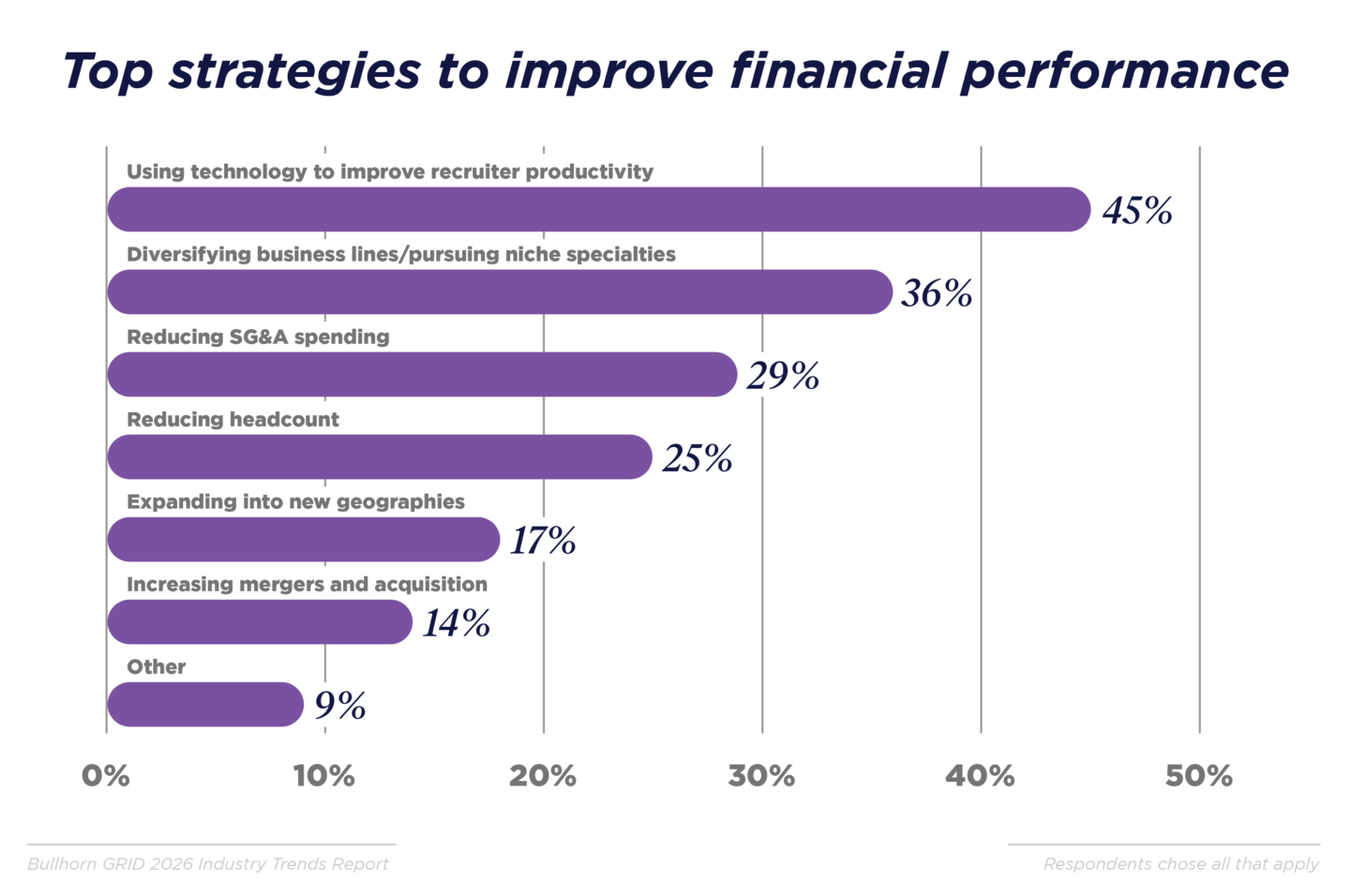
That survey answers a question the pricing tables cannot: 45% of recruitment firms name technology-driven recruiter productivity as their top financial-performance lever, well ahead of reducing headcount at 25%. Firms are explicitly choosing to spend on software instead of people, which is the demand condition that lets seat prices hold and AI add-ons get sold at 20%-plus uplifts. It also explains why the modules with no published price are the ones growing: they are being bought against a headcount budget, not a software budget, and a headcount budget makes a $30,000 AI line look cheap.
6. Enterprise Talent Suites: 5 Tools Priced
At the enterprise end, recruiting is not a product you buy, it is a line inside a suite deal, and the line is priced per employee. All five tools here meter on total company headcount rather than recruiting activity, none publishes a US list price, and three of the five can only be bought on top of a mandatory foundation product you may not want. This is the part of the market where the metering unit does the most damage, because the population being billed is the largest and the correlation with recruiting value is the weakest.
The good news is that this is also where government procurement disclosure is most useful, because enterprise vendors chase public-sector business and public-sector business demands a rate card. Two of the five have complete published ladders sitting on the UK G-Cloud framework right now, which is the single best-kept secret in enterprise HR software buying.
Workday Recruiting cannot be bought at all without Core HCM. Its G-Cloud 14 rate card, in versions dated 15 October and 16 December 2025 carrying identical figures, prices the Core HCM plus payroll connector plus Expenses plus Recruiting bundle at £236.08 per employee per year for 750 to 1,500 employees, falling through £198.74, £168.91, £136.47 and £108.38 to £85.86 at 50,001-plus employees. Comparing that against the same document's bundle without Recruiting and Expenses gives the incremental cost of adding them: £77.77 per employee per year at the smallest band, down to £28.29 at the largest. Vendr's median Workday contract is $50,352 across 368 transactions with a range up to $532,311. The gotcha is compound: you pay for every employee rather than every user, and Workday contracts carry true-up clauses that reprice headcount growth mid-term, so a good hiring year raises your recruiting bill even though the recruiting team never grew.
Workday's 2026 change is the arrival of a second, orthogonal meter. Flex Credits, announced 16 September 2025 and available to purchase immediately, are a fungible annually-renewing credit pool consumed by Illuminate AI agents, described by Workday as included in every subscription with more available "as their AI usage expands" - Workday. No dollar-per-credit rate is published. Note also that Workday's own announcement names eleven agents covered by credits and Recruiter Agent is not among them, so which recruiting agents draw credits remains publicly unresolved.
SAP SuccessFactors Recruiting is the most consequential entry in this section, and not because of its price. An authorised reseller publishes SAP's full module rate card on G-Cloud: Recruiting at £2.24 per user per month for 1 to 2,000 users, sliding to £0.81 at 100,001-plus. The mandatory Employee Central Core HR foundation costs £4.70 per user per month at the same band, more than twice the recruiting module itself, which is the clearest illustration in this guide of a recruiting decision dragging an entire HR core along with it.
The reason to read that carefully is that SAP is retiring the product. Following the SmartRecruiters acquisition, SmartRecruiters entered the SAP Price Book from December 2025 and became the standard SAP recruiting engine on 3 March 2026, with customers given three to five years to migrate - CIO. The commercially decisive detail is that licences do not carry over: existing SuccessFactors Recruiting licences do not transfer or convert, so every user needs a new licence for SmartRecruiters. Anyone signing or renewing SuccessFactors Recruiting in 2026 is buying a product with a stated end state and should budget the migration as a second purchase and a second implementation, not a version upgrade.
Phenom publishes nothing: its pricing page is a lead-capture form. Vendr's median buyer pays $98,313 a year, with observed contracts from $37,500 to $112,278, and OutSail independently reports $7 to $13 PEPM with annual contracts that "often start at $100K". The floor is the problem, and it is set by employment rather than hiring: a 15,000-employee company hiring 300 people a year pays roughly what a 15,000-employee company hiring 3,000 pays, so cost per hire swings by an order of magnitude on a variable the talent team does not control. Our Phenom pricing page carries the PEPM detail.
Eightfold AI has no pricing page at all: eightfold.ai/pricing returns a 404. Every figure in circulation is an analyst estimate, and several are estimates citing other estimates, converging on $7 to $10 PEPM, which implies $168,000 to $240,000 at 2,000 employees and $840,000 to $1.2M at 10,000. The structural criticism is sharper here than at Workday: Eightfold is not your system of record, so you are paying per employee for a talent-intelligence layer sitting beside an ATS and an HRIS you already pay per employee for. The same headcount is billed two or three times across the stack. Treat any specific Eightfold figure you read anywhere, including here, as an estimate rather than a price.
Beamery does not disclose a metering unit, which IndustryLabs confirms directly after working through a database of 67 AI-native HR tools. Vendr's median is $76,797 a year with a range of $24,717 to $204,153; IndustryLabs puts enterprise deployments materially higher at £100,000 to £400,000-plus. The gap is a scope difference rather than a data error, and it is the thing to watch: Beamery repositioned from talent CRM to workforce transformation with the launch of Task Intelligence on 29 July 2025, and a talent-CRM deal and a workforce-intelligence deal carry the same logo with roughly an 8x price difference. Our Beamery pricing page carries the Vendr distribution.
The buying advice for this section is narrow and specific. Before you accept a PEPM quote, calculate your own cost per hire from it and compare against the SHRM benchmark of $5,475 nonexecutive, because a suite that costs $98,313 for a company making 300 hires is adding $328 per hire and a suite that costs the same for 3,000 hires is adding $33. Then negotiate the band boundaries rather than the rate, since the rate is where the vendor expects the fight and the band is where the money is.
7. Sourcing and Talent Intelligence: 7 Tools Priced
Sourcing is the one category where prices are genuinely published, genuinely comparable, and genuinely moving down. SeekOut published a self-serve price for the first time in 2026. Juicebox publishes a full ladder including a per-agent SKU. HeroHunt.ai publishes a monthly ladder with unlimited positions, metered on AI-screened and matched profiles delivered and candidate emails found. LinkedIn publishes nothing and yet has the most completely documented price list of any vendor in this guide, thanks to procurement disclosure. This is the section where a buyer can most easily benchmark a quote in an afternoon.
It is also the category where the meter has changed most in the last year. Search is nearly free to provide, so nobody meters it: what gets metered is contact reveals, exports, sourced profiles and, newly, autonomous agents. That shift means the headline seat price is now routinely the smallest part of a working deployment, and the honest way to compare these products is cost per verified contact or cost per open role, not cost per seat.
| Tool | Published entry | Meter | Median buyer paid | The catch |
|---|---|---|---|---|
| LinkedIn Recruiter | none on linkedin.com | seat, volume-banded | $38,445/yr contract | bands are cliffs, see below |
| SeekOut | $149/mo (3 seats) | seat + contact credits | $20,000/yr | 500 credits pooled, not per seat |
| hireEZ | $494/mo solo | "the stack it replaces" | $13,000/yr | price set by your current spend |
| Gem | $130/mo (1-10 FTE) | total company FTE | $25,700/yr | AI is a separate seat class |
| Findem | none | seat, moving to per hire | ~$8,000/yr entry estimate | outcome pricing uncaps cost |
| Juicebox | $99/seat/mo | seat + agent + credits | no benchmark exists | agents are $199 each |
| HeroHunt.ai | $99/mo | AI-screened and matched profiles + candidate emails per month | list = paid (self-serve) | allowances reset monthly |
LinkedIn Recruiter is the headline finding of this entire guide. LinkedIn publishes no price on its own site, but its G-Cloud 14 price sheet, uploaded 20 October 2025, contains the complete ladder in GBP excluding VAT, per seat per year: £8,925 for 1-2 licences, £8,575 for 3-10, £8,150 for 11-30, £7,500 for 31-50, £7,150 for 51-100, £6,750 for 101-250 and £6,350 for 251-plus. Each licence includes at least 150 InMails a month. Vendr separately puts the median LinkedIn contract at $38,445 across 2,338 purchases analysed, with 15% to 30% off list common.
The commercially astonishing consequence is that total cost is not monotonic in seat count, because each band reprices every seat on the contract. Thirty seats at £8,150 is £244,500. Thirty-one seats at £7,500 is £232,500. The thirty-first licence saves you £12,000 a year. The same inversion sits at every boundary: 100 seats cost £715,000 while 101 cost £681,750, a £33,250 saving for buying one more; 250 cost £1,687,500 while 251 cost £1,593,850, a £93,650 saving. Any team sitting on exactly 30, 50, 100 or 250 licences is paying a premium to own fewer of them, and no LinkedIn representative has an incentive to raise it.
LinkedIn's 2026 change is that agentic AI got its own priced line. Hiring Assistant now appears on the same public price sheet at £2,079 per licence per year at the 1-2 band, falling to £1,575 at 101-250. At the entry band that is a 23.3% uplift on the seat price for the same seat. Two structural details matter: the add-on cannot exceed your total Recruiter licence count, so agent capacity scales strictly linearly with headcount and there is no efficiency dividend; and it is separately capacity-metered in candidates sourced and evaluated, the first time LinkedIn has metered a recruiting product in anything other than seats, slots or InMails. A dated promotion running from 1 October 2025 to 30 June 2026 grants Tier 2 capacity at Tier 1 price. Our LinkedIn recruiting pricing guide covers the full product family, and the Recruiter Lite guide covers the self-serve end.
SeekOut published a self-serve price for the first time in 2026, and it is genuinely good value read correctly. Recruit Core is $149 a month paid annually ($1,788 a year) or $179 monthly, and it includes 3 seats, which works out near $50 per recruiter. Fourteen days free, no credit card. The catch is that contact credits are the real meter and on the entry plan they are pooled rather than per seat: 500 contact credits a month across three recruiters is about 167 reveals each, which a working sourcer burns in under two weeks. Vendr's median SeekOut contract is $20,000 across 65 purchases, with per-seat bands of $3,000 to $6,000 at Essentials rising to $8,000 to $15,000-plus at Enterprise. Anyone quoting SeekOut as "$149 per user per month" has tripled the real entry cost, a correction our SeekOut pricing page makes explicitly.
hireEZ publishes exactly one number, "Solo recruiters start at $494/mo with a 7-day free trial", and has rebuilt its enterprise pricing around a genuinely unusual principle: its own page states that pricing is "configured to the stack hireEZ replaces rather than a flat per-seat rate times headcount", and hands prospects a worksheet to total their existing tool spend first. Read that as what it is. Your price is set by what you already spend, so the better-tooled your team, the higher your quote. Vendr's median is $13,000 a year with a $7,000 to $25,000 range. A warning worth repeating because our own archive has offended twice: the $169 and $199 per-user tiers quoted all over the internet are dead, as our hireEZ pricing page has said since January 2024.
Gem publishes a price for exactly one tier and it is the smallest: the Startup Program at 1-10 FTE, $270 struck through to $130 a month billed yearly, with companies under 30 employees getting Gem All-in-One free for six months then 50% off. Everything above that is custom and keyed explicitly to total company FTE count, which Gem states on its own page. It is a PEPM model in a recruiting tool's costume. Vendr's median is $25,700 across 233 purchases with a 20% average buyer saving, and SpendHound corroborates the shape from 160 verified contracts. The 2026 change is that Gem carved AI into a separate paid seat class, so its sourcing, screening and ranking agents are an upsell layered on top of an FTE-based bill rather than included in the base.
Findem is the only vendor in this section that publishes nothing whatsoever, and it is in the middle of switching meters. The legacy model is a per-seat annual licence; the new model is outcome-based and tied to hires, following the Getro acquisition announced 4 December 2025. SelectSoftware's estimate of roughly $8,000 a year entry is the only usable third-party figure and it is weak evidence, so treat it as an order of magnitude rather than a price. The structural point is worth more than the number: outcome pricing converts a capped cost into an uncapped one. A seat licence has a known ceiling no matter how many hires you make; a per-hire fee does not, and you generally still pay the floor.
HeroHunt.ai
Because we are one of the 40 tools in this guide, here is our own ladder read straight off the live Stripe pricing table rather than from any of our older articles: Starter $99/month (1 user, 2,000 AI-screened and matched profiles and 500 candidate emails a month, 750M profiles), Pro $199/month (1 user, 5,000 profiles and 1,000 emails, 1B profiles, premium models, analytics and integrations), Team $399/month (3 users sharing 25,000 profiles and 4,000 emails). Annual billing gives 2 months free, and every tier starts with an 8-day free trial (card required). The part to understand is the meter: positions and searches are unlimited, and HeroHunt.ai meters only AI-screened and matched profiles delivered and candidate emails actually found, not seats and not open roles, so an extra requisition costs nothing until it produces candidates. The honest caveat is that both allowances reset monthly, so a team that sources heavily one month and lightly the next has to size its plan for the peak. If your sourcing volume swings hard, check your busiest month against the allowance before you pick a tier.
Juicebox publishes the clearest agent pricing in the market: Free at $0, Starter $99 per seat per month with 500 contact and 500 export credits, Growth $179 per seat, and separately Juicebox Agents at $199 per agent per month with one agent included on paid plans. Contact credits are asymmetric, at one credit for an email and three for a phone number. The economics deserve attention because the seat is not the product: the $99 seat is search and outreach, while the autonomous sourcing the marketing is about is the $199 agent, and agents are priced per open role rather than per recruiter. A three-recruiter team with eight live requisitions is not paying $297 a month, it is paying $297 plus up to eight agents. Juicebox raised an $80M Series B at an $850M valuation on 10 March 2026. Our own Juicebox pricing coverage sits, confusingly, at the PeopleGPT page, which is a naming problem section 12 addresses.
The comparison that matters across this section is cost per open role rather than cost per seat, because that is the unit sourcing value actually accrues in. A single LinkedIn Recruiter licence at the 1-2 band is roughly £8,925 a year, which is about £744 a month for one recruiter. Juicebox for one recruiter running four agents is $99 plus three additional agents at $199, about $696 a month. SeekOut Recruit Core is $149 for three seats. These are the same order of magnitude only if you ignore what each one actually delivers per role, which is exactly the calculation vendors would prefer you skip.
8. Contact Data: 3 Tools Priced
Contact data is the only category in this guide where the sticker price is nearly irrelevant, because the credit conversion rate is the real price and two of the three vendors changed it in 2026 without changing the sticker. A plan advertising 600 credits a month sounds like 600 contacts. At Lusha's 2026 rates it is 60 phone numbers, or 54 full contacts. Read the conversion table before the price table, every time.
This is also the category with the most misinformation in circulation, including on this blog, because vendors run multiple separately-metered credit pools with similar names. Apollo alone runs four. Conflating them is how a correct statement about email credits gets "corrected" into a wrong statement about export credits, which is a mistake our own archive has made in both directions and which section 12 unpicks.
Apollo.io publishes a full annual ladder: Free at $0, Basic $49 per user per month, Professional $79, and Organization $119 with a three-seat minimum, all billed annually. The monthly ladder is not reliably pinned and sources disagree, so treat the annual figures as the anchor. The four credit pools are the thing to learn. Email credits are nominally unlimited but governed by a Fair Use Policy that caps them at 10,000 a month on a verified corporate domain and just 100 a month on a personal domain like Gmail, which is the single highest-value undocumented fact in this category. Mobile numbers cost 8 credits against 1 for an email. Export credits are separate again, at roughly 10 a month on Free. Vendr's median Apollo contract is $19,000 a year across 99 purchases with a 30.17% average saving, the highest discount rate in this guide.
Lusha publishes the most transparent ladder of the three and executed a stealth price rise through the meter rather than the sticker. Free is $0 with 40 credits a month; Starter $49.90 monthly or $37.45 billed annually with 400 credits; Professional $69.90 or $45.45 annually with 600; Premium $399.90 or $259.95 annually. The conversion is stated on Lusha's own page: one credit reveals an email, ten credits reveal a phone number. That phone cost doubled from five credits to ten in mid-2026 with no change to the subscription price, which halved the value of every plan overnight for phone-led sourcing. Vendr's median is $15,999 a year across 143 purchases at a 10.93% average saving, the lowest discount rate here.
ZoomInfo Talent publishes nothing at all: zoominfo.com/b2b/talent shows only "Free trial" and "Contact sales", the pricing page returns a 403 and two adjacent product URLs are 404s. Vendr's median across all ZoomInfo products is $33,500 a year with a $7,200 to $155,370 range and a 21.81% average saving from 1,012 handled deals. The contract terms cost more than the sticker here: annual only, a three-seat minimum, auto-renewal by default, and a cancellation window that closes 60 to 90 days before renewal. Miss it and you are locked in for another year at an uplifted rate. Our ZoomInfo Talent pricing page is, by search volume, one of the most-demanded pages on this entire blog.
Apollo.io
If you are choosing a contact-data tool on price, the number that decides it is not the seat rate, it is the domain you sign up from. Apollo.io's free plan carries what it calls unlimited email credits, and its Fair Use Policy caps that at 10,000 emails a month on a verified corporate domain and only 100 a month from a personal address like Gmail. Same plan, same $0, a 100x difference in what you can actually send. Paid tiers run $49, $79 and $119 per user per month on annual billing. Two caveats worth knowing before you compare it to Lusha: a mobile number costs 8 credits against 1 for an email, so phone-led sourcing burns a pool far faster than the headline suggests; and the $119 Organization tier carries a three-seat minimum, which makes the real entry price closer to $357 a month than $119.
The way to compare these three honestly is to price a fixed job of work rather than a plan. Take 500 target profiles, assume you need an email for all of them and a mobile for the 100 you actually call, and compute the credit draw on each vendor's published conversion. On Lusha that is 500 email credits plus 1,000 phone credits, so 1,500 credits, which is more than two months of the Professional allowance. On Apollo it is 500 email plus 800 mobile credits against an annual grant of 30,000 on Basic. The plans look similar and the workload costs very different amounts, which is the entire game in this category.
One final piece of advice specific to contact data: never let a vendor sell you on database size. Every vendor here claims hundreds of millions of records and the claim is unfalsifiable. What is falsifiable is hit rate and bounce rate on your own roles, which you can measure in an afternoon with 20 profiles and two free plans, and which will vary more between your role families than between these vendors.
9. AI Interviewers and Assessment: 5 Tools Priced
This is the least transparent category in recruiting software and the one growing fastest, which is not a coincidence. Of the five tools here, none publishes a price on its own website, one has no unit at all, and the only complete rate card in the category exists because a vendor wanted to sell to the UK government. It is also the category where the gap between the metered price and the cost of production is widest, which section 11 quantifies.
The commercial structure worth understanding up front is that these products are sold on volume bands you do not fully control. HireVue meters on applicant volume, which is the top of your funnel and therefore the number most affected by a viral posting or a competitor's layoffs. Maki meters on candidate interactions, and charges for assessments candidates start and abandon. Only Sapia meters on something the employer decides.
Sapia.ai has the cleanest meter in this entire guide: per hire, capped annually, with unlimited users, unlimited applicants and unlimited interviews. Its own page states it plainly: "you'll only pay for the people you end up hiring". The full rate card is public via UK G-Cloud, dated 7 May 2024: Starter £15,000 a year for up to 150 hires, Pro £28,000 for up to 500, Enterprise £75,000 for up to 1,000. That implies effective list rates of £100, £56 and £75 per hire respectively, and the G-Cloud listing independently shows the unit band as "£56 to £200.00 a unit", confirming the unit is a hire.
The gotcha at Sapia is not volume, it is scope. Starter buys a model for exactly one role family, so the moment you screen a second job type you move from £15,000 to £28,000, an 87% rise driven by scope rather than hiring volume. Add-ons are also priced disproportionately at the low end: interview scheduling is £5,000, which adds a third to a Starter contract, and CEFR language scoring is a flat £45,000 regardless of tier, three times the entire Starter subscription. Budget the add-ons before you anchor on the headline. Our Sapia.ai pricing page also formally retracts a widely-circulated "$1 per interview" tier that does not exist.
HireVue publishes two package names, Essential and Premium, and no numbers, routing everything to an ROI calculator. The transaction data conflicts with itself in a way worth publishing: Vendr's marketplace page gives a median of $20,900 with a $9,794 to $41,056 range, while Vendr's own buyer guide for the same vendor gives an average of $49,855 with a top around $145,000, explicitly disclosed as coming from "more than 5 completed deals and 3 unique purchasers". A 2.4x discrepancy between two pages from the same data provider on a five-deal sample is a better illustration of the state of this market than any single figure. The meter is applicant volume, which ratchets one way. HireVue acquired the Hireguide technology and team on 10 March 2026 to move into agentic AI, terms undisclosed.
Paradox is the most important pricing story in this section because the meter is changing under existing customers. Historically it was an annual subscription scaled by requisitions, locations and candidate volume, with nothing published. Workday completed its acquisition on 1 October 2025 for around $1 billion in cash, and Olivia was repackaged as the "Workday Paradox Candidate Experience Agent", available for purchase through either company. The consequence is that a Paradox contract bought as a flat annual subscription is being absorbed into Workday's Flex Credits consumption model, where no dollar-per-credit rate is published anywhere and credits expire annually with no rollover. If you run Paradox today, the single most valuable question for your next renewal is which meter your 2027 invoice will be calculated on.
Maki People rejects the seat meter explicitly, stating on its pricing page that you "pay only for what you use, candidate interactions, not licenses", sold as prepaid credits with a per-agent activation dimension. No figures are published anywhere, and no Vendr, SpendHound, Tropic or Ramp entry exists, so what a Maki customer actually pays is genuinely unknown. The detail that matters is in the Terms of Sale rather than the pricing page: one credit equals an assessment started by a candidate, and assessments "only started by a Candidate but not finished are counted down" from your balance. You are billed for abandonment, which in a category with well-documented candidate drop-off is a material cost nobody models. Our Maki People pricing page covers the product in depth.
Alex, formerly Apriora, publishes no price and no unit at all: not per interview, not per seat, not per hire, not credits. apriora.ai/pricing now 301-redirects to alex.com/pricing, which is a demo booking form. The single number in circulation, roughly $10,000 to $35,000 a year, originates from a direct competitor's comparison page, which makes it structurally unreliable in both directions. Treat Alex as unbudgetable before entering a sales process, and understand that this is a design choice rather than an oversight: by the time you see a number, the vendor knows your volume, your urgency and your incumbent. Our Alex pricing and alternatives page works through the comparison set.
For a genuinely published per-interview price in this category, the reference point is Ribbon, which sells Growth at $499 a month for 100 interviews with $4.00 overage, Business at $999 for 400 with $3.00 overage, and Scale at $1,999 for 1,000 with $2.50 overage. Those are the numbers to hold every quote in this section against, because they are the only published per-interview rates in the market and they convert every opaque annual contract into a comparable unit cost. Our Ribbon AI pricing page has the tier detail.
10. Job Boards, Marketplaces and Outcome Pricing: 5 Tools Priced
The oldest pricing model in recruiting is also the only genuine outcome pricing in it, and the software vendors currently talking about outcomes have shipped credits instead. Paraform charges a percentage of first-year salary. Randstad charges a markup on hours worked. Korn Ferry charges a management fee or a percentage. These are outcome models that predate SaaS by decades, and they are the benchmark any AI vendor's "outcome pricing" claim should be measured against.
The job board layer sits in between, metering on advertising units that convert to hires at rates the buyer must measure themselves. That measurement gap is where most recruiting advertising money is wasted, and it is worse in 2026 than it was, because the meter is now a setting rather than a product.
Indeed runs two meters and lets you switch between them with a toggle most buyers do not recognise as a pricing decision. Its own page states you are "charged when job seekers click to view your job post with daily budgets or when job seekers click to apply to your job post on monthly budgets". A daily budget bills per click; a monthly budget bills per started application. Same job, same cap, entirely different unit economics. Published figures: up to three free job posts per calendar month, each live 30 days; Sponsored Jobs budgets from $5 a day or $150 a month; and Smart Sourcing Professional in the US at $520 a month or $4,992 a year including 100 contacts with six-month rollover and $5.20 per additional contact.
That contact overage is the expensive bite and it hides inside something that looks like flat SaaS. A recruiter making 300 outreaches in a month pays $520 plus $1,040, so $1,560, three times sticker. Vendr's Indeed average contract value is $15,000 with a $9,000 to $46,620 range from 72 handled deals at 18.13% average savings. One correction worth carrying: the widely-recirculated Smart Sourcing price rise from £250 to £325 a month is an April 2024 UK change, routinely mis-dated as 2026 across SEO content. Our LinkedIn job posting cost guide covers the comparable advertising maths on the other major platform.
ZipRecruiter publishes no price and its pricing pages return 403 to anything that is not a browser, but it is a public company, which makes it the best-documented job board in this guide. The Q1 2026 10-Q discloses 63,329 quarterly paid employers and revenue per paid employer of $1,698, down 2% year over year and down 10% sequentially from $1,889 in Q4 2025. The meter is the active job slot, a reusable container you can swap roles through at no extra cost but which bills whether or not anyone applies. Slots auto-renew, and one documented complaint describes charges continuing for 13 billing cycles after an employer closed their account. Our ZipRecruiter pricing page derives the per-employer figure from the filings.
Paraform charges a flat percentage of first-year base salary on success only, with the employer setting a per-role reward that can be a percentage or a fixed bounty. Third-party 2026 comparisons put the contingency at 20% to 25%, worth $30,000 to $37,500 on a $150,000 role. Paraform's own Series B post from 18 March 2026 is the better evidence: average candidate compensation on the platform is around $260,000 a year, rising to $300,000-$400,000 with equity, across 1,000-plus companies, with over $50 million paid out to recruiters. The structural detail buyers miss is that the 90-day guarantee is a replacement search, not a refund, and payment is due within 14 business days of the candidate signing. Our Paraform pricing page covers the marketplace mechanics.
Korn Ferry runs three meters and the guide-worthy fact is that it publishes its realised rates in investor materials while publishing no rate card at all. FY2026, ended 30 April 2026: total fee revenue $2.9 billion, up 7%, with a consulting bill rate of $442 per hour, up 7% year over year. RPO delivered $98M in Q4 revenue against $842M of remaining contracted fees, which implies contracts averaging well over two years. The management-fee model transfers utilisation risk to the buyer: you pay for the embedded team whether or not the requisitions materialise. Our Korn Ferry pricing page works through the engagement economics.
Randstad prices as a markup on the worker's pay rate, producing an hourly bill rate invoiced per pay period. It publishes no percentage, explaining in detail what the markup covers and then declining to quote a number. The best available evidence is its own group gross margin, which caps what any blended markup can be and demolishes the persistent "50% markup" folklore: Q2 2026 revenue €5,897M against underlying gross profit €1,071M, an 18.2% underlying gross margin, down from 18.9% a year earlier. Perm placements contributed minus 10 basis points and temporary placements minus 70. The gotcha is that the largest cost items under the markup float rather than fix at signature, since healthcare costs accumulate with engagement length and job-specific insurance varies by risk. Our Randstad staffing pricing guide includes filed public-sector bill rates.
The synthesis across this section is the one number every software vendor should have to answer to. A single agency placement at 20% on a $120,000 salary is $24,000, which is about the median annual cost of a full ATS. Paraform on a $260,000 average placement at 22% is roughly $57,000. Against that, Ribbon's published $2.50 per interview and Workable's $0.095 per AI credit look like rounding errors, and they are: the entire economic case for AI in recruiting is that it competes with the outcome model, not with the seat model. Any vendor pricing an agent at agency rates is asking to be benchmarked against an agency.
11. The AI Meter: What a Credit Actually Costs to Make
Vendors are not moving to metered AI pricing because inference is expensive. They are moving to it because inference is nearly free, and a meter turns a fixed seat licence into a variable revenue line that grows with your hiring. That is a strong claim, so here is the arithmetic, built entirely on published rates from both sides of the transaction.
Start with what the vendor pays. Anthropic's own documentation carries a worked example that maps almost exactly onto resume screening: processing 10,000 conversations averaging around 3,700 tokens each on Claude Haiku 4.5 costs about $37 in total, which is $0.0037 per conversation - Anthropic. Haiku 4.5 lists at $1 per million input tokens and $5 per million output, and the Batch API halves both. Google's Gemini 2.5 Flash-Lite lists at $0.10 and $0.40 per million.
Now the calculations, which are ours and should be treated as assumptions rather than retrieved figures. A single resume screen with a CV and job description in and a structured score out, assuming 2,000 input tokens and 300 output, costs $0.0035 on Claude Haiku 4.5 or $0.00032 on Gemini Flash-Lite, halving again with batch processing. A deeper screen including an interview transcript, at 15,000 input and 1,500 output on Claude Sonnet 5, costs about $0.045. A 20-minute AI voice interview at Google's published Live audio rates, assuming the candidate speaks for 20 minutes and the agent for six, comes to about $0.21, and a defensible published range allowing for context reprocessing is $0.15 to $0.50.
What a metered AI unit sells for vs what it costs to produce
The multiples are the story. Workable's published credit rate of $0.095 to $0.12 sits roughly 30 to 400 times above a single model call at Anthropic's published Haiku rate. Ribbon's $2.50 to $4.00 per interview sits around 12 to 19 times above the inference cost of the interview itself. Intercom's Fin, outside recruiting but the best-documented outcome price in software at $0.99 per resolution, sits around 250 times above it. None of these are scandals: vendors carry real costs in engineering, compliance, storage, support and sales that inference does not capture. But the gross margin on a metered AI unit is comparable to the gross margin on the software it is bolted onto, which means the meter is a revenue instrument rather than a cost pass-through, and you should negotiate it like one.
That has three practical consequences at the negotiating table. First, credit rates have far more give in them than seat rates, because their cost basis is near zero, so ask for the top pack rate at the bottom volume rather than a discount on the subscription. Second, included allowances are cheaper for the vendor to grant than discounts, so trade a smaller headline discount for a much bigger credit inclusion. Third, insist on a published overage rate in the contract, because an unpriced overage on a meter you cannot forecast is the single most dangerous line in an AI-era software agreement.
The macro picture supports treating this as a systematic repricing rather than a vendor-by-vendor quirk. Gartner's February 2026 forecast has the software segment growing from $1.25 trillion in 2025 to $1.43 trillion in 2026, up 14.7%, well ahead of general inflation, and Vertice's index puts SaaS inflation specifically at 16.4% in June 2026. Josh Bersin's July 2026 research reports that talent-acquisition vendors are now "required to demonstrate not just innovation, but clear, tangible business outcomes" against "greater scrutiny around pricing and value" - Josh Bersin Company. Buyers have more leverage in this category than the pricing pages imply, and almost none of them use it.
Software spend is growing faster than any other IT segment in 2026

The counterweight worth holding alongside all of this is that the deployment reality is far behind the pricing reality. Gartner's own forecast is that over 40% of agentic AI projects will be cancelled by the end of 2027, and Aptitude Research found 1% of employers running voice screening agents in 2026. Vendors are metering a behaviour their customers have not yet adopted. That is an argument for buying agent capacity in small, cancellable increments and refusing to fund a three-year commitment against a workflow you have not proven in your own funnel.
The video below is the most useful buyer-side briefing we found on evaluating this category before purchase, and it is worth twenty minutes before your first vendor call.
Best ATS Software 2026: what recruiters need to know before buying
12. Where Our Own Archive Contradicts Itself
This blog has published more than 60 vendor pricing pages since 2022, and several of them contradict each other on the same vendor's price. Publishing that fact is uncomfortable and it is also the entire point of building an index: a pricing corpus without a reconciliation layer decays into noise, and readers deserve to know which number to trust. Every contradiction below was found by reading our own published bodies, and each one is adjudicated with a reason.
The reason this happens is structural rather than careless, and it will happen to any large pricing corpus that is not indexed. Vendors reprice quietly, review sites republish stale figures, and a number that was correct in 2024 keeps getting cited in 2026 because it is the most quotable version. The fix is not to write more articles, it is to name one page as canonical per vendor and make every other page defer to it. That is what section 15 does.
Our own price was published four different ways, and here is the correct one. Different articles on this site have given different starting prices for HeroHunt.ai, and one claimed a permanent free tier that does not exist. Read directly from the live Stripe pricing table behind herohunt.ai/plans, the ladder is Starter $99 a month or $990 a year, Pro $199 or $1,990, Team $399 or $3,990, with an 8-day free trial (card required) on every tier and no permanent free plan. Every plan has unlimited positions and searches. Starter is one user with 2,000 AI-screened and matched profiles and 500 candidate emails a month against 750 million profiles; Pro is one user with 5,000 profiles and 1,000 emails against a billion; Team is 3 users sharing 25,000 profiles and 4,000 emails. Every earlier figure on this site is superseded by that.
LinkedIn Recruiter has appeared at seven different prices across our archive, from "$8,000-plus per seat" to "$10,800 to $12,960" to "$8,999 to $15,000-plus" to "$1,150 a month" to a "$38,451 median contract" to "exceeding $50,000 annually". Most of those are not actually in conflict, they are different units printed as though they were the same: a seat price, a monthly restatement of a seat price, and a whole-contract median are three different quantities. The correct framing, now that LinkedIn's own G-Cloud ladder is available, is that the list price is a volume-banded per-seat annual rate running £8,925 down to £6,350, and the $38,445 Vendr figure is a contract median across all products, not a seat price. Never print those two next to each other without saying which is which.
Two articles published on the same day gave HireVue two different figures. One quoted the $20,900 Vendr median, the other the $49,855 Vendr average, neither reconciling with the other. Both come from the same data provider cut differently, on a sample Vendr itself discloses as five deals from three purchasers. The right published position is: HireVue publishes no price; observed buyer data spans roughly $9,794 to $145,000, median around $20,900, mean around $49,855, on a very thin sample.
Eightfold has appeared at five incompatible prices on this site, including "$799 per seat per month with a $50,000 minimum". That figure appears in exactly one article and nowhere else in the corpus or the market, and Eightfold does not sell per recruiter seat. It should be retired. The consistent reading is $7 to $10 PEPM, custom-quoted, no published price, which arithmetically explains the other figures: roughly $650 a month is a 1,000-employee company at the low rate, and $150,000 to $500,000 a year is a 2,000-to-5,000-employee company at the same rate.
Sapia is the most instructive failure, because we debunked a fabricated price and then reprinted it. Two of our articles formally retracted a widely-circulated set of Sapia plans at "$1 per interview with a 100-interview minimum", stating plainly that those plans do not exist. A July 2026 article then republished the $1-per-interview figure and built a comparison chart on it. The correct position is the one in the G-Cloud rate card in section 9: Sapia prices per hire, at £15,000, £28,000 and £75,000 a year for 150, 500 and 1,000 hires. The same pattern hit hireEZ, where we correctly debunked the dead $169 tier in three articles and then two later articles quoted $169 again. hireEZ's published solo price is $494 a month.
Four smaller corrections belong on the record. SeekOut's $149 is for a three-seat bundle, not per user, so quoting it per user triples the real entry cost. Workable's entry is $189 to $299 depending on which year's page you read, and the meter is employee headcount plus active jobs, not seats, so the phrase "per seat" in one of our guides is wrong. Apollo runs separate credit pools, so "900 credits per seat per year" (general and export) and "10,000 email credits a month on a corporate domain" (Fair Use) are both correct and are not substitutes for one another. And Moonhub was recommended as a live vendor in a June 2026 article although it wound down in June 2025, which is the error class that section 14 exists to prevent.
The general lesson for any reader benchmarking a quote is worth more than the specific corrections. When you find two different prices for one vendor, do not average them and do not pick the newer one by default. Ask what unit each number is in, what population it was measured over, and on what date, because in this market the majority of apparent contradictions are unit mismatches rather than factual disputes, and the minority that are genuine disputes are almost always a stale number that refuses to die.
13. Negotiating: Discounts, Renewals and the Clauses That Bite
The most valuable negotiation fact in this guide is that the benchmark everyone quotes is three years old and roughly 40% too low. The "average SaaS discount is about 10%" figure repeated across procurement content traces to a Vendr trends report from Q2 2023. Vendr's own current per-vendor pages show average realised savings of 16% on Greenhouse, 16.26% on Lever, 15.24% on Workday, 20.86% on Ashby, 21.81% on ZoomInfo and 30.17% on Apollo. If you are anchoring at 10% in 2026, you are conceding half your available room before you open your mouth.
The second fact is counterintuitive and worth testing against your own procurement policy. Tropic's data, drawn from over $18 billion of managed spend, segments average discount by contract term and finds 31.93% on terms of 0 to 12 months, 26.31% on 12 to 24 months and 27.92% on 24 to 36 months. The conventional wisdom that longer commitments buy deeper discounts is not what buyer-side data shows. Tropic does not disclose its sample size or collection window, which limits how hard you can lean on it, but the direction is clear enough to justify pricing a one-year deal alongside the three-year one the vendor will push.
The renewal is where the real money moves, and 2026 has a specific pathology. Tropic's customer renewal data separates two populations: a normal annual uplift runs 3% to 9%, while anything with AI in the SKU is asking 20% to 37%. Buyers who negotiate land at around 12%, meaning negotiation reduces the ask by roughly 55% on average. Since almost every vendor in this guide shipped an AI SKU in the last eighteen months, assume you are in the second population and prepare accordingly.
Five levers actually work in this category, in rough order of value. Each is worth more than the discount percentage most buyers spend their energy on.
- Negotiate the unit, not the rate. On PEPM contracts, fight the headcount bands and the true-up trigger rather than the per-employee price.
- Cap the escalator in writing. An uncapped uplift clause converts a 20% to 37% AI ask into a fait accompli at renewal.
- Buy credit inclusions instead of discount. Allowances cost the vendor near zero to grant, as section 11 shows, so they are the cheapest thing to win.
- Demand a published overage rate. An unpriced overage on an unforecastable meter is the most dangerous line in an AI-era contract.
- Start six months out. Tropic's guidance is to open renewal conversations well before the notice window and to ask explicitly for legacy pricing.
The last of those deserves expansion because it is where most buyers lose by default rather than by negotiation. Standard SaaS paper auto-renews on a 30-day notice window, and the notice deadline typically falls before the buyer has done any usage review, which means the decision to renew at the vendor's number is made passively. ZoomInfo's 60-to-90-day cancellation window is at the aggressive end of this and it is not unusual. Put every renewal notice date in a calendar the day you sign, set the reminder six months before it, and treat the notice window as the real contract date rather than the anniversary.
One more benchmark is worth having in your head when the conversation turns to whether the spend is justified at all. Zylo's 2026 index, from more than 40 million licences and $75 billion of managed spend, finds organisations waste an average of 36% of their SaaS licences, and recruiting seats are the classic case: bought for a hiring surge, never reclaimed. Before negotiating a discount on 40 seats, audit whether you are using 40 seats, because reclaiming ten is a 25% saving that requires no vendor's agreement at all.
How one team negotiated 85% off a SaaS renewal
The final piece of leverage is the one section 3 gave you. Walking into a renewal with a specific, dated, sourced benchmark changes the conversation from an argument about value to an argument about a number, and vendors negotiate very differently against a buyer who can cite the median contract value and the sample it came from. That is the practical reason this index exists.
14. Buying in a Market That Deletes Vendors
Two of the AI recruiting products most confidently recommended across the industry in 2025 no longer exist, and one of them went from general availability to switched off in about thirteen months. Contract length is a pricing decision, and in this category it is the pricing decision that carries the most risk. The vendor graveyard is short enough to read in full and specific enough to change how you sign.
Moonhub wound down in June 2025. Salesforce hired part of the team, pointing them at Agentforce, and clarified that it did not acquire the company. Tezi shipped its "Max" autonomous recruiter to general availability in March 2025, announced its shutdown around 13 March 2026 with an effective date of 12 April 2026, and gave customers 30 days to export their data and find a replacement. On 31 March 2026, Headway, a mental health provider network, announced it had acquired the team, with the cofounder joining as VP of Engineering. The release does not say what happens to the product, because the acquirer did not want the product.
The detail that should genuinely change your contracting behaviour is what happened next: no primary Tezi shutdown notice survives on tezi.ai or blog.tezi.ai, which now serve the Headway transition announcement. The record of the wind-down was gone within four months. If your data export plan depends on the vendor's website still explaining the process, you do not have a plan. Our pricing pages for both products remain live as obituaries: Moonhub and Tezi.
Three lessons follow directly, and all three are commercial rather than technical. A 30-day export window is the realistic worst case, not the theoretical one, so negotiate a longer one into the contract while you have leverage rather than after the announcement. The acquirer may have no interest in your category: Tezi's team went to a mental health company and Moonhub's to a CRM company, so team acquisitions do not preserve products. And match contract length to vendor maturity, because Gartner's own forecast is that over 40% of agentic AI projects will be cancelled by the end of 2027, which makes a three-year lock-in with a single-product venture-funded AI recruiter a mispricing of risk rather than a discount.
There is a genuine silver lining in the pricing shift here, and it is the one place where metered pricing favours the buyer. A per-interview or per-credit contract without a multi-year minimum is structurally the correct hedge against a vendor that may not exist in thirteen months, because your exposure is capped at consumption rather than commitment. Where a vendor offers you a choice between a discounted three-year seat deal and a slightly more expensive metered one, the metered option is buying you a real option on the vendor's survival, and in this category that option has value.
The clause that matters most in 2026 is not price at all. Gartner's George Brocklehurst, discussing the $234 billion of enterprise application spend the firm considers exposed to agentic arbitrage, puts it bluntly: "The most important clause in the next generation of software contracts is: 'Who owns what the system learns from you?'" - CIO. For recruiting specifically, that means your scorecards, your rejection reasons, your hiring outcomes and your calibration data. If those accrue to a shared vendor model, you are paying to improve a product your competitors also buy, and no discount compensates for that.
Consolidation deserves one closing note because the intuitive expectation is wrong. Workday spent $1.53 billion in cash on HiredScore and Paradox in nineteen months, and SAP bought SmartRecruiters, and across all three deals no post-acquisition price increase is documented anywhere from any source. What actually happened is subtler and worse for buyers: published prices disappeared. Paradox was opaque before Workday and remains opaque after, SmartRecruiters is sales-gated, and Workday has never published per-employee pricing. The observable effect of consolidation in this market is not higher prices, it is fewer prices, which is exactly the condition that makes an index like this one necessary.
15. The Complete Pricing Index
Every vendor pricing page we maintain is listed here with a note on whether the number in it is current. Use this as the lookup layer: find the vendor, read the dedicated page for the tier detail, then benchmark it against the meter and the median in the relevant section above. Where two of our pages cover the same vendor, the canonical one is named.
Applicant tracking and core recruiting systems: Greenhouse (canonical, May 2026), Lever, SmartRecruiters, Jobvite, iCIMS, JobAdder, Vincere (content rewritten for Access Vincere Evo despite the slug), Jobylon and Bullhorn (canonical, supersedes our 2024 page).
Sourcing, CRM and talent intelligence: LinkedIn Recruiting (canonical for the whole LinkedIn family), LinkedIn Recruiter Lite, LinkedIn InMail credits, SeekOut, hireEZ, Gem, Findem, Beamery, Phenom, AmazingHiring, Entelo (now Rival Recruit), RecruitBot, SourceWhale, Torre and ZoomInfo Talent.
AI interviewing, assessment and screening: Sapia.ai (canonical, supersedes our PredictiveHire page since the company was renamed in 2022), Harver, Maki People, Alex by Apriora, Ribbon AI, ConverzAI, Braintrust AIR and HiredScore (now sold only inside a Workday contract).
Job boards, marketplaces and services: ZipRecruiter, LinkedIn job posting, Paraform, Qureos, Contrario, Dex, Pin, GoPerfect, Arc.dev, Korn Ferry and Randstad. For hiring abroad, the employer of record comparison is the canonical page and supersedes our older remote-hiring roundups, several of which carry prices that are wrong by a factor of three or more.
Three pages carry a health warning. Our PeopleGPT page is in substance the Juicebox pricing page under a name Juicebox retired, so read it as Juicebox coverage. Our Moonhub and Tezi pages describe products that no longer exist and are useful only as case studies in vendor risk. And micro1 has withdrawn its recruiting products entirely and repositioned as an AI data lab, so the page describes a business that has moved on.
The reason to maintain an index rather than a pile of pages is that vendor prices are not independent facts, they are a system. Once you know that Ashby, Workday, Gem, Phenom and Eightfold all meter on total headcount, you can price your entire stack against one number instead of five. Once you know that a LinkedIn seat and a Greenhouse contract are quoted in different units, you stop comparing them. That system view is what turns 60 pricing pages into a buying decision.
16. The Bottom Line
If you take one thing from this guide, take the question rather than any number: what exactly do I have to do more of for this invoice to go up? Everything else in these 40 reviews follows from the answer. A tool metered on employees taxes business growth. A tool metered on seats taxes team growth. A tool metered on hires, interviews or credits taxes recruiting activity, which is the only one of the three that tracks the value you are buying.
For teams under about 100 employees, the decision is easier than the market makes it look. Buy from the vendors that publish a price, pay list, and do not enter a sales cycle for a product whose entire annual cost is less than a week of your time spent evaluating it. Manatal at $15 a user, JazzHR at $1,000 a year, Breezy at $157 a month, Workable at $299, SeekOut at $149 for three seats and HeroHunt.ai from $99 a month with unlimited positions are all self-serve, all published and all cheaper than the meetings required to negotiate an alternative.
Between roughly 100 and 1,000 employees, you are in the band where the meter starts to hurt and the discount starts to matter. Get a benchmark before your first call, from Vendr's marketplace pages or SpendHound's free tier, model the quote at twice your current headcount, and negotiate the band boundaries and the escalator rather than the headline rate. Expect 15% to 21% off list as a normal outcome on the vendors with published buyer data, not the 10% that most procurement guidance still cites.
Above 1,000 employees, the sticker is irrelevant and three things decide your cost: the metering unit, the escalator cap and the term. Check whether the vendor has a UK G-Cloud rate card before you accept that no list price exists, because Workday, SAP, LinkedIn and Sapia all publish complete ladders there while publishing nothing at home. Then price the AI line separately from the platform line, because that is where the 20% to 37% renewal asks are being taken and where the credit inclusions are cheapest to win.
Whatever size you are, buy AI capability in short, cancellable increments. Two well-funded autonomous recruiting products shut down between June 2025 and April 2026, one with a 30-day export window whose own announcement has since been deleted, and Gartner expects over 40% of agentic AI projects to be cancelled by the end of 2027. Metered contracts with no multi-year minimum are the correct structural hedge, and they are one of the few places where the pricing shift genuinely favours the buyer.
Published price, 8-day trial, no sales call: see where HeroHunt.ai sits against the 40 tools above.
Finally, hold every vendor in this guide against the one benchmark that has not moved: a single agency placement on a $120,000 salary at 20% costs $24,000, roughly the median annual cost of a complete applicant tracking system. That is the comparison the whole category is really competing in, and it is the reason a $0.095 AI credit and a 22% placement fee can coexist in the same market. When a vendor tells you its agent is priced on outcomes, ask which outcome, at what rate, measured by whom, and compare the answer to the number an agency would have quoted. Most of the time the software still wins, and the times it does not are worth knowing before you sign.
This guide reflects recruiting software pricing as of 28 July 2026. Every figure was read from a primary page, a government rate card, an earnings filing or a named buyer dataset on that date, and figures that could not be verified are flagged as estimates in the text rather than presented as prices. This category reprices unusually fast, several vendors here changed their ladder twice inside 2026, and at least two widely-recommended tools became defunct in the eighteen months before publication, so confirm current terms with the vendor before purchasing.