



The practical, end-to-end guide to hiring, paying, retaining, and legally employing the humans who train frontier AI models.
Each frontier AI lab now spends on the order of $1 billion a year on human training data - SemiAnalysis. That single number reframes what "AI training talent" means. It is no longer a procurement line hidden under data-labeling. It is a workforce strategy, and getting it wrong now costs models, money, and reputations.
The problem is that almost nobody treats it as a workforce. Labs staff enormous compute budgets with dedicated infrastructure teams, then improvise the human-data function through a single vendor and a stack of 1099 contracts. In 2026 that improvisation collides with a wave of misclassification lawsuits, the EU AI Act's data-governance obligations, and a bidding war for PhDs that has pushed some rates past $200 per hour. Hiring the people who train your model is now simultaneously a sourcing problem, a compensation problem, a legal problem, and a duty-of-care problem.
This guide covers all of it, from a lab operator's chair. It starts high with why this became a strategic function, maps the market and the players you buy from, then goes deep on the parts most guides skip: compensation and benefits, worker classification and employment law, regulation and compliance, ethics and wellbeing, retention, and the operating model that ties it together. It ends on how AI agents are reshaping the work and what to build for 2027. Recruiting is part of the story, but only part. This is about the whole employment relationship.
This guide draws on the same lens Yuma Heymans (@yumahey) built HeroHunt.ai around: sourcing scarce, specialized people at scale. The hard part of staffing a model is rarely volume. It is finding, vetting, and keeping the few humans who genuinely know more than the model does.
Contents
- Why Hiring AI Training Talent Became a Strategic Function
- What "AI Training Talent" Actually Means in 2026
- The Market and the Players You Buy From
- Where to Find and Source the Talent
- Screening for Genuine Expertise, and Against Fraud
- Compensation: What It Actually Costs
- Worker Classification and Employment Law
- Regulation and Compliance: The EU AI Act, GDPR, and US State Laws
- Ethics and Wellbeing: The Human Cost You Inherit
- Retention: Why the Workforce Churns and What Keeps It
- The Operating Model: Build, Buy, or Blend
- How AI Agents Are Changing the Work
- The 2027 Outlook: The Expert-Data Economy
- Conclusion: A Staffing Decision Framework
1. Why Hiring AI Training Talent Became a Strategic Function
The scarce input in frontier AI has quietly shifted from compute to human judgment, and that shift is the reason this workforce now deserves a strategy rather than a purchase order. Pre-training on scraped web text has plateaued, so the gains that separate a leading model from a mediocre one increasingly come from post-training: supervised fine-tuning, reinforcement learning from human feedback, and expert evaluation. A lab can spend hundreds of millions on GPUs and still ship a weak model if the humans shaping its behavior are poorly chosen, poorly paid, or poorly managed. Human data has moved from a cost to a competitive weapon.
That is why the money is real and recurring. Each of the leading labs is estimated to spend around $1 billion per year on human-provided training data, a figure attributed to Foundation Capital and echoed across industry analysis - SemiAnalysis. To ground how much capital sits behind this, global corporate AI investment climbed to $252.3 billion in 2024, and the human-data layer is where a meaningful slice of that is now spent to turn raw model capability into shippable behavior.
The money behind the models
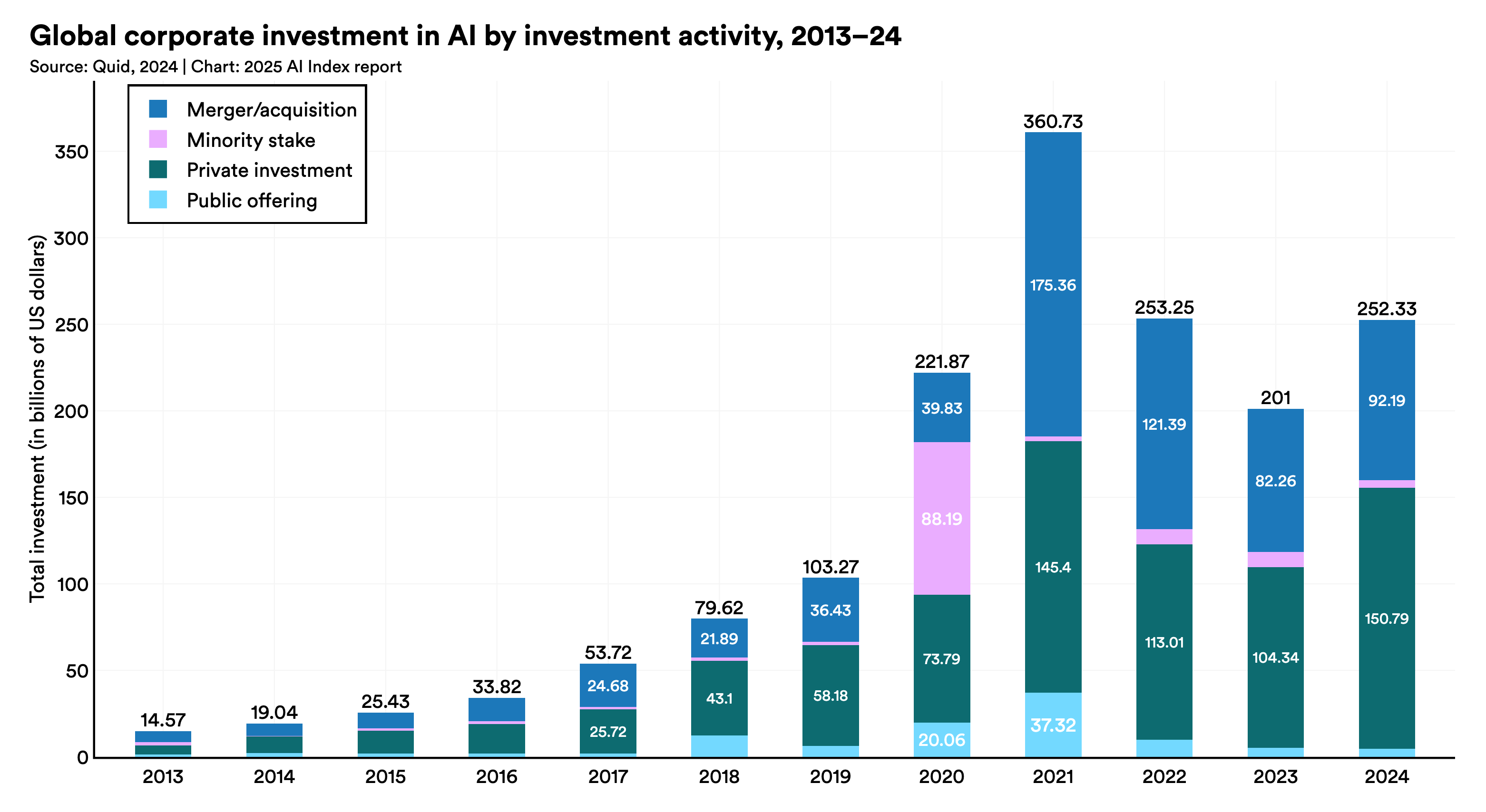
The reason this matters for hiring is asymmetry. A lab can spend hundreds of millions on chips and still ship a mediocre model if its post-training data is poor, because in the "data-centric" view the majority of model-performance gains now trace to data quality rather than architecture. Human judgment sits at the top of that data-quality stack, which means a relatively small human-data budget has outsized leverage on the final product. That asymmetry is why the leading labs treat human data as strategy: the dollars are modest next to compute, but the decisions about who provides the data, how it is graded, and whether the workforce is stable determine whether the compute was well spent. Under-investing here is the cheapest way to waste an expensive training run.
The practical consequence for anyone doing the hiring is that the old mental model, "annotation is cheap offshore labor," is now actively dangerous. It leads to three predictable failures: underpaying for work that determines model quality, mis-hiring generalists for tasks that need credentialed experts, and inheriting legal and reputational risk from a supply chain nobody audited. The rest of this guide is organized around avoiding those three failures.
There is one more framing to internalize before the tactics. The binding constraint is no longer the labeler, it is the expert and the person who can verify the expert's work. As models improve, the errors that remain are subtle enough that only a specialist can catch them, which is why demand and dollars are stampeding toward the top of the market even as the bottom automates away. Treat AI training talent as a tiered workforce you design deliberately, and most of the downstream decisions get easier.
2. What "AI Training Talent" Actually Means in 2026
The single most useful thing to grasp is that "AI training talent" is now at least five different jobs wearing one label, and staffing them with one blended rate or one vendor guarantees you overpay for some and under-resource the rest. The market has stratified into a steep pyramid: commodity labelers and content moderators at the bottom, mid-tier domain professionals in the middle, and a scarce frontier tier of PhDs, physicians, lawyers, quants, and competitive coders at the top, where the work is judgment rather than tagging - Pebblous.
The shift that created this pyramid is a change in how models are trained. The field has moved from bulk labeling toward reinforcement learning from verifiable rewards, reasoning-trace data, and interactive "environments" where agents practice real workflows. The result is that the highest-value roles are no longer producers of labels, they are producers of trusted judgment: people who design a task, write the reference solution, grade a model's reasoning, and explain precisely why one answer is better than another. Handshake's CEO put the bar plainly, describing PhD contributors who "are farther ahead than the model itself, they can break it" - The AI Economy.
The diagram below shows the stack you are actually hiring across, from the commodity base to the two specialist peaks that most 2026 demand now targets.
Reading the stack from the bottom clarifies who you hire for what. The crowd labeler tags images, transcribes audio, and moderates content, priced by geography and sourced through high-volume platforms. The RLHF annotator ranks and critiques model outputs, a mid-skill role. The domain expert is a credentialed professional whose scarce knowledge is the product. The evaluator or verifier grades reasoning and writes the rubrics that turn expert judgment into a repeatable signal. The two peaks, red-teamers who adversarially break models and environment engineers who build the simulated worlds agents train in, are the fastest-growing and best-paid categories of all.
Two categories deserve a note because they are easy to over- or under-hire. Red-teaming has become a distinct, senior job family, driven partly by safety regulation, with frontier-lab researchers earning $180,000 to $280,000 or more and the strongest signals being published jailbreaks and open-source tooling rather than certifications - The Interview Guys. The "prompt engineer," by contrast, has faded as a standalone title: postings tagging prompt engineering as a skill grew sharply while job titles with "Prompt Engineer" in them declined, as the work was absorbed into AI engineering and trainer roles - The AI Career Lab. Treat prompting as table stakes, not a hire.
To make the tiers concrete, look at what the top of the market is actually paid to do, because it explains the pay and the difficulty of sourcing it. On an expert marketplace, cardiologists review AI diagnoses, securities attorneys evaluate AI-drafted legal briefs, and financial analysts assess AI investment memos, work only a credentialed professional can grade correctly - Metaintro. The task is rarely "label this," it is "compare these two model answers in your field and explain in detail why one is better," which is why the minimum bar has risen from a spare hour and a smartphone to a real degree and years of practice. When you write a requisition, the difference between "annotator" and "evaluator" is the difference between a commodity you rent and a specialist you recruit, and conflating them is the most common and most expensive mis-hire in the whole function.
The reason this shift is durable rather than a fashion is that the training method changed underneath it. Reinforcement learning from verifiable rewards and reasoning-trace supervision reward the model for the path to an answer, not just the answer, so the humans in the loop must be able to judge a chain of reasoning and, ideally, produce a reference solution and a grading rubric. That is a fundamentally more skilled activity than tagging, and it is why the same companies that once ran armies of crowd labelers now advertise for STEM professors, practicing physicians, and senior engineers. For an operator, the implication is that your hiring mix in 2026 should skew away from headcount and toward credential density, because a handful of genuine experts who can build and grade tasks are worth more to a model than a thousand generalists tagging examples.
3. The Market and the Players You Buy From
Before you decide where to source, you have to understand who controls the supply, because in 2025 the vendor landscape was reshaped by a single transaction and its aftermath. In June 2025, Meta invested roughly $14.3 billion for a 49% non-voting stake in Scale AI, valuing the company at more than $29 billion and taking founder Alexandr Wang to run Meta's superintelligence lab - Reuters. It was structured as an investment rather than an acquisition to sidestep antitrust review, and it backfired commercially in a way every buyer should study.
The face of the data-labeling gold rush

The fallout tells you where reliability now sits. Rather than route proprietary training data through a vendor half-owned by a competitor, Google (Scale's largest customer, on track to spend around $200 million that year), plus OpenAI, xAI, and Microsoft, pulled back or paused work - Reuters. Scale then laid off about 200 full-time staff (14% of its workforce) and 500 contractors in July 2025 - CNBC. The lesson is not that Scale is finished; it is that a single owner or single customer can vaporize a vendor's neutrality overnight, which is why "neutrality" is now a first-class procurement criterion, not a talking point.
The vacuum redistributed roughly a billion dollars a year, per lab, to a cohort of challengers, and knowing their shape is your power map. Surge AI, bootstrapped since 2021 by Edwin Chen, is the quiet leader: it booked around $1.2 billion in 2024 revenue on only ~130 full-time employees and ~50,000 expert contractors, and is Anthropic's primary vendor - Sacra. Its first-ever fundraise, seeking about $1 billion, was reported in talks at valuations from $15 billion to $25 billion and had not closed as of the latest reporting, so treat any fixed Surge valuation as a target, not a fact - Reuters.
The other headline winner is the expert marketplace Mercor, and its trajectory captures how fast money is moving into human data. It quintupled to a $10 billion valuation on a $350 million Series C in October 2025 - TechCrunch, pays out more than $2 million a day to over 30,000 weekly-active contractors as of May 2026 - Mercor, and by July 2026 was reported in talks to raise near a $20 billion valuation - Bloomberg. The chart below plots that climb; note the final point reflects reported fundraising talks rather than a closed round.
Mercor Valuation, 2024 to 2026
Rounding out the field keeps you from overpaying a fashionable vendor for work a quieter one does better. Handshake AI turned its campus network of 500,000-plus PhDs into a data business growing 349% year over year to roughly $1.1 billion in annualized gross revenue by April 2026 - Sacra. Turing supplies coding and reasoning data to OpenAI at a $2.2 billion valuation - TechCrunch, micro1 vets the top ~1% of applicants with an AI interviewer - Sacra, and Labelbox, Toloka (backed by a Bezos-led round), Invisible, Snorkel AI, and AfterQuery round out the neutral platform-plus-network options. The legacy end is a cautionary tale: Appen lost its ~$82.8 million Google contract, saw revenue fall, and its stock is down more than 99% from its 2020 peak - CNBC. The strategic read is that the market fragmented on purpose, because labs now deliberately spread work across neutral vendors, and your job is to buy that neutrality rather than concentration.
The challenger cohort is deeper than the headlines, and each name does something specific enough that it changes who you should call. Snorkel AI pivoted to expert-evaluation datasets and lifted revenue to $148 million in 2025 by hiring STEM professors and lawyers rather than crowd labelers - Forbes, Invisible Technologies raised at a $2 billion-plus valuation supplying RLHF and post-training data - SiliconANGLE, Toloka took a Bezos-led round as it repositions from crowdsourcing toward expert and agentic data - SiliconANGLE, and AfterQuery reached a $100 million revenue run-rate about a year after founding by building expert-curated datasets across finance, healthcare, and law - SiliconANGLE. The practical read is to match the vendor to the tier: a programmatic-labeling problem, an expert-evaluation problem, and an RL-environment problem are three different purchases even though the vendors' marketing blurs them together.
One more piece of vendor-side turbulence belongs on your risk register, because it affects supply reliability. The competition for scarce experts has spilled into court: in September 2025 Scale AI sued Mercor and a former Scale employee, alleging he took more than 100 confidential documents and pitched a top Scale client while still employed, a claim Mercor denies - TechCrunch. Litigation between your suppliers is not your fight, but it is a signal: the talent and the customer relationships in this market are mobile and contested, which is one more reason not to bet your entire pipeline on any single vendor's continuity.
For a first-hand read on how the incumbent thinks about neutrality and what labs buy next, Scale's post-Wang CEO Jason Droege gave a detailed interview worth watching before you sign any single-vendor deal.
Scale AI's CEO on the Meta deal and what frontier labs buy next
4. Where to Find and Source the Talent
The first strategic choice is not which platform to use, it is whether to source people at all or to rent a managed workforce, and the answer differs sharply by tier. For commodity and mid-tier work, most labs do not recruit individuals; they contract a vendor that already runs the pipeline, the vetting, and the payments. For the frontier tier, where you need a specific radiologist, securities attorney, or senior Rust engineer, sourcing becomes a genuine recruiting problem, because the person you want has a full-time job and no interest in a generic gig platform. Getting the build-versus-rent line right per tier is the whole game.
The expert-marketplace channel is the fastest way to stand up specialized capacity without building a recruiting function. Mercor, Handshake AI, Surge AI, micro1, and Braintrust all supply vetted domain experts on demand, and they compete on the quality of their matching, not just supply. Braintrust, for instance, publishes rate bands for exactly this kind of work, from RLHF rating at $25 to $60 per hour up to AI code review at $75 to $200 per hour - Braintrust, while Prolific stood up a pre-verified domain-expert pool it recommends paying $30 to $100 per hour - Prolific. The trade-off is control: a marketplace is fast and low-overhead, but you see the workforce through the vendor's lens and inherit its labor practices.
For high-volume commodity work, a managed crowd vendor still makes sense, but the sourcing decision there is really a vendor-selection decision, and it should be made on labor practices as much as price. Deciding to build any of this in-house is warranted only in specific cases: when the data is so sensitive you cannot let a competitor-adjacent vendor see it, when quality requires tight iteration between researchers and annotators that a vendor relationship is too slow to support, or when a task is core enough to your model's differentiation that you want the institutional knowledge to accrue internally. Those conditions describe the frontier and safety-critical work, not the bulk of labeling, which is why even labs with large in-house teams still rent most of their volume. The mistake to avoid is symmetrical to the mis-hire: do not build a standing annotation org for work a vendor does better and cheaper, and do not outsource the handful of judgment calls that actually define your model.
When you need to find and reach specific specialists that no marketplace has pre-pooled, the sourcing layer sits upstream of everything else. This is where dedicated sourcing tooling earns its place: platforms such as HeroHunt.ai search across a billion-plus public profiles on LinkedIn, GitHub, and similar sources, screen each candidate against a precise requirement using language models, and run outreach automatically, which is the find-and-qualify step a lab uses to locate a verified cardiologist or a compiler engineer before a marketplace or interview stage exists for them. Used well, it turns "we need three quant PhDs who can grade derivatives-pricing reasoning" into a shortlist rather than a months-long search.
HeroHunt.ai
The practical test for whether to reach for HeroHunt.ai here is scarcity, not volume. A marketplace can only sell you people who already signed up for AI-training work, and the frontier specialists in the stack above (the practising cardiologist, the securities attorney, the compiler engineer) mostly have full-time jobs and never will. Screening each profile against a written requirement rather than a keyword string is what makes that reachable population searchable at all, since credentials for this work rarely sit in a job title. The honest limits: it finds and qualifies individuals and stops there, with no payments, contracts, gold sets or QA workflow, so everything in section 11 still has to exist around it. And below the frontier tier the economics invert: for commodity and mid-tier capacity a managed crowd vendor or an expert marketplace is faster and cheaper than recruiting people one at a time, so reserve targeted sourcing for the handful of experts whose judgment actually moves the model.
Universities and referrals remain underrated, especially for the expert tier. Handshake's entire thesis is that a credential graph built over a decade of campus recruiting is a better expert-sourcing funnel than cold outreach, and labs increasingly recruit graduate students and postdocs directly for flexible, well-paid training work. Referrals from your existing expert pool are the highest-conversion channel of all, because one verified specialist tends to know others in the same niche, and a paid referral bounty aimed at your best-rated contributors is one of the cheapest ways to grow a scarce, pre-vetted talent pool. A radiologist who grades diagnostic reasoning well almost certainly trained alongside other strong radiologists, and a warm introduction clears both the sourcing and the trust hurdle at once. The practical implication is to run a portfolio: rent commodity capacity from a neutral vendor, tap a marketplace for mid-tier specialists, and use targeted sourcing plus referrals for the handful of frontier experts whose judgment actually moves your model. For a deeper tactical treatment of channels and conversion, our companion data-annotation recruiting playbook goes channel by channel.
5. Screening for Genuine Expertise, and Against Fraud
Screening is now the hardest part of hiring AI training talent, because the same language models you are training have made it trivial for an unqualified applicant to impersonate an expert. This is not hypothetical. A foundational EPFL study estimated that 33% to 46% of crowd workers secretly used LLMs on a text task, and that prohibiting AI use and disabling copy-paste each only cut the prevalence roughly in half - arXiv. If a third or more of your annotators are quietly routing your gold-standard questions through a chatbot, the "human" data you are buying is partly the model grading itself, which is worse than useless for post-training.
The fraud problem compounds at the identity level. Gartner projects that by 2028, one in four candidate profiles worldwide will be fake - HR Dive, purpose-built live-cheating tools such as Cluely raised around $20 million to help candidates beat interviews - TechCrunch, and the US Department of Justice has run nationwide actions against North Korean operatives using stolen identities to win remote technical jobs, seizing dozens of laptop farms in a single sweep - DOJ. For a lab, a bad hire is not just a wasted rate; a fraudulent "expert" injecting confident wrong answers into your reward signal actively degrades the model.
The defense is a layered screen rather than a single test, and the anchor is measurement against known answers. Best-practice pipelines admit annotators only after they clear a gold-standard set, typically requiring 85% or higher agreement with expert labels before any production work, and premium vendors target very high inter-annotator agreement (Surge is reported to aim for 94% or better) - HeroHunt.ai. Live, proctored work samples that mirror the real task catch both cheating tools and shallow expertise, and for credentialed roles you verify the license, the publication record, or the h-index rather than taking a resume at face value, exactly as Prolific does for its clinical and academic pools.
The interpretation for an operator is that screening is a recurring cost center, not a one-time gate, and it should be budgeted as such. Marketplaces increasingly bundle it: Mercor screens via a roughly 20-minute AI video interview, micro1's agent conducts asynchronous technical interviews at scale, and Handshake leans on a pre-verified credential graph. If you build in-house, treat gold sets and agreement metrics as living instruments, re-seed them regularly so they cannot be memorized, and watch for the counterintuitive failure mode where suspiciously high agreement on vague guidelines signals shared bias rather than quality. The cost of skipping this is quantifiable: enterprise estimates put the cost of a single undetected failed placement at $20,000 to $50,000 once you count fees, onboarding, and re-fill - Procom via Alex AI.
Above the skills screen sits an identity screen, and for remote expert hiring it is no longer optional. The same DOJ actions that seized laptop farms showed that organized operations will use stolen identities to place people in remote technical roles, so a credential check that never confirms the person behind the webcam is the actual license-holder leaves an obvious gap. Practical controls are proctored live sessions, document and license verification tied to a real identity, and, for the highest-stakes roles, biometric or know-your-worker checks at onboarding. The counterweight is that over-screening has a cost too: every extra hoop lowers your conversion of genuine experts, who have day jobs and little patience, so calibrate the friction to the stakes. A commodity labeler and a physician grading oncology answers do not warrant the same gate, and treating them identically either lets fraud through at the top or drives away the experts you most need.
6. Compensation: What It Actually Costs
Compensation is where the two-tier market becomes concrete, and the spread is so wide that a single blended rate is a planning error. The national average AI-trainer rate sits around $31 per hour, but that average hides a range from roughly $12 per hour for entry-level labeling to $200 or more per hour for credentialed specialists - Mercor. Geography stretches it further at the bottom and compresses it at the top: commodity work is priced by where the worker lives, while frontier expertise clears $50 to $100 per hour and up almost regardless of geography, because the scarce input is the knowledge, not the labor hour.
The chart below shows representative 2026 rates across the tiers. The gap between the bottom and the top runs roughly 25x to 150x, which is the single most important fact to carry into any budget conversation with a hiring manager who still thinks annotation is cheap.
Representative 2026 Pay by AI-Training Tier (USD per hour)
At the top, the numbers are eye-watering and rising. Mercor pays its 30,000-plus contractors an average above $85 per hour, with credentialed profiles (physicians, M&A attorneys, quants, research-math PhDs) reaching $175 to $200 or more - Mercor; Handshake pays specialized graders $100 to $125 per hour - Sacra; and reporting on Surge cites medical-fellow evaluations far above that for niche work. Many academics report that fifteen to twenty hours a week of this work exceeds their full-time salary - AI Gig Jobs. The strategic point is that at the frontier you are competing with the person's day job and with every other lab, so pay is a retention lever, not just a cost.
At the bottom, the picture is the opposite and it is where reputational risk concentrates. Kenyan content moderators labeling toxic text for ChatGPT safety took home roughly $1.32 to $2 per hour while the outsourcer billed OpenAI around $12.50 - TIME, and Venezuelan clickworkers average a little over 90 cents an hour - Rest of World. Compounding this, the middle is being squeezed: Outlier projects that paid $28 to $35 per hour in early 2025 were restructured toward $18 to $22 by early 2026 as automation absorbed the easy work - Breaking Even.
Two structural details matter more than the headline rate, and they are where most disputes originate. The first is unpaid time: onboarding tutorials, qualification tests, and "reserved-slot" idle time routinely go uncompensated, so an advertised $20 rate can net closer to $14 once the timer's gaps are counted - Breaking Even. The second is benefits, which for the vast majority of this workforce simply do not exist. Nearly all AI training work is 1099 contract work with no health coverage, no paid leave, and no employer contribution, and for 2026 that got harder as enhanced ACA subsidies lapsed and marketplace premiums rose about 26% on average - eHealth. What "good" looks like is rare and worth naming: Sama provides moderators with health insurance including mental-health coverage, mandated wellness breaks of 1.5 hours a day, and around-the-clock counseling - Sama, while the retention ceiling is in-house research roles at OpenAI and Anthropic where equity dominates total packages of $700,000 to $1.5 million - JobsByCulture. The practical levers are simple: pay for assessment and idle time, and use a real employment relationship where you actually want people to stay.
How compensation is structured matters as much as the headline rate, and it is where budgets go wrong. Most of this work is hourly-or-piece-rate contract work gated by quality scores and task availability rather than guaranteed hours, so a posted rate is a ceiling, not a promise, and utilization is the hidden variable. Expert marketplaces tend to pay clean hourly rates with a floor around $60 and a common band of $90 to $120 for accepted specialists, with top frontier work well above that, but there is no salary, paid time off, or benefits layer underneath it - Mercor. When you model total cost, remember the vendor markup: at the crowd tier the client often pays several times the worker's take-home, as the roughly $12.50 billed against $2 taken home in the Kenya case illustrates, so a low advertised worker rate does not mean cheap data. Budget in blended, fully-loaded terms per tier, include screening and QA overhead, and price the reserved-slot idle time you will be asked to cover, because those are the numbers that actually hit your run rate.
7. Worker Classification and Employment Law
The single largest legal exposure in hiring AI training talent is worker misclassification, and it has become the hottest target for class-action litigation in the US labor bar. The pattern is consistent across cases: workers are recruited with promises of $25 to $40 per hour, effectively paid below minimum wage once unpaid training is counted, subjected to algorithmic pay-docking and mandatory surveillance apps, and labeled 1099 "taskers" or "experts" while the company controls their hours, tools, rates, and clients. That control is the legal problem, because control is the core test of employment.
The docket is long and growing. Scale AI and its Outlier arm faced a first class action in December 2024 estimating 10,000 to 20,000 misclassified California workers - Clarkson Law Firm, a January 2025 PAGA suit alleging effective pay of ~$15 per hour against a $16 minimum because instruction-review time went unpaid - TechCrunch, and a separate federal suit over psychological harm - The Register. Surge AI was sued on the same theory in May 2025 - Clarkson Law Firm, and even the expert-marketplace model was not spared: Mercor was hit in May 2026 with a proposed class action alleging it misclassifies its roughly 30,000 experts while dictating their hours and monitoring their screens through a mandatory surveillance app - Troutman Pepper Locke. Scale moved to settle four California suits in October 2025 on undisclosed terms and stopped onboarding California gig workers - Business Insider.
The federal test is genuinely in flux, which makes state law the thing that actually bites. The US Department of Labor's Wage and Hour Division stopped applying its 2024 six-factor rule in May 2025 and proposed reinstating a more employer-friendly test in February 2026 - Jackson Lewis, and it quietly dropped its own investigation into Scale - TechCrunch. California's ABC test is far harsher and controls most of this litigation because the workforce is concentrated there: it presumes employment unless the hirer proves the work is outside its usual course of business, and for a lab or data vendor, labeling and annotation is the usual course of business, so that prong is essentially unwinnable - California LWDA.
For a distributed, cross-border workforce, misclassification compounds with corporate-tax exposure, and this is the decision point where the operating answer is usually an Employer of Record. Under OECD guidance from late 2025, a worker who spends half or more of their time in a country for a genuine business reason can create a taxable permanent establishment, triggering local corporate tax and payroll obligations - Ogletree Deakins. A properly structured EOR or Contractor-of-Record arrangement through a provider such as Deel, Papaya Global, or Remote separates your non-resident entity from direct employer status in each jurisdiction, handling local payroll, tax, and social security under local rules. It is the cleanest way to employ the people you want to retain, W-2 or its local equivalent, with benefits, rather than stretching a contractor relationship past its breaking point.
Deel
If you are moving frontier experts or in-house-caliber trainers off fragile 1099 arrangements, an Employer of Record is the practical fix, and Deel publishes real prices where most competitors negotiate: Contractor of Record from $325/month and full EOR from $599 per employee per month. Worth knowing before you sign: an EOR employs people compliantly, but it does not cure misclassification if you keep treating genuine employees as gig contractors, and partner-heavy models can fragment compliance across countries, so confirm owned-entity coverage in the jurisdictions that matter to you.
The honest caveat on all of this is that no legal structure fixes an underlying employment reality. If you control the work like an employer, the safe answer is to employ, and the arbitration clauses and class-action waivers that vendors lean on (Outlier's terms compel individual arbitration) are a defense, not a cure. Overseas outsourcing does not shield you either, as the Kenyan cases against Meta make clear that the ultimate client can be pulled into court despite the intermediary - Business & Human Rights Resource Centre. Build the classification decision into hiring from day one, because retrofitting it after a model ships is where the eight-figure liabilities live.
8. Regulation and Compliance: The EU AI Act, GDPR, and US State Laws
A lab that staffs the human side of model training now sits at the intersection of three fast-moving legal regimes, and the workforce is squarely inside all three. The first is the EU AI Act, whose data-governance duties for high-risk systems, in Article 10, explicitly govern annotation, labelling, and cleaning, the exact processes your data teams perform - EU AI Act. Those obligations become enforceable on 2 August 2026 for Annex III high-risk systems, Article 14 requires meaningful human oversight of high-risk outputs (the role your evaluators play), and penalties reach EUR 35 million or 7% of global turnover for prohibited practices and EUR 15 million or 3% for most other breaches - EU AI Act.
General-purpose model obligations arrived sooner and touch anyone training a foundation model. GPAI duties have applied since 2 August 2025, with models placed on the market before that date given until 2 August 2027 to comply - Skadden. In practice this means two concrete workstreams for your human-data function: publishing a public summary of training-data content using the Commission's mandatory template issued in July 2025 - WilmerHale, and, for systemic-risk models above the compute threshold, documented adversarial red-teaming under the GPAI Code of Practice - European Commission. There is also a staff-facing duty that is easy to miss: the Act's AI-literacy requirement has applied since February 2025 and obliges you to train your own workforce - EU AI Act.
The second regime is GDPR, which governs the personal data your annotators touch and the model built on it. The European Data Protection Board's December 2024 opinion confirmed that legitimate interest can lawfully ground AI training but only after a strict necessity-and-balancing test, and warned that a model built on unlawfully processed personal data can taint its deployment unless it is truly anonymized - EDPB. This is not theoretical: Italy's regulator fined OpenAI EUR 15 million over ChatGPT's training-data practices - Euronews, and France's CNIL issued detailed rules on lawful scraping with mandatory safeguards - CNIL. Because annotators and red-teamers routinely see sensitive prompts and special-category data, you owe them role-based access, logging, encryption, and NDAs as a matter of security law, not just good practice.
Two GDPR details land specifically on the annotation pipeline and are worth building into your workflow rather than discovering in an audit. The first is special-category data: the AI Act permits processing sensitive attributes such as race or health strictly to detect and correct bias, but only when it is strictly necessary, cannot be done with synthetic or anonymized data, and is wrapped in safeguards including a sealed environment and deletion after use - Pebblous. If your annotators label those attributes, that entire workflow needs documentation and access controls that most labeling setups do not have by default. The second is data-subject rights: individuals can demand erasure and rectification of their personal data, which is technically hard to honor once information is baked into model weights, so regulators accept documented alternatives such as output filtering and suppression lists. The takeaway is that your data-labeling instructions, your access logs, and your removal-request mechanism are now compliance artifacts, and the person who owns them should sit inside the human-data function, not bolted on afterward.
The third regime is a thickening patchwork of US state laws that took effect at the start of 2026. California's AB 2013 requires generative-AI developers to publicly document their training data across twelve enumerated categories - Goodwin, California's SB 53 created whistleblower protections for frontier-AI employees with penalties up to $1 million per violation - White & Case, and Texas enacted its own AI governance act - Latham & Watkins, while Colorado delayed its AI Act to 2027 - Proskauer. Layered on top, the EU Platform Work Directive, which member states must transpose by December 2026, creates a rebuttable presumption of employment for algorithmically managed gig workers and bans emotion and psychological-state monitoring - EUR-Lex. The practical takeaway is that compliance is now a staffed function: you need someone who owns training-data documentation, data-subject-rights handling, red-team evidence, and worker-classification posture, because these obligations land on the human-data pipeline first.
9. Ethics and Wellbeing: The Human Cost You Inherit
The ethics of this workforce are not a CSR footnote, they are an operational risk that has already produced trauma, litigation, and organized labor, and it concentrates at the two ends of the pyramid: content moderators and, increasingly, red-teamers. When a lab builds a safety filter, someone has to look at the content the filter is meant to block. For ChatGPT, that someone was often a Kenyan moderator, and the cost was severe: of 185 Sama moderators in the Kenya case, a hospital psychiatrist assessed 144 and classed 81% with severe PTSD after daily exposure to graphic violence and abuse - CNN.
The watchdog layer

This is now a live legal and reputational exposure rather than a historical one. Kenya's Court of Appeal confirmed that Meta can be sued in Kenyan courts despite having no local entity - Business & Human Rights Resource Centre, and while the substantive liability question remains open, the jurisdictional rulings alone dismantle the assumption that outsourcing insulates the client. The benchmark for what remediation costs is the 2020 Facebook settlement, $52 million with a $1,000 base payment per moderator and up to $50,000 for diagnosed conditions - TechCrunch. Moving the work does not move the problem: after Kenya, Meta's outsourced hub in Ghana drew its own investigation into suicide attempts and depression among migrant moderators - Business & Human Rights Resource Centre.
Crucially, the harm now reaches in-house safety staff, so this is not only an offshore-vendor concern. A 2025 study found that AI red-teamers experience desensitization and stress on par with content moderators, and a peer-reviewed FAccT paper named their unmet mental-health needs a critical workplace-safety concern - arXiv. The recommended safeguards are concrete and transferable: capped and blurred exposure, structured breaks between high-risk tasks, staff rotation, trauma-informed counseling, and post-employment support. The best-studied resilience program only prevented deterioration rather than improving wellbeing, and saw more than half its study participants drop out, so treat wellness as harm-reduction with limits, not a cure - Frontiers in Psychiatry.
A standards-and-watchdog ecosystem has hardened around exactly this, and it gives you ready-made tools for vendor selection. Fairwork rates cloudwork platforms against five fair-work principles, and its 2025 ratings put the AI-data platforms near the bottom, with Appen at 3 out of 10, Remotasks at 2, and Amazon Mechanical Turk at 0, alongside a finding that microworkers earn about $2.15 per hour and spend 27% of their time unpaid - Fairwork. Partnership on AI publishes a Responsible Sourcing standard across eight decision points you can write directly into a vendor contract - Partnership on AI, and the DAIR Institute's worker-led Data Workers' Inquiry surfaces the on-the-ground reality that vendor sales decks omit - DAIR. The geography of this workforce is worth understanding because it shapes both the risk and the alternatives available to you. Beyond Kenya, Scale's Remotasks platform ran more than 10,000 workers in the Philippines, where pay reportedly collapsed from up to $10 a task toward fractions of a cent, and most interviewed workers had payments delayed, reduced, or cancelled after completing work - Washington Post. Latin America became a low-cost hub with the same opaque piece rates, sudden account bans that erase earnings, and payment sometimes made in gift cards rather than currency - Global Voices. There is a partial alternative in the "impact sourcing" model pioneered by firms like iMerit, which employ workers full-time from under-resourced backgrounds with training and progression, though reviews show even that model still fights the low-pay perception - MIT Technology Review. The point for a lab is that "cheap offshore labeling" comes bundled with a supply chain you will eventually be asked to answer for, and the ethical vendors cost more precisely because they carry the labor overhead the cheap ones externalize.
The operator's move is to pay a living wage tied to local minimums, cap traumatic exposure, contract wellness support into every statement of work, and vet vendors against Fairwork and Partnership on AI before you sign, because the labor question is now the least theoretical risk on this list.
10. Retention: Why the Workforce Churns and What Keeps It
Retention economics invert completely between the two tiers, and understanding why is the difference between a stable pipeline and a quality problem you cannot see. At the crowd tier, churn is not a bug, it is the business model: a former vendor employee estimated that retraining and running an appeals process costs $8 to $12 per worker retained, while onboarding a fresh worker from an effectively infinite queue costs close to zero, so platforms re-queue rather than retain - Icytales. The visible symptoms are opaque deactivations with no appeal, chronic unpaid onboarding, and unstable task flow, and they directly degrade data quality because a constantly refreshed pool never builds expertise.
Pay compression accelerates the exit. Outlier project rates fell from roughly $40 to $50 per hour in 2023 toward a $15 to $22 baseline by 2026 as more workers qualified than the platform needed, and reporting indicates more than 70% of workers on per-task platforms earn below the effective US minimum wage once idle and qualification time are counted - Jobright. When the rate drops overnight, so does trust: Mercor's cancellation of one project and rehiring at $16 instead of $21 per hour for 5,000-plus workers produced exactly the reputational damage you would expect, with one worker calling it "a slap in the face" - Forbes. For a lab, crowd-tier churn is not the vendor's problem to absorb quietly; it is your data-quality problem, because inconsistent, disengaged annotators produce inconsistent labels.
At the expert tier the dynamics flip into a bidding war, and the retention toolkit is completely different. Mercor, Surge, Scale, and Handshake compete for the same scarce PhDs and specialists, and labs increasingly poach the best trainers in-house because human data now costs more than marginal compute for post-training. Non-competes are a weak lever here, largely unenforceable in California and increasingly disfavored elsewhere, so newer labs rely on equity vesting, retention bonuses, and strong NDAs instead - Unwildered. Retaining a scarce expert looks like retaining any senior specialist: pay at the top of the band, offer a real employment relationship rather than a gig, and give them interesting work.
The career-ladder point deserves emphasis because it is the cheapest retention lever most operations ignore. A worker who can see a path from annotator to reviewer to QA analyst to annotation project manager or data-operations lead, with the top of that ladder reaching salaried six figures, has a reason to build expertise and stay, and that accumulated expertise is exactly what improves your data quality over time. The platforms that churn hardest are the ones with no ladder at all, where a labeler is a labeler forever and the only signal is a fluctuating accuracy score. If you run the function in-house, defining two or three concrete progression rungs and promoting into them visibly is nearly free and pays back in both retention and quality; if you outsource, ask your vendor what its progression looks like, because a vendor that cannot describe one is telling you it treats the workforce as disposable, which will eventually show up in your labels.
What actually keeps people across both tiers is less exotic than it sounds, and it is worth stating plainly because so few platforms do it. The durable retention levers are transparent and stable pay at or above the local minimum, predictable task pipelines instead of feast-and-famine, real career ladders from annotator to reviewer to QA to operations lead, recognizable clients, and genuine mental-health support for anyone touching harmful content. The absence of a defined ladder is repeatedly named as a churn driver, and its presence is cheap to build. The practical implication is that if you outsource, you should audit your vendor's deactivation and appeals process the way you would audit its security, because a churning workforce is a leaking data-quality pipeline, and if you employ directly, the ordinary tools of good management outperform any clever contractual lock-in.
11. The Operating Model: Build, Buy, or Blend
The prevailing 2026 operating model is easy to state and hard to execute: keep the brain in-house, rent the hands. Labs run a small internal human-data function that owns strategy, quality, and tooling, then distribute execution across several vendors so no single competitor or owner sees unreleased-model data. Anthropic's public job postings make the shape concrete, hiring a Data Operations Manager for Human Data at $270,000 to $365,000 to own data strategy across RLHF, safety, and agentic workflows and to orchestrate outside vendors - Anthropic. OpenAI runs a comparable in-house Human Data team with its own labeling tooling. The pattern is consistent: own the judgment, rent the scale.
The diagram below sketches that blended model and where the compliance and quality gates sit.
The multi-vendor "neutrality" playbook is now standard, and the Scale episode is the reason. The decisive variable when choosing vendors is neutrality, not headcount or price: labs route the highest-quality frontier feedback through a structurally neutral provider, scale specialized expert teams through a marketplace, and use platform-plus-network vendors for delivery, deliberately avoiding over-reliance on any one - HeroHunt.ai. Turing has gone as far as marketing a "Switzerland" posture, positioning structural neutrality as its competitive advantage - Turing. The Scale lesson, made concrete by its layoffs and lost customers, is that a single owner can evaporate a vendor's neutrality overnight, which is the whole argument for structural redundancy.
Quality operations are the core discipline of the in-house function, and they are what separates a data foundry from a labeling budget. The instruments are well established: gold-standard and honeypot tasks with known answers, an agreement gate before production, inter-annotator-agreement targets tuned to how subjective the task is (0.90 or higher for objective work, lower for inherently subjective preference tasks), reviewer hierarchies with maker-checker adjudication, and consensus methods that down-weight unreliable annotators - Claru. Tooling ranges from open-source Label Studio, whose enterprise tier starts around $12,000 a year, to Labelbox at the enterprise end, with many labs building proprietary internal platforms on top - Labelbox.
Org design is the quiet determinant of whether this function works, and the recurring question is who owns human data: research or operations. The answer at leading labs is a dedicated ops team that reports close enough to research to translate a model requirement into a data pipeline, but is staffed by people with vendor-management and program-management skills rather than only ML backgrounds, which is exactly the profile Anthropic's $270,000-plus data-operations role describes. The historical precedent is instructive: OpenAI's original instruction-following alignment work leaned on a small, screened in-house team of around forty contractors who wrote and labeled the data, not a faceless crowd, which is where the "small trusted core, large rented periphery" pattern comes from - HeroHunt.ai. The practical guidance for a lab standing this up is to hire the ops brain first, before the volume, because a well-run small team with clear quality instruments outperforms a large, poorly-instructed one, and the cost of the reverse is silent: bad data that only shows up as a worse model.
Vendor management is therefore a first-class function, not a procurement afterthought, because you are spending on the order of a billion dollars a year and inheriting the legal and reputational risk of everyone in the chain. That means SLAs on quality and throughput, hard data-security requirements given the sensitive prompts involved, an audit of the vendor's own labor practices, and, for the workers you decide to employ directly rather than rent, a compliant employment rail through an EOR so the people who matter most to your model are not one deactivation away from walking.
For the in-house-caliber trainers and specialists you want on real employment terms across borders, an EOR like Deel is the compliant rail: full EOR from $599 per employee per month, contractors from $49.
12. How AI Agents Are Changing the Work
The most important shift for anyone planning 2027 headcount is that AI is now hollowing out the bottom of this workforce while raising the premium at the top, and both effects come from the same technologies. Automated pre-labeling and model-in-the-loop tooling now handle roughly 80% of routine labeling, leaving the hard-judgment 20% for humans and collapsing demand for commodity work - Pebblous. "LLM-as-a-judge" auto-evaluation offers 500x to 5,000x cost savings over human review while reaching around 80% agreement with human preferences, though its reliability is contested enough that expert humans are still needed to build and calibrate the judges - ACL Anthology. The net effect is fewer labelers and more reviewers who audit the machine.
Reinforcement learning from verifiable rewards, popularized by DeepSeek, deepens this in a specific way that changes your hiring mix. Wherever a task can be checked automatically, by a compiler, a unit test, or a math checker, the reward signal no longer needs a human rater, which shifts demand from people who express preferences toward engineers who can design the verifier and the environment around it - Turing Post. But verifiable rewards only reach so far: many valuable tasks, from summarization to legal reasoning to bedside judgment, have no clean automatic check, so human expertise stays essential precisely where the stakes are highest and the answers are contestable. The strategic reading is that automation is redrawing the boundary between what machines grade and what only humans can grade, and your job is to staff the human side of that line rather than fight the tide on the machine side. That means budgeting for verifier-designers and domain experts who can adjudicate the ambiguous cases, not for another wave of generalist labelers doing work a model will soon do for a fraction of the cost.
Synthetic data is the other force reshaping demand, and its limits are as important as its promise. Anthropic's Constitutional AI replaced human harm labels with an AI judge scoring against written principles, and Nvidia productionized synthetic-data generation into downloadable pipelines and datasets - NVIDIA. Gartner estimated 60% of AI data in 2024 was synthetic, but recursive training on model-generated data causes documented "model collapse," where the distribution drifts and rare events disappear, which is the central argument for keeping real human data in the loop - arXiv. The debate over whether human data is dead keeps colliding with this result: Ilya Sutskever called data "the fossil fuel of AI" and declared "peak data" at NeurIPS 2024 - OfficeChai, but the resolution is premiumization, not extinction, because the scarce resource became the expert who supplies what only humans know.
The clearest signal of where paid work is heading is the rise of reinforcement-learning environments, interactive simulations where agents practice real workflows, which have become the industry's hottest bottleneck. Scale says nearly half of its new data-training projects now involve RL environments - Scale AI, UI "gyms" that clone production software sell to labs at around $20,000 per environment with OpenAI reportedly buying hundreds, and Anthropic has discussed spending more than $1 billion on environments over a single year - TechCrunch. Startups like Mechanize now pay engineers $500,000 salaries to build them, and Prime Intellect runs an open hub of thousands of community environments.
From labels to worlds

The hiring implication is direct and it is the crux of any 2027 plan. The work is moving from tagging data to building and grading the worlds models learn in, which means the profile you need is shifting from the generalist annotator toward two poles: the credentialed domain expert who supplies judgment a verifier can check, and the engineer-plus-domain builder who constructs interactive tasks and reward functions. Reinforcement learning from verifiable rewards, popularized by DeepSeek, automates the reward signal wherever a task can be checked by a compiler or a unit test, which shifts demand toward people who can design those checks. Plan your bench around verifiers and environment builders, not around volume labeling, because the volume is exactly what is being automated.
13. The 2027 Outlook: The Expert-Data Economy
The dominant 2027 hiring thesis is "the expert-data economy," and the phrase is a useful compression of everything above: value has shifted from scale to specificity, and the money follows the specificity. The commodity tier keeps deflating into an automated sub-$12-per-hour layer while demand and dollars stampede toward PhDs, verifiers, red-teamers, and environment designers. Mercor's founder frames the endgame bluntly, arguing the real opportunity is "teaching them what only humans know: judgment, nuance, and taste," and predicting the automation of roughly two-thirds of knowledge work - Fortune. For a first-hand articulation of where the expert-data market is heading, his Stanford talk is the clearest single source.
Mercor's CEO on agentic data and the expert-data economy
The demand driver underneath the thesis is a hard data ceiling. Estimates put the usable stock of quality human public text at roughly 300 trillion tokens, projected to be consumed between 2026 and 2032, while synthetic data hits overfitting limits, which leaves expert-driven, domain-specific human data as the next frontier - Epoch AI. The validation is showing up in evaluations: on GDPval-style tests spanning dozens of occupations, frontier models are already reaching win rates above 70% against human experts, which paradoxically requires more expert humans to design and adjudicate the tests in the first place - SignalFire. The labor market confirms the direction: the World Economic Forum, citing LinkedIn, named data annotators one of the fastest-growing job categories of 2026 - World Economic Forum.
Market forecasts point the same way but disagree on magnitude, so use ranges rather than a single number. Mordor projects the data-annotation tools market growing from about $3.07 billion in 2026 to $12.42 billion by 2031 at a 32% CAGR - Mordor Intelligence, while Grand View is more conservative, and broader "data collection and labeling" services are materially larger; the honest read is that no single market-size figure is settled, so cite the firm and the scope. Structurally, expect the crowded field of roughly twenty RL-environment startups to consolidate to three to five winners by 2030, mirroring how the labeling market settled - Wing Venture Capital, and expect labs to internalize more human-data work to control quality and cost.
The politics will not stay quiet either, which is itself a planning input. Kenyan workers have formed a Data Labelers Association that reached tens of thousands of workers within months and is engaging regulators over pay and mental-health support - Computer Weekly, and cross-border organizing is uniting moderators across Africa. A lab building an offshore workforce in 2027 should expect rising labor-rights scrutiny and classification pressure, and should plan its sourcing, pay, and duty-of-care posture on the assumption that this workforce becomes more visible and more organized, not less.
Two structural moves will define the supply side over the same horizon, and both change your build-versus-buy math. The first is that labs are internalizing more human-data work to control quality and cost, with post-training and human feedback becoming the place marginal spend grows rather than shrinks - SemiAnalysis. The second is that vendors are moving up-stack out of commodity labeling and into evaluations, verifiers, and RL-environment "factories," which means the vendor you buy from in 2027 is selling judgment and infrastructure, not tagging capacity. The combined effect is a market that looks less like a pool of interchangeable labelers and more like a set of specialized partners plus an in-house brain that orchestrates them. If you plan headcount and vendor contracts today for the labeling market of 2023, you will be buying the wrong thing by the time your next model trains, so budget for the expert-and-environment market that is actually forming. What to build for 2027 follows from all of this: an in-house human-data ops function, expert-sourcing partnerships, a verifier and red-team bench, environment-engineering headcount, and a compliance-and-ethics layer that is staffed rather than improvised.
14. Conclusion: A Staffing Decision Framework
If you take one thing from this guide, make it this: hiring AI training talent is a tiered workforce strategy, and nearly every mistake comes from treating it as one undifferentiated purchase. The scarce, decisive resource is the credentialed expert and the verifier who can check the expert, and everything from your pay bands to your legal structure to your retention plan should be designed around that fact rather than around commodity labeling that is rapidly automating away.
The framework is a sequence of five decisions, and taking them in order keeps the downstream ones clean. First, define the tier for each stream of work, because a crowd task and a PhD-evaluation task are different labor markets with different rates, vendors, and risks. Second, choose build, buy, or blend per tier, keeping strategy and quality in-house while renting scale through neutral, redundant vendors. Third, set compensation to the tier and the geography, paying for assessment and idle time and paying at the top of the band where retention actually matters. Fourth, get classification right from day one, using a real employment relationship, through an EOR where the workforce is distributed, for anyone you genuinely control or genuinely want to keep. Fifth, staff compliance and duty of care as a named function covering the EU AI Act, GDPR, worker classification, and wellbeing, because that is where the eight-figure liabilities and the reputational damage live.
The market context makes the stakes plain. The $14.3 billion Meta-Scale deal and the customer exodus that followed proved that vendor concentration is a strategic risk, the misclassification and trauma lawsuits proved that cutting corners on employment is a financial one, and the stampede of capital into experts and environments proved where the value is going. Tools sit at every layer of this: neutral vendors and expert marketplaces for scale, sourcing platforms such as HeroHunt.ai for finding the specific specialists who move your model, and an EOR like Deel for employing the ones you want to keep. Assemble them deliberately, treat the people who train your model as a workforce rather than a cost, and you will ship better models with far less legal and ethical exposure than the labs still improvising.
Written by Yuma Heymans (@yumahey), founder of HeroHunt.ai. He has spent years building AI systems that source and screen scarce, specialized talent at scale, the same problem every lab now faces in staffing the humans who train its models.
This guide reflects the AI training talent landscape as of July 2026. Valuations, pay rates, and regulations in this field change quickly (Mercor's and Surge AI's rounds were live or rumored as of writing), so verify current details before acting on them.