



LinkedIn Recruiter Lite costs about $170 per month, or $1,680 per year billed annually, for one US license in 2026. LinkedIn does not publish the price, so these are tracker-reported figures - Spott. Lite includes 30 InMails a month and 20+ search filters, and it only reaches your 1st to 3rd degree network - LinkedIn. Licenses 2 to 5 are reported at $270 each per month.
The LinkedIn Recruiter product serves to find profiles on LinkedIn in an almost unlimited fashion.
But because the full LinkedIn Recruiter product is not affordable for many businesses like small and medium businesses, LinkedIn has a Lite product available.
LinkedIn Recruiter Lite has less features and some strict limits in terms of the amount of InMails that you can send.
The short answer: about $170 per month, or $1,680 per year for a single license billed annually. The longer answer is what those limits end up costing you once you source seriously, and that is where most Lite buyers are surprised.
In this blog we’ll answer:
- What does LinkedIn Recruiter Lite cost?
- What does LinkedIn Recruiter Lite offer?
- What alternatives are there to LinkedIn Recruiter Lite?
What does LinkedIn Recruiter Lite cost?
The latest pricing indication for LinkedIn Recruiter Lite is:
$1,680 billed annually (or about $170 per month, month to month).
Those are the figures reported for a single US license in 2026, and they line up across price trackers -Pin.
You can’t find LinkedIn Recruiter pricing online by simply navigating to the LinkedIn website. LinkedIn’s own Recruiter Lite page lists the features and a “Try now for $0” button, and no price whatsoever.
LinkedIn intentionally keeps pricing intransparant to be able to offer custom pricing based on market conditions and factors like company size.
Take into account that prices can vary based on factors like company size, industry, geography and if you are a LinkedIn customer already.
This is a price per seat, which means that every individual recruiter needs their own paid license. The detail that catches teams out is that licenses 2 to 5 cost more than license 1: seats two through five are quoted at roughly $270 per license per month - Juicebox, or about $2,670 per license per year - Sprad.
So a team of 5 recruiters on Lite is not 5 x $1,680. It is closer to $12,360 per year ($1,680 for the first license plus four more at roughly $2,670 each). That is Recruiter Corporate money for a product that still only searches your own network, which is the point at which the Lite maths stops working.
In comparison, a full LinkedIn Recruiter Corporate seat is reported between $10,800 and $12,960 per year - Juicebox, with buyer-reported quotes up to $15,000 per seat - Pin. Corporate is quoted per seat but sold as a team product, so reps often push a three seat minimum and the practical entry point is north of $30,000 per year -Spott.
Budget for one more line item on either plan: once you burn through the monthly InMail allowance, extra InMails are reported at about $10 to $15 each - Juicebox.
The euro pricing LinkedIn used to display in-product looked like this:
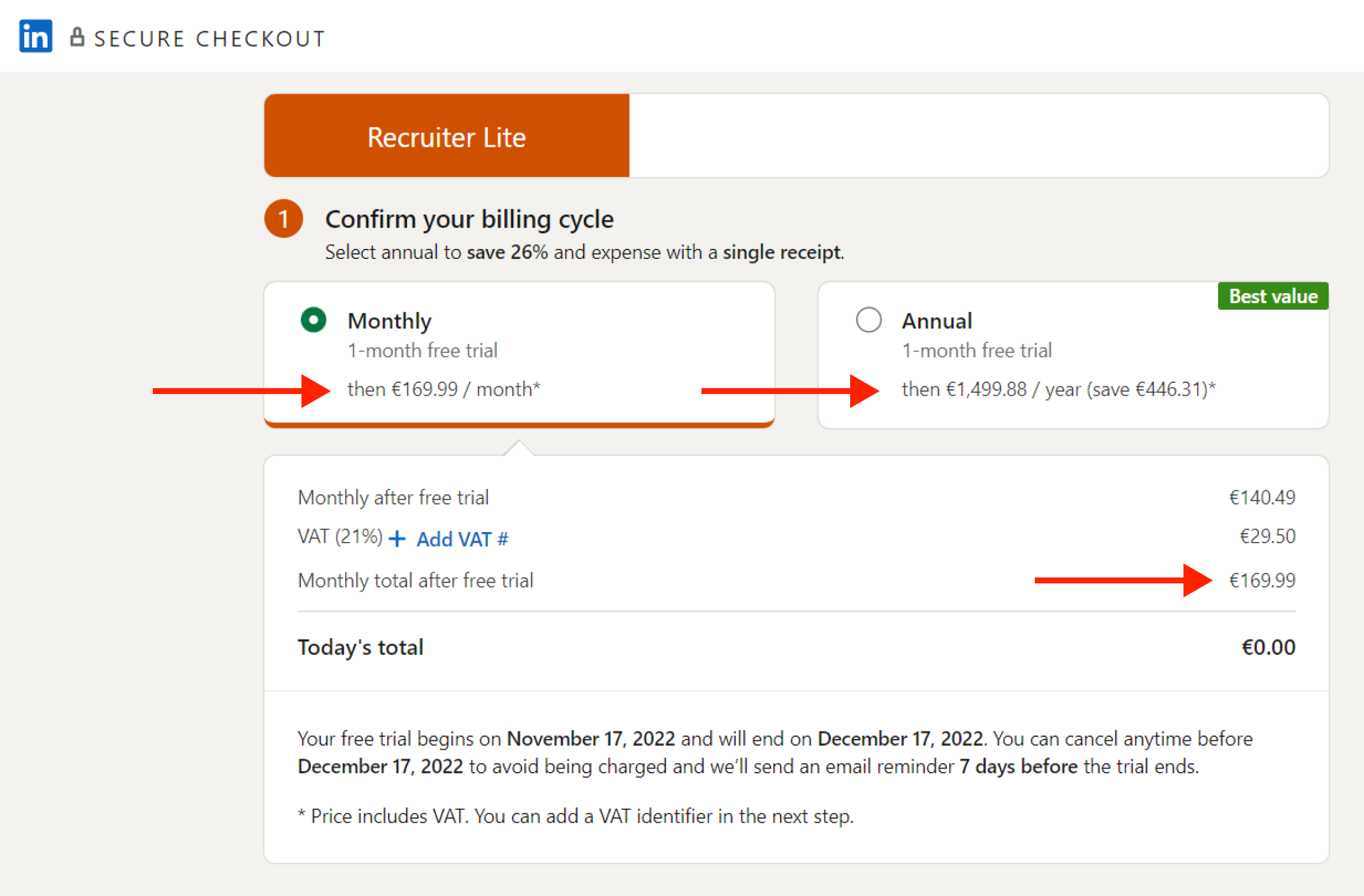
Before you commit to a year, note that Lite is the only Recruiter tier sold self serve, and LinkedIn offers a trial that expires exactly one month after it’s redeemed. Eligibility is not guaranteed for every account, but it is worth checking under Subscriptions & payments in your settings before paying for twelve months up front.
HeroHunt.ai
What $1,680 a year actually buys is a search that stops at your 3rd degree, and no amount of budget moves that line: LinkedIn caps InMail top ups at 70 extra credits a month with no more than 120 held at once, so the constraint you cannot buy out of is reach, not volume. HeroHunt.ai indexes 1 billion profiles across LinkedIn, GitHub and Stack Overflow regardless of who you are connected to, and runs the outreach automatically. The honest caveat: it works over email and public profile data, so it does not drop a message into a candidate's LinkedIn inbox. If your market only ever replies to InMail, you will still want a LinkedIn seat next to it.
What does LinkedIn Recruiter Lite offer?
The main differences between the plans are the amount of search filters, the monthly amount of InMails and how far outside your own network you are allowed to see.
LinkedIn Recruiter Lite is a limited version of the LinkedIn Recruiter product.
With the LinkedIn Recruiter Lite product you get the stripped down version:
- Finds only 1st, 2nd and 3rd degree connections, doesn't show you any profiles outside of your network.
- InMails: 30 InMails every month
- Search: 20+ search filters
- Profile views: capped at 2,000 unique views per day
- Reports: basic InMail and job analytics only
The InMail rules are stricter than the headline number suggests, and this is the limit that actually shapes how you can work. LinkedIn lets you top up with a maximum of 70 extra credits per month, and you can accumulate no more than 120 InMail credits per seat. Credits do not quietly pile up while you wait for a hiring push, so Lite punishes bursty sourcing: you cannot bank six quiet months and then blitz a role.
One correction worth making, because most guides on this topic get it wrong: Recruiter Lite is not strictly single user anymore. LinkedIn sells it as up to 5 licenses on one contract, and projects can be shared with other users on your contract. What you do not get is the full team layer: pipeline, usage and cross contract reporting and ATS integration all stay on Recruiter.
Only with the full LinkedIn Recruiter product can you expect the following (per LinkedIn's plan comparison):
- Find all LinkedIn profiles (also out of your network)
- InMails: 150 InMails every month
- Search: 40+ search filters
- Collaboration: team seats with shared projects, tagging and centralized workflows
- Reports: Jobs and InMail reporting, plus pipeline, usage and custom reporting
There is a middle tier most buyers never hear about: Recruiter Professional Services, the staffing and agency version, which sits between the two at 100 to 140 InMails per seat and buys back a slice of the network limit with 30 to 50 out of network profile unlocks per month rather than full access.
The network limit is the difference that should decide this purchase, not the InMail count. Lite looks like a cheap Recruiter, but it only searches your own 1st, 2nd and 3rd degree connections. If you are sourcing in a market, country or discipline where you have not built a network, Lite will simply not show you the people who are there, and no amount of extra InMail credits fixes that. A well connected recruiter in their home market gets most of Recruiter's value out of Lite. A recruiter opening a new market gets a fraction of it.
What alternatives are there to LinkedIn Recruiter Lite?
LinkedIn Recruiter Lite is a solid option when your ideal candidates are already inside your network, but the 30 InMails per month and the network only search become limiting once you start sourcing at volume.
The two limits recruiters hit first are outreach volume and reach, and they have different fixes. If outreach volume is your constraint, the answer is to stop paying per message. A B2B contact database and email finder like Apollo lets you find verified email addresses and run sequences directly, so you are not rationing a 30 InMail allowance or paying $10 to $15 for the 31st. Its free tier makes it cheap to test against Lite's price point before committing to a year.
Test email outreach against Lite's 30 InMail cap before you commit to $1,680.
If reach is the constraint instead, a contact database does not solve it either, because you still need to find the person first. That calls for a search engine that indexes profiles regardless of who you are connected to. HeroHunt.ai searches up to 1 billion public profiles regardless of who you are connected to and reaches out automatically, which is the same job Lite refuses to do outside your third degree. Plans start at $99 per month with an 8-day free trial (card needed, charged when the trial ends unless you cancel).
Search past your 3rd degree before you commit to a year of Lite.
And if the budget is zero, a free LinkedIn account plus good search technique recovers more of Lite than most recruiters expect, since the profiles themselves are largely public. It is worth learning how to x-ray LinkedIn before you conclude you need a paid seat.
Frequently asked questions
How much does LinkedIn Recruiter Lite cost?
Trackers report about $170 per month or $1,680 per year for one US license, and $270 per month for each of licenses 2 to 5. LinkedIn's plan comparison lists no price.
How much does LinkedIn Recruiter Lite cost in India?
LinkedIn publishes no India price. Internshala reports about ₹8,260 per month as of July 2026 - Internshala. That is a third party figure, not a LinkedIn quote.
What is included in LinkedIn Recruiter Lite?
Each license includes 30 InMail credits per month, 20+ search filters and reach up to your 3rd degree connections - LinkedIn. You can buy up to 70 extra credits a month, but no more than 120 can be held at once.
Is there a free trial of LinkedIn Recruiter Lite?
Some accounts may be eligible for a trial that expires exactly one month after redemption, and LinkedIn requires a credit card to start it - LinkedIn. Lite is billed monthly or yearly, and a cancelled subscription ends at the end of the current billing cycle - LinkedIn. See how to get the trial and how to cancel.
Pricing indications checked September 2026. LinkedIn does not publish Recruiter pricing and negotiates per account, so treat these as ranges to negotiate against, not list prices.