



The insider guide to Mercor: how the AI-training marketplace works, what it really pays, and the alternatives worth your time.
Mercor pays out more than $1.5 million a day to over 30,000 experts, at an average of $85+ per hour - TechCrunch. That is not a gig-economy microtask platform. It is a company whose three founders became the youngest self-made billionaires in the world at 22, riding a wave of demand from OpenAI, Anthropic, and every other frontier lab that suddenly needs doctors, lawyers, bankers, and PhDs to teach their models how to think.
If you are a credentialed professional wondering whether you can earn real money training AI, Mercor is probably the first name you heard. It is also one of the most misunderstood. The marketing promises $200 per hour and six-figure tutoring salaries, while worker forums are full of people who passed the interview, got accepted, and then stared at an empty task queue for three weeks. Both stories are true, and the gap between them is exactly what this guide exists to close.
Here is what you will get: exactly how Mercor works (the AI interview, the matching engine, the payment mechanics), what it actually pays by profession, the reality check that the marketing skips, the funding story that explains why it can afford those rates, the controversies you should weigh before handing over your passport scan, and a ranked breakdown of the best Mercor alternatives in 2026, from DataAnnotation and Outlier to micro1, AfterQuery, and Handshake AI. By the end you will know whether to apply, how to get accepted, and how to build an income that does not evaporate when one project ends.
Mercor
If you are an engineer, clinician, lawyer, banker, or PhD who wants to try this work, Mercor is the highest-ceiling place to start: the company says its experts average $85+ per hour and it pays out over $1.5 million a day, with reliable weekly payouts through Stripe. The honest caveat, so you go in with eyes open: pay is project-based and can be volatile, and the single most common complaint is the empty queue (accepted experts who sit unmatched for weeks), so treat it as variable side income, not a salary. Create your profile and take the AI interview through this link before you apply anywhere else, or the referral will not track.
Contents
- What Mercor Is, and Why It Exploded in 2026
- How Mercor Works, Step by Step
- What Mercor Actually Pays
- The Reality Check: Empty Queues and the Wage-Cut Backlash
- The Money Machine: Funding, Valuation, and Growth
- Controversies and Risks You Should Know
- How to Get Accepted and Actually Earn
- The Best Mercor Alternatives in 2026
- The Other Side: Who Hires This Talent
- The Future: Agentic Data and Where This Goes
1. What Mercor Is, and Why It Exploded in 2026
Mercor is a talent marketplace that rents expert human judgment to the companies building AI. In its own words, it operates "at the intersection of labor markets and AI research," connecting professionals with the frontier labs and enterprises that need them - Mercor. On one side sit the workers: software engineers, physicians, attorneys, investment bankers, consultants, scientists, and PhDs. On the other side sit the buyers: AI labs that have run out of public internet data and now pay for something they cannot scrape, which is the reasoning of people who are genuinely good at hard jobs.
The reason this became a multi-billion-dollar business is a shift in how AI is built. Early models learned from the open web. Modern models learn from proprietary human data: expert-written examples, preference rankings, and evaluations that teach a model the "judgment, nuance, and taste that only humans possess." Mercor's earliest backer framed it bluntly, calling the company a human data provider that exists because developers exhausted public datasets and now need something better - General Catalyst. When a lab wants to make its model better at diagnosing rare diseases or structuring a leveraged buyout, it does not scrape Reddit. It hires a cardiologist and a banker through a marketplace like Mercor.
Two things turned a good idea into a gold rush in 2025 and 2026. The first is that the labs' appetite for this data is close to bottomless, with each major lab now spending on the order of a billion dollars a year on human data. The second is a single deal that scrambled the market: in June 2025, Meta paid $14.3 billion for a 49% stake in the incumbent, Scale AI, and hired away its CEO - TechCrunch. Rival labs like OpenAI and Google immediately pulled back from Scale over the obvious conflict of interest, and that fleeing demand had to go somewhere. It went to neutral vendors like Mercor and Surge AI, which no single lab owns.
Understanding this context matters for you as a potential worker, because it explains both the money and the instability. The money is real: labs are competing for the same experts and bidding up rates. The instability is also real: this is a young, fast-moving market where a single lab's decision to pause a project can end your income stream overnight. Mercor sits at the premium end of this market, focused on credentialed experts rather than commodity labeling, which is why its rates are high and its bar to entry is real.
It helps to be concrete about what "expert data" actually is, because the phrase hides several very different kinds of work. Some is reinforcement learning from human feedback (RLHF), where you compare two model answers and say which is better and why, teaching the model human preferences. Some is supervised fine-tuning data, where you write the gold-standard answer a model should have produced. Increasingly it is rubrics and evaluations, where you decompose "is this a good answer" into dozens of measurable criteria so a model can be graded at scale. Mercor even builds public benchmarks from this work, such as its APEX index measuring model performance on real investment-banking, consulting, law, and medicine tasks. The common thread is that all of it captures how a competent professional reasons, which is exactly the thing labs cannot buy off the shelf, and exactly why they will pay a cardiologist or a litigator by the hour to produce it.
The deepest public explanation of why this business exists comes from founder Brendan Foody himself. In a widely shared 2025 conversation, he walks through why expert-written evaluations became the bottleneck for frontier labs and how that created, in his framing, one of the fastest-growing companies in history. It is the single best hour you can spend before deciding whether to apply.
Why expert AI evals are creating the fastest-growing companies in history
2. How Mercor Works, Step by Step
Getting onto Mercor is a three-step process that is deliberately front-loaded: prove your expertise once, then get matched repeatedly without re-applying. You create a profile, complete an AI-conducted interview tailored to your background, and then get matched to projects. Mercor is explicit that "you don't need any prior AI experience," because the work is about your domain expertise, not machine learning - Mercor. Tasks typically involve reviewing AI outputs, writing training examples, and evaluating quality within your field, whether that field is software engineering, law, medicine, finance, consulting, or cybersecurity.
The centerpiece, and the part that surprises people, is the AI interview. Instead of a human recruiter, an AI voice agent runs a roughly 20-minute video interview (you need a working camera and microphone) that reads your resume, probes your specific skills, and asks follow-up questions - Mercor Talent Docs. It is adaptive rather than scripted: the system dynamically decides what to ask next based on your previous answers, and it is designed to score your reasoning process as heavily as your final answers. You get up to three retakes of any unique interview, and the transcript and score stay attached to your profile.
That persistent score is the mechanism that makes Mercor efficient. Strong candidates become discoverable to hiring managers as Verified Experts, and Mercor operates an Instant Offers system where a good profile can receive work without a fresh application each time. In practice this means the model is closer to "get vetted once, get surfaced many times" than "apply to every job." Mercor's docs describe using AI "to efficiently match experts with projects at scale" and to reduce time-to-match, and the typical wait to hear whether you have advanced is two to four weeks. If you do not get matched in four to six weeks, that silence is usually the rejection.
Day to day, a live project feels less like a job and more like a rolling series of self-contained tasks. You open a workspace, pick up a unit of work (say, a set of model responses to grade against a rubric, or a prompt that needs an expert-written ideal answer), complete it under the time tracker, and move to the next. Instructions come from the lab through Mercor, quality is spot-checked, and consistently strong work tends to earn you more hours and better-paying follow-on projects, while sloppy or slow work quietly dries up. The upside of this structure is real flexibility: you genuinely can do an hour at 6am and two more after dinner. The downside is that there is no manager investing in your growth and no guarantee tomorrow's queue looks like today's, which is why the experienced advice is to treat each project as a short, well-paid contract rather than the start of a stable job.
The worker journey from sign-up to paycheck follows a consistent path, which is worth seeing as a whole before we get into the money.
Once you are selected for a project, onboarding is more corporate than most gig platforms. You verify your identity (Mercor uses a provider called Persona), pass background checks where required, sign agreements, complete tax forms, and set up payment. The experience is genuinely global: Mercor handles international compliance so it can hire experts in dozens of countries, with India historically its single largest talent source, followed by the United States. What that global reach hides is a hard requirement: your payout account must be a bank account in your own name in a supported country.
Most work is paid hourly, and this is where a lot of the friction lives. You track time in a desktop application called Insightful, starting and stopping a timer during project tasks, approved meetings, and webinars, and Mercor is clear that only legitimate time recorded in that app is compensated - Mercor Talent Docs. Some projects are instead milestone or deliverable based. There is a weekly cap on hours to maintain quality, and no universal minimum-hours commitment, which is part of why the platform functions better as flexible income than as a full-time job. The monitoring software is also a recurring complaint, and later a legal one, that we will return to.
One rule catches new experts off guard and is worth understanding before you accept anything: Mercor generally offers one paid work trial across the platform, and accepting a project can invalidate other pending offers, while its passive "Instant Offers" are non-exclusive. In plain terms, your first "yes" is a real commitment, so it pays to be a little selective rather than grabbing the first thing offered. Eligibility itself is broad on paper (Mercor describes needing roughly undergraduate-level expertise, though many roles require professional experience or advanced degrees), and individual projects typically run from a few weeks to a few months with extensions tied to performance. That project-length reality is the mechanical root of the income volatility this guide keeps flagging: you are not hired by Mercor, you are engaged by a project that has a lifespan.
To see the expert side of the marketplace as Mercor presents it, its own site foregrounds the people, not the tasks. The homepage rotates through profiles of the specialists doing the work, a deliberate signal that this is expert labor rather than crowd labor.
The expert side of the Mercor marketplace
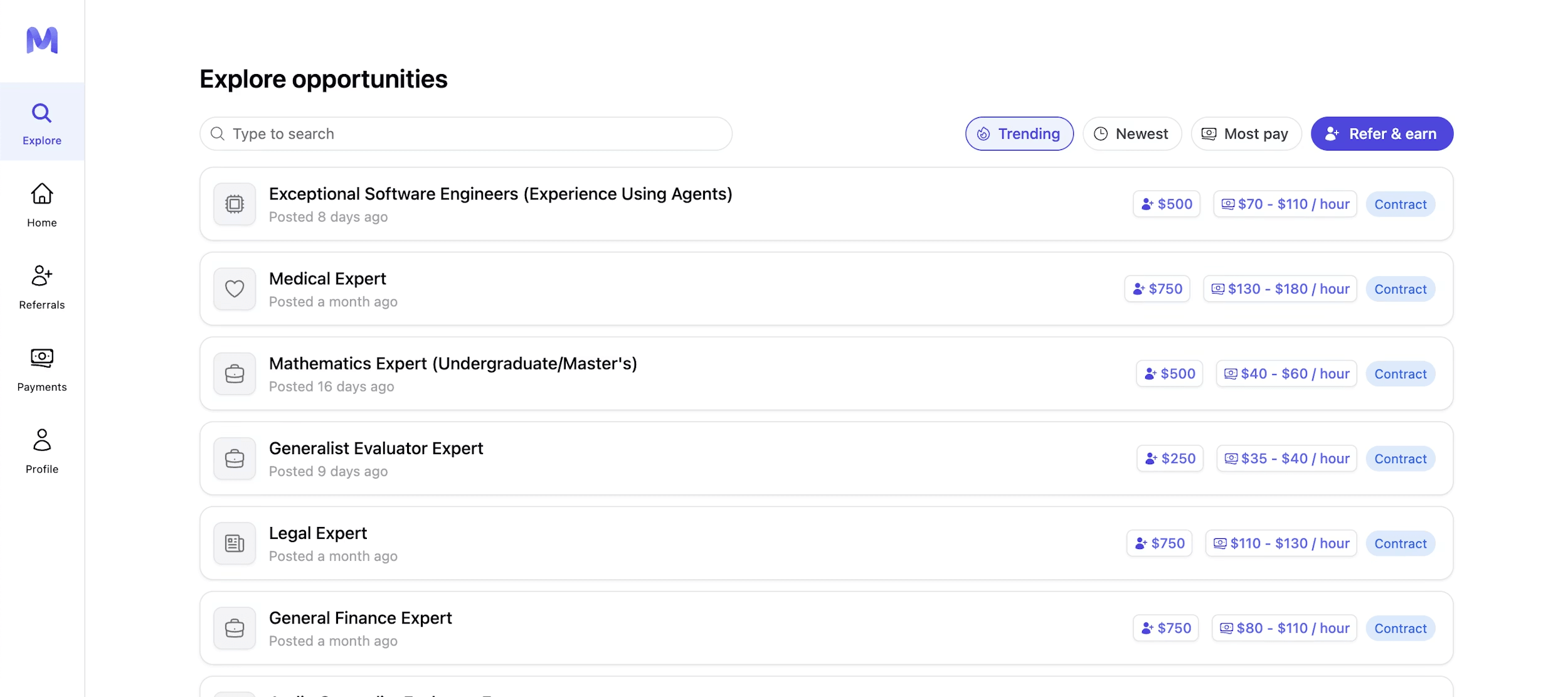
The practical takeaway is that Mercor front-loads its effort. The interview is the gate, and it is a real one, but once you are through it and rated well, the platform is built to bring work to you rather than making you hunt for it. Whether that work actually shows up consistently is the single biggest variable in the entire Mercor experience, and it is the subject of Section 4.
3. What Mercor Actually Pays
Mercor advertises an average pay rate north of $85 per hour, which is genuinely exceptional for remote, flexible work, but the average hides an enormous spread. The company and reputable press consistently cite an average in the low-to-mid $80s, with founder Brendan Foody at one point posting that the average had crossed $100 per hour - Fortune via AOL. Treat the $100 figure as a founder's marketing high-water mark and the $81 to $85 range as the more sober number that outlets like TIME reported in the same period.
You will see several different "average" figures depending on where you look, and it is worth reconciling them so you are not misled. Mercor's own Experts page has advertised an average closer to $115 per hour with a headline band of roughly $60 to $250, TIME cited about $81, Fortune reported $85+, and Foody claimed $100+. These are not contradictions so much as different snapshots and different mixes of who is counted: a fast-growing platform's average pay drifts month to month, and a number weighted toward credentialed specialists will always look higher than one that includes the generalist pool. The safe way to read all of it is to anchor on the $85 press figure as a realistic blended average, treat $115+ as the optimistic marketing number, and remember that your personal rate is set by your credential and the specific project, not by any platform-wide average.
The reason the average is high is that pay scales steeply with credentials and scarcity. Mercor's own resources describe a tiered structure: roughly $12 to $25 per hour for entry-level generalist labeling and basic RLHF, $25 to $53 per hour for specialized RLHF, coding evaluation, and translation, and $75 to $200+ per hour for credentialed professionals such as PhDs, physicians, and attorneys with years of experience - Mercor. The very top of the ladder is real but rare: Mercor advertises Senior Domain Experts at over $200 per hour, equivalent to roughly $400,000 a year, and requires at least four years of professional experience for that tier - TIME.
Concrete numbers by profession help more than tiers. Reporting on Mercor's pay found the company paying primary-care physicians $130 to $170 per hour to review datasets and evaluate outputs, and lawyers $110 to $130 per hour to craft and assess legal questions - Built In. Sales and investment professionals landed around $80 to $120, while chemists, journalists, medical secretaries, and similar roles sat closer to $60 to $80. There are also full-time "tutor" salaries, teaching models specialized domains, reported between $90,000 and $200,000 a year. The chart below shows how steeply the ladder climbs once you clear the generalist tiers.
Mercor advertised hourly pay by role
Those figures are a ladder, not a promise, and reading them correctly is the difference between disappointment and a good decision. The high tiers are gated by verified credentials: Mercor routes a cardiologist to cardiology reviews and an attorney to legal reasoning, and its resources note that "a medical license or bar admission is what gets you in the door." If you are a generalist without a scarce credential, you are competing in the crowded $12 to $30 band, where the effective experience looks a lot more like every other annotation platform. If you hold a professional license or a doctorate, you are in the small pool that Mercor is genuinely built to reward, and the headline rates become achievable.
To understand why the top rates are what they are, look at who is actually doing this work. TIME reported that Mercor's task-creating professionals average about 7.25 years of experience and are drawn from firms like Goldman Sachs, JPMorgan, McKinsey, BCG, Latham and Watkins, and Mount Sinai - TIME. These are people whose day-job hourly value is high, and the whole pitch is that Mercor lets them monetize that expertise on the side without leaving their careers. One former Bank of America analyst now contracting for Mercor put the appeal bluntly: "It's hard to imagine a better hourly job from a pay perspective." For a mid-career professional, $120 to $170 an hour for a few flexible evening hours is a genuinely rare offer, and it is the real reason the platform attracts the caliber of people it does, rather than the viral $200 headline.
The payment mechanics are refreshingly concrete. Payouts are weekly, with a pay period running from Saturday to Friday and payment for the prior week typically processed by end of Wednesday (Pacific), so most people see funds land Thursday. Your first payout carries a Stripe-enforced seven-day hold; after that it settles into a normal weekly cadence with no minimum threshold - Mercor Talent Docs. Payments run through Stripe in most countries, with Wise used where Stripe is unavailable (Mercor lists regions such as Brazil, the UAE, Turkey, Nepal, and Ghana). There is no PayPal, Payoneer, or crypto option, and the account must be in your own name.
One number the marketing never volunteers deserves emphasis, because it reframes everything above. When Mercor reports a $2 billion annualized revenue run rate, that is gross revenue, meaning total customer spend before it pays contractors. Independent research estimates contractors keep roughly 60% to 70% of the top line, with Mercor retaining the rest as its margin - Sacra. For you, the worker, that split is fine, you keep 100% of your own posted hourly rate. But it explains how the company can be worth tens of billions while paying out over a million dollars a day: it is taking a healthy cut of a very large, very fast-growing pie.
4. The Reality Check: Empty Queues and the Wage-Cut Backlash
The single biggest complaint about Mercor is not low pay, it is no work. Across review sites, Reddit, and Trustpilot, the recurring theme is the "empty queue": experts pass the interview, get accepted, and then log in to find nothing to do, sometimes for weeks - TalentsForAI. AI-training projects are finite by nature, tied to a specific lab's specific need, so when a project wraps or gets paused, the income attached to it can vanish with little warning. The strong consensus from experienced workers is to treat Mercor as side income and to keep more than one platform active, precisely so an empty queue never becomes an empty week.
This is not a reason to avoid Mercor, but it is a reason to calibrate expectations. The sentiment is genuinely mixed rather than negative: Mercor's Trustpilot score sits around 4 out of 5 across a few hundred reviews, with the praise consistently landing on the same points, namely reliable and accurate weekly payments, remote flexibility, and interesting expert-level work - Trustpilot. Reviewers routinely say the company "is not a scam" and pays on schedule. The complaints are equally consistent: overstaffed projects where tasks disappear before you can claim them, opaque AI screening with no rejection feedback, use of the Insightful monitoring app, and slow support. Both sides of that ledger are real, and which one you experience depends heavily on how scarce your specific expertise is.
The "is Mercor legit" question that dominates search results deserves a direct answer: yes, Mercor is legitimate, it is a real, well-funded company that pays reliably, and the skepticism is misplaced if it is about getting paid. Where the skepticism is warranted is about consistency and transparency. The AI screen rejects a significant share of applicants with limited feedback, so many people never get past the interview and never learn why. Among those who do get in, the experience bifurcates: scarce specialists describe steady, well-paid work, while generalists more often describe the empty-queue frustration, because there are simply more of them chasing the same lower-tier tasks. Read a batch of reviews with that lens and the apparent contradiction resolves: the platform is not inconsistent so much as it is stratified, and where you land on it depends almost entirely on how rare your credential is.
The episode that crystallized the tension between Mercor's wealth and its workers came in November 2025. Mercor abruptly cancelled a large project (codenamed "Musen," reviewing Meta's Reels content), locked thousands of contributors out of their Slack workspace, and offered rehire on a replacement project at $16 per hour, down from $21, a cut of roughly a third - Forbes. Managers had earlier told workers the project would run through December. The new rate fell below minimum wage in several US states. One worker's quote captured the mood: "It felt like a slap in the face. I know we are working with AI but we don't work for AI." Business Insider reported that some of the same workers had earned up to $60 an hour on earlier Mercor projects, underscoring how much the platform's pay can swing - Business Insider via AOL.
Two details make that story more than a one-off. The first is timing: the wage cut landed within weeks of the three founders becoming billionaires on Mercor's $10 billion funding round, a contrast that turned a routine "project ended" into a national story about who captures the value in the AI economy. The second is Mercor's framing. The company described the role as temporary and project-based, said it had reviewed contributor feedback, and cited "greater earning stability" as a rationale, while its head of communications called the reporting inaccurate. Whether you find that persuasive or not, the underlying mechanic is the thing to internalize: on Mercor, your rate is attached to a project, and projects change.
The practical lesson is not "Mercor is bad," it is "Mercor is a marketplace, not an employer, and you should structure your income accordingly." The workers who do well treat it as one high-ceiling stream among several, keep a diversified set of platforms, and move quickly when a strong project appears because good tasks are claimed fast. The workers who get burned are the ones who quit other income to bet everything on a single Mercor project. Section 7 covers how to be in the first group, and Section 8 covers the alternatives that make diversification possible.
5. The Money Machine: Funding, Valuation, and Growth
Mercor's valuation went from $250 million to a reported $20 billion in under two years, one of the steepest climbs in startup history. The company was founded in 2023 by three friends from the Bellarmine College Preparatory speech-and-debate team, Brendan Foody (CEO), Adarsh Hiremath (CTO), and Surya Midha (COO and board chair). All three are Thiel Fellows who dropped out of college to build it, and, contrary to a common assumption, Mercor was not a Y Combinator company; its seed round was led by General Catalyst - TechCrunch. It started as a way to match freelance engineers in India with US companies before pivoting into the expert-data business that made it famous.
The origin story is almost comically lean, which matters because it explains the company's DNA. The idea came after Foody attended a hackathon in São Paulo and realized he could match companies with skilled engineers abroad and take a cut of the fees - Contrary Research. The first client paid $500 a week for a developer, and the founders took roughly 30%, pairing people by hand over WhatsApp and Google Sheets from their dorm rooms. Hiremath had spent two years at Harvard doing labor-market research for economist Larry Summers, who later became an investor. That the same three people who were manually brokering single developers in 2023 were running a marketplace paying out over a million dollars a day by late 2025 is the whole story in miniature: this is a hand-built matching business that happened to be sitting exactly where the AI industry's demand exploded.
The funding ladder is worth laying out because each rung tracked a real jump in the business. A $32 million Series A in September 2024 (led by Benchmark, with backers including Peter Thiel, Jack Dorsey, and Adam D'Angelo) valued it at $250 million. A $100 million Series B in February 2025, led by Felicis, valued it at $2 billion on roughly $75 million of annualized revenue. Then a $350 million Series C in October 2025, again led by Felicis with Benchmark, General Catalyst, and Robinhood Ventures, valued it at $10 billion, quintupling the Series B in about eight months - Mercor. By July 2026 the company was reportedly in talks to raise around $500 million at a $20 billion valuation - Forbes.
Mercor valuation by round
That last round matters for a specific reason, and it is a fact this guide flags carefully: as of the reporting, the $20 billion valuation was still "in talks," not closed. It reflected a term sheet Mercor said it had received, not a completed round. If it closes, each 22-year-old founder would be worth well over $4 billion. The October 2025 milestone, by contrast, is confirmed: at the $10 billion Series C, the three founders became the world's youngest self-made billionaires - Forbes. Keeping the confirmed and the rumored separate is exactly the kind of discipline the hype around Mercor tends to skip.
The scale of these numbers has already pulled an eventual IPO into the conversation, with Foody calling a public listing "potentially on the horizon." Whether or not that happens soon, the valuation trajectory tells you something useful as a worker: investors are betting that expert human data is a durable, expanding market, not a one-year AI-hype spike. That is broadly good news for pay stability, since a company raising at $20 billion has every incentive to keep its expert supply happy and paid on time. But it also raises the stakes on the risks in the next section, because a company this valuable, this fast, and this dependent on tens of thousands of contractors is exactly the kind of target that attracts lawsuits, regulators, and hackers, all three of which have already arrived.
The revenue trajectory underneath the valuations is the part that is genuinely hard to believe. Annualized gross revenue ran about $75 million at the Series B in February 2025, was "on track to hit $500 million" by the Series C in October, reached roughly $760 million by the end of 2025, crossed $1 billion in February 2026, and then doubled to $2 billion by June 2026 - Dealroom. The chart makes the curve visible in a way the numbers alone do not.
Mercor annualized gross revenue run rate
How does Mercor actually make money on all that revenue? The core engine is marked-up hourly billings: Mercor charges the lab more per hour than it pays the expert, keeping a take rate estimated around 35% on ongoing engagements. It also earns placement fees of roughly 30% of first-year compensation when it places permanent talent, a nod to its recruiting roots. Because its 30,000-plus experts are contractors rather than employees, its fixed costs are low, which is how a two-year-old company reported free-cash-flow profit even while pouring money into growth. Foody's ambition for where this leads is not modest; he has argued that "over time, ChatGPT will be better than the best consulting firm, better than the best investment bank" - TechCrunch. The irony that the bankers and consultants training those models are helping build their own replacements is not lost on anyone, and it is a tension we return to in the final section.
Behind that curve are the founders themselves, whose age and speed became part of the story the moment the billionaire headlines hit. The people building the company that pays doctors and lawyers by the hour are younger than most of their contractors, a fact the press has not been shy about foregrounding.
Mercor's founders
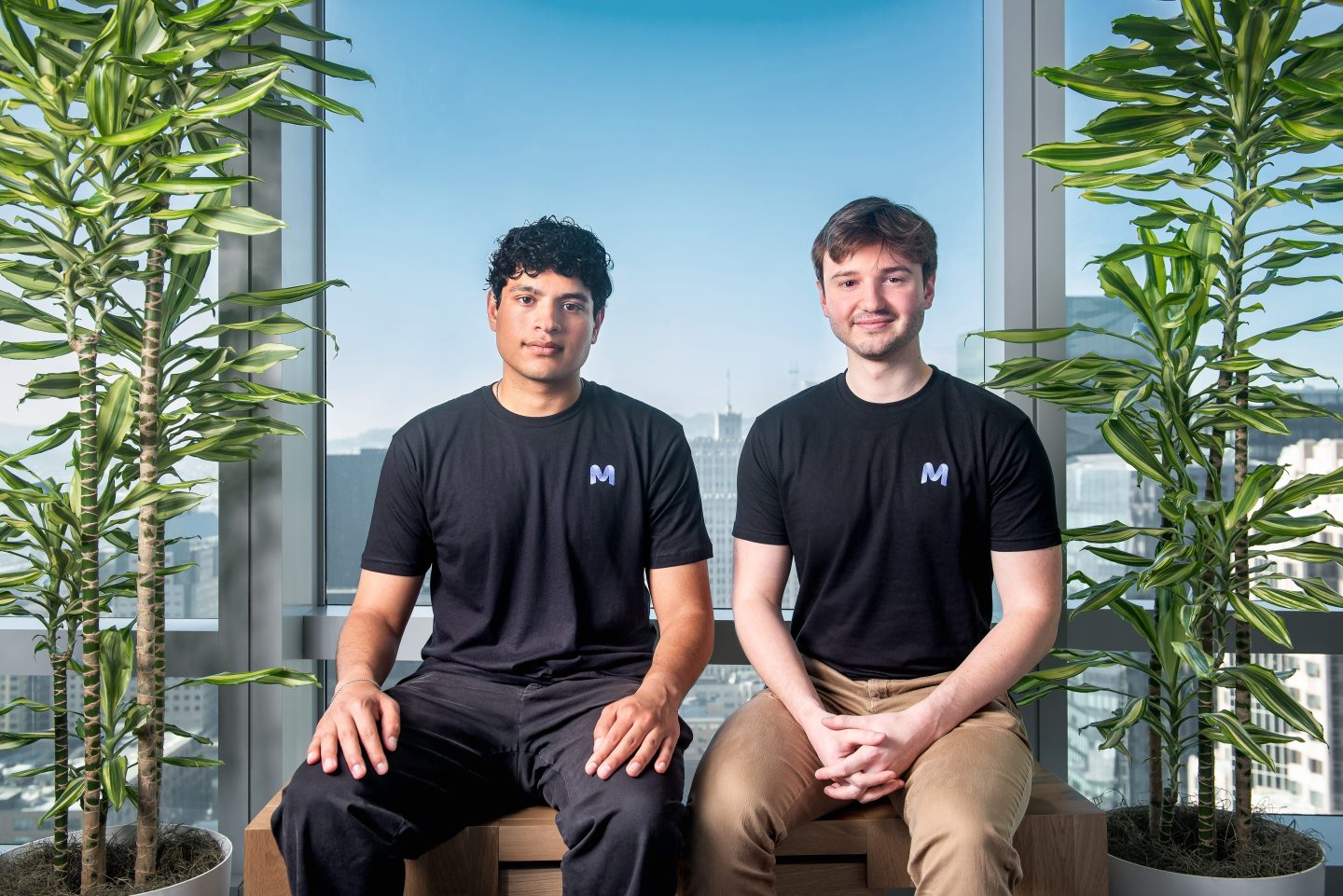
For a worker, the wealth on display is a double-edged signal. On the positive side, a well-funded company on a steep growth curve is far more likely to keep paying reliably and on schedule than a cash-strapped startup, and Mercor's payment reliability is one of the few things nearly everyone agrees on. On the cautionary side, the same growth that produced the billionaires is what makes projects appear and disappear so quickly, and the optics of a wage cut announced days after a billionaire milestone are what turned worker frustration into a legal and reputational problem, which is the subject of the next section.
6. Controversies and Risks You Should Know
Before you upload your passport and Social Security number, you should know that Mercor suffered a major data breach in 2026. On April 2, 2026, the company confirmed a cybersecurity incident stemming from a supply-chain attack on the open-source LiteLLM library; extortion groups claimed to have taken around 4 terabytes of data, including source code and internal communications - Fortune. Multiple reports indicated the exposed data included contractors' full names, emails, work histories, Social Security numbers, passport and ID scans, and video interviews, along with proprietary training methodologies from labs like OpenAI and Anthropic - Halborn. Mercor said it moved promptly to contain and remediate the incident with third-party forensics, but the sensitivity of what Mercor holds on its workers is now a documented risk, not a hypothetical one.
The mechanics of the breach are worth a beat because they show how modern these supply-chain attacks are: a compromised scanning tool led to malicious code being injected into the widely used LiteLLM package, and poisoned versions sat live on the public package registry for roughly forty minutes, long enough to harvest credentials that opened the door to Mercor's systems. The fallout reportedly rippled to the buyer side, with Meta said to have paused work with Mercor and OpenAI opening a review, which is a reminder that a breach at a vendor like this is not just a worker-privacy issue but a business risk that can freeze the very projects paying you. If you sign up, assume your identity documents are now part of a large, valuable, and previously targeted dataset, and act accordingly.
The breach is the most personal risk, but it is not the only legal cloud. In May 2026, a proposed class action, White v. Mercor.io Corp., alleged that Mercor misclassified its roughly 30,000 experts as independent contractors rather than employees - Troutman Pepper Locke. The complaint points at exactly the mechanics described earlier in this guide: Mercor sets pay, dictates availability, monitors screens through a mandatory app, trains and supervises, and offboards underperformers, all hallmarks of an employer relationship. These are allegations only, with no findings made, but they matter to you because the outcome could reshape how the work is structured, taxed, and benefited. For now, you are a 1099 contractor responsible for your own taxes, with no benefits.
Mercor has also been on the receiving end of a corporate-espionage lawsuit from the incumbent it is disrupting. In September 2025, Scale AI sued Mercor and a former Scale executive, alleging he downloaded more than 100 confidential documents to a personal account before joining Mercor - WinBuzzer. Mercor co-founder Surya Midha said the company had "no interest in any of Scale's trade secrets" and offered to have the files destroyed, which Scale characterized as evidence tampering. This one is less about worker risk and more about the knife-fight competitive dynamics of a market where labs are switching vendors and poaching is rampant, but it is part of the picture of a company moving very fast in a contested space.
There is also a quieter, structural risk that no lawsuit captures: conflict and exclusivity are handled informally. Because experts often come from the exact firms whose knowledge labs want, Mercor's safeguard against IP theft is essentially a rule that contractors "are instructed not to upload documents from their former workplace," with Foody conceding that at scale "there are things that happen" - TechCrunch. If you are a working professional moonlighting on Mercor, you are personally responsible for not walking your employer's confidential material into a training set, and the platform's protection here is guidance, not a technical guardrail.
None of this means you should not use Mercor, and it is worth being fair: a fast-growing company that touches sensitive data and 30,000 contractors is a large attack surface and a natural lawsuit magnet, and some of these issues are industry-wide rather than unique to Mercor. But it does mean you should go in informed. Use a dedicated email, understand that your identity documents will be on file at a company that has already been breached once, keep your own records of hours and pay for tax time, and never upload anything that belongs to a current or former employer. Weighed against pay that can genuinely reach $100+ an hour, these are manageable risks, but only if you actually manage them.
7. How to Get Accepted and Actually Earn
The people who earn well on Mercor treat the AI interview as the whole game, then treat matching as a numbers game. Getting accepted comes down to two things you control: a resume that clearly signals a scarce, verifiable credential, and an interview performance that shows your reasoning out loud. Because the AI scores your problem-solving process as heavily as your conclusions, the worst thing you can do is give clipped, confident-sounding answers with no visible thinking. Talk through how you would approach the problem, name the tradeoffs, and correct yourself when you notice an error; that is precisely the behavior a model-training company is measuring for.
Preparation should be specific to your domain and honest about your credential. If you are a licensed physician, attorney, CPA, or a PhD in a technical field, lead with that, because it routes you to the high-paying tiers and is genuinely scarce. If you are a strong generalist without a licensed credential, you can still get in, but you should target the coding, evaluation, and language tracks where demonstrated skill substitutes for a license, and you should calibrate your expectations to the mid tier rather than the $200-an-hour headlines. Either way, a clean, current resume in PDF form matters, because the AI reads it directly and builds the interview around it.
The interview itself rewards a few concrete behaviors. Treat the camera and microphone check as non-negotiable, because a technical failure is one of the few things that can tank an otherwise strong session, and it is also the only situation where support may grant an extra retake beyond your usual three. Do a genuine practice run first so you spend your best attempt on your best performance rather than burning it on nerves. During the interview, resist the instinct to answer like a quiz; instead, narrate your reasoning, state assumptions, weigh alternatives, and revise openly when you spot a flaw, because the system is explicitly scoring your problem-solving process. And answer as your real, specialized self rather than a generic professional, since the adaptive AI probes deeper on whatever expertise you signal, and depth in a narrow area beats breadth across many.
Once you are in, a handful of habits separate people who earn steadily from people who churn out frustrated. The most important is diversification, because the empty queue is a structural feature, not a bug you can fix.
- Stack two or three platforms so a paused Mercor project never zeroes your week
- Move fast on new projects, since strong tasks get claimed quickly on overstaffed rosters
- Keep your profile and score current, because Instant Offers surface the best-rated experts first
- Log time honestly in Insightful, as only tracked, legitimate time is paid
- Track your own hours and pay for 1099 taxes, since you get no employer withholding
Those habits sound mundane, but they map directly onto the failure modes documented earlier. Diversification is the answer to project volatility. Speed is the answer to overstaffed queues. An up-to-date, well-scored profile is the answer to passive matching, which rewards the top of the list and ignores the rest. And disciplined record-keeping is the answer to the reality that Mercor is a marketplace paying you as a contractor, not an employer managing your taxes. The workers who internalize that they are running a tiny business, rather than holding a job, are the ones who make this pay.
A final tactical note: apply through a referral link before you start any applications, because Mercor's referral attribution keys off your first touch, and it costs you nothing while supporting the people (like this guide) who help you navigate the platform. Then apply broadly across the credible platforms in the next section, because the strongest earners are almost never single-platform loyalists. They are experts who let several marketplaces compete for their hours and take the best-paying work available in any given week.
8. The Best Mercor Alternatives in 2026
No serious AI-training worker relies on one platform, and several Mercor alternatives are excellent depending on your credential and how open the front door is. The landscape splits into three groups: high-end expert marketplaces that compete directly with Mercor for credentialed professionals, broader annotation platforms open to generalists, and adjacent networks for research or freelance work. The right mix for you depends on whether you hold a scarce credential (which unlocks the expert marketplaces) or are building from a generalist base (which favors the open platforms). The comparison table below is the quick version; the profiles that follow add the detail.
| Platform | What it is | Typical pay | Openness | Best for |
|---|---|---|---|---|
| Mercor | Expert marketplace for AI labs | $85+/hr avg, to $200+ | AI-interview gated | Credentialed experts |
| DataAnnotation | Surge AI's worker-facing arm | $20-40+/hr | Open, assessment | Generalists starting out |
| Outlier | Scale AI's contributor platform | $15-60/hr | Open, assessment | Coders, STEM generalists |
| Handshake AI | Campus-graph expert engine | ~$100-125/hr | US students/grads | US grads and PhDs |
| micro1 | AI-vetted talent engine (Zara) | $25-95/hr, to $200 | AI-interview gated | Engineers, always-on work |
| AfterQuery | Elite expert-data startup | $40-150+/hr | Credential gated | Specialists, PhDs |
| Prolific | Research-participant panel | ~$8-15/hr | Fully open | Anyone, low commitment |
Reading the table, the pattern is that pay and selectivity move together. The platforms that pay the most gate the hardest, usually through an AI interview or a credential check, while the platforms that are easiest to join pay the least. A smart portfolio usually pairs at least one gated expert marketplace (for the ceiling) with one open platform (for the floor of steady work), and the profiles below explain how each one differs from Mercor in practice.
DataAnnotation.tech
DataAnnotation is the most common on-ramp into this world, and it is quietly the worker-facing arm of Surge AI. Forbes confirmed that Surge, the bootstrapped RLHF giant, recruits its roughly one million gig workers through the DataAnnotation.tech brand without displaying the Surge name - Forbes. You join via a skills assessment rather than a video interview, which makes it far more open than Mercor. Pay starts around $20 per hour and rises to $40 and beyond for specialized coding, STEM, and professional tasks. Compared to Mercor, DataAnnotation offers steadier generalist hours and an easier door, but a lower ceiling and less of the elite-expert work.
Outlier (Scale AI)
Outlier is Scale AI's contributor platform, and it is the cautionary tale of what vendor instability does to workers. It is open to new applicants via a skills assessment, with pay commonly cited from $15 to $25 per hour for generalist RLHF up to $30 to $60 for coding and expert-tier work - AI Gig Jobs. The catch is the parent company: after Meta's $14.3 billion investment triggered a client exodus, Scale laid off staff and terminated contractors, and Outlier's queues and rates became notably more volatile through 2025 and 2026. It remains a legitimate way to earn, but it is the clearest example of why you should never depend on a single platform whose fortunes hinge on one lab's decisions.
Handshake AI
Handshake reinvented itself from a campus job board into a billion-dollar training-data engine, and its edge is its credential graph. After "re-founding" around AI data in early 2025, Handshake AI crossed roughly $1.1 billion in annualized revenue by 2026 - UpStarts Media. It uses a decade of campus relationships to source vetted graduate students, PhDs, and recent grads, with reported rates around $100 to $125 per hour for experts, paid weekly. The important limitation for many readers: Handshake AI is gated to US-based applicants with valid work authorization, which is a sharp contrast to Mercor's global pool. If you are a US student or recent PhD, it is one of the best-paying options available.
micro1
micro1 is the closest structural twin to Mercor: an AI recruiter vets you upfront, then keeps you working. Its AI interviewer, "Zara," runs a conversational assessment much like Mercor's, and the company raised $35 million at a $500 million valuation in September 2025 while scaling ARR from about $7 million to $50 million that year - TechCrunch. Reported pay runs roughly $25 to $95 per hour, reaching $200 for frontier AI and ML work, and micro1 markets itself hard on "always work" availability, which is a direct answer to Mercor's empty-queue problem. If you want a Mercor-style experience with a stronger emphasis on consistent hours, micro1 is the first alternative to try.
AfterQuery
AfterQuery is the elite-specialist play, a Y Combinator-backed startup that captures how top professionals reason. It raised $30 million at a $300 million valuation in April 2026, barely fourteen months old, having already surpassed $100 million in ARR with a network of nearly 100,000 developers, attorneys, and other professionals - SiliconANGLE. It is effectively gated to credentialed specialists and focused on higher-pay, deeper-reasoning tasks than commodity labeling, with specialist tracks reported well into the low hundreds per hour. For a PhD or licensed professional building a portfolio of expert-data gigs, AfterQuery belongs on the shortlist alongside Mercor.
Terac and Braintrust
Terac and Braintrust round out the credentialed-expert options with different twists. Terac verifies domain experts through a short conversational-AI voice screen and matches them to both AI-lab evaluation work and market-research studies, with sign-up handled via LinkedIn - Terac. It is a good fit if you want AI work plus paid expert consultations, and you can apply through Terac. Braintrust is a token-based talent network where you keep 100% of your posted rate because the client pays the platform fee, with AI-training work spanning roughly $25 to $60 per hour for RLHF up to $75 to $200 for AI code review; it targets experienced professionals rather than beginners, and you can join Braintrust with a resume-grade profile. Both are smaller than Mercor but genuinely competitive on pay for the right specialist.
Turing, Prolific, and the broader field
Beyond the direct competitors sit a wider set of platforms worth knowing, each serving a different niche. Turing runs an "AGI Advancement" division supplying coding and reasoning trainers to labs including OpenAI, and it raised $111 million at a $2.2 billion valuation in March 2025 on the back of a large software-staffing business - Tech Startups. Prolific is a fully open research-participant marketplace that enforces a minimum around $8 per hour and typically pays $10 to $15, useful as an easy, low-commitment floor rather than a serious income - Prolific. Others include Toloka (now recruiting through "Mindrift," backed by a $72 million Bezos-led round), Labelbox's Alignerr, Invisible Technologies, Sapien, and the degraded remnants of Remotasks.
Each of those deserves a one-line reality check, because their names come up constantly in this space. Surge AI, the profitable giant that owns DataAnnotation, does hire directly for premium work (its coding and software-engineering contractor pages advertise $100 to $150+ per hour), but direct Surge contracts are invite-only and highly selective, so most people reach Surge only through DataAnnotation. Toloka/Mindrift is globally open with no approval gate but spans everything from true microtasks paying cents to expert tracks near $90 an hour, so your experience depends entirely on which tasks you qualify for. Alignerr (Labelbox's payment and recruiting arm) is free to join and advertises $20 to $120 per hour across roles, but you apply project by project and workers frequently report high advertised rates against near-empty boards. Invisible Technologies runs more like project employment, with AI-trainer roles reported around $65 an hour but inconsistent flow. And Remotasks, once the default entry point, has degraded into region-restricted, bottom-of-market labeling paying a few dollars an hour, and is best skipped in 2026.
The practical way to use this list is to build a two-tier portfolio rather than to pick a single winner. Anchor the high end with one or two gated expert marketplaces that match your credential (Mercor, micro1, AfterQuery, or Handshake if you are a US grad), and anchor the floor with one open platform (DataAnnotation or Outlier) that gives you something to do when the expert queues run dry. If tracking dozens of platforms and their live pay ranges sounds like a full-time job in itself, the aggregator AITraining.jobs maintains a live index of AI-training roles across more than 35 platforms with what each one actually pays, which is the fastest way to see where the best-paid work is this week. Diversification is not a hedge here; it is the entire strategy.
9. The Other Side: Who Hires This Talent
To understand Mercor as a worker, it helps to see who is on the other side of the table paying the bills. The buyers are the frontier AI labs themselves, OpenAI, Anthropic, Google, Meta, and xAI, plus a growing set of enterprises building AI products. Reporting indicates these labs now spend on the order of a billion dollars a year each on human data, and after the Meta-Scale controversy they deliberately spread that spend across multiple neutral vendors rather than concentrating it in one - TechCrunch. The industry shorthand is "keep the brain in-house, rent the hands": labs keep their researchers and stack their human-data buying across Surge, Mercor, Handshake, Turing, and others.
This buyer's-eye view explains the volatility you feel as a worker. When a lab reallocates its budget from one vendor to another, or pauses a project because its research priorities shifted, thousands of contractors downstream feel it as an empty queue. It also explains the relentless demand: as long as labs are racing to build smarter models and are willing to pay for expert reasoning they cannot scrape, the appetite for credentialed humans is structural, not a fad. The worker who understands the buyer's incentives can read the market, following the money toward the domains labs are investing in (reasoning, coding, medicine, law, evaluations) and away from the commodity labeling that AI is increasingly automating.
It also helps to see how buyers stratify the workforce, because it tells you where to aim. At the bottom are crowd labelers doing commodity annotation for $12 to $15 an hour, the tier most exposed to automation. Above them sit RLHF annotators and then domain experts, the band where Mercor concentrates. Higher still are evaluators and verifiers, the fastest-growing category, because as models improve, the scarce skill becomes judging whether an answer is actually correct rather than producing a labeled example. At the top are red-teamers and environment engineers who design the simulated worlds used to train AI agents, roles that command salaries well into the low hundreds of thousands. The clear career move for anyone serious about this work is to climb that ladder, from labeling toward evaluation and environment design, where both the pay and the durability concentrate.
There is a mirror-image labor market on the buyer side, too: the same AI-first hiring logic that Mercor applies to gig experts is reshaping how companies recruit full-time staff. The marketplaces themselves build recruiter tooling (micro1's Zara, Braintrust's AIR interviewer), and a wider category of AI sourcing tools helps companies find and reach candidates at scale. Platforms like HeroHunt.ai search across more than a billion profiles and use language models to screen and reach out to candidates automatically, the sourcing-side counterpart to what Mercor does on the gig side. If you are curious how labs and enterprises actually find this talent, HeroHunt's own guide to hiring AI-training talent maps the buyer side in detail.
The takeaway for a worker is strategic, not just informational. You are selling into a market with a handful of enormous, well-funded buyers who are competing for scarce expertise and who move their budgets around constantly. That competition is why rates are high. The budget movement is why any single stream is fragile. Both facts point to the same conclusion this guide keeps returning to: sell your expertise to several buyers at once, and never let one lab's roadmap decide your income.
10. The Future: Agentic Data and Where This Goes
The next phase of this work is shifting from labeling text to building the environments that train AI agents, and it will change what Mercor pays for. The frontier is no longer just ranking two chatbot answers; it is constructing realistic, reinforcement-learning environments and verifiers, simulated worlds where an AI agent attempts a multi-step task and a human-designed system grades whether it succeeded. Foody frames this "agentic data" as the next leap in how models are trained and benchmarked, and Mercor's July 2026 acquisition of the agent-training startup Deeptune was a direct bet on it - TechCrunch. Mercor, Surge, and a handful of others are racing to own this emerging layer, where the moat is the neutrality and quality of the environments rather than the raw headcount of labelers.
You can already see this shift in what Mercor builds publicly. It has released a string of expert-built benchmarks (APEX, testing models on real banking, consulting, law, and medicine tasks; a consumer index called ACE; and an APEX-Agents benchmark measuring how well AI agents complete long-horizon professional tasks), each assembled with hundreds of the same domain experts who take on paid projects. The through-line is that the unit of work is getting more sophisticated: from "label this" to "score this against a 29-point rubric" to "design the environment and the verifier that decide whether an agent succeeded." For a worker, that is the single most important trend to track, because it is simultaneously compressing pay at the bottom and lifting it at the top, and which end you experience is largely a choice about which skills you invest in.
For workers, this shift is both a threat and an opportunity, and reading it correctly is how you stay employable. The threat is that the bottom of the market, simple labeling and basic RLHF, is exactly what AI is getting good at automating, which will keep compressing rates for commodity work. The opportunity is that the top of the market, designing hard tasks, writing rigorous verifiers, red-teaming agents, and evaluating expert reasoning, is getting more valuable, not less, because those judgments are precisely what a model cannot yet make about itself. The experts who move up the value chain, from labeling toward evaluation and environment design, are moving toward where the pay and the durability are.
Foody's fuller vision is worth hearing directly, because it explains why he believes this is a decades-long shift rather than a temporary boom. In a 2026 Stanford talk, he lays out how agentic data and expert evaluation become the durable inputs to AI progress, and what that means for the future of professional work.
Brendan Foody (Mercor): Agentic Data and the Future of AI
The honest uncertainty is where this leaves the workers Mercor depends on. One reading is optimistic: as models get more capable, they need harder, more expert human data to keep improving, and the ceiling for genuine specialists keeps rising. Another reading is more sober: the same companies paying you today are explicitly building systems to do more of this work automatically, and the "new category of work" Foody describes may be a bridge rather than a destination. Both readings argue for the same behavior. Get in while the pay is exceptional, climb toward the expert and evaluation tiers that resist automation, keep your income diversified across platforms, and treat this as a high-yield chapter rather than a permanent career.
Written by Yuma Heymans (@yumahey), who built HeroHunt.ai, the AI recruiter that sources talent from over a billion profiles. He has spent years mapping the AI-training labor market that platforms like Mercor now dominate, from both the worker and the buyer side.
Conclusion: Is Mercor Worth It in 2026?
Mercor is worth it if you have a scarce credential, treat it as one income stream among several, and go in with clear eyes about the volatility. For a licensed physician, attorney, engineer, or PhD, it is one of the best-paying remote opportunities in existence, with a credible average above $85 per hour, reliable weekly payouts, and access to genuinely interesting work at the frontier of AI. The AI interview is a real gate, but a fair one, and the platform is built to bring work to well-rated experts rather than making them hunt. If you clear the bar into the expert tiers, the headline rates are achievable.
The decision framework is straightforward once you strip away the hype. If you hold a scarce professional credential, apply to Mercor and to a second gated marketplace like micro1 or AfterQuery, and treat DataAnnotation or Outlier as your steady floor. If you are a strong generalist without a license, start with the open platforms to build a track record, and target Mercor's coding and evaluation tracks rather than expecting the $200-an-hour tier. In every case, keep two or three platforms active, because the empty queue is structural and diversification is the only real protection against it.
Weigh the risks honestly rather than dismissing them. Mercor has been breached once, faces a worker-misclassification suit, and pays you as a contractor with no benefits and no withholding, so use a dedicated email, keep your own records, and never upload anything that belongs to an employer. But measured against pay that can reach into the hundreds per hour and a market that is still growing at a pace few companies in history have matched, those are risks to manage, not reasons to walk away.
Ready to test the highest-paying tier of AI-training work? Set up your Mercor profile, take the 20-minute AI interview, and let the matching engine surface projects in your field. Then stack a second platform so an empty queue never means an empty week.
The bigger picture is that Mercor is a symptom of something real: for the first time, the AI industry is paying professionals well for the one thing machines still cannot replicate, which is expert human judgment. That window will not stay open forever, and the smartest move is to walk through it now, climb toward the expert and evaluation work that resists automation, and let several buyers compete for your hours while the competition is this fierce.
This guide reflects the AI-training and expert-data landscape as of August 2026. Pay rates, funding figures, and platform policies change quickly (the $20 billion valuation, for example, was in talks and not closed at publication), so verify current details before applying or relying on any single number.