




What an AI engineer really costs in 2026, line by line: salary, taxes, benefits, fees, visas, tools, compute and the risk of losing them
A $200,000 AI engineer costs about $280,000 in year-one cash, or $320,000 through an agency. That assumes a hire at the US median base salary for machine learning engineers, recruited either in-house or through a contingency agency, and it works out to 1.4x to 1.6x the salary before a single share of equity is counted, and about 1.65x to 1.85x once it is. The salary line that ends up in the offer letter is the part of the bill everyone negotiates, and it is also the part that tells you the least about what the hire will actually cost.
The problem is that almost every "cost to hire" number in circulation is either stale, averaged across the wrong population, or missing half the stack. The widely repeated $4,129 cost per hire is a SHRM figure from fiscal 2015. The "fully loaded cost is 1.25x to 1.4x salary" rule of thumb fits mid-wage staff, not engineers whose pay sits above the Social Security wage cap. The "AI engineers earn a 56% premium" headline compares job ads across every occupation worldwide, not AI engineers against software engineers. And none of these numbers include the things that now dominate an AI hire's real cost: the agency fee on a $200,000+ base, the interview hours of your most expensive engineers, a visa regime that changed four times in twelve months, per-engineer AI tool and token budgets, GPU time, and the real risk that a lab with a bigger equity pool poaches your hire in month seven.
This guide rebuilds the number from the ground up with 2026 data. It starts with the short answer and a reference budget, then works through each layer of the cost stack: what AI engineers are paid across five very different markets, the employer on-costs that sit on top, the hiring process itself, immigration, hiring outside the US, the post-hire costs of ramp, tools and compute, retention, and the frontier-lab extreme where packages run to nine figures. It closes with how AI agents are changing the cost on both sides of the table, and four worked budgets you can adapt. Where a platform genuinely lowers a cost line, including HeroHunt.ai for in-house AI sourcing, it is named with its real price and its limits, like every other option.
Written by Yuma Heymans (@yumahey), founder of HeroHunt.ai, the AI Recruiter used by 15,000+ recruiters to find candidates and reach out on autopilot. A former management consultant at Bain and KPMG, he has been building AI recruitment tools since 2021, including the kind of in-house sourcing automation this guide weighs against agency fees.
Contents
- The Short Answer: What an AI Engineer Really Costs in 2026
- The Salary Line: Five Markets Behind One Job Title
- The Fully Loaded Cost: Taxes, Benefits, Equity and Overhead
- The Hiring Bill: Agencies, Interviews, Tools and Time
- Visas and Immigration: The $100,000 Question
- Hiring Outside the US: Global Costs, EOR and Contractors
- After Day One: Ramp Time, AI Tools and Compute
- The Cost of Losing Them: Retention, Turnover and Bad Hires
- The Frontier Extreme: Nine-Figure Offers and Acqui-Hires
- How AI Agents Are Changing the Cost to Hire
- Four Real Budgets and How to Cut Them
- The Bottom Line
1. The Short Answer: What an AI Engineer Really Costs in 2026
The true year-one cost of a US AI engineer is 1.4x to about 1.85x the base salary, and the multiplier depends far more on how you hire than on what you pay. For an engineer at the all-levels market-median base of $200,000, payroll taxes, health insurance, retirement match, equipment and AI tools add about $45,000 (22%). The hiring process adds another $4,000 to $5,000 of internal cost if you recruit in-house, or $40,000 to $57,500 if a contingency agency makes the placement. A median-sized sign-on bonus, which about a quarter of ML/AI offers include, adds $30,000. Equity, which most budgets leave off entirely, adds whatever your grant is worth: roughly $52,000 a year at the Levels.fyi US median for a machine learning engineer.
The reason this matters is that the cheapest-looking decisions often carry the largest hidden costs. A lower salary offer that loses the candidate to a competing offer resets a 75-day search and restarts the vacancy clock. An agency fee that feels like a convenience is usually larger than every other hiring-process cost combined. A visa route that looks routine can swing by $100,000 depending on a court ruling. The purpose of breaking the cost into layers is to see which of these levers you actually control.
The reference budget below uses one concrete hire so every number can be traced. It assumes an AI engineer in California at the Levels.fyi all-levels US median base of $200,000 for machine learning engineers - Levels.fyi, a median-sized ML/AI sign-on bonus, an average employer health plan, the average 401(k) match, standard AI tooling, and a typical interview loop. Items marked as assumptions are labelled so you can swap in your own figures.
| Year-one cost line (reference hire) | Amount | Basis |
|---|---|---|
| Base salary | $200,000 | Levels.fyi US ML engineer median base |
| Sign-on bonus | $30,000 | Pave: ML/AI median sign-on = 15% of base |
| Employer payroll taxes (CA) | $15,166 | Social Security to $184,500 cap, Medicare incl. sign-on, FUTA with CA's likely credit reduction, CA UI/ETT |
| Health insurance | $14,432 | Aon 2026 employer cost per employee |
| 401(k) match | $9,400 | Vanguard 2026 average promised match, 4.7% of pay (assumes full take-up) |
| Laptop, AI seats, agent usage | $5,746 | MacBook Pro over 3 years, Claude + Cursor seats, $200/mo usage |
| Interview time, assessments, checks | $4,326 | ~26 interviewer hours at $150/h (assumption), CodeSignal, Checkr |
| Year-one cash, in-house | $279,070 | 1.40x base |
| Contingency agency fee (20% of base) | $40,000 | Optional: 15-25% of base or 20-25% of first-year cash is typical |
| Year-one cash, via agency | $319,070 | 1.60x base |
| Equity at grant value (not cash) | ~$52,000 | Levels.fyi US ML engineer median annual stock grant ($51,900) |
Three things stand out in this table. First, the on-costs that people usually argue about (taxes, benefits, retirement) are a smaller share of pay for AI engineers than for most staff, because Social Security stops at $184,500 and health insurance is a fixed dollar amount rather than a percentage. Second, the single largest discretionary line after salary is the agency fee, and it is entirely a function of how you source. Third, equity is real money even when it is not cash: it dilutes your cap table, it triggers employer Medicare tax when RSUs vest, and at frontier labs such as OpenAI it is the majority of the package.
The chart below shows the same reference hire through an agency, so you can see how large each layer is relative to the others.
Year-One Cash Cost of a $200K AI Engineer Hired via Agency
Read the chart as a map of leverage rather than a map of spend. Salary is the biggest bar, but it is also the least negotiable once you have decided the level and the market you are competing in. The agency fee and the sign-on bonus are the second and third biggest bars, and both are choices: a strong in-house sourcing process removes the first, and a fast, well-calibrated offer process reduces how often you need the second. The statutory lines are fixed by law, and the tooling line is small today but is one of the fastest-growing costs in the stack, as section 7 explains.
There is also a set of costs that never shows up on an invoice but shows up in your results. The diagram below separates the visible costs from the hidden ones across the full life of a hire.
The left and middle branches are budgetable, and most of this guide is about pricing them precisely. The right branch is where the largest numbers hide. Using a simple salary-equivalent method (the role is worth at least what you pay for it, an assumption), the 75-day median time to fill a technical role that Ashby measures in its 2026 benchmarks represents roughly $41,000 of foregone capacity on a $200,000 seat - Ashby. Gallup estimates the cost of replacing an employee at one-half to two times annual salary, which on the same seat is $100,000 to $400,000 per departure. Those numbers are why the cheapest hire is usually the one you do not have to repeat.
How to apply this: build your own version of the table before you open the requisition, not after the offer is signed. Decide the level and market first (section 2), then price the on-costs (section 3) and the sourcing route (section 4), and only then set the offer range. Teams that reverse the order tend to anchor on a salary number, discover the true cost later, and then cut the parts of the process that protect the hire, such as a proper interview loop or a competitive offer.
2. The Salary Line: Five Markets Behind One Job Title
There is no single market rate for an AI engineer in 2026: there are at least five markets sharing one title, and the gap between the bottom and the top is more than 6x. A federal wage survey, a crowd-sourced comp database, a bank's pay-transparency posting, a Big Tech leveling ladder and a frontier lab's job listing will give you five different answers, and each is correct for its own population. The first job in budgeting is to decide which of these markets you are actually hiring in.
The broadest measure is the government's. The US Bureau of Labor Statistics puts the median wage for computer and information research scientists, the federal occupation closest to AI and ML research, at $140,300 in May 2025 - BLS. Software developers sit at $135,980. These are straight-time wages that exclude equity and non-production bonuses, so they are a floor for non-tech employers rather than a benchmark for anyone competing with tech companies. They also cover a tiny population: only 37,200 people hold the research scientist code, against almost 1.7 million software developers.
The crowd-sourced data tells a very different story, and the title you put on the job ad changes the answer more than most people expect. On Levels.fyi, the US median total compensation for the title "Machine Learning Engineer" is $280,000, with a median base of $200,000 and a 90th percentile near $498,000. The title "AI Engineer" has a median of just $154,000, below the all-software-engineer median of $195,000, with a median stock grant of zero - Levels.fyi. The likely explanation is not that AI engineers are underpaid. It is that "AI Engineer" is now used by many non-tech employers for applied roles that wire models into products, while "ML Engineer" skews toward companies that train and serve models at scale. The chart below lines these medians up against the Big Tech and frontier-lab tiers, so you can see the full spread in one view.
What "AI Engineer" Pays Depends on Which Market You Are In
The chart makes the budgeting problem concrete. The first two bars are the market most non-tech employers actually hire in, where cash dominates and equity is small or absent. The middle bar is the broad tech market. The last two are Big Tech and the frontier. Levels.fyi shows a Meta E5 machine learning engineer averaging $472,000 (about $228,000 base, $34,000 bonus and $209,000 a year in stock) - Levels.fyi. An OpenAI L5 engineer averages $919,000, most of it in private stock, although that average rests on only seven submissions - Levels.fyi. If you set a budget from the wrong bar, you will either lose every candidate or overpay by six figures.
Pay-transparency postings are the best primary source
Job postings in pay-transparency states have become the most reliable way to see what a specific employer will pay, because the ranges are legally required and dated. They are especially useful for the enterprise and startup tiers, where crowd-sourced samples are thin. Reading a handful of live listings side by side shows how wide the spread is even within the same week.
At the enterprise end, Capital One posts its AI Engineer 5 role (six or more years of experience) at $250,800 to $286,200 base in New York and San Jose, plus eligibility for cash bonuses and long-term incentives - Capital One. That base is above Meta's E5 average base, which suggests that large non-tech employers can now match or beat Big Tech on base pay while losing on equity. Databricks lists a Staff Machine Learning Engineer in San Francisco at $190,000 to $285,000 base plus bonus and equity eligibility, and Perplexity uses a standard $220,000 to $405,000 band plus equity for most engineering roles - Perplexity.
At the frontier, the base salary alone exceeds most total packages elsewhere. Anthropic lists a Research Engineer, Machine Learning (Reinforcement Learning) role at $500,000 to $850,000 in annual salary, with equity on top - Anthropic. OpenAI lists a machine learning engineer on its monetization team at $381,000 to $555,000 plus equity. Even inside the labs the spread is large: applied, customer-facing AI engineer roles post at roughly $200,000 to $320,000 at Anthropic and $251,000 to $278,000 at OpenAI, less than half the research engineering ceiling.
- Enterprise AI engineer: $230,000 to $286,000 base, plus bonus and LTI eligibility
- Funded AI startup: $190,000 to $405,000 base plus meaningful equity
- Big Tech senior ML engineer: about $470,000 total, roughly half in stock
- Frontier applied AI engineer: $200,000 to $320,000 base plus equity
- Frontier research engineer: $350,000 to $850,000 base plus equity
The practical reading of this list is that a posted range tells you the ceiling and floor for a whole ladder, not the price of your hire. xAI's machine learning listings run from $180,000 to $600,000 in base, which covers everything from a strong mid-level engineer to a staff-level researcher. The way to use postings is to pin the level first (senior, staff, principal), then read the band for that level at three or four comparable employers. If you are not a lab, benchmark against Big Tech and funded startups rather than lab bands, because you will rarely be competing for the same candidates, and anchoring on $850,000 base numbers will distort every conversation.
The real AI premium is smaller than the headlines
The most quoted statistic about AI pay is a percentage premium, and most versions of it are the wrong comparison for a hiring budget. PwC's 2026 Global AI Jobs Barometer reports that jobs requiring AI skills carry an average wage premium of 62%, up from a restated 57% the year before (last year's edition reported 56%, the figure most headlines still quote) - PwC. That figure compares AI-skill job ads with similar ads across all occupations in 27 countries and territories, with the premium ranging from 118% in consumer markets to 16% in government, so it measures how much AI skills lift pay in general, not how much more an AI engineer earns than a comparable software engineer.
The like-for-like number is much smaller and depends on level. Levels.fyi measured the premium of AI-focused engineers over non-AI engineers at the same standardized level at 6.2% at entry level, 11.9% at mid-level, 14.2% at senior and 18.7% at staff - Levels.fyi. Dice's salary survey found a 17.7% premium for professionals who design or implement AI solutions, though Dice notes that part of the gap reflects AI professionals holding more senior roles. The practical rule is to budget roughly 10% to 20% above your software engineering band at senior and staff levels, and only about 6% at entry level, unless you are competing with Big Tech or the labs, in which case the employer tier matters far more than the specialty.
Startups pay the premium differently again: mostly in equity. Carta's data shows the median initial equity grant for AI/ML engineers at VC-backed startups grew 31% between January 2024 and February 2026, nearly three times the rate for other employees, while median AI/ML salaries rose only 9.1% - Carta. At the top of the market, Carta's benchmarks put an 80th-to-95th-percentile AI/ML engineer at an AI-native startup valued above $500 million at $320,000 in salary and 0.146% of the company, against $285,000 and 0.1% at a non-AI-native company of the same size. The salary premium there is about 12%; the equity premium is about 46%.
ML hires get sign-on bonuses more often than anyone else
Sign-on bonuses deserve their own line in the budget because AI and ML engineers receive them more often and in larger amounts than any other job family. Pave's analysis of accepted offers across more than 3,000 companies found that 25% of ML/AI engineering offers include a sign-on bonus, against 17% for software engineering - Pave. When one is offered, the median is 15% of base, rising to 23% at the 75th percentile and 31% at the 90th.
On a $200,000 base, that is a typical $30,000 sign-on and a top-decile $62,000. Pave describes sign-ons as a way to close competitive candidates, especially those holding other offers, without disrupting salary bands. Two practical implications follow. First, if your agency fee is calculated on first-year cash compensation, as most retained and many contingency agreements specify, the sign-on bonus increases the fee. Second, a sign-on is usually cheaper than raising base salary, because it is paid once rather than compounding into every future raise and refresh.
For a deeper, level-by-level breakdown of comp bands across employer tiers, see HeroHunt's companion guide to AI engineer salaries in 2026. One caution applies to every figure in this section: crowd-sourced benchmarks are rolling averages of new submissions, so they move as the market moves, and small per-company samples can swing noticeably with a handful of new data points. Re-pull live data right before you set an offer range rather than relying on a number you saved last quarter, and date-stamp every benchmark you share internally.
Why this matters for the rest of the budget: every downstream cost scales with the salary line. Agency fees are a percentage of it, 401(k) matches are a percentage of it, turnover costs are multiples of it, and the vacancy cost is a daily fraction of it. Getting the market right is therefore the single highest-leverage decision in the whole exercise, and it is the one most teams make by instinct. How to apply this section: pick the employer tier you actually compete with, pin the level, read three or four live pay-transparency bands for that tier and level, add the like-for-like AI premium (about 10% to 20% at senior and staff), and budget any sign-on as a separate one-time line.
3. The Fully Loaded Cost: Taxes, Benefits, Equity and Overhead
For a US AI engineer earning $200,000 to $300,000, the honest loaded multiplier before recruiting and equity is about 1.18x to 1.24x, not the 1.25x to 1.4x that folklore suggests. The reason is structural: Social Security tax stops at a wage cap, health insurance is a flat dollar cost rather than a percentage, and equipment and software seats are the same price whatever you pay the engineer. As salary rises, the fixed items shrink as a share of pay. The folklore multiplier is not wrong for mid-wage staff; it is simply the wrong model for engineers paid well above the median.
This matters because a loaded-cost assumption gets reused everywhere: in headcount plans, in build-versus-buy comparisons, and in the business case for tools that replace hiring. Overstating it by 15 points on a team of ten AI engineers inflates the plan by several hundred thousand dollars a year, and understating it hides the benefits costs that are rising fastest. The sections below price each on-cost for 2026 using primary sources, then explain how equity fits into the picture.
Payroll taxes: capped where it matters most
Payroll tax barely moves with an AI engineer's offer, because Social Security stops at a wage cap and only Medicare applies above it. Employers pay 6.2% Social Security tax on wages up to a $184,500 wage base in 2026 (up from $176,100 in 2025), plus 1.45% Medicare on all wages with no cap - IRS. The extra 0.9% Additional Medicare Tax on wages above $200,000 is paid only by the employee; there is no employer share. Federal unemployment tax (FUTA) is 6.0% on the first $7,000 of wages, reduced to 0.6% ($42 per employee) after the standard state credit.
For a $200,000 engineer that works out to $14,381 in federal payroll tax, or 7.19% of salary. For a $300,000 engineer it is $15,831, just 5.28%, because every dollar above $184,500 costs the employer only 1.45% in Medicare. A practical consequence is that raising an AI engineer's offer from $250,000 to $275,000 adds only about $363 in employer payroll tax. The tax line is almost irrelevant to the offer negotiation at this pay level; it is the benefits and fees that move.
State taxes are where location starts to matter, and the differences are larger than most budgets assume. California assigns new employers a 3.4% unemployment rate on a $7,000 wage base plus 0.1% for its training tax, about $245 per employee - California EDD. California employers also face a FUTA credit reduction because the state still carries a federal loan balance: 1.2% extra in 2025, and a potential 1.5% for 2026 (up to 5.3% if an add-on is not waived) that only becomes final on November 10, 2026 - US Department of Labor. New York's 2026 unemployment wage base jumped to $17,600, so a new employer at 4.1% pays about $722 per employee. Washington taxes the first $78,200 of wages, so every percentage point of assigned rate costs about $782 per head.
Health insurance: the fastest-rising line
Health insurance rivals payroll tax as the largest on-cost for most US employers, and it is rising faster than any other line in the stack. KFF's 2025 Employer Health Benefits Survey puts the average annual premium at $9,325 for single coverage and $26,993 for family coverage, of which employers pay roughly $7,885 and $20,143 respectively - KFF. Firms with a high share of well-paid workers pay more than average, which describes almost every company hiring AI engineers.
What a family health plan costs an employer
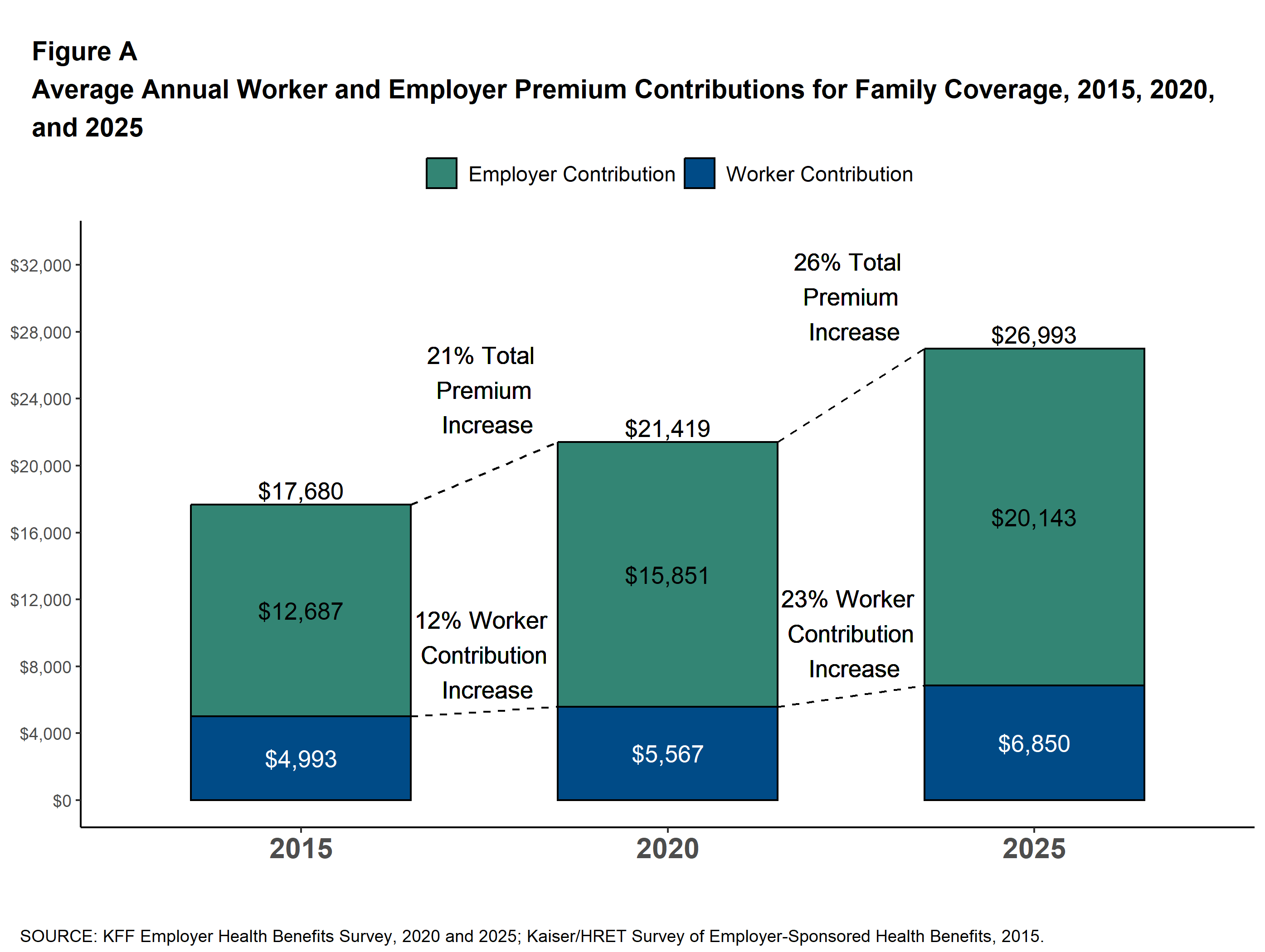
The chart shows why health cost is a planning problem rather than a rounding error: the employer contribution for family coverage rose from $15,851 in 2020 to $20,143 in 2025, and the trend is accelerating. Aon measured the average US employer health cost per employee at $14,432 in 2026, up 8.8% in a year, and projects a further 9.5% increase in 2027 before employer plan changes, pushing total plan cost above $19,000 per employee - Aon. Marsh (formerly Mercer) projects an 8.2% rise in 2027, the highest since 2003, or 11% for employers that make no plan changes.
For budgeting, use a blended employer cost of about $14,400 per employee in 2026 and roughly $15,800 in 2027, and adjust upward if you expect a senior hire with a family on a rich plan. Business Group on Health notes that actual cost trend has beaten employer forecasts three years running, so err toward the higher projections.
Retirement, equipment and the rest of the per-head overhead
Retirement is the third meaningful on-cost. Vanguard's 2026 How America Saves report puts the average employer matching contribution at a record 4.7% of pay - Vanguard. On a $200,000 base that is $9,400 a year, as long as the engineer defers enough to capture the full match. An AI engineer who earned more than $160,000 from the company in the prior year counts as a highly compensated employee under IRS rules, which means a traditional 401(k) can fail nondiscrimination testing and refund part of their contributions. A common fix is a safe-harbor plan, at a known cost of roughly 4% of pay.
The remaining overhead is smaller but real. A 16-inch MacBook Pro with the 40-core-GPU M5 Max chip lists at $4,999, about $1,666 a year over a three-year life. A Claude Team premium seat costs $1,200 a year billed annually - Claude. A Cursor Teams seat costs $480 a year - Cursor. Office space is the most variable line: at CBRE's national average asking rent of $37.58 per square foot, an assumed 150 square feet per person costs about $5,600 a year, and gateway markets such as San Francisco and New York cost considerably more. Fully remote hires remove this line and often add a home-office stipend instead.
- Payroll taxes: about $15,000 on a $200,000 California hire
- Health insurance: about $14,400 blended, $20,000+ for family coverage
- 401(k) match: about 4.7% of base, $9,400 at $200,000
- Laptop and AI seats: about $3,300 a year before metered usage
- Office space: $0 remote to $5,600+ per desk in an average market
Added together, statutory taxes, health, retirement and roughly $9,000 of equipment, seats and desk cost bring a $200,000 California hire to about 1.24x salary, and a $300,000 hire to about 1.18x. That range is also consistent with the government's own data. The Bureau of Labor Statistics reports that for private-industry professional occupations in June 2026, benefits were 30.8% of total compensation, but that figure counts paid leave as a benefit even though paid leave is already inside a quoted salary - BLS. Once paid leave is moved back into salary, the loaded ratio for professional occupations is about 1.23x, or 1.28x with bonuses. Dividing total compensation by wages gives 1.45x, which is a common way to overstate the multiplier.
Equity: not cash, but not free
Equity is the line most budgets leave blank, and for AI engineers it is often the largest single component of the package after base salary. At Big Tech it is paid in RSUs that vest over four years; at startups it is usually options. Both have real costs even though no cash leaves the company at grant.
The first cost is tax. Under IRS rules, RSUs are taxed as wages when they vest and non-qualified options when they are exercised, so the employer owes 1.45% Medicare on every vest, plus 6.2% Social Security if base salary is still below the wage cap - IRS. Incentive stock options avoid employment taxes at exercise, which is one reason early-stage startups favor them. The second cost is dilution, which every existing shareholder bears. The third is accounting expense: Meta recognized $20.4 billion of share-based compensation in 2025 across about 78,900 employees, roughly $259,000 per head, and still had $54.8 billion of unrecognized RSU expense on its books at year end - Meta 10-K.
The fourth cost is newer and matters for risk: vesting cliffs are disappearing at the top of the market. OpenAI cut its equity cliff for new hires from the industry-standard 12 months to 6 months in April 2025 and in December 2025 reportedly told staff it would drop the cliff entirely, and xAI reportedly shortened its cliff in the same period - Fortune. Without a cliff, a hire who leaves in month three keeps whatever has vested, which shifts mis-hire risk onto the employer. If you match no-cliff terms to compete, budget for that leakage, or use monthly vesting on a smaller initial grant with larger refreshers tied to tenure.
How to apply this section: price on-costs as dollar amounts, not as a percentage of salary. Use the state-specific tax lines, a 2027-adjusted health number, your actual match formula and your actual tool stack, then treat equity as a separate line with its own tax and dilution cost. The result will almost always be lower than the folklore multiplier for AI engineers, which frees budget for the two lines that actually decide whether you win the hire: the salary level and the sourcing process.
4. The Hiring Bill: Agencies, Interviews, Tools and Time
For an AI engineer, the hiring process costs anywhere from about $5,000 to more than $57,000 per hire, and the difference is almost entirely whether an agency makes the placement. The published averages hide this spread completely. SHRM's 2025 benchmarking puts average cost per hire at $5,475 for non-executive roles and $35,879 for executives - SHRM. Those are means. The median for the same survey is only $1,200 for non-executive hires, which tells you that most hires are cheap and a minority of expensive, agency-filled or relocated hires pull the average up. A senior AI engineer sits firmly in that expensive tail.
SHRM's definition also leaves out two costs that are large for technical hiring: the time engineers spend interviewing, and sign-on bonuses. SHRM counts agency fees, job boards, referral costs, relocation, recruiter pay and recruiting systems, divided by the number of hires. For an AI engineer, the engineering interview loop alone can cost more than twice the entire SHRM median, which is why the process needs to be priced bottom-up rather than borrowed from a survey average. This matters because the hiring process is the cost line you control most directly: on a $200,000 hire, the choice between an agency and an in-house search alone moves year-one cash by $40,000 or more.
Agency fees: the largest discretionary line
Agency fees follow a well-established structure, and the details of the fee base matter as much as the percentage. Contingency recruiters typically charge 20% to 25% of first-year cash compensation, paid only if they fill the role, and a search consultant quoted by SHRM in 2016 notes that the fee base usually includes salary, bonus and signing bonus - SHRM. Some platforms, such as Dover, describe the range as 15% to 25% of first-year base, with a 30-to-90-day guarantee that usually takes the form of a replacement search rather than a refund.
On a $200,000 base, a 20% fee is $40,000. If the agreement applies 25% to first-year cash and the offer includes a median $30,000 sign-on, the fee rises to $57,500. Recruiter marketplaces use the same success-fee model: Paraform, whose customers include AI startups, charges a flat percentage of first-year base on hire (it does not publish the rate) and says its average placed candidate earns about $260,000 a year - Paraform. There is no reliable evidence that AI roles command a standard contingency fee above 25%; claims of 30% to 35% norms trace to marketing pages rather than published fee schedules, so treat anything above 25% as a negotiated exception.
Retained search, used for heads of AI and senior research leaders, is more expensive and slower. Korn Ferry's 2026 annual report states that its search fees are generally one-third of estimated first-year cash compensation, plus a percentage for indirect expenses and an "uptick" fee if the final package exceeds the estimate - Korn Ferry 10-K. Heidrick & Struggles reported average revenue per executive search of $162,000 in the third quarter of 2025, which implies typical placed first-year cash of roughly $450,000 to $490,000. For a Head of AI with a $450,000 estimated package that ends at $510,000, the fee lands near $170,000 before the indirect-expense charge, and Heidrick recognizes search revenue over roughly six months, a fair proxy for how long these searches take.
Interview hours: most of an engineering week per hire
The process cost every hire incurs is the time of the engineers who interview candidates, and it is growing. Ashby's 2026 data shows the average technical hire consumed 23.3 hours of total interview time in the first quarter of 2026, against 12.2 hours for a business hire, with engineering roles at 24.7 hours and data roles at 24.9 - Ashby. Gem's 2026 benchmarks put engineering at 35 to 36 interviews per hire, about 26 interviewer hours, and note that interviews per hire have risen 33% since 2021.
Priced at a loaded rate of roughly $100 an hour (the BLS mean software developer wage with benefits) that is about $2,500 per hire; priced at the rate of the senior AI engineers who typically run AI interview loops (assuming $300,000 a year in cash pay and Gem's 26 hours), it is closer to $5,400. The larger cost is calendar time. Ashby finds that technical jobs take a median 75 days from opening to first hire, 15 days longer than business roles, and that senior roles take 37% longer than junior ones. Its startup data shows companies under 25 people hire in 42 days on average with a recruiter involved and 62 days without, which is a strong argument for professionalizing the process early.
Offer acceptance adds a hidden multiplier. Ashby's 2026 data shows sourced technical candidates accept 76% of offers, against 84% for referred technical candidates, so you should expect to make roughly 1.3 offers for every sourced hire. Gartner's candidate surveys point the same way from the other side: only 48% of candidates said they accepted their most recent job offer in late 2025, down from 85% two years earlier, which Gartner links to candidates being more reluctant to switch jobs in a volatile economy - Gartner. Every declined offer adds weeks of vacancy and another round of interview hours.
Tools, assessments and verification
The third group of process costs is tools, and at small scale the per-hire cost of a seat is higher than it looks. LinkedIn Recruiter's UK government price list shows £8,925 per seat per year for one or two licences, falling to £6,350 for 251 or more, with the Hiring Assistant agent sold as an add-on - LinkedIn G-Cloud. A dedicated technical recruiter makes about 3.8 hires a quarter, so one seat adds roughly £590 per hire. A founder hiring three AI engineers a year pays nearly £3,000 per hire for the same seat.
Assessment and verification costs are small by comparison and are worth paying. CodeSignal's self-serve plans start at $79 a month billed annually for 60 assessment credits, which works out to about $280 per hire if roughly 18 candidates are assessed for each hire and every credit is used, and Checkr's published pricing runs from $29.99 to $94.99 per background report, with identity verification included in the two higher tiers or sold separately for $4.99 - Checkr. Identity checks have become essential for remote technical roles: Gartner predicts that 1 in 4 candidate profiles worldwide could be fake by 2028, and 6% of candidates in its survey admitted to interview fraud. For the full playbook, see HeroHunt's guide to candidate identity verification.
Referral bonuses and relocation round out the list. WorldatWork puts the share of employers with formal referral programs at 77%, and a HireClix survey it reports found more than 80% of companies with programs pay bonuses above $1,000, and referrals remain the channel with the best offer acceptance. Atlas Van Lines' 2026 corporate relocation survey found the most common relocation lump sum is $10,000 to $12,499, unchanged since 2023, and 94% of firms relocating people internationally said the H-1B fee had affected their relocation budgets - Atlas Van Lines.
- Contingency agency: $40,000 to $57,500 on a $200,000 base
- Retained search for AI leaders: about one-third of first-year cash
- Interview hours: $2,500 to $5,400 per hire, plus 75 days of calendar time
- Seats, assessments, checks: a few hundred to a few thousand dollars
- Referral bonus or relocation: $1,000+ and $10,000 to $12,500 typical
The pattern in this list is that the agency fee is typically several times larger than every other process cost combined. That makes the sourcing decision the most important cost decision after the salary level. An in-house process built on referrals, direct sourcing and a fast interview loop costs a fraction of a placement fee, but it only works if someone owns the top of the funnel, because many of the strongest AI engineers are passive candidates who do not answer job ads. The practical question is not whether agencies are worth it in general, but whether your team can reliably generate a qualified shortlist of passive AI engineers without one.
This is where AI sourcing tools have changed the arithmetic. Instead of paying a percentage of salary for a shortlist, an in-house recruiter or hiring manager can run the search directly across public profiles, GitHub activity and publications, and send personalized outreach at scale. HeroHunt's own guide to recruiting AI and ML engineers covers the sourcing signals that separate real builders from keyword-stuffed profiles. The companion piece on sourcing AI engineers on GitHub shows how to read contribution history as evidence.
HeroHunt.ai
If the line you most want to remove from this budget is the $40,000 to $57,500 agency fee, the test worth running is an in-house search with an AI recruiter. HeroHunt.ai screens each profile against your written brief with a language model across up to a billion public profiles, including GitHub, instead of keyword-matching titles, and runs the outreach and follow-ups on autopilot. Pricing is read from the live plans page: Pro is $249 a month (one user, 10 open positions a month), Starter $149 and Team $499, with an 8-day trial (card required), so a full year of Pro costs less than a tenth of one placement fee. The honest caveats: it is metered on open positions per month and the slots do not roll over, it is a sourcing and outreach layer rather than an applicant tracking system, and for the handful of frontier researchers whose names everyone already knows, a warm introduction still beats any search tool.
How to apply this section: price your hiring process before you pick a channel. Estimate the agency fee on first-year cash, the interviewer hours at your engineers' loaded rate, and the vacancy cost of each extra week, then compare that with the cost of building an in-house pipeline. For teams hiring more than two or three AI engineers a year, the in-house route with good sourcing tooling almost always wins on cost, and it keeps the candidate relationships inside the company rather than with the agency.
5. Visas and Immigration: The $100,000 Question
As of late September 2026, the $100,000 H-1B payment still exists on paper but cannot be collected, and the bigger risk for 2027 is a separate $103,265 fee now in proposed rulemaking. For most AI engineer hires, the realistic visa cost today is $9,000 to $20,000 in government and legal fees with premium processing, depending on the route. But the range of possible outcomes is wider than for any other line in the budget, which is why the visa strategy for a foreign-born AI engineer now deserves the same attention as the offer itself.
This matters disproportionately for AI hiring because the talent pool is international. Stanford's AI Index notes that most growth in new AI PhDs has gone to academia while the number going to industry has stayed roughly flat, and LinkedIn finds AI engineering talent is 8x more likely than the average member to move across borders. A hiring plan that assumes every strong candidate is already a US citizen or green card holder will either shrink the pool dramatically or run into immigration costs mid-process.
Where the $100,000 payment stands today
Employers are not required to pay the $100,000 today, but the timeline shows how quickly that could change. The proclamation took effect on September 21, 2025 and required a one-time $100,000 payment on new H-1B petitions for workers outside the US; the White House clarified that it does not apply to renewals. On June 8, 2026, a federal court in Massachusetts vacated the agency guidance that implemented the payment, and on July 24, 2026 the First Circuit refused to pause that ruling. USCIS now states that DHS will comply while it considers next steps, and that DHS "still plans to collect the payment" if the order is lifted - USCIS.
On September 18, 2026, the President extended the underlying proclamation for another 12 months, to September 21, 2027, and the White House reported that the payment had been made for more than 700 petitions since the proclamation took effect - White House. Immigration counsel read the extension as not overriding the court order, so employers are not currently required to pay. A separate case brought by the US Chamber of Commerce went the other way at the district level in December 2025 and is pending at the D.C. Circuit, which means a circuit split and eventual Supreme Court review remain possible. The video below captures the June ruling that changed the picture.
Trump's $100,000 H-1B Visa Application Fee Thrown Out
Even when the payment was enforced, its scope was narrower than the headlines suggested. It applied to beneficiaries outside the US without a valid H-1B visa and to petitions requesting consular notification. An approved change of status inside the US, such as an F-1 student on OPT moving to H-1B, or a transfer of someone already on an H-1B, was exempt. For AI hiring that distinction is large, because a big share of the candidate pool is already in the US on student or work status.
The next risk: a $103,265 fee and a weighted lottery
The cost risk that deserves more attention in 2027 planning is a different rule. On August 25, 2026, DHS proposed a $103,265 fee on every cap-subject H-1B petition, including master's-cap cases and in-country changes of status that are exempt from the proclamation today, payable in addition to any proclamation payment - Federal Register. It rests on a different legal authority (fee-setting for cost recovery rather than the President's entry powers), so the Massachusetts ruling may not carry over directly. Comments closed on September 24, 2026, and a final rule could arrive before the March 2027 registration season. Transfers and cap-exempt petitions would not be covered.
The lottery itself has also changed. Since February 2026, a DHS rule enters each registration into the H-1B selection pool four, three, two or one times depending on whether the offered wage sits at OEWS level IV, III, II or I - Federal Register. DHS projected selection odds of about 61% at level IV against 15% at level I. Registrations fell 38.5% to 211,600 in the first weighted season, so actual odds were likely higher at every level. Well-paid AI engineers often sit at level III or IV, although the level depends on the offered wage against OEWS data for the occupation and metro area, which makes the lottery friendlier to them than before, although a pending Labor Department rule would raise the wage percentiles behind each level and could push some salaries down a tier.
What each route actually costs
An H-1B transfer is the cheapest sponsored route at about $9,000 all-in and the O-1A the most flexible at roughly $10,000 to $20,000, so price the options side by side before you make an offer to a candidate who needs sponsorship. The figures below use the current USCIS fee schedule, the premium processing fee of $2,965 that took effect on March 1, 2026, and published flat legal fees at the lower-middle of the market; large immigration firms typically charge more - USCIS G-1055.
| Route (employer with 26+ staff) | Government fees incl. premium | Typical legal fees | Notes |
|---|---|---|---|
| H-1B transfer (already on H-1B) | $6,295 | ~$3,000 | No lottery, no $100K, outside proposed fee |
| H-1B change of status (F-1/OPT) | $6,510 | ~$4,000 | Exempt from $100K; proposed $103,265 would apply |
| H-1B from abroad | $6,715 incl. visa fee | ~$4,000 | $100K if reinstated; proposed fee on top |
| O-1A (extraordinary ability) | $4,620 | $5,000 to $15,000 | No cap, no lottery, 15 business days |
| UK Skilled Worker (3 years) | £4,485 employer charges | varies | Plus ~£3,900 worker fees often reimbursed |
Three practical conclusions follow from the table. First, a candidate who is already on an H-1B is the cheapest and least risky sponsored hire by a wide margin, and that status is now a real line item in how you value a candidate. Second, the O-1A has become the default route for strong AI engineers with publications, patents, high pay or recognized contributions: it has no cap, no lottery, is outside both the proclamation and the proposed fee, and gets a USCIS decision or request for evidence within 15 business days with premium processing, at the cost of higher legal fees and a heavier evidence file. Third, employers with 25 or fewer US staff pay reduced I-129, training and asylum fees, saving about $1,370 per H-1B petition.
Green cards add time more than money. Labor certification (PERM) must be paid for entirely by the employer, and the Labor Department's average analyst review time was 336 calendar days in August 2026, on top of three to four months for a prevailing wage determination - DOL FLAG. For key AI hires, self-petitioned routes such as EB-2 National Interest Waiver or EB-1A skip PERM and cost a few thousand dollars in government fees. The much-publicized "Gold Card" is not a hiring tool: the corporate version costs $2 million per employee plus a $15,000 processing fee, and the Commerce Department reported a single approval as of April 2026.
Outside the US the costs are lower and the process faster. The UK raised its Immigration Skills Charge by 32% in December 2025 to £1,320 a year for medium and large sponsors, which brings mandatory employer charges for a three-year Skilled Worker visa to about £4,485 - GOV.UK. Senior researchers can often use the unsponsored Global Talent visa for £766 instead - GOV.UK. Canada's Global Talent Stream charges CAD $1,000 per position with a 10-business-day service standard, which makes a Toronto hub a practical fallback for candidates whose US path is blocked.
How to apply this section: decide the visa route before the offer, not after. Ask candidates about their current status at the first screen, prefer transfers and O-1 eligible profiles when timing matters, budget a contingency line for cap cases filed in 2027, and consider a Canadian or UK hub for candidates whose US path is blocked. HeroHunt's detailed playbook on hiring around the $100K H-1B fee covers the cap-exempt, L-1, TN and E-3 routes in more depth.
6. Hiring Outside the US: Global Costs, EOR and Contractors
A median machine learning engineer costs roughly 40% to 83% less outside the US even after statutory employer costs, but the discount shrinks at the top of the market and flat EOR fees eat a larger share the cheaper the location. On Levels.fyi medians, a like-for-like ML engineer costs about $171,000 in London, $126,000 in Berlin, $116,000 in Toronto, $77,000 in Warsaw, about $66,000 in São Paulo and about $49,000 in Bengaluru once statutory employer contributions are added, against $296,000 in the US on the same basis. Those gaps are real, and they explain why global hiring has become a standard part of AI team building rather than an edge case. This matters because location is one of the few levers that can halve the cost of a hire without lowering the bar, but only if you compare fully loaded costs and the employment route rather than gross salaries.
The comparison needs care, because statutory on-costs differ enormously and they fund different things. European social contributions already pay for health care and pensions that US employers buy privately, so a like-for-like comparison uses statutory costs only and treats US health insurance and 401(k) as extra. The calculation below uses Levels.fyi total compensation medians for the ML engineer title in each city as of September 2026, each country's 2026 statutory employer rates, and European Central Bank reference exchange rates of September 24, 2026 - ECB.
Fully Loaded Cost of a Median ML Engineer by City (Statutory On-Costs Only)
The chart hides as much as it shows, because each country loads costs differently. In London, the median ML engineer's £111,746 attracts employer National Insurance at 15% on everything above about £5,000 a year, with no upper cap, plus a 3% minimum pension contribution - GOV.UK. In Berlin, the €93,597 median attracts about 18.6% in employer social contributions, but pension contributions stop at €101,400 and health at €69,750, so a €150,000 senior hire costs only about 12% on top. Canada is the cheapest high-cost market on statutory load, because pension and employment insurance contributions are capped at about CA$6,200 per employee plus Ontario's 1.95% health tax.
Emerging markets load costs the other way. Brazil's employer social security is 20% of total pay with no ceiling, plus 8% into the FGTS fund, a mandatory 13th salary and a vacation bonus of one-third, which together add about 42% to a 12-month base before sector levies - Planalto. Poland's employer contributions add about 20% to 22% on an employment contract (the chart includes the 1.5% PPK pension contribution), but 38.5% of respondents to Bulldogjob's 2025 Polish IT survey invoice as self-employed B2B contractors, where the median ML/AI engineer invoice is about PLN 22,500 a month with no employer social costs at all. India's new Labour Codes, in force since November 2025, require wages to be at least 50% of total remuneration, raising the base for provident fund and gratuity, but Indian offers are usually quoted as cost-to-company, which already includes those items, so the Bengaluru figure above (which adds them to the Levels.fyi median) is slightly on the high side.
EOR, contractors and staffing marketplaces
Without a local entity, the standard way to hire abroad is an employer of record (EOR), which employs the engineer on your behalf for a flat monthly fee. Deel lists EOR from $599 per employee per month. Remote and Oyster both list $699, and Papaya Global starts from $499 - Remote. At $599 a month, the fee is $7,188 a year. That is about 4% on top of a loaded London hire and about 6% in Berlin, but roughly 9% in Warsaw, 11% in São Paulo and 15% in Bengaluru, because the fee is flat while salaries are not. Once you have several hires in one country, a local entity or payroll provider usually becomes cheaper.
Contractors and staffing marketplaces are the other route, and they price very differently from employment. Arc's 2026 benchmarks put senior freelance AI/ML engineering at $110 to $190 an hour and AI infrastructure or MLOps at $120 to $200, which annualizes to about $229,000 to $395,000 at full-time hours, in the same range as a US employee's total pay - Arc. LatAm staffing marketplaces such as Revelo list senior ML engineers at $7,200 to $10,700 a month all-in, about $86,000 to $128,000 a year including their margin. Clutch's AI agency listings show most firms at $24 to $49 an hour, but those are agency listing bands rather than rates for senior ML specialists.
- Direct employment via local entity: lowest ongoing cost, highest setup effort
- Employer of record: $499 to $699 per month, fastest compliant route
- B2B or PJ contractor: no employer social costs, misclassification risk
- Staffing marketplace: sourcing and vetting included, at a visible markup
The practical takeaway is that the route matters as much as the country. A São Paulo ML engineer at the Levels.fyi median costs roughly $66,000 to $70,000 loaded plus about $7,000 in EOR fees, so around $73,000 to $77,000, against $86,000 to $128,000 through a marketplace rate card. The marketplace premium buys sourcing, vetting and replacement guarantees, which can be worth it for a first hire, but becomes expensive at scale. Contractor models remove employer costs but create misclassification risk in countries that police it, and they rarely create the long-term alignment an AI team needs.
The discount disappears at the frontier
The one place the global discount does not hold is the top of the market. Levels.fyi shows OpenAI's median software engineer package in London at £390,000, and Anthropic's London range at £349,000 to £473,000 or more, roughly three and a half times the city's ML engineer median - Levels.fyi. Anthropic says it tripled its EMEA headcount in a year and is adding roles in Dublin, London, Zurich, Paris and Munich, and it opened a Bengaluru office in February 2026. If you need the same people these labs want, expect to pay close to US rates in London and Zurich.
European AI premiums at the median are modest by comparison. Ravio's benchmarks show a 12% premium for AI talent at professional levels and 3% at management levels in Europe - Ravio. A Berlin mid-level ML engineer benchmarks at almost exactly the same salary as a general software engineer, €80,800 against €80,600 - Ravio. The US-style premium appears mainly at Big Tech, the labs and the upper percentiles, which is also where the competition for talent is fiercest. For a map of where AI skills actually concentrate, see HeroHunt's global AI talent map.
How to apply this section: compare locations on fully loaded cost, never on gross salary, and pick the employment route alongside the country. For a first hire in a new country, an EOR is usually the fastest compliant option; from the third or fourth hire, price a local entity. Budget near-US pay for anyone the frontier labs are also recruiting, and remember that time-zone overlap and hiring speed often matter more than the last 10% of cost.
7. After Day One: Ramp Time, AI Tools and Compute
The costs that start after the offer is signed are now the fastest-moving part of the AI engineer budget: ramp time is falling, while AI tool and compute spend per engineer is rising fast enough to rival a meaningful share of salary. A decade ago, post-hire costs meant a laptop and a few months of reduced output. In 2026 they include seats for several AI coding tools, metered token spend that can run from a few hundred to several thousand dollars a month, and, for engineers who train or fine-tune models, GPU time that can exceed their salary.
This matters because these costs scale with how productive you want the hire to be. Starving an AI engineer of tools and compute saves money on paper and wastes the salary you are paying. Leaving the spend uncapped can blow a budget in months. The goal is a deliberate allocation, and that requires knowing what each piece costs in 2026.
Ramp time is shrinking, but it is not zero
The time it takes a new engineer to become productive has fallen sharply as AI tools have spread. DX, which measures developer productivity across hundreds of large engineering organizations, reported in April 2026 that the average time from start date to a developer's 10th merged pull request, among engineers using AI daily, was 33 days, down from 39 days in late 2025 and more than 50% lower than in early 2024 - DX. In a narrower comparison at six multinational enterprises, developers with no AI use took 91 days to reach their 10th merged pull request, against 49 days for daily AI users.
DX itself cautions that a 10th merged change is a milestone, not full productivity, and says nothing about the quality or depth of understanding behind those changes. As an illustrative cost, if a new hire averages half their eventual output until that milestone (an assumption), the ramp on a $200,000 salary costs about $9,000 at 33 days and about $25,000 at the 91 days DX measured for developers not using AI. The lesson is not that ramp no longer matters, but that the first week of AI tooling, codebase context and documentation is likely among the highest-return spends you can make on a new hire.
AI tools: cheap seats, expensive usage
The seat prices for AI coding tools are low and well published. GitHub Copilot Business costs $19 per seat per month and Enterprise $39, each with a pooled allowance of AI credits and overage at $0.01 per credit - GitHub. Cursor Teams has a Standard seat at $40 per user per month and a Premium seat at $120 with five times the agent limits. Claude Team premium seats cost $100 a month billed annually, and ChatGPT Business, which includes Codex, costs $20 per user per month billed annually. Devin's Teams plan costs $80 a month plus $40 per full developer seat.
Metered usage is where the money actually goes. Anthropic's own documentation says enterprise deployments of Claude Code average about $13 per developer per active day and $150 to $250 per developer per month, with 90% of users staying under $30 per active day - Claude Code docs. Cursor's documentation says daily agent users typically run $60 to $100 a month in usage and power users running multiple agents often exceed $200. The heavy end is much higher: one founder quoted by The Pragmatic Engineer in April 2026 described spend rising from about $200 to about $3,000 per developer per month in six months, and a staff engineer said some developers now spend $500 a day - The Pragmatic Engineer.
Uncapped usage is a real budget risk. Fortune reported in May 2026 that Uber used its entire 2026 AI coding tools budget in about four months after encouraging adoption with an internal leaderboard that ranked teams by usage, and its COO said the link between rising Claude Code use and more useful consumer features was "not there yet" - Fortune. At the extreme, Nvidia CEO Jensen Huang said he would be "deeply alarmed" if a $500,000 engineer did not consume at least $250,000 of tokens a year, which is best read as an aspiration rather than a benchmark. Ramp's AI Index shows the top 1% of US businesses on Ramp, ranked by AI spend per employee, spent about $7,200 per employee per month on AI in August 2026, averaged across all staff, while its spring 2026 data put the median firm at about $11.
- Seat stack: roughly $1,700 a year for Cursor Teams plus a Claude premium seat
- Typical agent usage: $150 to $250 a month per developer
- Heavy agent usage: $3,000 or more a month per developer
- Review capacity: budget for testing and code review alongside tools
The practical way to budget is in tiers. Give every AI engineer the seat stack, set a standard monthly usage allowance in the low hundreds of dollars, and approve a higher tier for engineers whose work demonstrably benefits, with per-user caps configured in the admin console of every tool. Productivity research supports investing but not blind spending: randomized trials at Google, and at Microsoft, Accenture and a Fortune 100 firm using autocomplete-era tools, found gains of roughly 21% to 26%, while METR's 2025 study of experienced open-source developers found them 19% slower with early-2025 tools, and its 2026 follow-up suggests they are probably faster now, with wide uncertainty - METR. Google's DORA research finds AI adoption correlates with higher throughput but lower delivery stability, so review and testing capacity has to grow with the tools.
Compute: the line that can exceed salary
For AI engineers who train, fine-tune or evaluate models, compute is often the largest post-hire cost. On-demand H100 prices in September 2026 range from $3.99 per GPU-hour at Lambda on an 8-GPU instance to about $6.16 at CoreWeave and $6.88 at AWS after its June 2025 price cut of up to 45% - Lambda. An 8x H100 node running around the clock costs about $23,000 a month at Lambda, $36,000 at CoreWeave and $40,000 at AWS on-demand, which is $280,000 to $480,000 a year. A single H100 used only during business hours (about 176 hours a month, our assumption) costs roughly $755 at Lambda's $4.29 single-GPU rate to $1,211 at AWS. At the frontier, compute budgets run to billions, as the AI Index estimates of OpenAI's and Anthropic's annual compute spend below show.
Compute now rivals payroll at the frontier
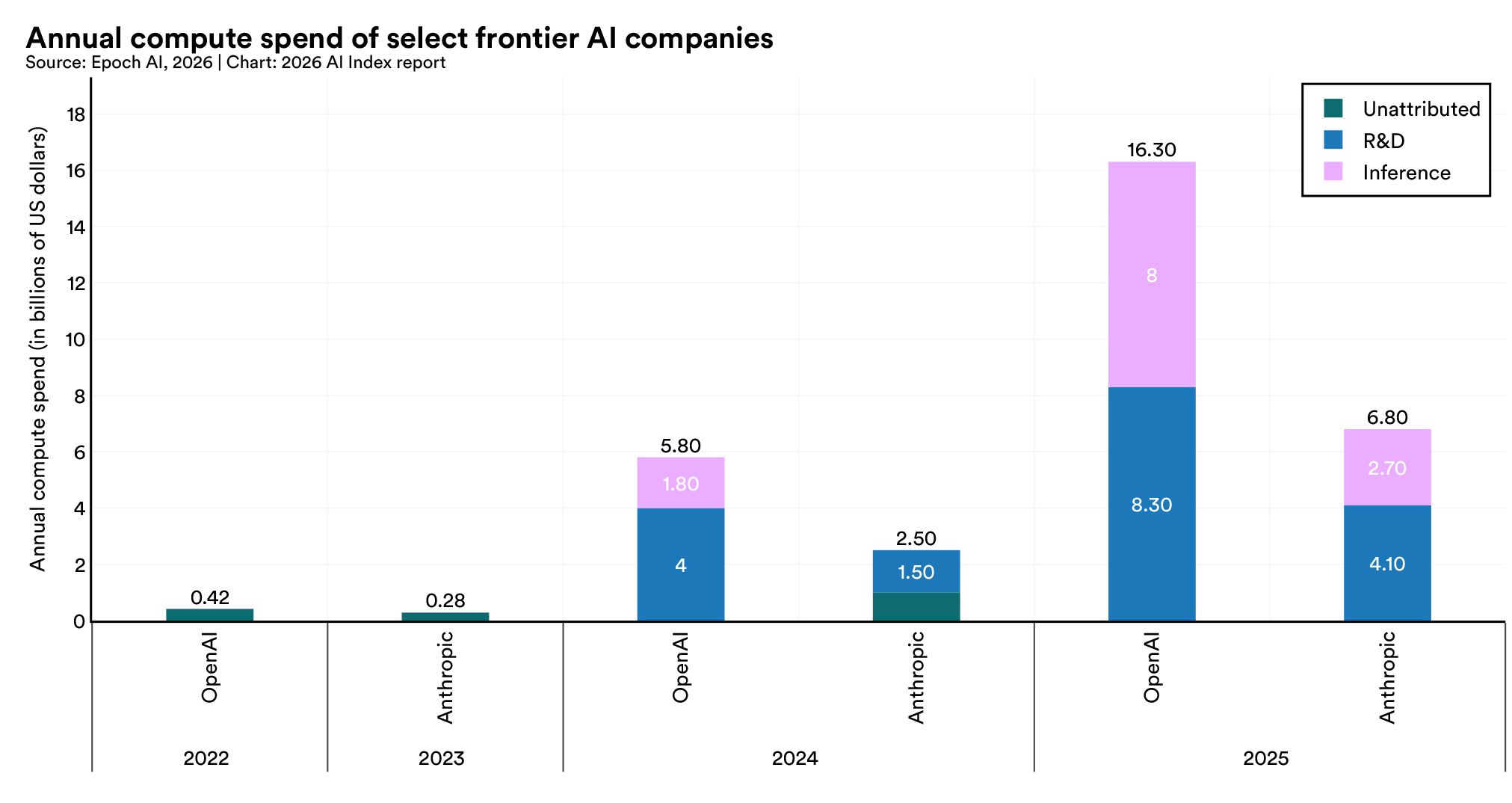
The chart shows why compute has become part of the recruiting pitch at the top of the market. Epoch AI's estimates, published in the AI Index, put OpenAI's 2025 compute spend at $16.3 billion, about half of it on research and development, and Anthropic's at $6.8 billion. Mark Zuckerberg has said that top researchers ask for "the fewest number of people reporting to me and the most GPUs," and that having the most compute per researcher is a strategic advantage in attracting them - Business Insider. For a non-frontier employer, a guaranteed GPU budget and a small, senior team can be a cheaper recruiting lever than matching cash.
How to apply this section: add a post-hire line to every AI engineer budget with three parts: a fixed seat stack of about $1,700 a year, a capped usage allowance of $2,000 to $3,000 a year for most engineers (with a higher tier by approval), and a separate compute budget for anyone training or evaluating models, managed with schedulers and automatic shutdown rather than always-on instances. The price per GPU-hour matters less than whether expensive nodes sit idle overnight.
8. The Cost of Losing Them: Retention, Turnover and Bad Hires
The most expensive AI engineer is the one you have to hire twice, and replacing one costs somewhere between half and twice their annual salary. Gallup's widely used estimate puts the cost of replacing an employee at one-half to two times annual salary, and calls that conservative - Gallup. For a $200,000 engineer that is $100,000 to $400,000 per departure: a new search, another round of interview hours, another vacancy, another ramp period, and the knowledge that walked out the door. For specialized AI roles, we would plan on the upper half of that range (our assumption, not Gallup's).
The good news is that engineers are among the stickiest corporate functions. SignalFire's 2026 State of Talent report found attrition of about 9% for engineers at the largest tech companies, against about 13% for sales and design - SignalFire. Applying that rate to Gallup's range gives an expected turnover cost of roughly $9,000 to $36,000 per seat per year on a $200,000 engineer. Why this matters: that expected turnover cost is a real budget line, and it is the one that retention spending should be measured against.
Retention at the frontier is priced in equity
At the top of the market, retention has become an explicit and expensive program. In August 2025, OpenAI gave a special one-time award to about 1,000 research and engineering staff, roughly a third of the company, ranging from hundreds of thousands of dollars for engineers to mid single-digit millions for its most sought-after researchers, paid over two years - The Verge. Combined with the removal of its vesting cliff and regular employee tender offers, that makes OpenAI's retention spend part of the market that every AI employer now competes against.
Money is not the only retention lever. SignalFire's 2025 report found two-year retention of 80% at Anthropic, 78% at DeepMind, 67% at OpenAI and 64% at Meta, measured on data through 2024, before the peak of the 2025 poaching wave. Anthropic's CEO Dario Amodei has said publicly that the company does not match individual poaching offers and keeps fixed, non-negotiated levels, to protect fairness among its staff - Fortune. Zeki Data's tracking, reported by Fortune in August 2026, put Anthropic's ratio of arrivals to departures at 22 to 1 in 2025, against 5.7 to 1 at OpenAI in 2025, while Google DeepMind's ratio fell to about 2 to 1 by the third quarter of 2026 - Fortune.
Very large packages also do not guarantee that people stay. Ruoming Pang, who reportedly joined Meta from Apple on a package above $200 million in July 2025, left for OpenAI about seven months later - Observer. Andrew Tulloch joined Meta in October 2025 and is reported to be leaving less than a year later - Semafor. Noam Shazeer, the centerpiece of Google's $2.7 billion Character.AI deal in 2024, left Google for OpenAI in June 2026 - CNBC. For most employers, the lesson is to decide your counteroffer policy before you need it, and to put mission, scope, compute and team quality alongside pay in the retention plan.
Bad hires, fraud and the numbers to avoid
Bad-hire costs are some of the most abused numbers in recruiting. The claim that "the US Department of Labor says a bad hire costs 30% of first-year earnings" appears across staffing and HR blogs, but we could find no Department of Labor publication behind it. The line that "SHRM says total cost to hire is three to four times salary" is one consultant's estimate quoted in a 2022 SHRM news article, not SHRM survey data - SHRM. The most defensible sourced figure, a 2017 CareerBuilder survey, found companies lost an average of $14,900 per bad hire across all roles, which clearly understates the cost of a six-figure AI engineer.
Research on hiring costs gives a better frame. A peer-reviewed study of Swiss firm-level data found average hiring costs for skilled workers, including recruitment and adaptation, of 10 to 17 weeks of wages, with marginal costs rising up to 24 weeks when firms hire many people at once - European Economic Review. On a $200,000 salary, 10 to 17 weeks is roughly $38,000 to $65,000 per hire, which is close to this guide's agency-route hiring cost plus ramp, and well above the in-house route. The convexity is the practical insight: hiring many AI engineers at once costs more per head, so spacing hires or adding sourcing capacity during bursts lowers the unit cost.
Fraud is the newest source of bad-hire cost, and it concentrates in remote technical roles. The Justice Department has described a North Korean remote IT worker scheme that used more than 80 stolen identities to get jobs at more than 100 US companies, causing at least $3 million in legal, remediation and other losses - DOJ. Enforcement has continued into 2026: in May the department secured the seventh and eighth sentences of US-based "laptop farm" facilitators within five months, in schemes where victim companies spent more than $1 million on auditing and remediation. A few dollars of identity verification and one live or in-person interview step are cheap insurance by comparison.
How to apply this section: put an expected turnover cost into the budget (attrition rate times replacement cost), and use it to size retention spending such as refresh grants, learning budgets and compute access. Protect the downside with structured interviews, reference checks and identity verification, and decide in advance how you will respond to a competing offer, because improvising a counteroffer under deadline pressure is how retention budgets get blown.
9. The Frontier Extreme: Nine-Figure Offers and Acqui-Hires
At the very top of the market, the cost to hire an AI researcher is measured in tens of millions of dollars per person, but those numbers describe a few dozen people and should never anchor a normal budget. The headline packages of 2025 and 2026 are real, but they are multi-year, equity-heavy and often contingent on performance or stock price. Turned into annual figures, they are still extraordinary, and they explain why frontier-lab compensation has pulled away from the rest of the market so sharply.
Understanding this tier matters even if you will never compete in it, for two reasons. First, it sets the ceiling that candidates and their advisers quote in negotiations, so you need to know which numbers are real and how they translate. Second, the frontier labs' retention and liquidity programs shape expectations across the whole AI market, from equity terms to vesting cliffs.
What the headline packages really were
The nine-figure offers were real but rarer and more deferred than the headlines implied, and they began with Meta's push to staff its Superintelligence Labs in mid-2025. Sam Altman said Meta had offered OpenAI staff signing bonuses as high as $100 million - CNBC. That claim was disputed almost immediately: a researcher who moved to Meta called the $100 million sign-on "fake news," and Meta's CTO reportedly implied that only a few very senior leaders may have been offered that much, and said the offers were not structured as sign-on bonuses - TechCrunch.
The reported individual packages were nonetheless enormous. Bloomberg reported that Meta hired Apple's foundation-models lead, Ruoming Pang, with a package worth more than $200 million over several years - Bloomberg. The New York Times reported that 24-year-old researcher Matt Deitke accepted about $250 million over four years, after turning down an initial offer of about $125 million - The New York Times. The Wall Street Journal reported an offer to Thinking Machines co-founder Andrew Tulloch that could have been worth up to $1.5 billion over at least six years, which Meta called "inaccurate and ridiculous" - TechCrunch. Annualized, Deitke's package is about $62.5 million a year, still roughly 74 times the top of Anthropic's posted research engineering base band.
OpenAI's response shows what retaining frontier talent costs in aggregate. The Wall Street Journal reported that OpenAI's average stock-based compensation reached about $1.5 million per employee across roughly 4,000 staff in 2025, equal to about 46% of revenue - Fortune. The clip below covers the investor-deck figures behind that number.
OpenAI's pay packages dwarf pre-IPO tech peers
That $1.5 million is an average accounting expense skewed by top researchers, not a salary, and posted OpenAI research bases run from roughly $250,000 to $600,000. Liquidity is part of the package too: OpenAI completed a roughly $7 billion employee share sale at an $852 billion valuation in August 2026, following a $6.6 billion tender in October 2025 - CNBC. A startup cannot match that cash-out path, which is why it has to compete on scope, mission, compute access and upside instead.
Acqui-hires: paying for teams, not companies
The other way frontier companies buy talent is the license-and-hire deal, sometimes called a reverse acqui-hire, in which a large company licenses a startup's technology and hires its founders and key staff. On reported prices and estimated headcounts, the implied cost per person varies more than twentyfold. Microsoft agreed to pay Inflection about $650 million in 2024 while hiring most of its 70 staff, roughly $9 million to $11 million per person - Bloomberg. Google DeepMind's May 2026 deal for more than 20 Contextual AI researchers was reported at $80 million to $100 million, or at most about $4 million to $5 million per person.
At the high end, Google reportedly paid $2.4 billion in licensing fees and compensation to hire Windsurf's founders and senior R&D staff in July 2025, and was reported to be in talks at $1.5 billion or more for Mechanize in 2026 before closing a deal that brought the co-founder and more than a dozen staff to DeepMind on undisclosed terms. The clearest evidence that these prices are payments for people comes from filings. Nvidia's annual report records $17.0 billion of total consideration for its December 2025 Groq transaction, of which $14.4 billion was goodwill "primarily attributable to the workforce" and future development of the licensed technology - Nvidia 10-K. Tesla's 2026 filing for an unnamed AI hardware acquisition ties 89% of a $1.95 billion price to service conditions or milestones.
- Inflection to Microsoft (2024): about $650 million, roughly $9M to $11M per person
- Character.AI to Google (2024): $2.7 billion to bring back two founders and some researchers
- Windsurf to Google (2025): $2.4 billion for licensing plus compensation
- Groq to Nvidia (2025): $17.0 billion consideration, 85% booked as goodwill tied mainly to the workforce
Two lessons carry over to ordinary hiring. First, most of an acqui-hire price is effectively deferred, retention-linked compensation, which is why deals increasingly tie consideration to service conditions. Second, these deals now attract regulatory cost: the UK's competition authority treated Microsoft-Inflection as a merger, the FTC announced scrutiny of acqui-hires in January 2026, and the Justice Department is reported to be probing whether the Nvidia-Groq deal was structured to avoid antitrust review. Big packages also do not guarantee retention, as the departures of Pang, Tulloch and Shazeer showed.
How to apply this section: when a candidate or adviser cites a frontier package, convert it to annual, risk-adjusted value and compare it with the base bands the labs actually post. If you are genuinely competing with the labs for a researcher, compete on the dimensions they value that you can offer (scope, speed, compute, ownership) rather than trying to match an equity pool you do not have. And if you are considering buying a small team outright, budget antitrust counsel and structure most of the value as retention-linked equity, as the largest buyers now do.
10. How AI Agents Are Changing the Cost to Hire
AI agents are pushing the cost to hire AI engineers in two opposite directions at once: they are making sourcing and screening dramatically cheaper, while concentrating demand on exactly the senior AI engineers who are hardest to find. On the recruiting side, a sourcing agent that costs a few hundred dollars a month can take over much of the search and outreach work a five-figure placement fee pays for, although independent evidence on time saved is still thin. On the demand side, companies are hiring fewer juniors and more senior, AI-titled engineers, which keeps the salary line under pressure.
Demand for AI engineering talent is still climbing even as the broader tech market stays soft. LinkedIn ranked AI Engineer as the #1 fastest-growing job in the US in its 2026 Jobs on the Rise report - LinkedIn. Its January 2026 labor market report counts about 177,000 AI engineer jobs created globally between 2023 and 2025, a 13x increase since 2023 - LinkedIn Economic Graph. ManpowerGroup's 2026 survey of more than 39,000 employers found AI skills are now the hardest to find globally for the first time, with AI model and application development cited by 20% of employers - ManpowerGroup. Indeed's posting data below shows the same split between AI roles and the rest of tech.
AI tech postings are rising while tech overall stays weak
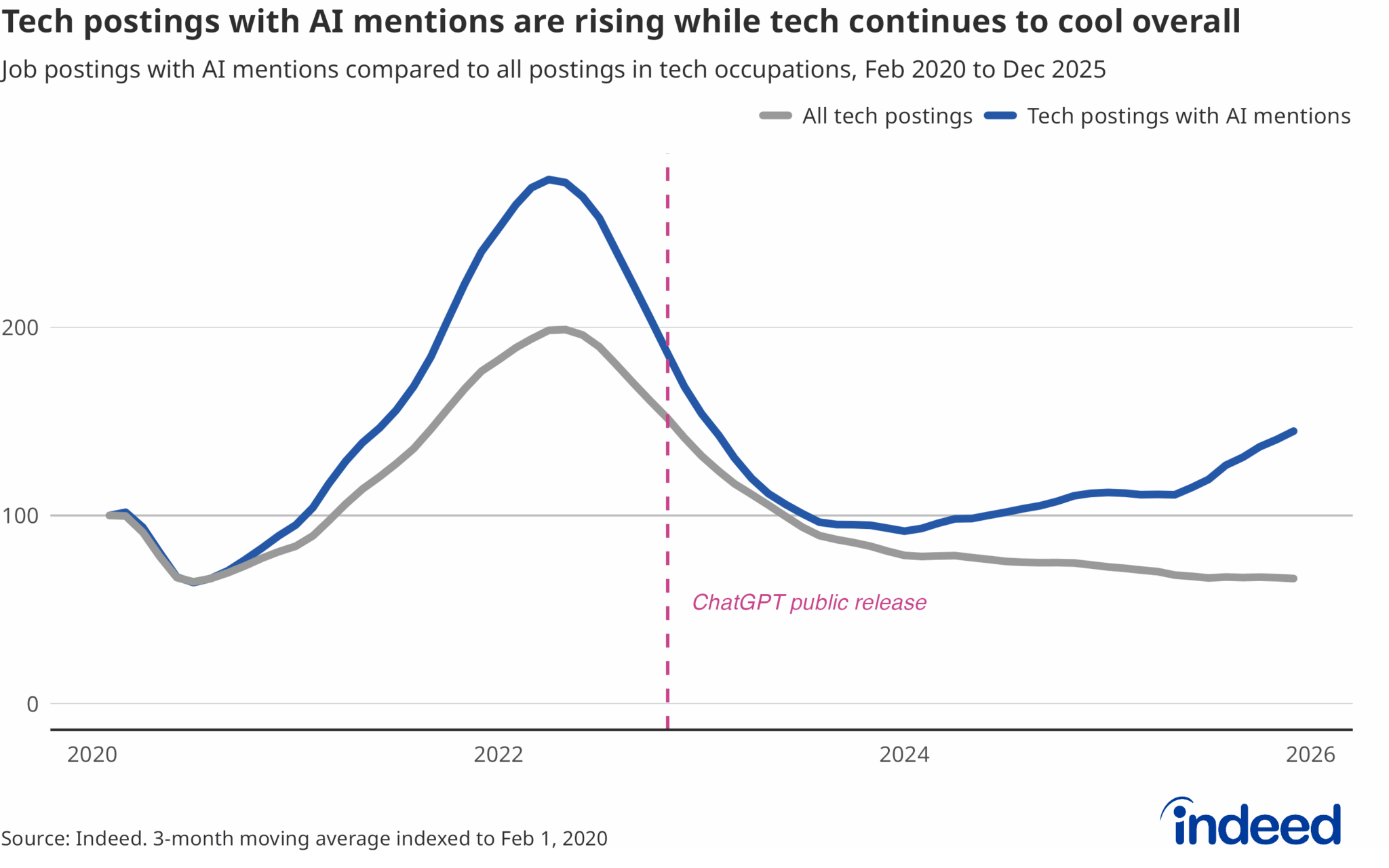
The chart captures the two-speed market that drives the salary line. By December 2025, US tech postings that mention AI stood about 45% above their pre-pandemic level, while tech postings overall were roughly a third below it, as the Indeed chart above shows. Indeed's July 2026 analysis adds that software development postings have risen almost 15% since Claude Code launched, and that 71% of the increase between May 2025 and May 2026 came from senior roles and 37% from jobs with AI in the title - Indeed Hiring Lab.
AI coding agents are reshaping who gets hired
The same tools that make engineers more productive are changing the shape of engineering teams. Stanford's Digital Economy Lab, using ADP payroll data through June 2026, finds that employment of workers aged 22 to 25 in AI-exposed occupations is now 19% below where it would have been had it kept pace with less-exposed peers, with no comparable gap for experienced workers, and that the effect works mainly through reduced hiring - Stanford Digital Economy Lab. SignalFire finds new-graduate hiring down about 65% at the largest tech companies compared with 2019, while the share of AI/ML engineers in the engineering workforce grew by 39%.
The engineering mix is shifting toward AI roles

The chart shows where the demand is moving: AI/ML engineers up 39.2%, forward-deployed engineers up 30% and research engineers up 28% as a share of the engineering workforce, while front-end, mobile and developer relations roles shrank. Company statements point the same way. Salesforce's CEO said in February 2025 that the company would hire no new engineers that year, citing a 30% productivity gain - The Register. Shopify requires teams to show why AI cannot do the work before asking for headcount - CNBC. These are statements of intent rather than measured outcomes, and LinkedIn's own research attributes most of the slowdown in hiring to the aftermath of the post-pandemic reshuffle rather than to AI, so the honest reading is that AI changes the mix of hires faster than it changes the total.
For a hiring budget, the implication is that the savings from AI coding tools show up as fewer junior hires, while the AI engineers you do need become relatively more expensive. Budget for a smaller, more senior team, and invest the savings in tools, compute and retention for the people who remain.
AI sourcing agents and the new price of a shortlist
The recruiting side of the equation has changed just as quickly. AI sourcing agents now search public profiles, score candidates against a written brief and run personalized outreach, at prices that are small next to any placement fee. LinkedIn's UK government price list shows its Hiring Assistant agent as an add-on at £6,350 per licence per year on top of a Recruiter seat - LinkedIn G-Cloud. SeekOut's self-serve Recruit Core plan costs $149 a month billed annually - SeekOut. Juicebox sells an autonomous agent add-on at $199 per agent per month - Juicebox. hireEZ's solo plan starts at $494 a month - hireEZ.
HeroHunt.ai sits in the same category as an AI recruiter that sources across up to a billion profiles and runs outreach on autopilot, with plans from $149 a month and metering on open positions rather than seats or contact credits, which suits teams with a steady number of open roles more than teams with one spike a year. HeroHunt's broader analysis of recruiting software pricing compares 40 tools by the unit they actually meter. The honest caveat across the whole category is that vendor time-savings claims are modest and mostly self-reported: LinkedIn's own figure is 1.5 hours saved per role in identifying top applicants, and the largest rigorous study of AI interviewers covered high-volume customer-service hiring, not senior engineers.
- Sourcing agents: cut the cost of a shortlist from a placement fee to a subscription
- Screening at volume: helps with 244 applications per job on Greenhouse
- Fraud detection: now a required layer for remote technical hiring
- Senior judgment: still human, especially for research roles
The practical meaning of this list is that the process cost of hiring an AI engineer is falling fastest at the top of the funnel, where agents do the searching and first-pass screening, and barely moving at the bottom, where senior engineers still have to assess other senior engineers. Greenhouse's benchmarks show applications per job more than doubling from 116 in 2022 to 244 in 2025 while recruiters per organization fell by more than half - Greenhouse. In a separate Greenhouse survey, 65% of hiring managers said they had caught applicants using AI deceptively, including 18% who had encountered deepfakes - Greenhouse survey. Outbound sourcing of passive candidates sidesteps much of that inbound noise, which makes it the more efficient route when inbound applications are this noisy.
The future outlook follows directly. Expect AI sourcing and screening agents to become standard in every in-house team hiring engineers within the next year or two, pricing to shift from seats to delivered candidates, and agency fees to come under pressure for all but the hardest senior and leadership searches. Expect identity verification to become a default step in remote hiring. And expect the salary line for senior AI engineers to stay high, because the same agents that make hiring cheaper also make each senior AI engineer more productive, which raises what they are worth.
Why this matters, and how to apply it: agents move money out of the hiring process and into the people you keep. Before you renew an agency agreement, pilot an AI sourcing agent on your hardest open AI role and compare the shortlist and the cost side by side. Add identity verification to every remote interview loop, and plan headcount as a smaller, more senior team whose tool and compute budgets are funded by the junior hires you no longer make. Measure vendors on cost per qualified candidate delivered, not on seats, because that is the unit that maps to your budget.
11. Four Real Budgets and How to Cut Them
Put together, the layers in this guide produce year-one cash costs from about $95,000 for a median ML engineer in Warsaw hired through an EOR to more than $375,000 for an enterprise hire placed by an agency in New York, before equity. The table below applies the same method to four realistic scenarios, using the sources and assumptions from earlier sections: Levels.fyi and pay-transparency data for salaries, 2026 statutory rates, Aon's 2026 health cost, Vanguard's average match, the standard tool stack of about $5,700 a year, and about $4,300 of internal process cost.
The point of the comparison is not the exact totals, which will differ for every company, but the shape of each budget. Some are dominated by salary, some by the agency fee, and some by equity that never appears as cash. Seeing them side by side shows which lever matters most in each situation.
| Year-one line | SF startup, in-house | NY enterprise, via agency | Big Tech-level offer | Warsaw via EOR |
|---|---|---|---|---|
| Base salary | $200,000 | $268,500 | $228,279 | ~$63,300 (PLN 244,193 median total comp) |
| Bonus and sign-on | $30,000 | none assumed | $68,542 | none assumed |
| Payroll and statutory costs | $15,166 | $18,499 (incl. NYC MCTMT) | $16,135 | ~$13,900 |
| Health and 401(k) | $23,832 | $27,052 | $25,161 | covered by statutory |
| Tools and process | $10,072 | $10,072 | $10,072 | $10,072 |
| Agency or EOR fee | none | $53,700 | none | $7,188 |
| Year-one cash | $279,070 | $377,823 | $348,189 | ~$94,500 |
| Equity (non-cash) | ~$52,000 | LTI eligibility | ~$209,000 | typically none |
A few notes on the scenarios. The New York enterprise case uses the midpoint of Capital One's posted AI Engineer 5 range, a 20% contingency fee on base and New York City's 0.895% transit payroll tax (MCTMT) for large employers - NY Tax Department. The Big Tech-level case uses Levels.fyi's average Meta E5 machine learning engineer package with a median 15% sign-on, to show what matching that tier costs a company that is not Meta. The Warsaw case uses the Levels.fyi median converted at ECB rates, Polish statutory contributions and Deel's EOR fee, and excludes private health benefits that many Polish tech employers add. In every US case, the agency fee or the equity grant is the swing factor, not the statutory on-costs.
The decision tree below summarizes how the hiring route changes the cost for a single AI engineer role.
The tree makes one thing clear: the two decisions that move cost the most are where the hire sits and how you source them. A US hire sourced in-house costs about 1.4x base in cash, the same hire through an agency about 1.6x, and a comparable engineer abroad often less than half the US figure even after EOR fees. Visa routes add thousands to tens of thousands, not the $100,000 that dominated 2025 headlines, as long as you favor transfers and O-1 profiles while the court order stands.
The levers, ranked by impact
Most teams try to cut cost by negotiating salary, which is the lever with the least room. The larger savings come from the process and the structure of the hire. Ranked by typical impact on a $200,000 US hire, the levers look like this.
The most effective lever is to own the sourcing. Replacing a 20% to 25% agency fee with in-house sourcing saves $40,000 to $57,500 per hire, and AI sourcing tools now make that realistic even for small teams without a dedicated recruiter. The second is speed: every week a role stays open costs roughly $3,800 of foregone capacity on a $200,000 seat (using the salary-equivalent assumption from section 1), and a declined offer resets the clock, so a tight interview loop and a fast, well-calibrated offer are worth real money. The third is location and route, where hiring abroad or favoring visa-light candidates can cut cost by half or more without lowering the bar.
- Own the sourcing: save $40,000 to $57,500 per hire versus agency
- Hire faster: each week of vacancy costs about $3,800
- Choose location and route: roughly 40% to 83% savings abroad
- Right-size the equity: fewer, larger refreshers tied to tenure
- Cap tools, fund compute: tiers, limits, automatic shutdown
The final two levers protect the investment rather than reduce the entry price. Structuring equity with refreshers tied to tenure, rather than front-loading grants without a cliff, reduces the cost of early departures. Capping AI tool spend by tier while funding compute deliberately keeps one of the fastest-growing cost lines under control without starving the engineer of the resources that make them valuable. Together, these levers can take a $320,000 agency-sourced hire down toward $280,000 in year-one cash without cutting salary at all. How to apply this section: copy the reference table, replace each line with your own salary band, state, benefits plan, tool stack and sourcing route, and review the total with finance before you open the requisition, not after the offer is signed.
12. The Bottom Line
The true cost to hire an AI engineer in 2026 is not the salary: for a median-paid hire it is 1.4x to about 1.85x the base (more if you must match a Big Tech equity grant), and the spread depends mainly on decisions you control. On-costs (taxes, benefits and per-head overhead) are smaller for AI engineers than folklore suggests, at about 1.18x to 1.24x of salary, because payroll taxes are capped and health insurance and equipment are fixed dollar amounts. The large swings come from the agency fee, the sign-on and equity needed to win a competitive candidate, the visa route, and, after day one, the tool and compute budget that makes the hire productive.
The decision framework follows from the cost stack. First, pick the market you are really hiring in, because pay for the same AI engineer title spans more than 6x, from the federal median wage to a frontier-lab package. Second, pick the route: in-house sourcing with AI tools for most roles, agencies only for the hardest searches, and global hiring or visa-light candidates where location allows. Third, price the post-hire costs honestly, with capped tool tiers, a deliberate compute budget and an expected turnover line that justifies retention spending. Fourth, protect the hire with a fast process, identity verification and a counteroffer policy decided in advance.
If you take one number away, make it this: on a $200,000 hire, removing an agency fee saves more than every statutory on-cost combined. That is why the in-house pipeline, not the salary negotiation, is where most of the savings in AI engineer hiring now live. Teams that want to run that pipeline with an AI recruiter can test HeroHunt.ai on a single hard-to-fill AI role and compare the shortlist with their best manual or agency effort.
Run one open AI engineering role through an AI recruiter before you sign the next agency agreement, and compare the shortlist and the cost side by side.
This guide reflects compensation data, tax rates, immigration rules and tool pricing as of late September 2026. Salary benchmarks move with every new submission, the H-1B fee is the subject of active litigation and rulemaking, and AI tool pricing changes frequently, so verify current figures before you make an offer or set a budget.