



Machine Learning is an increasingly relevant domain within almost any industry, especially in tech driven businesses.
The demand no longer needs forecasting, it shows up directly in job postings. AI skills are now explicitly mentioned in 2.5% of all US job postings, up 55% in a single year and up 297% compared to a decade ago (Stanford AI Index, 2026). Python is the most in-demand specialised skill in that set, appearing in 258,674 postings. The pay reflects the squeeze: the average base salary for a Machine Learning engineer in the United States is $189,948, based on 5,300 reported salaries (Indeed, July 2026). At the top of the market, total packages at the large AI labs are a different conversation again, driven mostly by equity rather than base.
Moving between hype and reality
When this article was first published, Gartner placed Machine Learning just past the Peak of Inflated Expectations and sliding toward the Trough of Disillusionment. The reading at the time: Machine Learning is still a hype, but people are also looking at it increasingly more critically.
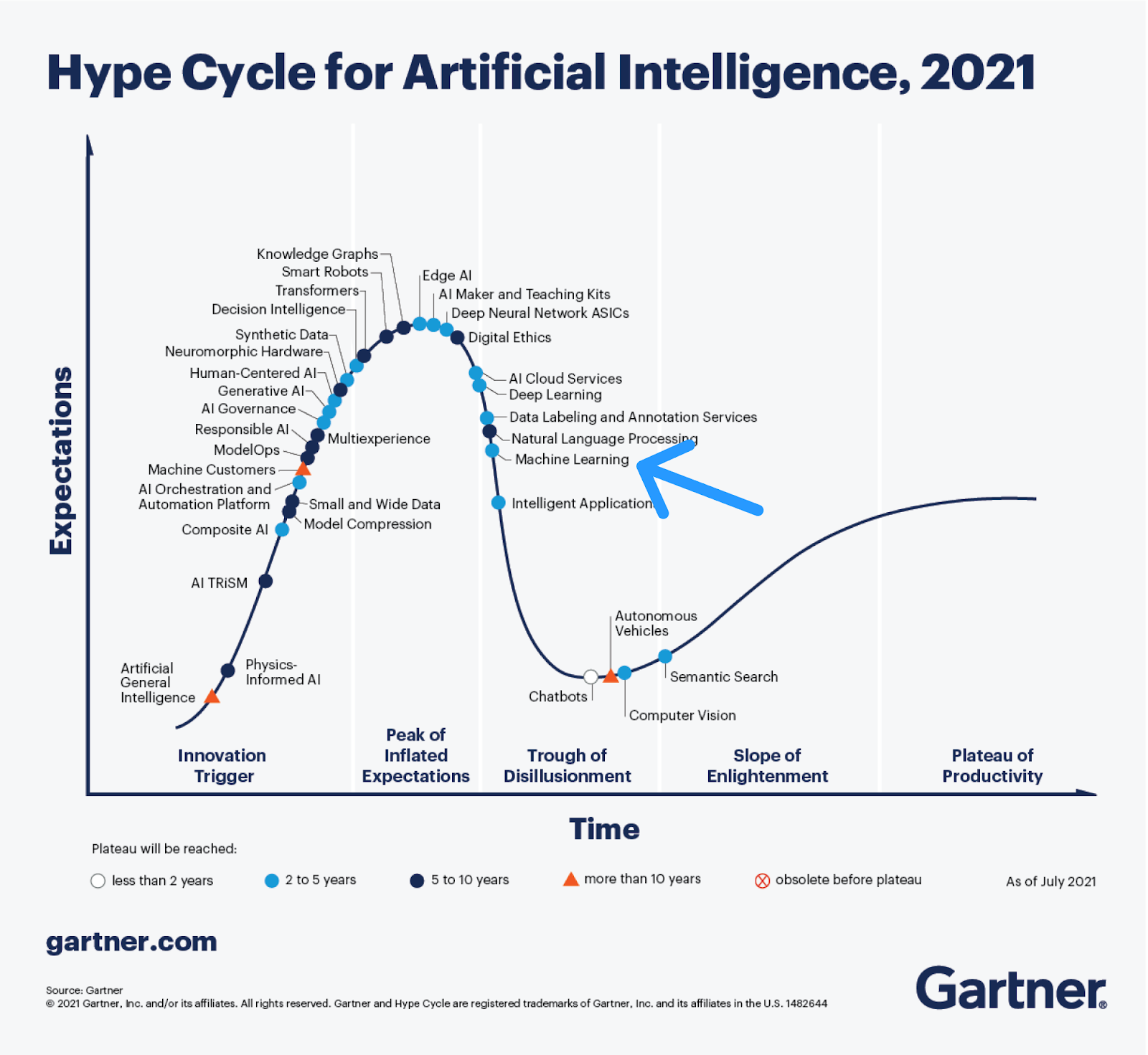
That argument has since resolved itself. In Gartner's 2025 Hype Cycle for AI, it is generative AI that has dropped into the Trough of Disillusionment, while AI agents, AI-ready data, multimodal AI and AI TRiSM occupy the peak. Machine Learning itself is no longer the thing being debated. It became the layer underneath the debate, which is precisely why the hiring demand outlived the hype it was attached to.
So what do we make of this when you're looking to hire Machine Learning experts?
In this blog we'll give some guidance on:
- Who Machine Learning engineers are
- Where you can find them
- How to hire them
1. Who are Machine Learning engineers?
Machine Learning engineers are typically strong software programmers who also have a good understanding of data models and more specifically learning models.
They research, build and test learning algorithms that they deploy in digital products that are self learning or within companies that use those models to improve processes.
Machine Learning experts typically work on the crossroads between data science, engineering and DevOps related activities.
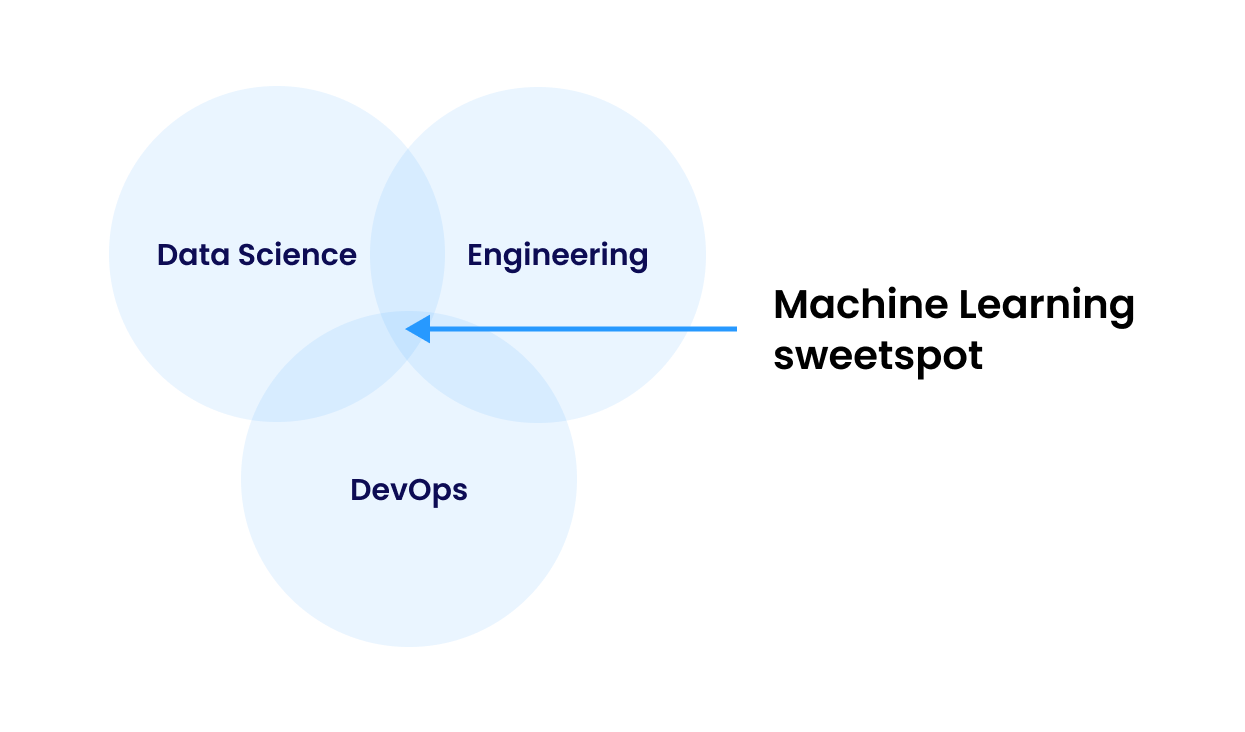
Some of the most important activities of a Machine Learning engineer:
- Engineering models and data solutions
- Deploy data modelling and analysis to find patterns within the data
- Algorithm selection and implementation
- Researching and implementing ML tools
- Selecting data sets and possibly cleaning them for use
- Validating and testing algorithms
Most important skills of a Machine Learning engineer:
- Math and statistics skills
- Strong analytical and problem-solving skills
- Software engineering skills like Python, Java, C++, C, R and JavaScript
- Understand data structures and data modelling
- Knowledge in computer architecture
What changed in the job itself
That list is still the foundation, but the centre of gravity has moved toward engineering. The Stanford AI Index reports that postings for AI roles increasingly ask for the skills that get systems built and run at scale, with some of the fastest long-term growth in deployment-oriented capabilities like AWS, scalability and workflow management. Fewer employers are hiring someone to prove a model can work. Most are hiring someone to keep one working in production.
Two practical consequences for your search:
- The stack turns over faster than your job spec. Skills tagged "agentic AI" went from 0.06% of US postings in 2024 to 0.23% in 2025, roughly 90,000 postings, in a single year. A requirement list copied from a two-year-old vacancy will describe a job that no longer exists.
- Deployment experience is the scarce half. Plenty of candidates can train a model. Far fewer have owned one after it shipped: monitoring, retraining, versioning, and the pager that goes off when output quality drifts.
Three roles that get confused with each other
Most failed ML searches are really briefing errors. Before you source anyone, settle which of these you are actually hiring:
- Research scientist: invents methods, publishes, usually holds a PhD. You find them through papers and conferences. They are the smallest and most expensive pool, and most companies do not need one.
- Machine Learning engineer: takes models (often someone else's, increasingly a foundation model) and makes them work reliably inside a product. This is the role most job specs mean, and it sits closer to backend engineering than to research.
- Data scientist: answers business questions with data, mostly analysis and experimentation. Overlapping toolkit, different output.
If your spec asks for NeurIPS publications and production Kubernetes experience in the same bullet list, you have merged two candidates who do not exist in one person, and you will source for months.
2. Where can you find Machine Learning engineers?
The useful thing about this market is that the work is unusually public. ML people publish models, code, notebooks and papers under their own names, which means you can assess the work before you ever send a message. That is rare in recruitment, and it is your biggest advantage here.
GitHub
The default starting point. GitHub reports more than 180 million developers and 4.3 million AI-related repositories, a number that has nearly doubled since 2023. More than 1.1 million public repositories now use an LLM SDK, and 2.4 million repositories used Jupyter Notebooks last year, up 75% year over year. Notebooks are the tell for data and ML work specifically.
Search by language and topic, then ignore the star counts. Stars measure marketing, not skill. Read the commit history instead: consistent contribution to a real project over months beats one viral repository every time. Our guide to sourcing tech talent on GitHub covers the search syntax in detail.
Hugging Face
Where ML engineers now actually live. Hugging Face reports 13 million users, more than 2 million public models and over 500,000 public datasets, and more than 30% of the Fortune 500 maintain verified accounts there.
Be careful with the signal, though. Roughly half of all models on the platform have fewer than 200 total downloads, and the top 200 models (0.01% of them) account for 49.6% of all downloads. "Has published a model" therefore means very little on its own. What separates a practitioner from a hobbyist is a maintained model card, honest evaluation numbers, and a repository where issues actually get answered.
Kaggle
Competitions give you something recruitment almost never gets: a ranked, verifiable performance record. The tier system (Novice, Contributor, Expert, Master, Grandmaster) is earned through medals rather than claimed on a CV, so it is one of the few credentials you can trust without a screen. See finding data science talent on Kaggle.
The caveat: competition skill is not production skill. Kaggle rewards squeezing accuracy out of a clean, fixed dataset. The job mostly involves dirty data, latency budgets and stakeholders.
Papers and preprints
For research-leaning roles, author lists are sourcing lists. Note that Papers with Code, long the standard tool here, was shut down by Meta in July 2025 and now redirects to Hugging Face Papers, which is where to look instead. arXiv remains the primary firehose.
Conferences
NeurIPS received 21,575 valid main-track submissions in 2025 and accepted 5,290 of them, an acceptance rate of 24.52%. Every one of those papers carries author names and affiliations, and the roughly 16,000 rejected submissions are public on OpenReview too. ICML and ICLR work the same way. That is a large, current, named pool of people who demonstrably do the work.
Still the widest net, and still the weakest signal for this specific market. Self-reported "Machine Learning" on a profile tells you nothing about whether someone has trained a model or watched a webinar. Use it to confirm employment history and to reach people, not to evaluate them.
Then comes the actual problem: reaching them
Every channel above gives you a person and no way to contact them. GitHub gives you a handle. Hugging Face gives you a username. A paper gives you an institutional address that may have expired along with the author's PhD. This is where most ML sourcing quietly dies. For the part of your list that is employed somewhere identifiable, which is most of the engineer end of it, a contact database like Apollo.io closes the gap fast enough to be worth the seat. For the research end, expect to do it by hand.
Apollo.io
Once you have a shortlist of names off GitHub, Hugging Face or a NeurIPS author list, the bottleneck stops being "who is good" and becomes "what is their email". Apollo.io is the pragmatic answer for that step, and you can test it against your own shortlist before paying anything: the free plan gives 900 credits per seat per year, released monthly, which is enough to check whether it actually resolves the kind of candidate you are chasing. Paid starts at $49 per seat per month billed annually, or $65 month to month. The honest limit matters here specifically: Apollo is a B2B sales database built around companies and corporate email, so it is strong on the ML engineer employed at an identifiable company and weak at exactly the research end of this market. For the PhD student, the independent contributor with a handle and no employer, or the person whose real inbox is a personal Gmail, no database will beat the commit email sitting in git log or the corresponding-author line on their paper. Use it for the employed half of your list and source the rest by hand.
Whatever you use, verify the address before you send. Our rundown of contact finding tools for tech candidates compares the options.
3. How to hire Machine Learning engineers
Sourcing is the easy half. This has been a candidate's market for a decade, so your process is what loses you people.
Lead with the problem, not the perks
Strong ML candidates screen you on the work, in a fairly predictable order: what data do you have, at what scale, is any of this in production or is it a greenfield promise, who owns the models once they ship, and how much compute can I actually get. An outreach message that answers two of those questions outperforms one that lists your benefits, because it proves there is a real problem here rather than an AI initiative announced by a board.
The reverse is also true. If the honest answer is "we have three years of messy CRM data and nothing in production yet", say so and sell the greenfield. Candidates find out in week one anyway, and the ones who like that problem are a different, cheaper, less contested pool.
Stop screening on years of experience
It is close to meaningless in a field where the tooling turned over twice since the job spec was written. Someone with "8 years of ML" may have spent six of them on models nobody deploys any more. Screen on what they have built recently, and on whether it survived contact with real users.
Use their public work instead of a take-home
This is the ML-specific advantage: you already have artifacts. Ask a candidate to walk you through a repository, a model card or a paper they own, and push on the decisions rather than the result. Why this architecture, what did you try first, what does it do badly, how would you know if it broke in production. Thirty minutes of that reveals more than any generic take-home, and it does not ask a scarce candidate to donate a weekend.
If you do need an exercise, scope it to two hours, pay for it, and use your own messy data rather than a clean toy set. Long unpaid take-homes are where senior ML candidates drop out of processes, and they are a common reason pipeline conversion looks worse than the sourcing did.
Be realistic about compensation before you start
With an average US base of $189,948 and the labs paying multiples of that in equity, the comp conversation decides most of these searches before the interview does. Work out where you sit against the market and be upfront about it. If you cannot match the top of the range, compete on what money cannot buy quickly: ownership of the model, access to unusual data, publication rights, a real compute budget, remote flexibility. Those are genuine currency with this group. See our guide to AI talent compensation for the detail.
Move faster than you think you need to
The mechanical thing that wins these hires is speed. A good ML engineer who is open to a move is typically in three processes at once. A two-week gap between your first call and your second is not a scheduling detail, it is your offer arriving second. Compress the loop, get the decision makers into the early conversations, and be ready to decide in the same week.
Conclusion
Machine Learning stopped being a hype cycle question and became infrastructure, which is why the demand did not deflate when the hype did. The upside for recruiters is that this is one of the few markets where the work is public: GitHub, Hugging Face, Kaggle and the conference proceedings let you assess people properly before you ever write to them.
So the sequence is: brief the right role (research, engineering or data science, not all three at once), find them where they build rather than where they list themselves, get a real contact address, and then run a process fast enough and honest enough to deserve them.
The first half of that sequence is mechanical enough to hand to software, which is the case for an AI recruiter like HeroHunt.ai. The second half is not.
HeroHunt.ai
The expensive part of that sequence is the sweep itself: an ML search means working GitHub, Hugging Face, Kaggle, OpenReview and LinkedIn separately, then reconciling five partial identities into one shortlist. HeroHunt.ai is built for that step, searching across a billion profiles, screening them with a language model against your actual brief rather than a keyword string, and running the outreach from the same place. The honest caveat for this market specifically: no sourcing tool can judge whether a model card is honest or whether a commit history shows real ownership. That read is yours, and on ML roles it is the part that decides the hire. Use it to compress the sweep from days to an afternoon, then spend the time you saved on the technical read described above.