
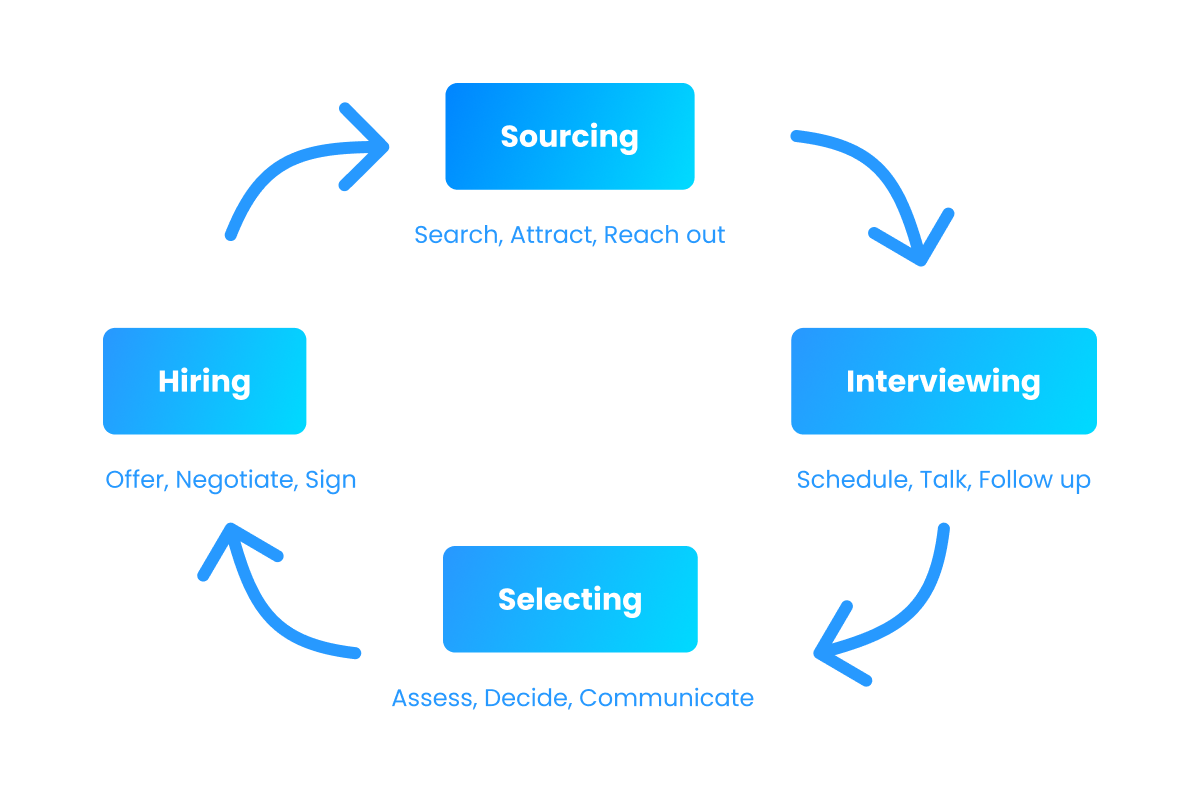



360 recruitment, also called the 360 recruitment cycle, full-cycle or full-desk recruiting, is a model where one recruiter owns every stage of a hire, from sourcing to the signed offer, and in agencies often client work and onboarding too - Pin. The opposite is 180 or split-desk recruiting, where specialists share the stages - AIHR. The four core stages are sourcing, interviewing, assessing and hiring.
What is the 360 recruitment cycle
The recruitment cycle, also known as the 360 recruitment cycle or the recruitment life cycle, is the complete process of recruiting talent with all the phases including sourcing, interviewing, selecting and hiring.
Depending on the organisation of the recruiting company, recruiters are responsible for the entire recruitment cycle which is also referred to as 360 recruitment cycle or full cycle recruitment, or different parts of the cycle are assigned to separate roles in or outside the organization. When one recruiter owns every stage, from sourcing through to hiring, a recruitment CRM or applicant tracking system like Manatal helps keep all the phases organized in one place.
Some organizations for example choose to have a dedicated sourcing team.
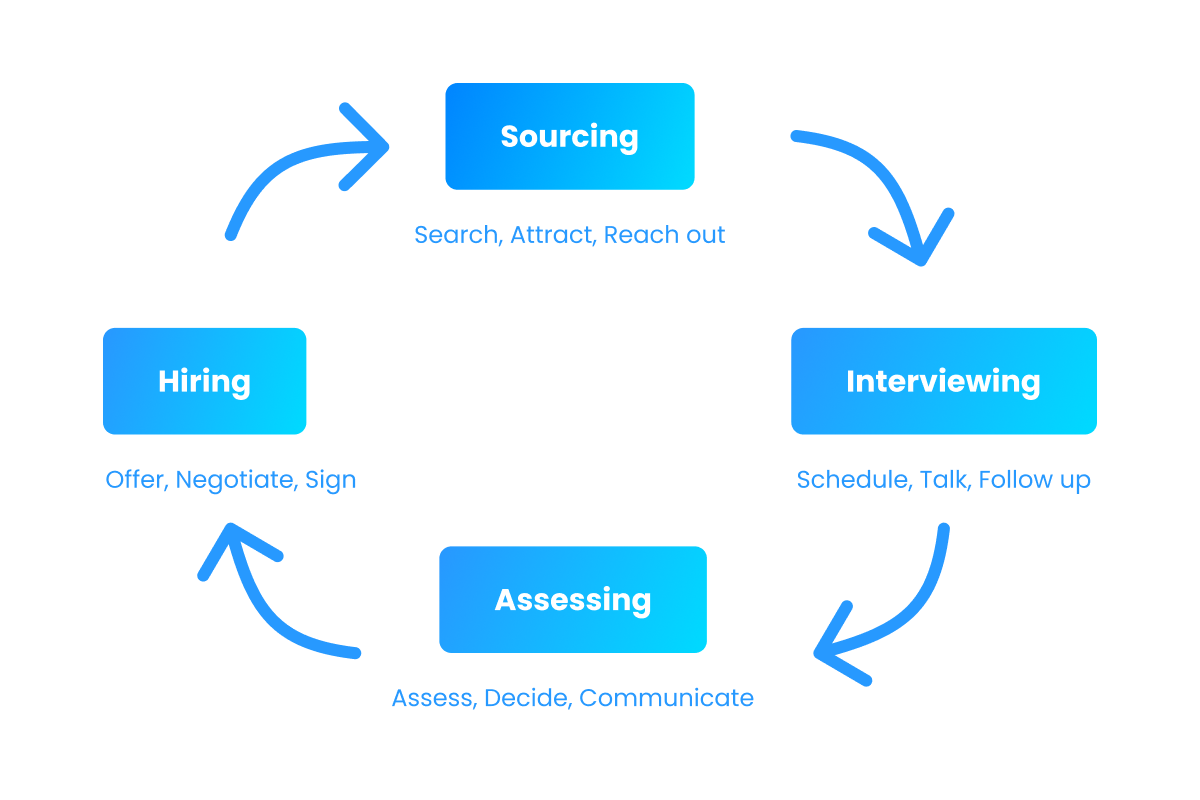
Steps in the recruitment cycle
1. Sourcing
The recruitment process starts with the sourcing process. The goal of sourcing is to find candidates who qualify for a certain set of job criteria.
Search
The search is the part where sourcers or recruiters search for the best candidates. This can be online or through referrals. The online search for talent is a search through several platforms including search operators to target the search and get the right results.
Attract
Attracting candidates is about getting candidates to your employer brand and job post. You do this by positioning your employer brand so it resonates with the talent pool and by posting job posts that are distributed across different channels like LinkedIn, niche job boards and other relevant platforms.
Reach out
Reaching out is key to getting qualified candidates to show any further interest in the job. Some recruiters choose to use standardized and automated messages but a hyper personalized message is usually the most effective. That is the tension a solo 360 recruiter runs into: personalization does not scale by hand, which is why AI recruiters such as HeroHunt.ai now handle the search and the first message together rather than leaving the sourcer to choose between volume and relevance.
HeroHunt.ai
Search, attract and reach out are three separate jobs, and on a 360 desk they are the ones that get squeezed first because the interviews already booked for today always feel more urgent than the pipeline you will need in three weeks. HeroHunt.ai compresses that stage: it searches over a billion public profiles across LinkedIn, GitHub and other sources, screens the results with a language model against the criteria you wrote down, and drafts outreach per candidate instead of one merged template. The honest limit: it is a sourcing and outreach tool, not a system of record. It will not hold your interview scorecards or track an offer, so the later stages of the cycle still need somewhere to live.
2. Interviewing
The interview stage is where the candidate assesses you as much as you assess them. It is also where a pipeline that took weeks to build tends to leak, and most of what goes wrong here is logistical rather than a matter of judgement.
Schedule
Scheduling looks like admin, but every day between a candidate agreeing to talk and the interview actually happening is a day a faster process can move ahead of you. Propose concrete slots in your first reply instead of asking for availability and waiting a round. Agree the hiring manager's calendar rules once, rather than renegotiating them for every candidate.
Talk
Structure the conversation itself. Asking every candidate the same questions in the same order against the same scoring scale is not bureaucracy: structured interviews predict job performance far better than unstructured ones, at a validity of .42 versus .19 - Sackett and colleagues (2022 study). Structure also makes candidates comparable once you reach the assessing stage. Leave real time for the candidate's own questions, because that is the part that sells the job.
Follow up
Follow up quickly, and tell the candidate what happens next and by when. This is the most broken part of most recruitment cycles: 61% of job seekers said they had been ghosted after an interview (report published December 2024) - Greenhouse. The candidates you lose to silence are the ones with other options, which is to say the ones you wanted.
3. Assessing
Assessing is comparing candidates against the criteria you set at the start of the cycle, not against each other. Ranking people relative to whoever else happened to apply is how a pipeline talks itself into a mediocre hire, and it is the reason the criteria need to be written down during sourcing rather than reconstructed from memory now.
Assess
Depending on the role, assessment can mean a work sample, a take home assignment, a technical test or reference checks. Score each candidate against the job criteria you defined at the start, so the decision stays traceable. If you cannot explain later why one candidate outscored another, you did not assess them, you reacted to them.
Decide
Deciding is a joint call between the recruiter and the hiring manager, and it is where the cycle stalls most often. The feedback is in, nobody actually disagrees, and still nothing moves for a week. Set the decision date before the first interview happens and treat it as a deadline rather than an aspiration.
Communicate
Communicate the outcome to everyone, including the candidates you turned down. Rejected candidates are next quarter's candidates and a source of referrals. A short, specific, personal rejection costs you a few minutes and protects the talent pool you will source from again. A silent rejection saves those minutes and costs you the pool.
4. Hiring
Hiring is the stage where the cycle either closes or resets to the beginning. A candidate lost at offer stage does not just cost you the offer, it costs you every hour spent in the three stages before it.
Offer
Make the offer verbally first, then confirm it in writing. A verbal offer lets you read the reaction and handle hesitation while you are still in the conversation. A written offer sent cold gives objections a few days to harden in private before you ever hear about them.
Negotiate
Negotiation is rarely only about salary. Start date, remote days, title, equity, notice period buyout and learning budget are all live, and some of them cost you very little. Work out which of these you can move on before you make the offer, not while the candidate is on the phone waiting for an answer.
Sign
A signature is not the end of the cycle. The notice period is when counteroffers land and accepted offers quietly fall through, so stay in contact between signing and the start date. Then the loop begins again: the person you just hired is the hiring manager who briefs your next cycle, and the runner up you rejected well is a candidate you can call first.
Running the full cycle yourself
The hard part of 360 recruitment is not any single stage, it is the context switching between them. A full cycle recruiter sources in the morning, interviews at midday and negotiates an offer in the afternoon, and every switch carries the risk of dropping something: the follow up that was promised, the scorecard that was never written down, the candidate who has been waiting nine days for an answer.
This is the practical argument for keeping all four stages in one system instead of spreading the cycle across a spreadsheet, an inbox and a calendar. When the cycle is split across separate roles, handovers are explicit and visible, and someone notices when a candidate goes quiet. When one recruiter owns every stage, nothing forces a handover, so the record has to do that job instead. Vendor pricing pages, such as Manatal's, show what that record costs per seat.
Manatal
That record is what an applicant tracking system is for: the candidate you sourced in week one has to still be findable, with their notes attached, at offer stage in week six. Manatal publishes a price for that, which most ATS vendors do not: $15 per user per month billed annually, or $19 billed monthly. Check the tier line before you commit, though. That plan caps at 15 active jobs and 10,000 candidates, and unlimited jobs and candidates start at $35 per user per month annually. If you are running more than fifteen live reqs on a 360 desk, price the $35 tier, not the $15 one.
Frequently asked questions
What is 360 recruitment, and what are its steps?
360 recruitment is a full-cycle model where one recruiter owns the whole hire, from sourcing through interviewing, assessing and hiring. It is also called full-cycle, end-to-end or full-desk recruiting. Fuller versions add client or stakeholder engagement and preparation first and onboarding last, and split the middle stages more finely, giving the eight steps AIHR describes.
Is 360 recruitment the same as full-desk recruiting?
Yes. 360 is the standard wording in the UK and Australia, while US firms say full-desk or full-cycle - Pin. The contrast is 180 or split-desk recruiting, which divides the stages among specialists: it favours specialization but risks delays and inconsistency - AIHR.
How long does the recruitment cycle take?
SHRM's 2025 benchmarking put median time-to-fill, from job requisition to offer acceptance, at roughly a month and a half for executive and nonexecutive roles alike - SHRM. Treat it as a benchmark rather than a promise, since individual roles vary. Our recruitment funnel guide shows where candidates drop out.
Can AI automate part of the 360 recruitment cycle?
It can take over the sourcing stage. The HeroHunt.ai AI Recruiter searches public professional profiles, screens candidates with AI and contacts them by email and LinkedIn. Starter is $99 a month with an 8-day free trial: a card is needed to start and is charged when the trial ends unless you cancel - HeroHunt plans.