



The practical 2026 buyer's guide to Apollo.io pricing, the quietly gutted free plan, the credit traps that inflate the bill, and eleven alternatives worth switching to.
Apollo.io sells a $0 plan that most people cannot actually run a real outbound campaign on anymore. The free tier still exists, still says "unlimited email credits," and still lets you build a list. But over 2025 and into 2026 Apollo migrated every account onto a new unified credit system that caps free email sending at roughly 250 a day, hands you only about 75 general credits a month, and lets nothing roll over - Prospeo. The plan you remember from two years ago and the plan you get today are not the same product, even though the marketing page barely changed.
That gap between the advertised price and the working price is the whole story of Apollo pricing in 2026. Apollo is still one of the best-value all-in-one prospecting tools on the market, with a genuinely enormous database and paid plans that start cheap. It is also a platform where the sticker price ($49 a seat) and the effective price (often $150 to $400 a seat once credits, overages, and phone reveals are counted) live in different postal codes - Saleshandy. Buyers who do not understand the credit model overpay, and buyers who assume the free plan is a working tool get stuck.
This guide breaks down exactly what each Apollo plan costs in 2026, what got cut from the free tier and when, how the credit system actually meters your spend, and the eleven alternatives worth comparing before you commit, from cheaper email finders to enterprise data platforms to AI recruiters built for a completely different job than Apollo does. Every price here was checked against a primary or reputable source, because Apollo's pricing page is JavaScript-rendered and the web is full of stale numbers.
Apollo.io
If you run a small, US-focused sales team and just need one affordable seat that bundles a big database with email finding and sequencing, Apollo's Basic plan at $49 per user per month (billed annually, $65 month to month) is still one of the best deals in prospecting, and it grants 30,000 credits per seat per year upfront rather than dribbling them out - Apollo. The honest caveats, spelled out in full below: credits do not roll over, "verified" emails still bounce at 15 to 35 percent in the wild, phone data outside the US is weak, and the free plan is now an evaluation trial, not a working tool. Try it free first, then upgrade only once you have measured your real credit burn.
Contents
- Apollo pricing in 2026: the four tiers at a glance
- The free plan got quietly gutted: what actually changed
- How Apollo credits really work (and why the bill surprises you)
- The real cost of Apollo: overages, per-seat math, and the effective price
- What you are actually paying for: inside the Apollo platform
- Data quality: the 97 percent claim versus real bounce rates
- What users really think: the G2 versus Trustpilot split
- Who Apollo is right for, and who should walk away
- The best Apollo alternatives in 2026
- How to choose: a decision framework
1. Apollo pricing in 2026: the four tiers at a glance
Apollo runs four plans in 2026: Free at $0, Basic at $49 per user per month, Professional at $79, and Organization at $119, all priced on annual billing. The four-tier ladder is published on Apollo's own pricing page - Apollo. Those are the headline numbers, and they are the numbers you should anchor to, because Apollo discounts annual billing heavily and the month-to-month prices are noticeably higher: Basic jumps to $65 a month paid monthly, with Professional and Organization commonly cited around $99 and $149 - Saleshandy. The verified Basic month-to-month figure is $65 rather than the $59 that still circulates on older blogs, which is a small but telling sign of how fast Apollo's numbers move.
The reason the tier you pick matters so much is that Apollo gates both features and credit allocations by plan, so the price difference buys two different things at once: more of the platform, and more of the raw fuel (credits) to use it. Free is a permanent plan rather than a trial, but it is deliberately constrained to two active sequences and a thin credit pool. Basic unlocks the parts most teams think of as "Apollo" (unlimited sequences, waterfall enrichment, a meeting scheduler, and two-way CRM sync). Professional adds the built-in dialer and intent data. Organization adds SSO, international dialing, and the highest API limits, and it carries a three-seat minimum, so its real entry cost is closer to $357 a month than $119 - PhantomBuster.
Here is the plan ladder in one view, on annual per-seat pricing:
- Free ($0) - 900 general credits per seat per year, 2 active sequences, capped AI
- Basic ($49) - unlimited sequences, waterfall enrichment, CRM sync, 30,000 credits/year
- Professional ($79) - adds the dialer and buyer-intent signals
- Organization ($119, 3-seat minimum) - adds SSO, international dialer, top API limits
The practical read on this ladder is that Basic is where Apollo becomes a real tool and Professional is where it becomes a real calling tool. Most small teams that just need emails and sequences live comfortably on Basic, and the jump to Professional is worth it only if you actually dial prospects or need intent data to prioritize accounts. Organization is an enterprise motion (SSO, security review, three seats) that you should not reach for unless procurement demands it. The Free plan, as the next section explains, is best understood as a supervised test drive rather than a plan you operate on.
To make the shape of the pricing obvious, here is the annual per-seat cost across the four tiers.
Apollo.io Monthly Cost Per Seat by Plan (Annual Billing, 2026)
What the chart hides, and what the rest of this guide exists to surface, is that the bar labeled "Free" is misleading and the bars labeled with dollar amounts are floors, not ceilings. Two teams on the identical plan can pay very different effective prices depending on how many phone numbers they reveal, how much they export, and whether they burn through credits mid-cycle and buy overages. Price per seat is the start of the Apollo cost conversation, never the end of it, which is exactly why so many buyers feel misled after month two.
2. The free plan got quietly gutted: what actually changed
There was no single dramatic announcement that Apollo cut its free plan. That is precisely why it caught so many users off guard. Instead of a dated policy change, Apollo spent 2025 and 2026 migrating every account onto a new unified credit system, giving it to new signups automatically and moving legacy accounts over on a rolling basis - Prospeo. The result is that two people on the "same" free plan can see different limits depending on when their account was migrated, and the generous free tier that recruiters and founders remembered from 2023 slowly became an evaluation trial without anyone getting an email about it.
The single most important thing to understand is what "unlimited email credits" actually means on Apollo's free plan, because the word "unlimited" is doing enormous work. Free email credits are governed by a Fair Use Policy, and in practice that policy caps a free account at 10,000 emails a month on a verified corporate domain and just 100 a month on a personal or unverified domain like Gmail - Alex Berman. So if you sign up with a company email you get a usable evaluation allowance, and if you sign up with a personal address you get roughly three emails a day. Neither is "unlimited," and the 100-versus-10,000 split is the detail that trips up freelancers, students, and anyone testing Apollo before they have a corporate domain to verify.
Beyond email, the free plan's other credit pools are where the real squeeze happens, and they are what make it unworkable for genuine outbound. A current free account gets roughly 75 general credits a month (900 per seat per year, released monthly), plus about 5 mobile credits, 10 export credits, and 50 AI credits a month, and none of it rolls over - Cognism. Because revealing contact data and exporting both consume these tiny pools, a free user can build a list of thousands but can only actually pull a trickle of it out per month.
The changes users felt most acutely break down like this:
- Email "unlimited" became fair-use capped at 10,000/month corporate, 100/month personal
- General credits shrank to about 75 a month, released from a 900-per-year pool
- Mobile and export credits dropped to roughly 5 and 10 a month
- No rollover was enforced, so unused credits simply expire each cycle
- Upload and export workarounds that stretched free credits were blocked - Prospeo
The honest, non-sensationalized version of the "free tier cut" story is this: some widely-shared blog posts claim the free plan "dropped from 10,000 to 100 email credits overnight in late 2025," but that framing conflates the corporate-versus-personal domain split with a temporal cut and should be treated skeptically - Astra GTM. What genuinely changed is subtler and arguably worse for trust: Apollo tightened the free plan through a quiet, gradual account migration rather than a clear announcement, stopped publishing a stable free-tier credit policy, and blocked the workarounds people relied on. The plan did not get cancelled. It got converted from a working free tool into a supervised demo, and the lack of a clear changelog is why the community reaction (covered in section 7) turned sour. For teams that genuinely need candidate or prospect emails at zero cost, our guide on how to find email addresses of candidates covers methods that do not depend on a shrinking credit pool.
3. How Apollo credits really work (and why the bill surprises you)
Apollo's credit system is the single biggest source of billing confusion, and understanding it is the difference between a $49 plan and a $400 one. The core mechanic is simple to state: almost every valuable action (revealing an email, revealing a phone number, exporting a record, running an AI research task) consumes credits from a pool that resets, and does not roll over, at the end of each billing cycle. Apollo's own About Credits page is blunt about it: credits expire at the end of each cycle and do not carry into the next one, a policy its Terms of Service repeats word for word - Apollo. If you have a slow month, those credits are gone; if you have a heavy month, you run dry and either pause or pay.
The part that confuses even experienced users is that Apollo has more than one kind of credit, and the definitions have shifted during the migration. Historically there were separate pools for email, mobile, and export; the newer unified framing rolls them together, which is itself a source of buyer confusion because two sources can quote wildly different numbers for the "same" plan - Saleshandy. The safe way to reason about it is to always ask which credit type a number refers to. "900 credits a year" (the free general pool) and "10,000 email credits a month" (the free email fair-use cap) are both true at once and describe completely different things, so treat any single credit figure with suspicion until you know its type.
The cost per action is where budgets quietly bleed, and one number matters more than any other:
- Email reveal costs 1 credit per verified address
- Phone number reveal is the expensive one, and its cost is disputed
- Full enrichment (email plus phone plus company) can run 9 or more credits per contact
- Exports draw from a separate, small export pool on lower tiers
- AI research actions consume credits too, with no fixed published rate yet
That disputed phone cost deserves a clear warning, because it is exactly the kind of detail buyers get wrong. Apollo's own About Credits page lists a phone-number reveal at 1 credit, the same as an email - Apollo. Many third-party pricing breakdowns, however, insist a mobile or direct-dial reveal costs far more, commonly 8 credits, and build their cost estimates on that figure - Prospeo. We are not going to assert a multiplier as fact when Apollo's own documentation contradicts it; what you should take away is that phone data is the credit type most likely to drain your pool fast, whether because it costs more per reveal or because its low accuracy (section 6) makes you reveal more numbers to find working ones. Either way, if cold-calling is your motion, model your phone credit burn carefully before you buy, and assume it is your most expensive line item.
4. The real cost of Apollo: overages, per-seat math, and the effective price
The most useful number in this entire guide is not $49. It is the $150 to $400 per user per month that active outbound teams actually spend on Apollo once you count everything. Reviewers who model total cost of ownership rather than sticker price consistently land in that range, and the drivers are predictable: expiring monthly credits force heavy weeks to run dry, phone reveals and full enrichment eat credits fast, and overage top-ups get bought to finish campaigns - Saleshandy. The $49 seat is real, but it describes a light user, not a working SDR pushing volume.
Overages are the mechanism that turns a fixed subscription into a variable bill, and they are priced to nudge you toward the next tier. When you exhaust your plan credits, extra credits cost about $0.20 each and are sold in a minimum 250-credit block, so the smallest top-up is roughly $50, and those overage credits also expire at the end of the cycle - PhantomBuster. The design is coherent from Apollo's perspective: if you regularly buy overages, upgrading looks cheaper, which is why so many users describe the credit model as upgrade pressure by design rather than a neutral metering system.
Per-seat math is the other place teams underestimate Apollo, especially at the top of the ladder. Because Organization enforces a three-seat minimum, a small team that wants SSO or international dialing is really signing up for about $357 a month, not $119 - PhantomBuster. And because pricing is per user, a five-person SDR pod on Professional is a $395-a-month commitment before a single overage, which is still competitive against enterprise data platforms but is a long way from the free-plan mental model people arrive with.
To put Apollo's entry price in context against the alternatives covered later, here is the cheapest self-serve monthly entry point across the major tools, on comparable per-user annual billing where it exists.
Cheapest Self-Serve Entry Price, Apollo vs Alternatives (per user per month, 2026)
Two caveats keep this chart honest. First, it plots entry prices, not value: Apollo's Basic seat bundles a database, email finding, and sequencing into that $49, while a $34 Hunter.io seat is a focused email finder and nothing more, so equal-looking bars buy very different amounts of platform. Second, the two most powerful data platforms most enterprises actually compare Apollo against, ZoomInfo and Cognism, do not appear here at all because they are quote-only and start in the tens of thousands per year, which is a category difference this guide returns to in section 9. Read the chart as "where does Apollo's floor sit among self-serve tools," not "which tool is cheapest overall."
5. What you are actually paying for: inside the Apollo platform
Apollo's real product is one of the largest B2B databases in the world, wrapped in a sales-engagement layer so you never leave the tool to act on the data. The database covers roughly 275 million contacts across 73 million companies, and the reason G2 reviewers pick Apollo over point solutions is that the same seat that finds a contact also sequences the email, dials the number, and syncs the record to your CRM - UpLead. That consolidation is the core value proposition, and it is genuine: replacing Apollo usually means buying two or three separate tools.
The platform breadth is best understood as data plus an engagement stack, and it is worth seeing what the working surface looks like rather than just reading a feature list.
The Apollo.io go-to-market platform
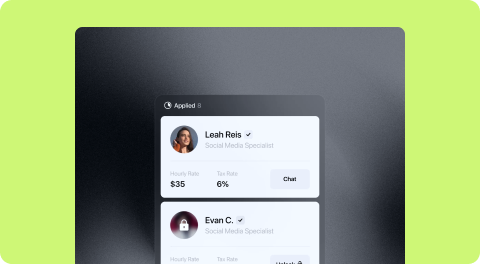
Underneath the interface, the features gate by plan in a way that maps cleanly onto how much you pay. Waterfall enrichment, which checks multiple sources in sequence to fill and verify a record before it enters outreach, is available from Basic up, as are unlimited sequences and bidirectional Salesforce and HubSpot sync - Apollo. One limitation catches multi-CRM teams by surprise: you can connect only one CRM at a time, so connecting Salesforce blocks HubSpot - Apollo. The built-in dialer and buyer-intent data are Professional-and-up features, with international dialing reserved for Organization - Apollo. If calling or intent is core to your motion, budget for at least the $79 Professional seat rather than assuming Basic covers it.
The biggest 2026 story on the product side is Apollo's aggressive pivot to AI, which is also where a chunk of your future credit spend will go. On March 4, 2026 Apollo launched an agentic AI Assistant that it bills as the first AI-native, end-to-end GTM platform: instead of suggesting actions like a chatbot, it executes them from natural-language prompts, building and running prospecting, enrichment, research, sequencing, and reporting workflows - PR Newswire. Apollo reports the AI platform grew 500 percent year over year with about 50,000 weekly active AI users, and it acquired the company Pocus in March 2026 to push further toward an AI-native GTM operating system - Apollo.
Apollo's own overview of the AI Assistant shows what "describe a goal, watch it run the workflow" looks like in practice, which is the clearest way to judge whether the AI is a real time-saver or a demo.
Apollo AI Assistant: Run Your Entire Outbound Workflow with AI
The catch, and the reason the AI matters for a pricing guide, is that its long-run cost is a forecasting unknown at purchase time. At launch the AI Assistant is free as an introductory offer on the paid plans and capped at five chats on Free, but Apollo has not published a stable per-action credit price, so you should expect AI research and writing to draw from your shared credit pool once the promo ends - PR Newswire. The practical takeaway is to treat the AI as a genuinely useful accelerant that you should not yet build a permanent budget around, because the meter behind it is not fixed. When you evaluate any AI-first tool, including the AI recruiters in section 9, ask what each AI action costs in credits before you rely on it, not after.
6. Data quality: the 97 percent claim versus real bounce rates
Apollo advertises email accuracy "up to 97 percent," and in real cold-email campaigns buyers report bounce rates of 15 to 35 percent. Both statements can be true, and the gap between them is the most important thing to understand about Apollo's data. The 97 percent figure describes verified addresses under ideal conditions; the field reality, aggregated across independent tests and reviewer reports, commonly runs 20 to 30 percent bounces, with cold-email practitioners citing 32 to 38 percent on "verified" exports through early 2026 - Prospeo. If you plan outbound around the headline number, you will damage your sender reputation; if you plan around the field number, you will budget for list cleaning and pace your sends.
Geography is the single biggest driver of Apollo's data quality, and it is where a lot of non-US teams get burned. US email accuracy runs in the mid-to-high 80s, roughly 88 percent, while non-US accuracy falls to around 60 percent, with EU data constrained by GDPR-era sourcing and APAC, Middle East, and LATAM records showing missing mobiles and stale job titles - Market Intelligence Tools. Apollo is a US-first database with international coverage bolted on, and buyers targeting EMEA or APAC should treat its coverage there as a starting point to be re-verified, not a finished list.
Phone data is Apollo's weakest link, and it is expensive precisely where it is weakest. Reviewers put direct-dial accuracy at roughly 50 to 70 percent, with many "direct" numbers routing to a company switchboard, and because phone reveals are the credit type most likely to drain your pool, inaccurate numbers waste budget fastest - Prospeo. Teams that live on the phone, especially in Europe, should not treat Apollo's mobile data as reliable and should keep a phone-specialist provider (Cognism and Lusha both score better here) in the stack for dialing.
On compliance, Apollo is in reasonable shape, which matters more than it used to as cold outreach draws regulatory attention. Apollo positions itself as GDPR-compliant in both processor and controller roles, and it complies with CCPA and CPRA, SOC 2, and the EU-US, UK, and Swiss Data Privacy Frameworks, sourcing data through a contributory community model plus partner feeds and continuous re-verification - Apollo. That said, compliant sourcing does not remove your own obligations: if you cold-email EU individuals, the lawful basis for that outreach is still your responsibility, not Apollo's, and the platform's data volume can make it easy to forget that.
7. What users really think: the G2 versus Trustpilot split
The clearest signal in Apollo's reviews is not the average score. It is the fact that Apollo holds about 4.7 out of 5 on G2 and about 2.9 out of 5 on Trustpilot at the same time. That split is not noise; it is structure. On G2, where reviewers are often power users evaluating the product's capabilities, Apollo is praised for consolidation and breadth across thousands of reviews. On Trustpilot, which attracts people motivated to complain, roughly a thousand reviews cluster around billing disputes, account suspensions, and data-accuracy gripes - SyncGTM. The product is genuinely good and the billing experience is genuinely contentious, and both facts show up in exactly the venues you would expect.
A representative example of the sentiment gap, captured from a real G2 review, is worth seeing because it shows the tone rather than just the number.
A real Apollo.io user review from G2
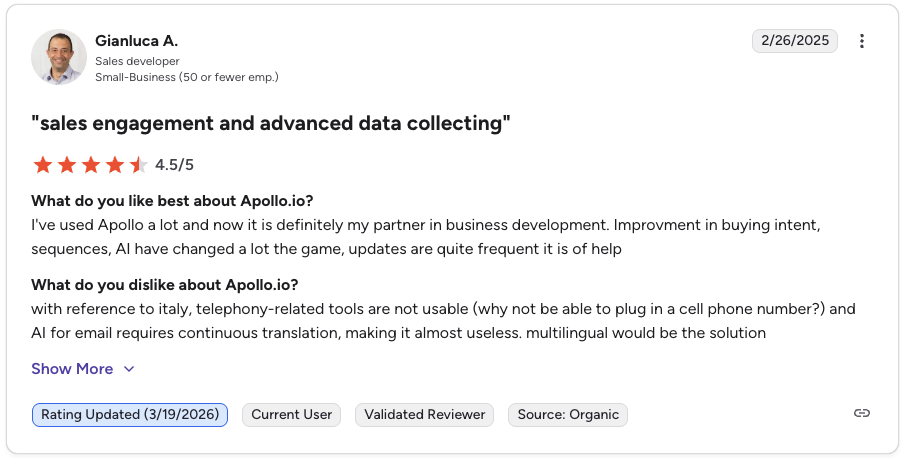
The specific complaints are consistent enough to be predictive, which makes them useful as a pre-purchase checklist rather than just venting. The recurring themes are that credits are confusing and hard to forecast, that the no-rollover policy feels punitive, that support is slow (support is Apollo's lowest-rated G2 subcategory at about 4.2), and that prices keep rising, with one long-tenured reviewer watching the Basic plan climb from $19 to $29 to $39 to $49 to $59 over successive renewals - Cognism. Notably, the migration-driven "bait and switch" perception traces back to the same root cause as the free-tier changes in section 2: Apollo changed the deal without clearly telling people.
The way to use this sentiment is not to be scared off, but to buy with eyes open. Nearly every serious complaint about Apollo is about the commercial experience (credits, billing, support, price changes) rather than the core product, which tells you where to focus your diligence: measure your real credit burn on a short paid trial, set a calendar reminder before renewal so a price change never surprises you, and never assume "verified" means "will not bounce." Apollo rewards teams that manage it actively and punishes teams that set it and forget it, which is a fair summary of the entire pricing story.
8. Who Apollo is right for, and who should walk away
Apollo is close to ideal for a small, US-focused sales team that wants one affordable seat to run outbound, and it is a poor primary tool for a recruiter trying to source candidates. Getting this fit judgment right is more valuable than any individual price, because the wrong tool at a great price is still the wrong tool. The clean version: if your job is emailing and dialing a large volume of US business contacts on a budget, Apollo's all-in-one bundle at $49 to $79 a seat is hard to beat. If your job is finding, evaluating, and reaching candidates, Apollo is built for a different motion and will fight you.
For sales and growth teams, Apollo's sweet spot is specific and real. It fits a one-to-five-person SDR pod that needs a low-cost, all-in-one prospecting engine to start outbound, where the value comes from having the database, sequencer, and (on Professional) dialer in a single seat rather than stitching three tools together - Reply.io. The teams that should look elsewhere are enterprises that need airtight EU phone data (Cognism), organizations standardizing on a single deeply-integrated data platform regardless of cost (ZoomInfo), and anyone whose whole motion is cold-calling internationally, where Apollo's phone accuracy will frustrate you.
For recruiters, the honest assessment is that Apollo is a supporting tool, not a sourcing engine, and treating it as the latter is a common and expensive mistake. Apollo's search is title-and-company based rather than skills-based, it has no candidate receptivity or "open to work" signal, no applicant tracking, and its profiles are optimized for sales (a current work email and title) rather than the career depth recruiters actually evaluate on. Where it genuinely earns a place in a recruiting stack is narrower but real: agency business development (finding hiring managers and founders to pitch), and enriching a candidate shortlist you have already built elsewhere with a work or personal email before you reach out.
That distinction points at the deeper issue. A contact database answers "what is this person's email," but sourcing answers "who are the right people, and are they reachable and interested," which is a fundamentally different and harder question. This is exactly where purpose-built recruiting tools, including AI recruiters like HeroHunt.ai that source and screen from over a billion profiles rather than reveal contacts from a sales database, do a job Apollo was never designed to do. If you are a recruiter who landed here because you were using Apollo for candidate outreach, section 9 is written for you, and our roundup of the best AI sourcing agents in 2026 goes deeper on the sourcing-native options.
9. The best Apollo alternatives in 2026
There is no single "best Apollo alternative," because Apollo does two jobs (contact data and sales engagement) and different tools beat it on each, while an entirely different category of tool beats it for recruiting. The right way to shop is to first decide which job you are actually buying for, then compare within that lane. This section splits the alternatives into three groups: cheaper or more focused self-serve data tools, enterprise data platforms, and recruiting-native sourcing tools. Prices below were each checked against a reputable 2026 source, because this market changes its numbers constantly.
Self-serve contact-data tools (cheaper or more focused than Apollo)
For teams that find Apollo's credit model punishing or simply want a narrower tool, several self-serve options undercut it or specialize. Lusha is the closest like-for-like, at $49.90, $69.90, and $399.90 per user per month, with strong US direct-dial data and a small free tier, which makes it the natural pick when Apollo's phone accuracy is the problem - Vendr. RocketReach starts cheapest at about $33 a month annually for 1,200 email-only lookups a year, with phone access gated to its $83 Pro tier - SalesIntel. Hunter.io is the lightweight email specialist at roughly $34 a month annually for 2,000 credits, ideal when all you need is to find and verify work emails - RB2B.
Two other self-serve tools are worth knowing for opposite reasons. Seamless.ai looks comparable on paper at about $147 a month for 250 credits, but it charges for every lookup attempt including ones that return nothing, and reviewers report 20 to 40 percent of credits wasted on dead records, so its effective cost per usable contact is high - Cleanlist. Clay is a different animal entirely: after a March 2026 overhaul its entry paid plan (Launch) runs about $167 a month for 2,500 data credits, and it is an enrichment-and-orchestration platform for technical growth teams rather than a simple contact finder, powerful but with a real learning curve - Warmly. The practical rule: pick RocketReach or Hunter to spend less than Apollo, Lusha to fix Apollo's phone gap, and Clay only if you have someone who will actually build workflows in it.
Enterprise data platforms (where Apollo is outgunned on data, at a price)
When data depth, coverage, and compliance matter more than cost, two platforms sit above Apollo and price accordingly. ZoomInfo is the incumbent, quote-only with a three-seat minimum, and its Professional tier starts around $14,995 a year, with the median real contract landing near $31,875 a year and most teams paying $30,000 to $60,000 once seats, intent, and international data are added - Cleanlist. It is the deepest US B2B dataset and the most expensive way to buy one. Cognism is the European counterweight, also quote-only, typically $15,000 to $25,000 a year for a small team, and its Diamond phone-verified mobile data (manually confirmed by a research team) is genuinely better than Apollo's for EU cold-calling - SpendHound.
The reason these belong in an Apollo guide at all is that a large share of "Apollo alternative" searches come from teams who outgrew Apollo's data rather than its price. If your bounce rates on EU contacts are unacceptable, or your enterprise needs one governed data source with SOC 2 and airtight consent handling, the tens-of-thousands-per-year platforms are the honest answer, and pretending a $49 tool competes with them does nobody any favors. Most teams, though, do not need this tier, and the recruiting-focused readers of this blog almost never do. Our ZoomInfo talent pricing breakdown covers the recruiting angle on that platform specifically, and the wider recruiting software pricing guide maps how all of these meter their pricing.
Recruiting-native tools (a different job than Apollo does)
If you are a recruiter, the most important realization is that your best "Apollo alternative" is often not a contact database at all, but a sourcing tool. SignalHire is the closest recruiting-friendly contact finder, starting at about $39 a month annually for phones or $57 for emails, with a combined unlimited plan around $167 and native ATS integrations - FullEnrich. ContactOut specializes in personal emails for passive candidates, with a free daily tier and paid plans commonly cited around $49 to $99 a month, which is exactly the data Apollo is weakest at - Tomba. At the enterprise end, SeekOut and hireEZ are quote-based talent-intelligence platforms built for diversity and technical sourcing, a different budget conversation entirely.
The category that genuinely replaces Apollo for a recruiter, though, is the AI recruiter, because it answers the sourcing question Apollo cannot.
HeroHunt.ai
What it does: HeroHunt.ai is the world's first AI Recruiter. Instead of revealing contacts from a sales database, it sources candidates from over 1 billion profiles, screens each one against your requirement with a language model rather than keyword matching, and runs personalized outreach on autopilot - HeroHunt.ai. It is built for the job Apollo is not: finding the right people and reaching them, not just looking up an email.
Key features:
- AI Recruiter - autonomously sources, screens, and contacts candidates end to end
- RecruitGPT - turns a single plain-language prompt into a candidate shortlist
- 1B+ profiles - global coverage across platforms, not a US sales database
- Language-model screening - evaluates fit and career depth, not just titles
- Free to start - no credit card required, paid plans from $149 a month
Best for: recruiters and agencies that want to automate sourcing and outreach rather than manually reveal and export contacts one at a time. It is trusted by 15,000+ recruiters globally, and because it is priced on open positions rather than credit reveals, it sidesteps the exact "credits ran dry mid-campaign" problem that drives people off Apollo.
HeroHunt.ai
If you came to Apollo as a recruiter, HeroHunt.ai fits the job Apollo was never built for: it screens a billion profiles against your actual requirement with a language model and reaches out on autopilot, instead of charging you credits to reveal one work email at a time. The honest caveat: it is a sourcing-and-outreach engine, not a sales-intelligence database, so if your real need is emailing US business buyers at volume, Apollo's $49 Basic seat is the better fit and HeroHunt is overkill. For candidate sourcing, the reverse is true, and HeroHunt is free to start with no credit card, so you can test the difference before you pay.
The honest way to summarize the alternatives landscape is by job. To spend less than Apollo on the same job, use RocketReach or Hunter.io. To fix Apollo's phone or EU data, use Lusha or Cognism. To buy the deepest US dataset regardless of price, use ZoomInfo. And to actually source candidates rather than look up contacts, use a recruiting-native tool like HeroHunt.ai. Matching the tool to the job matters more than shaving a few dollars off the seat price, because the biggest cost in prospecting or sourcing is never the subscription: it is the time your team wastes on a tool built for someone else's workflow.
10. How to choose: a decision framework
The decision comes down to two questions asked in order: what job are you buying for, and what is your data reality (geography, phone dependence, and budget)? Answer those honestly and the shortlist collapses from a dozen tools to two or three. Everything in this guide has been building toward this framework, because Apollo pricing only makes sense once you know whether Apollo is even the right category for your job. The diagram below traces the path most buyers should follow.
Reading the diagram in practice, the sales branch is where Apollo genuinely competes. A small, US-focused team on a budget should start with Apollo Basic at $49 a seat, and drop to a focused tool like RocketReach or Hunter only if they need less than Apollo offers, not more. An enterprise or an EU-heavy team should skip Apollo for its data ceiling and go straight to ZoomInfo or Cognism, accepting the tens-of-thousands-per-year price as the cost of coverage and compliance. The single most important sales-side move is to run a short paid trial and measure your real credit burn before committing to a tier, because the effective price, not the sticker price, is what you will actually pay.
For a small US sales team, Apollo's $49 Basic seat (annual) bundles a database, email finder, and sequencer that would otherwise be three separate subscriptions. Size the plan to your measured credit burn, not the sticker price.
The recruiting branch is where most readers of this blog should exit the Apollo funnel entirely. If all you need is to enrich a shortlist you built elsewhere, Apollo, SignalHire, or ContactOut will do it. But if your actual job is to find the right candidates and reach them, a contact database is the wrong category, and an AI recruiter that sources and screens from a billion profiles will do in an afternoon what credit-metered contact reveals do in a week. That is not a knock on Apollo; it is a category boundary, and respecting it is how you avoid paying a sales tool to do a recruiting job badly.
A final word on the free-plan question that brought many readers here. Apollo's free tier is worth using for exactly one thing: a genuine evaluation of the platform before you pay. It is no longer a working outbound tool, and the quiet way it was tightened is a fair warning about how the credit model behaves in general, which is to say it rewards active management and punishes assumptions. Verify your domain, test your real credit burn, watch your renewal dates, and never trust a "verified" label to mean zero bounces. Do that, and Apollo is a strong, affordable tool for the job it was built for. Assume the marketing numbers are the working numbers, and you will be the next Trustpilot review.
This guide was written by Yuma Heymans (@yumahey), who built HeroHunt.ai after years of watching recruiters bolt sales-data tools like Apollo onto a job those tools were never designed for. He has been building AI-powered sourcing since 2021, and HeroHunt.ai now helps 15,000+ recruiters find and reach candidates from over a billion profiles on autopilot.
This guide reflects Apollo.io pricing and the contact-data landscape as of August 2026. Credit policies, plan prices, and free-tier limits change frequently and often without announcement, so verify current details on each vendor's own page before purchasing.