



What Metaview Costs in 2026, What fillmore Really Charges, and the Best Alternatives
Metaview now publishes a price for almost everything it sells, except the product it just raised $60 million to scale. Its pricing page lists the Notetaker at $60 per user per month, the Sourcing agent at $100 or $300, and Application Review from $150 for 500 reviews - Metaview Pricing. fillmore, the autonomous outbound recruiter that Metaview took to general availability alongside its Series C on 30 September 2026, carries no price at all, only the line "only pay when you hire".
That gap is the most important thing to understand before you buy. fillmore is not the $100 Sourcing seat on the pricing page. It is a separate, Slack-based agent that sources, writes outreach, follows up and books screening calls on its own, and it is sold on a success fee rather than a subscription. The only published number for that model comes from Reval, the AI recruiting company Metaview bought in August 2026 to accelerate fillmore, which charged from $50 per search plus 10% of base salary on hire - Reval. On a $150,000 engineer, that is a $15,000 fee, roughly four years of a Sourcing Max seat.
This guide breaks down every Metaview price agent by agent, the credit pools and seat rules that sit outside the pricing cards, what fillmore is likely to cost, real monthly bills for teams of one, five and fifty, how the pricing changed as Metaview grew from a notetaker into an agent platform, and the seven strongest alternatives with verified 2026 prices. Every current price was checked on 5 October 2026 on the vendor's own page, documentation or a public price list, historical prices come from archived pricing pages, and each figure links to its source.
Written by Yuma Heymans (@yumahey), founder of HeroHunt.ai, an AI Recruiter that competes with fillmore and Metaview Sourcing for the same outbound budget. He has been building AI sourcing and outreach agents since 2021, so read this as a competitor's analysis and check every linked number yourself.
Contents
- What Metaview Is in 2026
- Metaview Pricing in 2026: Every Agent, Every Tier
- fillmore: What It Does and What It Will Cost
- What Metaview Really Costs: Three Team Scenarios
- How Metaview Pricing Changed From 2023 to 2026
- The Hidden Costs: Credits, Seats and What Buyers Pay
- Where Metaview Is Worth the Money, and Where It Is Not
- The 7 Best Metaview Alternatives in 2026
- Full Comparison: Price, Meter and Best Fit
- How to Choose, and How to Negotiate if You Stay
- The Bottom Line
1. What Metaview Is in 2026
Metaview is no longer an interview notetaker with extras: it is a set of recruiting agents sold one by one, plus fillmore, an autonomous outbound recruiter sold on outcomes. The company was founded in 2018 by Siadhal Magos and Shahriar Tajbakhsh, former Uber and Palantir leaders, and it runs from London and San Francisco with a New York office opening. On 30 September 2026 it announced a $60 million Series C led by Insight Partners, with GV, Intrepid Growth Partners, Seedcamp, Vertex Ventures US, Plural and Garuda Ventures participating, taking total funding to $110 million - Business Wire via FinancialContent.
The scale behind that round is real. Metaview says more than 7,000 companies now hire with it, that it has captured more than 6 million interviews, and that it will grow from 80 to 250 employees by the end of 2027. Named customers include Deel, Affirm, Navan and Replit. The round came fifteen months after a $35 million Series B led by GV in June 2025, when Metaview reported just over 3,000 customers - Metaview. Its customer count more than doubled in that window, and the pricing changed almost as fast.

The investor strip at the bottom of the graphic explains the product direction. GV led the June 2025 Series B, after which Metaview put its first agent beyond notes, AI Sourcing, on its pricing page, and Insight Partners, a growth investor, led the round that funds fillmore's general availability. For buyers, the practical reading is that Metaview is in a land-grab phase: it is spending to win customers who buy several agents at once, which usually means discounts are available for multi-agent deals and less so for a single notetaker seat.
1.1 The product line, agent by agent
Metaview's site lists eight products, and they fall into four groups that are priced in different ways. Knowing which group a product belongs to tells you which meter it runs on, and that is the first question to settle before comparing numbers with any competitor. A notetaker billed per user and a screening agent billed per interview cannot be compared on sticker price alone.
The groups also explain how Metaview sells. The interview and pipeline agents live inside one web app and share an Ideal Candidate Profile that Metaview builds from your job description and refines from your hiring decisions, so each agent should get better as the others are used. fillmore sits outside that app entirely, which is why it has its own commercial model.
- Interview agents: Notes (the Notetaker), Reports, and Screening, an AI voice interviewer
- Pipeline agents: Sourcing, Outreach (called Sequences in the app) and Application Review
- Content agent: Job Posts, which keeps postings consistent and on-brand
- Autonomous coworker: fillmore, the Slack-native outbound recruiter
Only Sourcing, Application Review and the Notetaker have plan cards on the pricing page; Reports is a flat-fee add-on, Screening runs on in-app credits, and Job Posts has no published price. fillmore is different by design: Metaview describes it as living "entirely in slack" with "no web app, no dashboard, no logins", and its only stated requirements are Slack, an ATS and active hiring - Metaview fillmore. Why this matters: you can buy the platform without fillmore, or fillmore without the platform, and the two are priced on completely different logic. How to apply this: decide first whether you are buying software your recruiters operate, or outcomes an agent delivers, because that choice decides which half of this guide applies to you.
The CEO's own explanation of the strategy is worth hearing before a sales call. In the interview below, recorded for the Series C announcement, Siadhal Magos describes why Metaview moved from notes into agents and explains the name: fillmore "goes out on your behalf and fills up your calendar".
Inside Metaview's $60M Raise with Siadhal Magos
The interview is useful mainly for what it says about direction: Metaview wants customers on several agents rather than one, and its pricing is built to make the first agent cheap and the platform the real sale. Keep that in mind when a renewal conversation turns into a bundle pitch.
2. Metaview Pricing in 2026: Every Agent, Every Tier
Metaview prices each agent separately, and each one uses a different meter. Sourcing and the Notetaker are charged per user per month, Application Review is charged per batch of applications with unlimited users, and Reports is a flat-fee add-on whose price is not published. Everyone in your workspace gets access to the same platform, but you only pay for the agents a given person actually uses, so two recruiters on the same team can carry very different bills - Metaview Pricing.
That structure is unusual in recruiting software. Most competitors sell one seat that bundles search, contact data and outreach, then meter credits on top. Metaview instead lets a team start with one agent, typically the notetaker it became known for, and add sourcing or screening later. The upside is that nobody pays for an agent they do not use. The downside is that the total is harder to predict, because the number on the pricing page is the price of one agent for one person, not the price of the platform. The complete suite, which Metaview calls the Agentic Recruiting Platform, is quoted only through a demo.
2.1 Sourcing: $0, $100 or $300 per user
Sourcing is Metaview's in-app search agent, and it is the only Metaview agent with three self-serve tiers. The free plan gives you the first 100 sourced profiles, Pro is $100 per user per month for 200 profiles, and Max is $300 per user per month with no cap on profiles. All three allow unlimited concurrent searches, so the meter is the number of candidate profiles the agent delivers, not the number of roles you run.
The agent searches publicly available professional profiles and data licensed from professional data providers, and since August 2026 it can also search 250 million research papers, which matters for technical and AI roles - Metaview Help Center. It starts searching automatically after an intake call is recorded, which is the clearest example of the agents feeding each other.
| Plan | Price | Profiles sourced | Concurrent searches |
|---|---|---|---|
| Free | $0 | First 100 profiles (one-off) | Unlimited |
| Pro | $100/user/mo | 200 per month | Unlimited |
| Max | $300/user/mo | Unlimited | Unlimited |
| Enterprise | Custom | Custom volume | Unlimited |
The free allowance is a trial, not a free tier. Metaview's help center says sourcing credits on the free plan "do not reset monthly", so the 100 profiles are spent once - Metaview Help Center. Pro works out at $0.50 per sourced profile if you use the whole allowance, and Max only matches that unit cost once a recruiter takes more than 600 profiles a month. Below 600, Max is the more expensive plan per profile; above it, every extra candidate makes Max cheaper. Note also that a profile is not a contact: emails and phone numbers come from a separate, limited pool of enrichment credits, covered in section 6.
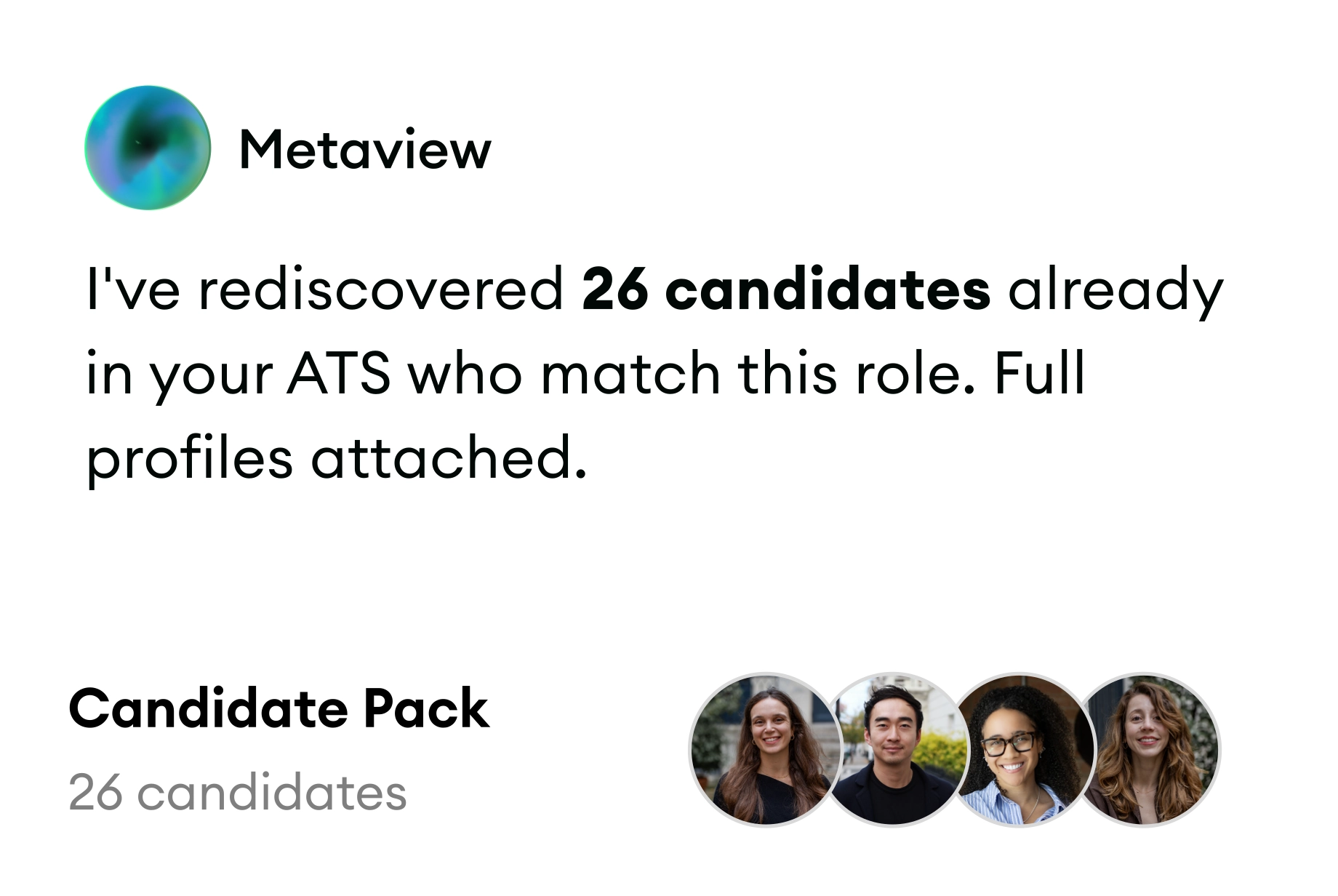
The screenshot shows a feature that changes the cost math: before searching the open web, the agent rediscovers past applicants already sitting in your ATS, here 26 for one role. Rediscovered candidates usually already have contact details in your ATS, so they rarely need enrichment credits, which makes Pro's 200-profile allowance go further for teams with a large historical pipeline than for a young company with an empty ATS.
2.2 Notetaker: $60 per user for unlimited calls
The Notetaker, Metaview's original product, costs $60 per user per month for unlimited calls. The free plan allows 25 calls a month with basic transcription, and Enterprise is custom - Metaview Notetaker pricing. Metaview's FAQ adds that questions to the assistant and note regenerations are included with no credits and no usage limits, which matters because several general-purpose notetakers meter exactly those AI features.
The Notetaker joins video calls and phone interviews, writes structured notes against your scorecard, and syncs them to the ATS. That last step is the real product. Generic notetakers produce a summary someone still has to move into Greenhouse or Ashby; Metaview fills the scorecard fields directly, which is why recruiting teams pay several times the price of a general meeting bot.
| Plan | Price | Calls | Notes |
|---|---|---|---|
| Free | $0 | 25 per user per month | Basic transcription |
| Pro | $60/user/mo | Unlimited | Priority processing |
| Enterprise | Custom | Custom | Dedicated support, security features |
The free plan has two caps that the pricing card does not show. Each free user gets 25 conversation credits a month, but all free users in one organization share a ceiling of 60 conversations a month, and free users can only open conversations from the last 14 days. In practice a hiring team cannot run its interviewers on free seats: three interviewers doing twenty interviews each would exhaust the company-wide cap, and notes older than two weeks would be locked by the time a slow debrief happens.
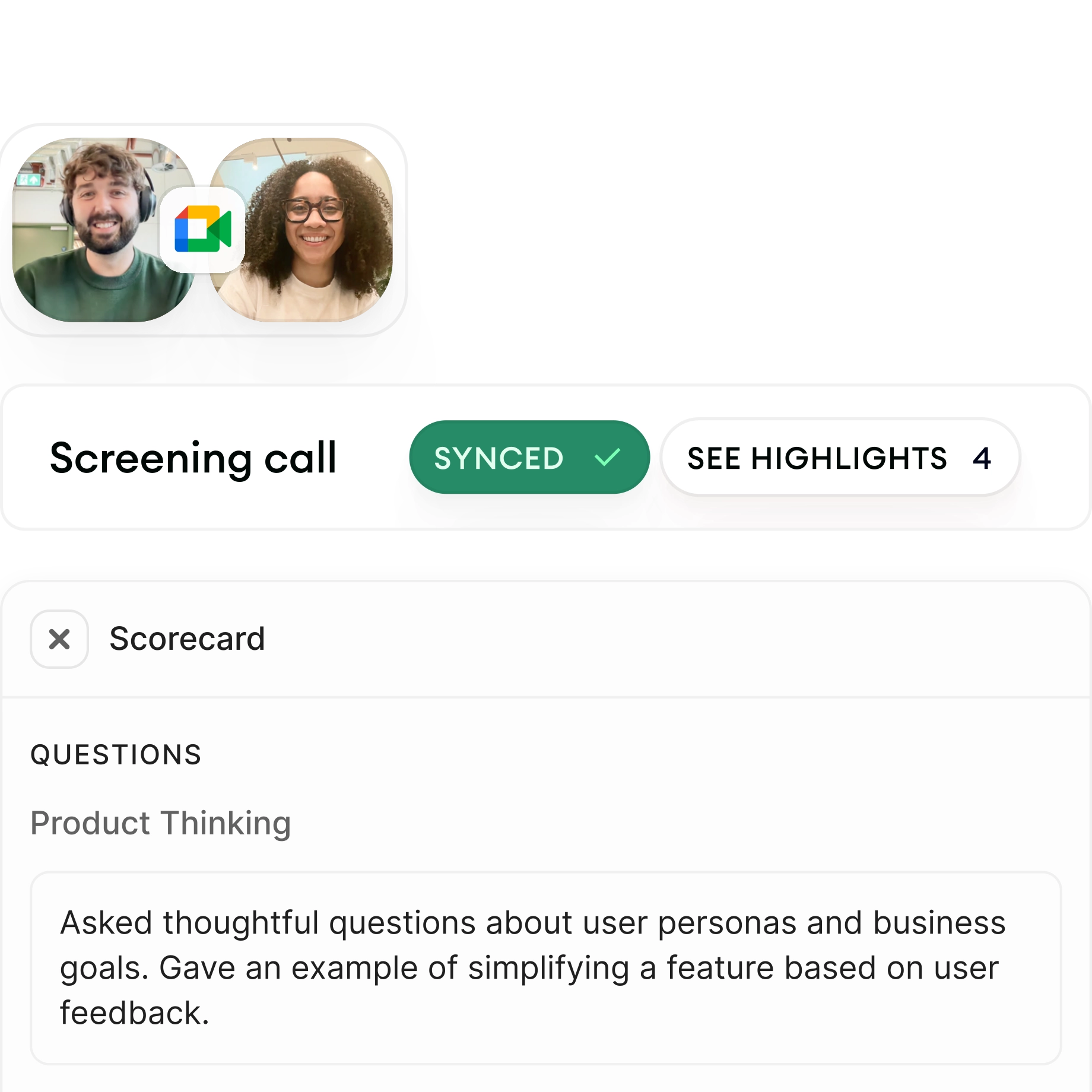
The "Synced" badge and the filled scorecard question in the screenshot are what the $60 buys over a $10 meeting bot. If your hiring managers already write feedback promptly and your ATS ships its own notetaker, that premium buys much less, which is why section 8 compares the Notetaker against both groups.
2.3 Application Review: priced by volume, from $150
Application Review is priced per batch of reviews, not per user, starting at $150 a month for 500 reviews. The free plan covers 50 applications a month with basic screening. The Pro tier includes unlimited users and advanced AI evaluation, and a slider on the pricing page runs from 500 to 100,000 reviews a month - Metaview Application Review pricing. Unlike Sourcing and the Notetaker, Pro is sold through a demo rather than a self-serve checkout.
Metaview's pitch for the agent is that every applicant gets read: its product page claims 100% of candidates reviewed, a 92% cut in screening time, and a policy of never auto-rejecting, so a human still makes each rejection. The table below lists every step of the slider, with the cost per review worked out.
| Reviews per month | Monthly price | Cost per review |
|---|---|---|
| 50 (Free) | $0 | $0 |
| 500 | $150 | $0.30 |
| 1,000 | $300 | $0.30 |
| 5,000 | $1,450 | $0.29 |
| 10,000 | $2,800 | $0.28 |
| 50,000 | $13,000 | $0.26 |
| 100,000 | $25,000 | $0.25 |
The volume discount is thin. Going from 500 to 100,000 reviews a month cuts the unit price by only 17%, from 30 cents to 25. Credits are used at one per application, unused monthly credits do not roll over, and when a workspace runs out, active reviews pause until you buy more or the month renews - Metaview Help Center. Resuming a paused review processes every candidate who applied in the meantime, so a backlog after a busy week is billed in one go.
The more important comparison is with the AI review built into applicant tracking systems. Ashby charges $0.10 per evaluation for credits beyond its included allowance - Ashby, and Workable's agent costs between 9.5 and 12 cents per screened candidate depending on pack size - Workable. The chart below puts the five price points side by side.
Price per AI Application Review, October 2026
Even at its highest volume, Metaview charges two to three times what the ATS-native reviewers charge per application. The difference is not pure margin: Metaview's review draws on the shared candidate profile and on interview outcomes, while ATS reviewers score against the job post. How to apply this: if your ATS is Ashby or Workable and you only need inbound triage, test its built-in review first; if you already run Metaview's Notetaker and Sourcing, the shared context is what the extra 15 to 20 cents per applicant buys.
3. fillmore: What It Does and What It Will Cost
fillmore is priced on hires, not seats, and Metaview has not published the fee. Its product page lists four promises: a 7-minute setup, meeting candidates within days, three times the response rate of cold outreach, and "only pay when you hire". There is no plan card, no free tier and no number, and the route to buying is a conversation with Metaview rather than a checkout.
That makes fillmore the hardest Metaview product to budget, and the one where a buyer most needs a reference point. Fortunately one exists, in the price list of the company Metaview bought to build it. The sections below explain what fillmore actually does, where its pricing model comes from, and how to estimate the fee against the alternatives before you get on a call.
3.1 How fillmore works
fillmore runs the whole top of the funnel from a Slack thread. You brief it the way you would brief a colleague, with a job description, a few example profiles or even rough notes, and it maps the market, researches each prospective candidate individually, and shortlists the ones that meet your bar. It then writes every message from scratch for one person and chooses the channel, email, LinkedIn or WhatsApp, where that person is most likely to reply.
When a candidate is interested, fillmore asks for approval in Slack and you accept or decline the meeting in one tap. After each screening call you give quick feedback, thumbs up, thumbs down or a note, and fillmore recalibrates its search, while a weekly digest reports how many candidates were sourced, contacted, interested and approved across all roles. Metaview's CTO announced it on 9 June 2026 as an agent that "researches prospective candidates, constructs target lists, writes personalized outreach, manages follow-up conversations, and schedules meetings" - Metaview.
The loop in the diagram is the product's core idea: feedback from each screening call flows back into research, so the search should sharpen as you use it. The final box is the commercial one. Under a pay-on-hire model, everything before it costs you little or nothing, which shifts the risk of a dry search onto Metaview and makes fillmore unusually cheap to try, and unusually expensive once it works.
Metaview's official walkthrough shows the Slack experience in about four minutes, including how a role is briefed and how meetings are approved. It is worth watching before a sales call, because it makes clear how little of the process happens outside Slack, and therefore how little your recruiters will be doing while the fee accrues.
Shipped at Metaview Ep 6: fillmore
3.2 Where the pay-on-hire model comes from
fillmore's pricing model most likely descends from Reval, the company Metaview acquired to accelerate it. Metaview announced on 11 August 2026 that it had acquired Reval, an AI-native recruiting company founded by Seth Tilliss and Aditya Gupta, noting that Reval had worked with more than 100 enterprises and agencies "at a fraction of the cost of traditional agencies" - Metaview. Reval's site still shows its price list under an "acquired by Metaview" banner that links to the fillmore waitlist.
That price list is the best public anchor for fillmore. Reval charged from $50 as a one-time job kickoff fee and 10% of base salary when you hire, positioned against "the 20-30% traditional agencies charge", with no retainers. Metaview has not said fillmore uses the same terms, so treat 10% as a reference point for negotiation, not as fillmore's price. What it does tell you is the order of magnitude: fillmore competes with agency fees, not with software seats, and it should be budgeted from the hiring budget rather than the tools budget.
3.3 What fillmore costs per hire, worked through
At a Reval-style 10% fee, fillmore would cost between $8,000 and $20,000 per hire for typical salaried roles. The table below applies that rate to four base salaries and compares it with a traditional agency at 20% and 25%, and with a full year of Metaview's own Sourcing Max seat at list price. The 10% column is an estimate built on Reval's published terms, not a Metaview quote.
The comparison matters because the two Metaview products solve the same problem with opposite economics. Sourcing Max is a fixed cost that your recruiter has to turn into hires; fillmore is a variable cost that turns into an invoice only when a hire happens. Which one is cheaper depends almost entirely on how many people you hire in a year.
| Base salary | fillmore at 10% (Reval terms) | Agency at 20% | Agency at 25% | Sourcing Max, 1 year |
|---|---|---|---|---|
| $80,000 | $8,000 | $16,000 | $20,000 | $3,600 |
| $120,000 | $12,000 | $24,000 | $30,000 | $3,600 |
| $150,000 | $15,000 | $30,000 | $37,500 | $3,600 |
| $200,000 | $20,000 | $40,000 | $50,000 | $3,600 |
The comparison cuts both ways. Against an agency, a 10% fee halves the cost of a hire and asks for nothing up front. Against a software seat it is expensive from the very first hire, since even an $80,000 hire costs more in fees than a full year of Sourcing Max: a recruiter on Sourcing Max who makes five hires at $150,000 costs $3,600 in software, against $75,000 in fillmore fees at 10%. The seat, of course, needs a recruiter's time to run the searches and conversations that fillmore runs on its own, and that labour is what the fee really pays for. A founder hiring two engineers a year with no recruiter is the ideal fillmore buyer; a ten-person talent team hiring sixty people is not.
HeroHunt.ai
If fillmore's model appeals but a fee on every hire does not, HeroHunt.ai runs the same loop (search across up to 1 billion profiles, AI screening with current GPT and Claude models, and automated personalised outreach) for a fixed monthly price metered on open positions: $249 a month on Pro for one user and 10 positions, with nothing owed when someone is hired. On a single $150,000 hire, a Reval-style 10% fee would pay for about five years of Pro at the monthly rate. The honest caveat: HeroHunt.ai has no interview notetaker, application review or Slack-only workflow, positions reset monthly without rolling over, and the 8-day trial requires a card, so it replaces fillmore and Metaview Sourcing, not the Notetaker.
3.4 Results Metaview publishes for fillmore
Metaview's published fillmore case studies show reply rates from 6% to 54% across 28 roles. The flagship example describes 52 candidates researched individually, 29 contacted in the recruiter's own voice, 8 replies (a 28% reply rate), 5 calls booked and an offer accepted on day 30 - fillmore case studies. Company and candidate names are anonymised, but Metaview says the timelines and numbers are real.
Two cautions apply. The "3x response to cold outreach" headline on the product page has no stated method or baseline, and the marketing graphic below, showing 101 screening calls booked in one week for a London sales role, is an illustration rather than a published result. Treat the case-study funnel as the realistic benchmark: dozens of researched candidates per role, a reply rate in the twenties, and a handful of booked calls per week.
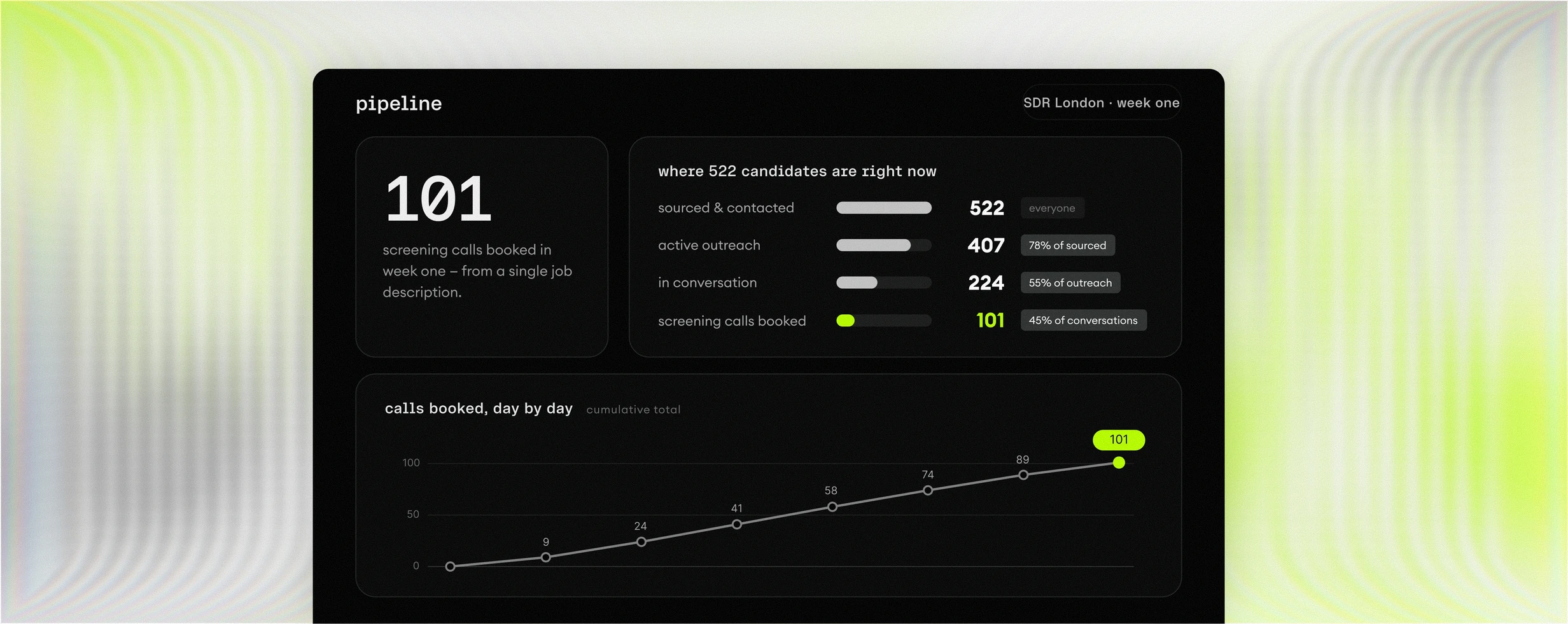
The funnel in the illustration (522 contacted, 224 in conversation, 101 calls) implies conversion far above the case-study average, which is why it should not anchor a business case. How to apply this: during a pilot, ask Metaview for the same four numbers on your own roles (researched, contacted, replied, booked), and compare the cost per booked call with what your recruiters or your current agency achieve today.
4. What Metaview Really Costs: Three Team Scenarios
A realistic Metaview bill is the sum of two or three agents, and at list price it runs from about $160 a month for a solo recruiter to more than $10,000 for a large team. The pricing page shows one agent for one person, so the only way to budget is to decide which agents each role needs and multiply. The scenarios below use Metaview's published list prices on monthly billing with no discount assumed, which makes them a ceiling for self-serve buyers and a starting point for anyone negotiating an annual deal.
The assumptions are deliberately simple. Recruiters who source get a Sourcing seat, everyone who runs interviews gets a Notetaker seat, and Application Review is sized to the team's monthly applicant volume. Reports, Screening credits and enrichment top-ups are left out because Metaview does not publish their prices, and fillmore is left out because it is billed per hire rather than per month.
| Scenario | Agents | Monthly list | Annual list |
|---|---|---|---|
| Solo recruiter, light sourcing | 1 Notetaker Pro + 1 Sourcing Pro | $160 | $1,920 |
| Solo recruiter, heavy sourcing | 1 Notetaker Pro + 1 Sourcing Max | $360 | $4,320 |
| 5 recruiters, in-house | 5 Notetaker + 5 Sourcing Pro + 1,000 reviews | $1,100 | $13,200 |
| 5 recruiters, heavy sourcing | 5 Notetaker + 5 Sourcing Max + 1,000 reviews | $2,100 | $25,200 |
| 20 recruiters + 30 interviewers | 50 Notetaker + 20 Sourcing Max + 5,000 reviews | $10,450 | $125,400 |
The solo rows show Metaview at its most competitive. At $160 a month, a recruiter gets interview notes and 200 sourced profiles for roughly what many sourcing tools charge for search alone, and month-to-month billing means the experiment can be stopped at any time. The jump to $360 comes entirely from Sourcing Max, so the first question for a solo buyer is whether 200 profiles a month is genuinely too few.
The five-recruiter rows show the sourcing tier doubling the bill. Moving five people from Pro to Max adds $1,000 a month, which is why it is worth checking actual profile consumption in the first month before upgrading everyone. The largest row is where list prices stop being meaningful: at fifty Notetaker seats the interviewers alone cost $3,000 a month, and a team of that size should be negotiating an Enterprise package rather than buying self-serve seats.
5. How Metaview Pricing Changed From 2023 to 2026
Metaview has re-metered its products twice, and both times the price of unlimited use roughly doubled or tripled. Archived copies of the pricing page show the notetaker's unlimited tier moving from $25 to $50 a user in 2023, and unlimited sourcing moving from $100 to $300 in 2026. Each change came as a product moved from launch to maturity, and the pattern is the best guide to what happens next.
The history also matters for anyone holding an older contract. Teams that bought Metaview as a notetaker in 2024 or 2025 were quoted a single per-user price, and a renewal in 2026 will be framed around agents they may never have used. Knowing what the old price was, and what it bought, is the strongest position to negotiate from.
| Period | What Metaview sold | Published price |
|---|---|---|
| Mar 2023 | Notetaker, one paid tier | Recruiter $25/user/mo annual or $32 monthly, unlimited interviews |
| May 2023 to Nov 2024 | Notetaker, two tiers | Core $20 (12 interviews/mo); Pro $50 annual or $60 monthly, unlimited |
| Dec 2024 to Sep 2025 | Notetaker, free + Pro | Free 25 conversations/mo; Pro $50 annual or $60 monthly |
| Nov 2025 to Mar 2026 | Notetaker + AI Sourcing | Sourcing $100/user/mo, unlimited searches, first 5 free |
| Apr 2026 | Sourcing split into tiers | Free 100 profiles; Pro $100 (200/mo); Max $300 unlimited |
| Jun 2026 to now | Per-agent menu + fillmore | Notetaker $60; Application Review from $150; fillmore pay on hire |
The first re-metering happened in May 2023. In March 2023, $25 a month on annual billing bought unlimited interviews - Wayback Machine, March 2023. Two months later, unlimited interviews had moved to a new Pro tier at $50, and the cheaper tier was capped at 12 interviews a month - Wayback Machine, May 2023. The $60 monthly rate set then has not changed since.
The second came in April 2026. Until March, $100 a month bought unlimited sourcing searches - Wayback Machine, March 2026. From April, $100 bought 200 profiles a month and unlimited sourcing moved to a new Max tier at $300 - Wayback Machine, April 2026. The meter also changed from searches to profiles, so the two are not perfectly comparable, but a heavy user's bill for unlimited usage tripled.
One quieter change deserves a question in any negotiation. Until the June 2026 redesign, the Notetaker card showed $50 per user on annual billing next to the $60 monthly rate; today's card shows only $60, while the help center still says monthly and annual billing are both offered - Metaview Help Center. Ask whether the $50 annual rate still exists before accepting $60. Why this history matters: Application Review and Screening are now at the stage Sourcing was in early 2026, so their current rates are the most likely to be re-metered. How to apply it: if you rely on a newer agent, negotiate a price lock for the full term.
6. The Hidden Costs: Credits, Seats and What Buyers Pay
The pricing page is accurate, but four costs sit outside it: enrichment credits, Screening credits, the Reports add-on and the rules on seats. None of them is hidden in bad faith, since all are documented in Metaview's own help center. They simply do not appear on the cards a buyer compares, and together they decide whether the bill matches the budget.
Why this matters: a sourcing agent that finds 200 profiles a month is only useful if you can contact the people it finds, and contacting them is metered separately. How to apply this: before you sign, ask for the enrichment allocation, the Screening credit price and the Reports fee in writing, and model them against your real volumes rather than the demo.
6.1 Enrichment credits for contact details
Finding a candidate and getting their email are two different meters at Metaview. Sourcing plans include a "limited monthly allocation" of enrichment credits, shared across the whole workspace and refreshed on the first of each month. Once that pool is gone, top-ups are sold in multiples of 100 and stay valid for six months - Metaview Help Center. Neither the size of the included allocation nor the top-up price appears in Metaview's public documentation.
Two details work in the buyer's favour and one does not. Credits are only consumed when an email or phone number is actually found, so empty lookups are free, and purchased top-ups survive for half a year. Against that, enrichment credits are non-refundable even when an email later bounces, because the data comes from third-party providers whose accuracy Metaview says it cannot guarantee. A team that leans on email outreach should budget for bounce losses on top of the credit cost.
6.2 Screening credits
Metaview's AI screening interviews run on a separate credit balance with no public price. Each completed candidate interview uses one credit when it is assessed, while building, publishing and previewing a screen is free. Workspaces get free starter credits, after which packs are bought inside the app, and both starter and purchased credits expire - Metaview Help Center.
The operational catch is what happens at zero. Candidates already enrolled can still finish their interview, but their results wait in an "Awaiting credits" state, and auto-enrolment stops adding new candidates until the balance is topped up. For high-volume or unlimited screening Metaview routes buyers to sales, so Screening is the agent where the list price tells you least.
6.3 Reports, the full platform, and seat rules
Reports is a flat-fee add-on, the full platform is enterprise-only, and self-serve seats cannot be shared. Metaview's FAQ confirms there are no per-report or per-recording charges for Reports but does not state the fee, and the "All agents" tab on the pricing page has no self-serve price at all. Notes Pro and Sourcing Pro or Max seats can be bought by card, cancelled at any time, and renewed monthly or annually.
A team admin can move a seat to a colleague, but only once per calendar month, and Metaview rules out shared logins and continuous rotation because seats are "priced for individual use" - Metaview Help Center. Cancellation takes effect at the end of the billing period, and cancelled accounts fall back to the free plans. That is friendlier than the annual-upfront terms common in sourcing tools, where a seat bought in January is paid for until December, and it makes the trial period a better use of time than a long negotiation.
6.4 What buyers actually pay
Third-party spend data puts the typical Metaview contract somewhere between $4,000 and $18,000 a year, but both datasets are thin. Vendr reports a median of $17,750 a year, with a range of $5,424 to $75,600 - Vendr. The page's underlying data shows only 13 purchases from 3 unique buyers, so that median describes a handful of mid-market deals, not the market.
SpendHound, which aggregates de-identified spend from its own customers, puts average SMB spend at $4,065 a year and enterprise spend at $6,096, and says SMB pricing rose 27.6% year over year across 33 SMB customers - SpendHound. The two sources disagree by about four times, which mostly reflects who is in each sample: a $4,065 average is roughly five or six Notetaker seats, while $17,750 looks like a multi-agent team deal. Read them as the two ends of the realistic range, and note that the 27.6% rise is consistent with the April 2026 sourcing re-metering described above.
7. Where Metaview Is Worth the Money, and Where It Is Not
Metaview is strongest where its agents share context, and weakest where you only need one of them. The product's distinctive claim is that each agent learns from the others: the FAQ describes an Ideal Candidate Profile built from the job description and refined by sourcing feedback, application review outcomes and interview results, and gives the example of the sourcing agent starting a search automatically after an intake call - Metaview Pricing FAQ. That loop only exists if the same vendor sits in the intake call, the inbox and the search.
This is the real reason to judge Metaview on the bundle rather than on any single price. On its own, a $60 notetaker competes with tools that cost a fraction as much, and a $100 sourcing seat competes with dedicated sourcing platforms that have larger databases and bundled contact data. The case for paying Metaview's prices is that the notes already know what the hiring manager asked for, so the search and the screening start from a richer brief than a standalone tool would get.
7.1 Where it earns its price
In-house teams on a modern ATS get the most from Metaview. The integrations it names first are Ashby, Greenhouse, Lever, Gem and SmartRecruiters, plus scheduling, phone and video tools, and the setup claim is aggressive: a search or a recorded interview in under 45 seconds, with most teams live the same day. For a team that already records intake calls and interviews, adding sourcing on top is a small step rather than a new implementation project.
It also suits teams whose interviews are the bottleneck rather than their top of funnel. Hiring managers who never write feedback, debriefs that rely on memory, and scorecards completed a week late are exactly what the Notetaker fixes. Metaview's Lemonade case study claims around 4,000 hours of recruiter time returned and LinkedIn costs cut by 60% - Metaview, which is a vendor-published figure, but the mechanism (less manual note-taking and fewer LinkedIn seats once sourcing moves elsewhere) is plausible for a large team.
7.2 Where it is the wrong buy
Agencies and high-volume sourcers often get better value elsewhere. A recruiter who needs more than 200 profiles a month is pushed to Max at $300, at which point Metaview's sourcing seat costs more than several dedicated sourcing tools that include contact data. Metaview's enrichment credits are a limited, workspace-wide pool, so an agency desk running heavy email outreach will pay for top-ups as well. Agencies that bill clients on placement also gain little from fillmore's success fee, since it eats into the same margin.
It is also a weak fit for teams that only want notes and run interviews on Zoom or Google Meet with little need for ATS sync. General notetakers cost a fraction of $60 per user, and Greenhouse and Ashby now ship their own interview notetakers. The honest summary is that Metaview's value rises with the number of its agents you use, so a one-agent buyer should benchmark that one agent against specialists before signing.
8. The 7 Best Metaview Alternatives in 2026
The right alternative depends on which Metaview agent you are replacing, because no single competitor replaces all of them. Buyers who came for fillmore want an autonomous outbound recruiter, buyers who came for Sourcing want a search engine with contact data, and buyers who came for the Notetaker want interview intelligence. The alternatives below are grouped that way: the first four replace fillmore and Sourcing, the last three replace the Notetaker.
Prices were checked on 5 October 2026 on each vendor's own pricing page or documentation. Where a vendor publishes nothing, we use a public procurement listing or Vendr's median contract instead and say so. For a wider view of autonomous tools, our guide to the best AI sourcing agents covers the category in depth, and our recruiting software pricing index compares 40 tools by metering unit.
8.1 HeroHunt.ai: AI Recruiter Priced Per Position
HeroHunt.ai is the closest like-for-like alternative to fillmore and Metaview Sourcing, with published monthly prices instead of a success fee. It searches up to 1 billion profiles across platforms, screens candidates against the role with current GPT and Claude models, and runs personalised outreach automatically. Plans are self-serve: Starter at $149 a month, Pro at $249 and Team at $499 for three users, with annual billing at ten times the monthly price - HeroHunt.ai Plans.
The meter is the meaningful difference. HeroHunt.ai charges by open positions per month (3, 10 or 20 depending on plan) rather than by profiles or by hire, so a recruiter running ten roles on Pro pays $249 whether a search returns 200 candidates or 2,000, and owes nothing when someone is hired. The trade-offs are real: positions reset monthly and do not roll over, there is no interview notetaker, application review or Slack-only workflow, and the 8-day trial needs a card. You can start at uwi.herohunt.ai.
| Plan | Monthly | Annual | Included |
|---|---|---|---|
| Starter | $149 | $1,490 | 1 user, 3 positions/mo, 750M profiles |
| Pro | $249 | $2,490 | 1 user, 10 positions/mo, 1B profiles, analytics, integrations |
| Team | $499 | $4,990 | 3 users, 20 positions/mo |
Best for: recruiters who want autonomous sourcing and outreach at a fixed monthly cost rather than a fee on every hire.
8.2 Juicebox: Natural-Language Search With Per-Agent Pricing
Juicebox is the alternative for teams that want Metaview-style agents on top of a strong search engine with contact data included. Its seats are published: Starter at $99 per seat per month on yearly billing ($119 monthly) with 500 contact credits, Growth at $179 yearly ($199 monthly) with 1,500 contact credits per seat, and Business on custom annual terms. Autonomous sourcing is a separate add-on at $199 per agent per month, which includes unlimited contact and email credits - Juicebox Pricing.
The structure mirrors Metaview more than it first appears. The seat buys search and outreach, and the agent that works around the clock is an extra line item, so a recruiter running one agent on Starter pays $318 a month on monthly billing. Juicebox's advantage over Metaview Sourcing is that contact data is bundled generously, while Metaview's enrichment is a shared and limited pool. Vendr's median Juicebox contract is $26,147 across 23 purchases, above Metaview's - Vendr. Our Juicebox alternatives guide covers it in depth.
| Plan | Yearly billing | Monthly billing | Credits |
|---|---|---|---|
| Starter | $99/seat/mo | $119/seat/mo | 500 contact credits |
| Growth | $179/seat/mo | $199/seat/mo | 1,500 contact credits/seat |
| Agents | $199/agent/mo | $199/agent/mo | Unlimited contact credits |
Best for: sourcers who want deep natural-language search with contact data, and are happy to pay per agent for automation.
8.3 LinkedIn Hiring Assistant 2: The Incumbent's Agent
LinkedIn's Hiring Assistant is the agent most Metaview buyers will be pitched against, and it is bought on top of LinkedIn Recruiter. LinkedIn announced Hiring Assistant 2 on 29 September 2026 with persistent recruiter memory, richer candidate signals, voice pre-screening (completed in a median of six minutes) and talent-pool management across Greenhouse, Lever, SmartRecruiters, Zoho Recruit and Tracker - LinkedIn. Existing English-language Hiring Assistant customers get the new capabilities free from November, and LinkedIn says more than 20,000 companies use its agentic hiring products.
LinkedIn publishes no list price, but its UK government price list gives a benchmark. A promotion priced Hiring Assistant at £2,079 per licence per year for one or two licences, falling to £1,575 at 101 to 250, on top of Recruiter seats - UK G-Cloud 14. That promotion ran until 30 June 2026 and the price after it is not published, so treat it as a floor. Our Hiring Assistant cost guide covers the tiers, and our LinkedIn recruiting pricing guide covers the Recruiter seats underneath.
Best for: teams already paying for LinkedIn Recruiter whose candidates live on LinkedIn and respond to InMail.
8.4 Fetcher: Sourced Candidates on a Subscription
Fetcher is the subscription alternative to fillmore's done-for-you promise. It sources and contacts candidates automatically, and its top plan adds a dedicated human sourcer. Self-serve costs $115 a month with 300 sourced candidates and 500 AI review credits a month, Growth is $379 on annual billing ($499 monthly) and Amplify is $649 annual ($849 monthly), with Growth and Amplify also reviewing up to 2,500 and 5,000 inbound applicants a year - Fetcher Pricing.
Fetcher's meter is candidates delivered, which is the closest a subscription gets to fillmore's outcome model without charging per hire. It also bundles applicant review into its plans, so a team weighing Metaview Sourcing plus Application Review can compare one Fetcher plan against two Metaview line items. Vendr's median Fetcher contract is $11,000 a year - Vendr. The limitation is scope: Fetcher has no interview notetaker, and its top tier's human sourcer makes it partly a service rather than pure software.
Best for: in-house teams that want a steady flow of sourced, contacted candidates for a fixed monthly fee.
8.5 Ashby and Greenhouse: The Notetaker Inside Your ATS
The fastest-growing threat to Metaview's Notetaker is the applicant tracking system it integrates with. Ashby sells an AI Notetaker as a paid add-on on every plan, with 500 interviews free to try and no expiry; Foundations customers see the price inside the product, while Plus and Enterprise pricing is tailored - Ashby. Ashby also bundles AI application review on all plans, with 1,500 included credits a month on Foundations and extra evaluations at ten cents each.
Greenhouse launched its own Notetaker in mid-2026 on its new Core, Plus and Pro tiers, with admin-controlled retention of up to 60 days and GDPR anonymisation alongside other candidate data - Greenhouse. Greenhouse pricing is custom, with a Vendr median of about $26,600 a year for the ATS. The trade-off against Metaview is depth versus integration: the native notetakers live where the scorecard already is, while Metaview's notes feed its sourcing and review agents and work across several ATS platforms.
Best for: teams on Ashby or Greenhouse that want interview notes without adding a vendor.
8.6 BrightHire, Now Part of Zoom
BrightHire was Metaview's closest interview-intelligence rival until Zoom bought it. Zoom completed the acquisition on 1 December 2025 for $98.0 million in cash, according to its quarterly filing, and now sells BrightHire as part of Zoom Workplace - Zoom. BrightHire publishes three tiers (Recruiters, Teams and Enterprises) plus a screening product, all behind a demo, and Vendr's median contract is $18,350 a year across 60 purchases - Vendr.
BrightHire is part of a wider consolidation. Employ bought Pillar in March 2025 and now sells it as an AI Interview Companion, and Equitas acquired Screenloop in January 2026 - Equitas. That leaves Metaview as one of the few large independent interview-intelligence vendors, which is a strength for roadmap focus and a reason to negotiate data-export terms in case it is bought too. BrightHire's interviewer coaching and analytics remain its distinguishing features.
Best for: enterprise teams already standardised on Zoom that want interview analytics and coaching.
8.7 Fireflies and Otter: General Notetakers at a Fraction of the Price
General meeting notetakers cost between a seventh and a half of Metaview's $60, and for some teams that is enough. Fireflies Pro is $10 per seat per month on annual billing ($18 monthly) and Business is $19 annual ($29 monthly) - Fireflies Pricing. Otter Pro is $8.33 per user per month on annual billing ($16.99 monthly) and Business is $19.99 annual ($30 monthly) - Otter Pricing.
The chart below compares Metaview's Notetaker with these general-purpose rivals on monthly billing, the fairest basis now that Metaview's card no longer shows an annual rate.
Notetaker Price per User, Monthly Billing (October 2026)
What the general tools lack is recruiting structure. They summarise a call but do not fill an ATS scorecard, rarely understand interview stages, and leave someone to copy the output into the hiring record, which is the work Metaview removes. Our AI notetakers for recruiters guide compares ten options. How to apply this: if your bottleneck is capturing calls, buy the cheap tool; if it is getting structured feedback into the ATS on time, the $60 is the price of that automation.
Best for: small teams and agencies that want transcripts and summaries without ATS scorecard sync.
9. Full Comparison: Price, Meter and Best Fit
On entry price Metaview sits in the middle of the market, but the meter each tool charges on matters as much as the sticker. A per-profile seat, a per-position plan, a per-agent add-on and a per-hire fee can all be the cheapest option for a different buyer, so the table reads best as three questions: what you pay on day one, what makes the bill grow, and which Metaview agent the tool replaces.
Where a vendor publishes no price, the table uses the best public benchmark and says so. Treat those rows as negotiation anchors rather than quotes, and remember that every self-serve price below can be tested on a trial before you commit to an annual deal. The second column matters most: it shows which Metaview agent each tool can actually stand in for.
| Tool | Replaces | Entry price | Meter | Best fit |
|---|---|---|---|---|
| Metaview Sourcing | (itself) | $100/user/mo | Profiles (200, or unlimited at $300) | Teams already on Metaview |
| fillmore | (itself) | Unpublished; Reval charged 10% of salary | Per hire | Low-volume hiring, no recruiter |
| HeroHunt.ai | fillmore, Sourcing | $149/mo | Open positions | Fixed-cost autonomous outbound |
| Juicebox | Sourcing, fillmore | $99/seat/mo + $199/agent | Seats + agents | Search with bundled contacts |
| LinkedIn Hiring Assistant | Sourcing, Screening | ~£2,079/licence/yr (promo) | Licence on Recruiter | LinkedIn-first teams |
| Fetcher | Sourcing, App Review | $115/mo | Candidates delivered | Steady sourced pipeline |
| Metaview Notetaker | (itself) | $60/user/mo | Users | ATS-synced interview notes |
| Ashby / Greenhouse | Notetaker, App Review | Ashby $0.10/review; notetaker add-on | Credits, plan tier | Teams on those ATSs |
| BrightHire (Zoom) | Notetaker | Vendr median $18,350/yr | Custom | Zoom-standardised enterprises |
| Fireflies / Otter | Notetaker | $8.33-$10/user/mo annual | Users | Transcripts without ATS sync |
The sourcing rows are where buyers most often compare like with unlike, so the chart below puts the monthly-billing entry price for one recruiter's AI sourcing side by side. It uses month-to-month prices where they exist, because Metaview itself is sold month to month.
Monthly Price for One Recruiter's AI Sourcing (Monthly Billing)
The chart shows why Metaview Pro looks cheap and often is not. At $100 it is the lowest sticker, but its 200-profile cap and separate enrichment pool mean a recruiter who needs more volume lands on Max at $300, within $18 of a Juicebox seat plus an agent with unlimited contacts. The real decision is not the cheapest bar but which meter matches your hiring: profiles if you source in bursts, positions if you run a steady set of roles, and hires if you rarely hire at all.
10. How to Choose, and How to Negotiate if You Stay
Choose by bottleneck first and by price second. A team whose problem is interview feedback needs a notetaker, a team whose problem is an empty pipeline needs sourcing or fillmore, and a team drowning in applicants needs review, and Metaview sells all three at very different prices. The diagram below maps each bottleneck to the Metaview plan or alternative that fits it.
The point of the map is to stop a common mistake: buying the platform because one agent impressed in a demo. Most teams have one dominant bottleneck, and the cheapest correct answer solves that one well before any bundle is considered.
The three branches rarely overlap in practice. The left branch is a question about your interviewers and your ATS: if you run Ashby or Greenhouse, test their native notetaker before paying $60 a seat, and if you run several ATSs or want notes to feed sourcing, Metaview's Notetaker is the stronger tool. The middle branch is about hiring volume, which is where fillmore, Sourcing Pro and a fixed-price AI recruiter diverge most sharply, and the right branch is about applicant volume, where ATS-native review at ten cents usually beats Metaview's thirty unless you already use its other agents.
If you choose Metaview, the history in section 5 tells you where the leverage is. Metaview re-meters products as they mature and is spending heavily to win customers who buy several agents, so the strongest position is a multi-agent deal with prices locked for the term. Three requests consistently move the number:
- Ask for the annual rate on the Notetaker, which was $50 until mid-2026
- Get credits in writing: enrichment allocation, top-up price and Screening pack price
- Lock newer agents' prices for the full term, since they are next to be re-metered
Each of these closes a gap between the pricing page and the invoice. The annual Notetaker rate is worth $120 per seat per year if it still exists, which adds up quickly across a hiring panel. Credits in writing turn the two unpublished meters into budget lines you can model, and a price lock protects you from the kind of change that tripled unlimited sourcing in April 2026. Before upgrading anyone to Sourcing Max, run a month on Pro and check actual profile consumption: if most recruiters stay under 200 profiles, the upgrade is money spent on headroom rather than candidates.
fillmore needs its own negotiation, because a percentage-of-salary fee scales with exactly the roles where you most want to control cost. Ask for a flat fee per hire, or at least a cap per role, so a senior hire does not cost twice as much as a mid-level one for the same work. Pin down what counts as a hire (an accepted offer or a start date), what happens if the person leaves within ninety days, and whether candidates fillmore contacted but you hired through another channel are billable.
Agencies settle these questions in every contract, and an AI success fee should settle them too. The pay-on-hire model is attractive precisely because it moves risk onto the vendor, so it is reasonable to insist that the contract defines that risk clearly. How to apply this: put the hire definition, the guarantee period and the attribution rule in the order form before the first role is briefed in Slack.
11. The Bottom Line
Metaview is a well-priced platform for in-house teams that use several of its agents, and an expensive way to buy any single one of them. Its published prices are clear: $60 per user for unlimited interview notes, $100 or $300 per user for in-app sourcing, and $150 per 500 application reviews. The costs that decide the real bill (enrichment credits, Screening credits, Reports and any enterprise bundle) sit outside the pricing cards and need to be asked for in writing.
fillmore is the part to think hardest about. It is genuinely different: an autonomous recruiter that lives in Slack and charges only when you hire, which makes it close to risk-free to try and potentially very expensive once it works. Reval's published terms (from $50 per search plus 10% of base salary) are the best public anchor, which puts a $150,000 hire at about $15,000. For a founder hiring a few people a year that beats a traditional agency; for a team hiring dozens, a subscription tool with a fixed price will almost always cost less. The decision framework is simple: buy the Notetaker if feedback is your bottleneck, compare Sourcing and fillmore against fixed-price alternatives if pipeline is, and negotiate any Metaview deal as a multi-agent package with prices locked for the term.
Autonomous sourcing, AI screening and outreach for a fixed monthly price per open position, with no fee when you hire.
This guide reflects Metaview's pricing and the alternatives' published prices as of 5 October 2026. Metaview has changed its pricing structure several times since 2023 and fillmore's fee is not published, so verify current terms with each vendor before purchasing.