
![Passive candidate sourcing: step-by-step guide [2024]](/_assets/images/619e8c66caa16f209ddad727_Active-vs-passive-candidate-sourcing.png)



Disclosure: some links in this article are affiliate links. If you sign up through one, HeroHunt may earn a commission at no extra cost to you.
Why passive candidate sourcing is effective
Passive candidate sourcing is recruiting for talent who have not indicated that they are open for a new job and are not applying for any jobs.
Where most recruiters focus on inbound candidates that applied to job posts, there are recruiters that choose to focus on passive candidate sourcing.
And for good reasons.
Passive candidates make up the biggest talent pool
70% of the workforce is passive talent (source).
LinkedIn's current recruiter guidance arrives at roughly the same place from the other side: 36% of workers are actively looking for a new role, which leaves close to two thirds of the market reachable but not applying (source).
They are not actively looking for a job but are mostly open to discuss opportunities that are relevant for them.
83% of talent acquisition professionals see passive sourcing as an important source of hire (source).
There is less competition for passive candidates
Because the majority of recruiters still rely on active candidate recruitment, the competition for passive candidates is less.
This enables you to source in a bigger talent pool and have less competition at the same time.
Matches are more accurate
With passive candidate sourcing you decide who to reach out to.
With active sourcing a lot of unqualified people apply to your job that you will have to screen. This creates a lot of noise and can be a big waste of your time.
On average, you will invite just 2% of candidates that applied to a job for a conversation. The other 98% you have to screen but will not lead to any next steps.
Quality of passive candidates is higher
When recruiters focus their efforts on passive sourcing, 73% of them find higher quality candidates (source).
Even if an active candidate seems to be the right candidate, they might not have the right reasons to apply for the job.
They might be laid off or desperate to find just any job to get out of the discomfort at their current job.
These cases sometimes only surface when you already hired them.
Passive candidates are usually of higher quality because if they show interest in your job, it is usually because they really like the job you’re offering. Otherwise there would not be a good reason to leave their current job.
There is more data than ever
On LinkedIn alone there are now more than 1 billion members (source). When this guide was first published that number was 700 million, which tells you how fast the raw pool is growing.
GitHub is the other one worth knowing: it passed 180 million developers in 2025 and is now adding roughly one new developer every second (source). Add Stack Overflow, Xing in the German-speaking market, Kaggle for data people, Wellfound (formerly AngelList Talent), Dribbble, Reddit and X, and the reachable pool is far bigger than any one recruiter can work through.
This data and the access to it enables you to find passive candidates in a very efficient way.
How to recruit for passive candidates
Passive candidates are usually employed. So it requires the right strategy to win them for your company and job.
You need know where to look for them, how you can screen profiles and information and you need to know how to reach out to them.
These are the steps that make you win in passive candidate sourcing:
- Know where to find your candidates
- Screen profiles using the right tooling
- Find contact details
- Hyper-personalize outreach
- Follow up and build the relationship
1. Know where to find your candidates
LinkedIn is flushed by recruiters searching for candidates. The competition is fierce, so you have to differentiate your approach from other recruiters.
Many candidates can be found in other places than LinkedIn.
And as a matter of fact, many talent categories prefer to spend their time on other platforms than LinkedIn.
Take engineers for example, you can better find them on platforms like GitHub and Stack Overflow.
And there are many other platforms where engineers can be found:
- GitHub, all engineers
- Stack Overflow, all engineers
- Reddit, all engineers
- HackerRank, all engineers
- Wellfound, startup minded engineers (this is the former AngelList Talent)
- Xing, German area engineers
- Kaggle, data scientists and data engineers
- Medium, engineers with a voice
- ResearchGate, (data) research focussed engineers
- GitLab, all engineers
- Dev.to, all engineers
- StackShare, all engineers
A word of warning on lists like this one, including the older versions of this one: they rot. Coderwall and Tumblr used to appear on every sourcing list and neither is worth your time in 2026. Before you build a workflow on a platform, check that people are still posting on it this month, not that it once had a big user count.
Also other talent can be found in different places.
Sales executives and marketers can be found on:
- Medium
- X (formerly Twitter)
- Wellfound
Designers can be found on:
- Dribbble
- Behance
Find all alternative sources to LinkedIn here:
Select the platforms that match your target talent pool and search them using an X-ray search or a talent search engine.
2. Screen profiles using the right tooling
There are more than one billion profiles across the internet.
You're obviously not going to screen through all those profiles so you need to be smart about filtering your profiles so you end up with a good selection of candidates that you can manage to screen for fit with your job.
Since we're talking about lots of data here, a tool can be really helpful to do the initial filtering.
One tool that is used to search and screen tech profiles is HeroHunt.ai.
HeroHunt.ai takes your job description and automatically translates this to a search.
Based on that search, the best candidates are found through different platforms and given to you so you can do your final screening.
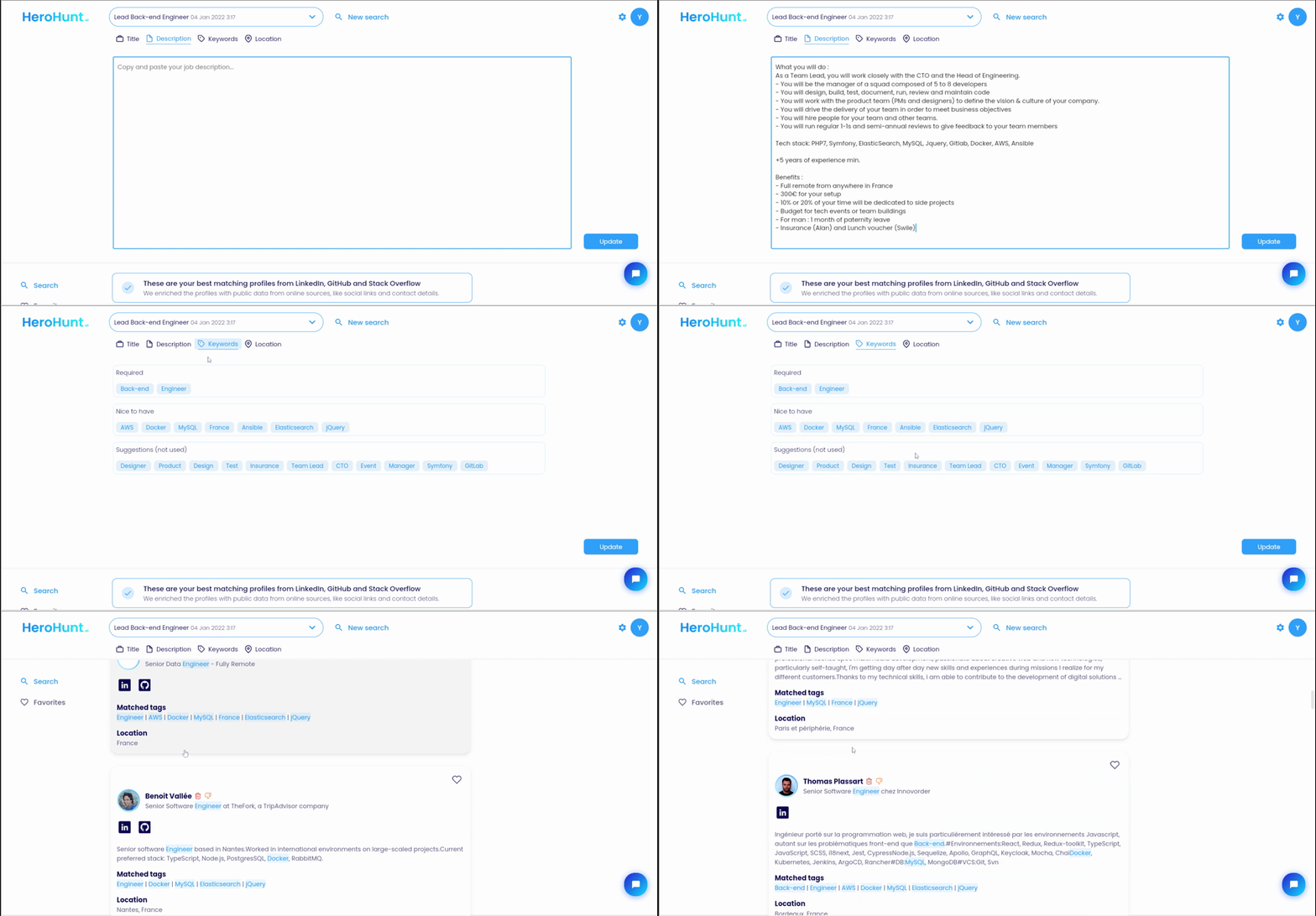
The recruiter gives in their job description and based on that the keywords are automatically recognized.
Candidates from different platforms are matched based on those keywords and returned to the recruiter, including the public contact details where those exist.
HeroHunt.ai
Screening is the step where passive sourcing either scales or dies, because the pool you just opened up is far too big to read by hand. This is the job HeroHunt.ai is built for: you give it the job description, it turns that into a search across more than a billion profiles spanning LinkedIn, GitHub and the other sources listed above rather than a single platform, and it screens the matches with language models so what lands in front of you is a shortlist instead of a result count. Two honest limits before you build a process on it. It surfaces contact details only where they are already public, which is exactly why step 3 below exists and why you will still want a dedicated contact finder for direct dials. And it is a sourcing engine, not an applicant tracking system, so once candidates start replying you still need somewhere separate to run the pipeline.
3. Find contact details
Now you have made your selection of candidates, you can start reaching out to them.
To do that the first thing you need are contact details.
You can send a LinkedIn message, but response rates on LinkedIn are not always the best for the roles you're recruiting, and a lot of the people you want (engineers especially) barely open the app.
Therefore it helps to find additional contact details like a work email, a personal email or a direct dial.
You can use a talent search engine that finds contact details.
Or use a contact finder like ContactOut, Lusha, RocketReach or Apollo.
They all do roughly the same job, so pick on the credit maths rather than the feature list, because the credit maths is what decides your real cost per candidate. Two of them publish numbers you can check before you buy. Lusha charges 1 credit for a verified email and 10 credits for a phone number, on a free plan of 40 credits a month (source). Apollo's free plan is 900 credits per seat per year, released monthly, which is the better deal if work emails are all you ever pull.
Lusha
This is the step where passive sourcing actually stalls. Nobody on your list applied, so nobody handed you their details, and the strongest people ignore InMail. That makes a direct dial worth more here than in almost any other kind of recruiting. Lusha is priced around that: 10 credits for a phone number against 1 credit for an email, plus 40 free credits a month, which is enough to test the hit rate on your own shortlist before paying anything. The caveat is that same 10:1 ratio. Starter at $49.90 per user per month buys 400 credits, so a phone-heavy month is roughly 40 direct dials and then you are done, and the next real step up is Premium at $399.90. If you only need work emails, start on Apollo's free tier instead.
4. Hyper-personalize outreach
Remember that when you reach out to passive candidates, it is very likely that they haven’t interacted with you or your brand yet.
Next to that, good candidates get a lot of mismatched outreach messages by recruiters who ‘spray and pray’ using automated messages.
Therefore you have to differentiate yourself from them and really deep dive into their background and interests and show in your outreach that you’ve done your research.
A hyper-personalized outreach message could look something like this:
Hi [first name], I saw that you’re a big Guardians of The Galaxy fan. Anyone who rates the soundtrack that highly is fine by me.
I’ve been looking at your GitHub repos and was impressed with your JavaScript projects, especially the chrome dev tools projects, not something I have seen a lot of people working on but seems to be very relevant.
With [your company name] we’re building out our [subject] app which is reaching 15k business clients and we’re looking for someone who’s able to not only write smashing JS code but who also can take the junior team to the next level (this is the product and tech stack we’re building on).
With the variety of your JS projects and the level of complexity you’re handling it seems to be something that you might love to do.
If you want to have a chat over this you can reply in short and I'll take care of arranging our chat. Enjoy this sunny day!
5. Follow up and build the relationship
Don’t dismiss talent that’s not a perfect fit for your current positions. You will literally let future hires go to waste.
Build a relationship and show how your company can focus on the long term value of a relationship. Don’t get transactional.
Show the candidate that you're valuable for them and can help them progress their career and find something they love.