


The 2026 buyer's guide to the systems that hospitals, post-acute operators, staffing agencies and physician recruiters use to hire clinicians, and what each one actually costs
It takes the average US hospital 78 days to recruit one experienced registered nurse. That is the headline of the 2026 NSI National Health Care Retention and RN Staffing Report, which surveyed 527 hospitals in 40 states and found hospital RN turnover back up to 17.6% with an 8.6% vacancy rate - NSI Nursing Solutions. The demand behind those numbers is structural. The Bureau of Labor Statistics projects that private healthcare and social assistance will add more than 2.2 million jobs between 2025 and 2035, about 37% of all new US jobs - BLS. No other sector comes close, and nearly every one of those hires will pass through some piece of recruiting software.
But here is the problem: "healthcare recruiting software" is not one market, and almost nobody in it publishes a price. A 20,000-employee health system choosing between Workday and iCIMS, a 40-facility skilled nursing operator hiring CNAs by text message, a travel nurse agency running credentialing and payroll, and a physician recruiter trying to reach cardiologists are buying four different products that rarely compete with each other. Most of the vendors route every pricing question to a demo request, so buyers negotiate blind and comparison articles fill the gap with numbers nobody can trace to a source.
The short answer to "which tool is best" depends on who is hiring. If your health system already runs Workday HCM, Workday Recruiting with Paradox is the default choice. If you want a standalone enterprise ATS, iCIMS has the deepest healthcare install base, and symplr Recruiting is the healthcare-native alternative built only for hospitals. Phenom is the candidate-experience layer for large systems, Apploi fits post-acute and senior living, Incredible Health is the strongest marketplace for permanent nurses, Doximity owns physician reach, Bullhorn says it is trusted by 22 of the top 25 healthcare staffing agencies, and AI sourcing tools such as HeroHunt.ai cover the passive specialists who never apply to a posting.
This guide ranks those 10 tools with real prices. Where a vendor publishes a price we use its own page. Where it does not, we use what buyers actually paid: US federal purchase records, a public hospital board filing, a UK government rate card and buyer-transaction data, each dated and sourced. For seven of the ten we found a dollar figure you can check yourself. For the other three we say exactly what is missing rather than invent a number: symplr's only public prices are for an adjacent product, Paradox's transaction data is too thin to use, and for Apploi no public price exists anywhere we looked. After the rankings come the parts most buyer's guides skip: what this software really costs over a contract, where it fails, how AI agents are changing clinical hiring and how to choose by buyer type.
Written by Yuma Heymans (@yumahey), who built HeroHunt.ai, the world's first AI Recruiter, and has been building AI recruitment tools since 2021. With a background in management consulting at Bain and KPMG, Yuma wrote this guide the way a procurement team would want it: price and evidence first, vendor claims second.
Contents
- What Healthcare Recruiting Software Has to Do in 2026
- The 2026 Market: Shortages, Travel Costs and Consolidation
- How We Chose and Priced These 10 Tools
- The 10 Best Healthcare Recruiting Software Tools in 2026
- Side-by-Side: Price, Pricing Unit and Best Fit
- What Healthcare Recruiting Software Really Costs
- Where Healthcare Recruiting Software Fails
- How AI Agents Are Changing Clinical Hiring
- How to Choose: A Decision Framework by Buyer Type
- The Bottom Line
1. What Healthcare Recruiting Software Has to Do in 2026
Healthcare recruiting software has to do everything a corporate applicant tracking system does, plus three jobs most corporate tools were never designed for. It has to confirm that a candidate is legally allowed to practice, it has to move fast enough to beat travel agencies and competing hospitals to the same nurse, and it has to reach a workforce that lives on its phone rather than in its inbox.
A nurse's state license, specialty certifications such as CCRN or ACLS, unit experience and shift preference decide whether that person can be hired at all, and every one of those facts changes over time as licenses renew and certifications lapse.
Speed is the second difference, and it is measured in money rather than recruiter hours. NSI found that the average time to recruit an experienced RN ranged from 56 to 102 days depending on specialty, with telemetry nurses the hardest at 87 days and med/surg at 83.
While a vacancy stays open it is usually covered by premium labor, and NSI puts the average travel nurse at $91.23 an hour against $59.46 for a staff RN including benefits, a gap of $66,081 per nurse per year. That is why the return on healthcare recruiting software is counted in travel hours avoided, not in hours a recruiter saves.
The third difference is the candidate. Certified nursing assistants, patient care technicians, home health aides and many bedside nurses apply from a phone, often after a shift, and they answer texts far more reliably than email. Paradox's healthcare page quotes a talent acquisition manager saying that almost 60% of candidates who scheduled interviews came in through its AI assistant after hours - Paradox.
A tool that only works during office hours, or only by email, loses those applicants to whoever answers first.
Put together, healthcare hiring breaks down into five distinct software jobs, and the products in this guide each specialize in one or two of them:
- System of record (ATS): requisitions, applications, offers, onboarding and compliance reporting
- Candidate automation: text, chat and voice screening and interview scheduling at volume
- Clinician networks: pre-built pools of nurses or physicians you can message directly
- Passive sourcing: finding specialists who are not applying anywhere
- Staffing operations: credentialing, shift booking, pay and billing for agencies
Most buyers need two or three of these, not all five, and the most expensive mistake in this market is buying a suite because it claims to cover everything and then discovering that its weakest module is the one your hiring depends on. A health system usually needs a system of record plus candidate automation, with a clinician network for its hardest nursing specialties. A staffing agency needs staffing operations first and everything else second. A physician recruiter mostly needs a network and a sourcing tool. Knowing which job you are buying for is the single most useful filter in the rest of this guide, because the "best" tool for one job is often mediocre at another.
The diagram below maps the main buyer types to the category of tool they should evaluate first. It is deliberately simplified: large systems end up with several branches, and small operators often stop at one.
Read the diagram from the top, and notice that the health system branch splits three ways rather than ending in one product.
That is the normal shape of a hospital stack in 2026: an ATS or HCM suite as the record, an automation layer for volume roles, and a specialist channel for the nurses and clinicians the ATS alone cannot attract.
Why this matters: if you evaluate a marketplace against an ATS, both will look bad, because they are not built to do the same job. How to apply this: write down which of the five jobs is your bottleneck today, and shortlist only tools whose core is that job.
2. The 2026 Market: Shortages, Travel Costs and Consolidation
Three forces define the 2026 healthcare recruiting software market: demand that keeps outrunning supply, travel labor that hospitals want to cut but still lean on, and consolidation that is folding standalone recruiting tools into larger platforms. Each one changes what you should buy and how you should contract for it.
The demand side is the clearest. The BLS projects that healthcare support occupations will grow 13.3% and healthcare practitioners and technical occupations 8.0% over the 2025 to 2035 decade, the two fastest-growing of all 22 major occupational groups, and that nurse practitioners will grow 41.0%, faster than any other detailed occupation in the economy. The single largest detailed industry gain is in services for the elderly and persons with disabilities, at 625,400 new jobs.
In practice that means two very different hiring problems: high-volume, hourly hiring for aides and support staff in post-acute and home care, and scarce, high-stakes hiring for advanced practice clinicians. Few tools are good at both.
Hospital nurse staffing has improved from its pandemic low point, but the improvement has stalled. The chart below shows NSI's hospital RN turnover and vacancy rates for calendar years 2021 to 2025, as published in its annual reports. One caveat on the vacancy line: NSI changed its vacancy formula in the 2026 edition, so the last point is not perfectly comparable with earlier years.
US Hospital RN Turnover and Vacancy Rates, 2021-2025
The takeaway is that vacancy fell sharply while turnover flattened out and then ticked up again. Hospitals filled their open positions, but they are still losing more than one in six nurses every year, and NSI calculates that the average hospital turned over 102% of its RN workforce in the past five years at a cost of $60,090 per bedside RN who leaves.
That is a refill problem, not a one-time shortage, and refill problems reward software that shortens every hire by a few days, because the savings repeat hundreds of times a year.
Travel labor is the second force. 70.7% of hospitals told NSI they want to reduce their reliance on travel and agency staff, yet the largest US healthcare staffing firm, AMN Healthcare, reported that travel nurse volume and revenue grew year over year in the first quarter of 2026 for the first time since 2022 - AMN Healthcare. For software buyers, that is the business case in one line: every permanent hire that replaces a traveler saves tens of thousands of dollars a year, so tools are now sold, and should be judged, on travel conversion.
The third force is the widening AI adoption gap between candidates and employers. Incredible Health's 2026 State of Nursing report, a survey of 2,240 US nurses, found that 39% of nurses have used AI in their own job search, rising to 60% of nurses under 28, while, by the report's count, only 4% of healthcare employers use AI in hiring - Incredible Health. Candidates are drafting applications, comparing offers and responding at machine speed, and most employers are still answering at human speed.
Consolidation is the last change, and it matters most at renewal time. Four deals in the past fourteen months reshaped the vendor map:
- Workday and Paradox: acquisition completed on October 1, 2025 - Workday
- iCIMS and Apli: frontline conversational AI, announced in September 2025 - ROI-NJ
- Viventium and Apploi: healthcare HCM plus ATS, closed January 30, 2026 - TechRSeries
- IntelyCare and CareRev: on-demand staffing platforms combined in January 2026 - Hospice News
The pattern is that recruiting point solutions are being absorbed into HR, payroll and workforce platforms. That is good for integration and bad for pricing transparency: Paradox never published a price before Workday bought it and now belongs to a company that sells its AI agents on consumption-based credits, while Apploi's buyers will increasingly be offered recruiting bundled with payroll and scheduling. Why this matters: the product you sign for in 2026 may be packaged and priced differently at your 2028 renewal. How to apply this: cap renewal increases in writing, ask what happens to your contract if the product is re-bundled, and keep a clean export of your candidate data so that switching stays possible.
3. How We Chose and Priced These 10 Tools
We chose tools with real healthcare traction, recent product momentum and price evidence a buyer can verify, and we grouped them by the buyer they serve rather than forcing one ranking across different categories. A marketplace for nurses and an enterprise ATS are not substitutes, so a single "number one" would be misleading. Within each category, the tool listed is the strongest current option on the evidence we could check in October 2026.
Four criteria decided inclusion. The first was healthcare evidence: named hospital, health system or agency customers with published results, not just a healthcare landing page. The second was 2025-2026 momentum, especially in AI features that change how clinical hiring works. The third was coverage, so that each major buyer type finds at least one strong option. The fourth was price evidence, which is where most published lists fail.
We also drew some deliberate boundaries. We excluded general job boards (our guide to Indeed pricing for employers covers the biggest one), vendor management systems for contingent labor, and staffing firms themselves, which sell people rather than software. Credentialing software appears only where it shapes a recruiting decision, because it is a category of its own.
Pricing came from five kinds of source, used in order of preference. The first is the vendor's own pricing page, read in a browser, for the few tools that publish a list price. Where none exists, we used US federal purchase records on USAspending, which list what an agency paid in each year of a contract, and public hospital board filings, where county hospital districts approve contracts in open session. For enterprise suites we used the UK G-Cloud rate cards that vendors must publish to sell to Britain's public sector. Last came buyer-transaction data from Vendr and SpendHound, always with its sample size stated.
Each source type has a different weakness, and the guide flags them where they matter. Government and hospital records show what one buyer paid for one defined scope in one year, which makes them precise but not universal: a federal agency's physician job board subscription is not necessarily what your system would pay. Rate cards are list prices before negotiation, and in the UK they are in pounds.
Buyer-transaction data has the opposite problem. It reflects negotiated outcomes, which is what you want, but it can rest on a handful of deals, and we state the sample whenever it is small. We did not use the many websites that publish precise-looking prices for these vendors without any source, because several of them contradict each other by an order of magnitude.
The other thing to keep in mind is that these tools are priced in incompatible units: per employee per year, per user per month, per annual subscription, per job posting and per AI-screened profile. Two quotes that look similar can scale completely differently as you grow, and section 6 shows how to compare them. With that frame in place, here are the ten tools.
4. The 10 Best Healthcare Recruiting Software Tools in 2026
The ten tools below follow the order a large buyer usually meets them: enterprise systems of record first, then automation and frontline hiring, then clinician networks, staffing agency software and finally AI sourcing. Within each category the tool listed is the strongest current choice, but the list is not a single ranking from best to worst across categories, because a nurse marketplace and an applicant tracking system do different jobs.
Each entry follows the same structure so you can compare them quickly: what the product is and who uses it in healthcare, the evidence that it works, what changed in 2025 and 2026, what it costs and how that price is metered, where it falls short, and who it is best for. All customer results quoted are reported by the vendor or its customer, not independently audited, which is normal in this market but worth remembering when a number looks too good.
4.1 Workday Recruiting (with HiredScore and Paradox)
Workday Recruiting is the recruiting module inside Workday's HCM suite, and for the large health systems that already run HR and payroll on Workday it is the default choice, because a candidate becomes an employee without any integration. It covers requisitions, job posting, candidate pipelines, interviews, offers and onboarding inside the same system that later handles the nurse's pay, scheduling and learning records. Workday describes the module as supporting an organisation's talent acquisition process, from identifying candidates through hiring and onboarding - Workday G-Cloud rate card.
What changed is that Workday bought the two AI products that matter most for healthcare volume hiring. HiredScore grades and prioritises applicants inside the Workday workflow, and Paradox, whose conversational assistant screens and schedules hourly candidates by text, joined Workday when the acquisition closed on October 1, 2025. Workday also introduced Flex Credits in September 2025, an annually renewing credit pool consumed by its Illuminate AI agents, with no published dollar rate per credit - Workday. For a health system, the practical result is one vendor for the record, the AI grading and the text-based candidate experience.
Workday publishes no price in the US, but it must publish a full rate card to sell to the UK public sector, and that document shows how the product is metered. On the rate card, Recruiting appears only in bundles that include Core HCM (other combinations "may be considered" at a different price), priced in pounds per employee per year on a three-year term that covers the entire employee population. The table compares the Core HCM bundle with the same bundle plus Recruiting and Expenses, so the last column is the incremental cost of adding those two modules.
| Employees | Core HCM + payroll connector | Plus Recruiting and Expenses | Difference per employee |
|---|---|---|---|
| 1,501 to 3,500 | £133.27 | £198.74 | £65.47 |
| 3,501 to 10,000 | £113.27 | £168.91 | £55.64 |
| 10,001 to 25,000 | £91.51 | £136.47 | £44.96 |
| 25,001 to 50,000 | £72.67 | £108.38 | £35.71 |
| 50,001 and up | £57.57 | £85.86 | £28.29 |
For a 20,000-employee health system, those list prices put the bundle with Recruiting at about £2.73 million a year, of which roughly £899,200 is the increment for Recruiting and Expenses. Each version of the document is labelled as temporary pricing for a short window, but the per-employee figures were identical in every version we checked, from December 2025 to August 2026. US buyers negotiate in dollars and usually below list: across 376 purchases of all Workday products, Vendr reports a median contract of $51,233 a year and average savings of 15%, a figure that reflects many smaller customers rather than large health systems - Vendr.
The weaknesses come from the same design that makes Workday attractive. You pay for every employee, including the thousands who will never touch recruiting, and a successful hiring year raises the headcount you are billed on. You cannot buy Recruiting without the HCM core, so it is only an option if you are on Workday or moving there. AI consumption through Flex Credits is not priced publicly. Workday is also the defendant in Mobley v. Workday, where a federal court conditionally certified a nationwide age-discrimination collective over its screening tools in May 2025 - Proskauer. That case does not mean the product is unlawful, but it does mean your legal team should review how AI grading is configured before you switch it on.
Best for: health systems with 3,000 or more employees that already run Workday HCM and want recruiting, AI grading and high-volume text screening from one vendor.
4.2 iCIMS
iCIMS is the standalone enterprise applicant tracking system with one of the deepest healthcare install bases, and it is the natural choice for health systems that are not on Workday or that want recruiting outside their HR core. It combines an ATS with a candidate CRM, career sites, text engagement, onboarding and analytics, and healthcare and hospitals are one of the industries it sells to directly. Its strength is scale: a multi-state system can run clinical, non-clinical and frontline hiring in one platform with consistent reporting.
The clearest recent healthcare evidence comes from Orlando Health, whose recruitment leader described in a June 2026 iCIMS session how the recruiting team grew from 31 to more than 100 recruiters while the organisation scaled from 13,000 to 43,000 employees, and how the team used migration and cost-of-living data, targeted sourcing and AI-assisted messaging to reduce travel staff in both Florida and Alabama. On the product side, iCIMS announced a fleet of AI agents in June 2025 and, on September 1, 2026, a new platform release with a Sourcing Agent available immediately, a Hiring Agent due in October 2026 and an Interview Scheduling Agent expected by the end of 2026 - iCIMS. It also announced the acquisition of Apli in September 2025 to add text, WhatsApp and web chat screening for frontline roles.
The Orlando Health session is worth watching for anyone running nurse recruitment at scale. The segment from 5:00 covers how the team used migration data to choose which states to recruit from, the segment at 9:10 explains why response rates matter more than message volume, and the discussion at 14:24 covers how the system uses the iCIMS CRM and AI sourcing.
AI Recruiting in Healthcare: How Orlando Health Scaled Hiring Across Multiple Markets
What stands out in the conversation is that the gains came from process discipline first and software second: scorecards for sourcers, clear market targeting and consistent follow-up. The software made that discipline repeatable across dozens of facilities, which is the real argument for an enterprise ATS in healthcare.
iCIMS has no pricing page at all; the address returns an error. The most useful benchmark is SpendHound, which tracks 160 iCIMS customers and, as of October 1, 2026, reports average spend of $20,484 a year for companies with 50 to 1,000 employees and $517,983 a year for companies above 1,000 - SpendHound. Those are averages rather than medians, and the gap between them shows how strongly the price scales with headcount and modules. Vendr's page tells a different story, a $9,771 median from only eight purchases, which most likely reflects smaller deals and point products rather than a health-system ATS contract. Our iCIMS pricing guide covers the module structure in more detail.
The main weakness is sprawl. CRM, text engagement, video interviewing, offer management and the new agents tend to arrive as separate line items, so a system that buys the ATS alone can end up negotiating several add-ons within a year. Clinical credential handling also deserves a hard look in the demo: ask exactly how licenses and certifications are captured at application, re-verified before the offer and passed to onboarding, rather than assuming a general-purpose ATS handles it the way a healthcare-native one does. The new agents are only weeks old, so judge them on a pilot rather than a roadmap slide.
Best for: multi-state health systems not on Workday that want one enterprise ATS and CRM for clinical, non-clinical and frontline hiring.
4.3 symplr Recruiting
symplr Recruiting is the healthcare-native applicant tracking system, built only for hospitals and health systems, and it is the strongest option for buyers who want recruiting, assessments and credentialing from one healthcare-specialist vendor. It is the product formerly known as HealthcareSource, which symplr agreed to acquire from Francisco Partners in May 2021 and completed buying that July - socaltech. It now sits inside symplr's talent management suite next to onboarding, learning, performance and the behavioral assessments that HealthcareSource built its reputation on.
The case for symplr is specialization. Its workflows assume clinical requisitions, unit-level hiring managers, licensure and certification fields, and the assessments hospitals use to screen for service behavior and retention risk. Hospitals that also use symplr's credentialing and provider data products can keep more of the clinician lifecycle with one vendor. The weakness of the same specialization is visible in the 2025-2026 news cycle: while Workday, iCIMS and Phenom have shipped AI agents for sourcing, screening and scheduling, we found no comparable 2025-2026 AI agent announcement for symplr Recruiting, so buyers should ask for a roadmap with dates.
symplr publishes no price for Recruiting, and we found no public purchase record for it. The only symplr prices on the public record are for its credentialing software, a different product that many hospitals buy alongside it, and they are useful because they show how symplr structures enterprise deals. The US Department of Veterans Affairs' national technology acquisition center paid $287,875 for symplr credentialing software and training in the base year from May 2024 and $257,875 for each of the option years exercised in May 2025 and May 2026 - USAspending. A regional VA network paid $185,875 and then $160,875 a year for the same kind of product - USAspending.
Those records are not a Recruiting price, and you should not quote them as one. What they do show is a pattern worth negotiating against: an annual subscription for a defined scope, with a first year roughly $25,000 to $30,000 higher than later years, consistent with one-time implementation and training costs. Ask symplr for the same split on a Recruiting quote, so you can see what is one-time and what will recur.
Best for: hospitals and health systems that want a healthcare-native ATS with built-in assessments and a single vendor for recruiting and credentialing, and that value specialization over the newest AI features.
4.4 Phenom
Phenom is the candidate-experience layer of the stack: it sits on top of an ATS such as Workday and adds a personalised career site, a candidate CRM, chatbots, voice screening and high-volume hiring automation. It is the tool large health systems buy when the ATS works but too many candidates drop off before they apply, or when recruiters need to nurture thousands of past applicants and silver medalists. Phenom was named a Visionary in Gartner's 2026 Magic Quadrant for talent acquisition suites, and its release cites an unnamed healthcare provider that cut time to offer in half and saved 400 recruiter hours a month - Phenom.
The best documented healthcare case is Franciscan Health, which reports $73 million saved over two years through reduced agency spend, time to hire down from 72 to 59 days, open positions reduced from 2,700 to 1,500, and about 1,000 additional hires a year that came through the chatbot - Phenom. Those are vendor-published outcomes, and agency savings in particular have many causes, but the size of the numbers explains why health systems with heavy travel spend keep buying candidate-experience software.
Phenom publishes no price. Vendr's page shows $98,313 a year, labelled a median, with observed contracts from $37,500 to $112,278, but that figure rests on only four purchases from two buyers and was last updated in February 2025, so treat it as a rough anchor rather than a benchmark - Vendr. Phenom is generally priced on employee count, which means the bill tracks the size of the organisation rather than the volume of hiring; our Phenom pricing guide covers the per-employee detail. Remember that it is an addition to an ATS rather than a replacement, so the realistic budget is Phenom plus the system underneath it.
The weaknesses follow from that position in the stack. Implementation touches the career site, the ATS integration and the CRM data model, so it takes months rather than weeks, and the value depends on recruiters actually working the CRM. For a smaller hospital with modest candidate volume, the same money usually buys more hires elsewhere.
Best for: large health systems with heavy candidate volume and travel spend that want to convert more career-site visitors and re-engage past applicants at scale.
4.5 Paradox (Workday Paradox)
Paradox is the conversational AI that screens, answers questions and schedules interviews by text around the clock, and it is the leading tool for high-volume hourly healthcare roles such as CNAs, patient care technicians, environmental services and food service. Its assistant, Olivia, works through text, chat and career-site messaging, and it integrates with several applicant tracking systems rather than only Workday. Since October 2025 it has been part of Workday and is sold as the Workday Paradox Candidate Experience Agent, through either company.
Paradox's healthcare page cites a 97% reduction in interview scheduling time - Paradox. The most detailed public case is Essentia Health, a Midwest system that reported doubling its scheduled interviews, cutting time to schedule from 3 days to 29 minutes, reducing time to hire by 30% and having AI answer 134,000 candidate questions - Workday. The photo below comes from that customer story.

The image is a reminder of who the automation is for. The 29-minute scheduling figure matters because the nurse or aide in that corridor is usually applying to several employers at once, and the first one to confirm an interview time often wins the hire. That speed advantage is the whole value proposition of conversational AI in healthcare.
Paradox has never published a price. Historically it was sold as an annual subscription scaled by requisitions, locations and candidate volume, and Vendr's page holds only two pre-acquisition transactions from a single buyer, last updated in February 2025, averaging about $15,900 a year, which is far too small a sample to benchmark against. The bigger pricing question in 2026 is the meter: Paradox now belongs to a company that sells its AI agents through Flex Credits, which have no public dollar rate and renew annually. If you run Paradox today, the most valuable question for your next renewal is whether your contract stays a fixed subscription or moves to credits, and which meter your next invoice will be calculated on.
The limits are worth stating plainly. A text assistant is excellent at logistics (availability, location, shift preference, scheduling) and weak at judging clinical competence, so it should screen for eligibility, not quality. It also depends on hiring managers keeping their calendars current; if they do not, the 29-minute scheduling turns into rescheduling. And because it talks directly to candidates, disclosure that they are messaging an AI is both good practice and increasingly a legal expectation.
Best for: multi-site health systems and large post-acute operators with high volumes of hourly and entry-level clinical roles, especially those already on or moving to Workday.
4.6 Apploi
Apploi is the applicant tracking system built for post-acute care, senior living and home health, where the hiring problem is a steady stream of CNAs, LPNs, aides and dietary staff across many small facilities rather than a few hundred specialist nurses at one hospital. It combines job distribution, two-way texting, interview scheduling, credential tracking and digital onboarding, and it is sold to skilled nursing and senior living operators through PointClickCare as Apploi Hire and Onboard. That PointClickCare listing says it posts jobs automatically to Indeed, ZipRecruiter, LinkedIn and HiredNurses, automates outreach, scheduling, offer letters and background checks to reclaim up to 42 hours per hire, and tracks licenses, certifications and vaccinations with expiry alerts - PointClickCare.
The 2026 news is ownership. Viventium, a healthcare-focused payroll and HCM company, closed its acquisition of Apploi on January 30, 2026, creating what it describes as a single system of record that combines recruiting, credentialing, onboarding, payroll and workforce management for post-acute and long-term care providers. For a nursing home operator, that combination is the point: the same record that tracks a CNA's certification at hire can follow them into scheduling and pay. The screen below shows the recruiter view, including an AI match panel that scores an LPN applicant on experience, license, location and status.

Two details in the screenshot explain how frontline healthcare hiring actually works. The messages are automated interview confirmations sent by text, because that is the channel aides and LPNs answer, and the match panel scores the license as a separate factor, because an applicant without the right certification cannot be hired however strong the rest of the profile is. The customer evidence is in the same spirit: AA Healthcare Management, which runs 14 care centers in Illinois and Wisconsin, reported growing monthly applicants from 40 to 200, a 90% decrease in cost per applicant and 17 hires from a single re-engagement campaign - PointClickCare.
Apploi is the one tool in this guide with no price we could verify. It publishes none, Vendr and SpendHound have no data for it, and searches of US federal, county and state purchase records found no contract naming it. Expect a quote based on the number of facilities and modules, and ask specifically whether the Viventium payroll and scheduling products are being bundled into renewals, because bundling changes the comparison with stand-alone recruiting tools.
The limits are the flip side of its focus. Apploi is designed for many small facilities with similar roles, not for the complexity of a large acute-care hospital with hundreds of specialty requisitions, and the change of ownership means its roadmap now serves a broader HCM platform. If you only need recruiting, make sure you are not paying for the platform.
Best for: skilled nursing, senior living and home health operators hiring CNAs, LPNs and aides across many facilities, especially those already on PointClickCare.
4.7 Incredible Health
Incredible Health is the leading marketplace for permanent nurses: nurses build a verified profile once, and hospitals apply to them, which flips the usual recruiting process. It describes a network connecting 1,500+ US healthcare employers with 1.5 million healthcare professionals, says hospitals often fill permanent roles in under 20 days, and says it is approved by Workday for integration - Incredible Health. Its named results include Johns Hopkins, which cut time to hire for permanent specialty roles from 95 days to 21, and Montefiore, which reduced premium labor spend by $3.8 million and sourced a third of all its nurse hires through the platform.
The 2025-2026 change is AI voice. Incredible Health's agent Lyn conducts full phone interviews with applicants around the clock, verifies specialties, presents the employer's pitch and introduces itself as an AI at the start of every call; the company reports a 96% candidate satisfaction score. A second agent, Gale, works for candidates, helping nurses refine resumes and practise interviews. The image below shows Lyn mid-interview for an ICU role.
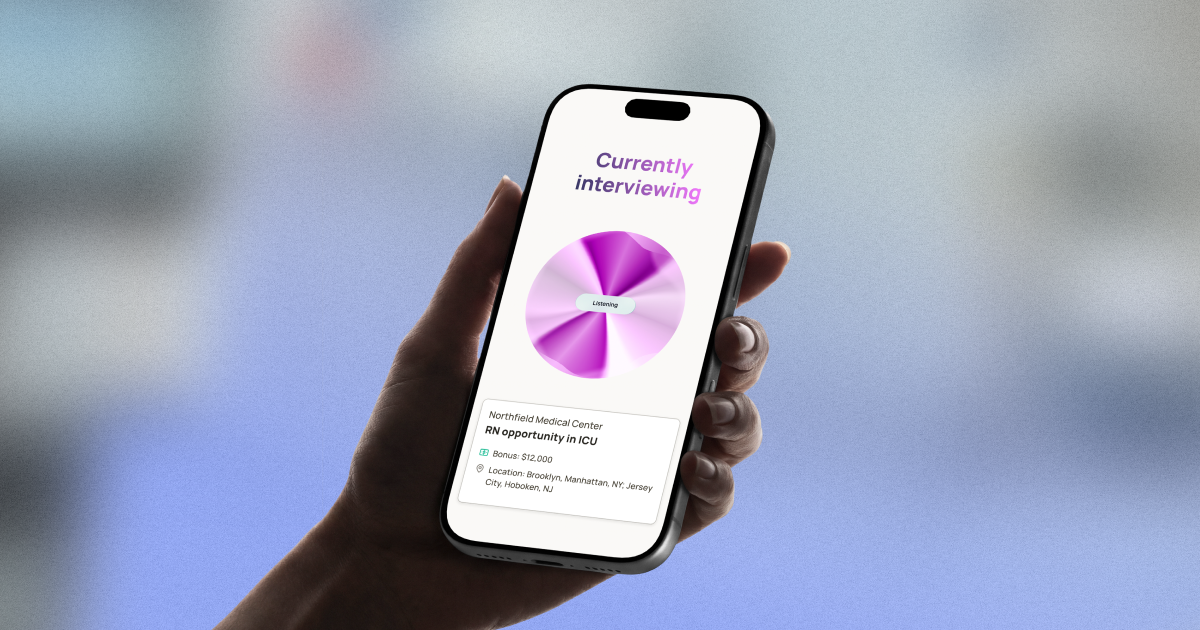
The screen captures where nurse recruiting is heading: the first conversation for a high-demand ICU role, including the sign-on bonus pitch, now happens with an AI agent on the candidate's phone, at whatever time suits the nurse. For employers, the practical effect is that every applicant gets screened rather than the share a recruiter has time to call, which is where most of the claimed time savings come from.
Incredible Health publishes no price. The American Hospital Association described the model in 2022 as charging hospitals to use the platform while keeping it free for nurses - AHA. The most recent public figure we found is from Harris Health, Houston's public hospital district, whose board ratified a renewal of the Incredible Health platform and services to recruit permanent RNs and nurse practitioners for March 2024 to March 2025 at an estimated $350,000, the same as the previous term - Harris Health board agenda. Measured against NSI's $66,081 annual travel premium, that equals the premium on about five travel nurses for a year.
The limits are clear. It is built for permanent nurses and nurse practitioners, not for CNAs, technicians or physicians. Its supply varies by region and specialty, so ask for counts of active, matching nurses in your market before signing. And the time-to-hire figures come from its best customers, so set your own baseline first and measure the change.
Best for: hospitals and health systems hiring permanent RNs and nurse practitioners in competitive specialties, especially those trying to convert travel spend into staff hires.
4.8 Doximity (Talent Finder and Hiring Solutions)
Doximity is the professional network that US physicians actually use, and its hiring product is the most direct way to reach physicians who are not looking at job boards. Its fiscal 2026 annual report counts over 3 million registered members, including more than 85% of US physicians, two-thirds of nurse practitioners and physician assistants and about 90% of graduating medical students - Doximity 10-K. Its Hiring Solutions let health systems and recruiting firms post jobs and send a fixed number of direct messages each month, sold as noncancelable subscriptions that generally run 12 months.
Doximity's own pitch for Talent Finder adds that 84% of physicians on the network are open to new opportunities, a vendor statistic but a plausible one given how physicians use the network for news and messaging - Doximity Talent Finder. The company does not break out Hiring Solutions revenue, and most of its business is pharmaceutical marketing, so its slowing company-wide net revenue retention, down from 119% in March 2025 to 107% in June 2026, tells you little about the recruiting product itself - Doximity 10-Q.
Federal purchase records give an unusually clear view of what physician recruiting tools cost. The Indian Health Service's Phoenix area paid Doximity $47,000 a year from 2021 under a contract for a physician-only job board and recruiter access (the record does not name the product), rising to $51,800 in the option years exercised in August 2024 and May 2025, an increase of about 10% - USAspending. The table puts that next to the alternatives on the public record:
| Tool | Buyer or source | Year | Cost |
|---|---|---|---|
| Doximity | Indian Health Service, Phoenix area | 2025 | $51,800 a year |
| PracticeLink | VA Network Contracting Office 23 | 2024 | $50,995 a year |
| PracticeMatch | Indian Health Service headquarters | 2024 | $144,190 a year |
| NEJM CareerCenter | List price | 2026 | $775 to $1,025 per job |
The PracticeLink figure is a three-year physician recruiting subscription for a VA region at the same price each year - USAspending, and the PracticeMatch figure is a membership bought by the Indian Health Service's headquarters acquisitions division and renewed annually through April 2025 - USAspending. The NEJM CareerCenter sells 30-day physician job postings at $775, $865 and $1,025, with three, five and seven candidate profile downloads respectively - NEJM CareerCenter. Together they suggest that a regional physician recruiting subscription costs around $50,000 a year in the public sector, with posting-only options far cheaper for low volume.
The limits are scope and messaging caps. Doximity reaches physicians and advanced practice providers, not nurses or allied health. Subscriptions include a fixed message allowance, so a team with many open specialties can run out, and the 10% renewal step in the federal record is a reminder to negotiate a cap.
Best for: physician and advanced practice recruiting at health systems, medical groups and physician search firms that need direct access to practicing physicians.
4.9 Bullhorn (for healthcare staffing agencies)
Bullhorn is the operating system of the staffing industry, and in healthcare it runs the recruiting, credentialing, scheduling and pay workflows of most large travel nurse, per diem, allied and locum tenens agencies. Its healthcare page says it is trusted by 22 of the top 25 healthcare staffing agencies, and it lists dedicated workflows for travel nursing, locum tenens, allied health and per diem, plus credentialing, shift scheduling, a time and pay engine that handles shift differentials and guaranteed hours, and a mobile portal for clinicians - Bullhorn. For an agency, the difference from a hospital ATS is that the candidate is placed repeatedly, credentialed for many facilities and paid weekly.
The 2026 change is Amplify Digital Workers, AI agents that run recruiting tasks inside Bullhorn. At its Engage conference on May 28, 2026, Bullhorn added four new skills (Prospect, Verify, Audit and Transcribe) to existing ones that enrich records, match candidates, screen by chat or voice, run outreach and present candidates to clients, and reported that early adopters increased placements per recruiter by 39% even as orders fell 20% - Bullhorn. Those early adopters are general staffing firms rather than healthcare specialists, so healthcare agencies should ask for clinical references.
Bullhorn is one of the few vendors here that publishes a price, though only for its entry tiers:
| Plan | Price | What it adds |
|---|---|---|
| Starter | $99 per user per month | ATS, resume parsing, client management, job posting |
| Core | $165 per user per month | App marketplace, custom fields and workflows, LinkedIn integrations |
| Pro | Quote only | Recruitment CRM, AI search and match, Amplify Chat |
| Max | Quote only | Amplify Digital Workers, agentic screening and outreach |
Those prices come from Bullhorn's own pricing page, last updated October 13, 2026 - Bullhorn pricing. A ten-recruiter agency on Core would pay $19,800 a year at list price, but that buys the ATS rather than the full healthcare stack: the CRM, AI search and digital workers sit in the quote-only Pro and Max tiers, and healthcare modules such as credentialing and pay do not appear in the published tiers at all. Our Bullhorn pricing guide walks through the add-on stack.
Two alternatives are worth knowing. LaborEdge is built only for healthcare staffing, with an ATS, vendor management, compliance and credentialing, and a candidate portal; it publishes no price - LaborEdge. Ceipal, which serves healthcare staffing alongside IT staffing, used to publish $24 per user per month with a five-user minimum, but its pricing page now redirects to its homepage, so treat that 2024 figure as history - Wayback Machine.
Best for: travel, per diem, allied and locum tenens agencies with ten or more recruiters that need credentialing, scheduling and pay in the same system as recruiting.
4.10 HeroHunt.ai
HeroHunt.ai is the AI sourcing option on this list: an AI Recruiter that finds and contacts the clinicians and healthcare professionals who are not applying to anything. Every other tool above works mainly with inbound applicants or with a network that candidates opt into. HeroHunt.ai works outbound: a recruiter describes the role once, for example "nurse practitioner, cardiology, three or more years of experience, licensed in Texas, open to Houston", and the AI Recruiter searches across more than a billion profiles, screens each one against that brief with a written explanation, finds contact details and sends personalised outreach for the candidates the recruiter approves.
In healthcare, that approach fits a specific set of roles: nurse practitioners, CRNAs, specialty and leadership nurses, allied health leaders, physicians who keep professional profiles, and the large non-clinical workforce in revenue cycle, health IT, clinical informatics and administration. These are the people most likely to have a detailed professional profile and least likely to be scrolling job boards. Plans start at $99 a month with unlimited positions and searches, metered on AI-screened profiles delivered and candidate emails found, with 2,000 AI-screened profiles a month on the entry plan and an 8-day free trial that requires a card - HeroHunt.ai plans.
The limits need to be explicit in a healthcare context. HeroHunt.ai does not verify licenses, so every candidate still needs a primary-source check through a board of nursing or Nursys before an offer. It is not an applicant tracking system and does not screen inbound applicants. And it can only find people who have a professional profile, which makes it strong for specialists and leaders and weak for CNAs, aides and many bedside staff nurses who keep thin profiles or none.
HeroHunt.ai
If your hardest healthcare roles are the ones nobody applies to, such as nurse practitioners, CRNAs, specialty nurse leaders or clinical informatics staff, an ATS or a marketplace can only wait for them. HeroHunt.ai's AI Recruiter goes looking: describe the role once with specialty, certifications, state license and location, and it screens each profile against that brief with a written reason, then finds emails and sends personalised outreach for the candidates you approve. Plans start at $99 a month with unlimited positions and searches after an 8-day free trial (card required). The honest caveat: it does not verify licenses or credentials, it is not an ATS, and it reaches people with professional profiles, so it is strongest for specialists and leaders and weakest for CNAs and frontline staff.
Best for: recruiters and talent teams filling advanced practice, specialty, leadership and non-clinical healthcare roles where the right candidates are not applying.
4.11 Five More Worth Knowing
Several strong products missed the ten because they overlap with a tool already listed, serve a narrower slice of healthcare hiring, or lack the price evidence this guide requires. None of them is weak, and for the right buyer some are the better choice, so they are summarised here with what makes each distinct and what it costs where that is known.
Vivian Health is the main alternative to Incredible Health, with a broader focus that includes travel, staff and per diem jobs; its homepage says more than 3 million clinicians have joined, and it is a subsidiary of People Inc. (NASDAQ: PPLI) - Vivian Health. It publishes no employer price. LinkedIn Recruiter remains the default professional search tool; the VA's national acquisition center paid $400,560 in March 2026 for a year of LinkedIn Recruiter Corporate, job slots and Talent Insights licenses, without disclosing the seat count - USAspending. Our LinkedIn recruiting pricing guide breaks down the seat ladder.
HireVue is the video interviewing and assessment platform that large employers, including health systems, use for structured early interviews; Vendr's median is $20,900 a year, but on only three purchases and last updated in April 2025 - Vendr. Carefam, a New York startup, raised $14.5 million in March 2026 for AI agents that handle candidate outreach, credential screening, interview scheduling and onboarding for hospitals, long-term care and home care, and says demand grew 900% in a year - Skilled Nursing News. It publishes no price.
Finally, Indeed is not recruiting software in the sense used here, but it is where volume comes from: Indeed says more than 1.5 million US registered nurses are active job seekers on its platform - Indeed. Most of the systems above post to it automatically, so job board spend belongs in the same budget conversation as software. The practical lesson from this list is that most healthcare employers end up with one system of record plus two or three specialist channels, so it pays to know the specialists even if you never buy them.
5. Side-by-Side: Price, Pricing Unit and Best Fit
The fastest way to compare these tools is by the unit they bill on, because the unit decides how your cost moves as you grow. A per-employee price rises with every hire your organisation makes, a per-user price rises only when you add recruiters, a flat subscription stays fixed until renewal, and a per-posting price scales with how many roles you advertise. Two quotes with the same first-year total can diverge sharply over a five-year contract if they meter on different things.
The table summarises all ten tools with the best price evidence available in October 2026. "List" means the vendor's own published price, "record" means what a named public buyer actually paid, and "buyer data" means negotiated contracts aggregated by Vendr or SpendHound, with small samples flagged. Use it to build a shortlist, then read the detailed entry above for the caveats behind each number.
| Tool | Best for | Pricing unit | Price evidence |
|---|---|---|---|
| Workday Recruiting | Health systems on Workday HCM | Per employee per year, bundled with HCM | List (UK): £136.47 per employee for HCM plus Recruiting and Expenses at 10,001 to 25,000 employees |
| iCIMS | Health systems not on Workday | Headcount and modules | Buyer data: $517,983 a year average above 1,000 employees |
| symplr Recruiting | Hospitals wanting a healthcare-native ATS | Annual subscription, quote only | No public Recruiting price; symplr credentialing: $257,875 a year (VA, 2026) |
| Phenom | Candidate experience at large systems | Employee count | Buyer data: $98,313 median (only four purchases) |
| Paradox | High-volume hourly clinical roles | Subscription; its owner sells AI on credits | Buyer data too thin to use (two purchases) |
| Apploi | Post-acute and senior living | Quote only | None published or on record |
| Incredible Health | Permanent RNs and NPs | Annual platform subscription | Record: $350,000 a year (Harris Health, 2024) |
| Doximity | Physicians and APPs | Annual subscription with message caps | Record: $51,800 a year (Indian Health Service, 2025) |
| Bullhorn | Healthcare staffing agencies | Per user per month | List: $99 and $165 per user per month; AI tiers quote only |
| HeroHunt.ai | Passive specialists and leaders | Monthly plan, metered on screened profiles | List: from $99 a month, unlimited positions |
The table makes one pattern obvious: the more a tool is built for large enterprises, the less it publishes, and the more its price depends on your total headcount rather than your hiring volume. The products here that do publish prices (Bullhorn, HeroHunt.ai and, among the alternatives, NEJM CareerCenter) are seat-based, plan-based or per-posting. That is not a coincidence. Per-employee pricing only works when each deal is negotiated, which is why buyers of enterprise systems benefit most from the public records in the next section.
6. What Healthcare Recruiting Software Really Costs
The real cost of healthcare recruiting software is set by three things the sticker price hides: the metering unit, the one-time costs in year one, and the renewal escalator. The headline annual fee is usually the smallest of the decisions you are making, because a five-year total cost of ownership is dominated by how the bill grows.
Public records are the best tool for seeing those mechanics, because they show the same buyer paying the same vendor year after year.
The chart below collects the annual costs from this guide that come from a named public buyer, buyer data or a published list price, so you can see the order of magnitude of each category. The units differ, which is the point: a nurse marketplace subscription, a credentialing contract and ten recruiter seats are all "recruiting software", and they sit an order of magnitude apart.
Annual Cost of Healthcare Recruiting Tools on the Record (USD)
Two conclusions follow. First, clinical recruiting channels such as nurse marketplaces can cost as much as enterprise software, which suggests they are priced on the value of the hires they produce rather than on the software itself. Second, even the smaller line items are large relative to what most recruiting teams control, so the budget conversation usually happens with finance and nursing leadership, not inside talent acquisition.
And for scale, SpendHound's average iCIMS contract above 1,000 employees, about $518,000, would sit off the top of this chart.
The hidden costs show up most clearly in the federal records, which list each year's payment separately. These are the five that recur across vendors:
- Year-one premiums: the VA paid symplr $30,000 more in the first year than in later years, consistent with implementation and training
- Renewal escalators: the Indian Health Service's Doximity subscription rose about 10% at its third option year
- Headcount commitments: Workday's rate card bills the entire employee population for a three-year term
- Separately priced modules: Bullhorn's AI tiers and healthcare modules sit outside its published seat prices
- AI consumption: Workday Flex Credits and similar models have no published per-unit price
What these have in common is that none appear on a first-year quote unless you ask. A health system that budgets only the annual subscription will understate a five-year cost by the implementation premium plus compounding escalators plus any headcount growth, and on a per-employee contract a successful hiring year raises the bill even if the recruiting team stays the same size. How to apply this: ask every vendor for a five-year schedule that separates one-time from recurring fees, cap annual increases at a fixed percentage, and price any AI component in units you can forecast.
The return side of the equation is unusually concrete in healthcare, which makes these costs easier to defend than in most industries. NSI estimates that each bedside RN who leaves costs a hospital $60,090, and that a travel nurse costs $66,081 more a year than a staff nurse.
Measured that way, Harris Health's $350,000 marketplace subscription pays for itself if it replaces about five travelers for a year, and a $51,800 physician recruiting subscription costs about the same as a single agency placement: at the 20% to 30% of first-year salary that published agency rate cards commonly charge, placing a clinician on $200,000 to $250,000 costs $40,000 to $75,000 - Recruitment agency fees 2026.
The discipline is to measure that return in your own data: baseline your time to fill, travel hours and cost per hire before the contract starts, and review them quarterly.
Negotiation is where public data pays off directly. Vendr reports that Workday buyers saved 15% on average against initial quotes, and procurement teams that bring a dated public record to the table, such as the Harris Health or Indian Health Service figures above, change the conversation from "what is your price" to "why is ours different".
For a broader view of how recruiting vendors meter their products, see our recruiting software pricing index, which compares 40 tools by pricing unit.
7. Where Healthcare Recruiting Software Fails
Healthcare recruiting software fails most often in five places: credential verification, reach into the frontline workforce, integration between systems, the legal exposure of AI decisions, and vendor claims that do not survive contact with your own data. None of these is a reason not to buy, but each is a reason to test specific things before you sign.
The most serious gap is credentials. Software can capture a license number, track an expiry date and send alerts, as the Apploi screen below shows, but tracking is not verification. Before an offer, every license still needs a primary-source check against the issuing board, and for nurses that is free: NCSBN describes Nursys QuickConfirm as a free service that lets employers retrieve licensure and any discipline records in one place - NCSBN. With 43 jurisdictions now in the Nurse Licensure Compact, a multistate license changes who you can hire across state lines, and your software needs to record the license type, not just the number - Nurse Licensure Compact.

The screenshot shows the right design: expired and soon-to-expire licenses surface automatically, and verification is an explicit step in the pipeline rather than something done from memory after the offer. When you evaluate any tool in this guide, ask to see exactly this view, and ask whether the verification step connects to Nursys or a credentialing vendor or simply records that a human checked. The failure mode is a system that looks compliant because a field is filled in, while the actual check never happened.
The second failure is reach. LinkedIn-style sourcing and professional networks cover physicians, advanced practice clinicians, nurse leaders and non-clinical staff well, but many CNAs, aides and bedside nurses keep thin professional profiles or none, and they respond to texts rather than email. A stack built only on sourcing tools will miss most of the frontline workforce, and a stack built only on job boards will miss most of the specialists. The fix is to match the channel to the role: text-based automation for volume roles, marketplaces for specialty nurses, networks and AI sourcing for physicians and leaders.
The third failure is integration. Large health systems often run recruiting on the same legacy suite as payroll and finance, and replacing it is a multi-year project. Harris Health, for example, renewed maintenance for its entire Oracle PeopleSoft suite, which includes eRecruitment alongside payroll, HR and purchasing, at $1,382,899 for March 2025 to February 2026 - Harris Health. When recruiting sits inside a system like that, a new tool must integrate rather than replace, and every integration is a place where candidate data, credential status or offer details can fall out of sync. Ask vendors for named healthcare customers running the same HR core as you.
The fourth failure is legal exposure from AI. California's regulations on automated decision systems in employment took effect on October 1, 2025 and require employers to keep automated-decision data for four years - Mayer Brown. Colorado's replacement AI law, signed in May 2026 and due to take effect on January 1, 2027, requires notice before automated technology materially influences a decision and a route to human review afterwards - Holland & Knight. Nurse unions are also writing AI into contracts: the agreements that ended New York City's 41-day nurse strike in 2026 included safeguards on how hospitals use artificial intelligence - NYSNA. How to apply this: tell candidates when AI is involved, keep a human able to review any rejection, and keep screening records for at least four years. None of this is legal advice.
The last failure is vendor claims. Every result quoted in this guide, from Franciscan Health's $73 million to Johns Hopkins' 21-day hires, is published by the vendor or its customer, usually from the best implementation. They are real, but they are not your baseline. Before signing, measure your own time to fill, cost per hire and travel conversion for at least one quarter, agree with the vendor on which of those numbers the pilot should move, and ask for two references with a similar size and care setting to yours.
8. How AI Agents Are Changing Clinical Hiring
AI in healthcare recruiting has moved from features that help a recruiter to agents that do a recruiter's tasks: interviewing candidates by phone, scheduling by text, sourcing passive clinicians and processing credentials. In 2024 the typical AI feature summarised a resume. In 2026 Incredible Health's Lyn runs a full phone interview, Paradox schedules thousands of interviews without a human, Bullhorn's digital workers screen and present candidates to clients, and iCIMS ships a sourcing agent with a hiring agent close behind.
The reason this happened in 2025 and 2026 rather than earlier is that healthcare combines the two conditions agents need: enormous volume of similar, rules-based steps, and a measurable cost of delay. A health system that receives tens of thousands of applications a year for aides, technicians and nurses cannot call every applicant within an hour, but an agent can, and NSI's travel premium puts a dollar value on every day the vacancy stays open. The agents fall into four groups, and each one changes a different part of the funnel:
- Voice interview agents: Incredible Health's Lyn screens every applicant by phone, around the clock
- Conversational schedulers: Paradox and iCIMS's Apli handle eligibility questions and booking by text
- Sourcing agents: iCIMS's Sourcing Agent and AI Recruiters such as HeroHunt.ai find and message passive candidates
- Staffing digital workers: Bullhorn's Amplify and LaborEdge's AI integrations process agency workflows
The common effect is that the first contact with a candidate is increasingly automated, fast and available at any hour, which is exactly what a nurse finishing a night shift needs. Screening that used to reach only the applicants a recruiter had time to call now reaches all of them, and scheduling that used to take days happens in minutes. For a hospital competing with travel agencies and other systems for the same nurse, that change in response time is often worth more than any improvement in matching quality, because the first credible offer usually wins.
The common risk is that agents amplify whatever they are given. A precise brief ("CCRN, three years of ICU, compact license, nights") produces a short list worth calling, while a vague one produces a flood of poorly matched outreach in the employer's name. The best-run teams treat agents like new recruiters: they give them clear criteria, review their output and widen their scope only as quality is proven.
That changes the recruiter's job rather than eliminating it. The work moves upstream to writing precise briefs, setting knockout criteria that are clinically and legally defensible, and deciding where the hand-off to a human should happen. It also moves downstream to the conversations agents cannot have well: walking a nurse through a unit's staffing model, negotiating a schedule and closing an offer. Recruiters who own those two ends become more valuable as the middle is automated.
The other side of the market is automating too. With 39% of nurses already using AI in their own job search and 60% of nurses under 28, candidate-side AI drafts applications, compares offers and answers screening questions. Recruiting is becoming two-sided automation, where an employer's agent often talks to a candidate's tools. That raises the value of the things AI cannot fake: a credible schedule, safe staffing ratios, a real manager conversation and a fast, clear offer.
New companies are building on this shift. Carefam's $14.5 million round in March 2026 is aimed squarely at AI agents for outreach, credential screening, scheduling and onboarding in hospitals, long-term care and home care, and the large platforms are adding agents through acquisition as much as development.
Expect consolidation to continue, and expect pricing to move from seats and subscriptions toward consumption, as Workday's Flex Credits already show.
Looking ahead to 2027, three developments are worth planning for. First, agents will connect more directly to license and credential data, so that a candidate's license status is checked during the first conversation rather than after the offer. Second, disclosure will become standard practice, because California's rules are already in force, Colorado's take effect in January 2027 and union contracts in New York already address AI, and Incredible Health's Lyn already introduces itself as an AI on every call.
Third, the competitive advantage will shift from having AI to configuring it well: the employers who win nurses will be the ones whose agents ask the right questions and hand off to a human at the right moment. Our guide to autonomous AI recruiters compares the leading platforms across industries, and our review of AI candidate screening software covers the screening layer in depth.
9. How to Choose: A Decision Framework by Buyer Type
Choose healthcare recruiting software by starting from your bottleneck and your existing systems, not from a feature list. The bottleneck tells you which of the five jobs from section 1 to buy for first: a slow first response points to candidate automation, an empty pipeline for specialists points to networks and sourcing, and messy compliance points to the system of record.
Your existing HR core decides which systems of record are realistic at all. A health system on Workday is not really choosing an ATS, and an operator on PointClickCare has a natural candidate for frontline hiring. Most of the bad purchases in this market come from skipping one of those two steps, usually by falling for a demo of a module that solves a problem the buyer does not have.
For a large health system on Workday, the default is Workday Recruiting with Paradox for volume roles, plus a specialist channel such as Incredible Health for hard-to-fill nursing specialties and Doximity for physicians. Spend your evaluation energy on the AI configuration and on the credits model rather than on the ATS itself, which is effectively decided.
For a large health system on another HR core, run a structured comparison of iCIMS and symplr Recruiting, and add Phenom on top of your existing ATS if candidate drop-off is your main problem.
Insist on references from systems of similar size running the same HR core, and price the CRM, text engagement and AI agents as separate lines from the start.
For post-acute, senior living and home health operators, the decision is usually between a healthcare-specific frontline ATS such as Apploi and a conversational AI layer on the system you already use. The deciding factor is credential tracking across many facilities, because a missed CNA certification is a survey finding, not just an HR error.
For healthcare staffing agencies, Bullhorn is the benchmark and LaborEdge the healthcare-only alternative. The deciding factors are credentialing depth, pay and bill, and how much of the AI tier you actually need, since the published seat price covers only the base ATS.
For physician and advanced practice recruiting, combine a network such as Doximity or PracticeLink with postings on specialty boards like NEJM CareerCenter, and add AI sourcing for the specialties where the network alone does not produce enough responses.
For a small clinic or practice hiring a handful of roles a year, skip enterprise software entirely: a low-cost ATS, targeted job board postings and direct outreach to specialists will cover the need.
Whatever the buyer type, a 90-day pilot should answer the same few questions:
- Time to fill: did it fall for the roles in scope, measured against your own baseline?
- Travel conversion: how many travel or agency shifts did new permanent hires replace?
- Recruiter capacity: how many more requisitions can each recruiter carry?
- Candidate experience: what share of applicants completed screening and scheduling?
- Data quality: are licenses, certifications and offer details accurate in the system of record?
If a vendor cannot agree to measure at least three of these during a pilot, treat that as a signal about how the full contract will go. Run the pilot on a defined set of roles and facilities, keep a comparison group where you can, and decide in advance what result would justify a full rollout, so the decision is made on evidence rather than on enthusiasm after a good demo. A pilot that touches only one facility or one role family is fine, as long as the result is measured the same way you will measure the full rollout.
The best negotiating position you will ever have is the end of a pilot with your own data in hand and a dated public record of what other buyers paid. Use both: your pilot results to argue for value-based terms, and the public records in this guide to challenge any quote that sits far above what comparable organisations have paid.
10. The Bottom Line
There is no single best healthcare recruiting software in 2026; there is a best tool for each kind of hiring, and the winning stacks combine a system of record with one or two specialist channels. Health systems on Workday should default to Workday Recruiting with Paradox. Systems on other HR cores should compare iCIMS and symplr Recruiting, with Phenom as the candidate-experience layer if drop-off is the problem. Post-acute operators should look at Apploi, nurse-heavy hospitals at Incredible Health, physician recruiters at Doximity and its peers, and staffing agencies at Bullhorn.
Price transparency remains the biggest weakness of this market. Only a few of these vendors publish anything, and the most useful numbers come from public buyers: $350,000 a year for a nurse marketplace at a Houston hospital district, $51,800 a year for a federal physician recruiting subscription, a per-employee rate card that Workday only publishes in Britain. Use those records to anchor negotiations, ask for five-year schedules that separate one-time and recurring costs, and cap renewal increases in writing.
The specialists nobody can find through applications are where AI sourcing earns its place. For nurse practitioners, CRNAs, specialty nurse leaders and non-clinical healthcare roles, HeroHunt.ai searches professional profiles, screens them against your brief and runs the outreach, while your ATS, marketplace and credentialing process handle everything after the first reply.
The simplest decision framework is this: fix the speed of your first response, convert travel spend into permanent hires, and put specialist channels to work on the roles that do not apply. The software in this guide can make each of those faster, but in healthcare the hire still depends on the schedule, the staffing ratio and the person on the other end of the call.
This guide reflects healthcare recruiting software products, prices and public purchase records as of October 2026. Vendor pricing, packaging and ownership change frequently in this market, so verify current details and quotes directly with each vendor before purchasing.