



Disclosure: some links in this article are affiliate links. If you sign up through one, HeroHunt may earn a commission at no extra cost to you.
What is sourcing?
Sourcing in recruitment is the process of finding and attracting the right candidates based on a given set of job criteria.
The word that does the work in that sentence is proactive. Sourcing is what you do when the person you need is never going to answer your job ad, because they already have a job and are not reading job ads. Posting a vacancy and waiting is not sourcing. Going out to find that person, and giving them a reason to reply, is.
What is the difference between sourcing and recruitment?
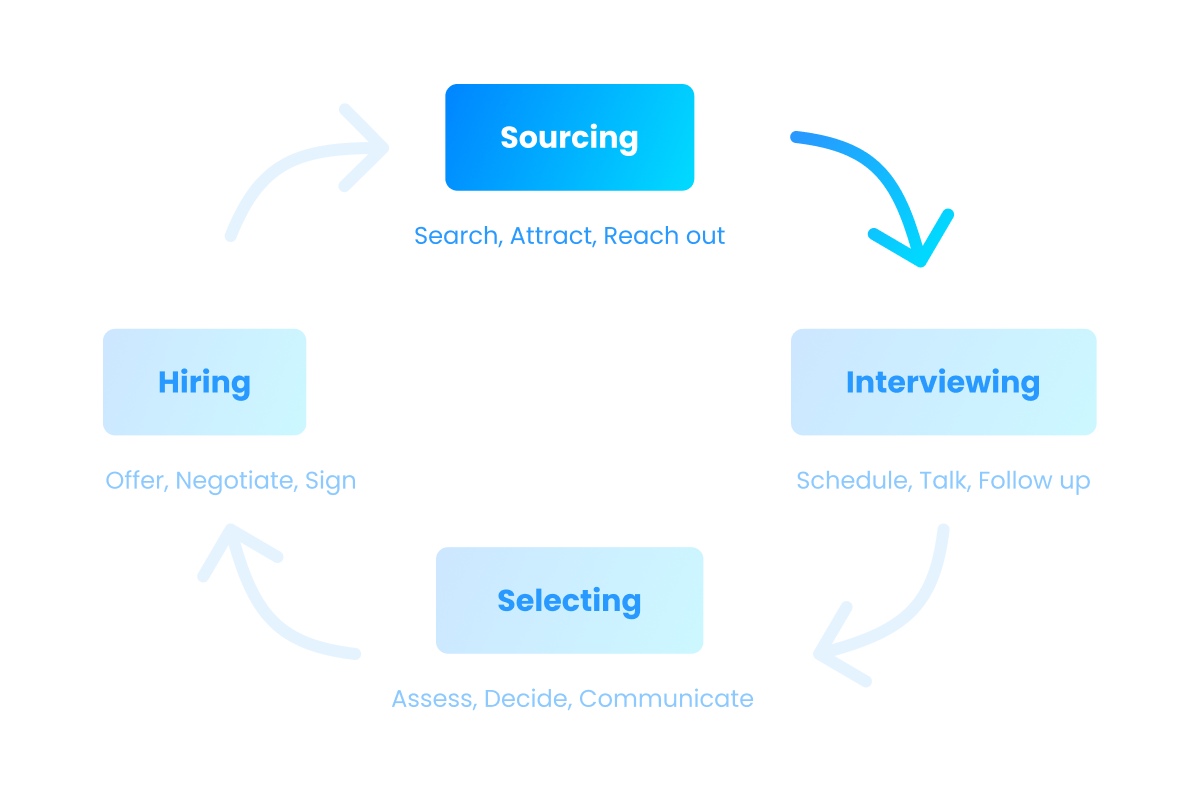
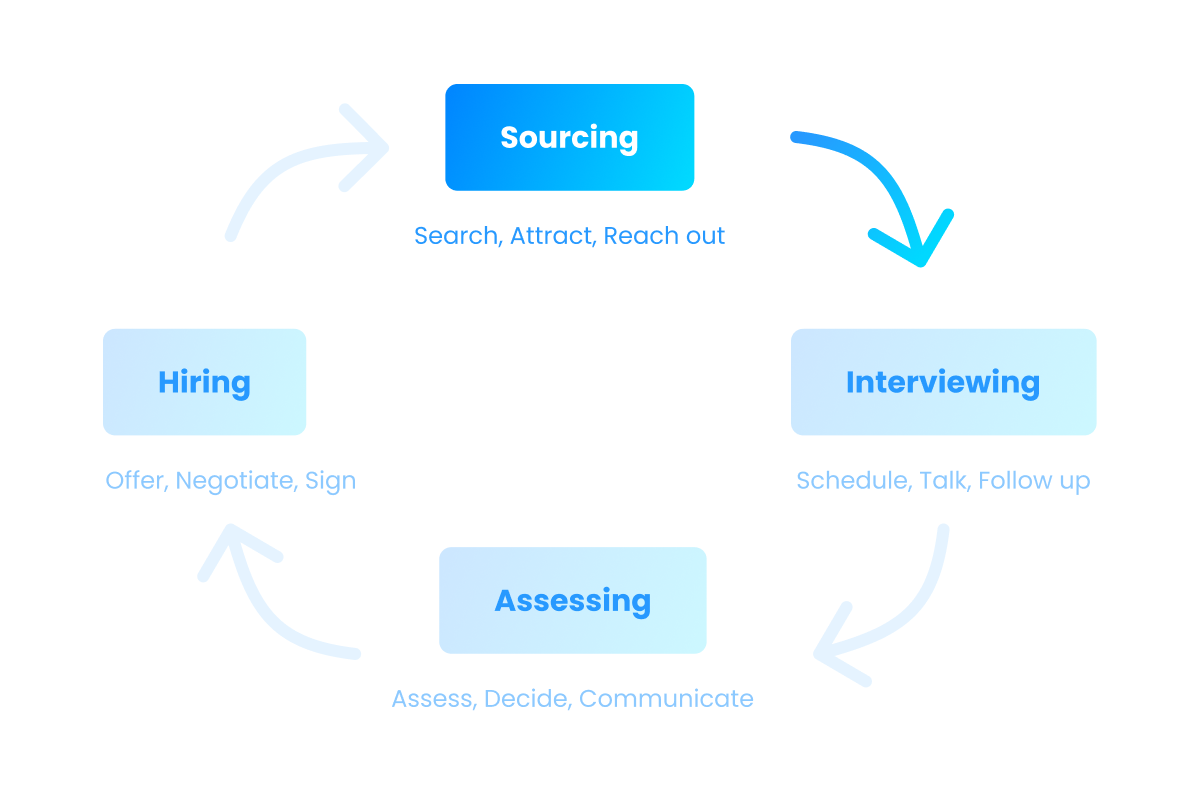
Recruitment can be seen as the full cycle of finding, reaching, interviewing and hiring candidates.
Sourcing is part of that process, but it’s focussing on the finding part.
Sourcing can also refer to a department or role within an organization which is responsible for proactively finding the right candidates, attracting them and sometimes also doing initial outreach to candidates.
Here's an overview of the full recruitment cycle.
How does talent sourcing work?
The accessibility to talent data has been increasing in the last decades because of the widespread adoption of the internet and the rise of professional social networks.
The world wide web contains billions of profiles of people and their activity online. LinkedIn on its own reports more than 1.3 billion members, and it is one network among many.
Out of all of these profiles the talent sourcer's work is to find the right profiles based on a set of job criteria she or he received.
The talent sourcers translate the set of sometimes very high level job criteria to a search.
The search usually consists of 1) a selection of platforms where the talent sourcer chooses to search and attract talent on and 2) the search criteria the talent sourcer chooses to include.
Selection of platforms
Most recruiters still rely for a big part on LinkedIn.
But in many industries like tech, recruiters cannot always find enough qualified candidates using LinkedIn only because a lot of people are not active on LinkedIn and because competition for talent on LinkedIn is fierce.
A lot of tech sourcers choose to work with a variety of platforms to find the right candidates.
Examples are GitHub for software engineers, Kaggle for data scientists and Wellfound (the job marketplace formerly known as AngelList Talent) for startup minded talent.
The trade-off is always the same. The further you move away from LinkedIn, the less competition you face for that candidate, and the more work it takes to identify them and reach them. A GitHub profile can tell you more about an engineer than any LinkedIn headline will, but it may not tell you their full name, their current employer or how to email them.
Search criteria
The search criteria determine which results get returned by the platform the sourcer is using.
Most people in the recruiting world are familiar with the search filters that LinkedIn provides like job title, location and keywords.
But there are many other ways to search for talent like:
- X-raying: using search engines like Google to find candidate profiles
- PSE sourcing method: customizable Google search engine that users can build themselves and adjust based on search features like pre-set websites to search in, synonyms, default keywords and languages
- Sourcing tools: these sourcing tools aggregate data from different sources and present matching profiles based on the job criteria (our own tool, HeroHunt.ai, is one of them)
In these searches Boolean operators and more advanced search operators are key to include in your search to get targeted results (here’s a guide on search operators).
One honest note on X-raying, because a lot of sourcing advice online oversells it: you only ever reach the profiles a search engine is allowed to see. LinkedIn lets every member decide which sections of their public profile are visible to people who are not signed in, and switch public visibility off entirely. Whoever has done that is invisible to Google, no matter how good your search string is. Treat X-ray as a way to find people you would otherwise miss, not as a free replacement for a recruiter seat.
Getting the contact details
This is the step that beginners underestimate, and it is the direct cost of sourcing outside LinkedIn.
Inside LinkedIn you have a messaging system, so finding the profile and reaching the person are effectively the same action. Everywhere else they are two different problems. Once you X-ray your way to a profile, or find an engineer through their commits, you have a person and no way to talk to them.
Sourcers close that gap in three ways. The cheapest is the platform itself: plenty of developers publish an email in their GitHub profile or in their commit history, and plenty of researchers put one in a paper. The second is a contact database such as Apollo.io, Lusha or ContactOut, which look up a work email or a phone number from a name and a company. The third is guessing the pattern (firstname.lastname@company.com) and verifying it before you send, which costs nothing and works more often than you would expect. We go deeper on this in the guide on finding candidate email addresses.
Whichever route you take, verify before you send. Contact data decays constantly as people change jobs, and a bounced first email is a wasted first impression as well as a hit to your sending reputation.
Apollo.io
If you are learning sourcing outside LinkedIn, the contact lookup is the part you will want to try before you pay for anything. Apollo.io has a genuinely free tier for exactly that: 900 credits per seat per year, released monthly (that is the general credit pool, and email credits are metered separately). Paid starts at $49 per seat per month billed annually ($65 month to month). The honest caveat: Apollo is a B2B sales database, built around people's current employer and work email. It is strong for an engineer at a named company and weak for freelancers, students and people at stealth startups, and it tells you nothing about whether someone is open to a move. It is a contact layer, not a candidate database, so it does not replace your sourcing platform.
What AI actually changed
Less than the headlines suggest, and not evenly.
AI tools now do the parts of sourcing that are pattern matching: turning a job description into a search, reading a profile and rating it against criteria, drafting a first outreach message, and keeping a shortlist warm. That removes a lot of the mechanical work the sections above describe, which is why the sourcer's job is drifting away from typing Boolean strings and towards deciding what "qualified" means and writing messages people answer.
The adoption data is more sober than the marketing. In iCIMS and Aptitude Research's April 2026 report, 69% of companies said they use AI somewhere in talent acquisition, but only 18% said they use it broadly across hiring, and sourcing was the least adopted use case of the four measured, at 46%. Screening and candidate communication are further along. So if you are new to sourcing, the craft in this article is not obsolete: most teams still do it largely by hand, and knowing what a good search looks like is what lets you tell whether a tool's shortlist is any good. Here is a practical walkthrough of using AI in talent sourcing.
HeroHunt.ai
The "sourcing tools" bullet above is the category this section is describing, and it is what we build. HeroHunt.ai runs the loop this article splits into steps: it searches across LinkedIn and the wider web rather than one network, screens each profile against your criteria instead of returning everyone who matches a keyword, and drafts the first message. The honest caveat is the number in the paragraph above. Sourcing is the least adopted AI use case in talent acquisition at 46%, and there is a reason: an AI shortlist is only as good as your definition of "qualified", so you still have to read the results and correct the brief. It is also not an applicant tracking system, so it finds and contacts people, and something else still has to run interviews and offers.
How is talent sourcing organized?
In some organizations there is a dedicated sourcing team that focuses on finding the right candidates and handing over matching candidates to recruiters who pick up (further) interaction with the candidates.
In some cases the role of the sourcer is even more specialized and they are specifically responsible for building pools of candidate profiles without interacting with the candidate.
In other cases the sourcer is responsible for finding the candidates and doing initial outreach.
In the latter case when the candidate shows interest the candidate is usually referred to a recruiter who does the interviews and manages the rest of the process.
Sometimes the perception is that the position of sourcer is a junior role but that doesn’t have to be the case. Many sourcers are highly experienced professionals with deep technical knowledge and skills.